



Abstract
The aim of this study was to examine the extent to which Katara Cultural Village enhances the image of Qatar, based on reviewers’ posts on TripAdvisor. It also sought to analyze the current situation of Katara from the managers’ perspective. A total of 2,342 comments about Katara on the TripAdvisor website were analyzed using content analysis. Three focus group meetings with eight divisional managers in Katara were also conducted and analyzed using thematic analysis. The results show a high level of overall satisfaction among TripAdvisor reviewers from different nationalities and backgrounds. A word frequency count presents Katara positively as a good destination for cultural experience, with amazing and attractive features. According to the comments, Katara contributes to enhancing the image of Qatar and Qatari culture worldwide. The Strengths, Weaknesses, Opportunities, and Threats (SWOT) analysis based on the focus group meetings with managers provided a clear and in-depth understanding of Katara’s current strengths, weaknesses, opportunities, and threats. This analysis can be important to planners and policy makers in Katara in developing and adopting suitable policies and strategies.
Introduction
The subject of place branding is indeed a complex subject, with different trends representing the various aspects that bring about this complexity. One of these steadily growing trends is Culture and Entertainment Branding, which focuses on the effects on the physical, economic and (sometimes) social environment of cities and countries. This cultural branding owes its development to the growing importance of the culture, leisure and entertainment industries within the contemporary economy, as much for tourists and other visitors, as for the local population (Kavaratzis, 2005). The role of any tourist destination in branding its own city or country depends on the perceived image of that destination among both previous visitors and potential visitors in future.
The image of countries and their attractive destinations is one of the most studied topics in the tourism industry (Fu et al., 2016; Hosany et al., 2007; Kladou & Mavragani, 2015; Marine-Roig, 2019; Nowacki, 2019; Simeon et al., 2017; Smith et al., 2018). The image of a destination comprises individuals’ beliefs, feelings, and general impressions of that destination (Baloglu & McCleary, 1999). The image of a destination has a vital role in the decision making process to select a destination to visit (Marine-Roig, 2019). According to previous literature, this image has three main components: cognitive, affective, and conative (Baloglu, 2000; Gartner, 1994; Nowacki, 2019). The cognitive component refers to people’s knowledge and awareness about a destination’s attributes. The affective component, on the other hand, involves people’s emotional sensation and feelings toward the destination. The third component, the conative, is connected to people’s behavioral activities toward the destination, such as visiting it and/or recommending it to others (Baloglu, 2000; Chen & Uysal, 2002; Kim & Richardson, 2003; Pike & Ryan, 2004). The overall image is the sum of cognitive and affective components (Beerli & Martin, 2004). Qu et al. (2011) stated that brand association types include cognitive, affective and unique image, which influence the overall image of the destination. In addition, overall image plays a mediating role in the relationship between a destination brand’s three image components and the future behaviors of tourists, such as intention to revisit and recommend. Hence, from the marketing perspective, establishing a positive and strong brand image of a destination, which comes from its cognitive, unique, and affective image, will contribute to increasing repeat visits and also attract new visitors (Qu et al., 2011). The destination image is an important issue for both suppliers and tourists. For suppliers, it informs them of what and how to promote the destination, identifying the target market, and designing the product to meet the tourists’ demands. Regarding the tourists, the image notifies them not only of the extent to which the product caters for their needs and expectations, but how to book and to behave in that destination.
Stylidis et al. (2017) proposed and tested an integrated destination image model, and stated that the cognitive component influences the affective component, and both formulate the overall destination image. Moreover, they also indicated that the cognitive component, the affective component, and the overall image have a direct effect on the intention to revisit and/or recommend the destination (see Figure 1).

Dimensions of destination image (Stylidis et al., 2017).
Recently, images of destinations have been examined widely using user-generated-content (UGC) websites, such as TripAdvisor in the marketing and tourism sector. For example, Nowacki (2019) has analyzed the image of five world cities, Tokyo, New York, London, Dubai, and Warsaw, based on TripAdvisor reviews. Posts and comments on TripAdvisor were also used to analyze the image of Phuket in Thailand (Taecharungroj & Mathayomchan, 2019), Attica region in Greece (Marine-Roig, 2019), Macao (Qi & Chen, 2019), the Balkan region (Smith et al., 2018), Naples (Simeon et al., 2017), historic areas in Istanbul (Kladou & Mavragani, 2015), Natal in Brazil (Medeiros et al., 2018), Barcelona (Garay Tamajón & Cànoves Valiente, 2017), and Catalonia (Marine-Roig & Clavé, 2016). Nowacki (2019) stated that TripAdvisor is nowadays the most commonly used tool for evaluation and recommendation of tourism products because tourists trust the electronic word-of-mouth posts on UGC sites as a neutral source, rather than other sources such as government and destinations’ websites. TripAdvisor website stores more than 867 million reviews and opinions on more than 8.7 million tourist facilities and destinations (TripAdvisor, 2020). Marine-Roig (2019) stated that the expansion of traveler-generated-content (TGC) has caused a shift in travel, tourism and hospitality research, in which surveys and interviews are becoming less used as a source of data gathering from visitors about tourist destinations, while data nowadays can be obtained free of charge from social media networks instead. In addition, TGC spread through electronic Word-of-Mouth (eWoM) “constitute a new and unsolicited organic image-formation agent in Gartner’s model” (Marine-Roig, 2019, p. 15). The UGC or TGC content may improve existing tourism statistics with tourists’ behaviors and opinions. In addition, it is considered as a useful tool for policy and decision-making processes and monitoring policy outcomes. Therefore, policy makers and planners in tourist destinations should consider this free feedback in their plans. This will help them to avoid the problems identified as facing tourists, which will finally contribute to increasing the competitiveness of these destinations.
Qatar, in its National Vision 2030, is seeking to diversify its economy away from dependence on traditional sources (oil and gas) into tourism, investments, and other activities. With regards to tourism, the Qatar National Tourism Authority is aiming to increase arrivals through developing cultural and urban tourism and MICE (Meetings, Incentives, Conferences, and Exhibitions) tourism (Qatar Tourism Authority, 2018). Many researchers and economists argue that small states should adopt several strategies for their economic survival in a globalized world (Peterson, 2006). One of these strategies is creating a unique niche whereby the small state provides services or commodities that benefit neighbors, the region, or the wider world. The niche strategy for Dubai, for example, is a combination of gold imports/re-exports, its free trade zone, consumer bargains, and tourism. The niche strategy for Bahrain is as a regional commercial headquarters, with financial services, regional services, and a weekend resort for neighboring states. Van Ham (2001) stated that “the brand state comprises the outside world’s idea about a particular place.” Creating a new brand is considered difficult, a long process, and expensive. It requires creating or exploiting a unique niche. As one of the Gulf’s petroleum-driven, traditionally inclined, micro-states, Qatar’s first priority is in creating distinctiveness. Qatar’s brand must be differentiated from those of its neighbors. This can be achieved through cultural and entertainment events. In this regard, Katara Cultural Village was selected as a case study for this research, for being one of the most visited destination in Qatar. Furthermore, the awareness of Katara’s managers of UGC websites such as TripAdvisor is crucial to the adoption of suitable policies and strategies, benefiting from visitors’ feedback on such websites.
Thus, the main aim of this study is to explore the role of Katara Cultural Village in marketing and branding the state of Qatar according to visitors’ reviews on TripAdvisor. Accordingly, the study seeks to answer the following questions:
What is the assessment of Katara from TripAdvisor reviews?
What are the main attractions that have a high level of satisfaction and the negative issues according to TripAdvisor comments?
To what extent does Katara contribute to marketing and branding the state of Qatar?
Are managers in Katara aware of the benefits of TripAdvisor, and do they consider reviewers’ comments in their plans and strategies?
Data and Methods
Data was collected from several sources that include:
Comments and feedback from 2,342 visitors about Katara taken from the TripAdvisor website (Figure 2). From this data, the visitors’ level of satisfaction, the main attractions, time of visits, and visitors’ positive and negative comments can be readily analyzed. In addition, these comments provides the information needed to represent the cognitive, affective, and overall image of Katara as well as the intention to revisit or recommend the place for others.
Focus group meetings with eight different divisional managers in Katara, who are responsible for the financial affairs, the human resources, the cultural affairs, the events’ organization, the public relations, the legal affairs, the information technology, and the media and press affairs. The interviews were designed to, first, determine the managers’ awareness and reaction to comments provided by TripAdvisor. Second, the interviews reveal the managers’ perception of the strengths, weaknesses, opportunities, and threats aspects of Katara. These interviews helped in understanding the role of cultural and entertainment activities of Katara in enhancing the image of Qatar globally, and the future of Katara.
The data is analyzed through the following approaches:
A descriptive statistical approach to describe the characteristics of visitors and their visits as well as their level of satisfaction with Katara.
A content analysis method to analyze visitors’ comments about Katara and its role in marketing and enhancing the image of Qatar. This approach maps symbolic data into a suitable data matrix for statistical analysis. The word-frequency count is the most-used technique, as the most frequently mentioned words are assumed to reflect greater interest (Dicle & Dicle, 2018). Only posts in the English language, the most used language for writing comments on TripAdvisor from visitors with different nationalities,(1,813 posts) were analyzed and the exact words (quotes) of reviewers were added to the text where needed, to build a story about Katara and its role in branding the image of Qatar. A list of keywords used in these comments was searched, and their frequency recorded in light of the three components of the image destination model.
Thematic analysis of the data gathered from both the comments and feedback from TripAdvisor and focus group meetings with managers in the Katara Cultural Village Foundation. The themes extracted from TripAdvisor data include the level of visitors’ satisfaction, the nature and time of visits, the languages of reviewers, the cognitive, affective, and conative components of Katara overall image, and the role of Katara in branding and enhancing the image of Qatar. However, the themes of the data obtained from focus group meetings are the perception of managers about TripAdvisor and the SWOT analysis of Katara from managers’ point of view.
SWOT analysis was also used to identify the strengths, weaknesses, opportunities, and threats of Katara from the managers’ point of view. Therefore, the results of SWOT analysis will contribute in understanding the real image of Katara, that can be beneficial for planners and design makers to maximize the strengths and benefit from opportunities from one side and to overcome the challenges and face the expected threats from the other side.

Reviews about Katara on TripAdvisor (TripAdvisor website).
Case Study
Katara Cultural Village was opened in 2010 as new public space in Doha, Qatar with a vision “to position the State of Qatar as a cultural beacon, a lighthouse of art, radiating in the Middle East through theater, literature, music, visual art, conventions and exhibitions,” participating in the accomplishment of Qatar’s National Vision 2030 (Figure 3). It also seeks to engage both local and foreign visitors in an exciting cultural experience, being open to all other cultures through hosting multi-culture activities and events (Katara, 2019). Culture and arts are the heart of Katara, with a large Roman amphitheater, opera house, drama theater, art galleries, heritage center, museums, and academic facilities, with additional services such as retail outlets, restaurants, and coffee shops (Al Suwaidi & Furlan, 2017). Accordingly, Katara satisfies different visitors’ motivations including attending cultural events, walking, sitting, relaxing, beach viewing, and eating. The number of visits to Katara had exceeded 15 million by 2019, with more than 400 events (Katara, 2019). Thus, Katara was selected as a case study for this research for being one of the most visited destination in Qatar for both locals and tourists with different nationalities.
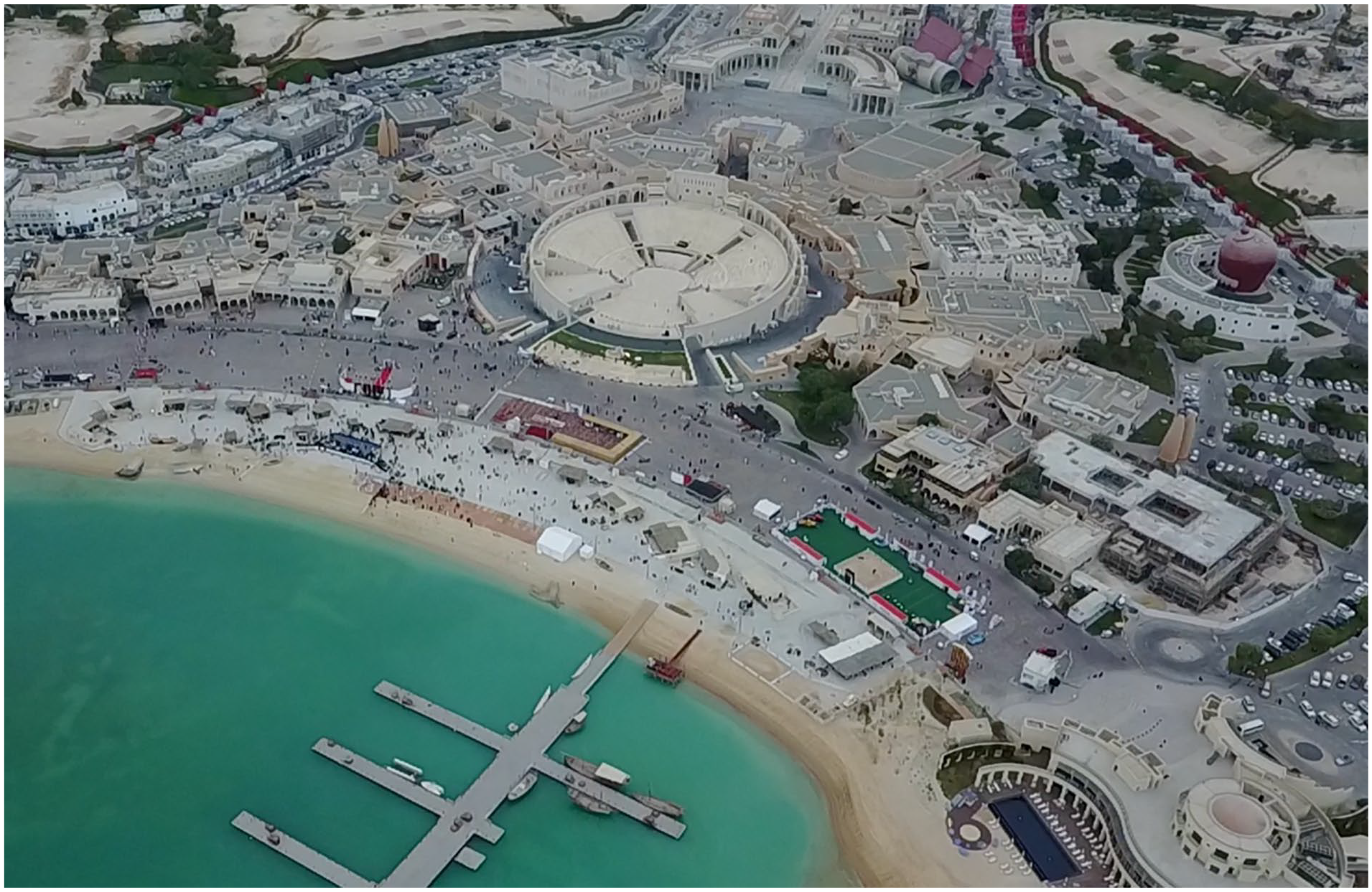
View of Katara Cultural Village, Qatar.
Results and Discussion
Results of TripAdvisor Data
The reviews of 2,342 visitors about Katara Cultural Village on the TripAdvisor website were analyzed (as at December 1, 2019). The results can be summarized and categorized in the following themes.
Level of satisfaction
Tourists’ satisfaction with a destination affects their choice, consumption, and the intention to revisit (Huh et al., 2006; Kozak & Rimmington, 2000). From the reviews on TripAdvisor, the overall level of satisfaction of Katara’s visitors was 4.5 out of 5, reflecting a high level of satisfaction with their experience. Table 1 indicates that, of 2,342 visitors who gave their comments, more than 50% stated that their visit was excellent, and about 84% rated Katara as very good and above. Only 4.4% of reviewers described their experience in Katara as poor.
Ratings of Katara Based on Visitors’ Reviews on TripAdvisor.

Nature and time of visits
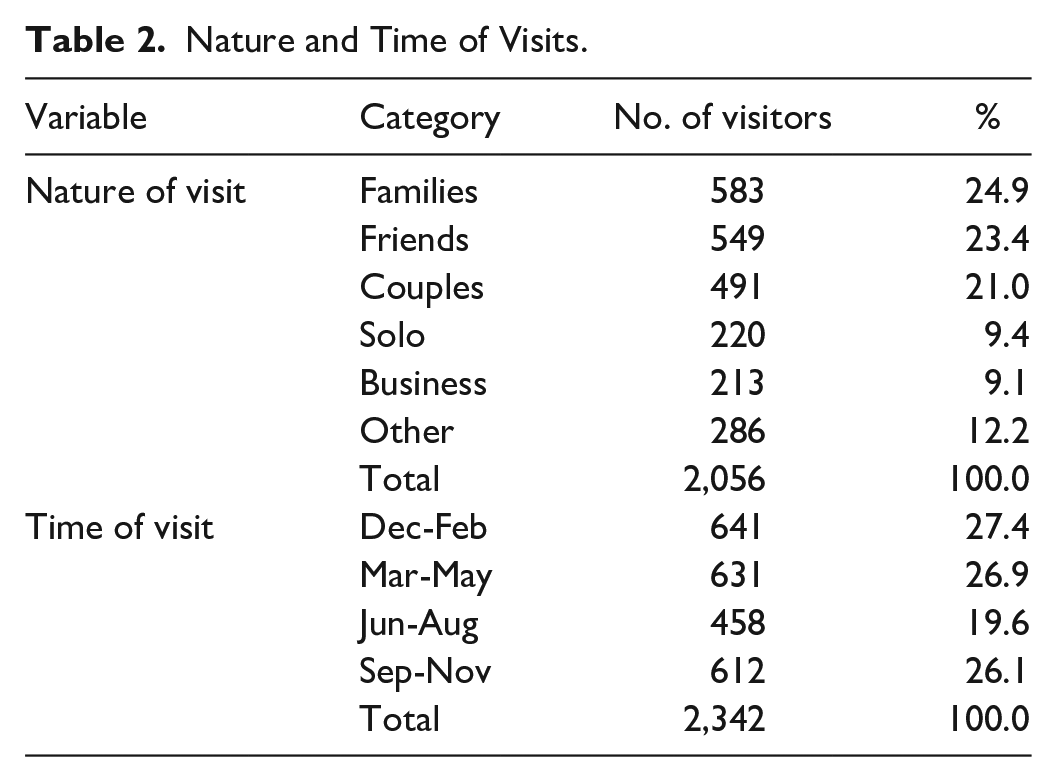
The TripAdvisor website also lists the nature and time of reviewers’ visits (see Table 2). The vast majority of the reviewers’ (69.3%) visit Katara as families (24.9%), friends (23.4%), and couples (21%). The results reflect the nature of Katara as a preferred destination for its events and activities, catering to the demands of different categories of visitors. With regard to the time of visits, the table shows that the most favorable time for visiting Katara extends from December to May, showing small differences among these months. The effect of the high temperatures in summer is clear from the low numbers of visitors during these months.
Nature and Time of Visits.
Languages of reviewers
The languages of reviewers indicate that Katara is a favorite destination for tourists from around the world. English is the dominant language, used by the majority of tourists from all countries (1,813 reviews), followed by Spanish (82) and Arabic (79). Other languages include Italian, Portuguese, French, Chinese, German, Russian, Turkish, Japanese, Dutch, Korean, and Greek.
The image of Katara from TripAdvisor comments
The website also provides subjective information of the visitors’ perceptions. A list of keywords used in the comments was searched, and their frequency recorded. In this regard, only 1,813 comments available on TripAdvisor in English language, were used. Most of the reviewers describe Katara as a nice (586) and a great (444) place. It was also described as beautiful (351), good (254), amazing (295), interesting (171), lovely (141), and wonderful (104). This positive perception of reviewers reflects a high level of satisfaction about Katara as a tourist destination (Table 3).
A List of Keywords That Describes Katara on TripAdvisor.

Specifically, reviewers described their experience in Katara positively as a nice place (361), a place that must to be visited (124), a good place (254), suitable for families (237) and children (131), having a nice beach (500), and pleasant to walk around (334) and stroll through (102), especially in the evening (337).
Katara was also described in the visitors’ comments as a global cultural destination (629) that hosts a huge number of cultural events (238). As a cultural destination, Katara has a large open amphitheater (336), a beautiful Opera House (62) for concerts (80), luxurious art galleries (73), and cultural museums (84).
The reviewers also described the large number of restaurants (951) and cafés (281) that reflect different cultures around the world, offering traditional food and beverages like Karak Tea (71) and Chapati (30). Other services mentioned included the Mosque (129) and golf carts (103).
Despite the positive perception of Katara, reviewers mentioned some negative issues. Kozak and Rimmington (2000) stated that destination attributes are crucial for the overall level of tourists’ satisfaction. Several other studies noted that tourists’ dissatisfaction with one attribute will negatively influence their overall satisfaction with that destination (Alegre & Garau, 2010; Kozak, 2003; Pizam & Milman, 1993).
Among the negative issues mentioned on TripAdvisor traffic was the most frequent. Reviewers also complained about the high cost of some services such as restaurants and cafés, and the high temperatures during summer, resulting in the place being suitable to visit in the evening but a “ghost town” in the morning.
To summarize, the cognitive image of Katara was determined through reviewers’ comments including its location, infrastructure, and socio-economic environment. The affective image determined by the adjectives listed in Table 3 describe the feelings toward Katara positively. The conative image of Katara is represented by comments on revisiting and recommendation to others, such as “a must visit place” and “can’t wait to go back.” From this review, the overall image evaluation of Katara was positive, first as a cultural destination and then as a recreational place. These results support the findings of previous research (Kladou & Mavragani, 2015; Papadimitriou et al., 2018). Papadimitriou et al. (2018) indicated that the cognitive image of a destination has a positive influence on the affective image and that both have a positive influence on the overall destination image evaluation. Accordingly, the cognitive, affective, and overall image evaluations have a positive influence on intention to suggest that others visit the destination.
The role of Katara in branding and enhancing the image of Qatar
In order to reveal the role of Katara in enhancing the image of Qatar, comments on TripAdvisor (1,813 posts) were analyzed using content analysis. From the comments, Katara is clearly playing a vital role in reflecting the image of the country and its culture globally.
The vision of Katara is “to be a world-leader for multi-cultural activities” (Katara, 2019). From the reviews on TripAdvisor, it has succeeded in being a global “cultural hub” and “cultural melting pot.” Katara as “a resort in the desert” is “the best and one stop entertainment” place in Qatar and “the spot to meet and experience the world cultures.”
According to reviewers, Katara was described as a place to explore “the Qatari traditions” and “the beauty of Qatari culture for everyone.” It also reveals “the cultural history of Qatar,” “introducing and understanding the real and true culture of Qatar” for everyone. Katara was also seen as a “modern design for all tradition values” and a “step back into the future” at the same time. Reviewers stated, “Qatar residents are lucky to have such a venue” to “dive into culture.”
Katara contributes to enhancing the image of Qatar worldwide. The analysis of the comments on TripAdvisor indicates that it has a strong role in branding and marketing the state as a global cultural destination and melting pot of all cultures. Reviewers described Katara as “the icon of Qatar,” “a taste of Qatar,” “Qatar personified,” and “a must-visit place” for those who wish to see “the real Qatar.” Katara is “Qatar’s focal point for multi-cultural activities,” displaying “the Vision of Qatar” according to visitors.
Reviewers also stated that Katara represents “all Qatar and Middle East in one place,” “a mini-Europe in Qatar,” and “a Middle Eastern version of Disneyland.” It was also noted that Katara “is exactly what the original Qatar could have been made with a touch of luxury.” With its “Arabic elegance and style,” Katara is seen as an “excellent place to enjoy the rich Arab culture.”
This analysis of reviewers’ comments on TripAdvisor provides clear evidence that Katara has succeeded in making its vision come true. The comments quoted above present Katara as a global cultural hub in which all cultures meet and interact. It plays a vital role in positioning Qatar at the forefront on the world cultural map.
Results of Focus Group Meetings
The results of the focus group meetings with the managers can be divided into two main themes as follow:
The perception of managers in Katara about TripAdvisor
The managers in Katara were asked for their perceptions of the significance of the feedback and comments from the TripAdvisor website. Most were unaware of the importance of TripAdvisor as a beneficial tool for assessment of their services and events. Instead of TripAdvisor, they relied mainly on the feedback available on social media such as Twitter and Facebook. There are some 384,500 followers of Katara’s page on Twitter and 193,600 on Facebook (Katara, 2019). For example, media and press affairs manager stated that they “(we) only depend mainly on the feedback from our Facebook and Twitter websites.”
SWOT analysis results
From the three focus group meetings with divisional managers conducted during September 2019, the strengths, weaknesses, opportunities, and threats of Katara were obtained, as summarized in Table 4.
Summary of Strengths, Weaknesses, Opportunities, and Threats Analysis of Katara From Managers’ Perspective.
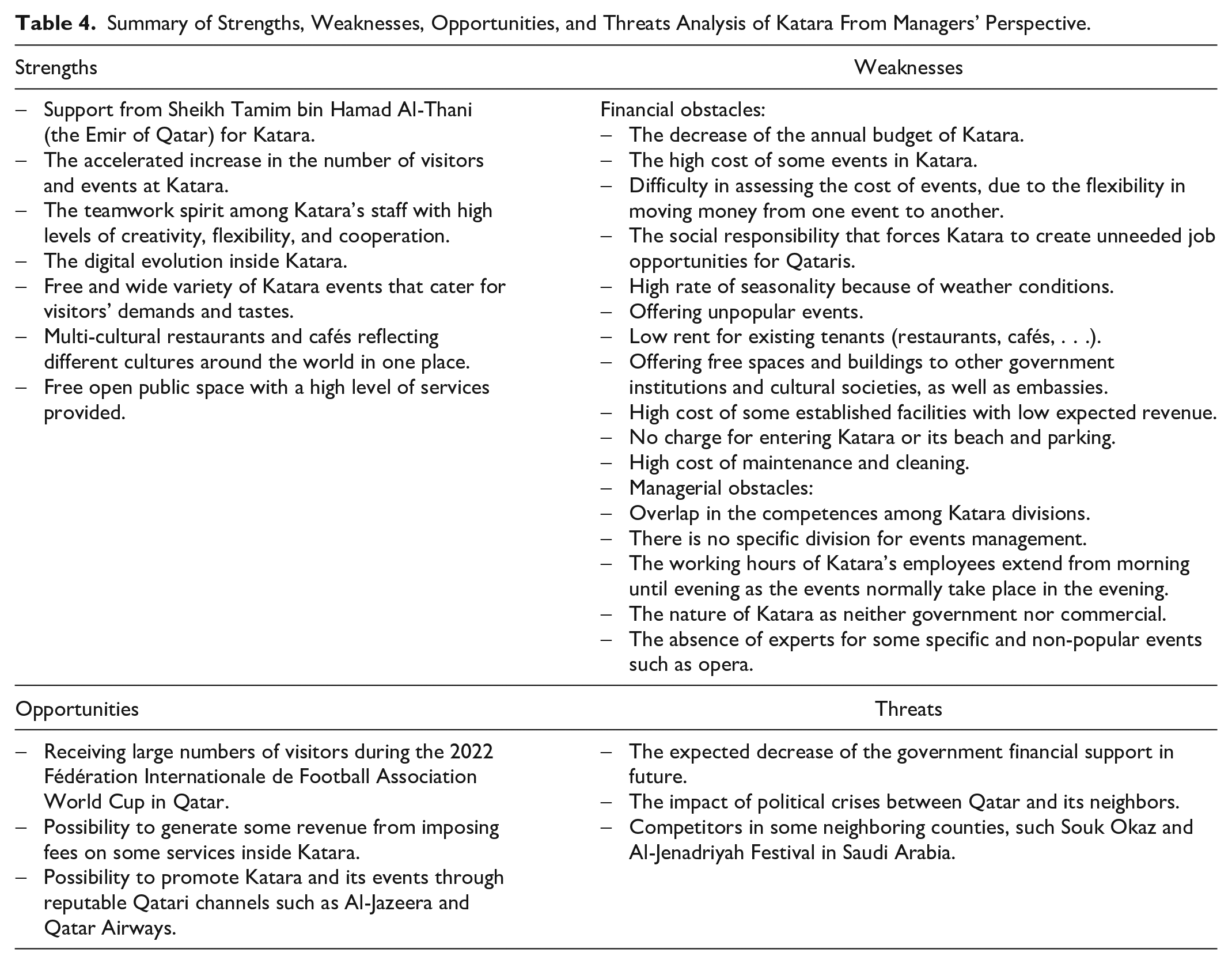
According to the managers, the support from the Amir of Qatar, Sheikh Tamim bin Hamad Al Thani, was a crucial foundation for Katara. In this regard, the financial manager of Katara said that “the support of Katara comes direct from the Emir of Qatra.” The continuing “increase in visitor numbers to the village and the multi-cultural events and facilities is a major strength” as the manager of cultural affairs declared. The financial and managerial challenges were the main weaknesses, as detailed in Table 4. For instance, the financial manager was worried from “the cut in Katara budget after five years of establishment to be self-funded organization at the end.” In the similar vein, “the absence of independent department for event management, and designating a temporally committee from employees for each event instead,” was the main managerial challenge as most of interviewed managers indicated. The adoption of policies to overcome the financial obstacles include: canceling some of the high-cost unpopular events; increasing the rent paid by tenants inside Katara and attracting new tenants; imposing fees for hosting some cultural societies and other government organizations inside Katara; evaluating the cost of events regularly for budgetary savings; and imposing fees for parking services. To overcome the managerial obstacles, the suggested policies focus on establishing a specific division for events management with qualified employees with clear competences and duties. Katara also needs to be an independent government organization with some private investment to fulfill its local and global role as a cultural hub and incubator of creativity. Finally, employees should have training to improve their skills, together with suitable financial incentives for working extra hours especially during the events season.
The 2022 FIFA World Cup hosted by Qatar will be a great opportunity for Katara to achieve its vision and mission of branding the image of Qatar as a global cultural hub, through the expected large number of visitors and people who watch the games all around the world. This can be achieved with sponsorship from Al-Jazeera and Qatar Airways according to managers. Finally, the main threats of Katara are, the existence of competitors in neighboring countries, such as Saudi Arabia and the United Arab Emirates. Their impact will be more serious if the financial support for Katara is reduced. The cultural affairs manager expressed his concern about the competitors in some neighboring counties, such as “Souk Okaz and Al-Jenadriyah Festivals in Saudi Arabia.”
Conclusion
This research aimed at exploring the role of Katara Cultural Village in branding and enhancing the image of Qatar based on visitors’ reviews and comments about Katara available on TripAdvisor website. To achieve this goal, the image of Katara was, first, examined in light of Gartner’s model of destination image. In this regard, the cognitive image of Katara was determined through reviewers’ comments on Katara location, infrastructure, and socio-economic environment. The affective image was expressed by the positive feelings of visitors’ toward Katara. Accordingly, the overall satisfaction (image) of reviewers from different countries and backgrounds toward Katara was very high at 4.5 out of 5 (2,342 reviewers). In other words, the overall image of Katara was positive and attractive. Therefore, the conative image of Katara was represented by comments on the intention to revisit Katara and recommendation to others. From this review, the overall image evaluation of Katara was positive, first as a cultural destination and then as a recreational place. Moreover, the positive feedback about Katara represents the success of Katara, as a global cultural hub where all cultures meet and interact, in branding the image of the country, Qatar. Analysis of TripAdvisor comments provides clear evidence that Katara has succeeded in playing a vital role in positioning Qatar on the world cultural map. To conclude, TripAdvisor, as a TGC site, has proved to be a reliable tool for evaluating tourist destinations. The obtained information from TripAdvisor can be useful for decision makers in Katara, because it represents a freely evaluations and satisfaction of visitors toward the destination. The decision makers of Katara should be attention to the negative comments to enhance the image of Katara in particular and Qatar in general. The results from the focus group meetings with managers show that they depend heavily on feedback from their pages on social media, rather than benefiting from TripAdvisor. The SWOT analysis provides a better understanding of the current situation of Katara in terms of its strengths, weaknesses, opportunities, and threats. Policy makers in Katara could benefit from these results by adopting appropriate policies and strategies that maximize the strengths, exploit the opportunities, minimize the weaknesses, and avoid the threats.
Limitations and Future Research
One of the limitations of this study is the fact that Katara is a newly opened destination in Qatar. Accordingly, Katara is still building its own image and can’t be compared with the other mature destinations. In addition, the authors couldn’t include comments written in other languages rather than English, even though the majority of comments was in English. The findings of the current study are based on data collected prior COVID-19 pandemic. Hence, these findings may be useful as a reference for future studies on tourism recovery in Qatar.
An analysis and comparison of the tourists’ comments and feedback and their satisfaction of a destination in different UGC websites is proposed for future research. In addition, researchers may compare the perceived image of a destination between traditional (surveys) and online (UGCs) sources of information. It would be also useful to analyze how managers and policy makers in Katara can benefit from such comments of tourists reported in such UGC websites. This would contribute in improving the destination image of Katara and Qatar and, thus, attracting more tourists. Furthermore, Katara would play a vital role in providing services and hosting the expected large number of visitors during the FIFA World Cup, which will be taken place in Qatar in 2022, and other anticipated mega events. This topic is suggested as another future research. Finally, it would be advisable to study the gastronomy and ancestral customs in Qatar in the future. This would have a positive impact on enriching tourists’ experience which may be reflected on the overall image of Qatar.
Footnotes
Declaration of Conflicting Interests
The author(s) declared no potential conflicts of interest with respect to the research, authorship, and/or publication of this article.
Funding
The author(s) received no financial support for the research and/or authorship of this article.
