




Abstract
Do improved women’s descriptive representation in legislative branches and women’s participation in civil society decrease the intensity of civil conflicts? Is the impact of women’s presence in legislative branches on the conflict intensity magnified by women’s participation in civil society, and vice versa? In this study, we aim to expand the constructivist argument that equal gender roles in politics and civil society can bring about less intensive internal armed conflicts. Relying on time-series cross-national data on 151 countries from 1960 to 2016, we demonstrate that the increases in women’s descriptive representation in parliaments and women’s participation in civil society tend to decrease the predicted civil conflict intensity. In addition, we demonstrate that the deterrent effect of women’s descriptive representation is magnified by women’s participation in civil society and vice versa. These findings remain consistent in alternative model specifications with additional women-related control variables.
Keywords
Introduction
Globally, the percentage of women legislators has been dramatically increased over the last decades reaching over 25% as of June 2021 (Inter-Parliamentary Union, 2022). Scholars have examined the impact of gender composition of legislative branches on social and political phenomena such as women’s substantive representation (Celis & Childs, 2008; Cowell-Meyers & Langbein, 2009; Lowande et al., 2019; Reingold, 2008) and policy outcomes (Taflaga & Kerby, 2020; Whitford et al., 2007; Woo, 2021). Among various topics, the relationship between female political representation and conflict behavior of states is one of the most hotly debated issues (Caprioli, 2005; Hessami & da Fonseca, 2020; Hudson et al., 2009, 2012; Koch & Fulton, 2011; Krause et al., 2018; Melander, 2005). However, even though previous studies have broadened our understanding about the impacts of the improved women’s descriptive representation on conflicts, there is still room for improvement.
Previous studies on the relationship between the gender composition of legislative branches and civil conflicts are largely focused on the onset and duration of conflicts (e.g., see Melander, 2005) rather than their intensity, which leaves some variations unexplained. The majority of previous studies regarding the intensity of civil conflicts focus on factors such as military sanctions, economic conditions, and existing resources to explain the intensity level of civil conflicts (Balestri, 2012; Chaudoin et al., 2017; Hultman & Peksen, 2017; Lujala, 2009). In addition, the influence of women’s descriptive representation on conflicts has been examined without considering potential conditioning factors. Given that women’s descriptive representation does not always have the same impacts across countries with different conditions (e.g., see Barnes & Burchard, 2013; Stockemer, 2015), this academic lacuna needs to be addressed. In order to bridge this academic gap, this article aims to examine the influence of women’s descriptive representation in legislatures and women’s participation in civil society on the intensity of civil conflicts. To achieve this goal, we will answer the following two questions: Do improved women’s descriptive representation in legislative branches and women’s participation in civil society decrease the intensity of civil conflicts? Is the impact of women’s presence in legislative branches on the conflict intensity magnified by women’s participation in civil society, and vice versa?
With longitudinal cross-national data on 151 countries from 1960 to 2016, we demonstrate that the improved women’s descriptive representation in legislative branches and women’s active participation in civil society tend to decrease the intensity of civil conflicts. More interestingly, we find that the deterrent effect of women’s descriptive representation on conflict intensity is magnified by their participation in civil society. The influence of women’s civil society participation on the conflict intensity is also amplified by women’s descriptive representation. These findings remain consistent in alternative model specifications with additional women-related control variables such as the presence of legislative gender quotas and access to justice for women.
This article contributes to the growing research interest on the association between women’s descriptive representation in legislative branches and civil conflicts both theoretically and empirically. By examining the changes of the intensity of civil conflicts, our study provides additional evidence for the conducive impacts of women’s entrance in politics on deterring civil conflicts. In alignment with the empirical evidence of the relationship between women’s participation in civil society and peace (Krause et al., 2018), our findings contribute to the literature about peace building processes by showing the conducive impacts of women’s participation in civil society. In addition, our findings also show that the improved women’s descriptive representation is not only associated with the onset or the duration of conflicts, but also with the intensity of conflicts. We also emphasize the importance of considering civil society as a factor by showing the women’s participation in civil society magnifies the deterrent effects of women’s descriptive representation on the intensity of civil conflicts.
This paper proceeds in the following order. In the next section, previous literature on gender and conflicts will be reviewed. Then, we discuss our theories and hypotheses about the influence of women’s descriptive representation in legislative branches on the intensity of civil conflicts, and the conditional relationship between women’s descriptive representation and women’s civil society participation. In the empirical analysis section, we discuss variables and data sources, model specification, and empirical results. Finally, we conclude with plausible directions for future studies.
Previous Literature on Gender and Conflicts
Social Norm
Male dominated gender composition in a society is a basis of how feminist scholars explain the masculinity of a society is correlated with the violent state behaviors (Sjoberg, 2018). Studies about civil war outcomes also point out that the majority of the victims and subject of negative effects of conflicts are women (Cohen, 2013a, 2013b; Melander, 2016, p. 205; Plümper & Neumayer, 2006; Solangon & Patel, 2012). This existing “power imbalance” between genders is reflected in structures and institutions of states (Nagel, 2021; Sideris, 2001). The underlying assumption that the feminist scholars have is the socialized gender roles cherish men and masculine characteristics while marginalizing women and feminine characteristics (Hudson et al., 2012; Nagel, 2021, p. 436). They argue the embedded gender role in societies and imbalance between men and women has brought about oppression and aggressions in diverse forms to women. They focus on societal and cultural factors to understand the behaviors of countries. For example, a society that has a system of “honor culture” marginalizing women while honoring masculinity may behave more violent and warlike (Melander, 2016, p. 201). The society with the “honor culture” tends to differentiate men and women honoring privileges of men and masculine characteristics. Countries with this norm of discriminating women and larger gender gap is associated with higher level of aggressive behaviors and hostility in the international arena choosing violence in the first place (Birchall, 2019; Caprioli, 2003, p. 196; Goldstein, 2003; Melander, 2016; Tickner, 1992, 2001).
Other scholars also emphasize the influence of social norm on policy choices by individual political actors. This social preference has not only perpetuated gender stereotypes within the institution, but also makes individual leaders follow the expected masculinity regardless of their biological gender. They argue that warlike or peaceful decisions by leaders are largely determined by norm of a society where each individual is belonging to (Caprioli, 2003, p. 198; Gilligan, 1982; Goffman, 1979). For example, individuals from the more war-like society have tendencies of preferring masculinity over feminine characteristics (Sjoberg, 2018). In this case, women leaders have more hostile choices following the expectation from the society that leaders should take more masculine policy choices regardless of gender (Caprioli, 2003; Eagly, 2013; Gilligan, 1982; Goffman, 1979). Others also have found that countries value patriarchal practices less are also less likely to be violent and experience civil conflicts (Nagel, 2021, p. 438). On the other hand, societies with gender-equal cultures are also more likely to support human rights (Brysk & Mehta, 2014; Reiter, 2015).
In summary, the previous studies have shown how socially expected gender role can bring about different state behaviors regarding conflicts (Nagel, 2021, p. 437). Countries that favor masculine characteristics with male-dominated state structures are more likely to be more violent, hostile, and prefer violent (Caprioli, 2003, p. 200; Nagel, 2021, p. 436).
Individual Actors
Although many feminist scholars demonstrate that the social norms and values can be a significant predictor of state behaviors, some other scholars focus on how to empirically measure the gendered social norm of individual political actors. The theoretical basis of this idea is on the psychological studies of international relations. The theory focuses on how propensities of individual political actors affect the occurrence of war and violence. For example, diverse characteristics of individual political actors such as their beliefs, leadership styles, misperceptions, and risk propensity (Hermann, 2001; Holsti, 1967; Jervis, 2017; Levy, 1992; Sjoberg, 2018) have been found to affect how states behave. The strategy of the scholars who follow this aspect is to emphasize on the biological gender of individual political actors to measure the existing gender equality in a society.
In align with the theoretical basis, scholars have argued that biological gender difference bring about different policy choices of individual actors (Reiter, 2015, p. 1306). Their argument is based on an assumption that women have more peaceful attitude than man (Melander, 2016, p. 199). According to the research, there will be more peaceful outcome in conflicts and wars when women have more influence on politics (Caprioli, 2003, p. 197; Goldstein, 2003; Reiter, 2015, p. 1306). These feminist scholars use gender of individual actors to analyze state behaviors and their effect on interstate and intrastate conflicts. A society where women have more access to political power has less propensity of wars than the one where women have inequal opportunities. In short, countries “where women have more political access would be less war-prone” (Reiter, 2015, p. 1306).
Previous Empirical Studies
Scholars have done many empirical analyses regarding gender equality and civil conflicts. The studies use diverse measures for analyzing the political participation of women and gender equality of a society. They include fertility rate, female labor-force participation (Caprioli, 2005), gender of a country’s leader (states with a woman leader), the percentage of women in parliament, and relative education level of women compared to men (Melander, 2005).
Similarly, regarding interstate conflicts, more gender equality reflected by political participation is related to peaceful relations with other states (Caprioli, 2000, 2003; Melander, 2005, p. 1; Regan & Paskeviciute, 2003). The results support that higher female participation in a society is associated with a lower risk of civil conflicts, onset, and violence (Caprioli, 2000, 2005; Melander, 2016). They have found the increased participation of women in politics particularly as legislatures decrease the probability of initiating wars and defense spending (Koch & Fulton, 2011; Nagel, 2021). Other studies contend that the termination of civil conflicts enhances women’s entrance in politics providing opportunities for women to engage political decision-making processes (Hughes, 2009; Hughes & Tripp, 2015). Other scholars have found that states with higher gender equality tends to rely more on international organization (Caprioli, 2003), the higher female representation promotes the ability of states to secure peace (Shair-Rosenfield & Wood, 2017).
In short, gender scholars who emphasize more on biological gender difference among leadership support the idea that higher participation of women in politics will bring about more peaceful outcome in international conflicts, they provide a background of the idea that the emancipation of women’s role enables more peaceful behaviors of countries. The outcomes support the idea that lower social status of women in a country’s society are correlated to the frequency of warfare conducted by the country (Goldstein, 2003; Melander, 2016, p. 207).
Theories and Hypotheses
Even though previous studies on this topic have broaden our understanding about the relationship between women’s role and peaceful behaviors of countries, there are still rooms to be improved. Contributing to the previous literature, this study aims to evaluate the influence of women’s descriptive representation in legislative branches and women’s participation in civil society on the intensity of civil conflicts, which have not been examined with time-series cross-national data. Moreover, we evaluate the conditional relationship between women’s descriptive representation and women’s civil society participation on civil conflict intensity.
As discussed, scholars who study gender and conflicts have laid theoretical backgrounds supporting the association between women’s descriptive representation in legislative branches and peace violence (Caprioli, 2000, 2005; Hughes, 2009; Hughes & Tripp, 2015; Melander, 2005). Particularly, Shair-Rosenfield and Wood (2017) theorize that prioritizing social welfare spending and improving public perceptions of good governance are essential components of promoting social stability and minimizing the risk of conflict recurrence. They argue that countries with higher percentage of women representatives is more likely to promote peace. Other studies also have found that women legislators tend to focus on issues of social welfare, social justice, and social expenditures due to feminist preferences (Carroll, 2001; Kittilson, 2008; Lu & Breuning, 2014; Mansbridge, 1999). Furthermore, the critical mass theory from Kanter (1977) argues that sufficient number of women are needed to overcome gender stereotypes and predominant male culture, and to focus on women’s issues, which argument has been supported by previous empirical studies (Childs & Dahlerup, 2018; Cowell-Meyers & Langbein, 2009; Woo, 2021). It suggests that the feature of women legislators can be reflected on peace building only when the percentage of women representatives reach at a certain point.
There have not been many studies, however, that particularly focus on the role of gender on civil conflict intensity. Instead, the existing studies regarding intensity of conflicts have focused on factors such as mediation process, rebel groups’ capacity or technologies, external sanctions, actors such as private security military companies (Balcells & Kalyvas, 2014; Beardsley et al., 2019; Berg, 2020; Wood, 2010). Some other studies that have discussed the relationship between gender and conflict intensity have focused on the effect of conflicts on women’s empowerment (Bakken & Buhaug, 2021; Tripp, 2016; Webster et al., 2019).
In addition to the findings of previous studies, we suggest that women’s empowerment in politics, particularly measured by the number of female legislatures, affect how governments would respond to civil conflicts. This is mainly because the “level of violence in a conflict … is choices made by elites” (Heger & Salehyan, 2007). In other words, the higher percentage of female legislators reflects that the social norm is less influenced by male dominated aspect that marginalize women and underrepresented groups. Under this more inclusive society, the gendered structural violence is less likely to be prevalent. Applying the above-mentioned theories and studies to explain the intensity of conflicts, we expect that the improved women’s descriptive representation tends to decrease the intensity of civil conflicts.
Hypothesis 1: The higher percentage of women in legislative branches decreases the intensity of civil conflicts while all other things being equal (Ceteris Paribus).
Rather than only focusing on the role of women’s descriptive representation in determining the intensity of civil conflicts, we also empirically examine the role of women’s civil society participation in determining the intensity of intrastate conflicts. Many previous studies have provided empirical evidence for the conducive role of civil society organizations in peace negotiations (Aall, 2007; Belloni, 2001; Hegre et al., 2020; Nilsson, 2012; Orjuela, 2003; Paffenholz, 2010). For instance, Hegre et al. (2020) demonstrate that the social accountability rooted in active civil society is one of the strongest predictor of non-belligerence in dyads compared to horizontal and electoral accountability. Even earlier, Nilsson (2012) show that the inclusion of civil society is likely to enhance the duration of peace.
The rationale behind the relationship between women’s participation in civil society and peace is from gender-sensitive approaches (Caprioli, 2000; Hudson et al., 2012). In line with the ethic of care theory developed by Gilligan (1993), previous behavioral studies provide evidence for that woman are more likely to offer holistic approach in peace building rather than to promote competition likely to result in conflicts (Dollar et al., 2001). Many studies have supported the argument that women are more peace-oriented than men (Charlesworth, 2008; De la Rey & McKay, 2002; Tickner, 1988). Based on the assumption that the role of civil society in peace building is not negligible, Stone (2014) argues that when women can exert their clout in civil society or grassroots mobilization, the holistic attitude of women can be reflected in peacemaking processes, resulting in durable peace.
Especially, the role of women’s participation in civil society has been emphasized by scholars as a factor of peace building (Gizelis, 2009; Joshi & Quinn, 2017; Krause et al., 2018; O’Reilly et al., 2015; Tripp, 2015). Gizelis (2009) unveils that gender equality for political participation is positively correlated with durable peace, and O’Reilly et al. (2015) demonstrate that women’s participation in peace processes is likely to increase the probability of reaching a peace agreement. More recently, Krause et al. (2018) based on mixed method design find that peace agreements signed by female delegates result in more durable peace rather than those by male delegates. Furthermore, they show that the agreements led by female tend to include the higher number of peace agreement provisions and implementation rates.
This also reflects how the society is likely to deal with interstate conflicts. The preference of peaceful negotiation by female legislators will also affect how the government is likely to deal with civil conflicts reflecting more inclusive society and social norms. This will make the society becomes less vulnerable to intense civil wars. Based on this, we expect that the active women’s participation in civil society tends to decrease the intensity of civil conflicts.
Hypothesis 2: The higher degree of women’s participation in civil society decreases the intensity of civil conflicts while all other things being equal (Ceteris Paribus).
In addition, we argue that there is an interactive relationship between women’s descriptive representation in legislative branches and women’s participation in civil society. On the one hand, the influence of women’s descriptive representation on civil conflicts can be magnified by the active participation of women in civil society. Considering that both female citizens and women representatives are more likely to be peace-oriented, women decision-makers can get support from female citizens. As decision-makers, female representatives in legislative branches are needed to secure their vote banks to be re-elected (Mayhew, 2004). If women legislators cannot get enough public supports from grassroots mobilizations for peace-oriented policies, it is hard for them to promote such policies. Therefore, the public supports expressed from female citizens in civil society make women legislators to actively pursue policies for peace building.
On the other hand, the positive impacts of women’s participation in civil society also can be strengthened in countries with higher percentage of women in legislative branches. Even though women’s participation in civil society can make differences, the influence of the participation can be limited without supports from decision-makers. Given that some studies find that the clout of civil society actors in determining government policies addressing conflicts is not always conspicuous due to the lack of decision-making authority (Carothers & Samet-Marram, 2015; Dupuy et al., 2016; Poppe & Wolff, 2017), the presence of representatives with a similar policy direction is essential for women’s participation in civil society to encourage peace building. The improved women’s descriptive representation in legislative branches make the voice from peace-oriented female civil society participants be more likely to be reflected in government policies.
This can be applied to civil conflicts as well. First, as society is more reflective of gender diversity and inclusive, cultural, and structural violence are less likely to happen. In addition, higher level of female political participation reflects more peaceful engagement with civil conflict issues. Thus, along with the independent impacts of gender composition of legislative branches and women’s participation in civil society, we examine the interaction relationship between them.
Hypothesis 3: The impact of women’s presence in legislative branches on civil conflicts are conditioned by women’s participation in civil society, and vice versa while all other things being equal (Ceteris Paribus).
Empirical Analysis
To empirically test the hypotheses, this study employs data on 151 countries from 1960 to 2016. Thus, the unit of analysis is a country-year. The number of countries is determined by coverages from available database used to build variables.
Variables
Dependent Variable
To evaluate the influence of women’s descriptive representation in legislative branches and women’s participation in civil society on civil conflicts, this study measures the intensity of civil conflicts based on the Civil Conflict Index from the Major Episodes of Political Violence (MEPV) dataset (Marshall, 2019). The MEPV dataset has been widely employed to empirical analysis unveiling factors of political violence including civil conflicts (e.g., Arbatlı et al., 2020; Brysk & Mehta, 2017; Omelicheva et al., 2017).
In the dataset, major episodes of political violence are defined as “the systematic and sustained use of lethal violence by organized groups that result in at least 500 direct-related deaths over the course of the episode.” The Civil Conflict Index (named as CIVTOT in the dataset) ordinally ranges from 0 (lowest intensity) to 10 (highest intensity), which combines the magnitude scores of episodes of civil violence, civil warfare, and ethnic warfare involving a state in that year.
Independent Variable
As independent variables, we use Women in Parliaments (%) and Women’s Civil Society Participation. Following academic tradition (Alexander, 2012; Childs & Dahlerup, 2018; Htun & Weldon, 2012), women’s descriptive representation in legislative branches is operationalized with the percentage of women in parliaments. This is also based on the rationale that countries’ domestic and foreign policies which are usually the cause of conflicts are largely determined by legislative branches. We collect the information about the percentage of women legislators from the Parline database developed by the Inter-Parliamentary Union (IPU). The IPU has collected all electoral results over the globe and provided information about the percentage of women representatives in legislatures.
To measure women’s participation in civil society, the Women’s Civil Society Participation index from the Varieties of Democracy (V-Dem) dataset (Coppedge et al., 2019). The V-Dem measures the women’s ability to express themselves and to form or participate in groups, based on the estimates from a Bayesian factor analysis model.
Control Variables
GDP Per Capita and GDP Growth
We also include GDP per capita and GDP growth of each individual countries. Previous studies have discussed the negative relationship between state capacity and initiation of civil conflicts (Cunningham et al., 2009; DeRouen & Goldfinch, 2012; Fearon & Laitin, 2003; Hegre & Sambanis, 2006). They use GDP per capita and growth to measure bureaucratic capability of individual countries. The higher level of military GDP of a country implies that people have less incentives to join rebel groups, and therefore, the country is more likely to be successful in managing conflicts within its territory. More importantly, the effect of gender (equality) and its pacifying effects are conditioned by the economic development of countries (Melander, 2016). Thus, to evaluate the independent impacts of the two main explanatory variables, we control both GDP per capita and GDP growth by relying on the data from the Quality of Government Dataset (Teorell et al., 2018).
CINC
We use the Composite Index National Capability (CINC) to measure the overall capacity of each country. The score is composed of six different indicators including total population, urban population, iron and steel production, energy consumption, military personnel, and military expenditures (Singer et al., 1972). Similar to the GDP measures, the CINC is another means of measuring state capacity that is generally considered to be more stable than GDP measures (DeRouen & Sobek, 2016). For these reasons, we include them to control state capacity level in our model. We decided to include both CINC score and GDP measures because some countries do not have high ranks in both measures (DeRouen et al., 2010). For example, Indonesia does not have very high GDP level, but has very high CINC score. Considering these cases, it will be needed to include both CINC score and GDP measures to distinguish their potential independent influences on the dependent variable.
Democracy
We use the Polyarchy Index from the V-Dem dataset to measure regime type of individual countries. The effect of regime type on civil war onset has been widely discussed (DeRouen & Sobek, 2016; Feng, 1997; Hegre, 2014; Hegre & Sambanis, 2006). They focus on domestic institutions that vary by different regime types. As democratic states generally have institutions, they are expected to be better at providing public goods and higher social stabilities. Similar to national capability measures, the incentives to join civil conflicts vary depending on the regime types. As democratic institutions are expected to be more efficient in providing public goods and keeping society stable, not only the onset but also the intensity of each civil conflicts is expected to vary.
Trade
Given that the relationship between economic trade and civil war has been debated in the previous studies (Hegre et al., 2003; Hegre & Sambanis, 2006), we also control the total sum of exports and imports of services and goods measured as a share of gross domestic product by using the trade index from the Quality of Government dataset.
Cold War
We include a variable that measures whether each civil conflicts happen during the Cold War era or not. This is a binary variable that measures whether the year is before 1989 or not. According to previous studies, the aspect of civil wars is different between pre and post-Cold War era particularly in relation to ethnic conflicts. The existence of super power, the existing local ethnic grievances are “exploited” by provided “training, weapons, and ideological justifications” (Levy & Thompson, 2010, p. 196). Because of the existing difference, we decided to distinguish the pre- and post-Cold War era.
Population
This variable measures the total population of a country in a year. Similar to the trade variable, population of a country is also expected to have association with civil war in relation to per capita income (Hegre & Sambanis, 2006), we decided to include this variable as a control variable.
Major Power
This variable measures whether the country is a major power or not. Major powers can affect civil war onsets through their decisions to intervene (Regan, 2002). If the country itself is a major power, the potential intervention by other major powers is less likely to happen and this can affect the outcome of civil war intensities as well. For this reason, controlling for whether a country is a major power or not is necessary to understand the influence of independent variables on the intensity of civil wars.
Ethno-Linguistic Fractionalization
Over decades, ethno-linguistic fractionalization has been examined as one of driving factors of intrastate conflicts. Some scholars demonstrate that the fractionalization is positively related to conflicts (Schneider & Wiesehomeier, 2008; Taydas & Peksen, 2012; Wegenast & Basedau, 2014), while others argue that curvilinear or negative effects of the fractionalization on civil conflicts (Collier & Hoeffler, 2004; Reynal-Querol, 2002). Even though there are also empirical findings supporting for the null effects of ethno-linguistic fractionalization on civil conflicts (Fearon & Laitin, 2003; Østby et al., 2009), we decide to control the degree of the fractionalization rather than to take the risk of the omitted variable bias. The historical index of ethnic fractionalization (HIFF) dataset developed by Dražanová (2020) is used to measure the degree of ethno-linguistic fractionalization.
Table 1 presents the descriptive statistics of all variables employed in empirical analysis. To check the multicollinearity, we conduct the variation inflation factor (VIF) tests. The individual VIFs of explanatory variables in the model without interaction terms do not exceed 3, indicating that there is no problematic collinearity among independent and control variables.
Descriptive Statistics.
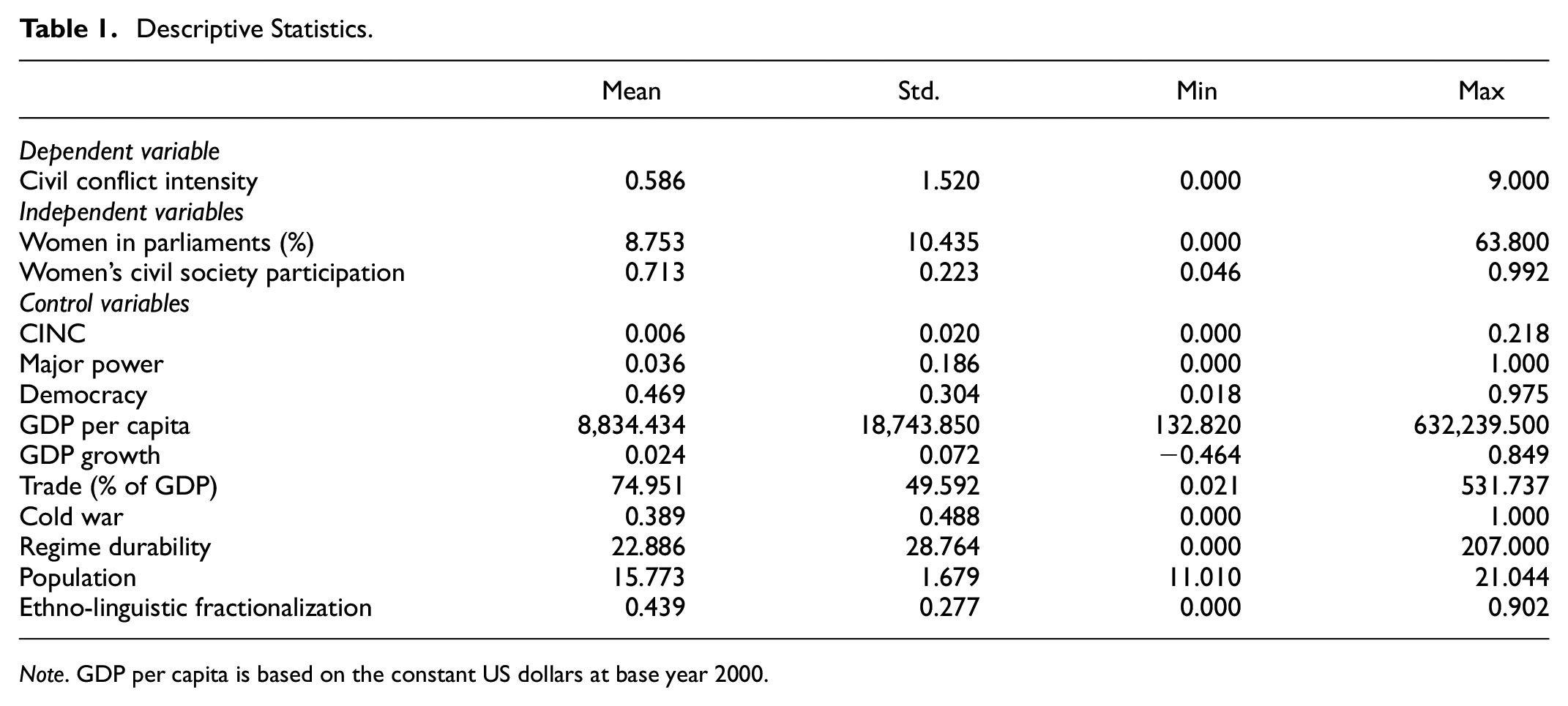
Note. GDP per capita is based on the constant US dollars at base year 2000.
Model Specification and Empirical Results
Given the nature of our dependent variable, estimating ordinary least square (OLS) regression will be problematic. Applying OLS regression with ordinal variables will give non-sensical predictions and bias standard errors (Wooldridge, 2016). To circumvent these problems, we estimate negative binomial models. Poisson models are not considered because of the problem of overdispersion in the dependent variable (for more information about overdispersion, see Hilbe [2011]). The equation of negative binomial models is,

where
Our empirical analysis starts from estimating the main effects of Women in Parliaments (%) and Women’s Civil Society Participation variables without including an interaction term between them. In Table 2, the two independent variables are statistically significant at the level of p < .05. To be specific, the estimated coefficients of Women in Parliaments (%) and Women’s Civil Society Participation variables are −0.023 and −0.535 respectively. It means that each one unit increase of the two variables decreases the expected log count of Civil Conflict Intensity by −0.023 and −0.535. This result supports to reject the two null hypotheses related to the main effects of both variables.
Main Effects of Independent Variables.

Note. Pseudo R 2, the Akaike Information Criterion (AIC), and the Bayesian Information Criterion (BIC) are provided to compare model-fits.
Turning to control variables, the majority of them show the significant outcomes as we expected. The level of democracy, the country’s national capability (CINC), GDP growth, GDP per capita, and trade level have all significant negative association with the dependent variables. Major power, higher population and ethno-linguistic fractionalization have positive association with the intensity of civil conflicts. The duration of polity variable and the variable about Cold War period have been found to be insignificant.
To evaluate the substantive effects of women’s political and social participations on intensity of civil conflicts, we estimate the predicted intensity level of civil conflicts by the two explanatory variables, Women in Parliaments (%) and Women’s Civil Society Participation. Figure 1 presents the predicted intensity of civil conflicts with 95% confidence intervals. Panel (a) and (b) are based on the values of each independent variable, and both panels show that the predicted intensity decreases with the increase in Women in Parliaments (%) and Women’s Civil Society Participation.

Predicted civil conflict intensity: (a) based on women in parliaments (%) and (b) based on women’s civil society participation.
For instance, if there is no women legislator in legislative branches, the expected intensity is 0.661. It decreases to 0.526 and 0.418 when Women in Parliaments (%) reaches 10% and 20% respectively. Although the slope becomes gentle after the percentage of women legislators exceeds 30%, the decreasing tendency is still noteworthy. At the extreme, the point estimate of the intensity is 0.167 with Women in Parliaments (%) is 60%. In terms of Women’s Civil Society Participation, the expected intensity of civil conflicts decreased from 0.820 when women’s participation is totally limited (0) to 0.480 when women’s right to participation in civil society is deserved (1). In addition to the estimated intensity, the estimated average marginal effects (AMEs) of Women in Parliaments (%) and Women’s Civil Society Participation are −0.014 and −0.305 respectively and both are statistically significant at the level of p < .05. Given that the variance of the dependent variable only slightly exceeds 1.500, the impacts of the changes in the values of the two independent variables are substantively meaningful. It should be noted that the results concerning two independent variables are also consistently robust in an ordered logistic regression model, a zero-inflated ordered logistic regression model, and ordered logistic regression models with year and country fixed effects (please refer Table A1 in Appendix).
The empirical results from Table 2 and Figure 1 provides empirical evidence for the association between the two independent variables and the intensity of civil conflicts intensity. Women in Parliaments (%) and Women’s Civil Society Participation have not only statistically significant association with civil conflicts intensity but also have substantively significant effects on the dependent variable.
Next, in order to test the conditional relationship between Women in Parliaments (%) and Women’s Civil Society Participation, we replicate the estimation process in Table 2 with the inclusion of the interaction term between the two independent variables. The AIC and BIC are lower than those in Table 2, indicating that the estimated model in Table 3 has a more fitted model. All the control variables have the same direction of influence on the intensity of civil conflicts, which supports the robustness of findings from previous literature about those variables.
Interaction of Independent Variables.

Related to the conditional relationship between the two independent variables, as you can see in Table 3, the interaction term of Women in Parliaments (%) and Women’s Civil Society Participation has statistically significant relationship (p < .001) in negative direction with the Civil Conflict Intensity. This result provides a preview of the magnifying relationship between the two independent variables. To investigate the marginal effects of Women in Parliaments (%) and Women’s Civil Society Participation, we estimate the marginal effects at mean (MEM) values according to the values of the two independent variables. Estimating the marginal effects allows us to evaluate how those two variables are interacted more intuitively.
The changes in marginal effects of Women in Parliaments (%) and Women’s Civil Society Participation are presented in Figure 2, according to the changes of the values in each other value. According to the panel (a) in Figure 2, the marginal effects at mean (MEM) of Women’s Civil Society Participation on the expected intensity of civil conflicts decrease with the increase in Women in Parliaments (%). The negative impacts of women’s participation in civil society on the intensity are getting magnified when there are more percentage of women in legislative branches. For instance, the MEM of women’s participation in civil society is −.393 when there are 10% women legislators in legislatures, which means that one unit increase in Women’s Civil Society Participation decreases the effected intensity by .393. The marginal effect reaches −.881 when the percentage increases to 30. At the extreme, the estimated marginal effect is −1.035. This finding provides an empirical support for the hypothesis that the deterrent impact of women’s participation in civil society on civil conflicts is augmented by the percentage of women in parliaments.

Marginal effects at mean values: (a) marginal effects of women’s civil society participation by women in parliaments (%) and (b) marginal effects of women in parliaments (%) by women’s civil society participation.
The panel (b) in Figure 2 reveals an interesting conditional impact of Women’s Civil Society Participation on the MEM of Women in Parliaments (%) on civil conflicts. As presented, the estimated marginal effects of Women in Parliaments (%) are above 0 when Women’s Civil Society Participation is under 0.6, indicating that the increase in the percentage of women in parliaments tends to increase the intensity of civil conflicts. This result is contradictory of the findings in the main effect model in Table 2. However, the direction of the MEM changes into the negative sign when a country-year has participation index higher than 0.6. It means that the increase in the percentage of women in legislative branches in countries where women enjoy their right to participate in civil society.
On the one hand, this result is in the line with our argument that the influence of women’s descriptive representation in parliaments on civil conflicts is conditioned by women’s right in civil society. On the other hand, it gives scholars a clue for why there have been conflicting results about the influence of women’s descriptive representation in legislatures on conflicts. According to our findings, previous non-consensus results on the impacts of the presence of women representatives are rooted from the exclusion of conditioning factors affecting the association between women’s descriptive representation and conflicts.
Robustness Check
To evaluate the robustness of our previous findings related to the influence of Women in Parliaments (%) and Women’s Civil Society Participation, and their conditional relationship, we replicate our analysis in Table 3 with three additional control variables: reserved-seats gender quotas, property rights for women, and Access to Justice for Women. Those three variables have been discussed by scholars as potential factors affecting women’s political participation and political efficacy (Ekman & Amnå, 2012; Franceschet et al., 2012; Zetterberg, 2009). To build each additional variable, this article relies on the Gender Quotas Database from the International Institute for Democracy and Electoral Assistance (IDEA) and the indicators (v2clprptyw and v2clacjstw) from the V-Dem dataset.
As in Table 3, the interaction terms between Women in Parliaments (%) and Women’s Civil Society Participation are consistently statistically significant at the level of p < .001 across the four models presented in Table 4. About the additional three control variables, the existence of reserved-seats gender quotas, Women’s Property Rights and Access to Justice for Women have statistically significant relationships (p < .01 and p < .001 respectively) with the dependent variable. Among other control variables, CINC, Major Power, GDP per capita, GDP growth, population, and ethno-linguistic fractionalization are consistently significant. Higher CINC score, GDP per capita, and GDP growth are negatively associated with the civil war intensities. These supports the known negative influence of economic and military capability of countries of civil war on the civil wars. On the other hand, major power variable, population, and ethno-linguistic fractionalization have positive association with the civil war intensities.
Estimations from Alternative Model Specifications.

Note. Robust standard errors are in the parentheses.
p < .05. **p < .01. ***p < .001.
The estimated MEMs of Women in Parliaments (%) and Women’s Civil Society Participation based on the results from the four models also have the similar pattern with those presented in Figure 2. Even after year-fixed effects are included as one of control variables to parcel out potential temporal autocorrelation, we find the robust and consistent empirical results.
Conclusion and Discussion
Does women’s higher political participation have negative effects on civil conflicts? More specifically, does the higher level of female representatives and higher civil society participation have negative influence on civil conflicts? Our answers to these questions are both yes. In this paper, we have found that two major influences of gender factors on the intensity of civil wars. First, the higher level of female legislators in Parliaments has a negative association with the intensity of civil wars. To be specific, if percentage of female legislators increases from 0% to 30% the predicted civil conflict intensity decreases by more than half. Second, when women have higher participation rates in civil society, it also has a negative association with the intensity of civil wars. Additionally, we also have found that the higher representation of female legislators and civil society participation have interactive effects on the intensity of civil conflicts. The conditional effects of women’s political participation are particularly likely when there is a high level of a civil society participation rate (more than 60%).
We have achieved three major findings in this paper. First, we have also confirmed the role of the gender aspect in civil conflicts. More specifically, by focusing on women’s political participation and civil society participation, we have found that the higher gender equality in society can experience less intense civil wars. Second, we connect the discussion of civil society participation with civil conflict literature with gender factors. Although the civil society participation literature has discussed civil society participation in state behaviors, it has less focused on the effect of gender on civil conflicts.
Lastly, we have expanded the role of female political and social participation in the civil war intensity. Many scholars have focused on discussing the influence of civil conflicts on women as members of marginalized groups of societies. Some scholars of civil wars have discussed gender as a factor that affects the onset or termination of civil conflicts. However, these previous studies have not discussed the influence of gender factors on civil war intensities. The majority of the studies have focused on different factors such as sanctions, economic development, and natural resources on civil conflict intensity. One of the limitations of these studies is that they focus more on factors that directly affect the intensities of civil conflicts such as availability of weapons (sanction), more participation rate of civil conflicts by economic struggles, and pursuit of available natural resources. Unlike these studies, we by focusing on gender aspects discuss the influence of social and political impact on the civil war intensities. This expands the discussion of causes of intense civil conflicts in relation to more social factors. Furthermore, this article also contributes to the growing literature on women’s representation in security sectors such as female combatants by providing empirical evidence that the presence and activity of women can alleviate conflict intensity.
The findings from this article also empirical supports for the introduction and diffusion of gender quotas. Gender quotas has been regarded as one of the most effective tools to promote women’s descriptive representation in legislative branches and a way to improve women’s substantive representation and rights at the global-level (Clayton, 2021; Krook et al., 2009; Woo & Ryu, 2022). This article shows that the increase in women in politics not merely positively affects women’s integrity but also national security. It is also worthwhile to consider other less obtrusive devices, such as funding or high-quality public daycare for women, which can reduce the barriers of political entry for potential female candidates to equally compete with their male counterparts (Mansbridge, 1999). The introduction of those “enabling devices” also can indirectly improve women’s civil society participation at the same time (Woo, 2022).
Footnotes
Appendix
Robustness Check with Alternative Model Specifications.

| Model A1 | Model A2 | Model A3 | Model A4 | |
|---|---|---|---|---|
| Independent variables | ||||
| Women in parliaments (%) | −0.019*** | −0.015** | −0.038*** | −0.070*** |
| (0.005) | (0.005) | (0.006) | (0.013) | |
| Women’s civil society participation | −0.986*** | −1.197*** | −1.590*** | −1.750** |
| (0.263) | (0.286) | (0.277) | (0.578) | |
| Control variables | ||||
| CINC | −17.100*** | −14.156*** | −13.809*** | −0.521 |
| (2.668) | (2.583) | (2.794) | (7.558) | |
| Major power | 1.512*** | 1.845*** | 1.659*** | 0.878*** |
| (0.233) | (0.261) | (0.238) | (0.132) | |
| Democracy | −0.499* | 0.011 | −0.269 | −2.139*** |
| (0.198) | (0.260) | (0.202) | (0.469) | |
| GDP per capita | −0.000*** | −0.000*** | −0.000*** | −0.000*** |
| (0.000) | (0.000) | (0.000) | (0.000) | |
| GDP growth | −2.246*** | −2.539*** | −1.218 | −2.924*** |
| (0.670) | (0.673) | (0.707) | (0.826) | |
| Trade (% of GDP) | −0.001 | 0.002 | −0.004** | −0.009** |
| (0.001) | (0.002) | (0.002) | (0.003) | |
| Cold war | −0.153 | 0.226* | 2.171*** | 5.188*** |
| (0.087) | (0.108) | (0.659) | (1.005) | |
| Regime durability | 0.001 | 0.005 | −0.002 | −0.030*** |
| (0.002) | (0.003) | (0.002) | (0.006) | |
| Population | 0.730*** | 0.525*** | 0.672*** | −0.752 |
| (0.039) | (0.072) | (0.041) | (0.566) | |
| Ethno-linguistic fractionalization | 0.941*** | 2.261*** | 0.932*** | −0.777 |
| (0.134) | (0.198) | (0.137) | (2.080) | |
| Number of observations | 5,917 | 5,917 | 5,917 | 5,917 |
| Pseudo R2 | .124 | . | .141 | .348 |
| AIC | 8,240.262 | 8,093.684 | 8,182.553 | 6,232.335 |
| BIC | 8,380.659 | 8,307.622 | 8,657.230 | 6,660.213 |
Note. Robust standard errors are in the parentheses. Model A1: Ordered logistic regression model, Model A2: Zero-inflated ordered logistic regression model, Model A3: Ordered logistic regression model with year-fixed effects, Model A4: Ordered logistic regression model with country-year-fixed effects. Pseudo R2 is not calculated in the zero-inflated ordered logistic regression model. The cutpoints and constants are not presented due to the concise presentation of the results. In Model A2, we use all control variables to predict zero Civil Conflict Intensity which is the dependent variable.
p < .05. **p < .01. ***p < .001
Declaration of Conflicting Interests
The author(s) declared no potential conflicts of interest with respect to the research, authorship, and/or publication of this article.
Funding
The author(s) received no financial support for the research, authorship, and/or publication of this article.

Data Availability Statement
Data sharing not applicable to this article as no datasets were generated or analyzed during the current study.