




Abstract
The Colombian government signed a revised version of the Havana Peace Deal with the country’s main guerrilla group, Revolutionary Armed Forces of Colombia (FARC), in November 2016, giving rise to a set of new opportunities and challenges for the South American nation. Societies that make the transition from conflict to peace need to seek truth, justice, and reparation concerning massive and systematic violations. Thus truth, history, and historical memory (HM) are central to reconciliation and play a key role in fulfilling the national and international obligations of the state. HM in Colombia has emerged mainly from the voices of victims, generating a narrative of events in which the discourses of members of the Armed Forces has, by and large, tended either to be out of place, or is regarded as the perpetrators’ account. Military personnel have usually been perceived to be offenders or perpetrators; finding the “truth” based on narratives of traumatic events is complex. This research contributes to the debate on HM in Colombia and the right to truth, exploring the narratives and emotions of traumatized soldiers who suffered permanent physical injuries, and presenting the results of an interdisciplinary project conducted via a series of in-depth interviews. It brought to light important accounts and deeply negative feelings toward the perpetrators of violence and the government, but also mixed feelings about the institution of the military that soldier victims continue to harbor.
Keywords
Introduction
Colombia has been plagued by internal conflict for a number of decades. The Colombian government signed a revised version of the Havana Peace Deal with the country’s main guerrilla group, the Revolutionary Armed Forces of Colombia (FARC), in November 2016, bringing about a set of new opportunities and challenges for the South American nation. The peace process and the post-conflict scenario in Colombia present a particularly difficult case of evolving toward a more stable and peaceful society owing to the perpetuation of drug-related violence and the continued presence of armed non-state actors and criminal groups.
Societal transitions usually require drawing a clear dividing line between a violent and turbulent past and ensuring a peaceful, participatory, and democratic future. Against this background, the society and its leaders must face responsibility for past human rights violations. Thus the victims have been converted into the central aspect of debates about transitional justice. Prosecuting perpetrators of such crimes and human rights violations, providing reparations to victims, reforming abusive institutions and, most importantly, revealing the truth about the past and promoting reconciliation are among the key objectives of transitional justice (van Zyl, 2005, p. 47). In this context, history and historical memory (HM) are considered key aspects to advance truth and reconciliation and to fulfill the national and international obligations of the state (Bell, 2006).
In the majority of cases across the world, the articulation of HM only begins following the conclusion of a peace agreement. However, Colombia is a peculiar case in that the construction of HM actually began in 2011, hence it crucially preceded the signing of the peace agreement in 2016. Moreover, in Colombia HM has in the main arisen from the voices of victims, generating a narrative of events in which the discourse of members of the Armed Forces has tended either to not have a place, or be considered as the perpetrators’ account. Military personnel have usually been perceived as offenders or perpetrators. Nevertheless, the literature is paying increased attention to military victimhood (McGarry, 2015; McGarry & Walklate, 2011, 2015).
This research contributes to the debate about HM in Colombia and the right to the truth, exploring narratives and emotions expressed by traumatized soldiers who suffered permanent physical injuries in the theater of armed conflict. Soldiers are frequently presented as perpetrators, but in the context of armed conflict they can also be seen as victims. Hence this paper pursues two objectives: (a) to know the emotions experienced by soldiers who have suffered physical damage, and (b) to explore the victims’ feelings toward the perpetrators of this harm.
Construction of the victims’ collective memory from the victims’ point of view in contemporary Colombia is crucial to understanding the country’s violent past and the social consequences of repeated acts of violence. In 2011 the Colombian government approved the Victims and Land Restitution Law (Law 1448), establishing a series of judicial, administrative, socioeconomic, individual, and collective measures for the benefit of victims of armed conflict, among which are rights claims to truth and memory addressed to the state. Thus who, how, when, why, and under what conditions the damages occurred must be uncovered. The past must be clarified, perpetrators punished, victims recognized, and legacies conveyed to future generations.
The victims’ right to the truth is inextricably linked to the state’s duty to remember. Thus the goals of transitional justice advocacy and HM are commonly presented as mutually reinforcing and complementary. While the state’s duty to remember does not imply the creation of an official history, the Colombian state has established the National Center for Historical Memory (NCHM), which is tasked with gathering and recovering all documentary material evidencing human rights violations, producing historical content by pointing out the guilt of the actors, to exercise transparency and the right to the truth. The construction of HM is understood to be a measure of satisfaction, contributing to the aim of guaranteeing the rights to truth, justice, reparation, and non-repetition of violence.
This pluralistic view of memory does not exclude the efforts of other state institutions. Thus the Ministry of Defense and the Colombian Armed Forces includes HM as a key element of one of their contributions to the right to the truth. Regarding the Colombian case, the construction of responsibility is important for the composition of discourses on HM. In Colombia HM has been provided by the victims, generating a narrative of events in which the discourses of members of the Armed Forces has, by and large, not played a role or has been downgraded as the perpetrators’ account.
As events occurred in the recent past, personal testimonies and oral stories have become more important than other sources. It is difficult to write a “true” version of the past based on the stories of victims due to the very nature and characteristics of autobiographical memories, especially when they are traversed by traumatic experiences, because trauma significantly complicates the situation. An individual suffering a trauma with feelings of shame, guilt, humiliation, and degradation tends to remain silent.
Approaching HM using a constructivist perspective, this paper presents the findings of a qualitative study of interviews conducted in Colombia, in which soldiers spoke about themselves in relation to the military institution during the Colombian armed conflict. Talking with soldiers, noncommissioned officers, and officers of the Colombian Navy is an opportunity to explore this process. The Navy has the second highest number of personnel affected by the armed conflict.
Management of the Navy’s HM elucidates instances of victimization, fosters reconstruction processes, represents HM with the active participation of victims, and serves as a platform for the promotion, coordination, and inclusion of reports of armed conflict. The system was set up to pay appropriate attention to those soldiers that have suffered a physical injury because of war.
This paper adheres to the following structure. Subsequent to this introductory section, we question the role of autobiographical memory in the construction of HM. Hence, we focus upon the relation between trauma and disorders of memory functioning and the overcoming of traumatic events. To achieve these objectives, a case study approach has been chosen. Case analysis facilitates exploration of the emotional consequences of traumatic events and makes sense to the one receiving knowledge of past events. This study examines the emotional consequences for a group of soldiers, noncommissioned officers, and officers. The results explore the question of how we remember historical injustice, which in turn affects how behavior is shaped in the present.
The Value of Life Stories: Autobiographical Memory
There is a growing consensus about the salience of the voices of victims to the efforts of HM in transitional justice. Victim narratives form a central “part of transitional justice scenarios” (Tamayo Gómez, 2019, p. 11), while a narrow view of the narratives of victims, consequently silencing dissenting voices, constrains memory construction (van der Merwe & Lykes, 2018). The construction of HM in Colombia hence understands the memory of acts of violence perpetrated against certain parts of the population and is based on generating their capacity to claim justice.
The NCHM has developed several publications and reports about emblematic and thematic events in Colombia’s armed conflict of which ¡Basta Ya: Memorias de Guerra y Dignidad! (NCHM, 2013) is perhaps the most renowned. The Commission Report states: “It is an active response to the ordeals of war, and a rejection of the attempts to impose silence on so many victims” (NCHM, 2013, p. 19). In other words, it is an approach biased in favor of the voices that have been suppressed or silenced.
The objective of the NCHM is to elaborate a narrative about armed conflict in Colombia that identifies: . . . the reasons for the emergence and evolution of illegal armed groups . . . all the cases documented show, with notable regularity, the collusion and omission of members of the Security Forces, acts that violate human rights, and alliances made with powerful groups that defend economic and political interests through violent methods, or greedily seek access to more land and/or resources. (NCHM, 2013, p. 26)
And is based on the victims’ voices. Our objective is to analyze the victims’ voices. We therefore analyze the voices of soldiers who are usually presented as perpetrators and who in this context can be seen as victims, but whose voices are often silenced in NCHM reports.
When events occur in the recent past, personal testimonies and oral stories become more important than other sources, It is often argued that narratives are most appropriate for describing what happened. They are not appropriate for explaining why it happened precisely because they do not go beyond description, most famously or infamously because they do not (and given their descriptive function should not) include lawlike generalizations about what would happen (or would have happened). (Beatty, 2017, p. 31)
Historiography has seen a shift toward the role of life stories and oral testimonies (the narrative turn), reflecting the growing importance of such testimonies, and opening legitimization processes based on narratives in the humanities and social sciences (Kreiswirth, 1992).
Life stories or autobiographical narratives are one of the essential resources of this work of reconstruction of the past. Autobiographical narratives put us on the track of lived events. It is important not to forget this aspect when narrators give an account of fragments of their lives and experiences. While we can know personal events that occurred at a specific time and place, we have information that is subject to two quasi-simultaneous processes of subjective interpretation. The first process is the reconstruction of the facts carried out by the narrator. The second, and somewhat more evident, consists of the interpretations arrived at by the researcher as listener and interlocutor.
Narrators (individuals who remember) construct a common thread that connects persons, groups, objects, and situations. The degree of significance of these elements in their life is the driving force of this process. Moreover, as the literature points out, memories have a selective character (Craik & Lockart, 1972).
Autobiographical memory is defined as an explicit memory of an event that occurred at a specific time and place in one’s past (Fivush & Nelson, 2004, p. 486). Autobiographical memory emerges from processes of social interaction and is informed by psychological aspects. Age and gender differences, emotional condition, temporal understanding, representation of self and others influence the process of attention and narrative comprehension and production (Fivush & Nelson, 2004; Mouw et al., 2019). In other words, storytellers portray people, including themselves, as characters: protagonists, antagonists, heroes, victims, or survivors. The stories they tell usually revolve around an epiphany or dramatic event. The events take place somewhere, sometime; a scene that provides context and a setting, framing, and texture to the story (Bochner & Riggs, 2014, p. 202).
As a consequence, true understanding requires that what is explained makes sense to the one who receives the knowledge, information, or detail. We need to understand the ways in which these persons remember, within contexts of social exchange.
The extant academic literature has highlighted the selective nature of memory, understood as our capacity to record, organize, consolidate, and recover information (Craik & Lockart, 1972). Our brains only retrieve certain facts and events but not others. Memory follows a specific procedure to store some of those memories that remain. We remember what is particularly meaningful to us (Hirschberger, 2018). This sense of what is important is conditioned by, among other factors, the emotional content of the event itself. The most emotionally charged contents are most likely to be remembered. Intense emotions, be they positive or negative, improve our memory of the main details, whereas what we perceive as secondary details are difficult to remember.
Furthermore, the literature also points to the fact that remembering depends upon the state of mind or mood (Forgas, 1995). It means that when a person feels either happiness or sadness, such emotions influence the procedure of recollection, which tends to be very selective. The process of recuperation of a particular memory is never the same. It can reflect happiness today, but tomorrow it could reflect melancholy. Affective states affect infusion: “the process whereby affectively loaded information exerts an influence on and becomes incorporated into the judgmental process, entering into the judge’s deliberation and eventually colouring the judgmental outcomes” (Forgas, 1995, p. 748).
Affect infusion shapes the way that information is selected, retrieved, and interpreted, especially when the affective valence is congruent with the ongoing mood. According to Blaney (1986), the effects of positive mood are stronger than those of negative mood. Thus, it is important to focus upon the effects that traumatic events have on autobiographical memories.
Autobiographical memory has some important functions. It involves a comprehension of who we are, which is basically a social framework that enables us to relate to others. When we remember our past stories, we strengthen our interpersonal relationships and establish new ones. The social characteristics of memory become evident by recognizing that human beings can remember by sharing memories with others. Nevertheless, these memories are very personal, they demonstrate a series of experiences that can be written in interpretative frameworks that give them meaning (Temin & Dahl, 2017). These interpretive frameworks are not individual or personal. Rather, they correspond to a series of collective and institutional processes (Erll, 2011). Autobiographical memory strengthens human relations and reinforces social solidarity.
Furthermore, some scholars contend that trauma events do not exist, arguing that they can be attributed to real or imagined phenomena. Hence trauma is entirely a social construct in that: “[e]vents are not in themselves inherently traumatic” (Alexander, 2004, p. 8), [T]raumas occur . . . when individuals and groups feel they have been subjected to a horrendous event that leaves indelible marks upon their consciousness, will mark their memories forever, and will change their future in fundamental and irrevocable ways. (Alexander, 2004, p. 1).
To sum up, memory does not retain all events, but only that part of the world which, given the time and place, is significant to us. The remainder does not receive attention and is not analyzed (Craik & Lockart, 1972; Ekuni et al., 2011). Equally, emotional conditions, social context, and other factors, such as the interviewer’s influence, shape the process of remembering. Thus evoking any past experience of one’s own life means not only recovering the events, but reliving or reexperiencing the past episode. These life experiences lead to the construction of an idea of who we are and where we are going (Demiray & Freund, 2017). Memories pass from being static representations such as a photograph to being precisely the contrary in that they represent goals, needs, and desires that the individual remembering entails. These important functions of autobiographical memory are intensified in individuals who have suffered physical trauma.
The Memory of Traumatic Events
Special attention should be paid to the psychological processes that occur when: “a person experiences trauma when subjected to or witnesses physical or psychological injuries or threats of injury” (Michaels, 2010). Individuals who have suffered physical or psychological trauma are bound to deal with its consequences for the rest of their lives (Blum, 2007). Moreover, age and gender differences, one’s emotional condition, temporal understanding, representation of self and others influence the process of attention and narrative comprehension and production. Furthermore, the literature also claims that remembering depends upon the state of mind or mood (Forgas, 1995).
While trauma imposes a huge burden on the suffering individual, it is complicated and prolonged owing to the process of making sense of the trauma. Individuals make sense of what happened as they reconstruct reality (the event), including what took place, how it took place, and their perceptions of themselves (Eisikovits et al., 1998). In other words, in the process of “making sense,” a version of reality is constructed by the individual.
As soon as the traumatic event occurs, it undergoes a selective process of reconstructing exactly what happened (Wagenaar & Groeneweg, 1990; Yuille & Cutshall, 1986). That is, the individual enters what can be interpreted as a negotiation over which events took place and then “chooses” what must be remembered. A “battle,” as it were, between what really happened and what is agreed upon plays out in the individual’s mind. The person must follow through by deciding what to deny and what to accept.
While ways of dealing with trauma differ greatly between individuals, in large part they tend to relegate or even forget so as to repress what has a more painful meaning. Subsequently, this will have important consequences for the future: fear, terror, anger, frustration, helplessness, depression, introversion, mistrust, hypervigilance, repression, dissociation (Eisen & Goodman, 1998), and even “false memories” (Ackil & Zaragoza, 1998; Arditte Hall et al., 2019; Brainerd & Reyna, 1996; Gelkopf et al., 2019).
Victims adopt cognitive and emotional attitudes toward events that occurred in the past. They assign responsibility for specific causes to specific objects. In other words, they point the finger or choose who or what to blame for that moment that caused them pain. Someone will be responsible for whatever happened to them or what they witnessed (Eisikovits et al., 1998), with victims assuming and internalizing whether the event was well deserved or undeserved, whether legitimate or illegitimate (moralization).
A soldier’s life involves misery, violence, limits to physical integrity, and even death. These critical incidents are regarded as potentially traumatic events that pose a threat to the soldier’s psychological integrity. Consequently, when making sense of what happened, there is a point in which doing so has its own consequences. Apart from the original psychological damage the victims suffer, there are emotional penalties such as anger, helplessness, and depression. Studies of survivors of Auschwitz show that traumatized adults can display their feelings differently (Ornstein et al., 2019). Specifically, survivors developed feelings of anger and frustration because, as survivors, they either had to come to terms with physical and emotional trauma for the rest of their lives (Abramovitch, 1986), or living in aggressive and oppressive contexts can pose a particular challenge, that of perceiving reality as natural and ordinary.
There is another key aspect of trauma that has yet to be introduced. When talking of war and its repercussions, theorists such as Eyerman (2001, 2019) seek to answer questions on its collective nature. Through varying analyses of post-conflict trauma in various cultures and countries, they arrive at the conclusion that trauma surpasses individuality.
On the broader issue of the consequences of trauma, theorists emphasize that when violence becomes systematic toward a community or group, trauma is not just individual but collective (Páez et al., 2001, 2013); thus it may pass through generations and remain in the mindset of a whole group, Individual and collective trauma may also be thought of as reinforcing one another, making the shock and sense of loss even greater. In an economic crisis as in war, one’s personal loss is intimately tied to those suffered by others. The cumulative impact would only intensify the trauma, where a sense of belonging, a collective identity, is shattered along with individual identity. (Kellerman, 2007) “(T)he past [as a social construction] conveys a kind of connective structure . . . to societies, groups and individuals, both socially and individually [and the] connection between time, identity, and memory operates at three levels: the inner (individual), the social and the cultural.” (Assmann, 2011, p. 15)
At the individual level, memory allows individuals to recognize themselves as members of a group. At the social level, “memory is about communication and social interaction”; and at the cultural level, it conveys the identity of society (Assmann, 2011, p. 16).
Assmann (2006) discusses the communicative character of the social interaction. Memory on the social level is always a communicative memory. It does not go back beyond a period of time between 80 and 100 years, that is, it survives for three or four generations. Cultural memory differs from this communicative memory. The transition to cultural memory necessarily occurs after the last survivors and witnesses of these massacres have died. Communicative memory could be preserved as long as survivors inform subsequent generations about the crimes of which they were victims (Assmann, 2006; Assmann & Czaplicka, 1995).
Speaking about the memory of the victims, we must point out that this is composed of the memories that can be transmitted by those directly affected by the conflict. As has been said, this memory of the victims is a communicative memory, which embodies the direct story resulting from the memories of those who directly experienced the brutal event. Our research hence seeks to explore the victims’ voices analyzing the voices of soldiers who are usually presented as perpetrators in NCHM reports.
In other words, when speaking of an individual group, such as soldiers or, more specifically, wounded soldiers, we must consider that the trauma could intensify. It may surpass individuality and intensify the trauma. Thus we must consider that processes of collective trauma may be witnessed in these wounded soldiers. Hence we propose that there may be variables that indicate the existence of a collective trauma. Yet for the purposes of this research we focus upon analyzing individuality, even though this may furnish some clues as to how collective trauma can have implications for the construction of identity.
Narration of these events not only has an informative function. It allows us to generate empathy, and to transmit our memories to those not directly affected by the conflict (Assmann, 2006; Assmann & Czaplicka, 1995). This may be especially important in the case of traumatic events, as it could make it possible to process the painful emotions generated by the memory of the traumatic events (resilience). In the same sense, individuals feel resentment because they recognize that this wrong should not be done to others and forgetting it makes us accomplices (Alford, 2012; Murphy, 1982; Stockdale, 2013). Nevertheless, Saltzman (2019), Carstensen (2006) and Zimbardo et al. (2012) highlight the importance of “[balancing] the time perspective by differentiating traumatic memories as the past (rather than present or future) and challenging survivors to believe that positive experiences [rather than resentment] are possible in the future.”
Soldier Victims in the Colombian Armed Conflict: Methods, Data, and Participants
In Colombia, truth, history, and HM are key aspects used to advance the purpose of reconciliation and to fulfill the international obligations of the state with respect to matters of truth. HM helps to clarify crucial events, identify those responsible, and establish the causes of the conflict. The NCHM (NCHM) in Colombia has dedicated its efforts to the construction of a HM based on the voices and life stories of victims. Thus the apportioning of responsibility is important for the composition of discourses on HM.
This research is an exploratory study with two main objectives. First, increasing our knowledge of the emotions experienced by soldiers who suffered physical damage. Second, exploring the feelings of the victims toward the perpetrators of acts of violence. The relationship between the voices of victims and responsibility requires problematization and some important theoretical considerations.
Case study analysis enables us to explore relationships with reference to multiple features of individual cases through close examination of the intervening variables (Mahoney, 2000). The exploratory study design has taken several forms. It is: “especially helpful for theorizing empirical material at an early stage, and which has a purpose to help . . . to decide whether to conduct a full study or not” (Swedberg, 2018, p. 3). Although authors differ in important ways about the nature and goals of this kind of research, we claim that exploratory studies are situated in the: “context of discovery rather than context of proof” (Gouldner & Peterson, 1962, p. 63). In other words, this kind of research might appear to be very informal in terms of methods and theories because its key purpose is to generate new ideas based on empirical data.
The research participants were screened from a group of soldier victims who participated in post-combat care programs offered by the Colombian Navy. Such programs are aimed at supporting veterans, service personnel and “their families through recovery, rehabilitation and reintegration into their home communities” (Amdur et al., 2011, p. 565). These soldiers come from all over the country and represent diverse ranks. After securing informed consent from the participants and obtaining written approval from the military authorities, a total of seven in-depth interviews were conducted between January 2017 and June 2017.
According to Decree 1796 of 2000 (Article 24[c]) soldiers are identified as victims owing to injuries sustained due to the direct action of enemies during or as a result of the conflict and of military operations, that is, combat actions, ambushes, antipersonnel mines, or improvised explosive devices (Colombian Ministry of Defence, 2000). Furthermore, we looked for soldiers who suffered injury at different times. We searched for interviewees with injuries dating from 10–15 years ago, 10–5 years, and interviewees from 5 years to 6 months. Anonymized audios and transcripts of the interviews are available upon private request.
To optimize the representativeness of the research design, we intended to select an equal number of male and female service personnel, and an equal number of soldiers representing the three broad categories of hierarchical ranks in the Colombian Navy (enlisted soldiers, noncommissioned officers, and officers). Because navy soldier victims are distributed across Colombia, we decided to focus upon cases in Bogotá, the country’s capital. Initially, the sample was structured so as to have an equal number of women represented, but when we came to the actual interview stage there was a modification made because of the very low quantity of female victims in the Colombian Navy. Thus the sample is composed of only male soldiers who have suffered physical trauma and who lived in Bogotá at the time of the interviews.
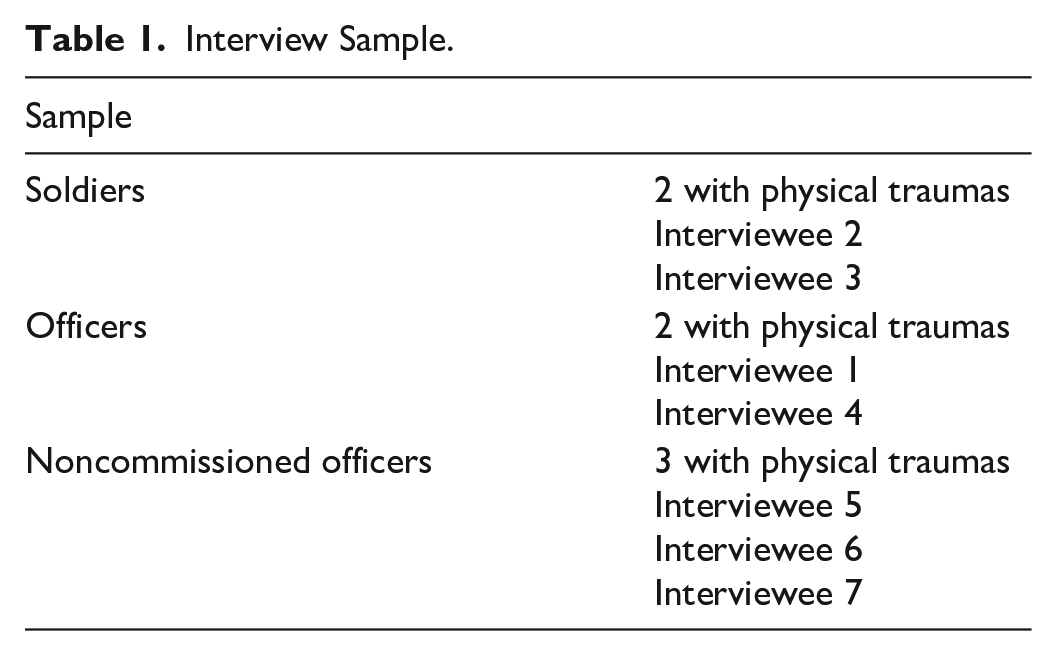
A total of seven soldiers met the criteria and were interviewed using a narrative autobiographical approach focusing upon their experience as soldiers and the factors that helped them deal with the trauma of war. All participants expressed a willingness to share their stories and gave permission to audio record the interviews which varied from 45 to 90 min in duration. The same team of two researchers conducted all of the interviews. The Table 1 shows the sample used.
Interview Sample.
We chose this methodology because it would afford us the opportunity to analyze a phenomenon without having previous variables established, transforming the construction of narratives into a descriptive exercise of interaction. Nevertheless, as a data collection tool, life stories provide a framework in which a specific lived experience, with the respondent focusing upon the narrative, can be analyzed. The life story interview helps to analyze one’s self-evolution, answering the question “Who am I?” and clarifying reality for the narrator. Thus we can generate a deep conversation between the researcher and the soldier victim, focusing upon the latter’s perception of self, life, and experience, and providing a rich in-depth analysis so as to develop the soldier’s narrative as a first-person account.
Moreover, some psychologists go so far as to point out that in many cases the real overcoming of trauma will only be possible if victims can narrate their experiences (Foa et al., 1989). When victims share their stories, they can express feelings, making it possible to process painful emotions (Schauer et al., 2011). In other words, when a personal memory is shared with someone who was not present in the episode remembered, the narration is no longer strictly informative but allows us to empathize and recognize ourselves as part of a group.
Results
In the final analysis of the interviews, the following three categories emerged. First, negative feelings toward the enemy, the institution of the military, and the government. Second, disputes owing to differences in rank, and third, overcoming injury.
Casting Blame: Negative Feelings Toward Enemies, the Institution of the Military, and the Government
Interviewees expressed deep negative feelings such as anger, rage, and hatred because of the physical traumas they had suffered, not only toward their enemies, but also toward the institution of the military and the government. More explicitly, three out of seven interviewees referred to their FARC adversary as “terrorists,” “criminals,” “cowards” and “cursed degenerates,” terms with obvious negative connotations. To further the analysis and explanation of the type of sentiments expressed, we focus upon Interviewees 4, 5, and 7, who showed the highest levels of anger, rage, discontent, and hatred.
Interviewee 4 had a leg amputated because of an antipersonnel mine. The soldier had feelings of resentment and hatred toward the enemy and toward the military and the government. During the interview, he did not refer expressly to enemies in combat, but rather in a diverse way with phrases that revealed the soldier’s thoughts. He seemed particularly bitter when talking of the disability allowance wounded ex-service personnel receive. The soldier felt that he had been treated unfairly by society and the government, complaining that other, able-bodied ex-service personnel enjoy better treatment than the interviewee.
While Interviewee 4 did not refer directly to FARC guerrilla members, the statements show discontent with Colombia’s present situation and without using the term “criminals” or citing what precisely the soldier thinks of them, Interviewee 4 pictured them in a negative way, conceiving of them as an adversary in battle that acted against the law.
Like Interviewee 4, Interviewee 5 was wounded because of an antipersonnel mine. The soldier’s perceptions were clearer than Interviewee 4. During the interview when referring to the FARC the soldier’s referred to “bandits,” “terrorists,” or “criminals.” It is as though these were their given names. When referring to trauma, the interviewee labeled the FARC “cowards” who not only planted the mines but infected them with feces, resulting in the soldier having an advanced leg infection. The depiction of the guerrilla became even more evident when talking about the present post-peace agreement scenario, referring to the now ex-FARC as “the same dog with a different collar,” verging on saying that they are still the same “terrorist and criminals” as before.
Finally, Interviewee 7 is perhaps the respondent who demonstrated feelings toward the “enemy.” The soldier’s first words resembling feelings toward the guerrilla were “God damn degenerate.” It is important to observe that the context of these words was set when the interviewee spoke of a regular marine who the interviewee was in charge of and who was shot in the head by enemy forces. “God damn degenerate” seemed an expression of moral responsibility for physical injuries. The interviewee also claimed that he did not want to have an emotional bond with anyone. As a result of the psychological injury suffered, the interviewee and his partner parted ways. The interviewee often expressed strong resentment and unwillingness to forgive the FARC, considering them the worst criminals there are, with words resembling those of a person who has deep hatred that became even stronger after having suffered injuries.
These accounts show that these individuals possess a great sum of negative feelings toward their enemies. Five of the seven interviewees made negative remarks about their “enemy.” All in all, the interviewees viewed the current post-peace agreement scenario in a negative way because of the “privileges” that their “enemies” are receiving. As some stated: “Those who perpetrated these terrorist acts must be brought to justice and held accountable for their horrific crimes.”
Only one individual differed in their assessment of the FARC. Interviewee 2 claimed to understand the guerrilla’s circumstances: “I feel no resentment towards them.” The soldier said that a number of them continue “a life of crime” not out of choice but necessity.
During the interviews, we found negative feelings toward the military. Most, if not all, the interviewees felt they had something to say about the institution, Interviewees 1, 4, 5, and 6 presenting the highest degree of negative feeling toward the military.
Interviewee 1 was injured at the beginning of 2017, making him the interviewee with the most recent injury. The interviewee’s sentiments revealed discontent and anger with the: “military process for a wounded soldier.” At various points in the conversation, the soldier stated that the institution of the military does not follow through with the process of supporting wounded ex-service personnel, even clarifying that the soldier had to have another part of his leg amputated. The soldier made it clear that the attention was inadequate and that there was very little concern with soldiers’ well-being generally. While the interviewee repeatedly mentioned the “process,” it appears that he was not talking about a particular procedure, but rather about a lack of concern on a personal level and a lack of human warmth. The case of Interviewee 6 displays similar features in that the soldier remarks on unfair treatment by the government and a lengthy and complicated process of obtaining compensation via the medical board.
Interviewee 7 made remarks that echo the above, claiming that the Navy must change its overly disrespectful and sometimes arrogant attitude and acknowledge that a wounded soldier is not useless as they merely fight for their rights, as opposed to begging. The interviewee explained in depth the nonconformity that most others sought to express. There is a clear feeling of abandonment and lack of concern. Their dissatisfaction with the procedure they have to negotiate leads to negative feelings toward the institution of the military.
Interviewee 4 showed anger, resentment, rage, and even hate, expressing a desire to simply leave and feeling that there was nothing positive in the institution and that if the soldier had a choice, he would abandon the uniform. The only positive aspect that Interviewee 4 highlighted were his children and wife. The soldier expressed a desire to sacrifice further study because it would mean remaining a member of the armed forces.
We identified the use of terms such as “clowns,” “rats,” and “thieves,” which are used to degrade an individual. All but one of the interviewees expressed displeasure with the government. The interviewees all stated that the country is plagued by a great many injustices, but there was a common variable in all of them. They all view the government as thieves who steal public funds and do not bring any benefits to the people. At one point, Interviewee 4 even referred to the president as “Chucky,” the evil doll portrayed in the Chucky film franchise. It became clear that interviewees felt dissatisfied with the way the country had been managed, but the government received the worst criticisms. This begs the question of whether discontent with the government revolved around the peace process, or if there were other factors involved.
Inequalities: Disputes Due to Differences in Rank
In institutions with a clear and structured hierarchy, discontent is common between ranks. It is worth reiterating here that we deliberately chose interviewees of different ranks in the Navy’s command structure and hierarchy. We discovered clear disparities, and, in our analysis, we found major disputes between ranks due to perceived or real inequalities.
However, not all the interviewees mentioned the differences that exist between different ranks and only the lower ranks highlighted the issue. More specifically, those referring to the differentiations were aspiring noncommissioned officers and officers, as well as those who were called up or volunteered for full-time military service. Interviewee 1 referred to his superiors and the people leading his operations on two occasions, stating that: “we risk our lives daily and have all too often done so, and they make the decisions and do not consider the risks.” Interviewee 4 expressed the perception more vehemently, claiming that whereas at some stage there was admiration for high-ranking officers, now: “they are merely the playthings of Chucky [President Santos who served from 2010 to 2018].”
Such statements show dissatisfaction with the hierarchy. These sentiments chime with Interviewee 6, who considers that: “some surpass their role.” In other words, high-ranking officers inadequately use their position to benefit themselves. In another statement, Interviewee 6 stated that “[non-commissioned officers] were paid less than regular soldiers, I do not know why,” while Interviewee 4 argued that: “the person suffering the loss does not receive any compensation.”
By contrast, in an off the record statement Interviewee 7 sought to explain in his own words why some of the aspiring noncommissioned officers and officers, as well as those who were called up or reported voluntarily for full-time military service felt rancor toward noncommissioned officers and officers, arguing that there are differentiations in salary because the junior officers had to take courses that they had to pay for themselves. When asked who they admired in the institution, five of the seven interviewees responded “no one.” We concluded that the differences between “salary” and “roles” are the cause of the rupture between high-ranking officers and the lower-ranked Navy personnel. It seems as though there are no strong connections between ranks, only merely on a cordial level.
Overcoming Injury
When speaking of physical injuries that involve battle, antipersonnel mines, or even shell fragments, we necessarily have to talk about traumatic experiences. A traumatic experience can cause numerous psychological damages to the individual. Assessing the interviews, a category emerged that identified all; their capacity to surpass the injury and move in a positive direction despite difficulties along the way. These are soldiers who have always been able to confront their injuries and make the best of it. As we will see further on in the analysis of this category, some of them used the tools offered by the military to overcome injury and adapt to their disabilities.
Throughout the interviews, it was common to accept the accident. As mentioned, an individual tends to put aside memories involving traumatic experience. The fundamental reason is that remembering causes harm. While this is true, it appears as though these individuals faced the fact that it could cause them harm and overcame this by merely accepting what had happened and moving forward using techniques such as sports, education, raising their self-esteem, creating their own business, or constituting a family. All of them refer to it as something that had to happen to them and overcome that fact by saying that if it had not happened to them it would have occurred to a child or a farmer.
Undoubtedly, sports play an essential role for most of the interviewees. Interviewees 1, 2, 3, 5, 6, and 7 all participated in physical activities during their recovery and continued to do so afterwards, even participating in international championships. Interviewee 3, who has a prosthesis in his right leg, even plays a sport, which involves running with dogs. Interviewee 6 lost both of his legs and an eye to an antipersonnel mine, but that has not stopped him from participating in weightlifting, dedicating time to training, and establishing a career. The interviewees refer to sport with great enthusiasm as the activity they look forward to most in their day. It seems as if these individuals have used sports to prove to themselves and to others that their disability has not limited their lives and that they can overcome the injuries sustained in combat or on patrol.
Perhaps the real question is whether the abandonment these soldiers feel makes them look for other mechanisms to overcome the physical, psychological, and emotional part of trauma, or if it is the survival instinct that makes them look for ways to use their environmental context to release the traumatic event. In sum, this category exhibits the capacity of an individual who has suffered a traumatic event (such as losing a leg, an eye, or their hearing) to overcome their injury and develop tools, mechanisms, and other type of activity to move forward and grow.
Discussion
Traumatic events can play an important role in the construction of life stories, resulting in inconsistencies and feelings that can overpower an individual. We have unearthed some important findings, but we must examine the results with care.
These three categories help us to understand how feelings and emotions can contribute to the construction of life narratives:
Casting blame: Negative feelings toward the enemies, the institution of the military and the government;
Inequalities: Disputes due to differences in ranks;
Overcoming injuries.
Furthermore, the literature also shows that remembering depends upon an individual’s state of mind. The existence of traumatic experiences tends to be associated with altered states of consciousness that condition the processing of information, altering the subject’s capacity to face events, thus affecting the way information is perceived and processed (dissociation). And with the passing of time victims adopt cognitive and emotional attitudes toward events that occurred in the past. Finally, there may be inconsistencies in the communication of trauma.
The interviews tend to confirm the above propositions. We found significant incongruence, which can be interpreted as a consequence of emotions of fear, terror, anger, frustration, helplessness, depression, introversion, mistrust, hypervigilance, repression, dissociation (Eisen & Goodman, 1998), and even “false memories” (Ackil & Zaragoza, 1998; Arditte Hall et al., 2019; Brainerd & Reyna, 1996; Gelkopf et al., 2019). There were constant inconsistencies that the interviewees displayed throughout the duration of the interviews. This category is cross-referenced with the category of developing negative feelings toward the institution of the military. All interviewees, with the exception of Interviewee 6, stated in their narratives the significance of the day they swore allegiance to the flag, considering this moment the most important in their lives. As claimed by Hirschberger (2018), individuals remember events that have a special meaning for them. The emphasis that the interviewees put on their allegiance to the flag serves to show the social character of memories and constitutes the element that defines them as members of the group (Assmann, 2011).
As seen in the above analysis, most of the interviewees had negative feelings toward the military and their individual processes as victims. Here an apparent contradiction arises. It would seem that if a person has feelings of anger, rage, or frustration toward the military owing to its perceived lack of care or attention toward them, it seems paradoxical that the memory of the first day of their time in the military remains the most important in their lives.
However, we found that the lack of attention received does not actually affect the soldiers’ commitment. This becomes clear from the testimony of Interviewee 2 who claims that: “I came close to dying, maybe, it is true, I am stubborn, therefore, they call me Lazarus.” For them, it seems that there is no incongruence between their compromise or loyalty toward the institution of the military and the lack of attention it has paid them.
The results of our analysis strongly suggest that time is significant as also suggested by Carstensen (2006), Zimbardo et al. (2012), and Saltzman (2019). Interviewees 2 and 6 had injuries dating the farthest back. These individuals were those whose data least corresponds to the categories that emerged in the interview process. Moreover, this might be a sign of resilience mechanisms (Murphy, 1982; Stockdale, 2013). The various mechanisms established in the analysis, such as forming a family, studying, or playing sports, resembled the overall intention of not acquiescing in the state of injury and advancing toward the future. We found that these individuals sought to find further purpose in their lives and that their survival resulted in the necessity to establish mechanisms to do so. It is as though these mechanisms resembled a way of defeating adversity and proving to themselves that their survival had to be significant because others did not survive and were not granted that opportunity.
According to the literature, time is important to explain the resilience of victims and usually they can analyze events without acknowledging negative emotions in an apparently reliable fashion. It can be said that these interviewees were the ones who had the most stable emotions, the clearest responses, and the sincerest opinions. Interviewees 2 and 6 viewed past events in such a way that they could state exactly what they thought without presenting considerable inconsistencies. Furthermore, these individuals, when talking about the present Colombian context, seemed to have more of an ability to overcome injury than others.
However, we came across statements such as: “There are no hard feelings—they are farmers.” Paradoxically, Interviewee 6 expressed the most resentment toward the military. While this soldier seemed to have overcome the trauma, the loyalty he felt toward the institution seemed to have been undermined. When considering the day that soldier felt most proud of, Interviewee 6 confirmed loving the nation, but if no job is granted in the Victims Directorate, the interviewee would not want to remain in the military.
When talking either in negative or positive terms, there was a common factor in all their discourses; they all used the term “us.” Using the first-person plural pronoun shows the importance of the group when seeking to understand individual identities. In all the categories, especially that on “Casting Blame: Negative feelings toward the enemies, institution of the military and the government,” interviewees did not seem to be talking for themselves. It appears all that they experienced directly tied them to the collective, that is, being wounded soldiers. In particular, in the analysis of negative feelings toward the institution of the military, we noticed that most had some sort of inconsistence of attitude regarding the treatment of injured soldiers’ post-incident. When they did not talk individually, they spoke collectively, almost as if it was a consensus and common treatment. When explaining their anger, frustration, and inconsistence of attitude toward the military and the government, they always talked of actions directed at “us.” These findings reflect a certain “collective resentment”: “Collective resentment is resentment that is felt and expressed by individuals in response to a perceived threat to a collective to which they belong. In collective resentment, the reasons for resentment are reasons for a collective, not an individual victim of mistreatment.” (Stockdale, 2013)
We can see why when the interviewees refer to the post-incident scenario, they not only referenced it as individuals, but as a group. Thus only individuals who form part of that group (in this case, wounded soldiers) can feel such collective resentment. Therefore, only they who can, when talking of how they are forgotten (Interviewee 6: “they forget about us”), exploit a plural term.
By contrast, even though they pointed at injustices toward “us,” when asked if they would participate in a focus group they declined. This led us to consider why they declined. Interviewees responded that it was because those negative feelings would be intensified at a focus group session. They emphasized that when they were together in a focus group scenario they would return with more rancor, frustration, and some even said they would become more depressed. Thus we concluded that the interviewees form part of a community, but owing to the repercussions of their injuries (physical and psychological), they would prefer to maintain their distance in the interest of their well-being. Loyalty or some form of mystic devotion to the armed forces does not apparently translate into more solidarity or cooperative attitude among them.
Conclusion: Between Resilience and Resentment
The overarching goal of this research has been to explore the victims’ voices. We therefore analyze the voices of soldiers who are usually presented as perpetrators and who in this context can be seen as victims, but whose voices are often silenced in NCHM reports.
When analyzing processes of healing in war-torn societies, we should recognize that healing does not tend to be a problem of normative justice. With respect to past events, personal testimonies and oral stories or histories have become more important than other sources that are available to us. It seems difficult to write a “true” version of the past based on the stories of victims due to the nature and characteristics of autobiographical memories, especially when these are traversed by traumatic experiences. The theoretical perspective used here differs from most other research about HM in two decisive ways. While this current research incorporates accounts and voices of victims, it explores the narrative of soldiers who are usually presented and discussed as perpetrators. Nevertheless, in conflict soldiers can also be deemed victims because of the physical and psychological consequences suffered in the context of armed struggle (McGarry, 2015). We see the centrality of autobiographical memory as a personal construction of life experiences. However, rather than viewing the self in such narratives, understood as an “objective” construction, we view it as a product of emotional aspects in a social space.
We explore the emotions experienced by soldiers who suffered physically in armed conflict and explore the feelings of the victims toward the perpetrators of these actions that even create incongruence and “false memories” (Ackil & Zaragoza, 1998; Arditte Hall et al., 2019; Brainerd & Reyna, 1996; Gelkopf et al., 2019). This research presents the findings of a qualitative study of interviews conducted in Colombia, in which the soldiers reflected and spoke about themselves in relation to the military institution during the decades-long Colombian conflict. Talking to soldiers, noncommissioned officers, and officers of the Colombian Navy, this research explored individuals’ perceptions, feelings, and emotions vis-à-vis the conflict. In-depth interviews unearthed negative feelings, not only toward perpetrators such as the FARC, but also toward the government and parts of the military. At the same time, we found apparent contradictions in their narratives that could possibly be consequences of trauma. The ramifications of living in a context dominated by armed struggle, experiencing a conflict of loyalties, and in a state of anger and frustration helps us to recognize what both happens for an individual suffering trauma and the contradictions of their narratives.
What kind of feelings will wounded soldiers experience when they feel that those who are briefed with watching over the memory of their actions ignore them? Their fight is more difficult because they not only struggle against neglect, but also against ingratitude. The soldiers’ social circumstances seem to give rise to resilience and resentment.
Practicing sports to foster resilience is a factor common to their narratives. While all the interviewees play sports as a mechanism to strengthen themselves and to progress, the truth is perhaps that resilience is more evident in those soldiers who suffered injury a long time ago. Most soldiers harbor deep rancor toward the institution of the military, the government and, particularly, the perpetrators of the violence inflicted on them.
For example, Interviewee 6 had both his legs amputated approximately 10 years ago. The soldier’s will to resist was the most evident. During the recuperation stage, this individual began using sports as a coping mechanism, stating that “life changes drastically after losing both legs,” a clear sign that he had accepted the traumatic event and surpassed it by recognizing hardship but converting it into something positive, overcoming adversity by using the tools provided to him. Nevertheless, this conflict of loyalties is a constant reminder of the inadequate procedures of the military, the FARC guerrilla, and a government which is seen as negligent and corrupt.
According to Abramovitch (1986), the survivor’s task includes not only intact physical survival, but also a coming to terms with the often agonizing facts of why they survived. It seems that all the interviewees overcame physical injury, yet not everyone accepts the fact that it happened to them and that they survived.
Emotional conditions and social context, representation of self and others influence the process of attention and narrative comprehension and production. The emotions and feelings of victims portray individuals in their stories, including themselves, as characters: protagonists, antagonists, heroes, victims, or survivors. In other words, the stories take place in a scene, and we need to provide context and bring setting, framing, and texture to the story. True understanding requires that what is explained makes sense to the one who is hearing the narrative account. Continuing research utilizing in-depth interviews is essential, not only to shine light on what happened but also to explore the feelings and emotions that shape the narrative.
One of the core arguments advanced in this article is that people give meaning to their experience of events (Temin & Dahl, 2017), particularly when such events are traumatic. It is crucial to comprehend the numerous instances or types of resentment to: “recognize all of the reasons grounding our emotional experiences, and if the resentments are to receive an appropriate response” (Stockdale, 2013). This research recognizes these circumstances and situations, treating individuals as active agents of their narratives. Research into HM in Colombia needs to include all of the country’s actors and surpass the “objective” view of autobiographical memories to establish a picture in all its shades and colors.
Footnotes
Declaration of Conflicting Interests
The author(s) declared no potential conflicts of interest with respect to the research, authorship, and/or publication of this article.
Funding
The author(s) received no financial support for the research, authorship, and/or publication of this article.

Supplemental Material
Anonymized audios and transcripts of the interviews are available upon private request.