




Abstract
This study examines the impact of students’ self-directed learning (SDL) ability and parental expenditures for shadow education, and other factors, on academic achievement in South Korea during the pandemic. Busan Education Longitudinal Study panel data for 2019 (pre-COVID) and 2020–2021 (COVID) were utilized. National exam scores of middle and high school students in Korean, English, and math subject areas were analyzed using multiple regression, random effects, and two-way random effects models. The analysis revealed that, during the pandemic, parents’ high expenditures to provide shadow education to complement their children’s public education did not significantly influence academic achievement. In contrast, SDL ability was found to have a significant impact on achievement in all three subject areas during the pandemic. The findings underscore the importance of programs, policies, and teaching strategies that develop students’ SDL skills to enable them to learn on their own when a crisis restricts traditional teacher-guided classroom instruction.
Keywords
Introduction
The increasing socioeconomic gap in South Korea has contributed to the growing problem of educational inequality in the nation (Chmielewski, 2019), a problem exacerbated by the COVID-19 pandemic (Byun & Slavin, 2020). There is a strong cultural perception among South Korean parents that they must provide their children with supplementary private education, referred to as shadow education, to give them a significant advantage, namely achieving higher college admission test scores needed for acceptance at one of the best universities in the nation. However, most low-income parents cannot afford the high cost of shadow education for their children (Borgen Project, 2017). Furthermore, during a crisis such as the COVID-19 pandemic, especially when face-to-face classroom instruction is no longer available, students need to be in control of their own learning and revise their learning strategies to adapt. Thus, having self-directed learning (SDL) skills can enable students to diagnose their individual learning needs, establish goals, identify and seek out appropriate learning resources, and develop and use effective learning strategies (Knowles, 1975).
This study assumes that students whose parents can afford private tutoring (i.e., shadow education) for their children and students who have effective SDL skills may be able to achieve higher academic performance, as demonstrated on standardized tests. The purpose of this study is to examine the influence of parental expenditures for shadow education and that of students’ SDL ability to determine which had the most positive impact on academic achievement specifically during the COVID-19 pandemic, utilizing 2019–2021 panel data from the Busan Education Longitudinal Study (BELS). Guiding this study is the following research question: Comparing parents’ monthly expenditures for shadow education for their children and their children’s self-directed learning (SDL) ability, which had the most influence on academic achievement in the subject areas of Korean, English, and math during the pandemic?
The next section provides a brief overview of education in South Korea during the COVID-19 pandemic, followed by sections presenting background on shadow education and SDL, data and methodology, and results. The final section provides a discussion of findings and conclusions.
Education in South Korea During the Pandemic: A Brief Overview
On January 20, 2020, South Korea reported its first official COVID-19 case. The situation rapidly worsened and schools were closed throughout the nation by late February, delaying the beginning of the new school year (scheduled for March 2) (Dighe et al., 2020). The COVID-19 crisis presented an unprecedented educational challenge to the nation. To prepare for full-scale online instruction, the Ministry of Education collaborated with wireless service providers, expanding web server capacity and traffic capacity of government-operated online learning platforms (Byun & Slavin, 2020). South Korea supported Internet expenses for disadvantaged students and provided free mobile internet for visiting government-supported websites that offered instructional content (Tinmaz & Öztürk, 2020). Furthermore, South Korea’s national common core curriculum allowed the entire student population to easily transfer to online schooling (Byun & Slavin, 2020).
South Korea has an education system consisting of 6 years of elementary school, 3 years of middle school, and 3 years of high school. Attendance is compulsory for all students. Even during the pandemic, the government provided guidelines for teachers to record students’ attendance status and a number of assignment methods assessing students’ learning in the online learning environment (Tinmaz & Öztürk, 2020).
The COVID-19 epidemic in South Korea was contained partly due to expanding test capacity, a national social distancing campaign, and contact tracing (Dighe et al., 2020). The return to face-to-face education was an organized step-by-step process during which strict measures were taken in all schools to prevent the spread of COVID-19. High school seniors were the first students allowed to return to school, on May 20, 2020, as the 12th grade is the final year in which they can prepare for the South Korean SAT exam, the results of which are critical for determining their acceptance to the best universities. During the following few weeks, the other grades returned to school on a staggered schedule, a precautionary measure implemented to decrease student density in the school environment (Tinmaz & Öztürk, 2020).
Shadow Education
Shadow education, a term coined by Stevenson and Baker (1992) and further elaborated in other earlier studies (e.g., Baker & LeTendre, 2005; Bray, 1999), refers to private tutoring that supplements mainstream education (Bray, 2017). Parents in South Korea perceive that providing shadow education for their children is crucial for their children’s acceptance to a SKY university and, ultimately, for their future career success. SKY stands for the first letters of the top universities in the nation (S for Seoul National University, K for Korea University, and Y for Yonsei University) (Borgen Project, 2017).
Most of the private tutoring is provided at locations away from the school premises and during after-school hours, usually in the evenings, weekends, and school vacations. In conceptualizing shadow education, Yu and Zhang (2022) described three basic points on which most scholars agree: (1) Shadow education supplements the mainstream public education; (2) as shadow education is provided by for-profit institutions or individuals, tuition is required; and (3) the teaching content and goals of shadow education and formal schooling are primarily the same.
In low-income countries, such as Egypt, the perception of deficiencies in the public schools led students to rely on shadow education more than regular schooling for learning (Hartmann, 2008). C. Buchmann’s (2002) and Bray et al.’s (2018) studies on shadow education in Kenya and Cambodia, respectively, echo this finding. However, shadow education is also valued over public education in high-income countries (Bray, 1999). In the United States, shadow education is mostly used by parents to provide remedial instruction for their children who are performing poorly in their regular schooling (C. Buchmann et al., 2010). Jansen et al. (2023) provided evidence of the relationship between socioeconomic status and the use of shadow education, specifically that privileged families worldwide utilize shadow education “to enhance intergenerational transmission of social privilege through schooling” (p. 18). Thus, middle and upper-class families may be more willing, and more able, to invest in shadow education to secure upward mobility in society.
In 2020, South Korea had more than73,000 private institutions (i.e., hagwons), which tutored students on the school curriculum (Korean Education Statistics Service, 2020). According to Piao and Hwang’s (2021) review of Korea’s shadow education policies during the pandemic (i.e., early 2020), the government issued guidelines and implemented policies that regulated all aspects of private institutions including the facilities, the tutoring venue, environmental hygiene and safety, the tutors, and the tuition fees.
During the pandemic, especially with the closure of public schools throughout the nation, parents felt that their children needed more instruction than the online education provided by the government and therefore sought supplementary education opportunities for their children from private institutions or individuals. Due to the high tuition for such services, a gap has always existed between what high-income and low-income families could afford, and this gap increased considerably during the pandemic (H. Lee, 2022).
The Korean Statistical Information Service (KOSIS, 2020) reported that approximately 74.5% of all K-12 students received shadow education in 2019. According to the Organization for Economic Cooperation and Development (OECD, 2020), South Korea’s private spending on shadow education is three times more than the average spent in other OECD countries. A survey of 74,000 students from 3,000 elementary, middle, and high schools across the country, conducted by the Korean Ministry of Education and the National Statistical Office, revealed that the total expenditure on shadow education in 2021 was 23.4 trillion won (approximately $163 billion U.S. dollars), a 21% and 11.5% increase over pre-COVID-19 levels in 2020 and 2019, respectively. The 2021 expenditures were the highest since 2007, the first year the survey was conducted. In 2020, the average monthly private education expenditure per student was 367,000 won (approximately $256 U.S. dollars), a record high at that time. In 2021, the average monthly private education expenditure per person for households with an average monthly income of 8 million won (approximately $5,579 US dollars) or more was 593,000 won (approximately $368 US dollars), while for households with an average monthly income of less than 2 million won (approximately $1,395 US dollars), it was 116,000 won (approximately $81 US dollars) (Y. Lee, 2022). Despite the higher expenditures for private education during the pandemic, in-person teacher-student interaction was limited (Kim, 2022).
Self-Directed Learning (SDL)
Self-directed Learning (SDL) can be considered as learning by oneself rather than learning through the actions of others. Self-directed learning theory asserts that SDL empowers individuals to be responsible for their own learning journey (Goldsten, 2023). A student-centric approach increases the learner’s sense of autonomy and reliance on active learning, rather than passive learning. Furthermore, SDL increases the student’s responsibility and accountability (Oinam, 2017).
Knowles (1975, p. 18) succinctly defined SDL as “a process in which individuals take the initiative, with or without the help of others, in diagnosing their learning needs, formulating goals, identifying human and material resources for learning, choosing and implementing appropriate learning strategies, and evaluating learning outcomes.” The student must employ management and control skills for process reflection, requiring high motivation (Nodoushan, 2012).
Among the competencies that SDL requires is the ability to identify one’s own learning needs, to establish goals, and to plan, implement, and assess learning activities (Knowles, 1977). Three dimensions of SDL were identified by Long (1989). First, the sociological dimension focuses on the social isolation, or social independence, of the learner in the learning situation. Second, the pedagogical dimension emphasizes the procedures that the learner performs to achieve learning goals and that such learning can occur even within groups. Thus, this dimension asserts, in contrast to the sociological dimension, that social isolation and independence are not necessary. The third dimension, psychological self-direction, concerns the learner’s personal characteristics, including the ability to have active control of the learning process and to maintain focused mental activities.
The abrupt emergence of the COVID-19 pandemic presented a major challenge to traditional teaching, learning, and evaluation in the conventional classroom environment (Ballad et al., 2022). With the closure of schools, the lack of face-to-face instruction, and the social distancing requirement, SDL provided students the means to take responsibility for their own learning. A study by Singaram et al. (2022) identified several enablers to SDL including one’s personal attributes, such as motivation, self-determination, and positive learning behaviors. To foster and increase students’ SDL, Oktaviani et al. (2021) asserted that teachers should utilize SDL methods and encourage their students to take more initiative in the learning process.
Several studies have provided evidence that SDL can be a positive predictor of academic performance (e.g., Grande et al., 2022; Khalid et al., 2020). Research conducted by Mahlaba (2020) highlighted the importance of preparing learners to be self-directed, thereby preparing them for any future challenges, such as another pandemic.
Other Potential Influences on Student Achievement
In addition to the impact of shadow education and SDL on student achievement during the pandemic, other factors could have been influential. For example, a number of studies (e.g., Whitney et al., 2018) found that parents with a college or graduate school education were found to place a high value on educational attainment. Other studies have provided evidence that student achievement is influenced by other variables, including teacher’s leadership (e.g., Shen et al., 2020), gender (e.g., Hartley & Sutton, 2013), relationship between parents and students (e.g., Shao & Kang, 2022), aspirations for children (M. Buchmann et al., 2022), teacher efficacy (e.g., Shahzad & Naureen, 2017), teacher enthusiasm (e.g., Palmer, 2020), democratic leadership (Kendrick, 2018), school principal leadership (Chen et al., 2022), school climate (e.g., Aschenberger et al., 2023), public versus private school (e.g., Witte, 1992), and class size (e.g., Asadullah, 2005). These potential influences are treated as control variables in the current study, as explained in the methodology section.
Data and Methodology
The aim of this study was to examine the influence of shadow education expenditures and SDL ability and to determine which had the most positive impact on academic achievement in the subject areas of Korean, English, and math during the COVID-19 pandemic in South Korea.
Data and Variables
This study utilized 2019 to 2021 panel data from the Busan Education Longitudinal Study (BELS). The BELS, conducted by the Busan Metropolitan City Office of Education since 2016, collects data on Busan students in elementary, middle, and high schools to examine the effects of educational policies and educational activities on student development. As a longitudinal study, the data from the annual Korean national standardized exam (scores ranging from 0 to 100) helps identify influences on and trends in student achievement. Survey participants included students, parents, teachers, and principals, and all data were matched based on school identification (ID) number. The research was conducted in accordance with the ethical principles outlined in the Declaration of Helsinki and the ethical standards of the Korean Ministry of Education.
Variables are listed and described in Table 1 below. The main independent variables for this study were Shadow Education Expenditures (i.e., parents’ spending for child’s private tutoring) and SDL Ability (i.e., child’s ability to take responsibility for their learning). Parent’s monthly expenditures for their child’s shadow education were measured in Korean won; this variable was standardized by rescaling to have a mean of zero and a standard deviation of one. To measure SDL ability, the responses to each of the six relevant survey items were averaged, then totaled, and then divided by six to calculate a mean value. The dependent variable for this study was student scores in the Korean, English, and math subject areas on Korea’s national standardized exams administered during 2019 to 2021. Control variables are lised and described in Table 2 below.
Dependent and Independent Variables: Definitions and Measures.

Control Variables: Definitions and Measures.

Other factors were treated as control variables. These include Gender (male = 1, female = 0), Father Education, Parent-Child Relationship, Parental Educational Aspirations, Parental Educational Values, Teacher Efficacy, Teacher Enthusiasm, Principal’s Decision-making Authority, Principal Leadership, School Climate, School Type (public = 1, private = 0), and School Area Population.
Method
In this study, 3 years of panel data from 2019 to 2021 were used to analyze the effects of shadow education expenditures and SDL ability of middle and high school students on student academic achievement. The analysis method is summarized as follows:
First, for the 2019 data, a multiple regression model was applied and analyzed for the 2019 data. Multiple regression is a statistical technique that can be used to analyze the relationship between a single dependent variable and several independent variables. The objective of multiple regression analysis is to use the independent variables whose values are known to predict the value of the single dependent value. The multiple regression model was used only for the 2019 data, as multiple regression does not consider that the data is usually measured repeatedly with the same participants. However, a limitation of this measurement is the difficulty in reflecting each participant’s unique characteristics repeatedly measured over time. Moreover, other limitations include the possible occurrence of heteroskedasticity between independent variables and error terms, as well as endogeneity problems caused by autocorrelation (Eom, 2014). The OLS model equation in this study is as follows (Equation 1) .

where Y is the dependent variable, corresponding to the student’s Test Scores in Korean, English, and mathematics on Korea’s national standardized test, and X1 is the main independent variable representing Parents’ Shadow Education Expenditures for their children’s private tutoring to complement mainstream schooling. X2 represents the other main independent variable of this study, the Student’s Self-directed Learning Ability. Xn represents the control variables in this study to explain the school’s academic achievement—a total of 12 variables including Gender, Father’s Education, Parent-Child Relationship, Parental Educational Aspirations, Parental Educational Values, Teacher Efficacy, Teacher Enthusiasm, Principal’s Decision-making Authority, Principal Leadership, School Climate, School Type, and School Area Population. Finally, e is the error term.
Second, for the 2020–21 data, a random effect model was applied and analyzed. In this study, the effects of 14 variables on student achievement were explored. However, considering the characteristics of the panel data, it was necessary to control the effects of other unobserved unique characteristics of the participant. Regarding the error term (ui) as a random effect was considered to be more reasonable because the number of students (approximately 4,500 in middle schools, 3,400 in high schools) analyzed in this study represented a sample of participants extracted from some Korean middle and high schools rather than the total number of students from all Korean middle and high schools.
That is, ui, an error term that includes unobserved variables, corresponds to an error term reflecting the unique characteristics of the students in the panel data that do not change over time. Also, as all 14 variables used to explain the dependent variable correspond to variables that do change with time, analyzing the panel data with the random effect model was considered more appropriate than using the fixed effect model. Therefore, least squares dummy variables (LSDV), which estimate the constant term differently for each participant by placing dummy variables for each participant, were estimated. In this study, the random effect model equation is as follows (Equation 2).

In addition, given that this data is panel data surveyed at two time points from 2020 to 2021, it was necessary to consider the unique characteristics of each time point. That is, if there were situations that could affect the student’s academic achievement during the period, analysis with a model reflecting these characteristics would be more appropriate as well. Therefore, it was deemed necessary to consider the effect of time characteristics. To calculate the effect of the SDL ability and parents’ shadow education expenditures for students, both the student (ui) and the heterogeneous characteristics (ut) at the time (2020–2021) of the survey were controlled. In this study, the two-way effect model equation is as follows (Equation 3):

The prediction error, the deviation of the model prediction results from the real results, in our regression analysis is normally distributed, indicating a very slight difference between the prediction values of our model and the actual values.
Results
Descriptive Statistics
The results of the descriptive statistics for this study’s main and control variables are presented in Table 3 (middle school) and 4 (high school). Average test scores for all three subject areas (Korean, English, and Math) for middle school students were similar (ranging from an average of 61.4–72.5) for 2019 and 2020–2021, respectively, with the exception of average math test scores in 2019 (M = 59.5). Average test scores for all three subject areas (Korean, English, and Math) for high school students were similar (ranging from an average of 45–50) for 2019 and 2020–2021, with the exception of average math test scores (M = 39.6) for 2020–2021. Although there was a noticeable drop in math scores for high school students during the pandemic period (2020–2021), it is interesting that for middle school students the lowest math scores were reported during 2019 (pre-pandemic). The drop in high school math scores was likely due to high school math being considerably more advanced and therefore more challenging than in middle school, evidence of the negative impact of the pandemic on students’ performance.
Descriptive Statistics: Middle School.

The mean for expenditures for shadow education per month for middle school students in 2019 was 105.05 (1,050,500 won, US$773.40), while the mean in 2020–2021 was 106.6 (1,066,000 won, US $785.18). The mean for expenditures for shadow education per month for high school students in 2019 was 109 (1,090,000 won, US$802.869), while the mean in 2020–2021 was 98 (980,000 won, US $ 721.84).
Regarding SDL skills, on a scale of 1(strongly disagree) to 5(strongly agree), middle school students in 2019 agreed that they possessed SDL skills (M = 4.067), while in 2020–2021 they self-evaluated their SDL skills slightly lower (M = 4.004). In contrast, high school students in 2019 agreed that they possessed SDL skills (M = 4.018), whereas in 2020–2021 students self-evaluated their SDL skills slightly higher (M = 4.065), possibly because students had to concentrate more on developing their SDL skills during the pandemic.
The results indicated that other variables may have influenced students’ achievement as well. For example, father’s education could have been influential, as most fathers had completed a 2 to 3 year university education (M = 3.324, middle school; M = 3.226, high school). The results of the descriptive statistics for other variables are presented in Tables 3 and 4, most showing only a slight difference in means for pre-COVID and pandemic years. Correlation analysis for all variables is presented in Table 5.
Descriptive Statistics: High School.

Correlation Analysis.
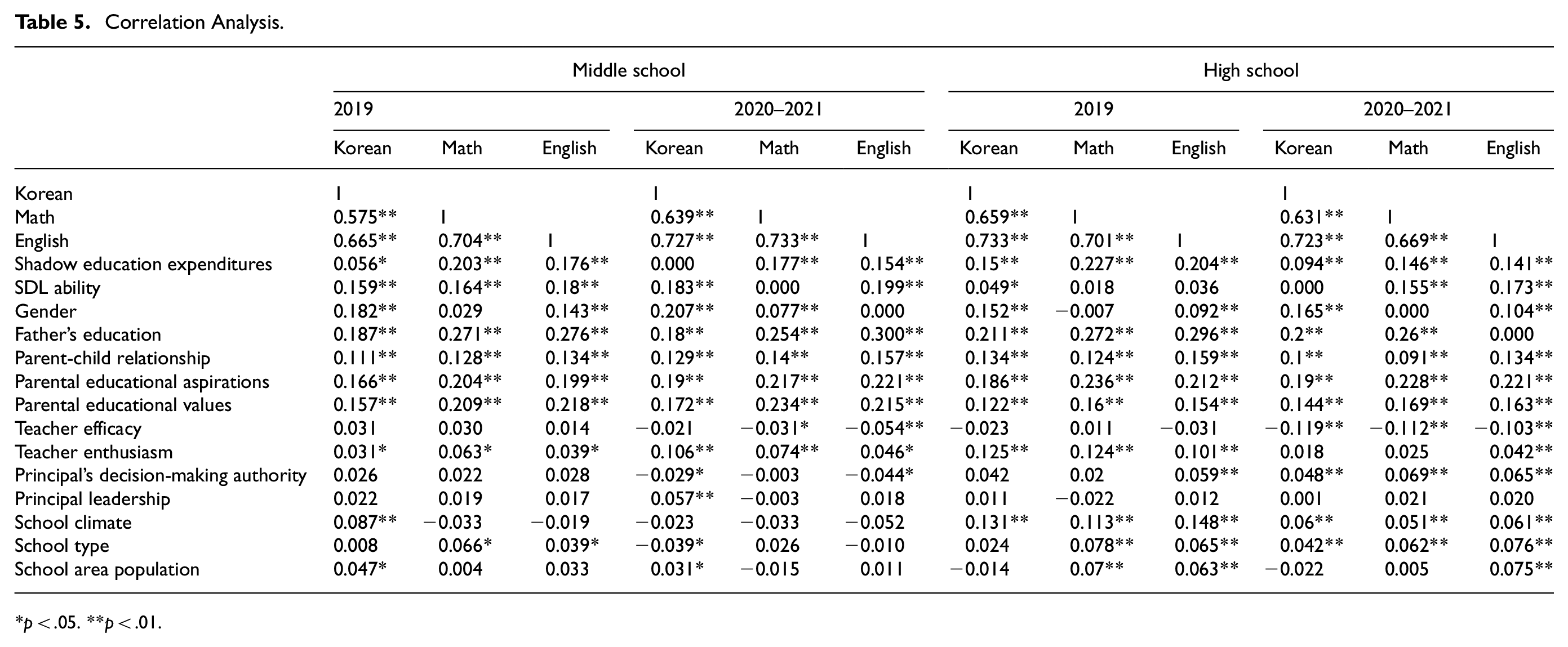
p < .05. **p < .01.
Analysis of Effects of Shadow Education Expenditures and Students’ SDL Ability on Student Achievement
As previously discussed, multiple regression was used for the analysis of the 2019 data, while random effects and two-way random effects models were employed for the 2020–2021 analysis. Table 6 presents the results of the analysis of the influence of student, parent, teacher, principal, and school factors on student achievement in the Korean language and literature subject area, measured by their performance on the Korean national standardized test.
Korean Language and Literature.
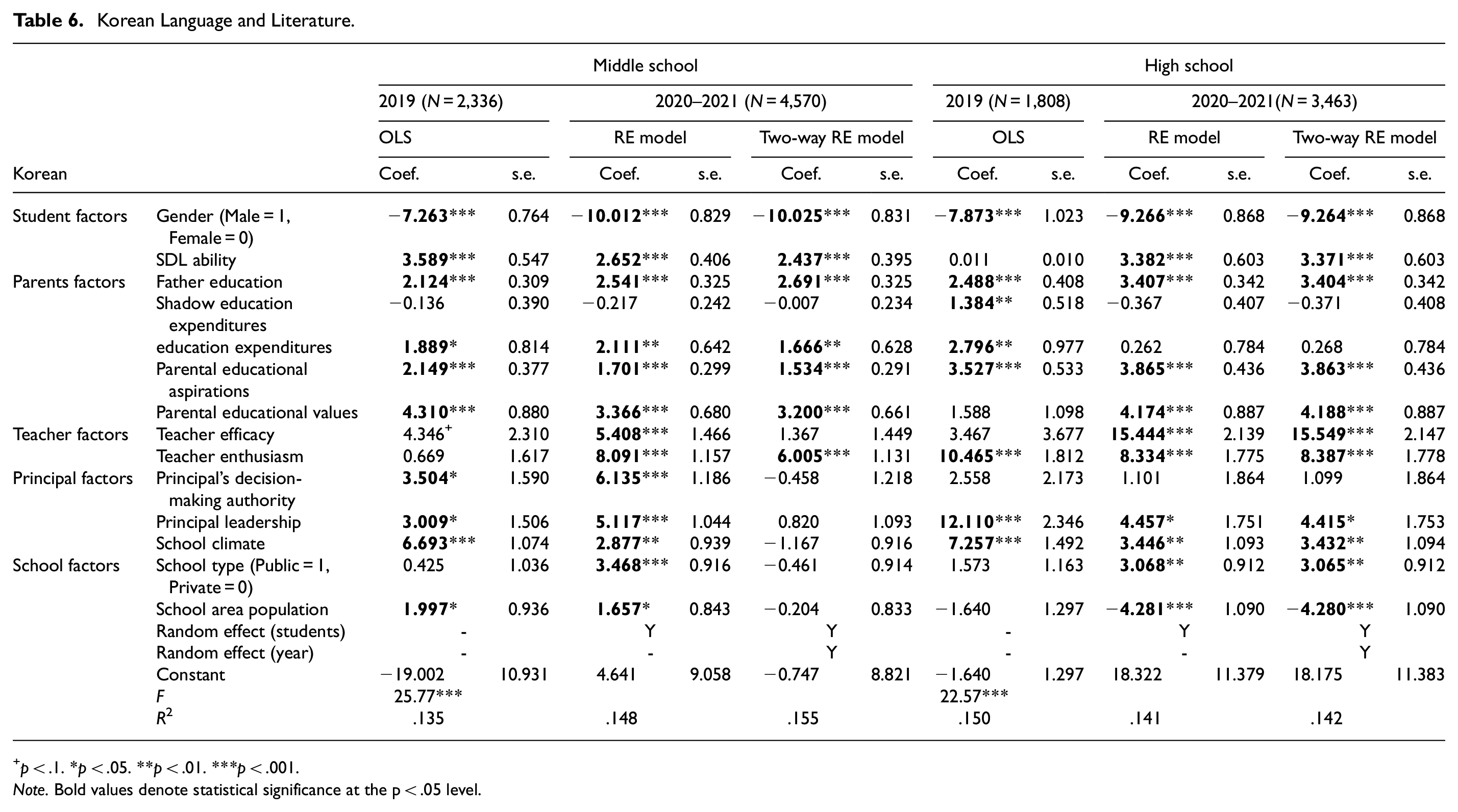
p < .1. *p < .05. **p < .01. ***p < .001.
Note. Bold values denote statistical significance at the p < .05 level.
Students’ SDL ability was shown to have a significant positive effect on student achievement for middle school students in 2019 (β = 3.589, p < .001) as well as 2020–2021 (random effects model: β = 2.652, p < .001; two-way random effects model: β = 2.437, p < .001). However, analysis of achievement of high school students showed a significant positive effect of SDL only for 2020–2021 (random effects model: β = 3.382, p < .001; two-way random effects model: β = 3.371, p < .001). During 2019, pre-COVID, as students had more access to classroom instruction as well as private tutoring, they would have likely not needed to rely as much on SDL ability to perform well on the standardized test.
Surprisingly, parents’ shadow education expenditures had a significant positive effect on student test scores in the subject area of Korean language and literature only for high school students in 2019 (β = 1.384, p < .01). Although parents invested a considerable amount of money to provide shadow education for their children, during the pandemic (2020–2021) face-to-face tutoring was limited due to the government-imposed restrictions, thus limiting the educational advantage that private tutoring normally provided.
The influence of some other variables (i.e., control variables) was also shown to be significant. Gender was found to be negatively significant for middle and high school students in both pre-COVID and COVID years of analysis. Father’s education, and parents’ educational aspirations were found to be positively significant for middle and high school students in both pre-COVID and COVID years of analysis. Also shown in Table 5, teacher factors, such as teacher efficacy and enthusiasm, had a positive significant influence on student achievement in the Korean subject area during the pandemic. This finding highlights the importance of teachers’ influence, especially during a crisis, thus emphasizing the need for policies and programs designed to improve teacher quality.
Principal leadership and school climate were found to have a consistent positive significant influence on middle and high school student achievement in Korean language and literature in both pre-COVID and COVID years. These findings indicate the importance of the principal’s leadership ability and the principal’s role in shaping a school environment that promotes teacher efficacy and student achievement.
The results of the analysis of the influence of student, parent, teacher, principal, and school factors on student achievement in the English language and literature subject area are presented in Table 7 below. SDL ability was found to have a significant positive effect on achievement for middle school students in 2019 (β = 4.410, p < .001) as well as 2020–2021 (random effects model: β = 2.346, p < .001; two-way random effects model: β = 2.128, p < .001). However, similar to the Korean language and literature results, analysis of achievement of high school students in subject area of English language and literature showed a significant positive effect of SDL only for 2020–2021 (random effects model: β = 3.164, p < .001; two-way random effects model: β = 3.215, p < .001). This finding is not surprising, as classroom instruction and private tutoring were more accessible in 2019, pre-COVID, and students would have likely not needed to rely as much on SDL ability to perform well on the standardized test.
English Language and Literature.

p < .1. *p < .05 **p < .01. ***p < .001.
Note. Bold values denote statistical significance at the p < .05 level.
Parents’ shadow education expenditures had a significant positive effect on student test scores in English for middle and high school students in the pre-COVID year of analysis, 2019 (middle school: β = 2.132, p < .001; high school: β = 2.285, p < .001). Despite parents’ high expenditures for shadow education for their children during 2020–2021, the COVID restrictions limited face-to-face tutoring, thus likely diminishing the advantage that private tutoring provided in pre-COVID years.
Gender was found to have a negative significant influence on student achievement in English in all years of analysis (2019–2021). Parental educational aspirations, and parental educational values—considered control variables in this study—were found to have a positive significant influence on student achievement in English in all years of analysis (2019–2021). These findings underscore the importance of parental influence on children’s achievement, confirming the findings reported in previous studies, such as Whitney et al. (2018), that reported the positive influence of parents who placed a high value on educational attainment. An interesting finding is that the parent-child relationship was found to be significant during the pandemic but not pre-COVID (2019), again confirming the important role of parental influence on children’s achievement during a crisis.
Teachers were also found to have a significant influence on student achievement in English for middle and high school students during the pandemic. Specifically, teacher efficacy and teacher enthusiasm positively and significantly influenced English achievement during 2020–2021, with the exception of teacher efficacy in 2020–2021 as shown by the two-way random effects model. These results highlight the positive influence of effective and enthusiastic teachers on their students’ achievement in English and point to the need for policies and programs that improve teacher quality and reward teacher enthusiasm.
Table 7 also shows that most of the analysis results for pre-COVID and COVID years showed a positively significant influence of principals (decision-making authority and leadership) and school climate on student achievement in English. These findings, similar to those reported for influences on Korean achievement, show the importance of strong principal leadership skills and principal involvement in maintaining a positive school environment for both teachers and students, especially during a crisis such as the pandemic.
Table 8 shows the results of the analysis of the influence of student, parent, teacher, principal, and school factors on student achievement in mathematics, as measured on the Korean standardized test. SDL ability was found to have a significant positive effect on achievement in math for middle school students in 2019 (β = 4.372, p < .001) as well as 2020–2021 (random effects model: β = 2.688, p < .001; two-way random effects model: β = 2.707, p < .001) and for high school students only in 2020–2021 (random effects model: β = 4.053, p < .001; two-way random effects model: β = 3.927, p < .001). This finding underscores again the importance of SDL ability especially during a crisis (e.g., COVID-19).
Math.

p < .1. *p < .05. **p < .01. ***p < .001.
Note. Bold values denote statistical significance at the p < .05 level.
Parents’ shadow education expenditures had a significant positive effect on student test scores in math for both middle and high school students in the pre-COVID year of analysis, 2019 (middle school: β = 3.083, p < .001; high school: β = 3.504, p < .001). The lack of significant influence of shadow education during 2020–2021 can most likely be attributed to the COVID restrictions that limited face-to-face tutoring and thus its educational advantage.
Interestingly, unlike the results for Korean and English achievement, the findings for achievement in math showed the negatively significant influence of gender only for middle school students during 2020–2021 (random effects model: β = −4.838, p < .001; two-way random effects model: β = −4.835, p < .001). Specifically, male students tended to have lower math test scores than female students in middle school. In contrast, parental influences including father education, parental educational aspirations, and parental educational values were all positively significant for student math achievement across all years of analysis (2019–2021), whereas parent-child relationship positively and significantly influenced math achievement of middle school students only in 2020–2021. Such findings again reinforce the importance of parental educational influence on their children’s academic achievement.
Teacher influence was also found to have a significant influence on student achievement in math for middle and high school students during the pandemic. Teacher enthusiasm positively and significantly influenced math achievement of middle and high school students in pre-COVID (2019) as well as COVID years (2020–2021). In contrast, teacher efficacy was found to be significant only for high school students only during the pandemic (2020–2021). This finding confirms again the importance of enthusiastic teachers who encourage their students especially during times of crisis. Therefore, more policies and programs that value and reward teacher enthusiasm and teacher efficacy are suggested.
Table 8 also shows that principals’ decision-making authority had no significant influence on middle and high school students’ math scores in pre-COVID and COVID years. Principals’ leadership, as well as school climate, was found to have a positively significant influence on math achievement only for high school students only during pre-COVID (2019). Again, compared to principals’ influence, the results underscore that teachers may play a more important role in helping students achieve higher scores in math during times of crisis.
Discussion
Summary of Main Findings
This study examined the influence of student, parent, teacher, principal, and school factors on student achievement in Korean, English, and math subject areas, as measured by performance on the Korean national standardized test, during the COVID-19 pandemic. The main purpose of this study was to compare the influence of shadow education expenditures and students’ SDL ability, both of which can give students an academic advantage, to determine which had the most positive impact on academic achievement during the COVID-19 pandemic.
The influence of shadow education expenditures and SDL ability were examined in three test areas: Korean language and literature, English language and literature, and math. Most interesting are the similar results regarding the influence of SDL on student achievement in all three subject areas. For achievement in Korean, English, and math, SDL ability was shown to have a significant positive influence on student achievement during the COVID-19 pandemic. These results underscore the importance of providing educational programs that help students develop their SDL ability, which can enable them to learn on their own when a crisis restricts the traditional teacher-guided classroom instruction. O’Shea (2003) asserts that SDL ability can help improve individuals’ self-confidence, autonomy, and motivation, as well as enable their lifelong learning.
Despite the positive influence of parents’ high expenditures to provide shadow education to complement their children’s public education during 2019 (pre-COVID), these high expenditures did not have a significant influence on achievement in the three subject areas during the pandemic (2020–2021). Again, these results support that SDL ability may be more effective than shadow education in enabling students to learn during a crisis that limits the traditional classroom instruction.
The findings of this study also revealed the positive and significant influence of other variables—namely, teacher factors (i.e., efficacy and enthusiasm), gender (with males tending to have lower achievement), father’s education, and parental influences—in all three subject areas (i.e., Korean, English, and math). Interestingly, principal leadership and school climate (a factor likely influenced by principal leadership) were significant influences on student achievement only in Korean and English language and literature, not math, during the COVID-19 crisis. This finding may point to a difference between learning a language and learning math. Brian Butterworth, emeritus professor of cognitive neuropsychology at University College London, asserted that our brain systems for learning math and language are quite different and independent (Hadhazy, 2011).
Limitations
This study has potential limitations that could be addressed in future research. The results of the analysis of influences on student achievement are based on data collected in one pre-COVID academic year and two academic years during the COVID pandemic. Extending the years of analysis (pre- and pandemic years) could more accurately identify patterns of influence and ensure generalization of the findings of this study. In addition, this study is limited to data collected in one country, South Korea. Despite the contributions of this focused research, a comparison of analysis of data from other countries would provide more in-depth investigation and possibly more insight into important influences on student achievement. Furthermore, this study’s examination of influences on student achievement was limited to test results in three subject areas: Korean, English, and math. Therefore, including other subject areas, such as science, could be beneficial not only for generalization of results but also for identification of other potential influential factors. Future research is also needed to examine the difference in influences on math achievement.
Implications and Conclusions
The findings of this study have implications for teachers, principals, parents, and students. First of all, the findings provide evidence that face-to-face instruction (i.e., teacher-guided classroom instruction) is more effective than online instruction. The significant results for the influence of teachers, principals, and school climate on student achievement during a crisis, such as COVID, underscore the importance of designing teacher preparation courses and professional development programs that improve teacher quality and principal leadership to ensure a school climate that most effectively promotes student academic achievement.
As SDL ability, compared to parental expenditures for shadow education, was shown to have more positive influence on student achievement during both pre-pandemic and pandemic years, more programs and policies that promote the development of students’ self-directed learning are needed. Although tuition is a highly variable issue, it is the quality of the teacher that matters. Professional development training workshops could be designed to better equip teachers with effective teaching strategies that help students acquire self-directed learning skills. The types of subjects that receive the most attention are also important since some of the students may only be tutored on weak subjects. Through promoting the acquisition and application of SDL skills, teachers can guide students in taking personal responsibility and ownership of their learning. Student-directed learning is driven by the students themselves and is closely aligned with their individual interests. Therefore, the students can more easily make the connection between what they learn and how it applies to them (Potter, 2020).
As facilitator, the teacher can play a significant role by guiding self-directed learners in using the most effective strategies for learning. John Dewey, acclaimed philosopher and educational scholar, explained that education is the agency that can facilitate students’ growth and development by guiding, rather than interfering with or controlling, their learning (Dewey, 1938). Accordingly, educational programs and policies should be developed at the national and local levels to ensure that teachers are trained and encouraged to employ strategies that are effective in developing students’ SDL skills for independent learning. Such strategies include using open-ended questions that will engage students in critical thinking, independent learning, and open discussion, and utilizing technology that encourages students to take more initiative in their learning (i.e., self-directed learning). Also, principals should support teachers in creating a student-centered learning environment in which students are motivated by a curriculum based on not only students’ needs but also their interests.
This study’s findings provide evidence that during an educational crisis, such as a pandemic, self-directed learning ability may have a more significantly positive impact on student achievement than parents’ high expenditures to provide shadow education for their children. A major contribution of this study is that it not only underscores the importance of developing students’ self-directed learning skills but also recognizes the potential positive influence of other factors such as teacher efficacy and enthusiasm, parental influences, and school climate. In our continuously and rapidly evolving world, lifelong learning has become essential for everyone. As we cannot always depend on others to guide our learning process, self-directed learning skills are required for success. From a theoretical perspective, SDL empowers students to be responsible and accountable for their own learning. It promotes active learning, rather than teacher-led passive learning (Oinam, 2017).
Students in South Korea have become dependent on private institutes that are believed to be advantageous in the fierce competition for admission to the top universities. Therefore, almost all Korean students participate in shadow education from elementary school to university admissions. At a recent world conference on research in education, Yoo and Yang (2021) asserted, “It is virtually impossible to drastically reduce shadow education in a short period of time because it is rooted in complex social issues such as a unique passion for education and a culture of driving for success.” They explained that efforts for change are required at the school, educational policy, and social levels, and that the Ministry of Education is currently focusing on developing policies to reduce education expenses and, most importantly, to improve public education (Yoo & Yang, 2021). Further research is needed. The Busan Education Longitudinal Study, the source of data for this study, provides a wealth of data that warrants further exploration and analysis.
Footnotes
Declaration of Conflicting Interests
The author declared no potential conflicts of interest with respect to the research, authorship, and/or publication of this article.
Funding
The author disclosed receipt of the following financial support for the research, authorship, and/or publication of this article: This paper was supported by Konkuk University in 2021.

Data Availability Statement
Data sharing not applicable to this article as no datasets were generated or analyzed during the current study.