




Abstract
The study explored (1) the relationship between university students’ goal orientations (according to the 3 × 2 model) and their academic achievement during COVID-19 pandemic, (2) differences in academic achievement by students’ levels in goal orientations, and (3) differences in university students’ goal orientations and academic achievement by gender, specialization, study level, and the interaction among them. Participants were 149 male and female students whose ages ranged between 18 and 42. The instrument used to collect data was the 3 × 2 (task-approach goals, task-avoidance goals, self-approach goals, self-avoidance goals, other-approach goal, and other-avoidance goals) Achievement Goal Questionnaire. A statistically significant relationship was found between goal orientations and academic achievement of university students. Total goal orientations did not affect students’ academic achievement during COVID-19 pandemic. However, self-avoidance goals and other-approach goals affected academic performance in favor of the average level of self-avoidance and the high level of other-approach. No statistically significant differences in goal orientations and academic achievement were found by gender. Yet, significant differences were found by specialization, the interaction between study level and gender, the interaction between specialization and gender, and the interaction among the three variables.
Introduction
For decades, researchers have been concerned with academic achievement and personality and environmental factors affecting it in an attempt to achieve the desired learning outcomes with varied environments, capabilities, and students’ interests and goal orientations. University students have academic goals with different orientations that affect academic achievement levels.
WHO (2020) reported cases of pneumonitis whose causes were unknown in Wuhan City, China on 31 December, 2019. Coronavirus was identified as the cause in January. Since then, the COVID-19 pandemic has become a challenge for educational systems all over the world. Governments in 119 countries closed schools, with 107 countries closing all schools and 12 countries closing schools in given territories. Closure of schools affected 861 million students all over the world according to data issued by the UNESCO (2020) on 18 March. By a ministerial decree issued on 08/3/2020, Saudi Arabia suspended attendance in all educational institutes all over the country to eliminate the spread of the virus. The decree recommended that educational institutes initiate virtual schools and distant learning during the closure of schools and actually this was implemented the following day. The Ministry of Education and other relevant entities have pursued efforts to monitor the distant learning process and update decisions based on emerging data. Since then, there has been a shift to distant learning in Saudi universities, with 1,421,000 virtual sessions delivered to 453,000 students from 8 to 13 March (the Ministry of Education).
Students’ academic goals differ with variations in the orientations of goals that they seek to achieve. Some students seek to increase knowledge and understanding of the learning material. These are goals that are focused on the task. Other students primarily seek to achieve high scores. These are referred to as performance goals. Students’ goals during learning times can be oriented toward interest in the learning process itself or achieving high scores (Eison & James, 1981). Various goal orientations play a significant role in students’ learning and achievement (Pajares et al., 2000; Pintrich, 2000). These orientations lead to adaptive and maladaptive models of emotion, cognition, and behavior. In mastery goals, the emphasis is placed on learning, mastering the task, challenge, curiosity, and competence development by exerting efforts. In performance goals, on the other hand, learners focus on comparing their abilities with others’, competition, and rewards (Mcwhaw & Abrami, 2001, p. 314). Goal orientations have also played different roles in online test anxiety and appeal for help. Appeal for help increases if goals are task or other-related. It decreases in the case of focusing on achieving competence that is self-related (Yang et al., 2016). Moawad (2020) reported that closure of Saudi schools and universities as a precaution against the spread of Coronavirus and the shift from conventional teaching to virtual teaching have aroused several fears and anxieties in Saudi university students which culminated in uncertainty about final exams.
Goal orientations that learners adopt in different learning contexts constitute one of the most important variables that affect their academic achievement. They also play an important role in predicting university students’ academic achievement (Menon, 2015). Goals were initially classified dichotomously into learning goals and performance goals (Dweck & Leggett, 1988) and mastery goals and performance goals (Ames & Archer, 1988). Then, three-factor (mastery goals, approach performance goals, and avoidance performance goals) and four-factor (the same goals in the three factor model plus avoidance mastery goals) models of goal orientations appeared (Elliot, 1999). Gavaza et al. (2014, p. 1) added a fifth orientation, that is, work-avoidance, which refers to students who tend to exert little effort to achieve their academic endeavors with no desire to develop skills and weak internal locus of control. The 3 × 2 achievement goal model included the definition and valence of components of competence. It encompasses six goal constructs: task-approach, task-avoidance, self-approach, self-avoidance, other-approach, and other-avoidance (Elliot et al., 2011, p. 634).
Goal orientations have been theoretically interpreted based on several models beginning with the 2-factor model and ending with the 3 × 2 model which is adopted in the present study. That is, the study would explore the impact of the 3 × 2 goal achievement model on students’ academic achievement during COVID-19 pandemic.
Statement of the Problem
The research problem in the present study relates to the COVID-19 pandemic and its effects on university education and the way Saudi universities have managed distant education to eliminate the negative effect on students’ academic achievement. During the pandemic, there has been pressure on educational systems and students who have been concerned about the effect of the pandemic on their performance. Although education in Saudi universities has continued smoothly with the help of distant learning systems like Blackboard, Zoom, and Microsoft Teams, some students withdrew from semesters to avoid negative effects on their GPAs. It has been also observed through direct experience that students were uncertain about assessment. In virtual sessions, students have repeatedly asked staff members including the author about the way they would be assessed and the possibility that their GPAs might be affected. They feared that they could not perform well in exams and that their assessment might not be fair compared to their colleagues in previous semesters. Staff members could not answer such questions to create an atmosphere of psychological security for the optimal continuity of the educational process. No clear answers could be given to these questions owing to emergents of the pandemic and the accompanying precautions.
The Saudi Ministry of Education has been judicious in its management of the crisis. It considered students’ welfare by emphasizing the continuity of the educational process and communication between staff members and students. It directed staff members to alleviate pressures on students. It also replaced the conventional results system with a system wherein students get either pass or fail in courses, so their GPAs would not be affected. However, these procedures were not sufficient for some students. It is noteworthy here that the researcher noted that there were variations in students’ involvement in learning and performance of academic tasks. Some students did assignments and performed in a way that would result in their just passing courses. Others were very punctual, interacted well in virtual sessions and did tasks well. A third group of students sought much more facilitation with their study. Some students even withdrew from courses and semesters. Since academic achievement and personality and environmental factors affecting it have recently captured researchers’ interest, the impetus to conduct the present study stemmed from the need to explore the impact on students’ academic achievement of the COVID-19 pandemic as an environmental factor that have affected education in all educational levels all over the world. Furthermore, goal orientations represent a personality factor that affects performance and learning outcomes.
A study was conducted on College of Education students at King Saud University a week after the shift to distant education to explore academic exhaustion resulting from the pandemic. Having completed a researcher-developed questionnaire, students were found to have six fears or stressors: tests in terms of type and date, tasks in terms of type and amount, lecture times, home academic settings (lack of computers or small-spaced houses), and fairness of online tests (Moawad, 2020).
Parents and students had many inquiries and doubts about learning mechanisms and resulting requirements, assignments, and results. This period has been accompanied by feelings of anxiety and uncertainty about emergents of the pandemic and the possibility to return to colleges. Also, there have been discussions among educators and practitioners about the possibility of students achieving learning outcomes at levels comparable to those achieved in normal circumstances. In this respect, the minister of education issued a decree to nominate a committee to develop a proposal for testing and coursework arrangements during the suspension of conventional study during the pandemic. On 18/3/2020, the committee issued several recommendations, for example, pursuing formative electronic assessment and using assessment tools rather than exams like term papers, reports, and assignments. In case suspension continued until final exams, the committee recommended that end-of-semester assessment be implemented electronically using formative assessment, electronic exams, open book exams, oral exams, presentations, discussion boards, and e-portfolios. The committee also recommended using a grading system according to which the student passes or fails courses, that is, pass without score if the score weight is less than his/her GPA. Universities were also given the choice to postpone high-stake tests if necessary. There was also a recommendation to expand the time during which students, including those with study loads less than 12 hours could withdraw from courses or semesters. It was decided that those withdrawings would not be discounted from students’ permissible opportunities of withdrawing. The detailed statement of the executive mechanism of study and exams for the second semester (412) was issued on 15 April, 2020.
Thus, students had the choice to withdraw, apologize, or pursue study with anxiety about whether their GPAs would be unaffected or affected negatively or positively. These anxieties were accompanied by uncertainty about the time span of the pandemic with no clear indication of a close return to conventional education. Since students have different goal orientations during learning, their responses during the COVID-19 pandemic can also be different. For this reason, this study was conducted to explore the impact of the COVID-19 pandemic on Saudi university students’ academic performance in terms of their achievement goal orientations. More specifically, the study addressed the following question: “What is the impact of goal orientations on university students’ academic achievement during COVID-19 pandemic?”
Aims of the Study
The study aimed to identify:
- University students’ level of goal orientations.
- The relationship between university students’ goal orientations and academic achievement.
- Differences in academic achievement by levels of goal orientations.
- Differences in goal orientations by gender, study level, and specialization.
Significance of the Study
Significance of the present study lies in exploring the impact of the COVID-19 pandemic and precautions relating to it on Saudi university students’ academic achievement in the light of their goal orientations based on the 3 × 2 model. Results of the investigation can inform educators about the role of goal orientations in managing learning and academic achievement during the COVID-19 pandemic. The study was expected to identify which goal orientations are of greater impact on academic achievement. Finally, results can help students manage their learning and achieve learning outcomes through enhancement of their goal orientations.
Definition of Terms
Goal Orientations
Ali (2015, p. 131) defines goal orientations within the 3 × 2 model as the individual’ tendency to approach or avoid specific academic tasks based on the nature of task, the impact of others or self-monitoring. There are six achievement goals: task-approach, other-approach, self-approach, task-avoidance, other-avoidance, and self-avoidance. The author defines goal orientations operationally as the student’ score on the goal orientations questionnaire.
Education During the COVID-19 Pandemic
It refers to distant education that Saudi universities initiated in the eighth week of the second semester of the academic year 2019 to 2020 during the spread of Coronavirus wherein attendance in educational institutes was suspended as a preventive measure. During that period, instruction was delivered to students using distant learning systems like Blackboard. Also in that period several ministerial decisions were issued to identify assessment mechanisms and calculation of students’ GPAs.
Academic Achievement
Academic achievement refers to students’ assimilation of knowledge and skills that they learn in study courses. It is measured by mean scores students get in study courses. Operationally, it is represented by students’ GPAs in the second semester of the academic year 2019 to 2020.
Review of Literature
Goal Orientations
Goal orientation provides students with cognitive guidance that guides them in performing academic tasks to achieve optimal learning. Goal orientations can motivate students to promote their skills, knowledge, and thinking to engage effectively in learning activities. This motivational thinking can also foster self-regulated learning. The student who strives to get high marks can engage in various thinking and behavioral processes to outperform others in learning and skill development (Mattern, 2005). Students’ goal orientation is related to their perceptions about success, competence, mistakes, and the effort exerted in the learning situation. Students can be driven by different goal orientations based on the learning situation. Some students pursue mastery goals that focus on learning, skill development, creativity, and quick understanding. Such students normally have greater interest in learning and positive attitudes toward it. They look at mistakes as a consequence of lack of correct information rather than deficiencies in their abilities. They exert the due efforts to perform their academic tasks and persist in the face of challenges (Pintrich & Schunk, 2002).
Goal orientation is a variable that clearly impacts students’ achievement. It can be performance-oriented. Students pursuing performance goals focus on the impressions that their learning leave on others. Students pursuing mastery goals, on the other hand, focus on skill mastery. Such students are more effective in processing information and primarily respond to self-motives. Orientation to performance and mastery goals fosters students’ persistence and promotes their learning (Al-Shemri, 2012, p. 3). Goals are viewed as cognitive representations of future events. They are important for the motivational components of behavior. They shape students’ orientations toward achievement and reflect their beliefs and perceptions about academic success (Wentzel, 1999, p. 76).
Students pursuing mastery goals adopt self-standards which they use to judge their performance. On the other hand, students pursuing performance approach and avoidance goals use external standards, that is, comparing their performance with the performance of others. Students with approach goals seek to achieve positive results, while students with avoidance goals seek to avoid negative results (Yang et al., 2016). Since goal orientation relates to students’ understanding of various learning activities and their engagement in them (Tuckman, 1999, p. 6), it is reflected in student behavior in two orientations:
Orientation toward learning (mastery), which describes students who conceive of their learning experiences as an opportunity to acquire knowledge and master information. Students with this orientation continually desire to excel and raise the level of their personal competence and have positive attitude toward learning (Braten & Olaussen, 1998, p. 182). Mastery is an internal orientation referring to students’ awareness of the causes and significance of engagement in the situation or the academic task. It indicates that students perceive the academic task as an end in itself, rather than a means to an end (Hassan, 1999, p. 107).
Orientation toward performance, which is an external orientation relating to awareness of causes of engagement in a task, for example, marks, rewards, and others’ evaluation. Here students are concerned with external causes and issues and not the task itself. Such students seek to get high marks as their performance motivation. They do not have learning styles that distinguish them from other students and they do not seek new information. They desire to reveal their high abilities to others (Roedel & Schraw, 1994, p. 1015).
Elliot et al. (2011) developed a 3 × 2 model of achievement goals based on two studies. The first study was conducted on 126 and the second on 319 university students. In both studies, confirmatory factor analysis revealed a 3 × 2 model of achievement goals that interrelate positively. In several studies conducted on university students, goal orientations and academic self-efficacy affected students’ academic achievement and predicted academic success (Karle, 2016; Menon, 2015; Suprayogi et al., 2019). Elliot et al. (2011) found a correlational relationship between task approach goals, intrinsic motivation, and learning effectiveness. They also found a relationship between other-approach goals, test performance, and learning effectiveness. Self-approach goals related positively to vitality inside the learning environment, whereas self-avoidance goals related negatively. Other-avoidance goals correlated negatively with test performance and learning motivation and positively with test anxiety. Performance goals and learning goals in the two-factor model of achievement goal correlated with academic self-efficacy. Learning goal orientations can significantly predict academic self-efficacy. Goal orientations correlated with intrinsic motivation and academic self-efficacy. A relationship was also found between (1) learning goal orientation, academic self-efficacy, and intrinsic motivation and (2) performance goal orientation, academic self-efficacy, and intrinsic motivation (Mahasneh & Al-alwan, 2011). In a study conducted on Saudi university students, Al-Watban (2013) found no differences in goal orientation structure according to the 3 × 2 model by gender or specialization. Al-Shawashreh et al. (2017) reported high levels of metacognitive thinking associating goal orientations. A positive relationship was found between mastery goals and all dimensions of metacognition. No significant differences were found in the two variables by gender. Statistically significant differences on the metacognition questionnaire were found between students with good and very good achievement in favor of students with very good achievement. Similarly, there were statistically significant differences in goal orientation between excellent and good levels in favor of the excellent level.
Classification of achievement goals began with the two-factor model where goals were classified into learning goals and performance goals (Dweck & Leggett, 1988) and into mastery goals and performance goals (Ames & Archer, 1988). After that, the three-factor (mastery goals, approach performance goals, and avoidance performance goals) emerged, followed by the 2 × 2 model that added avoidance mastery goals (Elliot, 1999). Gavaza et al. (2014, p. 1) further added a fifth orientation which is work avoidance. Work avoidance orientation refers to students who tend to exert less effort to achieve their academic endeavors with no desire to develop skills and weak internal locus of control. The 3 × 2 model encompasses (1) the definition of competence related to self, others, and task and (2) valence: positive task approach and negative task avoidance.
The 3 × 2 model of achievement goals that is adopted in the present study encompasses six goal orientations (Mascret et al., 2015, 2017; Méndez-Giménez et al., 2017; Yang et al., 2016):
Task-approach goals: focus is on achieving competence through performing the task correctly and skillfully.
Task-avoidance goals: focus is on avoiding the task, hence hindering understanding and learning.
Self-approach goals: performing better than before to achieve competence based on self-standards.
Self-avoidance goals: avoiding performance for fear of performing worse than before based on self-standards.
Other-approach goals: achieving competence by performing better than others.
Other-avoidance goals: avoiding incompetence by performing worse than others.
The six goal orientations can predict scholastic achievement of university students with a contribution of 81%. The Task-approach dimension headed other dimensions in predicting achievement with a contribution of 76%, followed by other-avoidance and self-avoidance (Ali, 2015). According to the 3 × 2 model, worry about online exams and help-seeking can be predicted among students in distant education programs (Yang et al., 2016).
Education During the COVID-19 Pandemic
The emergent COVID-19 pandemic was first reported in Wuhan City in China on 31 December, 2019. On 30 January, WHO (2020) announced a state of emergency in dealing with the emergent virus that changed into a pandemic with 77 countries reporting infections with the virus. Several countries could eliminate the spread of the virus. Kingdom of Saudi Arabia took several preventive measures in response to the pandemic. Among these measures was suspension of study all over the kingdom beginning from 9 March, 2020 until further notice. A shift from conventional education to distant education in all educational stages was also initiated. That period represented a great challenge for educational systems in many countries all over the world. It was imperative during that period to spread psychological reassurance among parents and students, increase the teaching power in distant education, and find flexible ways to alleviate the pandemic’s adverse effects on learning (Daniel, 2020). However, distant education was likely to fail if (1) faculty members were not well-trained on the use of distant education applications, (2) training courses were not designed properly, and (3) financial support was not sufficient (Rovai & Downey, 2010). Furthermore, the need to depend on recent technologies in distant education could affect the success of the whole educational process (Al Meajel & Sharadgah, 2018). In this respect, it is noteworthy that 32% of students reported uncertainty about final exams and assessment. They doubted if their assessment would be fair. A 17% of them also reported having problems with internet access in terms of speed and cost. Some students were worried about their ability to use distant learning platforms and hence took training courses on Blackboard and other applications. About 16% of students asserted that home-based learning is not comfortable and 13% of them had the fear that assignments would increase and that it would be difficult to obtain the references to help them with the assignments (Moawad, 2020).
Study Hypotheses
There is a statistically significant relationship between university students’ goal orientation and academic achievement during the COVID-19 pandemic.
There are statistically significant differences among university students in goal orientations and their levels by specialization and study level.
There are statistically significant differences among university students in academic achievement by goal orientations.
There are statistically significant differences among university students in goal orientations and academic achievement by study level, specialization, and their interaction.
Method
Since the present study is correlational in nature, the descriptive analytical method that suits the study of correlations and differences was used. The target relationships and differences included (1) the relationship between goal orientations and academic achievement and (2) differences in goal orientations by gender, specialization, and study level.
Participants
Study population was male and female students in the second semester (412) of the academic year 2019 to 2020. The study sample consisted of 149 students (91 males and 98 females) whose ages ranged between 18 and 42. Of those 149 students, 23% were in human and administrative majors, 27% in scientific majors, 7% in engineering and computing majors, 12% in health majors, 10% in language and arts majors, and 21% in medical majors. As to study level, 14% were in the first and the second levels, 20% in the third and the fourth levels, 28% in the fifth and sixth levels, 32% in the seventh and eighth levels, and 4% in practicum. Characteristics of participants are listed in Table 1.
Characteristics of the Study Sample.

Instruments
The Achievement Goal Orientations Questionnaire (Ali, 2015) was used in the present study. It consists of 30 items distributed under six dimensions: task-approach, task-avoidance, self-approach, self-avoidance, other-approach, and other-avoidance. Each dimension has five items. Responses to items are given based on a three-point scale: often, sometimes, and rarely. The questionnaire includes some negatively worded items: 16, 22, 23, 28, and 29. And the validity of Questionnaire was tested by content which remain all items and discrimination validity in compare between highest 27% of students’ scores and lowest 27% on all items of Questionnaire then all get value of (z) score more than (1.69), which means ability of discrimination between highest and lowest students for all six dimensions. Also reliability verified by Cronbach’s alpha to measure internal consistency, and the values were (.67, .75, .78, .65, .74, and .71) for all six dimensions in ordering. Also Spearman-Brown for split-halves was (0.69) which is acceptable for reliability. Academic achievement was measured by students’ GPAs.
Statistical Analysis
Pearson correlation coefficient was used to explore the relationship between achievement goal orientations and academic achievement. One-way analysis of variance (ANOVA) was used to explore the effect of achievement goal orientations on academic achievement. Finally, multiple analysis of variance (MANOVA) was used to explore differences in achievement goal orientations and academic achievement by gender, specialization, and study level.
Results
The first hypothesis: There is a statistically significant relationship between university students’ goal orientation and academic achievement during the COVID-19 pandemic.
To test this hypothesis, Pearson correlation to measure linear relationship between total scores of achievement goal orientations and academic achievement was calculated. These results are listed in Table 2.
Correlations Between Total Scores of Goal Orientations and Academic Achievement.

It is clear from Table 2 that there was a correlation (r = .154, p = .05) between achievement goal orientations and academic achievement, but weak relation (Lehman, 2005).
The second hypothesis: There are no statistically significant differences among university students in goal orientations and their levels by specialization and study level.
To test this hypothesis, students’ scores on the Achievement Goal Orientations Questionnaire were converted into three levels for the whole questionnaire and each sub-dimension. The percentages of levels are shown in Table 3.
Levels of Achievement Goal Orientations.

Data in Table 3 reveals that 53% of the students scored high on achievement goal orientations. The largest percentage of students (83%) scored high in task-approach and self-approach achievement goals, followed by 78.4% of students scoring high in self-avoidance. Other-avoidance goals achieved the lowest percentage of the high level of goal orientations.
To identify the effect of specialization, study level, and their interaction on levels of achievement goal orientations, two-way ANOVA analysis of variance was calculated. is used to estimate how the mean of a quantitative variable changes according to the levels of two categorical variables (specialization, study level), on the dependent variable (goal orientations). These results are presented in Table 4.
The Effect of Specialization and Study Level on Goal Orientations.

Data in Table 4 shows that achievement goal orientations were not significantly affected by specialization, study levels, or their interaction.
The third hypothesis: There are statistically significant differences among university students in academic achievement by goal orientations and their sub-dimensions.
To test this hypothesis, one-way ANOVA analysis of variance was calculated to understand how different groups respond, identify differences in students’ academic achievement by level of achievement goal orientations (high, average, and low). Table 5 presents these data.
Differences in Academic Achievement by Level of Goal Orientations.
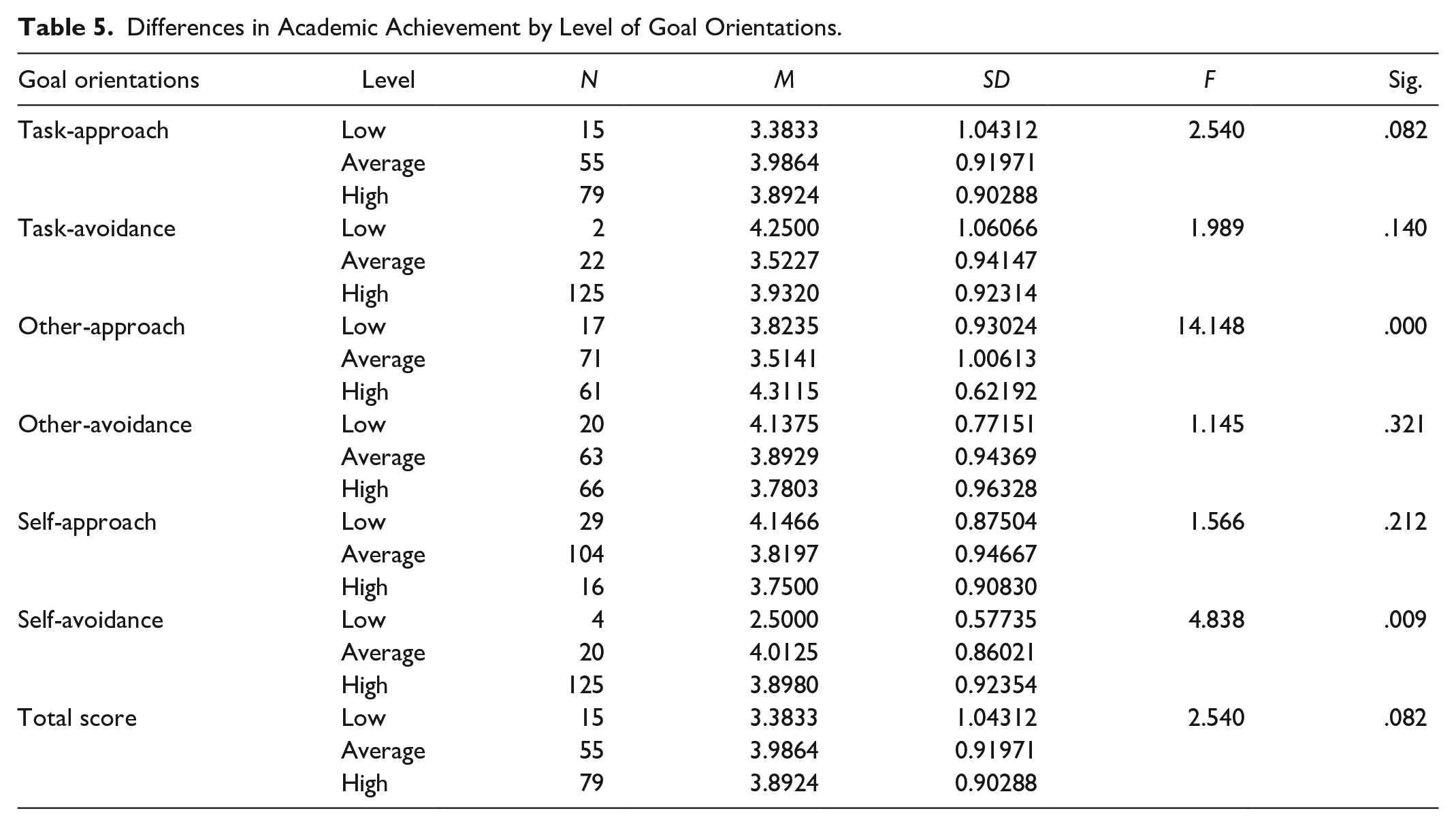
It is observed from Table 5 that there were statistically significant differences in students’ academic achievement by their level of other-approach and self-avoidance goals. Meanwhile, no statistically significant differences in students’ academic achievement were found by the other goal orientations or total scores. It is also observed that mean scores are higher for students with high level of task-approach goals and students with average level of self-avoidance goals.
The fourth hypothesis: There are statistically significant differences among university students in goal orientations and academic achievement by study level, specialization and their interaction.
MANOVA was calculated using the Wilks lambda test because there are differences between the means of identified groups of subjects on a combination of dependent variables, so it is identify differences in academic achievement and goal orientations by gender, specialization, and study level. These results are shown in Table 6.
Differences in Academic Achievement and Goal Orientations by Gender, Specialization, and Study Level.

It is clear from Table 6 that there were statistically significant effects on all goal orientations and academic achievement by specialization, the interaction between specialization and gender, the interaction between study level and gender, and the interaction among gender, specialization, and study level. The direction of effect is shown in Table 7.
The Direction of Effect on Academic Achievement and Goal Orientations by Gender, Specialization, and Study Level.

As shown in Table 7, gender and study level did not have significant effect on goal orientations or academic achievement. Specialization had a significant effect (p = .04) on goal orientations. The interaction between (1) specialization and gender and (2) gender and study level had a significant effect (p = .02 and .00, respectively) on goal orientations. Finally, the interaction among specialization, study level, and gender had a significant effect (p = .01) on academic achievement.
Discussion
The results of the present study concerning the relationship between university students’ goal orientations and academic achievement are consistent with many previous studies (e.g., Karle, 2016; Menon, 2015). Similarly, the results are in line with previous studies (e.g., Mahasnah & Alalwan, 2011; Mahasnah et al., 2019; Suprayogi et al., 2019) concerning the effect of goal orientations, academic self-efficacy, and intrinsic motivation on students’ academic achievement. Results revealed that only 53% of the participants reported high levels of goal orientations. This partially concurs with the study conducted by Al-Shawashreh et al. (2017) that used a different achievement goals model. Results also revealed significant differences in academic achievement in favor of students with other-approach and task-avoidance goals. Concurring with previous studies (Al-Shawashreh et al., 2017; Mahasnah et al., 2019), the interaction between gender and study level had a significant effect on academic achievement. So these results support previous studies’ result about the importance of goal orientations for students in facing difficulties in study and changing in the learning environment circumstances like learning in different ways of teaching, moreover changing evaluation system during COVID-19 pandemic time. Therefore, educational specialists and researcher must focus on Techniques and methods which can influence or improve students’ goal orientations for its impact on their academic achievement.
Implications
As revealed by results, students with high levels of achievement goals had better academic achievement than students with low levels of achievement goals during the COVID-19 pandemic. It is therefore imperative to promote university students’ goals orientations to help them getting better academic achievement in face of any academic or environmental obstacles during their educational journey. Students’ level in other-approach goals was low. That is, students tended to avoid tasks that gave a negative picture about them among their colleagues. This deficiency should be addressed in order to avoid negative effects on students’ learning, academic efficacy, and achievement. Other-approach goals (i.e., approaching academic tasks to excel others) proved to have a strong effect on academic achievement. Teachers should focus on this goal orientation to stimulate students and promote their academic efficiency. Self-avoidance goals (i.e., avoiding tasks in which current performance may not be as previous performance) strongly affects academic achievement. Students holding this goal orientation need self-promotion. Teachers should encourage students to adopt positive academic goals and give them appropriate academic assignments that promote self-esteem and competition with others without the fear from making mistakes and being evaluated by others. Finally, learning environments should support students to adopt self-, task-, and other-based goals orientations which contributing in their academic success.
Footnotes
Declaration of Conflicting Interests
The author(s) declared no potential conflicts of interest with respect to the research, authorship, and/or publication of this article.
Funding
The author(s) disclosed receipt of the following financial support for the research, authorship, and/or publication of this article: Researcher would like to thank the Deanship of Scientific Research, Qassim University for funding publication of this project
