




Abstract
This study assesses the degree to which students practice digital citizenship values at Prince Sattam bin Abdulaziz University. The researchers identified elements of digital citizenship and divided them into three areas: respect, education, and protection. Following a descriptive approach, the sample consisted of 540 male and female students who were randomly selected. The study found strong results in all three areas, although protection had the lowest practice. Female students were significantly more likely than male students to practice these values. Significant differences were also found according to field of study.
Keywords
Introduction
Social networking sites offer new methods of civic engagement, collaborating on projects with peers around the world, and sharing photos, videos, and opinions (Fingal, 2020). Despite the many benefits of these networks, they can also be used for deception and illegal or otherwise unethical activity (M. Ribble & Miller, 2013), such as violating intellectual property rights, cyberbullying, disrespecting others, and fraud. Thus, many educators have called for schools and universities to better prepare students to interact online, exercise their digital citizenship, and protect themselves from the potential dangers of social media (A. H. Al-Qahtani, 2021; Al-Saadoun, 2019).
Universities have a duty to instill students with a sense of responsibility when using digital technology (Abbas, 2011). This is because the role of higher education has expanded to guiding and mentoring students and society (M. Ribble, 2015). Faculty are also expected to become digital leaders in their university communities, such as by designing creative activities related to the positive elements of digital citizenship, highlighting the dangers of digital technology, and developing critical and constructive thinking skills about online content.
The COVID-19 pandemic has further pushed students to use digital tools in every area of their lives (Öztürk, 2021; Ranchordas, 2020). This shift calls for regulations that encourage students to act responsibly, ethically, and safely in digital environments. Such responsible online behavior has been called digital citizenship (M. Ribble, 2008; M. S.Ribble et al., 2004).
Digital citizenship refers to online behaviors that ensure the legal, safe, ethical, and responsible use of information and communication technology (Elcicek et al., 2018; Goode, 2010; Oxley, 2011). Digital citizenship standards are among the most important measures adopted by the International Society for Technology in Education in 2009 and applied in different curricula. Ribble developed digital citizenship standards in 2011 to provide a balance between giving access to digital technology and preventing misbehavior by clarifying the penalties for non-compliance (Ribble, 2015).
Saudi Arabia has adopted policies for using online networks and computers in government institutions, such as requiring organizations to develop their own information security programs and define policies for accessing digital platforms, risk and property management, and managing information security incidents (Bureau of Experts, Council of Ministers, 2019). Nevertheless, some universities have not realized the importance of disseminating these policies to the extent required for university students to read and adhere to them (Al-Saadoun, 2019). This has also negatively affected the degree to which students practice safe, ethical, and responsible behavior in the digital sphere. Moreover, some universities have failed to recognize these policies’ potential to inculcate digital citizenship behaviors among undergraduates. For this reason, the current study sought to discover the degree to which Prince Sattam Bin Abdulaziz University (PSAU) students practice the values of digital citizenship.
Problem Statement and Objectives
Hill (2015) emphasized the urgent need to investigate digital citizenship, while Ribble (2015) called on education leaders to promote the positive aspects of new technology and minimize negative aspects. Many studies have examined students’ awareness and perceptions of the components of digital citizenship (e.g., Abbasi & Hamdi, 2020; Al-Hanafi, 2021; Al-Momani & Alsmadi, 2020; A. H. Al-Qahtani, 2021; Al-Rashidi, 2021; Cubukcu & Bazyan, 2016; Naji, 2019; Nassar, 2019). Abbasi and Hamdi (2020) reported that University of Jordan students held an average understanding of the digital citizen, and Al-Sulayhat et al. (2018) showed similar results, while Tawalba (2018) showed that Yarmouk University students were aware of their digital practices and the impact on their citizenship values.
Some research on digital citizenship has focused on the mechanism of developing effective skills through programs and adding them to the curricula (e.g., Ahmed, 2021; Al-Juhani & Al-Ruhaili, 2020; Al-Khurisat, 2019; A. Al-Qahtani, 2018; Tapingkae et al., 2020). However, few studies (e.g., Domingo & Guerrero, 2018; Kara, 2018) have explored the degree to which undergraduates practice these values when using digital technology.
Furthermore, most previous studies have focused on awareness of digital citizenship and its elements among teachers and students in general education, not higher education (Blevins et al., 2014; Gazi, 2016; Hill, 2015; Hollandsworth et al., 2011; M. Ribble, 2008, 2012; M. S. Ribble & Bailey, 2004). The current study sought to bridge this gap with the following objectives:
Identify the degree to which PSAU students practice digital citizenship values in the areas of respect, education, and protection.
Identify the impact of gender and field of study on PSAU students’ practice of these values.
Based on the above aims, the study sought to answer the following main research question: To what extent do PSAU students practice digital citizenship values in terms of respect, education, and protection? This question was divided into the following sub-questions:
To what extent do PSAU students practice the digital citizenship value of respect?
To what extent do PSAU students practice the digital citizenship value of education?
To what extent do PSAU students practice the digital citizenship value of protection?
Does gender have a significant effect on PSAU students’ practice of digital citizenship values?
Does field of study have a significant effect on PSAU students’ practice of digital citizenship values?
Significance of the Study
The results of this study contribute to current knowledge about university students’ practice of digital citizenship values and could help guide learners toward safe, optimal use of digital technology. The results could inform curriculum design, policymakers, and educators by drawing attention to these values and current practice and could provide researchers with a theoretical and practical reference point. The research could provide useful feedback to learners, educators, and administrators at Saudi universities about the need to include digital citizenship values in coursework.
Limitations
The limitations of this research are as follows:
Substantive: The study was limited to three basic themes of digital citizenship: respect, education, and protection.
Temporal: The study was conducted during the second semester of 2020 (1442 AH).
Spatial: The study was limited to a random sample of students at PSAU.
Theoretical Framework
M. Ribble (2008) defined digital citizenship as the norms of appropriate and responsible behavior with regard to technology use. In this sense, a digital citizen is someone who has the ability to use information technology appropriately in different situations, such as official transactions, social communication, and education (Yildiz et al., 2020). The operational definition in this study was a set of values applied to use digital tools safely and effectively in all areas of life, but especially in education.
Although previous studies have given digital citizenship different definitions, they share a common meaning. For example, Hollandsworth et al. (2011) described it as the online version of traditional society, where people can socialize, receive education, trade, work, buy, and entertain online. M. S. Ribble and Bailey (2004) defined it as the norms of behavior for technology use, and M. Ribble (2008, 2009) defined it as a responsible and appropriate use of technology. Al-Kout (2015) argued that the concept evolves according to societal trends. The term is emblematic of the influence of digitization on the concept and practices of citizenship, as today’s youth increasingly turn to the Internet for information and to communicate with others.
The above definitions reveal that digital citizenship focuses on the behavior and interaction of people using digital resources, such as websites and social media. They also show that digital citizenship concentrates on using such resources to promote respectful and tolerant behavior among learners as well as increasing civic cooperation (Jones & Mitchell, 2016). Furthermore, it can facilitate individual development and protect social values in digital communities (Gazi, 2016).
Digital citizenship can be characterized broadly as an awareness of the components of digital citizenship, having the skills to effectively use digital tools, and practicing ethical behavior that ensures socially acceptable interaction (Alqahtani et al., 2017).
Some educators (e.g., M. Ribble, 2011; M. S. Ribble & Bailey, 2004) have suggested three categories or areas of digital citizenship: respect, education, and protection. These three categories include nine elements that illustrate the general framework of digital citizenship, as described below.
First Area: Respect (for Oneself and Others)
Research has shown that Internet access leads people to participate in digital citizenship activities in areas such as politics and economics (Mossberger et al., 2012), and connecting to online services is key to sustaining such practices (Kara, 2018). Information technology is thus an important factor helping citizens interact with friends, family, employers, and the government. Countries have therefore paid growing attention to applying e-government. Saudi Arabia, for example, established a law in 2003 to ensure all government functions and services could be accessed via the Internet and thereby protect equal digital rights, such as issuing passports, traffic fines, national identity papers, and renewing residency (Noor Al-din & Suriya, 2014). This area includes the following elements:
Second Area: Education (Teaching and Learning)
The second area includes the following elements:
Third Area: Protection
The third area includes the following elements:
Previous Studies
Kara (2018) employed a mixed-methods interpretive study to investigate the practices and ideas of 435 university students regarding digital citizenship. A questionnaire on a 5-point Likert scale was used to collect the quantitative data, which were analyzed via factor analysis, descriptive statistics, and parametric testing. The quantitative results showed that college students preferred not to engage in political activities online. The qualitative phase was then conducted to better understand the reasons behind the ideas and practices reported in the first phase. Kara conducted semi-structured interviews with 10 students and used content analysis to analyze the data. The results indicated that students preferred to avoid online political activities due to pressure from society, emotional turmoil, and fear of negatively influencing their future.
Domingo and Guerrero (2018) used a questionnaire to determine students’ practice of digital citizenship values at an Omani university. They randomly selected 200 students who were enrolled in the fifth and sixth levels of the 2016–2017 academic year. The study focused on self-respect/respecting others, self-education/communication with others, and self-protection/protection of others. Gender and education level were found to affect the practice of digital citizenship. Students were practicing self-education and communicating with others (education) at a higher level than respecting themselves/others (respect). In addition, men was significantly more than women when it came to self-education and communicating with others through digital technology. In contrast, protecting oneself or others was lower in practice, and some participants were less aware of digital health. Similarly, the current study divided the elements of digital citizenship into respect, education, and protection.
A descriptive study by Al-Abdullatif and Gameil (2020) surveyed undergraduate students’ knowledge and practice of eight elements of digital citizenship. Although participants had many years of Internet experience and sufficient knowledge about how to access and interact with digital technology, they lacked sufficient knowledge of a number of elements of digital citizenship. Digital commerce had the highest level of access and interaction, but participants showed an inadequate level of digital security and safety practices when making purchases online. The results also showed a high level of digital competence in information exchange for personal and academic purposes, and participants displayed a high level of proficiency in undergraduate practices related to digital law, digital rights and responsibilities, digital health and safety, digital literacy, and digital etiquette.
Al-Rashed (2020) explored students’ knowledge of digital citizenship skills at Jordanian public universities. The researcher used a descriptive approach and collected the data through a 45-item questionnaire divided into three areas: digital skills, digital responsibility, and digital safety. The population included all graduate students at Jordanian public universities. A random sample of 5,200 students showed a high level of digital citizenship skills, but their digital safety and responsibility skills were average. The results revealed no significant differences in participant responses according to gender, college, or academic year, but those from the University of Jordan did show a significantly higher score than those from the University of Mutah.
Al-Masri and Sha’at (2017) surveyed 300 students at a Palestinian university following a descriptive analytical approach with a 68-item questionnaire distributed across nine areas of digital citizenship. The total degree of digital citizenship was high (71%), with no significant differences due to gender. Masri and Sha’at recommended that digital citizenship be included as a basic requirement of universities and to spread this culture through workshops, meetings, and courses.
Yildiz et al. (2020) distributed a quantitative questionnaire to 253 students in different sections of the Indik Secondary School for Technical Sciences in Sakarya University, Turkey. The questionnaire contained 49 items representing eight factors for digital citizenship. Relevant dimensions were communication, law, responsibility, critical thinking, participation, security, digital skills, ethics, and commerce. Male students were more awareness with the sub-dimensions of digital citizenship than female students. Additionally, students aged 18 to 21 were more awareness than those 21 to 24 or 25+. In contrast, there was little difference between students from different departments. Students whose father or mother graduated from high school showed significantly higher digital citizenship.
Abbasi and Hamdi (2020) sent a 36-item questionnaire to 500 students from the University of Jordan who were selected using a random stratified method, followed by a descriptive analytical approach to data analysis. The level of awareness in this sample was average, with no significant differences due to gender, college, or academic level. Similarly, the current study employed a descriptive analytical approach.
Al-Sulayhat et al. (2018) employed a questionnaire to assess awareness about digital citizenship among 230 randomly selected undergraduates in the Faculty of Educational Sciences at the University of Jordan. Student awareness was generally average, with no significant differences attributable to gender, age, place of residence, or amount of Internet use. The study recommended teaching students how to protect themselves from online risks, such as cases of hacking.
Tawalba (2018) conducted qualitative semi-structured interviews with (383) Yarmouk University students. Oliver’s (2000) steps were used to analyze the data. A number of main categories and sub-categories were generated representing awareness of digital practices and their impact on citizenship values. The results revealed that the degree of awareness of the concept of digital citizenship was high among students. Also, the results showed that there is a high correlation between the degree of awareness of the concept of digital citizenship and the axes of digital citizenship.
Methodology
This study employed a descriptive approach in describing the literature (Al-Assaf, 2012) and the data needed to measure the level of awareness about digital citizenship values among PSAU students. This was in keeping with the tendency for studies concerning evaluation or aiming to observe opinion to follow a descriptive approach (Adas, 1993).
Population and Sample
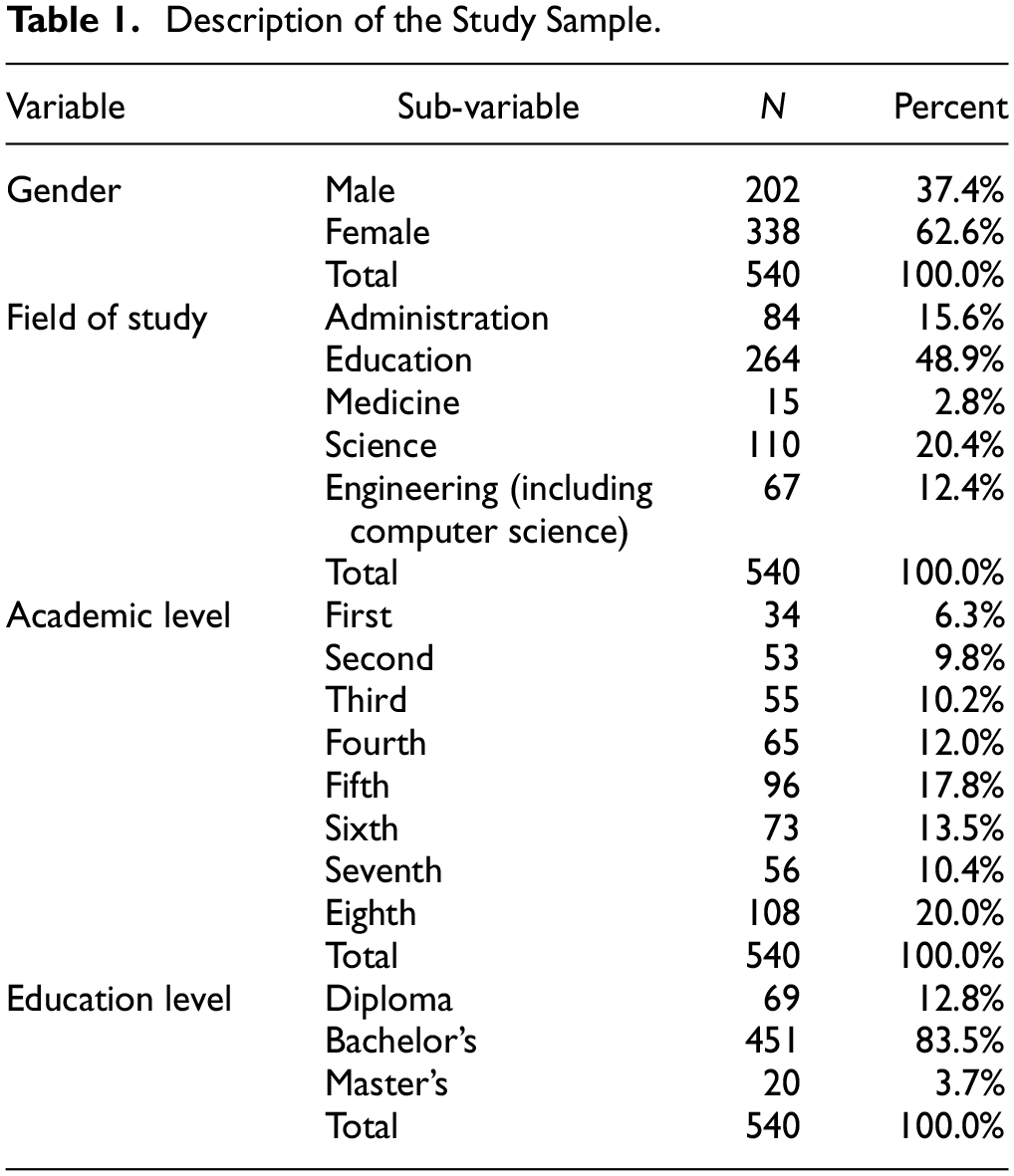
The study population consisted of all students attending PSAU. All students were invited by email to fill out the questionnaire, which was attached to the email along with the consent form. They were free to fill out the online questionnaire at the time and place of their choice and to express their thoughts freely (Robson, 2002). In total, 552 responses were received, and after random and incomplete responses were deleted, 540 responses were left for analysis. Table 1 describes the sample in terms of gender, field of study, academic level, and education level.
Description of the Study Sample.
Instrument
The data were collected through a questionnaire designed by the researchers based on a set of previous studies (e.g., A. Al-Qahtani, 2018; Al-Shayab & Tawalba, 2019). It consisted of two main sections. The first collected demographic information, and the second was divided into three areas of digital citizenship focusing on students’ awareness of respect (12 items), education (12 items), and protection (13 items). All responses in the second section were measured on a 5-point Likert scale (strongly agree, agree, undecided, disagree, strongly disagree).
Validity and Reliability
To test for face validity, the initial version of the questionnaire, which contained 41 items, was examined by six experts specialized in curriculum and teaching methods, education technology, and measurement and evaluation. They were asked to express their opinion about the instrument’s adequacy to answer the research questions, the clarity of the content, and the content’s relevance to each area. Based on their feedback, the questionnaire was restructured to its final version containing 37 items.
Internal Consistency
After confirming face validity, the researchers applied it to a sample of 30 students from the study population. A Pearson product-moment correlation coefficient was used between the degree of each phrase of the area and the total degree of all phrases of that area, as shown in Table 2.
Pearson’s Correlation of Items to the Area’s Total Degree.

Correlation significant at α ≤ .05. **Correlation significant at α ≤ .01.
All correlations were significant at α ≤ .01. Thus, all items were related to the areas to which they belonged, and the areas were related to the questionnaire as a whole.
Reliability
Table 3 shows the reliability coefficients of the sample responses according to Cronbach’s alpha.
Cronbach’s Alpha Coefficients Measuring Instrument Reliability.
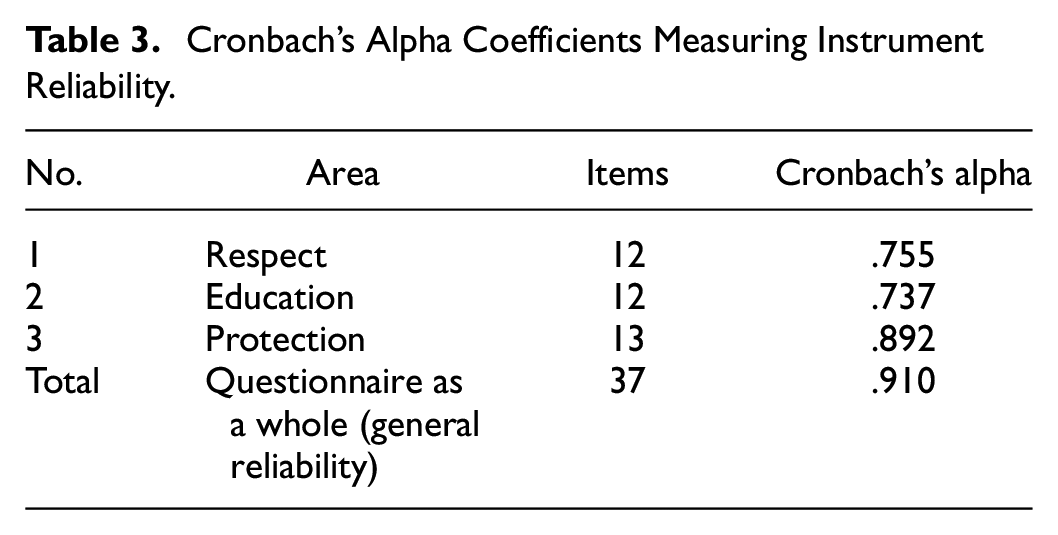
All Cronbach’s alpha coefficients ranged from .737 to .892, indicative of an average level of reliability, which is often higher than .7 (Field, 2017). This finding suggested that the questionnaire could reliably achieve the study objectives and that the statistical analysis would be valid and acceptable.
Statistical Processing
To analyze and interpret the results, the researchers used IBM SPSS statistics (4th ed). Data were coded and logged in a computer, then statistically processed. To determine the degree of awareness for each item, the researchers set three levels (high, medium, low) based on the following equation: class interval = (upper-class limit – lower class limit)/number of classes (see Al-Kilani & Al-Sharifin, 2007). Thus, the range was calculated as (5–1)/3 = 1.33, which was the class interval. This value was added to the lowest value in the scale (unity) to identify the upper limit to this cell.
Through SPSS, the following statistical methods were used:
Descriptive statistics (replications, rate, mean, standard deviation).
A Cronbach’s alpha coefficient for the reliability of the questionnaire.
A Pearson product-moment correlation coefficient for the face validity of the questionnaire.
A t-test to determine significant differences between participants according to gender and college.
A one-way ANOVA to identify significant differences between participants based on Internet use.
A Scheffe test to look for significant differences between variable answers.
Results and Discussion
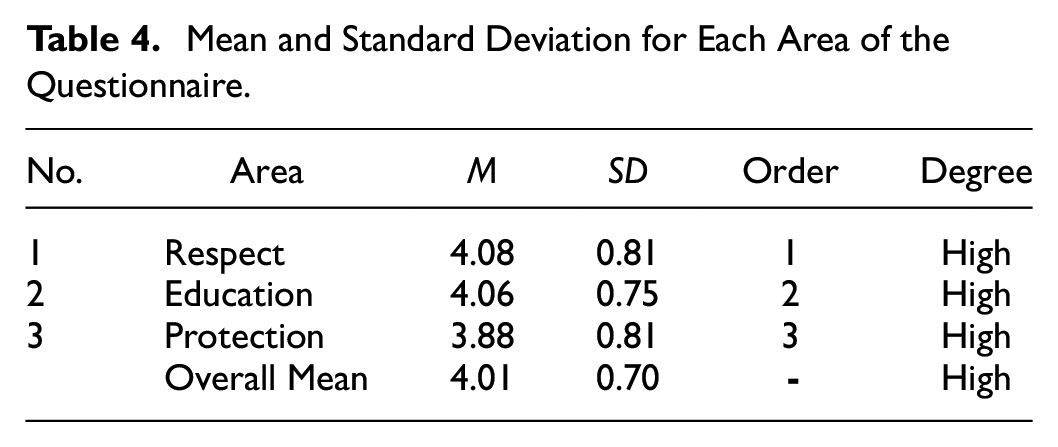
The main research question asked, “To what extent do PSAU students practice digital citizenship values in terms of respect, education, and protection?” As shown in Table 4, the overall mean (M = 4.01) and standard deviation (SD = 0.70) showed a high degree of agreement with digital citizenship values. The areas were ordered based on mean. Respect came first (M = 4.08, SD = 0.81), followed by education (M = 4.06, SD = 0.75) and protection (M = 3.88, SD = 0.81).
Mean and Standard Deviation for Each Area of the Questionnaire.
This result could be due to the COVID-19 pandemic, which has led to increased awareness and use of digital technology in education. This concurs with Öztürk (2021), who analyzed a series of studies on digital citizenship and pointed out that the importance given to teaching digital citizenship has increased during the pandemic.
The digital citizenship value of respect was the most common, possibly due to the high moral and religious awareness among university students. Education as a close second could be attributed to the university raising awareness among students, such as through links to electronic resources. The e-course design standards also emphasize intellectual property rights and an e-learning charter, including policies for the safe, responsible use of digital technology. The high practice of protection could be explained by providing the basic rights of all university students to access technology, preserve their privacy, and express their opinions.
These results are consistent with those of Domingo and Guerrero (2018), who found protection was generally less commonly practiced than respect or education. In contrast to Domingo and Guerrero, however, students in the present study did not practice education to a higher degree than respect.
Research Question 1
To answer Research Question 1 (To what extent do PSAU students practice the digital citizenship value of respect?), mean and standard deviation were calculated for each item in the first area, respect (see Table 5).
Responses to Each Item Under Respect.

The overall results (M = 4.08, SD = 0.81) indicated that students commonly practiced the digital citizenship value of respect. The items were ordered by mean. For example, Item 11 (I refrain from impersonating others on social media for whatever reason) came in first place (M = 4.40, SD = 1.26), followed by Item 10 (I refrain from circulating indecent video and audio clips) (M = 4.38, SD = 1.25), both with a high degree of practice. Item 6 (I use the Internet and social media in a balanced manner without over- or under-use) came in last (M = 3.53, SD = 1.23) with a medium degree of practice.
The above could be due to students’ high awareness of responsible, safe, and ethical use of digital technology. All items in the respect area pointed to a high degree of practice, except for the balanced use of digital technology, which showed a medium degree of practice. These results are consistent with Domingo and Guerrero (2018), who indicated that students practiced the digital citizenship value of respect to a high degree but less so than the digital citizenship value of education.
Research Question 2
To answer Research Question 2 (To what extent do PSAU students practice the digital citizenship value of education?), descriptive statistics were calculated for each item within this area (see Table 6).
Responses to Each Item Under Education.

The overall statistics (M = 4.06, SD = 0.75) indicated students commonly practiced the digital citizenship value of education. The items were arranged according to mean. Item 8 (I submit my academic assignments online) came in first place (M = 4.55, SD = 0.84), followed by Item 7 (I distinguish useful from useless content on webpages) (M = 4.53, SD = 0.88), both with a high degree of practice. In last place was Item 1 (I make new friends from all over the world using digital media) (M = 3.08, SD = 1.40) with a medium degree of practice.
The above findings illustrate that students educate themselves and communicate with others to a high degree. This may be attributed to faculty and programs educating students about how to communicate with them and their colleagues online, especially since the start of the COVID-19 pandemic. These results correspond with Domingo and Guerrero’s (2018) finding that students practiced self-education and communicated with others (education-oriented digital citizenship skills) to a high degree.
Research Question 3
To answer Research Question 3 (To what extent do PSAU students practice the digital citizenship value of protection?), descriptive statistics were calculated for each item in this area (see Table 7).
Responses to Each Item Under Protection.

The overall results (M = 3.88, SD = 0.81) suggested a high rate of digital citizenship skills related to protection. The items were arranged according to mean. Item 6 (I change my device passwords to protect my privacy) came in first place (M = 4.47, SD = 1.04), followed by Item 7 (I refrain from providing any unknown person with my personal information, such as my identity or bank account numbers) (M = 4.13, SD = 1.13), both with a high rate of practice. Item 4 (I refer to the source of digital data when quoting or using it) was ranked last (M = 3.39, SD = 1.52) with a medium rate of practice.
This result could be due to students’ awareness of related digital citizenship values, as suggested by them claiming to change their passwords to protect their privacy. This is a basic aspect of responsible, ethical, and safe behavior with digital technology that many educators have called for (e.g., Ribble, 2015). The results differ from some studies, such as Domingo and Guerrero (2018), who showed that some male and female participants were less aware of digital health, while the current study found frequent practice of protection-related digital citizenship skills.
Research Question 4
To answer Research Question 4 (Does gender have a significant effect on PSAU students’ practice of digital citizenship values?), an independent-samples t-test was conducted on responses in relation to gender (see Table 8).
Differences Between Participants According to Gender.

significant at .001 level.
Overall, Table 8 shows that female participants were significantly more likely than male participants (at ≤0.05) to report using digital citizenship values in all three areas examined. These results differ from those of Yildiz et al. (2020), which showed male students had significantly higher digital citizenship values than female students. The researchers attribute this difference to female students’ greater engagement and interest in these values in the present study.
Research Question 5
To answer Research Question 5 (Does field of study have a significant effect on PSAU students’ practice of digital citizenship values?), a one-way ANOVA was used to analyze the responses in relation to field of study (see Table 9).
Mean Differences Between Participants According to Field of Study.

, *significant at .001 and .05 levels.
Table 9 shows a significant difference (at ≤0.05) between responses about respect according to field of study, but no such significant difference was found regarding education or protection. To determine the differences in the area of respect according to field of study, the researchers used the Scheffe test, as shown in Table 10.
Scheffe Results for Mean Differences between Responses About Field of Study.

Significant difference ≤ .05 in favor of the greater mean. **Significant difference ≤ .01 in favor of the greater mean.
Education students were significantly more likely to report using digital citizenship values than students in medicine, science, engineering, or administration. This might be due to the inclusion of this topic in the College of Education. Likewise, it could be due to the pandemic fostering a higher awareness and need to use digital technology among students in that college. Another factor is the greater number of responses from students in the College of Education.
Recommendations
This study investigated the degree to which PSAU students practiced digital citizenship values in the areas of respect, education, and protection. In addition, it revealed the impact of gender and field of study. The results showed students practiced these values in all three areas, with female participants reportedly practicing them significantly more than male participants.
Based on these findings, universities should help students acquire the key values of digital citizenship and promote the responsible use of digital technology. Faculty members could pay attention to having students read and sign the policies established by the university and competent authorities to raise awareness about these values and thereby encourage safe, responsible, and ethical practice. More studies are needed in global citizenship, especially those following a mixed-methods approach.
Footnotes
Declaration of Conflicting Interests
The author(s) declared no potential conflicts of interest with respect to the research, authorship, and/or publication of this article.
Funding
The author(s) received no financial support for the research, authorship, and/or publication of this article.

Data Availability Statement
Data sharing not applicable to this article as no datasets were generated or analyzed during the current study.