




Abstract
The study seeks to analyze the effect of women’s empowerment on household food security in northern Ghana. Employing Random Effect and Generalized Estimating Equations on the two rounds of Feed the Future dataset, 2012 and 2015, the study measured women empowerment as the comparative years of schooling and decision making by women. Multivariate Decomposition was used to explain whether variations in food insecurity between gendered household types are due to differences in explained and/or unexplained variations. The study showed significant differences in food insecurity levels between male and female headed households. The finding revealed that improving women decision making at the household level will reduce food insecurity by 45%. The study therefore recommends that Ministry of Gender, Children and Social protection should educate male partners on the need for women’s decision making and also ensure the establishment of social groups for women.
Plain Language Summary
The study seeks to analyse the effect of women’s empowerment on household food security in northern Ghana. Employing Random Effect and Generalized Estimating Equations on the two rounds of Feed the Future dataset, 2012 and 2015, the study measured women empowerment as the comparative years of schooling and decision making by women. Multivariate Decomposition was used to explain whether variations in food insecurity between gendered household types are due to differences in explained and/or unexplained variations. The study showed significant differences in food insecurity levels between male and female headed households. The finding revealed that improving women decision making at the household level will reduce food insecurity by 45 percent. The study therefore recommends that Ministry of Gender, Children and Social Protection should educate male partners on the need for women’s decision making and also ensure the establishment of social groups for women. Our study has two drawbacks. First our empowerment variable was constrained to two main proxies. Second, the time period may not reflect current situation. Hence, future studies may benefit from expanding the proxies for capturing the various dimensions women empowerment and also gathering data to reflect current situation.
Introduction
Food security remains a pervasive global issue, with millions of people worldwide facing hunger and malnutrition. According to Food and Agriculture Organization (FAO), an estimated 811 million people were food insecure in 2020, up from 690 million in 2019 (FAO, IFAD, UNICEF, WFP, & WHO, 2021) which equates to an increase of 21% in a year. This global issue is a significant challenge in the Ghanaian context, with an estimated 5.5 million people suffering from food insecurity in 2020 (WFP, 2021) and this is highly predominant in the northern regions. The predominant rate of global food insecurity to cross-cutting factors are identified in the literature such as poverty, conflict, climate change, and inadequate access to resources. Evidence reveals that poverty is the leading cause of food insecurity, with nearly 9 out of 10 food-insecure people living in low- and middle-income countries (FAO, IFAD, UNICEF, WFP, & WHO, 2021). The World Food Programme (WFP) reported a double burden of high poverty rates (21.4%) and stunting (31%) in the Northern regions of Ghana (WFP, 2021). Climate change is also a major driver of food insecurity, as it disrupts food production and distribution systems and causes food prices to rise. In Ghana, climatic differences across the country exacerbated the issue of food insecurity particularly in the northern regions where there are unfavorable rainfall patterns (Moreno, 2022).
The foregoing has spurred a growing body of literature aimed at examining the factors that influence food insecurity, especially given the range of negative consequences, including malnutrition, poor health, and reduced productivity that accompanies food insecurity. The Sustainable Development Goals (SDGs) included a target to end hunger and achieve food security by addressing the root causes of food insecurity and ensuring that everyone has access to safe, nutritious, and affordable food. Clement et al., 2019 revealed that reducing food insecurity requires a multifaceted approach that involves investment in agriculture, social protection programs, climate-smart agriculture, improved access to markets, food waste reduction, and most importantly empowering women. Women's empowerment is revealed as vital in resolving food insecurity, as it can improve food security outcomes, increase agricultural productivity, and contribute to more sustainable and equitable food systems. Evidence has shown that women’s participation in decision-making processes related to agriculture and food production can lead to more sustainable and equitable food systems. When women have greater control over household resources, they are more likely to invest in the health, education, and nutrition of their children, leading to better household wellbeing outcomes (Clement et al., 2019; Duflo, 2012; Tsiboe et al., 2018). Women who are empowered tend to increase the proportion of budget they apportion to food expenditure, which significantly enhances children's nutritional and educational outcomes (Hallman et al., 2003; Meltzer et al., 2009; Quisumbing & Maluccio, 2003). Thus, women empowerment is a key player in inducing positive externality on major household outcomes, particularly in mitigating food insecurity.
Despite the critical roles women play in agriculture, most development programs do not necessarily capture women as integral to the processes of economic development. Women are often marginalized and have limited access to productive resources, which hinders their ability to contribute to economic transformation and further denies them the benefit from it (Food and Agriculture Organisation et al., 2017). Recent evidence has shown that gender biases in agriculture are ubiquitous and demonstrated the negative consequences for food security. Women often have less access to and control over productive resources, which limits their ability to improve agricultural yields and contribute to household food security (Clement et al., 2019; Duflo, 2012). The issue of gender biases transcends agriculture productivity to other economic trajectories. The United Nations and other agencies have emphasized the importance of addressing these gender disparities to support agricultural development and improve global food security. Empowering women at the household and national levels has been identified as a key strategy to address these disparities and improve food security outcomes (Clement et al., 2019; Tsiboe et al., 2018). Discussions on food security had envisioned that if women are given the same opportunity to productive resources as well as allowed to partake in decision-making at all levels within the economy, agriculture productivity will increase, leading to enhanced food security (Clement et al., 2019; Tsiboe et al., 2018).
This paper complements existing studies by examining the effects of women empowerment on household food insecurity in Northern Ghana. The study intersects with one of the FAO’s (2022) approvals of improving decision-making and empowerment programs in developing countries to mitigate the risks of food insecurity among poor and vulnerable populations. This policy target is not far-fetched, given that women’s empowerment is one of the dominant peculiar households’ economic decision shocks. We make at least two essential contributions to literature. First, we estimate the direct effect of women’s empowerment on food insecurity in Northern Ghana based on women’s input in decision-making and access to economic resources. Second, we analytically assess the potential roles of endowments as relevant transmission channels through which women’s empowerment influences food insecurity. The analyses corroborate the main direction of the SDGs of “leaving no one behind” with the mandate to engage in lower levels of analyses to ensure policy targeting and interventions.
The choice of northern Ghana is highlighted for several reasons. First, Northern Ghana has a considerably high rate of food insecurity which is experiencing quite an unstable path over time. WFP in 2021 estimated 1.9 million people being food insecure and this represents about 11% of the region’s population. The report further revealed that about 38% of households in the region are food insecure with 15% severely experiencing food insecurity and unable to meet their daily nutritional needs. The main causes of food insecurity in Northern Ghana have been reported to include recurrent droughts, floods, and pests that affect crop yields, as well as poverty and limited access to food markets and other basic services. Evidence shows that women in the northern regions are disproportionately affected by food insecurity due to social, cultural, and economic factors that limit their access to resources and opportunities for economic empowerment (Ghana Northern Rural Program, 2021). Women in Northern Ghana often have limited access to resources such as land, credit, and technology, which are essential for economic empowerment and this limits women’s engagement in income-generating activities. Cultural and social norms hinder women’s ability to participate in decision-making processes (Plan International, 2018). Empowering women in Northern Ghana is crucial for achieving sustainable development and addressing food insecurity in the region. This study seeks to add insight into the relationship that exists between women’s empowerment and food security in northern Ghana. The study further explored gendered variation to unravel heterogeneities in factors that affect food insecurity. Based on female population and food insecurity statistics, northern Ghana provides a fertile ground to produce evidence on women empowerment–food insecurity nexus given the Ghanaian context. This evaluation is essential to help formulate strategic policies relevant to bolstering women’s empowerment and improving food security in Northern Ghana.
The remaining parts of the paper are organized into the following sections: literature review, followed by the methodology, then the results and discussions. Finally, the last section will render the conclusion and policy implications.
Literature Review
The past decade and half have witnessed the rise of food security as a policy tool intended to achieve the SDGs (FAO et al., 2017). Arguably, other different factors elicited the rise of food security dialogue. The rising food insecure population across the globe has raised concerns about the post-2015 development agenda to emphasize measures that stimulate hunger and food insecurity reduction among countries. Food security has been reviewed as multidimensional, ranging from global, to the individual level; making the concept a complex phenomenon especially given its diverse determinants and outcomes (FAO et al., 2015). The 1996 World Food Summit (WFS) conceptualized food security as “a situation that exists when all people, at all times, have physical, social, and economic access to sufficient, safe, and nutritious food that meets their dietary needs and food preferences for an active and healthy life” (FAO, 1996). Thereby, food insecurity refers to the condition when people do not have enough food to satisfy hunger or are anxious about not having enough food due to economic and social deprivation; not voluntary fasting or dieting or for other reasons (FAO et al., 2017). According to FAO, understanding food insecurity is imperative for framing its associated problems and developing interventions to address the phenomenon. FAO (1996) defined food security that focuses on three distinctive but interrelated components as key pillars of food security: availability of food, accessibility of food and utilization of food. Yet, the evolution of the concept urged the FAO to include the stability dimension of food security in the underlined existing three pillars, to assess the constancy of food to households (FAO et al., 2015).
The theoretical literature on food security highlights the importance of women’s empowerment as a critical component of achieving food security. The growing body of theoretical literature focuses on how gender, class, race, and other social identities shape access to resources and power in the context of food systems. Exemplifying the theoretical foundations, feminist political ecology (Rocheleau et al., 1996) emphasizes the importance of analyzing the intersections of power and inequality in food systems and recognizes the agency of women in creating sustainable food systems. This approach explores the relationships between gender, power, and environmental change. It further argues that gendered power relations shape people’s access to resources, including food, and that women’s empowerment is critical to addressing environmental and food-related challenges. Likewise, the capability approach (Sen, 1985) argues that capabilities to function and achieve certain goals, such as having access to adequate and sustainable food, are central to understanding poverty and human development. Women’s empowerment is a key component of the capability approach, as it enables women to have more agency and control over their lives, including their ability to access and provide food for their families. Other frameworks like the sustainable livelihoods approach postulated by Chambers and Conway (1992) focus on poverty and development that emphasizes the importance of diverse livelihood strategies and the assets and resources necessary to pursue them. Women’s empowerment is seen as a key component of a sustainable livelihood, as it enables women to access resources and engage in income-generating activities, including those related to food production. These theoretical frameworks emphasize the importance of enabling women to access resources, make decisions, and take action to improve their lives and that of members of their households. They also highlight how gender norms and power structures shape access to resources and decision-making power in food systems, and prioritize the agency and voices of women toward creating more equitable and sustainable food systems. Empowering women through access to education, healthcare, and economic opportunities can help address the root causes of food insecurity.
Determinants of food security are one of the most empirically investigated food security-related themes. Several empirics of the determinants of household food security focus on sociodemographic and economic characteristics of individuals and households, and how specific variable affects household food security status. Some factors cut across all dimensions of food security whereas others are attributed to specific pillars. Distinct factors make one household food secure and the other insecure with regards to the dimension of food security one is considering.
Exemplifying these factors, women’s empowerment has been linked to household food security (Essilfie, Sebu, Annim, & Asmah, 2020; Malapit et al., 2014; Schutter, 2013; Smith et al., 2003). Empirical evidence reveals favorable correlation between women empowerment and food security, employing the various latent areas: enabling resources, inherent and instrumental agency. Women empowerment comprises all-around structures that equip women with the required resources to manage their affairs. Smith et al. (2003) showed that women with a relatively higher status than their male counterparts better handled household resources and had easy access to information and health services. Likewise, most women had more satisfactory nutritional status and nourished children with the best care possible. Women’s land ownership plays a noteworthy role in improving various development indicators, including their wellbeing and children’s food and nutrition security. Rehman et al. (2019) revealed that women’s land rights in Pakistan not only improves women’s welfare but also improve their children’s nutritional security.
Evidence reveals the implication of women’s empowerment on food security and proposed that any form of discrimination faced by women, and any measure that will relieve them of their burden should be explored (Essilfie, Sebu, & Annim, 2020; Schutter, 2013). Several factors render women susceptible to food insecurity. According to Laar and Aryeetey (2014), vulnerability of women to food insecurity can be attributed to their lower socioeconomic status. In addition, they highlighted other factors, such as the unequal allocation of intra-household food and the willingness of women to miss meals to feed their children, especially when foods are scarce. Colecraft et al. (2006) revealed that women in some Ghanaian communities could only eat after men in their households have been served. Also, foods rich in nutrients, especially animal-sourced foods like meat and fish, were mostly given to the males. Women’s empowerment has been hypothesized to command resources effectively and embrace better feeding practices which may result in optimal upkeep and a higher nutritional status in the home (Malapit et al., 2014).
Over the past two decades, studies on food security have indicated that households’ access to food depends on the party who earns the income and not necessarily on the size of the households’ real income. Income-earning women, in most cases, are more susceptible to expending their income on necessities like food and other household consumption like health care and education services (Quisumbing & Maluccio, 2003). Exploring the link between household food security and women empowerment, Sraboni et al. (2014) sought to examine the rippling effect of empowering women in agriculture on the dietary diversity and adult body mass index of households in Bangladesh. Farm household data was obtained from the 2012 Bangladesh Integrated Household Survey. Using five dimensions of women empowerment: resource, production, leadership, income, and time, the results revealed that empowering women improved households’ dietary diversity, considering the possible endogeneity bias. Although the study segregated the concept of women empowerment into various dimensions and examined their effect on the dietary diversity of households, it failed to explore other approaches to measuring food security. The study, particularly, ignored the experience-based method, rendering it unable to measure and ascertain the stringency of food insecurity within households and how empowering women could help resolve the consequences. It must be noted that the experienced-based measure of food security is proposed by FAO as a global monitoring measure directly linked to SDG 2.2.2 of reducing prevalence of malnutrition and hunger.
Education is a very substantial course to achieving women empowerment. The education gap between men and women affects their income earnings and translates into their household food security standing. Olumakaiye and Ajayi (2006) conducted a study in Osun State, Nigeria to investigate the relationship between women’s education status and food provision for their household. Their research revealed that higher educational attainment among women increased their ability and made them more likely to supply a variety of foods to their households, hence increasing food security. Similarly, Choudhary and Parthasarathy (2007) conducted a study to examine the women empowerment and food security nexus in Western India. Their study employed participatory rural appraisal techniques and household surveys based on standardized questionnaires. Their results highlighted women’s major roles in improving household food security in terms of availability, accessibility, utilization and stability. They recommended that measures be implemented to enhance land ownership in rural areas.
Malapit and Quisumbing (2015), in their study in northern Ghana, demonstrated that women empowerment has a significant impact on the quality of infant and young child feeding (IYCF). Their study, which employed a survey-based index and women empowerment in Agriculture index, highlighted that women’s involvement in credit decisions enhanced their dietary diversity; however, it did not lessen their chance of being malnourished. It is therefore imperative to highlight that several factors beyond diet quality may also affect individuals’ nutritional status, especially infections. Malapit and Quisumbing (2015) emphasized that infections and diseases make it challenging for the body to absorb food nutrients, indicating the need for households to exert more effort in increasing caloric requirements and reducing individuals’ body mass index via a myriad of diets. Despite the literature on women empowerment and food security, limited evidence exists on how women’s decision making and relative years of schooling affect household food security in Northern Ghana. Analyzing the context-specificity of women empowerment in food security will provide a set of policy options that can be used to empower women and improve nutrition. Against this backdrop, understanding women’s empowerment in northern Ghana will provide context to the food security discourse.
Data and Methodology
It must be emphasized that varying methods were adopted for the study, that is a panel model, Generalized Estimating Equations (GEE) as well as multivariate decomposition for non-linear regression models were used. The GEE is used in addition to the panel model based on two counts. i. to determine the consistency of our results across different models and also, the fundamental benefit of GEE is the objective estimation of population-averaged regression coefficients. The study makes use of data from the Feed the Future (FTF) population-based survey conducted in northern Ghana in 2012 and 2015 by the United States Agency for International Development (USAID) and Ghana Initiative Program to enhance food security at the household level. These data were purposely collected to examine, among others, issues of food security and women empowerment. Hence, the use of these two datasets is necessary as they provide baseline data on the issue of food security and women empowerment in the Northern areas of Ghana. Hence, this study could be used as a baseline for which future studies would be compared when newer data becomes available.
The survey sample was selected through the use of a two-stage random sampling procedure. The very first process entailed the identification of enumeration areas (EAs) for the 2010 Ghana census, which was accomplished through the use of the probability proportional to size (PPS) technique. After, a systematic sampling strategy was employed to choose households from each sampled EA in the second process. A sample of 4,410 households was interrogated in round one, and a further 4,297 households were followed up in the second round.
In order to achieve the objectives of the study, consistency checks were carried out and a sample size of 3,768 was used for the analysis. Household Hunger Scale (HHS); which considers predominance of hunger in households, determines household vulnerability to food insecurity, and is capable of ranking the intensity of household food insecurity from food secured to food insecure, was used as an indicator of food security. The indicator counts how much food is available to a household, not its quality. The HHS can be used to create two different sorts of indicators: a categorical HHS indicator and a median HHS. Based on the value of the HHS score, the category HHS indicator is divided into the following three categories: 0 to 1: There is little to no hunger in the home; 2 to 3 indicates moderate hunger; and 4 to 6 is an indication of severe hunger in the home. The study re-categorized food insecurity into a binary variable measured; 0 if the household is mild to food secured and 1 if the household is moderate to severely food insecure. Women empowerment was measured as (a) measured as number of years spent by the woman in school/years spent in school by the partner, thus relative years of schooling by the woman) and (b) women decision-making (measured as the involvement of women to make decisions at the household level. Thus, whether she makes production decisions at the household level). It must be emphasized that even though there may be other measures of women empowerment, the study uses these two measures as a proxy for women’s employment.
The data employed was the 2012 and 2015 Feed the Future dataset. A panel model was used to account for all time-invariant unspecified variables that have an impact on the dependent variable. Specifically, the Random Effect Model (REM) was used to account for missing latent variables that are not correlated with time-varying covariates.
The REM model is one of the most commonly used for panel data analysis. It supposes that all the explanatory variables do affect the dependent variables and these effects are the same across all periods (Bollen & Brand, 2010; Essilfie, 2020. Econometrically, the REM is specified as

Based on the model above, an empirical model derived for the study was

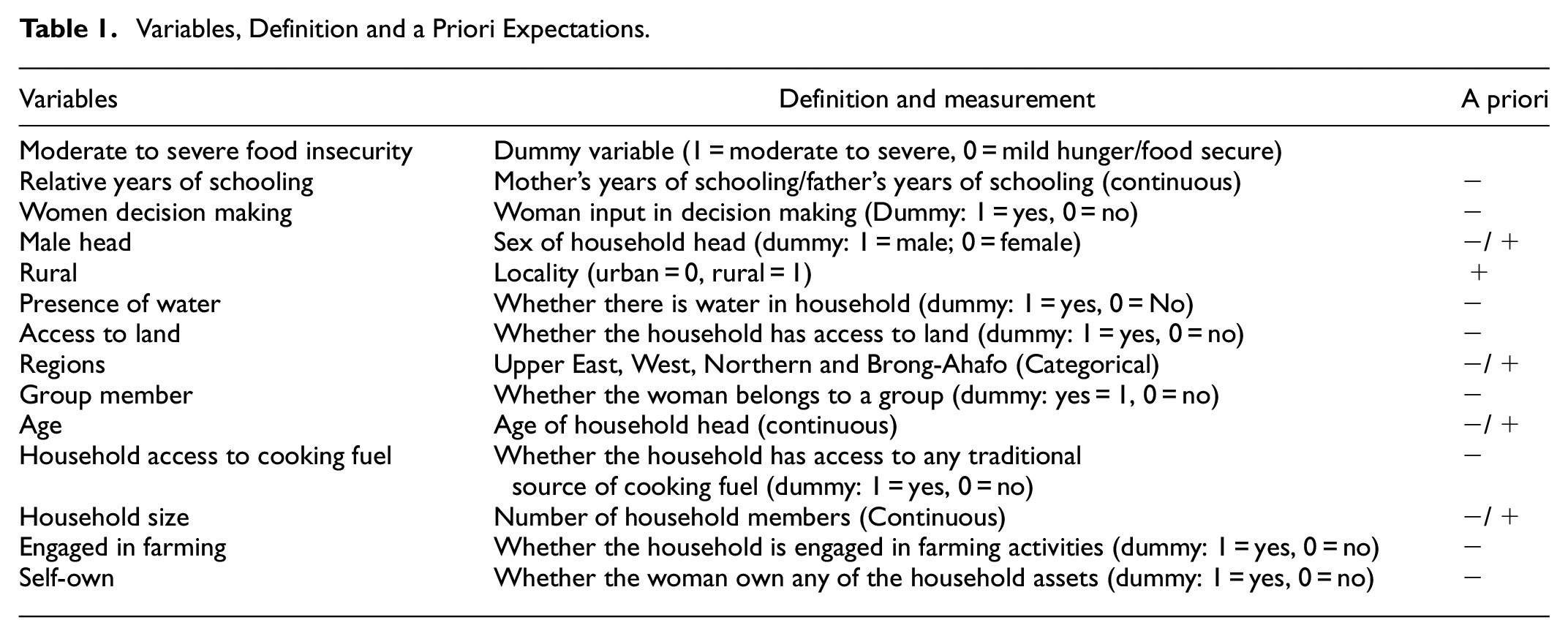
The definitions of the variables are presented in Table 1.
Variables, Definition and a Priori Expectations.
In addition to the REM, Generalized Estimating Equations (GEE) was estimated to check the consistency of the results from the REM. GEE, a method for assessing assumptions about the influence of various factors on binary and other exponential variables allows for the examination of regression on dependent variables that are not distributed normally (Ballinger, 2004; Ziegler et al.,1998). However, when using asymptotically normal sampling distributions, GEE estimates regression coefficients as well as standard errors for a given regression model. A link function is used in GEE to calculate the MLE of the regression parameters (β) and the variance (Ballinger, 2004; Rotnitzky & Jewell, 1990). We specified an autoregressive correlation structure which causes the within-subject correlations to be set as an exponential function of a lag period, which is selected by the operator. The GEE model is specified as:

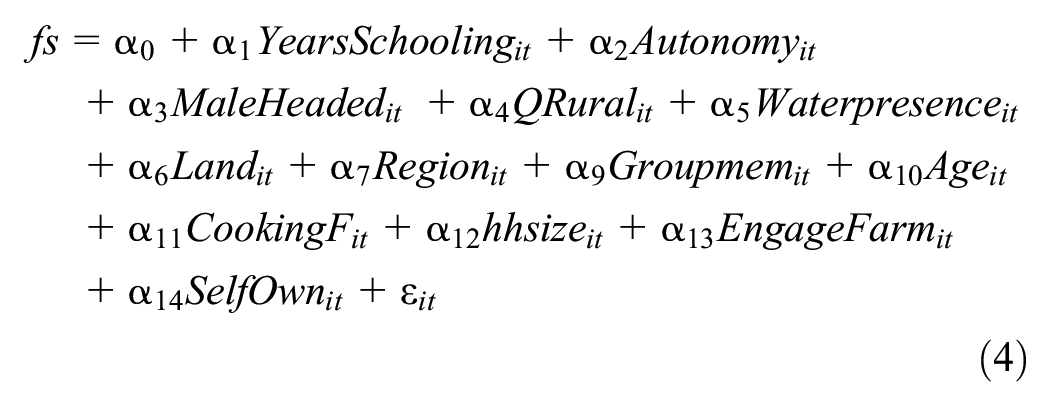
Following the model above, the econometric model for GEE is specified as
In order to estimate the gender gap in food security status between male and female headed households and also determine the source of the gap, Multivariate decomposition for nonlinear regression model was estimated. The method separates aspects of group variance in a statistic, such as mean or percentage, into those that are ascribable to compositional dissimilarities (that is, differences in characteristics or endowments) and those that are attributable to differences in the consequences of attributes (that is, differences in the returns, coefficients, or behavioral responses) (Power et al., 2011). Change over time can be partitioned into elements owing to changing effects and components related to modifying content using these equally relevant strategies. The model is specified as:


Endowment Coefficient
The Coefficient element refers to the portion of the disparity of disparities in coefficients, which is referred to as the unexplained element and the Endowment component reflects a counterfactual comparison of the difference in outcomes from group A’s perspective (that is, the expected distinction if group A had group B’s allocation of covariates. Coefficient element refers to the portion of the differential directly attributed to distinctions in implications (Powers et al., 2011; Yun, 2004).
Results and Discussion
Descriptive Statistics
Figures 1 and 2 present how food security varies according to the gendered household types. As shown in Figure 1, 56% of males compared to 10% of females experienced low levels of hunger. Male headed households experienced relatively higher levels of hunger than their women counterparts. Figure 2 shows that the Northern Region had the highest recording of all the categories of hunger scale, while the Upper East registered the least incidence. Households with the highest incidence of moderate hunger were also recorded in the Northern Region and followed by the Brong Ahafo Region. The Figure shows that severe hunger was little of a problem given that only 1.24% of the total sample experienced severe hunger.

Food security status by gender of respondents.

Food security status by region.
Food Insecurity Status and Women Empowerment
Estimated results from random effect model as shown in Table 2 are discussed in this section. This is because there was not any significant difference between the GEE and the random effect estimates. The result from the GEE model is however presented in Table 6.
Random Effect Logistic Regression Results.

p < .1. **p < .05. ***p < .01.
Women Empowerment Measures
Table 2 presents the odds ratio of the logit random effect model. This shows that a unit growth in relative years of schooling for females in the home reduces the odds of the home experiencing moderate to severe hunger by a factor of 29.8% and this is significant at 10% alpha level.
Further, women decision-making in household production activities was imperative in expatiating household food security. Relative to households where women do not necessarily engage in decision making, households, where women have the liberty to engage in decision-making activities had a lesser odd of 4.2% of being moderate to severe food insecure.
Other Covariates
Results from Table 2 further show that rural households had 6.3% higher odds of being extremely and moderately food insecure compared to urban households.
From Table 2, the odds of households headed by males being moderate to severe food insecure decrease by 44% compared to their female counterparts at 1percent level of significance. For the regional analysis, the results show that the odds of households in the Upper West Region being food insecure increases by 55% as compared to those in the Upper East Region. Further, compared with the Upper East Region, residents in the Northern Region had a decreased odds of 32.8% to be moderate to extreme food insecure at 1% level of significance.
Networking among women was significant in describing food security in the northern part of the country. Thus, the odds of households with no women being active members of a group to be moderate to severe food insure increased by 84.5% at a 5% level of significance compared to those who are socially active. Likewise, the study reveals such factors as land ownership and access to land affect food security.
Access to cooking fuel in households, thus, whether the household has access to any traditional source of cooking fuel positively affects household food security. Thus, compared to a household that has no cooking fuel, households with cooking fuel had a decreased odds of 2.2% of experiencing moderate to severe food insecurity. Access to improved water sources in the household strongly affects food security.
Also, household size adversely affects food security. As household size increases, the odds of the households being prone to moderate to severe food insecurity increases by 2%.
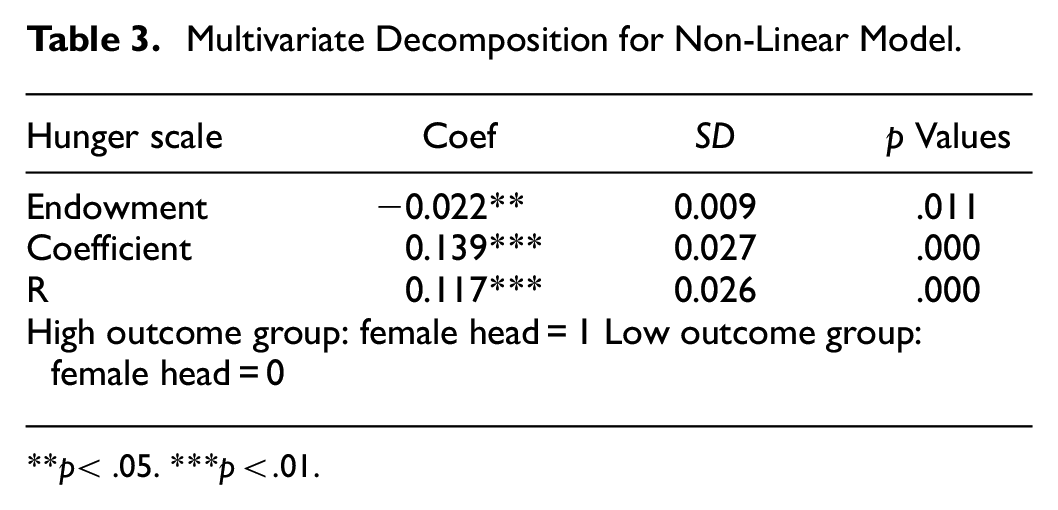
Tables 3 to 5 highlight results from the multivariate decomposition. Different interpretations of the effects of two groups’ differences in attributes result from their disparate characteristics or endowments. From the RE estimates in Table 2, it is proven that there exists disparity in hunger between households headed by males and households headed by females.
Multivariate Decomposition for Non-Linear Model.
p< .05. ***p < .01.
Differences in Endowment.

p < .1. ***p < .01.
Differences in Coefficient.

*p < .1. **p< .05. ***p < .01.
This claim is established in Table 3, as the performance of females was worse than that of males. The result shows that the differences are attributed to observed and unobserved characteristics.
The results from Table 4 show that relative years of schooling, women’s decision making, access to water and geographical location (rural) were the significant explained characteristics that influenced food security in these gendered household types. The findings show that if households with female heads have exact opportunities available to their male heads, especially for relative years of schooling and decision-making, the likelihood for them to experience moderate to severe hunger will reduce by 9.3 and 3.3% respectively.
Table 5 shows that women autonomy is the dominant unexplained characteristic that affects food security in female headed households. Hunger in female headed households falls by 46% as women decision making increases. This means that allowing women to make decisions in the household has lower probability of experiencing moderate to severe hunger (Table 6).
Women Empowerment and Household Food Security (GEE Model).

p< .05. ***p < .01.
Discussion
On the two measures of women’s empowerment, results that were obtained indicates a case for the importance of women empowerment in increasing food security. For the first indicator, relative years of schooling, a relatively higher education of women to men increased the odds of better food security. This implies that additional year of schooling in the household by the woman reduces the odds of experiencing moderate or extreme hunger and thus increases the odds of household being food secure. Seid (2007) indicated that an additional year of education for the male head households reduces the odds of being food insecure by 0.002 compared to female households in Amhara region of Ethiopia.
Educated women can explore better employment avenues to increase income. Thus, a top tier educational success of women increases the tendency of acquiring high-paid jobs which increases household income and exposure to diverse food systems (Olumakaiye & Ajayi, 2006; Tefera &Tefera, 2014). With the rise in household income level, one would expect sufficiency and constancy in the quantity and quality of food intake of such households. Moreover, given that females are mostly caretakers of homes, with exposure to education, they become more aware of diversified and nutritious food which is likely to improve household food security status. Consequently, minimizing illiteracy rate among women in the northern part of the country has a higher odd of improving the food insecurity status of households.
Also, the second indicator of women empowerment, measured by the decision-making power of women, decreased the odds of being food insure in the household. Thus, sovereignty of women in the household reduces the odds of households suffering severe forms of food insecurity, thereby improving food security status of households. This is in tune with the work of Amugsi et al. (2016), who opined that women’s inclusion in making decisions about household purchases and production is associated with higher household dietary diversity (Amugsi et al., 2016). Women tend to be more rational, as compared to men, when it comes to decision-making for distribution of relatively limited resources (income and food) to increase the utility of households (Dasgupta, 2001; Ibnouf, 2009).
Location plays an important role in the discussion of food security in Ghana especially given that the rural communities are deemed to be the bread basket of the country. Although rural households are considered to be the primary producers of food, the majority of the produce is consumed in urban areas. Nevertheless, food security goes beyond just availability to include eating nutritious food. This implies that most rural households do not take diversified food. Considering the income level, GSS (2014), revealed that average annual per capita income in urban areas is GH7,019.72 (GH19.23 per person and day) relative to GH3,302.83 (GH9.04 per person and day) for rural dwellers. Thus, inadequate income is seen as one factor hindering rural households to ensure sufficient food.
Further on the issue of location is the regional effects of food security. The results show varying effects with the Upper West Region being the worse culprit. Literature has identified the Upper West region to be the most affected region in the area of food insecurity (GSS, 2014; Quaye, 2008). The findings further show that residents in the Northern Region are more food secure than their counterparts in the Upper East Region.
Gender of the household head also plays an important role in the discourse of women empowerment and food security. Kassie et al. (2014), for instance, examined the various determinants of gender disparity and food security in Kenyan homes. They observed that there exist relevant gender-directed instances that make female-headed homes to be less food secure than male-headed homes, even though both groups have similar observed characteristics. The economic status of most female household heads is generally less prosperous relative to male household heads. Also, societal pressures and lack of recognition for most women prevent them from engaging in high profile activities (Jung et al., 2017; Mwawuda & Nyaoke, 2015).
Participating in social groups, thus networking, provides the extra support needed in society hence positively influencing food security. The findings from the study support the findings of Chriest (2017) on the importance of community social capital on acute food insecurity. Chriest (2017) argued that community membership helps in improving acute food security needs and that group affiliation builds social networks of persons by providing information and resource sharing. These groups are significant in the agrarian rural areas, as they serve as channels through which the members accessed farm inputs and agricultural extension services (Dzanja et al., 2013).
Households with access to land had a decreased odds of being food insecure compared to households without access to land. Yami et al. (2013) advanced the implications of arable land access on food security status in Ethiopia and indicated that access to land was a major factor for food security taking into cognizance the farm size. They asserted that peasant households have to maximize production from accessible resources to meet the food requirements of their participants and to accumulate household assets through the minimal sale of surplus produce.
Access to cooking fuel encourages households’ food preparation, thus, decreasing their odds of going hungry. Hanjra and Qureshi (2010) recommended the need for adequate investment in preservation of water and responding to other global challenges that tend to affect the state of food security.
Thus, larger household size tends to exert more pressure on available food and this adversely affects their food security status compared to members in smaller households. This conforms with the studies of Obi and Tafa (2016); Ngema et al. (2018); Sekhampu (2013) which revealed that larger household size adds burden on the resources at home concerning the number of people the household is purported to feed.
Conclusion and Policy Implications
The study examined the effect of women’s empowerment on household food security in northern Ghana. A sample size of 3,768 from the two rounds of Feed the Future dataset was used in the analysis. The objective of the study was to examine the source of food insecurity between gendered household types in northern Ghana and also identify the most dominant factor of food insecurity, either observed or unobserved. Generalized Estimating Equation, Random effect model and Multivariate decomposition for non-linear regression were all estimated. The results showed that women empowerment, measured as women decision-making and relative school years, was significant in reducing the rate of food insecurity in homes. The results from the decomposition model showed that moderate to severe hunger was more prevalent in homes with females as heads than in homes headed by males in northern Ghana, of which an improvement in women’s education and decision-making can help reduce this negative effect by 9 and 45% respectively. Thus, if women are relatively better educated and also are allowed to make decisions at the household level, food insecurity will reduce significantly. The study recommends that the Ministry of Education should develop targeted educational policies for women and girls in the Northern regions of the country. The Ministry of Gender, Children and Social Protection should encourage formation of local social groups for women, as these groups serve as a learning ground for women and also enhance their involvement in decision-making. In addition, one approach to enhancing women empowerment and household food security in Northern Ghana is to implement gender-specific policies that increases women access to knowledge while encouraging formal education for both partners.
Our study has two drawbacks. First our empowerment variable was constrained to two main proxies. Second, the time period may not reflect current situation. Hence, future studies may benefit from expanding the proxies for capturing the various dimensions women empowerment and also gathering data to reflect current situation.
Footnotes
Declaration of Conflicting Interests
The author(s) declared no potential conflicts of interest with respect to the research, authorship, and/or publication of this article.
Funding
The author(s) received no financial support for the research, authorship, and/or publication of this article.
Data Availability Statement
Data used for the study is available at https://www.usaid.gov/basic-page/ghana-feed-future-baseline-survey-dataset;  .
.