




Abstract
Sustainable education is key to advancing environmental awareness and global responsibility. Institutional procedures can provide pressure points and opportunities to help foster the mainstreaming of sustainable development. This study aims to analyze how higher-level educational institutions influence environmental awareness and global responsibility in engineering students by evaluating the perception and knowledge of sustainability issues in three universities with different educational systems. This study considers the results of a questionnaire from a sample of 620 industrial engineering students from a Higher Education Institution in northern Mexico. The application of the instrument was random among students from the fourth to ninth semester. The survey included items on demographic aspects, behavior, knowledge, attitudes, and how the educational institution fosters sustainable practices. Only 16% understand sustainable development in the three axes, and 50% recognize that they play an essential role in promoting a sustainable culture. The results show that students do not clearly understand the scope and environmental benefits of implementing, creatively and assertively, environmental innovation through savings and optimization in the matter, time, and natural resources. The findings offer an opportunity for educational institutions to raise awareness and incorporate new measures and strategies to implement sustainability among their students.
Introduction
Sustainable education is key to advancing environmental awareness and global responsibility. At a higher level, it positively influences daily behavior regarding sustainability habits. According to Pérez-Foguet and Lazzarini (2019), he states that students recognize the social role in their professional profile as carriers of change. In addition, it emphasizes that engineers in training will be future leaders and specialized professionals who will play a fundamental role in promoting a more sustainable future, assuming responsibility for making important decisions with an impact on the environmental, economic, and social domain.
Applying sustainable practices contributes to local and state well-being, consequently contributing to the national and economic development of the country. This situation becomes vital in small and medium-sized enterprises (SMEs) since they represent 99.6% of all companies classified in the manufacturing, commerce, and services sectors (SE, 2016). Patricio et al. (2018) state that SMEs, compared to large companies, face more challenges in implementing sustainable practices due to a lack of financing and access to technological improvements. He suggests that knowledge, creativity, and constant innovation are required for companies to improve their environmental performance.
University policies within the study plan have positively influenced the students’ ability to integrate sustainability (Bradley, 2019). In addition, institutional procedures such as conferences, interactive workshops, and seminars can provide pressure points and opportunities to help foster the mainstreaming of sustainable development.
Environmentally friendly Higher Education Institutions (HEI) can be defined as those with processes that reduce environmental impacts inside and outside the institution and environmental awareness in communities. Authors (Freidenfelds et al., 2018) have indicated that higher education is considered the best place to start environmentally friendly activities because principles of understanding and management can be taught simultaneously. However, other authors (Gaudiano et al., 2015) indicate that it is difficult to think that universities can serve as a model to generate significant social changes in the medium and long term in the relationship with the biosphere if the training that their students receive continues fundamentally reproducing knowledge, cultural practices and environmentally unsustainable and socially unfair production models that have placed us on the threshold of a socio-environmental collapse.
Higher education institutions have much to learn to address sustainability issues, and several studies have been conducted to improve. A case is Tejedor et al. (2018), who reviewed the literature to analyze the different ways of applying or bringing transdisciplinarity approaches to engineering and technology, concluding that is necessary a new class of engineers who think critically about the construction of public welfare and the technological systems in which it works. On the other hand, Parvez and Agrawal (2019) evaluated the current state of sustainability in HEIs with the sustainability rating systems UI GreenMetric World University Ranking (UI GreenMetric WUR) and Sustainability Tracking, Assessment and Rating System (STARS) to obtain a contextualized evaluation framework in India to move toward sustainability by HEIs. The authors concluded that Indian HEIs are far from fully incorporating sustainability into their operating systems, as only 50% of the parameters in the assessment frameworks are currently implemented on the campuses studied.
The transition toward sustainability will only be achieved with education, particularly environmental education. Said strategy will achieve radical changes since it helps to understand how the decisions and actions taken by individuals affect the environment. Environmental education develops knowledge, skills, and behaviors that allow maintaining a harmonious relationship with the natural environment. Sharma et al. (2023) argue that environmental education can transform and invoke positive behavior change by imparting knowledge, choices, and attitudes that could create emotional ties to the environment. Some researchers have demonstrated the potential of environmental education to improve students’ environmental knowledge, attitudes, intentions, and behavior. In this sense, van de Wetering et al. (2022) synthesized the effectiveness of environmental education for children and adolescents, reporting that environmental education significantly improved environmental knowledge, attitudes, intentions, and primarily self-reported behavior. In other research, Kurokawa et al. (2023) evaluated the effectiveness of an environmental education class using two behavioral science intervention approaches, “nudges” and “boosts.” The authors reported no differences regarding the intervention approaches in secondary school students’ knowledge. However, they showed that pro-environmental behavior can only be improved if the cost of change is low. Another study where it is analyzed if and in what way environmental education determines the adoption of pro-environmental behaviors was carried out by Suárez-Perales et al. (2021). The authors analyzed two theoretical approaches, instrumental and emancipatory perspectives, considering higher education students. The authors showed that environmental education in higher education affects pro-environmental behavior indirectly, that is, through the knowledge-concern-will model, promoting personal growth and critical thinking from an emancipatory perspective.
Environmental education is the key to achieving sustainable development. It creates a sustainability mindset and empowers people to become agents of change by raising awareness of the importance of protecting the environment. In this sense, Olsson et al. (2019) analyzed students’ sustainability awareness and its components (knowledge, attitudes, and behaviors related to sustainability) in green and non-green schools in Taiwan. They applied a questionnaire to students of different academic grades, sixth, ninth, and twelfth grades. Their results show that differentiating between schools considered green or not green does not improve students’ sustainability awareness. In addition to the fact that there is a gender and age gap, obtaining higher mean values in girls and a drop in the student’s sustainability behavior as her age advances. Chuvieco et al. (2018) investigated the factors affecting university students’ sustainability habits. They surveyed 25 sustainability habits and defined three indicators to measure the differences in the environmental behavior of the students, establishing groups of gender, country, and disciplines related to the environment. Their results showed that 53.3% of the students are considered more sustainable, that there is no significant difference related to the country, and that the self-perception of environmental commitment tends to show similar consumption habits, although the most committed have a lower proportion of superfluous purchases than those with little environmental concern. Qammar et al. (2023) studied the perception of university students and professors regarding sustainability in an institution in Pakistan. To do this, they used a questionnaire and performed a descriptive analysis. Their results show that students’ and teachers’ knowledge, awareness, interest, and commitment are sufficient. They also identified a need for more institutional commitment to provide the appropriate platform for university sustainability.
Pereira Ribeiro et al. (2021) carried out a quantitative-descriptive study to determine if the Green Campus Initiatives applied in four Brazilian universities were viable strategies to disseminate the concepts of sustainable development in higher education institutions, improving the knowledge and proactivity of students around sustainability. The authors found that students’ understanding of sustainability could be higher, and a gap exists between the assessment and implementation of sustainable actions. Cervantes Rosas and Aldeanueva Fernández (2016) analyzed an exploratory study from the student’s perspective on actions related to sustainable development in the university environment, for which they used a quantitative methodology of an instrument proposed by the Contruye País Network of Chilean Universities. Their study identified that students (from 1 to 5, mean 3.46 and standard dev. 1.23) perceive sustainability practices within the University. Dieleman and Martínez-Rodríguez (2019) point out that, since the 1980s, environmental education has been part of the curricula of all schools in Mexico, and each of the 32 states has a state plan for education, training, and environmental communication. However, most environmental education focuses on isolated environmental issues such as water, waste, or air pollution and lacks a more systemic orientation of sustainability, linking the environment with economic and social problems; this is just knowledge transfer. What is suggested is that students should actively and more critically participate in defining the problem and identifying possible environmental actions to address these problems.
HEI performance benchmarking, similar to that used in the industrial sector, makes it possible to identify best practices and conduct a comparative analysis of environmental management in universities (Freidenfelds et al., 2018). Leal Filho et al. (2019) identified a gap in the literature on international studies on universities’ role in local sustainability efforts. Therefore, they analyzed 22 universities through a global qualitative survey to assess regional university sustainability initiatives trends. Their findings indicate no consistent differences regarding the opportunities and limitations in the search for the sustainability of universities in industrialized and developing countries. In the study by Blanco-Portela et al. (2018), the barriers and drivers for the integration of sustainability in HEIs were analyzed through open expert opinion interviews and a participatory workshop in 45 Latin American universities. The authors reported that the success factors for the transition of an HEI toward sustainability are: (i) strong support from university leaders; (ii) availability of dedicated resources; (iii) efficient internal change management; and (iv) committed staff who can help with the transition.
Due to the above, the objective of this study was a comparative investigation between industrial engineering students from universities of different educational systems in northern Mexico on the perception of their role in favor of sustainability. This study’s results are intended to generate knowledge that helps develop strategies or action plans to increase knowledge and, therefore, awareness by promoting sustainability as a lifestyle.
Methodology
The present investigation has used the quantitative method; It is exploratory since it constitutes a first approach to the phenomenon. The study was carried out in northwestern Mexico’s different public educational systems: an autonomous system, a federal system, and a state system. Graduates of industrial engineering from these institutions obtain their jobs mainly in the manufacturing industry, Maquiladora, and Export Services. According to the INEGI (2019), Baja California is the leader in the number of IMMEX establishments registering 930 in January, which represents 18.2% of the IMMEX in the country. It also occupies the second national place in the personnel employed in this industry, with 334,766 employees, 12.4% of the total IMMEX staff in the country. Furthermore, these companies have environmental regulations that they must comply with, so a growth in the needs of students with more knowledge of the industry-environment relationship can be expected.
A survey applied to students through the Google® platform was used as an instrument for collecting information. The questionnaire adapts the proposal made by Gericke et al. (2019), based on the UNESCO framework. The survey consisted of 55 items divided into six sections, demographic aspects, perception, behavior, knowledge, attitudes, and the educational institution. First, demographic aspects of the students were considered, such as gender, age, current school period, and socioeconomic level. In perception, through eight items, the students’ beliefs in sustainability concepts are analyzed. The behavior section has 12 questions to examine to what extent students carry out sustainable actions at home and outside the home, that is, in their daily lives in terms of water, electricity, and waste. Sustainable development was evaluated using 17 items and the attitudes with seven. In the last section, educational institutions with 11 items sought how they promote sustainability, both in the curricular plan and practices in care in matters, water, electricity, and waste management. Response options consisted of multiple-choice, dichotomous responses, and 5-point Likert scales where 1 (strongly agree) and 5 (strongly disagree). The survey was validated with 37 respondents before its application in the field.
The instrument was validated with 37 respondents before its application in the field. The validation was carried out randomly with students of different careers from U1 University. As a result, some changes were applied to the initial survey. Among those that stand out is the difference in the wording of some questions, as well as a shorter version of the questionnaire, to make it a simple instrument to answer and partially fast.
The sample was obtained from a student population of 341 students in the autonomous system (U1), 1,199 students in the federal system (U2), and 232 students in the state system (U3). In all three educational systems, a confidence level of 95% was considered, with an error of 5%. The application of the instrument was random among the students of the fourth semester and further. The surveys were applied within the facilities of each institution in small groups. Before starting the survey, the students were welcomed, and an introductory talk was given about the structure and proper instructions. They were informed that the information provided was confidential and that the results obtained would be used exclusively for research purposes. The students were accompanied by their teacher on duty and a researcher during the application to give reliability to the survey application.
The calculation of Cronbach’s alpha was performed to determine the reliability of the information, whose result for all the elements was .6939. Taber (2018) points out that values greater than .600 are acceptable.
The result of the survey application through the Google® platform was a database. The information collected was analyzed using Excel® software. Descriptive statistics were used, and the weighting in each question was obtained by dividing the total sum received in each query by the maximum possible points.
Results and Discussion
The sample size for each university was determined to be 181 (U1), 292 (U2), and 145 (U3). The student’s cooperation in U1 and U2 allowed for more students to be surveyed, giving 189 for U1 and 306 for U2. In the U3, the application coincided with a change in the study period. So only 125 students were surveyed, which increased the margin of error by 1%.
Demographic Aspects
In the three universities, the male gender predominated, with 58 to 66% of men. These percentages are slightly lower than those reported in Mexico by INEGI (2018), where the percentage distribution of undergraduate and technology enrollment in the engineering area is 72% for men. Gender is an influential factor in environmental behaviors. Zhang et al. (2018) reported that women represented the highest percentages, although not by many variations, of environmental behaviors through the care of water, electricity, and waste management both at home and outside it. In addition, they indicated higher percentages in the axes of sustainable social, economic, and environmental development regarding men. In this same sense, Olsson et al. (2019) and Chuvieco et al. (2018) indicate that sustainability awareness is higher for the female gender than for the male.
Regarding age, Olsson et al. (2019) indicated that this should be considered when analyzing aspects of environmental education and sustainability. Their studies found a positive relationship between increasing age and pro-environmental commitment. In this study, the maximum percentages in the age range from 18 to 22 years, for U1 with 58% and in U2 it is 72%. In the case of U3, 60% of those surveyed are older than or equal to 23 years. This situation can be attributed to the curricular plan managed by the institution, which is shorter and mostly in practical training, which becomes more accessible for work and to complete professional training in a shorter time.
Regarding economic conditions, most respondents report that they have family incomes in the medium income range (USD $700–1,610), with 51% and 48% for U1 and U2, respectively. In the case of U3, it has a low-income level (≤USD $700). This aspect is correlated with the age of the respondents, where it can be seen that they have a greater need to work while they are studying.
Perception
The general perception of the three universities that students have regarding the issue of sustainability is incomplete since only 16% (20% U1, 16% U2, 10% U3) understand sustainable development in the three axes; 34% (27% U1, 38% U2, 38% U3) consider that it is only environmental, 14% (10% U1, 18% U2, 10% U3) see it as social and 7% (10% U1, 4% U2, 12% U3) as economic. Pereira Ribeiro et al. (2021) reported similar results, concluding that students focus on associating the concept only with environmental issues. However, it is essential to highlight that 16% (14% U1, 20% U2, 7% U3) consider it in the environmental and social axis, so the students do not perceive the positive economic impacts that can be obtained. This fact contradicts what was stated by Dyllick and Rost (2017), who establish that sustainability is strongly aligned with economic advantages for companies.
Students are considered carriers of change, where U1 and U2, with a percentage of 50 and 47% respectively, recognize that they play an essential role in promoting a sustainable culture, although not as sole actors, but together with teachers, university authorities, and the secretary of education. In contrast to U3 where it was reflected with 26%. In this sense, universities in Mexico opt for a top-down approach to incorporate sustainability plans in higher education institutions. The university administration determines the strategy, while professors and/or students do not contribute to these strategies. For their part, Yuan and Zuo (2013) mention that although contributions by the institution are essential for sustainable development within the facilities, they consider that a combination of the top-down approach and vice versa involves all parts making contributions to the system. The “top-down” approach is considered a necessary action for change. However, the “bottom-up” approach helps to raise awareness.
In Mexico, environmental education actions were implemented to establish a harmonious relationship with nature by forming attitudes and values for social commitment. In addition, students were provided with elements that allow them to analyze the current environmental problem and learn about its role in the transformation of society to achieve better living conditions. These actions were carried out through the Environment and Natural Resources Sector Program (PROMARNAT) and the Training Center for Sustainable Development (CECADESU). The latter aims to spread environmental education in a new pedagogical approach that is defined as a process that trains the individual to play a critical role in society (SEMARNAT, 2018).
To face the problem of sustainability in the country, the Mexican government has carried out various plans through a national climate change system. Since the approval of the General Law on Climate Change (LGCC) that came into force in 2012, as well as the implementation of public policy instruments; such as the Intersecretarial Commission on Climate Change (CICC), the Climate Change Council (C3), the National Institute of Ecology and Climate Change (INECC) in 2013 and the Energy Reform, in which the Congress of the Union, entities federations, and associations with municipal authority (INECC, 2015). Among the action mechanisms, regulatory advances, and information tools of the LGCC, the National Climate Change Strategy Vision 10-20-40 was developed and approved; the Special Climate Change Program 2014-2018; the carbon tax; Commitments 2020-2030; the National Program for the Sustainable Use of Energy 2014-2018 and the Special Program for the Use of Renewable Energies 2014-2018; and the National GHG Emissions Inventory.
Although there are programs for implementing sustainability in the country, these have not yet permeated all levels. The result of this situation is reflected in the perception of the students surveyed. Of the three universities, 46% perceive Mexico as an unsustainable country with 2 points on a 5-point scale and 38% with 3 points of 5. Figure 1 shows the breakdown of the three universities.
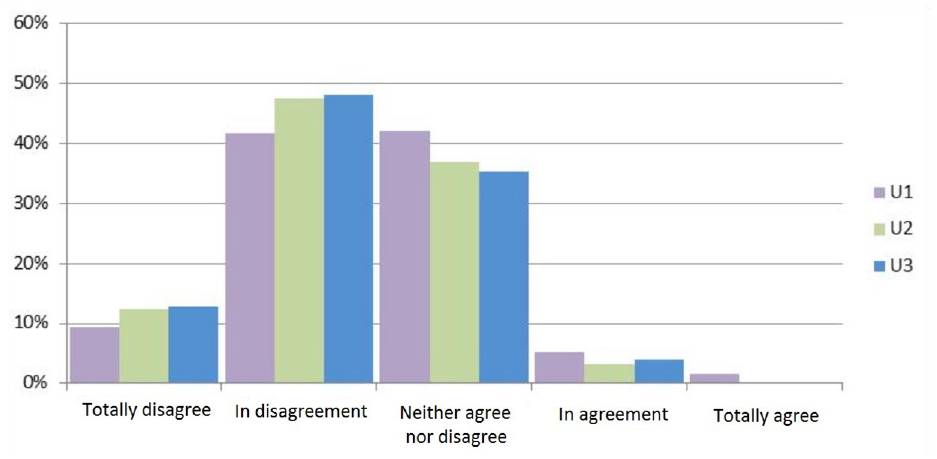
Do you think that Mexico is a sustainable country?
Behavior
Figure 2 shows the type of general behavior that the respondents have regarding sustainable actions inside and outside the home in the axes of economy, society, and environment. It can be seen that the values are inclined to an average positive action of 81%.

Behaviors regarding sustainability. Questions: 12. I pick up garbage when I see it lying on the street or in public places; 13. I often think about how my actions can harm the environment; 14. I usually make lifestyle choices that are not good for my health; 15. I show the same respect to women and men; 16. I avoid buying products from companies with a dubious reputation for environmental care; 17. I watch news programs or read newspaper articles related to the economy in Mexico; 18. I buy second-hand products on the Internet or in a store.
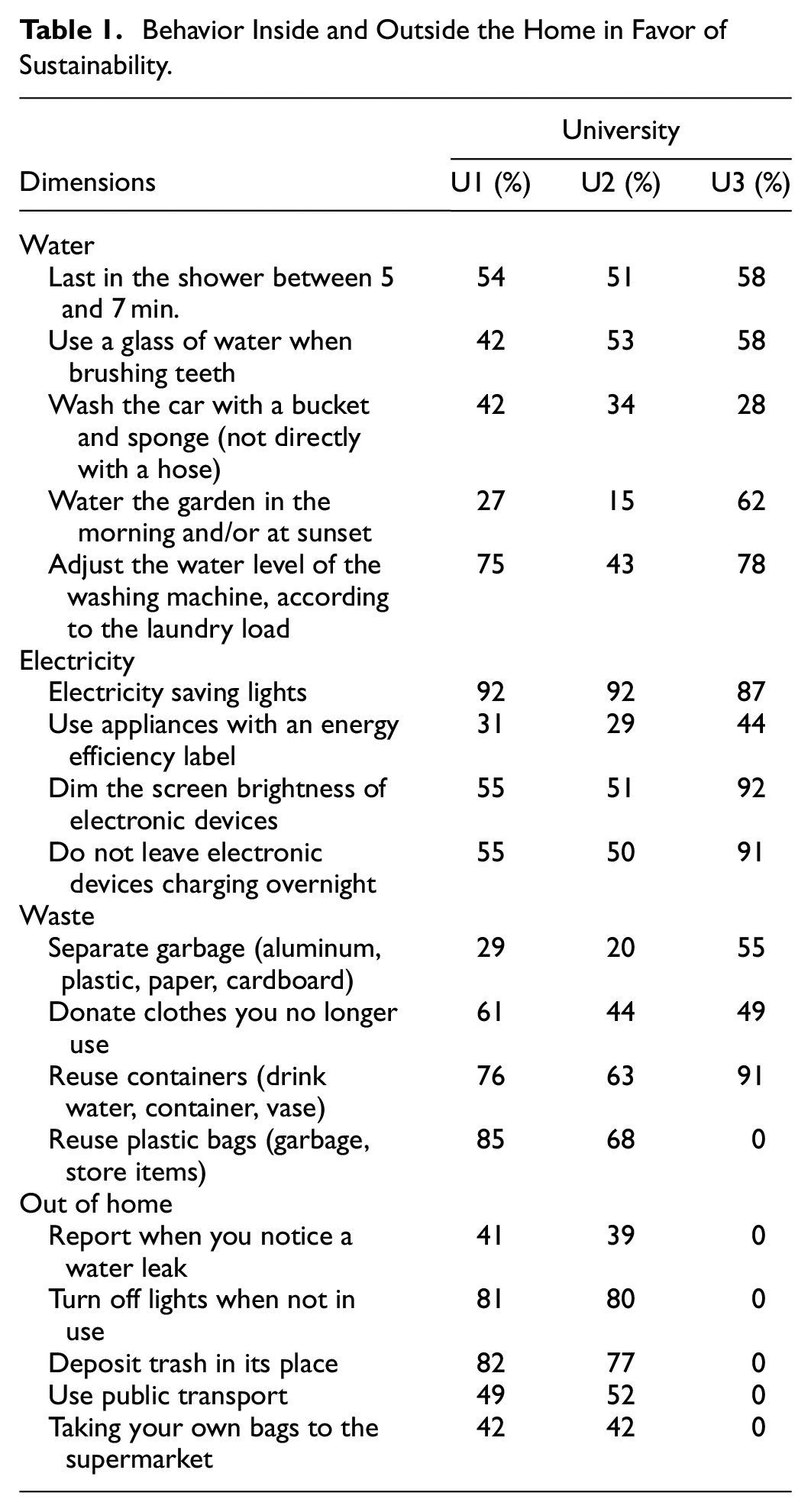
Other actions reported by those surveyed, 83% are willing to buy products made with recycled materials even if they are more expensive than usual, being 82%, 77%, and 91% of the U1, U2, and U3, respectively. Table 1 shows the pro-sustainable behavior they present in terms of water, electricity, and waste and some actions they carry out as a lifestyle away from home. In this regard, Sáez-Martínez et al. (2016) report that marketing and sales strategies negatively influence the behavior of waste generated by people, emphasizing the critical role of retailers in preventing food waste generation.
Behavior Inside and Outside the Home in Favor of Sustainability.
Knowledge
One of the most used methods for measuring the environmental impact generated by a product or service is the analysis of the life cycle of a product (LCA). These impacts evaluate and identify the weaknesses and strengths of the process; in this way, environmental improvement strategies can be applied through the modalities of sustainable design, production, and consumption (Bradley, 2019). Students with an engineering profile will be the future responsible for carrying out these actions in the industry, so it is necessary to know and know how to apply the tools required to achieve it. The students were asked if they knew the concept (LCA). The total number of students surveyed showed that 72% of the students do not understand the concept, from the cradle to the grave, and only 28% affirm that they do know it (Figure 3). These percentages are worrying since, as Tejedor et al. (2018) expose, engineers must achieve an eco-efficient human activity to celebrate the mutually beneficial relationship between man and nature.
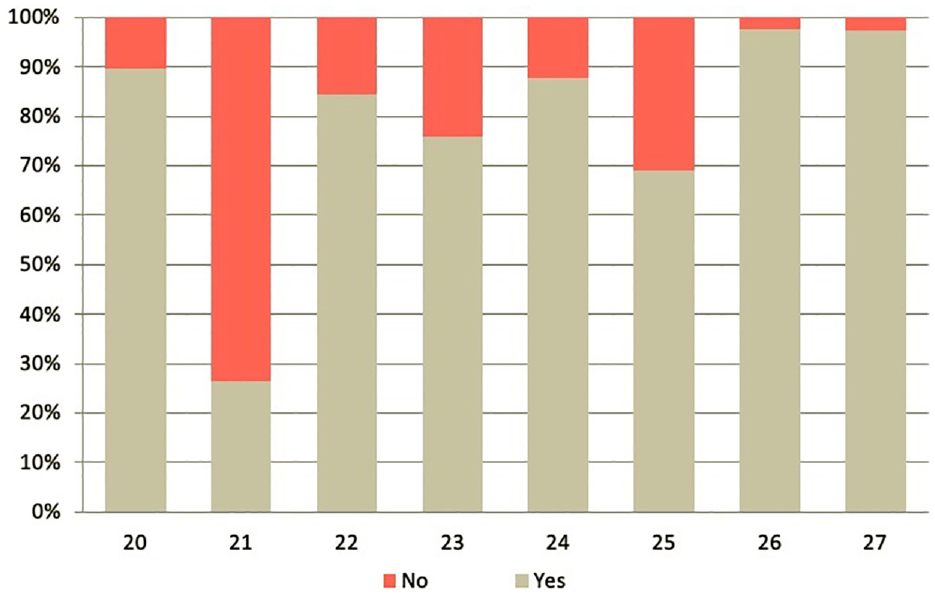
Knowledge Category. Questions: 20. I know that eco-design aims to…; 21. I know the “from the cradle to the grave” concept; 22. I know the tools to optimize processes. 23. I know that the environment is an essential part of a business strategy; 24. The packaging of a product gives a competitive advantage. 25. Sustainable development requires an understanding of how the economy works; 26. In a service company, there may be environmental improvements; 27. The type of packaging of a product can reduce contamination.
Although it is essential to know tools to optimize processes, it is necessary to identify methods to measure areas of opportunity and procedures to measure the environmental impact of any process. Chuvieco et al. (2018) suggest that students with more knowledge of environmental problems still need to change their attitude toward a more significant commitment to solving these problems. For this reason, they were asked in general if they know tools to optimize operations without specifying any in particular, and a total of 81% of those surveyed said yes. In comparison, only 19% answered that they do not know them.
Attitudes
Figure 4 shows the differences in attitudes in the three different educational systems. It was observed that 91% of those surveyed agree that we should all acquire the knowledge, values, and skills necessary to live sustainably. Dyllick and Rost (2017) state that the contributions of companies to solving sustainability problems remain invisible worldwide. Regarding business commitment, 83% think that companies are responsible for reducing the use of natural resources, and 85% that companies should reduce the use of disposable packaging and items.

Category of Attitudes. Questions: 30. Using more natural resources than we need threatens people’s health and well-being in the future; 31. I think it is essential to take action against the problems that have to do with climate change; 32. I think we should all acquire the knowledge, values, and skills necessary to live sustainably; 33. I think that we must ensure that people in the future enjoy the same or better quality of life than we do today; 34. I think that companies are responsible for reducing the use of natural resources; 35. People who pollute the land, air, or water should pay for the damage they cause to the environment; 36. I believe that companies have a responsibility to reduce the use of disposable packaging and items.
Educational Institution
Universities play an essential role in promoting sustainability since the impact generated on students can positively influence the rest of society. Dagiliūtė et al. (2018) suggest that the environmental information provided by the institution significantly determines student participation. Although he mentions that the institution’s web portals become an essential platform to involve students in relevant sustainability issues, his study reveals that students obtain most of the information about the university’s position concerning the environment. Through the university’s web portal, fewer students read strategic documents where the university’s work on the environment and sustainability within the institution is generally presented.
In this study, students were asked if their institution has a website dedicated to reporting on the field of sustainability. It is worth mentioning that U1 is the only institution that has a website dedicated to reporting on issues relevant to sustainability, where 9.6% responded that the university does not have a website, 78.2% do not know if it exists, and only 12.2% say yes. The results U2 do not have a website dedicated to reporting on sustainability; 24% of students said no, while 71% answered that they did not know, and only 5% answered yes. U3, like U2, does not have a web platform, but a higher percentage of students stated that it does with 14%, 50% answered I don’t know, and 34% indicated that it does not exist. This fact suggests that the institution’s initiatives, official commitments, and position to instill in students’ knowledge, attitudes, and sustainable work models must be unified with particular activities, such as dissemination campaigns. Otherwise, they will remain as statements only.
The operation of sustainability is of paramount importance to students. They must be aware of the causes and consequences triggered by climate change and develop capacities to apply responsibly and creatively to mitigate impacts (Ruiz-Mallén & Heras, 2020). To achieve this, universities must integrate a strategic plan to promote the issue while applying them within the institution. Universities as active promoters of sustainability have been expressed in numerous international declarations and agreements (Blanco-Portela et al., 2018).
Higher education institutions committed to the environment offer significant opportunities to meet the SDGs (Sustainable Development Goals), working in the facilities, teaching staff, and students. However, sustainability is often not taught from the first subjects of the academic plan, with teachers regularly separated from the institutional regime and community service (Purcell et al., 2019). In this same sense, Parvez and Agrawal (2019) report that courses on sustainability are offered for HEIs in India. However, only some are formally taught or evaluated the general understanding of sustainable development by students; sustainability learning is not included in their daily life.
The perception of those surveyed regarding the institution’s actions concerning waste management is relatively positive. For example, 88% mention that they have garbage cans with classification, 22% that organic waste is used as plant fertilizers, 60% have observed collection of batteries, 25% collection of electrical-electronic devices, 41% collection of recycled paper and cardboard, and 6% collection of toners. Regarding the curricular program, 33% indicated that they had taken at least one subject on sustainability, and 42% said they have carried out academic projects in this same aspect. In addition, 74% said their profession is related to environmental pollution, and 71% reported that teachers relate environmental care to their subjects. Chuvieco et al. (2018) and González Gaudiano et al. (2015) states that changes in environmental education in schools and universities are still slow and, in most cases, superficial. Therefore, the authors propose to review university environmental education, considering whether the educational objectives include transforming students’ attitudes toward the environment or only offering information to understand environmental problems better.
Conclusions
Future engineers in training in the three educational systems do not have a clear definition of sustainable development. Therefore, students must handle the different methods that allow environmental improvement in the production processes of goods and services. In addition, the possible economic and social benefits of the changes implemented to obtain sustainable production systems must also be quantified.
Although there are programs in Mexico that aim to spread environmental education in a pedagogical approach, they have been running for a short time with a lacked a budget in recent years. The students perceive this reality, mostly cataloging Mexico as an unsustainable country. They are aware of the problems in matters of sustainable practices in the country. However, they are not aware of the conceptualization that represents sustainable development. Therefore, these results offer an opportunity for educational institutions to raise awareness and incorporate new measures and strategies to implement sustainability among their students and put them into practice, both professionally and personally.
Footnotes
Declaration of Conflicting Interests
The author(s) declared no potential conflicts of interest with respect to the research, authorship, and/or publication of this article.
Funding
The author(s) received no financial support for the research, authorship, and/or publication of this article.

Data Availability Statement
Data sharing not applicable to this article as no datasets were generated or analyzed during the current study.