




Abstract
Principal preparation programs face the unique challenge of preparing social justice leaders who are equipped to dismantle the many inequities in K-12 schools. In 2017 California’s credential requirements for school administrators (e.g., principals) changed significantly with the adoption of new state standards for administrators and the addition of a new high-stakes administrator performance assessment (the California Administrator Performance Assessment, or CalAPA). Accordingly, principal preparation programs throughout California had to respond to this change. The purpose of this paper is to share faculty and student perceptions of one principal preparation program’s revision to equip candidates to be social justice leaders; to align to new state leadership standards (the CAPE); and to prepare candidates for a high-stakes, state-mandated performance assessment (the CalAPA). Data for this study included student focus groups and faculty interviews as students and faculty shared their perceptions of and experiences with the new program and the CalAPA performance assessment. Several implications for principal preparation programs were found: the need for a comprehensive curriculum with an explicit social justice focus, the benefits of the cohort model, the value of field based assignments, the need for supportive instructional practices, and the challenges and benefits of state-mandated performance assessments such as the CalAPA. The process of program revision and adaptation to a new state-mandated, high-stakes administrator performance assessment may be relevant to other programs seeking to prepare social justice leaders.
Keywords
Introduction
Principal preparation programs face the unique challenge of preparing social justice leaders who are equipped to dismantle the many inequities in U.S. K-12 schools while also meeting state requirements for principal licensure. Despite Brown versus Board of Education’s 1954 promise to end separate and unequal schools and decades of subsequent reform efforts, inequities in opportunity and academic outcomes persist in U.S. K-12 schools, especially for underserved student subgroups such as low-income students and students of color (Cambron-McCabe & McCarthy, 2005; Darling-Hammond, 2000, 2018; Khalifa, 2018). The COVID-19 pandemic and the resulting learning loss compounded these inequities with a disproportionate negative impact on students of color (Goldhaber et al., 2022; OCR, 2021).
Now more than ever, schools need social justice leaders who will address the systemic inequities in education and respond to the needs of underserved students. Principals have a profound impact on student learning at their school sites (Grissom et al., 2013; Leithwood et al., 2020; Liebowitz & Porter, 2019). Accordingly, it is a principal’s leadership that can effect needed reform at a school. A true social justice leader will not only serve as an instructional leader who works with the school community to improve teaching and learning, but they will also work to break down systemic barriers to student success (Bogotch, 2002; Cambron-McCabe & McCarthy, 2005). It is up to principal preparation programs to train these social justice leaders who go into schools to disrupt long-standing inequities (Capper et al., 2006; Hernandez & McKenzie, 2010).
Background
National and State Leadership Standards
On the national stage, school leadership standards have included a focus on social justice since the creation of the Interstate School Leadership Licensure Consortium (ISLLC) standards in 1996 (Robey, 2019). The ISLLC were replaced by the Professional Standards for Educational Leaders (PSEL) in 2015, which strengthened the focus on equity by adding emphasis on “each student” throughout the 10 standards and explicitly mentioning equity, social justice, and culturally responsive leadership throughout the elements (NPBEA, 2015, pp. 9–18). California’s leadership standards, especially the elements of the California Administrator Performance Expectations (CAPE), also focus on principles of equity-driven leadership and social justice (CTC, 2017c, 2021). Despite this heavy emphasis on equity and social justice leadership in the leadership standards in California and nationally, the extent to which principal preparation programs focus on equity and social justice varies greatly (Brown, 2004; Capper et al., 2006; Robey, 2019).
Principal Licensure in California
In California, principals and other administrators in public school districts are required to hold an Administrative Services Credential issued by the state’s credentialing agency, the California Commission on Teacher Credentialing (CTC). With the adoption of the CAPE in 2017 came a new high-stakes performance assessment for prospective administrators in California: the California Administrator Performance Assessment (CalAPA). The CalAPA is a 3-cycle performance assessment administered by Pearson (CTC, 2021). Cycle 1 focuses on “Analyzing Data to Inform School Improvement and Promote Equity,” Cycle 2 focuses on “Facilitating Communities of Practice,” and Cycle 3 focuses on “Supporting Teacher Growth.” (CTC, 2021, p. 1). Beginning in 2019, all students earning a Preliminary Administrative Services Credential (PASC) through a preparation program in California must successfully complete the CalAPA.
The CalAPA’s theoretical underpinnings as well as the actual work being required of students in performance assessment cycles connect social justice leadership for equity. The CalAPA cycles focus on site-based leadership tasks such as analyzing California state indicator data to spot and address an equity gap (Cycle 1), facilitating a community of practice to address a problem of practice related to student learning or well-being (Cycle 2), and conducting a cycle of teacher observation and coaching (Cycle 3) (CTC, 2021). Each CalAPA cycle is assessed by seven (Cycles 2 and 3) or eight (Cycle 1) rubrics, and Cycles 2 and 3 require that students record, upload, and annotate several video clips that show precise components of the assessment (CTC, 2021). The CalAPA is supported by 10 foundational concepts: theory of action, student-centered learning and well-being, equity-driven leadership, culture and context, data-driven decision making, collaborative leadership, reflective practitioners, bias and deficit thinking, multi-tiered systems of support, and adult learning theory (CTC, 2020). The foundational concepts are described briefly and supported with literature in the CalAPA Program Guide (CTC, 2021).
Each of the CalAPA foundational concepts connects to social justice leadership. Specifically, the foundational concept of equity-driven leadership is described by CTC (2021) as: [E]quity-driven leaders critically examine how the sociopolitical context of the school community, the curriculum and teaching practices influence equitable and powerful teaching and learning for all students. Equity-driven leaders then take appropriate action to redress institutional biases and barriers that constrain equitable practices in schools (p. 11).
This description of equity-driven leadership from the CTC connects to the systemic and ecological dimensions of social justice leadership described by Furman (2012) and the elimination of marginalization in schools included in the definition of social justice leadership from Theoharis (2007).
Leadership Program Redesign
The recent significant changes to the leadership standards and school administrator licensure requirements in California have prompted principal preparation programs across California to adapt to the new high-stakes assessment and corresponding leadership standards. At South Coast University (pseudonym), the Preliminary Administrative Credential program (Program) responded to these changes with a complete revision the Program. In 2018, program faculty, led by the Program coordinator, completed a revision of its 13 courses. The Program redesign was focused on preparing students to be social justice leaders, providing students with opportunities to practice and be assessed in all six of the CAPE domains, and supporting students in successful completion of the CalAPA. The newly revised curriculum first appeared in the University catalog for the 2019 to 2020 academic year, and the cohort that began in fall 2019 was the first cohort to experience the revised Program.
In additional to alignment with the new leadership standards and state assessment, South Coast University viewed the redesign as an opportunity to imbed principles of social justice leadership throughout the Program. It is critical to not only prepare leaders to use data to spot equity gaps and work toward closing those gaps for all students (a requirement of Cycle 1 of the CalAPA), but students should also leave the Program with a strong foundation in principles of social justice leadership (Frattura & Capper, 2007; Theoharis, 2007) and culturally responsive practices (Gay, 2018;Khalifa, 2018). Social justice is a thread that is woven into multiple courses in the revised Program through discussions, assignments, and course readings. Teaching students to use data to spot and address equity gaps is emphasized in several Program courses as well as Cycles 1 and 2 of the CalAPA (CTC, 2020; Skrla et al., 2004). The Program also uses an anchor text (Frattura & Capper, 2007) across several program courses to make sure that conversations about social justice are happening in more than one course and that students see the importance of social justice leadership to all Program content (e.g., from instructional leadership to fiscal leadership). Frattura and Capper (2007) ground their work in the Freirean reality that “the population of oppressed and dehumanized students in our schools is growing” and that the systems of oppression are deeply imbedded in schools and difficult to overcome (p. xxvii). Accordingly, they focus on the need for school leaders who believe at their core that students have improved outcomes in equitable, heterogenous learning environments (Frattura & Capper, 2007). There are additional course readings across several courses that focus on social justice leadership as culturally responsive leadership (Khalifa, 2018). Khalifa’s (2018) elements of culturally responsive school leadership provide a framework for students to apply when reflecting on their own leadership practices and when working in the field to disrupt the oppressive structures and practices in K-12 schools. Further, throughout the Program students are asked to reflect on their personal biases and their privilege; how personal biases and privilege connect to systemic inequities in education; and how leaders can play a role in disrupting inequities through their reflection and action (Brown, 2004; Furman, 2012; Khalifa, 2018).
One of the biggest structural changes to the Program was to incorporate a three-course instructional leadership sequence (EDAD 655A-C) that mirrors the three cycles of the CalAPA as means of imbedded CalAPA support for students. In these three courses, students have an opportunity to receive instruction, practice and receive feedback on portions of their high-stakes assessment from instructors and peers before submitting final version to Pearson. Additionally, an introductory data analysis course was added to the Program to better equip students for analyzing data to spot and address equity gaps in schools.
Purpose
The purpose of this study was to collect information from students and faculty related to their experiences in the revised principal preparation Program at South Coast University, especially the Program’s ability to equip students to be social justice leaders while also preparing them for the CalAPA. Existing studies about principal preparation programs focus on elements of high-quality programs and do not explicitly explore the preparation of social justice leaders (Davis & Darling-Hammond, 2012; Davis et al., 2005; Orr & Orphanos, 2011). The existing literature about social justice leaders/principals tend to focus on the principals themselves rather than the preparation program (Ezzani, 2021; Khalifa, 2018; Theoharis, 2008). The literature most similar to the present study are reports from Wallace Foundation’s University Principal Preparation Initiative (UPPI); these reports briefly mention social justice when telling the story of seven principal preparation programs—one of which is located in California—and their 2016 to 2021 redesign process (Herman et al., 2022; Wang et al., 2018). The present study adds to the body of knowledge by sharing the experiences of a principal preparation program redesign focused on social justice that occurred outside of Wallace Foundation’s UPPI initiative.
Hearing student and faculty experiences related to how the revised Program content prepared students to be social justice leaders will provide insight for other principal preparation programs who are also striving to prepare social justice leaders. The study also focused on student and faculty experiences with and perceptions of the California Administrator Performance Assessment (CalAPA). California is among the first states in the nation to require a high-stakes performance assessment (the CalAPA) as part of the licensure process for administrators, so it is critical to tell the story of how South Coast University adapted to this challenge to add to the body of literature of current best practices in administrator preparation and how faculty and students perceive these changes.
Review of the Literature
Preparing Social Justice Leaders
By focusing the Program redesign on preparing social justice leaders, it was important for the Program to be able to clearly define social justice leadership. Theoharis (2007) defines social justice leadership as “addressing and eliminating marginalization in schools” (p. 223). For Theoharis (2007), good leadership cannot be separated from social justice leadership: “Leadership that is not focused on and successful at creating more just and equitable schools for marginalized students is indeed not good leadership” (p. 253). Theoharis (2007) drew on earlier social justice leadership work when arriving at this definition, especially the idea from Bogotch (2002) that social justice and educational leadership are intertwined. The work of Bogotch (2002) and others connects school leadership to the sustained work of creating solutions to inequities in schools. For example, Furman (2012), building on the work of Theoharis (2007) and Bogotch (2002), created a social justice leadership framework that outlines five dimensions of social justice leadership as praxis: personal, interpersonal, communal, systemic, and ecological. Furman’s (2012) framework focuses not only on school leaders’ personal leadership development (personal dimension) but also on the connection between leadership and the persistent, systemic inequities in schools (systemic dimension), which have their foundation in a larger political, social, and economic context (ecological dimension).
All of these facets of social justice leadership have implications for principal preparation programs. Capper et al. (2006) urge leadership preparation programs not to merely stamp a social justice label on their program but to engage in the deep work of developing social justice leaders. In their framework for preparing educational leaders for social justice, Capper et al. (2006) outline how a program’s curriculum, pedagogy, and assessment can result in preparing principals who have the critical consciousness, knowledge, and skills to be social justice leaders (p. 220).
Accordingly, the Program redesign at South Coast University sought to prepare “good leaders” (Theoharis, 2007) by incorporating three key features of high-quality principal preparation programs (Davis et al., 2005) while also infusing a focus on social justice leadership throughout the Program. This emphasis on social justice can especially be seen in the Program’s curriculum and assessments, including the CalAPA.
High-Quality Principal Preparation Programs
An important step in the Program redesign was a review of literature surrounding administrator preparation programs. It should be noted that the South Coast University program prepares students to earn a PASC, which will allow them to hold a variety of administrator positions at K-12 public schools in California. While these administrator positions are not limited only to the role of principal, the thrust of the CAPE and CalAPA is to prepare students to be site administrators (assistant principal or principal). Accordingly, the body of literature surrounding principal preparation programs was appropriate for informing the Program revision and this study. A common thread across the literature was that programs should be carefully designed to provide prospective principals with practical course content and field-based experiences that enable them to solve problems of practice that they encounter in the workplace (Davis & Darling-Hammond, 2012; Knowles, 1972). Students in administrator preparation programs also benefit from innovative instructional practices (e.g., problem-based learning) and minimal lecture (Gordon et al., 2016; Ni et al., 2019). The Rand Corporation’s report on the first year of the Wallace Foundation University Principal Preparation Initiative (UPPI) confirmed what was found in earlier literature: curriculum that blends theory and practice and robust, supervised clinical experiences were significant factors to incorporate in a high-quality principal preparation program (Wang et al., 2018). This curriculum should also be relevant to the daily work of principals, which means that high-quality programs must include input from faculty and practitioners and include clinical experiences to ensure that students are prepared for the principalship (Davis, 2016). The involvement of practitioners—leaders from school districts—in PASC curriculum redesign work is also needed to provide context for the theory that is part of the curriculum (Wang et al., 2018).
Several elements of high-quality administrator preparation programs emerge from the literature. The seven key features of effective leadership preparation programs from Davis et al. (2005) as cited in Davis and Darling-Hammond (2012) are: (1) Coherent program organization around clear values, (2) Standards-based curriculum, (3) Supervised field-based experiences, (4) Cohorts of students to allow for collaboration, (5) Instructional practices that link theory and practice, (6) Rigorous recruitment and selection of students, and (7) Strong partnerships with school districts. These key features are in line with the newly revised CTC program standards for PASC programs (CTC, 2017a) as well as the 2017 California Administrator Performance Expectations (CAPEs) (CTC, 2017b). Orr and Orphanos (2011) discussed the seven elements from Davis et al. (2005) but emphasized three elements as being most significant in exemplary leadership preparation programs: (1) instructional-leadership focused program content, (2) integration of theory and practice, and (3) knowledgeable faculty (p. 50). Moreover, their study highlighted the important role that a quality leadership preparation program plays in principals’ leadership practice and ability to improve their schools (Orr & Orphanos, 2011). Confirming the findings of Orr and Orphanos (2011) and Ni et al. (2019) studied principal preparation programs across the nation and found that program rigor and relevance, faculty quality, and a cohort model with peer support were factors contributing to principals’ leadership learning in their preparation programs. A blend of several of these features of high-quality principal preparation programs was used in the South Coast University Program redesign.
High-Stakes Performance Assessments for Principal Licensure
California is not the first state to adopt a high-stakes assessment as part of the licensure process for school administrators. Gordon and Niemee (2020) reported that 33 states require a written test or some other form of skills assessment for licensure as a school administrator, although most of these exams are not performance-based assessments. California’s performance assessment requirement follows a similar requirement in Massachusetts, who began requiring their own state-specific performance assessment for principal licensure, the Performance Assessment for Leaders (PAL), in 2016 (MA DOE, 2022). The PAL is administered by Pearson and has four leadership tasks, with the first three tasks being very similar to the content and format of the three CalAPA cycles; similar to the CalAPA Cycles 2 and 3, PAL tasks 2 and 3 require video submissions (MA DOE, 2022). The PAL is assessed using only three or four rubrics per task compared to the CalAPA’s seven or eight rubrics per cycle (MA DOE, 2022; CTC, 2021).
Georgia and Texas have adopted the Performance Assessment for School Leaders (PASL), administered by ETS, which is a three-task performance assessment that became operational in 2019 (ETS, 2022). While performance-based, the PASL in Texas and Georgia differ from the CalAPA in several significant ways. First, the content and format of the three CalAPA cycles differs from the three PASL tasks. Overall, the PASL tasks focus less on videos and more on written evidence (ETS, 2021). Only PASL Task 3, where students are asked to facilitate a collaborative team of stakeholders, requires a video submission, and the video submission comes in the form of one 5-min clip from a meeting and one 10-min reflection video from the student (ETS, 2021). This is very different from the videos in the CalAPA, where Cycles 2 and 3 each require several video clips where students must demonstrate very specific required elements of each Cycle (CTC, 2021). Further, each PASL task is evaluated by a total of four rubrics, one for each of the four steps in each task, compared to the CalAPA where each cycle is evaluated by seven or eight different rubrics (CTC, 2021; ETS, 2021).
Performance assessments are useful tools that provide evidence of students’ readiness for leadership positions (Orr et al., 2018); however, the impact that these state-mandated performance assessments have on students’ leadership preparation has yet to be studied. There has been some research conducted on the early impact of these high-stakes performance assessments on principal preparation programs (Kearney et al., 2018; Ojeda et al., 2019; Orr & Hollingworth, 2018) but not on the actual impact on student/future administrator learning or leadership practice. It is likely that additional states will adopt high-stakes performance assessments for principal licensure in coming years, so the lessons from this program evaluation related to preparing students to complete a high-stakes assessment will be useful in California and beyond.
There is an emerging body of literature on the impact that the CalAPA is having on administrator preparation programs in California. Ojeda et al. (2019) found that because the CalAPA is “both complex and rigorous,” most PASC programs in California “will need to adjust their program to match the requirements and expected outcomes of the CalAPA” (p. 41). Training for faculty and implementation of new assignments and curriculum were seen as the greatest needs for CalAPA implementation, according to survey responses from PASC preparation programs across California in 2017 and 2018 (Ojeda et al., 2019). Kearney et al. (2018) interviewed leaders of 20 PASC programs across California in 2018 to discuss the impact that CalAPA was having on their programs. Most programs reported that the CalAPA was going to require significant changes to their courses, assignments, and instructional strategies (Kearney et al. 2018). Potential barriers to implementing the CalAPA included a lack of time and lack of program staff that PASC programs had available to make the needed changes in response to CalAPA (Kearney et al., 2018; Ojeda et al., 2019). Orr et al. (2018) studied some of the pilot assessments that preceded CalAPA in California and found that performance assessments can be an authentic and useful tool for leadership development in PASC candidates and that, while perhaps challenging to implement, the performance tasks were feasible.
Conceptual Framework
The Program redesign as well as the Program evaluation that serve as the foundation for this study were guided by a conceptual framework that includes principles social justice leadership (Theoharis, 2007) and principles of effective, high-quality principal preparation programs (Davis et al., 2005; Wang et al., 2018). Davis et al. (2005) outlined seven key features of effective leadership preparation programs, and South Coast University chose three of these features as the central focus of the Program revision: (1) coherent program organization around clear values, (2) a rigorous standards-based curriculum, and (3) field-based experiences. The Program redesign focused especially on creating a coherent program that organized around the clear values of preparing social justice leaders and student support; creating a standards-based curriculum that emphasizes instructional leadership in preparation for the high-stakes state assessment; and imbedding practical, field-based assignments and experiences throughout the program (Figure 1).
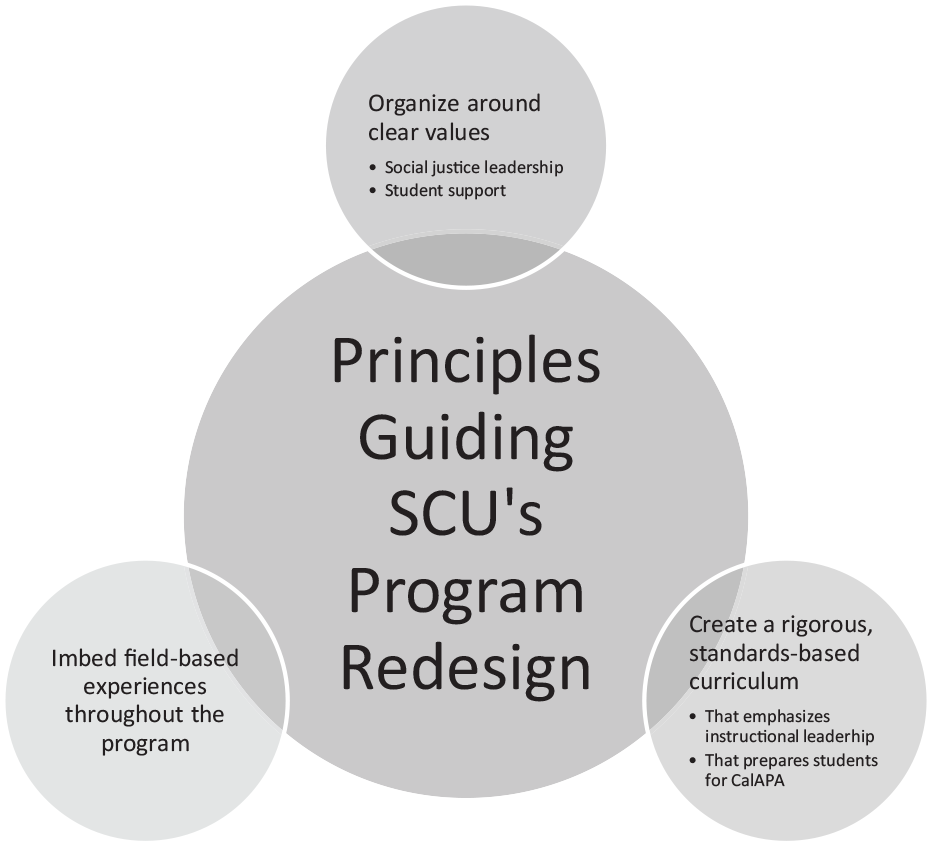
Conceptual framework: principles guiding SCU’s program redesign.
Research Question
This study of the principal preparation Program at South Coast University was guided by the following question:
In what ways is the revised Program preparing students to be social justice leaders?
The study explored faculty and student experiences in the program, including their perceptions about how the Program prepares students to be social justice leaders.
Methodology
Data from this study included student focus group interviews and 1:1 faculty interviews. The study was focused on the first cohort of students to complete the new Program curriculum, including the CalAPA. This cohort of 17 students began in August 2019 and completed the program in May 2021. It should be noted that this cohort of students was impacted by the COVID-19 pandemic as all instruction at South Coast University moved online during the spring 2020 semester and continued to be online for the remainder of this Cohort’s time in the Program.
Data Collection
Qualitative data were comprised of student focus groups and faculty interviews. All 17 students in the cohort we invited in focus group interviews in May 2021, after the completion of their program and after final program grades had posted. A total of six students participated in two focus group interview sessions during June and July 2021. All student participants provided informed consent prior to the focus group interviews. Students were also reminded throughout the recruiting and interview process that their participation in the study was completely voluntary. The students in this cohort were all employed full-time in K-12 schools during the time the Program evaluation was being conducted, which may have impacted their experience in the Program and their desire or ability to participate in focus groups.
Data also included 1:1 faculty interviews from five faculty members who taught seven different program courses. At the time of the evaluation there were four full-time faculty members and five adjuncts teaching in the Program, with some faculty teaching multiple Program courses. Faculty interviews occurred between February 2020 and April 2021. All faculty provided informed consent prior to participating in an interview.
Instruments
The researcher created two interview protocols for this study. The interview protocol for the student focus groups was informed by the literature and reviewed by other Program faculty. The researcher and other Program faculty all have subject matter expertise related to best practices in principal preparation programs and social justice leadership. The protocol contained questions asking students about their experiences with how well they were prepared to be social justice leaders; Program courses, assignments, fieldwork, and the CalAPA; and their perceptions of support they received from the Program. The researcher also developed the faculty interview protocol, which was slightly different than the student focus group protocol, based on the literature and her subject matter expertise related to principal preparation Programs. The faculty interview protocol focused on course connections to social justice and equity, to the CalAPA, and faculty’s overall experience teaching the revised courses for the first time.
Data Analysis
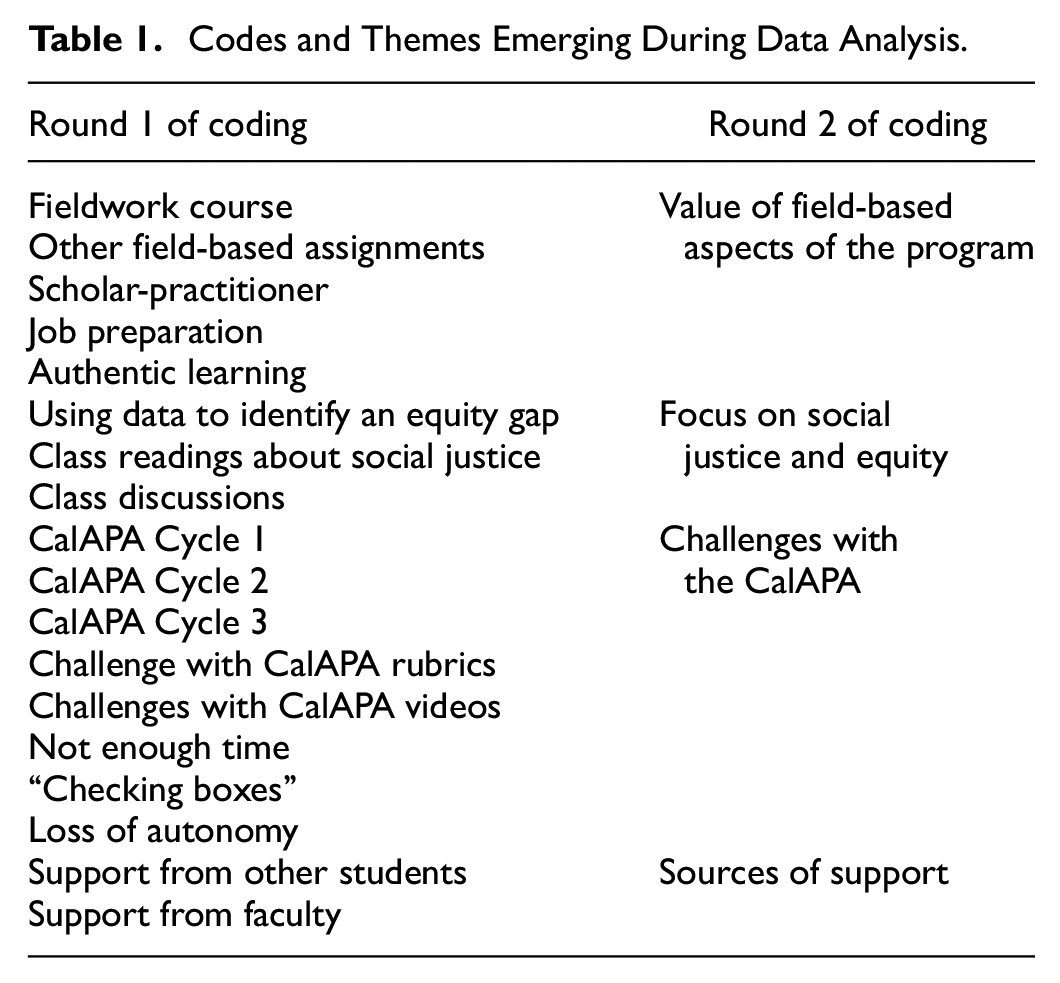
Data analysis consisted of two rounds of coding of focus group and interview data. As Patton (2008) explains, “the evaluator using a qualitative approach seeks to capture what a program experience means to participants in their own words, through interviews” (p. 273). All interviews, whether focus groups or 1:1, were conducted online via Zoom videoconference, and the audio from each interview was recorded. The audio files were transcribed verbatim using Rev.com’s machine transcription, and the evaluator reviewed all transcripts for accuracy while simultaneously listening to the audio. All transcripts were then coded through two rounds of inductive coding. Inductive coding was used to best allow the participants’ own ideas about the Program to emerge from the data rather than pre-selecting codes (Patton, 2015). During the first round of coding, 18 different codes emerged from the data (see Table 1). During the second round of coding, these codes were grouped together into four themes (see Table 1) and exemplar passages were identified, which are presented as the evaluation findings. These themes were shared with other Program faculty, including those who did not participate in the interviews, as a means of establishing credibility and to make sure the findings sounded reasonable based on their experiences as program faculty. The program coordinator kept analytic memos throughout the coding process to keep her analysis and conclusions separate from the words of the participants (Patton, 2015).
Codes and Themes Emerging During Data Analysis.
Findings
Data from faculty interviews and student focus groups yielded four main themes that also help answer the research question: (1) the Program’s focus on social justice and equity, (2) the value of practice-based assignments and experiences, (3) sources of support during the Program, and (4) the challenges with the high-stakes performance assessment. While these findings are relevant to South Coast University, they are also relevant to other principal preparation programs across California and in other states who are preparing social justice leaders, especially in states where high-stakes performance assessments for principals have been or will be implemented.
Focus on Social Justice and Equity
Faculty and students frequently mentioned the Program’s focus on equity when sharing their experiences in the redesigned program. It is interesting to note that in their responses more of the participants talked about equity specifically more than they mentioned social justice.
When asked specifically about how their courses incorporated principles of social justice leadership or focused on equity, all five instructors were able to mention concrete assignments, course readings, or activities that helped students focus on social justice leadership and equity. This focus on equity was strongest for courses explicitly aligned to the CalAPA but was mentioned when discussing other Program courses as well. The most common example across several courses was preparing students to use data to identify an equity gap, which is also a significant focus of the CalAPA. One faculty member discussed how students’ CalAPA submissions related to equity: I think the exciting thing is that the problems of practice that the students chose really went right to the heart of equity issues. For example, they were concerned about achievement of African-American boys or achievement of English language learners. I don’t think there was a single problem of practice that didn’t deal with equity.
Another faculty member explained how they emphasized equity as much as possible as part of the new curriculum: I bring in this notion of social justice because again, not only does CalAPA emphasize that, but our program emphasizes equity and social justice as well. It’s kind of permeated what I do in this class. And the move towards really dealing with equity and equity gaps, which I see as a tripod, with the first piece about data, the second piece about institutional and personal biases, and then this third piece about naming that we have to tie our analysis to certain student groups across status and social demographic markers and specifically things like race and linguistic identities and then gender identity and sexual orientation. I’m always trying to make sure I align these different strands in my teaching so students realize that there is a value-added component here that I’m trying to use this exam. And I’m also trying to use our program’s call broadly speaking to engage in social justice and equity and inclusivity to go above and beyond what the exam calls for itself.
All of the faculty interviewed were able to articulate at least one course reading or assignment that focused on principles related to equity. When mentioning social justice leadership, specifically, faculty articulated several course readings that allowed opportunities for students to participate in class discussions and reflect on themselves as social justice leaders.
Similarly, all students who participated in the focus groups were also able to articulate their learning related to their development social justice leaders and focus on equity. Students most often talked about the CalAPA and course readings and discussions when explaining how the program prepared them to be social justice leaders. One student reflected on her work on Cycle 1 of the CalAPA and its connection to equity: More than anything Cycle 1 made it very clear to me that there are, that there’s a lot of work to be done in terms of how we look at data in California. I dove into Cycle 1 wanting to do one thing and, because the data I wanted that I was looking at wasn’t specific to the [California School] Dashboard, I didn’t think that would be a good idea, but I was surprised by how limiting the Dashboard data is in terms of understanding the real problems, or equity gaps, in education. So it was a great exercise in terms of how you look at data and how you understand equity gaps and I guess just how much work there still is to be done if we’re really supposed to be equity-driven leaders.
The other students were nodding in agreement when this student was speaking. Other student responses focused on the connection to equity in course readings, with one student sharing: The program helped me to contextualize equity in education or in a learning environment. And then, with the support of the professors the other students in the program, and the resources that we were tapping into like texts and the articles, helped facilitate those conversations around equity in our school communities.
When asked about what aspects of the Program prepared them to be social justice leaders, another student was able to make the connections between the course readings, class discussions, and their field-based assignments: I think a lot of the coursework and reading that we did as well. Because I was moving my books the other day and saw The Poverty and Education Reader and Leading for Social Justice. A lot of the readings we did from those and just other different articles that we read I think gave us a lot of different things to think about and discuss related to equity. And I like that we had the opportunity to put that into action in class too. Like [another student] mentioned being able to talk about what was relevant and apply a lot of what we read to our school sites.
When discussing how the program prepared them to be social justice leaders, all students mentioned that they had grown in their ability to use data to identify an equity gap as a result of completing Cycle 1 of the CalAPA.
Benefit of Practice-Based Assignments and Experiences
A significant theme emerging from the data was the value of practice-based aspects of the Program. Most students and faculty commented on the Program’s emphasis on using data to solve problems of practice and how this knowledge will be used when students are administrators. One faculty member explained how they incorporated practical components into their course: I think it helped them recognize the importance of being a scholar practitioner. That’s a huge piece that I stress throughout all my courses is emphasizing your responsibility to be a scholar practitioner. And so the signature case study allowed them again to pull from every skill to think critically about reading the data to spot equity issue at their site. And just kind of learning the toolbox of being a leader out in the field of practice, they also learned in some ways the toolbox of what an action researcher would do and what kind a very micro evaluation project might look like.
Fieldwork, including the CalAPA cycles, was a practice-based experience that students mentioned as an enhancement to their preparation for administrator positions. One student explained that her coaching work as part of Cycle 3 is part of what landed her a leadership position as an instructional coach position after she completed the program. Another student explained:
I think that the practical parts, whether it’s through the CalAPA experience or through the summer [clinical, supervised] fieldwork, just those experiences were the most beneficial. A lot of the learning in some of the other classes it helps with like your disposition and perspective, but the practice and being able to apply it, that’s the most enriching part of the experience.
Other students also stated during the focus groups that the practical nature of many assignments supported their preparation for serving as an administrator. The specific assignments that students mentioned as especially beneficial to their leadership development included a budget assignment about the Local Control Accountability Plan (LCAP), which is a field-based assignment, and a leadership self-assessment, which is not a field-based assignment. The assignments that students mentioned most frequently were the three cycles of the CalAPA. One student explained the benefit of the CalAPA despite his frustration with Cycles 1 and 2: It was really a challenge for me, but at the end, it was practical for admin. This is our job. And we have to be very thorough analyzing the data, coming up with solutions and being reflective. And that’s one of the things that’s a good take way from the CalAPA. How can I, as a leader, reflect on my decisions that I’m making?
While students spent a lot of time in the focus groups discussing their frustration with the CalAPA (see challenges section of findings), students expressed clear appreciation for the practical learning that occurred during the three cycles of the performance assessment since the CalAPA cycles were discussed more than any other assignment as directly contributing to students’ leadership learning. Compared to the students, faculty were more critical of the CalAPA.
Challenges of the High-Stakes Performance Assessment
Students in the focus groups spent about as much time in the interviews discussing the challenges associated with the required performance assessment as they did discussing the benefits of the assessment cycles, and faculty also spent much of the interview time discussing challenges associated with the assessment. Overall, the CalAPA dominated much of the discussion with students and faculty during the interviews.
The faculty freely shared their experiences with the CalAPA as taking over their courses and feeling a resulting lack of autonomy, which was especially significant in the CalAPA-aligned courses. One instructor shared: Usually we’ve had a great deal of autonomy as professors to determine the course content. And then we determine basically whether candidates would become school administrators … as long as they successfully completed our courses we had control over everything. Well, now it’s a different game because we’re coming from a situation where I had just about a hundred percent control of the curriculum content, the instruction and the grading and everything. Now I have about 10% control. I mean, it’s not a 50/50 deal. It’s, it’s down to 90/10.
Another instructor explained how the CalAPA has kind of taken over their instructional focus: I mean, naturally the CalAPA has definitely impacted the direction of this course. In terms of my own instruction, it’s made me hyper hyper-focused on the key performance and content knowledge objectives that are assessed by the exam. And so I think for me there are always going to be concerns or tensions around what gets cut from the curriculum because of this change in direction in recent years.
Even instructors whose courses did not directly align to the assessment cycles mentioned that the CalAPA had impacted what was taught. One faculty member described feeling pressure to teach certain foundational skills that she knew would be assessed by the CalAPA later in the program, so she planned to shift the focus even more toward CalAPA preparation in upcoming semesters just to ensure students were prepared. Instructors expressed frustration and sometimes sadness that the choice to include so much CalAPA content meant that other content, especially content related to social justice leadership, would be left out. Instructors further described that the course content related to the state assessment felt “formulaic” because of all of the rubrics and templates and that they felt like they were “just checking off a series of boxes” when including CalAPA tasks in their courses.
Students used similar language to the faculty when describing the CalAPA; students described the steps in each CalAPA cycle as feeling more like checkboxes than authentic learning tasks. One student stated: “I guess I feel like the task was really to fit into the CalAPA box instead of how do we develop you all as leaders?” This student continued to explain how the course readings and assignments caused her to reflect about her role as a social justice leader but that this learning wasn’t necessarily captured in her CalAPA submissions.
Several students expressed frustration that the video clips uploaded as part of the CalAPA didn’t paint a full picture of all their learning and leadership growth. One student shared: “So much of what I felt I learned in Cycle 2 the CalAPA assessors thought that I had not learned, which was surprising to me. And it really made me question whether getting an admin credential was worth it.” The difference between this student’s self-perception of her learning and the score she received from an assessor on Cycle 2 of the CalAPA caused her to rethink her decision to be an administrator. The student explained that she did not think the short video clips were able to capture the true leadership experience of facilitating a community of practice associated with Cycle 2, and she even questioned whether such brief video clips could ever truly capture that type of leadership learning and performance. When she was sharing her experience, other students in the focus group could be seen nodding in agreement. The students also shared that it was difficult to complete the CalAPA cycles, especially Cycles 2 and 3 which require video clips and are dependent on the cooperation of others at a school site, in the time prescribed by their instructors. Students did acknowledge that part of the time crunch they felt when completing their CalAPA cycles may have been due to the COVID-19 pandemic.
The CalAPA rubrics were another point of frustration for students. One student voiced: I appreciate the complexity of the rubrics, but it almost seemed like it was this jigsaw puzzle they created for us to figure out the puzzle and to do our very best. But with this process it was uncomfortable how much I felt like I had to sort of fake things or just get through the assignment. And the rubrics—I mean, in the end it just became like, all right, I’ve looked at how this goes together four or five different ways. And to look at it ten different ways is just going to make me crazy, so I’m not going to. But it was challenging.
When sharing summary statements about their experience with the CalAPA students often used words like “challenging,”“overwhelming,” and “stressful.”
Sources of Support
Students and faculty frequently mentioned the fact that student support felt like a priority in the Program, with the two main sources of support being faculty and the cohort. Faculty across several courses mentioned the opportunities they provided students to practice CalAPA skills and tasks during coursework. Two faculty members shared how they used class time for peer feedback groups so that students could support each other in their drafts of CalAPA materials. Students also shared that the design of the courses to incorporate CalAPA practice, instructor feedback, and peer feedback time was a critical factor in their success on the CalAPA. Students further shared that the guidance faculty provided related to the CalAPA rubrics was a significant source of support: In our template the professor would connect certain parts of the written narrative to aspects of the rubric. And I found that alignment to be extremely helpful. Just having that reference material there, what each of the rubrics corresponds to, really helped me a lot because what I mentioned earlier about the rubric and the complexity of it, I think that having that connectedness, this part of the narrative corresponds to this part of the rubric, I wouldn’t have known that had the professor not highlighted that.
A couple of students also mentioned the support role that faculty play during their fieldwork by helping troubleshoot issues that arose. Additionally, students commented about their instructors’ expertise and admin experience, approachability, and availability during office hours and via email as being critical program supports. One student shared, with several others agreeing: It felt like the intention was truly that we would grow as leaders throughout the process and not just pass an exam. I felt really supported by the professors and I felt that space was created for us to talk about equity or problems of practice in an authentic, real, and meaningful way with our colleagues.
This student’s comment indicated that perceived classroom space to have authentic equity-focused conversations to be a form of support from faculty. Several other students also mentioned class discussions as a place where they could learn from their cohort mates.
The cohort design of the program was another significant source of support for students. This remained true when the program shifted to fully online instruction due to the COVID-19 pandemic. During the focus groups, several students mentioned a cohort text message thread that provided support and comfort during the stressful moments in the program. One student described the cohort bond, with several others agreeing: I loved the cohort because nobody was just looking out for themselves. Everybody was there to support everybody. And it was a special, very special thing, I think. And I hope that in my future I will have such supportive people to work with.
Students also shared that, in addition to the peer groups formed by instructors during class time, they formed their own peer feedback groups outside of class and would often support each other with the CalAPA and other assignments. The cohort model provided both relational and academic support to students.
Implications
Several implications emerged for best practices in principal preparation programs, including programs that are facing the reality of preparing students to be social justice leaders while also preparing them for a high-stakes, state-mandated performance assessment: (1) the need for a comprehensive curriculum with an explicit social justice focus, (2) the benefit of the cohort model, (3) the value of field-based assignments, and (4) the value of and challenges with the performance assessment.
Need for a Comprehensive Curriculum With an Explicit Social Justice Focus
Principal preparation programs should continue to include topics in their programs beyond what is explicitly covered by the state performance assessment and provide explicit content related to social justice leadership. A balanced, standards-based curriculum will prepare students to be social justice leaders and prepare them for the required performance assessment (e.g., the CalAPA). Students need to learn some of the practical aspects of administration (e.g., fiscal matters and student discipline, to name two) that are not necessarily covered by the state’s performance assessment so that they have a broad understanding of their leadership responsibilities and are prepared for the many facets of school leadership once they are in the field. Further, a curriculum that covers the breadth of the leadership responsibilities administrators face allows students to make connections between social justice leadership and their varied leadership duties even before they assume a formal leadership position.
Explicit social justice content must also be deliberately included into a program’s curriculum, pedagogy, and assessments at multiple places in the program (Cambron-McCabe & McCarthy, 2005; Capper et al., 2006). Students and faculty in the South Coast University program were able to mention some curriculum and assessments that connected to social justice leadership; however, nearly all of experiences mentioned by participants were about using data to spot and address equity gaps and, except in two instances, did not further expand on how students were prepared to be social justice leaders during the program. In fact, the discussion of the CalAPA eclipsed the discussion about social justice leadership during all of the focus group sessions with students. Additional course content, including structured opportunities for dialogue and reflection, would help students further develop their knowledge, skills, and critical consciousness as social justice leaders (Capper et al., 2006).
Benefits of the Cohort Model
From the student focus groups, it is clear that the cohort model was a highly valued aspect of credential/principal preparation programs. This is no surprise, as the literature strongly supports the use of cohort models for principal preparation programs (Davis & Darling-Hammond, 2012; Davis et al., 2005; Ni et al., 2019). The support that students derived from the cohort model was evident from the data: the cohort model provided built-in opportunities for students to connect with one another and form peer groups to support each other with assignments and the CalAPA. The cohort also served as a community of practice where students and faculty could meet together during class time (even via Zoom) to discuss and reflect on equity issues in schools. Whether formal peer groups during class time or informal peer networking via the peer text thread, the students in the cohort cared for and valued their cohort members as sources of support and as members of a learning community.
Value of Field-Based Assignments
The value of the field-based assignments, including the state-mandated performance assessment (CalAPA) was evident from students’ experiences. The literature mentions the importance of field-based experiences (Davis, 2016; Davis & Darling-Hammond, 2012), yet several states still do not require fieldwork as part of their principal licensure process or their state policy surrounding fieldwork is not clear (Anderson et al., 2022). Fieldwork should be a central feature of principal preparation programs. Students overwhelmingly reported that authentic learning from the field-based experiences, including supervised clinical experiences and the CalAPA, truly prepared them for a leadership position. These field-based experiences also provided students an opportunity to see firsthand the inequities in schools and how social justice leaders can actively work to remedy these equity gaps.
Value of and Challenges With the CalAPA Performance Assessment
What was perhaps surprising from the data is how much emphasis students and faculty placed on the CalAPA performance assessments. Most of the interview and focus group time was dominated by discussion of the CalAPA. Students and faculty shared challenges with the CalAPA as well as emphasizing the value of all three CalAPA cycles as authentic, field-based assessments. Students mentioned all three CalAPA cycles as assignments that most contributed to their learning and leadership preparation during the program. However, the students and faculty also shared several challenges with the CalAPA, most notably around the videos and rubrics. It did seem that the high-stakes nature of the CalAPA interfered with the authenticity of the tasks and therefore with student learning. Students shared that the many rubrics used for assessment and the stringent requirements related to the video clips definitely interfered with their learning.
Recommendations
In addition to the implications for principal preparation programs already discussed, data from this study suggest some recommendations related to the preparation of social justice leaders and California’s performance assessment. While the student and faculty experiences in this study suggest that locally administered and assessed performance assessments may result in more authentic student learning, the reality for many principal preparation programs, including those in California, is that high-stakes performance assessments are already required by the state’s credentialing agency. Accordingly, principal preparation programs must make the best of the flawed assessment system by providing ample support to their students. Data from this study illustrate that programs should provide imbedded CalAPA within the coursework so that students are supported in their CalAPA work without it being something additional. In South Coast University’s redesigned Program, the CalAPA cycles were imbedded in a series of three courses with designated assignments to support CalAPA completion, and the CalAPA was still a challenge for students. Absent this streamlining of CalAPA and course content, students likely would have struggled even more to complete the CalAPA during the time allotted in the program. A thoughtful imbedding of performance assessments within coursework is recommended, with instructors using the tasks, templates, and rubrics from the actual performance assessment as part of the course content. Further, program faculty can look for opportunities to make explicit connections for students between social justice leadership and the CalAPA so that students can use the performance assessment as an opportunity to work toward eliminating an equity gap in schools and to reflect on their capacity as social justice leaders. Critical social justice discourse must be woven throughout the program so that students have opportunities to think differently about their role as a leader within the education system (Cambron-McCabe & McCarthy, 2005).
If the CalAPA continues to be a requirement for earning a preliminary administrative services credential (PASC) in California, then adjustments to the assessment are needed and research needs to be conducted about the assessment’s impact on leadership practice, especially the extent to which the CalAPA is supporting students in becoming social justice leaders. First, the assessment rubrics should be streamlined for clarity. The CalAPA uses seven or eight rubrics to assess each cycle (CTC, 2021). As a point of contrast, the performance assessments in Massachusetts (MA DOE, 2022) and Texas and Georgia (ETS, 2021) use only three or four rubrics to assess each performance assessment task. It seems that simplifying the CalAPA rubrics is needed so that there are no more than four rubrics per cycle. Second, the video clip requirements of the CalAPA should be examined and adjusted to ease some of the logistical burden on students. If possible, fewer video clips should be required so that students can focus on authentic learning rather than trying to artificially capture specific evidence across several video clips. In other states utilizing performance assessments, at most two video clips are required (ETS, 2021; MA DOE, 2022). The CalAPA requires 3 to 4 video clips in Cycle 2 and 3 to 8 video Clips in Cycle 3 (CTC, 2021). By simplifying the rubrics and video requirements of the CalAPA, students will be able to spend more time on their development as social justice leaders and can focus on their leadership development and the actual content of the assessment rather than the technical burdens of the assessment. Finally, additional research is needed to determine the impact that state-mandated, high-stakes performance assessments, such as CalAPA, are having on school leaders.
Conclusion
School administrators and the programs that prepare them are faced with an ever-changing and increasingly complex educational landscape. School leader preparation programs must prepare social justice leaders who are prepared to confront the many systemic inequities in schools while also preparing leaders who are competent in the basics of school management and instructional leadership. Added to this already difficult charge, administrator preparation programs in some states, including California, must now also prepare their students for high-stakes performance assessments. Rather than perceiving all of these responsibilities as competing, administrator preparation programs can approach these multiple concerns as a unified charge to prepare social justice leaders using the performance assessment as one measure of students’ competency.
Footnotes
Declaration of Conflicting Interests
The author declared no potential conflicts of interest with respect to the research, authorship, and/or publication of this article.
Funding
The author received no financial support for the research, authorship, and/or publication of this article.

Data Availability Statement
The data generated and/or analyzed during the current study are available from the author on reasonable request.