




Abstract
In the fall of 2013, Fountain-Fort Carson High School implemented a new “Advisory Period” for all students at all grade levels. Incoming ninth-grade students were randomly assigned a faculty advisor and stayed with the advisor over the course of their 4 years of high school. School counselors wrote the Advisory programming which included academic and attendance progress monitoring in addition to mentorship with the intent to connect student with a caring adult to positively impact graduation and attendance rates while reducing dropout rates. Previous graduation rates were compared for students who did not have Advisory and those who had either 1, 2, 3, or 4 years of Advisory. Researchers hypothesized an increase in cohort graduation rates for those students who had participated in the entire 4-year Advisory program compared with students who either did not have Advisory or had 1 to 2 years of Advisory. The variations in graduation rates between groups of students that did not have Advisory and those who did were shown to be statistically insignificant.
Keywords
Introduction
High school graduation rates are historically the yardstick of measurement for school effectiveness and success. Interventions for increasing graduation rates have become numerous, with very little research to demonstrate these interventions are effective. In August 2013, school counselors at Fountain-Fort Carson High School implemented a formalized Advisory period for all students at all grade levels. The intent of the Advisory program was to have 14 to 18 students permanently assigned to a faculty advisor for their duration of time at the high school. Through a formalized and locally written curriculum the students would receive academic progress monitoring, attendance monitoring, and nonacademic curriculum delivery written by counselors and delivered by advisors in conjunction with school counselors. Philosophically, the Advisory program was undertaken as a means to guarantee each student had a relationship with a caring and trusted adult to follow them through their high school years.
Upon implementation of Advisory, it was determined that measurements should be taken for benchmarking purposes of the program’s effectiveness. The measures selected to determine effectiveness of Advisory program implementation and delivery were graduation rates of students participating in Advisory, attendance rates, and student dropout rates. The Advisory implementation team hypothesized that with full Advisory implementation the school would see a reduction in the dropout rate, and increase in student 4-year graduation rates, and an increase in yearly student attendance rates. It was determined that regardless of initial measures of effectives that Advisory would stay in place to meet the less measurable impact of students feeling like they have a trusted and caring adult to connect to. The decision was made that eventually, despite measurable outcomes, student perception of their relationship to their trusted and caring Advisor would prevail in the short term. This study measures the impact of Advisory on three quantitative data points rather than student perception data, though this is an area for extended research following full program implementation.
Literature Review
Research exits in varying fashions on the effectiveness of advisory programs, or more often Positive Behavior Interventions and Supports (PBIS), either from student perception data or quantifiable measurements. As part of a measurable comprehensive school counseling program, the need to measure the effectiveness of Advisory program needs further exploration. Carey and Dimmitt (2012) analyzed numerous preexisting studies on comprehensive school counseling programs and identified the continued need to further develop valid and reliable measures of counseling programs in general. McClure, Yonezawa, and Jones (2010) found through student survey responses that “the relationships among advisory period, personalization, and academic outcomes are not as straightforward as previously thought” (McClure et al., 2010). It was in fact found that students who positively perceived advisory actually had worse academic achievement outcomes.
Quantitative measures of advisory effectiveness were attempted to be captured by Hendon and Jenkins (2012) through their analysis of advisory impact on state assessment scores and graduation rates in addition to student and parent surveys. Hendon and Jenkins (2012) analyzed student achievement scores on state assessments in addition to graduation rates and could not establish a direct correlation to the advisory program. As on ongoing theme in advisory research, Hendon and Jenkins (2012) argue that advisory will potentially continue to increase in popularity as schools look to increase student opportunities.
Research by Dunham and Frome (2003) found that the purpose of formalized advisory programs was to communicate high expectations for all students from faculty, in addition to encouragement for students to do well in school. Dunham and Frome (2003) found that advisement from teachers, and not counselors, was the greatest indicator of student success for student at the middle school level, but not in high school. The conclusion was drawn that faculty engagement with students in an advisory capacity was positive, if not directly measurable across grade levels.
Koszewski (1994) used qualitative student perception responses, in addition to parent responses to determine effectiveness of an Upward Bound Program. Koszewski (1994) assessed through student and parent responses that the advisory program needed to be more academically formalized with strong communication between advisors, students, and parents. An improvement in student grades was not found; however, respondents listed the possibility of increased group cohesion as a perceived benefit. The need for more formalized and structured advisory activities was a point of emphasis for respondents and Koszewski (1994).
One of the defining aspects of a formalized advisory period is the development of strong student relationships with caring faculty members. O’Dowd (2013) found through middle school advisory implementation that identifying the need as a school for advisory outweighed the approach to advisory. Identifying the need to cultivate strong, caring relationships between students and faculty becomes the primary emphasis of a formalized advisory program, O’Dowd (2013) argues. O’Dowd (2013) continues to clarify the need for faculty to understand the purpose and implementation strategies of an advisory program for it to be successful.
The need for purposeful and meaningful faculty engagement in advisory programs was found to be essential by Welsh (2012). Welsch surveyed faculty advisors on their understanding of and use of personalization strategies in their advisory role within advisory. The need to have faculty buy in to advisory implementation will improve faculty understanding of personalization and use for change Welsch argues. School counselors are a necessary source of leadership for the explanation and justification behind the need for Advisory and long-term student outcomes. Young, Dollarhide, and Baughman (2015) found that communication was one of five essential themes for school counselors as leaders. High level of communication regarding the need for Advisory with faculty was an essential aspect of Advisory planning and implementation and continues to be so in future iterations of Advisory. The ASCA National Model (American School Counselor Association [ASCA], 2005) identifies strong leadership as essential in the design and implementation of effective school-wide counseling programming, of which Advisory satisfies through social emotional education and postsecondary planning.
As a means of PBIS, the Advisory model establishes preventive education and behavior supports for academic, social emotional, and career ready needs. Goodman-Scott, Betters-Bubon, and Donohue (2015) conceptualized the connectedness of PBIS and comprehensive school counseling program. With counselor leadership essential to Advisory as an aspect of PBIS, further alignment to ASCA standards can be addressed through formal Advisory lesson creation and delivery. Martens and Andreen (2013) came to similar conclusions agreeing that school counselors are essential to the implementation of a school-wide PBIS system that includes aspects of Advisory such as parent communication and progress monitoring.
Method and Design
The data analyzed in this research study spans graduating cohorts of Fountain-Fort Carson High School from 2012 to 2017. The graduating cohorts were broken down into three groups. Group A consisted of students in the graduating cohorts of 2012 and 2013—the last two graduating classes to not be enrolled in the Advisory program. Group B consisted of students in the graduating cohorts of 2014, 2015, and 2016—students with some exposure to Advisory. Finally, Group C consisted of the graduating cohort of 2017—the first graduating class to have completed the entire 4-year Advisory program.
Students were randomly assigned to Advisory faculty upon enrollment in the ninth grade. The Infinite Campus student information system (SIS) randomly assigned students to Advisory faculty, balancing out Advisory enrollments across all sections of Advisory to between 16 and 18 students. Research by Lapan, Whitcomb, and Aleman (2012) indicated that small ratios of faculty and counseling faculty to students for counseling program delivery were demonstrated to increase graduation rates. All licensed instructional faculty, licensed special service providers, and school administrators were assigned to an Advisory group, ensuring that all students were assigned a faculty Advisor in groups no larger than 18. A total of 124 Advisory groups were established to accommodate an initial 2,027 students at the beginning of the 2013-2014 school year. Over the course of this study, school enrollment fluctuated in line with student transiency rates, with number of total Advisory sections and Advisors remaining consistent.
The format of Advisory sessions centered on a weekly Advisory session each Wednesday for a period of 46 min. Every Wednesday, for the length of the school year, students would meet with their faculty Advisor. This Advisory session meeting time and day remained consistent over the course of the study. The first several Advisory sessions of each school year focused on Advisors working with their individual students on personal goal writing around the areas of measurements—attendance and grades. Faculty Advisors were responsible for individual student meetings, on a rotating basis, to use the gridded progress monitoring tool with students, and have personal discussions around the individual student’s goal attainment and improvements or declines. Students then completed the progress monitoring tool and charted their weekly entries, with Advisors keeping the progress monitoring tools between sessions. In addition to progress monitoring, students also received an Advisory lesson, taught by their Advisor, and created by the school counseling department, on topics relating to social-emotional well-being and post-secondary planning. School counselors created these specific monthly lessons as a main delivery technique for the PBIS concepts not addressed through the Advisor progress monitoring. An informal emphasis on Advisor–student relationship building was placed on all PBIS school counselor–created lessons.
Participants and Demographics
Fountain-Fort Carson High School serves the communities of Fountain, Colorado, and nearby Fort Carson Army Post. The school has an enrollment of 1,910 current students with total enrollment changes occurring frequently, of which 46% qualify for free or reduced-price lunch. The student population is ethnically diverse—Hispanic: 27%, Black: 13%, Asian Pacific Islander: 2%, American Indian: 1%, Two or More Races: 9%, White: 48%. Fountain-Fort Carson High School serves a large military population with nearly 73% of the student population either being direct military dependents of militarily connected. The state-defined “mobility rate” of Fountain-Fort Carson High School is traditionally 20% higher than the state average from year to year. This mobility or transiency is due in large part to military dictated troop and family movements, with soldiers and families moving frequently to and from Fountain-Fort Carson High School. Graduating class sizes between the sampled years ranged from 342 at smallest to 398 at largest. Approximately 124 faculty members were assigned as advisors. Teachers, counselors, and administrators were all assigned advisory groups and followed their advisory group through to graduation. Upon an advisory group’s graduation, the faculty advisor “rotates” back down and receives a new incoming ninth-grade advisory the following year.
Measures
Data collected for each cohort included number of total graduates within each cohort year for graduating cohorts 2012 to 2017. Total number of nongraduates (students failing to satisfy necessary course credit requirements) for each year of graduating cohorts 2012-2017 was also collected. These numbers were used to create each graduating cohort’s graduation rate (graduation percentage). Cohorts assigned to Group A, B, and C were then compared to determine whether an increase in graduation rate was seen between each group.
Attendance data were collected as a yearly measure for all years ranging from the 2011-2012 school year through the 2016-2017 school year. Attendance data are a percentage attendance rate for the whole school based on attendance by day and by class period. School Years 2011-2012 and 2012-2013 were used as baselines, demonstrating attendance rates prior to Advisory implementation. School Years 2013-2014 through 2016-2017 were used as measures of Advisory program attendance monitoring effectiveness when compared with prior years without Advisory in place.
Data for graduating cohorts has been housed within the school’s SIS by individual student and graduating cohort for all years 2012-2017. Personalized and identifiable student data were intentionally omitted to protect student privacy and to adhere to The Family Educational Rights and Privacy Act (FERPA) regulations. Additional data points, such as specific numbers of dropouts, were intentionally omitted and reported as overall percentages. This was done intentionally to protect the small number of students reported in that percentage from being identified within the small community of Fountain, CO.
Results
Among the three groups, based on level of exposure to Advisory, graduation rates were inconsistent and showed no discernable difference between groups after exposure to Advisory academic monitoring strategies. Students with no exposure to Advisory in the graduating cohorts of 2012 and 2013 (Group A) showed consistent graduation rates of 96.38% and 97.57%, respectively (Figure 1). The graduation rates for 2012 and 2013 were used as baselines for the measurement of Advisory effectiveness beginning with the graduating class of 2014 through 2017. Students with partial exposure to Advisory in the graduating cohorts of 2014, 2015, and 2016 had 1, 2, or 3 years of exposure to the formalized Advisory program upon Advisory implementation in Fall 2013. Within this group (Group B), the graduation rates were 96.51% in 2014, 94.1% in 2015, and 97.31% in 2016 (Figure 2). The graduating cohort of 2017 (Group C) was the first cohort to go through the full 4-year advisory program and attained a graduation rate of 96.8%.

Graduation rates separated by group participation in Advisory.

Graduation rates over time before and after Advisory implementation.
Student attendance data were analyzed for the same three groups based on engagement with Advisory program attendance monitoring. For the years prior to implementation of Advisory in 2012 and 2013, the yearly attendance rates were 91.5% for 2012 and 92.1% for 2013. The following years of school-wide attendance rates starting in 2014 demonstrated typical fluctuations seen in years prior to Advisory implementation. Attendance for 2014 was at 92%, 2015 at 92.6%, 2016 at 92.2%, and 2017 at 91.25% (Figure 3). Interestingly, the lowest yearly attendance rate was found in the Advisory programs fourth year of existence.
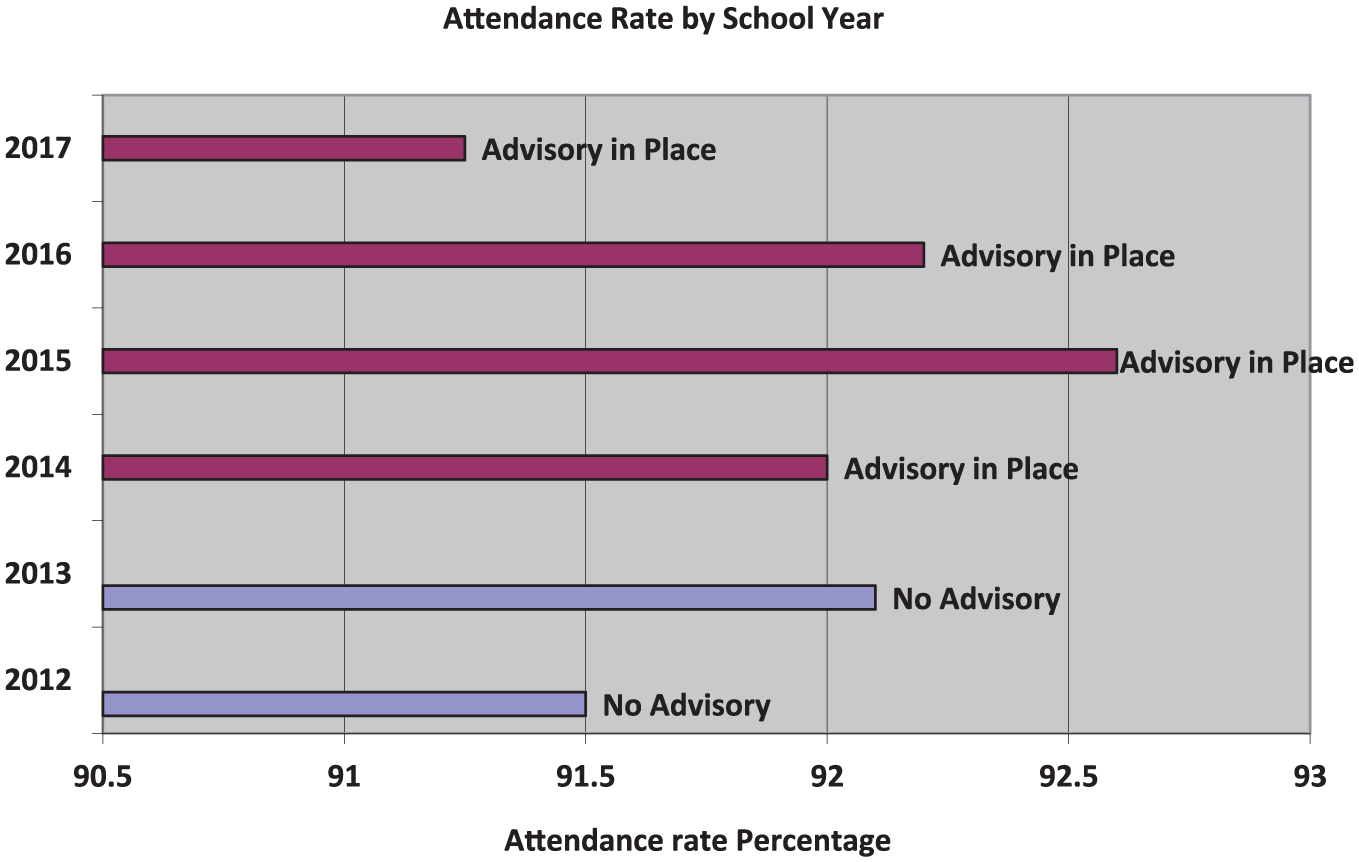
Attendance rates by year and Advisory implementation.
Student dropout rates did see reduction in relation to Advisory program implementation. Students with no exposure to Advisory in the graduating cohorts of 2012 and 2013 (Group A) showed dropout rates of 0.7% and 1.0%, respectively. The dropout rates for 2012 and 2013 were used as baselines for the measurement of Advisory effectiveness beginning with the graduating class of 2014 through 2017. Students with partial exposure to Advisory in the graduating cohorts of 2014, 2015, and 2016 had 1, 2, or 3 years of exposure to the formalized Advisory program upon Advisory implementation in Fall 2013. Within this group (Group B), the dropout rates were 0.8% in 2014, 0.2% in 2015, and 0.5% in 2016. The graduating cohort of 2017 (Group C) was the first cohort to go through the full 4-year advisory program and attained a dropout rate of 0.3% (Figure 4).
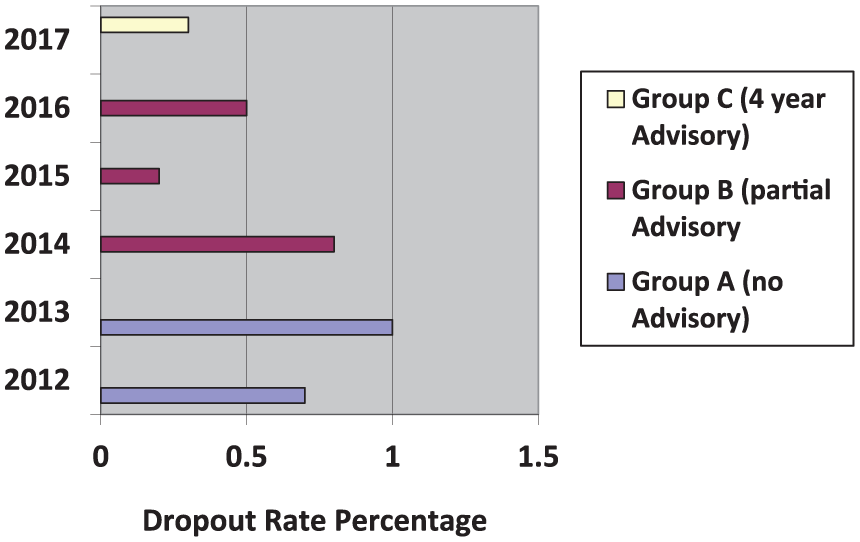
High school drop out rates by year and group Advisory participation.
Discussion
The original intent in creating a formalized 4-year Advisory program stood on philosophically solid ground. Faculty desired an additional way to impact students in a nontraditional and nonacademic way. However, the results did not yield a significant impact to justify the continued allocation of resources, time, and faculty for the Advisory program. Though dropout rates did increase over the course of program implementation, the percentage reduction was so low that two to three students accounted for the variation year in and year out. Impacts on graduation rate seemed to trend positively without a strong positive correlation being identifiable. Attendance rates decreased, or fluctuated within standard expectations both before and after Advisory implementation with no indefinable impact.
Over the course of this longitudinal study, there were several unforeseen circumstances that could be controlled for in future research that were not initially identified at the onset of this study. Most significantly, as mentioned in the Participants and Demographics section of this article, transiency of the high school military student population was a factor that could not be controlled. Over the course of the first 4 years of advisory, approximately 30% of the graduating cohort of 2017 withdrew from the high school between their ninth and 12th grade years, leading to an equivalent number of students transferring in. When summed, this means that only two thirds of the graduating cohort of 2017, the first to have a 4-year Advisory program, completed the entire 4 years.
The progress monitoring tool used for academic progress monitoring in 2015 and 2016 consisted of a simple paper grid marked by date where students input their own current grades and attendance to goal set accordingly. Starting in the 2016-2017 school year, the progress monitoring tool was abandoned due to connectivity issues with the SIS’s online portal. Having the entire student body login to the wireless network simultaneously crashed the network frequently. This resulted in numerous student’s errors in self-assessing academic progress in preparation for their progress monitoring session with their faculty Advisor. As a replacement for online grade access, the school counseling department began printing hard copies of student’s progress reports that students would then use in progress monitoring sessions with Advisors. This change in progress monitoring tools created a complicating factor by negatively impacting the efficiency and accuracy of Advisor progress monitoring. During the 2015 and 2016 years in which the more formalized progress monitoring tools were used, it was found that student attendance reached the highest levels at 92.2% and 92.6%, respectively. As the progress monitoring tool also included attendance monitoring, it can be concluded that Advisor progress monitoring on attendance, based on student self reporting and goal setting, did increase student attendance rates. The drop in attendance rates the following school year of 2016-2017 correlates with the removal of the previously more formalized progress monitoring tool. Future research may further explore school-wide implementation of Advisory progress monitoring tools, specifically the rate of overall implementation with fidelity by all Advisors. Dunham and Frome (2003) addressed this method as a means to continually communicate high faculty expectations through Advisory programming. However, the rate in which these tools are implemented effectively across all Advisory groups by all Advisors remains yet to be seen.
In addition, a small math-specific intervention was created by high school administration in the middle of this study to assist students with below-grade-level math skill. The effectiveness of this intervention has not been proven yet; however, it has made comparing groups of students from years prior to Advisory more difficult. When controlling for this difference between Group A and Group C, no noticeable difference was found in graduation rates for Advisory participants. Another variation found over the length of this study was the natural turnover of faculty over time. Advisors assigned to student groups occasionally retired or moved away from the school, resulting in new hires being assigned to preestablished Advisory groups. Future research should attempt to control for this faculty turnover and remove data points for Advisory groups with turnover from the data set.
The largest and most uncontrollable variable of the Advisory program was faculty engagement and buy-in. Faculty resistance or apathy toward the Advisory program makes the effectiveness of the school-wide initiative difficult to measure. Student and parent survey data and perception data would be useful in future research to discern the outcomes of smaller subsets of students based on the perceived quality of relationship between student and faculty advisor. Without these student and parent response data, it is not possible to control for small pockets of disengaged advisors skewing data. This recommendation is in alignment with Koszewski’s (1994) research recommending student and parent survey data to determine program effectiveness used in conjunction with data points on graduation rates, attendance rates, and dropout rates.
Smaller numbers of faculty Advisors, selected on previously set qualities and criteria, would be recommended to measure effectiveness of selected Advisors rather than assigning all faculty and Advisory. Future research may find greater student outcomes when students are assigned to only faculty specifically chosen to be Advisors. The school-wide emphasis on Advisory as a means of PBIS delivery, in addition to progress monitoring, would be an additional area of study in future research. A specific focus on student and parent survey perception data, specifically focusing on relationships with faculty Advisors, would be an additional potential support for PBIS delivery within an Advisory model. This focus on relationships within an Advisory model would build on this current student and findings by O’Dowd (2013) that an emphasis on caring relationships with adults should be the main focus of an Advisory model with components of PBIS.
This study’s most applicable and useful finding for current school counselors and administrators is in the use of a progress monitoring within a formal Advisory model. Through the structured and formalized Advisory setting, Advisors can utilize individual student progress monitoring sessions on grades and attendance to improve student outcomes in those areas. An assigned and consistent faculty Advisor, with students assigned to them over the course of 4 years, demonstrated that students can effectively monitor their own progress, with Advisor support, through the formal relationships established in this model.
Footnotes

Declaration of Conflicting Interests
The author(s) declared no potential conflicts of interest with respect to the research, authorship, and/or publication of this article.
Funding
The author(s) received no financial support for the research, authorship, and/or publication of this article.