




Abstract
This quantitative study investigates the effect of instructional and distributed leadership practiced by school principals on teacher professional development in schools in Jakarta. The study also explores the causal-relation between instructional and distributed leadership. Stratified sampling was used by dividing schools in Jakarta into strata (west, north, east, and south) to gain 430 participants to answer a survey that covered instructional and distributed leadership and teacher professional development. Instrument developed by Alma was used distributed leadership, Hallinger for instructional leadership and The Teaching and Learning International Survey (TALIS) developed by OCD was used for teacher professional development. Data were analyzed using Structural Equation Model (SEM) through SmartPLS statistical software. The findings of PLS-SEM revealed the direct effect of both instructional and distributed leadership on teacher professional development. The findings also reported the direct effect of instructional leadership on distributed leadership. The findings provide empirical support for implementing instructional and distributed leadership practices in Jakarta schools, as they lead to teacher professional development. It also advocates for leadership training in these practices for school principals. Keyword: school leadership, instructional leadership, distributed leadership, Jakarta, Indonesia, SmartPLS.
Keywords
Introduction
As learning outcomes and student achievement have become performance indicators for schools, school administrators are being held accountable for the success of their students. School systems around the globe have focused their attention on educational theory, policy and practice, and school administration and leadership improvement have become major priorities (Barber et al., 2010; Leithwood et al., 2008; Mulford, 2007; Torrance & Humes, 2015). School supervision, instructional standards, teacher professional development, and learning outcomes are yardsticks for effective school leadership. In addition, the demands of the Fourth Industrial Revolution (IR4.0) and the global pandemic have even made it vital for school leaders to possess technology skills if they are not to fall behind in these challenging times. All of these recent developments call for reformation in the way schools are administrated, and the way teaching and learning are conducted (Hinton, 2018; Raman & Thannimalai, 2019; Schwab & Davis, 2018).
The concept of professional development for teachers has changed over the years. Yet, its overall objective always has been to improve teachers’ skills and competencies to increase students’ learning capability (Choi & Kang, 2019). Professional development has been described as a program designed to improve teachers’ expertise to improve student learning outcomes and achieve the school’s goals. Teacher professional development includes many procedures, actions, and mechanisms shaped by the cultural, social, political, and economic characteristics and circumstances of each context (Bautista & Oretga-Ruiz, 2017; Tan & Dimmock, 2014).
Research on instructional and distributed leadership suggests that teachers cannot perform their roles and responsibilities without the appropriate support mechanisms and continuous professional development that meets their leadership needs. Defined as the ability to influence others, teacher leadership (TL) is reported to be one of the skills enhanced by teacher professional development. Hence, for teachers to be leaders, they must possess skills to affect the attitudes and behaviors of others, be independent, and set their sights on student success (Schott et al., 2020). However, the distributed instructional leadership approach acts as a tighter coupling in developing strategies to effectuate innovations in the classroom and best classroom practices for leaders (Elmore, 2004; Halverson & Clifford, 2013; Spillane & Burch, 2006; Spillane et al., 2004; Weick, 1976; Zuckerman et al., 2018).
Furthermore, a growing body of research has focused on instructional leadership and its role in teacher professional development and school principal supervision, assessment, and feedback to advance student learning. Considering the investment in schools and education globally, the implementation of effective professional development programs must be considered as these will improve student outcomes and the quality of teaching (Miller et al., 2019). Research points to the crucial role of principals in teachers’ professional development (Sebastian et al., 2016) and the importance of allowing school teachers to learn from their peers through mentoring observation and mutual reflection (Harris, 2004; Little, 1995; Yee, 2016). Teachers play a crucial role in sustainability education. In regards to this, teacher professional development plays an essential role in the enhancement of quality teaching and sustainability education (Choi & Kang, 2019) that fosters innovation (Vincent-Lancrin et al., 2019) and supports experimentation with continuous evaluation, assessment, and feedback (Choi & Kang, 2019).
In high performing education systems like Japan, South Korea, Shanghai (China), and Singapore, principals are provided with rigorous training courses, specialized internships and mentoring programs to improve their leadership skills (Darling-Hammond, 2010; OECD, 2012; SABER Country Report, 2015). A study of Chinese schools showed that principal instructional leadership promotes collaborative activity in schools, collective focus on student learning, and teacher self-efficacy (Zheng et al., 2019). Another study from China (Liu & Hallinger, 2018) reported a moderate indirect effect of principal instructional leadership on teacher professional learning. Sumiati and Niemted (2020) found a positive relationship between principals’ instructional leadership and teacher self-efficacy in the Indonesian context. Among the problems reported in South Sulawesi, Indonesia, schools are principals’ lack of leadership skills and their unwillingness to share administrative authority with teachers (Usman & Tafsir, 2016).
Nevertheless, principal roles are varied and keep on changing. In light of this and the increasing pressure on school heads, the distributed leadership model is proposed as a modern approach to the school administration to empower teachers for joint responsibility, accountability, and participation in the decision-making (Amzat, 2017). Research has found that distributed leadership is more likely to improve teaching and learning (Hermann, 2016). However, this depends on providing proper training and continuous professional development for teachers, most of whom have not been prepared to take on administrative responsibilities. One-shot workshops on leadership are usually insufficient; continuous professional development requires multiple sessions over time. This training must be systematic, gradual, and ongoing. Kim and Lee (2020) studied principal instructional leadership and teacher professional development in three Asian countries. They suggested that the instructional leadership practice should focus on mentoring, peer observation and coaching.
In Indonesia, religion and traditional principles have the greatest influence on the education system, even while the education system changed during the Dutch colonial era and, later, the Japanese occupation. The rapid development of education in Indonesia took place after independence with the creation of universal education to form the sense of nationhood based on Pancasila, the underlying principles of an independent Islamic state. This rapid development saw the government working with the private sector to create the country’s educational infrastructure and institutions. During this universal education drive, thousands of unprepared teachers were hired to deliver the newly established national curriculum (Suratno, 2014).
Indonesia’s four decades of teacher professional development programs have yet to be fruitful and meet expectations. According to the World Bank Report 2015, teachers still lacked knowledge and adequate pedagogical skills, children underperformed as reported by PISA, and lacked mathematical skills (Beatty et al., 2018; Revina et al., 2020). To prepare teachers for the future, the Indonesian government in 2005 created a comprehensive Teacher and Lecturer Law for better teacher management and development.
This law helped reform the teacher management and development system to strengthen educational institutions in the country. This reform was instituted by the Ministry of Education and Culture, supported by the World Bank, to raise the standards and competency among teachers and lead to their professional development (Chang et al., 2014). However, due to politics and power involvement, inadequate funding, and poor management, the education system in Indonesia is still struggling and fares poorly compared to other countries and the global educational system (Rosser, 2018).
The reform mandated by the Ministry of Educational and Culture in 2013 changed instructional practices from teacher-centered to student-centered instruction. School principals are expected to play a major role in ensuring that this curriculum is implemented in schools (Asikin-Garmager, 2017). However, principals seem ill-prepared to do this. Asikin-Garmager’s (2017) findings on Indonesian public-school principals’ enactment of agency have suggested the need for more support and training for school principals in Indonesia and urged their involvement in policy-making and implementation.
The new school-based management policy arising from the 2013 reform gives Indonesian school principals the responsibility to carry out and implement school plans. However, politics still play a crucial role in the success of the implementation. Despite an East Java study reporting and supporting the importance of school leadership for highly progressive changes in schools, strong leadership still is highly needed (Center for Education Policy Research, 2019) while academics, educators, and policymakers are eager to implement models in educational change in the Southeast Asian context.
There is little empirical research on school development in Indonesia as compared to other Asian countries. Despite the plethora of studies over time on leadership practices elsewhere (Sumintono et al., 2019), more studies are highly needed on educational leadership and teacher development in Indonesia (Lumban Gaol, 2021; Pereira, 2016). A study by Dania and Andriani (2021) reported the challenges faced by school principals in public elementary schools in Indonesia. Despite the practice of instructional leadership performed by the selected principals in their study, time constraints and lack of parental supports were some of the difficulties faced by principals in improving student achievement.
Other studies in Indonesia found that some principals enthusiastically and successfully played the role of instructional leadership in their schools (Rahayu et al., 2022). Another study reported a correlation between principal instructional leadership practice and teacher commitment and development (Sugandi et al., 2021). However, the majority of these studies were conducted in schools in one city (Yogyakarta), with small and unrepresentative sample sizes, and methods that were not sufficiently robust. Moreover, there were wide gaps in the literature regarding principal distributed leadership practice in Indonesia. Therefore, more research is needed on these two leadership models in the Indonesian context for teacher professional development and learning enhancement. Taking into consideration the huge contribution of school leadership to teacher professional development and, in turn, to student learning, this study aims to rectify this situation and to:
determine whether there is any significant direct effect of instructional leadership practiced by school principals on teacher professional development in a sample of schools in Jakarta, Indonesia;
investigate whether there is any significant direct effect of distributed leadership practiced by school principals on teacher professional development in a sample of schools in Jakarta;
explore whether there is any significant direct effect of instructional leadership on distributed leadership;
explore the significant indicator for instructional and distributed leadership, as well as professional development, for best practices of leadership and teacher professional development in the sampled schools;
examine the connections between instructional and distributed leadership that predict teacher professional development.
The hypotheses presented in the section below guide this study based on these objectives.
Literature Review
Distributed Leadership Practice and Teacher Professional Development
H¹: Distributed leadership practiced by school principals in the selected schools in Jakarta has a direct effect on teacher professional development.
In the learning community, distributed leadership plays a significant role in initiating, implementing, and sustaining a professional learning community (van Den Boom-Muilenburg et al., 2021). Additionally, distributed leadership also has been found to form positive relationships within the professional learning community (Hamzah & Jamil, 2019) and relationship with school effectiveness in Egypt and Oman (Al-Harthi & Al-Mahdy, 2017).
Research has suggested that it is one of the best leadership practices for schools. Mostly, during the COVID-19, effective leaders strive to build positive cultures that pave the way to express professional talent and extend knowledge and capability (Harris, 2020).
Scholars have concluded that the success of a school, or any teaching/learning organization, requires carrying out complex tasks and dealing with continuous changes in financial, curricular, and instructional accountabilities, all of which cannot be achieved without sharing or distributing the leadership responsibilities among members of the organization (Bellibas & Liu, 2018; Elmore, 2000; Harris, 2004).
Distributed leadership has been defined as a way of allocating leadership capacity, empowering staff, and sharing the decision-making (Liu & Werblow, 2019). However, the process of specifying what distributed leadership stands for is still ongoing. It has been discussed as an alternative to various leadership models and has gained global recognition for being one of the school leadership models. Despite lacking a unified definition, distributed leadership has gained momentum and is perceived as an alternative form of school leadership (Sol, 2021). Distributed leadership in schools focuses on fostering shared leadership practices while enhancing best practices and culture (Hickey et al., 2022). It is considered a “new kid on the block” (Gronn, 2006, p. 1). The most controversial leadership model at its inception, distributed leadership eventually emerged as one of the leading school leadership models and continued to influence the process of educational policy and practice (Harris & DeFlaminis, 2016).
Distributed leadership is attributed to the concept of respect and empowerment in an organization (Xu et al., 2021) and using interpersonal interaction to influence others, rather than using formal positions, roles, and responsibilities (Quek et al., 2021; Xu et al., 2021). According to Spillane, distributed leadership involves interaction among leaders, followers, and situations (Sol, 2021). Distributed leadership, then, can be seen as “people actions” collectively performed by leaders and followers. In this study, it can be operationally understood as a concept of working together as a team, building relationships, and empowering interdependency.
In exploring the power of distributed leadership practice in U.K. schools, Torres (2019) found a positive relationship between distributed leadership and teacher job satisfaction, reciprocal mediation, and professional collaboration. Joo (2020) found a significant indirect influence on teacher professionalism through the mediation of distributed leadership. In terms of theory, distributed leadership is guided by self-organization, which leads to networks and relationships between individuals and the professional learning community (PLC) (Lakomski, 2008; Morrison, 2002). This can be understood as both an activity and an organizational learning theory, which is the theoretical mechanism for distributed leadership (Joo, 2020; Shin & Joo, 2016). Such studies show that distributed leadership paves the way for self-leadership and empowerment.
Research has shown that distributed leadership builds relationships, increases teacher satisfaction, forges collaboration in the school community, and increases professionalism. Moreover, teachers tend to perform better in schools where distributed leadership is practiced and power, responsibilities, and activities are shared. It creates an environment where teacher leadership and professional development can be nurtured and fostered (Poekert, 2012; Torrance, 2015). Teacher leadership contributes to professional development and promotes collaboration (Anthony et al., 2019). Eventually, we can say that distributed leadership is an important school leadership model that fosters relationships, trust, collaboration, and empowerment, and creates an environment where power and responsibility can be shared. This helps teachers have a sense of autonomy and belonging and they strive to perform better in their teaching.
Principal Instructional Leadership Practice and Teacher Professional Development
H²: Instructional leadership practiced by the principals in the selected schools in Jakarta has a direct effect on teacher professional development.
As an educational theory, instructional leadership has received significant attention for its focus on enhancing teaching, learning, and activities in schools (Hallinger & Huber, 2012). While the term was coined by Edmonds (1979), its influence on and role in the success of a school have been discussed by many scholars, including Hallinger (2005) and Manaseh (2016). As the head of the school, the principal has core responsibilities, which include providing instructional leadership to ensure high-quality teaching, supervising instructional programs, managing classroom time, and creating an educational environment that will achieve students’ academic goals and school objectives (Ail et al., 2015; Loyce & Victor, 2017). Multiple studies found a connection between principal quality and school performance (Hallinger & Heck, 1998 cited by Gray, 2018). At the helm of every successful school, then, is an effective principal.
According to the Wallace Foundation Report on school principals, reported by Grissom et al. (2021), effective principals have a positive effect on student achievement, attendance, teacher satisfaction and retention. The school principal is a leading factor in influencing student entrance scores (Hou et al., 2019) and learning outcomes (Louis et al., 2010; Pina et al., 2015; Winingsih & Sulistiono, 2020). However, the principal’s roles are related not only to leadership practices but also to the teaching process. Instructional leadership is known for influencing the process of teaching and learning (Munna, 2021).
While it is not easy to implement this leadership style (Ail et al., 2015), it is worth the effort, as it helps concentrate on outcome-based measures and results and makes teaching and learning the central focus of the school principal (Lunenburg, 2010). Hosseingholizadeh et al. (2020) and Al-Mahdy et al. (2018) found a direct effect of principal instructional leadership on teacher professional learning through teachers’ collective efficacy and commitment. It is generally accepted that there is a positive relationship between principal instructional leadership and teacher collective efficacy. Thus, teacher improvement in skills and expertise is as much the responsibility of school leadership as is student learning.
Ahmed (2016) stated that the practices of instructional leadership include the formation of school goals, communicating school objectives, instruction supervision and evaluation, coordinating curriculum, tracking student progress, maintaining and protecting instructional time, keeping high visibility, offering teacher incentives, promoting professional development, and providing student inducements. The Wallace Foundation Report (2013, 2021) on the school principal as leader stated that the core responsibilities of an effective instructional leader include: shaping a vision of academic success for all students, creating a climate hospitable to education; cultivating leadership in others; improving instruction; managing people, data, and processes; and improving school leadership (Grissom et al., 2021).
Hallinger and Murphy (1985) added that instructional management functions mainly are: coordinating curriculum, supervising instruction and monitoring and evaluating learner progress. Under these functions, instructional leaders must perform the following five roles: (1) protecting instructional time, (2) providing incentive for teachers, (3) providing incentive for learners, (4) promoting professional development, and (5) maintaining high visibility (Geleta, 2015). All of these dimensions provide an effective framework to achieve continuous school success (Best & Dunlap, 2014; Day et al., 2018). It is clear, then, that the instructional leadership practice of principals plays a critical role in the success of schools, teachers, and students. It facilitates the process of teaching, ensures the best instructional tools are available for teachers to perform effectively, supervises teacher development, and monitors student academic progress.
Instructional Leadership and Distributed Leadership
H³: Instructional leadership practices of principals in the selected schools in Jakarta directly affect the practice of distributed leadership.
Many studies have been conducted on instructional and distributed leadership in schools across the globe, and findings have supported the value of both practices. However, there are few studies on the effect of one on the other in improving school performance. According to some scholars, distributed leadership cannot stand on its own because “it is a vehicle through which to implement leadership actions” (Howard, 2016, p. 5). In other words, instructional leadership, which is practical, leads to a distributed approach. It is challenging to practice instructional leadership or distributed leadership in isolation. In addition, many studies indicate that distributive leadership has a positive impact on organizational change, teacher leadership in schools, the development of learning communities, teachers’ self-efficacy, and school morale (Bellibas & Liu, 2018; Bolden, 2011). While a principal is considered the leader of schools, he or she cannot carry out leadership functions alone. Distributed leadership, therefore, provides a framework through which the instructional leadership function in a school is being performed and can be diagnosed and understood (Dampson et al., 2019; Howard, 2016).
Distributed leadership practice creates a sense of belonging and self-efficacy among teachers. Giving teachers freedom and autonomy in their practice allows them to be creative and innovative in selecting materials that enrich student learning. Studies around the world have reported positive that teacher autonomy, perceived self-efficacy, satisfaction, empowerment and positive work climate prevent staff turnover and burnout (Wermke et al., 2019) and promotes student success in higher education (Okada, 2021). Principals, as instructional leaders, can play a crucial role in establishing teacher autonomy. They also must develop strategies that allow all teachers the opportunity to lead certain school functions and take on various responsibilities, as sharing and distributing the leadership roles can stimulate learning/teaching activities and enhance the effectiveness of school practices based on common goals, beliefs, perceptions, and standards.
According to Lizotte (2013), no one person can effectively lead a school. The author recommends a collaborative model that involves the participation of school faculty through shared decision-making as defined by a distributed leadership model. Heck and Hallinger (2009) found that distributed leadership had direct positive effects on teachers and academic capacity and positive indirect effects on student achievement (Spillane & Mertz, 2015). This research provides evidence that distributed leadership among principals and teachers effectively increases school performance and raises the bar on teaching and learning.
Previous research shows that instructional leadership and distributed leadership can be practiced only in a school culture that promotes learners’ advancement; teachers’ collaboration, leadership, and capacity building; professional development; support for teachers and administrators; and communication with parents and other members of the school community. However, there is little research, linking either directly or indirectly, instructional leadership and distributed leadership, especially on issues related to teachers’ affairs or school-level factors. Therefore, the systematic review of previous research on distributed and instructional leadership supported this study’s aims and revealed that these are the most frequently used leadership models in educational research (Gumus et al., 2018) and that both models contribute to positive student outcomes (Heck & Hallinger, 2009; Liu et al., 2021; Robinson et al., 2008).
This study takes a unidirectional approach by looking at the effect of instructional leadership on distributed leadership. The method was dictated by the fact that most studies conducted since the 1990s view principals as instructional leaders in charge of school development, goals, curriculum, program, and teacher and student development (Hallinger, 2009). In addition, the instructional model was the leading leadership model before educators attention switched to transformational leadership and distributed leadership due to the realization that instructional leadership was limited by its focus on principals (Bush, 2015). This indicates that teaching cannot be improved alone without power distribution. There are few studies on the direct effect of distributed leadership on instructional leadership. Therefore, we can assume that distributed leadership is one of the manifestations of the instructional leadership model in improving teaching and school effectiveness.
Theoretical and hypothesized model
This study is underpinned by distributed and instructional leadership. Teacher professional development was conceptualized as a framework in 2008 and 2013 by OICD. These studies focused on effective instructional and institutional environments to improve learning. The 2018 version focused on institutional and teacher professional characteristics and pedagogical practice (Ainley & Carstens, 2018) (Figure 1).

Research hypothesized model.
Methods
Population, Sample Size, and Sampling
This research is based on a quantitative analysis of survey data. In total, 500 questionnaires were distributed to teachers in the selected schools in Jakarta, and 450 questionnaires were returned. Of these, 430 (95.56%) were used for this study after data screening. This is higher than the acceptable response rate of 50% set by Babbie (1973) and Kidder (1981) for social research survey (Nulty, 2008; Richardson, 2005), 60% by Fincham (2008), 70% by Dillman and Frey (1974), and 75% by Bailey (1987).
Hence, 430 teachers from different schools in Jakarta participated in this study. In terms of sampling, stratified sampling was used by dividing Jakarta regional groups (west, north, east, and south) and quota sampling was then used to select samples from the strata. As the population was unteequal, sample sizes varied. Thus, some schools in the region tend to have more teachers in comparison to others. Therefore, the population is not equally distributed due to the nature of the schools and the regions. During the data collection, we approached the principals of the selected schools in each region to gain permission for data distribution and collection. Data were gathered in 2018 to 2019, using a face-to-face approach.
Instrumentation
An instrument that Alma (2013) developed was used to measure distributed leadership. The instrument consists of nine factors (school structure, strategic vision, values and beliefs, collaboration and cooperation, decision-making, responsibility and accountability, initiatives, school leadership and teachership) with 29 items. Under distributed leadership, “school leadership” is an original factor that measures the level of freedom and autonomy given to teachers by their principals. The same is true of “promote professional development” factor under instructional leadership that measures the principal’s supervision of in-service activities.
For instructional leadership, researchers used a version of the Principal Instructional Management Rating Scale (Hallinger, 1983, selected by Atkinson, 2013). The combined instrument consists of 39 items with 9 factors (frames the school’s goals, supervises and evaluates instruction, protects instructional time, communicates the school’s goals, coordinates the curriculum, monitors student progress, provides incentives for teachers, promotes professional development, and provides incentives for learning).
The Teaching and Learning International Survey (TALIS), developed by the Organization for International Co-operation and Development 2008, 2013, 2018 was used to examine teacher professional development (Ainley & Carstens, 2018). It consists of 22 items with three factors (needs, autonomy, and participate in academic functions). The factors are original and all these instruments have been used worldwide with high reliability (Duif et al., 2013; Gurley et al., 2016; Manaze, 2019). These instruments were available online for free usage and were adapted by this study with some changes to suit the research context. Rigorous tests of reliability and validity were conducted using CFA as explained in the analysis section.
Some items and factors used to measure distributed and instructional leadership and teacher professional development were dropped due to their irrelevance to the Indonesian context and unfitness or low reliability. Researchers used composite reliability, discriminant validity, convergent validity, and Average Variance Extracted (AVE) from confirmatory factor analysis (CFA) through SmartPLS 3 to determine the reliability and validity of the items. The resulting instrument was translated into the Indonesian language by an expert at the language center at the University of Uhamka.
Analysis
PLS-SEM is a combination of the measurement model and structural model. For PLS-SEM, confirmatory composite analysis (CCA) is currently used to confirm measurement models as an alternative approach for CFA in covariance-based structural equation model (CB-SEM). In PLS-SEM, CCA is a series of steps to confirm measures in both reflective and formative measurement models and develop new measures. In addition, CCA helps PLS-SEM confirm the measurement models’ linear composites and fitness.
Therefore, researchers used PLS-SEM for path analysis or the structural model to determine the effect of distributed and instructional leadership practices by school principals in Jakarta on teacher professional development. PLS-SEM results are presented in two stages: a measurement model and a structural model. Measurement models report the instrument and model’s reliability and validity, while the structural models report the path analysis. Measurement models also explain the relationship between observed variables or latent variables for theory specification, while a structural model explains the causal effect of exogenous variables on endogenous variables, as shown in the hypothesized model. This study uses PLS-SEM to allow the researchers to analyze and determine the relationships simultaneously. In addition, PLS-SEM is preferable because it provides less contradictory evidence than regression (Hair et al., 2019) and helps discover causal-effect and prediction (Hair et al., 2019; Sarstedt et al., 2017; Wold, 1982).
Findings
Demographics
Table 1 presents the demographic information of the respondents. It shows that 75.6% (n = 325) of the respondents were female teachers, 54% (n = 232) of the respondents were from East Jakarta. In addition, 76% (n = 327) of the respondents had more than 2 years of working experience. For the school level, 70.2% (n = 302) of the respondents were primary school teachers, and 82.1% (n = 353) of the respondents held bachelor’s degrees.
Demographic Information About Respondents.

Assessment of Measurement Model
Stage One of this study presents reliability and validity through the evaluation of the measurement model of reflective constructs: (1) distributed leadership (school structure, vision, values and beliefs, collaboration and cooperation, responsibility, initiatives, school leadership, and teachership); (2) instructional leadership (frame the school goals, communicate the school goals, supervise and evaluate instruction, coordinate the curriculum, monitor student progress, protect instructional time, provide incentives for teachers, promote professional development, provide incentives for learning); (3) teacher professional development (participation in academic functions, needs, and autonomy). It presents Cronbach’s Alpha, factor loading, composite reliability, discriminant, validity or convergent validity, Joreskog rho (Omega) and Average Variance Extracted (AVE). According to Hoffmann and Birnbrich (2012), composite reliability explains the internal consistency of latent variables, with .70 suggested as the minimum acceptable value for CR, according to Herath and Rao (2009) and Arshi et al. (2021). To claim discriminant validity, Fornell and Larcker (1981) suggested that AVE must be greater than the shared variance of each construct, while Henseler et al. (2015) recommended heterotrait-monotrait (HTMT) values of .90 between two constructs (Hidayat-ur-Rehman et al., 2020). With these suggestions and recommendations, the conditions to achieve discriminant validity were met. As shown in Table 1, all the constructs (distributed and instructional leadership and teacher professional development) exceed the minimum value.
The rule of thumb for the factor loadings (λ) of all items is that they must be significant and greater than .70. The Average Variance Extracted (AVE) should be greater than .50 (or the square root of AVE > .707), while the composite reliability index for each construct should be greater than .70. Table 2 shows that all the items in this study are significant and greater than .70. For the convergent validity, AVE was greater than the acceptable threshold of .5, as shown in Table 2. Therefore, convergent validity was confirmed according to Fornell and Larcker (1981) and Liu et al. (2011). All the composite reliabilities for indicators exceeded .70. Because the study achieved the minimum required reliabilities and validities suggested, researchers could move to Stage Two.
Formative Outer Measurement Model Assessment.

Structural Model
Proceeding to Stage Two, researchers checked the standardized path coefficients by looking at the R² values to determine the predictive value and the effect on exogenous variables (distributed and instructional leadership) on the endogenous variable (teacher professional development). A bootstrapping resampling procedure (with 500 samples) was run to estimate the significance of paths in the structural model. The next step was to measure the model’s predictive accuracy (R²), which combines exogenous constructs’ effects on the endogenous construct (Ghasemy et al., 2018; Hair et al., 2017). Figure 2 shows the output (R²) analysis. It reveals that 37% (.376) of the variance in teacher professional development can be explained by both distributed leadership and instructional leadership while 49% (.490) of the variance in distributed leadership can be explained by instructional leadership.
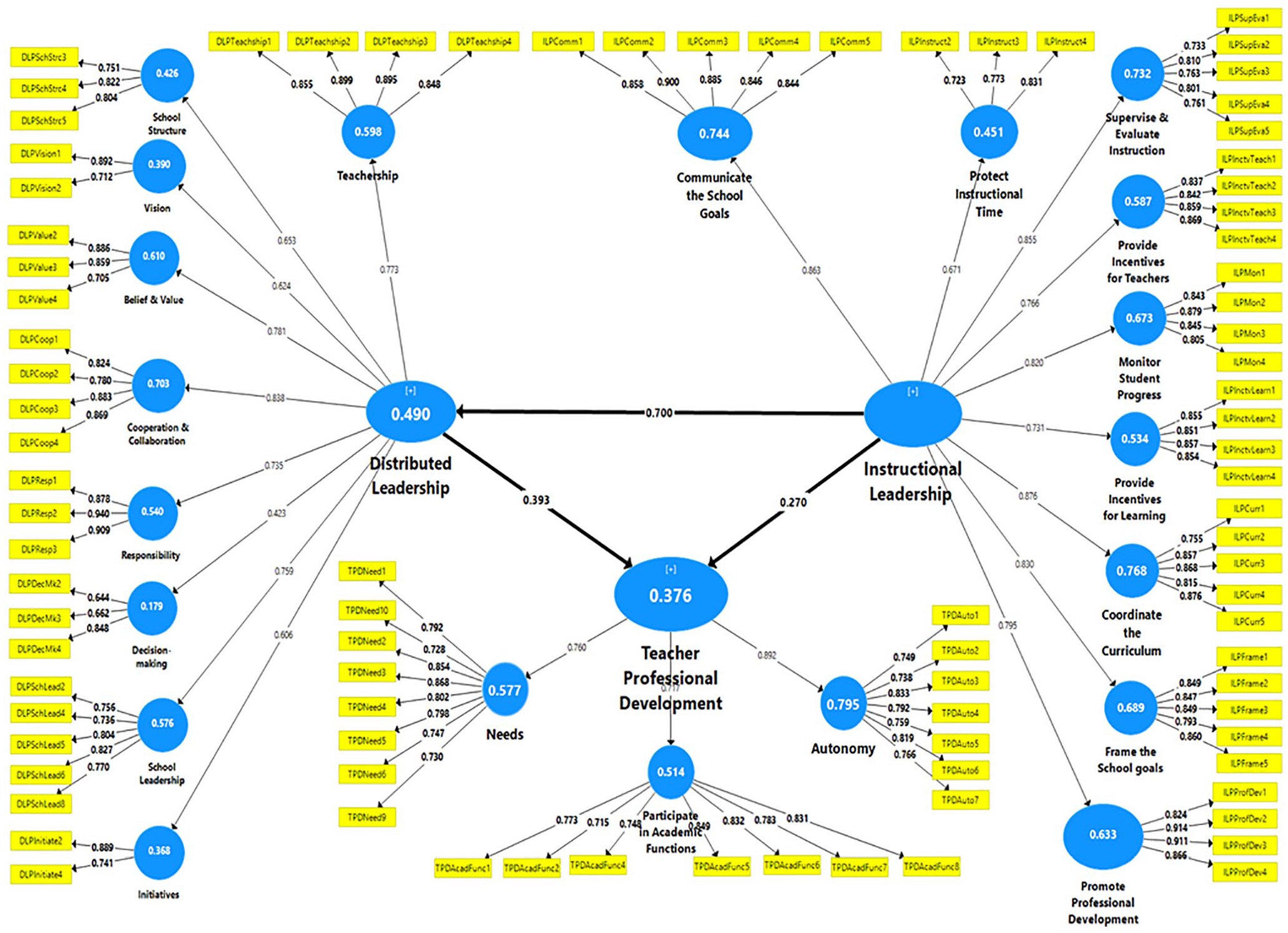
Outer loadings for measurement model.
Therefore, the variance explained by the distributed leadership model was 49% and 37% by teacher professional development. An R² of .490 was calculated for distributed leadership, which is treated as the endogenous variable for instructional leadership. The figure is high due to the strong effect of instructional leadership on distributed leadership. The value for teacher professional development was .376 for endogenous instructional leadership. For the path analysis, the path coefficient is significant if the t-statistics are more than 1.96, using a two-tailed t-test with a significance level of 5% (Wong, 2013). Table 3, shows that the t-statistics for all constructs exceed the minimum requirement: p-values indicate their significance.
Path Analysis of the Effect of Instructional and Distributed Leadership on Teacher Professional Development.

For the path coefficient, the hypothesis (H¹) posited that principal distributed leadership practice would have a direct effect on teacher professional development. The findings shown in Table 3 and Figure 3 confirmed that the hypothesis was supported and that principal distributed leadership practice had a significant and direct effect on teacher professional development (β = .393, T = 4.071, p < .001). H² posited that principal instructional leadership practice would have a direct effect on teacher professional development (β = .270, T = 3.981, p < .001). This hypothesis also was supported (See Table 3). It can be concluded from this is that teacher professional development, manifested by teacher needs, autonomy, and participation in academic functions can be improved when instructional and distributed leadership are practiced in the selected schools in Jakarta.

Assessing structural model and path coefficient.
Additionally, researchers tested the existence of a relationship between instructional leadership and distributed leadership (Hypothesis H³) because previous studies showed that instructional leadership in schools was related to the practice of distributed leadership by principals and among teachers. In today’s schools, instructional leadership should be shared by faculty and administrators. Therefore, H³ hypothesized that instructional leadership would influence or directly affect distributed leadership. As shown in Table 3 and Figure 3, there is a strong and significant direct effect of instructional leadership on distributed leadership practices (β = .700, T = 17.850, p < .001), indicating that the distribution of power among teachers can achieve the eight factors used to measure distributed leadership. Thus, due to the unidimensionality of the effect, it can be assumed that principal instructional leadership practice could facilitate the practice of distributed leadership in schools in Jakarta. As instructional leadership in some way facilitates instructional activities in school, this practice could pave the ways for teachers to take responsibility for their instructional functions while empowering a self-leadership mindset among teachers.
Determining the Best Indicator and Predictor
Understanding SmartPLS prediction begins with the construct-level and item-level prediction (Shmueli et al., 2016). The study looked for the best indicator (item) that highly represents each latent factor under each construct/latent variable (distributed and instructional leadership) and then examined the best predictor that highly predicts the outcomes of the teacher professional development construct. Operationally, indicators are items that belong to each factor or dimension. The best indicator was determined by finding the factor with the highest factor loadings in Measurement Model offered by CFA, while the predictor in this study serves as the exogenous construct (independent variable) and highly predicts the indigenous construct (dependent variable). In this study, exogenous consists of distributed leadership and instructional leadership. CFA assesses the interrelation between latent factors, or observed variables, and predicts the item response from the factor.
Among distributed leadership factors, Item 2, “I am kept accountable,” under the Responsibility or Accountability factor, was the best indicator for the distributed leadership construct, as it had the highest factor loading at .940. This means that the responsibility/accountability factor plays a major role in the practice of distributed leadership in schools and among teachers. For instructional leadership, the best indicator was Item 2 (“He/she obtains the participation of the whole staff in important in-service activities”), under the Promote Professional Development factor, with the highest loading (.914). This indicates that involving teachers in school activities promotes teacher professional development from an instructional leadership perspective. Item 3 (“I’m in need of classroom management”), under Needs, is the best indicator for the factor and the Teacher Professional Development construct (.868). This means that training teachers in classroom management is vital for improving teaching skills and professional development.
Regarding prediction, researchers used path analysis to examine the effect of distributed leadership and instructional leadership practices on teacher professional development. In determining the predictor between distributed leadership and instructional leadership for teacher professional development, Figure 3 shows that distributed leadership has a slightly higher regression weight and effect on teacher professional development than instructional leadership. In other words, when it comes to teacher professional development and enhancement in the Indonesian context, distributed leadership might better predict the outcome of teacher professional development. Interestingly, researchers tested the possibility of a relationship between both leadership models, or the effect of one on another, and found that instructional leadership has a strong direct effect on distributed leadership (β = .700, T = 17.850, p < .001).
Again, this study produced some interesting findings as it revealed the significant roles that school leadership plays in facilitating teacher development. For example, it is interesting to juxtapose distributed leadership and instructional leadership practices aiming to see their dual impact on teacher professional development in the Indonesian context. Moreover, it is considered a bold step to position and regress one of these two models with one as an independent variable and the other as a dependent variable. These findings call for policy change to improve school leadership by analyzing school administration in Jakarta to identify needs, strengths, and weaknesses. These two leadership theories and their practices, then, could serve as a game changer in improving teaching and learning in Indonesian schools.
Discussion
H¹: Distributed leadership practiced by school principals in the selected schools in Jakarta has a direct effect on teacher professional development.
Previous research supports the findings of the study reported here on the effect of distributed leadership on teacher professional development. Several scholars reported that this administrative strategy improved teacher knowledge and skills, student achievement, and learning outcomes (Hermann, 2016; Louis et al., 2010; Spillane & Mertz, 2015). Moreover, the findings about the impact of power distribution among faculty and administrators, as well as instructional leadership practices on school development, teaching, learning, and curriculum, were in line with those of Elmore (2000), Harris (2004), and Bellibas and Liu (2018). Usman and Tafsir (2016) found a similar link between distributed leadership and teacher development in South Sulawesi schools in the Indonesian context. It is also in line with Al-Harthi and Al-Mahdy (2017) findings that found a relationship between distributed leadership and school effectiveness in Egypt and Oman.
Study results related to distributed leadership and teacher professional development reveal the importance of socialization in schools and self-leadership (Poekert, 2012; Torrance, 2015). Teachers tend to work well and improve their performance when they collaborate and socialize (Anthony et al., 2019). When power is distributed and shared in schools, teachers have the confidence, support, and empowerment to do everything they can to ensure learning occurs and students succeed.
H²: Instructional leadership practiced by the school principals in selected schools in Jakarta has a direct effect on teacher professional development.
This study’s results mirror Zheng et al. (2019). Studying schools in China, they found a significant effect of principal instructional practice on collaborative school activity, collective focus on student learning, and teacher self-efficacy. It is also aligned with Al-Mahdy et al. (2018) findings that found a direct-effect of instructional leadership on teacher self-efficacy and commitment. Liu and Hallinger (2018) also found direct and indirect effects of instructional leadership on teacher professional learning. This implies that a school principal or leader plays an essential role in improving the faculty members’ teaching ability and the students’ learning capability. This should not be a big surprise, as the core function of instructional leadership is to enhance teaching, learning, and curriculum.
As a result, it is necessary to consider leadership practice when looking at teacher professional development, as instructional leadership contributes to improving instructional knowledge and skills. Therefore, there should be a relationship between instructional leadership and teacher professional development. In other words, a principal’s practice of instructional leadership should promote teacher academic development and capability. Research in Indonesia revealed this to be the case, as Sumiati and Niemted (2020) found a positive relationship between instructional leadership practice and teacher efficiency in that country’s schools.
H³: Instructional leadership practiced by the principals in the selected schools in Jakarta has a direct effect on the practice of distributed leadership.
The effect of distributed leadership on teacher professional development signifies that distributed leadership practice in schools can significantly improve relationships and trust between teachers and principals. The improvement in those relationships is due to the nature of distributed leadership, which involves daily interactions between school leaders, administrators, and school organization members (Hamzah & Jamil, 2019; Spillane et al., 2004). Trust is needed in the practice of distributed leadership, and the relationship between parties is dynamic (Smylie et al., 2007). Due to the unidimensionality, researchers here cannot claim that, the more distributed leadership is practiced in those elected schools, the greater is the of instructional leadership. However, when both models are employed simultaneously, they compensate each other in regard to teacher professional development.
In terms of teacher outcomes, the relationship shown here between instructional leadership and distributed leadership models supports the studies of Heck and Hallinger (2009), Robinson et al. (2008), Liu et al. (2021). From the theoretical perspective, the instructional leadership model is believed to improve teaching and learning and curriculum in schools. In the Indonesian context, this could only take place when instructional leadership is constantly practiced and applied by the principals, who have been trained to do so in high quality, easily accessible professional development programs. Similarly, the direct effect of distributed leadership in this study aligns with the distributed leadership theory. This advocates shared responsibilities, leadership, autonomy, and accountability in schools, which all are part of teacher professional development.
There is very little research on school leadership in Indonesia, especially on principal distributed leadership practice. The same is true of instructional leadership and teacher professional development. The study reported here fills those gaps, finding that distributed and instructional leadership practices among principals in selected schools in Jakarta could influence teachers’ participation in the professional development activities. Therefore, since teacher development is paramount for student achievement, the researchers suggest the combination of both models a framework for teaching improvement and positive learning outcomes. Based on the researchers’ best knowledge, this combination and investigation have yet to be carried out in Indonesia.
Research Implication and Future Study
The findings of this study can be used to improve relationships between principals and teachers in schools in Jakarta, specifically, and in Indonesia, generally. Further, they should result in a call for further action to improve teacher quality. Policymakers, stakeholders, school principals, and training departments must meet to discuss how to raise the standard and strengthen the academic practice of teachers in Indonesia. The findings also show the advantage of shifting from one leader (the principal) to multiple leaders (the faculty). Teachers should be in charge of their classrooms, create their syllabi, select teaching materials, and be accountable for their student’s achievements.
The findings can also be used for teacher training. They reveal the factors that contribute to teacher professional development and lead to the best leadership practices in schools in Indonesia. Once implemented, the ideas put forth in this study will improve the academic advancement of the country’s teachers. More importantly, it will enhance the professional practice of their principals, who will be motivated to engage in the leadership strategy most likely to contribute to high student achievement. Because there is a scarcity of research to explore the relationship between instructional leadership and distributed leadership and on teacher professional development, this work appeals to future researchers who can look at other roles that distributed and instructional leadership can play in schools in Indonesia and around the globe. The goal is to develop a theory that bridges both distributed leadership and instructional leadership, as both models play a vital role in advancing the standard of teaching and learning and other school-related activities. The application of these two theories has proven again that they are crucial in improving teacher academic performance, autonomy, relationship, and responsibility.
Conclusion
School leadership plays an essential role in school development and will continue to be vital in underpinning teaching and learning improvement. As the effort to improve teaching and the educational system in Indonesia is ongoing, the efforts of revamping the educational system for teacher development could commence by focusing on school leadership development. School leadership is widely agreed to be, after classroom instruction, the most important factor contributing to student achievement (Leithwood et al., 2004). Therefore, to investigate the role that school leadership plays, this study investigated the direct effect of instructional and distributed leadership on teacher professional development in selected schools in Jakarta, Indonesia. It also examined the effect of principal instructional leadership on distributed leadership. The findings of this study suggest that the implementation and practice of instructional leadership and distributed leadership by the school principals can improve teacher professional development. Moreover, distributed leadership is one of the mechanisms that will improve teaching and teacher professional development. School principal instructional leadership practice could support the practice of distributed leadership in schools for teacher empowerment.
Thus, principals who practice instructional leadership can improve teaching and learning. This approach offers teachers an opportunity to advance their academic careers and improve their professionalism when academic development is a top priority of their school leaders. Schools with principals practicing instructional leadership tend to have regular training for teachers, which results in improved instruction and student outcomes.
As was reported in previous studies, distributed leadership may be one of the newest theories in educational administration, but it already has made an impact. A school that practices distributed leadership has the potential for improving relationships among its stakeholders and advancing teaching and learning. This study has also shared other interesting findings by reporting the little-studied effect of principal instructional leadership on distributed leadership. It will be even more interesting to see which leadership practices have the greatest impact on any related school variables. In light of this, the researchers advocate for more training for school leaders.
We also urge the Indonesian Ministry of Education and other policymakers to intensify training to improve school leadership capacity and instructional skills. It is vital for school leaders in Jakarta and beyond to embrace changes by empowering teacher leadership in schools and encouraging self-leadership to improve instruction and learning. Further studies in Indonesia also are needed to report future changes in school leadership practices and teacher development for continuous improvement in teaching, learning, and leadership.
Footnotes
Declaration of Conflicting Interests
The author(s) declared no potential conflicts of interest with respect to the research, authorship, and/or publication of this article.
Funding
The author(s) disclosed receipt of the following financial support for the research, authorship, and/or publication of this article: We thank Universitas Muhammadiyah Prof. Dr. Hamka (Uhmaka), Jakarta, Indonesia for the research grant and all the teachers that participated in this study.
