




Abstract
This study investigates the relationships between decent work, job satisfaction, workplace social courage, and intent to quit among job and career counselors in Turkiye’s IT sector employment agency. The research data was obtained from 408 job and career counselors at an IT sector employment agency in Turkiye. Partial least squares-based structural equation modeling was used to test the hypothesized relationships. The study findings reveal a significant positive influence of decent work on job satisfaction. In contrast, job satisfaction is associated with a notable decrease in the likelihood of employees intending to quit their positions. Additionally, workplace social courage is crucial in reducing intent to quit. Furthermore, our research underscores the mediating roles of job satisfaction and workplace social courage in explaining the relationship between decent work and intent to quit. Intriguingly, it is noteworthy that higher levels of workplace social courage are unexpectedly linked to an increased intention to quit. Conversely, heightened job satisfaction is associated with an augmentation in workplace social courage. These findings carry substantial theoretical and practical implications, offering valuable insights into the intricate dynamics of decent work, job satisfaction, and social courage within the workplace context. These insights can contribute to avoiding intent to quit and minimizing turnover rates. Job satisfaction and social courage are two edge swords that organizations must cautiously follow up. This study emphasizes the significance of establishing a secure and nurturing work environment that fosters decent work, job satisfaction, and social courage.
Keywords
Introduction
Social and economic changes fundamentally alter the nature of work worldwide, with secure jobs decreasing and precarious forms of work becoming more common (ILO, 1999). Many experts and non-governmental organizations are concerned that the fundamental workplace changes will significantly considerably diminish the availability of exceptionally decent work for millions worldwide. Underemployment and unemployment are unwelcome problems in most societies (World Economic Forum, 2016).
Many requirements include decent work, such as improving individuals’ working conditions, receiving adequate pay, protecting their rights, and recognizing sufficient safety and health facilities (Anlesinya et al., 2021). Decent work enhances social protection, reduces inequalities, and increases people’s purchasing power, contributing to economic sustainability. Given its importance, the United Nations (UN) has designated decent employment as one of its sustainable development goals (SDGs) in 2019.
Today, countries spend a significant portion of their budgets on employment policies. The efforts of job and vocational counselors are thought to be critical to the effectiveness of employment policy (Musset & Mytna Kurekova, 2018). In many countries, when a person loses their job, they must meet with job and vocational counselors and follow their guidance. Job and vocational counselors advise which jobs to seek and how to search for them while controlling the job search process. In this context, job and vocational counselors are essential to employment policies. In countries like Turkiye, the employed are primarily low- and middle-skilled. Youth unemployment is widespread, and job and vocational counseling services are becoming increasingly important in the labor market. As a result, it is critical to determine the characteristics that will ensure the effectiveness, efficiency, and job satisfaction of job and vocational counselors in their duties.
Duffy et al. (2016) view working life as an essential element of life and a crucial feature of mental health, and they characterize decent work, which they developed in the Psychology of Working Theory (PWT), as the most important predictor of individual well-being (Duffy et al., 2016). Therefore, they argue that individuals must have better working environments and conditions in many respects.
In the literature, it is reported that healthy work environments lead to increased job satisfaction, dedication to work, and performance (Bulińska-Stangrecka & Bagieńska, 2021; Ernst et al., 2012; Nam & Kim, 2019; Raziq & Maulabakhsh, 2015). Job satisfaction is the contentment employees feel toward their work when their desires and those of their job align (Cheng & O-Yang, 2018). Higher morale among staff members who are engaged and content with their work is advantageous for the workplace. (Schoderbek et al., 1979). Job satisfaction is adversely connected to the intention to quit (Al Sabei et al., 2022; Mérida-López et al., 2022; Piotrowski et al., 2022). Decent work contributes to higher levels of job satisfaction among employees. The likelihood of individuals experiencing a sense of value and fulfillment in their respective professions is heightened when they are subjected to equitable treatment, provided with avenues for personal and professional development, and operate within a secure and conducive work environment (ILO, 1999). As a result, motivation and productivity increase.
On the other hand, intense competition in the current business world has caused employees adverse conditions and job dissatisfaction, such as stress, pressure, and job insecurity. Employees who experience job dissatisfaction are likely to exhibit higher rates of absenteeism, turnover, and inefficiency (Ghani et al., 2022). Additionally, there will be an increase in workplace health and safety issues, ultimately leading to employees leaving the organization. This will increase organizational costs (Huang et al., 2006). Indeed, Buyukgoze-Kavas and Autin (2019), McIlveen et al. (2021) and Aybas et al. (2022) have found in their research that decent work has a negative effect on the intention to quit a job.
The work environment directly impacts the staff, which is critical to the work performance. The work environment consists of physical, social, and psychological factors. Psychological factors include individuals’ inner needs and external influences. As one of these psychological factors, workplace social courage is defined as the willingness of employees to speak up and question the status quo when they perceive something is wrong (Fenton, 2020). Studies have shown that social courage is linked to proactive activities that enhance the work environment, such as prosocial voice and organizational citizenship behaviors (Choi, 2021; Howard & Holmes, 2019). Additionally, according to research, as social courage increases in the workplace, there is an increase in innovation (Edmondson, 2002), employee retention (Detert et al., 2000), and job satisfaction (Milliken et al., 2003). However, the role of social courage in predicting intent to quit has not been thoroughly investigated.
To provide sustainable competitive advantage and performance for organizations, keeping their employees within the organization in the long term and identifying the antecedents that may cause them to leave their jobs is essential. For this reason, the objective of this investigation, based on PWT, is to examine the mediating role of job satisfaction in the association between decent work and intent to quit. It also examines the mediating effect of social courage on the association between job satisfaction and intent to quit.
Studies on decent work in literature generally focus on societal-level outcomes (Aybas et al., 2022; Blustein et al., 2016). This study examines the topic from an alternative standpoint by narrowing the notion of decent work to the individual level. Our study makes a scholarly contribution by seeking to antecedents the factors that may influence employees’ intention to quit their jobs and investigating the mechanisms that explain the connections between decent work and intention to quit. Furthermore, this study seeks to make a scholarly contribution by establishing a correlation between an individual’s level of social courage at the workplace and their levels of job satisfaction and intent to quit. Notably, this research addresses this relationship at the individual level, which has not been previously explored in the existing literature. The literature on the relationship between decent work and intention to quit has predominantly focused on samples comprising of private sector employees, both blue-collar and white-collar. By using career and job counselors as our sample, we aim to provide a different perspective on the situation from the public sector and contribute to the literature in this regard.
Given these gaps in the literature, the primary objective of this project is to investigate the following research questions:
Does Decent Work affect job satisfaction positively?
Does job satisfaction affect the intent to quit negatively?
Does workplace social courage affect job satisfaction positively?
Does workplace social courage affect the intent to quit positively?
Does workplace social courage mediate the relationship between job satisfaction and intent to quit?
Our research delves into the concept of “decent work” within the context of evolving global employment trends. It is essential to recognize the significance of this inquiry, particularly in nations like Turkiye, where pressing issues such as youth unemployment and the prevalence of low- and middle-skilled employment demand attention. Our investigation centers on the pivotal role played by job and vocational counselors in enhancing the effectiveness of employment policies. This inclusion underscores the timeliness of our research and the substantial research gap we aim to address. Additionally, our research aims to apply “decent work” to the personal level, focusing on career and job counseling services. Our study is relevant and urgent because of the growing significance of these services in labor markets, particularly in areas with high teenage unemployment rates. Our research intends to shed light on an essential aspect of employment policies that has not gotten much attention up to this point by investigating the complex relationships between the factors that we have chosen.
Our study is unusual in that it examines the relationship between decent work and the intention to resign, focusing on the mediating roles of job happiness and workplace social courage. This method allows us to explore individual-level determinants, setting our research apart from other studies mainly concentrating on societal-level effects. Most of the current research focuses on workers in the private sector. However, our study offers new insights into the topic by integrating career and employment counselors from the public sector, which is a novel perspective.
Regarding the importance of the study, our results have applications that advance our knowledge of the complex relationships among decent work, job happiness, and social courage in the workplace. By clarifying these linkages, our research can provide valuable insights for companies looking to improve employee retention and well-being. To further assure the validity and reliability of our findings, our study uses robust analytical techniques like partial squared-based structural equation modeling (PLS-SEM).
Hypothetical Development
Decent Work, Job Satisfaction, and Intention to Quit
PWT framework has played a crucial role in understanding the associations between job satisfaction and intent to quit. The theory posits that employees’ impressions of their workplace, the nature of their job tasks, and the level of support they receive from their colleagues and supervisors are all critical factors in determining their job satisfaction and intent to quit (Blau & Boal, 1987; Hackman & Oldham, 1975; Karasek, 1979). Additionally, the ILO acknowledges that the notion of decent work is present in all societies. However, the standard of employment might vary based on different types of labor, diverse working conditions, and individual characteristics such as job satisfaction and perceived value (Bolton & Laaser, 2021). So, it is essential to research these variables in different contexts like countries, industries, and organizations.
PWT is founded on the idea that people could have various restrictions relating to their employment in real life and might not be able to benefit from their freedom of choice while making professional decisions (Allan et al., 2019). The theory also presents a model that aims to highlight the needs of individuals that have not been sufficiently expressed in terms of career. The model explains contextual factors that affect human-centered work, the tools that relate to these contextual factors, and the results that individuals who reach work that befits humans will encounter (Duffy et al., 2016).
Işık et al. (2019) mention that human-centered work is based on more macro-level perspectives worldwide, such as vulnerable employment and general unemployment. However, a macro-level approach often falls short of expressing how people perceive and experience their work lives (Piasna et al., 2020). PWT approaches the notion of human-centered work more individually by focusing on its psychological roots (Blustein et al., 2019). Therefore, individual-level developments found in the conditions presented by the ILO (1999) for human-centered work, such as (a) a physically and relationally safe working environment, (b) necessary leisure time and rest, (c) adequate wages, (d) access to adequate health services, and (e) consistency between the values of the institution and the values.
The theory holds that marginalization and economic constraints are contextual factors affecting human-centered work (McIlveen et al., 2021). Accordingly, marginalization is defined as the sum of individuals’ exclusion and discrimination behaviors (i.e., disability status, gender, and race discrimination) (Tokar & Kaut, 2018). Economic constraints are used to express the limited economic resources that individuals face in the process of reaching human-centered work (Diemer et al., 2013). Human-centered work meets three human needs: social interaction, survival, and self-determination. Studies have shown that meeting these three types of needs has a positive effect on job satisfaction and overall well-being (Kim & Kim, 2022; Masdonati et al., 2019; Šakan et al., 2020; Tokar & Kaut, 2018) while also affecting employees’ intent to quit (Wan & Duffy, 2022; Wang et al., 2019).
Decent Work, Job Satisfaction
Decent work: It is a place where a living wage is paid with the necessary social protection, human rights are protected, equality of opportunity is ensured, and human dignity is protected. The ILO regards decent work as a fundamental human right and a mechanism for enhancing working conditions, akin to the rights to life and employment. (Mundlak, 2007). Over time, the idea of decent work has shifted from a narrow evaluation of job satisfaction to a broader and more inclusive evaluation of job and employment quality (Burchell et al., 2014). Decent work is also associated with positive outcomes such as work motivation (Ferraro et al., 2020), well-being, and career development (Su & Chan, 2023 ). For example, decent work, employee commitment (Braganza et al., 2021), job satisfaction (Seubert et al., 2021), and organizational commitment are positively related (DeConinck & Stilwell, 2004). However, to date, there exists a scarcity of research examining the correlation between decent work and intent to quit.
As such, decent work focuses on four main strategies: fundamental rights related to employment, work, social security, social protection, and social dialog. The main goal is to create jobs and ensure that the jobs created are of acceptable quality (ILO, 1999).
According to PWT’s concept of decent work and (International Labour Conference, 2008), Duffy et al. (2016) developed the Decent Work Scale (DWS), which evaluates five dimensions of decent work: (a) physical and relational safety, (b) access to health services, (c) adequate pay, (d) leisure time and rest, and (e) compatibility of corporate values with family and social values. PWT theory suggests that decent work can be achieved when these components are combined.
As previously stated, the idea of “decent work” was investigated in our study, and it was quantified using the following sub-dimensions: job conditions, healthcare options, wages, leisure time, and values congruence. When done successfully, work reveals the crucial inner experience closely tied to the demand for psychological and career happiness. (Duffy et al., 2016). In this context, job satisfaction is conceptualized as the positive affective state that an individual in a specific job role encounters, stemming from their overall employment and work-related encounters (Riggle et al., 2009). Individuals develop an internal response to their work and work conditions for job satisfaction, considering their norms, values, and expectations. Job satisfaction results from an employee’s expectations being met by their internal response, while job discontent emerges when these expectations are not fulfilled (Blustein et al., 2016; Svicher & Di Fabio, 2021).
According to PWT, decent work positively correlates with job satisfaction and well-being, which has significant implications for individual and organizational outcomes. Therefore, creating decent work environments is critical for improving well-being and job satisfaction. A study conducted in Turkiye (Buyukgoze-Kavas & Autin, 2019) found a positive relationship between decent work and job satisfaction and a negative relationship between job satisfaction and intent to quit. According to Wan and Duffy (2022), in a study conducted on 391 people in China, decent work has a negative effect on intent to quit, and job satisfaction has a mediating effect on the association between decent work and intent to quit. Ribeiro et al. (2019), as a result of their research on 307 adults in Brazil, found that decent work conditions are associated with a favorable impact on individuals’ job satisfaction. Furthermore, the study shows decent work conditions are inversely related to employees’ intention to quit.
Other studies show a link between decent work and job satisfaction (Duffy et al., 2017; Ferreira et al., 2019; Işık et al., 2019; Kim & Kim, 2022; Masdonati et al., 2019; Wang et al., 2019).
In the light of these explanations, the subsequent hypothesis was produced.
H1: Decent work sub-dimensions affect job satisfaction positively.
Job Satisfaction and Intention to Quit
According to Schneider and Snyder’s (1975) definition, job satisfaction is a crucial concept in organizational psychology, representing a person’s subjective evaluation of their workplace and its results. It includes their internal reactions to how they see their working environment, filtered through their standards, beliefs, and expectations. Contrarily, a proactive and unfavorable kind of employee behavior that expresses discontent with one’s working circumstances is the intention to resign (Rusbult et al., 1988). The importance of job satisfaction in affecting the desire to quit and, as a result, organizational success is highlighted by Han et al. (2015) research.
According to the social exchange theory, people are more inclined to stick with their jobs and organizations when the norms reflect their values. Employees typically perform better and show more dedication to their jobs when they feel that they are being treated fairly and appreciated for their contributions (Afsar et al., 2018). On the other hand, workers who are dissatisfied with their jobs and have a decline in their psychological health might think about quitting (Dawson et al., 2017; Labrague et al., 2020). Thatcher et al. (2002) expanded on this theoretical framework by adding new aspects to the relationship between job satisfaction and intention to resign. They identified complex relationships between employee retention, intention to quit, and opportunities to leave. Additionally, a study on nurses by Modaresnezhad et al. (2021) confirmed the detrimental effect of job satisfaction on the intention to resign, especially in the healthcare industry. Similarly, Li et al. (2019) investigated the experiences of South Korean child protection professionals and found that job satisfaction moderated the relationship between workplace violence and the intention to quit, in addition to having a negative impact on it.
These studies’ strong empirical and theoretical underpinnings support hypothesis H2, which holds that work satisfaction negatively impacts the desire to quit. The idea is further supported by the numerous research that has consistently shown this association in the body of existing literature (Cooke et al., 2019; Coomber & Barriball, 2007; De Milt et al., 2011; Lee et al., 2020; Nelson et al., 2021).
Job Satisfaction as a Mediator
Duffy et al. (2016) from the perspective of PWT, from the perspective of PWT, stated that job satisfaction arises from meeting the needs of employees and showing emotional reactions toward their work. It is stated that people who have decent jobs are more effective in contributing to society, sustaining their lives, and determining their destinies. In this way, they can increase their job satisfaction and, therefore, their welfare levels (Ferraro et al., 2020). Studies in the PWT field also show that factors such as working conditions (Wang et al., 2019), adequate compensation (Nam & Kim, 2019), and career compatibility(Fiori et al., 2015) exert an influence on an employee’s inclination to remain in or intent to quit. Wang et al. (2019) investigated a sample of 337 individuals in China. He reported that decent work positively affects job satisfaction. Koekemoer and Masenge (2023), in a study conducted on blue-collar employees, reported that decent work conditions were associated with a significant increase in job satisfaction.
There are various studies applied in different cultures that demonstrate a favorable association between decent work and job satisfaction in the literature (Ferreira et al., 2019; Ribeiro et al., 2019; Wang et al., 2019). A study on teachers (Madigan & Kim, 2021) reported that job satisfaction was inversely related to the intention to quit. Mérida-López et al. (2022) found in their study on 1079 teacher educators that job satisfaction significantly negatively impacted their intention to quit. There are also studies in the literature that show that job satisfaction has a negative influence on the intent to quit (Alsaraireh et al., 2014; De Milt et al., 2011; Modaresnezhad et al., 2021; Yu et al., 2020).
Therefore, if employees have decent work, it is likely that they will be satisfied with their job. The feeling of satisfaction that an employee perceives about their job will have a positive impact on their tendency to stay in the job, while it will have a negative impact on their intent to quit.
Workplace Social Courage, Job Satisfaction, and Intent to Quit
Workplace Social Courage and Job Satisfaction
Social courage is the willingness of individuals to speak up and address challenging situations in the workplace, such as bullying or harassment, despite potential negative consequences (Geller, 2016). Workplace social courage has been increasingly acknowledged as vital to a healthy work environment (Fernando et al., 2022). According to the results of a study on the courage of entrepreneurs (Namal et al., 2023), it can be stated that entrepreneurs with high courage respond to changes with more innovation than entrepreneurs with low courage. Similarly, while prior studies have demonstrated an association between social courage and job performance (Geller, 2016; Tkachenko et al., 2020), less emphasis has been paid to the influence of social courage on job satisfaction. Magnano et al. (2017) emphasize that employees who demonstrated social courage were more satisfied with their jobs than their less courageous peers. Furthermore, it is more probable that employees will have a sense of appreciation and respect from their employers when they feel empowered to speak up about workplace difficulties (Fernando et al., 2022). The experience of respect and appreciation can result in heightened levels of job satisfaction and work engagement (Lodi et al., 2022).
Social courage can help to foster a positive workplace culture, which is a critical factor in job satisfaction. According to the results of Koksal and Mert’s (2024) study on nurses’ interactional justice, it was significantly and negatively related to emotional exhaustion but was positively related to workplace social courage. High courage strengthens the negative relationship between interactional justice and emotional exhaustion. According to Tkachenko et al. (2020), those who indicated a favorable workplace culture characterized by open communication and mutual respect demonstrated a higher likelihood of experiencing job satisfaction. Fernando et al. (2022) found that organizations with a robust social courage culture demonstrated a greater propensity to report elevated employee engagement and job satisfaction. The authors explained that social courage can act as a catalyst for positive workplace culture, as employees who exhibit social courage are more likely to hold themselves and others accountable for ethical behavior, leading to a more positive and supportive work environment. Additionally, Magnano et al. (2022) reported that employees who exhibited social courage were more likely to report high levels of job autonomy and control. Furthermore, employees who feel empowered to speak up and address workplace issues are more likely to feel that they have a voice in the workplace and that their opinions are valued (Fernando et al., 2022).
H4: Job satisfaction affects workplace social courage positively.
Workplace Social Courage and Intent to Quit
Courage is an essential component within the organizational setting, significantly impacting employee conduct and attitudes, including their inclination toward intent to quit. According to Anderson et al. (2014), employees who thought their organizations supported more social courage were less likely to say they planned to leave.
Furthermore, research has shown that a lack of social courage can have an adverse effect on employees, such as increased stress and intent to quit. King et al. (2020) found that employees who felt unsupported in their workplace and did not feel comfortable expressing their opinions were more likely to experience stress and express an intent to quit. Similarly, Detert and Edmondson (2011)found that, employees who lack social courage at work are more likely to keep their difficulties or worries to themselves, which lowers their job satisfaction and increases their risk of leaving. According to Kilmann et al. (2010), nurses with a greater perception of elevated levels of social courage demonstrated a decreased likelihood of expressing an intention to quit. Similarly, Comer and Sekerka (2018) found that physicians with higher courage exhibited a stronger predisposition toward job satisfaction and a decreased likelihood of expressing an intention to quit their profession.
H5: Workplace social courage affects intent to quit negatively.
Workplace Social Courage as a Mediator
Workplace social courage, the willingness to voice concerns despite potential consequences, significantly affects job satisfaction and intent to quit. It fosters an open, supportive work environment that encourages engagement and commitment, reducing the likelihood of quitting. King et al. (2020) found that social courage mediates the link between work stress and intent to quit. As work stress rises, social courage falls, impacting job satisfaction positively and intent to quit negatively. Similarly, Kilmann et al. (2010) showed that workplace social courage mediates the connection between work engagement and intent to quit. Engaged employees tend to express their concerns or ideas, fostering a supportive environment.
The effect of workplace social courage in mediating the association between job satisfaction and intent to quit is significant. Schaubroeck and Lam (2004) revealed that it partially mediates this link, where job satisfaction directly affects intent to quit, partially explained by social courage. Another study by Liu et al. (2018) said that workplace social courage fully mediates the relationship between job satisfaction and intent to quit in Chinese organizations. Job satisfaction indirectly impacts the intent to quit through social courage. Similarly, Jin et al. (2018) found a similar mediating effect in the United States, where workplace social courage fully mediates the association between job satisfaction and intent to quit among university professors. In addition, a study by Bockorny and Youssef-Morgan (2019) showed that workplace social courage serves as a partial mediator in the association between intent to quit and job satisfaction within the healthcare industry.
In the light of these explanations, the subsequent hypothesis was produced:
H6: Workplace social courage mediates the relationship between job satisfaction and intent to quit.
Figure 1 shows the conceptual model of the research.
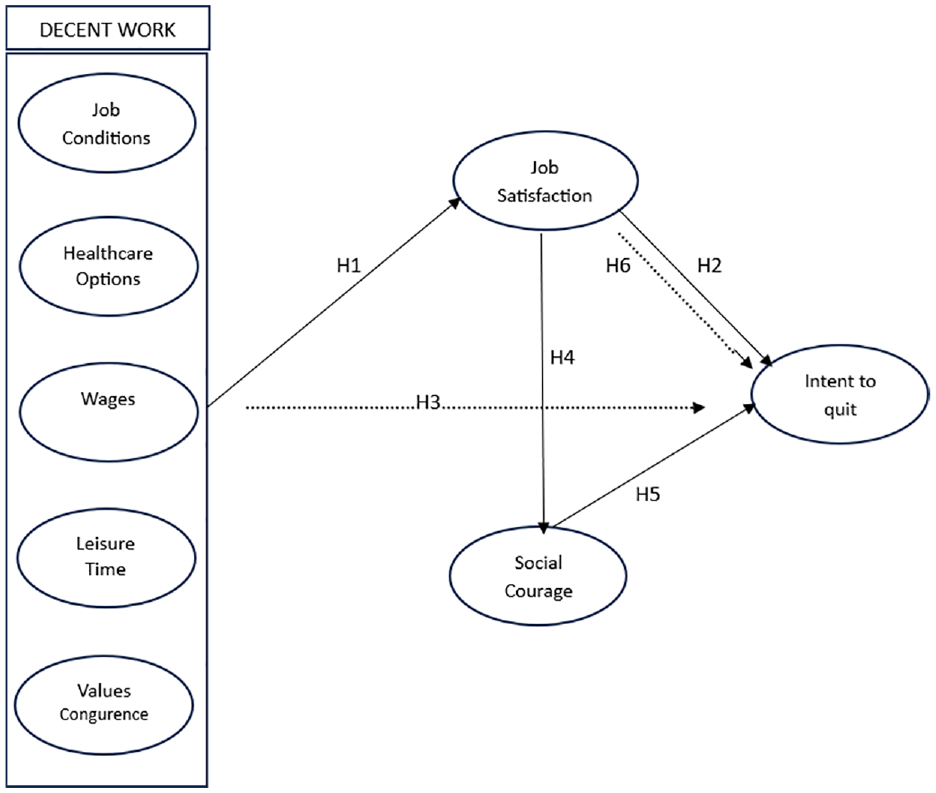
The conceptual model of the research.
Methodology
Sample and Procedure
The research was conducted on job and vocational counselors at the Turkish Employment Agency. The Turkish Employment Agency was established to carry out unemployment insurance transactions and assist in creating national employment policies, the development of employment, and the prevention of unemployment under the Ministry of Labor and Social Security. Among the tasks of the Turkish Employment Agency are conducting job and vocational analyses, providing job and vocational counseling services, and developing vocational training and labor force integration programs to increase employability as part of the restructuring of the Turkish Employment Agency and the increase of its institutional capacity, 2000 job, and vocational counselors were appointed in 2011. Job and vocational counseling are holistic counseling services that focus on employment for job seekers, employers, and students, the critical actors in the labor market.
This study was conducted on 1,000 job and vocational counselors who came together in an in-service training provided by the Turkish Employment Agency. The counselors who participated in the training were employees from every province of Turkiye, and the sample covered all 81 provinces. The researchers provided the participants with a preliminary explanation of the purpose of the research. They emphasized that the data collected would only be used for scientific purposes and that personal privacy would be respected. A total of 452 responses were received from the 1,000 participants who were sent an electronic questionnaire form, and the age range varied between 24 and 38, with an average of 26.5. All participants were at least university graduates, 8% having a master’s or doctoral degree, and 60% were male.
Scales
Decent Work-Independent Variable
Turkiye is one of the nations that has validated the decent work scale’s international translation, which was created by Duffy et al. (2017). The Turkish version of the scale, validated by Buyukgoze-Kavas and Autin (2019), revealed that a correlational five-factor model of the international decent work scale also exhibited a good model fit for Turkish working adults. So, the Turkish version of the scale was utilized to assess decent work among Turkish working adults. The five 3-item subscales that make up the decent work scale are physical and interpersonal safety at work, access to health care, adequate wages, hours for leisure time, and organizational values that support family and social values. Safe working conditions, access to healthcare, enough compensation, free time and rest, and complementary values all received internal consistency reliability estimates for the decent work scale of 0.77, 0.83, 0.87, 0.85, and 0.90, respectively. The internal consistency reliability for the total scale was 0.80 (Buyukgoze-Kavas & Autin, 2019). A sample item is “I feel emotionally safe interacting with people at work.” The Cronbach’s alphas for this scale can be seen in Table 1 in the current study
Correlation Between Variables and Data Quality Assessment.

Note. |Value| = Heterotrait–monotrait ratio; AVE = average variance extraction; CA = Cronbach’s alpha; CR = composite reliability.
Job Satisfaction-Mediator Variable
The job satisfaction scale is adopted from Wan and Duffy (2022). The job satisfaction scale consists of five items under one dimension. A sample item is “I like my job better than the average worker.” A 5-point Likert scale (1-never, 5-always) is used to rate the items.
Social Courage-Mediator Variable
The scale of social courage is used from Ginevra et al.’s work (Ginevra et al., 2020). The scale consists of six items under one dimension. Sample expressions from the scale are “I tend to face my fears”; “I will do things even though they seem dangerous.” A 5-point Likert scale (1-never, 5-always) is used to rate the items. The same authors also validate the scale in Turkish. Cronbach Alpha of the scale is found to be .938, and composite reliability is .939.
Intention to Quit-Independent Variable
The scale, which consists of four items, is adopted from Rosin and Korabik (1995). The items on the measure (such as “I often think of leaving my job”) were scored using a 5-point Likert scale. The scale’s Cronbach alpha score was .84, and it was determined that the scale was reliable Çankır and Arıkan (2019). (Note: Information about the scale items is shown in Appendix 1.)
Results
Figure 1 illustrates a theoretical model, which connects conceptual variables in a series of structural relationships to codify a theory and show the links (Bollen, 2002). When researchers construct and propose quantifying abstract notions, conceptual variables indicate broad ideas or views about those topics (e.g., social courage and satisfaction). In statistical models like a structural equation model, constructs are conceptual variables. The construct definition aids in understanding how constructs in structural equation models represent conceptual variables by clarifying how the abstract, conceptual variable connects to quantifiable, observable quantities (also referred to as latent variables). As a result, in this study, Smart PLS is used as a measurement to analyze the construct. PLS-SEM offers better statistical power than other statistical approaches due to its high efficiency in parameter estimation. Greater statistical power increases the likelihood that a particular link will be deemed significant by PLS-SEM when it is significant in the population (Hair et al., 2017; Sarstedt et al., 2022).
Figure 2 contains information about the model and path analysis created.

Path coefficients related to the model.
Table 1 represents the two essential elements of a correlation coefficient, namely the type of relationship (positive or negative) and the strength of the relationship, as well as the fit indicators of the research model represented in Figure 1. According to correlation results, the intention to quit is negatively related to decent work except for the leisure time sub-dimension. Additionally, job satisfaction is positively related to decent work except in the leisure time subdimension. More clearly, decent work decreases the intention to quit and increases job satisfaction. The most significant sub-dimensions of intention to quit are values congruence (−0.368), job conditions (−0.348), healthcare options (−0.332), and work wages (−0.235). These results show that values are the most important, and wages are the least important factor in deciding not to quit a job. Every one-point increase in the work values congruence decreases the intention to quit by almost 0.4 points. Values congruence is the most critical subdimension of decent work for job satisfaction (0.475). The other essential subdimensions are healthcare options (0.383), job conditions (0.363), and wages (0.248). Leisure time has a minimal and negligible impact on both intentions to quit (0.061) and job satisfaction (−0.107).
There is no missing data. Table 1 displays correlations between the three significant factors, their scores for the data quality assessment, and the outcomes of the observed variables’ data quality evaluation. First, the data passes the threshold reliability tests: With a standardized factor loading (SFL) >0.40, an indicator is more reliable (Sarstedt et al., 2022); composite reliability (CR) >0.60 (Brown, 2015); and consistency reliability with Cronbach’s alpha (CA) >.70 (Nunnally & Bernstein, 1994). Secondly, the variables passed the validity thresholds: convergent validity with average variance extraction (AVE) >.50 and <CR (Fornell & Bookstein, 1982) and discriminant validity with the square root of AVE < correlation (Fornell & Bookstein, 1982), or a heterotrait–monotrait ratio (HTMT) <.90 (Hair et al., 2017; Henseler et al., 2015; Sarstedt et al., 2022). HTMT is the ratio of the between-trait correlations to the within-trait correlations. In contrast to the (geometric) mean of the average correlations of indicators measuring the same construct, HTMT is the mean of all correlations of indicators across constructs measuring in different ways. Thirdly, the data had no bias issues: common method bias with the maximum percentage of the variance of 34.58% < 50% (Podsakoff & Organ, 1986). Finally, the data had no multicollinearity problem with variation inflation factor (VIF) values <5.0 (Hair et al., 2010). The fit indexes of the global model are SRMR: 0.053, Chi-square: 1655.937, NFI: 0.821, d_ULS: 1.869.
The path coefficients, calculated according to the relationships, are in Table 2. Significance values (p values) show that the effect of decent work wages and leisure time on job satisfaction is not statistically significant (p > .005). Thus, H1 is partially supported. In other words, not all sub-dimensions of decent work are significant for job satisfaction. On the other hand, H2 and H3 are supported. Job satisfaction affects intent to quit negatively (H2), and job satisfaction mediates the relationship between decent work and intent to quit (H3). The coefficient between job satisfaction and intention to quit is −0.676. In other words, every one-point increase in job satisfaction can decrease the intention to quit by almost 0.7 points.
Hypothesis Testing and Path Coefficients.

Note. M = sample mean; STDEV = standard deviation; p = p values; Job sat. = job satisfaction; SC = social courage; In.Quit = intention to quit.
Job satisfaction increases social courage by 0.319 (H4 is accepted), and social courage increases intention to quit by 0.124 (H5). So, social courage mediates the relationship between job satisfaction and the intention to quit. However, according to the research model (Figure 1), job satisfaction simultaneously decreases the intention to quit, so H6 is accepted.
Conclusion and Discussion
This study investigated the association between decent work, job satisfaction, workplace social courage, and intent to quit. Additionally, the study sought to explore the potential mediating effects of job satisfaction and social courage in this relationship. The study’s findings support the hypotheses that decent work, job satisfaction, and workplace social courage significantly impact the intent to quit. The study also highlights the mediating role of job satisfaction and workplace social courage in the association between decent work and intent to quit. The consequences of these findings are significant for managers and policymakers to promote decent work, job satisfaction, and workplace social courage, ultimately reducing employee turnover.
Among the decent work sub-dimensions, three of them, healthcare options, Job conditions, and value congruence dimensions, significantly and positively affect job satisfaction. The discovery of a strong and positive relationship between healthcare alternatives, values congruence, and job satisfaction aligns with prior studies conducted in this area. Providing healthcare options holds significant importance in job satisfaction, as employees with sufficient access to healthcare services tend to exhibit higher levels of job satisfaction (Gazioglu & Tansel, 2006; Karim & Rehman, 2012). Similarly, values congruence is positively related to job satisfaction (it has the highest impact among other subdimensions, 0.333), as employees who perceive their values align with their organization’s values tend to be more satisfied with their jobs. Interestingly, wages have a limited (0.054, p > .005) but no statistical effect on job satisfaction among IT workers. These results support the view theory of human-centered work as decent work that should be practiced from organizational and social justice perspectives rather than economic ones (Barrientos et al., 2011; Cooke et al., 2019). So, despite the ILO’s “adequate earning or average” approach to wages in decent work (ILO, 2008, p. 224), many scholars operationalize the concept of decent work by giving wages more importance than needed. Additionally, human-centered work in a digitalized work environment puts the criteria of time elasticity, diversity of requirements, and holistic work design to the core of work design that is more suitable for job satisfaction of IT workers rather than the wage approach (Tegtmeier et al., 2022). Furthermore, as stated by Card et al. (2012), the impact of unfavorable income comparisons with colleagues on an individual’s reported job satisfaction is more significant than that of favorable comparisons. In that sense, it can be assumed that wages or earnings are similar in the IT sector; thus, there is no significant impact on job satisfaction and not part of decent work.
Organizations must recognize the significance of healthcare options and values congruence in promoting employee job satisfaction. Providing sufficient healthcare alternatives and promoting organizational principles congruent with employees’ values can engender heightened levels of job satisfaction. Consequently, this can result in enhanced job performance, diminished employee turnover rates, and heightened levels of organizational dedication.
There could be several possible explanations for the unsupported claim that wages and leisure time do not significantly affect job satisfaction among job and vocational consultant employees in the employment and employment agency sample. One possible explanation is that these employees may already have adequate wages and leisure time; therefore, these factors may not significantly impact their job satisfaction. Another possible explanation is that other factors, such as work meaningfulness or job security, maybe more critical to the job and vocational consultants’ employees than wages and leisure time. As a result, decent work practices, such as fair wages, safe working conditions, and work-life balance, can improve employee well-being. Nevertheless, it is worth noting that many characteristics, such as physical, mental, and emotional well-being, job satisfaction, and general quality of life, exert a more significant influence compared to other elements when it comes to decent work (Duffy et al., 2019).
Furthermore, the nature of the job and vocational consultants’ work may also affect their job satisfaction. For example, their job satisfaction may be influenced by their ability to help others find meaningful employment, their autonomy level, or the support they receive from their supervisors.
It is imperative to acknowledge that the conclusions drawn from this research may lack generalizability when applied to alternative industries or occupations. Further investigation is warranted to examine the effects of various dimensions of decent work on job satisfaction across diverse samples and circumstances to enhance our comprehensive comprehension of the association between these factors.
The present work makes theoretical contributions that are relevant to previous research findings. Firstly, the results underscore the significance of job satisfaction in mitigating the intention to resign. Numerous studies have repeatedly demonstrated a negative correlation between job satisfaction and the intention to quit (Callister, 2006; Masum et al., 2016). It has been found that a healthy work environment plays a crucial role in fostering job satisfaction, hence enhancing intent to quit. Secondly, the study highlights the mediating role of job satisfaction in the relationship between decent work and intent to quit. This means that job satisfaction is critical in explaining how decent work affects the intent to quit. Research has shown that job satisfaction mediates the relationship between work-related factors, such as job demands and resources, and intent to quit (Kiazad et al., 2014; Masum et al., 2016). Therefore, understanding the mediating role of job satisfaction in the relationship between decent work and intent to quit can help organizations identify specific areas to focus on to reduce turnover.
Thirdly, it is emphasized that workplace social courage is essential in promoting job satisfaction. Workplace social courage is the willingness of employees to speak up or act constructively to address workplace issues (Detert & Edmondson, 2011). Research has shown that workplace social courage is positively related to job satisfaction (Kish-Gephart et al., 2014; Ng & Feldman, 2008). This suggests that creating a work environment that encourages and supports workplace social courage can contribute to employees’ job satisfaction.
Fourthly, the theoretical contribution of the hypothesis (workplace social courage affects intent to quit positively) highlights the potential negative impact of a lack of workplace social courage on intent to quit. Research has shown that a lack of workplace social courage, such as fear of retaliation or negative consequences, can lead to employees’ reluctance to speak up or address workplace issues (Detert & Burris, 2007; Edmondson, 2018). This can contribute to a negative work environment, leading to increased intent to quit (Zhao et al., 2021). Therefore, organizations promoting workplace social courage may be better equipped to retain employees.
Last but not least, according to the study’s findings, workplace social courage mediated the relationship between job satisfaction and intent to quit. This means that workplace social courage is critical in explaining how job satisfaction affects the intent to quit. According to the results, a lack of workplace social courage mediates the relationship between various work-related factors, such as job resources, job satisfaction, and emotional exhaustion (Hakanen et al., 2006; Ng & Feldman, 2008). Therefore, understanding the mediating role of workplace social courage in the relationship between job satisfaction and intent to quit can help organizations identify specific areas to focus on to retain their employees.
Managerial and Practical Applications
Our research explores the intricate connections between decent work, job satisfaction, workplace social courage, and intent to quit. These findings hold practical implications for managers and policymakers aiming to reduce employee turnover. By elucidating the relationships and mediating effects among these variables, our study offers valuable insights for organizations seeking to enhance employee retention and well-being.
Organizations need to provide decent working conditions and prioritize the fulfillment of the decent work sub-dimensions identified by the ILO, such as fair pay, social protection, and the right to organize and bargain collectively. By doing so, organizations can increase job satisfaction and reduce turnover intention (Wan & Duffy, 2022). Managers can assess employee perceptions of decent work sub-dimensions through surveys and feedback sessions and develop policies and practices that address any areas perceived as inadequate.
It is imperative for managers to possess a comprehensive understanding of the various aspects that contribute to job satisfaction and to implement strategies aimed at augmenting these factors. For example, facilitating avenues for professional advancement and enhancement, acknowledging and incentivizing employee accomplishments, and cultivating harmonious interpersonal connections with peers can collectively contribute to the attainment of job satisfaction (Blau & Boal, 1987; Keon & McDonald, 1982). By doing so, organizations can reduce turnover intention and retain valuable employees.
Regarding the job satisfaction mediator role in the relationship between decent work and intent to quit, organizations must prioritize job satisfaction by providing decent working conditions that meet employees’ basic needs and enhance their sense of fulfillment and engagement. By doing so, organizations can reduce the likelihood of turnover intention among employees. Managers can assess employee perceptions of job satisfaction through surveys and feedback sessions and develop strategies addressing concerns.
According to the study, workplace social courage positively affects job satisfaction and intent to quit. In this context, organizations must foster a work environment that encourages employees to speak up and address workplace issues without fear of retaliation. By encouraging workplace social courage, organizations can increase job satisfaction by creating a sense of psychological safety among employees (Edmondson, 2018). Managers can encourage employee feedback and suggestions through regular meetings, surveys, and other feedback channels, ensuring employees feel heard and valued.
Organizations must ensure that employees are equipped with the essential assistance and tools to effectively express their concerns and resolve workplace challenges, influencing their intention to quit. By promoting workplace social courage, organizations can reduce the likelihood of turnover intention among employees. Managers possess the capacity to offer training and development initiatives that augment the communication aptitude of employees, thereby fostering a work atmosphere that is conducive to open communication and support.
Lastly, it is found that workplace social courage mediates the relationship between job satisfaction and intent to quit. In this regard, organizations need to recognize the mediating role of workplace social courage in the relationship between job satisfaction and turnover intention. By supporting a culture of workplace social courage, organizations can foster job satisfaction and reduce turnover intention. Managers can provide training and development opportunities that enhance employees’ communication skills and create a supportive work environment that encourages open communication.
Firms can implement various targeted tactics to improve work satisfaction and lower turnover. These include fostering diversity and inclusivity, providing skill-development mentorship programs, stressing rewards and recognition, offering conflict resolution training, setting up efficient feedback channels, prioritizing wellness and mental health initiatives, and providing flexible work schedules. Organizations may create a more fulfilling and encouraging work environment and eventually boost employee retention and well-being by concentrating on five doable activities.
Conclusion
Our quantitative data set shows strong relationships and mediation effects between these variables. Notably, our results are consistent with earlier research (Callister, 2006; Masum et al., 2016) that found a negative relationship between job satisfaction and intention to resign. This quantitative alignment highlights the dependability of our findings and supports the established relationship between work satisfaction and intention to leave.
Moreover, our research goes beyond the traditional interpretation of work satisfaction and intention to leave. We offer a fresh viewpoint by quantitatively demonstrating the mediation function of job satisfaction in the association between good work and intent to quit. The lack of a comprehensive earlier study examining this mediation in the context of decent labor lends credibility to this addition.
Quantitative data supports the favorable association between social courage in the workplace and job happiness, which is another noteworthy discovery. Although the significance of social courage has been mentioned in a few other research (Koksal & Mert, 2024; Namal et al., 2023), our study adds depth to the body of literature by quantifying this link in the particular context of intent to quit.
Our selection of variables is based on accepted theories and other studies in the relevant domains. The International Labour Organization (ILO) has defined decent work as a basic idea widely acknowledged in labor laws and deeply ingrained in labor theory and prior research. Simultaneously, job satisfaction is prominent in organizational psychology and human resource management. It is supported by established theories and a substantial corpus of research demonstrating its association with various outcomes connected to the workplace. Furthermore, organizational behavior and communication theories—which explicitly address proactive employee behavior—are incorporated into the concept of workplace social bravery. Previous studies in this field confirm its applicability as a critical variable to understanding dynamics in employment and aspects associated with the job.
Several limitations should be considered, primarily based on the sample used in the study. Firstly, the sample consists only of job and vocational consultant employees in the employment and employment agency, which limits the generalizability of the results to other occupational groups or industries. Secondly, the study is conducted in a specific geographic location, which may limit the generalizability of the findings to other cultural contexts. Thirdly, the study only focused on the relationship between decent work sub-dimensions, workplace social courage, job satisfaction, and intent to quit. In contrast, the analysis did not include other variables affecting job satisfaction and intent to quit, such as individual differences, personality traits, and job characteristics. Fourthly, the study used self-report measures, which may be affected by social desirability bias and common method variance.
Future research could include more diverse samples from different occupational groups and industries, including a wider range of variables that may affect job satisfaction and intent to quit, such as personality traits and job characteristics, and use multiple data sources to minimize common method variance. Additionally, future studies could employ a longitudinal design to investigate the causal relationships between decent work sub-dimensions, workplace social courage, job satisfaction, and intent to quit over time.
Subsequent studies should focus more on how important digital technology is to upgrading industrial structures. The importance of this field has been shown by recent advances, where topics like “Interaction Mechanism and Dynamic Evolution of Digital Green Innovation in the Integrated Green Building Supply Chain” highlight how transformational digital solutions can be. Understanding how digital technology promotes innovation and influences supply chain dynamics will be crucial for supporting sustainable growth and competitiveness as sectors continue to change and adapt to shifting environments. Therefore, investigating the various facets of digital technology’s impact on upgrading industrial structure is an exciting direction for future study, providing several.
Lastly, as a suggestion for future research, exploring moderating variables within the context of decent work, job satisfaction, and quit intention could enhance our understanding of how certain factors may influence or interact with these relationships.
Footnotes
Appendix 1
Author Contributions
MKN: Writing, methodology. CT: Conceptualization, writing, and data collection. ISM: Conceptualization, writing, and data collection. KA: Writing, methodology
Declaration of Conflicting Interests
The author(s) declared no potential conflicts of interest with respect to the research, authorship, and/or publication of this article.
Funding
The author(s) received no financial support for the research, authorship, and/or publication of this article.

Data Availability Statement
Data is available on reasonable request from the corresponding author.