




Abstract
The factors that determine the prices of goods and services are within the core inquiry of economic science. Do consumer’s emotions affect seller’s selling prices? The current study explores this issue through six field studies. The first four studies focus on happiness, demonstrating for the first time that happiness signals affect the prices of products and services. Happy customers are offered to pay lower price for goods–cellphones and bicycles–and for related services. The results are relevant both in face-to-face and online interactions and in between—and within—subject designs, implying that extended real income is another objective benefit of individual happiness. Two additional experiments do not show the same effect when other emotions–anger and disgust–are signaled by the consumer. We present a formal model for the positive happiness premium and discuss the welfare implications of our findings.
Plain Language Summary
The purpose of this study is to investigate how consumer emotions, especially happiness, can influence the pricing of goods and services. The researchers conducted six field studies; they examined both face-to-face and online interactions, to understand the effects of happiness signals on prices are consistent across different contexts, products, and services. The methods employed in this study involved analyzing real-world data from real and online marketplaces. The researchers compared the pricing outcomes of messages that included a happiness signal with those that did not. They measured the average difference in discount rates between the two groups. The study’s conclusions reveal significant differences in price reductions between the control group (messages with no happiness signal) and the experimental group (messages with a happiness signal) by between 5% and 9%. The implications of this study highlight the importance of emotions in seller-buyer interactions. Sellers may be more inclined to offer discounts or negotiate prices when they perceive the buyer as happy. Expressing the emotions of anger and disgust did not result in similar price reductions. The authors provide a mathematical model to explain these differing effects among various emotions and discuss the welfare implications for both sides of the market. In summary, this study sheds light on the role of emotions in pricing decisions and offers valuable insights for both buyers and sellers. However, further research is needed to explore the broader range of emotions and their effects on pricing in different cultures.
Introduction
What is the effect of consumers’ emotions on market activity? Research on emotions suggests that they are powerful social cues (Andrade & Ho, 2009; Pham, 1998), whose regulation is important to social relationships in the context of ongoing interactions (Keltner & Haidt, 1999). It was found that emotions motivate actions and shape reactions of others in the negotiation process (Andrade & Ho, 2009; Gross & John, 2003; Mackie et al., 2000; Roberts et al., 2015; Sasse et al., 2018; Scherer et al., 2001; Van Zomeren et al., 2004). The key focus of this paper is on one specific emotion, which is the ultimate goal of every human activity– happiness (e.g., Dalai Lama & Cutler, 1998; McMahon, 2006). The first four experiments inquire about how consumers’ happiness signals affect sellers’ selling prices. Two additional experiments focus on anger and disgust, examining whether they produce a similar effect.
The motivation for our inquiry is two-fold: first, extending knowledge of the objective benefits of individual happiness. Literature shows that personal happiness affects various aspects of human life, such as health, longevity, and social interaction (Amen, 2022; Diener & Tay, 2017; J. R. Dunn & Schweitzer, 2005; Lawrence et al., 2019; Lyubomirsky et al., 2005), and also employees’ engagement, productivity, and business performance (Bellet et al., 2019; Edmans, 2011; Lester et al., 2022; Oswald et al., 2015). Does it also affect the real budget set? In other words, does signaling positive emotions increase consumers’ purchasing power? Second, contributing to knowledge of the non-monetary factors affecting market prices. Literature shows that beside objective factors, such as production costs, degree of competition and aggregate demand, market prices are affected by non-pecuniary variables, such as consumer attractiveness (Ruffle et al., 2022), ethnicity, and gender (Castillo et al., 2013; Grosskopf & Pearce, 2020; List, 2004; Mujcic & Frijters, 2021), and name-letter effect (Sherman & Barokas, 2023). Because price mechanism has become one of the two ultimate concerns of modern economics (Galbraith, 1987), an important question is whether consumers’ happiness also affects the prices of goods and services sold in the markets? Such an effect would imply that consumer’s happiness signal affects both consumer’s budget and seller’s profits.
To the best of our knowledge, there is no evidence attesting to the effect of customers’ happiness signaling on sellers’ pricing decisions. Suppose, for instance, a customer wants to buy a product. They are restricted by their budget, and are willing to increase their welfare by saving money or buying more goods. Both desires may be achieved through lower prices. They should decide which seller to approach and how to react to affect sellers’ market behavior. To do so, they should consider sharing their feelings with a seller who determines the product’s price. What would be the price offered by such a seller to two kinds of consumers—one is happy and the other is angry? Moreover, let us consider a busy car dealership with two customers, Customer A and Customer B, who want to buy a car. Customer A is very happy, talking to the salespeople and looking at different cars excitedly. On the other hand, Customer B looks angry or disgusted. The saleswoman naturally notices how the customers are feeling, and this changes how she talks to each of them about buying a car. Hence, our main research questions are whether and under what circumstances do customers’ happiness signals affect seller’s selling prices? And if it does, what is the explanation for this phenomenon? Does offering “happy” customers lower prices can be considered a profit-maximizing behavior?
We contribute to the research on market pricing by presenting evidence from four field studies, conducted in the spring of 2019, which demonstrate that signaling consumers’ happiness has a significant negative effect on selling prices. We show that this result is robust across genders, applies for both different products and services of different kinds, and is relevant for face-to-face and online interactions, in a between—as well as within—subjects designs. Our findings imply that sellers agree to replace pecuniary utility for non-pecuniary benefits that are derived through interaction with happy customers.
We suggest at least five potential explanations for this phenomenon. Our leading explanation is based on ample evidence showing that
The novel phenomenon discussed above raises an additional question of whether it is unique to the emotion of happiness? In addition to happiness, there are at least five other basic emotions: fear, anger, sadness, disgust, and surprise (Ekman, 1972). Does anger signal carries a similar effect on seller’s pricing behavior? To answer this question, we conducted another field study in 2021. The global experience with COVID-19 allowed us to analyze the signal of negative emotions, in times of deterioration in the affective component of subjective well-being, manifested through stress, confusion, and anger (Brooks et al., 2020; Shavit et al., 2021; Yang & Ma, 2020). The results of the fifth study suggest that sellers are indifferent to anger signaled by consumers; we did not find any significant effect on market prices. Similar results were obtained in a sixth experiment, where we investigated the effect of disgust.
The reminder of the paper is organized as follows: Section 2 presents literature review and theoretical background; Section 3 describes the experimental procedures and the experimental results for the effect of happiness signaling; Section 4 presents the results for the effect of negative emotions; in Section 5, we discuss the implications of our results for individuals, businesses, and for the overall welfare in the market.
Literature Review and Theoretical Background
The factors affecting consumer’s well-being attract great interest in literature (e.g., Agarwal et al., 2022; Anguera-Torrell et al., 2021; Fatima et al., 2020; Hsieh et al., 2018). While this issue is beyond the scope of the current paper, we focus our attention on the opposite direction—the consequences of individuals’ emotions on market outcomes. Generally, it was found that happier individuals are healthier, live longer, earn higher incomes, have better social interactions with their spouses and friends, and are more willing to help, to cooperate with, and to trust others in a negotiation (Allred et al., 1997; Amen, 2022; Baron, 1990; De Neve et al., 2013; Diener & Tay, 2017; J. R. Dunn & Schweitzer, 2005; Lyubomirsky et al., 2005). Furthermore, Yuan and Dennis (2014) show that individuals’ emotions affect online auction behavior. People with mild positive emotions are expected to bid significantly higher compared to people with neutral emotions.
As for the supply side, literature highlights the objective benefits of happiness for business success (Bellet et al., 2019; Edmans, 2011, 2012; Lester et al., 2022; Oswald et al., 2015; Vecchi et al., 2022). Furthermore, Genevsky and Knutson (2015) show that eliciting positive affective features in loan request photographs can promote the success of such requests, while Sherman and Barokas (2019) demonstrate that including a personal happiness statement in a curriculum vitae significantly increases employers’ callbacks for male candidates.
Literature also provide evidence for a price premium based on customers’ attractiveness (Ruffle et al., 2022) as well as ethnicity and gender (see, e.g., Castillo et al., 2013; Grosskopf & Pearce, 2020; List, 2004; Mujcic & Frijters, 2021). A recent study by Sherman and Barokas (2023) demonstrated the influence of the “name letter effect”—the phenomenon where people’s choices are swayed by the similarity between the first letter of their choice and their own first name—on sellers’ decisions related to market prices. They demonstrate that the economic value of the name letter effect is approximately 3.5% to 5% of the product’s initial price. The explanation for this result is based on the non-pecuniary utility sellers receive through interacting with buyers who share the first letter of their names. The current study seeks to enhance our understanding of how non-monetary factors affect sellers’ behavior. Specifically, we analyze how sellers respond to both positive and negative emotions signaled by consumers. To our knowledge, this is a novel investigation. We present in the following subsection the mechanisms through which emotion signaling might affect sellers’ pricing decisions.
The Effect of Consumers’ Happiness Signaling on Sellers’ Prices
Let us consider a scenario in which a seller who wishes to maximize her welfare interacts with a potential buyer who signals that she is a happy. How can this signal affect the seller’s decision regarding the offered price? We hypothesize that sellers would agree to sell their product at a lower price, based on the following motivations:
(I) Effect on future demand. According to common practices, price has a strong effect on both current and future demand. Today’s happy customers share their experiences through social media, attracting future customers. In a similar vein, a happy consumer may be perceived as more loyal, which may increase sellers’ willingness to interact with them.
(II) Happy customers bargain less. Sellers know that the requested price is high and that they will agree to sell at a lower price after bargaining with customers; they also expect happy consumers to exert less bargaining pressure and therefore may offer them a lower price earlier in the interaction.
(III) Happy customers interact more. Since social relationships are a strong predictor of happiness (e.g., Layard, 2011), sellers may believe that happy customers are more likely to interact with other sellers and receive other offers, which may lead them to offer reduced prices.
(IV) Willingness to spread happiness. Sellers may offer lower prices because they believe that happy customers spread their happiness around. The seller is motivated by such beliefs as “it is a great Mitzvah to be happy always” 3 and, to paraphrase Louis Armstrong’s song, “when you’re happy, the whole world’s happy too.” 4 Selling to happy customers at lower prices carries a non-pecuniary benefit for sellers: it makes them happy too.
We suggest the following model showing another motivation for sellers to reduce their price.
A Formal Model
Our model relies on two main assumptions: First, we assume that transactions yield a number of potential benefits for the individuals involved in them beyond monetary rewards (See, e.g., Boudreau et al., 2007; Folta, 1998; Long, 2007; Thaler, 1983), and that these benefits increase when individuals transact with others who are similar to them (Kwok & Xie, 2018; Montoya et al., 2008). Second, it is assumed that individuals overestimate their virtues 5 (c.f., Alicke & Govorun, 2005). Thus, transacting with happy individuals is expected to produce a higher surplus, some of which is distributed to the buyer; hence, the lower price. The opposite occurs in markets where buyers enjoy, on average, higher welfare than sellers. In such cases, signaling happiness leads to negative happiness premium, because happiness in such markets signals that the buyer is less similar to the seller.
We model a market with n individuals equally divided into sellers and buyers. Sellers have a fixed marginal cost normalized to 0, and buyers’ value of the market’s good is normalized to 1. The set of individuals’ virtues is
Seller
If a trade occurs between seller j and buyer i, then the seller’s surplus is given by:

where

where
Similarly, buyer i’s surplus from trading with seller j is given by:

Finally, we assume the price is determined so that it equalizes surplus from the transaction between the seller and buyer. 6
The following theorem is proved under the assumption that both the actual and perceived distributions are uniform. The notation
Theorem 1 shows that buyers who provide a happiness signal are expected to pay less than buyers who do not provide such a signal. To grasp the intuitive reasoning for this, note that there are two independent mechanisms that render a lower price for buyers who signal happiness. First, those who provide a happiness signal have a higher expected degree of virtue and, thus, when the seller, who over-estimates his or her own degree of virtue, transacts with them, he or she is expected to gain a higher surplus, which reduces the price. Second, those who provide a happiness signal have a lower expected surplus because they have not only overestimated their virtues; they also have higher virtues than the average seller. This reduces the expected similarity to the average seller and the buyers’ expected surplus, which also lowers the price. We strongly conjecture that these two mechanisms also play a role under more general assumptions of the distribution of virtues. The exact distributional properties that are both necessary and sufficient to obtain this result are left to a more theoretically oriented paper.
The Effect of Consumer’s Negative Emotions Signaling on Seller’s Prices
Literature shows that people experiencing negative emotions, and particularly anger, are less trustworthy, more competitive, and more selfish (Andrade & Ho, 2009). It was also found that expressing anger can be an effective way to evoke cooperative behavior in others and get things done (e.g., Côté et al., 2013; Reed et al., 2020; Sasse et al., 2018). In the context of market prices, Rotemberg (2005, 2008) shows that prices can induce anger among consumers, therefore the threat of a consumer’s anger can explain why firms charge prices below marginal cost for many goods, and account for the rigidity of prices over time. Cavallo et al. (2014) suggest that retailers can restock at a higher cost, but they are unable to increase their own prices due to fear of “customer anger.” Such fear may explain why sellers often refrain from increasing their requested prices in response to anger signaling by potential customers.
We hypothesize that the motivations presented in subsection 2.2 are not relevant in the case of negative emotions. Particularly, our model asserts that sellers seek to interact with buyers who possess desirable virtues, anger and disgust are not among them. Hence, offering lower prices to consumers who are perceived as holding negative emotions would not improve the sellers’ welfare. Thus, we hypothesize that sellers’ reaction to negative emotions signaling by potential customers would not be reflected in the selling prices.
Four Field Studies—Happiness Signaling and Seller’s Selling Prices
Our experimental design included four field studies, with three preconditions for the market researched: first, following Ruffle et al., 2022; Sherman & Barokas, 2023, we had to identify markets in which the products’ prices are determined by the end-sellers. Thus, products sold on e-commerce platforms, such as Amazon or eBay, could not be examined, because their pricing mechanisms are determined exogenously, without buyer-seller interaction. Similarly, products whose price is published on catalogs (e.g., IKEA) or sold in chain stores (e.g., Zara), implying their price is fixed and cannot be manipulated, were excluded.
Second, we looked for markets in which the sellers’ awareness can be effectively captured by the customers’ happiness signal. For example, we conducted a pilot at a car repair market. Two male research assistants, one with a happiness sticker on the dashboard of his car and the other with no such a signal, asked for a price quote for a repair on the same car, from the same seller. The reaction of the seller was similar in both cases, which made us question whether he was aware of the signal. In another pilot, research assistants entered cellular stores with a damaged phone. They analyzed sellers’ awareness of a sticker taped inside the wallet case. The assistants reported that all 10 times they visited a shop with a sticker mentioning “I’m a happy person” the seller smiled or head-nodded implying that sellers’ awareness was indeed captured by the signal. The assistants reported that a similar reaction was not obtained by the sellers when the assistants entered the shop with the same broken phone. However, they entered the shop without a same sticker inside the wallet case. Sherman and Barokas (2023) demonstrate that sellers’ awareness is also effectively captured in second-hand products sold on online platforms. 7 Such platforms allow sellers to publish their initial prices, but the final price may be influenced by customers’ behavior, for example, by sending a WhatsApp message.
Third, it was necessary to distinguish effects of the happiness signal from those of a standard price bargaining. If price bargaining would be involved, it would be impossible to isolate the pure effect of the happiness signal from possible variations in the bargaining process.
Studies 1 and 2—Experimental Procedure
For Study 1, we instructed two 26-year-old female assistants to enter 40 cellular shops located in northern Israel. Each assistant separately entered 20 shops holding a SAMSUNG S8 cellphone with a broken screen. The phone had a wallet case. They asked the seller to check the damaged phone and give her a quote for an upgrade to a new SAMSUNG S9. The price was not publicly published; therefore, it was at the seller’s discretion. 8 A week later, they switched shops, and again asked for a price offer. This time, the same seller saw a sticker taped inside the wallet case that stated:
“I’m a happy person.”
For Study 2, we repeated the same experimental procedure but with 27-years old male assistants; we provided them a damaged LG G4 cellphone and they asked to upgrade to new LG G6 model. We used males in Study 2, to rule out the possibility that the hypothesized phenomenon is a gender based. In addition, in Study 2, we instructed the assistants to ask for the price for repairing their old phone. We did so to examine whether the hypothesized phenomenon is robust not only for goods, but also to services.
Note that in all occasions, each assistant wore standard clothes and was instructed to ask for the quote with a similar attitude. Naturally, it was difficult to control assistants’ behavior de facto in these experiments, a difficulty we resolve in Experiments 3 to 6. We also note that the seller was aware of the exogenous signal. The assistants reported that there were some reactions, for example, head-nodding, smiling, or verbal responses by sellers when opening the case wallet.
Results
As can be seen from Figure 1, the happiness signal affects the pricing of products and services sold at the market. The differences between prices with and without the signal are statistically significant, with a large effect size. Specifically, in Study 1, we found difference of

Requested prices of the two groups (Studies 1–2).
Although the results suggest that both women and men who seek to pay lower prices for a new phone should consider signaling their state of happiness, one may wonder whether the happiness premium is effective only in face-to-face interactions. Showing that the results are also robust in other interactions is important, because it neutralizes potential differences in the experimental assistants’ attitudes, such as smiling or addressing the seller in a tone when they had or did not have the happiness sticker.
Study 3—Experimental Procedure
To control for variations in buyer’s attitude with and without emotion signaling, we conducted two more studies that do not require any face-to-face interaction between seller and buyer. Similar to Sherman and Barokas (2023), we used Yad 2, the largest internet platform in Israel for buying and selling used products. We randomly selected 204 private users who wished to sell their used phones. The sellers had published their requested prices, which ranged from USD84 for Nexus 5 to USD1390 for iPhone XS Max, and we sent them a WhatsApp message. 9 Since the results of the previous studies did not show gender differences, we sent 102 messages without gender clarification and without the happiness signal: 10
Hi,
I saw the ad and would like to know the final price for the phone.
Thanks
The other 102 messages included the happiness signal:
Hi, I’m a happy person.
I saw the ad and would like to know the final price for the phone.
Thanks
Results
First, we present the cumulative distribution of price reductions (as a percentage) for the two groups. As shown in Figure 2, significant differences in price reductions were found between the two groups. In response to a message with no signal (control group), around 55% of the final offers did not include a price reduction, compared to only around 31% in response to the messages with the happiness signal (experimental group).
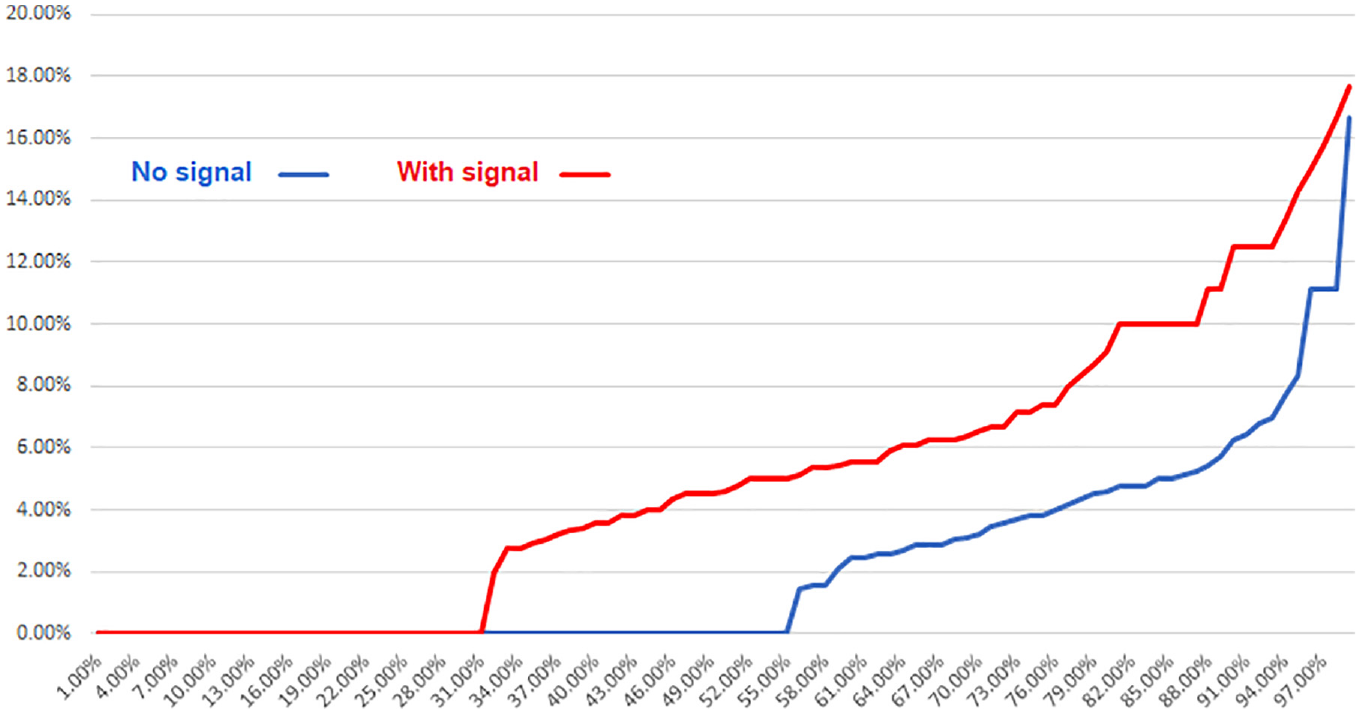
Cumulative distribution of price reduction for the two groups.
Additionally, only around 15% of requests in the control group resulted in a price reduction of more than 5% compared to around 52% in the experimental group. To complete the picture, we report the average difference in discount rates between the two groups. In the experimental group, average discount rate was 5.2% compared to 2.3% in the control group, indicating that the prices differed by
Several other factors can potentially affect the price reduction: (1) the initial price of the product; does the percentage of price reduction depends on the initial price? (2) The day of the week; do sellers react differently on weekends? (3) Seller’s gender. do male sellers offer different discounts than females? (4) Seller’s ethnicity; there are two distinct minorities in Israel—one is an immigrant from the Former Soviet Union, and the other is Israeli-born Arab. Both groups report lower life satisfaction than the majority group—Israeli-born Jews (Kushnirovich & Sherman, 2018). What discounts do ethnic minority sellers offer compared to majority sellers? (5) The phones’ model; does the iPhone receive greater discounts than Android?
To examine whether these factors can affect the final price we constructed the following variables. Weekend: A binary variable that takes 1 for weekends and 0 for weekdays. Ethnicity: A binary variable that takes 1 if the person is part of a minority group and 0 otherwise. 11 Model: A binary variable that takes 1 if the phone is an iPhone and 0 if it’s a different model. Initial Price: A continuous variable representing the initial phone price. Seller Gender: a categorical variable, which takes 0 for male, 1 for uncertain gender, 12 and 2 for female. Finally, our main variable of interest, Happiness, is a dummy variable that takes 1 when the seller is approached with a happiness signal. It takes zero when it is approached without the signal. Then we ran a linear regression with the percentage of price reduction being the depended variable and all constructed variables being the explanatory, the results are presented in Table 1.
Regression Analysis (Experiment 3, N = 200).

Note. A linear regression analysis with the percentage of price reduction being the depended variable.
***p < 0.001
As can be seen from Table 1, none of the constructed variable affected the percentage of price reduction, and when controlling for them, we find a significant happiness primum of 2.72%.
An immediate critique regarding the happiness premium in Experiment 1 is the possible high level of random noise caused by the between-subjects design. In addition, one may wonder whether the similar premium exists in other kinds of markets. Therefore, we conducted a within-subject experiments in a different second-hand market.
Study 4—Experimental Procedure
We analyzed the effect of a happiness signal on used bicycle prices. We identified 53 ads in Yad 2. As in the third study, the requested price, which ranged from USD300 to USD1400, was published in an ad. We sent 53 randomly chosen WhatsApp messages without gender identification and without a happiness signal, and 53 more WhatsApp messages from a different number to the same published ads, this time with the happiness signal. The signal was similar to that used in study 3.
To avoid an order effect, half the sellers received the message with the happiness signal prior to the message without the signal.
Results
As shown in Figure 3, we found substantial differences in price reductions between the experimental and control groups. The rate of offers that did not include a price reduction was 32% in the experimental group and 49% in the control group. Additionally, only around 10% of the participants in the control group offered a price reduction of more than 10%, compared to around 25% in the experimental group. Finally, the maximum price reduction in the experimental group was significantly higher (28%) than in the control groups (20%).

Cumulative distribution of price reduction for the two groups (within-subject experiment).
To complete the picture, we report the average difference in discount rates between the two groups. The average discount in the experimental group was 7.05% compared to 3.72% in the control group, indicating that the difference in prices was
In a manner like Experiment 3, we examined the robustness of our results by controlling for gender and initial price (we omitted day of the week as a control variable because all interactions happened on weekdays, and ethnicity was disregarded as only one participant was identified as part of a minority group). Specifically, we ran a mixed-effects regression model with the percentage of price reduction serving as the dependent variable, Individual as the random effect, and Gender, Initial Price, and Order as fixed effects. Here, Order is a dummy variable that assumes a value of 0 for the first approach and 1 for the second. Table 2 presents the results.
Regression Analysis (Experiment 4, N = 106).

p < .05. ***p < .001.

Note. A mixed effect regression model with percentage of price reduction being the dependent variable and individuals being the random effect.
As can be seen from Table 2 none of the constructed variables is significant and there is no significant order effect. In addition, when controlling for the seller’s gender, the initial price, and the order, we find a happiness premium of 3.33%.
Studies 1 to 4 show that the price reduction for “happy” buyers is robust across genders, types of products or services, and media (face-to-face or online). These findings raise a question concerning the limitations of the identified phenomenon. How do sellers react to other emotions signaled by consumers?
Two Experiments on Negative Emotions’ Signals
Study 5—Experimental Procedure
To assess the effect of negative emotions’ signaling on market prices, we had to identify those emotions that would not trigger sellers’ empathy. For example, signaling sadness may lead the seller to react directly to the signal instead of the request for a price reduction. 13 In addition, we had to identify those emotions that would not feel strange and out of context, as we assumed that in such cases, the seller would not reply. Shavit et al. (2021) found that negative emotions rose in Israel during the COVID-19. Thus, the COVID-19 pandemic offered us an opportunity to connect consumer’s negative emotions to the overall situation in Israel.
In study 5, we analyze the effect of anger. We identified 59 ads of various products such as bicycles, cellphones and laptops sold on Yad 2. Prices ranged between $90 and $1,600. Two assistants sent each supplier two WhatsApp messages. Both messages indicated the customer was interested in the product, but just one of the messages included an anger signal. The message without the signal was:
Hi,
I saw yours add for the ___
I wish to know the final price of the _______
thanks
The message with the signal was:
I saw yours add for the ___
Although I’m very angry about the Covid-19 situation, I wish to know the final price of the _______
thanks
To avoid an order effect, half of the sellers received the message with the anger signal before the message without the signal. Two sellers did not send us their price in respond to the anger signal; rather, they responded: “why are you angry?” and “I’m angry to, so what?!.”
Results
As can be seen from Figure 4, the cumulative distribution of price reduction is very similar for the two groups. In addition, the difference in the price reduction between the two groups was statistically insignificant (t(56) = 0.84, p = .40). The results indicate that anger signals do not affect seller’s selling prices. Seller’s behavior is in line with previous findings regarding rigidity of prices in response to consumer’s anger (Rotemberg, 2005, 2008).

Cumulative distribution of price reduction for the two groups (anger experiment).
Study 6—Experimental Procedure
In study 6, we analyzed the effect of disgust. Similar to anger, disgust is a negative emotion that is common during a turbulence in the affective component of subjective well-being (Brooks et al., 2020; Yang & Ma, 2020). We identified 60 ads of products offered on Yad 2 for various products priced between $90 to $7,500. As in study 5, two assistants (different than those participated in study 5), holding different phone numbers, sent each supplier two text messages via WhatsApp. Both messages indicated the customer was interested in the product, but just one of the messages included a disgust signal. The message with the signal was:
I saw yours add for the ___
Although I feel disgusted by the Covid-19 situation, I wish to know the final price of the _______
thanks
To avoid an order effect, half of the sellers received the message with the disgust signal before the message without the signal.
Results
The result from this experiment indicates that the disgust signal does not affect selling prices. The difference in the price reduction between the two groups was statistically insignificant (t(60) = 0.047, p = .97). The results, once again, indicate that seller’s decisions regarding pricing is not a function of the consumer’s negative emotions.
Figure 5 summarizes the results from Experiments 3 to 6.

The difference and confidence intervals of price reduction between the control groups (NS denotes no signal) and experiment groups (H.S, A.S, and D.S denote happiness signal, anger signal, and disgust signal, respectively) in Experiments 3–6.
General Discussion
The factors that determine the price of products and services are at the core of economic science (Galbraith, 1987). In a series of field studies, we showed that in specific markets, happiness signals affect the selling prices of products and services. Sellers of new and used products agree to profit less money when they interact with customers that signal their happiness. The results show that a positive happiness premium ranges from 2.9% to 9.14% of the initial price. The reduction in prices is similar to Ruffle et al. (2022), and Sherman and Barokas (2023). The economic value of interacting with happy customers, or feeling happy when selling to customers sharing their first name-letter with the seller is around 3% of the initial price. However, the current study demonstrates that face-to-face interaction leads to higher premiums. In our current study, the largest premium was obtained for services (9.14% for phone repair), whereas the highest was between 5% and 7.6% for products (phone upgrading). Our results are similar to those of price reductions offered to attractive females in Israeli produce market (Ruffle et al., 2022). It indicates that happiness signaling is stronger in face-to-face interactions than in online interactions. The reason, we suggest, is that in face-to-face interaction the seller derives extra non-pecuniary benefit through observing the customer and influencing his or her emotions by offering lower prices. The happiness premium stands in contrast to mainstream economic predictions, which assert that sellers are driven solely by profit motivation. Such effect was not found for two negative emotions, namely, anger and disgust.
Implications
Conclusion, Limitations and Future Investigations
We demonstrated that consumers’ happiness signaling affects market prices of both products and services sold in physical stores and on online platforms. On online platforms, the happiness premium is about 3%, while on physical stores, it ranges from 5% to 9%. The results show that such a premium does not arise from the signaling of negative emotions, specifically anger and disgust. Various plausible explanations are presented, including the effect on future demand, less bargaining, social interactions, and willingness to spread happiness. Our mathematical model elucidates the impact of both positive and negative emotions on selling prices. It suggests that transactions with happy individuals are likely to yield a higher surplus for both sellers and buyers. Consequently, sellers are inclined to offer reduced prices to buyers who signal happiness, while no such concessions are made for those signaling anger or disgust.
Although the empirical results show that sellers’ pricing decisions are a function of consumers’ emotions signaling, the result may be culture-based. In Israel, it is common to negotiate prices and to express emotion publicly. Hence, one might argue that happiness signaling was not perceived as peculiar or situationally unrelated practice in the current context, which encourage sellers to respond to such signaling. More research is required in order to determine if our results are culturally robust. Further investigation is required to compare the results of our field experiments to laboratory experiments, which can include control interventions. Moreover, a qualitative study is required to better understand the trade-off between monetary and non-monetary incentives involved in seller-buyer interactions. Future research is also required to distinguish between the different explanations for the happiness premium. Another venue of future research concerns the relation between emotional signals (other than happiness) and sellers’ selling prices. Our results do not imply that each emotional signal is captured by the seller as relevant information. We did not find evidence supporting the effect of two out of five other basic emotions. Further research is required to assess the effect of sadness, fear and surprise. If other emotions also carry an effect on selling prices, what is the most beneficial emotional signal for customers who seek to improve their consumer surplus? Finally, future research may compare between the effects of emotions signaled through external signals, with the same emotions signaled through facial expressions.
Research Data
sj-xlsx-1-sgo-10.1177_21582440241241455 – for Does Consumer’s Happiness and Other Emotions Signaling Affect Seller’s Prices? Theory and Evidence From Six Field Studies
sj-xlsx-1-sgo-10.1177_21582440241241455 for Does Consumer’s Happiness and Other Emotions Signaling Affect Seller’s Prices? Theory and Evidence From Six Field Studies by Guy Barokas and Arie Sherman in SAGE Open
Footnotes
Appendix: Proof of Theorem 1
Let
Since price equalizes surplus, we have for agent j and a random seller
and for agent k:
Now, because
We first show that any virtue contributes a non-negative amount to
We now show that the contribution of virtue
We now divide for three cases according to whether
If
Declaration of Conflicting Interests
The author(s) declared no potential conflicts of interest with respect to the research, authorship, and/or publication of this article.
Funding
The author(s) received no financial support for the research, authorship, and/or publication of this article.
Ethical Approval
Ethics statement is not applicable.

Data Availability Statement
Notes
References
Supplementary Material
Please find the following supplemental material available below.
For Open Access articles published under a Creative Commons License, all supplemental material carries the same license as the article it is associated with.
For non-Open Access articles published, all supplemental material carries a non-exclusive license, and permission requests for re-use of supplemental material or any part of supplemental material shall be sent directly to the copyright owner as specified in the copyright notice associated with the article.
