



Abstract
The aim of this article is to explore the circumstances leading employers to discriminate by gender and parenthood, contributing to the broader aim at increasing our understanding about the mechanisms underlying gender inequality in the labor market. Previous Swedish (and many international) studies show that employers are about equally likely to hire men and women. These results tend to refer, however, to data based on aggregates of branches, occupations and sectors. Statistical power is commonly low when results are broken down by segments. Studies showing no employer discrimination at the aggregate level may thus hide discrimination in certain segments. There are reasons to expect discrimination by gender and parenthood to vary depending on context and we explore this by relating variation in employer behavior to variation in demographic (gender) composition and qualification level in the occupation applied for. In this study, a large-scale experimental correspondence test design is employed, and non-authentic applications—with gender and parenthood randomly assigned to job applications—are sent to job openings in the Swedish labor market, including information on a total of 6,755 job applications in 15 occupations. The results show no indication of discrimination based on gender or parenthood in this early step of the recruitment process, and this is regardless of whether the occupation is dominated by either gender or is gender balanced.
Introduction
In general, men outperform women, and fathers outperform mothers in the labor market (for a review, see Ponthieux & Meurs, 2015). Research is not clear about the role that employer discrimination of women and mothers may play for differences in labor market outcomes. While qualitative studies propose that gender-related discriminatory attitudes and behaviors are dominant among some employers (see Hobson et al., 2011), systematic studies of discrimination are still too few to draw conclusions with certainty.
Discriminatory behavior by employers is often claimed to be a possible mechanism behind these gender (by parenthood) gaps (e.g., Bygren & Gähler, 2012; Blau & Kahn, 2017), and perhaps more so in Sweden and the other Nordic countries than in other societies. Sweden is well-known for its generous family policy model. Near full pay parental leave periods are extensive, and subsidized, high-quality, public childcare is easily accessible for parents of small children. These policies, paired with individual taxation, have facilitated parental employment and created strong economic incentives for families to have dual earners. As a result, the female and maternal employment rates are higher in the Nordic countries than in most other OECD countries (OECD, 2017). Nordic, including Swedish, family policies are generally regarded as institutions increasing gender equality in the labor market. A number of scholars have however raised concerns about this conclusion (e.g., Bergmann, 2008; Mandel & Semyonov, 2006), as generous family policies—in practice mostly used by women—inadvertently may obstruct women’s (i.e., mothers’) opportunities for successful careers.
The aim of this article is to investigate the contingencies of employer discrimination by gender and parenthood, if and how it varies across segments in the labor market, and to explore some of the potential mechanisms behind any such variation. In recruitment decisions, employers seem to generally discriminate against some categories of applicants. Experimental studies uniformly indicate that employers are reluctant to hire employees with “foreign” or “minority” names (for a review, see Baert, 2018; Lippens et al., 2023).
While the authors, in a previous study, show no evidence of gender discrimination in the Swedish labor market (Bygren & Gähler, 2021), in this study the authors will explore specifically the interaction of gender and parenthood with the aim to shed light on some of the potential discriminatory mechanisms. That is, whether mothers—or fathers or parents in general—are discriminated in different segments, and in specific occupations, of the labor market. In addition, here we theorize about demand side conditions affecting the employers’ propensity to discriminate, and use a stringent empirical method to test hypotheses on such demand side effects.
It is not easy for researchers to empirically explore discrimination and unravel its consequences in the actual labor market, in particular because discrimination can be subtle, appearing more or less subconsciously (Cunningham et al., 2004; Petersen, 2006). The data used here emanate from correspondence testing, which represents a type of field experiment design that has evolved in response to this challenge. It uses inauthentic written applications to apply for jobs in the labor market. The approach has been successfully applied in a large number of studies, primarily to detect ethnic discrimination but also discrimination based on, for instance, race, gender, sexual orientation, age, social class, personality, and attractiveness (see Baert, 2018). Previous studies, in Sweden and internationally, generally show no or weak signs of gender discrimination (e.g., Ahmed et al., 2021; Albert et al., 2011; Baert et al., 2016; Birkelund et al., 2022; Bursell, 2014; Bygren et al., 2017; Capéau et al., 2012; Carlsson, 2011; Kline et al., 2022; Zhou et al., 2013). These results often refer, however, either to single occupations or aggregates of more occupations. Thus, discrimination in certain segments of the labor market may be hidden. To be able to identify the potential when and whereabouts of employer discriminatory behaviors appears as an important and natural next step for this research field. It would nuance the question about the role of discrimination, away from the simple yes/no dichotomy to an investigation of the conditions leading to more, less, or no gender by parenthood discrimination in the labor market. Our approach therefore aligns with a research agenda focusing on the structural—rather than individual—conditions conducive of discrimination.
The results that will emanate from this paper speak to several fields of research. This study fills a void in the knowledge about labor market segment differences in discrimination, for gender by parenthood. Due to small sample sizes, previous research has not been able to fully evaluate established hypotheses concerning such differences. For instance, Bygren et al., 2017 found large differences in gender by parenthood discrimination rates between the 16 occupations included in their study, but because of the low-n problem they were unable to disentangle whether these differences were just an effect of random variation or caused by occupational differences, such as varying demand for labor (i.e., queuing effects), skill levels, demographic composition, sector, or something else. The combined data sets of this paper put us in a much better position to evaluate possible patterns of segment differences in employer discrimination.
A better understanding of these differences is important in order to advance theory development concerning the mechanisms behind discrimination. In order to fully understand how discrimination based on gender and parenthood works, the theoretical understanding of this process needs to be developed in dialog with high quality empirical evidence about under what circumstances this type of unfair treatment occurs, and under what circumstances it does not.
Theory and Previous Research
In a globalized world, while gender equality has increased in many countries, gender segregation in the labor market and a gender divide in unpaid (care) work remain (see Ullah et al., 2023). Mothers, or potential mothers-to-be, may spend long periods away from work, or work reduced hours. Swedish (Nordic) employers are therefore expected to practice statistical discrimination against women, and mothers, in hiring as they (on average) can be seen as less productive employees, and thereby more costly to the employer, in comparison to men, and fathers. Highly educated women may be particularly likely to suffer because employers find it riskier to hire or train women for jobs where they are hard to replace (Mandel & Semyonov, 2006). That is, employers will negatively discriminate high-educated and high-skilled women and mothers, and more so the more family policies give parents (read: mothers) incentives to spend time away from full-time work.
While statistical discrimination is based on differences in the average productivity of groups (Arrow, 1973; Phelps, 1972), for example, men and women or mothers and fathers, discrimination may also stem from a cognitive bias that functions beyond the actual productivity of groups (cf., S. J. Correll & Benard, 2006). Status characteristics related to gender and parenthood may play a role in this context. In fact, a branch in sociological theory argues for the role of status characteristics, for instance regarding gender and parenthood, in the labor market (cf., C. L. Ridgeway & Correll, 2004). Predominant cultural status rankings concerning individuals of certain groups are frequently applied in the evaluation of performance and characteristics, and status-related beliefs of this type tend to propose men as superior to women in many spheres of social life (C. Ridgeway, 2011; C. L. Ridgeway & Smith-Lovin, 1999). A status characteristic operates, or is activated, when it distinguishes between individuals or appears relevant in a certain context. The status characteristic is then adopted by individuals to make predictions, about behavior, competence, commitment, among others, that are in line with their beliefs regarding a certain status. For instance, it is likely that the gender discriminatory practices that manifest themselves in the context of employer callbacks following job applications, are activated only for women and men with children, because parenthood may be the characteristic that an employer believes to be linked to possible differences in skills between women and men. Status characteristics seem to be applied quite stridently when evaluating the parenting skills and job-related competence of mothers and fathers.
US-based laboratory experiments have found parenthood to be connected to rather strict job-related standards for women, but relatively soft standards for men, implying a status-based discrimination mechanism to operate to disbenefit mothers and to benefit fathers. Fuegen et al. (2004) reported raters to be less favorable toward hiring and promoting a mother than a childless woman (with identical formal qualifications) and that parental status did not matter as regards the hiring and promotion of men. Heilman and Okimoto (2008) showed that female applicants with children were rated lower on job commitment and competence, and that they consequently were less likely to be recommended for a vacant position. S. Correll et al. (2007) reported childless women to be rated higher than mothers for an executive position; despite of their qualifications being the same on all dimensions, mothers were penalized on a number of measures, such as perceived competence.
As noted, there are strong reasons to expect employers to discriminate by gender and parenthood in the hiring stage, but conclusive evidence of this is lacking, and direct investigations of whether employers discriminate on these dimensions are remarkably few. Many field studies have found no evidence of employer hiring discrimination by gender (Albert et al., 2011 [Spain]; Baert, 2015 [Belgium]; Baert et al., 2016 [Belgium]; Birkelund et al., 2022 [when looking at the pooled data across six countries, but, in a few countries, discrimination against men is reported when the countries are analyzed separately]; Capéau et al., 2012 [Belgium]; Zhou et al., 2013 [China]; Kline et al., 2022 [the U.S.). There are exceptions to this, as men have been found to be discriminated against in some studies (Berson, 2012 [France]; Booth & Leigh, 2010 [Australia]; Di Stasio & Larsen, 2020 [five European countries]; Jackson, 2009[the UK]; Lippens et al., 2023 [a meta-study comprising many countries]), and other studies have found discrimination against women (González et al., 2019 [Spain]; Petit, 2007 [France]; Riach & Rich, 2006 [the U.K.]). Also, Swedish studies including data on gender tend not to suggest that employers in general discriminate against women at the hiring stage (Ahmed et al., 2021; Bursell, 2014; Bygren et al., 2017; Carlsson, 2011). These results, however, tend to refer to averages across very different types of employers and labor market conditions, and gender discrimination may still be practiced in certain situations (see Brandén et al., 2018).
Rather few studies have used correspondence testing to evaluate whether employers discriminate based on parenthood in interaction with gender. Most commonly, European field experiments have not shown evidence of a motherhood penalty in general (Bygren et al., 2017; González et al., 2019; Hipp, 2020; Petit, 2007). Yet, a few field experiments report a motherhood penalty when exploring the order in which the (fictious) candidates receive responses in Spain (González et al., 2019) and when investigating explicit interview invitations (instead of all callbacks) for an event manager position in Germany (Hipp, 2020). In a French study, Petit (2007) found callback rates to be consistently higher among non-parents, regardless of gender. In a Belgian study, Baert et al. (2018) found the callback rate of mothers and non-mothers to be on par; instead, fathers were penalized compared to non-fathers. In a Swedish study, Bygren et al. (2017) found callbacks not to differ significantly depending on the gender and parenthood status of applicants. In contrast to these European studies, in an American study, S. Correll et al. (2007) found the callback rate for mothers to be half the rate of that for equally qualified non-mothers, indicating employer discrimination against mothers; for men, parenthood did not matter for callbacks (but it was generally lower than for women). A limitation associated with the American and French study is that they focused only on very limited segments of the labor market, that is, marketing and business jobs and the financial sector respectively. The Belgian and Swedish studies, in contrast, covered a broader range of occupations. In the Swedish study, some interesting between-occupation patterns emerged, but the low-n problem precluded conclusions on occupational heterogeneity.
Why would we expect heterogeneity across employers and labor market conditions in employer discrimination by gender and parenthood? Based on theory and the scholarly literature, we will investigate two dimensions as potential modifiers of discrimination: (1) Demographic composition. The gender composition of segments of the labor market might be reproduced through gender bias in their supply of labor (Bygren & Kumlin, 2005), but also be reinforced by cultural perceptions of gender (combined with parenthood) differences in job competence, and these may, consciously or subconsciously, affect employer priors on how men and women will perform as employees (cf., Pager & Shepherd, 2008). Some jobs require workers to embody the brand they represent in speech and appearance. For workers with direct customer contacts, “looking right and sounding right” may be crucial for customer satisfaction, driving employers to hire based on easily observed characteristics (cf., Williams & Connell, 2010). Accordingly, one would expect employers to hire in accordance with the current gender composition. However, employers might also want to counterbalance a skewed gender composition in their workplaces by favoring minority applicants. A few studies conducted in Sweden suggest employers to have a (weak) preference for hiring job applicants belonging to the underrepresented sex (Bursell, 2014; Carlsson, 2011), but there are exceptions to these (Ahmed et al., 2021). We have previously shown (Bygren & Gähler, 2021) women to be slightly favored over male job applicants in both male-dominated occupations and female-dominated occupations in Sweden, but these gender differences in callbacks are not statistically significant. Also, international studies have sometimes found discrimination against men in female-dominated occupations whereas discrimination against women have been found in male-dominated occupations (cf., Adamovic & Leibbrandt, 2023; Riach & Rich, 2006). We therefore have partially conflicting empirical expectations with regard to this dimension, and we now want to explore specifically the gender by parenthood interaction. (2) Qualification level. The qualification level of the job might mediate the effect of any potential discrimination in several ways. Mothers may suffer from higher statistical discrimination in more qualified jobs, where workers are more difficult to replace and where absence is extra costly for employers. This may particularly be the case in societies, such as the Swedish, that have generous parental-leave programs (see above). Parental leave mandates impose potentially significant nonwage costs to employers, disadvantaging in particular highly skilled working women because employers have strong incentives to pass on the ones more likely to use these mandates (cf., Mandel & Semyonov, 2006). On the other hand, there is also a tendency that employers of high-skilled (high-earning) workers want their jobs to be portrayed as family-friendly by offering work-schedule flexibility (Budig & Hodges, 2010). Organizations hiring highly educated personnel may be more likely to apply equal treatment policies and formalized recruitment processes, suggesting that discrimination should be less pronounced for these positions. We thus have conflicting hypotheses also for this dimension.
These dimensions vary across industries, occupations and sectors. We also aim at theorizing and exploring potential complex patterns between demographic composition and qualification level. For example, in high-skilled male-dominated segments (e.g., finance), men might be less willing to let employees belonging to the minority sex enter into their ranks compared to employers in high-skilled gender-balanced or female-dominated segments. Moreover, occupations tend to vary in terms of labor demand, and this may impact the level of discrimination. Deriving from rationales on economics of discrimination (Becker, 1971), with a greater level of demand for workers—when vacancies are more difficult to fill—employers are less likely, and less able, to discriminate. Thus, it will also be explored whether a higher level of demand for employees in the occupation is related to decreased discrimination based on gender and parenthood.
Study Design, Methods and Data
Because of generalizability issues related to the results from laboratory experiments, and the weaknesses of the observation methods, it has become common to conduct field experiments to study labor market discrimination. Correspondence audits represent the main type of field experiment used to study discrimination in the hiring process, and inauthentic job applications are used to apply for jobs in the labor market. Thus, correspondence testing is based on written applications, and the job applicants exist only on paper. An advantage of the method is its high external validity. Real employers make real decisions based on “real” job applications that were manipulated in such a way that factors other than, in this case, gender and parenthood are held constant, or controlled for, thereby effectively minimizing the risk that a discriminatory effect is spurious. The extent of discrimination, that is, the differential treatment of applicant categories in focus, is measured directly based on employers’ responses, callbacks, to the applications. What makes this method superior to other techniques is its real-world context that generates more direct—less biased—evidence of the extent of discrimination while a great deal of control is still possessed by the researcher.
Some limitations of the approach should be kept in mind. The main drawback is that it is difficult to genuinely understand employer choices using field experiments. Such questions require the use of more intense methods involving closer observation, interviews, and perhaps tailored tests (e.g., Implicit Association Tests, vignette survey experiments). Moreover, while correspondence testing observes employer discrimination in the early stage of the recruitment process, discrimination can also take place at later stages, and within an organization or a workplace. Workers may, for instance, be displaced or assigned different work tasks because of their gender or parenthood status, or suffer in other processes that are not observed in correspondence testing, such as wage-setting, promotions, internal training opportunities and lay-offs. Moreover, our findings are restricted to publicly advertised positions that approve written job applications. Yet, in the Swedish context, this should be less of a problem as written job applications are practically the standard. Nevertheless, entry into employment through other routes, such as social networks and walk-ins, are neglected here. Nevertheless, discriminatory mechanisms that operate in organizational processes, or as a consequence of homophily in social networks, may also be influential when employers choose which of the otherwise unknown job applicants to contact.
A limitation of the study design—corresponding testing—is its lack of informed consent from the participants. Yet, the lack of informed consent is inherent in the study design. If employers knew about the study and its purpose, the employer behavior regarding discrimination that the researcher aims to observe would not be informative. Thus, in order to observe discrimination patterns, one cannot inform the employers about them being observed, as this could lead to them changing their behavior.
This type of research involves a cost for the employers, in terms of time and resources, for handling a fictitious job application that they believe to be authentic. Yet, the employers and their representatives most likely do not experience any physical or mental harm or suffer any pain, discomfort or invasion of privacy due to the research. For an individual employer, the loss of time and resources can be argued to be very minor in absolute terms, and, especially, in relation to the societal and scientific benefit generated by the research as regards increased knowledge about potential discrimination based on for example, gender and parenthood, in the labor market.
Multiple measures were taken to limit the risk of harm to the employers, and to minimize potential employer costs. First, only one fictitious application was submitted in response to each job advertisement. While this design, in comparison to sending two (or more) applications to each employer, involves not only (at least) one application less for the employer to administer, it also means that the employers do not need to compare and decide between two (or more) fictitious applications with equal merits, thereby clearly saving time. Second, the employers who respond to the fictitious applicants will shortly receive a notice about the applicant no longer being interested in the advertised vacancy. Third, employers remain anonymous, and only aggregated results are published. This means that individual employers cannot be identified in the reporting of results. Fourth, as only one application is sent to each job opening, and the researchers have no information about other applicants, there is no way of identifying potential discrimination among individual employers. The aim of the study is to detect general discrimination patterns, not to point out individual employers, and the collected data can only be used to observe discrimination patterns in the Swedish labor market, and in given occupations or occupational categories, in general.
Although this study leads to no direct benefits for the involved employers, companies and organizations, there is an indirect benefit of this type of research. In case discrimination based on, for example, applicant gender and/or parental status, occurs in the Swedish labor market, the labor market appears not to function effectively in terms that the right worker may not end up in the right place and the most qualified candidate may not be chosen for a vacancy, which in turn entails costs for employees as well as employers. Therefore, it may be considered to be in the interest of all employers to observe (potential) hiring discrimination Further, this type of research can result in increasing employer awareness of their own behavior, and unintentional discrimination, which could generate improved recruitment decisions in the future.
Prior to conducting the data collection, and later to pool data with a previous data collection, ethical applications were submitted to The Regional Ethics Review Board in Stockholm and the Swedish Ethical Review Authority respectively which decided not to review the applications. The board stated, in both cases, that the research project did not include the kind of processing of personal data that according to the Ethical Review Act is sensitive to the research persons, and that the research is therefore not covered by the Ethical Review Act. According to the accompanying statement of opinion, the committee viewed that there were no obstacles to carrying out the research.
The data comprise 6,755 job applications submitted to advertised vacancies between October 2013 and April 2019 using an unpaired design, that is, one application was sent in response to each advertisement. Some of the benefits of the unpaired procedure—besides minimizing employer costs time and effort wise—are enabling the use of identical applications, instead of using applications with equivalent merits, and decreasing the risk of detection by the employers (see Vuolo et al., 2018). Also, the procedure of using only one application avoids the risk of spillover effects (see Phillips, 2019).
Applicant gender was randomly assigned to the applications, and foreign-sounding names were assigned to a portion of the applications. While the Swedish-sounding names were common for persons born during the same decade as the fictive applicants, the foreign-sounding names were typical Yugoslavian and Middle Eastern names that are common in Sweden. To indicate parenthood (and civil) status, half of the applications contained information that the applicant lives with his/her two children, and the other half, contained no information about children. All applicants were aged 31 years, which lies close to the median age of becoming a mother in Sweden.
While job applicant gender and a signal of parenthood status were randomized to each application, the data can be considered as an experiment in which employers are the subjects and applicant gender—signaled by a gender-specific first name—and parenthood status are the treatments. Occupations that differ in terms of gender and immigrant composition, educational level and sector (see Bursell, 2014) were chosen. Also, occupations that could—and that appeared reasonable to—be applied for with relatively simple applications were chosen. Thus, applications were submitted in the following 15 occupations: accountant/auditor, assistant nurse, carpenter, chef, cleaner, computer specialist, driver, engineer (in machine technology, industrial economics, or electronics), financial assistant, teacher (elementary or high school), nurse, preschool teacher, receptionist, salesperson, and store personnel/cashier. By comprising seven of the 10 largest occupations in the Swedish labor market, these represent relatively common occupations in the Swedish labor market.
Vacancies were searched for on one of the largest websites for job advertisements in Sweden, that is, the Swedish Public Employment Service’s website, focusing mainly on vacancies in, or nearby, the three largest cities in the country, Stockholm, Gothenburg, and Malmö.
The job applications included a CV and a cover letter. The CV contained contact information (name, telephone number, e-mail address, and postal address), date of birth, work experience and educational background. Each applicant had a relevant occupation-specific education and work experience, and the cover letter contained additional information about these as well as the applicant’s background (e.g., parenthood status). Each (fictious) applicant was linked to a given phone number with a voice mail and a name-specific e-mail address.
A callback was defined as a reply—by e-mail or telephone—from the employer indicating interest in the applicant., commonly an invitation to a job interview, a direct job offer or a request for more information. Thus, any explicitly negative callbacks, automatic replies, and nonresponses were not considered as callbacks. Descriptive statistics are shown in Table 1. As a check, job applicant gender was regressed on the variables in Table 1 (except the indicators of occupational gender composition as these are determined by occupation); these variables should not predict treatment status as long as the randomization was successful. None of the variables appeared significantly associated with treatment status, and the p-value for the F-test of joint significance (.928) indicated a successful randomization (not shown here; results are available from the authors upon request).
Descriptive Statistics, Percentages.

To test hypotheses on segment heterogeneity in gender (by parenthood) discrimination, two occupation-level dimensions were related to discrimination here. Regarding demographic composition, Statistics Sweden’s yearly population register data covering the entire Swedish labor market was used to construct detailed measures of gender composition in various segments of the labor market. For the purpose of this paper, the share of female employees in each occupation was used as an independent variable. Thus, the occupations were categorized based on the share of female employees, relying on Statistics Sweden’s occupational register for 2016 into three types: female dominated (more than sixty percent females), gender balanced (between 40% and 60% females), and male dominated (below 40% females). Store personnel, financial assistant, preschool teacher, school teacher, cleaner, receptionist, nurse and assistant nurse were categorized as female dominated. Chef, accountant/auditor and salesperson were categorized as gender balanced; whereas engineer, computer specialist, driver and carpenter were categorized as male dominated. Qualification level was directly measured as the jobs we apply for are well-defined on the types of formal merits required in them. The following occupations were classified as highly qualified because as a rule they require tertiary education: accountant/auditor, computer specialist/engineer in computer science, engineer (in machine technology/industrial economics), nurse, preschool teacher, and school teacher. In addition, information about the labor demand in the occupation was used to assess the probability of a callback based on the level of labor demand by gender and parenthood. Relying on the Swedish Employment Agency’s vacancy and unemployment statistics, labor demand was measured based on the ratio of advertised positions to unemployed in the occupation in the year the job application was sent.
Results
Do Swedish employers discriminate on the grounds of gender and parenthood? In accordance with the authors’ previous analyses (Bygren et al., 2017) of employer callbacks, based on a smaller part of the data used for this analysis, no indication of such discrimination is found. As the authors have shown previously (Bygren & Gähler, 2021), when data are aggregated, that is, when all occupations are pooled, women receive employer callbacks to a similar extent as men do (if anything, the female callback rate is slightly higher: 31.8% vs. 29.7%). Figure 1 shows that parents receive employer callbacks to similar extent as non-parents (or parents-to-be) do (30.3% vs. 31.1%). In addition, Figure 1 illustrates that parenthood does not affect male and female job applicants’ chance of receiving an employer callback in any substantially different way.
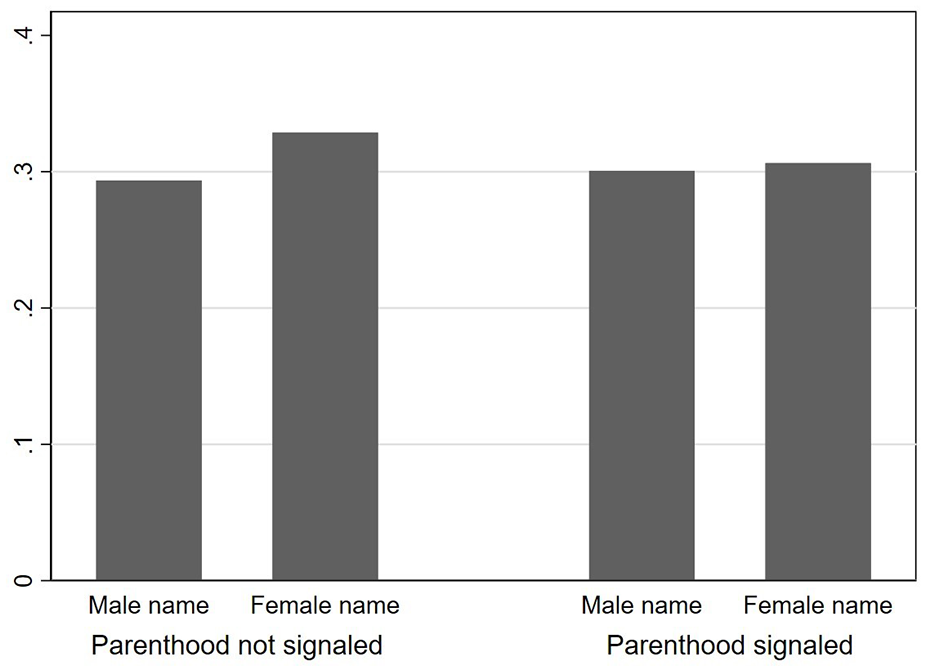
Employer callback rates by applicant gender and parenthood signal.
Figures 2 to 7 present percentage point differences in employer callbacks (the significance tests mentioned here refer to two-sample tests of difference in proportions). When the results are broken down by occupation (Figure 2), some gender variation in callback rates is found. In two cases, assistant nurse and cleaner, differences are around 10 percentage points, to the advantage of female applicants, and statistically significant on the 5% level. Both occupations are female dominated. Thus, it seems that employers of these professions act to consolidate existing gender segregation. On the other hand, however, results also indicate that male applicants are preferred as nurses, suggesting that employers of other professions strive to correct for existing gender bias. Coefficients for most occupations, however, hover around 0 and, thus, indicate no or just a few percentage points difference in employer callbacks between male and female job applicants.

Effect size of applicant gender on probability of callback by occupation with 95% confidence intervals (ref: male name).
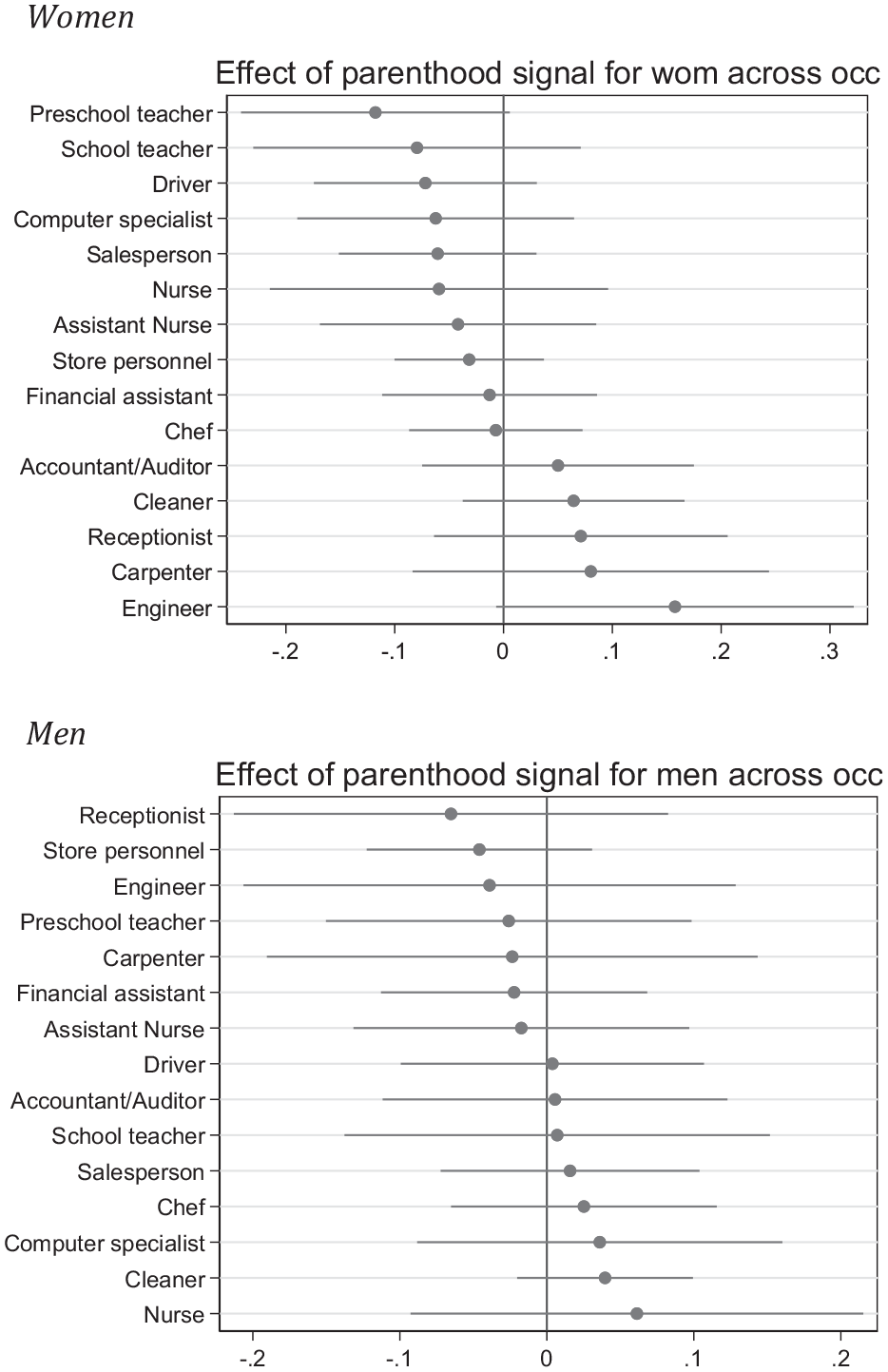
Effect size of parenthood signal and applicant gender by occupation with 95% confidence intervals (ref: no parenthood signal).

Effect size of parenthood signal and gender composition of occupation by applicant gender with 95% confidence intervals (ref: no parenthood signal).

Effect size of applicant gender by qualification level of occupation with 95% confidence intervals (ref: male name).
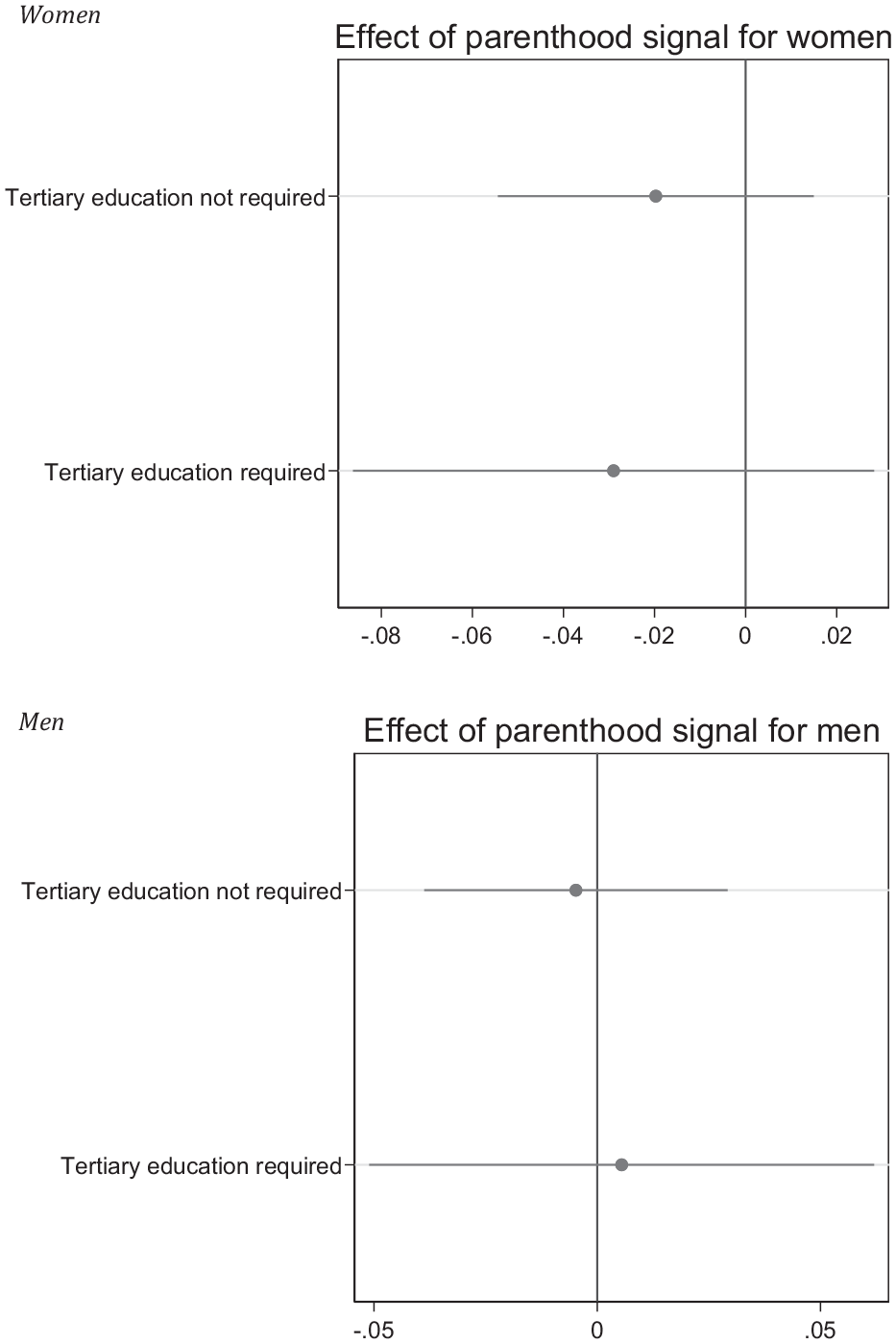
Effect size of parenthood signal and qualification level of occupation by applicant gender with 95% confidence intervals (ref: no parenthood signal).

Effect size of applicant gender and gender composition of occupation by qualification level of occupation with 95% confidence intervals (ref: male name). Highly qualified jobs. Less qualified jobs.
The small, or non-existing, effect of signaled parenthood is confirmed when the data are broken down by occupation. For no occupation does the difference in callback rate between parents and non-parents reach statistical significance, neither for female nor for male applicants (Figure 3). Again, differences are not only non-significant, but also, in general, rather small.
So far, our results confirm what has been found in most previous studies, only with larger and, thus, more reliable data: there seems to be no overall employer discrimination by the combination of gender and parenthood when it comes to hiring, or at least in the early step of the hiring process. Our aim here, however, is to study whether this general pattern hides discrimination by certain structural conditions, that is, occupational gender composition and/or occupational qualification level. Results presented in Figure 4 show that employers, regardless of current gender composition in occupation, seem to be rather indifferent to female and male job applicants’ parenthood status. Differences between signaled parenthood status among men and women respectively for all measures of gender composition, male dominated, gender balanced, and female dominated, are close to 0 and in no case reach statistical significance.
Turning to qualification level of occupation, two conflicting hypotheses were formulated. First, that employers are reluctant to hire mothers for highly qualified jobs because absence is costly and workers are difficult to replace in these positions. Second, that employers are less likely to discriminate applicants for these positions because they are eager to hire the most productive employee and are also more likely to apply equal treatment policies and formalized recruitment processes. Again, indifference among Swedish employers is found. Males and females are equally likely to receive a callback on their job application regardless of whether the job requires a tertiary education or not (Figure 5) and, again, signals of parenthood have very little impact (basically none) for both genders (Figure 6).
In a final analysis, gender composition is interacted with qualification level of occupation. At this stage, we only have a crude hypothesis claiming that men in highly qualified, male-dominated occupations are keen to exclude women from these positions. Once again, these expectations are not confirmed. If anything, females applying for jobs in male-dominated, highly qualified occupations, have a slightly higher chance of receiving an employer callback but the difference is not statistically significant (Figure 7). In none of the cases, regardless of occupation gender composition or qualification level female applicants are found to be negatively discriminated against by employers. In one case, however, the opposite is found. Females are more likely than their male peers to receive a callback from employers when they apply for a female-dominated, low qualified job. This could be sensed already by studying Figure 2, where female applicants were preferred for jobs as assistant nurse and cleaner. It should be noted, however, that although this gender difference is statistically significant (the confidence interval does not cross the zero line), it is not very substantial, only around three percentage points. Finally, regression analyses show that the (logged) ratio of labor demand in the occupation does not appear to matter notably for the callback probability by gender or parenthood (see figures in Online Appendix). Although the figures illustrate somewhat different patterns by the interaction of gender and parenthood based on labor demand, these differences are not very substantial.
Concluding Discussion
Sweden ranks high on the United Nations Gender Development Index and Gender Equality Index respectively. Gender differences in, for example, life expectancy, education, standard of living, reproductive health, and empowerment, are smaller here than in most other societies (United Nations Development Programme, 2016, tables 4 and 5). Labor market outcomes differ relatively little between men and women, female labor force participation is high in Sweden (United Nations Development Programme, 2016, table 5), the gender employment rate gap is small, also for mothers to young children (OECD, 2017, figures 1.6 and 1.7), and so is the gender difference in unpaid working time (OECD, 2012, figure 17.1). Still, the Swedish labor market is strongly gender segregated, in fact, as segregated as labor markets in societies ranking lower on gender equality overall (Nermo, 2000). Thus, women and men work in different occupations, branches and sectors. Could this be referred to employer discrimination by gender, that is, that employers prefer employees of a certain gender for a certain occupation? Our results here, and previously (Bygren & Gähler, 2021), show no indication of this, at least in the early stage of the recruitment process. Employers are as likely to respond positively to job applications regardless of whether the applicant is male or female—or a mother or a father—and regardless of whether the occupation is dominated by either gender or is gender balanced. Thus, the reason for gender segregation on the Swedish labor market must be sought elsewhere. One possibility is, of course, that employees are less likely to remain in occupations dominated by the opposite gender, based on, for example, social exclusion or hampered career opportunities. An obvious reason behind the segregation, however, is the fact that the pool of potential employees is highly gender segregated (Bygren & Kumlin, 2005). In other words, women and men are educated and trained, and apply, for different occupations, which limits employers’ possibility to remove gender segregation, even if they prefer to do so. Is there such a preference? For some occupations, this indeed seems to be the case. Nurse is a female-dominated occupation and computer specialist and engineer are male-dominated occupations. For these occupations, there is a tendency that employers prefer job applicants of the non-typical gender. For other occupations, however, such as assistant nurse, cleaner, and preschool teacher, all female dominated, there is a tendency that employers prefer job applicants of the typical gender, thus maintaining existing gender segregation. The reason why employers behave differently in different occupations, although these occupations share characteristics such as, for example, gender composition, is an issue that deserves further study.
A common argument is that employers are reluctant to hire mothers and women in fertile ages for highly qualified positions, the argument being that it is difficult and costly to replace them when they are on parental leave, work part-time, or stay home with sick children. This argument does not receive support in our data. Female job applicants are just as likely (or even more) as male job applicants to receive employer callbacks when they apply for jobs that require tertiary education, and signaling parenthood status does not seem to matter. There appears to be basically no gender difference in callbacks even when applying for highly qualified jobs in male-dominated occupations. In other words, based on employer callbacks, there is no indication of employers trying to reserve certain high-status occupations for male applicants or prevent female applicants to enter these segments of the labor market. It should be noted, however, that some of the ultimate elite positions on the labor market are not included in the data here and, thus, there is no way of knowing whether hiring patterns differ there. The opposite argument, that employers for highly qualified positions behave less discriminating than other employers, because they belong to organizations that apply equal treatment policies where recruitment processes are formalized, also receives no support in our data. Employers of less qualified jobs are just as likely to disregard applicant’s gender and parental status as employers of qualified jobs are.
Previous research shows that gender differences on the labor market emerge or increase in connection with parenthood. For example, Bygren & Gähler (2012) show that men’s chances of receiving a managerial position increase when they become fathers, whereas women’s chances are unaffected when they become mothers. Moreover, men receive a larger wage premium when they become parents than women do (Bygren et al., 2021). Does this mean that employers prefer fathers over mothers overall? No sign of this is found here. When responding to job applications, employers appear to make no difference between parents and non-parents in general and, moreover, women are not affected in any other way by parenthood than men are. This finding may come as a surprise, given the fact that Swedish men often increase their working time following parenthood whereas women decrease theirs (Kennerberg, 2007), and mothers still use the large majority of parental leave days (Swedish Social Insurance Agency, 2017). Employers, of course, know this. Thus, rather than asking whether employers discriminate against mothers, one may instead ask why they do not. A recent Danish study may shed some light on this issue. Brenøe et al. (2020) find that small firm “output, profitability or survival” (p. 1) are unaffected by mothers’ parental leave and decreased working hours. The firms find ways to handle this by, for example, replacing these women with temporary manpower. Thus, when employers hire, applicant credentials and merits may overrule any potential influence of signals of parenthood.
In fact, this may be the general conclusion from our analyses: Regardless of occupational qualification level or gender composition, Swedish employers seem to disregard irrelevant characteristics such as applicants’ gender and parental status when responding to job applications and, instead, focus on characteristics that contribute to their organization’s prosperity and survival, such as the applicant’s competence and expected productivity. One may even be so bold as to claim that Swedish employers in this way seem to behave in a rational manner.
Supplemental Material
sj-docx-1-sgo-10.1177_21582440251335435 – Supplemental material for The When and Whereabouts of Gender Hiring Discrimination
Supplemental material, sj-docx-1-sgo-10.1177_21582440251335435 for The When and Whereabouts of Gender Hiring Discrimination by Magnus Bygren, Anni Erlandsson and Michael Gähler in SAGE Open
Footnotes

Ethical Considerations
Ethical applications were submitted to The Regional Ethics Review Board in Stockholm (dnr. 2013/1237-31/5) and the Swedish Ethical Review Authority (dnr: 2019-01220) which decided not to review the applications. The board stated, in both cases, that the research project does not include the kind of processing of personal data that according to the Ethical Review Act is sensitive to the research persons, and that the research is therefore not covered by the Ethical Review Act. According to the accompanying statement of opinion, the committee viewed that there were no obstacles to carrying out the research. Due to the research method (corresponding testing), the study lacks informed consent from the participants.
Author Contributions
The authors have contributed equally to this article.
Funding
The author(s) disclosed receipt of the following financial support for the research, authorship, and/or publication of this article: This research was supported by the Swedish Research Council for Health, Working Life and Welfare (Forte grant 2012-0587; Forte grant 2018-00594), and by the Academy of Finland Flagship Programme (decision number 320162).
Declaration of Conflicting Interests
The author(s) declared no potential conflicts of interest with respect to the research, authorship, and/or publication of this article.
Data Availability Statement
The data that support the findings of this study are not publicly available, and restrictions apply to the availability of these data. Aggregated data are however available from the authors upon reasonable request.
Supplemental Material
Supplemental material for this article is available online.
References
Supplementary Material
Please find the following supplemental material available below.
For Open Access articles published under a Creative Commons License, all supplemental material carries the same license as the article it is associated with.
For non-Open Access articles published, all supplemental material carries a non-exclusive license, and permission requests for re-use of supplemental material or any part of supplemental material shall be sent directly to the copyright owner as specified in the copyright notice associated with the article.
