



Abstract
The Smart Education of China, a large education data platform for the aggregation and application of high-quality educational resources, is vital for China to stimulate the balanced development of education and to reduce students’ learning burden. This study focuses on the long-term mechanism of the Smart Education of China, adopting TOE framework and qualitative comparative analysis research method to investigate the technological conditions, environmental conditions, organizational conditions and content conditions of the Smart Education of China before summarizing four usage paths of the Smart Education of China. With regard for the existing issues, the study concludes that for the sake of a long-term mechanism the Smart Education of China needs to solve four problems, including unfinished construction, content-insufficient platform, popular but ineffective application, and substandard quality.
Keywords
On July 24, 2021, the General Office of the Communist Party of China Central Committee and the General Office of the State Council (2021) jointly released the Opinions on Further Reducing the Burden of Homework and Off-campus Training for Students Undergoing Compulsory Education (hereinafter referred to as the “Double Reduction” policy), needing all regions and departments to earnestly carry out it combining the actual situation. The “double reduction” Opinions have standardized the approval qualifications for off-campus cultural training, and institutions that have not obtained education licenses are forced to withdraw. The “double reduction” Opinions have accelerated the reform of basic education and guided the basic education’s return from discipline knowledge to talent’s literacy cultivation (Guanghai Li, 2022). In the same year, the Outline of the 14th Five-Year Plan (2021-2025) for National Economic and Social Development and vision 2035 of the People’s Republic of China proposed “quality education for all” (Zhonghua Guo, 2022) which has become the inevitable development of China’s educational reform in the new era. How to cultivate high-quality talents under the background of “double reduction” and change the current situation of unbalanced educational resources? On March 28, 2022, the Smart Education of China was officially launched, which is a phased achievement of the national strategic action for the education digitization, and an important step in building a networked, digital, personalized and lifelong education system. It is significant to promote balanced educational resources and provide high-quality education.
Since the term public educational resources was put forward in the Forum on the Impact of Open Courseware for Higher Education in Developing Countries held in 2002, all countries in the world have been building public educational resources and started in-depth research (Baas et al., 2022; Chen, Chen et al., (2022); Ferreira & Lemgruber, 2019; McGreal et al., 2015; Paskevicius et al., 2018). The research perspectives include textbook (Hilton, 2020; Venegas-Muggli & Westermann, 2019), public courseware (Carson et al., 2012), open course (Griffiths et al., 2022), public online education (G. Chen et al., 2021; Schophuizen et al., 2020) and so on. With the dramatical development of Internet era and the outbreak of COVID-19, public online education in various countries has developed rapidly. Although public educational resources are not a panacea for all educational problems (Mishra, 2017; Olcott, 2012; Tlili et al., 2021), they make a vital impact on promoting the balanced development of education and ensuring the normal learning of students in all countries during the pandemic period. Scholars from all countries have made many explorations around online education. Scholars not only pay attention to the audience groups of online learning (Chen, Shuo et al., 2022; Shih, 2008; Sørebø et al., 2009), but also gradually deepen the exploration of different stages of online education use (Cheng & Yuen, 2018; Motaghian et al., 2013), especially focusing on the analysis of the use of MOOCs, open online courses, in their research (Dai et al., 2020; Shao, 2018).
However, currently, most of these studies analyze adult online education platforms such as MOOCs, lacking research on the uneven distribution of basic educational resources. Educational inequality remains a difficult problem in the current stage of promoting public education. This study primarily aims to identify multiple conditions that influence the long-term mechanism of using the national smart education public service platform. Based on the results of configuration analysis and in combination with existing issues in online learning platforms, such as unfinished construction, content-insuficient platform, popular but ineffective application, and substandard quality, the study seeks to identify the root causes of these problems and propose adaptive strategies suitable for China’s national conditions to achieve the continuous promotion of equitable education development.
Literature Review
CiteSpace is a visualization software that can analyze the development process, research hotspots as well as development directions of research fields. Generally, the major authors, research focus and hotspots in different time periods in the research field can be identified through visual analysis of authors, keywords and references. The CiteSpace software does a statistic analysis of big data samples, different from the analysis based on the subjective judgment, to carry out the more objective data visualization analysis, which enables scholars to have a more macroscopic control over the development trend of research fields. Therefore, CiteSpace software is used to analyze the literature on the TOE framework and public educational resources in order to get clear about the research direction from a more macroscopic perspective. The specific version of CiteSpace software used in this study is 6.1.R2.
Analysis of TOE Framework Based on Application Scenario
Among the many studies based on the analysis of TOE framework, the TOE framework put forward by Tornatzky and Fleischer in 1990 has the most extensive influence. The framework identifies three aspects, including technology, organization and environment, to explain the decision of an organization to adopt technological innovation. In later studies, following Tornatzky and Fleischer’s application perspective, the TOE framework is mostly used for the scenarios of organization’s technology adoption in multi-fields. With the increasingly wider application of TOE framework, its practical research in various fields is also gradually booming.
With the purpose of better reflecting the research status and progress of TOE framework, the Science Citation Index Expanded and Social Sciences Citation Index in the Web of Science core collection database are used as the retrieval databases. The retrieval time is June 15, 2022. The retrieved Topic is TOE framework or Technology*-Organization*-Environment*Framework. The literature type is selected as papers and review papers. The language is English. The retrieval time range is from January 1, 2010 to December 31, 2021, and a total of 1,576 papers were found. The retrieved literature are further screened according to their titles and abstracts, among which TOE literature unrelated to TOE framework and literature that only selected 1 to 2 aspects of technology, organization and environment for research are deleted. A total of 338 papers are retained and analyzed.
Temporal Distribution
Through the statistics of 338 papers in the past 12 years, the changing trend of published papers on TOE framework can be grasped as a whole. Through the visual analysis of particular years and the number of papers published in the corresponding years, the specific results are presented in Figure 1. As shown in Figure 1, during 2010 to 2016, the research on TOE framework shows a relatively stable upward trend as a whole. Although the number of published papers decreases in some specific years during this period, the overall fluctuation is relatively stable. There is a significant decrease in papers published in 2017 compared with those in 2016, but research on the TOE framework grows steadily from 2017 to 2021, with a very significant increase in 2020 compared with 2019. In general, although the research on TOE framework is not always in a growing stage, it is still in a developing stage in the recent 5 years.

2010 to 2021 trend of annual number of papers published.
Key Words Co-Occurrence Analysis
Keywords analysis is helpful to find out research hotspot and focus and tor predict research trends. Through co-occurrence atlas analysis of research keywords, the overall map of the research can be more intuitive. Among the keywords included in the analysis, the keywords atlas of TOE framework research is finally obtained after the synonyms are merged, which can be found in Figure 2.
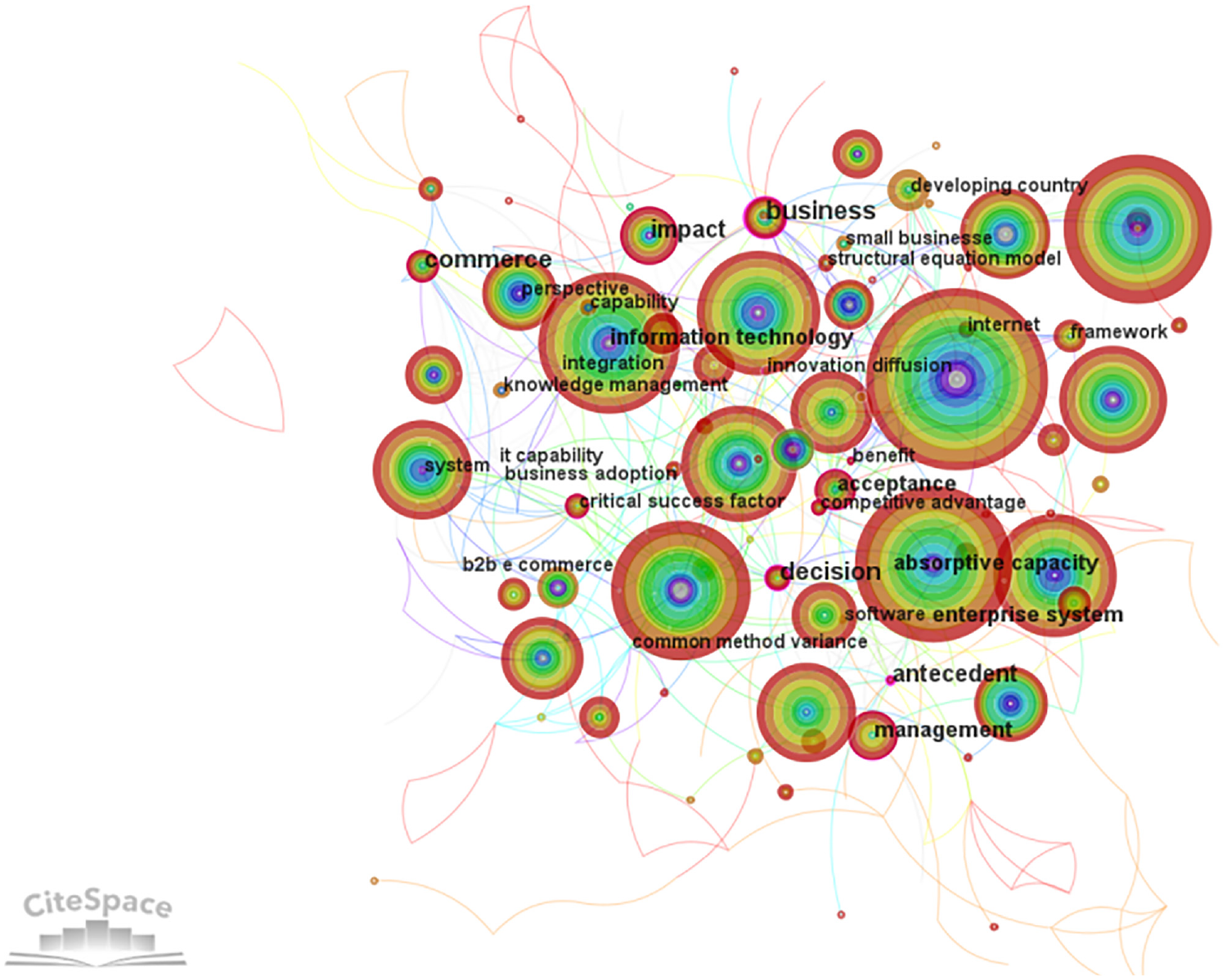
Keywords graph of TOE framework research.
After removing the words without clear research content, such as TOE framework, determinants, models and impacts, the occurrence frequency and betweenness centrality are counted and ranked. The results of the top 10 values in a descending order are shown in Table 1. Although e-business and business, commerce, innovation and innovation diffusion, user acceptance and acceptance, cloud computing and internet, software are not exactly the same words, the meanings of these four types of words are highly similar and they are all high-frequency words and high-betweenness-centrality words. Through the analysis of the above words, it can be clear that the research on TOE framework mainly focuses on business, information technology (software), innovation field and user acceptance scenario.
High-Frequency Words and High-Betweenness-Centrality Words in TOE Framework Research.

Keywords Cluster
The timeline graph can not only reflect the technological evolution and history span of the discipline field, but also clarify the relationship between clusters. In order to clearly display the knowledge structure of TOE framework research, Citespace 6.1.R2 software is used to perform clustering analysis of the keywords of TOE framework research, and the top 10 clusters are selected. The results are shown in Figure 3. The keywords in innovation diffusion cluster appeared at the earliest in 2012 and were the latest to appear among the top 10 clusters. However, new keywords of this cluster continued to appear in subsequent studies, but the number of studies was relatively small as a whole. Keywords of structural equation modeling cluster appeared earlier with a large number of studies, and a new keyword with much research appeared in 2014, but no new keyword appeared in this cluster in 2021. DOI theory and government activity clusters in the early stage displayed keywords with much research, but in recent years there are only a few new keywords with much research, and the research trend is unpopular. The clusters of big data, project management, cloud computing, smart city, developing countries showed keywords with much research and higher frequency, attracting the attention of more scholars.
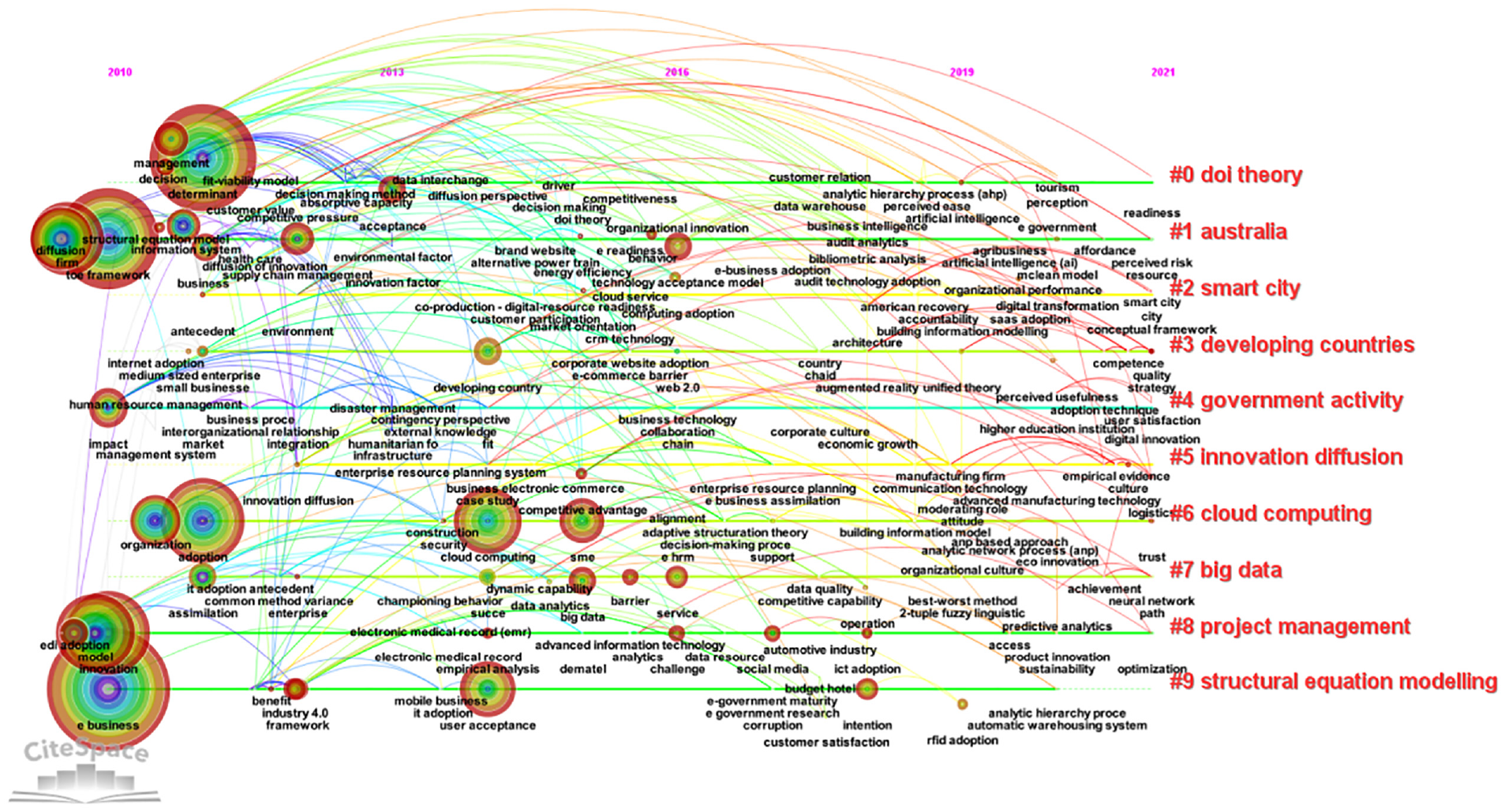
Timeline graph of TOE framework’s keywords clusters.
Research Progress of Public Educational Resources
In order to have a clearer cognition and analysis of the related research on public educational resources, the Science Citation Index Expanded and Social Sciences Citation Index in the Web of Science core collection database are used as the retrieval databases. The retrieval time ranges from January 1, 2010 to December 31, 2021. The retrieved topics are open education* resources* and open online education* resources*. Paper and review paper are selected for literature type. English is selected for language. A total of 2,114 papers are retrieved. The retrieved literature are further screened according to their titles and abstracts. Literature relevant to open educational resources (OER), e-learning, MOOC, open educational practices, open textbook and distance education and so on are retained and other irrelevant literature are deleted. Finally, 600 papers and review papers are retained and analyzed.
Temporal Distribution
After screening the papers, this paper analyzes the 600 papers of the past 12 years which are highly related to the research topic, identifying the changing trend of papers published about public educational resources. Visual analysis is performed according to the particular years and the number of papers published in the corresponding year. Figure 4 illustrates the specific results. The research on public educational resources has revealed a steady growth trend during the past 12 years. The number of papers published in 2010 to 2011was the least in the studied time range and thus this period was in the early stage of the research. Subsequently, the number of papers published elevated notably in 2012 and 2013, while it remained stable from 2013 to 2016. The number of papers published elevated sharply in 2017, and the overall growth trend was shown from 2018 to 2021. To sum up, the overall research on public educational resources is in a stable and growing state.

Trend of the number of papers published from 2010 to 2021.
Analysis of Major Authors
The statistical analysis of the papers published by the major research authors in the field of public educational resources and the initial publication year is shown in Table 2. In addition to the eight authors shown in Table 2 who had 3 or more publications in the field of public educational resources, other authors had two or less and therefore they are not shown in Table 2. WILEY D, having the highest number of papers (9) in the field of public educational resources, has made early research in this field in that he has published relevant papers as early as in 2011. BURGOS D, ANDERSON T and ZHANG J also have made much research on public educational resource, all having published 4 papers in this field. TLILI A and HUANG R both published 3 papers in the field of public educational resources in 2021, making them rising stars in this field.
Major Research Authors in the Field of Public Educational Resources.

Literature Co-Citation Analysis
If two or more papers are cited at the same time by one or more subsequent papers, they are said to constitute a co-citation relationship. Co-citation graph can reflect the fundamental knowledge of a scientific field, and the nodes with high betweenness centrality can show the transformation of the research field from one perspective to another (C. Chen, 2004). The co-citation graph analysis and cluster analysis of the references of public educational resources research are carried out, and the specific results are presented in Figures 5 and 6. It can be observed from the co-citation visualization graph of references in Figure 5 that Hilton J (2016), Cronin C (2017), and Wiley D (2018) are very important papers with very high citation frequency and thus are the most significant. Hegarty B (2015), Fischer L (2015), Bliss TJ (2013), Colvard NB (2018) and other nodes are papers with high citation frequency. Based on Figure 5, the clusters are named by extracting nominal terms from the keywords of the cited papers. The Q value of the clustering result is 0.8473, and the weighted average S value is 0.9364. The structure is significant and the reliability is high. The 10 largest clusters are selected for display, and the results are shown in Figure 6. The cluster tags extracted by Citespace are micro learning, assemblage, open textbook, open educational practice, anatomy education, cognitive electrophysiology, reuse, accessibility, epub, publishing, etc. The research of public educational resources mainly focuses on some educational sub-disciplines (anatomy education, cognitive electrophysiology, open educational practice), educational resources (open textbook, epub, publishing, assemblage, reuse) and microlecture learning (micro learning, accessibility).

Co-citation graph of public educational resources research literature.
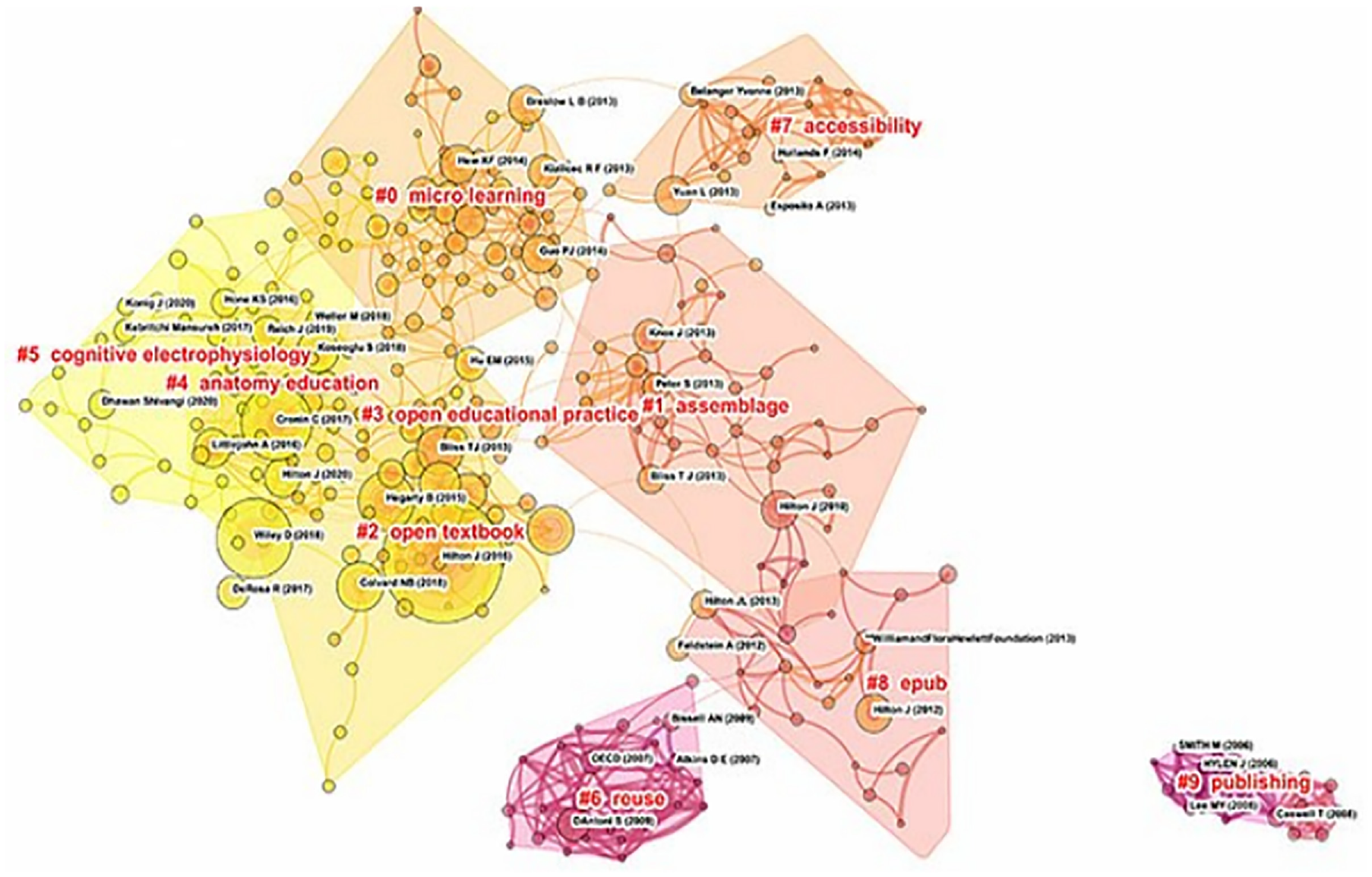
Co-citation clustering of public educational resources research literature.
According to the cluster tags extracted by Citespace, the current research on public educational resources mainly focuses on disciplines, types of public educational resources (public teaching materials, e-books, etc.) and microlecture learning. Although the research related to online education has become a hotspot, there is little research on the use of public online education platforms. This paper will supplement the research types of public educational resources, expanding and extending the research on the use of public online educational resources through the research on the Smart Education of China.
Theoretical, Framework, and Conditional Variable Interpretation
Theoretical Foundation
This paper constructs a research framework based on TOE framework. TOE framework was initially used in technology adoption scenarios, and it has been used in many fields based on different perspective of researchers. Some scholars have combined the technology acceptance model (TAM) with the technology-organization-environment (TOE) framework in their research, taking personal experience and technology-organization-environment as external variables (Na et al., 2022). Some scholars conducted empirical exploration through combining the diffusion of innovation theory (DIT) and the technology-organization-environment (TOE) framework, determining seven factors affecting the adoption of social media in organizations (Pateli et al., 2020). Some scholars developed a conceptual model on the basis of the technology-organization-environment (TOE) framework, and explored the different impacts of the model on CRM’s evaluation, adoption and programing stages (Cruz-Jesus et al., 2019). In general, the quantitative research is mainly carried out by expanding TOE framework or combining TOE framework with other theories. In recent years, the research of TOE framework in the field of non-technology adoption has gradually emerged. Scholars have conducted exploratory research with a view of classifying complexity factors of international development projects (Gajic & Palcic, 2019) and exploring the influencing factors of precast concrete components (PCC) used in construction in the building industry (Katebi et al., 2022), and the universality of TOE framework is also being established step by step.
With the development of Internet technology, many enterprises face the transition from product value creation to Internet platform value creation (Liangjie Zhu & Huang, 2018), and the research of TOE framework gradually extends to the organization’s use of Internet technology to construct the system or platform. Based on the TOE model, scholars found that the relationship between ICT infrastructure and e-government assimilation was the most significant when exploring the Indonesia e-government assimilation platform (Pudjianto et al., 2011). Haibo et al. (2019) proposed an integrated analysis framework for the construction performance differences of local government websites using TOE framework in combination with the characteristics of Chinese government’s organizational behavior, and conducted configuration analysis on 31 Chinese provincial government portals. At present, the research that applies the TOE framework to organization’s systems, platform use and construction is gradually increasing. Since the technology, organization and environment originally included in TOE framework are the essential and basic elements for system, platform use and construction, the TOE framework is also applicable to online education platform. In Saudi Arabia’s distance education study, Khloud Alshaikh collected data from 150 undergraduates and graduates in Saudi Arabia within the COVID-19 pandemic, and analyzed the influencing factors of COVID-19 on distance education based on TOE framework (Alshaikh et al., 2021). Therefore, the TOE framework naturally has the advantage of being suitable for system, platform use and construction.
Analytical Framework
Through the analysis of the literature, the current research on public educational resources is more inclined to public courses (micro-lectures, MOOC, etc.) and public educational materials (e-books, books, etc.), lacking the research from the perspective of the construction and application of public online education platform. Based on existing research findings and in conjunction with the actual situation of constructing the national smart education public service platform, a modified and expanded TOE (Technological, Organizational, and Environmental) framework was developed. This framework consists of five variables: organizational conditions, environmental conditions, technological conditions, content conditions, and long-term mechanisms (Figure 7).

Analytical framework.
Conditional Variables Interpretation
Organizational Conditions
Organizational conditions mainly include organization size, business scope, formal/informal institutional arrangements, communication mechanism, idle resources of reserve and other aspects (Walker, 2014). For the Smart Education of China led by the state, government support and corresponding financial allocation are the prerequisite of the platform’s use, so government support and supply of financial resources are selected as two secondary conditions for the organizational conditions. The government is in charge of key links and key fields, and makes targeted efforts to carry out precise regulation to ensure the effective supply of the Smart Education of China, such as formulating laws related to technology use to influence the adoption of technology (Qasem et al., 2021). In the actual operation of the Chinese government, government support is a vital factor influencing the implementation of a policy and project, and the attention and support of the government made an important effect on the progress of the project (Haibo et al., 2019). In addition, from the perspective of currency, the government must consider the time and allocation of financial resources supply for the establishment of the Smart Education of China, so as to improve, use and promote the public platform of online educational resources step by step. The construction of the Smart Education of China needs the support of financial allocation. Financial resources is a key driver and major constraint for any organization/institution to adopt technology and establish platforms, particularly in developing countries (Hiran & Henten, 2020).
Technological Conditions
Technological conditions mean the characteristics of technology itself and its correlation with the organization (Chau & Tam, 1997). As for the Smart Education of China, the technology ability of teachers and the technology foundations of the platform are the starting point for the development of the platform. As for teachers, digital skills are even more essential, and digital skills have become an important influencing factor of individuals’ social life (Ertl et al., 2020). The construction of platform’s technology infrastructure is the prerequisite for the development of Smart Education of China. Therefore, teachers’ digital skills and technology infrastructure construction are selected as two secondary conditions for the technological conditions. Searching, processing and sharing information has become a core competency requirement for the teaching profession (Saikkonen & Kaarakainen, 2021). Especially during the COVID-19, teachers must have digital skills for online teaching (Perifanou et al., 2021), which is a prerequisite for teachers to implement ICT in the classroom (Rubach & Lazarides, 2021). Teachers often need training and guidance when using digital technology to spread their expertise in teaching (Spiteri & Chang Rundgren, 2020). Technology infrastructure construction refers to the software and hardware in the daily work of the platform, which is the necessary condition for the use of the Smart Education of China and guarantees the supply capacity of the platform to the public educational demands (Mukred et al., 2019). IT infrastructure makes a vital important impact on supporting the online education system (Alsabawy et al., 2013), so it can be observed that the construction of technology infrastructure plays a key role in stimulating the Smart Education of China.
Environmental Conditions
Environmental conditions include the market structure of organization operation and the regulatory policies of external governments, etc. (Oliveira & Martins, 2011). The government takes the lead in building and promoting The Smart Education public of China, so priority is given to the market environment in which the platform environment is selected when selecting environmental conditions, mainly involving the needs of users and competition between industries. Meeting the educational demands of different groups is conducive to promoting the harmonious development of society (Wong et al., 2021), and educational demands stems from the discrepancy between the current and ideal abilities of people. Therefore, the analysis of educational demands of different groups helps to clarify the mission objectives and implementation steps. In the context of education information, both national and enterprise education institutions have chosen to build corresponding online learning platforms for value maximization (Tarhini et al., 2018). Organizations face the pressure from competitors in the same industry, which determines the pressure of other organizations in the same industry (Oliveira & Martins, 2011), and competitive pressure affects the construction and adoption of new technologies and platforms. Therefore, public educational demands can be identified through surveys, with The Smart Education of China to be designed, developed, implemented, evaluated and improved based on the analysis of public educational demands (Kang & Do, 2021). The construction and use of the The Smart Education of China will also be affected by for-profit online education institutions. The Smart Education of China, by expanding the scope of users to gain competitive advantage, builds a free learning platform that students, families, and teachers can use, so that the platform use can be promoted.
Content Conditions
Content conditions indicate the characteristics of the content itself and its association with the organization. The course is the specific content of learning. For online learning platforms, the quality of courses on the platform directly influences the quality of education (Noaman et al., 2017), the choice of families and students and subsequent sustainable use, so standards need to be set for the quality of course content. Therefore, formal quality standards are chosen as secondary conditions. Clarifying the formal quality standards of the curriculum helps students clarify the structure and focus of the curriculum and to understand the importance of the curriculum. Familiarity with such standards results in more effective feedback (Falchikov, 2004), leading students to define feedback standards for learning courses themselves, which is more beneficial than providing them with ready-made standards (Dmoshinskaia et al., 2021). Formal quality standards are based on established instructional design principles and the current online course design assessments. Therefore, with the aim of improving the quality of online courses, the development of public online courses should not neglect the standards development (Baldwin & Ching, 2019). The setting of formal quality standards should closely follow the direction of the national syllabus and examination syllabus, so that students can have a target and create The Smart Education of China to meet students’ needs.
To sum up, the four first-level conditions (technology, organization, environment and content) include seven second-level conditions. Among the seven sub-conditions, government support, construction of technology infrastructure, supply of financial resources, and competitive pressure are objective endowment conditions. This is because these four types of conditions largely lie with local governments themselves, and it is often difficult to effectively change the status quo in a short period of time. Teachers’ digital skills and quality standards are subjective and controllable, as local governments can directly change the status quo in the short term through options such as outsourcing services and restructuring of topic spaces. Public educational demands are conditions that change over time due to many factors, including government policies and the economy.
Research Methods and Data
Under the configuration view, the influence of technological conditions, organizational conditions, environmental conditions and content conditions on user use is not independent of each other, but works together through linkage and matching. Specifically, concurrent synergies between multiple conditions may include mutually reinforcing through adaptating to or canceling each other through substitution. Therefore, this paper will empirically explore how the four conditions (technology, organization, environment and content) and their interaction will influence the users’ use mechanism.
Qualitative Comparative Analysis
The present study attempts to make a configuration- based analysis of the multiple driving mechanisms behind the effectiveness mechanism of The Smart Education of China, and therefore, so it uses fs/QCA to carry out empirical testing. QCA was put forward by Ragin (1989) in the 80s of the 20th century. In QCA analysis, researchers can find out the logical correlation between the matching patterns of different conditions and the results by making across- case comparisons, that is, “Which configurations of the condition variables can contribute to the emergence of the result variable? which conditional configurations in turn lead to the disappearance of the result variable,” thus further detecting the synergistic impacts of multiple conditional variables while acknowledging the causal complexity (L. J. Yunzhou Du, 2017)
Since 2000, there has been a significant upward trend in the interest of QCA in empirical research in foreign academia, involving many disciplines such as political science, sociology, management and international relations. In recent years, domestic academia has also begun to apply this method in the fields of strategic management and technology application of organizations (Cong Wang, 2018; Jianqing Cheng et al., 2019; Jin Hao & Wang, 2017; Ronggui Huang, 2009; Ziteng Fan et al., 2018). Qualitative comparative analysis contains three basic categories: clear set qualitative comparative analysis (cs/QCA), fuzzy set qualitative comparison analysis (FS/QCA) and multi-valued set qualitative comparative analysis (mv/QCA). In comparison with CS/QCA and MV/QCA, which are only appropriate for dealing with category problems, FS/QCA can further address issues related to degree change or partial affiliation (L. J. Yunzhou Du, 2017). Therefore, recently, FS/QCA has been extensively applied in the relevant empirical studies.
Variable Measurement
With the purpose of ensuring the reliability and validity of the measurement scale, most of the ideas and concepts are measured using existing measurement scales in the literature, with appropriate adjustments made according to the research purpose and research context, to find a measurement tool for collecting data. Individual ideas for unsophisticated measurement scales were obtained through accessing industry experts, managers and staff of public platform for online educational resources. The design of the questionnaire is based on extensive literature review, using the Likert 5-point scale for the scale questions, ranging from 1 “disagree very much” to 5 “agree very much.” In relative to the specific semantic expression of the public platform for online educational resources, the question items of the existing scale of result variable and condition variable can be improved.
Result Variables
The result of this paper is the long-term usage mechanism of The Smart Education of China, and the main purpose of its construction is to promote the balanced development of national education by building an efficient and free learning platform that reduces people’s education expenditure. Therefore, in addition to attracting and facilitating the use of users, the platform needs a virtuous cycle of long-term usage mechanism for sustainable development. Technology, organization and environment influence the use and implementation of organizations’ technological innovation (Cruz-Jesus et al., 2019). This study builds a debugged and extended TOE framework in order to determine the influencing factors for the establishment of the long-term usage mechanism, by converting to the use object and shifting from organizations’ using technological innovation to users’ using of smart education platform. In determining the scale, four items used by OOE were adapted from the studies by Bhattacherjee (2001) and Lee (2010) (Bhattacherjee, 2001; Lee, 2010), four items of OOE’s long-term mechanism were adapted from those by Danielsson et al. (2021), Jihong (2023), and Hevia et al. (2022).
Conditional Variables
Four government-supported items were adapted from those by Qasem et al. (2021) and Shahzad et al. (2020). Four items for supply of financial resources were adapted from those by Hiran and Henten (2020) and Wanberg et al. (2020), and three items on competitive pressure were adapted from Qasem et al. (2021). Three items for public online educational demands are prepared according to the actual situation, five items on the construction of technology infrastructures are adapted according to Mukred et al. (2019) and Liu et al. (2022), four items on teachers’ digital skills are adapted from Perifanou et al. (2021) and Rubach and Lazarides (2021). The 4 items of the formal quality standard were adapted following Suárez-Perdomo et al. (2018), Noaman et al. (2017), Dmoshinskaia et al. (2021), and Baldwin and Ching (2019).
Data Collection
In this paper, a sample survey method was adopted, and the questionnaire was distributed online for a period of 6 months (May 2022 to November 2022). With the aim of avoiding the effect of common method deviations, the present study performed program control in the design and distribution of questionnaires: Additionally, the anonymity and confidentiality commitment of respondents were denoted in bold, and the psychological pressure of respondents was lowered by dissembling stories when the questionnaire was distributed, and the social desirability response bias of respondents was minimized. In addition, in addition to the Likert 5-level measurement mode, judgment questions and semantic difference questions were supplemented to reduce the consistency motivation of survey respondents. Totally 215 questionnaires were collected via the online survey platform (questionnaire star). In addition, altogether 210 valid data samples for empirical analysis were obtained after cleaning the sample data. The criteria for determining the invalid questionnaire are: (1) There are too many missing answers in the question items; (2) The answers to the questions remain the same and the answering time is less than 60s; (3) There is an obvious contradiction in the answers across items.
Research Models and Data Analysis
Research Model
In the current work study, the fsQCA (fuzzy set QCA) method was adopted for making a specific analysis of the combination of antecedent conditions of students’ intention of continuous use. fsQCA is appropriate for explaining which combinations of conditions cause the results and which conditional configurations cause the lack of results. This method has advantages the variable-centered approach. Variable-centered approach (such as regression analysis and analysis of variance) can reveal unique and independent relationships between each element and the outcome variable, but it is difficult to analyze the synergistic effects between multiple elements (Gabriel et al., 2015). There are many antecedent conditions for students’ continuous use of intention. In addition, the causal relationship of various antecedent conditions is complex, which can be particularly suitable to employ the fsQCA method. On the basis of the configuration perspective, the current wok constructs the configuration model as shown in Figure 8, selecting the antecedent variables from four aspects: technological conditions, organizational conditions, environmental conditions and content conditions of the platform.

Configuration analysis mode.
Data Analysis
In the current work, the antecedent variables were chosen from four aspects: government support (GS), financial resource supply (FRS), competitive pressure (CP), public online educational demand (ED), technology infrastructure construction (TI), teachers’ digital skills (TDS), formal quality standard (FQC), OOE use (OOEA), and OOE long-term mechanism (OOELM). The variables are studied in 210 cases.
Following the steps of fsQCA, firstly, we convert the values composed of the set of antecedent variables and result variables, setting 3 critical values according to the actual situation: complete affiliation, intersection point and complete non-affiliation, with the converted set value falling between 0 and 1. According to previous studies, this study set the three anchor points to 5%, mean value and 95% for the sample data. The calibration anchors for the study variables are presented in Table 3.
Calibration Anchors for Each Variable.

Second, we construct a truth value table, with seven antecedent conditions forming 128 antecedent condition combinations (27). Considering the combination is only all the possible solutions in theory, this study further detects which antecedent combinations are subsets of the results through assessing the consistency of the combinations and the frequency of cases. Based on the criteria of Ragin (2006), we define the raw consistency score to 0.8, the case frequency threshold to 1, and PRI consistency threshold to 0.75 (Q. L. Yunzhou Du & Cheng, 2020). Combinations with a consistency score above or equal to a critical value are determined to be fuzzy subsets and encoded as 1, whereas combinations below a critical value do not constitute a fuzzy subset and are encoded as 0.
Third, we test the necessity of antecedent conditions. If a antecedent condition has an effect of more than 0.9 on the outcome variable, it is regarded as a necessary condition. Table 4 presents the necessity analysis of each antecedent condition. As can be seen from Table 4, antecedent conditions are not necessary conditions and their interpretation of the outcome variables is weak.
Necessity Analysis.

The configuration of the resulting variable is obtained by analyzing the configuration results and simplifying the table of truth value. Regarding the study of high long-term mechanism, the complex solution of the result variable is directly acquired without using logical remainder. Therefore, the logical remainder is presented, aiming to simplify the table of truth value. In addition, the logical remainder “ED*TD*FQC” is used to obtain a reduced solution. And then, the logical remainder is added to obtain an intermediate solution based on theoretical and practical knowledge. For the study of non-long-term mechanisms, complex, reduced and intermediate solutions of the resulting variables are directly obtained instead of using logical remainder. By comprising the nested relationship between intermediate solution and reduced solution, the core conditions of each solution are detected: the conditions that appear simultaneously in the intermediate solution and the reduced solution are the core conditions of the solution, and those that only appear in the intermediate solution are the edge conditions.
In this study, the configuration results of high long-term mechanisms and non-high-long term mechanisms were obtained, following the above steps, with the data processed and analyzed by fsQCA3.0 software. The findings are illustrated in Table 5.
Configuration Results of Long-Term Mechanism and Non-Long-Term Mechanism.

※The current work follows the configuration representation method in Fiss et al. (2014) and subsequent studies, ● and • suggest the existence of the condition, ⊗and ⊗ show that the condition does not exist; ● and⊗ indicate the core condition, • and ⊗ denotes the edge piece, and “blank” indicates that the condition can exist or may not exist in the configuration (there exists no direct causal relationship with the result).
Result Analysis
Data Consistency and Coverage Rate Description
Qualitative comparative analysis of fuzzy sets yields three types of solutions: complex solutions (excluding logical remainders), parsimonious solutions (including logical remainders, but not evaluating their rationality), and intermediate solutions (limited to logical remnants conforming to theoretical and practical knowledge). Among them, a vital merit of intermediate solutions refers to that they do not allow for the elimination of necessary conditions, and generally, intermediate solutions have superiority to the other two. Distinguish between The core and edge conditions of the configuration are distinguished on the basis of the parsimonious solution and the intermediate solution: if an antecedent condition appears in both the parsimonious solution and the intermediate solution, it is the core condition, which makes a vital impact on the result. If this condition occurs only in the intermediate solution, it can be shown to be an edge condition, serving as a secondary contribution (L. J. Yunzhou Du, 2017). After counterfactual analysis to acquire the intermediate solution, that is, supposing that the occurrence of each condition variable is probably to improve the use of long-term mechanism, fuzzy set analysis shows that there are five configurations (paths) that produce high long-term usage mechanism (as displayed in Table 5). Moreover, the consistency indicators of the five configurations were 0.974, 0.963, 0.977, 0.971, and 0.969 separately, which indicates that the five configurations are sufficient conditions for the long-term mechanism. The overall consistency index is shown to be 0.950, which can further support that the five configurations covering most cases are also sufficient conditions for a high long-term mechanism. In addition, the overall coverage of the model is 0.770, suggesting that the five configurations explain approximately 80% of the reasons for the high long-term mechanism.
Path Analysis of High Long-Term Mechanism
By comparing the five configured paths, it is found that the overall coverage of the five paths with the high long-term usage mechanism is up to 77%, explaining 77% of the outcome variables, covering about 162 cases. With the aim of better comparing the differences of different configurations, the present study summarizes the following five configurations (paths) using the long-term mechanism in Table 5, in which the core conditions of S1a and S1b, S3a, and S3b are the same, and therefore can be regarded as the same path: (1) Being led by public educational demands and government and financial support, supplemented by competitive pressures and teachers’ digital skills; (2) Being led by government support, supplemented by technology infrastructure and competitive pressures and public demand for education. (3) Being led by public educational demands and technology infrastructure and teachers’ digital skills, supplemented by government support and competitive pressures from financial supply; (4) Being led by quality standards and public education demands and financial support, supplemented by technology infrastructure; (5) Being led by quality standards and public educational demands and teachers’ digital skills. According to a comprehensive comparative analysis of the five pathways, public educational demand is the core condition of each pathway, while competitive pressure is only used as the main core condition in S2.
Therefore, for the Smart Education of China to be used in the long term, the primary condition is to meet the educational demands of different groups of people. In addition, despite the competition with other enterprise-level online education platforms, the nation attributes will ensure no great troubles for the Smart Education of China, which also reflects the superiority of the nature of nation. The other core conditions of the S2 path overlaps with the S3 path, so the S2 path can also be ignored here. In the end, we have a total of four paths to explain.
(1) Being led by public educational demands and government and financial support, supplemented by competitive pressures and teachers’ digital skills (S1a and S1b): It suggests that China should develop policies and invest financial support to meet public educational demands. Only through sustained financial investment, led by governments, can public online education platforms be effective.
Specifically, the construction of The Smart Education of China not only requires the central government to issue relevant policies, but also requires a large amount of continuous financial funds to satisfy the demands of the continuous construction of the platform. As the demand for education in China continues to change, platform upgrades and transformations will occur at any time. It is less enough to rely solely on the central government, and instead, governments at all levels should establish relevant institutions to coordinate and cooperate with the central government to do a good job in the construction and service of The Smart Education of China, otherwise it will cause an embarrassing situation of “unfinished construction.”
(2) Being led by public educational demands and technology infrastructure and teachers’ digital skills, supplemented by government support, financial supply and competitive pressure (S3). It shows that in order to satisfy the demands of public education, some issues must be faced, such as whether the platform is easy for the public to accept and use, or the teachers on the platform can successfully complete the teaching.
Specifically, in order to meet the educational demands of the people, it requires that the software and hardware infrastructure of The Smart Education of China be perfected, and the state should continue to support the construction of the platform to meet the increasing educational demands of the public. Meanwhile, more attention should be focused on the digital skills training of platform teachers, as most domestic teachers have not participated in formal online teaching or online learning digital skills training. This has prevented many excellent teachers from playing their due role in The Smart Education of China, resulting in a situation of “content-insufficient platform.”
(3) Being led by content quality standards and public educational demands and financial support, supplemented by technology infrastructure (S4). It shows that the attributes of The Smart Education of China. Therefore, the quality standards of platform resources, which are particularly important, should meet the national standards, and the educational demands of learners on the platform. To meet these demands, they need supported from the government financial funds.
Specifically, The Smart Education of China must first ensure the online education content meets the national quality requirements and standards of teaching content, so that the public will be able to carry out online learning. However, building a platform that meets national quality standards and compatible with public education require the necessary financial security from national and local governments. Otherwise, there may be a phenomenon of “popular but ineffective application.”
(4) Being led by quality standards and public educational demands and teachers’ digital skills (S5). It shows that public educational demand is the purpose of the construction of public platform for online educational resources, with content quality standards being the root of the platform’s use and teachers’ digital skills being the prerequisite for the content quality of the platform. Meeting public education demands should be accompanied by improving teachers’ digital skills and the quality of platform content, which are mutually reinforcing and mutually restricting. Failure to pay attention to content quality standards and teachers’ digital skills can cause the public illusion of “substandard quality.”
Specifically, with the progress of information technology as well as the continuous progress of society, the masses’ desire to learn is gradually increasing. The launch of The Smart Education of China will attract more people to the platform for learning, who hope to find high-quality learning resources to meet their own learning needs. At the same time, in order to be able to fully demonstrate the quality of their teaching, teachers need to continuously improve their digital skills with the development of technology to meet the demands of teaching on the platform.
Conclusion
The main contradiction in China now is the one between the increasing demand for a better life and unbalanced and inadequate development. The launch of The Smart Education of China is precisely to solve the contradiction between the ever-increasing quality of life and the unbalanced and insufficient development of education. It is a measure in line with China’s national conditions. Therefore, for an effective mechanism of the Smart Education of China, the following problems should be overcome.
First of all, we should solve the situation of “unfinished construction,” the core of which is the policy support and continuous financial investment of the national and local governments. Continuously improving the digital skills of teachers and improving the technology infrastructure of the platform are needed to ensure the construction of The Smart Education of China; Secondly, to solve the phenomenon of “content-insufficient platform,” it is necessary for the competent government ministries to continuously strengthen the development of teachers’ digital skills and the construction of infrastructure to maintain the normal operation of the platform and the improvement of teachers’ ability to deliver lessons on the platform; It is also necessary to solve the embarrassing situation of “popular but ineffective application,” which requires platform managers to continuously strengthen the quality control of platform resources to meet the demands of public education. Finally, it is necessary to avoid the phenomenon of “substandard quality.” If the quality of the platform itself and the quality of resources are not guaranteed, it will create the illusion of “substandard quality” for the public, which is also worth noting for the Smart Education of China. The uneven and inadequate development of education should be addressed by meeting the changing educational demands of the public.
The continuous improvement of the educational demand of the masses will promote the continuous development of the Smart Education of China, and only by continuously meeting the needs of public education can we effectively solve the imbalance in education and reduce the people’s education expenditure, before ultimately realizing the Chinese dream of great rejuvenation.
Supplemental Material
sj-docx-1-sgo-10.1177_21582440241239471 – Supplemental material for Research on the Long-term Mechanism of Using Public Service Platforms in National Smart Education—Based on the Double Reduction Policy
Supplemental material, sj-docx-1-sgo-10.1177_21582440241239471 for Research on the Long-term Mechanism of Using Public Service Platforms in National Smart Education—Based on the Double Reduction Policy by Yang Liu, Shuo Cao and Guomin Chen in SAGE Open
Footnotes
Acknowledgements
After completing the paper, I would like to take this opportunity to express my sincere gratitude to all the authors who participated in this research, who have made great efforts to this research. Without everyone’s efforts, the paper cannot be completed. At the same time, I would like to thank those who participated in this questionnaire survey for providing strong support for your careful filling in the paper data. Finally, I would like to thank the Western Program of the National Social Science Fund of China for its support, which has strengthened the research direction.
Declaration of Conflicting Interests
The author(s) declared no potential conflicts of interest with respect to the research, authorship, and/or publication of this article.
Funding
The author(s) disclosed receipt of the following financial support for the research, authorship, and/or publication of this article: This study was supported by the Western Program of the National Social Science Fund of China, “Research on the Reaction and Impact Mechanism of Using Online Education by Urban Families in the Education Context of Double Reduction Policy” (No. 22XSH007).
Ethics Statement
This study does not involve human experiments, and the questionnaire does not involve ethics.

Data Availability Statement
The datasets collected and analyzed during the current study are available from the corresponding author upon reasonable request.
Supplemental Material
Supplemental material for this article is available online.
References
Supplementary Material
Please find the following supplemental material available below.
For Open Access articles published under a Creative Commons License, all supplemental material carries the same license as the article it is associated with.
For non-Open Access articles published, all supplemental material carries a non-exclusive license, and permission requests for re-use of supplemental material or any part of supplemental material shall be sent directly to the copyright owner as specified in the copyright notice associated with the article.
