



Abstract
The global housing management sector is being transformed by digital innovations, especially those introduced by property technology start-ups, or PropTech. These entities are reshaping the dynamics between property owners, tenants, and housing management processes. As scholarly literature expands on this subject, our study focuses on assessing the impact of such digital interventions on housing management in Scotland. This systematic review of 10 scholarly articles (2018–2022) on this subject revealed three dominant themes: automation, digitization management, and brokerage-based functions. These findings indicate a shift from conventional housing management practices, significantly influenced by PropTech advancements. This study provides valuable insights for policymakers and IT designers, guiding them to identify populations in need and create user-centric applications, hence contributing to the evolving landscape of Scotland’s housing market.
Plain Language Summary
This study examines how digital innovations, particularly those introduced by property technology start-ups (PropTech), are changing the housing management sector globally, with a focus on Scotland. We analyzed ten scholarly articles published between 2018 and 2022 to understand the impact of these innovations. Purpose: The purpose was to assess the influence of digital advancements in housing management in Scotland, specifically looking at automation, digitization, and brokerage functions influenced by PropTech. Methods: We conducted a systematic review of existing literature on technology innovations in Scottish housing management, ensuring a comprehensive and replicable approach. Findings: The study revealed three main themes: automation, digitization management, and brokerage-based functions. These themes signify a shift from traditional housing management practices due to PropTech. Implications: Policymakers and IT designers can use these insights to create user-friendly applications and policies that cater to specific population needs and contribute to Scotland’s evolving housing market. Digital innovations can reshape urban development and community management practices. Limitations: The study has limitations, including reliance on secondary data, potential biases in the original articles, a small dataset, and a qualitative design that restricts broad generalization. Time and financial constraints were also limitations. Conclusions: PropTech has the potential to transform housing management and inform equitable housing policies. Policymakers should consider incorporating digital innovations while ensuring robust cybersecurity measures. Coherent policies are needed to harness the transformative power of PropTech in housing management. In summary, this study highlights the significant impact of PropTech on housing management in Scotland, offering valuable insights for policymakers and IT designers, but with some limitations in terms of data and generalizability.
Keywords
Introduction
Within recent years, digitalization and digital innovation have rapidly transformed the industrial sectors—housing and real estate are no exception (Goodchild & Ferrari, 2024; Siniak et al., 2020). In today’s economy, it is important to acquire a functional understanding of how technological advancements strategically improve the housing management sector. The sector extends beyond capitalist principles as efficient and streamlined services for the public are salient parts of housing management that substantiate the field of social housing (Ferreri & Sanyal, 2022; Starr et al., 2021).
This paper engages specifically with the emergence of real estate technology management tools such as PropTech (Wainwright, 2023). Rapid digital advancements in real estate have seen a major acceleration in investment and funding since 2019, post the 2008 financial crisis (Wainwright, 2023). The USA has been the topmost investor with the UK and China following closely behind (Siniak et al., 2020). Key stakeholders within the field have harnessed the potential of technology, as property-based technologies have altered major management processes such as rent accommodation (e.g., TurboTenant), maintenance (e.g., DoorLoop), and portfolio management (e.g., VTS) (Ferrari & Sanyal, 2022; Tagliaro et al., 2021).
Since the focus of this study is on Scotland, we provide a brief overview of current housing market conditions in the fourth quarter of 2022 (Scottish Government, 2022). Post the COVID-19 pandemic, house prices continued to increase by an annual 8.8% (although this figure represents a decrease from 11.7% in April–June 2022). Meanwhile, private housing rental prices continued to rise by an annual 4.4%, prompting parliamentary discussions on extending protections in the Cost of Living (Tenant Protection) Act. To satisfy demands in supply, private new builds increased by some 2% in August 2022 (relative to August 2019). While commercial websites projected dissimilar perspectives of the Scottish housing market, the role of innovative technology was identified as pivotal to legislative policymaking on homelessness, housing demand supply, and affordability (Sims, 2022).
Despite the numerous benefits of digitalization, its adoption in the housing sector has not been sufficiently explored. There exists a significant gap in the literature concerning how these innovations could enhance service provision, address systemic societal issues, and promote social integration in housing services (Costarelli et al., 2020; Ferreri & Sanyal, 2021). Moreover, while PropTech innovations promise enhanced efficiency and convenience, concerns persist regarding equitable access, privacy, and the interests of marginalized populations. Ongoing debates question whether technology adoption privileges landlords and tech companies over tenants (Siniak et al., 2020). While Siniak et al.’s (2020) quantitative data provides useful insights into PropTech investment trends, their analysis of funding amounts lacks contextual qualitative data on how these technologies impact housing management practices. Integrating interviews and case studies would provide a more holistic understanding. However, optimists highlight the potential of innovations like online rental platforms to expand housing access. Our study aims to critically evaluate PropTech’s implications based on existing research.
By broadening our citation base and drawing upon the works of eminent researchers, we aim to fill this knowledge gap and provide a comprehensive review of the topic. We will examine how digital technologies such as PropTech have transformed traditional housing management practices, optimizing services like rent accommodation, maintenance, and portfolio management (Ferrari & Sanyal, 2021; Tagliaro et al., 2021). Furthermore, we aim to provide insights into how these technological advances may help address pressing issues in the Scottish housing sector, such as escalating house prices and rental costs (Scottish Government, 2022).
Ultimately, the findings of this research could have substantial implications for the housing management industry in Scotland, by offering insights into the potential benefits and consequences of these technological advancements. This, in turn, could inform policy-making decisions, improving the delivery of housing services and addressing pressing societal challenges in the housing sector. This study, therefore, makes a significant contribution to the existing literature on housing management and PropTech in Scotland.
Literature Review
The current literature illuminates a myriad of perspectives on technological innovations and their integration within the housing management sector, specifically focusing on Scotland. The breadth of this literature can be categorized into three main themes: the influence of digitalization and PropTech on the real estate industry, the social implications of such transformations, and the unique context of Scotland within these discourses.
Sanyal and Ferreri (2018) have employed mixed methods, comprising quantitative data analysis and qualitative interviews, to explore how sharing economy platforms, notably Airbnb, have disrupted traditional hospitality and housing forms in London. The authors bring into light the challenges confronting local councils in obtaining data for enforcing new regulations and the discord between public good and corporate interests. However, they underscore the need for comparable studies in different geographical and economic contexts, signifying a gap in the literature. Boland et al. (2022) also undertake a comprehensive review of the digital technology proposals geared toward revolutionizing the planning system. The authors, through their analysis, pinpoint the democratic deficit and digital divide as substantial challenges that could potentially undermine these initiatives. A key gap identified in their study is the requirement of additional empirical studies to evaluate these proposals’ real-world implications on efficiency and societal issues such as citizen empowerment and quality of life. Boland et al.’s (2022) comprehensive policy analysis offers a rich understanding of technology’s democratic implications for planning. However, the lack of empirical grounding leaves uncertainties around the proposals’ real-world effectiveness and outcomes. Studies evaluating pilot implementations would bridge this evidence gap.
Gangneux and Joss (2022) examine the implications of the COVID-19 pandemic on data practices and digital transformation within Scottish local government, relying on an in-depth analysis of official documents, reports, and policy materials. The authors underline the intensified data use and sharing, especially health-related data, and the adoption of information systems in crisis response. They identify a gap in the study of how to make digital transformation effective and relevant through the identification of precise data needs and investing in data capabilities and infrastructures. Gangneux and Joss (2022) provide a rigorous documentary analysis of digital transformations in Scottish governance during COVID-19. Still, the rapid pace of technological change means their insights may already be outdated. Longitudinal tracking of digitization impacts is needed. In the comparative study of Scotland, Catalonia, and Flanders, Colomb and Tomaney (2021) delve into the intersection of spatial planning, nationalism, and territorial politics. They highlight the role of political ideologies and public policy interventions in shaping housing and land development. The authors call for further research to understand the interplay between these factors across different European contexts, especially their impact on housing management.
Charlton et al. (2023) perform a comprehensive literature review combined with a policy analysis to examine the digital transformation of planning systems and its bearing on public participation. They highlight the need for a research agenda for smart engagement that intertwines physical and digital elements. An identified gap is the necessity to tackle trust issues, democratic deficits, and complex planning systems to make digital transformation more effective. Ferreri and Sanyal (2022), through their case study analysis, propose the concept of digital informalisation, signifying how digital platforms reorient housing geographies and introduce new governance forms. They expose discriminatory and exclusionary housing practices resulting from practices like algorithmic redlining and biased tenant profiling. A key gap lies in the need to explore the governance of digital mediation in housing beyond North-South dichotomies. While Sanyal and Ferreri’s (2018) mixed methods approach provides quantitative data on Airbnb’s impacts plus qualitative insights from interviews, their London case study has limited generalizability. Comparable analyses across different cities would build knowledge on how housing platform economies play out in diverse contexts, an acknowledged gap.
In summary, the literature review underscores the profound impact of digital technologies and platform economies on housing management, planning policy, and urban governance. While extant literature has identified promising benefits like enhanced citizen engagement and data-driven decision-making, the challenges including democratic deficits, digital divides, and discriminatory practices warrant further investigation. Furthermore, there is a consensus on the crucial role of crises, like the COVID-19 pandemic, in driving digital transformation in housing management, underscoring the need for future research in this area. The relationship between spatial planning, nationalism, and territorial politics in the context of housing management is another area that requires deeper exploration. Lastly, the implications of digital informalisation for housing geographies remain an under-researched area that holds potential for future studies.
Materials and Methods
The research methodology applied in this study is a systematic review, involving a comprehensive analysis of extant literature pertaining to technology innovations in housing management in Scotland. The advantage of this approach lies in its methodical and replicable nature, which allows for a holistic understanding of the research topic.
Research Design
Qualitative research such as secondary analysis of articles is important to uncover emergent themes, concepts, and insights into a context (Bowen, 2009; Patton, 2002). The method falls within the interpretivist orientation as a socially centered research philosophy that aims to generate context-specific and realistic insights while considering different situational circumstances and social realities (Alharahsheh & Pius, 2020). Consequently, a systematic review of the literature in the field of housing management in the context of Scotland was purported to highlight recent innovations and developments (Thomas & Harden, 2008). Since the focus is specifically on PropTech, we extracted published articles that acknowledged the nascent PropTech applications boom in Scotland or the UK within 4 years (2018–2022). The impact factor threshold of 2 was used as a benchmark to ensure the selected journals were of a certain level of quality and recognition in the academic community. This aligns with Google Scholar’s top 100 publications in the category of “Urban Studies,” the majority of which have an impact factor of 2 or above. While recognizing that impact factors can vary across different databases, we chose Google Scholar due to its extensive interdisciplinary coverage and accessibility.
Inclusion criteria:
Full-text articles.
Published in journals with an impact factor of 2 or higher (based on Google Scholar metrics).
Published between 2018 and 2022.
Contextual focus on Scotland or the UK.
Subject matter directly related to PropTech applications in housing management.
Exclusion criteria:
Non-full-text articles.
Grey literature.
Publications outside the year range (2018–2022).
Publications focusing on countries other than Scotland or the UK.
Published in journals with an impact factor lower than 2 (based on Google Scholar metrics).
After applying our selection criteria to our initial set of articles, we ended up with a total of 10 articles that matched all the criteria. This was not a predetermined sample size, but rather a result of the stringent criteria we applied to ensure that the articles were highly relevant to our research question.
Data Collection
The study comprises a systematic literature review carried out meticulously to ensure data robustness. The first step involved the formulation of specific inclusion and exclusion criteria designed to narrow down the scope of the investigation. The primary criteria included: full-text articles published from 2018 to 2023 in peer-reviewed journals with an impact factor of 2 or higher; articles focused on innovations in housing management, particularly with a technological aspect, in Scotland or the UK broadly; and articles written in English. These criteria were selected to ensure we captured the most recent, relevant, and impactful research in the field.
Our search strategy encompassed a thorough exploration of Google Scholar, undertaken from December 9 to 27, 2022. We employed a strategic blend of keywords and noun strings, including “innovations in housing management,”“modern housing management practices,”“PropTech,”“housing management,”“Scotland,”“artificial intelligence,” and “technology in housing management.” These were methodically combined with Boolean operators (“AND,”“OR,”“NOT”) to enhance search precision and ensure coverage of pertinent literature.
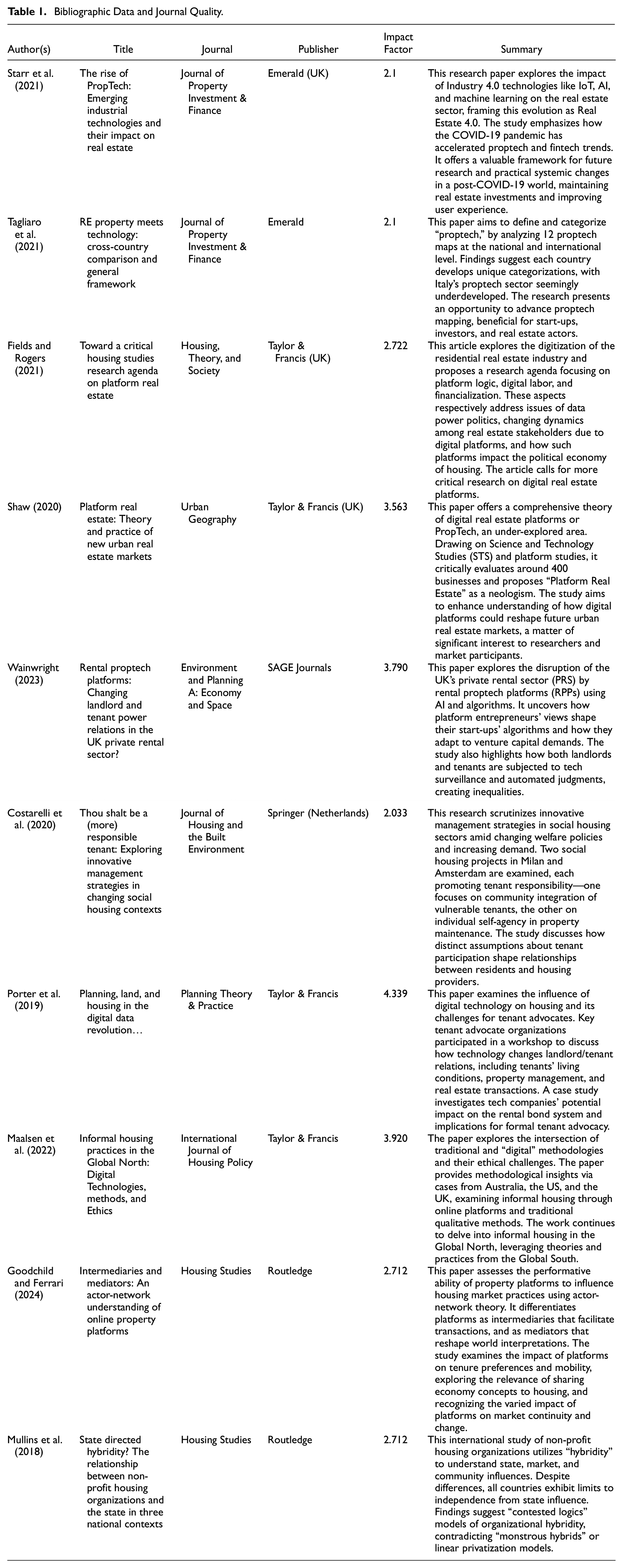
From the initial yield of 17,400 search results, we initiated a multi-tiered screening process. Duplicate entries were first expunged, followed by title and abstract examination. After applying the publication year and geographical focus filters, we evaluated the articles based on the journal’s impact factor. Consequently, eight journals were singled out, and a final set of 10 articles was selected for analysis (refer to Table 1 for details). For enhanced transparency and to illustrate the search and selection procedure, the PRISMA flow diagram is included as Figure 1.
Bibliographic Data and Journal Quality.

PRISM flow chart of the process.
Data Analysis
The thematic analysis produced 10 articles. The process involved a sequential procedure of identification, analysis, and interpretation of patterns or themes within the body of data that allowed the generation of different themes and codes (Braun & Clarke, 2012; Terry et al., 2017). Adopting an inductive, data-driven methodology facilitated a nuanced distillation of themes from the primary codes, an approach grounded in the underpinnings of grounded theory. This bottom-up methodological framework, contrasted with a deductive, theory-driven approach, releases the analysis from preconceived categories, affording a grip of the data’s inherent complexity. This interpretative richness provided a capacious analytical vessel for the intricate phenomena under scrutiny, capturing the dynamism of the innovation landscape in housing management in Scotland.
First, the dataset was analyzed to establish an index of the amalgamated findings. A code generation process was then initiated which systematically captured interesting features present within the dataset, and relevant to the research scope and its operating objectives (Clarke et al., 2015). Once the codification process was completed, a thematic induction was initiated. The codes generated initially acted as building blocks for the final themes since these possessed similar features and exhibited similar patterns. This step in the procedure was based on the identification and recognition of similar core concepts or ideas that governed multiple different sets of codes (Braun & Clarke, 2012). This eventually led to the generation of key themes that reflected the state of innovation in housing management practices in Scotland. This technique enabled a framework to be established through which the created dataset could be analyzed, organized, and systematically reported (Alhojailan & Ibrahim, 2012).
Ethical Considerations
This research is based on secondary data analysis, so no IRB approval was required (Jol & Stommel, 2016).
Results
This section reports on the themes extracted from the analysis. Table 1 shows the bibliographical data of the extracted articles.
Initial Codes
The first step of the thematic analysis was based on a codification process. Fourteen (14) codes were generated which pertained to the different types of innovative digital technologies being used for different functions in housing management. Some codes also pertained to the direct impact of these PropTech technologies and innovations on societal well-being and quality of life. Of note were the general discussions about the concept of generalized real estate management across the selected publications. This concept was either discussed at length or briefly in 8 of the 10 publications. The initial codes generated from the analysis are presented in Table 2.
Initial Codes Developed in the Thematic Analysis.

Generated codes were then grouped into overarching themes. The analysis generated three basic themes, which succinctly addressed the central research question about the current state of innovation in housing management practices in the UK and Scotland. The themes also elaborated on the different types and categories of innovations in housing management and the impact of these innovations on society.
Final Themes
Three overarching themes were generated from the 14 identified codes using a bottom-up approach that endeavored to go beyond the expressed findings in each publication. The most prominent theme revolved around how different PropTech applications were strategically targeted toward specific housing management functions. This theme inferred certain basic functions of housing management involving property management, rent negotiations, and consultation were already being undertaken by PropTech companies in the UK albeit the technology was still within the early financing stages (Siniak et al., 2020). Nevertheless, the data were able to confirm the benefits of PropTech technologies to UK housing management. This was deduced from the various modes of services provided through digital platforms and mobile-based applications.
More specifically, these tools functioned as fillips to the industry. PropTechs matched homes with clients, and drones provided virtual tours; patterns of urban inequalities were also more evident (Ferreri & Sanyal, 2021; Siniak et al., 2020). Ultimately, digital technologies and innovations were aimed at systematically creating convenience for tenants, housing managers, and property owners (Starr et al., 2021). Their introduction undoubtedly impacted the housing value chain in Scotland based upon a streamlining process. During this process, occupants and tenants of properties have an advanced and convenient channel to acquire housing management-related services. Similarly, a channel extended to proprietary stakeholders of the property allowed management of tenants’ demands and finding the best occupants for their properties (Tagliaro et al., 2021). Technological innovations have created various types of operational and data platforms that have transformed the conventional procedures through which housing management practices were effectuated.
The third most prominent theme revolved around the impact of these technological innovations on the social and societal dimensions of housing management. Many of the publications highlighted how these technologies potentially enabled the housing management sector in Scotland and UK generally to address certain systemic issues and problems within the society. The analysis suggested innovative digital technologies in housing management provided opportunities for a more integrated society in the UK and Scotland unfettered from racial and socioeconomic segregation (Costarelli et al., 2020).
Table 3 is a table of the initial codes set in three representative themes. These themes will be elaborated upon in the Discussion.
Overarching Themes Generated Through Initial Codes.

Discussion
Theme 1: Categories of Housing Management Functions Utilizing PropTech
The most popular theme from the analysis revolved around categorizing different PropTechs used for other housing management functions. Five broad parts were identified from emerging PropTech innovations in Scotland. The clustering of PropTech ventures in the UK, particularly around brokerage, sales, and letting, echoes the findings of Porter et al. (2019). Scotland showcases the trend of PropTech enterprises offering brokerage services veiled as real estate agent services, reflective of local regulations and specificities. Tagliaro et al. (2021) contributed further to our understanding of PropTech’s taxonomy, asserting that PropTech’s domain sprawls across Fintech for real estate, shared economy-based models, and intelligent real estate modalities. Each of these threads together the tapestry of real estate asset management, operational optimization, utilization maximization, and the facilitation of ownership trading. Tagliaro et al.’s (2021) cross-country comparison establishes a broad PropTech taxonomy but may overlook unique regulatory environments shaping adoption. A granular analysis of PropTech typologies within specific country contexts would be valuable.
Shaw (2020) also provided a unique framework for the typology of PropTech technologies and the ways they changed housing management practices. He noted that PropTech and other digital technologies within the housing management sector performed four essential functions, which allowed the further enhancement of the real estate value chains. These were automation, brokerage, digitization, and management. The automation function was evident in operational digital platforms. Here, technology was utilized to complete tasks and make transactions concerning different housing management sectors (Maududy & Gamal, 2019). While helpful for categorization, Shaw’s (2020) framework for classifying PropTech functionalities remains hypothetical without empirical examples demonstrating these automation, brokerage, digitization, and management roles in real-world platforms. Ethnographic research observing PropTech systems in operation could enrich and validate the proposed taxonomy. Brokerage functions establish a liaison between buyers, sellers, and renters of housing and property. A technological interface facilitates direct communication between the two parties and eliminates intermediaries and middle agents. The function of digitization revolved around transforming conventional goods and services into data-based services that can be shared at much more economical costs (Baum, 2017). Management functions revolved around the technology-aided organization and monitoring of tenants and occupants. This conceptualization, provided by Shaw (2020), coincided with the typology designed by Tagliaro et al. (2021), as the concept of “smart real estate” depends on the automation of housing management processes. While the brokerage functions effectively fall within the Fintech real estate category, they technologically enabled the financial transactional processes involved in house management, such as rent collection, leasing, buying, and selling.
Digitization fits into the class of product and service provision. At the same time, the generalized management processes revolve around the allocation and organization of housing and tenants as a part of information management systems. Moreover, it can be readily established that PropTech-based innovations interact with housing and real estate management processes. These are streamlined through task completion, modification of responsibilities, establishing mediation interfaces between property owners and tenants, aiding the transformation of physical goods into data-based services, and the sorting and organization of tenants and occupants (Shaw, 2020). This suggested that the housing management sector within the UK in general and Scotland might be headed toward a large-scale transformation through PropTechs. These innovations can be convenient for all key stakeholders and further enhance the value chain. Generally, technological modalities allow critical stakeholders within the housing sector to connect directly, facilitating an interactive value exchange (Tagliaro et al., 2021; Table 4).
Typology of PropTech Innovations against Housing Management Functions.

Source. Tagliaro et al. (2020).
Theme 2: Digital Platforms and Technologies for Housing Management
The second significant theme specifically focused on the different types and modes of digital platforms and technologies currently used for housing and real estate management. In tracing the historical arc of digital technology’s integration in real estate, we acknowledge Fields and Rogers (2021) as they assert that such a marriage of the digital and real estate realms is not an emergent phenomenon. Its roots trace back to the early 2000s (Baum, 2017), with the growing visibility spurred on by ICTs, cloud computing, and big data analytics advancements. The consequent escalation of venture capital investments has further solidified technology’s imprint on the industry. This was accompanied by a global increase in venture capital investments alongside technology applications in the real estate and housing management sector. These digital technologies have evolved from narrow services such as property listing to broader housing management functions such as property management, rental management, sales and valuation, insurance services, and construction management (Fields, 2017).
Technological advances have also had a tremendous impact on tenancy management practices. Research by prominent housing studies scholars such as Koh et al. (2016) and Shaw (2020) on digital technologies in real estate and housing management has highlighted a slowly shifting focus of this sector from the capitalist dynamics. Fields and Rogers’ (2021) framework of trading, operational, and data platforms provides a helpful categorization of real estate technologies. However, their analysis relies substantially on conceptual arguments rather than empirical evidence. Surveys and interviews with platform users could substantiate how these models play out in practice. Examining specific platforms ethnographically could also reveal nuances missed in their broad discussion.
Broadly, digital platforms in housing management bifurcate into three categories, according to Fields and Rogers (2021): trading platforms, operational platforms, and data platforms. The critical digital innovation-based platforms operating within this management space were mainly based on trading platforms. Trading platforms, such as “S1 Homes,”“LoopNet,”“Skyecottage,” and “Flambard Williams,” facilitate the process of buying, selling, and renting property, allowing interaction between geographically distant parties (Fourcade & Healy, 2016). More specifically, these websites enabled property owners, managers, brokers, and customers to list and search for properties, submit different offers and bids, and provide channels for negotiating and navigating offers (Fourcade & Healy, 2016). Furthermore, these platforms enabled property owners and managers to strategically enlist their properties for investment opportunities and establish investment criteria based on rents and yields. Moreover, specialized tools for these purposes enabled property owners to optimize the valuation of their property. Specifically designed operational platforms also facilitated and effectuated basic processes involved within rental property management through automation and outsourcing-based functions (Fields & Rogers, 2021).
Innovative platforms facilitated key housing management processes revolving around renting, rent allocation, marketing, and leasing, albeit in a geographically different location from the actual property. These operational platforms established a technological interface between owners, vendors, and tenants and regarded secondary processes in housing management, such as general maintenance and evictions (Kenney & Zysman, 2016). For instance, RentBerry, an international platform, simplifies processes like tenant screening and rent collection, creating an efficient interface between owners, vendors, and tenants. Current platforms allow homeowners to handle the exterior maintenance and renovations of properties. While Kenney and Zysman’s (2016) policy analysis offer thoughtful commentary on the rise of platform economies, their sweeping generalizations about impacts require validation. Their arguments would be strengthened by tracing platform evolution through case studies and longitudinal data analysis.
Comparing traditional industries transformed by platforms also clarifies the mechanisms and pace of change. Additionally, specialized digital platforms enable property owners to connect with other professional and legal service providers to outsource functions such as evictions (Wainwright, 2023). Wainwright’s (2023) case study of rental PropTech platforms in the UK provides an in-depth qualitative understanding of their impacts on tenant-landlord power dynamics. However, focusing on a single country obscures variations across contexts. Comparative cases from diverse housing system types would reveal more profound insights into how PropTech platforms influence relational power.
Aside from these trading and operational platforms, the other fundamental orientation of PropTech-based digital platforms was based on data platforms. These platforms were geared toward providing data solutions concerning the overall real estate infrastructure and system prevalent within a particular area. Strategically aimed toward providing data and information concerning a particular property market, these platforms employed technological modalities such as machine learning, artificial intelligence, and big data (Fields & Rogers, 2021). The Scottish platform “S1 Homes” provided trading and database services by establishing a connection between various groups of stakeholders within the national Scottish real estate database. These platforms also generated predictive analyses-based services for property values based upon different dimensions such as city, postal area code, and the overall scale of adjoining properties within the area. By establishing data accessibility for different investors, proprietors, landlords, and property owners and allowing them to undertake their housing management tasks more efficiently, these platforms provided critical market intelligence and insights. In turn, owners could estimate proportionate sales and rent prices (Langley & Leyshon, 2017). Real estate data are reported via governmental or municipal databases in many countries every quarter. This decades-old practice presents significantly less reliable data than that provided through consistent market coverage via digital real estate data platforms (Fields & Rogers, 2021).
Trading, operational, and database digital real estate platforms offer various essential housing and real estate management services to key stakeholders within the real estate market. Digitally innovative platforms have reoriented the conventional activities in the housing management sector. These platforms facilitate remote communication, interaction, and transactions by acting as an intermediate interface between the customers and the property owners.
Theme 3: Social Improvements Through Innovations in Housing Management
The third key theme generated from this analysis revolved around the impact of these innovations in housing management practices. Most publications mentioned the social implications and consequences of using PropTech technologies in housing management (Maalsen et al., 2022). At the same time, Maalsen et al.’s (2022) examination of digital technology ethics in informal housing unveils significant concerns, their broad scope bypasses granular analysis of specific tools. Ethnographic research centered on particular PropTech applications could unearth tangible ethical complexities for design and regulation. However, their insights remain helpful as they suggested that the concept of housing management was intrinsically intertwined with societal circumstances as social housing was a significant part of housing management, which further entwines the views of Ferreri and Sanyal (2021). The mention of social housing was perhaps due to the ability of housing management practices to impact market orientation, residualization, and changes within overall property demands (Robertson & Serpa, 2014). Housing managers also could influence overall conduct, regulations, and tenants within the society through the definition of conduct and Standardized Operating Procedures for “proper” societal behavior (Costarelli et al., 2020).
Moreover, consensus reverberates around the potential of digital technology and PropTech-based innovation to enhance societal integration and cohesion (Wainwright, 2023). A tangible manifestation of this is the catalytic role of technology in amplifying social solidarity and economic inclusion. It achieves this by optimizing housing availability and ameliorating living conditions, fostering a tangible metamorphosis of neighborhoods and localities (Ciaramella & Dall’Orso, 2021). This virtual restructuring imbues a sense of urban regeneration and cultivates nascent neighborhood dynamics, inducing a seismic shift in local interactions (Mullins et al., 2018). Exemplifying this, the “Neighbourly” platform aims to boost social connections within neighborhoods. It facilitates the sharing of local news, organizing events, and even the establishment of neighborhood watch groups, significantly improving the sense of community and safety within localities. It functions similar to which “Rentberry,” allows for transparent rental bidding, where potential tenants can view other offers, promoting a sense of fair competition and respect for the rental process.
The intermediating role of PropTech in housing management bears the potential to ameliorate societal conditions. By mediating how individuals perceive and interact with urban localities through digital platforms, PropTech paves the way for positive transformative shifts across neighborhoods. This phenomenon is manifested in enhanced social interactions at the grassroots level, which consequently nurture social cohesion and integration (Ciaramella & Dall’Orso, 2021). In turn, these activities effectuated a mediation of how people experienced different urban localities through these digital platforms. One positive outcome was the implementation of a widespread change throughout the neighborhood. Housing management practices through PropTech apps also led to an increase in social interactions at a local level, which in turn contributed toward increased cohesion and integration. However, Ciaramella and Dall’Orso’s (2021) theoretical discussion lacks empirical evidence across neighborhoods and cities to substantiate the proposed impacts. Mixed methods combining surveys, interviews, and spatial analysis could substantiate how PropTech restructures communities. Kauko (2019) observed that digital technologies also had great potential to improve societal security overall and protect neighborhoods against localized crimes and criminal uprisings.
Property owners can extensively screen and vet potential tenants while simultaneously enabling tenants to gather information about the neighborhoods, and their landlords. Costarelli et al. (2020) discussed this issue at length. They proposed it was pivotal for PropTech to positively influence these avenues of social integration and societal cohesion so technological innovations can be truly successful in housing management. However, their research centered on organizations in a single country (Netherlands) constrains wider applicability. Extending the analysis to social housing providers in diverse welfare regime types could reveal variation based on policy contexts. A comparative approach drawing on quantitative performance data and tenant survey feedback could also substantiate whether purported innovations like tenant responsibility translate to positive outcomes. While highlighting promising directions, this study requires replication across contexts along with mixed methods to evaluate real-world impacts.
Overall, the studies show that PropTech technologies have immense potential to restructure and realign the future of urban development. This necessitates that these digitally aided housing management practices should consider the inherent local specificities of social and economic conditions of a particular locality or neighborhood. The housing management sector has greater control over the prospect of community management practices prevalent in a particular society through digital innovations and platforms.
Limitations of Findings
Not unexpectedly, the findings possessed certain limitations. First, the analysis was based entirely upon secondary data; hence the scope and context of these findings are constrained within the criteria set for data collection. Then, while the findings might be influenced by the biases of the original authors, it also allowed the illation of additional concepts when synthesized collectively. The size of the final dataset was limited to 10 publications; however, the notion was to focus on information power or the quality of the samples (Malterud et al., 2016). Thus, the use of impact factor and peer-reviewed status was crucial in adjudging the quality of the publication. Then, in addition to the limited number of articles, the qualitative design delimited the findings from being broadly generalized. Time and financial constraints were also limitations.
The policy implications derived from this exploration are manifold. PropTech innovations, by democratizing access to housing and fostering societal cohesion, may inform legislative decisions to foster a more equitable housing landscape. Policymakers may consider incorporating these digital strides in housing management practices, enabling tailored housing solutions that are responsive to local socio-economic specificities. Additionally, with the digitalization of the sector, governments could advocate for a more stringent regulatory framework to safeguard stakeholders from potential cybersecurity threats. Consequently, this study underscores the imperative for coherent policy interventions that appreciate the transformative potential of PropTech in sculpting the future of housing management.
Policy Recommendations
The findings suggest several policy priorities. Firstly, updated regulations must ensure digitally mediated rental and sales markets enable fair housing access, preventing algorithmic discrimination or redlining (Ferreri & Sanyal, 2021). Open data standards enabling scrutiny of PropTech systems could boost accountability. Secondly, investments in digital literacy initiatives and public digital infrastructure are imperative to prevent marginalization of non-tech-savvy groups (Boland et al., 2022). Thirdly, stronger data protection measures must safeguard tenant privacy amidst expanding data collection and analysis by platforms (Gangneux & Joss, 2022). Finally, urban planners should proactively partner with PropTech companies and housing providers to foster responsible innovation aligned with communities’ needs (Colomb & Tomaney, 2021). Balanced policies that harness technologies for equity while mitigating risks are vital for digitally augmented housing systems.
Suggestions for Future Research
This review has identified several critical gaps in the literature that warrant further investigation. Firstly, while existing studies highlight the catalytic effect of crises in driving digital transformation in housing systems, more research is needed to understand the long-term attitudinal and expectation changes amongst both housing providers and users. Quantitative surveys immediately following a crisis and at intervals thereafter could reveal how willingness to adopt new technologies shifts over time. Qualitative interviews may unpack how crises challenge assumptions and alter mindsets around the role of digitization in housing services.
Secondly, the implications of emerging digital informalisation practices enabled by housing platforms and algorithms remain under-analyzed, especially outside of Global North contexts. Comparative case studies of platform-mediated rental markets in cities of the Global South versus North could highlight divergent outcomes based on contextual factors. Critical discourse analysis of rental platforms could also unpack how algorithmic tools potentially reproduce inequalities. Integrating tenant experiences would reveal embodied consequences.
Finally, links between housing technologies and community social capital require investigation. Longitudinal ethnographic research could unpack how community ties strengthen or weaken as digital management and engagement tools become normalized over time. Surveys and interviews may determine whether digitally enabled social features on platforms increase neighborliness or reduce in-person interactions. Overall, adopting mixed methods approaches grounded in people’s lived experiences can substantiate abstract debates on how technologies reshape rental markets, community relations, and the role of crises. Human-centered research must orient future inquiries to realize equitable digitization.
Footnotes
Declaration of Conflicting Interests
The author(s) declared no potential conflicts of interest with respect to the research, authorship, and/or publication of this article.
Funding
The author(s) received no financial support for the research, authorship, and/or publication of this article.
