




Abstract
Understanding the teacher’s technology adoption process is essential to comprehend and narrow the digital divide in the post-epidemic age. During the pandemic, the stay-at-home orders not only intervened schooling and teaching but also increased digital accessibility to teachers. This research studies teacher heterogeneity and adoption controls in the epidemic to simultaneously affect teacher’s underlying intention and adoption behavior based on a dynamic framework under the theory of planned behavior. We present a quantitative framework for modeling the teachers’ adoption behavior of a technology conditioned on intention, defined as latent dynamic processes via a hidden Markov model. This model allows us to examine the effects of three concerned adoption controls: epidemic, community, and experience. We also explicitly characterized teachers’ digital traits as the estimated results accounts for teacher’s heterogeneity. The implicit quality of digital teaching artifacts is examined to correlate the dynamic analyses with the qualitative supports. We collected data from four primary schools in Shanghai over 173 weeks, using an after-school activity management system. The data collection spanned periods both before and after the school closure caused by the epidemic, providing us with a dynamic view of technology adoption patterns under different circumstances. Our results suggest that the interventions derived from the controls of the epidemic did not significantly narrow the digital gap. In particular, well-prepared teachers may be more sensitive to adjusting their usage to meet the evolving standards. The inexperienced teacher struggles to maintain a high level of adoption once the passive external pressure is eliminated. Even the compulsory policy can temporarily change their adoption behavior. These implications highlight the second-order digital divide problem.
Keywords
Introduction
The unprecedented global COVID-19 pandemic in 2020 caused institute closures, home quarantine, and social distancing, affecting many people’s lives in a variety of areas. The epidemic also severely disrupted the regular flow of teaching and learning. Most countries suspended face-to-face classes, and majority of learning activities transitioned to online classrooms. As an emergency substitute, the school administrators and teachers may establish essential motivation and exert greater effort into incorporating online technologies in their work (Xue, 2020). Meanwhile, remote teaching and learning pose significant challenges to the present educational system, such as teacher’s anxiety (Talidong & Toquero, 2020), teacher’s low digital competence (Guangul et al., 2020), the absence of sufficient external technology training (Papadakis et al., 2022), and the digital divide through the use of technology (Azubuike et al., 2021). The phrase “digital divide” did no emerge until recently to describe the unequal access and utilization of new media (Gunkel, 2003). Technology usage was conceptualized as the second order digital divide due to the limitation of instructional equipment access in the developed areas (Van Dijk, 2017). This concept became a fundamental perspective for understanding and measuring the digital divide (Lebeničnik & Istenič Starčič, 2020). Therefore, analyzing teachers’ technology adoption process is essential to understand and narrow the digital divide in the post-epidemic age. Technology adoption refers to the process by which an individual or an organization begins to utilize a new product or innovation. Teacher’s technology adoption is an antecedent of using technology on education.
The antecedent perceptions of adoption intention in technology adoption have been extensively studied using self-reported instruments, such as attitudes toward technology (Tondeur et al., 2018), perceived utility (Al-Maroof et al., 2023), and perceived social influence (Mehta et al., 2019). However, research shows that intention does not necessarily translate to actual behavior because it would not be the sole factor in the absence of extrinsic influence (Norberg et al., 2007). Notably, sufficient digital access allows teachers to use specific technologies more extensively (Burke et al., 2018). This was particularly evident during the COVID-19 pandemic when teachers were obligated to implement online teaching systems, irrespective of the strength of their adoption intention. To address this issue, the “behavioral control” component introduced by the theory of planned behavior (TPB) (Ajzen, 1991) can be used to explain the mechanism.
During the pandemic, stay-at-home orders not only intervened in education and teaching but also increased teacher’s digital accessibility. This study aims to deepen the understanding of teacher’s technology adoption dynamics during the COVID-19 pandemic. Herein, the TPB’s framework is implemented to model teachers’ cross-sectional technology adoption during the pandemic. We assume that the teacher’s choice of using technology at a specific time is determined by the extrinsic behavioral controls and cross-individual heterogeneity. Prior survey-based studies focused on the difference in technology adoption-related digital divide from the perspective of teachers’ digital literacy (Quaicoe & Pata, 2020) and digital competencies (Ertl et al., 2020) from a static viewpoint. However, personal intentions may vary with the changes in control intervention and digital accessibility, influencing the adoption decision. Rogers (2003) claimed that process dimension measurement should be recognized in technology adoption to investigate how determinants influence the sequence of a set of events over time beyond a cross-sectional analysis from a one-shot survey. Accordingly, we further built the model on a dynamic assumption, which refers to the relationship between constructs that can change over time. We account for the intention-behavior dependence in the TPB framework with a dynamic nature. Such definition can enable us to not only investigate the heterogeneous influence of adoption controls but also account for the cross-individual heterogeneity. We use the hidden Markov model (HMM) to simulate the dynamics of teacher’s technology adoption in the epidemics. TPB is a psychological theory for explaining and predicting behavior, while HMM is a statistical model used to characterize the properties of time-series data. In this context, we use the TPB to identify key factors influencing teachers’ technology adoption behavior and then use HMM to model the dynamic effects of these factors over time. This is because the influential factors may undergo significant evolution during the pandemic. The utilization of HMM allows us to better understand and predict these dynamic changes. To address the limitation of homogenous HMM, we introduce the extra dependencies between the latent and the observation process to relax this assumption of conditional independence. Such a modeling approach can substantially increase the flexibility to capture the effects of technology adoption’s exogenous factors (Netzer et al., 2008).
Research Design
Modeling Teacher’s Technology Adoption as a Dynamic Planned Behavior
From a theoretical perspective, teacher’s technology adoption is viewed as the ability to exert internal intention to engage in technology implementation in a teaching context. The key determinant is adopting intention, which is influenced by the teacher’s attitudes and beliefs derived from subjective evaluations. For instance, if a teacher evaluates a suggested adoption as positive and believes that significant others (e.g., school leaders or colleagues) want the teacher to perform the adoption, then the behavioral intention will be more significant, and they would be more likely to achieve the adoption. However, these interpretations are inadequate to explain the exogenous effects. Some effects may stem from the obstacles attributing to the unequal availability across users. The limited access to technology and little support from community might hinder technology adoption. Meanwhile, some effects may be posed by external interventions, such as compulsory remote teaching caused by the epidemic. In this situation, behavioral intention is not the only determinant of final adoption where adoption controls should be considered. Such links between beliefs to behavior, including attitudes, intention, and controls, can be modeled as TPB, where the final decision is determined not only by the intrinsic beliefs but also by the extrinsic behavioral controls. The behavioral control refers to the presence of certain factors that may moderate intention on behavior and directly affect the actual behavior (Ajzen, 1991).
According to TPB, we presume that the adoption controls indirectly affect the teacher’s final decision through intention and directly affect actual adoption. Based on the literature, technology adoption is a dynamic process instead of an event. Moreover, external controls, especially negative ones, may have a long-term effect as a result of the growing knowledge and understanding gap associated with technology (Dewan & Riggins, 2005). However, TPB illustrates a static psychological model that arises from linear decision-making at a specific time and does not consider that it can change over time (Ajzen, 2020). Furthermore, TPB disregards the cross-individual heterogeneity caused by the degree of digital accessibility, which is regarded as the strongest concern in second-order digital barriers for teachers (Burke et al., 2018). Thus, we model teachers’ technology adoption as a dynamical planned behavior process to address these issues.
We use HMM to model the adoption as two stochastic processes: a process of observed usage and a latent process of the teacher’s intention states. Figure 1 illustrates how a teacher transits between intention states under various adoption controls and how their actual usage depends on the intention states. In our HMM, the space of a latent state is spanned by an intention indicator calculated by the underlying evaluation of the risks and benefits of the outcome. Each state corresponds to a particular propensity level of technology adoption behavior. Such definition of an intention state with unique adoption behavior allows us to capture dynamics in technology adoption behavior.
(1) A teacher resides in one of the states for any given period. Each state captures the time-dependent strength of intention to employ technology. Specifically, a set of intention states
(2) The teacher could switch to any state in nature of the Markovian chain from time t−1 to t, which can account for the dependence of usage on the pre-existing intention and teacher’s propensity formed by internal (e.g., perceived accessibility or utility) and external factors (e.g., facilitate condition). The positive and adverse effects are allowed to be yielded in intention formation. This notion implies that a teacher can be aroused by the school-closure policy and frustrated by the additional restrictions.
(3) A teacher could perform varied usage based on the adoption controls (e.g., increased access due to epidemic) depending on the residing state in t. The observed usage could be regarded as a noisy signal of the hidden intention state process. For example, a teacher’s final behavior could be interfered with by the dormant context (e.g., non-work days), even if they have high strength of intention.
Figure 2 depicts our theoretical framework. This framework consists of two parts. In part one, the past observed adoption controls and unobserved heterogeneity determine the present intention state moderated by the previous states. In part two, the present intention state determines the adoption behavior moderated by the conditions from the present adoption controls. In this framework, we focus on three types of adoption controls. First, the trigger event is a crucial component due to the compulsory policies or special norms (Bayerl et al., 2016). Second, an established community not only provides greater access to technology but also exerts influence of peer pressure on teachers (Cullen, 2001; Straub, 2009). Third, the positive or negative valence of each anticipated outcome or experience may contribute to the adoption in return (Ajzen, 2020). Apart from the controls, the teacher’s heterogeneity is assessed to identify the unobserved effects of intrinsic characteristics, including digital literacy, attitudes, and beliefs. This task is crucial because the various types of technology use must be distinguished and measured to enable a precise and nuanced approach to the adoption behavior (Brandtzæg et al., 2011).

HMM of technology adoption.

Proposed theoretical framework.
We investigate two research questions in accordance with the framework: (1) To what extent do the behavioral controls dynamically affect teacher’s technology adoption in the epidemic period? (2) How do the effects of behavioral controls vary from the teacher’s digital participation?
Data Collection
We collected data from a case involving an after-school activity management system. This system has been in use for over six semesters (173 weeks) across grades 1 through five in four primary schools in Shanghai. The system consists of a teacher-specific, parent-specific, and student-specific mobile application. Teachers can digitally organize activities in the system to complete specific management tasks after school, including assigning homework, issuing notifications to parents, initializing discussions, discussing with parents or students, and evaluating students’ performance of their submissions. Moreover, teachers can observe other colleagues’ activities aside from the discussions with parents and students. The collected data include a complete teacher experience in the systems with the parents’ and students’ responses for 173 weeks, including the workweek before and after an epidemic crisis school-closure period in the epidemic outbreak. After the outbreak of the novel coronavirus, educational institutes in Shanghai were closed in the following semester. Consequently, teachers were strongly required to employ digital approaches to complete their teaching tasks during school closure. A detailed weekly timeline of the primary schools’ status in Shanghai is illustrated in Appendix A.
The system was introduced to 451 teachers in September 2018. Nevertheless, the teacher’s adoption of this system varies across individuals. Most teachers were inactive in the first two semesters and sporadically utilized the system before the school closure due to the pandemic. Only 84 (18.63%) teachers showed early engagement in the first three semesters before the epidemic. The difference remains apparent after the school reopened. We divide teachers into three groups according to their active weeks to distinguish the significant difference and compare the dynamics between teachers based on their digital participation. We label the top 25% of teachers as advanced users and the bottom 25% as laggards according to the typology of digital participation (Brandtzæg et al., 2011). Majority of the routine users come from the same school (77.23%), and most limited users are from another three schools (84.16%). This notion suggests that the institute standard varies with school in this case. We regard the school with the most advanced users as collectively adopted school, while another three schools are named as sporadically adopted schools.
In conjunction with the theoretical framework, the document and statistical analyses based on the system’s log entries were used to search and define the potential features that correspond to controls. Consequently, six features were selected. These factors include the changing norm of pandemic crisis, the compulsory delivery of remote teaching during the school closure period, the community size, the teacher’s use of the system, the teacher’s interactions with parents and students in the system, and working week status. Table 1 presents the descriptive statistics of the relevant data.
Descriptive Statistics of the Relevant Data.

Table 1 details the percentage of various school statuses throughout the research timeframe. Regular working weeks constituted 59.0% of this duration. A substantial 46.2% was characterized by the norms of the pandemic crisis. Importantly, the 9.2% of time marked by school closures required the implementation of compulsory remote teaching. Table 1 further highlights the variation in teacher’s digital engagement throughout three key phases of the epidemic. For all teachers, activities organized and interactions increased dramatically during the school closure, compared to before the epidemic. Interestingly, both advanced users and laggards exhibited similar trends during the epidemic. However, advanced users tended to have higher engagement levels both before and after the epidemic, while laggards showed lower levels of engagement. After the reopening of schools, the active participation levels diverged again, returning to the pre-epidemic pattern with advanced users being more active and laggards less so.
Measuring Quality of Digital Teaching Artifact
We further collected the additional data by inspecting the implicit quality score of digital teaching artifacts to triangulate the dynamic analysis results. The only observed behavioral measures could raise concerns that the dynamics represent merely differences in the likelihood of adoption decision rather than variations in quality reflected from teaching digital artifacts (Koehler et al., 2017; Netzer et al., 2008). In the field of information systems, the term “artifact” has been redefined to denote the product of creativity within the design process. In this study, “teaching digital artifacts” signifies the digital objects that teachers crafted for instructional activities and instruction-oriented interactions. We qualitatively measured teachers’ digitally crafting artifacts with rubric schemes of quality and conducted phase-by-phase statistical tests to explore the quality dimensions of teachers’ technological performance. This approach is consistent with the call for incorporating behavioral quantification with the quality evaluation of teaching outcomes (Gibbons, 2013; Koehler et al., 2017).
A quality assessment rubric was co-constructed to evaluate teachers’ artifacts in three areas: technology knowledge, social effectiveness, and task presentation (Appendix C). Technology knowledge is defined by assessing the technology selection flexibility and compatibility with task goals. This criterion rubric was adapted based on the TPACK (Technological Pedagogical Content Knowledge) artifact rubric (Koehler et al., 2017). We customized the principles of teaching social artifacts suggested by Viberg et al. (2020) to measure teachers’ achievement of social effectiveness, which is the primary aim of using this platform. From this point of view, social effectiveness is defined by creating venues for fostering digitally fluent communicating situations. Task presentation refers to the level of teacher’s creation of effective digital presentations for teaching tasks. We co-adapted this criterion rubric from the task completion rubric (Wong et al., 2015) and the TPACK artifact rubric (Koehler et al., 2017). The raters can score the quality of teacher artifacts ranging from low (1) to high (4) by using the rubric.
We did not perform activity-by-activity or interaction-by-interaction annotations but evaluated quality based on the snapshots of weekly usage. Before the evaluation, we concatenated teachers’ crafted content of activities that occurred during a week and the related interactions into one page. Accordingly, the researchers can give a single score to each teacher’s weekly artifact snapshot with respect to its holistic quality across the criteria. A total of 2,110 snapshots (25%) that contain at least one activity were selected by using stratified random sampling according to phases. Prior to the formal evaluation, we prepared 120 labeled artifact snapshots (10 per grade across the criteria) to train the raters and serve as reference examples during the evaluation process. The raters achieved a consensus on the grading of these reference examples through the training, ensuring consistency and reliability. The raters then graded all snapshots independently to establish inter-rater reliability, which was substantiated by a Cohen’s kappa value of 0.67, denoting a substantial level of reliability according to Cohen’s (1960) guidelines. Differences were resolved through discussion.
Model Development
Transition Probabilities of Intention States
A teacher can switch among the possible states in S. We model the transition between intention states as a Markov chain process. Then, the state transition matrix is defined as follows:

where

where

where
State-Dependent Adoption Choice
Given the teacher’s intention state, the teacher’s choices are assumed to be conditionally independent. We adopt the binary logit model to model the probability of a dichotomous choice of technology adoption:

where
Estimation
As described in model development, our goal is to estimate state transition matrix coefficients
Variables
Our dependent variable is the technology-adoption behavior, which is captured by the incidence of adoption-choice (zero or one) at a specific period. We assume the teacher’s weekly actions that can contribute to teaching or class management as a measure of technology adoption. Thus, we consider the choice of whether a teacher completes at least one teaching activity they are deeply involved in as the adoption behavior.
According to the model-free analysis, the teacher’s usage shift might be determined by the contexts, including the compulsory norm of remote teaching during School-closure, the growing opportunities of utilizing technology derived from the Epidemic, and the status of Workweek. Accordingly, we incorporate the corresponding variables into
According to prior literature, a teacher may gain utility from the accumulative knowledge in the school community and pressure from their colleagues who have adopted the technology. We control such effects by incorporating the accumulated collective usage of the Community into

where
If a teacher has the experience of accessing the system in the past, then they may be more likely to return to the platform and have more opportunities to continue their usage because the original purpose of the system is to help the teacher with instructions and communications after school. We consider two different aspects of the experience: Activities organized and Reply received. Activities organized represents the digital tasks initialized by the teachers. Meanwhile, Reply received describes the teacher’s interactions with students and parents. A time-discounted cumulative experience function suggested by Singh et al. (2011) is employed to model the experience:

where
Estimation Process
We estimated the model by using an MCMC Bayesian estimation with a Python library, PyMC3 (Salvatier et al., 2016). We run the Bayesian estimation for 20,000 iterations over six chains by using MCMC. The first 10,000 iterations were used for the burn-in period and the last 10,000 iterations for estimating the parameters. Furthermore, we perform the Gelman and Rubin (1992) diagnostic test across multiple parallel chains to assess convergence. We also exclude the first two semesters of three schools (where almost all teachers were dormant) and focus on analyzing the rest semesters. We randomly selected successive 30 weeks’ observations from 161 teachers (40.0%) to validate the estimation, containing all existing school status, including closure, reopening during the epidemic, workweek, and vacation week.
The first stage is to identify the values of discounted factors in the decaying variables. The optimal values of discounted factors are determined by comparing the log-likelihoods of models for different values. Then, we choose the values (
The second stage in estimation is the selection of the number of hidden states. We choose an optimal number of hidden states by minimizing the widely available information criterion and Pareto-smoothed importance sampling leave-one-out as the primary fit metrics for model selection. Finally, a three-state model was selected as the best-fitting model. A detailed report of the model selection is provided in Appendix B.
Result
Tables 2 and 3 illustrate the estimated parameters of the three-state model. We refer to the ordered states as Low, Medium, and High to characterize the levels of intention. Coefficients
Estimation Results of the Heterogeneity Parameter.

Estimation Results.

*p < .1, **p < .05, ***p < .01.
Heterogeneity Estimates
We first examine parameter
Control Effect Estimates
The variation in coefficient
A similar pattern is observed for Community size, which could influence individual teachers through the collective adopting decisions. The coefficients indicate that teachers in all states could benefit from the easy community access. Furthermore, the marginal effect of the social influence decreases as a teacher transfers to a more motivated state. Initializing activities in the past weeks strengthens the intention and raises a teacher from state Low and Medium to High. The effect of Activity organized decreases to negative for teachers in state High. We could interpret these results as perceived frustration caused by the recent intensive effort after teachers stay in state High. Meanwhile, recent communication with students and parents has almost no effect on teacher’s adoption intention, whereas a teacher could be more sensitive to the online interactions with other participants if they is in state Medium and High. These results highlight the effectiveness of the audience’s responses from a virtual teaching space to strengthen adoption intention, especially for teachers in High states.
We now turn to parameter
With regard to pressure from the community, the coefficients are all positive and significant in the three states. This finding implies that a teacher could be affected by the colleagues who have adopted technology to make the same decision. In terms of the controls from personal experience, the highly significant and positive coefficients of Activity organized and Reply received show that the cumulated experience and recent actions lead to the usage in the current week.
Transition Matrices
We calculate probabilities in the transition of technology adoption’s intention for teachers with different digital participation by incorporating
Mean Posterior Transition Matrices Under No Controls.

Note. All numbers are transition probability.
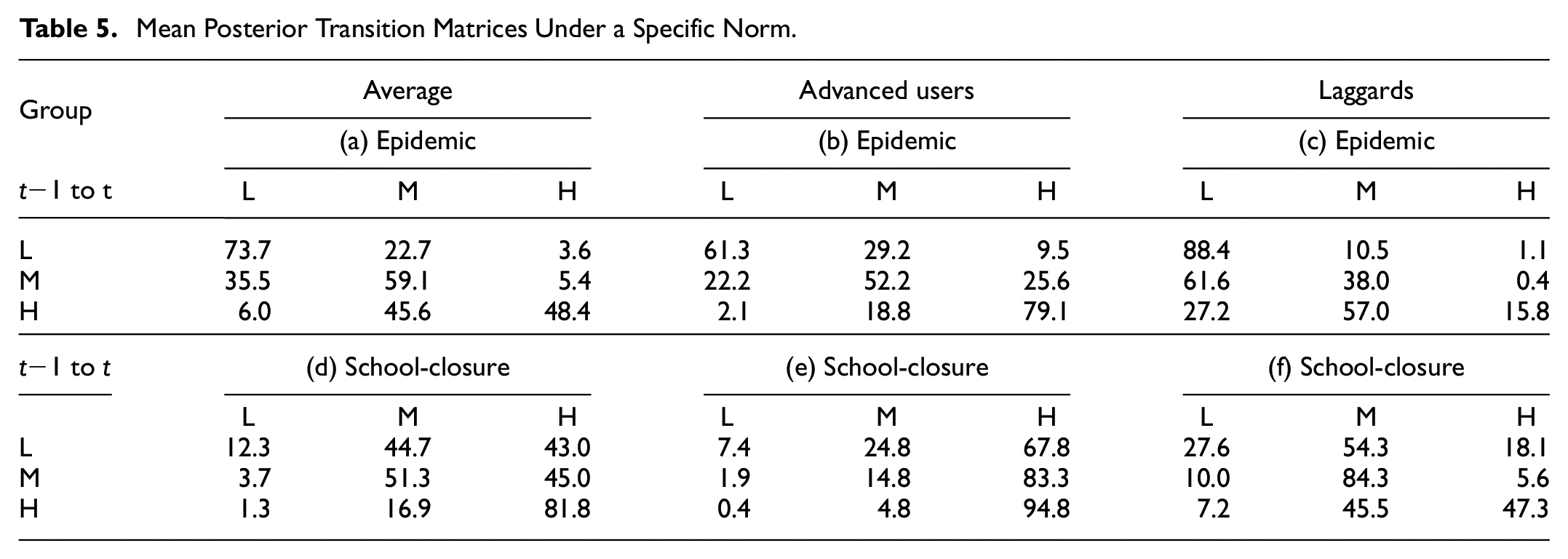
We calculate the transitions when a particular norm variable is triggered (Epidemic and School-closure), or a variable increases by one standardized unit in a mean level (0.51 for Community pressure, 0.37 for Activity organized, and 0.52 for Reply received) to quantify the marginal effect of each adoption control on intention transition probability while setting other control’s effects to zero. Matrices (a)–(f) in Table 5 show the transition probabilities caused by a special norm for teachers with digital participation. Table 5(b)–(e) demonstrates that the policy of school-closure strongly affects switching most teachers away from the unmotivated levels to a higher intention level, especially the advanced users. In addition, issuing such a compulsory norm substantially increases the probability of activating a laggard from a dormant state to a moderate state and substantially increases the probability of retention in the state Medium. Conversely, a slight increase in migration of intention can be observed in the Epidemic only effect (Table 5(a)–(c)). This notion implies that a teacher who is not an advanced user might be less likely to be promoted by the norm caused by only epidemic even if he had a significant change during the school-closure period.
Mean Posterior Transition Matrices Under a Specific Norm.
We then focus on the transition matrices affected by the community size in Table 6(a)–(c). The community is highly relevant to the promotions of the school leadership. For instance, teachers might obtain more opportunities to access the digital tools or accumulate experience if the school organized seminars or workshops on specific education technologies. Table 6(a) shows that one unity of additional Community size increases the transition probability from a low state to a higher one and helps teacher persist in an adopted state. Nevertheless, advanced users can benefit much more from the growth of community than laggards.
Mean Posterior Transition Matrices Under a Specific Control.

Based on the experience of organizing online activities, we can observe the increase of activating probability for dormant teachers but a relatively weaker effect on the high states (Table 6(d)–(f)). Meanwhile, the experience of communicating with participants is more likely to keep a motivated teacher staying in higher states rather than activate the dormant teachers, as shown in Table 6(g)–(i). This notion implies that teachers might perceive more utility from communication, which is more advanced utilization than simple publishing of the activity content in this platform. Similar patterns can be drawn from comparisons between advanced users and laggards. Advanced users would increase their commitment to technology use if they had the same level of experience.
Short- and Long-Term Effects of Controls
We numerically compute each control’s immediate and enduring effect through counterfactual simulations to assess the marginal and integrative effect of adoption controls. Accordingly, we calculate the result for each control by using a one-time effect in the first week and trace the simulated changes in the next 10 weeks. The simulated percentage change of adoption probability in the first week captures the short-term effect that is directly affected by the control in
Short- and Long-Term Effects of Teacher’s Technology Adoption Controls.

Note. all numbers are growth rate of adoption probability.
School-closure has the most substantial short- (624.4%) and long-term (216.9%) effects. Apart from the epidemic effects, Community size could increase 175.8% of the adoption percentage in the first week and 21.3% in the following weeks. This notion indicates that the magnitude of long-term effect derived from the community is more prominent than those of other controls. As the “sticky” of lower states in stationary distribution (73.0%, 23.3%, and 3.7% for three states) on teacher’s average, teacher’s experience can lead to a relatively limited increase (8.4% and 5.4%). This finding shows that recent individual experience may be difficult to affect the subsequent adoptions when a teacher still had low intention.
According to Table 7(b)–(c), we can quickly identify the different patterns of percentage increase between the advanced user and laggards. The advanced user can gain a more extended magnitude in long-term parts than the laggards due to the lower thresholds. By contrast, the more remarkable lifts in short-term parts of the limited users suggest that they might be easily activated. Nonetheless, the effect of this activation is short. These results further indicate that a teacher with a positive intrinsic propensity can easily improve their adoption to the changed context. Otherwise, a teacher with insufficient propensity in utilizing technology is less likely to retain the adoption when the persistent intervention from special norms disappears.
Analysis of Digital Teaching Artifact Quality
We performed one-way repeated measures ANOVA tests on the quality score to investigate the changes in teachers’ usage across the epidemic phases. We also performed multiple pairwise comparisons to investigate the pairs with significantly different phases. The analysis results are presented in Table 8. The tests revealed a significant increase in artifact quality after the epidemic broke
One-Way Repeated Measures ANOVA Tests on Quality Score Statistics.

Note. Score ranges from one to four.
p < .05, **p < .01, *** p < .001.
Unraveling the Dynamics of Teacher’s Technology Adoption Amid the Pandemic
The primary objective of this research is to enhance understanding of the dynamics behind a teacher’s technology adoption during the COVID-19 pandemic. As the pandemic triggered widespread stay-at-home orders, schools were disrupted but it also led to an increase in digital accessibility for teachers. We developed a quantitative framework for modeling the teachers’ adoption as a planned behavior structure via an HMM to examine these impacts on teachers’ adoption change in a dynamic nature. The results of this model provide a detailed account of the observed behavioral controls and varying teacher characteristics, providing key insights into these dynamics. We further conducted the inspection of implicit quality of digital teaching artifacts. The artifact analyses gave qualitative support to the dynamics captured from the observed adoption behavior.
The analysis results derived from our model provide a quantitative measure of the impact of epidemic controls, personal experiences, and collective norms on the dynamic process of teachers’ technology adoption. This is a step beyond previous studies which primarily focused on establishing correlations or differences between variables, presenting motivations within a linear framework from a static perspective (Ajzen, 2020). Consequently, our proposed model provides a substantial enrichment to these traditional methodologies, offering a more comprehensive understanding of the dynamics involved in technology adoption. It provides school leaders with a measurable lens to make decisions that have long-term impacts. Future studies could utilize dynamic programming algorithms to optimize the implementation of intervention strategies designed to enhance teachers’ technology adoption. Moreover, this framework allows us to quantitatively disentangle the cross-individual heterogeneity caused by varying degrees of digital accessibility from the effects on adoption controls. This disentanglement is crucial for interpreting the diverse manifestations of technology adoption among teachers with differing digital literacies during the pandemic (Burke et al., 2018). In the light of this, future research can utilize our model could assist school leaders in formulating more adaptive training plans. By appreciating and addressing this heterogeneity, teachers can be better prepared to meet the demands of digital competence beyond the pandemic era. Importantly, our model is flexible, making it potentially applicable across diverse cultures, countries, and grade levels, enabling a broad-scale understanding of technology adoption dynamics.
Behavioral Control Variations Amid Epidemic by Digital Participation
This study also sought to explain variations in behavioral control effects. Our results suggest that the interventions derived from the controls of the epidemic did not significantly narrow the digital gap. The estimates and quality measures indicate that the epidemic effect varies among individuals. The presence of an epidemic can drive the teacher’s adoption intention to a higher level. This observation is consistent with the claim that adoption shifts could be triggered by a massive incident that affected the interpretation of the technology and rationales (Bayerl et al., 2016; Dhawan, 2020; Lavidas et al., 2022). Our results further reveal that a well-prepared teacher may be more sensitive to adjust their usage to meet the emerging norms. This observation consists of the recent findings that digitally literate people may have a greater propensity to shift to remote working approaches in response to epidemics (Saka et al., 2021). However, the teachers who have limited participations before the epidemic are hardly to benefit from the increased digital accessibility during the epidemic due to their weak propensity. A possible explanation is that these teachers might struggle with using technology independently and confidently as they have to increasingly relied upon technologies because of a lack of technology readiness, which refers to the enduring propensity to embrace new technology (Badri et al., 2014).
With regard to the epidemic interruptions in teaching, our results reveal that compulsory remote teaching can temporarily change laggards’ adoption. By contrast, the teacher cannot retain a high level of intention once the passive external pressure is removed. A possible explanation is that the lack of intrinsic beliefs and direct support could restrain the strength of the teacher’s intention. Furthermore, the epidemics might further narrow the communication channels for the entrants to learn from the early adopter’s experience in class or capture the actual feedback. Such implications illustrate the “second-order digital divide” problem, which indicates a disparity in the development of digital literacy and digital capabilities (Lebeničnik & Istenič Starčič, 2020). This issue arises when teachers lack the necessary support and intrinsic motivation to adopt new technologies. This becomes particularly acute during epidemic interruptions where they may have to rely on remote teaching but lack opportunities for peer learning and feedback, as the crisis might limit communication channels. This divide might worsen, especially since remote teaching and class management have become more commonplace post-epidemic (Azubuike et al., 2021; Mathrani et al., 2022). Our findings suggest that the influence of the epidemic on teaching practices, especially among technology laggards, may contribute to widening this divide. One of the adoption aims is to encourage teachers to more efficiently use technology to improve instructional and communication effectiveness in distance teaching rather than confining themselves to more straightforward utilization, which typically requires a higher level of technological understanding and skill. However, these findings are consistent with the claims that the means for the effective use of technology is more essential than the capability of accessing it (Gurstein, 2003).
According to our analysis, school leaders should consider fostering the adoption community. The digital gap can be bridged by providing information services to help teacher individuals learn and utilize the technologies to which they have access. The results show that teachers, on average, can benefit the most from the community except the compulsory policy. Most prior studies of technology adoption have found that social influence plays a vital role within the educational context. Majority of the advanced users come from the same school in our study. This notion implies that teachers within a routine-use institute culture shared a set of norms, values, and beliefs, which might impose a positive effect to guide the teacher’s adoption (Ertmer & Ottenbreit-Leftwich, 2010). Furthermore, the teachers in our study can observe the teaching activities of other involved colleagues. The teachers can gain the knowledge grounded in content-based examples by following the feedback from participants and the related digital materials, which could be most effective toward forming technology-integrated pedagogy (Hughes, 2005). Ertmer et al. (2012) suggested teachers must provide demonstrations that result in meaningful outcomes that may lead to changes in teachers’ pedagogical beliefs due to the perceptions of expected gains. In comparison with novice teachers, the limited users can benefit from peers when trapped in a dormant status. The entrants’ growing propensity could come from the caring and supportive environment provided by experienced peers. Hall and Hord (2014) referred to such support from the developed community as an “implementation bridge” to help teachers cross the leap between innovation and outcome with positive change.
Conclusion
In this study, we present a comprehensive analysis of the dynamics surrounding teachers’ technology adoption during the COVID-19 pandemic. In integrating the effects of behavioral controls and heterogeneity within a dynamic framework, we unravel the multifaceted interplay of personal experiences, epidemic controls, and collective norms in driving the evolution of teachers’ technology adoptions. The impacts of these factors are adjusted during the COVID-19 pandemic. Our findings highlight the necessity of targeted interventions to mitigate the digital divide among teachers, particularly focusing on those who had limited digital engagement before the pandemic. Moreover, we emphasize the crucial role of intrinsic motivation and institutional support in facilitating sustainable technology adoption. Overall, our work underscores the significance of understanding and addressing the nuanced dynamics of technology adoption among teachers, thereby informing effective policies to enhance digital literacy and teaching efficacy in an increasingly digital educational landscape.
We highlight some limitations of this study. First, our analysis disregards full volume longitudinal data of teaching artifact quality. Future studies can explore a comprehensive approach to evaluate adoption metrics. Another limitation is that the proposed model uses threshold parameters to account for all unobserved beliefs. Future work can utilize the self-reported evidence to disentangle the intrinsic beliefs of attitudes and subjective norms. Finally, we incorporate all distilled adoption controls into transition and behavior variables’ vectors. A feature selection of controls can be considered in the model estimation in the future study.
Supplemental Material
sj-docx-1-sgo-10.1177_21582440241237858 – Supplemental material for Dynamic Teacher’s Technology Adoption During the COVID-19 Pandemic
Supplemental material, sj-docx-1-sgo-10.1177_21582440241237858 for Dynamic Teacher’s Technology Adoption During the COVID-19 Pandemic by Longwei Zheng, Tong Liu, Yuanyuan Feng, Xiaoqing Gu and Ming-Hua Yu in SAGE Open
Footnotes
Declaration of Conflicting Interests
The author(s) declared no potential conflicts of interest with respect to the research, authorship, and/or publication of this article.
Funding
The author(s) disclosed receipt of the following financial support for the research, authorship, and/or publication of this article: This research was supported in part by National Natural Science Foundation of China (Grant No. 62007008), Natural Science Foundation of Chongqing, China (Grant No. CSTB2022NSCQ-MSX0590), Shanghai Science and Technology Commission (Grant No. 23692123200), and Opening Foundation of State Key Laboratory of Cognitive Intelligence (Grant No. iED2023-008)

Data Availability Statement
The research data supporting the findings of this study are available upon request. Due to privacy or ethical restrictions, the data cannot be made publicly available. Interested researchers may contact the corresponding author for access to the data under conditions that will ensure its confidential and ethical use.
Supplemental Material
Supplemental material for this article is available online.
References
Supplementary Material
Please find the following supplemental material available below.
For Open Access articles published under a Creative Commons License, all supplemental material carries the same license as the article it is associated with.
For non-Open Access articles published, all supplemental material carries a non-exclusive license, and permission requests for re-use of supplemental material or any part of supplemental material shall be sent directly to the copyright owner as specified in the copyright notice associated with the article.
