




Abstract
The article discusses some features of social work, broad community practice trends, and imperatives for political engagement in local communities in developing countries. Drawing on secondary data and the author’s observations and research on community development in developing countries, it addresses an important question: Do social workers practice in local communities generally, and particularly through political engagement? The analysis shows broad community practice trends in developing countries and argues that social workers and their profession are almost absent in local communities, and when they are so engaged, most of them do not engage politically. In view of local communities’ contexts and people’s deprived conditions, the imperatives for social workers to engage politically in community practice are discussed. These are as follows: adhering to values/principles-based social work practice with communities, making an entry and gaining acceptance, awareness-raising and capacity building, challenging exploitative and oppressive community power structures, and ensuring sustainable community development. In conclusion, it is argued that to effectively address these imperatives, social work may need to alter its non-political and non-religious neutral stand, where appropriate. In many situations, social workers need to focus on the profession’s fundamental values and principles and actively engage with local politics and power structures so as to improve the living conditions of people and local communities in developing countries.
Keywords
Introduction
The main argument of this article is that, when practicing social work with local communities in developing countries, it is often necessary to facilitate political engagement in the process of addressing community needs and issues, and it is important to alter the common ideological position that social work is non-political and non-religious in practice, while focusing instead on the fundamental principles of human rights and social justice. To substantiate this argument, the article clarifies basic concepts relevant to the article; discusses some features of social work education and practice and the neglect of local communities; drawing on secondary data and the author’s observations, analyzes trends in community practice in developing countries; and shows that professional social work has largely neglected local communities. Furthermore, it presents five imperatives why social workers should engage politically in local communities in seeking to improve community conditions and people’s well-being.
Basic Concepts
It is important to clarify a few basic concepts, such as social work practice, local communities, community power structure, and political engagement, for the purpose of this article. Social work practice includes all those micro- to macro-level activities (Hugman, 2009) that emanate from the internationally accepted social work definition that reads as follows: The social work profession promotes social change, problem solving in human relationships and the empowerment and liberation of people to enhance well-being. Utilising theories of human behaviour and social systems, social work intervenes at the points where people interact with their environments. Principles of human rights and social justice are fundamental to social work. (International Association of Schools of Social Work [IASSW] & International Federation of Social Workers [IFSW], 2004)
The word “local” in local-level communities does not carry any one specific connotation. Uphoff (1986) saw it as signifying any or all of the following: locality (a set of interrelated communities), community (a relatively self-contained socioeconomic-residential unit), or group (a self-identified set of persons with a common interest). In general terms, social work practice with local communities is practice that takes place at the local level and is ideally initiated by the local level. It may be referred to as community practice encompassing the essential processes of community organizing, social planning, community development and advocacy, and progressive social change work (Weil, 2013). It is not essentially or ideally action that occurs at the local level as a result or flow of central-level planning and decision making (United Nations Centre for Regional Development, 1988). It involves enabling local people and communities through their community structures to assume responsibility for improving their social and economic conditions (Midgley, 1992; Pawar & Cox, 2010a). Community power structure connotes the distribution and concentration of, and control over social, economic, political, cultural (including religion and education) power and resources in local communities, and peoples’ linkages to such power and resources within and beyond the local community. Generally, the poor, marginalized, and disadvantaged people and groups are excluded from, and/or exploited/oppressed by, such structures. Political engagement is not merely limited to voting and membership of organizations and associations, but includes mobilization and authentic participation of local communities, particularly the excluded and/or exploited/oppressed groups, to organize themselves to create pressure, lobby, confront oppressive structures, make decisions, and work with governance systems to improve communities and their conditions, and quality of life.
The Nature of Professional Social Work Education and Practice and the Neglect of Work With Local Communities in Developing Countries
The nature of professional social work education and practice greatly varies from one country to another. However, it is possible to identify a few common trends, which partly explain the state of social work practice in local-level communities. As professional social work is taking roots in the traditional societies of many developing countries, by and large, it is extremely difficult and challenging for it to develop an identity and recognition as a profession (Al-Krenawi and Graham, 2001; Hugman, 2009). Almost every country has a story to tell about this issue. Generally, people have problems in understanding what professional social work from the West is, and how it differs from other peoples’ activities described as social work (Pawar, 2014). In many developing countries, social work’s education and practice models, which have a predominant orientation toward work with individuals (case work) and therapy/clinical practice, have been directly transplanted from the United Kingdom, the United States of America, or both countries (Ankrah, 1992; Cox, 1995, 1997; Hugman, 2010; Mazibuko, McKendrick, & Patel, 1992; Midgley, 1981; Yan & Tsui, 2007). In the United States, although the settlement house movement and traditions of community organizing and reform that have always played an albeit smaller but persistent role in critiquing the direction of the profession, directing community-based projects, organizing for community empowerment, and in general shaping the community organizing (see Bettin & Austin, 1990; Fisher, 1984; Kahn, 1991, 2010; Mizrahi, 1978, 2001), the models of clinical practice appear to be the most dominant. Such transplanted models in developing countries do help address some social issues and needs, but they are neither sufficient nor effective for undertaking macro-level work with deprived communities beyond urban areas where poverty, unemployment, health, education, and community infrastructure are the core issues. Most social work schools in developing countries are urban-centered, though some new schools are emerging in rural areas and small towns (e.g., in India), although commonly without adequate resources. The indigenization of social work education remains the greatest challenge in many countries (Gray, 2005; Gray, Coates, & Yellow Bird, 2008; Pawar, 1999; Tsui & Yan, 2010), though some small efforts are noteworthy being usually a combination of global and local ideas and practices as attempted in Vietnam (see Hugman, 2010). For the most part, whatever indigenization has occurred has done so in the natural course of events, often serendipitously. There seem to be forces that consciously or inadvertently appear to perpetuate Western social work models that do not dovetail with developing countries’ local community conditions.
As a consequence, social-work-oriented community practice is generally neglected in local communities. In an African country context, Ankrah (1992) notes that Social work educators have attempted to move away from a basically Western-biased social work curriculum to one that addresses the needs of Ugandans and that stresses a macro level approach to education and practice that requires preparation for social development and community-based practice. (p. 155; see Hall, 1990; Mazibuko et al., 1992)
In the same vein, from a developmental social work perspective (Midgley, 1995; Patel, 2005), Pawar and Cox (2010b) also have suggested the undertaking of the comprehensive development of grassroots-level communities and villages, along with its nine dimensions—cultural, political, economic, ecological, education, health, housing, equity groups, citizens and their institutions—by the local-level communities themselves (for details, see Chapters 2 and 3 in Pawar & Cox, 2010a, 2010b; see also Midgley, 2014; Midgley & Conley, 2010).
Despite such calls, neither social work education and practice nor the profession generally has given adequate attention to community practice, particularly at the local level and with political engagement, and social workers’ work with communities appears to have lost its momentum, although its increasing relevance has been recently well acknowledged (Mizrahi, 2001; Stepney & Popple, 2008). Relative to the overall social work literature, the literature on community practice is very limited with only a few texts and journals available (e.g., Campfens, 1997; Felix & Rivera, 1992; Gangrade, 2001; Hardcastle, Powers, & Wenocur, 2004; Henderson, Summer, & Raj, 2004; Homan, 2003; Ife, 2013; Kenny, 1999; Popple, 1995; Stepney & Popple, 2008; Weil, Reisch, & Ohmer, 2013; Journal Community Development from the United Kingdom and Community Development and Journal of Community Practice from the United States): Moreover, the author’s analysis of articles published in these journals shows that very few articles from developing countries are included in them. Although, following a successful project in India in the 1950s and 1960s, community development work gained momentum with about 60 countries in Asia, Africa, and Latin America adopting community development programs (see Korten, 1980), Korten’s analysis showed that this push failed, due to resistance, the use of state benefits by elites (community power structure) from village to upper levels, lack of access to villages, lack of coordination among inter-ministerial bureaucracies, an over-emphasis on social services, centrally led bureaucratic and reporting procedures, and a lack of involvement of communities and of linkages between them and higher-level regional units. During the same period, a lot of literature appeared on community power structures and ways of breaking and working with these structures (Agger & Goldrich, 1958; Dahl, 1961; Danzger, 1964; Hunter, 1953; Meenaghan, 1976; Oommen, 1970; Rogers, 1964; Schulze, 1958; Smith & Hood, 1966; Wachtel, 1968; Walton, 1968), mostly in the U.S. context. However, since the 1980s, very little has been published despite its relevance to community practice.
Within the social work profession generally, its value orientation appears to be somewhat mixed (see Clarke & Asquith, 1985). As part of their ethical stand, social workers need, and are expected, to be non-political and non-religious in their practice (Smyth & Campbell, 1996; Whiting, 2008). They are not expected to align or be partisan with any particular political or religious groups, but are expected to remain neutral and non-judgmental, irrespective of their personal values and beliefs. Smyth and Campbell (1996) state that the social work code (in the U.K. context) espouses complex principles such as “respect for persons,” “individuation,” and “confidentiality” (p. 78), without fully acknowledging their close association with wider personal, professional, and political ideologies. This has often encouraged educators and practitioners to assume that such principles are self-evident, and politically and socially neutral. They further argue that such principles may make professionals feel comfortable, but their practice can impinge the rights of clients (Rojek, Peacock, & Collins, 1988; cited from Smyth & Campbell, 1996). Are such values and assumptions serving to silence discussion and action on important issues and approaches to resolving human problems (Dinnerman, 2003)? Although Smyth and Campbell, and Whiting’s analysis should not be taken as a guiding edict of the profession, Chu, Tsui, and Yan (2009) contend that there has been little discussion of the moral and political character of social work, and that the social work profession in many Western countries has been struggling with the withering of political bases. For example, Balu and Abramovitz (2004) point out a lack of political action among social workers by noting the paucity of professional publications on political issues of the times in the 1950s to 1960s (also see Salcido, 1984). Although it has been argued in the developed country context, the trend is concerning because social work education and practice in developing countries is generally based on such values and principles, and practices that do influence practice within the local communities of developing countries (Chu et al., 2009). Overall, this literature review suggests that generally, social workers and the social work profession in developing countries have neglected community practice with political engagement in local communities (e.g., India and similar countries).
Objectives and a Research Question
The main objectives of this article are to examine broad trends in community practice in developing countries, and to discuss the imperatives for social workers to engage politically in local communities. It aims to address the core question, “What are the broad trends in community practice in developing countries and do social workers practice in local communities with political engagement?”
Research Method
The data for this article were collected from secondary sources such as books, articles, and reports (Stewart & Kamins, 1993; Pawar, 2004) and the author’s observations of and research and reflection on community development projects in several Asia-Pacific countries. The secondary sources were purposively selected depending on their relevance to the objective of the article. The data were analyzed by using the qualitative content analysis method (Williamson, Karp, & Dalphin, 1977).
Community Practice in Developing Countries
A General Community Profile
To provide a glimpse of community practice trends in developing countries, community practice activities across a broad range of areas have been included irrespective of whether they are undertaken by professionally trained social workers or not. Although there is a significant diversity among local communities within and between countries, in terms of historical legacies, size, geography, resources, population, income, ethnicity and religion, industrial structure, external dependence and influences, and power, political, and institutional arrangements (Todaro & Smith, 2003), they all seem to have a common profile. Most of the local communities in developing countries are commonly characterized by low income, low levels of living, poor health, inadequate education, low productivity, high rates of population growth, substantial dependence on agriculture and primary-product exports, imperfect markets, gender-based discrimination, and vulnerability (see Todaro & Smith, 2003). Likewise, local communities in the least developed countries are generally characterized by persistent high levels of poverty, large rural-based populations, an economy heavily dependent on agriculture, poor infrastructure, vulnerability, high levels of under-nourishment, and a resource gap (Food and Agriculture Organization, 2003; United Nations Development Programme, 2005). Most people in these communities live with exploitative and oppressive community power structures, and unsatisfactory governance systems.
Community Practice Approaches
Community practice in developing countries may be categorized into five approaches (see Table 1). The first approach, community-driven development (CDD), has been named, designed, and implemented by mainly the World Bank (2009), which claims that this approach “gives control over planning decisions and investment resources to community groups and local governments by following the principles of local empowerment, participatory governance, demand-responsiveness, administrative autonomy, greater downward accountability, and enhanced local capacity.” The main areas of activity within CDD are micro-finance, a disability focus, youth inclusion, natural resource management, and urban development (World Bank, 2007). Second, some international/non-government organizations, such as CARE and Oxfam, and some others use a rights-based approach, which aims to realize human rights by laying the emphasis on rights and responsibilities and human dignity rather than charity, and by directly addressing the causes of poverty. It is based on the ethical stand that all human beings are entitled to certain minimum standards. Third, the asset-based approach is essentially a strength-based approach that recognizes and builds on existing communities’ assets, which mainly include the assets of individuals and groups, local associations and institutions, the local physical aspects and economy, and formal and informal relationships, skills, and capacities among all participants. It is very much rooted in the local setting and aims to use such assets for community development rather than being preoccupied with needs and problems (see Foster & Mathie, 2001). It is generally used by the U.S. aid agencies. Fourth, the sustainable livelihoods approach focuses on poverty reduction by focusing on people and by converging bottom-up and top-down strategies. It comprises the capabilities, assets (including both material and social resources), and activities required for a means of living. The Department for International Development and the Institute of Development Studies (IDS; 2007) seem to follow this approach. Fifth is a local-level development approach that essentially draws on social development ideas, values, and principles (Midgley, 1995, 2014; Patel, 2005; Pawar, 2010). It focuses on comprehensive dimensions and multi-levels. This approach is yet to be widely used in its full or comprehensive form in local communities (Pawar, 2010). Depending on the funding agencies and implementers, all these approaches are used in developing countries. Although the nomenclature of these approaches varies, many of their features are common and some overlap. Thus, many of these approaches can be combined. They all emphasize participation, empowerment, and people-centered development, though to what extent these are practised in local communities is an open question.
Major Agencies and Their Broad Approaches to Community Development in Developing Countries.
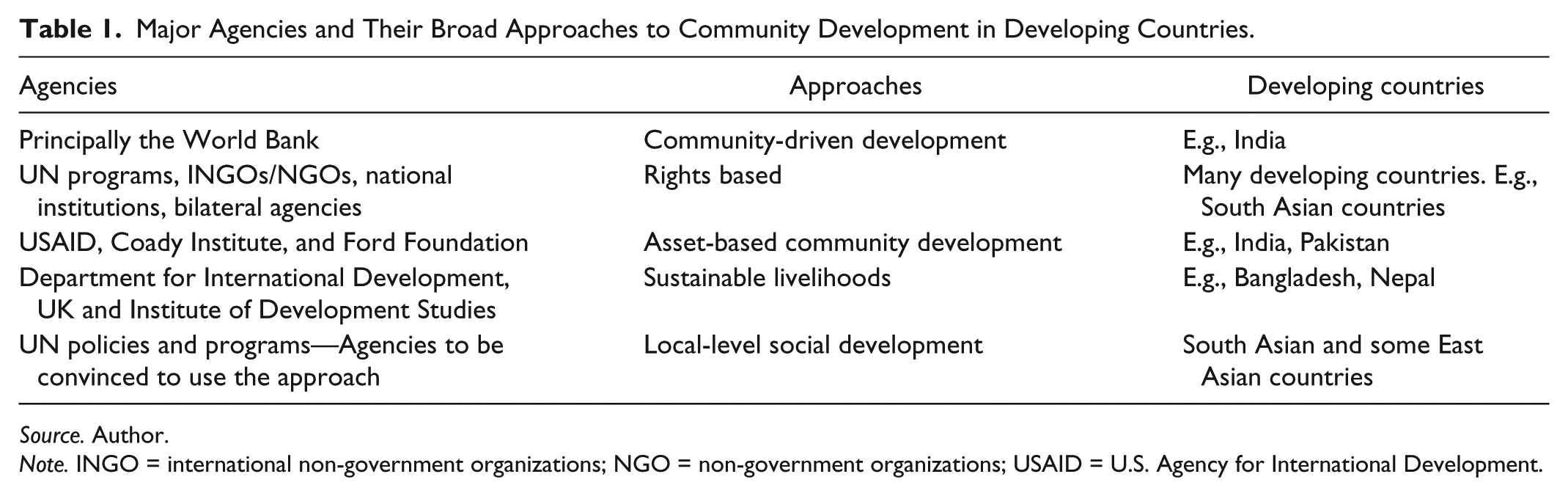
Source. Author.
Note. INGO = international non-government organizations; NGO = non-government organizations; USAID = U.S. Agency for International Development.
Community Practice Trends
A broad survey of current programs and projects that have a community practice focus suggests a wide range of activities, which may be categorized under 15 themes, though these are not exhaustive and may overlap with others, and I might have overlooked some practice areas. However, these appear to be the major ones in the available data. Generally, community practice processes were mixed in terms of bottom-up and top-down approaches. In many countries and communities, (a) self-help groups (SHGs) and micro-credit schemes were very popular. These mainly included small economic enterprises that directly benefitted individual members of the SHGs by lifting their income levels, which in turn positively affected (though gradually) other aspects of life such as health, education, and housing, thereby often lifting these people out of poverty and generally improving their standard of living. (b) Agriculture was a major area of community development practice and included a range of activities such as extension work, watershed development, and improving farming practices, and has great potential to expand further. (c) A number of international non-government organizations (INGOs) and NGOs were active in promoting and practising community forestry to raise awareness among various stakeholders (community members, groups, local bodies, and NGOs), develop necessary policies and procedures, and make decisions by organizing and involving community people so as to sustain forests and livelihoods, particularly for poor people (CFI, 2007). (d) Water has emerged as an important area of community development practice. INGOs such as IRC (International Water and Sanitation Centre) and WaterAid, in partnership with several agencies, worked in six countries (Bangladesh, India, Nepal, Pakistan, Papua New Guinea, and Timor Leste) in Asia and the Pacific to provide water, sanitation, and hygiene education to some of the world’s poorest people (WaterAid, 2007). (e) Infrastructure and service development was a key area of community practice and people were effectively mobilized to build basic infrastructure in their communities, and there were many good examples in developing countries where this was accomplished (Guggenheim, Wiranto, Prasta, & Wong, 2004). (f) Development-induced and disaster-led displacement was common in developing countries, particularly in China and India, and community practice approaches were used to settle and rehabilitate displaced people with different degrees of success (see the World Commission on Dams, 2000; Fuggle et al., 2000, cited by Stanley, 2004). (g) Lack of sanitation has been a major issue in many developing countries and several community practice models were implemented to effectively address this issue (see Kar, 2005; Sulabh International, 2006; World Bank, 2006b). (h) In many conflict-torn areas, community development projects were attempted to prevent further conflict, promote peace, and thereby develop or rebuild basic infrastructure, harmonious networks, and participation in governance (World Bank, 2006a). (i) Community practice relating to indigenous populations included a focus on land, gender, livelihoods and natural resource management, indigenous knowledge, culture and institutions, identity and self-esteem, and microenterprises (IFAD, 2006). (j) There were also good examples of small-scale community development led by community people themselves without external aid, and such projects are worth emulating elsewhere (see Hazare, 2003). (k) By using cooperative principles and processes, a number of cooperatives were developed to productively engage disadvantaged groups such as street children and scavengers (Medina, 2000). (l) In many countries, a number of associations, clubs, and interest groups, such as Lions Clubs, Rotary Clubs, sports associations, and religious groups, offered voluntary services, such as conducting a medical camp, blood donation camp, and an eye camp, and building a small community center or school or a bus stop, which activities may or may not contribute to sustained community development. (m) Community practice was also used to meet the needs of vulnerable groups such as children, women, the disabled, the sick, and the elderly. (n) A number of innovative projects were being experimented to see how information and communication technology could be used to achieve community development (Cecchini and Raina, 2002; Solution Exchange, 2009; United Nations Educational, Scientific and Cultural Organization, 2004). (o) State-initiated significant community practice platforms were created in China and India (e.g., “Sheque,” Villagers’ Committees, Panchayati Raj) for participatory community development activities (Choate, 1997; Derleth & Koldyk, 2004; Pawar, 2009).
A General Lack of Professional Social Work Presence in Local Communities, and Particularly in Political Engagement
Although community practice is undertaken to varying degrees in developing countries, both by professionally trained social workers and others who are interested in community development, it appears that such practice appears inadequate relative to the vast number of local-level communities and the severity of their conditions. This is not to suggest that there are no good and successful examples of community practice. Several individuals and organizations have, with passion and commitment, demonstrated effective community development practice. For example, Anna Hazare’s (2003) comprehensive village development in Maharashtra state of India, Bunker Roy’s Barefoot College in villages of Rajasthan, India (Roy, 1997), scavenger cooperatives in the Philippines (Medina, 2000), Sarvodaya’s work in Sri Lanka, Kamal Kar’s community-led total sanitation, and Grameen Bank’s micro-credit work in Bangladesh and elsewhere demonstrate that such community practice examples are worth replicating with necessary adaptation in other communities. Similarly, many faith-based (religious) organizations with political affiliations have significantly contributed to community development through a range of health and education provisions. Although these community practitioners are not professionally trained social workers, against all odds they have effectively engaged with people, communities, and politics, and have contributed to community development and to improving the conditions of people in general.
However, barring a few exceptions such as Mrs. Medha Patkar’s environmental activism and mobilization of indigenous and rural people in India to defend their rights and a handful of social workers’ community practice through NGOs, generally social workers’ contribution to community practice is minimal and many local-level communities are untouched. Moreover, wherever they are involved in community practice, their political engagement is usually minimal or nil. When there were right opportunities, the author guided and directed a few social workers to engage politically to address the community issue, but the response was not forthcoming. Many social workers’ experience suggests that those who have entered local communities without political engagement have often faced significant hurdles, which were mostly created by the dominant community power structures. Local political leaders and their politics can make professional social work entry difficult and affect the quality of work in terms of the pace of progress and outcomes. A rudimentary comparison between community practice of professionally trained social workers and of other-than-trained social workers suggests that the impact and effectiveness of the latter appear to be far greater or more visible. The author’s observation and analysis shows that generally, the social work profession and social workers are not active in community practice in local communities, though one tends to assume that their knowledge and skills are useful in improving community conditions (Mizrahi, 2001) by facilitating self-help groups, micro-credit schemes, asset-building, social enterprise, and so on (Midgley, 2014). Why do most social workers not undertake community practice at local levels and not engage politically to address core community issues? Is it because of their professional non-political and non-religious value/principle-base; the kind of knowledge and training provided in the course; Western models of social work education that tilt more toward therapeutic and clinical work; a lack of capability, commitment, and interest; or an unwillingness to move to local communities that are far from their comfort zones and of their preoccupation with individual choice and the material world? Or is it because local communities are complex and difficult, hard to make an entry into and to make a difference as everything is an issue there and altogether they require long-term commitment? The analysis of these questions may result in affirmative or negative responses, depending on how social workers perceive their usual contexts vis-à-vis local communities. However, the core factor of the utterly deprived conditions of a majority of local communities in developing countries, as presented above under the general profile of communities, makes a compelling case for political engagement with those communities. The imperative for social workers to do so are discussed in the next section.
Imperatives for Political Engagement
Values and Principles-Based Social Work Practice With Local Communities
The very nature of the values and principles of social work, such as human rights and social justice enshrined in the global definition of social work stated above, and global social work standards (Chu et al., 2009) suggest that social workers’ adherence to such values and principles in practice requires political engagement. It is difficult to imagine the realization of human rights and social justice for local communities without political engagement. Many people in local-level communities live without meeting their basic needs and with deplorable conditions, which suggest that their human rights have been denied and that they are subjected to social injustices. How can social workers engage politically to practice human rights-based and social justice-based community practice? Human rights and social justice are not apolitical issues. In seeking to achieve social change, equality, and social justice, it is necessary for social workers to include and address all three types of rights—civil and political; economic, social and cultural; and collective rights—in an interdependent and integrated way, for in community practice all human rights are closely connected (Ghai, 2001). The conscious use of human rights values/principles helps shift the focus from individual and community needs to individual and community rights. Such a value orientation and the application of associated principles help workers to focus on claims, and to invoke the duties and responsibilities of the state and other social and economic institutions to address these claims of their people and communities.
Rights make it clear that violations are neither inevitable nor natural, but arise from deliberate decisions and policies. By demanding explanations and accountability, human rights expose the hidden priorities and structures behind violations and challenge the conditions that create and tolerate poverty. (Committee on Economic, Social and Cultural Rights, 1998)
In a similar vein, Uvin (2004) states that human rights values/principles focus on social structures, loci of power, rule of law, empowerment, and structural change in favor of the poorest and most deprived. Thus, to be true to their values and principles, social workers need to engage politically with local communities.
Making Entry Into and Gaining Acceptance From Communities
Can social workers enter communities and gain their acceptance without political engagement? Entering a community and gaining acceptance is a necessary first step in community work. Without successfully completing this step, community practice cannot begin. How the worker is introduced to the community, with whom she or he interacts, with which groups she or he engages, and the introducer all significantly affect successful entry into the community. If the community worker is replacing a previous worker in an ongoing community development project, people’s response and receptivity would be different depending on their previous experience with the worker and the project. An outside community worker is keenly observed, tested, and judged by the people against their hopes and individual and collective expectations. People’s perceptions and conclusions about the worker may hinder (at least initially) or facilitate her or his actions depending on what those perceptions and conclusions are. Several factors may lead to the acceptance or non-acceptance of the worker. It is important to prevent the mismatch between the expectations of people and the worker’s community practice agenda. The worker’s identification and frequent interactions with members of a group who are dominant and have tended to disadvantage and marginalize poorer people may result in the non-acceptance of the worker as the latter may look at the worker with suspicion. If the worker is perceived as a threat to the existing power structure, powerful groups may impose hurdles to initiating any community practice. If commitment and skills on the worker’s part are lacking, people may find it difficult to support the worker. False or unrealistic promises and hopes may result in community disappointment and distrust. Finally, instead of contributing, recognizing people, and giving credit to them, if the worker engages in promoting self-recognition and taking the credit for others’ work, people may gradually distance themselves and begin criticizing the worker. To gain acceptance, workers need to put aside their own agendas and focus on the most desperate and felt needs of people and those that are close to the heart of the culture and community, thus building trust and winning confidence. Understanding communities based on statistics and profiles, if available, is important, but may not be enough to understand people, their culture, beliefs, politics and power structures, vested interests, and dynamics. The community worker needs to devote a significant amount of quality time in the community and with people to gain these deeper insights. All these are essentially social workers’ political engagement processes.
Awareness-Raising and Capacity Building for Transformation
Awareness-raising and capacity building of the disadvantaged, marginalized, and oppressed groups, and of their organizations and institutions in communities, are essentially political activities. In Freire’s (1972) words, workers need to raise critical consciousness or “conscientization” of people. Raising awareness for awareness sake is of no use if it does not translate into action. It should help develop people’s faith in themselves and their ability to think about their rights, the injustices surrounding them, and the structures that cause them, enable them to act so as to transform despair to hope, and dependence to independence. How do you raise that kind of awareness? It cannot be achieved through one-way communication, or spoon-feeding, or blaming people for their situation. It is important to initiate dialogue with people on an equal footing, engage in dialogue that explores and interprets their understandings of the world, and in critical reflection on it, to maintain two-way communication to ensure action (see Freire, 1972).
To raise awareness and build the capacity of individuals, groups, organizations, and institutions, workers need to facilitate social, cultural, economic, and political development in communities on a sustainable basis. Toward this end, specific groups or categories in local communities need to be identified for awareness-raising and capacity building. Generally, these will include individuals and groups, and particularly marginalized and disadvantaged people, functional leaders, facilitators or catalysts, volunteers, community-based organizations (CBOs) or people’s organizations (POs), existing or new youth groups, NGOs, and local institutions. Depending on the need and issue, workers need to identify competent facilitators or volunteers from the community, organize “train the trainer” workshops or sessions, expose people to model community development projects and people engaged in such projects, and draw maximum resources from the community (local cultural and religious aspects that can make the point quickly and to which people can relate). Through such political engagement of awareness-raising and capacity building, workers can enable people and communities to initiate the process of transformation of their conditions.
Exploitative and Oppressive Community Power Structures
Prevailing dominant, autocratic, and dictatorial leadership styles and the concentration of power among a few leaders are critical challenges for most communities in developing countries. To understand such challenges, it is necessary to look at the whole community as well as specific sections of it. Unnecessary politicization, political processes, and leaders highlighting group divisions are major causes of non-development in many communities. For example, one successful community practitioner states: Some people who get themselves addressed as the head of a village are afraid of losing power as villagers become united and self-reliant and do not remain dependent on him and stop calling him “Patil” (head). People in politics often fear the idea of empowering villagers who will be able to think on their own and vote. . . . outside vested interests do not allow the villagers to unite, for the fear of losing their own importance. Disunity is deliberately fostered because of affiliation to different political parties, castes, status etc. (Hazare, 2003, pp. 22, 59)
Communities cultivated under such a myopic leadership style cannot be participatory and people-centered. Hence, altering or changing such leaders across the diverse communities in the region is a challenge for social workers and their community practice.
Due to such leaders and community power structures, most grassroots-level communities, particularly in rural areas, have been experiencing extreme deprivation, oppression, and discrimination for a long time. Irrespective of political structures, democratic or otherwise, the current social, economic, and political arrangements are commonly advantageous to local elites and feudal leaders. Existing government bureaucracies often tend to please, or comply with the requirements of these leaders. Hence, any change that aims to alter the current status quo is likely to be resisted by some elements within these grassroots-level communities. The nature of such resistance can be extreme, including violence and deaths, thus causing further violations of human rights. Owing to such leaders and community power structures, both oppressed and unoppressed community members do not readily come forward to participate in community activities. Such leaders also subvert the democratic process. Poor and marginalized people who have been suppressed and weakened over a long period are not in a position to see beyond their current situation (involving apathy, indifference, helplessness, and powerlessness), and changing that situation is an essential task for social workers. To deal with such complex issues and dynamics in communities, social workers, on the one hand, need to tactfully engage with both monolithic (Hunter, 1953) and/or pluralistic (Dahl, 1961; see also Oommen, 1970; Rogers, 1964) community power structures and, on the other, enable the oppressed groups to realize that the cause of their situation lies elsewhere in socio-economic and political structures, and that they can change that situation by redefining their conditions and taking responsibility for changing that situation. Breaking the entrenched power structure in communities and altering dictatorial and often violent leadership styles are challenges in many communities. As an important part of political engagement, social workers with people need to address the following questions: How are such leaders developed and supported? What can be done to transform such myopic leadership styles? How can this concentrated power be diffused and shared with common people?
Sustainable Community Development
Social workers need to engage politically to ensure sustainable community development, in terms of both ecological and community sustainability. Although both are connected, due to the paucity of space, only community sustainability is discussed. Community sustainability connotes need-based community development activities that can be planned, developed, and continued by communities/people themselves without depending on external support, or with minimum external support. Social workers’ community practice needs to focus on utilizing the existing capacities and extending the capacities of individuals, groups, leaders, organizations, and institutions in relation to developing participatory mechanisms for self-governance and management without unnecessary external dependence and interference. Toward this end, they need to engage meaningfully with Community-Based Organizations/People’s Organizations (CBOs/POs), local NGOs and other associations, and local institutions (councils), which are the main pillars of self-governance and management in communities. By networking among these groups, flexible structures and processes need to be developed for self-governance and management of a range of community development activities in the areas of health, education, employment, housing, culture, natural resource management, and economic production. For example, in both China and India, decentralizing governance systems to local-level democratic institutions—Villagers’ Committees in China and Panchayati Raj in India—has been introduced. Instead of developing parallel governing systems, people in local communities, through CBOs/POs, NGOs, and other associations in coordination and cooperation with these local institutions, can plan and implement village/community development programs and activities. Although these institutions have democratic structures (theoretically), and are thus avenues for people’s participation, their governance systems need to be radically changed and transformed by becoming transparent, honest, open, responsive, and accountable to people and themselves. They need to be inclusive of common people and responsive to their voices. Sustainable community development practice should essentially focus on translating these local-level institutions and their written commitments into appropriate practice. This may call for amicable dialogue, building trust, cooperation, collaboration, communication and understanding (Clarke & Stewart, 1998), and at times political activism on the part of people and communities, including social workers, to make these institutions work along the lines intended.
Conclusion
As aimed, this article has provided a glimpse of community practice trends in developing countries and pointed out that professional social workers’ contributions to community practice in local communities currently leaves much to be desired as they do not engage politically in their practice as much as they should. The discussion shows clear imperatives for social workers to engage politically with people to transform local community conditions for the better. Inter alia, if social workers’ ideological non-political and non-religious neutral position (Smyth & Campbell, 1996; Whiting, 2008) hinders them from doing this, their other fundamental values and principles of human rights and social justice (Chu et al., 2009; Weiss, Gal, & Katan, 2006) make a compelling case for political engagement in local communities. Certainly, social workers need to exit their comfortable neutral zone. The utter deprived conditions of local communities, oppression of people by community power structures, examples of community practice with political engagement and impactful community practice by other than professional social workers make one wonder, why are social workers and their profession so silent and inactive, notwithstanding values, principles, and commitment enshrined in their code of ethics? I hope this article helps social workers to reflect critically on this question and act.
Footnotes
Declaration of Conflicting Interests
The author(s) declared no potential conflicts of interest with respect to the research, authorship, and/or publication of this article.
Funding
The author(s) received no financial support for the research and/or authorship of this article.