




Abstract
The academic performance of faculty members, as reflected by their research productivity and quality, is a crucial factor in determining aninstitution’s reputation and ranking. However, research productivity varies across academic disciplines and is influenced by multiple factors. In this study we investigate the impact of the academic discipline on research productivity and quality among faculty members in the School of Arts and Sciences at the Lebanese American University, and explore potential factors that could affect their research productivity. We measure research productivity and quality using indicators such as publication count, publication pattern preferences, and average number of citations per publication. Additionally, we assess the effects of individual, institutional and occasional factors on research productivity through a questionnaire distributed to faculty members. Our findings indicate that faculty members in hard disciplines tend to be more productive and have more cited works than their counterparts in soft disciplines, but both groups target top journals at similar rates. Furthermore, international collaboration is a significant predictor of advanced research productivity in hard disciplines. Additionally, both groups agree that teaching loads can limit the time available for research and that the research funding and equipment should be improved. Finally, we note the COVID-19 lockdown and the economic crisis in Lebanon have decreased research activity among faculty members in hard disciplines.
Keywords
Introduction
The productivity and quality of research serve as crucial indicators of academic performance for universities, and form a significant basis for university rankings. In order to make continuous progress at the national, regional and global levels, universities are increasingly focusing on building their capacities to improve the quantity and quality of research, and encouraging their faculty to maintain a constant level of activity (Brew et al., 2016). As a result, higher education institutions are implementing various measures to increase research productivity, such as offering incentives in the form of promotions, teaching relief, reward systems and research funding (Braxton et al., 2002; Edgar & Geare, 2013; Jung, 2012).
To assess the research productivity of an academic institution, a quantitative approach is commonly used that involves measuring the number of publications including peer-reviewed journal articles (Akbaritabar et al., 2018; Butler, 2003), books/book chapters and conference proceedings (Heng et al., 2020; Khuram et al., 2022). Bibliometrics, such as number of citations, average citations per publication (Agarwal et al., 2016; Carpenter et al., 2014; Leydesdorff & Shin, 2011) and the journal quartile indicators ranging from Q1 (highest) to Q4 (lowest) (Bornmann et al., 2013; Chinchilla-Rodríguez et al., 2016; Miranda & Garcia-Carpintero, 2019), are also used to assess the quality of research. In this study, we have adopted these criteria to evaluate the productivity and quality of research in our the academic institution.
Research productivity varies across academic disciplines, with hard disciplines such as natural sciences, computer science, mathematics and bioinformatics, exhibiting higher research output than soft disciplines such as social sciences, humanities, communication arts and languages (Heng et al., 2020; Jung, 2012; Kyvik, 2003). The publication pattern preferences also differ between disciplines, with researchers in hard disciplines publishing mainly in prestigious journals, while academics in soft disciplines prefer books (Nguyen, 2015). Collaboration and co-authorship are more prevalent in hard disciplines, and positively correlate with higher research productivity (Abramo et al., 2009; Jung, 2012; Kyvik, 2003). In addition, various factors can differentially influence research productivity across disciplines (Brew et al., 2016; Heng et al., 2020; Jung, 2012; Kwiek, 2018; Oancea, 2013; Opesanwo & Simisaye, 2017; Shin & Cummings, 2010), including individual and institutional factors (Armijos Valdivieso et al., 2022; Bland et al., 2006; Heng et al., 2020; Jung, 2012; Kwiek, 2016; Teodorescu, 2000). Individual factors include age, gender, academic rank, and self-efficacy (Heng et al., 2020; Nguyen, 2015), while institutional factors refers to the research policies and strategies that support academic research including reward systems, academic promotion, research funds and resources, post-graduate training, teaching load and relief, and opportunities for research collaboration (Nguyen, 2015; Quimbo & Sulabo, 2014).
For several decades, the assessment of research productivity and the factors that affect it in higher education institutions have been crucial for various reasons. One reason is the need for comparative rankings of academic institutions, which reflect their academic performance and reputation, and ultimately influence students’ choices of universities (Bowman & Bastedo, 2009). Moreover, it helps academic administrators identify gaps that may be hindering the institution’s research output and inspires them to develop more robust research infrastructure and strategies to promote institutional growth and evolution (Bastedo & Bowman, 2011; Jameel & Ahmad, 2020b). Therefore, numerous studies have investigated the productivity and quality of research in different higher education institutions worldwide, including schools in developed and developing countries, by examining the impact of academic discipline and other critical individual and institutional factors (Abouchedid & Abdelnour, 2015; Brew et al., 2016; Heng et al., 2020; Jameel & Ahmad, 2020a; Jung, 2012; Khalil & Khalil, 2019; Opesanwo & Simisaye, 2017; Quimbo & Sulabo, 2014; Shin & Cummings, 2010). In comparison to the rest of the world, the Arab region has low research productivity due to multiple socioeconomic and political crises that significantly affect the productivity and quality of research (Almansour, 2016). Additionally, only a few studies have been conducted to compare research productivity in Arab countries, including Lebanon (Abouchedid & Abdelnour, 2015; El Rassi et al., 2018; Gul et al., 2015), or to assess factors influencing research productivity in specific Arab academic institutions and schools (Dakik et al., 2006; Jameel & Ahmad, 2020a; Khalil & Khalil, 2019; Rachid et al., 2021).
In this present study, our objective is to evaluate the impact of the academic discipline on the productivity and the level of research, and to identify other variables that may influence research productivity across disciplines, specifically in the School of Arts and Sciences (SoAS) at the Lebanese American University (LAU) over a 2-year period (2020–2021). LAU is a private, not for profit American-chartered university located in a developing country, ranked in in the 501 to 600 bracket out of 1,800 universities worldwide, and is ranked as the second-best university in Lebanon according to the Times Higher Education (THE) World University Rankings 2023. The SoAS encompasses various fields belonging to both the hard disciplines in the natural sciences, computer science and mathematics departments, and the soft disciplines in the social sciences and education, communication arts, and languages departments. This study aims to identify factors that may positively or negatively affect research productivity in each discipline, thereby identifying areas of improvement and potential gaps, to enhance the quantity and quality of research output in the school and improve the university’s performance on a larger scale.
Theoretical Background and Goals of the Study
Numerous studies have explored the factors that impact the research productivity of academics as it serves as a key indicator of the overall academic performance of higher education systems. Individual factors such as age, gender, academic rank, and research activity status, as well as institutional characteristics such as the reward system, funding, time spent on research, local and international collaboration, and post-graduate training, have been identified as efficient predictors of research productivity. However, it should be noted that the impact of these factors varies by discipline, with research productivity differing depending on disciplinary background, particularly between hard and soft sciences (Becher & Trowler, 2001; Jung, 2012; Linton et al., 2012; Pepe & Kurtz, 2012). This variation in research productivity across disciplines can be attributed to academic reasons such as differences in theory and research methods, research topics, publication patterns, and the time needed to publish (Agnew, 2013; Becher & Trowler, 2001). Additionally, the possibility of collaboration and co-authorship may be more prevalent in hard sciences than in soft sciences disciplines is shown to be probably more frequent in hard sciences than in soft sciences disciplines (Abramo et al., 2009; Jung, 2012). The teaching load has also been shown to have both positive and negative effects on research productivity in both disciplines, as it can engage academics more in research in some cases, particularly in soft sciences, while reducing the time spent on research in others, particularly in hard sciences (Ramsden & Moses, 1992; Teodorescu, 2000). While numerous studies have evaluated the research productivity of universities as a whole or limited to certain disciplines, only a few have examined and compared predictors of research productivity across disciplines. This approach is crucial in assessing the influence of factors in each discipline (Wanner et al., 1981) nd developing specific measures to enhance research productivity across disciplines, thereby boosting it throughout the entire institution. Findings from different studies investigating the influence of factors on research productivity cannot be generalized due to several reasons, including location, institution size, university by-laws (Nguyen, 2015), different departments, and sample size (Almansour, 2016; Gul et al., 2015; Jameel & Ahmad, 2020a). Furthermore, the special circumstances of each case study, such as the security situation of the studied country and the relevant period of time, may affect research productivity. For instance, the economic crisis and the COVID-19 pandemic have had an impact on research productivity in various institutions (Nocco et al., 2021; Shehatta et al., 2023)
Based on the previous literature and to the best of our knowledge, we conclude that:
Only a few studies have assessed research productivity and its predictors in Arab countries, and these are limited to some disciplines (Abouchedid & Abdelnour, 2015; El Rassi et al., 2018; Jameel & Ahmad, 2020a; Khalil & Khalil, 2019; Rachid et al., 2021),
Despite the robust role of individual and institutional factors in predicting research productivity in higher academic institutions, the positive, negative, or neutral effect of each factor cannot be generalized to all disciplines and institutions. For example, while some studies indicated a positive effect of collaboration and co-authorship on research productivity(Abramo et al., 2011; Ductor, 2015; Kato & Ando, 2013), another study found that collaboration does not impact research output (Ynalvez & Shrum, 2011). n addition, one study indicated that research productivity is enhanced only by international collaboration but not with local collaboration (He et al., 2009), contradicting another finding that local collaboration positively impacted research productivity (Abramo et al., 2017).
The purpose of this study is to evaluate and compare the research productivity and quality of the hard and soft disciplines in the Faculty of Arts and Sciences at the Lebanese American University, a leading university in the Arab region. Additionally, we will investigate the impact of individual, institutional, and occasional factors on research productivity in both disciplines. The results of this study will be used to redirect the university’s research policy based on the effect of each of the studied factors. This study will address the following questions, and the study model is presented in Figure 1:
Q1: Do the research productivity and quality of research differ between the hard and soft disciplines in the School of Arts and Sciences at the Lebanese American University

Model of the study.
To answer this question:
First, we will compare the number of publications in indexed journals, books, and conference proceedings, as research output is a reliable predictor of research productivity (Jung, 2012; Nguyen, 2015; Teodorescu, 2000).
Second, we will compare the number of publications in different publication patterns and classify them based on whether they were published in Q1, Q2, Q3, or Q4 journals, books, or conference proceedings, as this approach is commonly used to assess research quality (Alamah et al., 2023; Bornmann et al., 2013; Chinchilla-Rodríguez et al., 2016; Miranda & Garcia-Carpintero, 2019; Shehatta et al., 2023).
Third, we will compare the number of citations per publication and their source, including whether they were extracted from Q1, Q2, Q3, or Q4 journals, books, or conference proceedings, as citations are a robust indicator of research quality(Alamah et al., 2023; Linton et al., 2012; Miranda & Garcia-Carpintero, 2019; Mryglod et al., 2013; Pepe & Kurtz, 2012).
Q2: Since research output and citation counts differ between the two disciplines, we will investigate the influence of individual, institutional, and occasional factors on research productivity for each discipline.
To address this question, we administered a questionnaire to faculty members in the relevant disciplines. The questionnaire contains direct inquiries about academic affiliation, academic rank, age, and gender (individual factors), as well as collaboration, teaching load, other occupations, reward system, research funding, research equipment, post-graduate training, and post-doctoral research fellow involvement (institutional factors). We also included questions regarding the impact of the COVID-19 pandemic and the Lebanese economic crisis (occasional factors) during 2020 and 2021. Responses were anonymous and recorded separately for faculty members in each discipline. We collected the percentage for each answer and conducted a comparative descriptive analysis based on faculty responses, as well as a regression analysis.
Data and Methodology
Disciplines
In this study, we take the case of the Lebanese American University (LAU), and focused especially on the School of Arts and Sciences (SoAS), one of the leading schools in high research activity, including its four departments: natural sciences, computer science and mathematics, social sciences and education, and communication arts and languages. In order to investigate the impact of the academic discipline on the productivity and the quality of research in the SoAS, we adopted the classification of the different disciplines into two general categories: the hard disciplines and the soft disciplines (Jung, 2012; Kyvik, 2003). The hard disciplines include both departments of natural sciences and computer science and mathematics, including the following sub-disciplines; biology, chemistry, biochemistry, physics, nutrition and food sciences, environmental toxicology, mathematics, computer science and bioinformatics. The soft disciplines include both departments of social sciences and education, and communication arts and languages, including the following sub-disciplines; education, English, Arabic studies, psychology, journalism, multimedia, communication arts, political sciences, philosophy, gender studies, film, theater, dance, and performing arts.
Data
To conduct our study, we considered the publications collected from LAU database for the faculty members assigned to the SoAS. Among them 38 members are affiliated to the hard disciplines and 38 members are affiliated to the soft disciplines, during the 2 years 2020 and 2021. This period coincides with the outbreak of COVID-19 pandemic and coexists with the ongoing Lebanese economic crisis, witnessing the worst decline in the levels of the Lebanese pound against the US dollar. We concluded to exclude the ongoing year to remove any inconsistency factor in the results, as the study began in mid-2022 and is not yet finished, and data collection needs constant updating.
The concerned faculty are the assistant, associate, and full professors, excluding part-timers and lecturers, because altogether most of them are engaged in teaching with no or reduced research activity (Jung, 2012).
The types of publication and publication venues considered in this study include the indexed journals (Q1, Q2, Q3, and Q4), conference proceedings and books (Alamah et al., 2023; Bornmann et al., 2013; Chinchilla-Rodríguez et al., 2016; Miranda & Garcia-Carpintero, 2019; Shehatta et al., 2023).
Data Analysis
Comparison of the Research Output in Both Disciplines
Since the research output is a robust indicator of the research productivity, we compared the total number of publications in both disciplines during 2020 and 2021. To investigate the significance of the research productivity, we compared the average of publication/year between the two disciplines using the statistical unpaired/two-tailed t-test to determine if there was a significant difference between the two group means.
Comparison of the Research Quality in Both Disciplines
We compared the quality of research between the two disciplines at both terms; publication pattern preferences (publication venues), and the average number of citations along with the source of citations (their distribution across the different publication patterns). At the first level, we collected data about the publication patterns where the publications were released, and we categorized them as indexed journals and their respective quartiles; Q1, Q2, Q3, and Q4 (based on SCImago Journal Rank (SJR) and Scopus database), conference proceedings and books. We calculated the total percentage of publications in each venue for both disciplines and sub-disciplines, and we compared the average percentage of publications in each publication pattern per year, using the statistical unpaired/two-tailed t-test to determine if there was a significant difference between the two group means.
At the second level, we collected the updated number of citations (until July 2022 -Google Scholar) for each publication in both disciplines, and we collected the total number of citations for each quartile or venue. To compare the differences in quality in terms of citations per venue between the two disciplines, we showed first the difference in the number of citations estimated as average number of citation per publication in both years for each discipline, and we compared the percentage of citations distributed in each quartile or venue for each year, using the statistical unpaired/two-tailed t-test to determine if there was a significant difference between the two group means.
Questionnaire: Factors Influencing the Research Productivity in Both Disciplines
With the intention of investigating what other factors may influence research productivity in both disciplines; we sent a questionnaire reviewed and approved by LAU - Institutional Review Board (IRB) (IRB #: LAU.GSR.SS1.28/Jul/2022), to the relevant faculty members of both disciplines (76 members). The questionnaire was composed of multiple choice questions and was divided into three sections, each comprising different type of factors adopted in previous studies (Heng et al., 2020; Jung, 2012; Nguyen, 2015; Quimbo & Sulabo, 2014). Section 1 represents the individual factors including questions about the academic affiliation, the academic ranking, the age, the gender, the self-efficacy and the engagement in research. Section 2 represents the institutional factors including questions about the research collaboration, the teaching load, other occupations, reward system and the research funding, research equipment, post-graduate training and post-doctoral research fellow’s involvement. In section 3 we aim to add some specific occasional factors regarding the situation in Lebanon between years 2020 and 2021 that may affect research productivity at LAU. These include questions about the impact of the COVID-19 pandemic and the Lebanese economic crisis on the research outputs during the biennium. The answers were anonymous and recorded independently for the faculty members from the two different disciplines. We collected the total percentage for each answer and conducted comparative descriptive analysis based on the faculty responses. Besides, we also addressed a regression analysis where the independent variable was the research output of faculty members during the considered biennium and the independent variables were the followings: academic rank (continuous), age (continuous), gender (dummy with Female = 1 and Male = 0), research activity (continuous), collaboration (continuous), workload (dummy with No = 0 and Yes = 1), other occupation (continuous), reward and funding (continuous), research equipment (continuous), postgraduate training (continuous), postdoc (dummy with No = 0 and Yes = 1), COVID-19 (dummy with No = 0 and Yes = 1) and Lebanese economic crisis (dummy with No = 0 and Yes = 1).
Findings
The Impact of the Academic Discipline on the Productivity of Research
The total number of publications released in 2020 and 2021 was 195 for the hard disciplines (94 publications in 2020 and 101 publications in 2021) and 68 publications for the soft disciplines (43 publications in 2020 and 25 publications in 2021) (Figure 2A). In order to assess the significance of this difference, we compared the means ± SEM of publications in the 2 years (2020–2021) between the hard and the soft disciplines). As shown in Figure 2B, the number of publications/year for the hard disciplines (97.5 ± 3.5) was significantly higher (p = .02) than the number of publications/year for the soft disciplines (34 ± 9). These results showed that the academics in hard discipline were more productive than their colleagues in the soft disciplines. This result reflects the academic discipline direct impact on the research output at LAU-SoAS.

The impact of the academic discipline on the productivity of research: (a) presentation of the total number of publications for the hard and soft disciplines and (b) average of publications per year (data are expressed as means ± SEM) .
We looked further to the distribution of these publications according to the different sub-disciplines that belong to the hard and the soft disciplines (Figure 3). Concerning the hard disciplines, the computer science major recorded the highest number of publications (n = 76) followed by the biology major (n = 58), the nutrition and food sciences (n = 20), mathematics (n = 12), chemistry (n = 9), bioinformatics (n = 7), biochemistry and physics (n = 5 for each) and the environmental toxicology (n = 3) (Figure 3A). For the soft disciplines, the education and English literature studies recorded the highest number of publications (n = 23), followed by the psychology major (n = 22), the journalism, multimedia and communication arts (19), the political sciences (n = 3) and the performing arts as Film, theater and dance (n = 1). However, no publications were recorded for the Arabic studies, philosophy and gender studies sub-disciplines (Figure 3B). These results showed that the number of publications may also differ according to the sub-disciplines in the same academic discipline.

Distribution of publications between the different sub-disciplines of the hard disciplines (a) or the soft disciplines (b).
The Impact of the Academic Discipline on the Level of Research in Terms of Publication Patterns
Regardless the number of publications, we aim to investigate the impact of the academic discipline on the quality of research in terms of their distribution in different publication patterns including indexed journals classified into four quartiles (Q1, Q2, Q3, and Q4) previously used to evaluate the research quality for faculty publications (Alamah et al., 2023; El-Zahr, 2022a, 2022b), conference proceedings and books. To do so, data were expressed as percentages of publications distributed in the different publication patterns (Figure 4). According to Table 1, around the half of publications in the hard disciplines (48.2%) were published in Q1 journals, followed by 28.2% published in Q2 Journals, 11.8% published in conference proceedings, 8.7% in Q3 journals, 2.6% in Q4 journals, where only 0.5% were published in books as book chapters. Similarly to the hard disciplines, around the half of publications in the soft disciplines (42.6%) were also published in Q1 journals, followed by 27.9% published in Q2 Journals. However, publications in Q3 journals represent 19.1%, followed by 8.8% published as book chapters, and only 1.5% of publications were published in conference proceedings, and no publications were recorded in Q4 journals (Table 2). These data showed that in both disciplines, the majority of publications are published in Q1 and Q2 journals, with no significant difference between the two disciplines (Figure 4) (p = .58 and p = .98, respectively), along with absence or very low record in the Q4 journals, reflecting the high quality of publications from the LAU-SoAS, regardless of the academic discipline. In addition, conference proceedings clearly make up an important venue for the hard sciences, but not for the soft sciences (p = .09), and vice versa for books (p = .35). Finally, both disciplines published in Q3 journals but to varying degrees (p = .4).
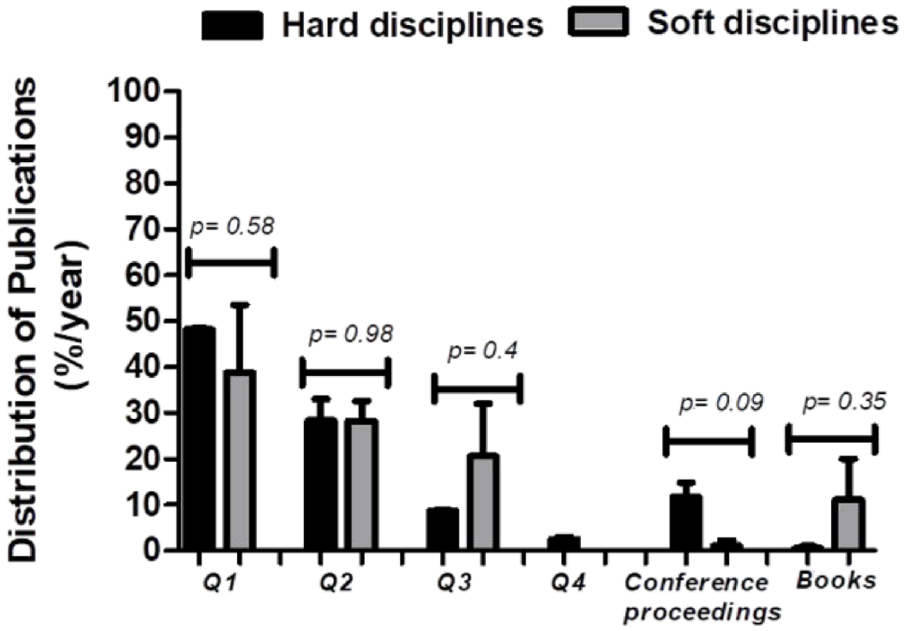
The impact of the academic discipline on the quality of research in terms of publication patterns. Distribution of publications on different venues; journals (Q1, Q2, Q3, and Q4), conference proceedings and books for the hard and the soft disciplines (data are expressed as the means ± SEM of percentages normalized to the total number of publications for each discipline per year).
Distribution of the Publications From Different Sub-Disciplines of the Hard Disciplines on Different Venues; Journals (Q1, Q2, Q3, and Q4), Conference Proceedings and Books.

Data are expressed as total percentages (%) normalized to the total number of publications during the 2 years (2020 and 2021).
Distribution of the Publications From Different Sub-Disciplines of the Soft Disciplines on Different Venues; Journals (Q1, Q2, Q3, and Q4), Conference Proceedings and Books.

Data are expressed as total percentages (%) normalized to the total number of publications during the 2 years (2020 and 2021).
According to Table 1, conference proceedings are strictly targeted by the computer science (10.8%) and mathematics (1%) sub-disciplines (total percentage for conference proceedings is 11.8%), where the books are only targeted by the computer science sub-discipline (0.5% = total percentage for books), and the Q4 journals are only targeted by the computer Science (1%) and the biology (1.5%) sub-disciplines (total percentage for Q4 journals is 2.5%). Q1, Q2, and Q3 journals are almost targeted by all the sub-disciplines (except for bioinformatics where no publication was recorded in Q2 journals and for biochemistry, environmental toxicology and mathematics where no publication was recorded in Q3 journals).
According to Table 2, conference proceedings are strictly targeted by the education and English sub-disciplines (1.5% = total percentage for conference proceedings), where the books are targeted by education and English (4.4%), psychology (1.5%) and journalism, multimedia and performing arts (2.9%), (total percentage for books is 8.8%). Q3 journals are targeted by education and English (11.8%), psychology (5.9%) and political Sciences (1.5%) (total percentage for Q3 journals is 19.1%). Q1 and Q2 journals are almost targeted by all the sub-disciplines (except for political sciences where no publication was recorded in Q1 journals and for film, theater, dance and performing arts where no publication was recorded in Q2 journals).
Overall, these results showed that academic discipline has no direct impact on research quality at LAU-SoAS with respect to the targeted quartiles of journals, but other publications patterns such as books and conference proceedings are more or less preferred depending on the academic discipline and sub-disciplines.
The Impact of the Academic Discipline on the Level of Research in Terms of Citations and Citation Resources
We aim to study the impact of the academic discipline on the quality of research in terms of citations. Regarding that the total number of publications vary widely between the hard (n = 105) and the soft disciplines (n = 68) during the 2 year period (2020 and 2021), we cannot directly compare the number of citations in both disciplines (2,084 citations for the hard disciplines vs. 324 citations for the soft disciplines). Instead, we estimated the number of citations per publication for each discipline by normalizing to the total number of publications for each discipline (Figure 5A). It recorded an average of 10.6 citations per publication for the hard disciplines versus 5.2 citations per publication for the soft disciplines (p = .21). Even if it seems statistically non-significant, these data obviously showed that the hard discipline publications are most probably more cited (>2 fold-factor) than those of the soft disciplines, thus the academic discipline could impact the number of citations at LAU-SoAS.

The impact of the academic discipline on the quality of research in terms of citations: (a) average of citations per publication per year for the hard and the soft disciplines (data are expressed as the means ± SEM of citations normalized to the total number of publications for each discipline per year). (b) distribution of citations on different venues; journals (Q1, Q2, Q3, and Q4), conference proceedings (data are expressed as the means ± SEM of percentages normalized to the total number of publications for each discipline per year).
Then we aimed to investigate how these citations are distributed on different publication patterns and quartiles, in other words, we searched for the resources of these citations (Figure 5B); the results showed that more than 85% of citations refer to publications released in Q1 and Q2 journals for both the hard (80.8% and 12.4%, respectively) and the soft disciplines (74.1% and 13%, respectively) with no significant difference between both disciplines (p = .62 and p = .89). The rest of citations was distributed between Q3 (3.8%), Q4 (1.5%), conference proceedings (1.3%) and books (0.15%) for the hard disciplines, and between Q3 (11.8%) and books (1.2%) for the soft disciplines, but no citation was recorded for conference papers. These data showed once again that the academic discipline has no direct impact on the quality of research in terms of citation resources at LAU-SoAS.
Overall, these results lead to the conclusion that the academic discipline has a remarkable impact on the productivity of research and citations since we found that the hard disciplines are more productive and their publications are more cited than the soft disciplines at LAU-SoAS. However, the academic discipline has not a direct impact on the quality of research in terms of journal quartiles or the citation resources.
The Influence of Individual, Institutional, and Some Occasional Factors on the Productivity of Research in Both Disciplines
Beside the academic discipline, we investigated other potential factors influencing the research productivity in both disciplines by sending a questionnaire to the faculty members. The responsiveness rate to the questionnaire was 60% and descriptive statistics and regression analysis are summarized in Table 3. It is noteworthy that none of the regression coefficients was significant (p > .05) due to the small sample size but we still mentioned the presence of negative or positive correlation with research productivity in the considered biennium.
Individual, Institutional and Occasional Factors Influencing Research Productivity.

Data are represented as percentage of faculty members and regression statistics.
Individual Factors
Associate professors represent the majority of both the hard and the soft disciplines faculty members (∼72% vs. ∼54%, respectively), followed by the assistant professors (∼22% vs. ∼42%, respectively) and the full professors (∼6% vs. ∼4%, respectively). Associate professors are more numerous in the hard disciplines than in the soft disciplines and the opposite is true for the assistant professors and the academic rank is positively correlated with the research productivity in hard disciplines but negatively correlated in soft disciplines. Most of the hard discipline faculty members have an age range between 30 and50 years old (∼72%), whereas the majority of faculty members in soft disciplines were >50 years old (∼57%) where age is positively correlated with research productivity in both disciplines. Males and females are almost equally presented in both disciplines with a slight increase in favor of males in the hard disciplines (∼56%), but the opposite is true in the soft disciplines with females representing ∼54%. Finally, research activity is positively correlated in both disciplines, and all the faculty members in the hard disciplines were research active; however, 13% of the soft disciplines faculty members were not during the considered biennium.
Institutional Factors
All the hard discipline faculty members collaborate to publish either by exclusive local collaboration (∼44%) or by both international and local collaboration (∼56%) with a positive correlation with research productivity; however, around 17% of the soft discipline faculty members have no collaboration at all in research and the rest collaborate locally (∼37%) or both locally and internationally (∼46%) but the collaboration doesn’t show a positive correlation with the research productivity. In both disciplines, faculty members believed that time spent in research is negatively affected by the teaching load (at least 70% of the faculty members) and other administrative occupations (33% of both faculty members) but the regression analysis showed that teaching load and other occupations are negatively correlated with the research productivity in hard sciences only. As well, half of the faculty members agreed that the reward system and findings are not sufficient to enhance research productivity in both disciplines and show negative correlation with research productivity. In addition, almost the half of both faculty members is not satisfied with the research equipment. The contribution of master and PhD students in published works is recorded in 72% of hard discipline faculty members and 54 % of soft discipline faculty members. They are distributed as 28% for master students, 11 % for PhD students and 33 % for both master and PhD students for hard disciplines, and 50% for master students, and only 4.2% for both master and PhD students for soft disciplines. Overall, postgraduate training is positively correlated with the research productivity inn hard sciences only. Postdoctoral research fellows were involved in research activity of ∼ 39% of hard discipline faculty members and 25% of soft discipline faculty members, with negative correlation with research productivity.
Occasional Factors
COVID-19 pandemic and the Lebanese economic crisis strongly affected the research activity of the hard discipline faculty members; around 72% of faculty stated that their research work is experimental done in person and on site and that the imposed lockdown delayed their projects, whereas 28% were not affected since their work can be done remotely or they managed to publish reviews related to the COVID-19 pandemic. As well, around 89% stated that the shortage of materials and reagents due to the economic crisis and the dollar rate fluctuation slowed down the lab work progress and therefore their research productivity. In contrast, COVID-19 pandemic slightly affects the research productivity of the soft discipline faculty members (13% only), since their research work can be done remotely and that they could publish works related to the COVID-19 pandemic. Similarly, they were slightly affected by the economic crisis (33% only) since their discipline didn’t require extensive equipment. In addition, both factors were negatively correlated with the research productivity in both disciplines.
Discussion
Although many universities in the Arab region are currently facing socioeconomic and political crises that hinder their global recognition, they have recognized the importance of both of both individual and institutional factors in building a healthy environment and robust research infrastructure to enhance their research productivity (Abouchedid & Abdelnour, 2015; Almansour, 2016). Research productivity is now widely considered the primary criterion for evaluating universities’ academic performance and is a key indicator for international, regional and national rankings. In this study we aimed to explore the impact of academic discipline on research productivity and quality, and to evaluate the influence of various individual and institutional factors on research productivity trajectory during the years 2020 and 2021 in the School of Arts and Sciences at the Lebanese American University, one of the leading universities in the Arab region and Lebanon.
Our study revealed that the academic discipline had a significant impact, as evidenced by the number of publications produced. Faculty members in hard disciplines published approximatively three times (2.9 fold-factor) more than their counterparts in soft disciplines. These findings are consistent with previous research conducted by Brew et al. (2016) and Heng et al. (2020) (Brew et al., 2016; Heng et al., 2020), which demonstrated that academics in hard disciplines tend to be more productive than those in soft disciplines. Similar results were also found in universities in Hong Kong (Jung, 2012) and North Korea (Shin & Cummings, 2010). Furthermore, faculty members in STEM disciplines (Science, Technology, Engineering, and Mathematics) are more likely to publish than those in non-STEM disciplines in North American universities (Padilla-Gonzalez et al., 2011).
Our study also revealed that publication counts varied across different sub-disciplines within the same discipline. For instance computer science (n = 76), biology (n = 58), nutrition and food sciences (n = 20) were the top performers among hard disciplines, while education and English (n = 23), psychology (n = 22), and communication arts (n = 19) were the top performers among soft disciplines. Other sub-disciplines within the same discipline showed much lower publication counts, ranging from 0 to 12 publications. These results are consistent with another study by Linton et al. (2012) that also demonstrated a wide variance in publication counts within different fields of the same discipline. (Linton et al., 2012). Interestingly, we found that highest number of publications in a discipline was not always due to the highest number of research active faculty members. For example, the chemistry field recorded nine publications and five research active members (∼2 publications per member), while the biology field recorded 58 publications and six research active members (10 publications per member).
At the level of research quality, we found that both disciplines preferred peer-reviewed journals, with the majority of publications appearing in Q1 journals, followed by Q2 and Q3 journals, with few or no publications in Q4 journals. This suggests a high quality of LAU publications regardless of the academic discipline. However, we observed that faculty in hard disciplines, particularly in computer science and mathematics sub-disciplines, publish more in conference proceedings than the faculty in soft disciplines. Conversely, the faculty members in soft sciences, especially in education and English, psychology and communication arts sub-disciplines, tend to publish more book chapters than those in the hard disciplines. This is consistent with previous studies indicating that academics in soft disciplines are more likely to publish in books than those in other disciplines (Heng et al., 2020; Jung, 2012; Nguyen, 2015).
Furthermore, we assessed research quality in terms of citation counts, as citation indicators are considered one of the most important criteria used in research university rankings by the Times Higher Education (Nguyen, 2015). Our results showed that publications in hard disciplines were cited approximately twice as often (∼10 citations per publication) as in soft disciplines (∼5 citations per publication). This difference is not related to publication pattern preferences, as the majority of citations are attributed to papers published in Q1 and Q2 journals in both disciplines.
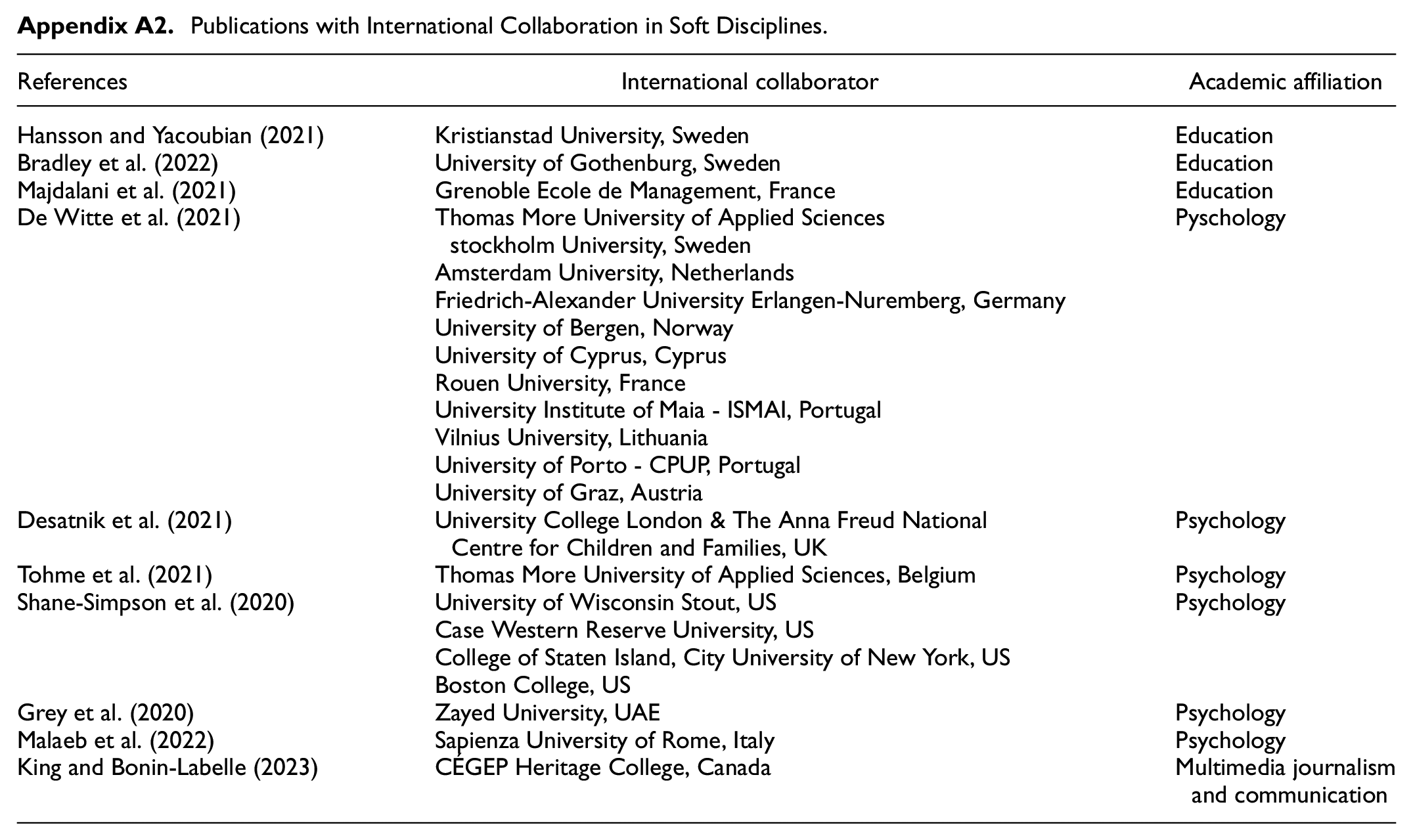
Research productivity across academic disciplines can be influenced by various factors. To explore this, a questionnaire was sent to faculty members addressing individual, institutional, and occasional factors, and descriptive statistics were analyzed. Regression analysis was conducted, but none of the coefficients showed a significant value (p > .05) due to the small sample size. However, we found that years of experience may play a role in the difference of research productivity between the two disciplines, as associate professors are more numerous in hard disciplines and the opposite is true for assistant professors, with a positive correlation with research productivity in hard disciplines and the opposite in soft disciplines. This may explain the higher research productivity in hard disciplines, where academic rank reflects more research productivity, as shown in other studies (Zhou & Volkwein, 2004). Additionally, experience is often accompanied by more funding for research and enrollment of more students engaged in research, contributing to higher research productivity. Age is positively correlated with research productivity in both disciplines, but faculty members in hard disciplines tend to be younger than those in soft disciplines. Gender disparity exists; with men believed to publish more than women (Aiston & Jung, 2015; Vabø et al., 2014). However, gender is not a major factor causing the difference in research output between the two disciplines, which may be due to other factors. Research status appears to play a major role in research productivity since all academics in hard disciplines stated that they are strongly engaged in research, whereas 13% of the soft discipline academics were either not interested in research or stated that the avenues of research are rare in their discipline. Working load, including teaching and other administrative occupations, decreased time spent on research, showing a negative correlation with research productivity in hard disciplines. Both populations consider that the university research policy, including research equipment and reward system, must be improved to enhance their research productivity. Collaboration is one of the most important factors enhancing research productivity in hard sciences (Abramo et al., 2009; Jung, 2012; Kyvik, 2003) due to the exchange of expertise and innovative ideas, as well as cooperation to achieve research tasks (Smeby & Try, 2005). Due to its remarkable importance, we collected in Appendix A1 (hard disciplines) and A2 (soft disciplines) all the papers published with international collaborations. The data showed that 36% of hard disciplines publications are co-authored with international collaborators versus only 14% recorded for soft disciplines. As well, the collaboration network in hard disciplines is wider than in the soft disciplines, and includes different institutes and universities worldwide located in United Arab Emirates, Iran, United Kingdom, France, Saudi Arabia, Germany, United States, Belgium, South Africa, Switzerland, Czech Republic, Canada, Portugal, Pakistan, India, Spain, Italy, Norway, China, Malaysia, Mexico, and Vietnam. Post-graduate training and post-doctoral research fellows, as well as contributions from master students and doctoral students, seem to be advantageous to the advanced research productivity of hard discipline academics, highlighting the importance of institutional and supervisor support to enhance doctoral students’ academic performance (Khuram et al., 2021). The COVID-19 pandemic and Lebanese economic crisis negatively affected the research productivity of academics in hard disciplines more than those in soft disciplines due to the experimental nature of hard discipline work requiring in-person laboratory work that was prohibited during lockdowns, and the Lebanese economic crisis delaying the acquisition of laboratory equipment and materials. Nonetheless, both occasional factors were negatively correlated with research productivity in both disciplines.
Conclusions
This study aimed to investigate the influence of academic discipline on research productivity and quality among LAU-SoAS academics in both hard and soft disciplines, while also exploring individual, institutional, and occasional factors that could affect research productivity. Our findings clearly indicate that academics in hard disciplines exhibit higher research productivity and citation rates, but both hard and soft disciplines demonstrate comparable quality of research in terms of targeted journal quartiles. We found that conference proceedings are a crucial venue for publishing research in hard disciplines, while books and book chapters are more popular among soft disciplines. In terms of individual factors, associate professors and those under the age of 50 in hard disciplines show more advanced research productivity than their counterparts in soft disciplines. Gender may also play a role in academic research productivity, despite a slight increase in men in hard disciplines and women in soft disciplines. Additionally, hard discipline academics’ absolute research engagement may account for their higher research activity than their colleagues in soft sciences. Regarding the institutional factors, post-graduate training, particularly involving PhD students, is advantageous for research productivity in hard disciplines, while international collaboration networks are one of the major predictors of advanced research productivity in hard disciplines. However, workload and institutional research policy have a negative impact on both hard and soft disciplines’ research engagement, leading to lower research productivity. The COVID-19 pandemic, coupled with the Lebanese economic crisis, has significantly affected hard discipline academics’ research productivity due to laboratory material shortages and lockdowns, while soft discipline academics have been less affected as their work can be done remotely. Although our study has some limitations, such as focusing only on one school and having a moderate response rate to the questionnaire (60%), we performed a comparative descriptive analysis based on the responses of the faculty members and the coefficients of correlation. Despite these limitations, our study identifies several factors positively correlated with department research productivity, such as international collaboration, and highlights that both hard and soft disciplines are affected by workload and dissatisfied with institutional research policy. These findings encourage officials to review research policies, initiate new strategies to lighten workload, and improve the reward system and funding, as well as enhance research equipment. We suggest that future follow-up studies include more schools at LAU and examine more variables that could impact the institution’s research productivity.
Footnotes
Appendices
Publications with International Collaboration in Soft Disciplines.
| References | International collaborator | Academic affiliation |
|---|---|---|
| Hansson and Yacoubian (2021) | Kristianstad University, Sweden | Education |
| Bradley et al. (2022) | University of Gothenburg, Sweden | Education |
| Majdalani et al. (2021) | Grenoble Ecole de Management, France | Education |
| De Witte et al. (2021) | Thomas More University of Applied Sciences stockholm University, Sweden Amsterdam University, Netherlands Friedrich-Alexander University Erlangen-Nuremberg, Germany University of Bergen, Norway University of Cyprus, Cyprus Rouen University, France University Institute of Maia - ISMAI, Portugal Vilnius University, Lithuania University of Porto - CPUP, Portugal University of Graz, Austria |
Pyschology |
| Desatnik et al. (2021) | University College London & The Anna Freud National Centre for Children and Families, UK | Psychology |
| Tohme et al. (2021) | Thomas More University of Applied Sciences, Belgium | Psychology |
| Shane-Simpson et al. (2020) | University of Wisconsin Stout, US Case Western Reserve University, US College of Staten Island, City University of New York, US Boston College, US |
Psychology |
| Grey et al. (2020) | Zayed University, UAE | Psychology |
| Malaeb et al. (2022) | Sapienza University of Rome, Italy | Psychology |
| King and Bonin-Labelle (2023) | CÉGEP Heritage College, Canada | Multimedia journalism and communication |
Acknowledgements
I would like to thank Dr. Mira Abboud (University of prince Edward Island, Cairo, Egypt) for her valuable advices in statistics test and Dr. Samer Saab (Lebanese American University) for his advices and ideas.
Declaration of Conflicting Interests
The author(s) declared no potential conflicts of interest with respect to the research, authorship, and/or publication of this article.
Funding
The author(s) received no financial support for the research, authorship, and/or publication of this article.

Data Availability Statement
Data sharing not applicable to this article as no datasets were generated or analyzed during the current study.