




Abstract
This paper examines the influence of consumers’ gender and age on the relationship between their attitudes and purchase intentions for choosing a sustainable retirement village, drawing on the Ecological Theory of Aging and the Theory of Reasoned Goal Pursuit. About 931 research participants were collected in China through an online research firm, which distributed questionnaires to its sampling database. Partial Least Squares Structural Equation Modeling was employed to test the proposed hypotheses. The study reveals that (1) consumers’ attitudes toward sustainable retirement villages mediate the relationship between social and environmental sustainability and purchase intentions; (2) The link between the attributes of sustainable retirement villages and consumers’ purchase intentions is mediated by their attitudes, which are not influenced by the consumers’ gender or age. This research demonstrates that neither the gender nor age of consumers significantly impact their attitudes and purchase intentions regarding sustainable retirement villages. The scope of this study is constrained by its sample and variables, as the research subject focuses specifically on Chinese consumers’ attitudes and intentions toward sustainable retirement villages.
Keywords
Introduction
Population aging affects developed and developing countries, including the United States, Japan, China, Australia, Thailand, and Malaysia. According to the United Nations Department of Economic and Social Affairs, Population Division (2020), the global population of individuals aged 65 or older is projected to reach 727 million by 2020. The proportion of people aged 65 and older is expected to increase from 9.3% to approximately 16.0% by 2050 (United Nations Department of Economic and Social Affairs, Population Division, 2020). Based on a report from the United Nations Department of Economic and Social Affairs, Population Division (2019), the anticipated growth in the aging population by 2050 is estimated to be 22.9% in the United States, 37.7% in Japan, 26.1% in China, 22.8% in Australia, 29.6% in Thailand, and 17% in Malaysia.
As societies age, the living accommodations of the elderly become increasingly crucial to their well-being (Leung et al., 2021; Ng et al., 2020; Park & Choi, 2021; Xia, Skitmore et al., 2015; Zhang et al., 2020). The Ecological Systems Theory (EST) (Bronfenbrenner, 1979) and the Ecological Theory of Aging (ETA) (Lawton, 1977; Lawton & Nahemow, 1973) both suggest that an elder’s decision-making process is shaped by their maturational experiences and interactions with their environment. Specifically, according to EST, housing arrangements for the elderly are associated with economic well-being, physical and mental health, and life satisfaction, influenced by factors such as health or physical capacities, social interactions, evolving lifestyles, and environmental friendliness (Hu et al., 2020; Xia, Skitmore et al., 2015; Xia, Zuo et al., 2015). Conversely, ETA examines an elder’s preferences or motivations for relocating to a retirement community or remaining in their current residence (Hu et al., 2020; Xia, Skitmore et al., 2015; Xia, Zuo et al., 2015).
The EST (Bronfenbrenner, 1979; Sim et al., 2022) posits that an individual’s behavior is closely linked to their developmental background and is shaped by their environment and life experiences. EST elucidates the impact of social and cultural practices on a person’s behavior by examining interactions across multiple levels of social structure, where hierarchical actions are interconnected (Bronfenbrenner, 1979; Zanti et al., 2023). These hierarchical levels of the environment to interact with people suggest that the microsystem (individual) is followed by the mesosystem (local) and macrosystem (global) (Bronfenbrenner, 1979; Sim et al., 2022; Zanti et al., 2023). Specifically, the theory explores how an elder’s decision-making process regarding housing arrangements evolves within a complex system of interdependent relationships across various levels of their environment.
For instance, a study by Sim et al. (2022) conducted an integrative review of 183 sources, including journal articles and book chapters, on disaster management for social workers using the ecological systems theory framework. The findings reveal that the microsystem (individual), mesosystem (local), and macrosystem (global) levels encompass knowledge, values, and skills in disaster management for social workers (Sim et al., 2022).
On the other hand, the ETA highlights the interaction between an elder and their environment to encourage health and well-being patterns among older adults (Buckley, 2022; Lawton, 1977; Lawton & Nahemow, 1973). Specifically, due to the aging process, the elder requires access to age-appropriate equipment in their living space (Buckley, 2022). In line with ETA, the interaction between elders and their environment enhances the quality of life for older individuals (Lawton, 1977). Moreover, the theory suggests that a positive person-environment fit leads to favorable outcomes, while a poor person-environment fit results in negative consequences (Buckley, 2022; Lawton, 1977; Lawton & Nahemow, 1973).
For example, in a study by Park and Choi (2021), Korean elders were faced with the decision to either continue living in their current homes or relocate to a retirement village in Seoul. The research considered the concept of sustainability in elders’ decision-making for their residential options, encompassing cost, social, and environmental sustainability. The findings reveal that (1) residential factors, such as the duration spent in the current home and neighborhood; (2) community facility needs, such as restaurants, supermarkets, and hospitals; and (3) residential service demands, including meal delivery, daycare, safe walking, community events, and activities, influence an elder’s willingness to age in place (Park & Choi, 2021). Furthermore, Park and Choi’s (2021) study concludes that an elder’s decision to move to a retirement community or stay in their current residence is affected by their childhood memories and experiences.
Nonetheless, as previously mentioned, two primary factors govern the housing choices of the elderly: affordability and sustainability (Hu et al., 2015, 2020; Xia et al., 2021; Xia, Skitmore et al., 2015; Xia, Zuo et al., 2015).
First, affordability refers to the financial ability of the elderly to cover their living expenses after retirement. Their financial sources largely influence their choice of living accommodations. Elderly individuals primarily obtain financial support from four distinct sources: (1) pensions and social welfare payments from governments; (2) transfers from family members or other private sources such as retirement funds or stocks; (3) assets and accumulated wealth; and (4) labor income (United Nations Department of Economic and Social Affairs, Population Division, 2019). It appears that housing arrangements for the elderly are tied to their income capabilities, which tend to decrease after retirement (Hu et al., 2015; Ketkaew et al., 2022; Xia, Skitmore et al., 2015; Xia, Zuo et al., 2015). For instance, a study by Ketkaew et al. (2022) reveals that consumers’ retirement age depends on their retirement savings. Their research finds that (1) younger and lower-income Thai workers lack the necessary funds to save for retirement; (2) older and lower-income Thai workers opt to work longer to save for retirement. However, Thailand’s civil servants and government employees rely on their pensions and social security systems.
Second, sustainability is a crucial societal concern due to its emphasis on environmental friendliness (Xia, Zuo et al., 2015). The United Nations has already established that the Sustainable Development Goals (SDGs) aim to be achieved for all segments of society and ages, focusing on the most vulnerable, including the elderly (United Nations Department of Economic and Social Affairs, Population Division, 2019). Specifically, the United Nations’ Sustainable Development Goal 1 addresses population aging, which is vital for achieving poverty eradication objectives. The purpose of SDG 3 is to promote health and well-being for individuals of all ages.
In other words, a sustainable retirement village should cater to the needs of the elderly. The concept of a sustainable retirement village is defined in terms of sustainable development and environmental gerontology theories, encompassing three components that embody the notion of sustainability (Hu et al., 2020; Xia et al., 2021; Xia, Skitmore et al., 2015; Xia, Zuo et al., 2015). These components consist of (1) social, (2) environmental, and (3) economic sustainability, which interact with the elderly and describe the characteristics of a sustainable retirement village (Hu et al., 2020; Lim et al., 2022; Xia et al., 2021; Xia, Zuo et al., 2015). This implies that a sustainable retirement village can address the issues of social isolation, environmental sustainability, and housing costs for the elderly (Hu et al., 2015, 2020; Ketkaew et al., 2022; Xia et al., 2021; Xia, Skitmore et al., 2015; Xia, Zuo et al., 2015). Furthermore, the integration of aging and sustainability positively impacts the health and well-being of residents in a sustainable retirement community (Hu et al., 2015, 2020; Xia, Zuo et al., 2015). Specifically, housing costs reflect the alleviation of age-related social poverty (Hu et al., 2020; Xia et al., 2021; Xia, Skitmore et al., 2015; Xia, Zuo et al., 2015).
Social sustainability encompasses adaptation, comfort, safety, security, belonging, and community relationships (Hu et al., 2015, 2017, 2020; Xia et al., 2021; Xia, Zuo et al., 2015). Environmental sustainability includes well-recognized concerns like resource efficiency, climate change, and ecological systems (Hu et al., 2015, 2017, 2020; Xia et al., 2021; Xia, Zuo et al., 2015). Economic sustainability is indicated by a community’s cost-effectiveness and resale value (Hu et al., 2015, 2017, 2020; Xia et al., 2021; Xia, Zuo et al., 2015). This also encompasses savings in construction costs, operational expenses, living expenses, future modification and maintenance costs, resale value, and community cost efficiency.
However, in previous studies focusing on the research population of sustainable retirement villages or retirement communities, the majority of these studies derived their research samples from the elderly population (Bronshtein et al., 2019; Ng et al., 2020; Nielson et al., 2019; Tsai et al., 2020; Xia et al., 2021; Zhang et al., 2020). For instance, the study by Nielson et al. (2019) investigates social exclusion and community in a New Zealand retirement community, including options for continued care. Their research sample’s age range is between 70 and 89 years. Tsai et al. (2020) examine the influence of brand positioning on a retirement community in Taiwan. The age range of their research sample spans from 50 to 99 years, with a mean age of 78.81. In a study by Hu et al. (2020) focusing on sustainable living environments in retirement villages in Australia, the research sample’s age range is between 65 and 80 or older.
Additionally, Ng et al. (2020) investigated sustainable retirement village purchase intentions in Malaysia, collecting data from Malaysians aged 50 and above. In a quantitative and qualitative study on physical activity in a retirement community in Southeast Michigan, United States, conducted by Zhang et al. (2020), the research sample’s mean age is 85.9 years. Lastly, Bronshtein et al. (2019) explore the income required to maintain a sustainable quality of life for the elderly during retirement in the United States, with a research population age range of 61 years and older.
As demonstrated above, these studies seem to have a research gap. They do not include young consumers in their research samples (Bronshtein et al., 2019; Ng et al., 2020; Nielson et al., 2019; Tsai et al., 2020; Xia et al., 2021; Zhang et al., 2020) and fail to examine the relationship between young consumers and sustainable retirement community features (Bronshtein et al., 2019; Ng et al., 2020; Xia et al., 2021). As a result, this paper focuses on a sustainable retirement village as its research subject to investigate the relationship between the features of sustainable retirement villages and consumers’ attitudes and intentions.
To address the research gap, this paper aims to investigate whether consumers’ gender and age influence the relationship between their attitude and purchase intention toward a sustainable retirement village, based on the Ecological Theory of Aging (ETA) and the Theory of Reasoned Goal Pursuit (TRGP) (Ajzen & Kruglanski, 2019; Lawton, 1977; Lawton & Nahemow, 1973). Consequently, the research questions are as follows: (1) Did customers’ attitudes influence the relationship between the features of a sustainable retirement village and their intention? (2) Did customers’ gender and age impact their attitude and intention toward a sustainable retirement village?
Literature Review
This section presents a conceptual framework for this paper, integrated by ETA and TRGP, as seen in Figure 1, and describes ETA and TRGP as follows. Following the presentation of a proposed conceptual framework are explanations of the framework’s displayed constructs and relationships. The conceptual framework consists of seven research variables: (1) social sustainability, (2) environmental sustainability, (3) economic sustainability, (4) attitude, (5) intention, (6) gender, and (7) age.

Conceptual framework design.
The paper decides the retirement villages’ (1) social, (2) environmental, and (3) economic sustainability as independent variables. Consumer attitude has been used as the mediating variable, whereas the consumer’s purchase intention is used as the dependent variable. The moderating variables are the (1) gender and (2) age of consumers. Specifically, the paper adopts respondents’ age range to divide into two groups, the young or elderly cluster.
Ecological Theory of Aging (ETA)
The ETA proposes that elders’ health and well-being patterns are influenced by several environmental factors, such as cognitive performance and the ability to accomplish daily activities (Lawton, 1977; Lawton & Nahemow, 1973; Leung et al., 2021). An elder’s behavioral, social, psychographic, and physical health is interactive by their living environment according to the ETA (Hu et al., 2015; Lawton, 1977; Lawton & Nahemow, 1973). For example, when some elders have poor physical or mental health problems, they require a suitable and sustainable environment, housing, and environmental situation tailored to their needs (Hu et al., 2015; Lawton, 1977; Lawton & Nahemow, 1973; Leung et al., 2021). Therefore, the ETA emphasizes matching an elder’s competence to interact with their living environment (Hu et al., 2015).
As illustrated above, ETA can be explored at the environmental microsystem (individual), mesosystem (local), and macrosystem (global) levels to interact with people (Lawton, 1977; Lawton & Nahemow, 1973; Sim et al., 2022). The global ecological systems mean through which organisms influence and are influenced by their environment, specifically biogeochemical factors. The biogeochemical cycle and climatic change influence the distribution and diversity of species and the ecological effects of human activities like agriculture, deforestation, and pollution. In local ecological systems, organisms and their ecosystem are included. It involves species interactions, resource competition, and the ecological effects of natural disturbances such as fires, floods, and storms on local ecosystems. Individual ecological systems are an individual’s connection to the environment. It illustrates how humans connect with the natural world through gardening, hiking, and wildlife observation, as well as the environmental consequences of individual decisions and actions such as energy consumption, trash disposal, and usage patterns.
ETS also has two concepts for interacting with elders: the environment and place. (Helmholtz, 1867; Lawton, 1977; Lawton & Nahemow, 1973). The concept of environment relating to the aging process is complex and diverse, requiring further development, specifically, the biopsychosocial model (Hu et al., 2015; Lawton, 1977; Lawton & Nahemow, 1973; Leung et al., 2021). The biopsychosocial model is among the most significant ways to consider this subject (Lawton, 1977; Lawton & Nahemow, 1973). It states that complex biological, psychological, and social interactions cause aging. The biological environment includes exposure to aging process substances, pollution, and other environmental stresses. Psychological environments include stress, trauma, and other psychosocial factors that impact physical health and well-being.
On the other hand, the place is a concept within the auditory perception field that explains how humans perceive sound frequencies and pitch, which Hermann von Helmholtz has developed (Helmholtz, 1867). Place theory states that a person’s attachment and interpretation of a location influence their psychological environment (Helmholtz, 1867). As individuals age, their sense of identity becomes increasingly intertwined with their social and physical environment, locations, and experience they have had there become part of their narrative. Therefore, connecting with a location can contextual aging and affect its effects (Helmholtz, 1867), as ETA’s person-environment interactions illustrate (Buckley, 2022; Lawton, 1977; Lawton & Nahemow, 1973).
It means that person-environment interactions create a reciprocal and interactive relationship between elders and their environment, including their location (Helmholtz, 1867; Hu et al., 2015; Lawton, 1977; Lawton & Nahemow, 1973). Furthermore, the environment and location must adapt to an aging population’s increasing physical and psychological needs. Therefore, as EST proposes by Lawton and Nahemow (1973), aging is controlled by a complex interplay of biological, psychological, and social factors that interact with individuals’ physical and social environments (or living locations). The EST is a paradigm for understanding the complex interaction between biological, psychological, and social factors in aging.
In accordance with the ETA, the interaction between elders and their environment will enhance the quality of life of the aged. As demonstrated above, social, environmental, and economic sustainability interact with the elderly to improve their quality of life. However, in conclusion, social interactions, support, and other factors can impact aging (Lawton, 1977; Lawton & Nahemow, 1973). Therefore, this paper assumes a sustainable retirement village can provide with a high quality of life.
For example, Hu et al. (2015) present their research framework for sustainable retirement villages based on the ETA. The sustainable retirement village satisfies the social, economic, and environmental sustainability of the elderly’s needs. Also, the study of Leung et al. (2021) utilizes the ETA to investigate the effect of the appropriate indoor built environment on the elderly’s declining cognitive functional abilities. In other words, ETA enables an elder’s involvement with their environment via subjective and physical experiences.
Theory of Reasoned Goal Pursuit (TRGP)
The TRGP has been proposed by Ajzen and Kruglanski (2019). The TRGP is the extension of the TPB (Ajzen, 1991), which has been merged with the Goal Systems Theory (GST) (Kruglanski et al., 2002). The variables of the TRGP consist of (1) active procurement goals, (2) active approval goals, (3) attitude toward the behavior, (4) subjective norm, (5) perceived behavioral control, (6) motivation, (7) intention, (8) behavior, and (9) actual behavior control.
Ajzen and Kruglanski (2019) illustrate the relationship among the TPB model’s variables. (1) Intention influences behavior directly, and its effect is limited by actual behavioral control. (2) To the degree that behavioral control accurately represents actual control, it can be used as a proxy for actual control. (3) Intention is determined by a consumer’s attitude toward the behavior, subjective norms, and perceived behavioral control. (4) Behavioral beliefs determine attitudes, normative beliefs determine subjective norms, and perceived behavioral control is based on control beliefs.
On the other hand, the TRRG modifications related to the TPB integrated with the GST added the variable of goal and motivation (Ajzen & Kruglanski, 2019). Therefore, the relationship among these nine variables summarizes as follows. (1) Motivation to engage in the behavior is jointly driven by attitude and subjective norm, and motivation is now a direct determinant of intention. (2) Rather than directly affecting intention, perceived behavioral control mediates motivation’s effect on intention. (3) Active procurement and approval goals directly influence behavioral and subjective norms. (4) Objectives for active procurement and approval goals can affect attitude and subjective norms on motivation to perform the behavior.
Consequently, this paper adopts the consumers’ attitude as the mediator variable and intention as the dependent variable.
Sustainability Retirement Village
The sustainable retirement village has been measured by (1) social, (2) environmental, and (3) economic sustainability as three components (Hu et al., 2015, 2020; Xia, Skitmore et al., 2015). Hu et al. (2020) illustrate the definition of each component as follows. (1) Social sustainability refers to the elders’ social interaction, self-sufficiency, emotional relaxation, and healthy living in the retirement village. (2) Environmental sustainability refers to minimizing the impact of the surrounding retirement village on the environment. For example, through electronic equipment, transportation, and building materials, environmental sustainability benefits can help deal with climate change and improve the elderly health. (3) Economic sustainability means offering affordable purchasing or leasing schemes to the elder to move in; it also emphasizes other cost-savings in operation and maintenance of the retirement village.
According to the ETA, each construct of sustainability has been developed by the concept of the interaction between person and environment (Helmholtz, 1867; Hu et al., 2015, 2020; Lawton, 1977; Lawton & Nahemow, 1973; Xia et al., 2021). In addition, the definition of a sustainable retirement village is based on theories of sustainable development and environmental gerontology, which include three components that reflect the concept of sustainability (Hu et al., 2020; Xia et al., 2021; Xia, Skitmore et al., 2015; Xia, Zuo et al., 2015). Therefore, according to the ETS, this paper employed these three components of a sustainable retirement village as three independent variables.
Consumer Attitude and Intention
The TPB defines attitude as a consumer’s opinion or prediction behavior to illustrate a consumer’s likes or dislikes (Ajzen, 1991; Ajzen & Kruglanski, 2019). Furthermore, attitude is determined by behavioral beliefs influenced by the active procurement goal (Ajzen & Kruglanski, 2019). While a consumer’s intentions directly cause his behavior, the effect on his behavior is also restricted by actual (rather than perceived) behavioral control and an active set of goals (Ajzen & Kruglanski, 2019). Therefore, a consumer’s intention is their willingness to engage in a particular behavior to indicate the motivational elements that influence behavior, such as a consumer’s desire to purchase (Ajzen, 1991; Ajzen & Kruglanski, 2019). In other words, intention refers to a consumer’s future willingness to make a purchase, such as a product or service (Wong & Tzeng, 2019, 2021).
More studies regard the relationship between attitude and purchase intention of consumers, internal or external factors such as environmental protection, green product knowledge, food safety, word-of-mouth, and unexpected events like the COVID-19 pandemic, which affect the consumer’s attitude and purchase intention (Boobalan et al., 2021; Wong & Tzeng, 2021; Yang et al., 2020). For example, green product awareness affects consumers’ intention to purchase organic products in China (Wong & Tzeng, 2021). In India and the United States, (1) subjective norm, (2) perceived behavioral control, and (3) attitude of consumers influence consumers’ organic product purchase intention (Boobalan et al., 2021). Furthermore, consumer attitude is the most critical factor affecting their intention to purchase an electric vehicle (Yang et al., 2020).
As with previous studies, the features of sustainable retirement villages affect the consumers’ attitudes and purchase intentions (Lim et al., 2022; Ng et al., 2020). Therefore, this paper adopted consumer attitude as the mediating variable and consumer intention as the dependent variable.
Effect of Sustainable Retirement Village on the Attitude and Purchase Intention
Hu et al. (2015) and Xia, Skitmore et al. (2015) illustrate the definition of a sustainable retirement village and consists of three components as mentioned above. In terms of the impact of sustainable retirement villages on consumer attitude and purchase intention, studying elderly consumers’ moving intention of a retirement community in the United States, (1) health-related factors, (2) social and family/friend-related factors, and (3) housing and property-related factors have a positive impact on an elderly consumers’ intention to relocate (Chaulagain et al., 2021). However, (1) economic and (2) social-psychological barriers have a negative effect on elderly consumers’ relocation intention (Chaulagain et al., 2021; Park & Choi, 2021). These studies reflect on customers’ decisions to relocate, which have been affected by social, economic, and environmental factors.
Regarding the sustainable retirement village studies, Ng et al. (2020) conclude that (1) attitude, (2) subjective norm, (3) perceived behavioral control, and (4) social sustainability affect elderly consumers’ purchase intention for a sustainable retirement village in Malaysia. Furthermore, according to a similar study conducted by Lim et al. (2022), consumers’ attitude toward their intention to purchase a sustainable retirement village in Malaysia is also influenced by (1) social and (2) economic sustainability. Therefore, this paper utilized these three components of a sustainable retirement village as the independent variables.
H1: Social sustainability influences the attitude toward a sustainable retirement village.
H2: Environmental sustainability influences the attitude toward a sustainable retirement village.
H3: Economic sustainability influences the attitude toward a sustainable retirement village.
H4: Social sustainability influences the intention toward a sustainable retirement village.
H5: Environmental sustainability influences the intention toward a sustainable retirement village.
H6: Economic sustainability influences the intention toward a sustainable retirement village.
H7: Attitudes influence intentions toward the sustainable retirement village.
H8: Mediating effect of attitude on the relationship between social sustainability and intention.
H9: Mediating effect of attitude on the relationship between environmental sustainability and intention.
H10: Mediating effect of attitude on the relationship between economic sustainability and intention.
Moderation Effects of Gender and Age on the Attitude-Intention Relationship
Consumer demographic variables such as gender, age, income, educational background, occupation, and religion categorize the market segment from the consumer behavior perspective (Ng et al., 2020; Wong & Tzeng, 2019). According to the product attributes, some consumer demographic variables have varied influences on their purchase intention and behavior, while others do not affect products purchase intention and behavior (Patak et al., 2021; Witek & Kuźniar, 2020; Wong & Tzeng, 2019; Xia et al., 2021).
For example, in the study of purchase behavior in an emerging market, female consumers are likelier than male consumers to purchase green products (Witek & Kuźniar, 2020). Moreover, elderly consumers purchase more green products than young consumers (Witek & Kuźniar, 2020). Male consumers’ green chemical products (detergents, cleaning agents, and cosmetic products) purchase intention is influenced by environmental concerns. In contrast, female consumers’ purchase intentions are environmental concerns, green lifestyle, promotion, and community (Patak et al., 2021). Oppositely, the consumers’ age does not affect their intention to purchase green chemicals (Patak et al., 2021).
Regarding organic products, consumers’ gender did not moderate the correlation between (1) awareness of certified organic labels, (2) green product awareness, (3) food safety attitude, and their organic foods purchase intention (Wong & Tzeng, 2019). Furthermore, the study of Hu et al. (2020) indicates that consumers’ age, there is a significantly different effect on the features of a sustainable retirement village (the age range is (1) 65–70 years; (2) 70–75 years; (3) 75–82 years); and (4) 80 and above years). Also, the consumers’ gender significantly affects the sustainable retirement village.
Therefore, this paper utilized the gender and age of consumers as the moderating variables to examine the correlation between the consumers’ attitudes and intention toward sustainable retirement village purchasing.
H11: Moderation effect of gender on the relationship between attitude and intention.
H12: Moderation effect of age on the relationship between attitude and intention.
Methodology
Sampling
This paper adopted online questionnaire distribution because of the COVID-19 pandemic and the local government’s “stay-at-home for safety” policy in China. Therefore, the paper distributed the questionnaire to a sampling database of one online research firm. In addition, the paper adopted a pilot study to determine the survey instrument’s validity and reliability. As a result, 931 respondents were collected by online distribution within 1 month, as shown in Table 1.
Demographic Profile of Respondents.

The respondents’ age range was separated into four clusters: birthed in 60, 70, 80, and 90 generations. The 60 generations are comprised of individuals born between 1960 and 1969. The 70, 80, and 90 generations were born between 1970 and 1979, 1980 and 1989, and 1990 and 1999, respectively. The paper classified respondents into two age groups, present young and elderly consumers. The young group was comprised of those born between the 1980s and 1990s. On the other hand, the elderly group was born in the 1960s and 1970s.
This paper examined the representative sample utilizing the goodness of fit test. The goodness of fit test was used to compare China’s male and female national demographics. China’s male-to-female ratio was 51.13% to 48.87% in 2018, according to the National Bureau of Statistics of China (2020). The Chi-Square value was .155, the DF value was 1, and the p-value was .694 > .05. As a result, the Null hypothesis failed to reject. In other words, the sample used in the study is completely representative.
Measurement
The questionnaire is translated from English into Mandarin and vice versa. Mandarin is China’s primary language of communication, reading, and writing. The questionnaire consisted of four sections. The first section consisted of social (4 items), environmental (5 items), and economic sustainability (6 items). The second section concerned consumers’ attitudes (5 items) and purchase intentions (5 items) regarding the sustainable retirement village. The third section involved gender, age, marital status, education level, and monthly income. As shown in Table 2, the questionnaire design is based on Ng et al. (2020) and Hu et al. (2020).
Construct and Scale Items of the Questionnaire.

At the questionnaire’s beginning, one statement explained the definition of a sustainable retirement village, which consisted of the social, economic, and environmental sustainability to describe their residence after retirement—a sustainable retirement village. The questionnaire contained a single question evaluating the respondent’s comprehension of “sustainable retirement village.” The “yes” and “no” options are given to the following question: “Do you understand the meaning of sustainability retirement village?” Thus, the sample is excluded from the respondent’s “no” study.
Data Analysis
This paper utilized Partial Least Squares Structural Equation Modeling (SEM) to examine the measurement model and estimate the structural coefficients via SmartPLS v3.0. Chin (1998) illustrates how SEM can be used to explore (1) the correlation between multiple predictors and criterion variables statistically; (2) construct unobservable latent variables; (3) analyze measurement errors for observed variables; and (4) statistically examine the correlation between prior substantive and empirical data measurement assumptions.
The SEM procedure consists of four steps (Baron & Kenny, 1986; Chin, 1998; Hair, Black et al., 2019; Hair, Risher et al., 2019; MacKinnon et al., 2004; McDonald & Ho, 2002; Sarstedt et al., 2017). First, this paper used the CFA to assess the measurement model’s validity and reliability. Second, the study examined hypotheses through the structural model utilizing a path analysis. Third, the study analyzed the mediating effect of customer sentiments using the bootstrapping method. Fourth, the study used bootstrapping to examine the moderation effect of consumers’ gender and age group.
Numerous mediation studies unitized the “causal steps” of Baron and Kenny’s procedure. However, the procedure has been criticized (Hayes, 2009; MacKinnon et al., 2002, 2004). Due to its low statistical power, the procedure could not simultaneously assess multiple mediating variables and produce a high Type I error rate. Meanwhile, it is assumed that paths a and b differ from zero based on a (statistically significant) criterion with an indirect effect on the path linking X to M or M to Y. The Sobel test was often recommended as an additional step to examine the indirect effect on paths a and b, provided that the sampling distribution of indirect effect is expected (MacKinnon et al., 2004). However, the sampling distribution of indirect effect or ab is often skewed, which explains why the bootstrapping procedure and the empirical M-test (distribution of product approach) consider a better alternative. Given the preceding, the paper employed the bootstrapping procedure to examine the mediation and moderation effects on the correlation between the independent and dependent variables.
Result
Measurement Model
Three critical factors were implemented into the measurement model: composite reliability (CR), convergent validity (utilizing Average Variance Extracted, AVE), and discriminant validity. According to Fornell and Larcker (1981) and Hair, Risher, et al. (2019), the cutoff value of CR is .70, and the obtained Value of AVE should exceed .50. In addition, the discriminant validity of the matrix indicated by the AVE’s square roots should be greater than the row and column values. As shown in Table 3, these values met the composite reliability, convergent validity, and discriminant validity requirements.
The Measurement Model of Composite Reliability (CR), Convergent Validity, and Discriminant Validity.

Note. In bold and italic, the diagonal elements represent the square roots of the Average Variance Extracted (AVE), whereas the elements located off-diagonally correspond to the Pearson correlation estimates.
The cross-loading analysis is another approach for examining discriminant validity (Chin, 1998). Chin (1998) and Hair, Black, et al. (2019) state that the factor loadings must be greater than cross-loading. As shown in Table 4, all measurement factor loadings were significantly greater than all other cross-loadings in this paper, indicating that the measurement model has discriminant validity.
Factor Loadings and Cross Loadings for the Measurement Model.

Note. The bold figures indicate the factor loadings for items within the same construct.
Structural Model and Hypotheses Testing
First, this paper adopted Bootstrapping 5,000 times and 95% confidence intervals, as shown in Figure 2. Figure 2 provides two of the adjusted R2 figures from the path analysis. The first adjusted R2 on the consumers’ attitude is .115, indicating that social and environmental sustainability explains 11.5% of variations in the consumers’ attitude. The second adjusted R2 is .683, suggesting that the consumers’ attitude explains 68.3% of consumer purchase intention variations.

Path analysis framework.
As demonstrated in Figure 2, the coefficients of paths a and b for social and environmental sustainability are related to attitude. Furthermore, attitude is related to purchase intention.
Fritz and MacKinnon (2007) demonstrate that the minimum samples required for percentile bootstrapping are defined in the coefficients of paths a and b. The coefficients of paths a and b for social sustainability to attitude and attitude to intention were .244 and .815, respectively; a minimum of 398 samples was required. The coefficients of Paths a and b for environmental sustainability to attitude and attitude to intention were .137 and .815, respectively; a minimum of 398 samples were required. As a result, the sample size included in this paper is sufficient to analyze the mediation effect.
Second, Table 5 illustrates the results of the percentile bootstrapping procedure for path analysis utilizing SEM. The path significantly affects the relationship between independent and dependent variables when the lower and upper percentile boundaries do not include zero. The result showed that hypotheses 1, 2, and 7 failed to reject.
Result of Path Analysis.

*p < .05. **p < .01. ***p < .001.
Also, Table 5 indicates the direct, indirect, and total effects of the percentile bootstrapping confidence interval. It regards the mediator variable, the consumers’ attitude. Table 5 shows that hypotheses 8 and 9 failed to reject. The results revealed that the retirement village’s social and environmental sustainability affects consumers’ attitudes toward their purchase intention. However, the social and environmental sustainable variables do not directly affect consumers’ purchase intention. As a result of the findings, the mediator variable is determined to be the partial mediation effect.
Third, it is directly related to the moderator variables: the consumers’ gender and age groups. Table 6 indicates that the gender of consumers did not moderate the correlation between consumers’ attitudes and their intention to purchase a sustainable retirement village. As a result, hypothesis 11 fails to accept. However, some paths have a significant difference, such as the path of social sustainability and intention has a significant difference between females and males.
Result of Moderation Model Analysis of Consumers’ Gender Different-Group.

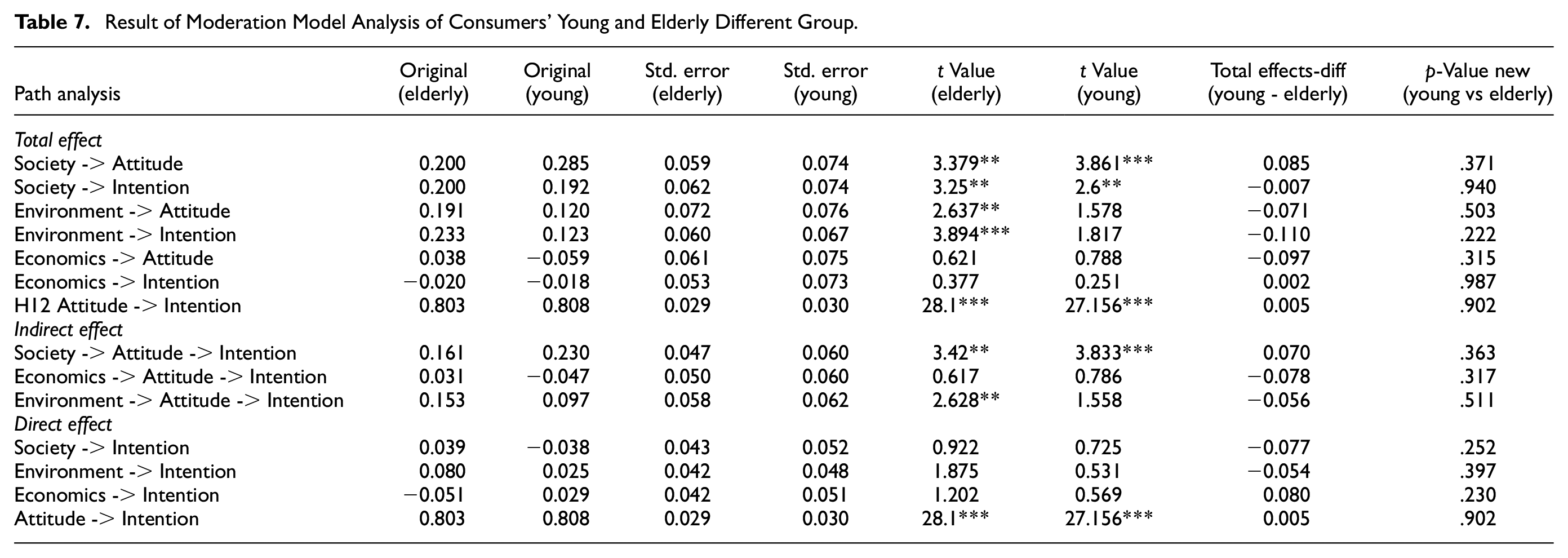
Regarding the other moderating variable, consumers’ age, Table 7 shows that consumers’ age groups (either young or elderly cluster) did not moderate the correlation between consumer attitudes and their intention to purchase a sustainable retirement village. Consequently, hypothesis 12 fails to accept.
Result of Moderation Model Analysis of Consumers’ Young and Elderly Different Group.
Conclusion
This paper aims to determine whether consumers’ gender and age influence their attitude and intention to purchase a sustainable retirement village in ETA and TRGP. The research subject focuses on post-retirement residences—sustainable retirement villages. Previous studies have predominantly used elderly consumers as their research sample. To address this research gap, this paper employs consumers’ gender and age as moderating variables to examine the relationship between their attitude and purchase intention, as influenced by the features of a sustainable retirement village. The following research questions are proposed: (a) Does consumer attitude impacts the relationship between the elements of a sustainable retirement village and their intention to relocate? (b) Does the gender and age of consumers moderate the relationship between their attitude and intention to purchase a sustainable retirement village?
This paper presents two findings to answer the proposed research questions. First, it addresses the mediating variable of consumer attitude. The findings reveal that consumers’ attitudes mediate the relationship between social and environmental sustainability and their intention to purchase a sustainable retirement village. It indicates that consumers are more concerned with their retirement lifestyles’ social and environmental aspects than economic worries. This result assumes that economic considerations will not be prominent in their retirement planning. Second, the results show that neither consumers’ gender nor age moderates the relationship between their attitude and intention to purchase a sustainable retirement community. Retirement topics should not be limited to only older male or female consumers. Young consumers also consider their retirement plans, in addition to their lifestyle, location, and gender.
The first finding demonstrates that, in line with the TRGP, (1) attitude toward behavior and (2) subjective norms represent external and internal factors influencing consumers’ attitudes, which subsequently translate into their purchase intentions. This paper’s external and internal factors pertain to a sustainable retirement village’s social and environmental aspects. The paper concludes that social and environmental sustainability impacts consumers’ attitudes, influencing their intention to purchase a sustainable retirement village. Furthermore, it highlights that the variables associated with social and environmental sustainability are related to the well-being and satisfaction of elders concerning their interaction between person and environment (Hu et al., 2020; Lim et al., 2022; Ng et al., 2020; Xia, Skitmore et al., 2015; Xia, Zuo et al., 2015).
On the other hand, social and environmental sustainability directly influences consumers’ attitudes and intentions to acquire sustainable retirement villages. It reflects that this social and environmental sustainability as external factors reflects adaptability, a sense of calm, safety, and security in their environment, healthy social connections, resource efficiency, climate change, and ecological system (Hu et al., 2020; Xia et al., 2021; Xia, Skitmore et al., 2015; Xia, Zuo et al., 2015). It signifies the interaction between person and environment theories, such as EST and ETA (Bronfenbrenner, 1979; Helmholtz, 1867; Lawton, 1977; Lawton & Nahemow, 1973), satisfies the elder’s expectations for their post-retirement residence. Additionally, this finding aligns with other studies (Lim et al., 2022; Ng et al., 2020; Wong & Tzeng, 2021; Yang et al., 2020). For example, Wong and Tzeng (2021) found that awareness of green products influenced food safety attitudes toward organic food purchase intentions. This finding suggests that influential factors, whether external or internal, impact consumers’ attitudes, affecting their intentions.
The second finding demonstrates that consumers’ gender or age does not influence their attitude toward the intention to purchase a sustainable retirement village. This result supports previous studies regarding consumers’ demographic factors such as income, age, and gender. However, certain demographic factors may affect consumers’ attitudes, intentions, and behaviors about product attributes (Patak et al., 2021; Witek & Kuźniar, 2020; Wong & Tzeng, 2019). For instance, Patak et al. (2021) found that environmental concerns, green lifestyle, promotion, and community influence female consumers’ intentions to purchase green chemicals. Additionally, age does not impact consumers’ willingness to buy green chemicals.
Interestingly, the results reveal that consumers’ attitudes and purchase intentions for a sustainable retirement village are not influenced by gender or age. Consequently, the key focus of this paper is to fulfill the research objective of examining the impact of consumers’ gender and age on their post-retirement residential choices, specifically their intention to purchase a sustainable retirement village. Notably, consumers’ gender, age, and living experiences significantly vary in the sustainable features of retirement villages (Xia et al., 2021).
The value of this paper lies in its exploration of consumers’ attitudes and intentions toward retirement housing arrangements. The study finds that gender and age are insignificant factors in determining these attitudes and intentions. The findings suggest marketers should focus on older consumers in retirement-related research topics to predict younger consumers’ purchasing intentions and behaviors. For instance, younger consumers consider housing needs when planning their future retirements through retirement savings plans and pension benefits in the post-COVID-19 era (Ketkaew et al., 2022; Tabor, 2020). Furthermore, the paper reveals that Chinese consumers prioritize social and environmental sustainability for their post-retirement residences. This trend is also observed in Australia, South Korea, and Malaysia, as demonstrated by studies conducted by Xia, Zuo et al. (2015), Park and Choi (2021), and Ng et al. (2020) respectively.
Limitations and Future Research
Because of the research objective and subject, this paper has two limitations. First, the research variables related to a retirement village’s sustainable components, consumers’ attitudes, and purchase intention have been limited. Second, the research sample is not restricted to the elderly due to the research object. As a result, the respondents were born during the 1960s, 1970s, 1980s, and 1990s. Therefore, the paper only collected samples from China.
One suggestion for future research is whether consumers’ culture affects the correlation between consumers’ attitudes and purchase intentions toward sustainable retirement villages. Specifically, it should be Asian countries. This is because these consumers have a similar culture in Asian countries regarding their residence after retirement.
Footnotes
Declaration of Conflicting Interests
The author(s) declared no potential conflicts of interest with respect to the research, authorship, and/or publication of this article.
Funding
The author(s) received no financial support for the research, authorship, and/or publication of this article.

Data Availability Statement
Data sharing not applicable to this article as no datasets were generated or analyzed during the current study.