




Abstract
An online survey was conducted to clarify the connotative meanings of the cute and the attitudes toward cuteness in three countries: Japan (n = 1,000), the United States (n = 718), and Israel (n = 437). The results show a remarkable resemblance in respondents’ conceptions of the cute (kawaii in Japanese and hamud in Hebrew) across countries. Except for slight cultural differences, the following common tendencies were found: (a) Cuteness is highly appreciated and believed to induce positive affective responses, (b) women tend to find things cute more frequently and strongly than men do, (c) animal babies are thought to be cuter than human babies, and (d) infants are found to be cuter when people get older, while older people generally show less positive attitudes toward cuteness. This study provides some evidence that the concept of cuteness and the feelings connected to its perception are universal.
Recently, the concept of cuteness has attracted attention in various fields, including psychology, neuroscience, aesthetics, marketing, and engineering (e.g., Dale et al., 2017; Kringelbach et al., 2016; Marcus et al., 2017; May, 2019; Nittono, 2016; Ohkura, 2019). As an adjective, “cute” describes something that is pleasant and attractive, particularly something young and vulnerable (e.g., babies, puppies, and kittens). Because the preference for cuteness is so natural and intuitive, it is often taken for granted that the concept of the cute is universal. However, it is not immediately evident how much the nuances of the word and people’s attitudes toward cuteness vary across cultural and linguistic contexts. For example, in American English, in addition to innocent, attractive, and charming, “cute” also means clever, quick-witted, and cunning, because it originated from the term “acute” in the 18th century (Dale et al., 2017; Oxford University Press, 2020c). Kawaii, the Japanese word for the concept, describes something adorable, endearing, and attractive. The word was derived from the ancient word kawahayushi, which meant a face [kao]-flushing [hayu] feeling toward miserable and pathetic people or situations (Nittono, 2016, p. 81). Kawaii has been an entry in the Oxford English Dictionary since 2010 (Oxford University Press, 2020d). In Hebrew, the equivalent term hamud, which originated from the biblical term lahmod (to covet), is used to describe something sweet, nice, and desirable (Doniach & Kahane, 1998).
More than just a term, cuteness is a broader psychological concept that stimulates an emotional effect in the beholder (Nittono, 2016; Sherman & Haidt, 2011). The psychology of cuteness can be traced back to the ethological idea of Kindchenschema (baby schema), which holds that physical characteristics such as a large and protruded forehead and a small chin, which are typically found in infants, trigger parental instincts and a desire to nurture the object (Lorenz, 1943). Indeed, the sight of cute objects evokes affective feelings characterized by a mixture of tenderness, caregiving, affiliation, and a kind of parental care that does not belong exclusively to parents but to everyone (Schaller, 2018; Sherman & Haidt, 2011; Steinnes et al., 2019).
Beyond the classical concept, Nenkov and Scott (2014) identified a new dimension of cuteness titled “whimsical cuteness.” Unlike kindchenschema cuteness, whimsical cuteness is not associated with the vulnerable nature of infants or young animals, but rather with the fun and playful characteristics of cute objects. Based on a series of behavioral experiments, Nenkov and Scott proposed that whimsical cuteness leads to indulgent and self-rewarding behavior, while kindchenschema cuteness leads to careful, responsible, and caretaking behavior. Therefore, cuteness appears to be a multifaceted construct with several underlying dimensions, although it has a unifying general concept at its core.
In psychology, cuteness is generally thought to be an attribute of a stimulus, typically a baby’s face. It has been used as a synonym of “infant physical attractiveness” (Hildebrandt & Fitzgerald, 1978; Karraker & Stern, 1990). In this sense, cuteness is perceived, not felt. On the contrary, the Japanese kawaii originally meant a feeling toward younger or weaker members of the society (Nittono, 2016). Buckley (2016) suggests that there is no English word that corresponds to the emotion of perceiving cuteness. Steinnes et al. (2019) echoed this view and added that not only English but also German and Norwegian lack a name for it, while some languages, such as Uralic languages (e.g., Hungarian, Estonian, and Finnish), do name it. Nevertheless, people around the world seem to agree that they have a special feeling when they see or have contact with cute beings, regardless of linguistic background. For example, Kalawski (2010) suggested that “tenderness” is an emotion in response to seeing a cute scene as well as a pitiful scene. Besides tender and gentle feelings, it seems to be a worldwide disposition that viewing a cute thing induces “cute aggression”: an urge to squeeze, pinch, or playfully attack it, as a countermeasure to regulate a strong positive emotion (Aragón et al., 2015; Dale et al., 2017).
While many previous researchers have focused on the characteristics and effects of cuteness, cross-cultural comparisons among people of different nationalities in relation to their definitions of and feelings toward cuteness have not yet been thoroughly conducted. Although people often assume that the concept of the cute is universal, it may not be true. For a more precise understanding of the characteristics of cuteness, an international online survey was conducted to obtain people’s views about cuteness in three different countries: Japan, the United States, and Israel.
The rationale for choosing these three countries is as follows. The authors were first interested in the recent development and prevalence of kawaii culture in Japan, which has been documented and well discussed in the literature (e.g., Kinsella, 1995; Yano, 2013). Then, American cute was picked up as a counterpart. This was because the two countries have been compared before in terms of the cool versus kawaii aesthetics (Botz-Bornstein, 2012), and American cute has been discussed extensively, including its relationship to the cool (Cross, 2004; Dale et al., 2017; May, 2019). In addition, Israel was added as a case study outside the countries that produced the dominant aesthetics to act as a comparison. The choice of Israel was partly for convenience. However, this country is considerably different from Japan and the United States both in language and history.
The first part of the survey addressed the connotative meanings of the cute and its equivalent words in respective countries (Study 1). The second part deals with similarities and differences between countries, genders, and age groups in terms of what people find to be cute and how they feel about cuteness (Study 2). Because there has been no previous empirical research on this topic, any specific hypotheses or predictions based on a specific conceptual framework cannot be given in advance. Although it is essentially a descriptive study, this survey is intended to be a starting point of this new field.
The Current Survey
Studies 1 and 2 were based on the same online survey, which was administered in three phases over a period of 9 months (between July 27, 2018, and May 1, 2019) in the local language of each country. The research protocol was approved by the Research Ethics Committee of the first author’s affiliation (29-112, 30-029, and HB019-116). A total of 2,155 respondents completed the questionnaire. Demographic variables (gender and age) were also obtained. Table 1 shows the summary of survey samples. Part of the Japanese data was published by Nittono (2019a) in an abbreviated form. The complete dataset is available at https://osf.io/hjgwv/.
Summary of Survey Samples.
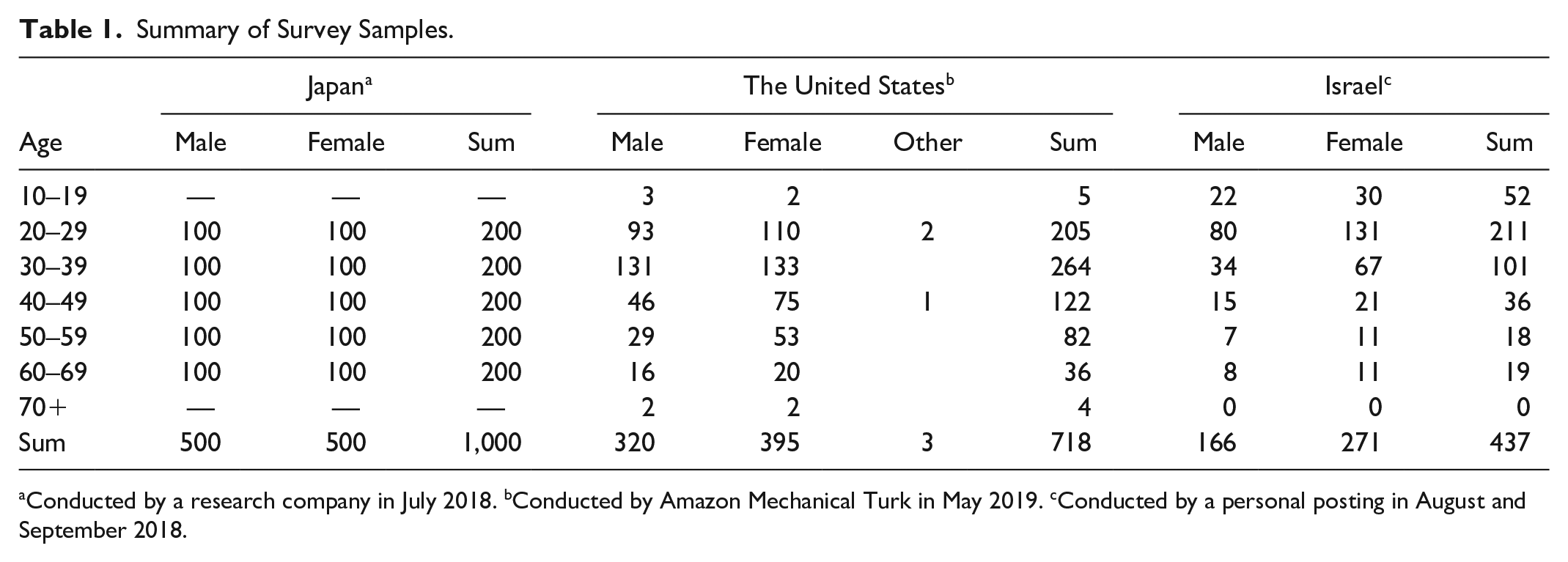
Conducted by a research company in July 2018. bConducted by Amazon Mechanical Turk in May 2019. cConducted by a personal posting in August and September 2018.
While the questionnaires were designed in a similar manner, a different web distribution measure was taken to reach each sample. The survey for Japanese was delivered over July 27–30, 2018, by a marketing company (Cross Marketing Group, Inc., Japan) to 1,000 Japanese men (n = 500) and Japanese women (n = 500), aged between 20 and 69. Respondents for the Israeli survey were solicited to participate through various social media groups (mainly Facebook) between August 12 and September 18, 2018. Respondents included personal acquaintances of the second author, general groups such as the Wild Guitars shop and the Orna Lieber School of Music and Arts [Mercaz Orna Lieber Lemuzika Vomanuyot], and some groups that had a connection to Japan, including the Embassy of Japan in Israel and Japan for Israeli Travelers. A total of 437 Israelis (271 women and 166 men) between the ages of 14 and 69 completed the questionnaire. A part of the survey that is not reported in this article was published by Lieber-Milo and Nittono (2019b). The survey for Americans was distributed on May 1, 2019, through Amazon Mechanical Turk (MTurk). A total of 718 Americans (395 women, 320 men, and three unspecified) in their teens and over completed the questionnaire. Their nationality was checked by self-report.
Before respondents were given the survey inquiries, a consent form page was presented to inform prospective candidates about the goals of the study, their voluntary participation, and a privacy policy stipulating that none of their personally identifiable information would be retained. All respondents, excluding Israeli respondents, received a small monetary compensation for their cooperation.
Study 1
The adjective “cute” describes something adorable and sweet that is cherished by many. While this appreciation of cuteness is hypothetically universal, its evaluation may depend on cultural nuances. History, beliefs, and language may construct different perspectives on cuteness. In the first study, the image of the cute or the equivalent term in each country was assessed using semantic differential scales (Osgood et al., 1957). For the purpose of comparison, the images of the related terms “beautiful” and “cool” were also assessed.
Method
In Study 1, the images of the cute, the beautiful, and the cool were assessed in the form of semantic differentials, which consisted of 10 pairs of bipolar adjective scales (e.g., “dislike–like” and “bad–good”). In the Japanese survey, kirei was used for beautiful instead of utsukushii because the former is more colloquial than the latter. Kakkoii, which literally means “look good,” was used as an equivalent of cool. In the Israeli survey, yafe and magniv were used for equivalents of beautiful and cool, respectively. The orders of target words and adjective pairs were randomized across respondents.
Results and Discussion
Figures 1 and 2 provide semantic profiles for each word, depicting the mean and 95% confidence intervals of the rating scores. Both figures show the same data. Figure 1 is arranged to facilitate the comparison of connotative meanings for the three adjectives, whereas Figure 2 is arranged to facilitate comparison across countries. The patterns of the graphs are remarkably similar across the three countries for each word concept. All three words were rated as likable and good. The characteristics of “cute” were childish, emotional, and approachable. Those of “beautiful” were superior, adult, significant, and expensive. “Cool” has few characteristics different from the other terms, although it was rated to be masculine, especially in Japan.

The semantic concepts of the words “cute,” “beautiful,” and “cool” in Japan, the United States, and Israel.

Comparison of the word concept across three countries.
Cute, kawaii, and hamud
The English term “cute” derived from the term “acute” in the 18th century and refered to someone sharp-witted as well as clever and cunning (Oxford University Press, 2020c). In the beginning, cute in American English had a negative association and did not convey its modern meaning of sweetness and innocence. The negative connotation faded away over the years, and the word is now used to describe something attractive in a pretty and endearing way (Dale et al., 2017).
On the contrary, the Japanese kawaii originated from kawahayushi, which expressed embarrassment. This conjoined word of “face” [kao] and “flushing/aglow” [hayu] was used to describe a sense of sympathy and pity toward weaker members of society such as women and children in ancient times (Nittono, 2016; Oxford University Press, 2020d). Later, this affective adjective came to express a tender and gentle feeling to the weak. Then, its original meaning of pity and shame was lost in the late early-modern period (ca. the 18th–19th centuries). It is said to be more similar to the English term “pretty” (Marcus et al., 2017, p. 34). In contemporary Japan, kawaii is considered one of the most frequent and common words to indicate objects that look lovely and adorable. Besides human and animal babies, it is a useful word for describing a wide range of types of people, including the elderly, as well as various commercial goods (Nittono, 2016). The present ubiquity of this word may be due to its implication of harmlessness, as the word is not associated with any danger or hostility. Kawaii has a wide spectrum of meanings that do not necessarily relate to classic (i.e., kindchenschema) cuteness. This character is reflected in coined compound adjectives such as kimo-kawaii (creepy but cute) and busa-kawaii (ugly but cute), which connect words of apparently opposite meanings (Nittono, 2019b).
As shown in Figure 2, Japanese people recognize kawaii as more feminine than the other respondents, although the other nationalities also rated the cute to be significantly more feminine than masculine. This Japanese characteristic seems to have a distinct historical origin. The kawaii aesthetic emerged in Japan as a part of girls’ culture in the early 20th century (Dale, 2020). Kawaii culture accelerated in the 1970s as a youth subculture among female junior high or high school students (Kinsella, 1995). Because this connotation has lasted to the present, many Japanese people associate kawaii with femininity. However, it is noteworthy that the “superior” rating of kawaii was higher in Japan than in other countries, suggesting that Japanese people consider kawaii to have power, not just vulnerability or weakness. This relatively new concept has now come to be shared with the Western world. As May (2019) pointed out, the fact that vulnerable cute objects have such power to stir our emotions is one factor that makes the cute “a powerful expression of the zeitgeist” (p. 9).
According to the Oxford English-Hebrew Dictionary, the equivalent of “cute” in the Hebrew language is hamud, which means pretty and sweet (Doniach & Kahane, 1998). Hamud has always had a positive meaning, while another word, mitchakem, is used for the other, original meaning of cute in American English, “too clever.” According to a Hebrew-Hebrew dictionary, hamud means nice, kind, and desirable (Even-Shoshan & Jarden, 2002). The roots of hamud (masculine) and hamuda (feminine) originate from the biblical term “to covet” (lahmod) which describes something adorable, cute, and delightful, and indicates objects that people desired (Academy of the Hebrew Language, 2011). Today, hamud is mainly used to describe young children or small animals and refers to their nice or sweet nature. However, the word can be used negatively, depending on the situation and intonation. For example, when the word is said in a critical tone, it is interpreted as offensive. It could be applied to women in a belittling or chauvinistic way or to men with the intent to question or damage their masculinity (Haaretz, 2017).
In sum, Study 1 shows that the overall meaning of the cute is highly similar in English, Japanese, and Hebrew, and that this concept generally has a positive (e.g., likable and good) attribution. Although part of this similarity may result from the recent increase of cultural exchange and globalization, it is also possible to credit a genetic or biological foundation underlying this psychological concept (Nittono, 2016).
The concepts of the beautiful and the cool
As the main focus of the current study is on the cute, the selection of the other concepts, the beautiful and the cool, was done without serious intent or rationale. Their equivalents in Japanese and Hebrew may not match the English words with the same precision as those for “cute.” However, there are reasonably good resemblances in their semantic profiles.
As compared with the cute, the concept of the beautiful was recognized as more adult, intellectual, significant, expensive, and formal, regardless of nationality. The term “beautiful” describes something with a grace in form, charm of coloring, and other attractive qualities that please the eye and senses (Oxford University Press, 2020a). Menninghaus et al. (2019) identify elegance, grace, and sexiness as the three aesthetic qualities most closely associated with the beautiful. More than a pleasure to the eye, beauty is a mental and physical experience that brings the viewer to a state of arousal through the experience of various feelings from desire and passion to happiness (Heller, 2012). Although the concepts of the beautiful and the cute share similar characteristics of attractiveness, the survey’s results show that the beautiful is a high-class concept characterized by being less emotional, more formal, and more expensive, which may make it less approachable than the cute.
There is an interesting etymological link in Japanese between the terms for the cute and the beautiful. In ancient Japan, the term utsukushi, which currently means “beautiful,” was used to describe lovely and adorable things or people, which would be called cute or kawaii from a modern Japanese perspective. A good example of the relationship is the 10th- or 11th-century essay by Sei Shōnagon, The Pillow Book [Makuranosōshi] (Morris, 1967). In one of her chapters, titled “Adorable Things” [Utsukushiki mono], she gives the examples of a baby, a little girl, and small objects as things that are appealing to her. In early-modern times, the word shifted to represent an ideal beauty, and its original meaning was taken over by a different word, kawaii, with a different origin.
The relationship of the cute and the beautiful to femininity differs across countries. For Japanese survey respondents, kawaii (cute) and kirei (beautiful) were similar in perceived femininity. “Beautiful” was rated to be more feminine than “cute” in the United States, whereas the opposite was true in Israel. We do not further discuss cultural differences of this aspect here, because the Japanese and Hebrew words corresponding to “beautiful” were chosen rather arbitrarily, and semantic matching was not achieved as precisely as for “cute.” Nevertheless, it is clear that cuteness is generally associated with femininity, as described in the previous section.
Compared with the cute, the concept of the cool was characterized as masculine. Although it is most evident in Japan, all the three nationalities have this tendency in common. In the formal–informal dimension, “cute” and “cool” were similar. However, “cool” was rated lower than “cute” in approachability. “Cool” has several meanings (Oxford University Press, 2020b). The initial meaning is moderately cold in an agreeable or refreshing way. It is also used to describe a personal attribute: not affected by passion, controlled, and calm. Then, as a colloquial term originally used in the United States, it means attractively shrewd or clever, sophisticated, and fashionable. As such, the concept of the cool conveys an atmosphere of calmness, aloofness, and restraint under stressful situations. “Cool” is a modern slang term that has its roots in prewar Black American culture as a crucial component of African American male identity (Majors & Billson, 1992). It became part of U.S. consumer and business culture in the 1960s (Frank, 1997) and is now used as a universal term of approval, especially among youth (Pountain & Robins, 2000). According to Botz-Bornstein (2012), “cool” is an attitude in which a person remains relaxed and demonstrates an emotional self-control carried off by virtue of his or her unique style. Both the cool and the cute aesthetics are rooted in contemporary material commercial culture. They have transformed into fashion statements expressed by youth culture: Hippies, followed by hip-hop in the United States in the 1960s to 1970s, and Lolita and Harajuku fashion in Japan in the 1980s to 1990s. These examples of subcultures rose as rebellions against society that allowed their adherents to express their feelings and opinions against the social norms of the time (Kinsella, 1995).
In conclusion, the results of Study 1 show that Japanese, American, and Israeli respondents evaluate the cute in approximately the same manner. Compared with the beautiful and the cool, the cute is characterized by its emotionality, childishness, and in particular high approachability, while all three adjectives are regarded as likable and good. It is also found that the cute is generally associated with femininity, not only in Japan but also in other countries.
Study 2
In Study 2, the survey focused on the cute as a type of feeling. Although the English word is usually used to describe a physical attribute of objects like babies and animals, perceiving cuteness is associated with a tender, adorable, and endearing feeling that is seemingly distinct from other positive feelings (Buckley, 2016; Kalawski, 2010; Steinnes et al., 2019). Here, we call it “cute feelings.” In this study, it is hypothesized that there are commonalities across countries in the types of objects that are felt or perceived to be cute, people’s attitudes toward cuteness, and their beliefs about the effect of cute things.
As kawaii is an important keyword of contemporary Japanese culture and can be seen in almost every channel of Japanese society—from Hello Kitty and idol singers to government public relations (Marcus et al., 2017; Ohkura, 2019; Yano, 2013)—it was assumed that Japanese people would show more positive attitudes toward cuteness in comparison with other nationalities. Moreover, gender and age would affect attitudes toward cuteness and what types of objects are found to be cute. Specifically, a previous study showed that young Japanese female students were more sensitive to cute things than young male students (Nittono, 2016). We examined whether this gender difference can be seen in other countries with different cultural backgrounds.
Method
The survey was conducted together with Study 1. The following two questions were asked using 6-point Likert-type scales without midpoint, considering the cultural differences in the preference for the middle option of the scale, namely, that Asian people are more likely to select the midpoints than Western people (Dolnicar & Grün, 2007; R. Wang et al., 2008).
A. How often or how much do you feel the items on the following list are cute (1 = never to 6 = extremely): (1) infants, (2) adult men, (3) adult women, (4) baby animals (such as puppies), (5) adult animals, (6) objects (such as teddy bears and small toys that represent living things), and (7) things (such as clothes and accessories that do not represent living things).
B. How much do you agree with the following statements (1 = strongly disagree to 6 = strongly agree): (1) I love cute things, (2) I get excited when I see cute things, (3) I feel better after touching cute things, (4) I often use the word “cute,” (5) I’m friendlier when observing anything cute, (6) Cute behavior helps to create a good environment, and (7) Cute behavior can be a useful tactic for obtaining favors.
Although the questionnaire was designed in a similar manner for all three national groups, Japanese respondents were not given the last three statements, which were added later when the Israeli and American surveys were conducted. The respondents were categorized into five age groups: 20s (20–29 years old), 30s (30–39 years old), 40s (40–49 years old), 50s (50–59 years old), and 60s (60–69 years old). To analyze the effect of gender and age in a factorial manner, the data of those who were younger than 20 or 70 years old and over (n = 61) and those who marked their gender as “other” (n = 3) were removed from the analysis of Study 2. The remaining sample sizes were 1,000, 706, and 385 for the Japanese, American, and Israeli surveys. Analyses of variance (ANOVAs) with repeated measures were applied to the dataset. For all analysis, the significance level was set at .05. Because this is a descriptive study, each item was dealt with independently and was analyzed separately without correction for multiple comparisons. Also, each country’s data were analyzed separately for descriptive purposes, even if there is no significant interaction. Statistical significance was assessed after Greenhouse–Geisser ε correction to compensate for Type I error inflation due to the violation of sphericity assumption.
Results
Frequency/strength of cute feelings
Figure 3 shows the mean ratings of cute feelings toward various objects. First, all the data were submitted to a Country × Gender × Age × Item ANOVA (see Supplementary Table S1 for a full description). A significant main effect of country was found, F(2, 2061) = 76.16, p < .001. Post hoc multiple comparison showed that the respondents in the United States (M = 4.33) gave higher scores than did the respondents in Japan and Israel (Ms = 3.88 and 3.82, respectively). Although the Country × Gender × Age × Item interaction was not significant, F(48, 12366) = 1.06, p = .362, the interaction effects of Country × Gender × Item and Country × Age × Item were significant, F(12, 12366) = 7.12, p < .001; F(48, 12366) = 1.89, p < .001, respectively.

How often or how much do you feel the items on the following list are “cute”? 1 = never, 6 = extremely.
These significant interaction effects suggest that the effects of gender and age differed across countries and items. Therefore, a Gender × Age ANOVA was applied separately for each item and each country (see Supplementary Table S2 for a full description). Asterisks in Figure 3 indicate the items showing a statistically significant gender difference. Female respondents gave higher scores of cute feelings than male respondents for almost all items, Fs > 5.30, ps < .022, while there were two exceptions. First, “adult women” was rated higher by male respondents than by female respondents, F(1, 990) = 35.86, p < .001; F(1, 696) = 49.59, p < .001, in Japan and the United States, respectively. A similar trend also appeared in Israel, but it did not reach the significance level, F(1, 375) = 1.47, p = .227. Second, “infants” was rated equally high by both male and female Israelis without gender difference, F < 1.
As for age differences, brackets in Figure 3 indicate the items showing a significant effect of age. Older respondents gave higher ratings to some items (e.g., infants in all countries, baby animals in the United States), but lower ratings to other items (e.g., objects and things in Japan, and adult animals in Japan and Israel). This means that what one finds to be cute changes over one’s lifetime. In particular, there was a robust common tendency across countries that infants are found to be cute more frequently/strongly when people get older, F(4, 990) = 6.87, F(4, 696) = 7.32, F(4, 375) = 6.91, all ps < .001, in Japan, the United States, and Israel, respectively.
Consistent with the omnibus ANOVA, no Gender × Age interaction effect was statistically significant, except for the ratings for “adult women” in Japan, F(4, 990) = 3.84, p = .004, and the ratings for “things” in Israel, F(4, 375) = 2.54, p = .039. For the former, the analyses of the simple main effects reveal that Japanese male respondents did not show age differences in the ratings of “adult women,” whereas younger Japanese female respondents gave higher ratings for “adult women” than older female respondents. For the latter, the analyses of the simple main effects reveal that Israeli male respondents did not show age differences in the ratings of “things,” whereas female respondents in their 20s gave higher ratings for “things” than female respondents in their 30s.
Human versus animal babies
To examine whether infants or baby animals are felt to be cuter, a Country × Gender × Age × Species (human vs. animal babies) interaction was conducted (see Supplementary Table S3 for a full description). The main effect of species was significant, F(1, 2061) = 92.13, p < .001, suggesting that animal babies (M = 5.24) are generally felt to be cuter than human babies (M = 4.83). The Country × Species, Age × Species, and Country × Age × Species interactions were also significant, F(2, 2061) = 7.28, p < .001; F(4, 2061) = 13.06, p < .001; F(8, 2061) = 4.92, p < .001, respectively. No gender-related interactions were found. Then, the effect of species was tested for each age group and each country, collapsing across genders. The results are summarized in Table 2. In all countries, young people gave higher ratings for animal babies than for human babies. However, the ratings for human babies increased with age. Older people in their 60s gave similarly high scores for both human and animal babies.
The Ratings of the Frequency/Strength That Human and Animal Babies Were Felt to Be Cute.
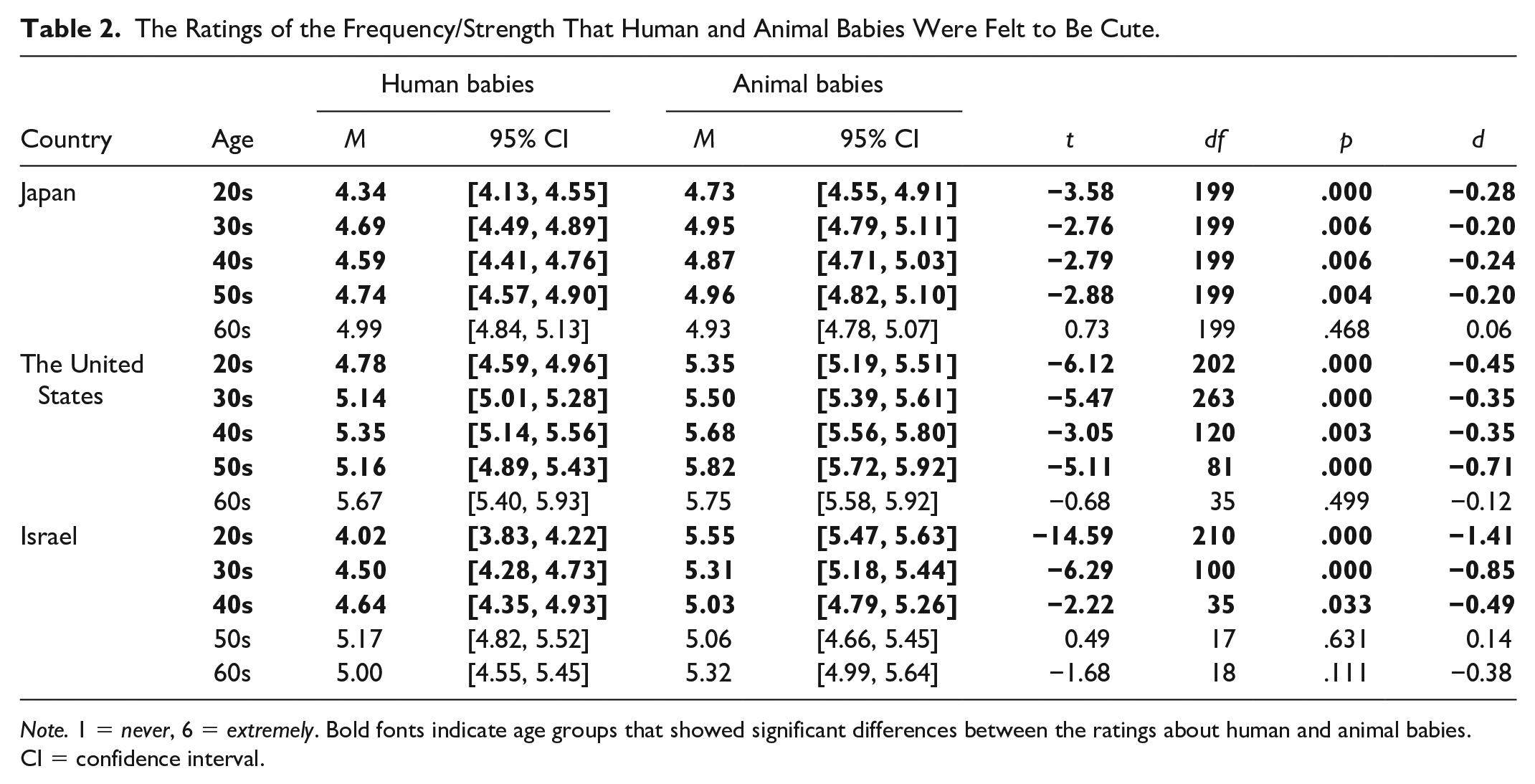
Note. 1 = never, 6 = extremely. Bold fonts indicate age groups that showed significant differences between the ratings about human and animal babies. CI = confidence interval.
Adult men versus women
To examine the feelings toward adults, a Country × Gender × Age × Object Gender (adult men vs. women) ANOVA was conducted (see Supplementary Table S4 for a full description). The main effect of object gender was significant, F(1, 2061) = 485.33, p < .001, suggesting that “adult women” (M = 3.60) was generally rated higher than “adult men” (M = 2.58). The Country × Gender × Object Gender interaction was significant, F(2, 2061) = 30.67, p < .001. No age-related interactions were found. Therefore, the effect of object gender was tested in each country separately for male and female respondents. The results are summarized in Table 3. Across all countries, male respondents gave higher cute ratings to “adult women” than to “adult men.” On the contrary, Japanese female respondents gave higher ratings to women than to men, whereas U.S. and Israeli female respondents gave equally high ratings to men and women.
The Ratings of the Frequency/Strength That Adult Men and Women Were Felt to Be Cute.

Note. 1 = never, 6 = extremely. Bold fonts indicate gender groups that showed significant differences between the ratings about men and women. CI = confidence interval.
Attitudes toward cuteness
Figure 4 shows the mean rating scores for each attitudinal question. First, the data of each question were submitted to a Country × Gender × Age ANOVA to ascertain the country-related differences (see Supplementary Table S5 for a full description). For the first four questions, the main effect of country was significant, F(2, 2061) = 77.12, 32.43, 5.09, and 17.36, ps < .007. Post hoc comparison showed that Japanese respondents gave significantly lower scores to all the four questions than the U.S. respondents and to all except Question 3, “I feel better after touching cute things” than Israeli respondents. For Question 5, “I’m friendlier when observing anything cute,” American people (M = 4.51) gave higher scores than Israeli people (M = 4.20), F(1, 1071) = 9.46, p = .002. In contrast, Israeli people (M = 4.56) gave higher scores than American people (M = 4.33) for Question 6, “Cute behavior helps to create a good environment,” F(1, 1071) = 5.62, p = .018. No country differences were found for Question 7, “Cute behavior can be a useful tactic for obtaining favors,” which received a generally positive response relative to the midpoint.

How much do you agree with the following statements? 1 = strongly disagree, 6 = strongly agree.
A Gender × Age ANOVA was conducted for each question and country (see Supplementary Table S6 for a full description). When an interaction effect was found, the simple effect of age was tested separately for male and female respondents. This analysis leads to three major findings. First, attitudes toward cuteness differed between men and women. The question items that showed a significant gender difference are marked with asterisks in Figure 4. In all countries, female respondents answered more positively than male respondents to the first four questions: “I love cute things,” “I get excited when I see cute things,” “I feel better after touching cute things,” and “I often use the word ‘cute,’” ps < .001. American and Israeli female respondents also answered more positively than male respondents to Question 5, “I’m friendlier when observing anything cute.” Among these question items, the largest gender difference was found for the frequency of using the word “cute” in Japan and the United States. While Israel had a similar trend, the gender difference was numerically larger for the question items about “love” and “get excited” than for the frequency of word usage. In all countries, the women’s mean ratings of word usage exceeded the virtual midpoint of 3.5 (3.68, 4.29, and 4.36 in Japan, the United States, and Israel, respectively), whereas the men’s mean ratings fell below the midpoint (2.76, 3.15, and 3.13, respectively). This result suggests that women are disposed to use the word “cute,” whereas men hesitate to use this word, regardless of the country. No gender differences were found for the questions, “Cute behavior helps to create a good environment” or “Cute behavior can be a useful tactic for obtaining favors,” to which both male and female respondents in the United States and Israel answered equally positively.
The second finding of the aforementioned Gender × Age analysis is that attitudes toward cuteness differed across age. The question items that showed a significant age difference are marked with brackets in Figure 4. In all countries, younger people tend to use the word “cute” more often than older people. The main effect of age was significant in Japan, the United States, and Israel, F(4, 990) = 2.59, p = .035; F(4, 696) = 4.79, p = .001; F(4, 375) = 3.25, p = .012, respectively. Moreover, compared with older people, younger people tended to give higher scores to the items “I love cute things” and “I get excited when I see cute things” in the United States and Israel and to the item “feel better” in the United States, ps < .005, although older people were also positive on these items as their mean scores generally exceed the midpoint.
The third finding of the above analysis is that Japan was different from the other countries in that male respondents did not show age differences in attitudes toward cuteness. The Gender × Age interaction was significant for all of the four question items to which Japanese respondents answered, ps < .012, whereas no interaction effects were found for the same question items in the other countries. The significant interaction specific to the Japanese sample results from the fact that Japanese men did not show age differences in their attitudes toward cuteness, p > .284. More specifically, Japanese young men did not give as high scores to the attitudinal questions as American and Israeli men of the same age group. This may be because the Japanese word kawaii is perceived to be more feminine than the English and Hebrew equivalents, as described in Study 1 (see Figure 2), and is regarded as a concept that belongs to female culture. The Gender × Age interaction was also significant for Question 6, “Cute behavior helps to create a good environment” in the United States, where only female respondents showed a significant age difference, F(4, 310) = 2.09 and F(4, 386) = 6.20, p = .082 and p < .001, for men and women, respectively.
Discussion
Study 2 deals with the types of objects that people find cute, attitudes toward cuteness, and beliefs about the effect of cute things. The results show that similar types of objects are found to be cute in Japan, the United States, and Israel, and that people are generally favorable toward cuteness, as it brings them positive feelings. Sorting out the complex results, we summarize major findings below.
The first question revealed five points. (1) Japanese people are not particularly enthusiastic about cute things. Rather, American people’s rating of cute feelings is highest among the three nationalities. (2) In all countries, women have cute feelings more often than men in response to various objects, except for “adult women,” to which men tend to have cute feelings more often than do women. (3) Age affects the type of object found to be cute. Specifically, older people find human babies cute more often than young people. (4) Animal babies are found to be cute more often and strongly than human babies are, although the difference decreases with age, and the rating scores become equally high in one’s 60s. (5) “Adult women” are generally found to be cute more often than “adult men.” In addition to male respondents of the three countries, Japanese women also answer in this direction.
The second question revealed the following points. (6) Japanese people do not care more for cuteness compared with those from other countries. (7) Women generally have more positive attitudes toward cuteness than men. In all countries, women are liable to use the word “cute” or its equivalents often, while men do not tend to use the word. (8) Younger people are more positive about cuteness than older people, although the latter do not show negative attitudes. The only exception is Japanese men, who did not show age differences.
Cultural differences
Although the main purpose of this study is to determine the transcultural features of cute feelings, we first discuss the differences among countries. Contrary to the prevalence of kawaii cultures reported in the literature (Dale et al., 2017; Kinsella, 1995; Yano, 2013), Japanese people do not have cute feelings more often or do not have more positive attitudes toward cuteness than people from other countries. Part of this result may stem from the general propensity of Asians, including Japanese people, to avoid extreme response options and prefer the midpoint (Dolnicar & Grün, 2007; R. Wang et al., 2008). Although the study’s scales did not have a midpoint, Japanese people have a tendency to select middle options more often than extreme options, which leads to lower, less extreme scores. Therefore, the absolute differences in mean values among countries are not easy to interpret. Nevertheless, at least we can say that cute feelings are also prevalent and appreciated positively in the United States and Israel. Consistent with this finding, Berque et al. (2019) reported that American college students found various photographs to be cute more often than Japanese students, with less gender difference, although only 47 students were sampled.
The finding that Japanese men—particularly in the younger generation—showed lower (but still medium) attitudinal scores toward cuteness compared with their counterparts in other countries implies that the Japanese kawaii is more associated with femininity than the English “cute” or the Hebrew hamud. This idea is consistent with the result of Study 1 about the connotative meanings of the words. In Japan, kawaii is rated to be significantly more feminine than “cute” and hamud, which is reflected in the leftmost graph of Figure 2; the 95% confidence intervals do not overlap between Japan and other countries on the masculine–feminine scale. For Japan, kawaii is a reminder of cultural phenomenon that boomed in the 1970s among young female students (Kinsella, 1995). As it is still associated strongly with femininity, young Japanese men may hesitate to express favorable attitudes toward kawaii. As a consequence, their scores become similar to those of older people, and the age difference disappears. The cute is associated more with femininity than with masculinity in other countries as well. However, because of differing historical and cultural backgrounds, young men in the United States and Israel can express their feelings more freely.
The strong association between Japanese kawaii and femininity is also reflected in Japanese women’s responses to “adult men” and “adult women.” Although there are no statistical differences in frequency/strength of cute feelings between these items in the United States and Israel (numerically, American women gave higher scores to adult men than to adult women), Japanese women gave higher scores to adult women than to adult men. Irrespective of nationality, men gave higher scores to adult women than to adult men. Therefore, not only men but also women associate kawaii with femininity in Japan.
Targets that evoke cute feelings
Despite minor differences, many features are found in common across three countries. Somewhat counterintuitively, human babies are not the cutest entity. Rather, animal babies induce cute feelings more frequently and strongly than human babies do, although older people found human babies to be cute more often than did young people, and the human–animal difference disappeared in the later stage of life. This tendency exists consistently across the three countries. Although the result does not fit the idea that cute feelings are associated with the nurturing and protection of offspring, it agrees with Lorenz’s (1943) original proposal that cute feelings are induced by specific stimulus features. In fact, the cuteness of pet animals is stimulated by the same physical cues as that of human babies (Borgi & Cirulli, 2016; Little, 2012). Considering that pet animals have been bred to meet the taste of humans (Francis, 2015), it is natural that animal babies are found to be cute more extensively than are human babies.
Generally, adult women are found to be cute more often than adult men are. This is not surprising because the cute is associated with femininity, as Study 1 shows. However, except for Japan, adult men are found to be cute to at least the same degree as adult women are. This result may reflect approachability, a distinctive feature of the cute. Previous studies have shown that when baby schema features in an infant face are enhanced, the motivation to see that face for a longer period of time is increased compared with when the same features are reduced (Hahn et al., 2013; Parsons et al., 2011). Moreover, in addition to pictures of infants and baby animals, other pictures that are rated to be kawaii but have no baby schema features are voluntarily looked at longer (Nittono & Ihara, 2017). Focusing on the Japanese kawaii, Nittono (2016) proposed that as an emotion, kawaii is characterized as “positive, unthreatened (in that the subject does not feel under threat), moderately aroused, approach-motivated and socially oriented” (p. 89). The current findings suggest that, not limited to the Japanese kawaii, cute feelings are better conceptualized as an emotion linked with approach motivation and social engagement (Borgi & Cirulli, 2016; Sherman & Haidt, 2011).
Gender differences
In all countries, women are more sensitive, reactive, and positive to cute things than men are. In particular, women use the word “cute” or its equivalents more often than men, who hesitate to use the word. This result is consistent with the finding of a previous study conducted in Japan (Nittono, 2016). As described above, kawaii is historically associated with female culture in Japan. Nevertheless, women’s preponderance in the realm of cuteness is also found in other countries.
One possible explanation is that the biological role of giving birth and rearing children may be related to the perceptions of and attitudes toward cuteness. As a general trend, women are more interested in children than are men, regardless of age (Maestripieri & Pelka, 2002). Moreover, women are more sensitive to the slight differences in physical attractiveness of infant faces (Lobmaier et al., 2010). Previous research suggests that female reproductive hormones can increase the sensitivity of cuteness perception (DeBruine et al., 2016). Sprengelmeyer et al. (2009) reported that those who were assumed to have a higher level of female reproductive hormones (i.e., premenopausal women or women who took oral contraceptives) showed better performance in a cuteness discrimination task, although subsequent research could not specify the hormones responsible for this effect (Lobmaier et al., 2015). Another study of young female participants (Hahn et al., 2015) reported that the rewarding value of infant faces, which was measured by the number of button presses to increase the viewing duration of the face, was affected by the within-subject changes in women’s salivary testosterone, a male steroid hormone that is secreted also in women. These hormonal effects imply that sensitivity and attitudes toward cuteness are not only affected by biological sex but also modulated by age and life events (e.g., giving birth, parenting, or mating; Schaller, 2018). It is also possible that social status (e.g., students and industrial workers) affects women’s views and attitudes toward cuteness (Lieber-Milo, 2019).
Age differences
On the whole, favorable responses to cuteness decline with age, consistent with the widespread notion that cuteness is a marker of youth culture. However, the frequency and strength of cute feelings toward human infants increase with age across all three countries. This finding is consistent with the result of field studies that examined the frequency of glances at a baby on a street or in a shopping mall (Nishiyama et al., 2015; Robinson et al., 1979; Schleidt et al., 1980). There is a U-shaped function between a viewer’s estimated age and the likelihood of giving attention to a stranger’s baby, which was higher in people in their teens or younger and their 50s to 60s and lower in between, that is, in the working and child-rearing generation. Moreover, the social role of grandparents, especially grandmothers, has been shown to affect positive responsiveness to babies (Feldman & Nash, 1979).
These findings make a case against the idea that cute feelings peak in youth and dull with age. Rather, the target that evokes cute feelings seems to change across life stages. Another age difference may be that older people have better emotion regulation skills than younger people (Gurera & Isaacowitz, 2019). The cute aggression theory holds that cute things can induce positive feelings too strong to control, which requires an opposite behavioral tendency of apparent aggressive behavior, such as squeezing and pinching, to contain and neutralize an extreme affective state (Aragón et al., 2015). If young people are too responsive to cute things, they may take impulsive behavior, especially because of the indulgent and self-rewarding tendency induced by whimsical cuteness (Nenkov & Scott, 2014). In contrast, older people may be more restrained and enjoy the positive aspect of cute feelings. Even if the sensitivity to slight differences in infants’ facial cuteness decreases with age (Sprengelmeyer et al., 2009), this change can contribute positively to more benevolent attitudes toward babies regardless of their physical appearance.
General Discussion
The online survey of Japan, the United States, and Israel administered in this study reveals that the semantic concept of “cute” and its equivalent words is transcultural. It also shows that people have cute feelings toward similar objects and express favorable attitudes toward cuteness regardless of nationality. Although minor differences exist—depending on the etymology and historical background of the word—the overall trend is remarkably similar, which strengthens the idea that the concept of the cute and aesthetics of cuteness are global and already established in the contemporary world. Although it is said that the English language does not have a proper word for expressing the feeling of perceiving cuteness (Buckley, 2016), the experience itself is comprehensible and familiar in the English-speaking world as well and can be described by other affective adjectives such as “tender” (Kalawski, 2010) and “heartwarming” (Steinnes et al., 2019). Moreover, the experience has been shown to change subsequent behaviors in various parts of the world (Karreman & Riem, 2019; Nenkov & Scott, 2014; Nittono et al., 2012; Sherman et al., 2009; T. Wang et al., 2017).
As mentioned in the introduction, Nenkov and Scott (2014) proposed two dimensions of cuteness: kindchenschema cuteness and whimsical cuteness. They described the two dimensions with different sets of adjectives: “vulnerable, naive, and caretaking” for the former and “whimsical, playful, and fun” for the latter. The common adjectives for both are “cute, adorable, and endearing.” The present study deals with cuteness as a whole and does not break it down into segments. However, because the result shows that cute feelings are sometimes associated with adult men and women, which cannot be categorized into either the kindchenschema or whimsical dimension, cuteness appears to have more dimensions than the two proposed by Nenkov and Scott (2014).
Sherman and Haidt (2011) argued that perceiving cuteness motivates social engagement. Steinnes et al. (2019) further proposed that the emotional response to cute entities results from a sudden intensification of a communal sharing relationship with the cute target. These studies suggest that cute feelings are a social-relational emotion that is linked to the wish for being together with others. Analyzing Japanese kawaii culture from a behavioral science perspective, Nittono (2016) proposed a two-layer model of kawaii, which holds that the psychology of kawaii has both a biological basis (kawaii as an emotion) and cultural determinants (kawaii as a social value). He argued that kawaii is an affiliative positive emotion with approach motivation that is developed in an unthreatening situation, rather than a reaction to vulnerability and infantility that has been assumed in the classical view of cuteness. Although this disposition is seemingly rooted in human nature, it became recognized and socially accepted in Japan ahead of other countries due to a boom in kawaii culture beginning in the 1970s and because certain characteristics of Japanese culture in general foster this trait. The results of the present study support this two-layer model in that cute feelings exist irrespective of culture and have become popular in countries other than Japan.
Although their historical and cultural backgrounds are different, the three countries addressed in this study are all under the influence of modern consumer culture. Part of the observed commonality may stem from globalization; for instance, the merchandising of characters and comics can mediate the rapid permeation of a social value (Lieber-Milo & Nittono, 2019a; Pellitteri, 2018; Yano, 2013). Further studies, preferably longitudinal ones, in other countries and areas will reveal the universal nature of cute feelings and how they become accepted in each society.
The online survey reported in this article has a number of limitations. First, the survey was conducted without any countermeasure or manipulation check against unfaithful answers (Oppenheimer et al., 2009). Second, the sample size and the sampling procedure may not be optimal in a statistical sense. Third, the constitution of the questionnaire and the time of administration were slightly different across the three countries. Nevertheless, these drawbacks are unlikely to discredit the major findings of the present study about the connotative meanings of the cute and people’s favorable attitudes toward cuteness. Fourth, the variety of question items, including the adjective pairs of the semantic differential method (Study 1), was limited and not comprehensive. If other adjective pairs than the current 10 items are used, more clear differences between countries may be found. Fifth, this study is purely descriptive and not based on a specific theoretical framework. In future research, it is preferable to use a more elaborative set of questions, specify a latent factor structure, and examine various levels of measurement invariance across cultures. Finally, the quantitative approach in the present study should be complemented by qualitative approaches such as interviews and field observations to get a more nuanced picture of the feelings and attitudes toward the cute and related concepts.
Despite these limitations, this study is the first empirical research on this topic and provides some evidence that the concept of the cute is transcultural and that cute feelings are a sensation shared commonly in many countries of the contemporary world, with only minor differences. The findings should be further tested in other countries and areas to discover whether they may be generalized beyond the three countries investigated in this study.
Supplemental Material
sj-docx-1-sgo-10.1177_2158244020988730 – Supplemental material for Cross-Cultural Comparisons of the Cute and Related Concepts in Japan, the United States, and Israel
Supplemental material, sj-docx-1-sgo-10.1177_2158244020988730 for Cross-Cultural Comparisons of the Cute and Related Concepts in Japan, the United States, and Israel by Hiroshi Nittono, Shiri Lieber-Milo and Joshua P. Dale in SAGE Open
Supplemental Material
sj-xlsx-2-sgo-10.1177_2158244020988730 – Supplemental material for Cross-Cultural Comparisons of the Cute and Related Concepts in Japan, the United States, and Israel
Supplemental material, sj-xlsx-2-sgo-10.1177_2158244020988730 for Cross-Cultural Comparisons of the Cute and Related Concepts in Japan, the United States, and Israel by Hiroshi Nittono, Shiri Lieber-Milo and Joshua P. Dale in SAGE Open
Supplemental Material
sj-xlsx-3-sgo-10.1177_2158244020988730 – Supplemental material for Cross-Cultural Comparisons of the Cute and Related Concepts in Japan, the United States, and Israel
Supplemental material, sj-xlsx-3-sgo-10.1177_2158244020988730 for Cross-Cultural Comparisons of the Cute and Related Concepts in Japan, the United States, and Israel by Hiroshi Nittono, Shiri Lieber-Milo and Joshua P. Dale in SAGE Open
Supplemental Material
sj-xlsx-4-sgo-10.1177_2158244020988730 – Supplemental material for Cross-Cultural Comparisons of the Cute and Related Concepts in Japan, the United States, and Israel
Supplemental material, sj-xlsx-4-sgo-10.1177_2158244020988730 for Cross-Cultural Comparisons of the Cute and Related Concepts in Japan, the United States, and Israel by Hiroshi Nittono, Shiri Lieber-Milo and Joshua P. Dale in SAGE Open
Supplemental Material
sj-xlsx-5-sgo-10.1177_2158244020988730 – Supplemental material for Cross-Cultural Comparisons of the Cute and Related Concepts in Japan, the United States, and Israel
Supplemental material, sj-xlsx-5-sgo-10.1177_2158244020988730 for Cross-Cultural Comparisons of the Cute and Related Concepts in Japan, the United States, and Israel by Hiroshi Nittono, Shiri Lieber-Milo and Joshua P. Dale in SAGE Open
Supplemental Material
sj-xlsx-6-sgo-10.1177_2158244020988730 – Supplemental material for Cross-Cultural Comparisons of the Cute and Related Concepts in Japan, the United States, and Israel
Supplemental material, sj-xlsx-6-sgo-10.1177_2158244020988730 for Cross-Cultural Comparisons of the Cute and Related Concepts in Japan, the United States, and Israel by Hiroshi Nittono, Shiri Lieber-Milo and Joshua P. Dale in SAGE Open
Supplemental Material
sj-xlsx-7-sgo-10.1177_2158244020988730 – Supplemental material for Cross-Cultural Comparisons of the Cute and Related Concepts in Japan, the United States, and Israel
Supplemental material, sj-xlsx-7-sgo-10.1177_2158244020988730 for Cross-Cultural Comparisons of the Cute and Related Concepts in Japan, the United States, and Israel by Hiroshi Nittono, Shiri Lieber-Milo and Joshua P. Dale in SAGE Open
Footnotes
Authors’ Note
The research protocol was approved by the Behavioral Research Ethics Committee of the Osaka University School of Human Sciences (29-112, 30-029, and HB019-116). The respondents were informed that those who had completed the questionnaire were deemed to give consent.
Declaration of Conflicting Interests
The author(s) declared no potential conflicts of interest with respect to the research, authorship, and/or publication of this article.
Funding
The author(s) disclosed receipt of the following financial support for the research, authorship, and/or publication of this article: This research is supported by Japan Society for the Promotion of Science KAKENHI Grant Number JP17H02651 to Hiroshi Nittono.

Supplemental Material
Supplemental material for this article is available online.
References
Supplementary Material
Please find the following supplemental material available below.
For Open Access articles published under a Creative Commons License, all supplemental material carries the same license as the article it is associated with.
For non-Open Access articles published, all supplemental material carries a non-exclusive license, and permission requests for re-use of supplemental material or any part of supplemental material shall be sent directly to the copyright owner as specified in the copyright notice associated with the article.
