




Abstract
As teacher well-being is impacted by the leadership ability of school management, which helps establish trust and cooperation among the teaching faculty, it is an important subject of research. Therefore, this study aims to explore how the authentic leadership of school principals impacts (1) the teacher-school relationship (based on organizational trust, organizational identification, and organizational commitment), and (2) teachers’ organizational citizenship behavior. In addition, mediating effects of the teacher-school relationship and organizational citizenship are investigated. For data collection, senior high/vocational school teachers in central Taiwan were recruited to participate in a self-reported questionnaire survey. Specifically, 783 valid responses were retrieved. The empirical findings are as follows. First, the principals’ authentic leadership had a direct effect on teachers’ organizational trust, organizational identification, organizational commitment, and organizational citizenship behavior. Second, organizational identification and organizational commitment directly affected organizational citizenship behavior. Third, organizational trust, organizational commitment, and organizational citizenship behavior directly affected teachers’ well-being. Finally, organizational trust, organizational commitment, and organizational identification had a mediating effect on the relationship between authentic leadership, organizational citizenship behavior, and teacher well-being. The academic and practical implications, as well as contributions of the study, are discussed, and suggestions for future research and management are proposed.
Keywords
Introduction
Owing to the impact of educational reforms and the declining birth rate in Taiwan, the supply of and demand for education is in constant flux, presenting unprecedented challenges to schools across the nation. As such, many educational institutes struggling to survive are seeking competitive advantage through innovation (Elrehail et al., 2018). Teachers play a multifaceted and complex role in schools. In addition to teaching, teachers are required to deal with daily administration tasks assigned by the principal (Smith et al., 2021). Such a heavy workload often leads to emotional exhaustion and other negative effects on teachers. Hence, the leadership qualities of school principals play a key role in motivating and supporting frontline teachers and helping them perform well in the workplace (Liu & Werblow, 2019; Player et al., 2017; Smith et al., 2021). Numerous studies have found that the principal is key to the success of a school, and their effective leadership improves the ability to adapt to constant change and drives the continuous improvement of the school (Drysdale et al., 2009; Liu & Werblow, 2019). The influence of the principals’ leadership is particularly important in building trust and cooperation among teachers (Liu & Werblow, 2019; Player et al., 2017; Smith et al., 2021). Over the past 10 years of research in the field of leadership, increasing attention has been cast on positive and value-oriented leadership styles (Elrehail et al., 2018). Through leadership by example, leaders are more likely to inspire and motivate subordinates to independently participate in work and increase the willingness to invest extra effort into achieving results (Lee et al., 2020; Luthans & Avolio, 2003).
Authentic leadership has received considerable attention in the field of leadership research. Numerous researchers have contended that authentic leadership is beneficial to organizations and drives strong results (Elrehail et al., 2018; Luthans & Avolio, 2003; Walumbwa et al., 2008; Wu & Chen, 2019). Authentic leadership emphasizes the value of learning and being consistent with what is expressed and intended. As such, authentic leaders are confident, sincere, reliable, and trustworthy. They express their genuine thoughts and beliefs when communicating with followers, focus on building followers’ strengths, expand followers’ scope of thinking, and generate influence by creating a positive and appealing organizational environment (Avolio & Gardner, 2005; Walumbwa et al., 2008). Compared to other trait-based leadership theories, authentic leadership emphasizes authenticity during interaction with members (Avolio & Gardner, 2005). Although authentic leadership has received widespread attention, most existing studies remain at a conceptual development stage; empirical research on the causes, results, and conditions of authentic leadership is limited and in high demand of further exploration (Peus et al., 2012; Walumbwa et al., 2008).
Past studies have showed that leadership style is an influential factor in developing organizational trust, organizational commitment, and organizational identification (Ausar et al., 2016; Avolio et al., 2004; Fallatah et al., 2017; Qiu et al., 2019). Organizational trust, commitment, and identity have captured the attention of scholars in the fields of psychology, management, and organizational behavior (Lee et al., 2020; Li et al., 2021; Qiu et al., 2019; Su & Swanson, 2019). In addition, research has emphasized that organizational citizenship behavior is important to organizational success (Cheasakul & Varma, 2016). Teachers’ lack of organizational citizenship behavior can affect students’ learning performance and the institute’s success (Cheasakul & Varma, 2016). Notably, exploring the influence of authentic leadership on organizational trust, organizational commitment, organizational identification, and organizational citizenship behavior is considerably significant.
A sustainable organization can be achieved by improving employee well-being and striving to promote the positivity and enjoyment of employees (Ilyas et al., 2020). However, although academia has highlighted the importance of teacher well-being from theoretical and practical perspectives, there has been a lack of prominence in both policy and organizational design. In response to this lack of emphasis, recent studies have explored factors related to teacher well-being by including motivational and emotional factors, teacher-student relationships, and teaching experience (Aldrup et al., 2018; Moè, 2016; Wang & Hall, 2019; Wang et al., 2015; Weiland, 2021). Despite this surge in interest, the influence of teacher-school relationships on teacher well-being has been overlooked. Past studies have shown that employee-organizational fit has gradually become regarded as a significant indicator of well-being in the professional environment and that it is necessary to explore further how employee-organization relationships (EORs) affect employee well-being (Coyle-Shapiro & Shore, 2007; Edwards & Cable, 2009). Therefore, this study attempted to explore the influence of teacher-school relationships on teacher well-being.
Several researchers in organizational science have stated that, in addition to exploring the dimensions of EOR, the influence of EOR on employee well-being is also worthy of understanding (Chughtai et al., 2015; Coyle-Shapiro & Shore, 2007; Fu et al., 2014; Mozumder, 2018; Su & Swanson, 2019). However, despite the widely recognized importance of EOR, few studies have explored the relationship between teachers and schools. Further, although a few empirical organizational studies have applied organizational trust, organizational commitment, and organizational identification as mediating variables (Choudhary & Saini, 2021; Lee et al., 2020; MacKenzie et al., 2001; Su & Swanson, 2019), education-focused studies that explored their role in teacher-school relationships and their mediating effects among teacher samples have yet to be conducted. Hence, this study primarily aimed to explore the following: (1) the influence of principals’ authentic leadership on teacher-school relationships (organizational trust, organizational commitment, and organizational identification) and teachers’ organizational citizenship behavior; (2) the influence of organizational trust, commitment, and identity on teachers’ organizational citizenship behavior; (3) the impact of organizational trust, identity, and citizenship behavior on teachers’ well-being; (4) the mediating role of teacher-school relationships (organizational trust, organizational commitment, and organizational identification) in the relationship between principals’ authentic leadership and teachers’ organizational citizenship behavior; and (5) the mediating role of organizational trust, identity, and citizenship behavior on the relationship between principal’s authentic leadership and teachers’ well-being. Finally, based on the findings, academic and practical contributions, as well as implications, were proposed.
Literature Review and Hypothesis Development
Authentic Leadership
Authentic leadership has grown in prominence in the field of leadership, and an increasing number of researchers have emphasized its importance (Elrehail et al., 2018). The concept of authentic leadership originated from positive psychology and positive organizational behavior. Authentic leadership describes a positive leadership style as one that is focused on integrity, honesty, and high moral values (Avolio et al., 2004; Luthans & Avolio, 2003; Walumbwa et al., 2008); however, the construct is not uniformly defined across research. Luthans and Avolio (2003) defined authentic leadership from a psychological capital perspective stemming from positive psychology, contending that authentic leaders are confident, hopeful, optimistic, and moral/ethical while placing their subordinates as a priority. In this line of thinking, instead of using persuasion to coerce subordinates, authentic leaders generate influence with sincerity and positive values, beliefs, and behaviors. Even when faced with strong external pressures, authentic leaders exhibit sincerity in their behavior (Harvey et al., 2006). Walumbwa et al. (2008) conceptualized authentic leadership as a high-level structure. They defined it as a pattern of leadership behavior that promotes positive psychological capacity and an ethical climate while enhancing the self-awareness and an internalized moral perspective of subordinates. This perspective balances the processing of information with relational transparency in leader-subordinate relationships to facilitate positive self-development.
Wu and Chen (2019) suggested that authentic leadership is a leadership style characterized by positive psychological capacity and moral awareness. Authentic leaders not only rely on psychological capabilities but also create highly developed organizational environments that achieve positive results and lead to higher self-awareness and self-regulated positive behaviors of both leaders and subordinates, which promotes positive self-development. Owing to this emphasis on the positive influence of authentic leaders on subordinates, the framework proposed by Walumbwa et al. (2008) has attracted widespread attention. As such, the definitions and connotations of authentic leadership proposed by Walumbwa et al. (2008) were adopted by this study to define principals’ authentic leadership. Specifically, authentic leadership is defined as a set of traits in principals that accentuate self-awareness and present an internalized moral perspective. These traits help balance the processing of information while presenting rational transparency in the working relationship with teachers to promote positive self-development. Further, these inspire others to be sincere by demonstrating self-understanding and being a role model while ensuring their behaviors are consistent with their expressed values and beliefs to gain the respect and trust of teachers.
Teacher-School Relationship
Research in organizational theory has demonstrated the importance of employee-organization relationship quality (Coyle-Shapiro & Shore, 2007; Farooq et al., 2014; Fu et al., 2014; Su & Swanson, 2019). Positive teacher-school relationships reduce workplace conflicts, increase efficiency, improve teaching quality, and promote teacher loyalty. Therefore, understanding teacher-school relationships is crucial to the development and success of schools. Nevertheless, more empirical research is needed to improve the understanding of the quality of the relationships in context. Relationship quality is a high-level structure composed of several distinctive yet associated dimensions. However, scholars have yet to agree upon the construct dimensions of relationship quality. For example, Su and Swanson (2019) applied organizational trust and organizational identification to represent EORs; Fu et al. (2014) believed that organizational trust and organizational commitment were elements of relationship quality. Among studies on organization management, organizational trust, organizational commitment, and organizational identification are seen as particularly important for EORs (Fu et al., 2014; Lee et al., 2020; Su & Swanson, 2019). They have been found to be predictors of various employee responses beneficial to the organization, including organizational citizenship behavior (Cheasakul & Varma, 2016; He et al., 2014; Meleady & Crisp, 2017; Yildiz, 2019). Therefore, this study adopted organizational trust, organizational commitment, and organizational identification as important dimensions of the teacher-school relationship.
Organizational trust
The construct of trust in theories and research on organizational behavior has shifted from a supporting to a leading role (Li et al., 2021) and is recently considered to be an important factor in the relationship between leaders and subordinates (Ilyas et al., 2020). As such, organizational trust has become an important topic for scholars in the fields of psychology, management, and organizational behavior (Li et al., 2021). However, owing to the wide variety of disciplinary backgrounds, no unified definition of the construct has yet been reached (Li et al., 2021). The concept of organizational trust was first proposed by Costigan et al. (1998), who described it as a factor of a unique organizational atmosphere. McCauley and Kuhnert (1992) claimed that organizational trust should cover both horizontal and hierarchical trust. Specifically, horizontal trust refers to the trust that an individual has with other organization members (colleagues), while hierarchical trust refers to the trust in direct supervisors, senior managers, subordinates, and the organization as a whole. In this study, the definition of organizational trust proposed by McCauley and Kuhnert (1992) was adopted; specifically, teachers’ organizational trust encompassed their trust in the actions taken by the school to benefit teachers.
Organizational identification
Organizational identification is a strong research area in organizational studies and a key component in understanding the EOR (Coyle-Shapiro & Shore, 2007; Su & Swanson, 2019). The concept of organizational identification is derived from the social identity theory (Tajfel & Turner, 1985) and is considered a unique form of social identity (Mael & Ashforth, 1992; Su & Swanson, 2019). Employees identify themselves based on their membership in an organization. Organizational Identification refers to how much individuals define themselves as members of the organization to which they belong (Ashforth & Mael, 1989; Mael & Ashforth, 1992). Su and Swanson (2019) define organizational identification as the degree to which an organization and its members share values, aspirations, and goals. On that account, organizational identification indicates that employees feel “oneness” or “belongingness” with the organization to a significant extent. Ashforth et al. (2008) claimed that organizational identification helps individuals to understand their self-worth and draws awareness toward a “sense of belonging” to the organization. In addition, they proposed the following: (1) organizational identification satisfies individuals’ basic needs to identify with and become a member of a larger group; (2) organizational identification provides individuals with a way to better understand their sense of self and their position in the world; (3) organizational identification is associated with important achievements of the organization, as such organizational identification has a positive impact on the cooperation and organizational citizenship behavior of members (Fu et al., 2014; Lee et al., 2015). Therefore, this study defined teachers’ organizational identification as the degree to which teachers identify themselves as being part of the school, as well as their perceived oneness or belonging with the school.
Organizational commitment
Organizational commitment is a widely applied and valued research construct in the fields of organizational theory, organizational effectiveness, and management practice (Lee et al., 2020; Li et al., 2021; Mowday et al., 1979; Qiu et al., 2019). Indeed, teachers’ organizational commitment represents a significant measure in determining school quality. A lack of organizational commitment indicates a decline in enthusiasm for work and organizational participation. Organizational commitment is a psychological state that represents the relationship between an organization and its members (such as a sense of belonging, emotional dependence, and attachment) and may lead to an increased psychological commitment to work (Allen & Meyer, 1996; Meyer et al., 1993). Mowday et al. (1979) referred to organizational commitment as the willingness to exert considerable effort for the organization and the desire to maintain membership due to the strong belief in and acceptance of organizational goals and values. Hence, teachers committed to the school accept the school’s goals and values, show a greater willingness to devote energy to the school, and value the importance of maintaining membership. Lee et al. (2020) defined organizational commitment as the relative power of teachers to identify with and participate in their school organization. Similarly, for this study, teachers’ organizational trust was defined as a strong belief in and recognition of the school’s future development goals and values and a willingness to maintain their sense of connection with the school (such as belonging and emotional attachment) by participating in school organizations and being committed to work.
Organizational Citizenship Behaviors
Studies on organizational citizenship behavior have received extensive academic attention. Teachers’ organizational citizenship behavior plays a key role in educational success and the overall efficiency of the school (Cheasakul & Varma, 2016). The concept of organizational citizenship behavior originated from that of extra-role behavior proposed by Katz (1964). It was first proposed by Organ (1977), who defined it as “individual behavior that is discretionary, not directly or explicitly recognized by the formal reward system, and that in the aggregate promotes the effective functioning of the organization.” Smith et al. (1983) further defined organizational citizenship behavior as a spontaneous personal behavior, which is independent of the organization’s rewards and award-punishment system and goes beyond the requirements of duty and employer-employee agreements and is hence beneficial to the organization. A successful school thus relies on teachers’ organizational citizenship behavior. Teachers’ organizational citizenship behavior comprises voluntary behaviors helpful to the school, fellow teachers, and students, without formal regulation by a reward system or being stipulated in the employment contract, while being beneficial to the school (Zeinabadi, 2010). Moreover, as students’ problems do not occur at a fixed time and location, teachers are required to resolve problems willingly at any given time. Organizational citizenship behavior is, therefore, conducive to solving student problems. As schools are a type of organization, teachers’ organizational citizenship behavior is beneficial to improving teaching quality and thereby promoting the efficiency of school operations. Thus, teachers’ organizational citizenship behavior plays a key role in educational success and the overall efficiency of the school. Therefore, for this study, organizational citizenship behavior was defined as a teacher’s unprompted behavior that assists the school, colleagues, and students, irrespective of the school’s reward and punishment systems, duty requirements, or contractual agreements, and is conducive to the school’s functional operations.
Well-Being
Until recently, teacher well-being had not yet been explored from the perspective of positive psychology (Weiland, 2021). Additional attention has been cast upon the key roles that teacher well-being plays in the relationship between the school and its leaders, teachers, and colleagues (Cherkowski, 2018; Morrison, 2013). Teacher well-being refers to the sense of happiness brought by one’s work. Scholars have previously attempted to define well-being from various perspectives. Seligman (2011) highlighted that well-being as a construct originated from positive psychology and focused on the study of positive human qualities, habits, and psychological models, rather than analyzing or exploring deficiencies and negative characteristics (Seligman & Csikszentmihalyi, 2000). Teacher well-being thus refers to teachers’ best mental faculties and positive (such as work enthusiasm and job satisfaction), rather than negative, work experiences (such as stress and emotional exhaustion) (Aldrup et al., 2018; Ryan & Deci, 2001). In this study, teacher well-being was defined as teachers perceiving positive emotional responses (such as work enthusiasm and job satisfaction), feelings, and a sense of satisfaction to the workplace and work life.
Theoretical Framework and Hypotheses Development
Organizational Trust, Organizational Commitment, Organizational Citizenship Behaviors, and Teacher Well-Being
Several organizational science researchers have contended that it is important to explore how EORs affect employee mental health (Chughtai et al., 2015; Coyle-Shapiro & Shore, 2007; Fu et al., 2014; Mozumder, 2018; Su & Swanson, 2019). Chughtai et al. (2015) found that when employees believe that the organization treats them and compensates their efforts fairly, employee psychological needs were better satisfied, and their perceived well-being was enhanced. The empirical results of Su and Swanson (2019) showed that greater organizational trust and organizational identification improved employee well-being. Other past studies have further confirmed that organizational trust is associated with employee well-being (Jain et al., 2013; Meyer et al., 2002). Employee well-being has also been found to be correlated to organizational citizenship behavior (Davila & Finkelstein, 2013; Kumar et al., 2016). Kumar et al. (2016) examined the relationship between the dimensions of organizational citizenship behavior and well-being and found that the two variables were correlated. Hence, teacher well-being is affected not only by the teacher-school relationship but also by organizational citizenship behavior. As such, the following hypotheses were proposed:
H1: Organizational citizenship behaviors positively affect teacher well-being.
H2: Organizational trust positively affects teacher well-being.
H3: Organizational commitment positively affects teacher well-being.
Organizational Trust, Organizational Identification, Organizational Commitment, and Organizational Citizenship Behaviors
Organizational trust is an important resource and channel for organizations to obtain a sustainable competitive advantage for future development (Li et al., 2021). Past studies have shown that organizational trust contributes to desired organizational results, such as generating organizational citizenship behavior from its members (Dirks & Ferrin, 2002; Yildiz, 2019). As organizational trust increases, employees are more likely to feel gratitude to the organization, thereby increasing their enthusiasm and exhibiting additional role behaviors (Dirks & Ferrin, 2002; MacKenzie et al., 2001; Yildiz, 2019). In recent years, studies on organizational citizenship behavior have provided increasing evidence of the positive impact of organizational commitment on organizational citizenship behavior (Cheasakul & Varma, 2016; Leephaijaroen, 2016; Meyer et al., 2002). Cheasakul and Varma (2016) further demonstrated the relationship between teachers’ organizational commitment and organizational citizenship behavior. Furthermore, in exploring the impact of organizational identification on organizational citizenship behavior, existing research suggests that employees with high organizational identification are likely to have a more positive evaluation of the organization and would be more willing to contribute to the organization. In addition, members with high organizational identification work more harmoniously and are more likely to strive toward organizational goals (He et al., 2014; Meleady & Crisp, 2017).
Thus, employees’ organizational trust, organizational commitment, and organizational identification have a positive influence on organizational citizenship behavior; organizational trust, organizational commitment, and organizational identification are important variables in the relationship between employees and organizations. Further, according to Cheasakul and Varma (2016), teachers’ organizational citizenship behavior played a key role in the success of the educational programs and the overall efficiency of the school. However, past studies have not explored the influence of teacher-school relationships on teachers’ organizational citizenship behavior. Therefore, in filling that gap, this study attempted to understand how the employee-organization relationship impacts the teacher-school relationship and its subsequent impact on organizational citizenship behavior. Thus, the following hypotheses were proposed:
H4: Organizational trust positively affects organizational citizenship behaviors.
H5: Organizational identification positively affects organizational citizenship behaviors.
H6: Organizational commitment positively affects organizational citizenship behaviors.
Authentic Leadership and Organizational Citizenship Behaviors
Past studies have pointed out that leadership behavior is a good predictor of organizational citizenship behavior (Podsakoff et al., 2000; Smith et al., 1983). Authentic leaders advocate a fair and open working environment so that subordinates are more willing to show extra-role behaviors (Avolio & Gardner, 2005). Walumbwa et al. (2011) found that authentic leaders influenced organizational citizenship behavior by increasing subordinates’ identification with supervisors. Based on the above analysis, for this study, it was predicted that the authentic leadership of principals facilitates teachers’ organizational citizenship behavior. Hence, the following hypotheses were proposed:
H7: The principal’s authentic leadership positively affects organizational citizenship behaviors.
Authentic Leadership, Organizational Trust, Organizational Identification, and Organizational Commitment
Although authentic leadership has received increasingly widespread attention in recent years, empirical research on the causes, results, and conditions of authentic leadership remains limited (Avolio et al., 2004; Peus et al., 2012; Qiu et al., 2019; Walumbwa et al., 2008). Several leadership studies have confirmed that authentic leadership is affected by approximate and remote constructs, such as work engagement, trust, organizational commitment, organizational citizenship behavior, and well-being (Ausar et al., 2016; Bird et al., 2009; Peus et al., 2012; Qiu et al., 2019; Walumbwa et al., 2011). From a teacher’s perspective, Bird et al. (2009) explored the relationship between principals’ authentic leadership and trust and found a correlative relationship between principal’s authentic leadership and teacher trust. Walumbwa et al. (2011) emphasized that authentic leadership is more helpful in enhancing the trust of members than transformational leadership. Further, some studies (Ausar et al., 2016; Avolio et al., 2004; Fallatah et al., 2017) have shown that authentic leadership has a positive impact on organizational commitment and organizational identification. Therefore, for this study, it was believed that through leadership by example and leadership behaviors that represent organizational values, authentic leaders are more likely to build strong organizational trust, organizational commitment, and organizational identification among their followers. This implies that the authentic leadership of the school principals has a positive impact on teachers’ organizational trust, organizational commitment, and organizational identification. Therefore, the following three hypotheses were proposed:
H8: The principal’s authentic leadership positively affects organizational trust.
H9: The principal’s authentic leadership positively affects organizational identification.
H10: The principal’s authentic leadership positively affects organizational commitment.
Mediating Effects
As mentioned above, the principals’ authentic leadership and teacher-school relationships (represented by organizational trust, organizational commitment, and organizational identification) are predicted to be the main effect on teachers’ organizational citizenship behavior and well-being. This is supported by several studies that have found that authentic leadership significantly predicts organizational trust, organizational commitment, and organizational identification (Ausar et al., 2016; Avolio et al., 2004; Fallatah et al., 2017; Qiu et al., 2019); organizational trust, organizational commitment, and organizational identification are correlated with organizational citizenship behavior (Kim & Brymer, 2011; Leephaijaroen, 2016; Meleady & Crisp, 2017). Therefore, for this study, it was predicted that organizational trust, organizational commitment, and organizational identification have a mediating effect on the relationship between principals’ authentic leadership and teachers’ organizational citizenship behavior. Hence, the following hypotheses were proposed:
H11: Organizational trust mediates the effect of the principal’s authentic leadership on organizational citizenship behaviors.
H12: Organizational identification mediates the effect of the principal’s authentic leadership on organizational citizenship behaviors.
H13: Organizational commitment mediates the effect of the principal’s authentic leadership on organizational citizenship behaviors.
Researchers have explored the impact of organizational trust and organizational identification on employee well-being (Fu et al., 2014; Mozumder, 2018; Su & Swanson, 2019). However, few studies have investigated the relationship between teachers’ organizational trust and well-being or the mediating role of organizational trust, organizational commitment, and organizational citizenship behavior on the relationship between authentic leadership and well-being, particularly in the school setting. Therefore, based on the aforementioned relationships between principals’ authentic leadership and teachers’ organizational trust, commitment, citizenship behavior, and well-being, this study speculated that organizational trust, commitment, and citizenship behavior play a mediating role in principals’ authentic leadership and teachers’ well-being. To confirm the mediating effects and the mechanisms behind them in this study, a deep and comprehensive exploration of the influence of teacher-school relationships was conducted to enhance the validity of the results. Hence, the final hypothesis was proposed:
H14: Organizational trust mediates the effect of the principal’s authentic leadership on teacher well-being.
H15: Organizational commitment mediates the effect of the principal’s authentic leadership on teacher well-being.
H16: Organizational citizenship behaviors mediate the effect of the principal’s authentic leadership on teacher well-being.
In summary, this study intended to explore the impact of principals’ authentic leadership on teacher-school relationships (organizational trust, organizational recognition, and organizational commitment) and teachers’ organizational citizenship behaviors and well-being, as well as the mediating effect of teacher-school relationships and teachers’ organizational citizenship behaviors. The relationships between the variables and hypotheses are shown in Figure 1.

Research framework.
Methodology
Measurement Development
This study collects data through questionnaires designed in two parts. The first part collected demographic information about the individual characteristics of the participants, including six questions (gender, age, work experience, formal education, position, and type of school). The second part of the main measurement items include questions related to the principal’s authentic leadership, organizational trust, organizational identification, organizational commitment, organizational citizenship behavior, and teacher well-being. Most of the measurement items were adapted from previously validated questionnaires, with minor modifications to fit the current research context. In addition, to ensure the validity of the questionnaire’s translation and reduce any discrepancies in the measurement items, this study adopted the back-translation method. An English version of the questionnaire was developed and the questionnaire measurement items translated from English into Chinese. Then, an experienced school administration researcher was invited to translate the measurement items from Chinese back into English. All measurement scales and responses were answered on five-point Likert scales ranging from 1 = strongly disagree to 5 = strongly agree.
A questionnaire was designed based on the scale development procedure proposed by MacKenzie et al. (2011). Specifically, the scale used to measure authentic leadership (4 items) was adapted from the questionnaire developed by past studies (Elrehail et al., 2018; Luthans & Avolio, 2003; Walumbwa et al., 2008; Wu & Chen, 2019). The scales used to measure organizational trust (5 items), organizational identification (4 items), and organizational commitment (5 items) were compiled based on the constructs developed by previous researcher (Fu et al., 2014; Lee et al., 2015, 2020; Li et al., 2021; Qiu et al., 2019; Su & Swanson, 2019). The scale used to measure organizational citizenship behavior (5 items) was adapted from past studies (Cheasakul & Varma, 2016; Kumar et al., 2016; Leephaijaroen, 2016; Lee et al., 2015). The scale used to measure teacher well-being (3 items) was compiled based on the scale developed by previous research (Aldrup et al., 2018; Su & Swanson, 2019; Wang & Hall, 2019; Weiland, 2021) and modified to meet the specific context of this study. The final questionnaire developed based on the research framework contained 6 dimensions and 26 items.
In addition, to examine the validity and reliability of the measurement items, this study conducted a pilot study with 85 senior high school and vocational high school teachers in Changhua, Taiwan. The Cronbach’s Alpha analysis of the resulting data returned alpha values for each construct above the .7 benchmark (Hair et al., 2010), which confirmed that all the measurement items were reliable and accepted for the final survey.
Demographic Characteristics
Senior high/vocational school teachers in central Taiwan were recruited as the research subjects, and a purposive sampling method was applied. A total of 900 senior high school and vocational high school teachers agreed to participate in this survey. Among them, 117 teachers did not meet the screening criteria and were removed, which included declining to participate, providing incomplete or inconsistent responses, and so on. This study obtained and analyzed 783 useable questionnaires. The analysis includes sample data from different schools and determines whether the valid sample characteristics are consistent. Therefore, this study follows Armstrong and Overton (1977) and adopts the T-test and chi-square test to check the differences between these valid samples. The results indicate no significant differences.
In addition, to confirm whether common method variance (CMV) was present in the resultant data, this study follows the recommendations of Podsakoff et al. (2003) and uses Harman’s single factor test to test the six latent variables in the research model. Harman’s single factor test is computed based on a principal component analysis (PCA) (Podsakoff et al., 2003). They also indicated that if there is one fixed factor or a single factor principal component that explains more than 50% of the variance, then common method variance is present. The result shows that common method variance is unlikely to become a serious problem in this study because the first fixed factor explains less than 50% of the variance (17.04%).
Therefore, this study has a valid sample of 783 teachers consisting of 479 and 304 vocational high school teachers (61.2%) and senior high school teachers (38.8%), respectively. In terms of gender, 449 are male (57.3%) and 334 are female (42.7). The majority of the respondents were aged 40 to 49 years (31.5%). Nearly half of the respondents (45.6%) have a master’s degree. Of the respondents, 23.6% had less than 5 years of work experience, followed by 23.0% with 6 to 10 years of work experience. Finally, 62.2% of the respondents were non-part-time administrative teachers. Table 1 provides the complete respondent demographic profile of the valid sample.
Demographic profile of respondents. (N = 783).

Results
Measurement Model
This study adopts structural equation modeling (SEM) to verify the research model and test the hypotheses. Partial least squares (PLS) regression is one of the most widely used SEM techniques. This study used the Smart PLS Version 3.0 software package as the main analysis tool and bootstrapping with 5,000 resamples to assess the significance of the indicators (Hair et al., 2017).
SEM provides two types of analysis: measurement model analysis and structural model analysis (Anderson & Gerbing, 1988). In the measurement model, the purpose is to assess the research model in terms of (1) convergent validity (CV) and (2) discriminant validity (DV) (Anderson & Gerbing, 1988). This study adopted the three most common evaluation indicators recommended by Bagozzi and Yi (2012) to examine construct reliability and to ensure convergent validity. These evaluation indicators include (1) item loadings (λ) and reliability coefficients (Cronbach’s alpha), (2) composite reliability (CR) values, and (3) average variance extracted (AVE) values (Bagozzi & Yi, 2012; Fornell & Larcker, 1981; Hair et al., 2010). As shown in Table 2, all constructs exhibited standardized factor loadings (ranging from .659 to .864) that were significant and above .6 (Hair et al., 2010), and the Cronbach’s alpha values were greater than .7. The CR values of all constructs were greater than the benchmark of .7, and the AVE values were satisfactorily greater than .5. (Fornell & Larcker, 1981; Hair et al., 2010). Hence, the results indicate that all constructs are reliable and confirm convergent validity.
Construct Reliability Results.

Note. AVE = average variance extracted; CR = composite reliability; PAL = principal’s authentic leadership; OT = organizational trust; OI = organization identification; OC = organizational commitment; OCB = organizational citizenship behavior; TWB = teacher well-being.
Finally, to evaluate the discriminant validity of the key constructs, this study analyzed the (1) the square-root of the AVE value of each construct, which should be higher than the construct’s correlation coefficient with other constructs; and (2) the Fornell-Larker criterion and heterotrait-monotrait (HTMT) ratio of correlation criterion, which should all be below the benchmark of .9 (Fornell & Larcker, 1981; Henseler et al., 2015). Table 3 reports the results. The bold numbers in the diagonal are the square root of the AVE for each construct, which was higher than all the inter-construct correlations. In addition, above the diagonal are the HTMT values, all of which are below .9 (Henseler et al., 2015). In the current study, all discriminant validity conditions were met.
Correlations Among Major Constructs.

Note. The bold numbers in the diagonal are the square root of AVE for each construct. Above the diagonal are the HTMT values. Below the diagonal are correlation between construct.
Structural Model
To understand the overall model quality and model fit, this study selected the most common evaluation indicators: goodness-of-fit (GoF), standardized root mean square residual (SRMR), and normal fit index (NFI) (Alolah et al., 2014; Hair et al., 2016; Tenenhaus et al., 2005; Ziggers & Henseler, 2016). The GoF value is .464, which is greater than the recommended cut-off of .36 (Tenenhaus et al., 2005). The SRMR value is .057, which is below the recommended cut-off of .08 to achieve model fit (Hair et al., 2010). The NFI value is .830, which is greater than .8 recommended by Ziggers and Henseler (2016). In summary, the goodness of fit indicators met academic standards, indicating that the research model proposed by this study had satisfactory overall goodness of fit and was an acceptable model.
Figure 2 and Table 4 display the PLS analysis results. Nine of the hypotheses were approved for the research framework. In addition, Figure 2 also shows the strong predictive power of the exogenous variables for the endogenous variables in this research framework, including teacher well-being (R2 = .470), organizational citizenship behavior (R2 = .441), organizational trust (R2 = .380), organizational identification (R2 = .186), and organizational commitment (R2 = .234). According to the above results, in addition to the relatively low explanatory power of organizational identification and organizational commitment, the other endogenous variables have good explanatory power. The results thus indicate a stable relationship among all the constructs in this research framework and that they have sufficient explanatory power.
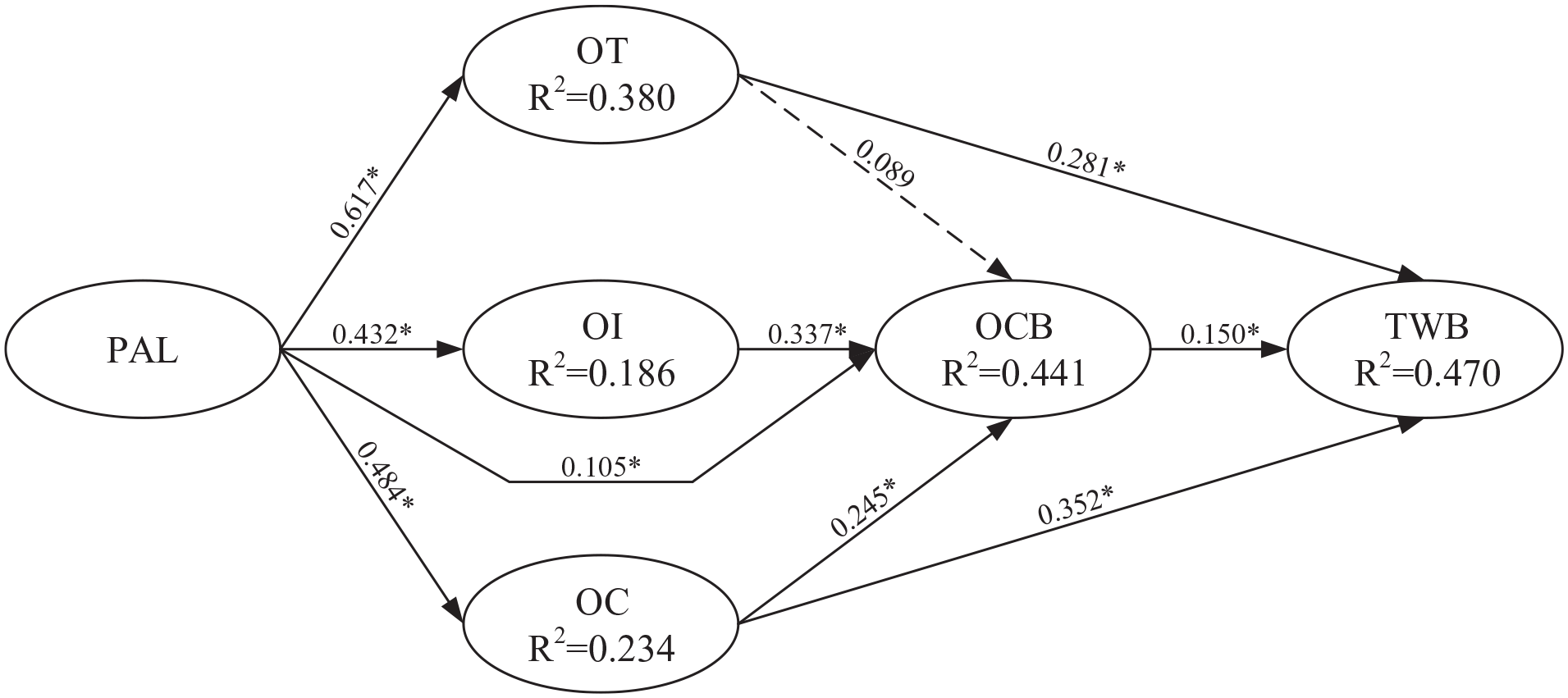
Empirical results of the structural path model. Value on path: standardized coefficients (β), R2: Coefficient of determination and *p < .05.
Structural Path Model’s Hypothesis Testing Outcomes.

p < .05.
Organizational citizenship behavior (β = .150, p < .05), organizational trust (β = .281, p < .05), and organizational commitment (β = .352, p < .05) exerted a positive and significant effect on teacher well-being. Therefore, H1 to H3 were supported. Amongst them, organizational commitment was an important factor affecting teacher well-being. Organizational identification (β = .337, p < .05), organizational commitment (β = .245, p < .05), and the principal’s authentic leadership (β = .105, p < .05) had a positive and significant influence on organizational citizenship behavior. However, organizational trust had no influence on organizational citizenship behavior. Therefore, the results support H5, H6, and H7 but reject H4. The principal’s authentic leadership was a positive and significant determinant of organizational trust, organizational identification, and organizational commitment (β = .617, .432, and .484, respectively). Hence, H8 to H10 were supported.
Mediating Effect Analysis
Table 5 shows the results of the bootstrap analysis (1,000 bootstrap samples were conducted) on the mediating effects of organizational trust, organizational commitment, and organizational identification on the relationship between principal authentic leadership and teachers’ organizational citizenship behavior and well-being. No zeros were included in the results. The table shows that H12 and H13 were supported, and organizational identification and organizational commitment were found to mediate the relationship between authentic leadership and organizational citizenship behavior. However, organizational trust did not have a mediating effect on the relationship between authentic leadership and organizational citizenship behavior; hence, H11 was not supported. In addition, the results confirmed that organizational trust, organizational commitment, and organizational citizenship behavior played a mediating role between the principals’ authentic leadership and teacher well-being. Hence, H14, H15, and H16 were supported.
Results of Bootstrap Analysis.

Note. LLCI = lower limit confidence intervals; ULCI = upper limit confidence intervals.
Conclusions and Discussion
Although previous studies have emphasized the importance of authentic leadership on work attitudes and performance, limited research has explored the impact of principals’ authentic leadership on teacher-school relationships (organizational trust, organizational commitment, and organizational identification) and the dimensions of teacher-school relationships on organizational citizenship behavior and well-being. This study established a framework of hypotheses to explore the influence of principals’ authentic leadership and teacher-school relationships (organizational trust, organizational commitment, and organizational identification) on teachers’ organizational citizenship behavior and well-being, as well as the mechanisms behind such influences. In addition, mediating effects of the teacher-school relationship and organizational citizenship behavior were also discussed. Teachers from senior high and vocational schools in central Taiwan were recruited to participate in a questionnaire survey, and 783 valid responses were acquired. A structural equation model was used for data analysis, and the proposed hypotheses were tested using the Smart PLS statistical analysis software package. The findings of the study are presented in the remainder of this section.
The results supported the theory of authentic leadership and extended existing empirical research by proving that principals’ authentic leadership played an important role in improving teacher-school relationships (organizational trust, organizational commitment, and organizational identification) and teachers’ organizational citizenship behaviors (Ausar et al., 2016; Avolio & Gardner, 2005; Bird et al., 2009; Fallatah et al., 2017; Walumbwa et al., 2011). The statistically significant results highlighted the positive influence of authentic leadership on teacher-school relations and organizational citizenship behavior, confirming the importance of the application of authentic leadership by principals in the educational workplace (senior high/vocational schools). Principals using authentic leadership interact with teachers with sincerity and transparency, listen to their suggestions, and adjust their strategies accordingly, and are, hence, more willing to shoulder the burden of any mistakes. Such a leadership style promotes the positive psychology of subordinates (teachers) and enhances trust and commitment to the organization, alongside organizational citizenship behavior. Schools led by principals that are perceived to be sincere, transparent, and consistent in their beliefs and behaviors are more likely to gain teachers’ trust and commitment and be seen as trustworthy, sincere, and reliable. In terms of organizational identification, when teachers recognize that their beliefs and values are consistent with those of the school, they are more likely to feel proud of being a school member (Zhu et al., 2012). The results of the study also revealed that authentic leadership directly affects teachers’ organizational identification (Avolio et al., 2004; Fallatah et al., 2017). Principals can influence teachers’ organizational identification by creating working conditions that encourage openness and honesty, engaging teachers in the decision-making process, reinforcing a positive organizational culture, and providing support to teachers to strengthen their sense of identity.
This study also found that principals’ authentic leadership and teachers’ organizational identification and organizational commitment had an impact on teachers’ organizational citizenship behavior, which was consistent with the results of past studies (Avolio & Gardner, 2005; Cheasakul & Varma, 2016; He et al., 2014; Leephaijaroen, 2016; Meleady & Crisp, 2017; Meyer et al., 2002). In addition, the influence of organizational identification on organizational citizenship behavior was found to be the most significant out of the tested relationships. According to the results, teachers exhibit organizational citizenship behavior at the workplace not because they felt trust in the organization but because of a sense of identity and commitment to the organization, as well as the belief that the principal was trustworthy, sincere, and reliable. Further, when teachers had higher levels of organizational identification and organizational commitment, they tended to have a stronger commitment to the organization (school). They were more likely to exhibit behaviors beneficial to the school (such as a willingness to invest more time in the school and their administrative department, the students, and attending meetings and lectures) without expecting anything in return—a clear manifestation of organizational citizenship behavior. However, this study found no significant effect of organizational trust on organizational citizenship behavior, which contrasted the findings of past studies (MacKenzie et al., 2001; Yildiz, 2019).
In recent years, under the influence of educational reform and the declining birthrate, Taiwan’s senior high/vocational schools have been forced to adapt in a varied manner. Public schools are more affected by government policies, while private schools are more affected by the decisions of the board of directors. In addition, during teacher-school communication, private school teachers remain in a disadvantaged position, while public school teachers are more permitted to voice their viewpoints. Nevertheless, owing to the nature of the profession, both public and private teachers are required to spend more time at school with students to participate in presentations and activities organized by government departments and related units in response to the declining birthrate and educational reforms. In such cases, teachers’ organizational trust has no direct effect on organizational citizenship behavior.
An increasing number of studies have begun to focus on the key factors that affect teacher well-being, specifically the relationships between teachers and school leaders, other teachers and colleagues, and the organization (Cherkowski, 2018; Morrison, 2013; Weiland, 2021). The results of this study suggest that teacher-school relationships (organizational trust, organizational commitment, and organizational identification) and organizational citizenship behavior positively affect teacher well-being. These findings echoed those of other fields (Chughtai et al., 2015; Jain et al., 2013; Kumar et al., 2016; Su & Swanson, 2019) and contributed to the research on the influence of teacher-school relationships and organizational citizenship behaviors on teacher well-being. When teachers perceive that the school treats and communicates with them reasonably, and they have a bond with the school (such as a sense of belonging and emotional attachment), their perceived well-being is enhanced. Moreover, if teachers are passionate about teaching and civic behaviors and are willing to invest additional time in participating in activities for the department and students (Cheasakul & Varma, 2016), they are more likely to feel a sense of joy and satisfaction in their working lives, which thereby improves their perceived well-being.
Furthermore, the study examined the mediating role of teacher-school relationships (organizational trust, organizational commitment, and organizational identification) and organizational citizenship behavior. It found that organizational commitment and organizational identification mediated the relationship between the principal’s authentic leadership and teachers’ organizational citizenship behavior. In other words, authentic leadership only influences teachers’ organizational citizenship behavior by influencing their organizational commitment and organizational identification. These findings echoed the results of organizational studies, which claimed that organizational commitment and organizational identification are significant mediating factors (Choudhary & Saini, 2021; Lee et al., 2020; Su & Swanson, 2019). Hence, when the principal demonstrates trustworthiness, sincerity, and reliable leadership behaviors (authentic leadership), teachers’ organizational commitment and organizational identification increase, and they are inherently more willing to spend more time with the students and school, with increased enthusiasm for teaching. This study also found that organizational trust, organizational commitment, and organizational citizenship behavior mediated the relationship between authentic leadership and teacher well-being. These findings contributed to the research on the mediating effects of organizational trust, organizational commitment, and organizational citizenship behavior between principals’ authentic leadership and teacher well-being. When principals lead the faculty with sincerity, communication, and transparency, their leadership style promotes teachers’ organizational trust, organizational commitment, and organizational citizenship behavior, thereby improving teacher well-being.
Limitations and Future Research Directions
Although the results of this study support the proposed hypotheses, certain limitations existed in the research design, which should be accounted for in future studies. First, this study adopted a cross-sectional design, which was not conducive to conducting a causal analysis. Future research is suggested to apply experimental and longitudinal designs to explore the factors that affect teachers’ organizational citizenship behavior and well-being. Second, the data used in this study only included senior high/vocational schools from central Taiwan; hence, the findings may not be generalizable to all senior high/vocational school teachers. Future studies are suggested to expand the sampling variance to cover a wider category of data. Third, the study used a self-reporting methodology, which may lead to common method bias and affect the structural validity while obscuring the relationship between the variables. Future research is suggested to acquire measures and variable criteria from more diverse sources to achieve more unbiased results. Finally, different leadership behaviors have different effects on EORs and employee well-being; however, this study focused only on authentic leadership. Future studies are suggested to explore the influence of other factors on teacher-school relationships and teacher well-being, such as other types of leadership behaviors (such as moral leadership) and organizational variables (such as organizational culture).
Footnotes
Declaration of Conflicting Interests
The author(s) declared no potential conflicts of interest with respect to the research, authorship, and/or publication of this article.
Funding
The author(s) received no financial support for the research, authorship, and/or publication of this article.
