




Abstract
This study aims to investigate how a teacher’s creative teaching is affected by the teacher’s imagination and his or her school principal’s visionary leadership, and how the contextual moderating effects are at play among the cross-hierarchical factors. The research framework is divided into two levels: the individual level on how “teacher’s imagination” affects “teacher’s creative teaching” and the group level on the impact of “the principal’s visionary leadership.” From the teachers of 65 primary schools in southern Taiwan invited to participate in the survey study, 861 valid data were returned. The cross-level moderating effects were further examined via hierarchical linear modeling (HLM). The result shows that the “teacher’s imagination” will impact the “creative teaching” positively. The “vision practice” will affect “autonomous learning and challenge-presenting” positively as well. Moreover, the “vision feedback” plays a positive moderator role in how “creative imagination” contributes to “interactive discussion and open-mindedness.” The implication of the study is to discover the predictive model which inspired the students’ creativity potential by cross-hierarchical perspective.
Keywords
Introduction
The phrase “actions speak louder than words” stems from the observation that the words and deeds of teachers profoundly affect children; teachers function as a crucial role model in a child’s life (Ministry of Education [MOE], 2016). Studies have noted the qualitatively different learning process of children in our present day, which has rendered traditional teaching methods ineffective. Creative teaching is a necessary skill for teachers, and this teaching method can effectively improve how sensitive and adept students are at learning. Moreover, creative teaching can make learning invigorating, meaningful, and profoundly experiential, thus helping students better develop the necessary cognitive and emotional skills (Hu et al., 2016; Rankin & Brown, 2016; Simplicio, 2000). In promoting creative teaching, schools cultivate the child’s future competitive advantage. The creative teaching of teachers is a crucial factor in creative teaching, which has become an important trend in education development (Davis et al., 2013; Sharma, 2017). Research has suggested that internal factors (e.g., motivation, characteristics, attitude, ability, and teaching experience of teachers) and external factors (e.g., students’ attitudes, students’ interactions with the school environment, the school administration, and the teaching media used) can influence creative teaching (Blazar & Kraft, 2017; Crede & Kuncel, 2006; Hanrahan, 1998; Organisation for Economic Co-operation and Development [OECD], 2009; Oroujlou & Vahedi, 2011). Sawyer (2011) argued that creative teaching includes the teacher’s use of imagination and employment of engaging methods to form the value of originality and judgment. The use of imagination and creativity can lessen the somberness associated with strict control in the classroom and make learning less tedious and more invigorating for students (Blazar & Kraft, 2017; Sharma, 2017). Highly imaginative teachers can integrate various teaching characteristics to make learning more invigorating and foster more creative students, in line with future educational trends (Craft, 2005; Phan, 2009). Therefore, the correlation between imagination and creative teaching ability in frontline teachers is an important research topic.
In the knowledge economy era, to cultivate talents’ creativity, sustainability concepts, and innovative potential was the critical issue in all developed countries and became an important educational policy (Širá et al., 2020). Furthermore, it was found that the insufficient study focused on the associations between a teacher’s imagination and a school principal’s visionary leadership. Research perspectives on creativity have changed from the use of a single approach to the use of a confluence approach. The confluence approaches no longer treat the development of creativity as being based on an individual’s personality or thinking pattern. Rather, the approach focuses on how an individual’s creativity is influenced by the interaction between them and their environment (Amabile, 1996; Csikszentmihalyi, 2006; Sternberg & Lubart, 1995). From this perspective, the environment affects the development of creativity at the level of the individual, where, relative to the individual-centric approach, those in leadership roles play a more important role in fostering individual creativity. Specifically, the leader must be sensitive to both the individual’s state and the atmosphere of the group that the individual is situated in. The leader must intervene in team operations and establish appropriate systems to avoid undue group-related pressure and conflicts (Okpara, 2007; Oxley et al., 2006). For educators, a principal is a school’s leader, and his or her leadership effectiveness implicates school operations, teachers’ teaching, and student learning (DuFour & Mattos, 2013; Fessehatsion, 2017; Lunenburg, 2010; Victoria State Government, 2017). As an internal-organizational factor, the principal’s role as a leader has a considerable and direct effect on the teachers’ creativity (Amabile et al., 2004). Therefore, another noteworthy research question is whether the visionary leadership of a principal strongly influences the creative teaching of teachers.
Research on creativity has mostly focused on undergraduates (Amabile, 2012; Davis et al., 2013; de Vere et al., 2010; James, 2015; Oroujlou & Vahedi, 2011; Rankin & Brown, 2016). However, few studies have investigated creativity, the most crucial factor in effective education (Blazar & Kraft, 2017; Eisner, 2001; Shank, 2016), as well as the correlation between the teacher’s imagination and creative teaching (Sharma, 2017). Research on the correlation between visionary leadership and creative teaching is even more scarce. In the organizational hierarchy of a school, teachers are under the leadership of the principal. From an interaction-theory perspective, the teacher’s imagination and creative teaching are individual-level factors and the principal’s visionary leadership is an environmental factor. From this hierarchical-interaction perspective, an analysis focusing on only individual or environmental factors, at the expense of the other, is inadequate (Davis et al., 2013; Sharma, 2017). Therefore, because the moderating effect of environmental factors must be noted, the researchers investigated the correlation that the teacher’s imagination and creative teaching have with the principal’s visionary leadership. In addition, a multilevel analysis was conducted to investigate the moderating effect of the principal’s visionary leadership on the relationship between the teacher’s imagination and creative teaching, thus filling a gap in the literature.
Theoretical Background
Imagination
Imagination is a type of intrinsic power of humans and it can transform “reality” into other possibilities, “existing things” into “other things,” and non-existent things into “existent things” (Rautins & Ibrahim, 2011). Imagination is a pivotal resource in ideals and practices of education, the driving force behind the development of education (Eisner, 2001), and a key learning experience for teachers. Among all cognitive abilities, imagination enables people to have alternative realities and stops them from staying in their comfort zone; it is regarded as a wide-awake process (Kisaka & Osman, 2013; Rautins & Ibrahim, 2011; Shank, 2016). Thus, in this study, the researchers defined imagination as a mental ability that can transcend spatial and temporal limitations to form images. The ability is based on the combination of an individual’s experience. This mental ability integrates the perceptual ability to visualize dynamic process, such as processing, transformation, reorganization, and mental innovation. Imagination enables an individual to have new ideas on things that they have never experienced, where these ideas are reflected in an individual’s work, life, and plans for the future.
The measurement of imagination differs across studies, particularly with regard to classification methods, because of their different theoretical foundations and set of research participants. Nonetheless, reproductive imagination and creative imagination have been the concepts adopted by studies in general (Liang et al., 2012). When compiling an imagination scale, the researchers separated imagination into two dimensions of reproductive imagination and creative imagination. Reproductive imagination involves the concretization of abstract concepts and application of existing knowledge to new fields or contexts, whereas creative imagination involves exploration into the unknown and the generation of novel ideas.
Creative Teaching
The ERIC Thesaurus defines creative teaching as “the development and use of novel, original, or inventive teaching methods” (Educational Resources Information Center, 2017). Kanter (1996) proposed that creative teaching is the teacher’s independent ability to conceive of novel ideas or adapt the ideas of others into their context. Creative teaching not only encourages participation from others but also puts ideas into practice in accordance with a plan and involves the use of external resources. In doing so, creativity can be more greatly exhibited in teaching contexts. In the book Teacher Skill and Strategies, Woods (1990) suggested that creative teaching, including creative teaching plans, is a structural foundation and a type of discovery that disrupts the teaching status quo. Sternberg and Lubart (1995) observed that creative teaching occurs when teachers collect relevant teaching materials through creative teaching activities, draw up creative teaching plans, and improve creative teaching strategies, thereby improving students’ learning effectiveness. Sawyer (2011) noted that creative teaching includes the teacher’s use of imagination and trendy methods to form the value of originality and judgment. Rankin and Brown (2016) demonstrated that creative teaching can make learning invigorating and deeply experiential, thus furthering the professional knowledge and social and emotional skills of students. Therefore, the researchers define creative teaching as the teacher responding to the individual-level needs of the student, proactively seeking innovation, and designing courses with rich and novel content. Additionally, in creative teaching, engaging teaching methods are adopted to effectively improve the learning motivation and learning outcomes of students, thus achieving the goal of effective teaching.
To measure creative teaching, Cheng (2001b) constructed five dimensions based on creativity theory; the scale has been used in the literature to study the creativity of teachers. The five dimensions are (a) Creative Teaching Ideas, (b) Ability in Creative Teaching, (c) Divergent Thinking Abilities in Teaching, (d) Motives in Creative Teaching, and (e) Creativity in Teaching Performance. Sawyer (2011) argued that the measurement of creative teaching must include the use of imagination as well as popular and innovative teaching methods and the possession of the value of originality and judgment. Considering the participants, aims, and dimension-related implications that are specific to our study, the researchers adopted three indicators in Huang and Yeh (2008) as dimensions for measuring creative teaching.
Visionary Leadership of Principal
To develop sustainably, school leaders must propose visionary leadership to define the school vision, and their leadership must center on the school vision and educational ideals. Moreover, leaders should replace administrative authority with visionary authority as the core task of leadership. The school vision can be used as an internal journey to attract the attention of school members and all stakeholders, evoke passion in followers, and create a common vision for the school. In addition, the power of the school’s vision can be more generally utilized to encourage school members and stakeholders to work together to develop the school’s characteristics, ensure education quality, and enhance the school’s effectiveness (Wallace et al., 1997). Powe (1992) started from an educational perspective and defined visionary leadership simply as a tool for attaining educational missions. Heath and Heath (2010) noted that visionary leadership occurs when leaders first establish their own vision, and then, a discussion with the organization’s members is conducted to obtain a common vision. Subsequently, organization members are authorized to act to achieve said vision. Taylor et al. (2014) observed that visionary leadership leads an organization to develop a greater sense of purpose, determine the priority of working, and integrate organizational policies, beliefs, and principles. Therefore, visionary leadership can unite the efforts of an organization’s members to achieve outcomes. Overall, one can infer that the principal’s visionary leadership covers the progress of school vision development and practice, and school visions should be established with an overall cycle perspective. Therefore, the researchers defined a school principal’s visionary leadership as a school principal must first understand the characteristics of the school’s internal and external environment, integrate personal visions, and adequately communicate the vision with school members. These actions can integrate the values and beliefs of school members to establish a common school vision, authorize and encourage school members to take action, lead members to actualize school visions, and provide continual feedback, thus enabling the school to constantly innovate and progress.
Different scholars have adopted different classification methods for measuring visionary leadership. Their methods can be categorized into three stages: vision formation, vision practice, and vision feedback (Chance, 1992; Heath & Heath, 2010; Johnson, 1991; Taylor et al., 2014). The researchers adopted these three aforementioned stages in our measure of visionary leadership. The first is vision formation: As a visionary leader, the principal leads team members to have communication and dialogue at the initial stage to formulate a school vision, where internal and external environmental factors affecting the school are considered. The second is vision practice: The principal establishes steps for actualizing a vision, incorporates the vision into school activities, and concretely puts the vision into practice to create a new school atmosphere. The third is vision feedback: The principal establishes a vision-tracking and feedback mechanism and embraces feedback from within and without the school, thus enabling the calibration of a vision or strategy for the sustainable development of the school’s vision.
Hypothesis Development
The theoretical bases depended on Csikszentmihalyi and Wolfe’s (2014) perspective, “The systems model of creativity.” It reflected interactive relationships among individual/personal, field/society, and domain/culture as a system. Thus, the teacher’s imagination is equal to individual/personal, the teacher’s creative teaching is equal to field/society, and the principal’s visionary leadership is equal to domain/culture in the setting of systems model of creativity. Hence, the related studies were integrated into below sections.
Teacher’s imagination and creative teaching
Studies have suggested that creativity is foundational to many disciplines (Chermahini & Hommel, 2010; Shalley et al., 2004). Imagination determines the scope of creative thinking and is the foundation of invention. Individuals can create more appropriate solutions to problems through imagination (Gharabaghi, 2008; Lindqvist, 2003). Researchers have observed that imagination refers to mental images of the creator, whereas creativity and creation are external displays of imagination; imagination and creativity are closely related because imagination is associated with innovation and change (Mellou, 1995; Reichling, 1990). Therefore, imaginative teachers can better involve themselves in their creative teaching, thereby inspiring the creativity of their students (Blazar & Kraft, 2017; Shank, 2016; Sharma, 2017). Accordingly, the researchers proposed Hypothesis 1 of this study as follows:
The visionary leadership of principal and teacher’s creative teaching
Vision is a key factor in the reforms undertaken by schools, and school principals must transform and innovate their school through visionary leadership, thereby improving teachers’ teaching quality and effectiveness (Conley et al., 1992). Chen and Chen (2013) noted that visionary leadership in an organization is significantly correlated with innovative behavior in the organization’s members. Felekoglu and Moultrie (2014) argued that a leader’s promotion of visionary leadership contributes to displays of creativity among their followers. Therefore, principals inspiring innovation among teachers by providing positive visionary leadership and open communication with teachers serves as crucial evidence for the influence of principals’ visionary leadership on teachers’ creative teaching (DuFour & Mattos, 2013; Fessehatsion, 2017). Accordingly, the researchers proposed Hypothesis 2 of this study as follows:
The visionary leadership of principal, teacher’s imagination, and creative teaching
Amabile (1996) proposed the componential theory of creativity and suggested that if an organization can adopt a management method that is conducive to creative teaching, the effect of individual factors on creative teaching will be enhanced. Research on creativity has emphasized the key factor of cross-level organizational context (Amabile, 1997). Midgley et al. (2000) noted that if teachers perceive that the school supports creative teaching, strives to improve teaching conditions, and is receptive and supportive to suggestions of better measures, they tend to show greater creative teaching behavior. From the interactionist perspective, individual behavior is determined by the interaction of individual and environmental factors. Nevertheless, under the influence of individual and environmental factors, the individual–environment interaction remains important. Studies have demonstrated that the visionary leadership of principals influences the imagination and creative teaching of teachers (Crede & Kuncel, 2006; Fessehatsion, 2017; Kisaka & Osman, 2013). Accordingly, the researchers proposed Hypothesis 3 of this study as follows:
Research Design
Framework
The research framework is illustrated in Figure 1. In the framework, the teacher’s imagination (X) is separated into two dimensions of reproductive imagination (X1) and creative imagination (X2) that are defined as individual level. Furthermore, the teacher’s creative teaching (Y) is separated into interactive discussion and open-mindedness (Y1), problem-solving and diversified teaching methods (Y2), and autonomous learning and challenge-presenting (Y3), all these factors defined as individual level. The principal’s visionary leadership (Z) is separated into three dimensions of vision formation (Z1), vision practice (Z2), and vision feedback (Z3) that are defined as group level.

The study framework.
Participants
Study participants were elementary schoolteachers in Tainan, Taiwan. With regard to sampling, Maas and Hox (2005) suggested that each organization must have at least five valid questionnaires for hierarchical linear modeling (HLM) to be conducted. Moreover, to obtain results of sufficient statistical power for the analysis of cross-level interactions, at least 30 sets of samples are required (de Leeuw & Kreft, 1998). The stratified sampling was employed in this study. There are a total of 211 elementary schools, and 120 schools (56.9%) had 12 classes or fewer in Taiwan City, in the year of 2018. Most schools with 12 classes or fewer had less than 20 teachers. Therefore, the researchers distributed 10 questionnaires to schools with 12 or fewer classes and 20 questionnaires to schools with more than 12 classes. Researchers asked school authorities to participate before sending them the questionnaires by email or in person. A total of 1,050 questionnaires were distributed to 72 elementary schools. After repeated checks, 861 valid questionnaires from 65 elementary schools were returned.
Instruments
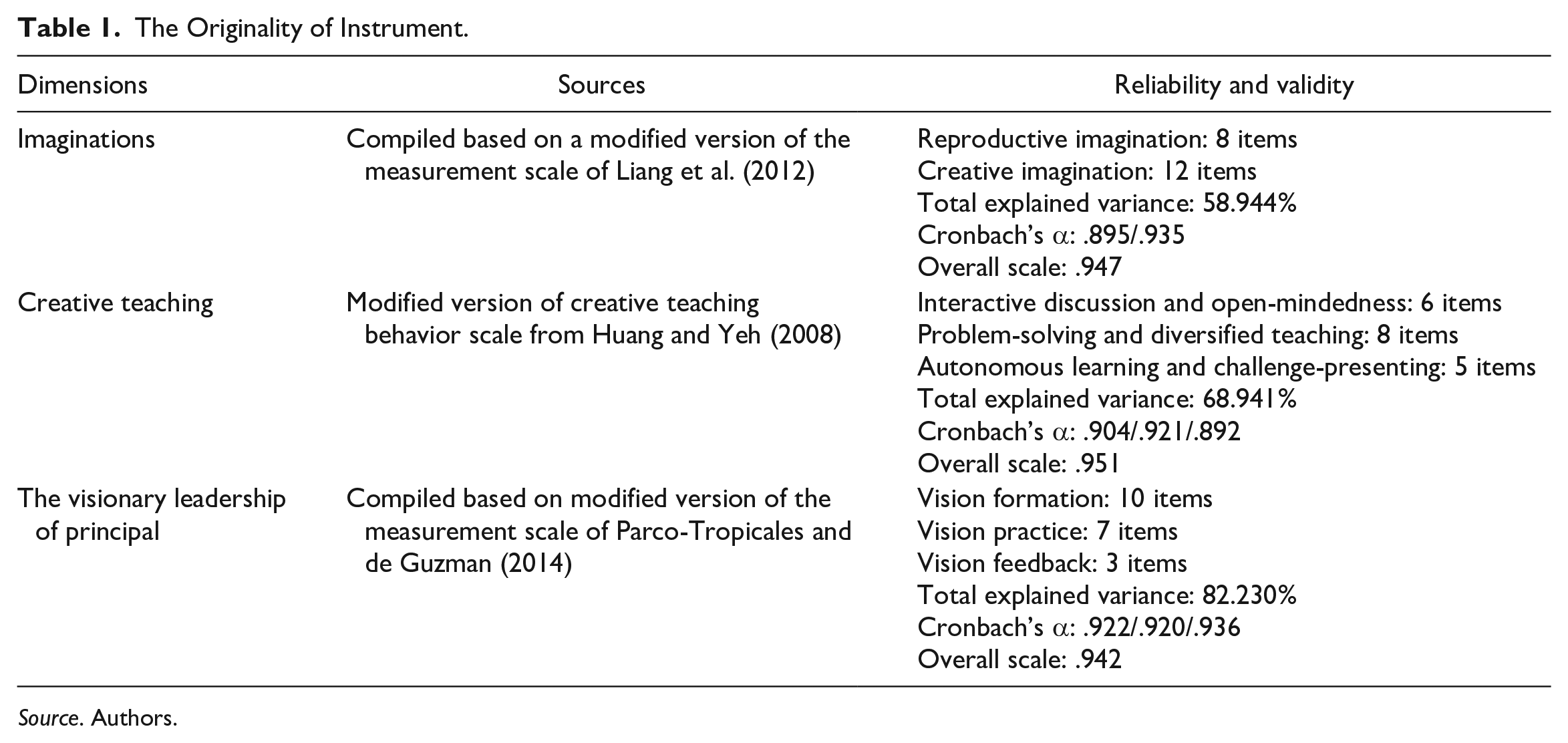
A total of eight scholars and experts (expert validity) helped to test for content check of the questionnaires, and the results of the said test were used to modify the questionnaires before a pretest was conducted. Subsequently, the researchers conducted item analysis and exploratory factor analysis (EFA) to test the construct validity of the final questionnaires (see Table 1).
The Originality of Instrument.
Source. Authors.
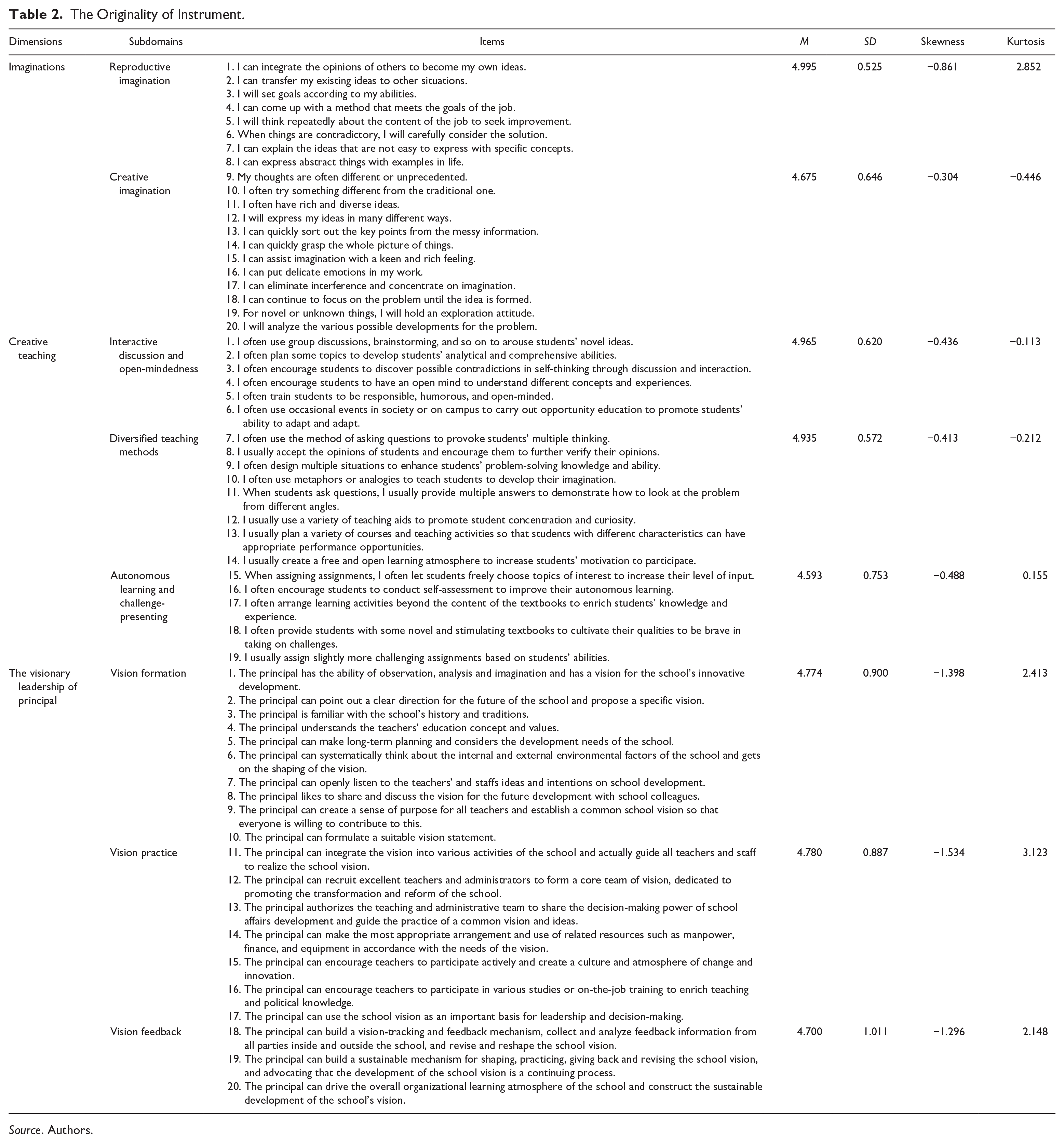
Furthermore, the measure items and mean scores, standard deviation, skewness, and kurtosis are summarized in Table 2. The items were rated on a Likert-type 6-point scale (6: completely fit, 5: mostly fit, 4: partially fit, 3: partially unfit, 2: mostly unfit, and 1: completely unfit). A higher total score indicates a stronger imaginative ability and a lower total score indicates a weaker imaginative ability.
The Originality of Instrument.
Source. Authors.
Data Analysis
Descriptive statistics were used to analyze for the teacher’s imagination and creative teaching as well as the principal’s visionary leadership. In addition, the Pearson product–moment correlation was used to analyze the correlation between each variable, and HLM (version 7.0) was used to determine the causal structure between each variable. The HLM included four models. The first model was a null model; it was used to examine the within-group internal consistency and between-group variances. The second model was a random coefficient regression model; it was used to examine the direct effect of teachers’ creative teaching. The third model was an intercepts-as-outcomes model; it was used to investigate the direct effect of principals’ visionary leadership on teachers’ creative teaching. The fourth model was a slopes-as-outcomes model; it was used to investigate the moderating effect of principals’ visionary leadership on the relationship between teachers’ imagination and teachers’ creative teaching.
Research on Human Participants
The study was reviewed and approved by an institutional review board on IRB Authorized Organization of Taiwan (ethics committee): the Human Research Ethics Committee (https://hrec.ypu.edu.tw/), Yuanpei University of Medical Technology, Hsinchu, Taiwan, R.O.C.
Findings
Foundational Characteristic Check
In this study, a principal’s visionary leadership was based on the teacher’s perceived leadership style of the school principal and was therefore considered a shared variable (Wen & Chu, 2009). Before conducting the cross-level analysis, the researchers examined the appropriateness of aggregating the individual-level contextual variables to group-level contextual variables. Within-group indexes (rwg) were used as evaluating indicators to verify the appropriateness of data integration. In the results, principals’ visionary leadership had a mean rwg of 0.95 (range: 0.72–0.99), which indicates that our integration process was within reasonable limits (James et al., 1993).
Model and Hypothesis Test
Null model
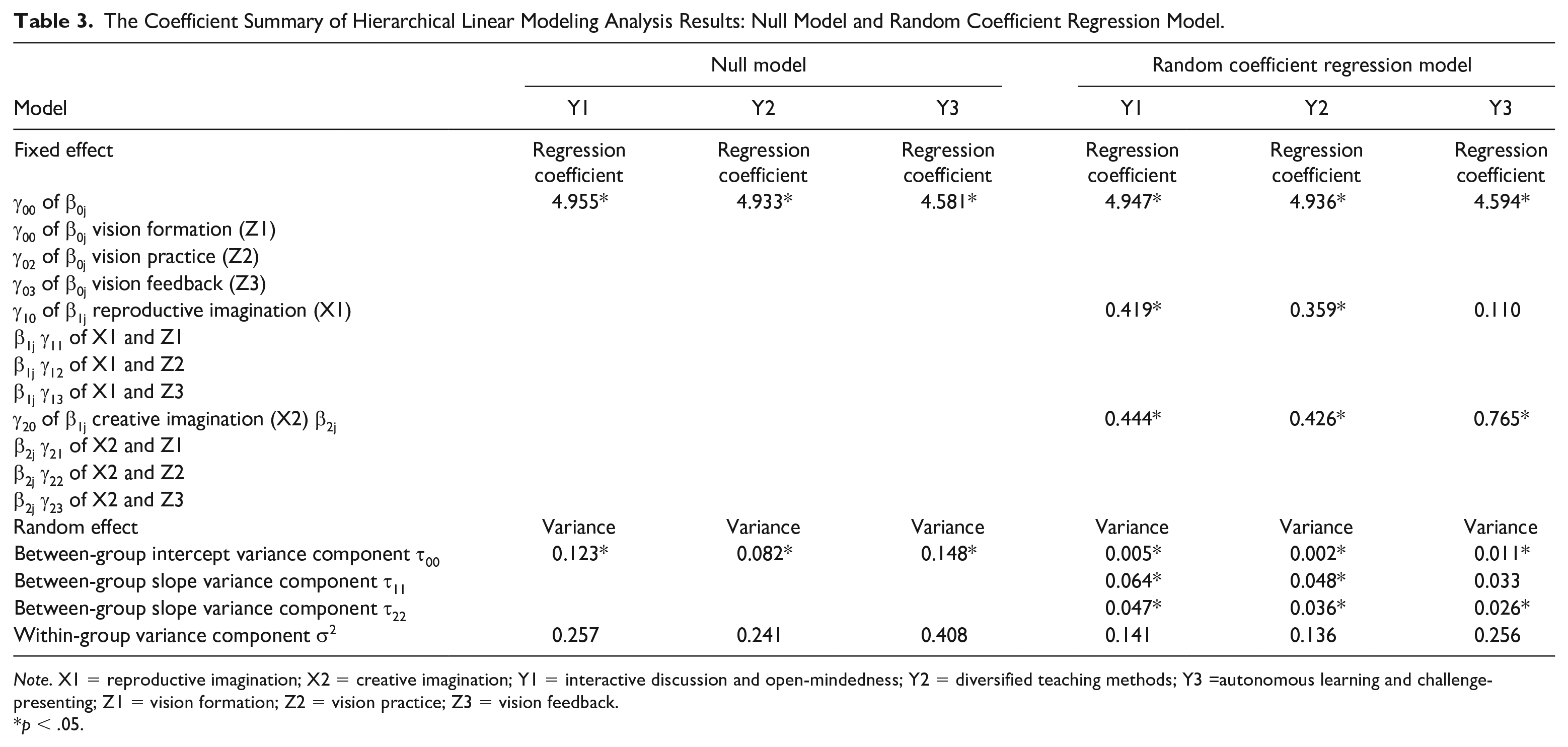
Prior to conducting a multilevel analysis, the existence of a cross-level effect must be evaluated. Specifically, between-group and within-group variance of all dependent variables must be significant; the researchers conducted a null model test to test for such significance. According to the results, the between-group variances for Y1 (interactive discussion and open-mindedness), Y2 (diversified teaching methods), and Y3 (autonomous learning and challenge-presenting) were 0.123, 0.082, and 0.148, respectively, and their χ² values were 489.742, 370.609, and 398.484, respectively (df = 64, and all variances were significant at p < .001). The interclass correlation coefficients for the three aforementioned variances were 0.324, 0.254, and 0.266, respectively. These values suggest strong correlations (Cohen, 1988), which allow for further tests on other models to be conducted.
Random coefficient regression model
This model aimed to examine the effect of teachers’ imagination on their creative teaching; the researchers examined the existence of intercept and slope items in individual-level regression (Wen & Chu, 2009). In addition, the model further tested for the existence of a group-level effect. In the model, γ10 and γ20 are X1 (reproductive imagination) and X2’s (creative imagination) estimated parameters of each dimension of creative teaching. If the estimates were significant, then X1 and X2 had a significant effect on the dimensions of creative teaching. A random effect was set, and this random effect allowed for different means between the various between-group schools. Therefore, if the between-group intercept variance component τ00 is significant, then different between-group schools have different intercepts. That is, significant variance of teachers’ creative teaching between different between-group schools can be used to further examine the existence of a direct contextual effect of principals’ visionary leadership on teachers’ creative teaching. In addition, the random effect allowed for different regression coefficients between the various between-group schools. Therefore, if the between-group slope variance components τ11 and τ22 were significant, then the different between-group schools have different slope items. The significant variance of the influence of teachers’ imaginative ability on creative teaching can be used to further examine the existence of direct contextual effect of principals’ visionary leadership on the relationship between teachers’ imaginative ability and their creative teaching (Wen, 2014; Wen & Chu, 2009). The results are presented in Table 3.
The Coefficient Summary of Hierarchical Linear Modeling Analysis Results: Null Model and Random Coefficient Regression Model.
Note. X1 = reproductive imagination; X2 = creative imagination; Y1 = interactive discussion and open-mindedness; Y2 = diversified teaching methods; Y3 =autonomous learning and challenge-presenting; Z1 = vision formation; Z2 = vision practice; Z3 = vision feedback.
p < .05.
As presented in Table 3, all values were statistically significant. These results indicate that teachers’ creative teaching (which is at the individual level) had a significantly positive effect on each dimension of creative teaching. Therefore, hypotheses from H1 were supported.
The variance component of the random effect indicates that different between-group schools have different intercepts. Therefore, principals’ visionary leadership may have a direct effect on teachers’ creative teaching.
For the Y1 part, it shows all values were also statistically significant. This indicates that different between-group schools have different slopes (Wen & Chu, 2009). Principals’ visionary leadership may exert a contextual moderating effect on dimensions Y1 and Y2 of teachers’ imagination (Wen, 2014). Therefore, a slope prediction model could be tested. This suggests that different between-group schools do not have different slopes (Wen & Chu, 2009). Therefore, each dimension of principals’ visionary leadership did not exert a contextual moderating effect on the influence of teachers’ imagination on Y3, and a subsequent test of a slope prediction model was not required.
Intercepts-as-outcomes model
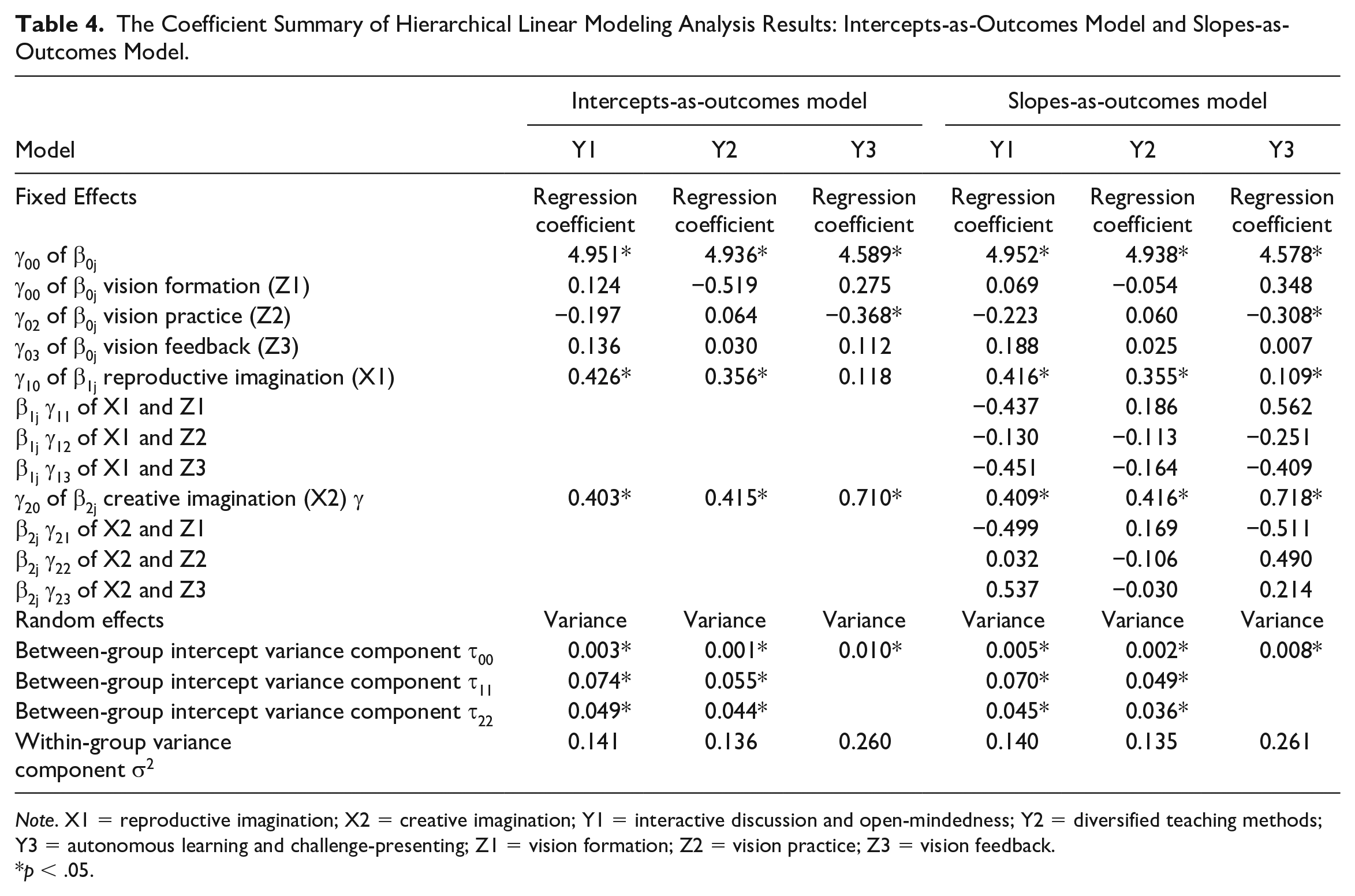
This model was constructed to investigate the direct and contextual effect of principals’ visionary leadership on teachers’ creative teaching. The intercept variance in the group-level regression model was further examined (Wen & Chu, 2009). In this model’s equation, γ01, γ02, and γ03 represent the direct and contextual effects of Z1 (vision formation), Z2 (vision practice), and Z3 (vision feedback) on teachers’ creative teaching. The test results are as follows:
Y1 (interactive discussion and open-mindedness) indicated that principals’ visionary leadership had no significant positive effect on each dimension of Y1, and our hypothesis H2 was not supported, which indicated that, if included, principals’ visionary leadership can explain 66.7% of variance in the positive effect on Y1.
Y2 (diversified teaching methods) indicated that principals’ visionary leadership had no significant positive effect on each dimension of Y2, and hypothesis H2 was not supported, which indicated that, if included, principals’ visionary leadership can explain 50% of the variance in the positive effect on Y2.
Y3 (autonomous learning and challenge-presenting) indicated that Z1 and Z3 did not have a significant positive effect on Y3, and hypothesis H2 was not supported, which indicated that, if included, principals’ visionary leadership can explain 10% of the variance in the positive effect on Y3.
This suggests that in addition to principals’ visionary leadership, other variables also exert direct and contextual effects on Y1, Y2, and Y3. However, these variables were not included in our study; they can be included in a future study as potential contextual variables (Lin & Pen, 2006; Wen & Chu, 2009).
Slopes-as-outcomes model
This model was constructed to investigate the existence of the cross-level variables’ interaction effects on the dependent variables. Specifically, the model was tested to determine, first, the contextual moderating effects of cross-level variables on dependent variables and, second, the slope variance in a group-level regression model (Wen & Chu, 2009). In the model’s equation, γ11, γ12, γ13, γ21, γ22, and γ23 represent the contextual moderating effects of Z1, Z2, and Z3 on each dimension of creative teaching in X1 and X2. The results are as follows (Table 4):
Y1 (interactive discussion and open-mindedness) demonstrated all values were statistically significant. This suggests that these variables also had a moderating effect, but they were not included in our study. A future study can investigate other potentially significant variables.
Y2 (diversified teaching methods) supported that all values were statistically significant. This suggested that these variables also had a moderating effect, but they were not included in our study. A future study can further investigate other potentially significant variables.
Y3 (autonomous learning and challenge-presenting): The results for the random regression coefficient indicated that the between-group slope variance components were not statistically significant. Principals’ visionary leadership did not exert a contextual moderating effect on Y3. Thus, a subsequent test of a slope prediction model test was not required, and H3 was not supported.
The overall result is shown in Figure 2.

The overall result of Assumption Model.
The Coefficient Summary of Hierarchical Linear Modeling Analysis Results: Intercepts-as-Outcomes Model and Slopes-as-Outcomes Model.
Note. X1 = reproductive imagination; X2 = creative imagination; Y1 = interactive discussion and open-mindedness; Y2 = diversified teaching methods; Y3 = autonomous learning and challenge-presenting; Z1 = vision formation; Z2 = vision practice; Z3 = vision feedback.
p < .05.
Discussion
Teacher’s Imagination to Creative Teaching
The results suggested that each dimension of teachers’ imagination had a positive effect on teachers’ creative teaching according to Figure 2; H1.1 to H1.6 were supported; besides, H1.3 had not reached the significant level. This is consistent with the findings of Reichling (1990), Mellou (1995), Lindqvist (2003), and Gharabaghi (2008). These scholars argued that imagination and creativity are closely related, and that imagination contributes to innovation and idea generation. However, different from most previous studies that have focused on students’ imagination, the researchers focused on teachers’ imagination. In addition, most previous studies have investigated the correlation between imagination and creativity, but few studies have examined the correlation between creativity and creative teaching. This study fills this research gap. According to the results of this study, teachers’ imagination had a significantly positive effect on their creative teaching. Because imagination contributes to innovation and idea generation, if teachers make good use of their imagination, their creative teaching will improve.
The Visionary Leadership of Principal to Teacher’s Creative Teaching
The findings suggested that the vision practice dimension had positive effects on autonomous learning and challenge-presenting according to Figure 2; thus, H2.6 was only supported. This is consistent with the results of Chen and Chen (2013) and Felekoglu and Moultrie (2014). Specifically, they demonstrated that a leader’s visionary leadership has a significant effect on the innovative behavior of members of an organization. In this study, the rest hypothesis paths were not fully supported. Specifically, each dimension of principals’ visionary leadership did not significantly affect the following dimensions of creative teaching: interactive discussion, open-mindedness, problem-solving, and diversified teaching. The vision formation and vision feedback dimensions had no significant effect on autonomous learning and challenge-presenting. All participants in our study were public elementary schoolteachers, and the teaching autonomy of these teachers has increased considerably in recent years. Therefore, in addition to good job stability, these teachers are given sufficient autonomy in their teaching (Lin, 2010; Sugiarto, 2018). The autonomy could be the reason why the principals’ visionary leadership had no considerable effect on teachers’ creative teaching; a future study should verify this conjecture.
The Contextual Moderation Effect of the Visionary leadership of Principal to Teacher’s Creative Teaching
Our findings suggest that the vision feedback dimension had a significant contextual moderating effect on the relationship between creative imagination, interactive discussion, and open-mindedness according to Figure 2; H3.16 was only supported. That is, when teachers’ level of perceived vision feedback is higher, the effect of creative imagination on their open-mindedness and conduct of interactive discussion is stronger. This is consistent with the finding of Amabile (1996) and Midgley et al. (2000). Specifically, if teachers perceive that their schools support teaching innovation, strive to improve teaching conditions, and are receptive and supportive to suggestions of better measures, they tend to show greater creative teaching behavior.
The results revealed that the rest hypothesis paths were not fully supported; each dimension of principals’ visionary leadership had no significant relationship between teachers’ imagination and teachers’ creative teaching. Eisner (2003) argued that as interpreters of education policies and the main medium of teaching content, teachers play a pivotal role in curriculum decisions. A teacher has relatively high autonomy and each teacher has their own teaching style, teaching policies, and teaching strategies (Fessehatsion, 2017; Victoria State Government, 2017). The teacher’s imagination, including their creative and reproductive faculties of imagination, is applied to creative teaching depending on their teaching style. The teacher’s application of their imagination is less affected by the extent of their principal’s visionary leadership. This potentially explains why the various dimensions of principals’ visionary leadership had no significant moderating effect on the influence of teacher’s imagination on teacher’s creative teaching; future research can verify this conjecture.
Most previous studies show how leadership affects organization members’ creativity focused on businesses rather than schools. By contrast, the researchers investigated principals’ visionary leadership and creative teaching using an HLM, a method and focus that has been rare in the literature. With respect to the organizational hierarchy of schools, teachers are under the leadership of the principal. The researchers tested the structural data of schoolteachers through a multilevel analysis adapted to this hierarchy. The analytical aim was to obtain more precise parameter estimations through estimating the effect of hierarchical factors on our dependent variables (Wen, 2014; Wu & Luh, 2010). The researchers used an HLM to investigate, first, the effect of principals’ visionary leadership on teachers’ creative teaching and, second, the contextual moderating effects of principals’ visionary leadership on the relationship between teachers’ imagination and creative teaching. Our findings aid education researchers in their understanding of the effect of hierarchically dependent variables on teachers’ creative teaching, thereby providing depth to findings in the literature.
Suggestions
To the School Administrators
Provide more imagination workshop for teachers
Teachers’ imagination had a positive effect on their creative teaching. Therefore, when designing the school curriculum, schools should incorporate more imagination training courses to improve teachers’ imagination, thus promoting creative teaching.
Apply the visionary leadership of principal to promote teacher’s creative teaching
The practice dimension of principals’ visionary leadership had a significantly positive effect on the autonomous learning and challenge-presenting dimension of teachers’ creative teaching. Principals can integrate the school vision into various school activities, lead school staff in achieving the school vision, and encourage teachers to proactively participate in various school activities and training, or in in-service training to enhance their teaching knowledge. Such actions by principals can positively influence teachers, specifically in motivating teachers to organize self-directed learning activities for students or inspire autonomous learning among students. Students should also be provided with novel and engaging teaching materials that have the aim of cultivating the student’s willingness to embrace challenges.
Enhance the feedback effect on the visionary leadership of principal
The feedback dimension of principals’ visionary leadership had a significant moderating effect on the influence of teachers’ creative imagination on interactive discussion and open-mindedness. School leaders should emphasize that the development of the school vision is a continuous journey, and they should collect extensive feedback from those outside the school. Moreover, leaders should be more receptive to teachers’ suggestions. Such receptiveness aids the sustainable development of the school vision and enhances teachers’ imagination and creative teaching.
To the Teachers
Participate in the imagination workshop
Imagination is fundamental to creation, and an active imagination is necessary for high-level creative work, regardless of the domain (Egan, 2007; Runco, 2003). Our results demonstrated that for teachers, an active imagination improves creative teaching. Thus, teachers should participate in various school activities, training, or in-service training to enhance their imaginative and cognitive faculties. Such activities can improve teaching effectiveness by helping teachers better apply these skills.
Comply with the visionary leadership of principal
To put a vision into practice and ensure its realization, a school principal must prudently organize their resources, such as human resources, finances, and equipment, toward the school vision. Principals must also encourage proactive participation among teachers and foster a culture of innovation. When teachers put a vision into practice to ensure its realization, they should participate in various school activities, training, or in-service training to enhance their teaching and administrative knowledge. This contributes not only to the realization of the school’s vision but also to teaching and class management in practice.
Willing to provide feedback
When feedback is provided with regard to a vision, a principal should be able to establish a tracking and feedback mechanism for the vision and incorporate feedback from within and without the school. This allows the vision, and its corresponding strategies, to be calibrated, which improves the learning atmosphere of the school. Teachers should be able to appropriately share their experiences and ideas with regard to both frontline teaching and interactions with students and parents. These actions constitute greater feedback to the school, thus enabling continual and sustainable improvements in the schools’ visionary leadership and teachers’ imagination and creative teaching.
To the Higher Education Officers
When the education administration department is planning creative teaching–related training in a city, imagination training should be emphasized. Alternatively, the department can encourage schools to conduct more intensive imagination training by assisting in finding suitable teachers. These measures will enhance the imagination of teachers and improve the effectiveness of their creative teaching.
To the Future Researchers
Apply longitudinal study
Future studies can conduct longitudinal research and collect data in stages to more deeply explore the correlation between teachers’ imagination, creative teaching, and principal’s visionary leadership, in addition to their contextual moderating effects.
Extend the samples and resource
Future studies can expand the research area to make the research findings more representative.
Use the qualitative study
Future studies can use qualitative methods, such as in-depth interviews or participant observation, to gain a deeper understanding.
From different perspectives
Future studies are advised to simultaneously consider the perspectives of principals and students in a cross-analysis, thus making the findings representative of different perspectives.
Add more variables: future studies are advised to incorporate more group-level contextual variables, in accordance with relevant discourses, and more extensively explore factors that affect teachers’ creative teaching.
Footnotes
Declaration of Conflicting Interests
The author(s) declared no potential conflicts of interest with respect to the research, authorship, and/or publication of this article.
Funding
The author(s) received no financial support for the research, authorship, and/or publication of this article.
