




Abstract
The recognition that one publication receives from another is a citation. The nature of these references (citations), their variability and the drivers of the citations concerning the subject of foreign investment in agribusiness are unknown. Consequently, we investigated the nature, variability, and drivers of the citations in the writings on foreign investment in agribusiness. We used 406 studies extracted from Google Scholar through Publish or Perish Software and modeled with a two-part regression analysis. The results show that peer-reviewed publications, age of publication, full text in Google scholar, collaborative publications and self-citation enhance citations. Review articles and publishing in journals with impact factors do not promote citations. To make an impact through citations, authors and funders must focus on peer review, full text, and collaborative publications and engage in self-citation.
Plain Language Summary
Citations are the acknowledgements that one document receives from another. The nature of these references (citations), their variability and drivers of the citations regarding foreign direct investment in agribusiness is unknown. Therefore, we studied the nature, variability, and determinants of the citations in the literature on foreign direct investment in agribusiness. We used 406 studies from Google Scholar through Publish or Perish Software and modelled them with a regression analysis. The results show that peer-reviewed publications, age of publication, full text in Google Scholar, collaborative publications and self-citation enhance citations. Review articles and publishing in journals with impact factors do not promote citations. To make an impact through citations, authors and funders must focus on peer review, full text, and collaborative publications and engage in self-citation.
Introduction
Foreign direct investment (FDI) refers to cross-border transactions creating a long-term concern by a dweller enterprise in one economy (direct investor) in an enterprise (direct investment enterprise) that is denizen in an economy other than that of the direct investor (Matiza & Pecks, 2022; OECD, 2009; Punthakey, 2020; United Nations Conference on Trade and Development [UNCTAD], 2009, 2013, 2016). FDI transactions (flows) and positions (stocks) comprise the acquirement or discarding of equity; plowed back earnings; and inter-company debt (FAO, 2022; OECD, 2009; UNCTAD, 2009, 2013, 2016). For the host country, the receipt of capital is inward foreign investment whilst for the investing country export of capital is outward foreign investment (Fung et al., 2020; Karakuş, 2020; Minakshee, 2020).
Studies on FDI have analyzed either multinational corporations (MNCs) or the monetary resources (transactions) by the MNCs (Assis, 2014; Bensalket al., 2010). In the literature, the FDI analysis has been the effect of FDI on a phenomenon such as domestic investment, growth, productivity, human development, and trade among others (Badu-Prah et al., 2023; Chandio et al., 2019; Djokoto, 2021a, 2021b; Djokoto et al., 2022; Narteh-Yoe et al., 2023; Owutuamor & Arene, 2018). Alternatively, others have examined the effects of some factors on FDI (Citak & Duffy, 2019; Djokoto, 2012b). The foregoing dimensions have been applied to many sectors including agribusiness (Cascante & Valenciano Salazar, 2016; Hanf et al., 2016; Wable et al., 2018).
Agribusiness was formally described by Davis (1956) as “the sum of all farming operations, plus the manufacture and distribution of all farm production supplies plus the total of all operations performed in connection with the handling, storage, processing and distribution of farm commodities and items made from them” (p. 109). This definition separates the agribusiness sector into the input subsector, production subsector, manufacturing, and distribution of farm products subsector. All these subsectors focus on food, fiber, and agriceutical (medicinal products from agricultural sources) products (Djokoto and Gidiglo, 2016; A. Goldberg, 1999; R. A. Goldberg & Davis, 1957).
Studies on FDI in agribusiness have been disseminated as theses (Abdalla, 2018; I. A. Adetunji, 2013), as book Franz & Müller, 2015), as working and conference papers (Rashid et al., 2018; Sun et al., 2002; Tada & Sentā, 2007; Takacs & Leibmann, 2011) and finally in journals (Djokoto, 2012a, 2021a, 2021b; Djokoto et al., 2014, 2022; Hooker & Caswell, 1996). With the myriad of journals has arisen the concern about quality, the criteria of which have culminated in some indexations of journals. Notable among these indexes is the Web of Science (WOS) (Osterloh & Frey, 2020; Waltman, 2016).
References that have been made to the studies also described as citations, are the recognitions that one publication gets from another (Bornmann et al., 2020; Djokoto, Agyei-Henaku, et al., 2020; Garfield, 1979; Kaur & Rattan, 2018). As how many citations a document receives is considered a mark of importance, studies on FDI in agribusiness have received some citation counts. These have varied from as low as 0 (Djokoto et al., 2022) through the median of 9 (Jovanović & Dašić, 2015; Somwaru & Bolling, 1999; Van Berkum, 2002) to as high as 345 (Gow & Swinnen, 1998). Considering the foregoing, the questions that arise are: what is the nature of the citations, the extent of variability and how do the afore-stated dimensions explain the observed citations?
Fairbrother (2013) studied patent citations relating to FDI. Whilst several citations studies relate to agriculture, these focus on univariate citation analysis of specific journals (Li, 2007; X. Wang et al., 2009), groups of journals (T. A. Adetunji et al., 2002; H. Wang, 2009), topics (Hadimani & Rajgoli, 2010; Lim & Jung, 2019; Morkunas & Belazentis, 2021) and a group of researchers (Sankar, 2019; Tekale et al., 2017). Although some papers in the study of Djokoto, Gidiglo, et al. (2020) included data on frontier applications (studies that measure efficiency based on the distance of an observation from a constructed boundary) in agriculture, the study focused on frontier applications in general and not FDI. None of these addressed the explanandum of citations of studies neither regarding FDI in agriculture nor FDI in food manufacturing. Indeed, FDI in agribusiness has received no attention in this regard. In contributing to citation knowledge, we explore the nature of the citations, the variability, and its extent as well as the factors that explain the citations.
Exploration of the citations highlights agribusiness as well as the dimensions of FDI literature and the extent of accessibility and quality of journals that would enhance the visibility of published works on FDI into agribusiness (Djokoto, Agyei-Henaku, et al., 2020). Our examination of the nature of the citations sheds light on how they relate to known distributions or patterns and inform the modeling strategy. Not only does analysing the extent of variability illuminate the nature of the variability, but it also indicates the full extent of the variance as well as further directs the modeling strategies to be adopted in identifying the drivers of the citation counts. The study also addressed one of the key goals in scientometrics; to investigate the variable that influence the increase of publications’ citation to isolate the best routines of research policy to enhance the diffusion of scientific research and knowledge in society (Haven et al., 2019; Mosleh et al., 2022; Neylon & Wu, 2009). Also, understanding the elements that explain the number and frequency of citations after publication is relevant in elucidating how researchers in the discipline can increase the conspicuousness and impact of their work (Djokoto, Agyei-Henaku, et al. (2020).Gelzer et al., 2022; Riley, 2022). FDI is beneficial for investment accumulation, technology transfer, improving managerial skills, job creation, and productivity growth (Ciftci & Durusu-Ciftci, 2022; De Mello, 1997; Djokoto, 2021b; Farla et al., 2016; Kosova, 2010). Progress in attaining the Sustainable Development Goals is dependent on investment from all sources including FDI (United Nations, 2020). Hence, the relevance of citation counts of studies on FDI in agribusiness.
The rest of the study is sectioned into five. Section two presents the theoretical and empirical literature. The methodology is outlined in section three. The results are presented and the same is discussed in section four. Section 5 is devoted to policy implications. Some concluding remarks are presented in the final section, 6.
Literature Review
Theoretical Review
Citation theories draw much from the sociology of science. “Described variously as the theory of citing (Mulkay, 1974), the theory of citation behavior (Gilbert, 1977), and citation theory (Cozzens, 1981), the goal of these theories largely is to describe the citation behavior of authors—the author makes citations, and how these do or do not reflect the actual research of the citer and use of the literature” (Djokoto, Agyei-Henaku, et al., 2020, p. 2). In the absence of a grand theory of citations, some theories are proposed to explain citation behavior. These include rewards, property, and persuasion, Price’s theory of “success breeds success,” and Small’s persuasive theories. Others are the Latour’s, Rousseau’s, Leydesdorff’s and Van Raan’s theories. We focus on a few that are critical to this paper.
Gilbert (1977), Small (1978), and MacRoberts and MacRoberts (1987) hold a persuasive view regarding citations. “That a scientist who has obtained results believed to be true and important must persuade the scientific community to share their opinions on the value of the work. This is accomplished by relating the findings to the current literature of the field of the study by providing evidence and argument to persuade the audience that the work has not been vitiated by error” (Djokoto, Agyei-Henaku, et al., 2020, p. 1). Additionally, proper, and satisfactory procedures and concepts have been used such that conflicting claims have been tested and excluded (Bornmann & Daniel, 2008). Gilbert (1977) noted that persuasion is achieved by logical argument and inference detailed within the body of the paper.
The persuasive perspective places the onus of citation solely on the author. However, Latour (1987) thinks otherwise. There are resources available to emphasize the idea being presented and to buttress the assertions. These include the editors of the journals, the referees of the journals, and the research funds that finance the pieces of research. The references in articles are key amidst resources the author commands to drive home the authors’ claims (MacRoberts & MacRoberts, 1987).
The two theories focused on persons or parties responsible for the citations. Leydesdorff (1998) departs from this approach to focus on the citation; and as either explanandum or explanans. The former suggests the subject to be elucidated whilst the latter is the elucidation. This is like a sword with two sides. In this vein, citation analysis is an instrument or a proxy in the explanans. Essentially, this is a bi-directional view of citations, the explained variable or explanatory variable. Pieces of evidence are, on one hand, employing documents’ citations in publications as pointers of the value of the publication (explanans). On the other hand, the explanandum is the result of the publications’ value (Bornmann et al., 2012; Djokoto, Agyei-Henaku, et al., 2020; Garfield, 1979; Lee et al., 2010). The persuasive views and the Latour theories can be considered part of the Leydesdorff theory as they form “variables” that explain or drive the explanandum.
Empirical Review
An extensive review identified three general categories and 28 factors to be responsible for citations (Mcmanus et al., 2023; Tahamtan et al., 2016). These categories are paper, journal and author-related. The specific paper-related factors include quality of the paper (number of pages, peer-reviewed), document type (review papers), age (years since the paper was published), and accessibility (open access [full text]). An important journal factor is the Clarivate analytics (formerly Thomson Reuters) impact factor (The impact factor is the number of citations to publications indexed in Web of Science within the first 2 years of a paper’s publications). The author factors include the number of authors, sole as opposed to multiple authors, and self-citation (citations of the author to the author’s previous publications).
Stremersch et al. (2007) considered the length of the article as a quality indicator and found a significant positive relationship with citations. This conclusion must be taken with some caution. As font size and page layout differ with publications, a page length in one publication may contain more text than in another, especially when the publishers differ. Also, the referencing styles differ such that some provide more text than others. Peer-reviewed papers which were often higher in quality than non-reviewed papers obtained more citations (Bhat, 2009; Tahamtan et al., 2016). Review papers tended to receive more citations than non-review papers (Biscaro & Giupponi, 2014; Ruano-Ravina & Alvarez-Dardet, 2012; Tahamtan et al., 2016; Vanclay, 2013).
Generally, papers published the previous year tended to garner more citations than papers published more recently (Bornmann & Williams, 2013; Ruano-Ravina & Alvarez-Dardet, 2012; Tahamtan et al., 2016). Tahamtan et al. (2016) noted that age and citation have a quadratic relationship. That is, the citation first rises to a peak and later falls. Barnett and Fink (2008) and Tahamtan et al. (2016) explained that as the paper’s information becomes increasingly outdated and obsolete, the likelihood of being cited decreases.
Full-text availability such as open access enhances citations (Abbasi et al., 2019; Alkhawtani et al., 2020; Basson et al., 2021; Djokoto, Agyei-Henaku, et al., 2020; Gelzer et al., 2022; Langham-Putrow et al., 2021; Razumova & Kuznetsov, 2019; Sababi et al., 2017; Staudt, 2018; Struck et al., 2018; Wohlrabe & Birkmeier, 2014; Xu et al., 2023). However, there is no broad citation advantage of open access at the journal level (Dorta-González & Santana-Jiménez, 2018). As Google Scholar codes crawl the web, they pick publications on the worldwide network. These multiple accesses, be they open access or behind a paid wall, enhanced citation (Djokoto et al., 2020).
There exists a positive relationship between the quality of the journal and citation (Asaad et al., 2020; Bornmann, 2017; Djokoto, Agyei-Henaku, et al., 2020; Elkins et al., 2010; Lee et al., 2010; Nuti et al., 2015; Wagner et al., 2021). These conclusions are across journal databases (Scopus, SCImago, Eigenfactor and CAIF), methodology (charts and statistical modeling), period of study (from 1990 to 2000s) and discipline (e.g., orthopedics and ophthalmology, plastic surgery). Others, however, found no such effect (Bozzo et al., 2017; Cartwright & Savino, 2009). Whilst Tahamtan et al. (2016) identified peer review as a quality standard, others considered the journal.
Breakthrough innovations often stem from recombining ideas that previously have remained unconnected (Fleming, 2001; Nomaler et al., 2013). Thus, collective works could be generally, more creative, and important than individual papers (Nomaler et al., 2013). “Recombining resources from centres located in different national systems and traditions can be expected to lead to more unique outcomes” (Nomaler et al., 2013, p. 967). There are positive effects of author cooperation on citation counts (Bornmann, 2017; Bosquet & Combes, 2013; Card and DellaVigna, 2017; Djokoto et al., 2020; Ronda-Pupo & Kartz, 2015; Struck et al., 2018; Thelwall & Maflahi, 2020). However, substantial international and field differences exist in the extent to which researchers collaborate and the extent to which collaboration influences citation counts (Thelwall & Maflahi, 2020). On the contrary, there is a negative relationship between the authors and citations in Clarivate Analytics’ impact factor journals (Maz-Machado & Jiménez-Fanjul, 2018; Wongkhae et al., 2017).
Author self-citations increase citation counts (Costas et al., 2009; Gelzer et al., 2022; Zhou, 2021), but can vary between fields although the effect decreases with time (Costas et al., 2009). Whilst some studies show that there is no association between the number of self-citations and the number of citations (Bhandari et al 2007; Tahamtan et al., 2016; Willis et al., 2011; Zhou, 2021), Jaffe (2011) and Tahamtan et al. (2016) found that author self-citation correlates negatively with the citation counts.
In the only FDI-citation study, a thesis, Fairbrother (2013) analysed patent citation count for FDI investments from the US into other countries and found that FDI inflow negatively influenced patent citation counts.
From the empirical review, the number of authors, methods of publication access, and standards of quality positively influence citation counts. Although the review encompassed several areas of study, none of the studies focused on FDI in agribusiness which has been found useful for poverty reduction, productivity, and the environment among others (Dittoh, 2019; Kimengsi et al., 2020; Pereira et al., 2020). The paper fills this void.
Following the literature review, we formulate these hypotheses;
H1: Paper-level factors influence the citations publications of FDI studies in agribusiness.
H2: Journal factors influence the citations and publications of FDI studies in agribusiness.
H3: Author-related factors influence the citations and publications of FDI studies in agribusiness.
Methodology
Data
Google Scholar (GS) with 389 million records, is currently the most comprehensive academic search engine (Gusenbauer, 2019; Orduña-Malea et al., 2015). Also, the use of GS allows the depiction of broad knowledge diffusion in economics and connected disciplines (Bosquet & Combes, 2013; Djokoto, Agyei-Henaku, et al., 2020). Therefore, the main source of data is GS. This was augmented with Scopus, the largest database of peer-reviewed publications (Gusenbauer & Haddaway, 2020). We used Publish or Perish (Harzing, 2007) to extract data from GS and Scopus based on the search terms “foreign direct investment” AND “agriculture” OR “agricultural” OR “food” OR “food manufacturing” OR “agribusiness” AND “review” in the title. The search ended at 08:30 GMT on 18th April 2022 and yielded 476 records. The studies covered 1958 to 2022. To be included in the data set, FDI must relate to agriculture, food (raw or manufactured), fiber (clothing, leathers, etc.) as well as trade and marketing of any of these. Application of these inclusion criteria and elimination of duplicates resulted in 420 publications before the coding. During a further search, some publications were found not included in GS as full text. Also, from the title and abstracts, reliable information could not be deduced regarding the data to be analysed. This resulted in the dropping of additional records. The final data analysed came to 406. One author worked on the coding whilst the others checked the coding. Tables 1 and 2 details the variables.
Variables in the Models.

Extent of Variation.
Source. Data from the study.
Methods
Scientific research design must undergird citation analyses (Djokoto, Agyei-Henaku, et al., 2020; Peritz, 1992; Shengbo et al., 2015). “A clearly defined research objective(s); the ascertainment of content-related variables, the similarity in elements that constitute the sample; the dependent variable, citation frequency, may comprise more than one kind of citation; the use of model-based methods which could accommodate larger numbers of variables and acknowledging the skewness of citation count distributions” (Djokoto, Agyei-Henaku, et al., 2020, p. 4). We focus on the last two in the current section because the first three have been covered in the previous subsection as well as the introduction section.
The overarching aim of the theories of citation is to represent the citation behavior, the explanans (Leydesdorff, 1998). For this study and based on the literature, the drivers of citation include paper factors, journal factors, and author factors (Tahamtan et al., 2016). Therefore, equation (1) is specified as

Based on Tahamtan et al. (2016) and the data we obtained, we rewrite equation (1) as

and

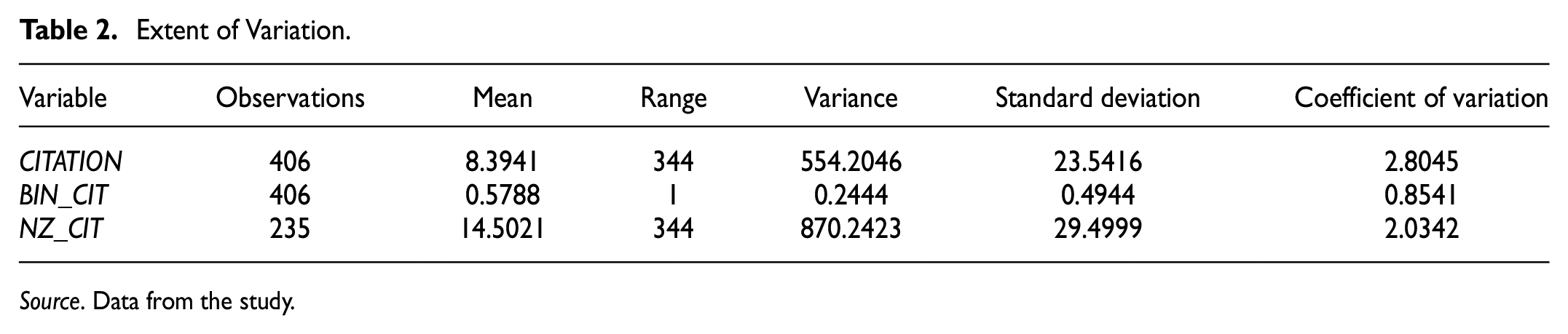
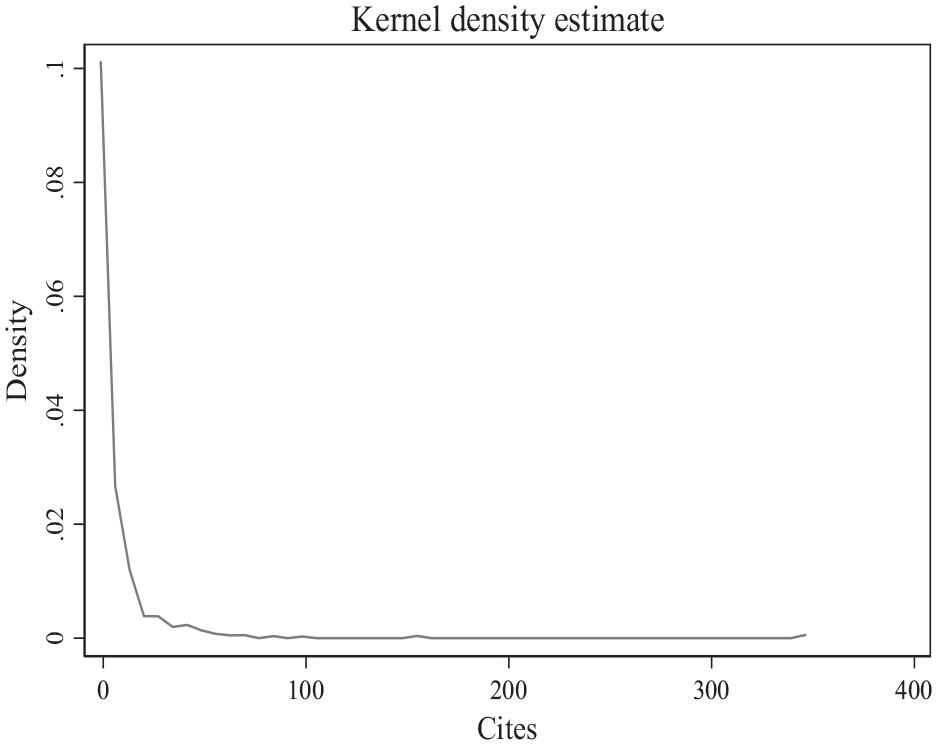
The definition and measurement of the variables are presented in Table 1. Estimating equation (1) using ordinary least squares (OLS) was inappropriate for the current study for two reasons. First, citation counts are often loaded with zeros. Our data has 170 zeros as citations, constituting 42% of the observations. The zeros can be so many that the distribution will be severely skewed (lop-sided) (Card & DellaVigna, 2017). Figure 1 shows the skewness of our citation counts. Second is the overdispersion of the data; that is, the conditional variances exceed the conditional means (Wohlrabe & Birkmeier, 2014). In our data, the mean of CITATION is 8.3941 whilst the variance is 554.2046.
Kernel density citation counts.
Other useful estimators include the negative binomial (NBREG), zero-inflated negative binomial (ZINB), zero-inflated Poisson (ZIP), inverse hyperbolic sine transformations (IHS), and general two-part models (GTPM) (Card & DellaVigna, 2017; Sousa et al., 2023; Struck et al., 2018; Thelwall & Maflahi, 2020).
For the GTPM, the binary model could be any binary link function; logit, probit, loglog, cloglog, and cauchit (Bandhu et al., 2020; Batalova et al., 2020; Djokoto, 2015; Greene, 2012; Ramalho et al., 2010, 2011), whilst the second part uses a wide range of distributions arising from no transformation of the non-zero citations to natural logarithm or IHS transformation of the non-zero citations. The IHS has been used in some citation studies recently (Afridi et al., 2022; Azoulay & Lynn, 2020; Bellemare et al., 2021; Card et al., 2020; Djokoto, Agyei-Henaku, et al., 2020; Hengel & Moon, 2020). In this paper, we explored five binary link functions and tested the no transformation, natural logarithmic and IHS transformations of the non-zero citations.
Following Djokoto, Owusu, et al. (2020) and Ramalho et al. (2014), we specify
Logit:

Probit:

Loglog:

Cloglog:

Cauchit:

The derivative is

We used three tests to assess and select the appropriate link function; RESET, goodness-of-functional-form tests and pairwise P test (Davidson & Mackinnon, 1981; Djokoto, Owusu, et al., 2020; Ramalho et al., 2014; Ramsey, 1969).
The IHS transformation (or archsinh) which normalizes the t-distribution (Anscombe, 1948, 1950), involves applying NZ_CIT in equation (3) to a variable y to realize a result, say

After this, the OLS estimator comes in handy.
To obtain the elasticities in the case of IHS as the dependent variable, we followed the procedure of Bellemare and Wichman (2020). Fancy equation

where x is a continuous variable. Then

To recover

The above can be restated as

In the limit
Equation 14 is inappropriate for binary variables (Bellemare & Wichman, 2020). Consider the estimable equation

where d is a dummy variable; 0 or 1.

Based on Halvorsen and Palmquist (1980), equation (16) yields

Results and Discussion
Background of Data
The non-zero observations total 235 out of the total observations of 406. The 171 zero citation counts justified the use of the two-part model as stated previously. The mean of the IHS transformation of the non-zero citation counts is 2.5158. The lower variance (1.2270 * 1.2270 = 1.5055) which is an under-dispersion can be attributable to the IHS transformation. Peer-reviewed (PEER_R) publications constituted 54.68% of the sample whilst review papers (REVIEW_P) made up a meager 1.48% of the sample. This is not surprising as review papers rely on existing research articles. About 53.69% of the publications in Google scholar possessed full text (FULLTEXT). The only journal factor we found is the impact factor (IMPACTF). Less than 10 (9.36) % of the publications were in journals with the Clarivate Analytics impact factor. More than 50% of the publications had two or more authors (COLLABO). The maximum self-citation count is 109 from a publication with 345 citations.
Nature of Citations
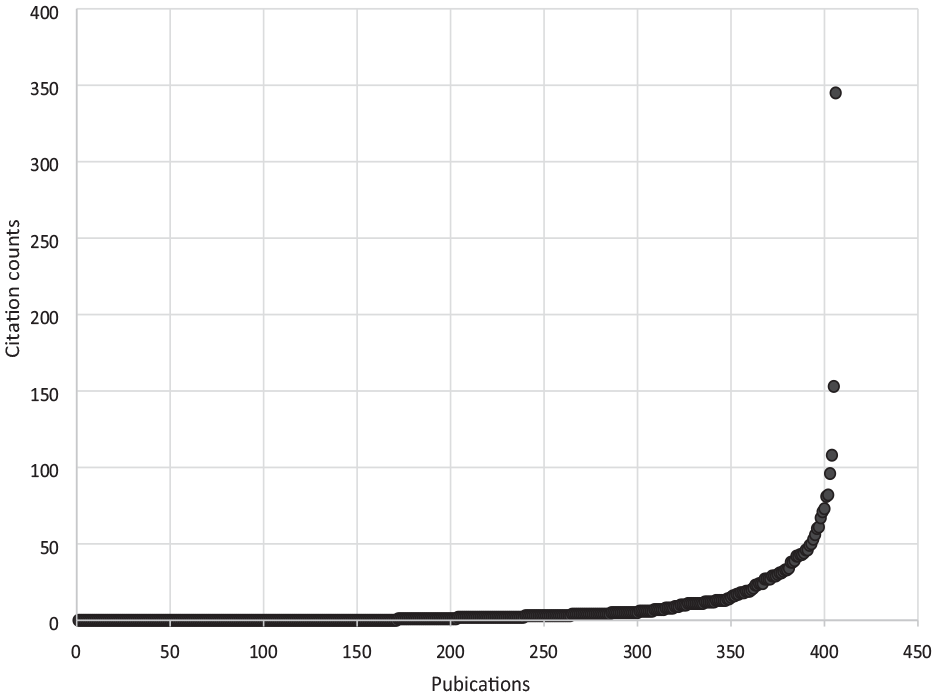
Figures 1 to 4 show the nature of the citation counts. In the kernel density plot (Figure 1), the citations are most dense at zero citations and get less dense as the citations increase. Figure 2 mimics a cumulative frequency curve. It can be observed that about 150 and 200 observations have zero citation counts. The citation counts lift above the zero line thence. About 393 publications possess citation counts of fifty and below. Three publications record citation counts above 100. Regarding timing, most citation counts are for publications between 1990 and 2022 (Figure 3). Citation counts above fifty were for publications within the same period. This indicates that citation activity appears to be concentrated in recent papers. This may have stemmed from increased FDI activity and the recency of data in agribusiness (agriculture and food manufacturing). Dropping the zeros from CITATION yielded NZ_CIT. The peak density of Figure 4 is 0.06 unlike 1.0 in Figure 1. This suggests the zeros significantly influenced Figure 1.
Alternative distribution of citation counts.

Distribution of citations based on publication year.

Kernel density plot of NZ_CIT.
Extent of the Variability of Citation Counts
The variation in citation counts noted in the introduction is formally examined in this subsection. The variance of CITATION (554.2046) is lower than that of NZ_CIT (870.2423) because the former contains zeros whilst the latter is made up of non-zero citation counts (Table 3). Similarly, CITATIONS show a lower standard deviation than NZ_CIT. As absolute standard deviation (SD) may not fully describe the variation, the coefficient of variation (CV) was computed, expressed as the ratio of the SD to the mean (M). Using the variance (V) or the SD, one would have concluded that NZ_CIT varied more than CITATION. However, with the CV, it is apparent that NZ_CIT varies less than CITATION with a difference of 0.7704. The extent to which some variables can explain this variation independently or jointly is important for empirical analysis.
Descriptive Statistics.

Drivers of Citation Counts
Model Properties and Model Selection
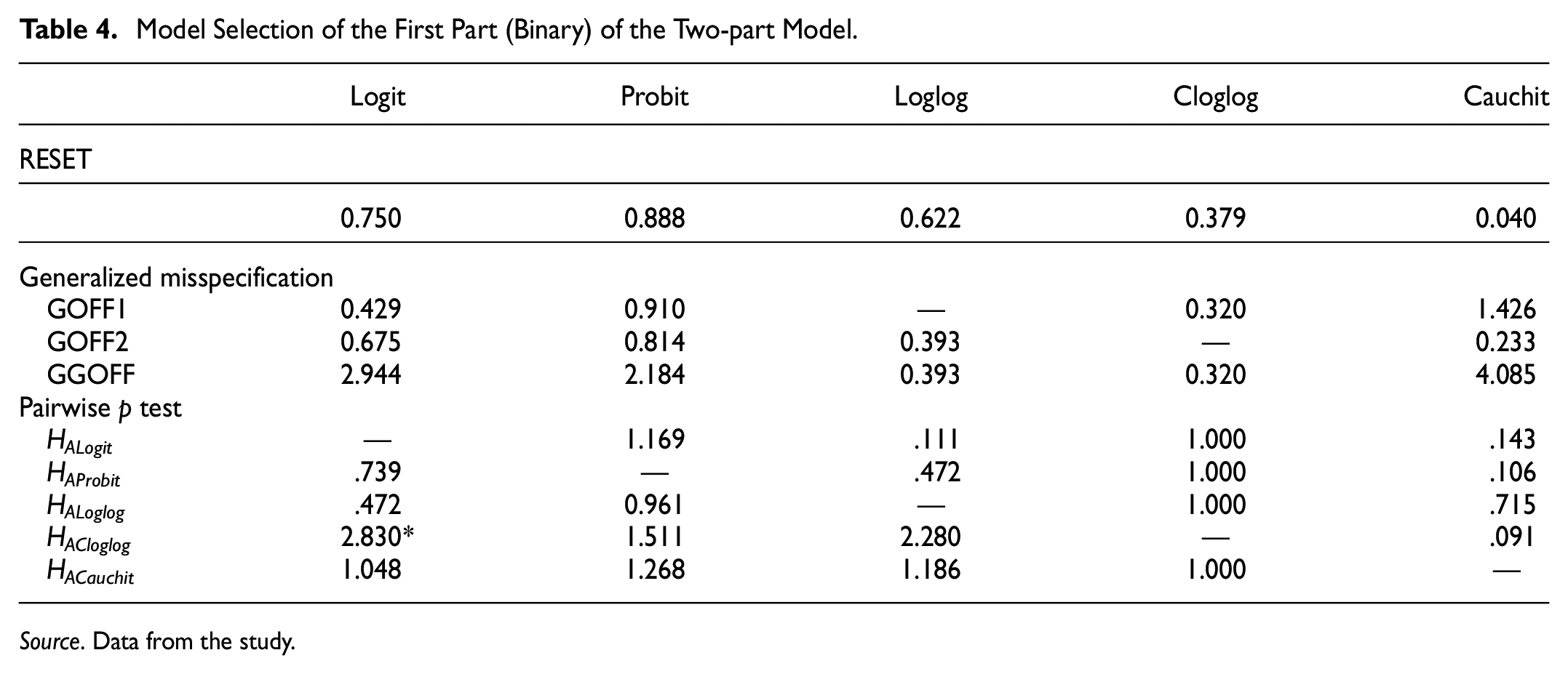
The estimates of equation (2) are presented in Table 4. The RESET test shows the link functions are appropriately specified based on failure to reject the null hypothesis that the model is not mis-specified. All three goodness-of-functional form tests also show that the link functions are appropriately fitted to the data. The pairwise p test is useful in selecting from among the five-link functions. The null hypothesis that the logit link function is preferred to the cloglog link function is rejected. Based on this result, the logit link function is out of contention. The other four are eligible, however, one must be selected. A close inspection shows that the p test statistics for the cauchit link function, the null hypotheses, are the least. This implies that the cauchit link function fails to reject the null hypothesis most. Or it is preferred to the other link functions most. It turned out that the cauchit link function also had the lowest AIC and BIC, as well as the highest pseudo-R, squared.
Model Selection of the First Part (Binary) of the Two-part Model.
Source. Data from the study.
Models 1, 2 and 4 were estimated respectively with NZ_CIT, lnNZ_CIT and IHS_NZ_CIT (Table 5). The Shapiro-Wilk normality test shows the errors in model 1 are not normally distributed. Whilst the errors in models 2 and 4 are normally distributed, the models are mis-specified based on the rejection of the null hypothesis of the RESET test. Consequently, the misspecification was corrected in models 3 and 5. Whilst the errors remained normally distributed, model 5 has the lowest AIC and BIC, hence this was selected as the second part of the two-part model. It must be noted that the highest VIF is 104.16 and is attributable to the correction factor, IHS_NZ_CITATpsq. This is common with corrections for misspecification. The high VIF exceeds the often-stated threshold of 10 (Belsley et al., 1980; Greene, 2012; O’Brien, 2007; Wooldridge, 2009). The key detriments of high multicollinearity are an increase in standard errors leading to invalidation of hypothesis tests and switches in the sign of the coefficients (Belsley et al., 1980; Greene, 2012; O’Brien, 2007; Wooldridge, 2009). Comparing the coefficients of models 4 and 5, not only are there no sign switches, but none of the statistically significant coefficients has also turned statistically insignificant. Rather, the statistically insignificant coefficients have turned statistically significant. Thus, the effects of high VIF have not materialized in this case. This is a case in which a high VIF is not necessarily detrimental. The statistical significance of the F statistics implies the explanatory variables jointly explain the citation counts (Djokoto, Agyei-Henaku, et al., 2020). This is in line with the explanan (Leydesdorff, 1998; Van Raan, 1998).
Model Selection of the Second Part of the Two-part Model.

Source. Data from the study.
Note. Robust standard errors in parenthesis. *, ** and *** are respectively 1%, 5% and 10% levels of statistical significance.
Having selected the cauchit binary link function for the binary part of the two-part model and the IHS transformation of the dependent variable for the second part of the two-part model, we now proceed to examine the robustness of the estimates from these selected models.
The coefficients of models 6 to 12 are like those of model 13 generally in statistical significance and sign (Table 6). The exceptions relate to the statistical insignificance of one coefficient and the weak statistical significance of the other. Thus, the estimates of the binary cauchit model are robust. In Table 7, the estimates of models 14 to 21 are like those of model 22, generally. There is a general rise in the number of statistically significant coefficients after correcting for misspecification. The selected cauchit model (marginal effects) (model 13) and the elasticities of model 23, that is model 24, are presented in Table 8.
Robustness Checks for the First (Binary) Part of the Two-part Model: Average Marginal Effects of the Selected Cauchit Link Function.

Source. Data from the study.
Note. Robust standard errors in parenthesis. *, ** and *** are respectively 1%, 5% and 10% levels of statistical significance.
Robustness Checks for the Second Part of the Two-part Model.

Source. Data from the study.
Note. Robust standard errors in parenthesis. *, ** and *** are respectively 1%, 5% and 10% levels of statistical significance.
Selected and Robust Two-part model; Elasticities of Cauchit and Model 23.

Note. Robust standard errors in parenthesis. *, ** and *** are respectively 1%, 5% and 10% levels of statistical significance.
Discussion of Coefficients
The marginal effect of 0.1079 suggests that peer-reviewed publications have a 10.79% probability of being cited than non-peer-reviewed publications. Once cited, a peer-reviewed publication will be cited 1.8407 times more than those that are not peer-reviewed. This is because peer review generates valuable comments. Whilst some manuscripts could be rejected, both the rejected and those with revise and resubmit, benefit from comments from reviewers and the editors. The incorporation of the comments and revision of the manuscript enhances the quality of the published paper. Further, some journals discourage the citing of non-peer-reviewed publications in manuscripts submitted for peer review. All these benefits do not accrue to non-peer-reviewed publications. This finding for citations to studies on FDI in agribusiness is like that of Bhat (2009).
The statistically insignificant coefficient of OFDI for model 13 suggests that the probability of studies on OFDI being cited more than inward FDI (IFDI) is statistically zero. Although the negative sign of OFDI points to the tendency of a lower probability of OFDI studies, this is not statistically significant. However, among the cited publications, papers on OFDI were more cited than those on IFDI by 0.2145 times. This finding departs from that of Fairbrother (2013) for which IFDI negatively influenced patent citations.
Although positive, the marginal effect of 0.3864 is statistically insignificant for REVIEW_P. Also, among the cited publications, the result is not different. The positive sign suggests that authors may have been tending to save time and effort reading review papers for their literature reviews more than going out to seek individual literature. The result, however, means that for citations on FDI on agribusiness, review papers do not necessarily possess a higher probability of being cited compared to research articles. Standalone literature reviews are important in every scientific discipline. Indeed, “many of our greatest scientists have used, created, and contributed to the review literature” (Garfield, 1987, p. 113). “Every 30 or 40 papers there is a need for a review paper to replace those earlier papers that have been lost from sight behind the research front” (Price, 1965). As in most scientific disciplines (Wagner et al., 2016) including agricultural economics, literature reviews provide a foundation for scientific progress. With almost no exception, most journals accept literature reviews, most often as a separate category of papers and provide higher word count limits including references for it (Waltman, 2016). Additionally, there are editorial initiatives that encourage the publication of literature reviews. This demonstrates the unique role of standalone literature reviews. However, our results could not confirm this. Hence, it is at variance with the conclusions of Biscaro and Giupponi (2014), Ruano-Ravina and Alvarez-Dardet (2012) and Vanclay (2013).
The marginal effect of 0.0004 of AGESQ suggests an increase in the age of publication by 1 year would increase the probability of citation by 0.04%. This suggests a quadratic relationship between citations and the age of publication (Figure 5). Once cited, an increase in the age of publication by 1% would increase the citation count by 0.1532%. Citations of FDI studies in agribusiness first rise, get to a peak and later fall. Although the citations of individual studies were not explored, the chart shows the turning point around 20 years. This fits the explanation of Tahamtan et al. (2016). Barnett and Fink (2008) attributed the fall to the obsolescence of information with time. Our finding is consistent with that of Bornmann and Williams (2013) and Ruano-Ravina and Alvarez-Dardet (2012).
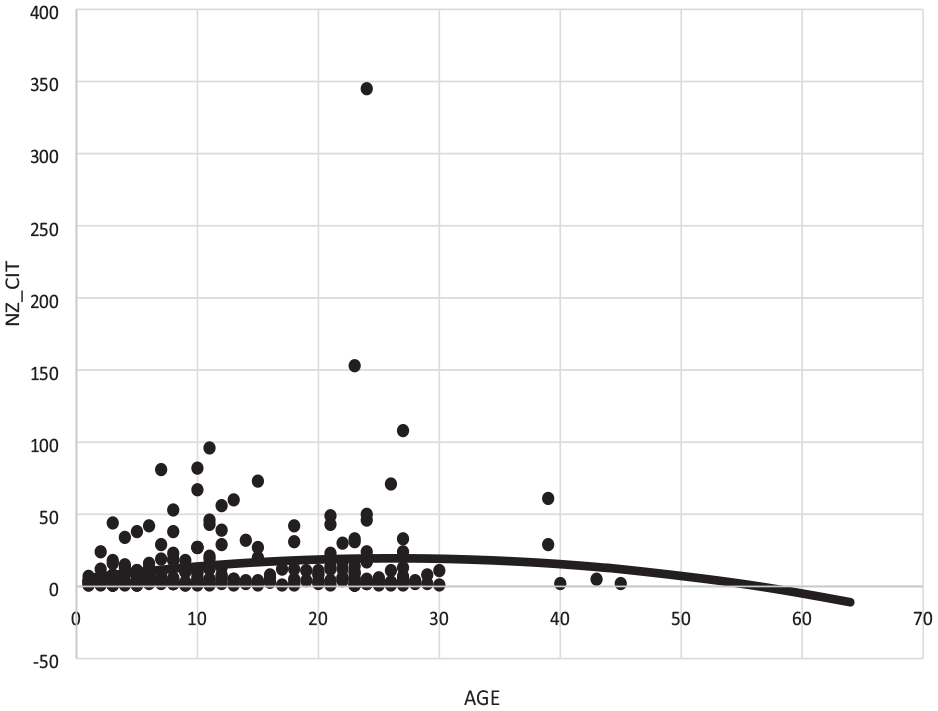
Quadratic relationship between NZ_CIT and AGE.
There is about a 9% probability that publications on FDI into agribusiness with full text in Google scholar will be cited more than those without full text. Full-text publications increase a citation by 5.44% compared to those without full text. This is the highest statistically significant elasticity. This result is understandable as full-text papers are accessible to readers more than those not accessible to readers. As unhindered access exists, it is expected that the probability of citation would also increase. Our finding is consistent with findings from existing studies (Abbasi et al., 2019; Alkhawtani et al., 2020; Basson et al., 2021; Djokoto, Agyei-Henaku, et al., 2020; Gelzer et al., 2022; Langham-Putrow et al., 2021; Sababi et al., 2017). There is, however, an exception, open access did not have a broad citation advantage (Dorta-González & Santana-Jiménez, 2018). From the foregoing, H1 is confirmed. That is, paper-level factors influence the citations and publications of FDI studies in agribusiness.
Turning to a journal factor, impact factor, our finding is that citations of publications in journals with impact factor do not differ from those not in journals with impact factor. The result is the same whether for the binary model or the second part of the two-part model. This implies in the subject area of FDI into agribusiness citations could be enhanced irrespective of publishing in journals with the Clarivate Analytics impact factor. Our finding departs from that of Asaad et al. (2020), Bornmann (2017), Djokoto, Agyei-Henaku, et al. (2020), Elkins et al. (2010), Lee et al. (2010), Nuti et al. (2015), and Wagner et al. (2021). H2, that paper levels factors influence the citations publications of FDI studies in agribusiness is not confirmed.
Publications with two or more authors have about a 10% probability of getting cited more than those with sole authorship. This result suggests author collaboration increases the probability of getting cited. Papers with co-authors would obtain 2.2846 times more citations than those of sole authorships. Fleming (2001) and Nomaler et al. (2013) explained that breakthrough innovations often stem from reconjoining ideas that have previously been unrelated. Nomaler et al. (2013) also stated that owing to pooling resources from centers or persons located in different national systems and traditions can lead to more unique outcomes. Our result is consistent with the literature (Bosquet & Combes, 2013; Djokoto, Agyei-Henaku, et al., 2020). The contrary is evident (Maz-Machado & Jiménez-Fanjul, 2018; Wongkhae et al., 2017).
In model 13, SELFCITATION did not feature in the model because the data was collinear with data of the dependent variable. That is, generally, citations with zero counts also have zero SELFCITATION counts. However, from model 24, an increase in self-citation by 1% would increase the total citation count by 0.1767%. The positive sign suggests that self-citation does contribute positively to the total citation count. The persuasive view of citations holds that scientists persuade the scientific community to share their opinions on the value of the work (Djokoto, Agyei-Henaku, et al., 2020). Scientists thus relate the results to the existing knowledge by advancing evidence and argument to persuade the readers that the work has not been impaired by mistakes (Gilbert, 1977; Small, 1978; MacRoberts & MacRoberts, 1987). To accomplish this persuasion, the citer must be well informed about the relevance and usefulness of the work for the persuasive purpose. Self-citers do this as well as others. The author (self-citer) knows about the existence of their publication, no additional access is required for example if the paper is behind a paid wall. Also, the self-citer may better appreciate the importance and interestingness of the work than others (Liu & Rousseau, 2013). Furthermore, in the case that the self-citer publishes in the same discipline as the already published paper, self-citing will be most probable. Our finding is consistent with that of Costas et al. (2009), Gelzer et al. (2022) and Zhou (2021) but incontinent with others (Bhandari et al., 2007; Jaffe, 2011; Willis et al., 2011; Zhou, 2021). H3, which states that paper-level factors influence the citation of publications of FDI studies in agribusiness is also confirmed.
Policy Implications
The binary part of the two-part model took the view of whether a publication is cited. For the second part of the two-part model, the understanding is that once cited, what are the determinants of citation? That is to state, what variables increase citation? Authors must first overcome the inertia of being cited and then pursue goals that would increase the citation counts.
There is much to be gained from the results of PEER_R. Peer review involves at least one reviewer other than the editor(s). Increasing the number of peer reviews within the circumstances of the availability of reviewers could further improve the quality of the review. Also, improving the thoroughness of the review would enhance the quality of the publications. Authors who have papers in non-peer review outlets should progress them to peer review outlets to attract more citations. Authors in the discipline of FDI into agribusiness must publish in a peer-reviewed journal to increase citations.
The choice between OFDI and IFDI may be useful if it becomes the only deciding factor for publishing an agribusiness paper. In that regard, OFDI papers may be preferred. Indeed, OFDI appears to be less common compared to IFDI.
Among the cited publications, full-text publications are the strongest drivers of citations in FDI studies in agribusiness. Authors seeking to increase citations must publish in journals that make the full text available on google scholar. Funders may also recommend full-text journals or hybrid or paid wall journals to make that full text available. This result justifies the goal of the open-access movement. As citations signal the impact of a publication, authors, journal publishers, and funders should seek to promote policies that would make the full text of publications immediately available or shorten the embargo period.
The positive effect of COLLABO means that a greater impact can be made by co-authored publications than by sole-authored publications. Although co-authored publications require additional time for coordination and could delay completion if some collaborators are lazy, energetic collaborators are a great asset that can complement one another in resources, knowledge, and skills. Authors seeking to make an impact based on citations must publish collaboratively. Funders should continue to encourage collaboration in their project design by requiring collaboration among research teams and awarding more points for collaborative applications in the funding assessment process.
Conclusion
The main contribution of this study is to explain the variability in the observed citations of FDI into agribusiness. We used 406 observations fitted to a two-part model, first, the cauchit link function, and second OLS estimator with the dependent variable transformed by an inverse hyperbolic sine function. The results show that peer-reviewed publications, age of publication, full text in Google scholar, collaborative publications, and self-citation enhance citations. Review articles and publishing in journals with impact factors do not promote citations. To make an impact through citations, authors and funders must focus on peer review, full text, and collaborative publications, and engage in self-citation. This study focused on total citations. Further research can consider addressing only self-citations.
Footnotes
Declaration of Conflicting Interests
The author(s) declared no potential conflicts of interest with respect to the research, authorship, and/or publication of this article.
Funding
The author(s) received no financial support for the research, authorship, and/or publication of this article.

Data Availability Statement
Data sharing not applicable to this article as no datasets were generated or analyzed during the current study.