




Abstract
In the contemporary landscape of construction project management, the strategic integration of Building Information Modeling (BIM) methodology has emerged as a fundamental avenue to improve operational efficiency. This study evaluates the feasibility and effectiveness of the implementation of the BIM methodology in improving the management of construction projects in construction companies in Peru. Using an applied approach underscored by a quantitative and correlational non-experimental design, a comprehensive survey was administered to 415 workers. This survey focused on evaluating the dimensions of BIM (3D, 4D, and 5D), as well as the fundamental facets of project management that encompass planning and execution. The results reveal that 47% of respondents highlighted deficiencies within the 3D BIM dimension, indicating potential challenges in visualizing and understanding the design. Likewise, 49% of participants highlighted deficiencies within the 4D BIM dimension, shedding light on issues related to time coordination and strategic planning. Around 57% expressed reservations about the 5D BIM dimension, highlighting the complexities surrounding accurate cost estimation and financial management. The synthesis of these revelations underscores an urgent call for specific interventions to rectify these specific areas. This involves investing in cutting-edge BIM technology tools and the simultaneous provision of targeted training programs for stakeholders to increase their multi-dimensional view of BIM. Ultimately, the study results drive innovation, thus opening the prospect of a more sustainable and streamlined construction industry.
Introduction
In the context of the construction industry, the Building Information Modeling (BIM) methodology has undergone a remarkable evolution, both in its thematic approach and in its practical applications. From its origins, mainly focused on visualization and computer-aided design, BIM has transcended into a comprehensive tool encompassing sustainability, energy efficiency and the integration of smart technologies (Akinlolu and Haupt, 2021). This evolution is reflected in a diversity of projects, from residential construction to large-scale infrastructure, demonstrating its adaptability and relevance in different contexts and challenges (Alecrim et al., 2020). The integration of BIM methodology in project management has had a significant impact on today’s society. This relationship between BIM and project management has generated substantial improvements in the efficiency and productivity of the construction industry (Al et al., 2020; Ore et al., 2020). Through the use of accurate and up-to-date 3D models, errors and rework have been reduced, leading to time and cost savings. This meets the increasing demand of today’s society for faster and more efficient construction (Einur et al., 2019).
The use of BIM in project management has also greatly improved collaboration and communication. The ability to use a centralized and shared model facilitates the real-time exchange of information between different stakeholders such as architects, engineers, contractors, and owners (Ye, 2021). This increased collaboration and communication speeds up decision making, which has a positive impact on society, resulting in more coordinated construction projects that meet the expectations of clients and communities (Castilla et al., 2020; Ismail et al., 2019).
In South Africa, it was found that most construction projects have a high number of accidents, injuries, and property damage, so it is necessary to implement BIM methodology to improve site planning and reduce construction risks (Luo et al., 2021). Similarly, in Iraq, it was found that construction management is not efficient due to the increase in people, documentation and formats that need to be collected, exchanged and recorded in the construction process, so it is essential to promote the use of BIM methodology and Geographical Information System (GIS) (Y. Zhang et al., 2021). Similarly, in Germany, it was found that construction project management is deficient, as the choice of materials, systems and design decisions do not improve the performance of the structure and generate a high carbon footprint (Ma et al., 2021). Finally, in Chile, it was found that the architecture, engineering, and construction industry needs to implement BIM methodology because it is constantly facing problems in managing human and material resources, meeting construction deadlines, making more accurate budgets and reducing construction errors (Doi et al., 2020). In Peru, it was identified that productivity in project management in the construction sector is much lower than in other sectors due to the lack of technology in the planning process to organize the stages and visualize progress, which increases errors at the time of execution (Chen et al., 2020). As a consequence, construction companies face difficult situations in the execution of works and require professionals capable of handling unforeseen situations (Mcquaid et al., 2021). In that sense, construction companies should aim for the correct implementation of BIM methodology in design, production, construction, operation, and maintenance to optimize the construction model (Lee et al., 2020).
Knowledge Gap, Objectives, and Scope of the Research
Previous studies have determined that the global adoption of BIM methodology has marked a turning point in project management, enhancing operational efficiency, and sustainability (Bustamante et al., 2021; Panteli et al., 2020). However, in regions such as Peru, the integration of BIM in the construction industry is still at an early stage. The particularity of this market, characterized by its growing urban infrastructure and the need to improve quality and efficiency in project delivery, presents a unique opportunity to explore the capabilities and limitations of BIM in a developing environment (Quispe and Ulloa, 2021).
In Peru, the construction industry faces significant challenges, including managing fluctuating costs, the complexity of coordinating large-scale projects and the need to accelerate construction times without compromising quality. These challenges are exacerbated by the lack of standardized practices and resistance to change toward digitalization. Therefore, this paper aims to fill this gap by analyzing the level of BIM implementation in the construction sector and the existing gaps in the dimensions of 3D BIM, 4D BIM, and 5D BIM in Peru. Therefore, the objective of this study is to analyze the feasibility and effectiveness of the implementation of Building Information Modeling (BIM) methodology as a strategy to improve efficiency in construction project management. It seeks to provide practical recommendations and solutions to address the deficiencies identified in the implementation of BIM and to promote its wider adoption in the sector.
Importance and Contribution
This study aims to make a substantial contribution to the understanding of BIM methodology in the construction industry in Peru, a region that has so far not been widely explored in the existing literature. By analyzing the current level of BIM implementation and its specific dimensions (3D, 4D, and 5D), our work provides valuable insights on how BIM can address the region’s endemic challenges in terms of operational efficiency, construction costs and times, and resource management. This detailed analysis reveals important gaps in the application of BIM in the Peruvian context, which is crucial for formulating targeted and effective intervention strategies. Beyond identifying these gaps, the study proposes practical and sustainable solutions to address the economic and environmental challenges facing the Peruvian construction sector. In doing so, it drives innovation and technological advancement in the local industry and offers a replicable model for other emerging markets. This contribution to the application of BIM encourages the search for greater efficiency, sustainability and positive economic impact in the construction industry, not only nationally but also on a global scale.
Literature Review
A meticulous review of the literature highlights the efficiency of BIM in the project management revolution within the construction industry. Analytical comparisons of projects managed with conventional methodologies versus those managed through BIM show that BIM not only strengthens coordination and collaboration between teams, but also enhances transparency and improves resource management (Karatas & Budak, 2023; Olofsson Hallén et al., 2023). It has been documented that the support BIM provides in decision making throughout all project phases can result in significant decreases in costs and lead times (Al-Roumi & Al-Sabah, 2023).
The literature also exposes how the adoption of BIM supports sustainable construction practices. BIM’s ability to integrate detailed energy analysis facilitates teams to make accurate assessments of building energy performance, leading to a more sustainable approach and reduced long-term environmental impacts (Waqar et al., 2023; Wang 2019). In developing markets, a gap in BIM adoption has been identified, indicating that its widespread adoption could be key to the modernization and increased competitiveness of the global construction industry (Aladağ et al., 2023). These studies collectively suggest that, although BIM adoption varies around the world, its positive influence on project management efficiency is consistently recognized and promotes a move toward more effective and accountable practices in the construction sector (Zhang et al., 2021).
In addition, the use of BIM in project management has improved the quality and safety of construction. The use of BIM analysis and simulation tools and capabilities makes it possible to identify potential problems or conflicts before they occur in the physical construction (Chang et al., 2022). This results in higher quality and safety in projects, which directly benefits society by reducing the risks associated with construction and ensuring higher quality buildings (Putri et al., 2019; Zhao et al., 2021). Sustainability and energy efficiency are also areas that have been positively impacted by the integration of BIM into project management. BIM models make it possible to assess and optimize the energy performance of buildings, resulting in reduced energy consumption and minimized environmental impact (D. Zhang et al., 2020). In a context where society is looking for more sustainable and environmentally friendly solutions, BIM has been a key tool to promote the incorporation of sustainable practices in building projects (Huihua et al., 2020; Ying et al., 2021).
Despite these advances, a gap is identified in the literature that delves into how these efficiencies and improvements are applied and measured in specific contexts, particularly in markets with early stage BIM adoption. Therefore, the research questions of this study focus on (1) assessing the current level of BIM implementation in an emerging market such as Peru, (2) identifying specific gaps in 3D, 4D, and 5D BIM dimensions, and (3) providing a comparative framework that can serve as a reference for the global industry. This approach not only ensures that the study addresses critical gaps identified in the literature, but also contributes to the field with a clear and impactful narrative, reinforcing the originality, and innovation of the article.
Method
Conceptual Framework and Hypotheses
Recognizing the importance of a clear conceptual framework to guide the research, we have developed a diagram of the research framework that illustrates the relationships between the different variables studied. This visual framework helps readers to better understand the interactions between the dimensions of the BIM methodology (3D, 4D, and 5D) and the various aspects of project management. The diagram shows how each BIM dimension relates to specific components of project management, such as project planning, execution, cost control, and quality.
In addition, the study is structured around several explicit research hypotheses, designed to reflect the expected relationships between BIM dimensions and project management. These hypotheses provide clear guidance to readers on the expected results and the focus of the analysis. The hypotheses are as follows:
H1: Effective implementation of the 3D dimension of BIM is positively correlated with improved design quality and reduced errors in construction projects.
H2: The application of the 4D dimension of BIM leads to better planning and time management, resulting in more efficient project execution and a decrease in delays.
H3: The use of the 5D dimension of BIM significantly improves cost estimation and control, contributing to more effective financial management in construction projects.
These hypotheses are examined through a detailed methodological approach, using both descriptive and inferential statistics to assess the relationships and correlations between variables. Figure 1 clearly presents these hypotheses and the research framework, to provide readers with a deeper and more coherent understanding of our research approach and the intended outcomes of the study.

Conceptual framework of the influence of BIM on construction project management.
Design
The applied, non-experimental research design of this study focused on a correlational-causal approach, allowing for an in-depth exploration of the interrelationships between Building Information Modeling (BIM) dimensions and critical aspects of project management (Hernández et al., 2014). This approach was chosen for its ability to uncover underlying patterns and relationships in the data without altering the natural environment of the study subjects, maintaining the integrity of the real context of work in the construction industry.
Inclusion and Exclusion Criteria
The purposive sample of the study consisted of 415 employees (319 men and 96 women). In order to achieve this result, the following inclusion criteria were followed: (a) age between 25 and 50 years, (b) consent to participate in the study, (c) permanent workers with at least 5 months of work experience in the construction sector. The construction sector was chosen for the research due to its increasing importance and complexity today, where BIM methodology is seen as a vital tool to improve project management and address the unique challenges of this evolving industry. Exclusion criteria consisted of (a) incomplete questionnaire and (b) unwillingness to continue participating in the study.
Procedure
The research was carried out during the months of September–November 2022 in which the participants were recruited continuously, using the type of convenience sampling until the desired sample size was reached (415 workers) considering that there were no incomplete questionnaires. The data collection technique was the survey, applying a structured questionnaire using the Google forms tool to measure the opinion about the variable BIM methodology according to its dimensions: BIM 3D, BIM 4D, and BIM 5D with a total of 15 questions; and 10 questions to measure the opinion regarding the variable project management and the dimensions: planning and execution, using the Likert scale according to the values efficient, regular, and deficient. The methodology of this study emphasizes a detailed understanding of the various dimensions of BIM, integrating them as central axes in the analysis. The integration of these three dimensions in our methodological approach allows for a comprehensive assessment of how BIM contributes to improving construction project management, not only in terms of design and planning, but also in time and cost management. By focusing our analysis on these dimensions, we seek to provide a comprehensive perspective on the benefits and challenges of implementing BIM in the construction environment, highlighting its potential to improve efficiency and effectiveness in project management.
Data Analysis
In this study, the data collected was organized into a tabulation matrix and processed using SPSS v25 and Excel statistical software. To measure the dimensions of the BIM methodology (BIM 3D, BIM 4D, and BIM 5D), a five-point Likert scale was used, ranging from “Very poor” to “Very efficient.” This scale allowed for a detailed and nuanced assessment of participants’ perception of each BIM dimension.
Cronbach’s alpha reliability tests were conducted for the BIM methodology and project management variables, obtaining a result of .859. This value indicates a high reliability in the measurements, ensuring the internal consistency of the questionnaire responses. In the first phase of the analysis, descriptive statistics were applied to perform the frequency distribution of the mentioned dimensions of BIM, as well as the dimensions of planning and execution in project management. This stage provided a clear understanding of the general trend in participants’ perceptions and experiences. In the second phase of the analysis, inferential statistics were used to validate the research hypotheses. For this, Pearson’s correlation coefficient was used to examine the relationship between the different dimensions of BIM (3D, 4D, and 5D) and key aspects of project management. This statistical method was instrumental in identifying the strength and direction of the correlations between these variables, providing a detailed understanding of how BIM implementations influence the efficiency and effectiveness of project management.
Ethical Considerations
Ethical principles of research were followed, ensuring confidentiality and informed consent of all participants. Personal information and responses were handled confidentially and used exclusively for research purposes.
Results
The questionnaire was applied to 415 employees, on the basis of which the following results were obtained:
Workers’ Perceptions of the Dimensions of the BIM Methodology Variable
The results derived from the BIM methodology provide a critical insight into workers’ perceptions of the application of BIM in multiple key dimensions. The fact that 47% of respondents consider the level of 3D BIM to be poor points to a gap between expectations and the actual quality of the 3D model, possibly affecting accuracy and coordination. Similarly, 49% who consider the level of 4D BIM to be unsatisfactory highlight problems in planning and time management, which could reflect challenges in scheduling and adapting to changes. In addition, 57% perceiving the level of 5D BIM as deficient suggests concerns in cost estimation and control, indicating possible obstacles in resource allocation and financial decision making. Taken together, these results emphasize the need to specifically address these areas to improve overall BIM implementation and achieve more effective results in future projects (Figure 2).

Perceptions of BIM methodology.
Workers’ Perceptions of the Dimensions of the Project Management Variable
The results from the project management analysis reveal a significant picture of how workers perceive various key aspects. It is notable that 45% of participants rate the level of planning as “fair,” which points to medium satisfaction, but also suggests possible areas where planning could be more accurate or comprehensive to ensure project success. Similarly, the fact that 51% of respondents rate the level of implementation as “low” highlights a worrying discrepancy between expectations and actual implementation. This finding could indicate challenges in task execution, team coordination, or resource management. These joint results underline the need for a detailed review of both project planning and implementation, with the aim of optimizing the effectiveness, efficiency, and quality of the work carried out (Figure 3).

Perceptions of project management.
Correlation Coefficient
The interpretation of Pearson’s correlation coefficients, presented in Table 1, reveals significant patterns in the relationship between BIM dimensions and project management. The moderate strength correlation between 3D BIM and planning (r = .624, p < .001) suggests that a more intensive use of 3D modeling is associated with more robust planning. This reinforces hypothesis H1 and underlines the practical importance of 3D BIM as a tool to improve conceptualization and forecasting in the early stages of construction projects. This correlation may be indicative that when teams have a clearer visualization of the project, they can plan more accurately and anticipate potential obstacles.
Interrelationships Between BIM Methodology Dimensions and Project Management Dimensions.

p < .01.
Furthermore, the strong correlations observed between BIM 4D and planning (r = .891, p < .001), as well as between BIM 4D and execution (r = .798, p < .001), validate our hypotheses H2 and H3, confirming that the integration of time and cost management within BIM contributes significantly to the overall efficiency of the project management process. These results highlight the critical value of incorporating the temporal and financial dimension into project planning and monitoring, possibly leading to a more synchronized workflow and more effective cost control.
The weaker relationship between 3D BIM and execution (r = .515, p < .001), although statistically significant, suggests that 3D modeling, while valuable in planning, may not have the same level of direct influence in the execution phase of the project. This could be due to the static nature of 3D models, which while providing a detailed plan, may not capture the dynamics and changes that occur during the actual construction phase. These findings urge us to further investigate how 3D BIM tools can be better integrated and updated throughout project execution to maximize their practical utility.
Implications for Practice and Future Research
The results of this study have direct implications for the improvement of project management within the construction sector, especially in contexts that are actively incorporating BIM methodology. The correlations observed between BIM dimensions and aspects of project management indicate that deeper integration of BIM could lead to more detailed planning and more efficient execution of construction projects. For example, advanced use of 3D BIM correlates with better design quality, suggesting that an investment in 3D modeling skills may be a prudent decision for companies seeking to minimize errors and rework. Similarly, the strong correlation between 4D BIM and scheduling highlights the importance of time management in successful project execution, suggesting that project managers can benefit significantly from training in these tools for better scheduling and progress tracking.
For future research, these findings open up several avenues for further exploration. One particular area of interest is the impact of the work environment and human factors on BIM adoption and effectiveness. Further research could examine how organizational culture and resistance to change influence the implementation of BIM and its acceptance by project teams. Furthermore, given the rapid pace of technological advancement, it would be valuable to investigate how new trends in BIM software and hardware can further optimize project management in the future. Finally, longitudinal studies that track the evolution of BIM implementation over time could provide a dynamic understanding of its adoption and maturation in the construction industry.
Discussion
3D BIM Dimension
The findings indicate that 46.75% of contributors perceive insufficient adoption of 3D BIM within their organization. This challenge highlights a gap between the ability to digitally represent construction projects in detail and the practical execution of these models. Figure 2 reflects this situation, highlighting a mismatch that can limit comprehensive visualization and the effective management of errors and conflicts in the early stages of design. The practice of “model checking” is proposed as a viable solution, in line with studies by Luo et al. (2021; Ma et al., 2021) that emphasize the value of 3D BIM in data storage and management for effective problem detection and resolution. Furthermore, Y. Zhang et al. (2021) suggests that the ability of 3D BIM to facilitate comparison between the proposed design and the executed model enables comprehensive analysis of volumes and materials, contributing to the fulfillment of building requirements.
However, the literature also reveals that 3D BIM implementation can be affected by contextual factors such as availability of specialized software, staff training and organizational culture, which can vary considerably between regions and companies (Choi et al., 2024). Some divergent perspectives suggest that the value of 3D BIM may not be fully realized in environments where these conditions are not optimal, underlining the importance of a holistic approach that includes technology, people and processes (Sun et al., 2023).
4D BIM Dimension
The perceived deficiency in the 4D BIM dimension by 48.92% of the respondents, as reflected in Figure 2, highlights a critical disconnect between construction schedules and the dynamic needs of the project. Lack of synchronization and coordination between different project stakeholders, such as architects and contractors, can lead to unresolved conflicts and delayed decisions. The importance of integrating professionals specialized in 4D BIM for effective planning and project lifecycle management is corroborated by previous studies (Doi et al., 2020; Mcquaid et al., 2021), which emphasize the inclusion of time as a dimension within the construction model to establish defined timelines and improve the decision making process.
In addition, the work of Chen et al. (2020) 29 highlights the added value of 4D BIM in anticipating and resolving interferences, improving productivity and performance in project management, and adhering to set deadlines through detailed time simulations. However, these benefits can be influenced by factors such as organizational culture, training policies and technology adaptability, which vary between organizations and can affect the implementation and effectiveness of 4D BIM. It is critical that firms recognize and address these variables to fully capitalize on the capabilities of 4D BIM.
5D BIM Dimension
The perceived deficiency in the 5D BIM dimension by 57.11% of the contributors, as shown in Figure 2, reveals significant problems in effectively linking digital models to cost and quantity estimates. These difficulties in generating accurate budgets and managing resources highlight a gap between theory and practice in the adoption of BIM for project financial management. Effective integration of 5D BIM requires close collaboration between modeling, time planning and cost estimating specialists, highlighting the interdependence between the different dimensions of BIM. The findings point to the need for improved management of materials and financial resources, a conclusion supported by existing literature (Ghazaryan, 2019; Lee et al., 2020), which emphasizes the use of 5D BIM for real-time cost estimation and price analysis throughout the various stages of the project.
In addition, the study by Yao et al. (2020) highlights the role of 5D BIM in comprehensive project control, ensuring detailed accounting of quantities and unit prices, which facilitates a more accurate prediction of the required investment. However, it is important to recognize that the implementation of 5D BIM can be affected by a number of contextual variables, such as the technological maturity of the company, specific training in estimating software and organizational willingness to integrate new cost management practices.
The practical implications of these results are clear: to optimize project management and improve accuracy in cost estimation and control, firms must not only adopt 5D BIM tools, but also promote a culture of interdisciplinary collaboration and continuous training. Future research should investigate how organizational and cultural factors influence the effectiveness of 5D BIM implementation and explore methods to facilitate the transition to more integrated, data-driven practices in the construction sector.
Planning Dimension
The employee response, shown in Figure 3, which indicates that 45.06% of employees rate the company’s planning as average, reveals a capacity to manage stages, activities, schedules, and budgets that falls short of excellence. This situation suggests that effective planning is being compromised by inaccurate input data, putting the quality of project execution at risk. Incorporating BIM into planning processes could be a strategic response to this issue, providing a framework based on accurate and up-to-date data, which in turn could significantly improve the planning and management of project resources.
This approach is in line with existing literature that identifies planning as a critical component in establishing an effective timeframe and ensuring smooth execution of project activities (Mering et al., 2017; Putri et al., 2019). These studies also emphasize the need for planning to be proactive in defining goals, identifying risks and benefits, and formulating strategies to avoid failures (Chaterine & Simanjuntak, 2020). In addition, it is recognized that planning practices can be influenced by the context in which the firm operates, such as local regulations, market conditions, and organizational culture, which can facilitate or impede the adoption of advanced methodologies such as BIM.
Execution Dimension
The perception of a poor level of execution by 50.60% of the collaborators, as shown in Figure 3, illustrates the challenges that the construction company faces in the effective completion of projects. These challenges include inefficient resource management, schedule inaccuracies, and budget issues, often leading to significant cost overruns. A recommended strategy to improve execution is to optimize the planning stage using the advanced tools offered by the BIM methodology. These tools facilitate detailed construction simulation and promote more accurate and effective management, aligning with literature that emphasizes the need to meticulously execute planned activities and to be prepared to adapt to changes (Dezhkam et al., 2019; Zuluaga et al., 2022).
Furthermore, the literature highlights that project execution can be affected by unforeseen changes and emerging issues that impact budget, time, and quality (Liu et al., 2020). In this dynamic scenario, the need to have professionals who not only have technical competence in BIM but also the ability to make strategic and adaptive decisions in response to unforeseen events is highlighted.
Evaluation of BIM in the Context of Existing Studies
To further support the importance of improving each BIM dimension in our company, it is relevant to compare the results of our study with previous research and recognized standards in the construction industry. Previous studies by experts in the field of BIM have consistently shown that a lack of 3D, 4D, 5D dimensioning and planning can have a significant impact on the efficiency of the construction process and the final results of the project. For example, the study by Lidelöw et al. (2023) found that companies that improved their level of 3D BIM were able to reduce design errors by 30% and disruptions by 40%, resulting in an overall improvement in construction quality. In addition to the studies cited above, it is important to consider different perspectives and viewpoints regarding the improvement of BIM dimensions in our company. While our research has identified shortcomings in the 3D, 4D, 5D and design dimensions, it is important to recognize that there are contextual factors that can influence outcomes. Some studies have suggested that successful BIM implementation can be influenced by various aspects such as organizational culture, availability of technological resources and staff training (Fonseca & Shafique, 2023; C. Zhang et al., 2023). For example, the work of Lozano et al. (2023) found that firms with higher resistance to change experienced greater challenges in adopting BIM, which could affect the perception of deficiencies in different dimensions. In addition, some studies have raised questions about the effectiveness of specific BIM tools and approaches.
To address the shortcomings identified in the various dimensions of BIM, it is crucial to explore potential solutions that can improve our performance in this area. Firstly, it is essential to invest in specialized BIM technology tools that enable more efficient visualization and coordination of projects. The use of advanced 3D modeling software and real-time collaboration tools can help overcome limitations in the generation of detailed digital models and more effectively eliminate errors and disruptions (Yilmaz et al., 2023). In addition, specific training programs for our professionals should be considered to strengthen their skills in using the different dimensions of BIM. This would include courses and workshops on 3D modeling, 4D design, 5D cost estimation, and BIM-based project management (Pan et al., 2023). In addition, the implementation of best practices in project management, such as standardization of BIM workflows, proper resource allocation, and integration of quality control processes, can significantly improve efficiency and accuracy at all stages of construction (Huang et al., 2023).
Proposal
Based on the results of the survey, the following BIM methodology model for improving project management is proposed, which allows to assess the current status and then apply the model to obtain suitable results.
The construction of Figure 4, which represents the BIM methodology model to improve project management in companies in the construction sector, was based on an integration of empirical findings and relevant literature. The actual state described on the left side of the figure directly reflects respondents’ perceptions of current deficiencies in the use of BIM dimensions, as illustrated in the survey results and statistical analyses. For example, the discrepancy between expectations and actual 3D model quality, highlighted by 46.75% of respondents perceiving deficiencies in the 3D BIM dimension, underscores the need for better quality and accuracy in design visualization.
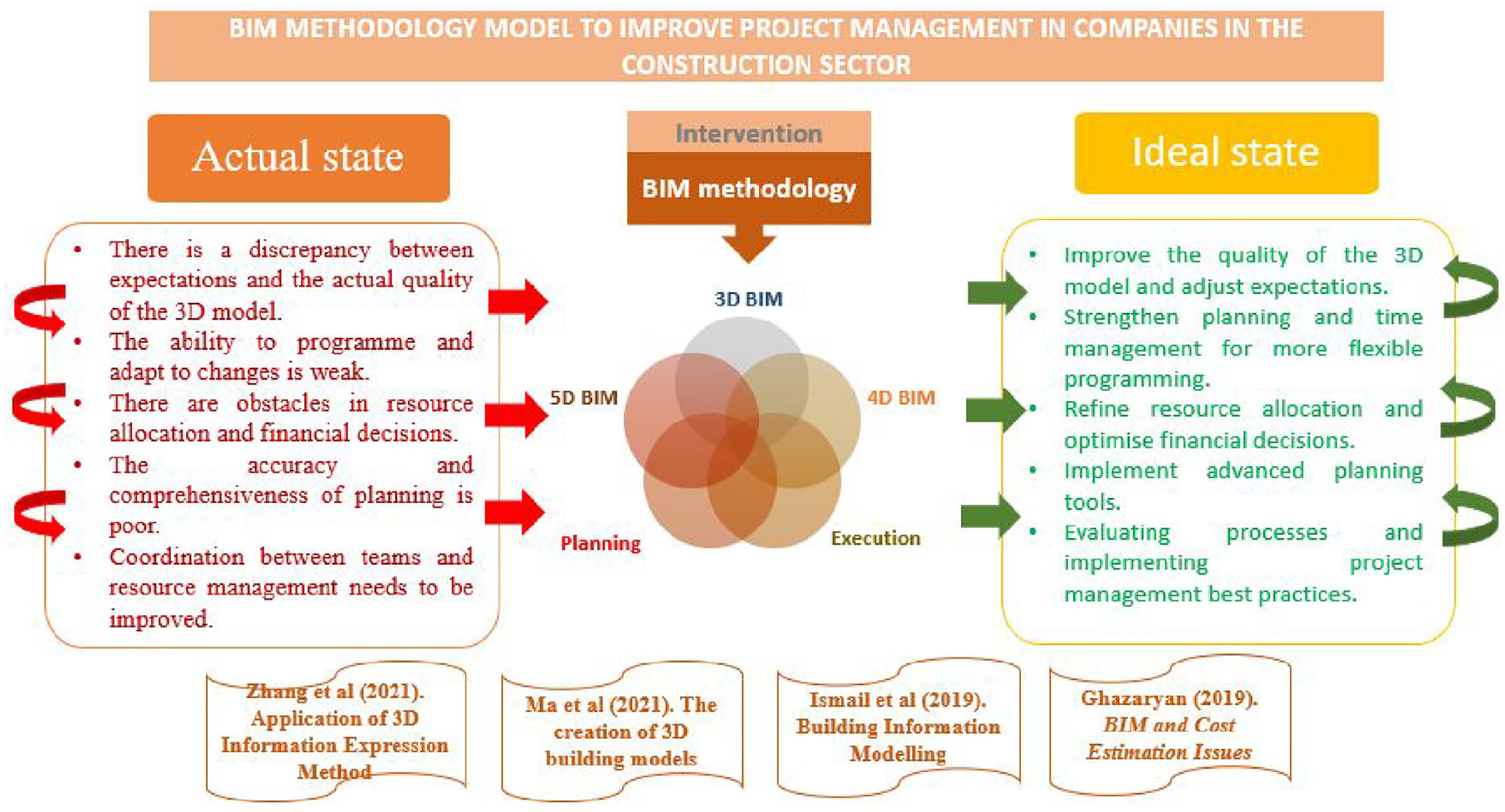
Strategic proposal for improving project management.
The intervention of the BIM methodology, located in the center of Figure 3, acts as a bridge between the real state and the ideal state, suggesting that the adoption and improvement in BIM practices could lead to better planning and execution of the projects. Projects. This section of the figure is inspired by the findings of our research, where positive correlations between the dimensions of BIM and efficiency in project management are evident, as well as the cited literature, which provides additional evidence of how the BIM methodology can address the identified challenges. Finally, the ideal state reflects a hypothetical scenario based on current literature and survey results, projecting the improvements that could be achieved through the effective implementation of BIM in all its dimensions. The point-by-point relationship between the actual state, the intervention of the BIM methodology and the ideal state is clearly established, offering a theoretical and practical framework for future research and applications in the industry.
The BIM methodology allows for an accurate and detailed digital representation of the work, which facilitates the planning and programming of activities. Through visualization in 3D, 4D, and 5D, project management teams can anticipate and foresee possible problems and conflicts, optimize the sequence of tasks and improve coordination between the different agents involved in the project. Additionally, BIM provides real-time information on required resources, allowing for more efficient management of timelines and costs.
Likewise, it encourages collaboration between different project teams by providing a centralized digital model accessible to all participants. This allows for more fluid communication and better coordination between architects, engineers, contractors, and subcontractors. Additionally, BIM makes it easier to identify potential conflicts between different disciplines early, saving time and avoiding costly rework.
BIM provides an integrated platform for real-time project control and monitoring. Changes made to the model are automatically reflected in all related views and sheets, ensuring consistency and accuracy of information. This allows for better decision-making based on up-to-date data and reduces the risks associated with a lack of accurate information. In addition, the ability to simulate different scenarios and perform cost-benefit analysis helps optimize resource allocation and anticipate possible deviations in the project.
The BIM methodology is not only limited to the construction phase, but covers the entire project life cycle, from conception and design to operation and maintenance. BIM facilitates asset management by providing detailed information about the components of the work, its characteristics and its conditions. This allows for more efficient asset management, maintenance planning, and informed decision making about future renovations and improvements.
Conclusion
This study reveals critical areas for improvement in BIM implementation within a construction firm, based on employee perception. It is evident that the 3D, 4D, and 5D dimensions of BIM do not meet current expectations, which is reflected in the accuracy of design, time planning and cost estimation. Research indicates that the quality of 3D modeling requires a more detailed approach to minimize errors, while the time and cost dimensions of BIM, that is, 4D and 5D, need more fine-tuned management to align construction schedules and improve financial efficiency. The positive correlation between BIM capabilities and project management suggests that strengthening the BIM methodology can lead to more coordinated and efficient planning and execution.
This study not only highlights areas for improvement but also proposes a path toward higher quality in project delivery, a decrease in construction times and more effective financial management. These improvements have the potential to transform the industry, significantly reducing waste, increasing sustainability, and improving safety on construction sites.
The importance of this work extends beyond operational optimization; underlines how a robust BIM implementation can act as an agent of change toward more sustainable and energy efficient construction practices. With construction accounting for a substantial portion of global energy consumption and waste generation, the effective adoption of BIM offers a promising path toward reducing environmental impact and supporting sustainable development goals.
Based on these findings, the creation of multidisciplinary teams of BIM experts is advised to foster continuous improvement and to ensure that planning, materials procurement, and human resource management practices are aligned with the most advanced technologies. This will not only improve the efficiency of individual projects but will also raise the standard of the industry as a whole, providing a replicable model for construction companies globally.
Looking forward, this study opens avenues for additional research focused on how technological evolution and innovations in BIM can continue to improve project management. It is crucial to explore the development of more advanced BIM tools and how these can be integrated with other emerging technologies, such as artificial intelligence and the Internet of Things, to create more sophisticated and adaptive solutions in construction project management. Additionally, future research should consider how factors such as organizational culture, training policies, and the regulatory environment influence BIM adoption and effectiveness.
Limitations
This study, although meticulous in its approach and analysis, is not without limitations that must be recognized for an adequate interpretation of the findings. One of the main external factors that could influence results is the dynamic evolution of the construction industry, which includes emerging trends, regulatory changes, and technological advances. The rapid adoption of new technologies and methods may alter project management practices and the application of BIM, possibly affecting the generalizability of our results over time.
Furthermore, socioeconomic conditions, especially in a developing market like Peru, can have a significant impact on the implementation of innovative methodologies such as BIM. Factors such as resource availability, BIM education and training, and investment in technological infrastructure can vary considerably, influencing the adoption and effectiveness of BIM in construction organizations.
Another relevant limitation is the geographical scope of the study. Although the findings provide valuable insight into the situation in Peru, cultural, economic, and regulatory differences may limit the applicability of the results to other regions or contexts. Therefore, caution is advised when extrapolating the conclusions of this study to different settings.
Supplemental Material
sj-docx-1-sgo-10.1177_21582440241233401 – Supplemental material for Transforming Construction Management in Peru: The Role of BIM in Innovation and Efficiency
Supplemental material, sj-docx-1-sgo-10.1177_21582440241233401 for Transforming Construction Management in Peru: The Role of BIM in Innovation and Efficiency by Alex Pacheco, Liz Pacheco-Pumaleque, Yrene Uribe-Hernández, Andrea Mogrovejo, Rosario Pariona-Luque, Marco Añaños-Bedriñana, Ana Alvarez, Cesar Peñaranda, Flor Pineda, Mario Ruiz and Edwin Felix-Poicon in SAGE Open
Footnotes
Acknowledgements
We would like to thank the Universidad San Ignacio de Loyola for their support in carrying out this research.
Declaration of Conflicting Interests
The author(s) declared no potential conflicts of interest with respect to the research, authorship, and/or publication of this article.
Funding
The author(s) disclosed receipt of the following financial support for the research, authorship, and/or publication of this article: This research was funded by Universidad San Ignacio del Loyola.
Ethical Approval and Consent to Participate
This study does not meet the definition of human subjects research and therefore an exemption was granted. The workers understood the objectives and methods of the study and gave their written informed consent.

Supplemental Material
Supplemental material for this article is available online.
Data Availability
Data will be able on request.
References
Supplementary Material
Please find the following supplemental material available below.
For Open Access articles published under a Creative Commons License, all supplemental material carries the same license as the article it is associated with.
For non-Open Access articles published, all supplemental material carries a non-exclusive license, and permission requests for re-use of supplemental material or any part of supplemental material shall be sent directly to the copyright owner as specified in the copyright notice associated with the article.
