




Abstract
The rapid growth of postgraduate education in China necessitates the imperative to augment the innovative behaviors of postgraduates. The purpose of this study was to explore whether a supportive mentoring style affects the innovative behavior of master’s degree students and the potential role that academic aspiration may play in the relationship between the two. A time-lag questionnaire was given to 911 master’s degree students in central China for Study 1. The results revealed that a supportive mentoring style positively predicted innovative behavior. Furthermore, the connection between a supportive mentoring style and innovative behaviors was mediated by academic aspirations. Study 2 matched five pairs of students with mentors to administer the survey using semi-structured interviews. The results confirmed the mechanisms through which supportive mentoring styles impact innovative behavior and provided more evidence for them. This study examines the development path of master’s degree students’ innovative behavior, reveals how internal (academic aspiration) and external (mentoring) factors impact such behavior, and offers insights into graduate students’ educational practices.
Introduction
In the era of the knowledge-based economy, a considerable number of young individuals have opted to pursue higher education (Mishra, 2020), a trend that is particularly pronounced in China (Mok & Wu, 2016). China’s higher education system has experienced a phase of universalization, as noted by Y. Zhao et al. (2023). This development has led to a significant increase in the enrollment of postgraduate students, positioning China as the second-largest country in terms of postgraduate student enrollment globally (Ministry of Education of the People’s Republic of China [MOE of PRC], 2022). Notably, the growth in the number of master’s degree students has been particularly remarkable. Graduate education emphasizes skill development through deep examination of one’s specialized area of knowledge (Noel & Parsons, 1973). The research and innovation capacity of graduate students is considered the critical determinant of their competitiveness (Ma et al., 2023). Expanding graduate student enrollment is essential for enhancing the quality of education (Zheng & Ouyang, 2022). However, this growth also presents challenges regarding limited educational resources (Luo et al., 2018). Consequently, finding ways to foster the innovation capacity of graduate students within these constraints has emerged as a critical concern for the advancement of higher education in China.
The current model of graduate education in China exhibits an apparent degree of consistency, wherein graduate students engage in profound and specialized study under the direct supervision of their mentors (Shang et al., 2022). The mentor plays a crucial role in postgraduate education, serving as the primary guide and supervisor for students at this stage (Dericks et al., 2019; Mason & Hickman, 2019). The Ministry of Education in China has implemented supplementary policies to govern the conduct of mentors (MOE of PRC, 2020). Concurrently, it mandates mentors to adopt innovative approaches in mentoring graduate students (MOE of PRC, 2005), with a particular emphasis on providing humanistic care and psychological guidance (MOE of PRC, 2018). As a result, it is critical to focus on the mechanism of mentor support on master’s degree students’ innovative abilities to take focused steps to ensure the quality of graduate students’ training.
Previous studies have substantiated the notion that mentors play a crucial role in bolstering the capabilities of postgraduate students, including their ability for innovation (Zeng & Zhang, 2022) and creativity (X. Wang et al., 2013). Furthermore, how mentor support is provided exhibits variation, contingent upon the individual dispositions of mentors or the attributes of the students (Rose, 2005). The style of mentor support is often manifested as differential leadership (Y. Liu & Li, 2021), patriarchal leadership (Chen et al., 2019), and empowering leadership (Y. Zhang et al., 2022a). The findings of these research indicate that mentor support plays a crucial role in the development of graduate students’ abilities.
However, objective geographic and economic factors in China have resulted in problems such as regional differences in the allocation of higher education resources that already exist in China (L. Wang & Xiao, 2017), with a large gap between graduate education resources available in the central and eastern regions (Song et al., 2000). Indeed, these distinctions are not limited to the central and eastern regions (W. H. Liu & Ma, 2018), and the educational conditions in many parts of China are inadequate (Maslak et al., 2010). Mentors can play a crucial role in postgraduate students’ innovative behaviors as the direct leader of postgraduate training in the process of postgraduate education (J. Han et al., 2022; Y. Zhang et al., 2023), but current research on mentor support at the graduate level is insufficiently rich, which is likely to be a hindrance to the growth of graduate student innovativeness.
This research contributes to the advancement of leadership style theory by examining the impact of supportive mentoring styles on the innovative behaviors exhibited by individuals. Previous research has primarily examined the impact of either external factors (X. Han et al., 2023) or internal factors (Yepes & López, 2023) on the innovative behavior of graduate students in separate ways. In contrast, our study aims to integrate external factors (supportive mentoring styles) with internal factors (academic aspirations) to investigate how graduate students’ innovative behavior develops. Our objective is to offer valuable information for cultivating innovative behaviors among postgraduate students and facilitating the transformation of the relationship between mentors and students. The study conducted on master’s degree students within a specific region of China is noteworthy due to its novelty. Furthermore, integrating qualitative and quantitative approaches enhances the credibility of our findings.
Literature Review and Research Hypotheses
Supportive Mentoring Style and Innovative Behavior
Innovation is the systematic process via which an individual recognizes an existing issue, conceives a novel concept or resolution, and successfully garners the necessary backing to fully realize the idea (Scott & Bruce, 1994). The innovative behavior of graduate students can be conceptualized as the active engagement of master’s degree students in the identification of significant challenges and ideas, which are subsequently implemented and applied throughout the research process (H. Wang et al., 2021).
According to the creativity component theory proposed by Amabile (1983), creativity is influenced by individual and environmental factors. Individual factors include personality traits (Pan & Gu, 2022), achievement motivation (D. Zhang et al., 2022), and self-behavior (Y. Li, 2022). On the other hand, environmental factors encompass leadership style (Ren & Chang, 2021), material resources (Wu et al., 2020), and other relevant factors. In recent years, there has been a growing scholarly interest in examining the relationship between individual and environmental factors to innovation ability (X. Li & Zheng, 2014; Ma et al., 2019). Among the various environmental factors, leadership style has been identified as a crucial determinant of innovation behavior (Pieterse et al., 2010; Pundt, 2015). The categorization of leadership styles into authoritarian, democratic, and laissez-faire (Billig, 2015) and previous studies have indicated that adopting democratic leadership styles is associated with favorable outcomes such as high work quality and job satisfaction (Hilton et al., 2021; Miao, 2021).
The mentor’s style of mentoring students can be viewed as applying a leadership style within the context of graduate education. Research has substantiated that the mentoring style has a direct impact on the quality of student training (Muteti, 2020). Within the academic world, leadership styles are categorized into different classifications. Scholars commonly categorize mentorship approaches as supportive or controlling (Hou et al., 2016). A controlling mentoring style often represents “authority” in a derogatory sense in the context of life, and a “controlling” mentor may not be welcome for graduate students (Peng & Hu, 2021). Since a similar “pejorative” mentoring style is inconsistent with policy and has been explored in related studies (Su et al., 2021; L. Xu, 2019), we focus on the effects of supportive mentoring styles on innovation behavior.
Mentors with a supportive mentoring style can provide information resources to graduate students, solve problems and difficulties, and acknowledge the ideas and behaviors they present (Wu et al., 2018). Individuals sense their mentors’ encouragement and trust, as well as the help and support they provide, which helps to stimulate students’ interest and commitment, increase their motivation to overcome difficulties and find solutions to problems, and improve their creative abilities (J. Han et al., 2022). In the study of mentoring style and innovative behavior of graduate students, some scholars believe that the role of mentor’s demonstration and practical guidance will play a significant role in promoting graduate students’ innovation ability (Y. Zhang et al., 2022a) and the effect of different mentoring styles varies across disciplines (Hou et al., 2016). The preceding study confirms that mentoring style can directly impact the development of innovative behaviors. Therefore, we proposed the first hypothesis:
H1: Supportive mentoring styles can positively influence the innovative behaviors of master’s students.
Academic Aspiration
While master’s degree enrollment has increased rapidly, the size of the doctoral program has remained stable, implying that the spillover of academic master’s degrees to the non-academic sector is an employment trend that may further reduce the number of master’s students interested in pursuing academic research (J. Zhao & Wang, 2022). Academic master’s students are precious to the renewal iteration of academic talents because they serve as a preparatory army for doctoral students and academic professionals. A significant challenge for master’s degree education in China is securing sufficient reserve forces for the academic community in the future.
Academic aspirations have been identified as a critical factor in determining students’ academic goals and choosing academic careers by research (Etmanski, 2019). Academic aspirations are an organic combination of interest and aspiration characterized by autonomy, plurality, and constructiveness while being beyond the individual (Almroth et al., 2018), involving values and acquisition, and serving as the foundation of modern elite education (Y. Lu & Shi, 2014). Some researchers have expanded on the meaning of academic aspirations, categorizing them into four dimensions: passion for learning, confidence in the future, career aspiration and self-expression (Lee & Durksen, 2018). Academic aspirations, in general, bring together individual interests and aspirations and can guide and regulate learners’ academic behavior (L. Lu & Gong, 2019).
On the other hand, academic aspirations are intertwined with individuals’ emotions and values, are susceptible to internal psychological states and external social environments (Othman et al., 2013), and must pass multiple academic career tests (Etmanski, 2019), making academic aspiration shifts common (Kiang et al., 2015). Previous studies have discovered that academic motivation, research commitment, and identity significantly impact academic aspirations (Robnett et al., 2015). It has also been demonstrated that there is a link between family cultural capital and academic aspirations (Seginer & Vermulst, 2002) and that family education and cultural environment play a significant role in developing early academic aspirations (Gerard & Booth, 2015; Henfield et al., 2014). Furthermore, many researchers have emphasized the critical role of mentors in developing academic aspirations (Huang, 2012; Lunsford, 2012) and that regulating mentoring behavior and strengthening mentor-student interaction are adequate safeguards for improving academic aspirations.
The master’s stage is a critical period for forming life interests, and academic master’s students’ academic aspirations may change more frequently. According to Nature’s global survey data from 2019, 61.3% of doctoral students have changed their academic aspirations (N. Liu, 2021); approximately 25% of undergraduates at well-known Chinese universities have experienced a transformation of their academic aspirations (G. Xu, 2020).
Moreover, the formation and development of innovative behavior might be influenced by academic aspirations. Numerous scholars have posited a connection between academic aspirations and the quality of graduate training (Kuang & Li, 2020). Furthermore, academic aspirations, which serve as an inherent motivator for students to attain a heightened academic condition, are subject to the influence of various external circumstances. Previous studies have demonstrated that graduate students who undergo training through the direct mentoring model of apprenticeship exhibit notably greater academic aspirations than those who receive training through the cascading indirect mentoring model (Y. Li & Fang, 2021). This suggests that mentors who employ direct, patient, and other supportive mentoring styles can significantly enhance the development of graduate students’ academic aspirations. Hence, the intricate and significant nature of the relationship between mentorship style and innovative behavior may be attributed to the impact of academic aspirations. Nevertheless, most existing scholarly investigations primarily center on the antecedents of academic aspirations, while there remains a limited body of study examining the consequences of academic aspirations. Based on this, we proposed the second hypothesis:
H2: Academic aspirations mediate the relationship between supportive mentoring style and innovative behavior.
In conclusion, while supportive mentoring style and academic aspirations have been shown to have a possible impact on innovative behavior in previous research findings, fewer studies have linked these three variables together to investigate their interrelationships. Based on previous research findings, this paper develops a research hypothesis model, as shown in Figure 1, to further clarify how these three interact to produce effects. We investigated the mechanism of the role of supportive mentoring style on innovation ability by considering supportive mentoring style as an external factor and academic aspirations as an individual factor.
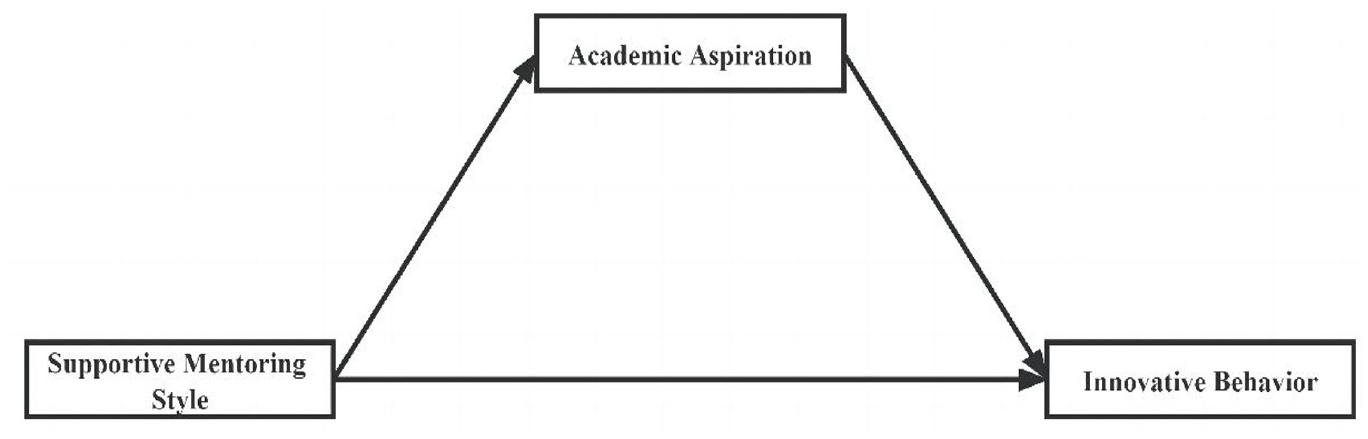
Hypothesized model.
Study 1: Quantitative Research
Participants and Procedure
Considering that there is a regional imbalance in the development of postgraduate education in China (Chu Ng & Li, 2000; Johnes & Yu, 2008), we chose master’s degree students from universities in central China as the target of the survey (including the six provinces of Shanxi, Henan, Anhui, Hubei, Jiangxi, and Hunan) (T. T. Zhu et al., 2018). Specifically, the quality and quantity of colleges and universities in the central region are not high, with only 18 colleges and universities qualified for “double first-class” (out of 147 in China), which is only ranked in the middle of the national ranking. Therefore, a survey targeting postgraduate students in central China will not only help to identify their general problems but also provide insights into regions that are less well-developed (Y. Liu, 2015). We used a convenience sampling method where one double first-class university in each province was selected as the sample source.
Due to China’s stricter COVID-19 prevention and control measures throughout the survey period (October to December 2022), we could only gather the surveys online through the “Sojump” platform (https://www.wjx.cn/). Master’s degree students from the sample universities completed the questionnaire for us. Each participant received a confidentiality commitment through Sojump prior to the questionnaire being conducted, and their informed consent was collected. Specifically, we committed to participant confidentiality by sending an Internet link outlining the study’s goals and ethics statement to each one of them before the survey ever started. Furthermore, we guarantee the confidentiality of participants’ personal information via Internet protocols. No personal information, such as IP address, mobile phone model, or geographic location, will be recorded during the survey. Second, after agreeing to participate in the survey, respondents will sign an informed consent form via the Sojump platform. Finally, to reduce common methodological biases, we chose two time periods for the questionnaire, 1 month apart.
Participants in the first wave of the study (T1) were asked to provide information on their demographics and perceived level of supportive mentoring style. Participants were asked to describe their innovative behaviors and academic aspirations 1 month later (T2). Participants were requested to supply the last four digits of their 11-digit cell phone number and their birth year as their code (e.g., 7570-1996) to match the reported data in both survey waves.
At T1, we had 1,120 responses, and at T2, we had 1,031 responses. A matched sample of 972 participants was obtained by matching the response codes from T1 and T2. After that, we used the following procedures to filter the responses: a) Discarding surveys where the responses are “straight” or “wavy.” While the latter refers to responses with wavy answers (e.g., 1, 2, 3, 4, 3, 2, 1), the former refers to responses with the same answer. b) Eliminate answers that contain inaccurate responses to interfering questions that are arbitrarily set (e.g., “Please choose option B directly for this question” or some straightforward math computations). c) Remove responses from the T1 and T2 surveys that were shorter (less than 5 min). The procedures mentioned above resulted in the recovery of 911 valid replies. Of the participants in the final sample, 66.41% were between the ages of 23 and 26, and 453 (49.73%) were female.
Measures
We measured all items apart from demographic variables on 5-point Likert scale (1 = strongly disagree, 5 = strongly agree).
Supportive Mentoring Style Scale
The Supportive Mentoring Style Scale, as created by X. Wang (2013), was utilized in this study. In order to match the Leadership Supervision Style Scale with the specific context of graduate education in China, X. Wang (2013) undertook adaptations and revisions to the original scale produced by Oldham and Cummings (1996). The scale consists of eight items, one example item being “My supervisor lets me decide for myself how to carry out my work.” The application of the scale to the Chinese graduate student population has been acknowledged and confirmed by multiple Chinese scholars (L. Wang et al., 2020; Xiong & Yang, 2020). The Cronbach’s α for this scale was 0.807, and the confirmatory factor analysis data showed a good fit: χ2/df = 2.636, CFI = 0.992, TLI = 0.986, RMSEA = 0.042, SRMR = 0.017, and composite reliability (CR) =0.910.
Academic Aspirations Scale
To assess academic aspiration, we used four items developed by Y. Lu and Shi (2015). An example was the statement, “I aspire to be a scientist and am willing to make significant scientific and technological contributions in the future through sustained hard work and dedication.” Although the scale was initially tested on undergraduates at Tsinghua University’s Top-notch Program, the program’s admission criteria were stringent, and accepted undergraduates were identified as potential academic talent. Furthermore, D. Xu (2022) tested the scale on a group of doctorate students, and Shao (2023) surveyed academic master’s degree students using this scale. Both investigations validated the scale’s applicability in the graduate student population. The Cronbach’s α for this scale was 0.862, and the confirmatory factor analysis data showed a good fit: χ2/df = 2.939, CFI = 0.995, TLI = 0.986, RMSEA = 0.066, SRMR = 0.013, and CR = 0.864.
Innovative Behavior Scale
The measurement of innovative behavior in our study was conducted using the eight items that were developed by Su et al. (2021). One example was, “Frequently, I generate innovative ideas and thoughts during my research.” The innovative behavior measure, initially developed by Scott and Bruce (1994), was refined and subsequently applied to a population of Chinese graduate students by Su et al. (2021). The suitability of the revised scale for conducting surveys on the innovative behavior of Chinese graduate students has been proven by multiple investigations (Zeng & Zhang, 2022; J. Zhu et al., 2023). The Cronbach’s α for this scale was 0.920, and the confirmatory factor analysis data showed a good fit: χ2/df = 2.610, CFI = 0.994, TLI = 0.990, RMSEA = 0.042, SRMR = 0.016, and CR = 0.920.
Data Analysis
This study was conducted with the help of SPSS V26 and Amos V28 software from IBM for data analysis. SPSS software is used for descriptive statistical analysis, reliability testing, and correlation analysis due to its easy operation in simple data analysis. In testing the data for mediation effects and performing confirmatory factor analysis and common method bias tests on the questionnaire, this study was implemented with the help of Amos software. Confirmatory factor analysis using Amos can estimate the fit coefficients of the model and determine the questionnaire’s fitness. Also, in this study, considering the low testing power of Harman’s single-factor test, the Amos software was used to implement a control for the effects of an unmeasured latent methods factor method to test for common method bias (Tang & Wen, 2020).
Common Method Bias Test
Based on the recommendations of related scholars (Tang & Wen, 2020), this study performed a common method bias test on the data by controlling for the effects of an unmeasured latent methods factor (ULMC) and conducting a confirmatory factor analysis on all scale questions involved in the hypothesis testing.
First, the M1 model was built with only trait factors. The results indicated an excellent model fitness with the results of (χ2/df = 3.465, CFI = 0.963, TLI = 0.958, RMSEA = 0.052, and SRMR = 0.033). Second, a two-factor model, M2 including the method factor, was built, and the two models were compared to obtain the following main fit indices: Δχ2/df = 0.735, ΔCFI = 0.017, ΔTLI = 0.015, ΔRMSEA = 0.008, and ΔSRMR = 0.004. The change in main fit indices was less than 0.02, indicating that adding the common method factor did not significantly improve the model. Thus, this measurement had no significant common method bias (Lian et al., 2018).
Analysis of Descriptive Statistics and Correlation Coefficients
This section examines the relationship between supportive mentoring style, academic aspirations, and innovative behavior. There was a significant positive correlation between supportive mentoring style and academic aspirations (r = .636, p < .001) and innovative behavior (r = .553, p < .001), as shown in Table 1. Overall, the results of the correlation analysis validated the relationship between the three variables and supported the subsequent simple regression and mediation effect analysis.
Mean, Standard Deviation, and Correlation Analysis Results of Each Variable.
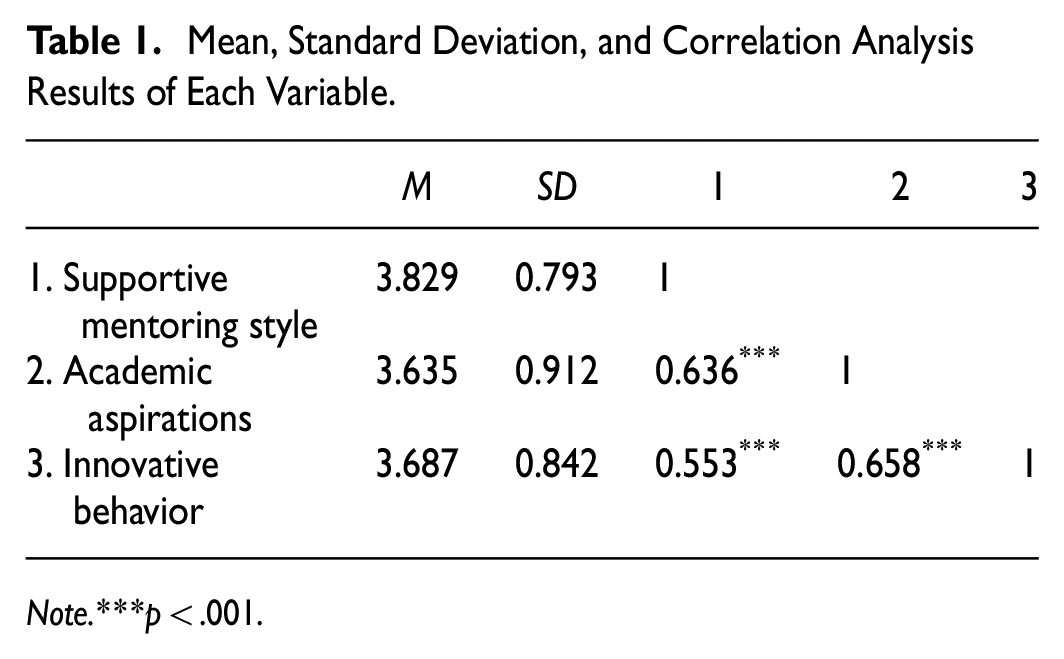
Note.***p < .001.
Simple Regression Analysis
The fit of each scale met the requirements of structural equation model analysis after confirmatory factor analysis of the above scales, and the scales were then combined into a total model for analysis. Figure 2 depicts constructing a simple regression model of supportive mentoring style and innovative behavior. The simple regression model’s fit indices were χ2/df = 2.937, CFI = 0.977, TLI = 0.972, RMSEA = 0.046, and SRMR = 0.031, indicating it was well-fitted. Meanwhile, the supportive mentoring style had a significant positive effect on master’s students’ innovative behavior (β = .773***), that is, for master’s students in central China, the supportive mentoring style of mentors showed a significant positive predictive effect on master’s students’ innovative behavior, and the results supported the H1 hypothesis.
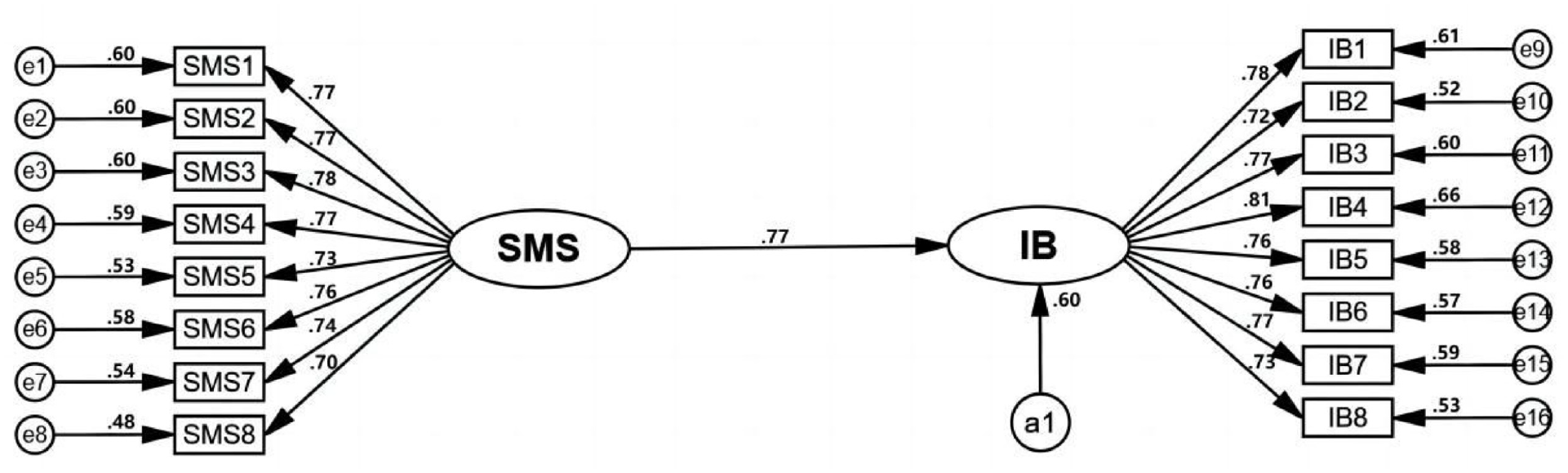
Simple regression model.
Mediation Effect Analysis
After validating the relationship between supportive mentoring style and innovative behavior of master’s students in this study, academic aspiration was added as a mediating variable to the structural equation model, as shown in Figure 3. The model fit indices of the mediated model are acceptable: χ2/df = 2.897, CFI = 0.973, TLI = 0.968, RMSEA = 0.046, and SRMR = 0.029.
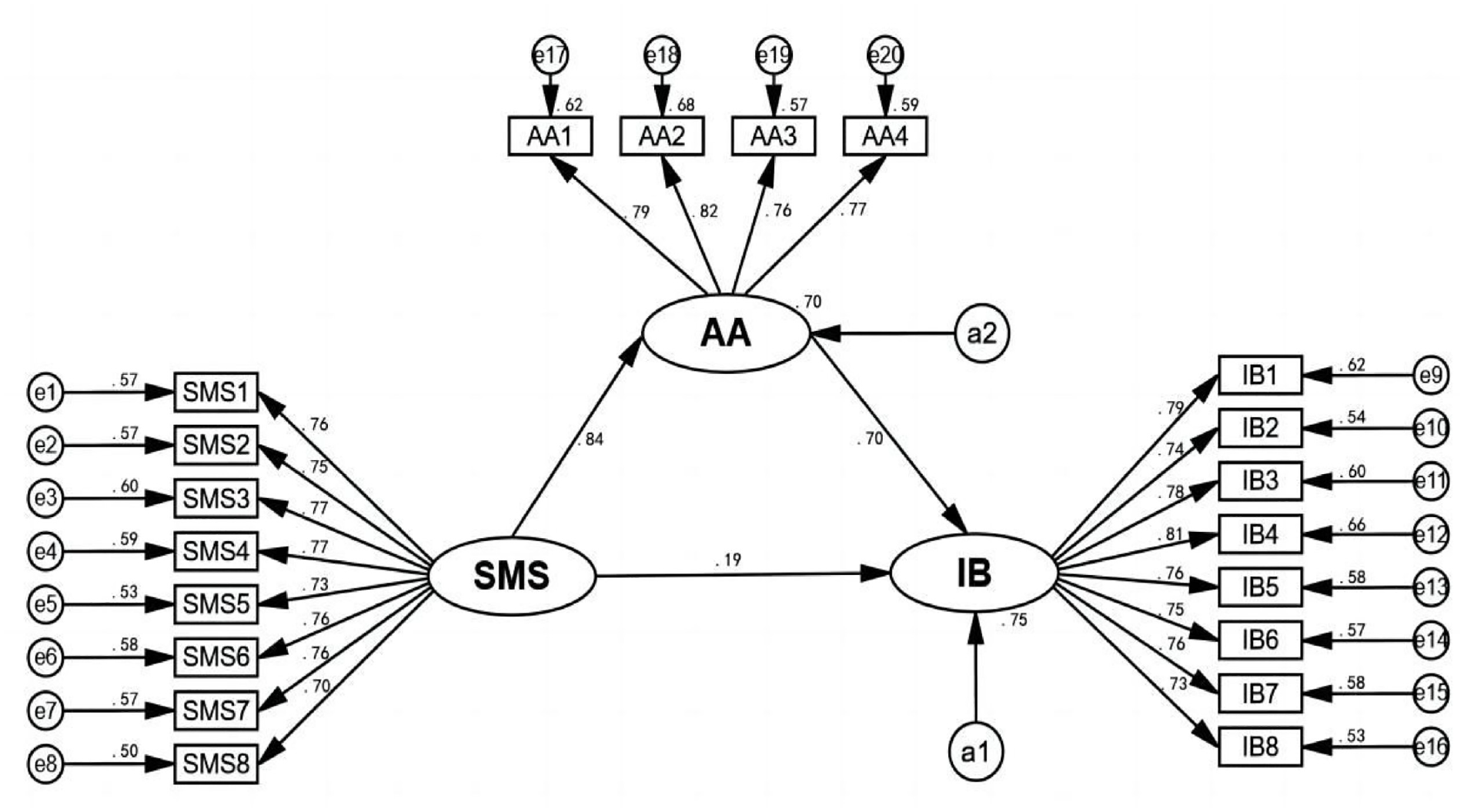
Mediational pathways effects.
Table 2 shows the effect of each variable in the path analysis of this structural model based on Amos’s standardized total, direct, and indirect effects output. According to the results of the Bootstrap test on the mediating effect of the structural equation model, the number of samples was set to 5,000, the percentile confidence level and the bias-corrected confidence level were set to 95%, and the significance level of the coefficients of the three paths reached the confidence level of 0.001. Academic aspirations partially mediated the role of supportive mentoring style and innovative behavior (β = .582***), and hypothesis H2 was verified.
Mediating Effect Test.

Study 2: Qualitative Research
The interview session in this study was designed to validate the analytical findings of the quantitative study (Truscott et al., 2010), to complement the significance of supportive mentoring styles and academic aspirations in the process of graduate education, and thus to provide insights for improving graduate students’ innovative behaviors.
Sample and Procedure
We used convenience sampling to select mentors from three sample universities (Henan, Shanxi, and Hubei provinces) whose majors cover various mainstream discipline types in China (humanities, social sciences, science and technology, and agriculture and medicine). We then targeted each mentor and randomly selected one of the graduate students they supervised. By the time we reached the fifth pair of mentor-student interviews, we had reached saturation of the data we had collected and could not obtain new material. Of course, we then added two more pairs of mentor-student samples and found that we were not adding anything new. In order to ensure that truthful information was obtained during the interviews, we did not inform the participants that their mentors/students would be interviewed as well, which we felt would reduce the participants’ concerns when responding.
The interviews were audio-recorded in this study with the consent of all participants. Prior to the start of the interview, the researcher signed a confidentiality pledge to each participant. Specifically, the researcher promised the participants that all recorded material produced during the interviews would be processed through a voice changer and that the participants’ personal information would be anonymized. Informed consent was obtained from all participants for this interview.
Due to COVID-19’s closed control policy, we used an online interview format, which was limited to 40 min. The interviews can be broadly divided into two phases. In the first phase, we proactively shared the researcher’s own experiences of schooling, thereby building trust and rapport between the participants and the researcher (Brown & Danaher, 2019). When participants began to share their own stories actively, the interview moved into the second phase, the formal interview phase. The outline of the semi-structured interviews referred to related scholars’ studies (X. Zhang, 2022; J. Zhao & Wang, 2022), which mainly included mentors’ daily mentoring styles, changes in graduate students’ academic aspirations, graduate students’ level of innovative behaviors, and whether mentors could improve their mentoring styles according to the characteristics of different graduate students. At the time of the interviews, we redirected the questions appropriately based on participant feedback (Adeoye-Olatunde & Olenik, 2021). However, the purpose of the study was always clear: to explore how external factors influence individual graduate student behavior.
We refer to the qualitative data analysis process used by O’Connor et al. (2018) and analyze the qualitative data using thematic analysis. Specifically, we organize the statements in the qualitative data, discover the laws, and generalize the relevant statements into corresponding themes. For example, “…The mentor is usually preoccupied with his work. He is unconcerned about my studies and relies on me to complete them independently. I intend to find work immediately after graduation and do not intend to pursue a doctorate…” a statement from a graduate student participant. We organized it as “Graduate students have academic aspirations, but their supervisors do not support them” and further categorized it into the theme of “ Mentor-Graduate Mismatch.”
At the end of the interview process, we converted the audio recordings into textual materials to be feedback to the participants, and only after obtaining their permission to use the interview materials in this study. In total, we collected nearly 50,000 words of valid interview transcripts. By organizing and summarizing the interview materials, a total of two themes and four sub-dimensions were obtained. We designed a mentor-student matching matrix based on these themes, as shown in Figure 4.

Mentor-student matching matrix.
Theme 1: Mentor-Student Matching
The theme of Mentor-Student Matching consisted of two sub-dimensions: positive matching and negative matching.
Positive Matching
Positive matching is located in the upper right corner of Figure 4 and refers to students possessing high academic aspirations, while mentors tend to be more supportive in their mentoring style. In this case, the student’s innovative behavior is greatly facilitated. In addition, the educational level of the mentor is further developed. Therefore, we named this dimension “Win-win” to represent a state of high mentor-student matching. Although only a few participants exhibited this characteristic, the existence of this state is a desirable goal for graduate education.
“…Only when students truly love academic research can they awaken their enthusiasm, and such students’ innovative behavior will be stronger…”
“…My mentor will encourage me in my regular studies so that I can be confident in my academic research. I believe I can continue down this path in the future…”
“…Students’ achievements are directly proportional to their level of innovation ability…”
“…My mentor usually pays more attention to cultivating innovation ability and often provides us with some cutting-edge research. Let us brainstorm on a problem…”
Negative Matching
Negative matching is located in the lower-left corner of Figure 4 and refers to a situation where the student neither has high academic aspirations nor the mentor provides supportive mentoring. This situation makes it difficult for students to generate innovative behavior. We have named this dimension, with Chinese characteristics, “Bailan.”“Bailan” refers to the fact that things can no longer go in the right direction, so they stop taking measures to control them and let them continue in the wrong direction. Mentors located in this dimension gave up mentoring poorer performing students, and students lost their academic aspirations. Similarly, fewer participants were located in this dimension, and the reality was often less extreme.
“…The mentor is usually preoccupied with his work. He is unconcerned about my studies and relies on me to complete them independently. I intend to find work immediately after graduation and do not intend to pursue a doctorate…”
“…I’ve also encountered some unmotivated students and initially encouraged them, but then I realized that they had absolutely no interest in academics, and I didn’t care much about them anymore…”
Theme 2: Mentor-Student Mismatch
The theme of Mentor-Student Mismatching also includes two sub-dimensions: the Unidirectional Effort-Mentors and the Unidirectional Effort-Students. We combine the interviews to argue that, in reality, most mentors and students are in both situations.
Unidirectional Effort-Mentors
This dimension is located in the upper left corner of Figure 4, where mentors maintain a high level of dedication by assuming their mentoring responsibilities as mentors in the face of students’ low academic aspirations. In a realistic context, graduate students not only need to face academic pressure but also bear the pressure of family, marriage and other aspects of pressure (Bekkouche et al., 2022). Therefore, there are many reasons for students’ low academic aspirations, and mentors must implement different mentoring styles according to the different states of graduate students.
“…Depending on the students’ personalities, I would take different measures. For instance, if some students are more introverted, I would encourage them to interact and offer them more emotional support…”
“…I didn’t like academic research at first, but my mentor, like my mother, was always there for me, whether in my studies or personal life…”
“…Because the essence of a graduate mentor is still that of a teacher, we must treat students as our children and instill confidence in them so that they will invest time and energy in learning…”
Unidirectional Effort-Students
We named the dimension in the bottom right corner of Figure 4“Unidirectional Effort-Students.” As the name suggests, this refers to students who have strong academic aspirations and are eager to achieve personal development in their academic path but are not provided with supportive mentoring by their mentors. This occurs for several reasons, such as the limited academic capacity of mentors (Y. Zhang et al., 2022a), more non-academic matters faced by mentors (X. Wang, 2022), and an excessive number of students under the mentoring of mentors (Taylor, 2012). There are also more mentors and students in this dimension because, under China’s education system, guiding graduate students is only a tiny part of a mentor’s work. In addition to that, the mentor also undertakes undergraduate teaching, scientific research tasks, social services and so on (X. Wang, 2022). Therefore, it is easy to see the insufficient energy of mentors to guide students in practice teaching.
“…To be honest, I’d love to just be a teacher and just worry about how to educate my students, but it’s simply not possible. Every day when I open my eyes, there’s a bunch of chores, so I don’t have time to mentor my students, and I often feel quite guilty towards them…”
“…My mentor has an administrative position and is busy with meetings, entertaining leaders, and many other things daily. So, I must make an appointment to see him in advance. And he can only spare a short while each time, and after a couple of chats, he returns to his work…”
Our data show that supportive mentoring styles can directly influence innovative behaviors and also have an impact on the innovative behaviors of master’s degree students via the mediating role of academic aspirations. Education occurs in complex social environments, and the quantitative component of the modeling is frequently too simplistic to account for complex social phenomena (Sullivan & Sargeant, 2011). As a result, through qualitative analysis, we could interpret the data and findings established in the quantitative section of the analysis, facilitating an understanding of the phenomenon under study (Sargeant, 2012). Finally, we created a mentor-student matching matrix, and we discussed the reasons for the appearance of each dimension as well as its mechanism of action in the context of real-life circumstances and interview materials.
Discussion
This research study centers on master’s degree students located in central China and aims to examine the mechanisms and boundary conditions that mediate the impact of mentors’ supportive mentoring styles on the innovative behaviors of these students. The study employs quantitative and qualitative research methods, drawing upon leadership style theory. The findings indicate a significant correlation between mentoring styles characterized by supportiveness and the manifestation of innovative behaviors among graduate students. Moreover, it is shown that supportive mentoring styles can anticipate the development of innovative behaviors by promoting academic aspirations. Specifically, a high level of supportive mentoring style promotes academic aspirations, which leads to higher levels of innovative behavior among master’s degree students.
Theoretical Contributions
As expected, there was a significant positive correlation between supportive mentoring styles and graduate students’ innovative behaviors. In other words, the higher the level of support provided by the mentor, the more innovative the students were, and this relationship was also reflected in previous studies (Lechuga, 2011; J. Wang & Shibayama, 2022). Relevant studies have concluded that the effects of supportive mentoring styles on graduate students are overwhelmingly positive (Wisker et al., 2003), such as the ability to establish a positive team learning atmosphere (Shin & Zhou, 2007), promote the development of creativity (P. Wang & Rode, 2010), and enhance academic productivity (Khuram et al., 2023), etc. We can explain this result with the help of ideas from leadership style theory (Gu et al., 2017). Specifically, individuals with higher levels of mentor support are more likely to face difficulties with a positive and optimistic attitude (Rego et al., 2012). Such individuals tend to develop higher-level interests and pursuits, leading them to actively seek information resources and professional guidance (Madhavan & Grover, 1998) and ultimately to achieve increased innovative capabilities (Gellin, 2003). In addition, graduate students who receive a high level of mentor support tend to be more confident and passionate (Yang et al., 2022), and these positive traits can also help them to produce a higher level of innovativeness. In addition to this, the mentor-student interaction hides ideas from social exchange theory (Zeb et al., 2023). The current mainstream group of master’s degree students mainly were born after the 1990s, and they tend to have a stronger sense of autonomy (Zhuang & Kong, 2023), which makes them demand more from the mentor-student relationship (X. Li & Yang, 2023). Suppose mentors give sufficient support to master students’ lives and study. In that case, they may develop trust and dependence on mentors to fulfill their exchange obligations (Howells et al., 2017), and this exchange relationship between leaders and those being led may be beneficial in stimulating innovative behavior among graduate students (Robertson, 2017).
This study also discovered that academic aspirations play a mediating function. A high level of supportive mentoring style, specifically, may lead to the development of academic aspiration, promoting master’s degree students’ innovative behavior. This discovery explains how supportive mentoring styles influence master’s students’ innovative behaviors. Previous studies on academic aspirations have concentrated on adolescent populations (Carroll et al., 2009; Mo et al., 2020; Morton, 2018), and these studies have claimed that academic aspirations form early in life. Even though relevant studies involving the higher education stage have not explicitly explored the impact of the mentor-student relationship on academic aspirations, these studies have argued that the factors influencing the formation of students’ academic aspirations are complex (Othman et al., 2013), such as the learning environment (Huang, 2012), the subject area (Etmanski, 2019), the pre-study experience (Santos Laanan, 2003), and so on. In short, our findings are an essential addition to the research on the antecedents of academic aspirations. There is more consistency in the research conclusions on the probable aftereffects of academic aspirations, which is that academic aspirations can increase students’ academic achievement (Ansong et al., 2019). According to social cognitive theory, people, environments, and behaviors are constantly influencing each other (Wood & Bandura, 1989), and master’s level education is a preparatory stage before entering the doctoral level, where master’s degree students form their attitudes and perceptions of academic research (Monk et al., 2012), and mentors, as the external factor with the most contact with graduate students, are bound to have a significant influence on the graduate student’s academic aspirations (Kim et al., 2018). In addition, according to self-determination theory, autonomy support is a crucial aspect influencing student learning (Ryan & Deci, 2000). Academic aspiration generation considerably improves graduate students’ learning initiative (Uwah et al., 2008), which is a vital component in determining innovative behavior (H. Wang et al., 2022). Thus, when graduate students experience higher levels of mentor support, they acquire more positive academic aspirations, which leads to higher levels of innovative behavior.
Furthermore, the present study has devised a mentor-student matching matrix based on the Motivational Synergy Model. According to Amabile (1993), the potential exists for intrinsic motivation to combine with extrinsic incentive, resulting in a synergistic combination that can lead to elevated performance levels. The present study utilized a model that was applied to the domain of graduate education, wherein mentor support was conceptualized as an extrinsic motivational factor, and individual academic aspirations were considered as intrinsic motivation. The investigation findings revealed a positive association between the extent of innovative behavior exhibited by graduate students and a model that aligns high levels of support with elevated academic aspirations. The results of this study confirm the beneficial effects of supportive mentoring styles on graduate students, elucidate the intricate processes underlying the formation of innovative behaviors, and contribute to the existing body of research on the influence of supportive mentoring styles on graduate students’ innovative behaviors.
Practical Implications
This study also has some practical implications. First, as the first person responsible for the training of master’s degree students, mentors should make appropriate adjustments to their mentoring styles according to differences in individual development (Santangelo & Tomlinson, 2012). For learning motivation of poor students to carry out more detailed education and guidance, gradually awaken their interest in academic research, and then encourage them to carry out moderate learning training to give the necessary spiritual and learning support to stimulate innovation ability. When dealing with highly motivated students, more appropriate goals can be set for them to achieve and simultaneously get full autonomy to further their ability to carry out academic research alone.
Secondly, individual master’s students should also take the initiative to awaken the development of individual endogenous motivation. Master’s degree students, due to the learning mode being different from the previous learning stage, it is more necessary to have strong self-control to carry out independent learning. At the same time, in the master’s degree, the external temptation to their learning motivation has a more significant impact, which requires individuals to have a strong interest in and enthusiasm for academic research. Therefore, individuals should mobilize their intrinsic motivation to stimulate their interest in learning to achieve a higher level of self-development. This requires a combination of factors, such as the patience of the mentor and the setting of appropriate academic goals, the positive attitude of the surrounding community toward learning, and the provision of adequate school resources, all of which are activating factors that influence the motivation of the individual to learn independently (Lindholm, 2004). As an individual master’s student, intrinsic motivation to learn can be enhanced through such measures as learning from the successes of others, consistently accumulating a sense of accomplishment with each advancement, and developing a complimentary area in which one excels.
In finality, our study solely focused on investigating the impact of mentor support on innovative behavior. However, it is essential to note that innovative behavior is not solely determined by a single component but rather emerges due to the interplay of multiple factors (Thurlings et al., 2015). Hence, administrators or mentors must consider multiple aspects, including the academic climate (X. Han et al., 2023) and research pressure (Yao & Yu, 2023), among others, in order to promote the development of innovative behaviors among graduate students.
Limitations and Future Research
This study does, of course, have some limitations. For starters, a small sample size reduces the external validity of the study’s findings. China has many master’s degree students, but only a few graduate students from the central region were chosen for this study. In the future, researchers can increase the sample size and conduct a more detailed classification of the sample group to validate the model developed in this study. Secondly, this study used a combination of online questionnaires and semi-structured interviews to collect data, and more investigative methods, such as experimental vignette methodology, could be considered in the future to improve the internal validity of the study. Finally, due to cultural differences, the findings of this study may only apply to some regions. Comparative studies of similar developing or developed countries may be considered.
Conclusion
The purpose of this study was to examine the relationship between supportive mentoring styles, academic aspirations, and innovative behaviors and to explore the mediating role of academic aspirations. We harvested some relatively valuable findings:
Supportive mentoring style had a significant positive impact on academic aspirations and innovative behavior.
Academic aspirations are an essential mediating variable between supportive mentoring style and innovative behavior.
We developed a theoretical model of mentor-student matching to validate the relationship between the above variables further.
Based on these findings, we emphasize the joint role of external environmental factors and internal individual factors, that is, a mentor’s supportive mentoring style and a graduate student’s academic aspirations are more likely to have a positive effect on a graduate student’s innovative behavior only if they are matched.
Footnotes
Declaration of Conflicting Interests
The author(s) declared no potential conflicts of interest with respect to the research, authorship, and/or publication of this article.
Funding
The author(s) disclosed receipt of the following financial support for the research, authorship, and/or publication of this article: This work was supported by the Graduate Education Reform Project of Henan Province [grant number 2023SJGLX011Y]; the Graduate Education and Teaching Reform Research and Practice Project of Henan University [grant number YJSJG2023XJ001]; and the Graduate Training Innovation and Quality Improvement Action Plan Project of Henan University [grant number SYLYC2022004].
Ethical Approval
This study did not conduct any animal or human studies and therefore no ethical statement was applicable.

Data Availability Statement
The data used and/or analyzed in Study 1 are available from the corresponding author upon reasonable request. The datasets used and/or analyzed in Study 2 are not publicly available.