




Abstract
The aim of this study is to explore the role of academic leadership and adaptive leadership on organizational readiness for change. During times of pandemic, adaptive leadership has emerged as a vital leadership discipline along with academic leadership due to uncertainty and sensitivity of situation. In addition, demand of innovative behavior has also increased over the years particularly during Covid-19. The study has been carried out in Higher Education Institutions of Pakistan where the data was collected from deans, directors and head of departments in two phases. Quantitative research strategy was opted for the study. Survey research design was followed to respond objectives of the study. The purpose behind the selection of senior academicians is to draw empirical results from the perspective of all the heads of their relevant departments. The data was collected from seven public sector universities across Pakistan. About 251 responses were found valid. Covariance based SEM was used to analyze the data. Analysis reveals a positive and direct relationship between academic and adaptive leadership and organizational readiness for change and similar results were found by placing innovative behavior as a mediator leading to the acceptance of all developed hypotheses. This study is unique in nature and has implications for leaders in academia in terms of unleashing the potential toward uncertain situation in higher education institutions. Study’s major limitation include less representation of the Pakistan as whole country as it included Punjab province only for data collection.
Keywords
Introduction
The 21st century brought plenty of unpredictable challenges for individuals, organizations and societies. The world is striving to adjust to the new age problems that have arisen as a result of globalization, technological expansion and spread of pandemic such as Covid-19 (M. A. Khan et al., 2021; M. Khan et al., 2022). Everything needs to adapt with the situation since nothing happens in a void, and each action in the system has effects, whether intentional or not, which necessitates system adaptability and the capacity to respond efficiently. Leaders, whom followers view as an important source of support at work, face a massive challenges in both support their subordinates during these difficult times while also continuing to encourage productivity through innovation and adaptive behaviors. However, little is known about what work situations expect of their leaders and how they perceive and evaluate leadership behaviors in the time of crisis (Eichenauer et al., 2022).
The pandemic has had far reaching implications across sectors, including challenges for educational institutions and those with formal administration responsibilities, such as academic leaders. This necessitates the “reinvention of advanced education,” and chairpersons at the forefront of scholarly initiative will almost certainly play a key role in revamping initiatives. In addition, their role will be as impact specialists, leading the reinvention of departmental policies, practices, and behavior through their academic control (Gigliotti, 2021).
In general, COVID-19 has exacerbated a considerable number of previously existing challenges in academia, such as distant learning, online evaluation, and staff commitment to concur with the global environment. The role of the leader in fostering a culture of faith, shared authority, and collective effort will increase institutes’ ability to fight in a crisis (Dever & Justice, 2020).
Digitization of education is an unavoidable option for institutions during the Covid-19 flare-up. In this scenario, institutes ought to know about their obligations as far as the desires of understudies to offer appropriate assistance comparable to the ordinary instruction time frame, while redesigning and presenting another framework where they should not face any hindrances. Then again, teaching and non-teaching staff should be prepared to have proficient offices and quality instructing capacities.
As an end, availability to change for any association is the essential factor to adapt its new climate. Innovation could be seen as the organizational exercises that plan to adapt its current circumstance with higher efficiency (Budur et al., 2021). Innovative behavior is considered as the way toward taking care of an issue, introducing an answer through information or novel thoughts as a matter of fact, supporting the thought, and understanding the plan to advance the organization’s advantages. Accordingly, innovative behavior can be summed up as the way toward receiving innovative thoughts that are introduced or created by people or group and transforming them into valuable assets (Sung & Kim, 2021).
This digitization in the institutions also requires readiness to change. Readiness for change addresses a comprehensive structure of the institution in which its individuals see how much the association is prepared to execute an enormous scope change drive. Moreover, it has been contended that individuals from the organization hold positive perspectives with respect to the requirement for hierarchical change and they additionally have a conviction that the changes, assuming effectively also, viably carried out on schedule, could bring positive and maintainable implication both for themselves just as for the organization prospectively (Ibrahim & Benabdelhadi, 2022).
The job of leader in such a circumstance is essential as well as crucial. Driving an organization in an emergency situation is hard, given that the job and the impact of the leader are amplified in the midst of progress. In such occasions, as per Fernandez and Shaw (2020), significance of academic leadership increases, as such people can comprehend the arising challenges very well.
During this modern era of substantial ongoing and rapid changes in higher education, there is a growing focus to the significance of understanding the leadership which is essential to direct educational institutions effectively. Academic leadership, is a relatively young discipline in leadership, which presently does not have a well-established reputable journal of it’s own domain emerge in a number of sources (Anthony & Antony, 2017), inflating the need for attention.
This study emphasizes how important university leadership is to structure a changing culture that will make an organization a learning organization. It also increases the theoretical knowledge of adaptive leadership and contributes to the organizational availability of change in the corpus of current literature. COVID-19 episode was a great challenge for the Pakistani Higher Education Sector. The said sector had to change its SOPs and other operations overnight with different inputs coming from various regulatory bodies. The Pakistani Higher Education Sector as many others consists of private and public sector institutions that are regulated by authorities at two levels. First is the Higher Education Commission (HEC), the primary regulatory body established in 2002 working under the federal government is now responsible for ensuring quality standards and providing other frameworks. On the other hand, since the promotion of the idea of devolution and increased provincial autonomy debate in the country in the first decade of this century, provincial higher education regulatory bodies were also established with the aim of governing the institutions.
However, the scope of this study is not HEI governance therefore, more light shall not be shed on it. Nonetheless, organizational leaders in this context and that of covid-19 had to deal and adapt to instructions coming from the dual channel, hence increasing the need for good and ready leadership.
Academic leaders also need adaptiveness at times. Adaptive Leaders utilizes “strategic opportunities” and can reclassify hierarchical roles by advancements in technology in educating and innovation to change or eradicate obsolete procedures (Fernandez & Shaw, 2020). Henceforth, investigating the setting of the examination and late writing, the job of academic and adaptive leadership is of desperate significance in context of pandemic namely COVID-19. Therefore, the aspiration is to identify the influence academic and adaptive leadership creates toward an organization readiness to change (ORC) as well as the intervening effect of innovative work behavior.
Literature Review
Academic Leadership is more important in terms of Higher Education Institutions (HEIs) where the role of academic leader is to keep the leadership spirit high while being on the headship position. Similarly, Adaptive Leadership has gained importance in the times of Covid-19 when number of changes can occur due to disruption of processes (Ramalingam et al., 2020). Under such situation, one needs to adopt innovative behaviors to tackle changes. There have been a very few studies conducted on Academic and Adaptive Leadership with respect to ORC. However, no study has been conducted so far by taking Innovative behavior as a mediator. So, the objective of this research is to fill this research gap in this sector.
Theoretical Underpinnings
According to the Theory of General System, Von Bertalanffy (1970a, 1970b), a system (organization) is a mixture of complex components that open to and interact with their environments. Katz and Kahn (1978), who described its emphasis on structures, linkages and their interconnectedness, have linked the application of the General System Theory to organizational theory. Katz and Kahn in particular tried to demonstrate why open systems tend more than required to attain balance or homeostasis as well as development through import of power. GST promotes the Darwinian notion of existence as a random occurrence based on mutation (a process in which new variation enters the species).
The institution is modified by organization’s readiness for change and contingencies from the external environment (Lawrence & Dwyer, 1983). The core of change might be strategic (i.e., new product lines are proposed), tactical (concerning providers and cultural activities more closely) and introducing employee motivation programs (Lawrence & Lorsch, 1967).
In this context, the second theory that addresses the domain of leadership required in this realm of challenges and uncertainty is the situational leadership theory (SLT), where not a leader is required to read the situation and act and guide its followers accordingly, while adapting to the developing circumstances (Hersey, 2014). Aslam et al. (2022) argued that during the pandemic, which they call the “New Normal” (p. 1), Situational Leadership idea reemerged and helped several organizations to overcome the rising challenges during that period and the adaptive discourse of leaders further helped them in adjusting to these challenges.
The reason for referring to General System Theory and Situational Leadership is the fact that the study also highlights the environmental context in which a leader operates and then takes into account various situations and acts accordingly, along with the sense of innovative behavior in these uncertain times. As Ramosaj and Berisha (2014) stress that “Systems approach clarifies the thought on the complexity and dynamism of the environment and provides a framework for building ideas.” Furthermore, in relation to an open system higher education institutions have to deal with environments and are therefore affected by them hence need dynamic abilities (Teece et al., 1997) and leaders can play an important role in this context (Sonn et al., 2021).
Academic Leadership
Academic Leadership is defined as “a process through which academic values and identities are constructed, promoted and maintained” (Bolden et al., 2012, p. 42). Leadership has received a lot of attention in the past, however academic leadership has received minimal attention due to its application primarily to educational institutions (Mukaram et al., 2021). Academic leaders must not only serve as administrators and chairs at the university, but they must also teach subjects in order to fulfill their obligations as faculty members (Fernandez & Shaw, 2020). As a result, they possess the necessary experience to be considered a supreme leaders (Gmelch & Burns, 1993). Successful academic leaders understand their responsibilities and perform their leadership roles by fostering a welcoming environment for both teachers and staff, as well as external stakeholders (Bolman & Gallos, 2010).
Academic heads are considered as the prime essential university administrators (Gallos & Bolman, 2021). Vilkinas and Ladyshewsky (2012) showed that the leadership of higher education has been an essential component of administration in the last 20 years. The core of leadership in higher education is vague and controversial due to organizational complexity at institutions and their diverse aims and traditional values (Spendlove, 2007).
Academic leaders are caught between administrator and faculty members’ conflicting interests. In two opposites, the first is the general mission of the academic field and the second is the institution’s wider mission. Leaders find their leadership changing and evolving between academic and management aspirations (Gmelch, 2013). Effective higher educational leadership therefore has a significant relationship to balancing responsibilities.
The need for more access through open and dispersed learning, new technologies, budget cutbacks, demographics for students and globalization, all lead to change in higher educational requirements (Duderstadt, 2009). Indeed, with its magnitude progress that left few unaltered aspects of ordinary life, the current technological revolution offers the University with an open task of “reinventing” itself once again. Indeed, the pressures on the universities for reforms today are more severe than those in any past historical period (Amirault & Visser, 2009).
Ramsden (1998) presented the concept of academic leadership for the first time which highlighted that higher educational leadership has following features; new teaching concepts; research leadership, the setting of their own research exemplary and guidance to the staff; strategic direction and networking, the creation of a trust environment and the potential of persons to achieve complex aims; establishment and acknowledgment of inter-personal performance.
According to Goldring and Greenfield (2002), in order to meet the demands of business and industry a relationship between leadership and higher education has never really been more clearly acknowledged that it today. Management in higher education takes on a meaning that extends beyond a sole figure of authority, including the needs, goals and expectations of both the leader, and the supporters. In highly competitive and volatile higher education environment efficient academic leaders may be a major source of benefits (Ramsden, 1998).
Amey (2006) discussed how academic leaders construct an academic climate that integrates strategic thinking. They create an atmosphere in which different perspectives and knowledge are accepted. They contribute to the development of practical knowledge and produce dynamic researchers. In addition, they operate as leaders in web-like and non-hierarchical structures with partnerships and teams. Siddique et al. (2011) affirmed that higher education leadership contains three categories: research, teaching, and administration.
According to Bryman (2007), 13 leadership traits in academia are identified such as: strategic vision, being considerate, treating academic staff clearly and with integrity, preparing department arrangements to facilitate the direction set, being trustworthy, encouraging open communication, having credibility, creating collegial work environment, advancing the department’s cause, making academic appointments that enhance department’s reputation and providing resources for and adjusting workloads to stimulate scholarship and research. (p. 697)
It is challenging for those leaders who can redesign universities to preserve the importance of higher education across the world who badly seeks what it offers (Smith & Hughey, 2006). Higher education’s players should see themselves as leaders, not because they are better, but because they have the ability to recognize what to do and work with their employees. It is no longer an option to depend on a few groups to fly the flag of leadership. It is thus the new approach to encourage employees at all levels to meet and work for genuine problems (Joyce & O'Boyle, 2013).
Adaptive Leadership
Adaptive Leadership, on the contrary, has received a lot of attention in recent years, especially in light of Covid-19 (Garavaglia et al., 2021). This idea is continually developing and has been influenced by different leadership theories such as “contingency, situational, transformational and complexity theories” (Nastanski, 2002) and are also utilized by the pioneers of adaptive leadership theorists such as Yukl (2002) and R. Heifetz (2004).
Academic, theoretical, and practical definitions of adaptive leadership are rigorous yet extensive. They define aspects of consequences, which are based on R. A. Heifetz’s (1994) broad set of standards that have been modified and enhanced for over a decade. It establishes a cause-and-effect relationship between adaptive leadership’s practicality and the act of being an adaptable leader.
Glover et al. (2002) presented the framework termed as “adaptive leadership theory.” As per this theory, leaders must deal with both internal and external pressures, as well as contextual elements, in order to adapt effectively to the circumstance, and this entire scenario outlines adaptive leadership rather thoroughly. This paradigm has received a lot of attention in the leadership world, and it has been defined by a number of authors (Hawkins, 2004). The findings also revealed that adaptive leadership is the theory of the future, owing to the constantly dynamic environment in which businesses operate as a result of internal and external shifting forces. This argument demonstrates that there is plenty of room in the literature to provide more value to this form of leadership.
Adaptive leadership differs fundamentally from good practices on a day-to-day basis. It is distinct in political and organizational hierarchy from a strong position. Therefore, the aim is not to live up to or surpass leaders’ expectations, but instead to challenge some and find a way to disappoint individuals, without fully pushing them beyond the limit (R. Heifetz, 2004).
Adaptive leadership is especially linked to changes that permit the ability to grow. New settings and new ambitions require new policies and leadership in supporting organizations, instead of perishing, regressing or shrinking, to prosper in the harsh conditions (Castillo, 2018). Signs of prosperity in organization include a higher shareholder value in the short and long term, exceptional customer service, good environmental and social impacts and higher staff morale. Thus, a challenge for adaptive leadership is to engage people to discern between what is truly important and that which may be expanded to protect from the organizational legacy. Consequently, both conservative and progressive adaptations are considered effective (R. A. Heifetz et al., 2009).
An adaptive leader can have a strong understanding of the organizational values and should respond to internal and external organizational changes. Adaptation includes valuation, implementation and conformation categories. The goal of adjustment is to enable the students to improve their knowledge and/or skills in actual or simulated circumstances that are comparable or different from the environment in which they first approached knowledge, competence and disposition (Dajani et al., 2022).
Educational change scholars respond by proposing nothing less a completely new leadership paradigm that delivers a whole system of change than a gradual “piece” shift in attention and focus (Reigeluth & Duffy, 2008). The theory recommends that modern organizations, composed of individuals interacting within the environment and who do not follow the top-down functions modeled on organizational flow charts, should be considered complex adaptive systems.
Daly and Chrispeels (2008) explains these three aspects, including the inclusion of others (Respect), vulnerability (Risk), and the preservation of high standards, skills and interconnectedness that form the fundamental basis of the practice of adaptive and technological leadership. R. A. Heifetz (1994) stated that the responsibility involved in this position of reconciling and resolving conflicting beliefs, claims, and views, is the key and distinguishing quality of adaptive leadership, recognizing the ability of different groups to “repair” their collective issues. Adaptive leaders help describe the nature of the job to be done without the result (Foster-Fishman et al., 2001). They try to provide the parties with a sufficient vision to concentrate on their claims without expressly proposing how their quest should be settled.
Today’s issues have far-reaching ramifications for sustainability of institutions and their members. The constraints include issues such as the best approach to undertake reforms in the interests of all stakeholders or to address deep-rooted structural difficulties that restrict organizations’ successful functioning. Although Heifetz and his coworkers first created the adaptive leadership model in the business environment, they found that their approach may be adapted to education systems because of the complex and multi-faceted challenges. They argued that this model was a process and a followers’ method to solve these difficulties. In this context, it was concluded that Leadership in education means mobilizing schools, families, and communities to deal with some difficult issues —issues that people often prefer to sweep under the rug. The challenges of student achievement, health, and civic development generate real but thorny opportunities for each of us to demonstrate leadership every day in our roles as parents, teachers, administrators, or citizens in the community (R. Heifetz & Linsky, 2011, p. 7).
Organizational Readiness for Change
Organizations must be ready to embrace and accept the changes happening due to the changing conditions of the environment in general and due to pandemic in particular. The most cited definition for organizational readiness (ORC) for change is “the beliefs, attitudes and intentions of organizational members regarding the degree to which changes are necessary and the amount of organizational capacity to successfully execute those changes” (Armenakis et al., 1993). Historically, this idea has origin with the leaders struggle with the resistance that comes up with some sort of change (Holt et al., 2007).
The notion of readiness in management struggles to overcome obstacles on the path of change has historically been questioned (Holt et al., 2007). Holt et al. (2007) conducted a systematic review of the literature and produced a new definition that incorporates the factors that affect change and describes readiness as a comprehensive attitude influencing the content (what changes), the context (“conditions under which the change takes place”), the process (the way change is carried out), and the theory (traits of such people who are being called for change). This combination shows how emotionally and cognitively individuals are compelled to take, embrace and embrace a certain strategy to change the current quo.
The successful implementation of changes is typically performed in three stages, namely “readiness, adoption, and institutionalization” (Lewin, 1947). Readiness is provided when its members are open and sympathetic to a future change in the organizational environment, structure and attitude. Adoption occurs when organizational members temporarily adapt their attitudes and conduct to the expectations of change.
Antony (2014) argued that it is equally or more essential to find the readiness elements for change when gaging organization’s readiness. In case, the organization looks for new initiatives, it is necessary to determine the readiness for change. The relevance of employee readiness predictor factors has been stressed in order to address anxiety and uneasiness of workers. Readiness factors are the key elements that increase the likelihood that any continuous improvement effort will succeed before a company finishes to dedicate its resources to that initiative, that is, its financial and human resources (Fadhilah et al., 2021).
According to Lehman et al. (2002), change process is influenced in number of ways in context of ORC. Initially, the circumstances essential to make changes are outlined. For instance, the change is less likely to be begun if the necessary motivating forces do not prevail. In addition, organizational dynamics facilitate and encourage a shift from one stage to another. For example, if the organizational environment does not change, it is not probable that a novel intervention is being explored or implemented. Likewise, when the employees lack the essential qualities of change like growth-orientation and flexibility, the change processes are less likely to take place. ORC is therefore a set of the broad factors that may be essential to make the change, but cannot be sufficient at all times. The focus is on the qualities of the personnel and the organizational environment.
Armenakis et al. (1993) also emphasized the necessity of looking at the views of people directly impacted by the change in assessing and measures the general organizational readiness for change to comprehend this structure. Furthermore, Cinite et al. (2009) explains that prior research has utilized the phrase “readiness for change.” Authors such as Daley (1991) and Lehman et al. (2002) have, on the other hand, characterized readiness by using both the institutional and personal components without making it obvious. Armenakis et al. (1993) research has characterized and described a causal link between the organizational and employee-friendly framework.
Cinite et al. (2009) reveal that the conduct of their changing actors, leaders, immediate supervisor at all levels, the overall practices of organization around change, and how these activities have an impact on the daily working of people should be viewed highly as structured organizations which want to be ready to change. These findings also reflect organizational change readiness with senior management’s capacity for change.
Several studies have reached a clear consensus on the important role of the internal conditions in which changes take place (climate of change), the method of changing and the degrees of readiness for change which assist comprehend the entire process leading to the productive implementation of change. A study of the variables that accelerate the change ability of the organization is essential before advancing to the phases of the proposed project of change (Bouckenooghe et al., 2009).
Innovative Behavior
In the context of adaptive leadership and Covid-19, innovation is one of the burning issues of discussion. Due to this evolving situation in higher education institutions, all educational institutions have gone online and most of the faculty does not seem to be equipped enough to tackle with the situation. Under such situation, adaptiveness with innovation is quite important. Furthermore, to remain competitive in the industry, one needs to be innovative enough to tackle with the challenges for long term survival (Mumford, 2000).
Innovation is often defined as crating new ideas and implementing the same across organizations for the long term survival of the organization (Hoch, 2013). Innovative behavior research aims to explain the actors’ presumed rational conduct and hence assumes that certain study variables impact the outcome construct. The outcome variable is the action (result), and in study of “innovation behavior,” the result is individual’s innovative behavior. The individual supporting the adoption of a novel concept in the organization is the innovation action under investigation in employee innovative behavior study.
The “innovation behavior” as variable posits that individuals are acknowledged as “self-responsible” individuals that identify and construct their own unique competence and are expected to participate in growth of the business for which work is accomplished (Monteiro et al., 2021). Nonetheless, the individual’s conduct is determined by the bargain struck between the employer and the employee (Sundbo, 1999). The business expects employees to be adaptable and to participate in innovative initiatives. Similarly, in response to such job assignments, the employee makes his or her requests. Essentially, it is believed that the innovative person stands a cost assessment in which the individual is aware of his or her interests and the possibility of all likely consequences is recognized. The goal is to describe human behavior, and the individuals must make reasonable decisions. According to Harré and Gillett (1994), “a person is equipped with a disposition to respond to certain conditions in certain ways but is not causally compelled to do so” (p. 120).
Hypotheses Development
When educational boards are faced with challenges of uncertainty, the response must be appropriate enough to tackle the situation (Jung et al., 2021). This study focuses on leadership in higher education as a particular kind of leadership in context of academia. Universities basically endeavor to gain innovation and creativity through the creation and transfer of knowledge (Gu et al., 2021). The span of leadership in academia spreads through numerous departments which includes individuals, teams and the entire organization.
Employees in higher education, according to Collinson and Collinson (2009), assess “dialectical” styles to leadership, such as changes in delegation and leadership, closeness and distance, and intrinsic and extrinsic involvement. The same could be said for other organizations with great levels of complication and a need for autonomy. Leaders must create the environment for good cooperation rather than selecting creative and innovative solutions. One method is to improve team reflexivity “the extent to which teams reflect upon and modify their functioning” (Schippers et al., 2008). Leaders may also actively include their teams in the leadership process to encourage autonomy and involvement. Enabling to “share the lead,” leaders must build an internal team atmosphere in which team members sense a common goal, support one another, and are given a platform to openly share their views (Carson et al., 2007).
The relationship between leadership and innovative behavior has been studied in a number of ways. According to Elrehail et al. (2018), higher education institutions’ leadership styles and innovative behavior play a favorable influence. A similar study was conducted on the relationship between leadership and innovation and the findings revealed a favorable relationship between leadership and innovation. Another study conducted by Oke et al. (2009) highlighted the positive results of leadership styles on innovative processes and behaviors. According to Hoch (2013), the level of innovative behavior of teams was positively linked with vertical and shared leadership, but link with composition of team was denied. Literature shows that not much studies are available directly on academic-adaptive leadership in connection with innovative behavior (Hsieh et al., 2014), however, number of studies have been done in the context of transformational leadership and authentic leadership (Purwanto et al., 2021; Zuraik & Kelly, 2019), entrepreneurial leadership (Bagheri et al., 2022), charismatic leadership (Le Blanc et al., 2021), ambidextrous leadership (Wang et al., 2021), and servant leadership (Ahmad et al., 2021) with innovative behavior. Some conflicting results are also found in literature where there was a negative relationship of transactional leadership found with innovative behavior (Pieterse et al., 2010). However, healthy literature has shown positive trend between leadership and innovative behavior. As guided by the SLT, in turbulent and uncertain times or changing situations, leaders are required to exhibit innovative behaviors in order to deal and maintain operations of their organizations, as is the case of HEIs during COVID-19. Hence, aforementioned discussion proposed the following hypotheses;
H1: Academic Leadership escalates the Innovative behavior in Higher Education Institutions
H2: Adaptive Leadership escalates the Innovative behavior in Higher Education Institutions
Leadership has important role in determining ORC. According to Nordin (2012), there are number of factors which are associated with ORC and the study was conducted to determine the relationship between leadership behavior and ORC for change in HEIs of Malaysia and found a positive relationship between leadership behavior and ORC. Similar study was conducted by Al-Hussami et al. (2018) in health care organizations and found a positive relationship between leadership and ORC.
Similarly, Mehmood et al. (2012) carried out a study in context of HEIs in Pakistan in relation with academic leadership and change management. The data found a positive role of academic leaders in implementing the change. As per Scott et al. (2008), the study demonstrated how, over the last quarter-century, larger social change forces have produced a variety of higher education-specific constraints on universities to change, which, in response, are testing the degree to which other organizations and their leaders are “change capable.”
It has been discovered that the most significant “change forces” presently pushing academic leaders are (in order of rank) lowered funding from the government, increased pressure to develop additional income, balancing family and work life, handling the stresses for continuous change, dealing with sluggish and uncooperative administrative processes, seeking and retaining “high-quality” staff, and enhanced state scrutiny and reporting. Despite these difficulties, it is obvious that academic leaders are strongly committed to the “moral purpose” and mission of higher education.
According to Mukaram et al. (2021), a study was conducted on HEIs and it was found that there is a positive and significant relationship between adaptive leadership and ORC. This study further opened the horizons to study the role of other leadership styles in accordance with organizational readiness for change. However, a conflicting result also showed up in the literature where the research was carried out in public health centers and no significant role of leaders was observed in increasing organizational readiness for change due to high level of bureaucracy (Wulandari et al., 2020). SLT also helps in determining this relationship, since it demands leaders to create readiness for change in organizations to manage routine and strategic operations effectively. Hence, following hypotheses are proposed on basis of major findings;
H3: Academic Leadership makes HEIs ready for change
H4: Adaptive Leadership makes HEIs ready for change
In terms of the association between innovative behavior and ORC, very little is known so far. According to literature, one of the crucial factors in institutions that keeps them ready for change is innovation. However, no empirical evidence for this association has been discovered yet. As a result, the focus of this research is on innovative behavior as a mediator between adaptive and academic leadership and ORC. Based on aforementioned discussion, following hypotheses are proposed and are also reflected via a conceptual framework in Figure 1:
H5: Innovative behavior makes universities ready for change
H6: Innovative behavior mediates the relationship between academic leadership and ORC
H7: Innovative behavior mediates the relationship between adaptive leadership and ORC

Research model.
Research Methodology
Higher education in Pakistan has gone through number of initiatives during the spread of Covid-19 spread as other parts of the world such as introduction of online classes, digital laboratories, online teaching software and many others, with all having their own challenges (Mumtaz et al., 2021). For that matter, studying academic-adaptive leaderships, and organizational readiness for change is of dire importance. Hence, research strategy used for this study is quantitative in nature as objectives and research questions of the study can be answered well through quantitative research strategy. The study involved finding the relationship between four predetermined latent constructs that is, academic and adaptive leadership, innovative behavior and organizational readiness for change, and a deductive or “top-down” approach that runs from theory to formulation of hypothesis in order to go in favor or oppose existing theory. Survey research design has been followed in this study.
Sampling and Data Collection
Population of the study is comprised of heads (including Deans, Directors and Head of Departments) of each department of the higher education institutions of both public and private sector universities of Pakistan. The purpose behind the selection of this population is to draw empirical results from the perspective of all academicians in their relevant departments about the academic and adaptive leadership of department heads of higher education. Focus of the study is HEIs in public sector therefore data was collected from 7 public sector universities where the total population of interest is 312 heads as individual level of analysis. Reason for selecting deans, directors and head of departments was to investigate the leadership role toward readiness for change. Since the population of interest is small, researchers opted to collect data from all of the target respondents through self-administered questionnaires. Respondents were visited on personal basis as per sampling frame drawn through simple random sampling technique and each respondent was firstly briefed about the study by the researchers. Informed consent was also taken from the respondents. No incentive of any kind was given to the respondents or organizations. In addition, two selection criteria for respondents were incorporated: all respondents should have been the public sector employees as heads and have full-time work positions. Out of 312 potential respondents, 264 responses were received during the first phase and 255 were received in the second phase owing the non-availability of some individuals who had contributed in the initial phase of data collection, hence the final valid with response rate of 80.45% was achieved. The non-response bias factor was also taken into account (Armstrong & Overton’s, 1977). The first and final 100 responses were used as inputs for the chi-square test and independent t-test. In these two situations, there was no discernible difference in the results. Therefore, the non-response bias in this study did not reveal any significant problems. Four of the respondents were found to be vague and incomplete after being analyzed. These hazy and inadequate responses were not taken into consideration since four concerned respondents did not complete the response sheet, hence the final analysis was conducted on 251 respondents.
The data was collected using simple random sampling in two phases from August 2021 to November 2021. The time based separation of the gathered data into an endogenous, exogenous and mediator constructs can help in limiting the problem of common method bias (CMB), hence the two phases were used as suggest by Podsakoff et al. (2012) which shall also be critical in adequately assessing the mediating effect (Cole & Maxwell, 2003). During the first phase, respondents were asked to provide Academic and Adaptive Leadership data, followed by data for Innovative Behavior and Organizational Readiness for Change in the second phase.
Measures
About 21 Items for academic leadership were adapted from the study of Xu (2011), 10 items were adapted for measuring adaptive leadership from Marques-Quinteiro et al. (2015). Nine items were used to measure ORC (Bouckenooghe et al., 2009) and innovative behavior was measured using nine items (Janssen, 2000). All the items were measured using a 5 point likert scale.
Data analysis was done using SPSS and covariance based SEM that is, AMOS based upon the findings of the literature. SPSS was used to analyze the descriptives and demographical profiles of the respondents whereas AMOS was used for finding the composite reliability and convergent and discriminant validity of the tool and then hypotheses testing through structural model. Reason for choosing covariance based structural equation modeling (CB-SEM) was owing to the fact that the data was normal as both skewness and kurtosis values of all the continuous variables were well in range that is, −0.5 to +0.5 for skewness and −1 to +1 for kurtosis.
Findings and Analysis
Demographic Analysis
Table 1 shows the distribution of all descriptives used by the researcher collected from respondents. Gender shows the composition of male (66.5%) and female (33.5%) highlights majority of the males are present in the dataset. About 46.6% of the respondents include in age group of 36 to 45, 18.3% in 25 to 35, 29.1% in 46 to 55 and merely 6% lies in the last category of 56 and above. Similarly, 42.2% respondents are having 11 to 15 years of experience in academia, 25.5% has experience of 5 to 10 years of experience, 23.5% has experience of 16 to 20 years and merely 8.8% participants has experience of 21 years and above. Lastly, 91.2% are the PhDs only, and 8.8% are Postdoc.
Descriptive Statistics.

Confirmatory Factor Analysis
The purpose of Confirmatory Factor Analysis (CFA) is to get the model fitness indices and to check the reliability and validity of the study model that is, “the association between observed measures and latent variables.” It is a crucial instrument for the validation of the construct where the findings provide convincing evidence that the theoretical structures are convergent and discriminant (Brown & Moore, 2012).
Table 2 shows the fitness index comparison of the two models. The aforementioned fit indexes have consistently been reported by SEM (AMOS) and utilized as the standard instruments for the model fit assessment (Hancock & Mueller, 2013). Absolute fit indices decide how well the sample data fits the previous model (McDonald & Ho, 2002). They show which models are most suited to the suggested model. These measurements offer the most basic indicator of how well the theory is compatible with the evidence. According to Jöreskog and Sörbom (1993), contrary to the incremental fit indices, they do not rely on a basic model comparison. Following indices should be considered: (1) The model relative chi-square, (2) CFI, (3) RMSEA, and (4) SRMR (Kline, 2005).
Fitness Model Indices.

Hu and Bentler (1999, p. 2) highlights about chi-square that it “assesses the magnitude of discrepancy between the sample and fitted covariance matrices.” An insignificant result at a threshold of 0.05 can be provided for a good model fit (Barrett, 2007). Hence, the Chi-Square statistic is often referred to as either a “badness of fit” (Kline, 2005) or a “lack of fit” measure (Mulaik et al., 1989). In case of small sample, the statistics of Chi-Square are powerless and cannot differentiate between excellent fitting and bad fitting models due of this restriction (Kenny & McCoach, 2003). As a result, researchers have looked for another index to estimate the fit of the model due to this obstacle name as relative/normed chi-square (χ2/df) and explained as “a ratio of approximately five or less as beginning to be reasonable” (Wheaton et al., 1997). Wheaton et al. (1997) suggests the maximum value of relative chi square as of 5 and minimum value of 2.0 (Tabachnick & Fidell, 2007). Value up to 3 is considered to be reasonable fit (Carmines & McIver, 1981) which is also the case as in our study as it is 2.296.
RMSEA is “badness-of-fit measure,” where the objective is to have an approximation or close match for the population rather than an accurate fit, which frequently is not useful to huge populations (Kaplan, 2000). According to Diamantopoulos and Siguaw (2000), since recent years, it is considered as “one of the most informative fit indices,” (p. 85). A model with an RMSEA ≥ 0.10 is contemptible of serious consideration (Browne & Cudeck, 1992). Looking at the threshold values, 0.072 is considered to be consistent with the standardized range.
The Comparative Fit Index (CFI) highlights that the latent variables (null/independence model) are completely unrelated and the sample covariance matrix is comparable to that null model. However, subsequent investigations suggest that a number close to “0.90” is required. A cut-off criteria of 0.90 or closer was first presented (Hu & Bentler, 1999). Considering this, CFI value of 0.895 is considered to be well in range. Similarly, SRMR value is also considered to be up to 0.08 just like RMSEA values (Browne & Cudeck, 1992) which in our case is achieved as the value came out to be 0.069.
Composite Reliability (CR) and Convergent Validity
According to Hair et al. (2012), CR’s minimum threshold value is 0.70. Table 3 portrays the CR value of each construct that is, Academic Leadership = 0.978, Adaptive Leadership = 0.955, Innovative behavior = 0.942, and Organizational Readiness for Change = 0.875 explicitly shows a high CR of all variables.
Composite Reliability and Convergent Validity.

Note. CR = composite reliability; SFL = standardized factor loadings; AVE = average variance extracted.
Convergent validity examines the association between the variable and its indicative measure. Three criteria should be achieved in order to meet the minimum level of convergent validity (Hair et al., 2012). First, standardized factor loadings (SFL) for each item should be at least 0.70. Secondly, the CR of each latent construct should also be more than 0.70. Lastly, Average Variance Extracted (AVE) value should be minimum of 0.50 (Hair et al., 2012). Table 3 constitutes all the pre-requisitory measures that are needed to fulfill the criteria of convergent validity. It can be explicitly seen that the SFLs of all the items along with their corresponding constructs are ≥0.70 which meets the first assumption of convergent validity. Secondly, the composite reliability of each latent construct is more than the threshold value of 0.70, which fulfils the second assumption. And lastly, the obtained average variance extracted (AVE) that is, Academic Leadership = 0.671, Adaptive Leadership = 0.679, Innovative behavior = 0.643, and ORC = 0.583 is consistent with the cutoff value that is >0.50. Thus, it shows that the minimum level of convergent validity exists in the model.
Discriminant Validity
Discriminant validity refers to the “extent that items measuring one construct are distinct from the items measuring other constructs” (Hair et al., 2012). A key criteria to obtain discriminant validity is the indication of Fornell and Larcker (1981) which states that “the square root of each average variance extracted (AVE) should be greater than all the correlations among the latent constructs.”Table 4 shows the correlations among all constructs. The square root of the AVEs are reported to be significantly higher than all the correlations which shows discriminant validity exists.
Mean, Standard Deviation, and Discriminant Validity.

Square root of AVE.
Hypotheses Testing Using Structural Model
As per Table 5, Academic Leadership has shown a weak yet positive relationship with ORC having β = .25 significant at 1% supporting the first hypothesis. Secondly, Adaptive Leadership has also shown the moderate positive relationship with ORC having β = .55 supporting second hypothesis of the study. Similarly, Academic Leadership has also shown a moderate positive relationship with Innovative Behavior having β = .49 which support the third hypothesis of the study. Same type of relationship is observed between Adaptive Leadership and Innovative Behavior with β = .61 significant at 1% supporting fourth hypothesis of the study. Lastly, fifth hypothesis include the relationship between Innovative Behavior and ORC which came out to be weak positive with β = .30 at significance value of .01. Hence, it is concluded that all the direct hypothesis of the study has been supported (Figure 2).
Direct Effects.

Significant at 1%.
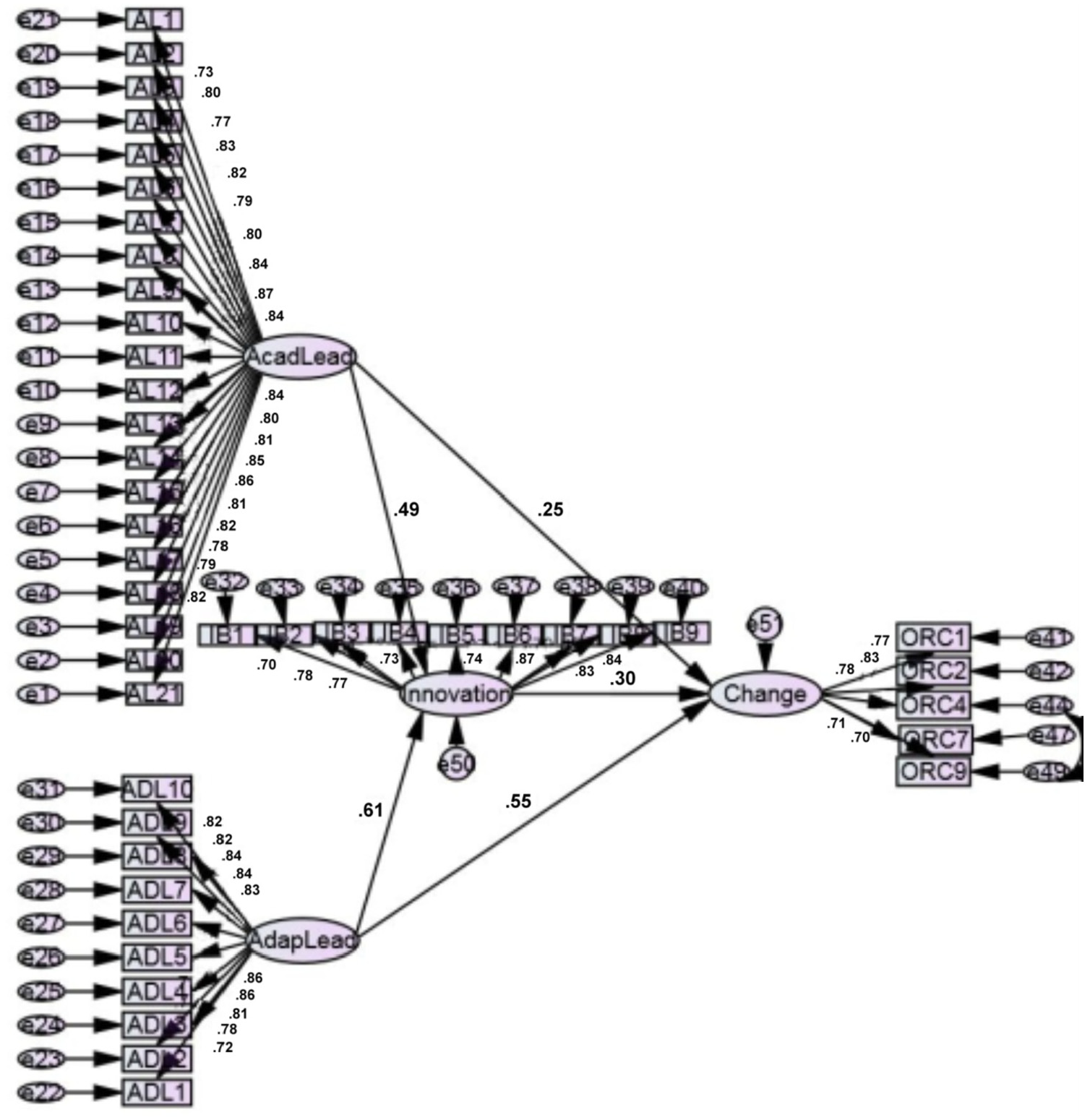
Structural model.
Regarding the indirect effects, as shown in Table 6, Innovative Behavior has played a mediatory role between Academic Leadership and Innovative Behavior with β = .147 which came out to be significant at 5% supporting sixth hypothesis of the study. Lastly, Innovative Behavior has also played a mediatory role between Adaptive Leadership and ORC with β = .183 which came out to be significant at 1%, hence supports the last hypothesis of the study.
Indirect Effects.

Significant at 1%.
Significant at 5%.
Discussion and Conclusion
This empirical study aimed to discuss the importance of academic and adaptive leadership and their contribution in creating ORC in HEIs by keeping in view the role of innovative behavior adapted by the administrative heads of higher education institutions of Pakistan. It highlights the importance of understanding the vital role of university’s leaders in facilitating organization’s readiness for change which will turn an organization into innovative organization. It also aims to improve the theoretical knowledge of academic and adaptive leadership and its contribution in creating organizational readiness of change.
Present leadership theories are founded in the notion of leadership, linkages between players participating in the leadership process and the links between environment, leadership, and the intended outcomes. These conventions and conceptions limit our comprehension of the evolutionary and developmental features of group leadership processes. In fact, most of the theories of leadership and empirical investigation are based on supervisor–subordinated relations in which the supervisor is viewed as a leader and the subordinate as followers (DeRue & Ashford, 2010).
The study picked adaptive leadership as a modern leadership paradigm, which is not one-way impact and over time, it may develop to become institutionalized and considered a reality unless the arrangement of leading connections is changed or disrupted. Several new insights emerge when leadership is conceptualized as an interactional lead process, followed and interlocked by actions of leadership and followers. This study quantifies the connection between adaptive leadership and ORC. A significantly positive relationship was found between these two variables in this study which also was found similar in the past few studies as well.
Doyle (2017) has illustrated the value and capacity of adaptive leadership to initiate or achieve effective academic reform. It introduced an adaptive leadership model to provide a range of guidance so that leaders can learn where and when to deal with growing demands in contemporary academic setting to be competitive, accountable and financially sustainable and to support sustainable and successful changes in the connection between the stakeholders and organization. They analyzed two cases studies to demonstrate that if stakeholders consider leadership as a “process” that needs creativity and involvement of all the concerned stakeholders then changes can have a greater level of success. This study has also shown a mediatory role of innovative behavior between adaptive leadership and organizational readiness for change. Innovation in academia proved to be an important thing during Covid-19 and has taken a creative and effective course in academic in terms of organizational readiness for change. New teaching methodologies were introduced during the episode of covid-19 including online teaching and assessment which made leaders to take decision in the favor of implementing these in the dire need to continue the education in innovative way.
Moreover, this study also undertook the role of academic leadership in fostering ORC. The result found out a positive relationship between academic leadership with ORC. The final results are in line with past studies that is, Bargh and Ferguson (2000) and Ramsden (1998).
As per Ramsden (1998), the primary benefit a university may have in a resource-hungry, competitive high-school setting may be seen as good academic leadership. Bargh and Ferguson (2000, p. 65) stimulate future leaders with their assertion that “individuals really make a difference in universities” and that whole departments may be changed in 2 years’ time. Koen and Bitzer (2010) in discussion of their empirical research describe that, if leadership in HEIs recognizes and if such circumstances follow, every member of this specific university community could have a positive downward influence.
Moreover, Leaming (2007) recognizes that in order to improve academic performance quality, departments can inevitably become flexible and constantly changing units. According to Braun et al. (2016), university leadership, that is, academic leadership and management, are prerequisites for performance for these institutions that is, administrative leadership.
Davies et al. (2001) argues by highlighting that leadership is essential to thrive and universities must be recognized and developed as such leaders. Moreover, Spendlove (2007) found that just one business responder saw academic life and administration as distinct entities and those who have been in academia perceived them as inseparably interconnected. Academic leadership may therefore greatly differ and require specific skills and experience from business leadership. A recent quantitative study takes support from the finding that shared leadership methods encourage academic originality and innovation (Hoch, 2013). Lastly, innovation being mediator was also found to be significant between academic leadership and ORC in HEIs of Pakistan during Covid-19.
Practical and Theoretical Implications
Literature has highlighted the necessity of adaptation to change and COVID-19 has reinforced that the leadership role cannot be underestimated in this respect. This study highlights, in particular, the relevance and advantages of adaptive and academic leadership in coping with the challenges and HEIs’ willingness to change. Several institutions have encountered this problem and the transition has not been seamless, apart from institutions in which leaders have been the differentiator, some maybe due to lack of resources of some maybe due to duality of information flow from various regulators, as mentioned earlier. Moreover, in this difficult period universities who invested promptly in digital systems with increased learning capabilities, survived in an effective way, however, the need for effective innovation must be re-emphasized keeping in view the contextual requirements of various localities, such as the fact that some institutions rapidly instructed its team members for shifting on to the digital channels, without realizing that at many parts of the country, the availability of digital communication channels is a challenge itself. So, leaders do need to adapt and innovate and lead, however, context should be kept in the equation.
In order to minimize risks of COVID-19 or any similar issue in future, HEI’s academic and adaptive leaders must adjust to change and develop their innovative behavior in the field of education and other development policies. The study’s findings are not confined to the public and private universities but can also be used by organizations with a relatively volatile and dynamic environment to combine these leadership qualities with innovative skills of their institutions, somehow reduce negative market or environment pressures and seize opportunities to improve their systems.
However, the study indicates that capacity development is needed in order to obtain the intended outcomes. Hence, higher education institutions should always strive for “best” practices, including creative behaviors of the heads, investing in human resources training and learning. This study also gives policymakers a guidance, especially the Higher Education Commission (HEC), for developing regulations that can make education more accessible to everyone while at the same time alleviating the issue of “digital divide.”
Lastly, situational leadership theory serves as the best approach for the organizations who work in uncertain and volatile times, where organizational leaders must act pro-actively and calculatedly in uncertain and complex times. Furthermore, innovation in this regard is a prerequisite for the leaders to adapt and to follow the best practices in order to make organizations survive as is the case of HEIs of Pakistan.
Optimistically, the findings will stimulate critical reflection on leadership effectiveness in academia. Anyone in an academic position may be interested in how academic and adaptive leadership approaches can be useful in creating an overall readiness for change in their institution can find this research beneficial. Moreover, the presence of innovation can add on to an organizational agility of moving toward the hallway of readiness for change. And innovative behavior should be considered as one of the most important strategic levers which can be used by an organization to attain its competitive advantage.
Leaders need to adapt their leadership in correspondence with the ongoing circumstances and aspire to create enabling conditions for effective teamwork. Team reflexivity as suggested by Schippers et al. (2008, p. 1593) which represents “the extent to which teams reflect upon and modify their functioning” is one way of doing so. The team members may communicate honestly in their perspectives about team results and deficiencies in ongoing projects throughout the reflection process. In order to foster “share the lead” leaders participate themselves in the “process of leadership” which in turn positively enhance autonomy and participation.
Limitations and Future Research Recommendations
This study has some limitations as well including the time constraint and relatively less representation of the Pakistan as whole country as it included Punjab province only for data collection. Future research in this area may benefit from a larger stratified random sampling considering all types of districts inclusive of all sites having higher educational institutions which can be stratified around “size, location achievement levels, reform efforts, socioeconomic status,” and percentage of literacy rate. Future research can also consider the role of demographics such as experience and gender in assessing the difference of opinions among the participants.
It further argues that further study in this area should more clearly explore the connection between adaptive leadership and leadership in academia while taking a larger population and targeting a larger number of participants. More specifically, the future research should undertake longitudinal design in order to observe differences between pre and post-practice of adaptive leadership in higher educational institutions.
Footnotes
Acknowledgements
No acknowledgments.
Declaration of Conflicting Interests
The author(s) declared no potential conflicts of interest with respect to the research, authorship, and/or publication of this article.
Funding
The author(s) received no financial support for the research, authorship, and/or publication of this article.
An Ethics Statement
Not applicable.

Data Availability Statement
Data can be provided on request.