




Abstract
In Chinese universities, most English majors are taught by teachers, and students attend classes and do homework. Students are often passive in their study, which can make them lose study interest, negatively affect their study and cause boredom in class. Although previous studies have studied the class-related boredom of some English courses, they have not compared the level of it between different English courses. Besides, in previous studies, study interest and perceived autonomy support, two factors that affect class-related boredom, have received a lot of attention, while student enthusiasm has not received enough attention. Based on Control Value Theory, this study examines the degree of class-related boredom experienced by English majors in various English courses from the three factors including study interest, perceived autonomy support and student enthusiasm in an effort to diminish it in a more focused manner. The respondents are 884 English majors (94.1% female) from a university in Shanxi Province, China. And SPSS 26.0 is used for descriptive statistics and multiple linear regression analysis. Studies show that Advanced English Listening has the lowest degree of class-related boredom, but Basic English has the highest one. This study also finds that study interest, perceived autonomy support and student enthusiasm in English major courses are significantly negatively correlated with class-related boredom.
Keywords
Introduction
Most English majors in Chinese universities are taught by teachers and students attend lectures and do homework. Students are often passive in their learning. And English majors are required to take many and complex courses to improve their listening, speaking, reading, and writing skills, including Pronunciation courses, College English Newspaper Reading and so on. These courses are often more theoretical and less fun because of the difficulty and pressure of the courses, as well as the single traditional teaching style of some teachers. Therefore, English majors in China often find English major courses boring. Pawlak et al. (2020) find that academic boredom is a very common emotion in English learning. English boredom may have a negative impact on English learning outcomes directly or indirectly through behaviors such as insufficient class engagement (Wu & Kang, 2023). At the same time, English classes with a high degree of boredom will seriously affect English majors’ study interest, learning motivation, and even their career aspirations and occupational choice (Wigfifield et al., 2002). So it is particularly important to explore the causes of class-related boredom for English majors. According to the study, there are more diversified motivational reasons for English majors than for non-majors (Sun et al., 2022). For example, English majors show a strong interest in the target language culture, which significantly affects students’ integrative motivation and makes English majors have additional integrative motivation. And intrinsic drive is inversely connected with class-related boredom (Pekrun et al., 2010). Students’ participation in class will be indirectly impacted by teachers’ autonomous support that perceived by students (hereafter referred to as perceived autonomy support) (Dincer, 2011). Hence, study interest and perceived autonomy support were highly valued by researchers in earlier studies. Researchers have conducted numerous studies on teachers’ enthusiasm and believe that this factor accurately predicts students’ engagement with learning (Keller et al., 2014). As one of the external influencing factors, the enthusiasm of other students in the class (hereafter referred to as student enthusiasm) has not been widely concerned by researchers and there hasn’t been a lot of in-depth research done. The excitement of classmates is a significant element when it comes to the external factors affecting students’ boredom in the class. Pekrun (2006) argues that boredom is one of the activity-related emotion in Control Value Theory, which is influenced by environmental factors such as autonomous support and intrinsic factors such as intrinsic assessment of learning. And among the external factors, in addition to the teacher’s independent support, the enthusiasm of peers also affects students’ achievement emotions. Therefore, this paper will use the control value theory as the theoretical support for research. To more specifically reduce class-related boredom for Chinese English majors, this study explores the class-related boredom of English majors in different courses and the relationship between study interest, perceived autonomy support and student enthusiasm and class-related boredom through a random sample survey of English majors in their different courses which are tough by different teachers.
The Class-Related Boredom of English Majors in Different Courses
Under the Control Value Theory, boredom refers to the emotion related to the learning process, which is often compared with the achievement emotion such as hopelessness and anxiety (Pekrun, 2006). Students have been reported feeling bored both in class and while studying (Tze et al., 2014). According to some experts, boredom can be defined as an emergent “affective indicator of unsuccessful attentional engagement in valued goal-congruent activity” (Westgate & Wilson, 2018). This connection between boredom and disengagement has recently received more attention in L2 boredom studies (Nakamura et al., 2021). The class-related boredom studied in this paper refers to the students’ inability to devote themselves to learning and absorb knowledge in English class due to various reasons. It is anticipated that boredom in educational settings will lead to task-irrelevant thoughts, reduce academic motivation, and promote less autonomous types of self-regulation (Niemiec & Ryan, 2009), referred as to behavioral, cognitive, motivational, and cognitive-behavioral engagement (Pekrun & Linnenbrink-Garcia, 2022). The use of cognitive approach strategies can effectively reduce or prevent class-related boredom (Kökçam & Satan, 2022). English majors in various classes frequently complain about being bored in class. For example, English majors will find reading classes boring, mainly because English reading classes focus more on reading scores rather than interesting reading content (Shehzad et al., 2020); When the form of English writing class changes to flipped classroom, it will appear that the classroom content is insufficient, so students will feel bored (Su Ping et al., 2020); Repeated listening can become tedious for second language learners (Sendag et al., 2018); The teacher-centered teaching style in listening classes will dull the students (Mohammed & Idris, 2010). Few research, however, have examined the factors that have the biggest influence on boredom in classes as well as how boredom differs between different courses.
Factors Affecting Class-Related Boredom of English Majors
In actuality, boredom is more than a lack of interest or motivation. While boredom is emotionally upsetting, lack of interest is affectively neutral and does not produce emotional discomfort (Daschmann et al., 2014). There are many factors that cause class-related boredom, including students’ internal factors and external factors. Kökçam and Satan’s (2022) research shows that, compared with Canadian students, there is less use of behavioral methods among Chinese students, which may be due to teachers’ insensitivity to students’ feelings of classroom boredom. In this study, we mainly focus on three important factors affecting class-related boredom: one of the internal factors, study interest, and two external factors, perceived autonomy support and student enthusiasm. In the study of class-related boredom factors, there is no research on these three factors as research objects. Therefore, we can try to explore how these three factors contribute to classroom boredom.
Study Interest
Interest is one of the key factors for academic success (Fryer et al., 2020). The importance of interest in learning is self-evident. Halme et al. (2021) believe that study interest refers to students’ preference for courses. For instructors and education in general, this research is practically relevant. Knowing what kinds of courses students enjoy makes it simpler for instructors to create lessons that will capture their interest and help them better comprehend and apply the material. A demotivating problem for Chinese university students learning English as a Foreign Language (EFL) is their lack of enthusiasm in the language, according to Tao (2021). For instance, challenging educational materials may deter certain students and decrease their intrinsic motivation (Tanaka & Murayama, 2014). Students’ domain interests directly and favorably predicted course success, according to a study of first-year university students in Japan, whereas their interests in the courses they were taking were associated to higher course attendance (Fryer & Bovee, 2021).
Cladera (2020) pointed out that lecturers should focus on students’ interests, adjust their courses accordingly, and improve students’ perception of teaching quality, which will also help build better communication and trust between lecturers and students. Paying attention to and understanding the needs and interests of learners can help lecturers adjust their use of a second language to reduce class-related boredom (Tran, 2023). Wilkins et al. (2021) came to the conclusion that there was a significant positive correlation between student teacher rating, course rating, and students’ perception of course interest, meaning that the more interested students were in the course, the more motivated they were to learn.
Perceived Autonomy Support
Students’ perceived autonomy support from teachers is very important to them. According to Bajrami (2015), autonomy is a human right that gives pupils the best chance to employ their creative thinking both within and outside of the classroom. It also significantly improves classroom involvement and cuts down on boredom. Different motivated behaviors reflect how in control or free one feels when pursuing their goals. In particular, intrinsically motivated behaviors serve as the model for autonomy since they are carried out voluntarily and are supported by the thoughts and emotions that naturally arise while engaging in the activity (Ryan & Deci, 2017). There is no question that learning calls for autonomy, which means that a student’s role in a classroom shouldn’t be that of a passive one and that they must be responsible for taking good care of their education. According to Reeve et al. (2004), instructors who employed autonomy support more frequently found that their pupils were more engaged and had less boredom in class. The need for self-determination, volition, meaning, and freedom of choice is referred to as the demand for autonomy (Deci & Ryan, 2000). According to Bajrami (2015), learner autonomy in one’s chosen field contributes to university outcomes like adaptability, flexibility, self-direction, and self-initiative while also preparing students for a lifetime of learning. This type of learning can also help advance democratic educational systems. Deci et al. (1981) discovered that students who had teachers who were more autonomy-oriented were more intrinsically driven and had higher self-esteem. In an experiment, Benita et al. (2014) randomly assigned 117 college students to three groups (autonomy-supportive, autonomy-suppressive, and neutral), adopted an intrapersonal-competence standard to improve graphic quality of handwriting, and found that when given in an autonomy-supportive context compared to the other two, mastery goals produced more positive emotional experiences. Scholars have experimented with this extensively recently. For instance, Dincer et al. (2019a) look at the causes and effects of 412 Turkish English as a Foreign Language (EFL) learners engaging in class. The authors looked at the connection between Chinese accounting students’ academic achievement, class participation, and psychological need fulfillment using the self-determination theory (Liu & Flick, 2019). The growth of teenage pupils’ well-being is significantly influenced by perceived autonomy support (Kleinkorres et al., 2023). Due to the foregoing, this study believes that the perceived autonomy support is a key element in minimizing class-related boredom and has significant research significance.
Student Enthusiasm
In this study, we believe that among the environmental factors affecting achievement emotion, the learning enthusiasm of peers is also one of the factors. We call it student enthusiasm. Researchers are beginning to recognize how critical it is to look into how the emotional component of teaching affects learning outcomes (Baumert & Kunter, 2006; Demetriou et al., 2009; Zembylas, 2005). The supportive role of foreign language teachers in fostering students’ enthusiasm for learning foreign languages has been shown in certain literature. Researchers have argued in favor of looking at learners’ excitement holistically in light of the growing interest in the role of passion in language learning (Dewaele & MacIntyre, 2014). While it is necessary to consider the impact of negative emotions such as class-related boredom in the learning process, it is also important to consider good emotions such as students’ reported enthusiasm (Dewaele & Pavelescu, 2021; Resnik and Schallmoser, 2019). Whereas negative emotions can stymie progress (MacIntyre & Gregersen, 2012), happy emotions help people succeed (Fredrickson, 2001, 2013).
In order to improve our knowledge of teenage enthusiasm, engagement, and achievement, Ryan (2001) noted that researching the degree, nature, and scope of peer group influence on academic achievements is an important topic for future research. According to Khamis et al. (2008), there is a mediocre link between peers’ views about learning and individuals’ own excitement for learning. It implies that students will be more engaged in class if they can recognize the beneficial correlation between each student’s engagement. When examining the variables influencing students’ learning, Meyer and Turner (2006) also stressed the significance of a pleasant environment fostered by instructors and students in the classroom. Peers have been shown to be significant contributors to building a social environment favorable to learning because of the influence of teachers on students’ motivation and learning. It can snuff off students’ boredom in class and tangle up their excitement. Therefore, it is very important to study how individual students view the enthusiasm of their classmates and whether there is a relationship between this view and the enthusiasm of individual students. Negative peer environment may be especially harmful to students, including their enthusiasm, interest, and autonomy.
Research Questions and Hypothesis
More studies are beginning to focus on academic emotion because it has a major impact on academic accomplishment as a non-intellectual factor. For the first time, Pekrun et al. (2002) introduced the concept of academic emotion. He made the argument that academic emotions, such as enthusiasm throughout the learning process, pride after success, and exam anxiety, are strongly related to academic achievement, classroom instruction, and school learning. It refers to feelings of achievement experienced in the classroom as well as the emotional experience of students after learning about academic success or failure. According to the academic emotion’s generating element, the Control Value Theory of Achievement Emotions further differentiates academic emotion, primarily includes active emotions during learning activities, prospective outcome emotions, and retrospective outcome emotions. The academic boredom studied in this paper is attributed to active emotions. Study interest, perceived autonomy support, and student enthusiasm are the important components of English majors’ academic emotions. So we explored the following two research questions:
Do English majors experience varied levels of boredom in various courses?
Is class-related boredom of English majors influenced by study interest, perceived autonomy support and student enthusiasm?
College students make up the research sample for this research. These variables can be used to examine class-related boredom among English majors in colleges and universities, despite the fact that many studies on it involve students in elementary, middle, or high school or in other college majors. The findings of this study have significant practical implications for how English majors are taught and learn. Two research hypotheses are put forward. Research hypothesis 1: English majors experience different levels of boredom in different classes; Research hypothesis 2: In the classroom of English majors, the three factors of student interest, perceived autonomy support and student enthusiasm can significantly predict class-related boredom.
Method
Participants
The respondents were 884 English major students from a university in Shanxi Province, China, with a mean age of 20.78 years (SD = 1.324) and a female gender percentage of 94.1%. These students include freshmen, sophomores and juniors, ages 18 to 25. They are native speakers of Chinese and English is their second foreign language. Students majoring in English learn the language and literature in English, as well as the fundamental concepts and knowledge of the history, politics, economy, diplomacy, society, and culture of English-speaking nations like the UK and the US. Besides, they also receive quality training in English speaking, listening, reading, writing, and translating (Table 1).
Sample Characteristics for English Majors From a University in Shanxi Province, China.

Data Collection
Ethical approval was granted for the study by Beijing Normal University Faculty of Psychology. The researchers randomly selected the entire class of English majors in each classroom where classes were giving by different teachers to conduct questionnaires. Before participating, students were informed of the research’s goals, duration, methodology, and data confidentiality. And student participation in this survey was voluntary and anonymous. Their informed consent was assured, and they were not paid in exchange for it. The participants were assured that their replies would remain private and would not impact their grade at the end of the semester. On the same day, in different classrooms, students were asked to recollect and assess how they felt in class about class-related boredom, study interest, perceived autonomy support and student enthusiasm and then return the questionnaires. We collected questionnaires from the seven compulsory English courses including Advanced English Listening, English Comprehensive Course, English Newspaper Reading, English Pronunciation, Intermediate Writing, Modern Educational Technology, and Basic English. And SPSS 26.0 was used for descriptive statistics and multiple linear regression analysis.
Measures
Class-Related Boredom
College students’ levels of class-related boredom were measured in this study using 11 items on a scale from the Achievement Emotions Questionnaire (AEQ) (Pekrun et al., 2011) (see Appendix for a full version of the questionnaire). For example, “I frequently check the time, and it seems to be moving slowly.” Responses were indicated on a 5-point Likert-type scale ranging from 1 (not at all true of me) to 5 (very true of me). In the current investigation, the Cronbach’s alpha value for this scale was .929.
Study Interest
A scale measuring study interest was used (Keller et al., 2014). There are 4 items (see Appendix for a full version of the questionnaire). For example, “In this course, I usually enjoy myself.” Students were asked to assess their experience in the current classroom, and their responses were indicated on a 5-point Likert-type scale ranging from 1 (not at all true of me) to 5 (very true of me). Higher total scores reflect higher levels of study interest. In the current investigation, the Cronbach’s alpha value for this scale was .862.
Perceived Autonomy Support
We used a scale, The Learning Climate Questionnaire (LCQ13-item), already validated on perceived autonomy support (Williams & Deci, 1996) (see Appendix for a full version of the questionnaire). “I have a lot of faith in my teacher,”“My teacher addressed my inquiries thoroughly and patiently,” and “My teacher is a good listener to my thoughts” are three examples of queries. Responses were indicated on a 5-point Likert-type scale ranging from 1 (not at all true of me) to 5 (very true of me). A higher overall score denotes more perceived support for autonomy. In the current investigation, the Cronbach’s alpha value for this scale was .937.
Student Enthusiasm
Three items were used to gauge student enthusiasm: “On the whole, other students in the class are full of energy in class,”“On the whole, other students in the class were really interested in what they learned in class,” and “On the whole, other students in the class are full of enthusiasm in class.” The questions were adapted from the questionnaire of Keller et al. (2014) on students’ perceived teacher enthusiasm (see Appendix for a full version of the questionnaire). Responses were indicated on a 5-point Likert-type scale ranging from 1 (not at all true of me) to 5 (very true of me). In the current investigation, the Cronbach’s alpha value for this scale was .877.
Data Analysis and Results
Means, SDs, and Intercorrelations of All Measures
Table 2 shows the relationship between the three dependent variables of study interest, perceived autonomy support and student enthusiasm in this study and the independent variables of class-related boredom, as well as their mean value and standard deviation. The results show that class-related boredom is negatively related to study interest (r = −0.405, p < .01), perceived autonomy support (r = −0.382, p < .01), and student enthusiasm (r = −0.332, p < .01). For correlation coefficients, Plonsky and Oswald (2014) suggested that rs close to 0.25 be considered small, 0.40 medium, and 0.60 large. Based on this criterion, correlation −0.405 corresponds to a medium effect size, indicating that there is a relatively strong negative correlation between study interest and class-related boredom; Correlation −0.382 corresponds to a medium effect size, indicating that there is a relatively strong negative correlation between perceived autonomy support and class-related boredom; Correlation −0.332 also corresponds to a medium effect size, indicating that there is a relatively strong negative correlation between student enthusiasm and class-related boredom, but it’s lower than the first two factors. All in all, the correlation between these three factors and class-related boredom in order of effect size is study interest, perceived autonomy support and student enthusiasm (Table 2).
Means, Standard Deviations, and Intercorrelations of Study Variables (N = 884).
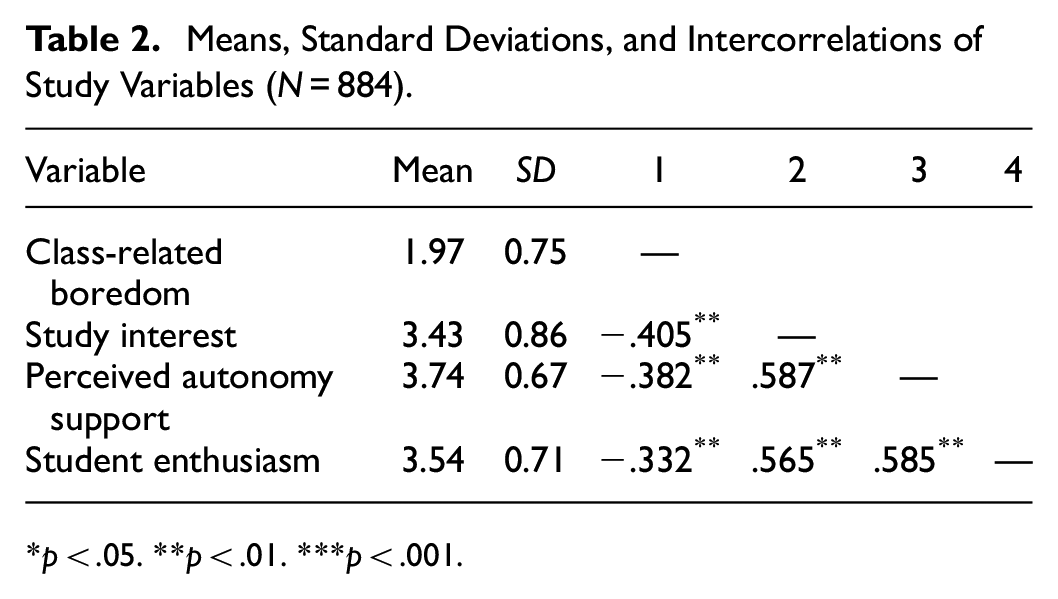
p < .05. **p < .01. ***p < .001.
The Class-Related Boredom of English Majors in Different Courses
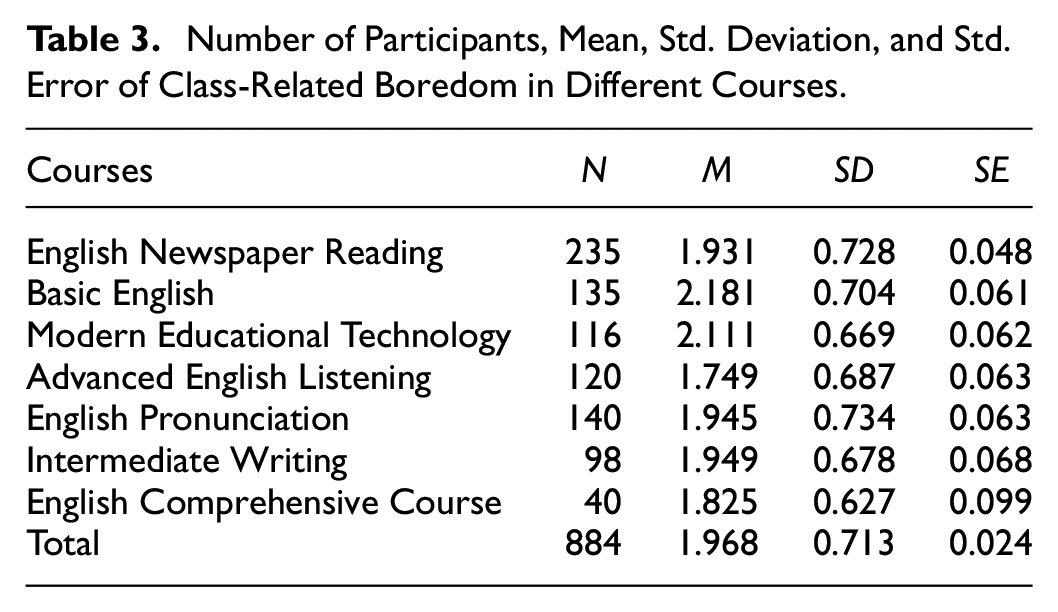
Figure 1 shows that, in seven courses of English majors, English majors have different levels of class-related boredom in different courses. Advanced English Listening has the lowest degree of boredom, but Basic English has the highest one.

Mean of class-related boredom in different courses.
On the basis of Table 3, we conducted ANOVA and post hoc test, and the statistical analysis results showed that there is a significant difference between English Newspaper Reading and Basic English, Modern Educational Technology and Advanced English Listening (p < .05), among which, students have the highest degree of class-related boredom to Basic English, the lowest degree of class-related boredom to Advanced English Listening, and the degree of boredom to Modern Educational Technology is also significantly higher than that of English Newspaper Reading. However, there is no significant difference between the English Newspaper Reading and the English Pronunciation, Intermediate Writing and English Comprehensive Course (p > .05), and students have similar levels of class-related boredom with these four courses. There are significant differences between Basic English and Advanced English Listening, English Pronunciation, Intermediate Writing and English Comprehensive Course (p < .05), among which students’ class-related boredom in Advanced English Listening is much lower than that of Basic English. However, the difference between Basic English and Modern Educational Technology is not significant (p > .05), and the degree of class-related boredom is similar. There are significant differences between Modern Educational Technology and Advanced English Listening and English Comprehensive Course (p < .05). The boredom degree of students in Advanced English Listening is much lower than that of Modern Educational Technology, but there is no significant difference between English Pronunciation and Intermediate Writing (p > .05). English Pronunciation is significantly different from Advanced English Listening (p < .05). The boredom of students in Advanced English Listening is lower than that of Advanced English Listening, but the difference with Intermediate Writing and English Comprehensive Course is not significant (p > .05). The class-related boredom of these three courses is similar. Advanced English Listening and Intermediate Writing vary significantly (p < .05), and students are less bored in Advanced English Listening than Intermediate Writing, but the difference from English Comprehensive Course is not significant (p > .05). The difference between the Intermediate Writing and English Comprehensive Course is not significant (p > .05), and the degree of class-related boredom is similar.
Number of Participants, Mean, Std. Deviation, and Std. Error of Class-Related Boredom in Different Courses.
The Predictive Effect of Important Factors on Class-Related Boredom
To unravel the complexities of these relationships, we employ hierarchical regression analysis, a multivariate regression technique that allows for the sequential introduction or exclusion of predictive variables. This approach enables the assessment of each newly introduced variable’s contribution to the model, thereby elucidating the incremental variance explained by each variable (Cohen et al., 2003). Hierarchical regression is particularly suited for evaluating potential moderation and mediation effects (Baron & Kenny, 1986) and assumes that the data meet the basic assumptions of linear regression, including homoscedasticity, independence, and normality (Aiken & West, 1991).
The analysis results are shown in Table 4. “Grade,”“Gender,” and “Age” are our control variables. In academic research, control variables like age, gender, and grade level are essential for isolating the effects of the independent variable. Age can significantly influence outcomes due to its association with cognitive and physical changes (Salthouse, 2009). Gender is a critical control variable, as numerous studies have shown gender differences in various psychological traits and behaviors (Hyde, 2005). Grade level, especially in educational research, is crucial for accounting for differences in cognitive development and academic skills (Aikens & Barbarin, 2008). By controlling for these variables, researchers can ensure that their findings are reflective of the true relationship between the variables of interest, rather than being confounded by these demographic factors (Field, 2013). In our application, control variables, “Grade,”“Gender,” and “Age”, are introduced first, followed by the independent variable “Study Interest,”“Perceived Autonomy Support,” and “Student Enthusiasm”. Data analysis is conducted using SPSS software, with standardized coefficients employed to interpret the influence of each variable. We anticipate that variables “Study Interest,”“Perceived Autonomy Support,” and “Student Enthusiasm” will significantly impact “Class-Related Boredom” after controlling for other variables, offering new insights into influencing factors of class-related boredom for English majors. Despite its limitations, such as assumptions about data distribution, hierarchical regression analysis provides a powerful method for assessing the joint impact of multiple variables on a dependent variable. Cohen (1988) defined the values of R2 in regression as 0.02, 0.13, and 0.26 as small, medium, and large effect sizes respectively. The effect sizes of study interest, perceived autonomy support and student enthusiasm are 0.178, 0.219 and 0.223 respectively. This suggests that 17.8, 21.9, and 22.3% of the variability of class-related boredom scores can be explained by the predictor variables.
Hierarchical Liner Regressions of Variables on Class-Related Boredom.
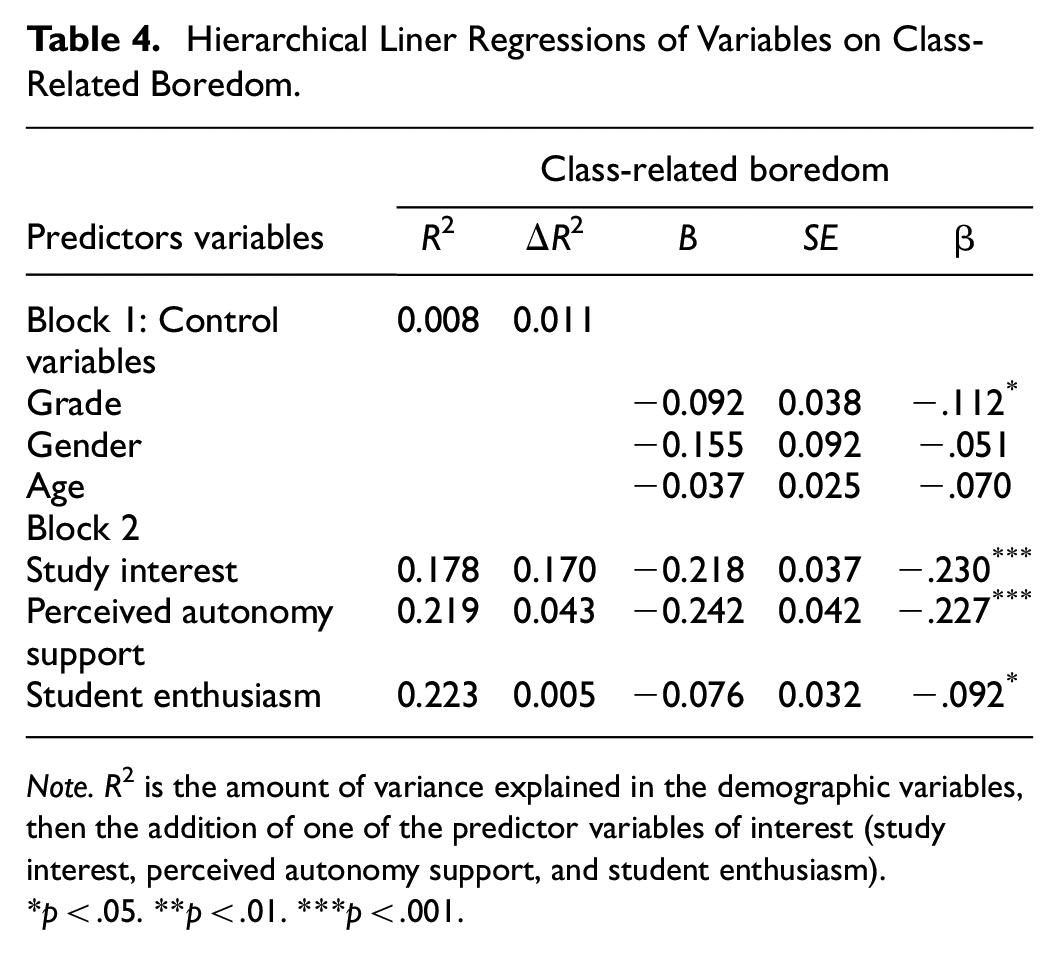
Note. R 2 is the amount of variance explained in the demographic variables, then the addition of one of the predictor variables of interest (study interest, perceived autonomy support, and student enthusiasm).
p < .05. **p < .01. ***p < .001.
Discussion
The Class-Related Boredom of English Majors in Different Courses
This study explores the class-related boredom of English majors in seven courses of English majors. The result shows that English majors have different levels of class-related boredom in different courses. Advanced English Listening has the lowest degree of boredom, but Basic English has the highest one, which is consistent with hypothesis 1. Although previous studies have done a lot of research on boredom in different English courses, such as too much emphasis on grades rather than content, inappropriate classroom organization and activity forms, and teacher-centered teaching methods will lead to class-related boredom (Sendag et al., 2018; Shehzad et al., 2020; Su Ping et al., 2020; Mohammed & Idris, 2010). However, they did not compare the degree of boredom in different courses, so this study further explored the degree of class-related boredom in seven English courses and made a comparison. Among them, the boredom level of Basic English is the highest. With regard to practicing certain language skills like speaking, reading, listening, and writing, students’ foreign language engagement may vary (Erkan & Saban, 2011; Mills et al., 2006; Rahimi & Abedini, 2009; Torres & Turner, 2016; Yang, 2017), which leads to the different reasons for different levels of class-related boredom. In the above courses, students’ learning activities are often too simple or difficult, or teachers’ choice of teaching materials does not meet the actual needs of students, which leads to different levels of class-related boredom (Kruk, 2021). For example, the Basic English class usually focuses on the single teaching content of vocabulary, grammar and reading comprehension, which is difficult for students to understand and use or is too simple and unchallenging, resulting in boredom for students. As for English listening according to Pishghadam et al. (2016), EFL learners feel shame, boredom, and helplessness when listening. However, we find that Advanced English Listening has the lowest degree of boredom, which is contrary to the findings of Pishghadam et al. Because in Advanced English Listening, not only the accent speed and content of listening materials are diversified, but also the practice of listening skills can enhance students’ class participation and interaction, and improve their interest in learning listening skills.
Influencing Factors of Class-Related Boredom for English Majors
We measured the influence of study interest, perceived autonomy support and student enthusiasm on class-related boredom, and found that these three factors are important influencing factors of class-related boredom. First, study interest significantly negatively predicted class-related boredom, and it has the greatest impact on class-related boredom (β = −.23, p < .001). This shows that the lower the study interest, the higher the level of class-related boredom. Secondly, the results show that the higher the students’ perceive teacher autonomy support, the lower the level of class-related boredom (β = −.227, p < .001). And the higher students perceived their classmates’ student enthusiasm for learning, the lower the level of class-related boredom (β = −.092, p < .05). Among them, study interest belongs to internal factors, and perceived autonomy support and student enthusiasm belong to external factors. The influence of internal factors on class-related boredom is greater than that of external factors. One of the main causes of foreign language learning activities becoming boring is a lack of interest (Li et al., 2023). Yasmin (2019) points out that Learners’ engagements, active participation, and interaction can make classroom interesting for students, thus make them more interested in English class and reduce the boredom of class. Therefore, teachers should employ supportive strategies to create a positive and attractive learning environment. In addition, perceived autonomy support and student enthusiasm are also important influencing factors. Promoting autonomous support in a learning environment would increase students’ intrinsic motivation and performance levels in English writing classes. Teachers were also important factors affecting class-related boredom (Cui et al., 2022). Higher attendance and grades were reported by students who felt their teachers supported them more, compared to those who felt less intervention from teachers (Oga-Baldwin, 2020). Finally, the factor of student enthusiasm also has a significant impact on class-related boredom in class. Through creative teaching strategies, teachers should increase students’ enthusiasm in the classroom. The students’ attitudes toward the game-based approach were positive, which reduced the interference of educational activities in instruction and revealed the teaching and learning quality beyond the traditional classroom (Almusharraf, 2023). It demonstrates how boosting student enthusiasm may considerably lessen class-related boredom and increase students’ drive to study. The above findings are consistent with our hypothesis 2.
Study Interest
This study finds that study interest, as an internal factor, is an important factor affecting class-related boredom. According to the research of Zhang (2022), teacher-centered classroom will make students lose interest in learning, which will lead to class-related boredom. This indicates that study interest is an important factor influencing class-related boredom, which is consistent with our research results. Xie et al. (2022) also believes that the occurrence of boredom is mainly affected by the lack of interest in learning. Study interest, as one of the intrinsic factors, is one of the pillars of sefl-directed learning (Lai et al., 2023). As a foreign language, English is quite different from students’ daily life and cultural background, which requires students to pay more efforts and time to learn. If students are not interested in learning English, it is difficult to actively participate in class activities. Cancino (2023) emphasizes that interest can be manipulated in language classroom settings to advance learning. Therefore, we should pay special attention to study interest when studying the influencing factors of class-related boredom for English majors.
Perceived Autonomy Support
This study finds that perceived autonomy support is an important factor affecting class-related boredom, which is consistent with previous studies. Basic psychological needs and intrinsic motivation were both positively connected with and positively predicted by student’ perceived autonomous support, which in turn positively predicted all aspects of classroom participation. (Dincer et al., 2019b; Lim & Wang, 2009). According to Vîrgă et al. (2022), mandating classroom participation could also lessen boredom. This proves from the side that our research conclusion is correct. For instance, in a comprehensive English course, teachers’ explanations and direction of the textbook’s content help students learn more effectively and meet their psychological demands for information acquisition, which increases their engagement in class and lessens their boredom.
Student Enthusiasm
Student enthusiasm is another important factor affecting class-related boredom. According to Chang (2010), students’ drive to learn was positively impacted by getting along with their more engaged classmates. An otherwise motivated learner may become discouraged if they are surrounded by slow learners who are unresponsive, indifferent, or uncaring toward one another. This demonstrates that student engagement in class is significantly influenced by their passion. Getting along with more engaged classmates has a positive effect on students’ motivation for learning. In contrast, being around slow learners who are unresponsive, uninterested, or caring for one another can demotivate an otherwise motivated learner (Chang, 2010). This demonstrates that student engagement in class is significantly influenced by their passion. For instance, Savignon (1997) emphasizes the necessity of meaningful communicative tasks in language classrooms when studying English phonetics. Students are more attentive, their classmates are more animated, and they experience less boredom in class when they are involved in worthwhile communicative tasks. On the other side, Basic English classes tend to be uninteresting because of the dull textbook material and the vague explanations, which results in a lack of excitement among the students.
Limitation and Future Research
There are some limitations in our study, and at the same time, we also put forward the prospect of future research. Firstly, the sample we investigated is college students, and the results are not applicable to other student groups. In the follow-up study, we will further investigate the influencing factors of class-related boredom of primary and secondary school students in their English courses. In addition, the self-reported form and cross-sectional study used in this study have certain limitations. And it is unknown whether the aforementioned research findings can be applied to other college students since the current study was conducted in a sample of a particular English major students in China, where the proportion of women majoring in English is significantly higher than that of men. In future studies, we will consider the gender balance of the sample group more, and investigate the level of class-related boredom of English majors at different time points. Finally, the results of this study were conducted on compulsory courses for English majors, and it is unclear whether they can be applied to elective courses, which requires further research.
Conclusion
The aforementioned research add to our understanding of the link between teacher workload and numerous classroom environment factors. This study discovered that English majors’ perceptions of class-related boredom, study interest, perceived autonomy support, and student enthusiasm vary between courses, and that these factors are strongly interconnected and may be used to predict one another. This helps English major teachers pay more attention to students’ class-related boredom and make teaching adjustments according to the level of class-related boredom in different courses. As a result, this study offers a critical foundation for further research.
Footnotes
Appendix
Declaration of Conflicting Interests
The author(s) declared no potential conflicts of interest with respect to the research, authorship, and/or publication of this article.
Funding
The author(s) disclosed receipt of the following financial support for the research, authorship, and/or publication of this article: This research was supported by the key project of Zhejiang Province’s education science Planning (Grant No. 2023SB090) and the Zhejiang Province’s Education Science Planning (Grant No. 2018SCG162).
Ethical Approval
The present study was approved by the Research Ethics Committee of School of Psychology, Beijing Normal University (WZU-2022049).

Data Availability Statement
Data sharing not applicable to this article as no datasets were generated or analyzed during the current study.