




Abstract
Scholars have long been interested in the complementary relationships forged by membership groups and political parties. The post-bellum period presents an opportunity to consider these connections using a case study of two groups concerned with the ills of alcohol, the Woman’s Christian Temperance Union (WCTU) and the Prohibition Party. Our analysis of presidential elections from 1876 to 1900 reveals that—although women were disenfranchised at the time—the WCTU’s organization and infrastructure was essential to early Prohibition Party success. In 1884, the first election after the two created a formal alliance in 1882, the strength of the WCTU helped the party grow its voter base. However, the two slowly diverged over how to achieve prohibition, and this relationship dissipated; there is little evidence of any significant connection between the groups after 1884. This supports the proposition that a shared means of accomplishing goals is an essential element of an effective group–party partnership.
Keywords
For the first 70 years of the post–Civil War United States, prohibition reemerged as a mainstream topic that interested people in every region of the country. The movement toward national prohibition was preceded by state and local efforts to shut down the traffic, sale, and consumption of intoxicating beverages. Given the intensity of feelings and the scope of activity, the abolition of alcohol became the political issue that trumped all others for a large number of committed citizens.
Prohibition also gained particular popularity among politically active women. Many had played key roles in abolitionist organizations (e.g., Jeffrey, 1998; Robertson, 2010) and early temperance groups (e.g., Dannenbaum, 1981; Tyrrell, 1982), and others had been involved with benevolent societies of various types (e.g., Boylan, 1990; Ryan, 1979). With the abolition of slavery, many women turned to addressing other ills in society that required correction, and they soon sought to heal the country and the family by advocating for public policies that promoted a “sober and pure world.” It is not without reason, then, that the largest women’s organization up to that time, the Woman’s Christian Temperance Union (WCTU), formed around the topic.
Established in Cleveland, Ohio, in 1874, the group’s mission was to “protect the home”—and by extension, create greater personal and financial security for U.S. families—through the prohibition of alcohol, tobacco, and other drugs. Early leaders, including Annie Wittenmyer, Mary Johnson, Mary Ingram, and Frances Willard (whose name is most frequently associated with the group), viewed the group’s cause as part of an attempt to exercise political voice, even without the franchise. Prohibition was a logical policy goal for women of this era, who were largely restricted to the private sphere, and were, thus, particularly susceptible to the social costs of alcohol abuse. In addition, it was considered unseemly for women of the era to spend much time in taverns and saloons, where much political business was conducted. As a result, few issues important to women and family—including education, child custody, and divorce—typically received the attention of political leaders of the day. The cause of prohibition, thus, became a way for women to bring indirect and direct attention to these issues.
The WCTU grew rapidly in membership and status, eventually becoming the largest women’s organization in the world. In the decade after its founding, it became organized in the vast majority of states and territories, and worked assiduously at the local, state, national, and even international levels to fight against the consumption of alcohol and the various social problems it created. Under Willard’s leadership, which lasted from 1879 to 1898, the group’s agenda also expanded to include other issues, such as immigration, suffrage, and workplace safety.
Of course, temperance and prohibition in the post-bellum era were not causes solely supported by women. Prior to the formation of the WCTU, a few committed male prohibitionists led by John Russell formed the Prohibition Party in 1869; its ultimate goal was a constitutional ban on the production, consumption, importation, and trade of alcohol. As one national Prohibition Party platform noted, alcohol was
now so threatening the perpetuity of all our social and political institutions, that the suppression of the same by a national party, organized therefor [sic], is the greatest object to be accomplished by the voters of our country; it is of such importance that it, of right, ought to control the political action of all our patriotic citizens, until such suppression is accomplished. (Prohibition Party, 1896, p. 106)
Whether to work alongside the Prohibition Party or whether to work through other channels led to serious debates within the WCTU. As president of the WCTU, Frances Willard advocated working alongside the party. She spoke at Prohibition Party conventions, and later, other members of the WCTU also served as delegates to these meetings. Still, opposition existed between those wanting less emphasis placed on partisan, electoral approaches to prohibition and those who desired a close connection with this minor party. These conflicting viewpoints lead us to ask an important question: Is there a connection between WCTU membership and the performance of the Prohibition Party at the ballot box?
It is worthwhile to explore this question for several reasons. First, the two organizations began within 5 years of one another, and their growth in support in the 1880s paralleled each other. Yet, to date, scholars have not quantitatively assessed the nature of the WCTU–Prohibition Party relationship. Second, and as an extension of the previous point, exploring this question allows us to speak to recent scholarship theorizing that political parties are not solely creations of politicians, but instead are the creations of various organized interests banding together (Bawn et al., 2012). A membership organization such as the WCTU, then, could play an essential role in a party’s development. Finally, it is also interesting to examine whether and how a female-only organization, prior to woman suffrage, could have significantly influenced the trajectory of a male-dominated political party, even if a third party.
To study these questions, we focus on the connection between the strength of state WCTU membership and Prohibition Party voting in the late 1800s. Using WCTU dues, weighted by a state’s population, as a measure of group strength, we find a relationship between the group and Prohibition Party presidential voting in 1884, 2 years after the organizations formed an official alliance. This evidence shows that a women’s organization influenced electoral politics prior to widespread voting rights for women. However, as the Prohibitionists sought to modernize their political organization by relying less on female activists, and as the WCTU responded by becoming less interested in working within a minor party, this effect quickly disappeared. These findings underscore women’s political capacity during the pre-suffrage era while also revealing that shared strategies for achieving policy goals, and not necessarily the alignment of goals, are the critical component in maintaining a membership group–political party connection.
The WCTU–Prohibition Connection
As mentioned in the introduction, the two organizations formed after the Civil War, the Prohibition Party in 1869 and the WCTU in 1874. But, it was more than just temporal proximity and mission that kept these two organizations in close alignment. In Pathways to Prohibition, Szymanski (2003b) notes that these two “radical” organizations found their early leadership in the more secretive International Order of the Good Templars, a temperance organization formed during the antebellum period (pp. 28, 36-42). Structured much like the Masons, the Good Templars allowed participation by both men and women.
With origins in the antebellum temperance movement, which was especially popular in the North among religious, native-born individuals, and sharing a similar goal of constitutional prohibition, these two groups began by attracting former Republicans and women who had favored that party. Pre-war abolitionists also saw this as an opportunity to cure society of yet another ill, and this group of experienced political activists included both men and women. For example, Gerrit Smith, the New York abolitionist who had helped to form the Liberty Party, and had been active in the pre-war temperance movement, was part of the effort to create the Prohibition Party. Likewise, longtime WCTU President Frances Willard was raised in a staunchly Republican, abolitionist 1 family; she even attended President Garfield’s inauguration in 1881 and went to the White House to present, from the WCTU, a portrait of Lucy Hayes, wife of Republican President Rutherford B. Hayes and a temperance woman herself (Bordin, 1986). Overall, then, the origins of these two organizations, as well as their ideological and policy inclinations, aligned well with one another.
This said, the WCTU was, at first, non-partisan, and especially so under the leadership of President Annie Wittenmyer (Andersen, 2011). Even when Frances Willard became president in 1879, the organization remained ostensibly non-partisan, though most WCTU women were likely sympathetic to the Republicans. Yet, after meeting with men from various temperance organizations and the Prohibition Party, Willard decided to push for a closer relationship with the third party (Bordin, 1986). In her 1882 presidential address, she noted that “[w]e should not consider our own interests to the exclusion of the interests represented by this independent movement” (Woman’s Christian Temperance Union, 1882: lxxxv), in part because the Prohibition Party had recently espoused woman suffrage at its previous convention. In fact, the party reorganized itself in 1882 as the “Prohibition Home Protection Party,” which, according to Andersen (2011), “combined it with the WCTU and the hundreds of thousands of members this organization had amassed since its beginnings” (p. 148). Andersen argues—although she does not empirically demonstrate the point—that this alliance “mapped partisanship—the predominant form of political organization in nineteenth-century America—onto the numbers, structures, and leadership of the WCTU” (p. 148).
In the wake of this change, though, Willard remained open to state auxiliaries working with major parties, noting “. . . we have not been slow to applaud the loyalty of any party to Prohibition, gratefully recognizing the action of Republicans in Iowa and Democrats in Arkansas” (Woman’s Christian Temperance Union, 1883, p. 49; italics in original). But, by the 1884 convention, just prior to the presidential election, Willard’s endorsement of the national Prohibition Party’s efforts was firmer and clearer. As she stated concerning the Republicans and Democrats, “Existing parties can not [sic], in the very nature of the case, take up this question [of national, constitutional prohibition]. Not to this end were they born; not for this cause did they come into the world” (Woman’s Christian Temperance Union, 1884, p. 69). Although there was some opposition to this alliance, the vote concerning the proposed WCTU resolutions of 1884, which included a plank endorsing the Prohibition Party, passed with a convention vote of 188 in favor (79.7%) and 48 against (20.3%; Woman’s Christian Temperance Union, 1884). Although most delegates accepted the results of the vote, the scars were still fresh for those who had opposed the arrangement, especially the Iowa WCTU (see Kleppner, 1979, for details on parties and prohibition in Iowa). In fact, this group, along with a few other wayward delegates, seceded from the main WCTU in 1889 to form a truly non-partisan WCTU.
Putting aside this minority, the WCTU–Prohibition connection, formed under Willard’s leadership, went beyond merely informal support; it became a symbiotic relationship. The Prohibition Party did not create formal party structures and did not keep track of membership dues, but instead relied on members from the WCTU, the Good Templars, and a smaller organization, the Sons of Temperance, to run their campaigns. And, though the Good Templars were larger in terms of membership in the 1870s and 1880s than the WCTU, the WCTU was a growing organization while the Good Templars were on the decline (see Szymanski, 2003b). This explains why Lisa Andersen’s (2011) work on the Prohibitionist–WCTU relationship argues that the new minor party “depended on women workers and women leaders to help their fledgling party meet the demands of a competitive party system” (p. 137). This also explains why the Prohibition Party allowed female participation at its meetings and endorsed suffrage. The party needed to develop an organization that could attract support from election to election, and prior to the WCTU–Prohibition alliance, its “leaders were looked upon as good political philosophers, but not practical political party builders” (Colvin, 1926, p. 131). The women of the WCTU, who, like their brethren in the woman suffrage movement, had developed a strong nationwide network of state and local affiliates, were good at such organizing.
But from the perspective of WCTU leadership, partisan activities were just one component of a broader strategy to “agitate- educate- and legislate” for change. In 1884, Willard stated that, “One candidate who incarnates our principles is of more political value to our cause than ten thousand signatures to a petition. But great petitions are great educators of the people, and have always been followed by new party alignments” (Minutes, 1884, p. 70). Thus, though the group’s efforts were partisan minded, they still retained a reform-minded approach to solving society’s problems. The working class could be improved, and middle-class values imparted to them, first and foremost by accepting temperance, which would create a cascading effect of positive changes to individuals and society at large (Gusfield, 1955). Accordingly, the group used a variety of tactics, from expanding temperance education in public schools (see Mezvinsky, 1961; Zimmerman, 1992) to holding meetings in railroad and mining camps, to achieve social change and working alongside the woman suffrage movement. Engagement in these various reform activities meant that female activists were developing political capital; likely, many women were attracted to the group because of these social and purposive benefits (Salisbury, 1969). In turn, perhaps by chance, the WCTU’s political empowerment of women, coupled with Willard’s election and direction, aided the cause of the Prohibition Party, too.
However, the Prohibition Party began to move away from the WCTU in the mid-1880s. According to Andersen (2011), the 1884 presidential election signaled to many male Prohibitionists that changes were needed to increase support. To mimic the major parties’ organization and outreach, the role of women would have to decline and the party would need to moderate on woman suffrage, which turned off many women to the organization. Conceivably, this would allow the party to attract more Southern support, though prohibitionists in this region seemed more accepting of local efforts to stop the sale and manufacture of alcohol, not constitutional prohibition. Furthermore, debates about whether the party should be focused solely on prohibition or embrace a broader agenda created a divide that led the party to split in 1896 between “narrow” and “broad” gauge platforms. Neither put an official suffrage plank in their platforms, which “tended to bring on a coldness in the attitude of some of the women toward the Party” (Colvin, 1926, p. 289). Due to this, and because the party was not successful at getting potential office seekers elected, “the [Prohibition] Party relied upon moral force and amateurism and became increasingly anachronistic in twentieth-century politics” (Blocker, 1979, p. 154). Overall, it was deemed necessary to downplay women’s issues and roles in the party to “professionalize” and appeal to Southerners. This moved the Prohibition Party away from its radical antebellum roots, with connections to women’s activism, in an attempt to become nationally relevant.
Of course, it was not a one-way street, as the WCTU moved away from the Prohibition Party, too. Although Willard stuck by the Prohibitionists into the early 1890s, a few factors weakened the relationship between the two. First, the secession of the Iowa delegation and its allies signaled that there was dissent over the organization’s connection to politics. Second, Willard attempted to bring the various reforms movements, including the Populists, together under one ticket for the 1892 presidential election. This failed, in large part because Prohibitionists she was working with felt the attempt involved compromising on prohibition and woman suffrage, and Populists were often unwilling to accept these planks (Bordin, 1986). Third, although she remained the leader of the national WCTU, Willard’s physical departure for Europe seems to have weakened the bond other members had with the Prohibition Party (Bordin, 1986). Finally, upon her death in 1898, Willard’s heir to the presidency, Lillian M. N. Stevens, oversaw the moderation of the group, appealing more directly to the South and its local (but not constitutional) means of restricting alcohol (Szymanski, 2003a). Although likely due, in part, to the rapid expansion of the Anti-Saloon League throughout the country, Stevens’ actions reflected a moderation that was not as accepted in Willard’s time (but see Ivy, 1998, on Willard’s attempts to build the WCTU in the South).
In addition, changes in ballot laws accelerated this supposed disconnect. The success of the Populist or People’s Party created concerns, generally among Republicans, over Populists’ ability to fuse ballots with Democrats. After Republican-led state governments again rose to prominence throughout the North, efforts were made to place ballots under government control (Argersinger, 1980; Ware, 2000); in the South, Democrats reacted to the Populists’ success by attempting to eliminate the competition (Hirano & Snyder, 2007). Southern state governments implemented signature requirements as barriers to ballot access, hurting not only the Populists (who were also affected by bans on “fusing” party tickets) but also the Prohibitionists. Women were especially marginalized by this reform, as the laws often required signatures from voters, and woman suffrage was quite limited at this time (Andersen, 2011). Thus, without the ability to construct and distribute ballots and without the guarantee of a place on the ballot, the Prohibition Party’s success waned (Andersen, 2012). Although the party got close to winning 2% of the popular vote in the non-competitive presidential election of 1904, it never again matched the success of earlier nationwide campaigns.
Despite these divergent paths, in the early stages of both organizations, the connection between them was supposedly quite strong. Scholars, such as those cited in this piece (see, for example, Andersen, 2011; Bordin, 1986; Szymanski, 2003b), have documented the relationship using anecdotal and qualitative evidence. However, research has not statistically illustrated the nature of this relationship. An empirical investigation of the ties between these two groups will help us to better understand the nature and extent of the connection between pressure groups and political parties. It is, after all, one thing to say that the organizations worked together on the campaign trail, but if this support did not translate into votes, it ultimately had little immediate effect on the composition of government. An empirical illustration of this relationship also allows us to better quantify the impact that disenfranchised women had on the political process in the late 19th century.
Data
We consider the relationship between state-level WCTU membership and state-level voting for the Prohibition Party during the presidential elections of 1876, 1880, 1884, 1888, 1892, 1896, and 1900. These elections cover the supposed rise and fall of the relationship between the two organizations, and allow us to consider the changing nature of these connections over time and as a result of conscious shifts in group strategy.
To measure WCTU membership, we rely on data presented in the Minutes of the National Woman’s Christian Temperance Union (1874-1894) and the Report of the National Woman’s Christian Temperance Union (1895-1900). Specifically, yearly data were gathered on the amount of dues given to the national union by the state unions, which was based on the size of the state unions. Because these amounts vary quite a bit, in part due to state populations, these dues are adjusted, per 10,000 in a state’s population, for 1880 (for 1876, 1880, and 1884 dues), 1890 (for 1888 and 1892 dues), and 1900 (for 1896 and 1900 dues).
States without recorded dues in a given year are included in the analysis, because the absence of dues signifies the inability of the WCTU to establish active and effective organizations. However, this poses a serious problem for 1876 and 1880. In these years, WCTU presence in the South was almost non-existent; no Southern states, further, recorded Prohibition votes for president in either year. In 1876, moreover, only 10 non-Southern states recorded Prohibition votes; 16 did not. But, 21 states had active, dues-paying WCTUs, compared with five that did not. Furthermore, two states recorded Prohibition voting without WCTU organizations, and, critically, 13 states had WCTU organizations without Prohibition voting. Similarly, in 1880, seven of the 27 states outside the South had no dues-paying WCTU, 11 of the states had no Prohibition voting, and 13 of the 27 states (almost half) had either no evidence of the organizations (five), WCTU formation but no Prohibition Party (six), or Prohibition voting with no WCTU (two). We, therefore, begin our multivariate analyses in 1884, when both the WCTU and Prohibition Party had more completely developed national infrastructures and were typically active in every state of the union. 2
To measure Prohibition Party support in the electorate, we collect vote percentages for the Prohibition Party from Leip’s (2012) U.S. Election Atlas. Some scholars might question whether other indicators of Prohibition Party strength are available or might be more appropriate. As noted earlier, however, the party supposedly maintained itself on the backs of organizations such as the WCTU; it did not keep its own records of local and state affiliates (see Szymanski, 2003b). Therefore, vote percentages are the best, and perhaps the only, reliable measure of the Prohibition Party’s support in a state.
Results
The simplest, yet most effective, means of looking at the connection between Prohibition Party presidential voting in a state and the WCTU dues per population in a state is through correlations. This is displayed in Table 1 by using the amount of state dues, adjusted for population; for reference, the Prohibition Party’s percentage of the presidential vote in each year is included, too.
Correlations Between State-Level Dues to the National WCTU and Prohibition Voting for President, 1876-1892.

Note. WCTU = Woman’s Christian Temperance Union.
This represents the more popular “narrow gauge” Prohibition Party vote. Money and the “broad gauge,” which split from the party’s convention to promote such issues as free silver, are correlated at .17 and .08, respectively, with 0.14% of the national vote. The correlation between the combined 1896 vote for the two splinter groups, and WCTU state-level dues per population, is .23.
A clear pattern emerges. The relationship was strongest in the early 1880s, which corresponds to the growing partnership between the party and group, culminating in their formal compact of 1884. This weakens somewhat in 1888 and 1892, which is consistent with previous research suggesting that the two organizations began to diverge during this era. This foreshadows the WCTU’s movement away from the Prohibition Party in the mid- to late-1890s, evidenced by the weak correlations evident in 1896 and 1900. In sum, these correlations generally confirm what prior qualitative research has suggested.
However, we also know that the WCTU and Prohibition Party proclaimed that they were above regional politics, and both groups were interested in building a national alliance during the post-bellum era. Even so, it has been noted that Southern support for both organizations was weak early on, and efforts did not truly gain traction in the region until after the separation of the WCTU–Prohibition Party alliance. It is possible, then, that region might affect the correlations noted above.
To test the accuracy of this claim, ordinary least squares regression models are used to predict Prohibition Party presidential voting as a function of WCTU strength and whether a state is Southern or non-Southern. The results from 1884 to 1900 are provided in Table 2. After adjusting for regionalism, the relationship between WCTU and Prohibition Party support tends to be weaker than suggested solely by correlations. In the 1884 election, which saw the formal alliance between the two lead to the “Prohibition Home Protection Party,” dues weighted according to a state’s population are significant. However, 1884 is the only year where this is the case. This said, the South dummy variable is negative and significant in 1884, 1888, and 1892, suggesting that support for both organizations was weak in the region. Additional models, with controls for other third-party voting, the margin of victory between the top two presidential candidates in a state, and Prohibition Party voting in the previous presidential election, confirm the more parsimonious presentation of results provided here. (See the supplementary appendix for these models and related figures.)
Linear Regression Models for Prohibition Voting, 1884-1900.
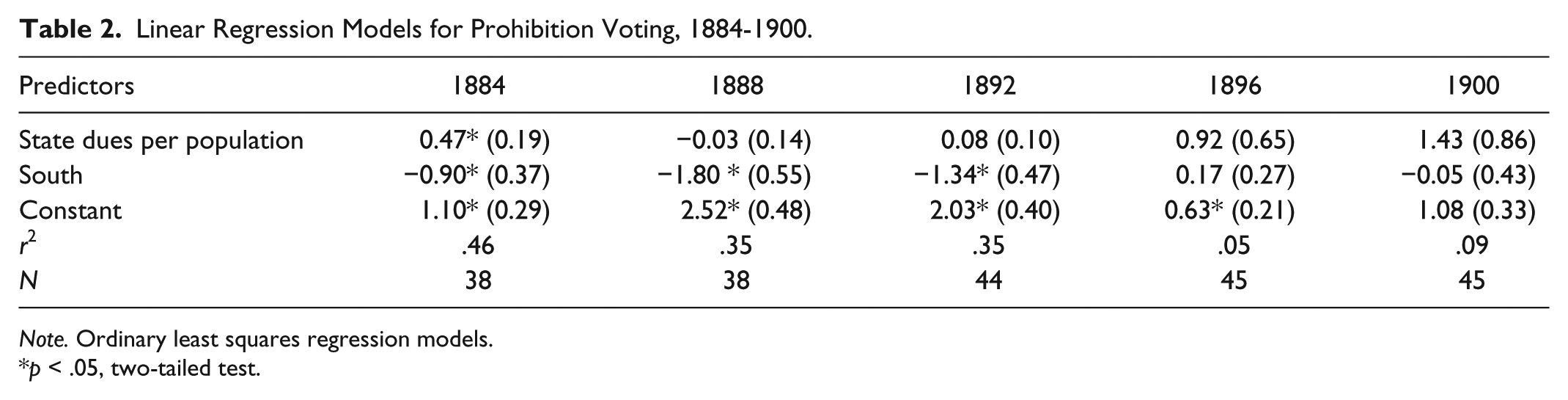
Note. Ordinary least squares regression models.
p < .05, two-tailed test.
By 1896 and 1900, the regional divide is no longer a significant explanatory variable of Prohibition voting, though neither are WCTU dues. The Prohibition strategy of appealing to the South, then, seems to have met with at least a modicum of success. The highest percentage of the vote for the “narrow gauge” platform in 1896, which carried forth under the traditional Prohibition Party banner, was in Georgia, when Joshua Levering, a Southern Baptist leader, was the presidential candidate. Likewise, in 1900, the largest vote percentage for the Prohibitionists came in Florida. Neither was a state where the WCTU claimed much support. 3
These results, then, clearly speak to earlier scholars’ contentions about the reliance of the political party on the women’s organization. The WCTU–Prohibition connection forged in 1882 appears to have helped the Prohibition Party in the North (and hence, throughout the country) in the 1884 presidential election, but the tumultuous battles within the party after that year, which culminated with separate campaigns in 1896 for the two distinct factions, subsequently weakened the relationship between the two entities.
Furthermore, the organizations’ reforms that began in the mid- to late-1880s moved the groups in opposite directions. As the WCTU took steps that slowly moved it away from the party and toward other issue areas, the Prohibition Party became more focused on building a national party with a stronger base of support in the South (though Prohibition voting remained much weaker there than it was outside the region). In many ways, the goals were at cross purposes, and drove a wedge between the groups, eroding the symbiotic relationship that once existed. The regional division both wanted to downplay was, in fact, a key component in the disintegration of their formal relationship.
Considering both organizations grew out of the Northern abolitionist impulse after the Civil War, this case reveals how shared policy goals can be at odds with political expediency. The mainstreaming and moderation of two similar-minded groups required separation as one (the WCTU) grew to prominence and the other (the Prohibition Party) struggled before withering into obscurity. Even if the connection was not as strong as it was in 1884, there was still some connection between the two throughout the period, as their shared missions aligned. But, once the third-party supporters attempted to mainstream the organization, which required separating from its radical Northern past and other social and political reforms, including woman suffrage, the WCTU moved its growing support away from the party. Thus, there was no strong, significant connection between the two organizations once their strategies for achieving their shared goals diverged.
Conclusion
The results presented above provide quantitative evidence for the rise and fall of an electoral connection between the activities of the WCTU and the Prohibition Party, thus reaffirming the historical, qualitative claims of Andersen (2011) and Szymanski (2003b). Our results specifically affirm the historical narrative of growing links around the 1884 election, followed by a declining connection thereafter. Much of this owes to regional divisions between the two groups, as well as varying strategies for achieving their shared goals.
The present research also adds to our scholarly understanding of party development, especially the recent theory that political parties form from the efforts of interest organizations (Bawn et al., 2012). Our findings underscore that this symbiotic relationship is highly dependent on the demands and resources of the group’s and party’s adherents and standard bearers. In other words, shared emphasis on one policy position, or a series of related positions, is not enough to bring parties and interest groups together; there must be greater consistency in goals and activist strategies. In this case, Prohibition Party candidates, looking to win election to office, openly advocated for change—including moving away from the call for woman suffrage—to align themselves with major-party organizations. This decision allowed candidates to assert some role in the development of the party (see, for example, Aldrich, 1995), but moved the Prohibition Party away from the WCTU, whose already skeptical adherents had doubts about the party’s general repositioning. Furthermore, the attempts by the two organizations to appeal to Southern voters, for the Prohibitionists, and Southern women, for the WCTU, led them to pursue different strategies, too.
These results also reveal that shared policy goals did not unite the two organizations so much as the shared means of achieving those goals. As powerful as the WCTU became, and as influential as it was in volunteer and lobbying programs, its leaders realized that the best strategy involved distancing themselves from radical minor-party politics once the Prohibitionists began to “professionalize” and eschew female assistance. However, when the organizations’ means of achieving goals aligned, the relationship worked. This suggests that membership groups, seen by many as the backbone of political parties (Bawn et al., 2012), are not wedded to electoral politics once they participate in such politics; instead, it appears to be a fluid system, whereby a powerful membership organization can move from aiding a party back to pressure politics, and build even more political clout. So taken together, parties and interest groups may couple and decouple, even with a common policy goal such as prohibition, if there is a disagreement over the strategies taken to achieve that goal.
Finally, this analysis illustrates women’s influence in the political system prior to enfranchisement. First, like other studies of the role of women in the abolition movement (e.g., Jeffrey, 1998), it provides clear evidence that disadvantaged groups can wield power in the electoral arena, even without the right to vote. Contrary to the assumption that women played little role in electoral politics prior to becoming enfranchised, what women lacked in such power, they often made up for in organizational skill, social networking, and political activism. Thus, as this analysis of the Prohibition Party and WCTU illustrates, a male-driven political party did benefit from the backing of a women’s organization. In this case, the Prohibition Party’s national vote for president saw its largest percentage increase between 1880 and 1884 (from 0.11% in the former to 1.5% in the latter), when the alliance made between the two organizations, in 1882, was at its strongest.
Second, and as an extension, this analysis shows that the prospects of a party, albeit a minor party, were directly affected by the growth, and eventual turn in orientation, of a powerful women’s organization. The federated nature of the WCTU allowed women to pursue different agendas in their states and localities; when major parties fed into this, the Prohibition Party was, thus, weakened. And, although the national WCTU would, at least in words, support the Prohibition Party’s cause at the federal level, even as the latter sought to limit women’s participation in the party, it never specified how state unions should operate. It understood that state unions needed to be independent of the Prohibition Party to be successful in state and local politics. As such, the WCTU showed itself to be more politically adept than its male-dominated, electoral counterpart.
This, then, raises questions about the relationship between the WCTU and the Prohibition Party that demand attention in the future. In what ways did state organizations formalize (or not formalize) the relationships between these groups, and how did that translate into candidate support? Did this connection between the two organizations lead to more policy gains or create hurdles to policy making? Is the WCTU’s experience in the electoral realm that much different than that of the first “true” interest group, the Anti-Saloon League (see Clemens, 1997)? Studying these simple, straightforward extensions of the findings presented here can potentially help a range of scholars better evaluate this historical era while utilizing it as a testing ground for other theories related to political organizations and social movements.
Footnotes
Declaration of Conflicting Interests
The author(s) declared no potential conflicts of interest with respect to the research, authorship, and/or publication of this article.
Funding
The author(s) received no financial support for the research and/or authorship of this article.
Notes
Author Biographies
References
Supplementary Material
Please find the following supplemental material available below.
For Open Access articles published under a Creative Commons License, all supplemental material carries the same license as the article it is associated with.
For non-Open Access articles published, all supplemental material carries a non-exclusive license, and permission requests for re-use of supplemental material or any part of supplemental material shall be sent directly to the copyright owner as specified in the copyright notice associated with the article.
