



Abstract
The importance of reflective thinking among teachers has long been recognized, and it remains a crucial indicator of learning and ensures teachers’ professional development. This study’s aim is to understand a teacher education program’s impact on the reflective thinking of preservice teachers in Pakistan. Utilizing a mixed-method approach, 400 teacher education candidates participated in the quantitative analysis, which involved a follow-up that included 10 semi-structured interviews by teacher education candidates. The results showed that teacher education in Pakistan is characterized by the production of more graduates but lacks the focus to develop and generate reflective practitioners in the field. This research contributes to our understanding about the importance of reflective thinking in terms of how it can improve preservice teachers’ thinking patterns and nurture teacher education. Furthermore, this study suggests that teacher-training institutions should focus on improving the quality of the trainings for students.
Keywords
Introduction
A teacher should be a reflective practitioner, who not only plans before their teaching session but is also capable of reconsidering their course of action midstream and reviewing their practices to consider alternative choices (Schon, 1991). In this sense, reflection refers to purposeful, structured thinking concerning the decisions that a teacher makes during their practice. Reflective thinking (RT) is the process of constructing knowledgeable and rational judgments in didactic matters and then being able to appraise their significance. Lambert et al. (2002) refer to reflection as an inner dialog with oneself, whereby a person calls forth their experiences, beliefs, and perceptions. This skill requires the ability to learn from one’s learning and reflective experience, which is necessary for both education and decision-making.
Since most decision-makers and educators promote the improvement of rational attitudes (Ennis, 2008; Mcbride et al., 2002; Stapleton, 2011) and the ability to reflect on one’s actions among their students, the concept of RT has become a scholastic norm in the present era. Therefore, preservice teachers’ preparation and ability to reflect on their learning activities is essential to encourage their professional development. Moreover, reflecting on one’s actions is crucial when it comes to participating in a skill-based work setting (Boud et al., 2013; Kember et al., 2000; Pham et al., 2020; Rogers & Shukla, 2001; Thorpe, 2004). In general, the development of reflective intellectuals is a critical objective of Dewey’s pragmatic stance and a constructivist move toward upgrading education (Başol & Evin Gencel, 2013).
The Allama Iqbal Open University (AIOU) in Pakistan is one of the largest universities in the world (Aslam, 2019), according to its sizeable and active enrollment. In contrast to the rest of the country’s official, functioning institutions, the AIOU includes 50% of the nation’s total teacher workforce (National Accreditation Council for Teacher Education, 2015). Recently, the government of Pakistan phased out all outdated teacher education programs (e.g., PTC, CT, B.Ed., and M.Ed.) and introduced new ones to improve the quality of future teachers. Since the teacher education programs at AIOU are only obtainable at a higher level than other programs, the question is whether they will fulfill the quality measures of teacher education (Sultana et al., 2016). Based on this situation, it was assumed that distance education institutions would fail to implement the new programs successfully, making them only partially effective (Aslam, 2019). Despite this, there is consensus regarding students’ RT, particularly that of preservice teachers.
To promote the usefulness of RT in Pakistan, this skill should be evaluated in terms of gender and among various fields, including teacher preparedness programs. Therefore, this study was conducted to investigate two primary questions: (1) In Pakistan, what impact does the distance learning teacher education program, resulting in a Bachelor of Education (B.Ed.), have on preservice teachers’ reflective thinking? (2) Are there gender-based differences among preservice teachers’ perceptions of reflective thinking? Examining these answers will contribute to the literature’s knowledge about the psychometric qualities of the Reflective Thinking Questionnaire (RTQ) and the existence of RT among future teachers, who are receiving a professional education at AIOU or in similar settings worldwide.
Literature Review
RT is a dynamic, constant, and cautious concern underlying any belief or hypothetical structure that concerns understanding in light of the objectives that sustain and conclude this process. Dewey affirms that RT involves understanding via reformation and modernization, which increases the goals that are essential for achieving a broader range of responsibilities. RT, a significant constituent of critical thinking (Ennis, 1987), involves beginners who are attaining educational goals and changing their behaviors (Dewey, 1933). In a repeated, continuous process (Pollard, 2002; Tripp, 2003), it develops a link between past, present, and/or future experiences (Goh et al., 2008).
Pollard highlights that teacher reflection has become highly significant for classroom practitioners (Pollard, 2002), as it leads to more precise learning (Moon, 2013), allowing participants to attain a more constructive and assimilated knowledge structure as well as knowledge that is more comprehensible and practical (Billing, 2007). Recent studies have been conducted on the following subjects: the RTQ’s validity and reliability, the quality of distance teacher education programs, RT, reflective practitioners, and teacher education programs’ impact on university graduates (Aslam & Rao, 2017, 2018; Başol & Evin Gencel, 2013; Bukhsh, 2010; Buzdar & Ali, 2013; Byrne & Flood, 2003; Clarke & Braun, 2013; Demir, 2015; Farahian et al., 2021; Ghanizadeh & Jahedizadeh, 2017; Harrison et al., 2003; Hussain et al., 2011; Kember et al., 2000; Lucas & Tan, 2007; Schon, 1991; Sultana et al., 2016; Syamsuddin, 2020; Zach & Ophir, 2020; Zubizarreta, 2009).
Lucas and Tan (2007) present the findings of a pilot study that concerns the evaluation levels of RT. The main objectives of the study involve the following: exploring the growth of undergraduate students’ reflective abilities through their work-based learning, the role of RT in the students’ final educational achievement of the year, and appraising the RTQ (Kember et al., 2000) to determine its utilization among students studying accounting and business. In regard to the former, the results show that the RTQ is sufficient to be utilized in further examinations but more work is essential to sustain its effectiveness.
Buzdar and Ali (2013) investigated the development of RT by studying distance teacher education programs at AIOU. The study adopted a quantitative research method to collect data from 450 distance teacher education students. After utilizing the RTQ (Kember et al., 2000) to collect the data, the findings reveal that Open University teacher training programs have a greater tendency to encourage the development and understanding of RT among learners. This study was conducted much earlier than the implementation of the new teacher education program in Pakistan, and it only administered a survey.
A number of studies have examined the gender differences in teacher education students’ RT. But no consensus has been reached. For example, Both, Afshar and Farahani (2015) found significant differences in the results of Independent Samples t-test, males outperformed their female counterparts regarding RT, and it is found that the average percentage of RT abilities of male students is higher than female students (Rahmadhani et al., 2020). In contrast, Erdoğan’s (2020) study revealed that female prospective teachers were significantly higher than those of males. Meanwhile, some studies showed that there was no significant gender difference across the four comprising factors of RT (Ghanizadeh & Jahedizadeh, 2017), and suggested that there may be no overall difference in RT between gender groups in prospective teachers (Tekkol & Bozdemir, 2018).
Theoretical Framework
The present research is based on Mezirow’s (1991) RT theory, which developed from the critical social theory of perspective on reflection. Inspired by Habermas, Mezirow (1991) launches a new perspective transformation, which shows its importance in the mechanism that involves becoming significantly conscious of how and why our supposition, regarding the world, constrains us from seeing others in a meaningful way. According to this theory, a critical reconsideration of one’s perceptions can transform their thoughts that involve knowing, feeling, and acting (Buzdar & Ali, 2013).
Schon (1991) and Rodgers (2002) also support Dewey’s viewpoint about reflection in problem-solving, but Mezirow’s (1991) theory provides more details about reflection. According to his theory, interpreting the meaning of any practice concerns two aspects: how one perceives and how one deducts a conclusion. Learning is the utilization of these findings in one’s decision-making. Mezirow argues that “meaning plans” instigate individuals’ usual transactions that can make and guide people’s views, assumptions, and decisions. People deal with different disputes in life, which may include distortions of their cognition, psychology, and social culture, which produces and overwhelms one’s perceptions and judgments. In Mezirow’s view, reflection leads to assessing these deformations, while “critical reflection” challenges the basis and prepositions of the resulting “meanings” and “perspectives.” Based on Mezirow’s theory, Kember et al. (2000) based on their work on four major levels of thinking: habitual actions, understanding, reflection, and critical reflection (see Table 1).
Levels of RT.

While the aforementioned studies on RT provide ample information that supports the concept’s usefulness in various fields, including teacher education, some issues (e.g., the RT abilities of preservice teachers and variations in terms of gender) still need to be addressed. This study was conducted to fill certain gaps in the literature, as there is a current need to research the RT of preservice teacher education. Furthermore, little is known about the implementation of Pakistan’s new teacher-education roadmap.
Materials and Methods
Organization and Structure: Teacher Preparation at AIOU
AIOU is the largest university in the country that uses correspondence distance education in most of its programs (www.aiou.edu.pk) rather than the online learning. AIOU offers different levels of teacher education programs, including bachelor’s, master’s, and doctoral degrees, and the present study only focuses on a B.Ed., which is a 1.5-year program. The teacher preparation program at AIOU is sequenced into three distinct semesters of professional education coursework that are completed concurrently with other coursework. The first semester included six compulsory courses, while the second semester included four electives and one compulsory course, Critical Thinking and Reflective Practices (Professional 8611) as well as two weeks of mandatory teaching practice. Students also completed a 4-week mandatory second teaching practice in the third semester, which also included an action research report and four compulsory courses (Appendix 1). Also, at the end of each semester, students also needed to submit written assignments, take final exams for their courses, and attend a mandatory workshop.
Research Design
A mixed research approach was used in this study, which pertains to both quantitative and qualitative approaches for data collection, data analysis, and other stages of the research (Wiersma & Jurs, 2009). This knowledge-based technique claims its efficiency on pragmatic grounds, whereby research problems can be better addressed by utilizing both strategies rather than only one (Creswell et al., 2003). The design consisted of two separate phases: the collection and analysis of (1) quantitative data and (2) qualitative data. Typically, quantitative data takes precedence, while qualitative data is utilized to interpret the quantitative results (Creswell & Zhang, 2009). Thus, we adopted an explanatory sequential design for our study purpose. In the first, quantitative, phase of the study, the research questions focused on the impact of the distance learning teacher education program on preservice teachers’ reflective thinking and gender-based differences among preservice teachers’ perceptions of reflective thinking. Data were collected from teacher candidates through a valid questionnaire. In the second, qualitative, phase, to understand the quantitative results in depth, semi structured interviews were conducted with teacher candidates.
Participants and Procedure
First, permission was obtained from the ethical committees of the universities that participated in the study. Then, the teacher candidates were selected if they were enrolled in their final semester of the program and carrying out their second teaching practice during the study period (Spring 2019). In the first phase of the study, a multistage sample was used, and the first one consisted of 420 teacher candidates, which were selected for convenience across seven of AIOU’s regional centers (n = 7 × 60 = 420): District Sialkot, Gujranwala, Lahore, Kasur, Faisalabad, Sahiwal, and Multan. The students ranged from twenty to 28 years (M = 23.93; standard deviation [SD] = 1.66), and while females accounted for 60% (n = 252) of the participants, males made up 40% of the total (n = 168).
A document was distributed, which was printed in English and included the RTQ and an invitation letter to participants. It contained all of the current research’s details and guidelines for responding to the questionnaire. Then, questionnaires were delivered to the participants during the program’s mandatory workshop segment at the end of the semester and collected afterward on the same day. Participants were assured that their information would be kept confidential and that the questionnaire could be answered anonymously. Of the 420 questionnaires, 405 were returned with 95% accuracy, meaning that only five returned copies were invalid due to being filled out incorrectly. Finally, the data from 400 questionnaires were entered into the SPSS.
Ten teacher candidates from AIOU were in the second sample of the current study, where females constituted 60% (n = 6) of the sample, and males made up 40% of the total (n = 4). A purposive sampling technique was employed during this phase, and the sample was selected based on Patton’s (1990) sampling principle criterion. Fifteen teacher candidates were contacted for potential interviews during the questionnaires’ distribution; 10 teacher candidates (Table 2) agreed to participate. Their names were kept anonymous, and they were given pseudonyms, from S1 to S10.
Profile of the 10 Teacher Candidates Attending Interviews.

The semi-structured interviews entailed recurrent episodes of research, and the main goal was to ensure quantitative findings. The data obtained through the interviews were thematically presented, and the findings were categorized according to the research questions.
Measurement Instruments
Sociodemographic data (gender and age) was collected using an ad hoc questionnaire. The RTQ, which was developed by Kember et al. (2000) was used in this study as an analytical device to support RT. The main focus of this tool was to scrutinize the effects of teaching and learning surroundings and possessions on RT. The RTQ contained a five-point Likert scale, ranging from five (definitely agree) to one (definitely disagree). It also consisted of 16 items with four subscales: Habitual Action (“When I am working on some activities, I can do them without thinking about what I am doing”), Understanding (“This course requires us to understand the concepts taught by the lecturer”), Reflection (“I like to think about what I have been doing and consider alternative ways of doing it”), and Critical Reflection (“As a result of this course, I have changed the way I look at myself”). Cronbach’s α values were 0.69 on the Habitual Action scale, 0.85 for Understanding, 0.80 for Reflection, and 0.80 for Critical Reflection. Reliability coefficients, ranging from +3 to 6.9, indicate a moderate reliability, while +7 to 1.00 indicate a strong reliability (Jackson, 2015).
A semi-structured interview guide was designed to gain insight into the perspectives of AIOU teacher candidates on RT by specifically referencing their teacher education program. Researchers sent them to senior faculty members for consultation after development, and once the first version was finalized, it was piloted on teacher education candidates. The final version of the interview guide consisted of questions that related to participants’ demographic information, understanding of RT, and views about the B.Ed., including ways to improve the program’s impact.
Interviews were conducted during the program’s mandatory workshop segment at the end of the semester. The interview questions were sent to the interviewees 2 days before the interview. Since English is one of Pakistan’s official and teaching languages in educational institutions (e.g., higher education), English interviews were conducted. A smartphone recorded all the interviews, Each interview lasted about forty minutes, where they were asked four main questions that ranged from participants’ demographic information (Would you please introduce yourself, understanding of RT (Would you please talk about your understanding of RT?), and views about the B.Ed., including ways to improve the program’s impact (How do you perceive the quality of the B.Ed. program and does university set any special requirements for students regarding RT? How do you think to improve the quality of B.Ed. program?). Later, the recordings were moved to a laptop for analysis. Once the transcriptions were ready, all 10 interviewees were contacted to confirm the transcriptions through emails.
To make sure the trustworthiness of the qualitative data an appropriate sample of respondents was purposefully selected. The interview questions were prepared clearly for exploring domains of interest. Interpretation is a necessary stage of all qualitative work. Two members of the research team coded and classified each part of the interview separately. Then, they collectively did this based on the analysis of the core concept for each part of the interview. To ensure the qualitative data collection’s authenticity, investigator triangulation was used. Based on the emergent themes, a three-step coding was used to further refine the interviews’ findings. While all processes were used to enhance the visibility of the qualitative results, each step also provided ample support regarding respondents’ views on RT.
Data Analysis
In the present study, data analysis was performed via an SPSS (version 24) and AMOS (version 24), conducting a Pearson correlation, t-test, confirmatory factor analysis (CFA), and structural equation modeling (SEM). To code all the interview transcripts, a thematic analysis technique was used, which mainly involved identifying, deducing, and recording different trends into groups (Clarke & Braun, 2013; Ritchie et al., 2013). A three-step coding approach was adopted (Gioia et al., 2013), which is similar to Corbin and Strauss’s (1990) open and axial coding. By mainly utilizing three order codes, the first step involved coding all the interview transcripts into several codes. Finally, four themes, containing various categories and subcategories, were generated as follows: (a) students’ thinking practices influenced habitual actions, (b) They utilized understanding and RT, (c) They were aware of RT, and (d) Their thinking practices were governed by critical reflection. Figure 1 shows the refined coding scheme for the qualitative data.

Representation of the coding scheme.
Furthermore, in the next step, we used axial coding (Corbin & Strauss, 2014), merged similar codes that were revealed during the first step, and clustered all the codes into a more intangible form (Gioia et al., 2013). In the final step, all similar codes that were found in the second step were ascertained; finally, we concluded by lumping all the codes into four (see Appendix 2 for an example) primary themes (Gioia et al., 2013). We used three columns to summarize the coding scheme (Figure 1): first-level and second-level codes (middle) as well as the third level that contained the aggregated themes.
Results
Preliminary Analysis: The RTQ’s Reliability and Validity
The original RTQ included four factors: habitual action (HA), understanding (U), reflection (R), and critical reflection (CR). Each factor had four items, and one item (#6) was eliminated because its chi-square/df was over 0.5 in a CFA (Hair et al., 1998). In the present study, then, the RTQ consisted of 15 total items and had a satisfactory internal consistency and reliability (Kember et al., 2000). The tool was validated in this study. Cronbach’s α ranged from 0.69 to 0.85 for all the RTQ factors. According to Hancock and Mueller (2013), Cronbach α values great than 0.6 are acceptable for conducting research, and the values of composite reliability (CR) ranged from 0.70 to 90 (Hair et al., 1998).
Furthermore, discriminant and convergent validity confirmed the construct validity. To achieve this purpose, the following tools can be utilized: an independent sample t-test, average variance extracted (AVE), and factor loading (FL) (Saleem et al., 2020). The values of the t-test ranged from 51.43 to 86.21 for the RTQ, and they were significant at p < .001. Meanwhile, all of the items (t-values) above the critical ratio of three were considered discriminative (Green & Salkind, 2016). All of the AVE values (RTQ = 0.71–0.78) and FL values (RTQ = 0.66–0.89) verified the construct validity (Hair et al., 1998) with a threshold of ≥0.6. The reliability and validity conditions of the RTQ were in accordance with acceptable standards.
RQ 1: In Pakistan, what impact does the distance learning teacher education program, resulting in a Bachelor of Education (B.Ed.), have on preservice teachers’ reflective thinking?
Descriptive Statistics
R (Table 3) showed the highest mean value (M = 4.38, SD = 0.82), while HA showed the lowest mean value among all the RTQ’s factors (M = 3.75, SD = 0.92). Teacher candidates also had higher mean values for U (M = 4.29, SD = 0.88) than CR (M = 4.19, SD = 0.93). Since a threshold of M ≥ 3 is considered satisfactory, all mean values were satisfactory (Saleem et al., 2020).
Correlation of Factors.

p < .01.
The Pearson correlation (Table 3) was calculated to determine associations among the constructs. All four RTQ factors showed values that were greater than 0.30 (moderate level) and 0.50 (largely correlated), which means that they were significantly intercorrelated (Olivier et al., 2017).
Instruments’ Fit Indices
An SEM was used to confirm whether the empirical data agreed with the RTQ. Upon analyzing the fit indices (Table 4), the RTQ was considered acceptable.
The RTQ: Absolute Fit Measures and Absolute Good Fit Cutoffs.

Note. IFM and PFI = Incremental fit measure and parsimonious fit indices.
All indices that absolutely fit the indicators were considered appropriate (Hair et al., 1998; Hu & Bentler, 1999; Kline, 2015; MacCallum & Hong, 1997). For an acceptable model, the fit values should be greater than 0.90 (Byrne, 2010), and all indices of incremental fit fulfilled this condition. The RTQ parsimonious had a value that was greater than 0.5, indicating a satisfactory fit (Mulaik et al., 1989). Hence, the findings showed acceptable levels for continuing with the current research (Hair et al., 1998).
SEM Findings
The research model showed an adequate data fit (Figure 2) (χ2 = 357.22, df = 183, χ2/df = 1.96, p = .001, RMSEA = 0.05, GFI = 0.91, AGFI = 0.90, and SRMR = 0.07, CFI = 0.93, IFI = 0.90, NNFI = 0.91, NFI = 0.92, RFI = 0.91, PNFI = 0.62, PGFI = 0.62). The final four-factor model showed an acceptable fit because all fit indices fulfilled this criterion. The model with the best fit showed an intercorrelation between the scales, or latent factors, as illustrated in Figure 2. This was conceptually predicted. The teacher candidates, who engaged in RT practices, tended to study for the purposes of HA, U, R, and CR in the more theoretical parts of AIOU’s program, which had an obvious relationship to the practice RT.
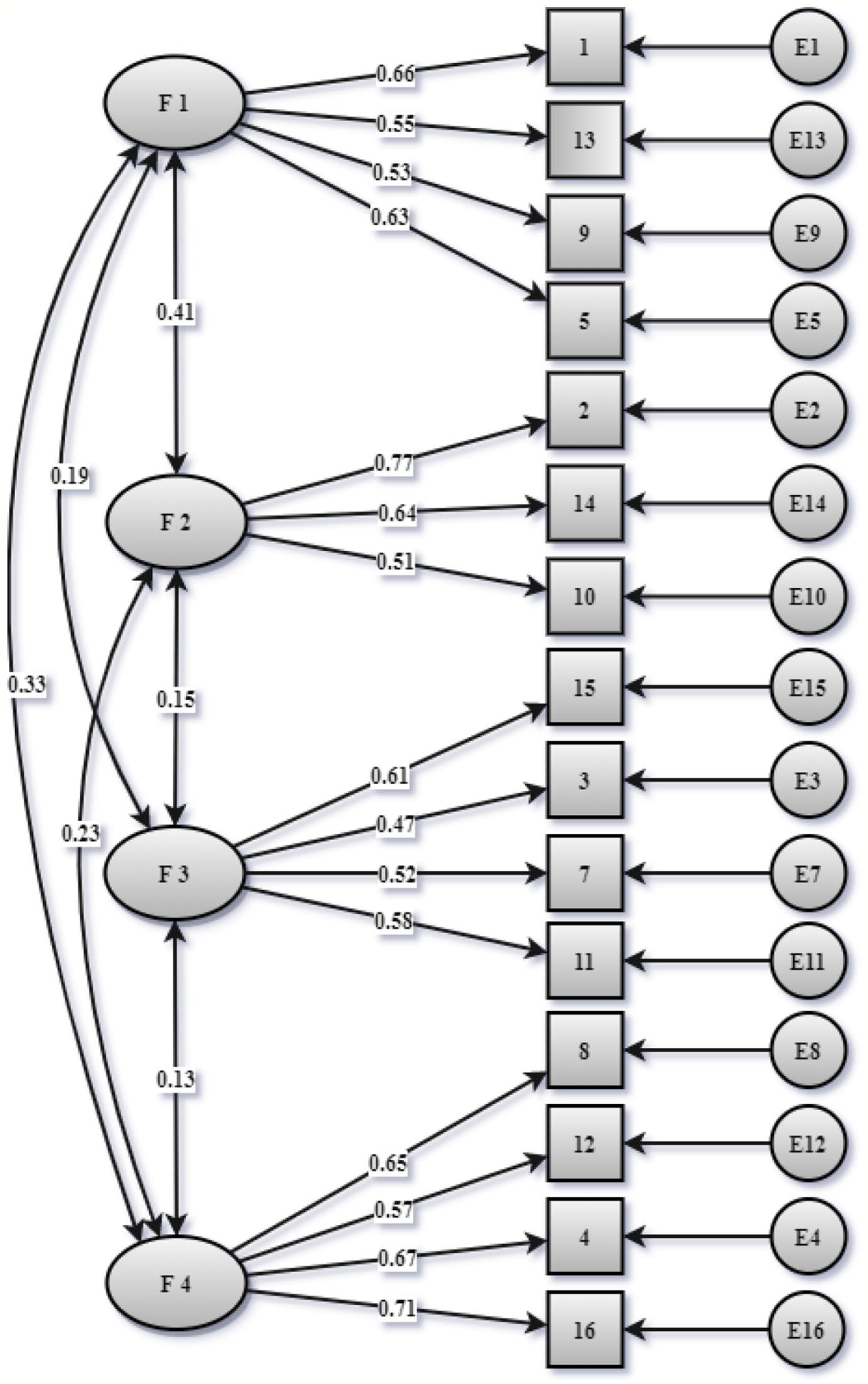
Structural equation modeling.
The qualitative data analysis of interviews also revealed that RT entails going through unconventional methods to find solutions to difficult problems by breaking down one’s everyday thinking habits and undergoing an exploration of richness while considering the probability of several options rather than merely confirming matters and blindly chasing accuracy. In other words, it not only involves perfecting existing theories but also how to introduce new ones.
Students’ thinking practices influenced their HA
To develop habits, we commonly engage in different practices multiple times, but in professional activities, HA cause less efficiency due to fewer opportunities for practicing the exercises. The following anonymous participant explains their experience: I was very much used to doing things habitually. However, after enrollment in the teacher education program, I . . . changed a lot, now I think before doing any activity or task (S9).
U and the utilization of RT
In terms of learning and professional practice, learners must understand the course content, as this will allow them to be successful in their studies and practices. A participant describes this process: During course work, I found clearly that without a proper understanding of content and its practice, I will neither pass the course nor improve my skill development level. [The] AIOU teacher education program is difficult, so we have to understand the content. However, one thing was alarming. During workshop sessions, tutors were not cooperative in the sense of delivering the required knowledge. They had their own planned lectures, so many times, we students asked them to deliver something difficult to [help us understand,] but they did not do so (S1).
Awareness of RT
Although R is a common approach to the learning process, learners do not always have an awareness of RT unless they are involved in a particular training. A participant describes their understanding of the concept: I understand well what is meant by RT after . . . enrollment in B.Ed. A specific course, ‘critical thinking and reflective practices’ was also in our course work. Only a few of our tutors discussed [RT in detail] during workshop sessions (S2).
Students’ thinking practices were governed by R
If one can make judgments based on reason from an altruistic perspective, they can be naturally confident that they are taking the correct action. However, this practice can be challenging in practice because people make judgments and take actions that are more often based on self-interest. To best lead children in manifesting this beneficial practice, teachers must play the role of being a “facilitator of meaning-making.” In this regard, the following participant describes their experience: I often think before doing any plan [and] always try to find alternative solutions to the problems. I think this quality of reflection was not [inherited]; however, [I gained a sense of reflection] after . . . admission to the AIOU teacher education program. I have developed it, and now, after continuous practicable work, I can [perform] as a useful reflective teacher. During the workshop session, I observed [that] some tutors were very [talented] at their jobs, but most of them were not ready to deliver according to demands. The same kind of behavior [was] also [practiced] in schools, where I was appointed for my two teaching practices (S4).
The teacher education program promotes CR skills in preservice teachers, so they can be thoughtful in a critically reflective way by using their mind and sorting out where they have been and where they should be in an attempt to clarify their position. Teachers utilize a range of strategies to lead students through different phases of reflection, such as by offering discussions, interviews, cross-questioning, blogs, and journals in order to improve the clarity and intensity of their thinking process. A participant describes this evolution of their thinking as follows: I have changed myself a lot after enrollment in B.Ed. I realized that my thinking pattern was not advanced. I always focused on the present and future rather than learning from the past. However, now I can discover faults in my previous beliefs and actions. Many of my classmates [produced] discussions about workshops and teaching practice sessions that . . . changed them and their ways of doing things. This program has changed my actions and thinking, so now I can critically reflect on my [actions] (S5).
RQ 2: Are there gender-based differences among preservice teachers’ perceptions of reflective thinking?
The second research question of the current study concerns gender differences in RT. An independent sample t-test was used to examine teacher candidates’ perceptions, regarding each dimension of the RTQ. There was a significant difference between women and men regarding reflection (Table 5), as female teacher candidates were more positive (M = 4.49) than males (4.01). These findings signify how teacher candidates believed that reflection helped them in several phases of the training as well as in their personal lives, such as improving their problem-solving and discussion skills. Specifically, female teacher candidates were more willing to accept challenges, be open-minded to new thinking patterns, and apply reflection throughout their career.
Gender Differences.
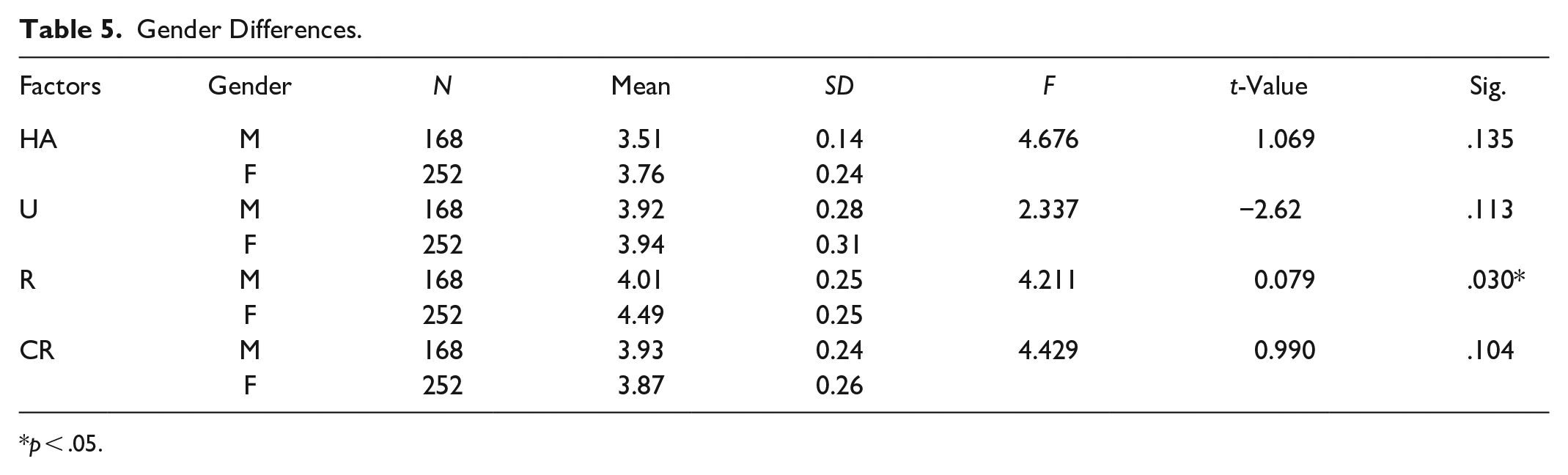
p < .05.
To play the role of facilitator, a teacher must work at connecting bridges between the learner and learning process by directing each learner to handle the learning activities in a calculated manner. RT entails going through unconventional methods to find solutions to difficult problems by breaking down one’s everyday thinking habits and undergoing an exploration of richness while considering the probability of several options rather than merely confirming matters and blindly chasing accuracy. In other words, it not only involves perfecting existing theories but also how to introduce new ones. Therefore, the solutions proposed by RT will often open new paths, such as focusing on value restructuring, model innovation, a concept breakthrough, repositioning, and so on.
Discussion
Previous studies have described a variety of reflective practices among teachers or students (Barbre & Buckner, 2013; Jay & Johnson, 2002). This study supports the present literature on RT and the RTQ by providing useful insight and exploring the thinking patterns of Pakistani university students, who were enrolled in the AIOU’s teacher education program. This study also argues that RTQs should also be utilized in South Asia’s developing countries.
The RTQ’s Reliability and Validity
The RTQ is a reliable, valid instrument for assessing the impact of an instructional design approach “Present, Apply, Review” on becoming agile warriors (The Agile Warrior is a soldier who can make decisions for themselves, as opposed to waiting for orders from senior officers). This questionnaire has even been validated in nursing school settings (Berry et al., 2020; Lethbridge et al., 2013), and the Persian version was confirmed by Ghanizadeh and Jahedizadeh (2017) while the RTQ was conducted in similar settings by Buzdar and Ali (2013), where it was also confirmed for validity and reliability. Meanwhile, in the present study, the Cronbach’s alphas indicated reasonable reliability for the RTQ, and only one factor, HA, showed a lower reliability than other factors (0.69). This is inconsistent with previous studies by Kember et al. (2000) and Lethbridge et al. (2013), who both found a satisfactory reliability for all factors. To improve the construct validity, one item (# 6) was deleted because the FL was <3. The reliability of the RTQ factors in the present study was within the acceptable range; to reiterate, previous studies in the same context also show that the RTQ is valid and reliable (Buzdar & Ali, 2013).
RQ 1: In Pakistan, what impact does the distance learning teacher education program, resulting in a Bachelor of Education (B.Ed.), have on preservice teachers’ reflective thinking?
Our insights have important repercussions for preservice teachers, teachers, and educational institutions that want to incorporate RT into their teacher education programs. First, a B.Ed. has gained popularity in Pakistan because of the mandatory professional degree recognition for preservice and in-service teachers. As a result of this study’s encouraging findings, we believe that RT can be used as a didactic tool to help students change their thinking patterns to promote their RT. By assuming the positions of assessors and assessments (Pham et al., 2020), this technique improves learner autonomy and engagement, as students develop new learning experiences. This research also validates the need for instructor guidance and RT teaching, which includes step-by-step advice that reflects on the information. Many educators believe that reflection is critical to learning and education (e.g., Cotter & Cullen, 2012; Raber Hedberg, 2009).
During the learning process, complex and fluid problems arise, so preservice teachers need help when it comes to thoroughly grasping realistic situations in real-world classroom settings. Having a consistent and in-depth understanding of the RT process is helpful for maintaining consistency and reliability in teacher education programs as well as fostering cognitive development. The findings are broadly consistent with previous studies, reflection involves questioning, and uncovering (or learning to uncover) basic assumptions and blind spots in one’s thinking (Nesbit, 2012).
Teacher candidates’ perception of distance teacher education is beneficial in regard to the cultivation of students’ thinking patterns. However, the current learning practices lack independent student training, and candidate teachers showed a somewhat low level of CR. Moreover, teacher candidates mentioned the incompetence of the AIOU tutors, indicating that there was room for the university to focus and emphasize tutors’ quality in order to improve their teaching standards. Teacher training institutions must provide quality training to their students because preservice teacher training determines the course of their professional careers. Therefore, we suggest that only well-qualified and well-trained teachers should train qualified students, who can critically analyze and reflect on their past, present, and future experiences. The AIOU should focus on training tutors to improve the program’s quality, and critical as well as RT activities should be included in teacher training to raise student teachers’ RT levels. The findings corroborate the ideas of previous studies (e.g., Derobertmasure, 2012; Hamilton, 2020; Van Seggelen-Damen & Romme, 2014).
The teacher candidates’ RT levels were the teacher education program’s key determinants, and the SEM results verified this new empirical evidence from Pakistan (Bukhsh, 2010; Buzdar & Ali, 2013; Harrison et al., 2003; Kember et al., 2000). The outcomes of the current study have revealed that teacher candidates’ HA during teacher training at AIOU was less encouraged in their studies, which confirms that AIOU courses require students to use different thinking patterns than the usual decision-making practices. The same argument has also been confirmed in previous studies (Bukhsh, 2010; Buzdar & Ali, 2013).
Meanwhile, qualitative outcomes have indicated that the AIOU teacher education program promotes R in teacher candidates during training and strongly promotes both R and U among teacher candidates during their training (Buzdar & Ali, 2013). These findings are further supported by Bukhsh (2010), Buzdar and Ali (2013), and Hussain et al. (2011). In terms of the quantitative outcomes, teacher candidates’ level of comprehension and R was more positive than CR, which confirms the positive impact of the program on teacher candidates’ thinking patterns, which was also the conclusions of Buzdar and Ali (2013) and Kember et al. (2000). The overall trend of responses from teacher candidates was in favor of RT skills (Demir, 2015), mostly revealing an optimistic attitude of RT, but there is still a need to improve their thinking patterns overall.
The current study also reveals two surprising findings that differ from previous studies. First, Bukhsh (2010) as well as Buzdar and Ali (2013) conclude that AIOU’s teacher education courses are easy to understand and self-exploratory; however, in the current study, most of the students explain that, in fact, courses are challenging. Therefore, these findings indicate that the course designer should listen to the distance learners’ voices and implement some changes in the courses to improve U.
Second, evidence suggests that teachers play an important role when it comes to inspiring students and building a healthy learning environment (Orvis et al., 2009; Overdale & Gardner, 2012; Stes et al., 2012). Teachers can successfully reassure students’ self-regulation in a student-centered environment, (Panadero, 2017; Zimmerman, 2000) and RT may also be particularly useful for students (Kember et al., 2000). The majority of respondents were satisfied with the tutors and their skills (Bukhsh, 2010); however, the findings of the current study overruled these ideas, revealing that tutors are not only incompetent but do not have the professional training that is required to teach graduate-level distance learners. Our findings, however, are aligned with those of Aslam and Rao (2018) and Nadeem et al. (2013). Although distance learning follows a student-centered approach, we cannot eliminate the unique role that tutors play during a teacher training program.
RQ 2: Are there gender-based differences among preservice teachers’ perceptions of reflective thinking?
Since there is insufficient knowledge about gender differences, regarding the level of RT among teacher candidates, the current study reveals the thinking patterns of each gender to determine some of the differences, revealing that female teacher candidates had a more positive approach to R than males. In contrast, males were slightly better at U. These findings align with those of Nadeem et al. (2013) in their study on students’ perceptions of the same program. The same argument has also been confirmed in previous studies (e.g., Erdoğan, 2020). Critical thinking is one of the most important abilities that preservice teachers should develop in their learning careers. Findings from quantitative and qualitative research indicate that male teachers need to have a satisfactory U of RT to accept new challenges and advance their career as well as their personal life’s endeavors. This is not only because gaining this skill can help them achieve excellent exam results but also because it will aid their future careers, as critical thinking is the most valuable skill that employers look for. So, whether they have this strongly developed skill will determine their career after graduation.
Conclusion
The current study explores the teacher education program (to achieve a B.Ed.) from the perspective of preservice teachers’ learning experience in Pakistan. The findings reflect that teacher education in Pakistan is predominantly characterized by the production of more teacher education graduates but lacks the focus to develop reflective practitioners in the field. Also, the study’s findings reveal that the RTQ could be a promising tool for measuring preservice teachers’ critical thinking. However, various cultural contexts should be carefully considered.
One limitation of this study is the comparatively limited sample size of participants, as only those from seven regional centers were utilized. To establish the generalizability of the results, replicate studies should increase the sample size of participants and regional centers in the context of Pakistan or other distance learning contexts. In addition, this study did not examine how RT could be developed in face-to-face and distance settings in teacher education programs or whether it is more difficult to stimulate learning from a distance rather than in physical classrooms. Future researchers can attempt to explore these issues.
Footnotes
Appendix
Example of Interview Data Analysis.

| Respondent | Excerpt | First level | Second level | Third level |
|---|---|---|---|---|
| S1 | During course work, I found clearly that without a proper understanding of content and its practice, I will neither pass the course nor improve my skill development level. [The] AIOU teacher education program is difficult, so we have to understand the content. However, one thing was alarming. During workshop sessions, tutors were not cooperative in the sense of delivering the required knowledge. They had their own planned lectures, so many times, we students asked them to deliver something difficult to [help us understand,] but they did not do so | Understanding, skill development, quality of tutors, difficult content, untrained tutors, need based lectures | Personal improvement, changing in beliefs, PROGRAM quality, Improvement | Understanding (U) and reflective thinking |
Declaration of Conflicting Interests
The author(s) declared no potential conflicts of interest with respect to the research, authorship, and/or publication of this article.
Funding
The author(s) received no financial support for the research, authorship, and/or publication of this article.
