




Abstract
This study examines a possible relationship between flexibility (content, teacher contact, and time) and student engagement (cognitive, emotional, and behavioral) in distance learning in higher education. The study applies a quantitative approach to give a response to the hypothesis of the research whether flexibility in distance education is positively related to student engagement. Participants comprised 164 distance students attending online classes in two faculties and four vocational schools of a state university in Türkiye in the fall semester of the 2023 to 2024 academic year. They completed an online survey measuring the levels of cognitive engagement, emotional engagement, and behavioral engagement and the flexibility of content, teacher contact, and time in distance education. The results revealed that the flexibility of teacher contact was significantly related to behavioral engagement while the flexibility of content was positively correlated with cognitive engagement. Additionally, time flexibility was significantly correlated with both behavioral and cognitive engagement. It was concluded that a positive relationship between flexibility and student engagement in distance education existed.
Plain language summary
The purpose of this study is to explore whether there is a relationship between flexibility (content, teacher contact, and time) and student engagement (cognitive, emotional, and behavioral) in distance learning in higher education. A quantitative approach was used to understand whether flexibility in distance education was positively related to student engagement. 164 distance students attending online classes participated in the study. Students were studying at two faculties and four vocational schools of a state university in Türkiye in the fall semester of the 2023–2024 academic year. An online survey was conducted to measure the levels of cognitive engagement, emotional engagement, and behavioral engagement and the flexibility of content, teacher contact, and time. The results of the study revealed that there was a significant link between the flexibility of teacher contact and behavioral engagement. Content flexibility was positively related to cognitive engagement. Besides, there was a link between time flexibility and behavioral and cognitive engagement. The study indicated a positive relationship between flexibility and student engagement in distance education.
Introduction
The advancement in computer and network technology that focuses on communication among students and openness of learning resources supports online learning or distance education as the terms, mobile learning, e-learning, online learning, distance education, and web-based learning can be used interchangeably (Karatas et al., 2017 as cited in Yilmaz & Banyard, 2020). Online learning is based on acquiring effective learning and is related to the continuous improvement of students’ cognitive levels. In an online learning environment, students should actively join in learning and communicate adequately with their peers and teachers (Hu & Li, 2017). It is considered that flexibility in learning supports students’ persistence when dealing with difficulties (P. B. Bergamin et al., 2012). It was asserted that distance education is the most flexible kind of learning mode of teaching and learning as its main feature lies in the flexibility of time and place, the pace of learning, and teaching (Naidu, 2017a). Moreover, the topic of student engagement has been discussed and gained popularity recently as it has been accepted as an important effect on the course and student success (Di Biase, 2021; Yang et al., 2023). It also becomes more vital in the context of distance learning (Di Biase, 2021). Although distance education has several advantages and disadvantages, there is a need to explore the quality of distance education to have good learning experiences (Yilmaz & Banyard, 2020). It is said that engagement in learning is an important issue in understanding the work of online courses (Mustapha et al., 2023) and should be examined (Chen et al., 2008 as cited in Yilmaz & Banyard, 2020) along with the issue of flexibility. Therefore, the current study intended to examine a possible relationship between flexibility (content, teacher contact, and time) and student engagement (cognitive, emotional, and behavioral) in the context of distance learning in higher education.
Literature Review
Student Engagement in Distance Education
The low level of student engagement in online education has been getting clearer with the popularity and improvement of online learning (Peng, 2017). On the other hand, engagement assists student learning since it is regarded as an essential part of learning. Student engagement is described as “the effort and commitment that students give to their learning” (Krause & Coates, 2008 as cited in Kahn et al., 2017, p. 204). According to the researchers (Chapman, 2003; Fredricks et al., 2004, 2016; Mandernach, 2015 as cited in Hollister et al., 2022), there are mainly three factors of student engagement as affective, cognitive and behavioral. Affective engagement is displayed by the positive response to a sense of belonging, teachers, peers, and the learning environment and also refers to emotional engagement in learning activities. Cognitive engagement refers to understanding, self-regulation, and deep learning and is related to mental effort in learning activities. Behavioral engagement is defined by positive conduct, persistence, and participation, and is related to active responses to learning activities (Hollister et al., 2022).
There have been recent studies examining students’ perceptions of engagement (Alghanmi & Nyazi, 2023; Álvarez & Montes, 2021; Farrell & Brunton, 2020), the link between student engagement, self-regulation, interest, self-efficacy (Sun & Rueda, 2012), course satisfaction (Baloran et al., 2021), factors influencing student engagement in distance learning (Dubey et al., 2023; Fang et al., 2023; Vermeulen & Volman, 2024) and student engagement and gender, age, and major (Zhao et al., 2023). Farrell and Brunton (2020) did qualitative research aiming to investigate student engagement in distance education at a tertiary level in Ireland. The findings of the research displayed that organizational skills and time management were necessary for online students to be successful. They also demonstrated that psychosocial factors including self-efficacy, an engaging online teacher and peer community affected successful student engagement along with structural factors such as course design and lifeload. Álvarez and Montes (2021) investigated students’ perceptions of online engagement. The results of the study confirmed the significance of student engagement in online learning specifically in terms of student-student interaction and teacher-student interaction. To prevent students’ isolation it was vital to provide activities in which students could exchange experiences, information, and interaction. The role of the course instructor, emotional barriers, content, and content delivery should be managed efficiently. Students’ motivation and interest in a course needed to be increased for successful online education. Alghanmi and Nyazi (2023) analyzed student engagement in distance education during the COVID-19 pandemic. The study demonstrated that students’ behavioral, social, cognitive, and emotional engagement was positively affected by distance learning while students had the lowest score in emotional engagement and the highest one in cognitive engagement. It also revealed that a significant difference existed between students’ gender and their social engagement since male students were less socially engaged than female students. The study suggested that students be emotionally supported during the pandemic and that behavioral, social, emotional, and cognitive engagement be part of the instructional design.
Sun and Rueda (2012) explored whether there was a correlation between student engagement and self-regulation, self-efficacy, and interest of distance students from engineering and gerontology departments at an American university. The study showed statistically significant differences between degree, age, first-time distance education takers, school enrolled in, and cognitive or emotional engagement. First-time students could be more anxious and have less level of emotional engagement in the distance education setting. Gender did not make a difference in any factors of engagement. The study proposed that discussion boards and multimedia as online instruments could enhance emotional engagement whereas they did not enhance cognitive or behavioral engagement in online learning. It was suggested that instructors needed to recognize students who took online courses for the first time and assist them in improving their emotional engagement.
Baloran et al. (2021) studied to understand whether there was a significant link between course satisfaction and student engagement in the context of online learning during the COVID-19 pandemic and it was found in the research that there was a close relationship between these two variables. Students had a high level of satisfaction and engagement concerning online learning delivery as the more students were satisfied with the learning facilities provided by instructors the more they were engaged regarding emotion, performance, participation, and course skills. It was recommended that instructors should use online teaching strategies, supply learning materials online, and arrange course contents to assist students feel socially, cognitively, and emotionally engaged during the implementation of distance learning.
Fang et al. (2023) examined the factors influencing student engagement in the distance learning setting and showed that digital equity, infrastructure, and sociocultural elements affected student engagement. In detail, students reported that distance learning caused digital inequity and diminished student engagement in terms of material equity (monetary equity and device equity) and marks equity (cheat risk and level of difficulty in the exam). Infrastructure factors included technical support (technical assistance and user-friendly platforms) and availability of technological devices. Sociocultural factors encompassed norm factors (institutional and local norms) and psychological factors (self-efficacy and motivation). Additionally, students were satisfied with the flexibility of distance learning as they could be involved in course content at their own pace considering their family, accommodating work, and their programs. Vermeulen and Volman (2024) searched for which online learning activities supported university students’ engagement in terms of cognitive, affective, and behavioral. The study displayed that the mechanisms of personalizing in asynchronous activities and generating discussion in synchronous activities supported cognitive engagement while the activities supporting interaction and a group feeling, and creating a sense of empathy and trust promoted affective engagement, and the activities providing flexibility, stimulating effort, focus and attention, and breaking barriers enhanced behavioral engagement. Similarly, Dubey et al. (2023) investigated the impact of e-learning factors such as attitude, empowerment, perception, usefulness, and hedonic motivation on student engagement among open and distance learners. It was displayed that student engagement in distance learning significantly contributed to attitude, hedonic motivation, and usefulness. However, empowerment and perception did not provide a connection with student engagement.
Zhao et al. (2023) examined the effect of major, age, and gender on student engagement in a blended learning context. Study results displayed that gender did not affect the behavioral engagement of students while a significant difference existed between gender and cognitive and emotional engagement. Particularly, female students had lower levels in terms of cognitive and emotional engagement than male students indicating the differences in cognitive methods for learning and attitudes. Furthermore, concerning students’ age, it was found in the research that there was a significant difference between emotional engagement and students of different ages but age did not influence the cognitive and behavioral engagement of the students. Besides, the study displayed that major did not affect student engagement in blended learning.
Flexibility in Distance Education
Distance education is a kind of education that provides learners flexibility in learning speed, place, and time (Shearer & Park, 2018 as cited in Turan et al., 2022) and makes it possible to enhance the flexibility in teaching and learning in higher education (Kallionpää & Hellsten, 2023). Flexible learning is regarded as the main issue of distance education (Bates, 2001 as cited in Turan et al., 2022). It is assumed that investigation of flexibility in distance education can help distance education plan in the future (Turan et al., 2022).
There is a variety of definitions of the flexibility concept as it is difficult to define the term, flexible learning because of its diverse attributes (Soffer et al., 2019). In an early definition, flexibility in learning referred to “students’ learning at any time, frequency, and duration, in the learning styles they want, and determining their own learning situations” (Van Den Brande, 1993 as cited in Akcay, 2023, p. 136). Later, it was further recommended that flexibility should appeal to learners’ instructional preferences, learning, and cognitive styles putting the learner in the center to provide full flexibility (Sadler-Smith & J. Smith, 2004 as cited in Thomas, 2012). Later, it was considered in terms of flexible pedagogy like course content and delivery modes, and as a quality necessary for instructional designers and instructors (Veletsianos & Houlden, 2019). Flexibility may encompass the preferences related to the educational institution, the ways and the mode of communicating with learners, and sharing time for teachers (Kallionpää & Hellsten, 2023). On the other hand, it can also cover preferences related to the choice of assessment tasks and learning activities for learners (Naidu, 2017b as cited in Kallionpää & Hellsten, 2023). Principles of flexibility in learning include negotiation, facilitation, and learner-centered instruction. In the facilitation of learning, instructors work with students to improve essential competencies of what is to be learned. Although some decisions can be made before the learner is involved in the lesson, some of them should be open to discussion. Discussions should allow students and instructors flexibility to make modifications and changes according to individual needs. Learner-centered instruction is based on student decisions and choices while learning (Hill, 2006). Although flexibility is assumed to be classified into only three groups based on learner decisions as how, when, and what to learn (Van Den Brande, 1993 as cited in P. B. Bergamin et al., 2012), it is also categorized into five groups as instructional approach and resources, delivery and logistics, entry requirements, content, and time (Collis et al., 1997 as cited in P. B. Bergamin et al., 2012). In the distance education setting, online learning is usually associated with flexibility as most learners prefer to study online due to the flexibility it provides, expecting that they can combine their learning with various concerns in their lives (Stone et al., 2019). It is also associated with the preference for class size and learning materials, the location and timing of learning activities, and the pace at which learners proceed through the curriculum (Miralrio et al., 2024). For this study, flexibility in distance education is categorized into three factors such as content, teacher contact, and time. The flexibility of content shows the ability students can learn wherever they would like to and access the content they select throughout their learning (Kokoc, 2019). It may include “a range of options, from being completely open where the learner is making all the choices, to providing options within a particular framework established by the instructor” (Hill, 2006, p. 189). It is believed that supporting learners’ choice in terms of content may contribute to learners’ satisfaction and flexibility of learning experience (Hill, 2006). The flexibility of teacher contact is related to the ability to seek various ways of communication and communicating with the instructor. The flexibility of time allows students to decide their own learning pace and the time they want to learn (Kokoc, 2019). Besides, time flexibility covered the timing of assessment and time for participation in the course (Nikolova & Collis, 1998 as cited in Thomas, 2012).
In the literature, some research has been done on the students’ opinions about flexibility (Cayetano & Autencio, 2021; Li, 2014), correlation between flexibility in distance education and students’ satisfaction (Akcay, 2023; Sahin & Shelley, 2008; Turan et al., 2022), students’ achievement (Soffer et al., 2019) and flexible learning dimensions (El Galad et al., 2024). Cayetano and Autencio (2021) examined nursing students’ perceptions of the implementation of flexible learning. The study revealed that students agreed to all items in the flexibility questionnaire. Specifically, they highly prioritized flexibility of time especially management of stress, organization, and goal setting. Flexibility of teacher contact provided a value for teamwork and a reliable learning environment. Flexibility of content ensured learners’ motivation by raising curiosity, improving new and necessary skills, cultural awareness, and language and subject competency. Li (2014) searched for distance students’ choices for flexibility in the courses in which they are engaged and found that their scores obtained from all categories such as flexibility of delivery, flexibility of instructional approach, entry requirement, flexibility of content, and flexibility of time were slightly higher than the average. Specifically, the findings indicated that students wanted to have a higher level of flexibility than was provided like examination date, assignment deadline, and availability of resources for assisting learning. It was suggested that course designers and program administrators needed to take students’ preferences into account.
Akcay (2023) investigated the possible relationship between students’ satisfaction and flexibility in online courses. The research findings indicated that flexibility of content was found to be the first factor that most explained the variance in participants’ online course satisfaction, the flexibility of teacher contact was the second, and flexibility of time was the third factor explaining online course satisfaction of the participants. It was suggested that flexibility of time needed to be provided by adding more asynchronous learning activities and contents so that students had the opportunity to learn when they wanted and plan their learning. Moreover, content presented in different types such as graphics, text, and animation should be increased. Hence, students could learn from different kinds of presentations, not from only one kind. Sahin and Shelley (2008) acknowledged that a course in distance education should provide learners with great flexibility in interacting with the course content, their classmates, and instructors. If learners had the ability to utilize online instruments and considered that distance education was a flexible and helpful way of sharing, communicating, and learning, they would be satisfied with online instruction enabling them a higher level of success, learning, and engagement. Turan et al. (2022) explored students’ perceptions of self-regulated effort, satisfaction, and flexibility in distance learning. The study indicated high levels of flexibility of content and time while low levels of teacher contact flexibility were obtained. It also revealed that female students had lower levels of flexibility than male students.
Soffer et al. (2019) analyzed the methods students employed flexibility in online courses regarding access to learning sources, place, and learning time and examined the relationship between course achievement and features of flexibility. The findings displayed that many students used different types of flexibility in access to learning, place, and learning time, and integrating flexibility in online courses provided students to learn considering their needs. Besides, it was found that students’ achievement was correlated to the use of flexibility.
El Galad et al. (2024) explored dimensions of flexibility namely course correspondence, grading and weighting, assessment type, modality, and deadlines from the perspectives of both educators and students. The study indicated a general agreement between flexibility factors such as more frequent, lower-weighted tasks, non-timed and take-home assessments, and collaborative deadline setting. The results also revealed that flexibility produced long-term results although it offered immediate relief. Besides, flexibility enhanced accessibility and supplied broad accommodation recognized different student populations, and humanized teaching and learning. It was suggested that higher education institutions should prioritize flexibility as a key factor to stimulate an effective, supportive, and inclusive learning atmosphere in terms of educators and students.
In light of the literature reviewed above, it has been clear that there is a gap in the field of distance learning in the area of flexibility and student engagement as there has not been any research focusing on the relationship between these topics. Moreover, the literature has indicated relatively few studies that investigate flexibility and student engagement in distance learning in terms of age and gender although many studies have underlined the importance of student engagement and flexibility in higher education. It would be beneficial to investigate the effect of age and gender on flexibility and student engagement in distance education. Therefore, the current study seeks to find proper responses to the following research questions:
1. What is the level of flexibility in distance education?
2. Does flexibility differ significantly in terms of gender and age in distance education?
3. What is the level of student engagement in distance education?
4. Does student engagement differ significantly in terms of gender and age in distance education?
5. Is there a relationship between student engagement and flexibility in distance education?
Methodology
Research Context
Data were collected from students attending online classes in the fall semester of the 2023 to 2024 academic year in two faculties and four vocational schools at a state university in Türkiye. When the data were collected, the students took all their courses in synchronous live lessons on the learning management system of the university through Meet for Moodle or BigBluebutton systems at the university’s Distance Education Research and Application Center. They were required to be online at a specific location (LMS via Meet) and meet with their instructors in real time every week. Courses were recorded in the system so that students who wanted to review or could not attend the course had the opportunity to re-watch the recordings at their own pace. This study took place in a mandatory course, namely “English I,” an English language course. The course was given through live sessions using an interactive e-book including listening extracts and videos accompanying lecture slides. The instructor prepared the contents of all courses. For each course, the same teaching materials and the same topics were used by the instructor during the presentation of the courses by conducting synchronous practices. It comprised learning activities such as learning tasks, feedback, online discussions, and learning resources such as a content package, and extra course materials. The students could access learning resources online and whenever they wanted and engage in the learning activities in a flexible manner. They could ask questions to the instructor directly or through written messages using a chat board during the synchronous course. They could also send direct messages to the instructor in the LMS system and e-mail whenever they wanted.
Participants
A total of 164 students studying at a state university in Türkiye were recruited for the research. All students were first-grade students at the time of the data collection in 2023. Among them, female students (n = 101) represented 61.6% of the participants while male students (n = 63) represented 38.4% of the participants in this study. The students’ ages ranged between 17 and 35 years old and their average age was 29.67. The numbers of those whose ages were between 17 and 19 were 96 (58.5%) and those whose ages were between 20 and above were 68 (41.5%). The students were from different departments of the university such as computer engineering, electrics and electronic engineering, software engineering, sociology, psychology, history, mining, child development, medical laboratory techniques, tourism management, and civil aviation. All of the participants were first-year undergraduate students and took their courses in a completely online environment delivered via Moodle LMS at the university for over 1 year, meaning that they did not attend any lecture classes. All participants were studying synchronously taking approximately 20 hr of credit courses. However, they spent an average of 12 hr taking the online courses as the students were given a 20-min course for a 1-hr course, 30 min for a 2-hr course, 35 min for a 3-hr course, and 40 min for a 4-hr course.
Data Collection Instruments
An online survey was sent to students via Google Forms to collect the data. The tools used to collect the data in this research were The Scale of Flexibility in Open and Distance Learning which was developed by P. B. Bergamin et al. (2010), revised by P. B. Bergamin et al. (2012) and adapted into Turkish by Kokoc (2019), and The Student Engagement Scale for Online Learning developed by Sun and Rueda (2012) and adapted by Topal et al. (2020) Both scales used 5-point Likert rating (1 = strongly disagree, 2 = disagree, 3 = neutral, 4 = agree, and 5 = strongly agree).
The Scale of Flexibility in Open and Distance Learning
The Scale of Flexibility in Open and Distance Learning adapted by Kokoc (2019) was used to measure students’ level of perceived flexibility in the context of open and distance learning. The scale was originally developed by P. B. Bergamin et al. (2010) and revised by P. B. Bergamin et al. (2012). The scale was comprised of nine items and three subcategories such as content (four items), time (three items), and teacher contact (two items). The Cronbach’s alpha value was .99 for the whole scale. It was .85 for time flexibility, .72 for teacher contact flexibility, and .73 for content flexibility. For the current scale, the Cronbach’s alpha value was obtained to be .84 for the whole scale. It was .78 for time flexibility, .73 for teacher contact flexibility, and .75 for content flexibility.
The Student Engagement Scale for Online Learning
The Student Engagement Scale for Online Learning developed by Sun and Rueda (2012) and adapted by Topal et al. (2020) was conducted to assess the engagement of students in the distance learning setting. The scale consisted of two parts. The first part contained students’ demographic information as department, gender, and age and the second part included the items in the scale. In detail, it consisted of 19 items and three subcategories such as behavioral engagement (five items), emotional engagement (six items), and cognitive engagement (eight items). The second, the third, and the 11th questions were reversed when scoring. The Cronbach’s alpha was .90 for the overall scale. It was .86 for cognitive engagement, .83 for emotional engagement, and .71 for behavioral engagement. For the current study, Cronbach’s alpha was found to be .84 for the overall scale. It was found to be .86 for cognitive engagement, .71 for emotional engagement, and .62 for behavioral engagement.
Data Analysis
For the analysis, the descriptive data of the study were summarized by the means and standard deviations. Moreover, an independent t-test was conducted to display the relationship between flexibility and engagement sub-dimensions and gender. One-way ANOVA was used to determine whether there was a correlation between flexibility and engagement sub-dimensions and age. Pearson correlation test was administered to understand if there was a significant difference between the sub-dimensions of flexibility and those of engagement in distance education as the data displayed a normal distribution.
Procedure
The study took ethical proof before data collection was initiated to ensure that the human subjects’ requirements and confidentiality were met. The ethics committee permission document required for the collection of the data used in this research was obtained from Malatya Turgut Özal University. The survey questionnaire was sent to 180 students from different departments of the university where the study took place via Google Forms, resulting in 164 valid responses. The participants were verbally informed that their participation in the study was voluntary and their personal information would be kept confidential.
Findings
Flexibility in Distance Learning
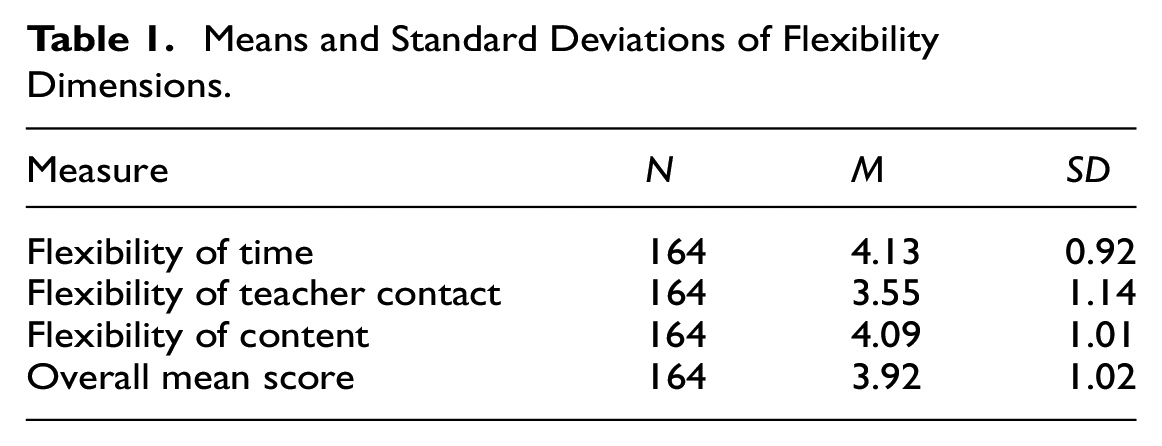
The means and standard deviations for each dimension of flexibility have been examined within the scope of the study as shown in Table 1. The highest mean score has been found in the flexibility of time (M = 4.13, SD = 0.92), followed by the flexibility of content (M = 4.09, SD = 1.01) and the flexibility of teacher contact (M = 3.55, SD = 1.14).
Means and Standard Deviations of Flexibility Dimensions.
Flexibility in Distance Learning and Gender
Table 2 displays the findings obtained from the independent sample t-test, which was conducted to determine whether gender has affected flexibility in distance learning.
Gender Differences in Flexibility in Distance Learning (N = 164).

As indicated in Table 2, it has been found that gender did not have a significant effect on flexibility in distance education. In detail, there has not been a significant difference between gender and time flexibility (t(162) = 1.129, p > .05), teacher contact flexibility (t(162) = 1.792, p > .05), and content flexibility (t(162) = 0.066, p > .05).
Flexibility in Distance Learning and Age
Table 3 reveals the results gathered from the One-Way ANOVA test, which has been used to determine whether age has influenced flexibility in online learning.
ANOVA Results on Age and Flexibility Dimensions in Distance Learning (N = 164).

As Table 3 indicates, there has not been a statistically significant difference between students’ age and flexibility in distance learning namely time flexibility, F(1,162) = 0.344, p > .05, teacher contact flexibility, F(1,162) = 0.094, p > .05 and content flexibility, F(1,162) = 0.03, p > .05. It has been clear that the students’ age has not contributed to flexibility in online learning.
Student Engagement for Distance Learning
Table 4 demonstrates the means and standard deviations for each factor of student engagement for online learning explored within the scope of the research. The highest mean score has been observed in behavioral engagement (M = 3.99, SD = 1.10), which has been followed by cognitive engagement (M = 3.49, SD = 1.05) and emotional engagement (M = 3.08, SD = 1.34).
Means and Standard Deviations of Student Engagement Dimensions.

Student Engagement for Distance Learning and Gender
Table 5 displays the results obtained from the independent sample t-test, which has been carried out to determine whether or not gender has influenced students’ engagement in online learning.
Gender Differences in Student Engagement in Distance Learning (N = 164).

As Table 5 shows it has been found that gender has had a significant effect on cognitive engagement (t(162) = 2.55, p < .05). Nevertheless, there has not been a significant difference between gender and behavioral engagement (t(162) = 0.551, p > .05) and emotional engagement (t(162) = 0.128, p > .05).
Student Engagement for Distance Learning and Age
As displayed in Table 6, the existence of a meaningful relationship between flexibility in distance learning and students’ age has been analyzed by a One-Way ANOVA test.
ANOVA Results on Age and Flexibility in Distance Learning (N = 164).
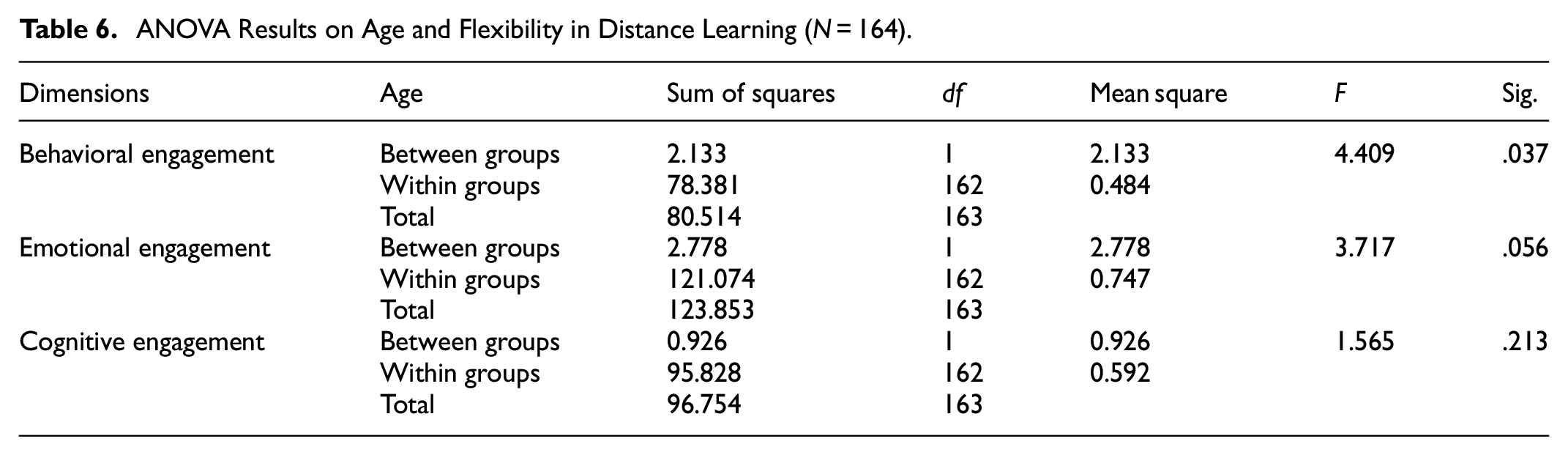
As Table 6 indicates, a statistically significant difference has been found between the students’ age and behavioral engagement F(1.162) = 4.409, p < .05. Students aged between 20 and above have had higher levels of behavioral engagement than those whose ages have been between 17 and 19. However, there has not been a statistically significant difference between the students’ age and emotional engagement, F(1.162) = 3.717, p > .05, and cognitive engagement F(1.162) = 1.565, p > .05. In other words, the students’ age has not contributed to their emotional and cognitive engagement. Relationship between flexibility and student engagement in distance learning
For the study in which the relationship between the levels of students’ engagement and flexibility levels has been examined, the Pearson Correlation Test has been administered as the data have displayed a normal distribution as shown in Table 7.
Regression Analysis of Flexibility Sub-Categories and Behavioral Engagement.

Table 7 indicates that independent variables namely factors of content, teacher contact, and time have explained 35.8% of the variance regarding the behavioral engagement factor. It can be said that the sub-categories of flexibility in online learning have had a positive effect on behavioral engagement (R = .370; R2 = .358; F = 31.325; p < .05). According to the standardized regression coefficients, the relative importance of the predictor variables on behavioral engagement has been as follows: Time (β = .355), teacher contact (β = .258), and content (β = .122). Time flexibility and teacher contact flexibility are associated with behavioral engagement.
Table 8 reveals that independent variables such as content, teacher contact, and time have explained 072% of the variance concerning emotional engagement. It means that the sub-dimensions of flexibility in online learning have not affected emotional engagement (R = .089; R2 = .072; F = 5.222; p < .05). No significant differences have been obtained between content, teacher contact, time, and emotional engagement.
Regression Analysis of Flexibility Sub-categories and Emotional Engagement.

Table 9 displays that independent variables such as content, teacher contact, and time have explained 40.7% of the variance in cognitive engagement. It has been seen that the sub-categories of flexibility in online learning have had a positive effect on cognitive engagement (R = .646; R2 = .407; F = 38.297; p < .05). According to the standardized regression coefficients, the relative importance of the predictor variables on behavioral engagement has been as follows: Time (β = .399), teacher contact (β = .339), and content (β = −.033) Time and content are positively correlated with cognitive engagement while no significant difference has been obtained between teacher contact and cognitive engagement.
Regression Analysis of Flexibility Sub-Categories and Cognitive Engagement.

Discussion
Regarding the first research question of the study, the level of flexibility in learning in distance education was explored. Studies in the literature revealed that students prioritized flexibility regardless of its type (Cayetano & Autencio, 2021; Li, 2014). By looking at the research findings of the study, time flexibility was found to have the highest level of flexibility among other flexibility types. Specifically, it was seen that students could repeat the subject matter at will, define their learning pace themselves, and decide when they wanted to learn in terms of time flexibility at a very high rate. According to these results, it could be asserted that students prioritized time flexibility in online learning as supported by the findings of the earlier research (Cayetano & Autencio, 2021; Turan et al., 2022). Nevertheless, this result was inconsistent with the result of the study indicating that the flexibility of time was the last factor explaining students’ satisfaction with online courses (Akcay, 2023). Following time flexibility, the level of content flexibility was also found to be high for this study (Cayetano & Autencio, 2021; Turan et al., 2022). Concerning content flexibility, students could learn topics of special interest and they could choose between the different learning forms: on-campus study, online study, and self-study. Moreover, they could prioritize topics in their learning and have a say regarding the focus of the topics of class. Learners’ preference concerning content was considered to be a contributor to the flexibility of the learning experience and their contentment (Hill, 2006). This result could be interpreted as the fact that students became a part of the learning process by explaining their opinions (Turan et al., 2022) so that distance education courses needed to provide the necessary flexibility in terms of course content for students’ satisfaction (Sahin & Shelley, 2008). However, the study displayed that the level of teacher contact flexibility was relatively lower than the content flexibility and time flexibility. Students reported that they could contact the teacher at any time at a moderate level and there were different possibilities of contacting the teacher. These results were in line with the previous studies (Álvarez & Montes, 2021; Turan et al., 2022) showing a lower level of flexibility of teacher contact in comparison to other flexibility factors. This result displayed that students had difficulties with communicating with their instructors as they could not reach them whenever they wanted and preferred to use different ways. The reason behind this could be related to the idea that instructors could only respond to students’ messages and questions during synchronous live courses (Turan et al., 2022). It was recommended that the interaction between teacher and student needed to be increased and managed properly for efficiency in distance education (Álvarez & Montes, 2021). It was also suggested that students should be supported to have the flexibility in communicating with their instructors to increase their satisfaction with a distance education course (Sahin & Shelley, 2008).
Concerning the second research question of the research, it was explored whether flexibility in online learning differed according to age and gender and it was found that students’ age and gender did not play a role in content flexibility, teacher contact flexibility, and time flexibility. Nevertheless, the results illuminated that female students’ levels of flexibility in terms of content, teacher contact, and time were found to be higher than the males, which was not consistent with the results of the earlier study (Turan et al., 2022) demonstrating that male learners had higher levels of flexibility.
Considering the third research question of the study, student engagement in distance education was examined. According to the results regarding student engagement in online learning, it was determined that the level of behavioral engagement was found to be at the highest level among other engagement factors. This result was not in line with the earlier study displaying the highest level of engagement in the factor of cognitive engagement (Alghanmi & Nyazi, 2023). In detail, concerning behavioral engagement, students completely agreed with the idea that they followed the rules of the online class, completed their homework on time, and did not “act” as if they were learning when they were in the online class. It was recommended that activities supporting attention, focus, and effort, and enabling flexibility could enhance the level of behavioral engagement (Vermeulen & Volman, 2024). Likewise, the level of cognitive engagement was also obtained to be high after behavioral engagement. Specifically, students stated that they checked their schoolwork for mistakes and they went back to watch the recorded session and learn again if they did not understand what they learned online and they did something to figure out if they did not know a concept when they were learning in the online class. It was suggested that using discussions among synchronous activities could help encourage the cognitive engagement of students (Vermeulen & Volman, 2024). Although the students’ levels of cognitive engagement and behavioral engagement were at a high rate, their level of emotional engagement was at a moderate level which was relatively lower than the others the results of which were the same as the previous research indicating the lowest level of engagement in this factor (Alghanmi & Nyazi, 2023). That was to say, students moderately felt happy when taking online classes or liked taking online classes and moderately felt excited by their work in the online class. Additionally, they were not completely sure that the online classroom was a fun place to be, they sometimes felt bored by the online class and they were moderately interested in the work. The reason could be related to the idea that students who took distance education for the first time were less engaged emotionally as they felt more anxious. For this reason, students should be supported emotionally (Alghanmi & Nyazi, 2023). To enhance their emotional engagement, it was suggested that multimedia be used in the distance learning environment and students’ interest and motivation be increased (Álvarez & Montes, 2021; Sun & Rueda, 2012). Instructors should help students enhance their emotional engagement (Sun & Rueda, 2012) by increasing instructor-student interaction. Additionally, such activities as forming a sense of trust and empathy, and creating a group feeling and interaction could be used to promote emotional engagement (Vermeulen & Volman, 2024).
Moreover, the study investigated the relationship between student engagement, gender, and age in distance learning in terms of the fourth research question of the study. Specifically, the study results indicated a significant difference between gender and cognitive engagement. The female students showed higher levels of cognitive engagement than their male counterparts the results of which were supported by the earlier research (Zhao et al., 2023). However, this result was not in line with the previous study which showed that gender did not affect student engagement (Sun & Rueda, 2012). The study showed no significant difference between behavioral engagement (Zhao et al., 2023) and emotional engagement in terms of gender, the finding of which was different from the research displaying a statistically significant difference between these two variables (Zhao et al., 2023). In terms of the correlation between age and engagement in online learning, a significant difference was obtained in behavioral engagement as older students had a higher level of behavioral engagement than the younger ones. The previous research also revealed a significant difference between student engagement and age (Sun & Rueda, 2012).
Regarding the fifth research question including the relationship between flexibility and student engagement in the context of distance education, the current study indicated the effect of cognitive engagement and behavioral engagement on flexibility in distance education. Specifically, behavioral engagement was related to the flexibility of time as supported by the earlier study (Kokoc, 2019). It was stated in the literature that time management was one of the significant issues for distance learners to be successful in the online learning environment (Farrell & Brunton, 2020). It was also found that there was a connection between the flexibility of teacher contact and behavioral engagement. It was stated that teacher-student interaction was the indicator of successful learning and essential in distance learning so the role of the course instructor should be managed properly (Álvarez & Montes, 2021). The literature indicated that if the instructor provided students with learning facilities the students would be more engaged in course skills, participation in the course, and their performance leading to students’ satisfaction with distance learning delivery. Among the facilities the instructor could use to make students feel emotionally, cognitively, and socially engaged were preparing course content, providing learning materials, and using online teaching strategies. (Baloran et al., 2021). However, this result was inconsistent with the research showing that the flexibility of teacher contact did not have a direct influence on behavioral engagement (Kokoc, 2019). Additionally, cognitive engagement was positively correlated with the flexibility of time and the flexibility of content. This result displayed that content and content delivery played an important role in student engagement (Álvarez & Montes, 2021). It was stated that students felt satisfied with the flexibility distance learning offered them if they got involved in course content at their own pace according to their schedules, work, and family (Fang et al., 2023) Nevertheless, the study displayed that there was not a correlation between emotional engagement and flexibility in distance learning. It was recommended that flexibility in learning be given priority in higher education institutions to create more supportive, effective, and inclusive learning settings for educators and students (El Galad et al., 2024).
Conclusion
Within the scope of the current study, it aimed to explore the relationship between student engagement and flexibility in the context of distance education. The main focus of the research was also discovering many aspects of student engagement such as cognitive, emotional, and behavioral, and flexibility such as content, teacher contact, and time in an online learning environment in higher education. With this aim, the overall student flexibility and engagement levels were first examined. The potential impacts of some demographics as age and gender were analyzed. Finally, the correlation between student engagement and flexibility in distance education was investigated. The results of the study displayed average levels of student engagement and flexibility in the context of distance education. Specifically, students had a medium level of flexibility in distance education, with flexibility of time ranking the highest, followed by flexibility of content and flexibility of teacher contact. Considering student engagement for online learning, students had an average level of engagement, with behavioral engagement ranking the highest followed by cognitive engagement and emotional engagement.
Furthermore, the study showed that gender and age were not significant factors in flexibility in distance education. However, gender affected students’ cognitive engagement, and age impacted students’ behavioral engagement. Besides, this study displayed that cognitive engagement and behavioral engagement affected flexibility in distance education. This result was considered to contribute to the progress of the literature in the area of distance education by ensuring a detailed understanding of the correlation between flexibility and student engagement.
Given its new insights, this study has some implications. Practical ways may be looked for to help students feel engaged in the process of distance education. For students to be successfully engaged in distance education, they should be trained to manage their time well and improve their organizational skills. Besides, psychosocial and structural factors concerning course design, peer community, and self-efficacy should be taken into consideration for effective student engagement. Instructors can improve their interaction with students to prevent isolation of the students in an online environment. Besides, higher education institutions can prioritize flexibility in distance education by taking students’ preferences into consideration in course content and content delivery and encouraging a supportive and efficient learning atmosphere considering students and educators.
This study had certain limitations. First, the participants of the study consisted of students taking their courses through distance education. It would be beneficial for further research to include a control group of face-to-face classroom students to make a comparison between the flexibility and engagement of students in a face-to-face classroom and a distance education environment. Secondly, the study used quantitative data collection tools; however, including qualitative methods to collect the data would be useful. Thirdly, the sample group of the research was limited to 164 students taking online courses from two faculties and four vocational schools of a state university but it would be beneficial for future studies to include a larger number of students from different educational backgrounds and private universities.
