




Abstract
Student engagement as an important predictor of peer interaction and academic achievement has received considerable attention in second language classes. Despite its significance, how study groups engage in online writing activities in collaborative learning settings remains underexplored. To fill this gap, the present study explored how a group of four engaged in an 8-week computer-mediated collaborative writing (CMCW) project in a Chinese university English as a foreign language (EFL) context. Data were collected from multiple sources such as a pre-survey, audio-recorded discussions, and retrospective interviews. Findings identify three developmental periods of group engagement through task completion, namely breaking-in, growth, and proficiency periods. During each period, the four dimensions of group engagement (i.e., behavioral, cognitive, emotional, and social engagement) were ongoing and salient to varying extents and mutually influenced among the participants. Also, the learners utilized certain collaborative strategies to promote meaning negotiation and care for the quality of interactions. The study highlights the great potential of CMCW to form a sociocognitive learning community where the students can actively engage in learning, construct new knowledge, and promote language skills through not only cognitive processing but also mutual interaction between peers and instructors.
Plain language summary
Purpose: Student engagement has received fast-growing attention in second language education in recent decades. In this study, the researcher attempted to address the research gap that little attention was paid to group engagement in computer-mediated collaborative writing (CMCW) over time. Methods: This design-based case study took place at a Chinese public university in North China. Multiple data sources were used, including a survey, audio-recorded discussions, and interviews with the students. Conclusions: The study identifies three developmental periods of group engagement in CMCW, namely breaking-in, growth, and proficiency periods, in which the facets of group engagement were ongoing and salient to varying extents. Besides, CMCW showed great potential to form a learning community where the students can construct language knowledge and promote writing skills. Implications: Since group engagement may change across timescales, instructors had better design their teaching according to the features of different periods. Learners need to be encouraged to apply collaborative strategies appropriately for promoting group engagement in all respects. Limitations: Due to the small number of participants in the study, the findings may be hard to be used to explain the learners’ group engagement in other contexts. Also, long-term academic outcome is impossibly observable due to the short duration of the study.
Keywords
Introduction
Student engagement can be identified as a state of heightened attention and involvement, which is an important indicator of academic achievement (Fredricks et al., 2004; Philp & Duchesne, 2016). Following Dörnyei and Kormos (2000), active learners’ engagement is a key concern for all instructed language learning. Engaged learners can be actively involved in their own learning process, hence meaningful learning through use of the language (Hiver et al., 2024). In the field of language education, a body of literature has demonstrated that the second language (L2) learners’ engagement accounts for the quality of performance, motivation, and academic outcomes (e.g., Al-Bogami & Elyas, 2020; Arnold et al., 2012; Henry, 2022; Yang, 2018).
With the intensive focus on learners’ involvement in joint tasks with others such as collaborative writing, group engagement has received fast-growing attention in L2 education in recent decades. According to Kearsley and Shneiderman’s (1998) engagement theory, “students must be meaningfully engaged in learning activities through interaction with others and worthwhile tasks” (p. 20). As a cognitive activity, collaborative writing provides numerous opportunities for meaning negotiation and knowledge construction when students can test their hypotheses about language, thereby enhancing language development (Swain, 1985; Yang, 2018). Meanwhile, students in social activities can benefit from mutual interaction which leads to peer feedback and authentic learning contexts (Vygotsky, 1978; Wang, 2014). Specifically, computer-mediated collaborative writing (CMCW) can provide an interactive setting without limitation of time and space, where L2 learners reinforce linguistic attention, audience awareness, writing competence, interactive skills, and learning motivation (Kim & Kim, 2020; Kuteeva, 2011; P. L. Liu et al., 2022; Zou et al., 2016). To benefit from CMCW, students are encouraged to fully engage in it. For instance, emotionally, when students enjoyed working in pairs or groups and found it interesting and useful, they were more likely to be motivated to involve in collaboration (Wang, 2014; Zhai, 2021). They will also notice linguistic problems and perceive learning progress if they work in a collaborative approach by highly engaging with teacher and peer feedback and making equal contributions to writing (Arnold et al., 2012; Li & Zhu, 2017).
Nevertheless, group engagement became much more complicated than that of individuals in such a learning situation due to its interactive and collaborative nature (Järvelä et al., 2016). Accordingly, students are no longer isolated learners. Instead, they are doubly influenced by their own learning states and peer interaction through joint work, thus their engagement tends to be mutually connected (Ma et al., 2022). As far as empirical research studies of CMCW are concerned, few researchers conducted an in-depth investigation on collaborative group engagement during the process of CMCW. If any, they addressed one facet of the meta-construct or utilized a one-time measurement such as questionnaires even though student engagement remains multidimensional and ongoing in authentic L2 classrooms (Hiver et al., 2024; C. C. Liu et al., 2016; Zhai, 2021). To this end, the present study aims to gain comprehensive answers to the following research questions:
(1) How does a language learning group engage in a CMCW project in a Chinese university EFL context?
(2) How does their group engagement change in the process of CMCW over time?
Theoretical Framework
This study draws on the theoretical framework of L2 education research from the sociocognitive perspective. In the last decade, two traditional research paradigms, cognitive and sciocultural approaches, were found increasingly limited in understanding the complex nature of language development (Batstone, 2010). As Atkinson (2002) views, the factors of cognition and society have to be interassociated and complementary instead of being competitive. From the sociocognitive perspective, group engagement is primarily based on not only cognitive processing when learners build knowledge through constructive and creative efforts but also social surroundings by means of interactions between individuals and course scenarios such as peers, instructors, activities, teaching norms, and even cultures in classroom settings (Elola & Oskoz, 2010; Xu & Fan, 2019). In a nutshell, measuring group engagement should take sociocognitive factors into consideration in all respects.
This study follows Philp and Duchesne’s (2016) concept of engagement in L2 language tasks, which consists of behavioral, cognitive, emotional, and social dimensions. In line with their theories, a main strand of work supports that student engagement can be manifested in learners’ behavioral choices in learning, mental activities through the cognitive process, emotional responses to learning tasks and peers, as well as social interactions between interlocutors (Henry & Thorsen, 2020; Hiver et al., 2024; Xu & Fan, 2019). As to its key characteristics, L2 instructors and researchers should pay close attention to that engagement is highly context-dependent and malleable. Since learners’ engagement is in part of product of their own learning environment, well-constructed interventions could have the power to form the dynamism of engagement (Reschly & Christenson, 2012), but the ultimate performance of study groups in tackling tasks is beyond instructors’ control (Arnold et al., 2012). Therefore, it is necessary to understand how learners engage collaboratively in online writing activities over time in a specific L2 context.
Literature Review
Student Engagement in L2 CMCW
Student engagement defines the learning process and creative actions (Al-Bogami & Elyas, 2020; Aubrey et al., 2022). In collaborative learning settings, with the shift of subjects of engagement research from individuals to groups (Ma et al., 2022), previous literature has demonstrated how L2 learners engaged in CMCW, though not from a comprehensive point of view. Behavioral engagement corresponds with active participation in task-related activities and working styles of groups. Examples of behavioral engagement in CMCW include writing and posting text, work allocation, discussions, and revisions (Bradley et al., 2010; Kessler, 2009). Cognitive engagement refers to sustained attention and mental effort in the process of collaboration. Researchers have focused on students’ questioning, understanding deeper, explaining, exchanging ideas, and peer feedback (Rouhshad et al., 2016; Yang, 2018). Emotional engagement means the degree of willingness, purposefulness, and autonomy (Svalberg, 2009). Students are emotionally engaged in CMCW when they are found motivated and willing to achieve given writing goals (Wang, 2014; Zhai, 2021). On the contrary, some were emotionally disengaged if they preferred individual writing or self-editing where they could control over their own writing (Arnold et al., 2012; Elola & Oskoz, 2010). Social engagement is linked to establishing affiliation which stresses interaction with and support of others in communities of language learning. It plays a key role in language learning since learners can be effective when being socially engaged (Philp & Duchesne, 2016). Researchers have identified a number of indicators of social engagement in CMCW, such as providing feedback and drawing from one’s ideas (Arnold et al., 2012; Li & Zhu, 2017).
Collaborative Writing With Web 2.0
Collaborative writing is “an activity where there is a shared and negotiated decision-making process and a shared responsibility for the production of a single text” (Storch, 2013, p. 3). In order to aid in collaborative writing online, Web 2.0 tools as “read-write Webs” (e.g., Skype, Wiki, and Google Docs) have been widely applied in L2 classes. The interactive nature of Web 2.0 tools is well suited to elicit meaningful learning and form dynamic online learning communities among students and teachers (West & West, 2008). Such a learning community can stimulate new insights, problem-solving, and reflective thinking for language knowledge (Yang, 2018).
Quite a few researchers have focused on the effects of Web 2.0 on learning in CMCW. For instance, Kuteeva (2011) used wikis for teaching Swedish university EFL learners academic writing and found that wikis activities can contribute to their grammatical correctness, structural coherence, and raising awareness of the audience. Wang (2014) detected the significant advantage of the wiki group in writing skills and grammatical knowledge by comparing Chinese university EFL learners’ performance in different modes of collaborative writing (face-to-face vs. wiki). Yang (2018) reported that web-based collaborative writing reinforced writing progress and mutual learning through meaning negotiation for text construction. In Elabdali’s (2021) meta-analysis, collaboratively written texts were found more accurate than individually written texts.
However, quite a few researchers have realized that using Web 2.0 may not necessarily yield collaborative learning performance. Some students may be labeled as free riders who contribute less than their fair share or even do nothing for meaningful interaction and task completion. For instance, Bradley et al. (2010) observed no visible signs of interaction among members of several wiki groups since their writing was basically finished by one author. In a cognitive way, Zheng (2011) found that when learners expressed their thoughts on a social network (QQ), meaning negotiation and language-related episodes (LREs) rarely happened. Similarly, more negotiations for meaning in face-to-face communication were recorded in the study of Rouhshad et al. (2016), compared with that in the computer-mediated mode (Skype). Rouhshad and Storch (2016) later reported that their learners were more likely to come to new insights in a face-to-face environment but to complete the divided workload in Google Docs. Accordingly, they argued that the web-based environment may discourage meaning negotiation and ultimately language learning. The inconsistent findings of these studies warrant further research on how groups of L2 learners tackle CMCW tasks and achieve anticipated learning outcomes.
Dynamism of Group Engagement
Engagement is ongoing and relies on social interaction in certain learning contexts (Hiver et al., 2024). Investigating the dynamic nature of engagement represents an easily overlooked notion that it should be treated as a dynamic construct instead of an unchanged one. According to Kim and Kim’s (2020) study, the students’ behavioral engagement (i.e., student interaction in their study) increased, maintained, and spiked across three periods in a wiki-based writing course. In Dao and Sato’s (2021) investigation into the relationship between engagement and interactional behaviors, the results revealed that L2 learners’ positive emotional engagement fluctuated over a 15-min oral task. Further, positive emotional engagement was positively associated with the degree of collaboration. This study supports the claim that learners’ engagement is susceptible to change in learning communities even within short duration. Based on long observation, Zhai (2021) identified a dynamic pattern of emotional engagement in a 10-week collaborative writing project for Chinese as a foreign language learners. In this study, the students felt motivated and positive at the beginning but were disengaged due to various practical issues such as linguistic challenges, time constraints, and group incongruity. When they perceived a strong sense of accomplishment and an awareness of collaborative outcomes, they reengaged in the program.
To date, little attention has been paid to the dynamism of group engagement over time in a computer-mediated environment. As the above studies mainly discussed certain facets of engagement, previous literature failed to demonstrate a holistic description of dynamic group engagement. The lack of studies calls for an in-depth understanding of how L2 learning groups engage in CMCW on various timescales, which is the focus of the present study.
Method
Participants and Setting
This design-based case study took place at a public university in North China. The participants were four juniors as English Education majors, taking an 8-week advanced TESOL (teaching English to speakers of other languages) course on research methods of language teaching in Fall 2022. This course is optional but only for the leading students in their academic achievement. Considering the researcher’s observation, the participants’ proficiency levels of English were around high-intermediate, though their writing competence varied somewhat.
In the course, a total of 28 students were assigned to different groups of three or four based on their willingness. One group of four was purposely selected because their collaborative logs were relatively intact while some students in other groups dropped out later. They were around 20-year-old Chinese female students who had never experienced a similar collaborative writing project. Table 1 lists their basic information. At the beginning of the study, they already knew each other except Participant 1, but it was the first time that they worked together in a study group. Participant 4 was elected leader later to monitor online writing and discussions. All participants gave their verbal consent to this study.
Information of the Four Participants.

CMCW Project
The present study applied a domestic web-based platform, Kdocs <www.kdocs.cn>, as the collaborative writing tool. As a Web 2.0 technology, Kdocs is capable of creating a collaborative and interactive community that is closely aligned with the sociocognitive paradigm. The main functions of Kdocs are very similar to Google Docs which can be harnessed to share documents and comments, perform real-time editing, and also store revision history (see Figure 1). The technical training addressed the functions of Kdocs and encouraged the participants to practice these functions. In addition, the participants were already familiar with this platform since it has been frequently used in their daily lives but never in L2 classes for learning purposes.

Screenshot of collaborative writing tool Kdocs.
During the 8-week collaborative writing project, the group was required to complete a research proposal using Kdocs as the ultimate goal. Usually, 1 to 3 weeks as a writing session focused on one writing task. In Week 1, the students were introduced to the requirements of the course and the ultimate writing goal as well. Based on their research interests, the group read related articles and summarized the gist collaboratively online. In Weeks 2 to 4, they revised the joint text concerning the research background and aims. In Week 5, they had discussions on research design, followed by reading and commenting on other groups’ products in Weeks 6 and 7. The group added a feasible schedule and eventually completed the research proposal according to the suggestions from their classmates and the instructor the following week. Due to the quarantine of COVID-19 in the year 2022, the participants had to communicate with each other through the Internet until they came back to the university in Week 5, and the course was only taught online within 8 weeks. The researcher participated in the CMCW project as the instructor of this course, who gave instructions and feedback on students’ academic writing. As an observer, she was not involved in developing the content of their discussions. In addition, the Kdocs product would be graded at the end of this course as 30% of group achievement which accounts for 40% of the final grade.
Data Collection Instrument
Pre-Survey
At the beginning of the study in Week 2, the participants were asked to report their perceptions of and difficulties in their group work. An online questionnaire with open-ended items was used to collect the participants’ answers. Their responses were carefully considered for selecting potential participants, designing subsequent interview questions (see Appendix A), and having a good understanding of the participants in the study.
Audio-Recorded Discussions
After class meetings, the participants were asked to audio-record their discussions regarding how to revise their research proposal. A total of three sessions (46 min) of audio-recorded discussions were made in their first language (i.e., Chinese) over the course of 8 weeks.
Semi-Structured Interviews
When this course was over in Week 9, semi-structured retrospective interviews with each participant were conducted in Chinese. The list of interview questions was used as a guide, but the researchers still “have the freedom to digress and probe for more information” (Mackey & Gass, 2016, p. 225). The questions were mainly about how the participants accomplished the CMCW project, how they perceived their group work, and what they expected from CMCW. The interviews were audio-recorded and lasted roughly 30 min for each of them.
Web 2.0 Writing Product
Within the study, all the participants and the instructor had access to the link to their Kdocs product. Weekly, the researcher collected one version of their collaborative text and revision history in Kdocs for further analysis.
Data Analysis
Before analyzing data, oral raw data (i.e., discussions, interviews) was transcribed. Nevertheless, a translation from Chinese into English was only made for presentation in this article to avoid possible distortion of meanings. Data analysis followed the constant comparative approach which involves “taking information from data collection and comparing it to emerging categories” (Creswell, 2013, p. 86). The researcher read data reiteratively, underlined useful statements and formed an initial coding list using the software Nvivo 11. Anything pertinent to group engagement was assigned to a code without taking any predetermined research questions into consideration. As Mackey and Gass (2016) note, this step is open coding in which “initial categories are based on a first pass through the data” (p. 137). Later, a tentative framework corresponding to the purpose of this study was made by removing unnecessary codes. As the focus of this study is how a group of EFL learners engage in the process of CMCW, the construct of group engagement was operationalized at the classroom level, involving behavioral, cognitive, emotional, and social dimensions (Philp & Duchesne, 2016). Categories were compared mutually with a view to establishing patterns among them. Finally, eight refined categories emerged from the data, every two of which would shed light on the first research question, including the approach to task completion, degree of participation, selective attention, regulating strategies, motivational reactions, perceived outcomes, affiliation with peers, and maintaining strategies. One more category labeled as dynamism of engagement also emerged for answering the second research question. Table 2 shows the final coding rubric used in the study.
Coding Rubric for Qualitative Data.

To establish reliability of the coding process, one more rater was involved in the study besides the researcher. The invited rater was a female TESOL teacher who received her master’s degree in Applied Linguistics and had more than 15 years of teaching experience. She coded 43.3% of the transcripts with 92.1% of agreements after a discussion, indicating substantial reliability between the raters. Furthermore, with respect to trustworthiness of this study, triangulation, member checking, and thick description were utilized. The data collected from different sources can achieve triangulation. Before reporting the findings, the participants were invited to check the accuracy. The thick description that described sufficient details about the participants’ group engagement in the CMCW project was made to aid in transferring findings to similar contexts.
Findings
The present study examined how a group of four language learners engaged in an 8-week CMCW project in a Chinese university EFL context from the sociocognitive perspective. The following sections introduce group engagement across four dimensions (i.e., behavioral, cognitive, emotional, and social engagement) and three developmental periods.
The Dimensions of Group Engagement in CMCW
How Does the Group of Four Engage Behaviorally in CMCW?
To understand how the group of four engaged behaviorally in CMCW, the researcher investigated two aspects: the approach to task completion and the degree of participation. In this study, the four participants worked together as a team for the first time, though, they showed active involvement in task completion. They confronted challenges in the beginning because they were poor at academic writing and it was not easy to fix a time for online discussions. Thus they took plenty of time on reading articles and figuring out how to get their work started. Later, in each writing session, Participant 4 as the group leader divided the task into four pieces of work, and each member chose one according to their willingness. They finished individual texts then, pasted their texts online, joined pieces into one, and discussed weekly or biweekly. Briefly, they read articles and wrote their own texts individually and also came to new insights into the negotiation process collaboratively. They resolved their understanding differences on the task and became accustomed to such an approach to task completion soon, as Participant 1 narrated in her interview:
Our group gradually worked well. Once the work was assigned, we put it into practice if there was no major disagreement. Everyone is of a similar mind and revises the texts based on a common direction.
Although the divided workload may be equally demanding, the participants revised their co-owned text to varying degrees. Being the group leader, Participant 4 devoted much energy to seeking opinions from others and revising their writing immediately. In the collaborative logs of the Kdocs product, a total of 135 login records were made by Participant 4, followed by Participant 2 (28), Participant 1 (10), and Participant 3 (5). From the audio recording, Participant 4 also contributed to the discussion with the most turns (27), followed by Participant 2 (23), Participant 3 (21), and Participant 1 (12). The interviews confirmed that Participant 4 spent much time organizing text structure, perfecting the format, and correcting language errors. Participant 3 mentioned that the leader would always revise the joint text one more time before each submission, perhaps on account of her personality and a sense of responsibility. In contrast, direct revisions were avoided by the three group members. I asked Participant 3 about the reason for her reluctance to revise others’ writing, she explained as follows:
Usually, we are responsible for a similar workload. I seldom revised others’ writing directly, because I think she must prepare this part with careful consideration. We may just differ in ways of thinking.
How Does the Group of Four Engage Cognitively in CMCW?
Two subcategories of cognitive engagement were taken into consideration to examine how the group of four engaged cognitively in CMCW, namely selective attention and regulating strategies. In the audio recording, the group seldom deliberated about language, which could be labeled as language-related episodes (LREs) as the unit of analysis in research on writing (Storch, 2013). According to the interviews, the participants focused on meaning rather than language forms in most cases. It was true not only when they read articles but when they wrote the texts. Participant 2 confessed to knowing nothing about academic writing and had to read extensively at the beginning of the course. There was no possibility to notice language under such circumstances in her view. When their writing product was basically finished in Week 6, she came to find “some good expressions” written by others. Interestingly, although Participant 3 admitted a lack of attention to language, it seemed that the instructor was of assistance to her in noticing lexical knowledge. For example, she never noticed the usage of deontic modal verbs like “should” or “must,” until the instructor gave feedback that Chinese EFL learners are more likely to overuse these two words due to the developing status of interlanguage and cultural differences (Long et al., 2016).
Regulating strategies emerged from how the participants exchanged ideas and engaged with others’ feedback. During the interactions, everyone may hold a different opinion on how to express, organize, or revise texts, which caused debates as “cognitive conflict” (Storch, 2013, p. 24). For example, when the four participants rationalized the first paragraph initially written by Participant 1, everyone clarified her ideas.
(Discussion 1, Week 4)
A range of indicators of cognitive engagement was identified from explaining (“When I wrote this, I’d like to explain that…”), understanding writing intentions (“Does it mean that…”), making comments (“It looks a little bit incoherent”), to offering solutions (“Maybe we could delete it”). Nevertheless, the participants were still reserved in terms of responding to others’ ideas. Although Participant 4 actively asked for others’ feedback, she insisted: “I favor sticking to my thoughts.” Participant 3 believed that revisions depended on the writer herself, indicating that each writer was responsible for her own text and others only provided suggestions. The other two members were more willing to consider peer feedback. Participant 2 was unsure of herself in academic writing and would initiatively ask for help from other members. Participant 1 also consulted others voluntarily in most cases, as she narrated:
I would check whether my argument was faulty or not when others gave me suggestions. Some sound reasonable and I just revised my writing… Also, others would easily find grammatical errors or semantic ambiguity in my writing, though I had revised it several times.
How Does the Group of Four Engage Emotionally in CMCW?
The first subcategory of emotional engagement is motivational reactions. At the beginning of this course, affections like fear of task difficulty were shown in the interview with Participant 1, because she once thought that academic writing was esoteric. She felt less anxious after task assignment later and prided herself on being able to write a research proposal, especially with support from other members. When asked for her views about their teamwork, she expressed a glow of satisfaction: “I learn from others to look at one issue from different perspectives.” Similarly, Participant 2 and Participant 3 also hold a positive viewpoint on CMCW. Participant 3 stated:
At first, everyone had her own way of thinking. I received some pieces of advice during discussions. It’s nice because I expand my vision, and then my thoughts could be diversified.
Meanwhile, Participant 4 was in stark contrast to the other three in that she disliked the way of collaborative writing. Although she believed that the group worked smoothly, she expressed a preference for individual writing because it is “more effective.”
Driven by task completion, the participants perceived a sense of achievement from the outcomes of the engaged task. This is the second subcategory of emotional engagement that the researcher investigated. For instance, Participant 1 stated that she usually rambled a lot in her writing and could not figure out the main points of referenced articles even though she had read them for several days. Through working on this CMCW project, her writing became concise and she could get a gist of texts from reading quickly because she realized that there should always be writing intentions. Another example of the participants’ perceived task outcomes is raising the awareness of their audience. Participant 2 found it helpful to clear the mind after all groups gave feedback mutually. She commented:
In that class meeting, we shared the content of the research proposal, and another group gave us comments. I think this method is very useful because we know how other people understand it when they read our writing. We also order our thoughts right away.
How Does the Group of Four Engage Socially in CMCW?
With reference to how the group of four engaged socially in CMCW, two aspects were analyzed, including affiliation with peers and maintaining strategies. The interpersonal relationship was believed to have been built as the participants communicated with each other. As Participant 1 explained, peer intimacy could foster mutuality in turn. Initially, she was not familiar with the other three. It concerned her that making comments on others’ writing would be detrimental to their closeness. With the establishment of intimate connections, they would communicate much more freely. Participant 3 also said:
In the first two weeks, the group worked not very well. Because, indeed, we were not very familiar with each other. With studying in our course, we became more intimate. I felt our communication getting better. We don’t clash or find it hard to make comments anymore. Well, it takes time.
Meanwhile, in the audio-recorded discussions, a series of maintaining strategies were found, aiming to keep the interaction going and care for the quality of interaction. For instance, when Participant 1 did not know others very well, she was often invited by them to join in the discussions by asking her to share the thoughts. Other devices of maintenance include immediate responses (“Hmm, yes”), repetition (“I know. I know.”), weak tones (“This part is slightly wordy”), being modest (“Could you explain our conclusion? I probably cannot do that”), and facial expressions such as smiling. Besides, positivity is crucial for maintaining interaction in sustained communication, as shown in the excerpt underneath.
(Discussion 2, Week 5)
When disagreement would not be settled, Participant 2 seemed to expect to end the argument, while Participant 3 explained herself further. It is interesting to note that they finally reached a consensus rather than the closure of the conversation with mutual efforts.
The Dynamism of Group Engagement in CMCW
Some time-varying features of group engagement in CMCW over time have emerged from the qualitative data. At first, the group of four experienced a breaking-in period when they were not acquainted with each other as well as the writing project. This period is characterized by isolated learning, anxious states, and careful cooperation. Taking work allocation as an example of isolated learning, the participants chose to read articles and write divided texts individually. As the leader (Participant 4) narrated, she normally divided the workload and everyone decided what she would attend to. They also expressed their confusion about the task completion to varying degrees and were fearful of explicit comments on others’ writing that may threaten existing relationships. Participant 3 stressed her concern that “providing direct comments on others’ writing may be improper.” When confronting difficulties in task completion, they also tried to resolve them by exchanging ideas carefully.
With frequent communication accelerating interpersonal closeness, collaborative actions and mental efforts often happened during a growth period. The participants came to realize that the writing should be co-owned and thus more energies on the co-construction of knowledge and meaning negotiation. According to Participant 2, concerted attempts to build common understanding were “very helpful” in developing a sense of achievement and audience awareness. Meanwhile, everyone held a different opinion in discussions in usual so they had to spend a long time reaching agreement, and their Kdocs product has been rewritten and sharply revised by all contributors. It seems that the participants were more likely to feel comfortable with other group members in this phase to provide direct feedback and response.
Lastly, during a proficiency period, the participants eventually mastered the secret of collaboration by taking less energy into building relationships and more on contents and language knowledge, though insufficient. They benefited from social interaction by drawing from each other’s feedback because there were fewer worries about detrimental effects of critical comments on affiliation. They actively discussed use of the language and promoted writing skills not only through cognitive processing but by social support from peers and the instructor. Besides, they were skilled in monitoring and carrying out task-related activities such as planning and reflection. In the interview, Participant 1 stated:
Our team works better and better, and we can make sure of a common direction and strive for it together… Compared to our performance in the beginning, we are now much more active and free in discussions, although we are still considerate towards other members.
Discussion
Understanding Group Engagement in CMCW
Concerning the first research question on dimensions of group engagement in CMCW, it could be manifested in behavioral, cognitive, emotional, and social facets. Generally speaking, there is a distinction between cooperation and collaboration in a learning environment. The former allows for a divided workload and focuses on individual contributions, while the latter includes shared responsibility and engagement with others’ contributions (Storch, 2013). As found in many studies (e.g., Bradley et al., 2010; Kessler, 2009), the learners of this study used both cooperative and collaborative approaches when attending to different task-related activities. At first, they read referenced articles and tackled writing in a cooperative way due to unfamiliarity with CMCW tasks (Chen & Hapgood, 2021), a sense of psychological ownership of a text (Arnold et al., 2012), and adhering to the Chinese traditional value of “harmony”(和) from Confucianism. They performed collaboratively soon later once they developed some knowledge about the CMCW project as well as a sense of co-ownership of the text and individual accountability.
Cognitively, they mostly focused on meaning (content) rather than language (form) within the entire project, even though they were encouraged to notice both. It was consistent with the findings of Kessler (2009) where the learners were more willing to collaborate about aspects of content rather than form in a Wiki environment. It seemed that a computer-based environment tended to encourage linguistic fluency rather than accuracy (Bradley et al., 2010; Zheng, 2011). In the present study, the limited-capacity model of attention possibly accounted for the lack of focus-on-form likewise, as it describes, “if a task demands a lot of attention to its content, there will be less attention available to be devoted to its language” (Skehan & Foster, 2001:189). According to the interviews, academic writing was viewed so hard that the learners paid close attention to expressing their thoughts instead of language features.
It is worth noticing that the degree of collaboration was not necessarily related to positive emotional engagement, although Dao and Sato’s (2021) findings revealed that the two always work hand in hand. As the team leader, Participant 4 observably contributed the most to their writing product, although the other three also actively participated in the project. However, she might feel comfortable with independent writing due to personal control and style of writing (Elola & Oskoz, 2010), a lack of awareness of collaborative outcomes, or other practical issues such as time constraints and group incongruity, while others felt satisfied with the fact that the CMCW project they engaged in had substantial effects on them such as audience awareness (Kuteeva, 2011), writing and reading competence, and collaborative skills. Simply, L2 learners’ personal preferences regarding tasks, perceptions of their teamwork, and even attitudes toward learning contexts contribute to their affective reactions to a great extent (Arnold et al., 2012; Zhai, 2021), hence the collaborative decisions of emotional engagement or disengagement.
In L2 learning settings, social engagement plays a central part in language learning (Hiver et al., 2024; Philp & Duchesne, 2016), because nobody can distance him/herself or remain isolated from others. Peer support can help meet learners’ expectancy, strengthen their task value belief, and promote all dimensions of engagement (Hoi, 2022). The learners in the study were more willing to perform peer feedback when they felt comfortable in the learning community. A good rapport with peers can help co-construct knowledge in turn (Ma et al., 2022). As a result, collaborative work becomes more effective when interpersonal relationships are no longer worried. In this study, the learners utilized multiple collaborative strategies (Table 3) to build new knowledge, maintain social interactions, and care for the quality of interactions. Regulating strategies are mostly used for cognitive purposes while maintaining strategies and avoidance strategies are of importance in social interactions.
Collaborative Strategies Used in Joint Task Completion.

Turning to the second research question about the dynamism of group engagement, different facets of group engagement turned out to be variously salient across three developmental periods of CMCW. Figure 2 illustrates the three periods along a continuum of social interactions from cooperative efforts to collaborative ones. The breaking-in period consists of plenty of misaligned triangles in different colors at the bottom, indicating potential pieces of cooperative efforts by individuals. In the growth period, learners come to realize their shared goals and work collaboratively with consistent cognitive processing represented by overlapped one-color triangles. In the end, an integrated triangle comes into being through frequent and effective social interactions among learners as well as instructors in the proficiency period.
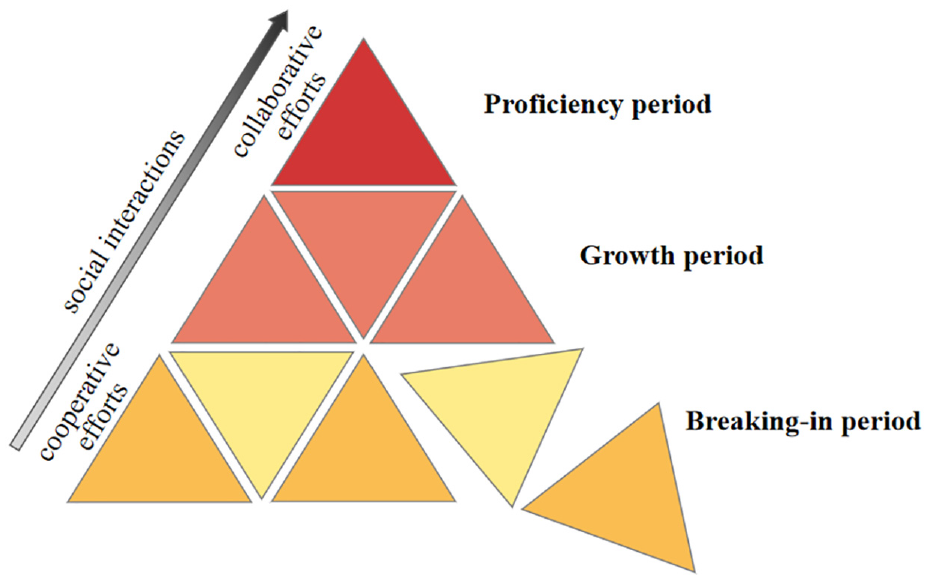
Three developmental periods of group engagement.
Metaphorically, group work is a worthwhile journey by ship, heading in a certain direction. A group leader and other members are a ship’s captain and crew respectively. At first, the leader acted like a newly promoted captain who steered the ship with rusty skills, while other members were raw recruits who tried out careful cooperation. Later, all members worked together with greater efforts to reach their common destination by offering new insights. Eventually, they made it on the basis of all contributions with effortless collaborative skills. Within the CMCW project, the leader as well as her group members always felt a sense of accountability for the writing product. It is believed that even if a group leader is not predetermined, informal leaders would also emerge voluntarily to ensure successful task completion in collaborative learning contexts (Arnold et al., 2012). Such learning roles were not due to personal characteristics alone, they also emerged once the learners perceived their shared responsibility and workload in group work. The learners have undergone a complete transformation from novices to masters through collaborative learning. Without regard to group variations, it is lucky to witness all-round trajectories of group engagement in the study.
Pedagogical Implications
Based on the aforementioned findings, this study has several pedagogical implications regarding designing and carrying out CMCW tasks in similar contexts. Since group engagement may change across timescales, instructors had better design their teaching according to the features of different periods. In the breaking-in period, simple activities targeted at understanding task requirements and increasing opportunities for communication should be used. Learners can relieve anxiety about task completion and find a comfortable way to get along with each other when they are working together. With the increasing interactive interactions, the focus of group work will be moved to the quality of writing products in the growth period, such as content, logic, and coherence. Taking task complexity into consideration, instructors should offer scaffolded assistance to decrease cognitive demands by providing outlines or textual samples, making learners more confident. In the proficiency period, a good learning community is already built with mutual efforts among group members and instructors. Learners can freely negotiate meanings, reconstruct ideas to accommodate new perspectives, and be capable of sparing attention resources to deliberate about language. Considering that a co-constructed understanding is not always superior to individual understandings as some researchers (e.g., Elola & Oskoz, 2010) claimed—because peer interaction could be misleading and inconsistent sometimes (Philp et al., 2014)—instructors may remind their students to consider peer commenting with caution and provide consulting feedback if needed.
At the same time, the importance of process-based assessment (e.g., the writing processes, the collaboration processes) should be highlighted in CMCW, since the formative assessment of group work can stimulate peer editing and linguistic attention (Zhang & Chen, 2022). Also, when learners are explicitly suggested to focus on form, they will utilize cognitive and meta-cognitive strategies to carefully engage with others’ language-related revisions. With the collaborative performance of learners more visible within writing instruction, free riders who benefit from others’ ideas and actions without any contribution to collaborative learning could barely appear.
Besides, the learners were found to use collaborative strategies actively in the study. Learners need to be encouraged to apply regulating and maintaining strategies appropriately for promoting group engagement. Meanwhile, instructors are accountable for guiding them accordingly by regarding the avoidance strategy as a necessity in group work instead of rejection of collaboration in a Chinese EFL context.
Conclusion
Giving full play to the interactive features of group engagement in nature, this study attaches great importance to CMCW using Web 2.0 tools in L2 classrooms. Through a qualitative investigation, the findings shed new light on how groups of L2 learners engaged in the process of CMCW from behavioral, cognitive, emotional, and social dimensions from the sociocognitive perspective. The learners’ group engagement was also found dynamic and mutually influenced across three developmental periods, namely breaking-in, growth, and proficiency periods. What is more, the learners applied certain collaborative strategies to accelerate cognitive processing and promote effective interactions, such as regulating strategies, maintaining strategies, and avoidance strategies. In sum, there was a noticeable shift for the learners from isolation to association and from independent to coordinated when the group actively engaged in their common work (Sotillo, 2002).
Study Limitations
One shortcoming of the study lies in the small sample size. There is only a group of four language learners in this case study, which may limit its generalization. Nevertheless, the purpose of case studies is to generate in-depth knowledge of how learners perform within specific learning settings, instead of generalizing the findings to a wider student population (Mackey & Gass, 2016). Through detailed descriptions with rich qualitative data, more instructors and researchers in similar L2 contexts (e.g., South Korea, Japan) could have a better understanding of what group engagement looks like and draw on the findings to put it into practice.
Moreover, although long-term outcome of language learning is impossibly observable in this study due to the short duration of the CMCW project, explicit instruction and social support from peers and instructors are likely to have a lasting impact on language development (Arnold et al., 2012; Hoi, 2022) in such a sociocognitive learning community. Overall, it is evident that group engagement is held accountable for the major part of collaborative outcomes in our digital era, making contemporary collaborative paradigms possible in language education with Web 2.0 technology.
Suggestions for Future Research
More studies in the domain of CMCW in L2 contexts are clearly warranted. As demonstrated in this study, CMCW has great potential in L2 writing instruction when an interactive learning community is actively formed. Further research is suggested to implement CMCW in other L2 learners with different levels of language proficiency to describe factors affecting their group engagement or trace the trajectories of group engagement in long duration. Besides, the study will hopefully lay the groundwork for the benefits of group engagement in CMCW tasks. When it comes to language learning, since teacher feedback is normally perceived more important than peer feedback (Arnold et al., 2012), teacher-learner interactions by making forms salient are worth a try for future exploration. Afterward, group engagement can be reevaluated by taking long-term outcomes of collaboration into consideration.
Footnotes
Appendix A
List of interview questions.
Declaration of Conflicting Interests
The author declared no potential conflicts of interest with respect to the research, authorship, and/or publication of this article.
Funding
The author disclosed receipt of the following financial support for the research, authorship, and/or publication of this article: This research is supported by Shanxi Office for Education Sciences Planning (GH-220464) and Shanxi Normal University.
