




Abstract
Educational reforms in many Asian countries, particularly in China and Vietnam, have highlighted the pivotal role of the constructivist approach. However, the implementation of constructivism into the classroom is still very challenging for teachers. Although there is a wealth of research on constructivism, few studies have focused on the difficulties teachers often encounter when organizing constructivist lessons, especially in the EFL context. To address this gap, this study employed a mixed-methods approach, including triangulated data (a questionnaire, classroom observations, and semi-structured interviews) with the participation of 120 EFL teachers in a private university in Vietnam. The findings indicate that teachers faced a wide array of problems in their constructivist classes, including conceptual, pedagogical, cultural, political, and technological dilemmas. Furthermore, they did not comprehend constructivism as they believed, probably due to a superficial understanding of this approach or the effect of Confucian culture. Additionally, this study verifies and contributes to the framework of Windschitl regarding the four dilemmas teachers often confront in constructivist classrooms. Theoretical and practical implications for future researchers as well as for educational stakeholders and institutional leaders on what should be taken into careful consideration prior to the incorporation of constructivism, were also discussed in detail.
Plain Language Summary
Purpose: explore the difficulties teachers often encounter when organizing constructivist lessons, especially in the EFL context. Methods: employ a mixed-methods approach, including triangulated data (a questionnaire, classroom observations, and semi-structured interviews) with the participation of 120 EFL teachers in a private university in Vietnam. Findings: 1. Teachers faced a wide array of problems in their constructivist classes, including conceptual, pedagogical, cultural, political, and technological dilemmas. 2. Teachers did not comprehend constructivism as they believed, probably due to a superficial understanding of this approach or the effect of Confucian culture. 3. The framework of Windschitl is still applicable to today’s educational context regarding teachers’ difficulties in constructivist classes. Technological dilemmas should also be taken into consideration. Implications: 1. Thorough training on constructivism for teachers is highly needed to assure the successful implementation of this approach. 2. The curriculum and assessment should be modified in correspondence with the constructivist approach. 3. In-depth orientations are needed for both teachers and students to comprehend their expected roles. 4. Technological tools should only be used when necessary to avoid students’ distraction. Limitations: 1. Small sample size 2. EFL context only 3. Individual differences (age, years of teaching experience, etc.) not taken into consideration.
Introduction
To meet the requirements for an optimal training system that promotes sustainable growth and a higher quality of life, educational innovations are needed (Kevany, 2007; United Nations Educational Scientific and Cultural Organization [UNESCO], 2014). The teaching and learning approaches have had considerable transformations over the past decades, from behavioral psychology (Skinner, 1965) to cognitive constructivism (Piaget, 1971) and social constructivism (Vygotsky & Cole, 1978). Classes in which students stay silent and passively listen to their instructors have evolved into those in which students actively collaborate with their instructors and classmates to generate new knowledge. In other words, there has been a structural shift from the teacher-centered model (behavioral psychology) to the one in which students are the key players (social constructivism). This has created an effective learning environment that facilitates knowledge acquisition and intellectual development (D. W. Johnson & Johnson, 1991; Jones, 2007; Vygotsky & Cole, 1978).
Promising as it is, appropriately understanding and applying the constructivist approach has posed many challenges for educators and even researchers, preventing them from achieving desired outcomes. In fact, inappropriate implementations of constructivism in past studies (Bostock, 1998; Huffman et al., 2003) were highlighted and analyzed by Baviskar et al. (2009), who concluded that such studies “do not correspond to constructivist criteria” (p. 541). Consequently, the obtained results and findings in these works were far less effective than claimed. In higher education, constructivism has also been misconducted (O’Connor, 2022). By examining two online programs at two Australian institutions, O’Connor (2022) found that the learning materials claimed to follow constructivism at these schools lacked constructivist components, leading to learning outcomes of low reliability. Additionally, Hằng et al. (2015) found that Vietnamese teachers at a primary school did not appropriately implement constructivism in their lessons. Therefore, it is critical to understand what prevents educators from effectively employing the constructivist approach.
However, very few studies have focused on the difficulties teachers usually face in constructivist classrooms, particularly in English as a Foreign Language (EFL) ones. Such scarcity can be concerning, especially in the circumstance that educational reforms have highlighted the importance of social constructivism in many countries such as China (Tan, 2017) and Vietnam (Hằng et al., 2015; Mai, 2008; Nguyen & Le, 2023). In his article, Windschitl (2002) thoroughly categorized and discussed teachers’ obstacles into four types, including conceptual, pedagogical, cultural, and political elements. Despite these insights, Windschitl’s (2002) research focused on a wide range of educational fields, not specifically on EFL. Moreover, it was conducted over 20 years ago, which needs to be re-examined in today’s educational context.
Furthermore, Windschitl (2002) presented little discussions on the technological aspect, which is of significant value to education, especially to language learning in the 21st century (Huang et al., 2019; Nguyen & Le, 2022; Teo et al., 2018). As technologies can be barriers when applied to the classroom (Ertmer et al., 2012; Hall et al., 2020; Ramorola, 2013), it is essential to explore whether teachers perceive these tools as a hindrance in their constructivist lessons and whether technological challenges may be added to Windschitl’s framework. Consequently, there is a pressing need to address these gaps.
Literature Review
Cognitive Constructivism and Social Constructivism
Cognitive constructivism is a theory that describes how students modify and enhance their knowledge (Piaget, 1971). According to this paradigm, students learn new information in an active and individualized way, basing on personal experiences, formal education, and a variety of additional stimuli that facilitate comprehension. This approach emphasizes the individual’s mental activity and depicts other students as intellectual disruptors (Piaget, 1985).
In contrast to cognitive constructivism, social constructivism considers knowledge a cultural touchstone (Vygotsky & Cole, 1978). According to this theory, knowledge is shaped by micro- and macro-cultural influences and emerges through activities that involve interaction and communication with others (Cole, 1990; Scribner, 1985). Vygotsky also established the “zone of proximal development,” which refers to the space between what learners can do with and without the guidance of teachers or more competent peers. Learners need to be presented with tasks that are just beyond their capabilities to promote maximum cognitive gains (Vygotsky & Cole, 1978).
The present study focuses on social constructivism as it features interaction and collaboration with others which reflect authentic classrooms these days. Furthermore, social constructivism has a strong association with students’ sustainable development (Kalsoom, 2019). Via constructivist pedagogical tasks such as project-based learning, community problem-solving, and interdisciplinary research (Kalsoom & Khanam, 2017; Lasen et al., 2015; Wiek et al., 2011), sustainability could be gained. The term, hereafter, is regarded as “constructivism” or “the constructivist approach.”
Essential Criteria for Appropriate Implementation of Constructivism
According to Airasian and Walsh (1997) as well as Richardson (2003), constructivism is not a theory of curriculum design or teaching but a theory of learning. Therefore, in order to appropriately incorporate this approach into the classroom, certain requirements need to be fulfilled.
Baviskar et al. (2009) concur with Windschitl (2002) that the content and settings of a typical constructivist lesson should address four primary aspects: activating prior knowledge, generating cognitive dissonance, practicing the new knowledge with feedback, and reflecting what has been learned. Baviskar et al. (2009) demonstrated that assimilation of new information could not be formed if prior knowledge is not activated. Therefore, evoking this kind of knowledge might be regarded as the first essential constructivist classroom requirement. The second requisite is the production of cognitive dissonance. This refers to the idea that students need to be presented with a problem that is challenging enough to activate their cognition (Inch, 2002; Sewell, 2002). The third element, the application of knowledge with feedback, is pivotal as students who do not use new information and receive adequate feedback are likely to misunderstand or reject new information (Windschitl, 2002). Additionally, this stage gives students the opportunity to apply new knowledge in a broader range of contexts, thereby reinforcing the newly learned information. The last dimension is known as learning reflection. After acquiring and validating the new knowledge, students must be well aware of what has been learned. This is a vital component of a constructivist lesson, facilitating students’ uptake and acquisition of new knowledge (Baviskar et al., 2009).
Table 1 presents a summary of the four essential constructivist characteristics with proposed activities for each element (Baviskar et al., 2009), and an illustration of a scientific constructivist lesson (Hopkins & Smith, 2011).
Summary of Four Constructivist Criteria and Suggested Activities.

Challenges for Teachers Implementing Constructivism
Windschitl (2002) developed a framework that categorizes the issues that constructivist teachers typically face into four elements: concepts, pedagogies, cultures, and politics, which are discussed in detail below.
Conceptual Dilemmas
Whether the implementation of constructivism in the classroom fails or succeeds depends on how well teachers understand the constructivist theory (Windschitl, 2002). They can only modify their lessons, assessments, and activities adequately once they have a solid grasp of constructivism’s principles, such as what it is and what it needs (Oakes et al., 2000). Constructivism is a learning theory, not teaching or curriculum design (Richardson, 2003). There have been no official models to follow (Fosnot & Perry, 1996); therefore, it is difficult for instructors to grasp its essence. Even individuals who consider themselves constructivist epistemologists may, in an unconscious way, return to the traditional manner of instruction (Windschitl, 2002). In their study, Tobin and Tippins (1993) described a constructivist instructor as someone who occasionally provided rapid and direct feedback to his students’ responses rather than allowing them to discover the information themselves. As can be seen, without adequate knowledge and experience, integrating constructivism in schools is not feasible.
Pedagogical Dilemmas
In constructivist classrooms, students participate actively and engage with one another, but this does not imply that the teacher’s role is less significant. In fact, teachers are required to take on even more duties (Cohen, 2013), as they must plan their classes and adjust their instructions by utilizing a range of facilitative activities to aid students’ acquisition (Windschitl, 2002). Another pedagogical problem is that teachers must make every effort to understand their students’ prior knowledge, skills, and mental development (Gallimore & Tharp, 1990; Mohammed & Kinyó, 2020). This task is considerably more difficult in classrooms where individual differences in skills, prior knowledge, and critical thinking are dissimilar. This is to ensure that opportunities for zones of proximal development are maximized.
Expertise in the topic matter is another challenge teachers must overcome, particularly in the present era where the material is continuously updated (Windschitl, 2002). Instead of building interactive tasks, teachers who do not entirely know what they are teaching are more inclined to present facts (McLaughlin et al., 1993; Rannikmäe et al., 2020). Teachers also face the challenge of assisting students in collaborating with their group members. It is claimed that competent learners tend to dominate or reject the work of less capable partners, resulting in undesirable outcomes such as inferiority complexes and academic freeloading (Grossman et al., 2019; Slavin, 1995).
Cultural Dilemmas
Cultural conflicts may occur as a result of radical changes in the roles undertaken by both students and teachers in a constructivist classroom (Windschitl, 2002). Constructivism requires students to be the key players who stay active in the classroom rather than passively listen to teachers (Vygotsky & Cole, 1978). However, in countries where cultural traditions like Confucianism significantly influence educational institutions (Cheng, 2000; Hanh, 2020; Nakane, 2006), students become passive observers rather than eager participants in their own learning. This makes it challenging for teachers to help students adapt to the new roles.
In addition, Confucianism urges students to be respectful and to maintain social harmony while studying (Berthrong & Berthrong, 2000). Students are advised to pay careful attention and to pose questions only when they have fully listened to the speaker as a sign of respect (Hằng et al., 2015). This might challenge educators in implementing constructivist activities in class since interaction between students-students and students-teachers may be restricted.
Political Dilemmas
According to Windschitl (2002), one of the fundamental political concerns of constructivism is the redistribution of power between educators, students, parents, and policymakers. Historically, educators have been left out of the decision-making process for curricular and assessment frameworks (Apple, 2012). As a result, educators are less flexible in meeting the needs of their students since they have to focus on teaching the exams (Darling-Hammond, 1996; Rowan, 1990). Also, O’Connor (2022) argued that despite schools’ and policymakers’ efforts to implement constructivism, neither the curriculum nor evaluation techniques were accordingly modified. This could be down to the notion that knowledge and curriculum can be easily transferred across modes of teaching without the need to consult teachers (O’Connor, 2022). Therefore, it is challenging for teachers to adhere to constructivism while following the curriculum, achieving learning objectives, and conducting valid assessments of their students. Another challenge is the weight of institutional, individual, and parental expectations (Barratt-Pugh et al., 2019; Tobin & Tippins, 1993). It is unrealistic to expect teachers to persuade educational stakeholders of the efficacy of constructivism if they themselves lack a thorough understanding of the philosophy behind it.
Overall, the dilemmas that teachers often encounter when incorporating constructivism into their lessons are categorized into four major types based on Windschitl’s (2002) framework . However, this framework was developed long ago and needed to be re-examined in the current educational context. Furthermore, Windschitl’s (2002) work does not take technologies into account. Given the fact that technologies have played an essential role in education, especially in language learning, more research should be done to investigate whether this aspect could be added to Windschitl’s framework.
Technological Dilemmas
Technologies play a crucial role in education (Hawkridge, 2022; Lewis, 2013) and language learning (Shadiev & Yang, 2020; Zhang & Zou, 2022), particularly in constructivist classes of the 21st century (Huang & Teo, 2021); the tools help students think more critically and “test their ideas in a practical, meaningful context” (p. 1442) (Mustafa & Fatma, 2013). However, advantages are accompanied by disadvantages (Alghamdi et al., 2020; Hall et al., 2020). Since Windschitl’s (2002) framework contains minimal information about instructional technology, it is vital to explore the technological obstacles teachers frequently encounter while implementing constructivism.
Ertmer et al. (2012) identified two basic types of technology barriers: external and internal issues. The former pertains to a lack of resources, inadequate training, and excessive time consumption, whereas the latter involves factors such as teachers’ beliefs, attitudes, and knowledge. Similar concerns were discovered in Ramorola’s (2013) research on the technology obstacles South African educators frequently encountered. Through interviews, observations, and document analysis, it was determined that insufficient resources, a lack of time, the absence of a training method, a fear of technology, and a lack of technology-qualified teachers were prevalent barriers to technology integration in the classroom. Although the context of Ramorola’s (2013) research may differ from those of other studies, the conclusions should be carefully considered before implementing technology in classrooms. Other researchers also reported that the use of technological devices at the school might allow multitasking, which distracts students from academic learning (Alghamdi et al., 2020; Hall et al., 2020).
Due to the paucity of studies on technology-related aspects in constructivist classrooms, especially in the EFL context, additional research is required to examine whether technology may be a barrier for teachers when attempting constructivism.
Recent Research on Constructivism and Teacher-Related Aspects
Scientific scholarship on constructivism and teacher-related factors is varied. In their research, Hằng et al. (2015) investigated whether Vietnamese teachers understood constructivism in its true essence. They found that the participants lacked a sufficient understanding of constructivism and that Asian cultures substantially impacted instructional practices for learning and teaching. Another study on teachers and constructivism was performed by Sharkey and Gash (2020). The authors aimed to explore the relationship between teachers’ constructivist and ethical beliefs. Via a survey design with the participation of 35 teachers, it was found that ethical dimensions were closely related to constructivist practices. Focusing on the EFL context, Vu (2020) examined whether constructivist training programs for teachers could promote their cultural and linguistic competencies. By analyzing learning journals, class observations, and semi-structured interviews of 71 pre-service teachers, Vu (2020) came to the conclusion that teacher education programs, when implemented in a constructivist way, might help develop their knowledge of culture and linguistics. In Huang and Teo’s (2021) study, the authors aimed to investigate whether policies in technology and beliefs in constructivism influenced EFL teachers’ use of technological tools in the classroom. Via the analysis of a structural equation model, Huang and Teo (2021) found that these two aspects had significant effects on teachers’ perceived usefulness of technology. In another work, Cansiz and Cansiz (2019) employed multiple linear regression analyses and discovered that teachers’ emotions significantly affected their pedagogical approach. Specifically, they were inclined to use constructivism when they gained more teaching experience and became more familiar with this approach, but would switch back to traditional teaching methodology when they were under stress or anxiety. However, these studies did not explore the difficulties the teachers encountered when implementing constructivism.
Scientific works on the challenges teachers often face during constructivism incorporation are limited. In her study, Tan (2017) focused on the issues and challenges that educators in China had in their constructivist classrooms. The author reported three key dilemmas including content mastery, incompatibility between constructivism and traditional teaching approach, and assessments. In another study, Zhu et al. (2011) explored what difficulties a teacher faced when implementing a constructivist physical education curriculum. Via the employment of classroom observations, interviews, and instructional documents with the participation of one elementary teacher and third-to-fifth graders, the authors concluded that there were two thematic issues that refrained teachers from implementing constructivism. The first one was the school’s contextual constraints (i.e., scheduling conflicts, lack of space and support) and the second one was teachers’ personal beliefs and preferences (i.e., favoring a recreational rather than a science-based training program). Nevertheless, these works neither focused on EFL classrooms nor took technological aspects into consideration. Thus, more research needs to be conducted.
Empirical research on EFL constructivist classes is even more scarce. In a study, Du (2013) aimed to explore whether the combination of constructivism and technological devices could promote L2 learners’ productive use of lexical knowledge. In order to achieve this goal, the author conducted a quasi-experimental study with the participation of 74 EFL learners who were assigned into one of the two groups: control group (CG) (N = 37) and the treatment group (TG) (N = 37). The difference between these groups was in the teaching methodology. Whereas the students in the CG learned in a conventional way, those in the TG were trained using constructivism and technology. It was found that the TG considerably outperformed the CG in vocabulary posttest scores. Furthermore, the author reported that learners in the TG perceived the use of constructivism-technology in a very positive way via the employment of a questionnaire. Similarly, Lin (2015) examined the role of the constructivist approach in facilitating EFL learners’ lexical knowledge. The author also adopted a pretest-posttest design, with two groups: a control group (N = 38) and a treatment group (N = 37). While the former learned vocabulary in a conventional way, the latter were instructed following the constructivist approach. The results revealed that lexical gains in the treatment group were significantly higher than those in the control group, proving the effectiveness of constructivism in promoting acquisition of lexical knowledge. Nonetheless, in these studies, the teachers of the experimental groups did not fully follow the four key components of a constructivist approach (i.e., lacking the steps of creating cognitive dissonance and reflecting on newly learned knowledge). It could be inferred that despite teachers’ efforts, the appropriate implementation of constructivism is still very challenging, which necessitates further investigations.
The Present Study
The literature review has summarized several deficiencies in previous studies. To fill in these research gaps, the present study aims to explore whether Windschitl’s framework of teachers’ dilemmas (2002) is still applicable to EFL classrooms in higher education these days. In addition, it also explores whether EFL teachers perceived technologies as a barrier in constructivist classes.
Therefore, two research questions were formulated:
Do EFL teachers still confront four types of issues classified by Windschitl in their constructivist classes?
Do EFL teachers consider technologies a barrier in their constructivist classes?
The present study is essential for a variety of reasons. First, it can confirm and add insights into Windschitl’s classification of the issues constructivist teachers typically confront, thereby contributing to the existing literature. Second, teachers can reflect on their experience, allowing them to make the necessary adjustments to design more constructivist activities. In addition, educators and policymakers can propose timely solutions to these problems, thus enhancing the quality of education and maximizing learners’ cognitive growth.
Methodology
Research Approach and Instruments
The mixed-methods approach was employed in the present study, which combined the collection and analyses of both quantitative and qualitative data to better address the research issues (R. B. Johnson et al., 2007). According to Creswell and Clark (2017), this strategy enables researchers to reduce the shortcomings of each method and so produce more accurate results.
In the quantitative phase, a questionnaire named “Constructivist Teachers’ Dilemmas,” was utilized to gauge the participants’ perspectives on constructivism and the use of this instructional strategy in the classroom. The 6-point Likert scale (ranging from strongly disagree to strongly agree) was employed for a thorough reflection of the participants’ views. The questionnaire consisted of five sections with a total of 18 items (See Appendix A) pertaining to five issues frequently experienced by teachers instructing constructivist classes. The first four sections were: Conceptual Dilemmas (CD, 4 items) (Tan, 2017; Windschitl, 2002), Pedagogical Dilemmas (PD, 3 items) (Tan, 2017; Windschitl, 2002), Cultural Dilemmas (CTD, 3 items) (Hằng et al., 2015; Windschitl, 2002), Political Dilemmas (POD, 4 items) (O’Connor, 2022; Windschitl, 2002). The fifth category was Technical Dilemmas (TD, 4 items), which relied on the works of Ertmer et al. (2012), Ramorola (2013), Hall et al. (2020), and Alghamdi et al. (2020).
In the qualitative phase, class observations and semi-structured interviews were employed to acquire a better understanding of the issues that teachers typically had with constructivism (Fraenkel & Norman, 1990; Locke et al., 2013; Merriam, 1998). Observations were conducted in actual classrooms so that researchers could learn how teachers conducted their lessons. A template for observation (See Appendix B) was utilized so that the observers could take detailed notes on what was occurring. Observers also recorded their impressions of the activities at the time in the field notes. As for the interviews, there were three key open-ended questions (See Appendix C), focusing on the participants’ understanding of and difficulties in leading a constructivist lesson.
One hundred twenty teachers, consisting of 83 females and 37 males between the ages of 24 and 50 (M = 33.6, SD = 6.53), volunteered to participate in the study. One hundred ten of these participants held a master’s degree in Teaching English to Speakers of Other Languages (TESOL), while 10 teachers had a Ph.D. degree in Education. They were all teachers of a private institution in Vietnam but worked at campuses in four different locations. At the time of research, these teachers were teaching EFL classes utilizing the constructivist approach, as advised and mandated by the institution’s administration. On average, they had 10 years of teaching experience (M = 10.33, SD = 5.65). Although the sample size was small, it represented more than 85% of the population. This was because only a total of 140 instructors at the school were randomly allocated to implement constructivism in their classrooms.
Data Collection Procedure
Data Analysis
The questionnaire was analyzed using SPSS (Statistical Packages for the Social Sciences) version 27.0. Its reliability and validity were measured via Cronbach’s alpha scores and the outcomes of an exploratory factor analysis (EFA). After that, descriptive statistics (i.e., mean values, standard deviations) and one-sample t-tests (when necessary) were calculated in order to uncover common issues that EFL teachers typically encounter in constructivist classrooms.
As for the observations, the researchers assessed the teaching and learning process based on Windschitl’s (2002) framework and the four criteria for constructing a constructivist classroom (Baviskar et al., 2009). The objective was to ascertain whether the lessons were founded on constructivism and to identify any difficulties teachers might encounter. The two researchers evaluated each template and the field notes together. Disagreements were resolved through discussion until both achieved a consensus.
Regarding the interviews, the researchers listened to and transcribed each recording separately. Then, each researcher read through the transcripts, highlighted keywords, and categorized them based on the five key themes of teacher dilemmas. After that, the researchers worked together to compare the information and resolve all the discrepancies.
The three types of data were then put together, compared, and contrasted to generate the answers to the two research questions.
Results
Classroom Observations
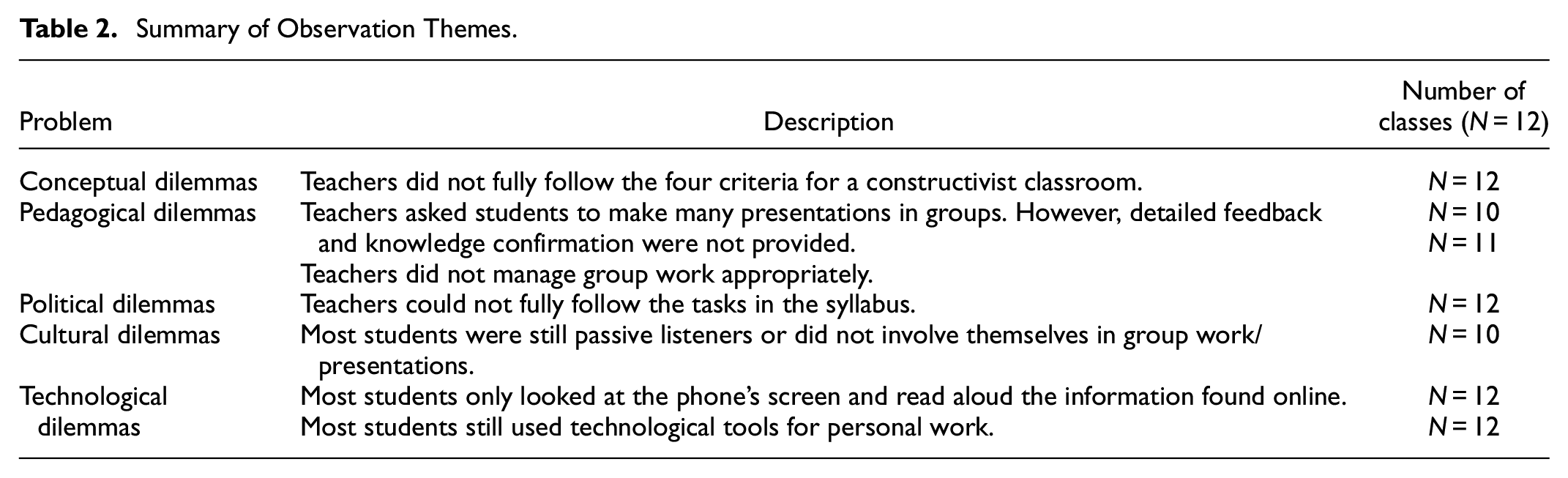
Table 2 reveals that a vast majority of the observed teachers had a wide array of difficulties in incorporating constructivism in their lessons, which could be put into five categories: conceptual, pedagogical, political, cultural, and technological dilemmas.
Summary of Observation Themes.
Questionnaire
The Cronbach’s alpha value of the questionnaire in the full-scale study was .93, and the values of “Corrected Item – Total Correlation” of all 18 items were larger than .3. Moreover, Cronbach’s alpha coefficients were calculated as .92 for Conceptual Dilemmas, as .824 for Pedagogical Dilemmas, as .828 for Cultural Dilemmas, as .954 for Political Dilemmas, and as .936 for Technological Dilemmas. These indicated that the questionnaire was of high reliability and consistence (Pallant, 2020). The 6-point Likert scale was interpreted as “Disagreement” (for points 1, 2, and 3), and “Agreement” (for points 4, 5, and 6).
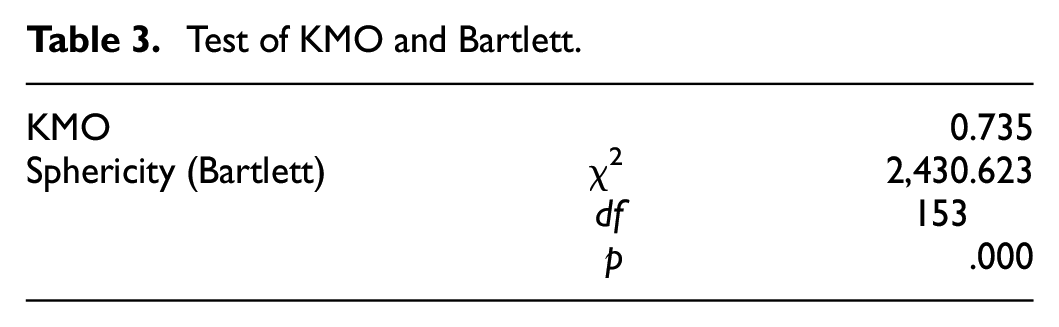
In order to examine whether each construct can be explained by its items, an EFA was conducted. The results revealed that all assumptions were met and that the observed variables (i.e., items) adequately explain the corresponding latent variables (i.e., constructs).
In Table 3, the first assumption of EFA was met (.5 < KMO value < 1, p < .01) (Kaiser, 1974). In Table 4, the second assumption was satisfied (Eigenvalue coefficient value >1.0, Total variance explained >50%) (Anderson & Gerbing, 1988). The last assumption (Table 5) of EFA was also met (factor loadings > .5) (Hair et al., 2009).
Test of KMO and Bartlett.
Total Variance Explained.

Rotated Component Matrix.

Therefore, it could be concluded that the questionnaire in the full-scale study was adequately validated, with five constructs corresponding to the five key challenges.
Teachers’ Conceptual Dilemmas
Table 6 indicates that most teachers had no trouble comprehending the constructivist approach; in other words, they believed they had a firm grasp of constructivism’s fundamental principles (General Mean = 2.64, General SD = 1.26). However, the observations revealed that all teachers (N = 12) did not fully understand the concept of constructivism. In particular, although they elicited students’ prior knowledge through warm-up activities, the vast majority did not generate cognitive dissonance or provide tasks for knowledge reflection. This was further strengthened by interview data as all of the interviewees’ answers to the question “Could you please tell me what constructivism is and what it requires?” did not adhere to constructivism. The followings were responses from two participants:
Descriptive Statistics for Conceptual Dilemmas.

Participant 4 shared, “Well, as far as I’m concerned, constructivism is about involving students in the lessons, letting them work in groups, having discussions, and presenting findings. I think this approach requires students to be more active.”
Having the same view, participant 7 said, “In my opinion, constructivism is, er…, a teaching methodology that … is more communicative than the traditional one. It focuses on, well, instructing students to contribute to the lesson by presenting their group’s ideas.”
Evidently, the answers mostly concentrated on group work, active learning, and presentations. These components do not necessarily characterize constructivism, as argued by Baviskar et al. (2009). Moreover, some participants misconstrued it as a teaching rather than a learning theory. Therefore, it could be inferred that the participants did not comprehend the concepts of constructivism as they claimed.
Teachers’ Pedagogical Dilemmas
As can be seen from Table 7, the majority of teachers had mixed opinions about the difficulties in pedagogy (General Mean = 3.33, General SD = 1.17). In fact, a one-sample t-test (t = −1.566, p = .12) shows that the General Mean value was not significantly different from 3.5, the middle point between 3.0 (Slightly Disagree) and 4.0 (Slightly Agree). On the one hand, they admitted that they asked students to present too much (M = 3.63, SD = 1.45) and that they could not accurately evaluate each individual (M = 3.67, SD = 1.31) as students mostly worked in pairs or groups. On the other hand, most teachers believed that they were able to manage collaborative work effectively (M = 2.70, SD = 1.30). This belief was, however, in contrast with the findings of the observations which revealed that most teachers failed to provide detailed feedback and knowledge consolidation (83.3%) or to manage group work properly (91.67%).
Descriptive Statistics for Pedagogical Dilemmas.

Analysis of interview data reveals that 6 out 10 participants shared the same view about this issue: “I feel desperate. I’ve tried many ways, even warnings to give minus scores, but many students just do private work during presentations. If I set my authority, that may interrupt the learning flow and atmosphere.” (Participant 10) “When they work in groups, it’s hard to give scores. You know who works and who doesn’t during discussions, but you can’t prove. You can’t just give them low scores.” Participant 6
Consequently, the participants had issues with their instructional strategies, but many refused to acknowledge these issues. This might directly result from their misunderstanding of constructivist notions as previously mentioned.
Teachers’ Cultural Dilemmas
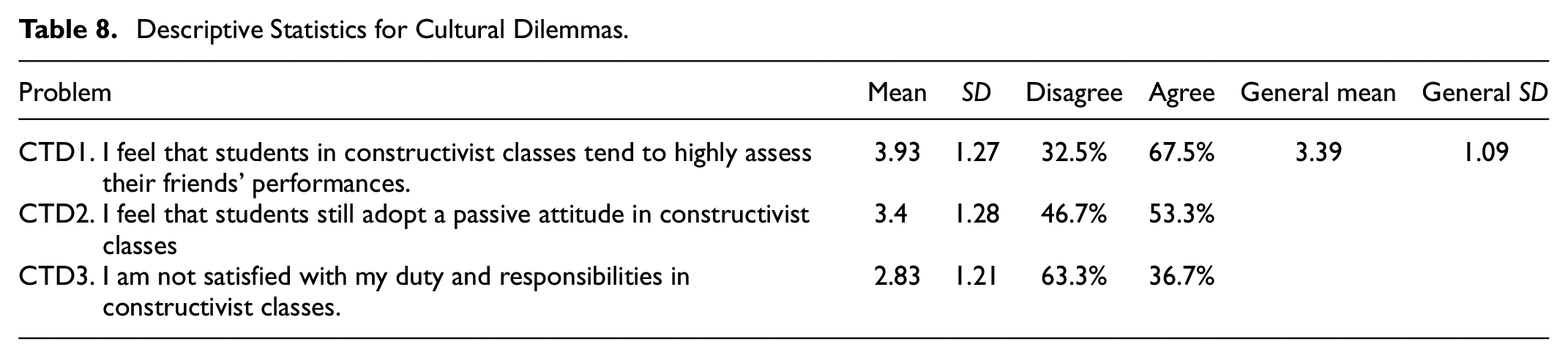
It can be inferred from Table 8 that most teachers had mixed views on cultural issues in constructivist classrooms (General Mean = 3.39, General SD = 1.09). The result of a one sample t-test (t = −1.149, p = .253) confirms that this Mean value was statistically equal to 3.5. Particularly, while 53.3% of the teachers believed that their students still had a passive attitude in a constructivist class, 46.7% did not. These mixed beliefs could be clarified by the observation data. In fact, in the observed lessons (83.3%), most students were passive listeners who were not really involved in group work or presentations, corroborating with the interviews’ results. Clearly, 70% of the interviewees had difficulty in motivating their students to speak, which was demonstrated in two participants’ remarks below.
Descriptive Statistics for Cultural Dilemmas.
“When I ask a question, only a few students volunteer to answer. When I specifically invite a person, especially a silent student, to speak, he or she just rambles around, wasting a lot of time.” (Participant 3) “You know, students just expect teachers to talk, and they just listen. They don’t want to be in the front and present information.” (Participant 4)
Thus, it could be concluded that teachers still faced issues related to culture, largely about motivating students to be active in the lessons.
Teachers’ Political Dilemmas
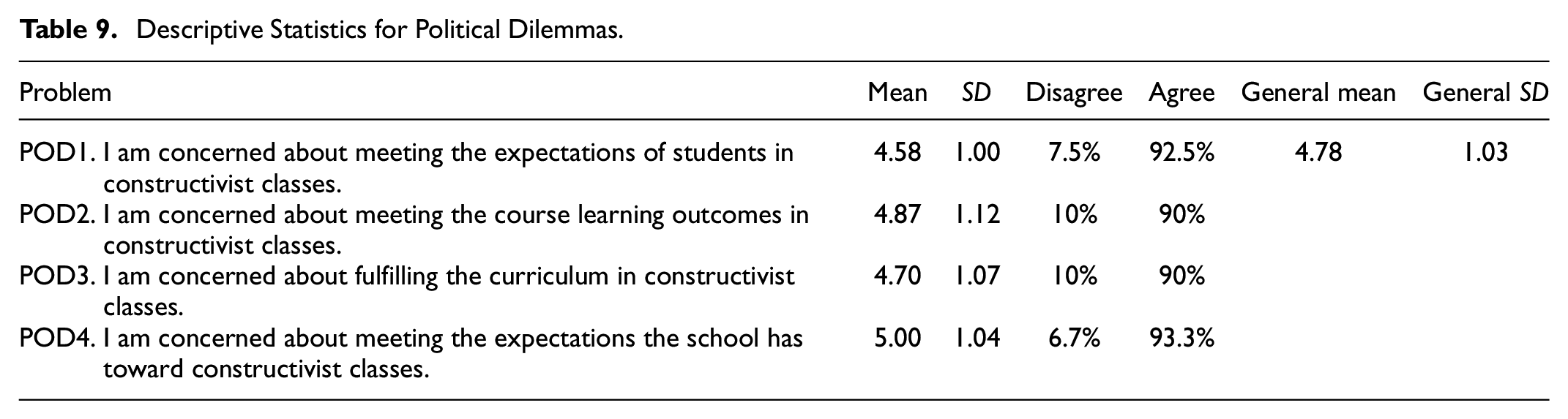
Political issues are the most bothersome for teachers (General Mean = 4.78, General SD = 1.03), as seen in Table 9. The teachers were concerned that the application of constructivism might not meet the expectations of educational stakeholders such as students, curriculum designers, and school leaders. This outcome was in line with the observations, which show that all teachers did not fully complete the required tasks. Detailed explanations were provided via the interviews, with 90% agreement from the interviewees:
Descriptive Statistics for Political Dilemmas.
“You know, when you ask students to work in groups, find answers, and present, it takes a very long time to finish the lesson. I often find my class way behind schedule.” (Participant 2) “I have to spend a lot of time preparing activities in advance so students can be more active in class. But in 90 minutes, I can only let two groups present while others just listen. I think many students find it a waste of time just coming to class and listening to their friends.” (Participant 9)
The three forms of data all reveal that teachers faced a lot of political obstacles, mostly about the lack of time required to fulfill the curriculum.
Technological Dilemmas
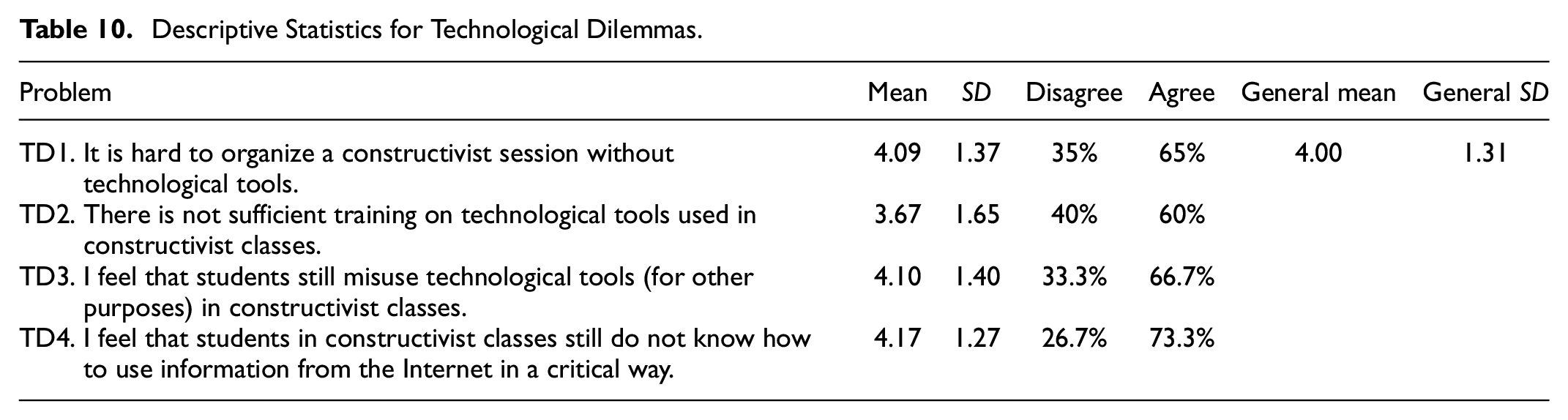
In a constructivist classroom, technological aspects could be seen as a problem (Table 10, General Mean = 4.00, General SD = 1.31). Indeed, the observation data indicate that most students seemed to misuse technological tools in the constructivist classroom. In fact, they used laptops and smartphones for private purposes or relied too much on these devices when presenting the information. Data from the interviewees (N = 7) shed light on these issues:
Descriptive Statistics for Technological Dilemmas.
Participant 6 stated, “Students are too addicted to social networking sites like Facebook or Instagram. They often chat with their friends and do private work, but I cannot do anything. When I asked them to stay focused, they said they were sharing information via Messenger.” Participant 10 explained, “Actually, I think students do not use online information appropriately. They simply copy and re-read everything they find. When they come to the front to present, they just look at the screen and read. I must admit that I don’t even understand what they said, let alone their friends.”
Obviously, when implementing constructivism in the classroom, the majority of teachers encountered five major challenges. However, it seemed that their beliefs were not always in line with classroom reality. In other words, the teachers were not fully aware of the challenges in the constructivist lessons.
Discussion
Via the employment of triangulated data, including a questionnaire, classroom observations, and semi-structured interviews, the present study uncovers three significant findings which are discussed in detail below.
Research Questions 1: Do EFL Teachers Still Confront Four Types of Issues Classified by Windschitl in Their Constructivist Classes?
The first finding is that EFL teachers experienced a wide variety of obstacles when attempting to implement constructivism in their lessons. These issues include conceptual, pedagogical, cultural, and political aspects. In other words, Windschitl’s (2002) framework of teachers’ dilemmas is still applicable to EFL constructivist classrooms in today’s educational context. In particular, most teachers lacked a solid command of the constructivist principles proposed by Baviskar et al. (2009); their lessons did not adhere to key components of constructivism, which was similar to the cases in the studies by Du (2013) and Lin (2015). This could be explained via the research by Vu (2020), which posited that teachers might not have appropriate training on how to incorporate constructivism into their classrooms. Another difficulty is related to pedagogy in which teachers did not provide students with adequate feedback or confirmation of obtained new knowledge. The explanation could be that there was an incompatibility between the traditional teaching approach (teacher-centered) and the constructivist approach (student-centered) (Tan, 2017). Besides this, cultures are also an issue that needs to be mentioned. Most teachers found that many students in constructivist classes were passive listeners who did not try hard enough to participate in group discussions or presentations. This difficulty can be well explained based on the research by Hằng et al. (2015). The authors argued that due to the influence of Confucianism, students were more likely to wait for and only value teachers’ information, not the knowledge presented by their peers. Finally, the political aspect is the most problematic for teachers when they could not follow the curriculum on time. O’Connor (2022) reported that the assessment structures and curriculum design in higher education are still not compatible with the constructivist approach, which led to time constraints.
The second finding is that, regarding conceptual, pedagogical, and cultural aspects, teachers’ beliefs and classroom reality did not match. Particularly, in the questionnaire (6-point Likert scale), most teachers did not believe that they had difficulties in comprehending the features of constructivism (Conceptual Dilemmas) (General Mean = 2.64, General SD = 1.26); about half of them did not admit having problems in certain dimensions of Pedagogical (General Mean = 3.33, General SD = 1.17) and Cultural Dilemmas (General Mean = 3.39, General SD = 1.09). However, classroom observations and semi-structured interviews revealed that these kinds of problems were prevalent in their constructivist lessons. There were two probable explanations for this inconsistency. For one thing, people in Confucian civilizations seemed to be hesitant to confess their weaknesses. As educators, it was even more challenging to accept that they did not comprehend a crucial educational concept such as constructivism. This was consistent with Hằng et al. (2015) and Berthrong and Berthrong (2000). These authors stated that social position, seniority, hierarchy, and respect were the norms within the Confucian culture, indicating that individuals of this culture tended to maintain their rank and strive to acquire the care of others. Another plausible explanation was that the participants lacked extensive training or research in constructivism (Vu, 2020), resulting in a superficial or inappropriate comprehension of the approach as demonstrated in the studies by Du (2013) and Lin (2015). The second finding is in line with Baviskar et al. (2009), who demonstrated that contrary to the claims of a number of educators and scholars, their in-class activities were not really constructivist.
Research Question 2: Do EFL Teachers Consider Technologies a Barrier in Their Constructivist Classes?
The results of the triangulated data show that technologies can also be perceived as a barrier in the constructivist classroom (General Mean = 4.0, General SD = 1.31). This finding aligns with past research on the integration of technologies into education (Alghamdi et al., 2020; Ertmer et al., 2012; Hall et al., 2020; Ramorola, 2013). There are two major factors why teachers consider technology a hindrance in their constructivist lessons. First, technological tools were crucial to constructivist classes’ success, but instructions and facilities, especially Internet connection, were not always available (Ertmer et al., 2012; Ramorola, 2013). Second, students tended to use technological tools for other purposes, such as entertainment (Alghamdi et al., 2020; Hall et al., 2020). Furthermore, according to the observations and interviews, students were more likely to read the phone’s screen rather than present information found online. These problems might refrain teachers from effectively integrating technologies into their constructivist lessons.
Therefore, it could be concluded that technological aspects should be added to the framework of Windschitl (2002) regarding teachers’ dilemmas when implementing constructivism in their classes. This addition could reflect the difficulties teachers often face in a more comprehensive way, which is relevant to the educational context in the 21st century when technologies have played crucial part in learning and teaching.
Concluding Parts
The present study aims to examine whether Windschitl’s framework of teachers’ dilemmas in constructivist classrooms is still applicable to today’s EFL context. It also seeks to explore whether technological aspects could be a barrier and thereby should be added to Windschitl’s (2002) framework . Via the employment of triangulated data, including surveys, observations, and interviews with the participation of a total of 120 EFL Vietnamese teachers in higher education, three significant findings were generated. First, it was found that teachers still encountered four types of problems related to conceptual, pedagogical, cultural, and political aspects, as described in the framework of Windschitl (2002). Second, based on the inferential and EFA analyses, it could be concluded that technologies are a major contributor to teachers’ obstacles in constructivist classes. Therefore, it is proposed that this aspect be added to the framework of Windschitl (2002). Another result was that teachers did not understand constructivism as much as they believed, probably due to the superficial comprehension of this approach or the influence of the Confucian culture.
However, there are three limitations to this research. First, it only investigates problems that EFL teachers often confront in constructivist classes; perspectives of teachers in other majors or fields warrant future studies. Second, as the participants were not very similar in characteristics (ages, years of teaching experience, regions), whether individual differences may affect their opinions remains unclear. Further research could further develop the topic by examining the mediating effects of these factors. Finally, the size of the sample is relatively small; therefore, other scholars could re-evaluate the outcomes by inviting more participants to join the research.
The present study formulates a variety of important implications for other researchers, teachers, students, and institutional leaders. Theoretically, it verifies and contributes to Windschitl’s (2002) framework of teachers’ dilemmas in constructivism implementation. In addition, it validates a scale to measure teachers’ common difficulties in constructivist classes based on a wide range of works (Alghamdi et al., 2020; Ertmer et al., 2012; Hall et al., 2020; Hằng et al., 2015; Huang & Teo, 2021; O’Connor, 2022; Ramorola, 2013; Tan, 2017; Windschitl, 2002). However, this scale should be adopted alongside other methods, such as interviews and observations, in order to generate data of high validity and reliability. Furthermore, it sheds light on the challenges teachers have to endure in organizing constructivist lessons, particularly in the EFL context. This contributes to the existing knowledge of constructivism, especially when there is very limited research on EFL teachers’ dilemmas.
Practically, institutional leaders need to assure that teachers receive appropriate formal training on constructivism based on the key components recommended by Baviskar et al. (2009), regardless of how well they believe they understand this concept. This helps avoid the misunderstanding and misinterpretation of constructivism as proved in the studies by Baviskar et al. (2009), Hằng et al. (2015), and O’Connor (2022). Moreover, teachers need to have frequent teaching practice with feedback and frequent self-reflection to acquire a deeper understanding of the constructivist approach (Vu, 2020). In other words, they should be put into the position of learners so that they can fully understand the concept and the perceptions of their students (Vu, 2020). Only by comprehending the essence of constructivism should teachers be able to adjust their pedagogy accordingly, specifically activating students’ prior knowledge, generating cognitive dissonance, conducting knowledge application as well as giving detailed feedback, and asking students to reflect on the newly learned information. Teachers can also organize activities such as problem-solving and project-based learning to promote students’ involvement into the lessons and their sustainable development (Kalsoom & Khanam, 2017; Lasen et al., 2015). As for the political aspect, school leaders should involve teachers in curriculum and assessment design so that they can offer revisions pertinent to their constructivist classes. Furthermore, curriculum and assessment structure should be modified in correspondence with how constructivism works (O’Connor, 2022). This is because the conventional approach (teacher-centered) is different from the constructivist approach (student-centered); the curricula and assessments are not easily interchangeable (O’Connor, 2022; Tan, 2017). Regarding technological dilemmas, it is recommended that institutional leaders need to equip each constructivist classroom with modern tools that work smoothly to ensure the quality of the lessons. Additionally, laptops and smartphones should only be used when necessary (i.e., when students do research to find answers to the given problem), under the supervision of in-charge teachers, to limit their distraction from academic practices (Hall et al., 2020). Finally, institutes can address the Confucian influence by organizing in-depth orientations in which teachers and students are clearly informed of their expected roles in class prior to the implementation of constructivism (Hằng et al., 2015; Windschitl, 2002). In particular, teachers should be aware that they only act as facilitators and that their students should be the key players (Hằng et al., 2015; Windschitl, 2002). As for students, they need to make clear that their contributions to the lessons are vital to their learning process, and that their performances will be assessed based on the amount of attention and contributions they make in their class.
In conclusion, it should be acknowledged that there are many obstacles teachers have to face when implementing constructivism in their lessons. Therefore, they need timely support from schools and policymakers, which is of vital importance as teachers tend to switch back to the traditional teaching approach if they are under stress or anxiety (Cansiz & Cansiz, 2019). The whole process would take a lot of time and efforts from multiple educational parties for the successful implementation of constructivism in EFL classrooms, conforming to the educational reforms and facilitating students’ sustainable growth.
Footnotes
Appendix
Appendix A. The survey

| Construct | Strongly disagree | Disagree | Slightly disagree | Slightly agree | Agree | Strongly agree |
|---|---|---|---|---|---|---|
| Conceptual dilemmas | ||||||
| CD1. I am not aware of the primary elements of social constructivism. | 1 | 2 | 3 | 4 | 5 | 6 |
| CD2. I am not aware of the procedure of social constructivism. | 1 | 2 | 3 | 4 | 5 | 6 |
| CD3. I am not aware of what social constructivism requires. | 1 | 2 | 3 | 4 | 5 | 6 |
| CD4. I am not sure whether activities in my classes are constructivist. | 1 | 2 | 3 | 4 | 5 | 6 |
| Pedagogical dilemmas | ||||||
| PD1. I rely too much on presentation tasks in constructivist classes. | 1 | 2 | 3 | 4 | 5 | 6 |
| PD2. It is hard for me to manage group work/pair work effectively in constructivist classes. | 1 | 2 | 3 | 4 | 5 | 6 |
| PD3. It is hard for me to assess students individually in constructivist classes. | 1 | 2 | 3 | 4 | 5 | 6 |
| Cultural dilemmas | ||||||
| CTD1. I feel that I do not bring much value to students in constructivist classes. | 1 | 2 | 3 | 4 | 5 | 6 |
| CTD2. It is hard for me to change from the role of a teacher to the role of a facilitator in constructivist classes. | 1 | 2 | 3 | 4 | 5 | 6 |
| CTD3. I am not satisfied with my duty and responsibilities in constructivist classes. | 1 | 2 | 3 | 4 | 5 | 6 |
| Political dilemmas | ||||||
| POD1. I am concerned about meeting the expectations of students in constructivist classes. | 1 | 2 | 3 | 4 | 5 | 6 |
| POD2. I am concerned about meeting the course learning outcomes in constructivist classes. | 1 | 2 | 3 | 4 | 5 | 6 |
| POD3. I am concerned about fulfilling the curriculum in constructivist classes. | 1 | 2 | 3 | 4 | 5 | 6 |
| POD4. I am concerned about meeting the expectations the school has towards constructivist classes. | 1 | 2 | 3 | 4 | 5 | 6 |
| Technological dilemmas | ||||||
| TD1. It is hard to organize a constructivist session without technological tools. | 1 | 2 | 3 | 4 | 5 | 6 |
| TD2. There is not sufficient training on technological tools used in constructivist classes. | 1 | 2 | 3 | 4 | 5 | 6 |
| TD3. Students still misuse technological tools (for other purposes) in constructivist classes. | 1 | 2 | 3 | 4 | 5 | 6 |
| TD4. I feel that students in constructivist classes still do not know how to use information from the Internet in a critical way. | 1 | 2 | 3 | 4 | 5 | 6 |
Appendix B
The observation template.DESCRIPTION OF A SOCIAL CONSTRUCTIVIST SESSION
Teacher: Subject: Lesson: Time and venue: Procedure

| Step | Teacher’s activity | Students’ activities | Individual/Pair/Group work | Field notes (Difficulties) |
|---|---|---|---|---|
Appendix C: Interview Questions
Acknowledgements
This study would not have been possible without the enthusiastic assistance of the participants and colleagues at my institution. A heartfelt thanks to all of them for their support.
Declaration of Conflicting Interests
The author(s) declared no potential conflicts of interest with respect to the research, authorship, and/or publication of this article.
Funding
The author(s) received no financial support for the research, authorship, and/or publication of this article.
Ethics Statement
All subjects participated voluntarily and provided their written informed consent to participate in this study. Research approval was granted by the school’s management board (463/QĐ-ĐHFPT).

Data Availability Statement
Data will be provided upon reasonable request.