




Abstract
Access to land remains a major factor in all productive activities in every society. Hence, this study examines the extent to which access to land influences the ability of the Federal Housing Authority (FHA) in the delivery of affordable housing to the middle and low-income earners in Nigeria with a specific focus on the Federal Capital Territory (FCT), Abuja. The study adopted survey approach with questionnaire and unstructured interview as major instruments of data collection. The study selected a sample size of 150 out of staff population of 430 which represents 34.9% of the study population. In analyzing the data, the study employed simple percentage, and arithmetic mean with the aid of the Statistical Package for the Social Sciences. The hypothesis of the study was tested with Pearson’s chi-square method. The findings of the study revealed that there is no significant difference among the staff of FHA in their perception of difficulty in access to land as a major challenge to the delivery of affordable housing in Abuja. Consequently, the study recommends that the Federal Government should take measure(s) that could enhance the FHA’s access to land with a view to reducing the cost of its houses for the citizenry. The amendment to the Land Use Act (1978) to simplify the process of securing land titles and eliminate the existing dual ownership of land titles in the country is long overdue.
Introduction
There is consensus among economists that land is the original and primary factor of production. This presupposes that in the milieu of production, land has no substitute; and that other factors of production, namely, labour, capital, and entrepreneur can only be useful with the availability of and access to land. Omirin (2002) shared this position when he asserts that “access to land and property rights is a major key in economic growth and development.” Similarly, Owoeye and Adedeji (2015, p. 10) posit that “land is fundamental to development, growth and housing delivery in any society.”
Housing provision is one of the basic needs of man in every society. The significance of decent housing in modern society cannot be overemphasized. Housing is essential to human being not just as a source of protection from the effect of sun, rainfall, and other climate conditions, but it also serves as a basic gathering point where important economic, social, and political activities are nurtured and pursued (Oladimeji, 2015, p. 1). Hence, access to land is vital to achieving efficient and sustainable housing delivery. Sustainable access to affordable housing delivery in Nigeria has, however, remained a challenge especially for the low and middle-income earners. According to Emiedafe (2015), “Nigeria with a population of about 174 million people is currently facing a national housing deficit of about 17 million units.” The level of the deficit has worsen over the years jumping from 7 million (1991) to 12 million (2002) and 14 million (2010) (Sapientvendors.com.ng/housing.in.nigeria).
It is instructive that access to affordable housing in the country is worsening in spite of housing delivery efforts by both government and private sector organizations. In other words, middle and low-income earners are increasingly unable to afford decent housing supply despite the continuous attempt at increasing housing stock by both formal and informal housing organizations in the country.
Against this back-drop that land is one of the essential factors in housing delivery; this study examines the effect of access to land in the delivery of affordable housing in Nigeria with specific focus on the Federal Housing Authority (FHA) in Abuja.
Statement of the Problem
Access to decent and affordable housing is one of the universal needs of man across societies. Over the years, successive Nigerian governments have tried to achieve the goal of affordable housing with several policy measures. Such policy measures include the establishment of the FHA in 1973 with a mandate to accelerate access of Nigerians to affordable housing and the setting of goals of particular housing units to be achieved within a given time frame (Amdii, 1993). Other examples of housing programs in Nigeria include the Shagari housing policy (1979), the 12,000 housing units target of 1994 and the 40,000 housing units per annum of the year 2002 (Oladimeji, 2015). In spite of plethora of these policies/programs, achievements in the delivery of affordable housing in the country remained abysmally poor. Olorunisola (2013) revealed that new housing construction by FHA is only 10,000 units per annum while 90% of housing delivery is through private developer. This ugly trend has limited the existing housing stock in the country thereby raising the prices of the available stock. Thus, Nigerians spend between 36% and 40% of gross income on rents. This level of expenditure has made decent housing unaffordable for the middle and low-income groups in the country.
Furthermore, houses constructed by the FHA are not priced at cheaper rates compare to those of private developers. The contradiction in Abuja, and other major cities in the country is that despite increasing housing stock, the number of people who could not secure affordable housing is on the rise. One pertinent question in this scenario is to ask for the place of access to land in the delivery of affordable housing especially for a government housing delivery agent such as the Federal Housing Authority (FHA)? This article therefore attempts to examine the effect of access to land on the delivery of affordable housing by the FHA in Abuja. The specific research questions in this direction are:
Hypothesis
This study is guided by the postulation that.
Method
The study location of this research is the headquarter of the FHA Abuja. The study population comprised of all the staff of FHA. The FHA has a staff strength of 430, out of whom 150 staff were selected as sample size. In drawing the sample population, stratified and judgmental sampling techniques were combined. The study adopted survey technique in obtaining its data. Data for the study were generated through a combination of both primary and secondary data. Questionnaire and unstructured interview provided primary data while secondary data were obtained through textbooks, journal articles, and Internet materials. Simple percentage, as well as the arithmetic mean, was used via the Statistical Package for the Social Sciences (SPSS’ version 17.0) in data analysis. The research hypothesis was tested with Pearson’s Chi-square.
Literature Review
Access to Land
Access to land remains a central issue to productive activities in general and housing provision in particular. Food and Agriculture Organization of the United Nations (FAO, 2002) observed that access to land is governed by land tenure systems. Land tenure is the relationship, whether legally or customarily defined, among people, as individuals or groups, with respect to land. In other words, land tenure system determines who can use what land, for how long, and under what conditions. Similarly, Quan (2006) defined access to land broadly as the process by which people individually or collectively gain rights and opportunities to occupy and utilize land (primarily for productive purposes but also other economic and social purposes) on a temporary or permanent basis.
Omirin (2002) conceived acquisition of land as comprising of availability of unusable lands, affordability of such lands, as well as by security of owner’s right. From the conceptualizations above, key elements in access to land are:
What processes and procedures are involved and how simple or complex are they? and
How affordable or otherwise to the citizen is the cost of acquisition of land?
Furthermore, FAO (2002) opined that the manner in which rights to land are distributed and used can be very complex. The group identified the various categories of land tenure as:
Private: The assignment of rights to a private party who may be an individual, a married couple, a group of people, or a corporate body such as a commercial entity or non-profit organization. For example, within a community, individual families may have exclusive rights to residential parcels, agricultural parcels, and certain trees. Other members of the community can be excluded from using these resources without the consent of those who hold the rights.
Communal: A right of commons may exist within a community where each member has a right to use independently the holdings of the community. For example, members of a community may have the right to graze cattle on a common pasture.
Open access: Specific rights are not assigned to anyone and no one can be excluded. This typically includes marine tenure where access to the high seas is generally open to anyone; it may include rangelands, forests, and so on where there may be free access to the resources for all. An important difference between open access and communal systems is that under a communal system, non-members of the community are excluded from using the common areas.
State: Property rights are assigned to some authority in the public sector. For example, in some countries, forest lands may fall under the mandate of the state, whether at a central or decentralized level of government.
Apart from the various forms of ownership discussed above, Quan (2006) pontificated that the processes of access to land include participation in both formal and informal markets, land access through kinship and social networks, including the transmission of land rights through inheritance and within families, and land allocation by the state and other authorities with control over land and landowners. In Nigeria, the current land tenure system is informally a combination of both the State tenured system and private ownership. From the foregoing, land tenure is the relationship, whether legally or customarily defined, among people, as individuals or groups with respect to land.
Affordable Housing
The concept of affordable housing has received tremendous attention from scholars to the point where it is regarded as being diverse, complex and elusive. Milligan, Phibbs, Fagan, and Gurran (2004) in Urban Research Center (2008, p. 5) opined that “affordable housing connotes housing that is responsive to the needs of households who do not have sufficient income to access adequate housing in the market without some form of assistance.” The UN-Habitat (2011, p. 9) broadly defined affordable housing as adequate housing in terms of quality and location, which does not cost so much as to prohibit its occupants from meeting other basic living costs or threatens their enjoyment of basic human rights. Scholars have also used the term decent housing to imply qualitative housing with essential amenities such as space, ventilation, and toilet. This means that two factors are essential in affordable housing; namely: quality of the houses in terms of facilities available, and the cost of acquiring the houses. Adejumo (2008, p. 2) elucidated on the second condition when he argues that affordable housing is a term used to describe dwelling units whose total housing costs are deemed affordable to a group of people within a specified income range.
The central issue of affordable housing is, therefore, economic and relates to households housing and non-housing expenditure and income as well as financial assistance like credit, loans, and subsidies open to them (Suhaida et al., 2011). It is instructive to note that there are varied approaches to measurement of affordable housing. In the United States and Canada, a commonly accepted guideline for housing affordability is a housing cost that does not exceed 30% of a household gross income. In some other instances, affordable housing is used to describe housing that a family group can acquire within a given period of time ranging between 15 and 30 years. In the words of the Center for Urban Pedagogy (2009), “when the government says affordable housing it means affordable for families in the middle or at the lower end of the income scale.”
The foregoing review shows that affordable housing refers to decent housing whose cost of either purchase or renting does not exceeds 30% of a household’s income. The concept of affordable housing becomes prominent in housing literature in the face of the existing reality of expensive nature of housing in the open market.
Effect of Access to Land on the Delivery of Affordable Housing
Access to land is one of the major factors in housing provision in general and affordable housing in particular. UN-HABITAT (2011) demonstrated that the availability of land at affordable prices is fundamental to expanding the supply of affordable housing and limiting the growth of new slums. Land remains a central constraint of increasing the supply of affordable housing in Asia. Low and middle-income households are, therefore, priced out of land markets in the vast majority of cities and have poor access to well-located land. Similarly, Abusah (2004) in his study of access to land for housing development: A review of land title registration in Accra, Ghana, used a questionnaire to obtain its data. He found that the backlog in the delivery of land and housing to Ghanaians cast doubt on government ability to give effect to the constitutional ideal of a more equitable dispensation of access to land. “The delays in, and long waiting periods for title registration increasingly lead to frustration and friction to would-be homeowners and investors alike” (Abusah, 2004, p. 11).
The situation in Nigeria is not too different from those of Asia countries and Ghana as shown above. Available literature revealed that access to land remains a complex subject in the sense that both customary rules and State participation are the dominant land tenure practices in the country. Prior to British rule, access to land was governed by customary rules with its attendant’s insecurity of tenure, incessant rancour, fraudulent sales of land, and marginalization of non-land holding family members, among others (Owoeye & Adedeji, 2015). The challenges associated with the customary land tenure system led to the promulgation of Land Use Act of 1978 with the aim of creating cheaper and easier accessibility for Nigerians.
However, the promulgation of the Land Use Act has not brought about any significant improvement in access to land for productive purposes in Nigeria. In the words of Owoeye and Adedeji (2015, p. 11), “therefore customary and state systems prevail in the country with the consequence of double purchase of the same land by the hoodlums locally called “Omo-oniles.” Adejumo (2008) corroborated this position thus: The constraints imposed by the land use act, a moribund and repressive act that hinders mortgage financing and creates enormous obstacles to private sector involvement in the housing industry and which has constrained the transfer of titles and made mortgage finance extremely difficult. As a result of land use act, obtaining the certificate of occupancy (popularly known as C of O) has become a big-time avenue for large-scale corruption.
Ugonabo and Emoh (2013) in their study of the major challenges to housing development and delivery in Anambra State identified lack of secure access to land among the multiplicity of factors inhibiting effective housing development in the state. Evidence abounds in urbanization studies in developing countries to buttress the fact that where land has been made available, even the poor have been able to provide themselves with some form of housing. “This assertion applies with equal force to Anambra State as even the very poor ones have been able to incrementally develop their residential houses even if it means one year one block until the building gets to livable stage” (Ugonabo & Emoh, 2013, p. 9).
The existing gap which this study tries to fill is the extent to which the FHA is constrained in its delivery of affordable housing by access to land in Abuja giving that one of the key responsibilities of the FHA is to accelerate access of Nigerians to affordable housing.
Data Presentation and Discussion
From Table 1, responses on the question of whether FHA faces difficulty in the acquisition of land in Abuja indicate a mean score of 3.72 which shows an existence of difficulty in land acquisition. Respondents also agreed that FHA usually seeks for allocation of land at the level of the Minister of the Federal Capital Territory (FCT) with a mean score of 3.97. However, respondents disagreed with the proposition that approval for land to FHA is usually obtained within a short duration with responses showing a mean score of 1.77.
Respondents’ Opinion on Land Acquisition as a Major Constraint to Housing Provision of FHA.

Source. Field Survey, August 2013.
Note. FHA = Federal Housing Authority, FCT = Federal Capital Territory, SD = Strongly Disagreed, D = Disagreed, U = Undecided, A = Agreed, SA = Strongly Agreed.
Furthermore, responses to the question of whether FHA usually pays the commercial rate for land allocation to the FCT for its housing programs reveal a mean score of 3.89 which implies an agreement. On the whole, the responses on the issue of land acquisition by the FHA show a mean score of 3.36 which represents an agreement that land acquisition is a major implementation constraint to FHA in housing provision.
Test of Hypothesis
Table 3 and the test of the hypothesis show that the Pearson chi-square value of 3.022 is less than the table value of 11.14. The research, therefore, rejects the alternative hypothesis and retains the null hypothesis. The null hypothesis states that there is no significant difference among FHA staff in their perception of difficulty in land acquisition as a major constraint to FHA in providing affordable housing for the middle and low-income earners. Furthermore, the grand mean score of 3.36 in Table 1, and the mean scores of the responses on each of the variables of land acquisition are an attestation to the conclusion reached on the test of the hypothesis above that difficulty in land acquisition is a major implementation constraint to FHA.
Respondent’s Opinion on Land Acquisition as a Major Constraint to Housing Provision of FHA.

Source. Field Survey, August (2013).
Note. FHA = Federal Housing Authority, SA = Strongly Agreed.
Chi-Square Tests.
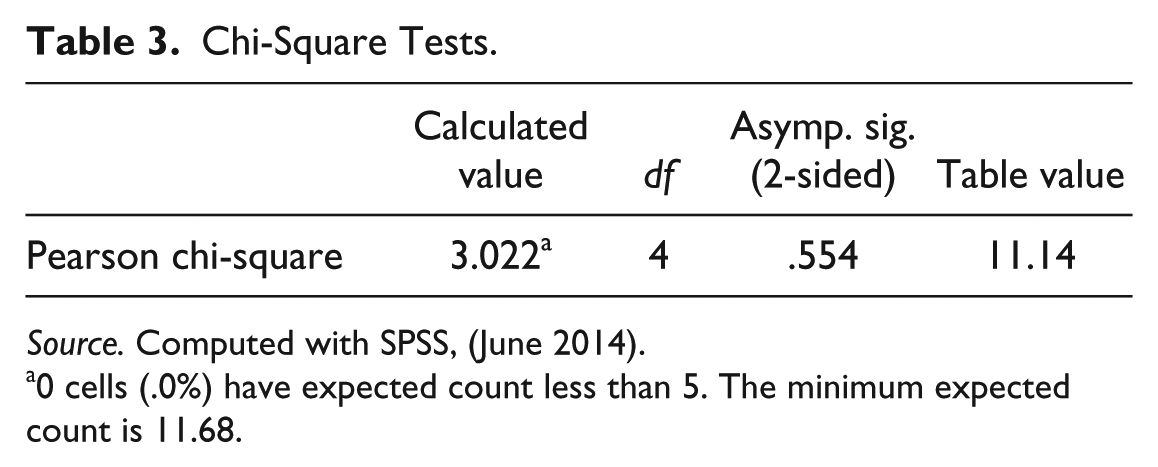
Source. Computed with SPSS, (June 2014).
0 cells (.0%) have expected count less than 5. The minimum expected count is 11.68.
Discussion of Findings
The result of the test of the hypothesis shows that there is no significance difference among the staff of FHA in their perception of difficulty being encountered in land acquisition. Acquisition of land is a major constraint to FHA in providing housing for the middle and low-income earners. Both the management and non-management staff of FHA are in agreement that land acquisition is a major problem to the effective and smooth operation of FHA. A close examination of the difficulty reveals that the procedure of securing land titles in the country is cumbersome and expensive. This situation has not only limited housing development, but it has also delayed the efforts of government agencies in housing provision in the country. As Aluko (2012, p. 120) rightly pointed out “the present land policy in the country is faced with many problems that make land acquisition difficult for corporate estates developers”.
As a result of this defective land policy (Land Use Act of 1978), the FHA land application usually takes a long time and is subjected to the same commercial rates which other corporate and non-government organizations in the housing sector pay. This arrangement is considered less than adequate for a government agency like the FHA, if it is to deliver affordable housing for the middle and low-income earners. Besides, subjecting a Government agency designed to promote access to home-ownership to the same market forces with privately owned organizations can only frustrate the efforts of such agency as the privately owned institutions will certainly perform better. Ikejiofor (1999) buttressed the difficulty in accessing land as a major challenge to housing development when he opined that “extensive and intensive literature searches reveal consensus among analysts that accessibility to land poses the greatest difficulty to urban housing production in many developing countries.”
According to Ugonabo and Emoh (2013) the fundamental difficulty in achieving land accessibility is the promulgation of Land Use Act of 1978 (Cap L5 LFN, 2005) which created a dual structure of land delivery systems, as customary and state systems prevail in the State with the consequence of double purchase from the customary owners and the State which has the effect of complicating the land accessibility process. They maintained that the Act rather than facilitate easier access to land has made it extra difficult for intending developers to get land while top government officials have been using it arbitrarily. “Ironically, an agency of the Federal government responsible for housing provision Federal Housing Authority (FHA) also identified difficulties in land acquisition as a major hindrance to housing delivery in the country” (Ugonabo & Emoh, 2013, p. 9).
Conclusion and Recommendations
Land is the number one factor of production. Without easy access to land, no productive activity could be undertaken. The delivery of affordable housing by the FHA has been largely constrained as the agency is usually subjected to a tortuous and complex process in securing access to land for housing delivery. In addition, the FHA is not given exemption (or subsidy) in payment of charges for land allocated it by the FCT Administration. The agency also has to pay compensation to indigenous claimants to a given land after the approval of the authorities has been obtained. Thus, FHA houses remained expensive and unaffordable for the middle and low-income earners in Abuja.
Another important factor in land acquisition with the FHA is the undue delay its applications usually suffer. This delay mostly emanates from administrative bottlenecks in government institutions part of which is the ministry of land and other agencies with responsibility for land allocation matters. This factor usually contributes to the delay in housing delivery by the authority.
Recommendations
To boost the capacity of the FHA in the delivery of affordable housing for the middle and low-income earners, the following measures are recommended to the Federal Government.
An amendment to the Land Use Act (1978) is long overdue and should therefore be undertaken. The objective of the amendment should be geared toward simplifying the process of securing access to land titles, especially for productive purposes. Dual ownership of land which currently prevails in the land markets must also be eliminated through the amendment.
A government agency such as the FHA should be given exemption from paying certain fees in its quest to delivering affordable houses for the masses. Such exemption will reduce the cost of housing delivery by the agency and invariably lowers the cost of its houses.
Authorities at the FCT administration should always facilitate processing FHA’s request for land thereby removing unnecessary delays which usually characterized land allocation.
Footnotes
Declaration of Conflicting Interests
The author(s) declared no potential conflicts of interest with respect to the research, authorship, and/or publication of this article.
Funding
The author(s) received no financial support for the research, authorship, and/or publication of this article.
