




Abstract
The social model of disability assumes that the university environment sometimes creates disability related obstacles and barriers. This study investigated faculty members’ attitudes toward students with disabilities and the latter’s capability to succeed in Saudi Arabian universities. The study surveyed 719 faculty members and conducted interviews with 8 faculty members from five Saudi universities. Data were analyzed using descriptive and thematic analyses. Differences in participants’ responses based on gender, previous experience teaching students with disabilities, academic college affiliation, academic rank, and years of experience were examined along with the types of professional development desired by faculty. Faculty members had positive attitudes toward students with disabilities and their abilities to succeed, but with statistically significant differences in terms of gender, academic rank, and college, with women, College of Education, and lower-ranking respondents being the most positive. Faculty members also wanted professional development opportunities to enhance these student’s educational experience.
Plain language summary
This study investigated faculty members’ attitudes toward students with disabilities and the latter’s capability to succeed in Saudi Arabian universities. A sequential explanatory mixed-method design comprises two stages: a quantitative stage, followed by a qualitative stage. The study surveyed 719 faculty members and interviewed eight from five Saudi universities. In conclusion, this study showed that faculty members in Saudi universities had generally positive attitudes toward SWDs and a desire to support them, which is consistent with other research. However, the participants disclosed that they lacked knowledge on various matters related to teaching SWDs. The findings might benefit stakeholders concerned with education policy-making in Saudi universities to help enhance the educational experience of SWDs and faculty members. The context of self-report and the non-random selection of the participants may limit the results. The participants were only selected from five universities, which may hinder the generalization of the findings to the larger population.
Keywords
In recent years, the number of students with disabilities (SWDs) attending higher education institutions has increased (Liasidou, 2014; Pumfrey, 2008; Seale et al., 2015). This growing number is due to several factors, including the development of laws and legislation that emphasize the need to provide inclusive education and the academic accommodations necessary for the success of SWDs. In addition, there is an economic aspect in that post-secondary education essentially enables individuals with disabilities to obtain employment opportunities that improve their quality of life by integrating them into society (Moriña, 2017a). Further, university education exposes SWDs to different experiences, which enhance their academic, social, personal, and self-determination skills (Alqazlan et al., 2019; Black & Roberts, 2009; Causton-Theoharis et al., 2009; Johnson & Nord, 2011; Jones et al., 2016) These advantages of university education have improved and enriched the educational process by providing greater diversity among students, thus benefiting all students regardless of whether they have disabilities (Jones et al., 2016; Moriña, 2017b).
Many studies have indicated that SWDs are more likely than their peers to withdraw and not complete further studies, and they may sometimes need more time to meet the graduation requirements (Lombardi et al., 2016; Wessel et al., 2009). Witte et al. (1998) and Wasielewski (2016) noted that SWDs graduate with lower grade point averages and need more time to graduate. These negative results are due to several challenges faced by SWDs in university education. Researchers divide these challenges into physical challenges, such as difficulty accessing different places due to urban structuring; social challenges, such as isolation and loneliness resulting from negative attitudes from peers and faculty members; and academic difficulties, such as faculty members being perhaps unaware of the needs of SWDs in relation to academic accommodations, overall course design, and low perceptions of self-efficacy (Alnahdi, 2020; Fleming et al., 2017; Hong & Himmel, 2009; Shevlin et al., 2004; Sniatecki et al., 2015; Stodden et al., 2001).
Theoretical Framework
This study relied on the social model of disability, which considers disabilities as a socially constructed condition rather than an attribute of the individual (Barney, 2012). In this model, the issue that must be addressed concerns the relationship between the individual and an inhospitable social context (Barney, 2012; Bingham et al., 2013; Palmer & Harley, 2012). Individuals with disabilities can be isolated and excluded from daily activities (Bingham et al., 2013), which may result from society’s negative attitudes toward individuals with disabilities and its reluctance to eliminate environmental impediments to full participation (Palmer & Harley, 2012)
Social acceptance and the availability of supporting facilities are essential factors that influence the academic performance of SWDs (Costea-Bărluţiu & Rusu, 2015; Lombardi & Murray, 2011). The social model of disability assumes that the university environment sometimes creates obstacles and barriers (e.g., practices, attitudes, policies) that prevent the inclusion of SWDs. Given such a context, universities must try to develop comprehensive teaching systems and strategies that encourage SWDs to complete their studies (Tugli et al., 2014).
One critical issue that universities should consider is faculty attitudes. The term attitude refers to a psychological variable that predicts behavior and comprises cognitive, emotional, and behavioral dimensions (Triandis, 1971). Attitude can be defined as a learned phenomenon that guides the behavior of individuals and may affect their decision-making processes (Greenwald, 2014). In the teaching profession, attitudes play an important role as teachers’ attitudes are related to their teaching behavior and the success of SWDs; such attitudes have been found to reflect the degree to which they favor or support the profession (Casey & Childs, 2017; Kunter et al., 2013). This finding is consistent with research showing that positive faculty practices in working with SWDs are closely related to faculty members’ attitudes. Attitudes may enhance or hinder the success of SWDs in their university education (e.g. Zhang et al., 2018).
This study also applied information integration theory to highlight the importance of professional development for faculty members. Information integration theory considers that the attitudes of individuals reflect their knowledge of a subject. Therefore, it is possible to change individuals’ attitudes on an issue by introducing new information. Thus, information integration is the basis for an attitude adjustment. For example, it facilitates a contemporary understanding of disability by encouraging the provision of information to transform people’s attitudes (Oliver, 1996).
Review of Related Literature
Faculty attitudes are influential as faculty members are directly responsible for providing pedagogical material to students (Baker et al., 2012; S. Becker & Palladino, 2016). Concerns have been raised regarding faculty members’ attitudes toward SWDs. In one study, seven SWDs (with visual disability, hearing disability, and physical disability) indicated their concern regarding faculty members’ attitudes and their lack of knowledge and skills to work with SWDs, which places students in various embarrassing situations (Moswela & Mukhopadhyay, 2011). The term disability may negatively affect faculty members’ attitudes, as they may be insensitive to the needs of SWDs (Houck et al., 1992; Sakız & Sarıcalı, 2018). The influence of attitudes has repercussions for the students’ efforts and results. Faculty members with negative attitudes toward SWDs tend to have lower expectations, which leads to reduced learning opportunities (Logan & Wimer, 2013).
Moreover, such attitudes affect students’ decisions in terms of seeking the help they need and makes it difficult for them to attain success; consequently, they do not make the necessary effort (Fleming et al., 2017; Murray et al., 2008). Negative attitudes may manifest as generalization and stereotyping of individuals with disabilities, negative comments about the student’s disability, and failure to provide accommodations that students need (Dowrick et al., 2005; Fekete, 2013; Fleming et al., 2017). In contrast, positive attitudes among faculty members help students feel comfortable disclosing their disability and requesting academic accommodations, which contributes to the academic success of SWDs (Reynolds & Hitchcock, 2014).
A review of studies on faculty attitudes toward SWDs at universities showed mixed results. Some studies reported negative attitudes (Duquette, 2000; Gaad & Almotairi, 2013; Ryan & Struhs, 2004; Tremblay et al., 2008) while others reported positive attitudes (Baggett, 1994; M. Becker et al., 2002; Benkohila et al., 2020; Bourke et al., 2000). A recent shift toward positive attitudes may be due to the enactment of legislation and regulations that have given individuals with disabilities the right to live with appropriate support, access education, and participate in community activities. Andini et al. (2019) reported that all faculty members who participated in their study accepted the enrollment of SWDs at the university, which also accords with a study that showed that faculty members believed in the right of SWDs to enter universities and colleges (O’Connor et al., 2012).
However, positive attitudes are not necessarily associated with the knowledge and skills required to teach SWDs. The same studies where faculty members showed positive attitudes also found a need for professional development concerning SWDs’ needs, and for teaching strategies and academic accommodations to prepare and qualify them to teach SWDs (Colón et al., 2018; Houck et al., 1992; Sniatecki et al., 2015). Faculty members who received training through lectures and workshops on SWDs had more positive attitudes, self-efficacy, satisfaction, and willingness to work with these students, thus providing quality education that was reflected in students’ performance (Lombardi et al., 2011; Murray et al., 2009; Park et al., 2012).
Several variables related to faculty attitudes have been investigated. Sánchez et al. (2018) and Abu-Hamour (2013) found that women showed more positive attitudes toward teaching SWDs in higher education. However, some studies report no statistically significant differences in faculty attitudes based on gender (Alhaznawi & Alanazi, 2021; Costea-Bărluţiu & Rusu, 2015), while others report no differences in faculty attitudes associated with specialization, or previous experience with SWDs (Abu-Hamour, 2013; Costea-Bărluţiu & Rusu, 2015). Only one study reported that faculty members with previous experience with SWDs tended to have more positive attitudes (Sánchez et al., 2018). A study by Alhaznawi and Alanazi (2021) in Saudi Arabia found that faculty members’ attitudes differed by academic rank, with low-ranking faculty showing more positive attitudes.
Higher Education for SWDs in Saudi Arabia
In Saudi Arabia, the admission of SWDs into university education is a relatively recent phenomenon. Admission was initially limited to the visually impaired in some universities, after which universities began accepting students with different disabilities to study in inclusive education with their peers. However, the number of SWDs at university level comprised only 4,130 students in 2021 (Authority for the Care of Persons with Disabilities, personal communication, March 3, 2021). Further, some categories of disability have less chance of acceptance, such as students with intellectual disability, autism, or multiple disabilities. There is a need to put more effort to guarantee the rights of people with disabilities in accepting students from different types of disabilities at the university level and providing reasonable accommodations to enable them to access the curriculum.
Study Purpose
In line with international trends and the application of local legislation, Saudi Arabia is committed to providing SWDs with the opportunity to enroll in college and to provide the support they need to succeed. Faculty members’ attitudes toward SWDs influence student success. Studies have also shown that faculty professional development in relation to SWDs, their characteristics, and their teaching practices contributes to positive attitudes and practices among faculty (Rao, 2004).
Despite the increase in studies on higher education related to individuals with disabilities, further research is needed, especially in relation to the situation in Saudi Arabia. The admission of SWDs into Saudi universities and the acceptance of multiple categories of disabilities are a recent phenomenon. Research on higher education concerning SWDs in Saudi Arabia is limited, with most studies focused on how to accommodate such students or on a specific category, and relying on a single data collection method (e.g., Alhaznawi & Alanazi, 2021). This study aimed to explore the attitudes of faculty members regarding SWDs in reference to three aspects: willingness of faculty to be supportive of SWDs, abilities of SWDs to be successful at university level, and abilities of SWDs to compete academically at a high level, compared to other students. It also aimed to identify professional development opportunities wanted by faculty.
This study adds to the literature by applying a mixed-methods design that considers different types of disabilities and a wide range of universities in Saudi Arabia to answer the following questions:
What are Saudi university faculty members’ attitudes toward SWDs concerning supporting SWDs, their abilities to succeed at the college level, and their abilities to compete at a high level academically?
Are there statistically significant differences among the participants’ responses based on disability categories, gender, college affiliation, academic rank, and number of years of service?
What professional development opportunities do faculty members need to teach SWDs?
Methods
Study Design
A sequential explanatory mixed-method design comprises two stages: a quantitative stage, followed by a qualitative stage (Creswell et al., 2003). Following this approach, the participants were first administered a survey (quantitative data) to understand the research problem. Then, the findings guided the construction of interview questions (qualitative data), with participant responses used for analysis to address the research questions (Creswell et al., 2003; Tashakkori & Teddlie, 1998).
Participants
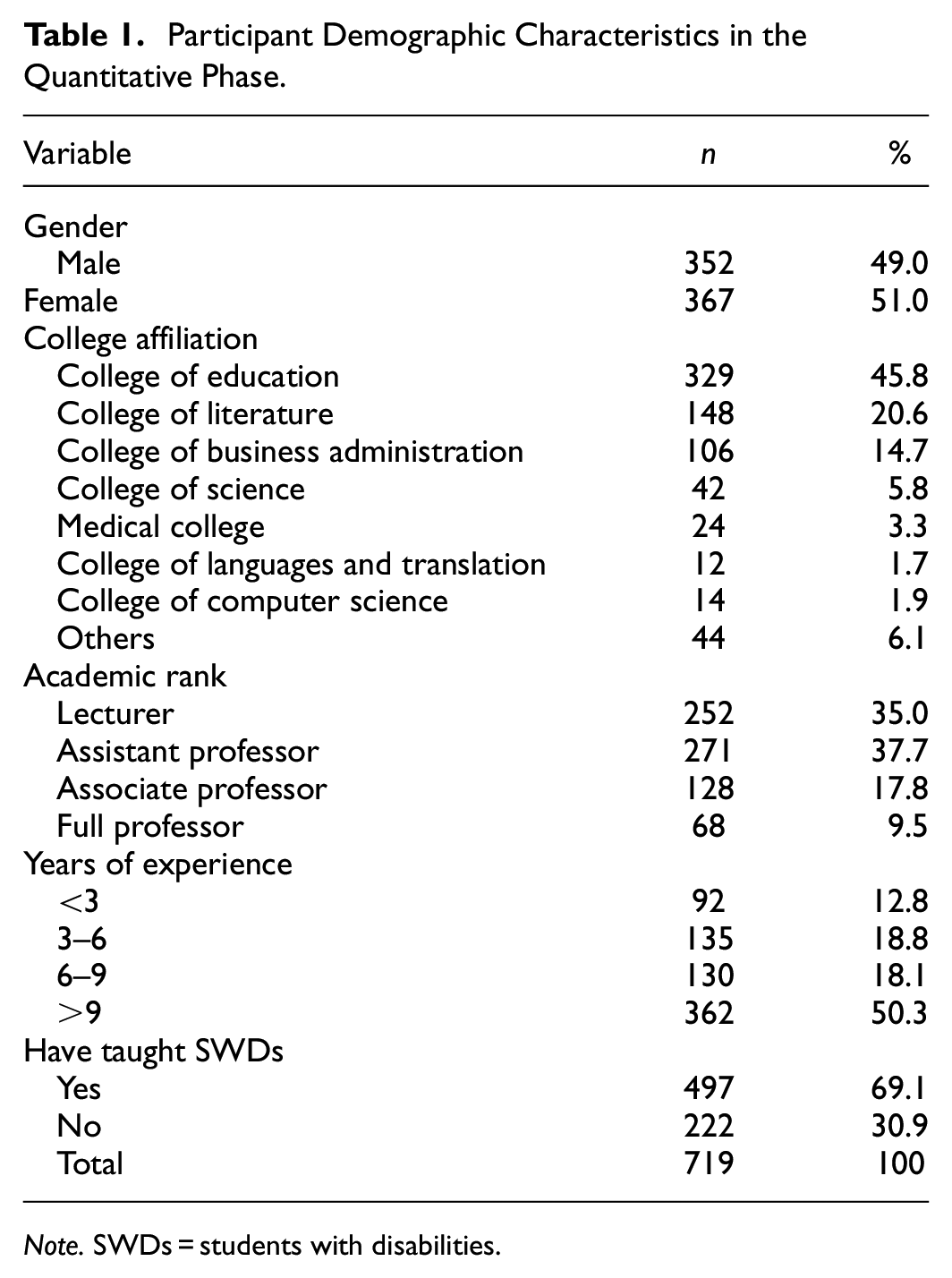
In this study, a total of 719 participants completed and returned the survey; most participants (N = 497) had previously taught SWDs. Table 1 shows the participants’ demographic characteristics. Eight faculty members, from those who indicated willingness to be interviewed and had previously taught SWDs, were selected to participate in the interview phase. Participant demographic characteristics in the qualitative phase are presented in Table 2.
Participant Demographic Characteristics in the Quantitative Phase.
Note. SWDs = students with disabilities.
Participant Demographic Characteristics in the Qualitative Phase.

Note. M = male; F = female; ASST = assistant professor; L = lecturer; ADHD = attention-deficit/hyperactivity disorder.
As shown in Table 1, the percentage of participants affiliated with the College of Education constituted the highest percentage (45.8%), with the lowest percentage from the College of Languages and Translation (1.7%). Half of the participants (50.3%) had more than nine years of work experience and most (69.1%) had previously taught SWDs.
Survey Approval Process
After obtaining ethical approval from the appropriate institutional review board of King Saud University, the researchers mailed the Deanships of Scientific Research at five public universities in Saudi Arabia for permission to conduct the first phase (quantitative) of the study at their institutions. The e-mails explained the purpose of the survey and invited the universities to forward the survey link to the faculties in different colleges. The first page of the survey informed the participants concerning the confidentiality of the information, that participation was voluntary, and that participants had the right to withdraw at any time.
Data Collection Methods
The First Stage: Survey
The study was conducted during the spring of 2021. The quantitative data were collected using an online survey employed by Sniatecki et al. (2015) to ascertain faculty members’ attitudes and professional training requirements related to teaching SWDs. Permission was obtained to translate and modify the survey. The researcher back-translated the survey as follows: translation of the questionnaire items into Arabic by a translation specialist, translation of the Arabic responses into English by a specialist, and comparison of the two English versions.
The survey comprised four sections. The first page introduced the purpose of the study and defined the terms within the questionnaire to ensure that it would be understood by the participants. The first section consisted of demographic information questions (gender, college, academic rank, number of years of experience, previous experience teaching SWDs, and type of disability). The second section consisted of 15 statements regarding faculty members’ attitudes toward supporting SWDs and the abilities of SWDs in terms of academic success. Participants were asked to indicate their attitude on a 4-point Likert-type scale (strongly agree = 4, agree = 3, disagree = 2, strongly disagree = 1). The third section included an open-ended question that referred to whether they had provided any advice to SWDs regarding changing their major discipline. The fourth section consisted of nine areas for professional development in teaching SWDs. Participants were asked to select those areas in which they desired to be given professional development opportunities.
Validity and Reliability of the Survey
The researcher presented the survey instrument to a group of faculty members from Saudi universities to verify its validity and to ensure its clarity and relevance. The instrument was modified based on the experts’ feedback. The researcher conducted a pilot study on 36 faculty members, with a Cronbach’s alpha coefficient of α = .90.
The Second Stage—Semi-Structured Interviews
The qualitative data were collected using a semi-structured interview conducted online. In qualitative research, in-depth interviews allow the researcher to obtain information on participants’ unique perspectives in relation to their thoughts and feelings (Merriam, 1998). The semi-structured interviews included four questions on a number of issues that were derived from consideration of the quantitative data and the literature review. The interview questions were evaluated by a group of expert faculty members to ensure validity. The main issues on which the questions were based included: factors that affect the success of SWDs, barriers faced by faculty members, support provided to SWDs by faculty members, and support needed for faculty members to work with these students.
Before each interview, the researcher provided a copy of the Human Subjects Consent Form and discussed the contents to determine if the participants had any questions regarding the study. The interviewed participants were given pseudonyms to protect their privacy. The interview lasted between 30 and 60 minutes. Field notes were used during the interviews to record phrases used by the participants, which were then used to identify possible themes.
Two techniques suggested by Zohrabi (2013) were used to ensure the trustworthiness of the qualitative data. First, method triangulation was applied using multiple data collection methods. Second, faculty member participants were sent the interview transcripts to confirm the accuracy and reliability of the data.
Quantitative Analysis Procedure
The quantitative data were analyzed using the statistical program SPSS. Descriptive statistical analysis (e.g., mean [M] and standard deviation [SD]) was conducted to investigate faculty attitudes toward SWDs in related to supporting SWDs, SWDs’ abilities to achieve success at the college level, and SWDs’ abilities to compete at a high level academically. The study used t-tests and one-way between-groups ANOVA with post hoc tests to examine the effect of disability categories and the demographic variables on faculty members’ attitudes toward SWDs.
Qualitative Analysis Procedure
The study employed Braun and Clarke’s (2006) approach to analyze the qualitative data using a thematic analysis method. First, the data were read and reviewed several times, with relevant notes and ideas obtained for coding. Then, category construction was initiated by developing the initial codes taken from the interview questions. The deductive-inductive approach was used to connect interview question responses to the research questions. Other codes were developed inductively as the researcher read over the transcripts and looked for recurring ideas and interesting thoughts that might help form potential themes. Finally, thematic categories were created and refined until a group of themes was finalized.
Results
The first and third research questions were addressed using both quantitative and qualitative methods, while the second research question was addressed using statistical analysis. The results of the survey are provided as descriptive analysis, while the results of the interviews are presented as extracts based on common themes. Results for each research question are presented below.
Q1: What are Saudi university faculty members’ attitudes toward SWDs concerning supporting SWDs, SWDs’ abilities to succeed at the college level, and SWDs’ abilities to compete at a high level academically?
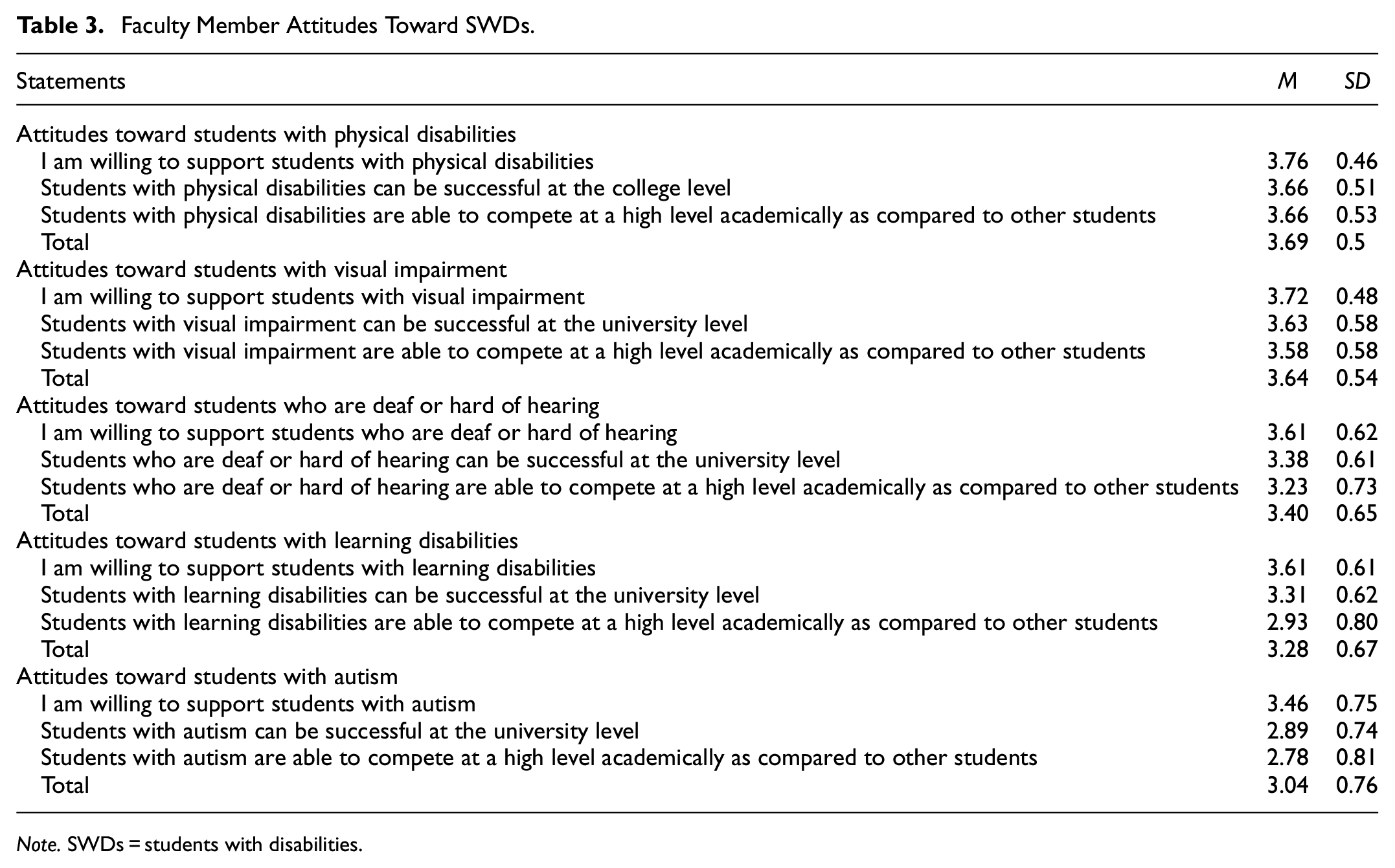
As shown in Table 3, the faculty members in this study responded to 15 items regarding their attitudes toward SWDs (physical disabilities, visual impairment, hearing impairment, learning disabilities, autism) and their abilities to succeed. The faculty responses (n = 719; M = 3.41, SD = 0.40), as shown in Table 3, indicated that the faculty members showed positive attitudes toward supporting SWDs and that they believed these students could compete with their colleagues.
Faculty Member Attitudes Toward SWDs.
Note. SWDs = students with disabilities.
The mean scores of the participants showed that their attitudes toward students with a physical disability had the highest level of agreement (M = 3.69, SD = 0.5), followed by those toward students with visual impairment (M = 3.64, SD = 0.54), hearing impairment (M = 3.40, SD = 0.65), and learning disabilities (M = 3.28, SD = 0.67). According to the participants’ responses, the lowest-scoring statements related to attitudes toward students with autism (M = 3.04, SD = 0.76). Positive attitudes were reflected in the desire of faculty members to provide support to SWDs, as the statement “I am willing to support students with physical disabilities” received the highest level of agreement (M = 3.76, SD = 0.46), followed by the statement “I am willing to support students with visual impairment” (M = 3.72, SD = 0.48). The two statements related to the abilities of students with physical disabilities that were ranked third and fourth were “Students with physical disabilities can be successful at the university level” ranking third (M = 3.66, SD = 0, 51), followed by the statement “Students with physical disabilities are able to compete at a high level academically as compared to other students” (M = 3.66, SD = 0.53). The lowest-scoring statement, according to the participants’ responses, was “Students with autism can be successful at the university level” (2.89, SD = 0.74), followed by “Students with autism are able to compete at a high level academically as compared to other students” (2.78, SD = 0.81).
An open-ended question asked the participants whether they had ever advised a student to change their major discipline due to their disabilities; only 12.8% answered affirmatively. An analysis of their responses showed that most of the participants directly talked to the students. Two of the participants discussed the issue with the student and their families. One of the participants addressed the issue with a social worker at the university, while another participant stated that he did so indirectly by informing the student concerning the complexity and effort involved in the course material.
In the thematic analysis of the qualitative interview data, three themes emerged regarding faculty members’ attitudes toward SWDs, namely, attitudes toward SWDs, factors affecting their successes, and barriers identified in teaching SWDs.
Faculty Members’ Attitudes Toward SWDs
All eight faculty members who were interviewed expressed positive attitudes toward SWDs, SWDs’ academic abilities, and SWDs’ competitive abilities. Indeed, some participants reported that SWDs sometimes outperformed their colleagues. Dr. Noor, who had previously taught students with visual disabilities, answered the question about SWDs achieving high grades by stating that “they can succeed at the highest level, as evidenced by the fact that one of the students with visual impairment obtained the highest rate and was first in the class.” Furthermore, Fahad added that “for the first time in my working life of 25 years, I did not give a grade of 100% except to a hearing-impaired student.” He further stated that “students with hearing impairment show interest in attending lectures, participation, and asking questions.” Moreover, he mentioned an example of a student who cared about their studies: “The student was on his way back from work and stopped in the car when the lesson began and started following the lesson through the Zoom program.” In addition, Dr. Noor declared that SWDs desired to study beyond the bachelor’s degree and enter graduate studies. Similarly, Dr. Rana mentioned that some students with hearing impairment were applying to graduate school.
Regarding whether certain majors should be allocated to specific categories of disabilities, seven participants explained that SWDs have the right to apply for any major, after which they are then evaluated to identify whether they are suitable for the major and its requirements. However, Dr. Ali noted deficiencies in some disciplines in relation to some categories of disabilities, such as for students with physical disabilities, who find medical school studies challenging.
The participants also showed positive attitudes toward teaching SWDs. Dr. Fahad mentioned that he had learned sign language to help in working with students with hearing impairment. Lecturer Rasha also mentioned having read many articles to help understand the characteristics of students with hearing impairment and develop appropriate teaching strategies. Furthermore, Dr. Noor and lecturer Rasha believed that teaching SWDs was an interesting and rewarding experience. For example, Dr. Noor said, “I do not feel that it is difficult to teach SWDs [visual impairment] because I am interested in teaching them, and I learn from their patience, diligence, and persistence.”
These positive attitudes also appeared through faculty members being willing to provide various types of academic accommodations to meet the needs of SWDs. Dr. Ali stated that he “provides academic accommodation such as giving extra time during exams [and] the method of submitting requirements without giving additional grades.” He also allowed SWDs to communicate with him via phone outside working hours. Dr. Rana accommodated SWDs by giving out notes before the lecture, which allowed them enough time to read the lecture. Dr. Rana also offered tutoring sessions for SWDs before examinations and met with the students every month to review the material. Lecturer Rasha also accommodated SWDs, stating, “I deleted two sections from the course I teach, [English] listening and speaking, because it is hard on students …. As the English language is not their native language and because of their disabilities. They cannot speak, and their writing is weak.” Lecturers Maha and Rasha used various methods to communicate with SWDs outside the classroom, such as e-mail, phone, meetings during office hours, and social media.
Factors Affecting SWDs’ Success at the College Level
In terms of factors that help SWDs to succeed, Fahad stated that a friendly relationship with SWDs and encouragement are essential. Four participants referred to the family environment as a critical factor that affects the success of SWDs. Dr. Ali said: If the student finds help and care within the family, he will do well within the university. The university is required to support SWDs, but family support begins through providing psychological and emotional assistance, understanding the student’s needs, and helping the student study.
Lecturer Maha mentioned concerning one student that “even if the student has multiple disabilities, she is excellent, and her family supports her.” In addition, Dr. Rana and Dr. Noor emphasized the effect of psychological factors on students, especially on being accepted by faculty members and faculty members’ willingness to provide appropriate academic accommodations. Dr. Naif noted the importance of using suitable presentation slides that organize information effectively, employing a multisensory method to present the course materials, and providing appropriate academic accommodations. In addition, lecturer Rasha stressed the importance of the educational environment for success at the highest levels for SWDs, which needed to include trained faculty, an appropriate curriculum, and support services, such as sign language interpreters.
Barriers to Teaching SWDs
The difficulties faced by faculty members varied and were not always present in all universities. One barrier that all the participants agreed on was their lack of knowledge concerning SWDs before the first lecture, which sometimes led them into embarrassing situations. Faculty members at some universities stated that a lack of sign language interpreters and appropriate resources were barriers. Lecturer Fahad mentioned that only two sign language interpreters were available, and consequently, it was difficult for them to deal with all of the courses. Dr. Naif said, “Sometimes there were no interpreters, which led to situations with students with hearing disabilities not having a sign language interpreter during the lecture.” Dr. Naif stated that the university allocated money to each student with visual impairment so that they could use a reader during examinations, but some students used the money for other purposes due to their economic situation. Moreover, Dr. Naif suggested that “it may be better if the Student Support Center provided a reader for students.” In contrast, Dr. Rana was proud of the SWD support center’s work at her university.
As a further barrier, two participants mentioned the inadequacy of some curricula in relation to the characteristics of SWDs. For example, Rasha and Fahad reported that the English language course was difficult for students with hearing impairment. It contained sections on speaking and listening skills, which prompted Rasha to delete these two sections; however, it was then difficult to evaluate the learning outcomes specified by the quality indicators. Dr. Naif discussed the challenges of explaining mathematical problems in physics and chemistry courses for students with visual impartment using Braille. Furthermore, lecturer Rasha reported that courses or lectures outside the curricula are lacking for students with hearing impairment. Moreover, lecturer Maha and Dr. Rana mentioned that teaching and providing accommodations for SWDs require more effort and time. This sometimes led to difficulties in offering such accommodations due to an increased practical and teaching burden on faculty members.
Q2: Are there statistically significant differences among the participants’ responses based on disability categories, gender, college affiliation, academic rank, and number of years of service?
Disability Categories
As shown in Table 4, a repeated measures analysis of variance ANOVA revealed that there were significant differences in the faculty members’ attitudes and willingness to support SWDs, the ability of SWDs to be successful at the university level, and the ability of SWDs to compete academically at a high level based on disability categories (p = .000).
Differences in Faculty Members’ Attitudes.

Note. p < .01.
Post hoc comparisons revealed that faculty members had positive attitudes toward supporting SWDs. The most positive attitudes were toward those with physical disabilities (M = 3.76, SD = 0.46), followed by visual impairment (M = 3.72, SD = 0.48), hearing impairment (M = 3.61, SD = 0.62), learning disabilities (M = 3.61, SD = 0.61), and autism (M = 3.46, SD = 0.75).
Regarding faculty members’ attitudes toward the ability of SWDs to be successful at the university level, the participants generally showed positive attitudes, with differences across the disability categories. Physical disability again reflected the highest positive attitudes (M = 3.66, SD = 0.51), followed by visual impairment (M = 3.63, SD = 0. 58), hearing impairment (M = 3.38, SD = 0.61), learning disabilities (M = 3.31, SD = 0.62), and autism (M = 2.89, SD = 0.74).
In addition, the participants showed positive attitudes toward the abilities of SWDs to compete academically at a high level, compared to other students. However, there were significant differences among the disability categories at the level of 0.01. The highest positive attitudes again were in relation to physical disabilities (M = 3.66, SD = 0.53), followed by visual impairment (M = 3.58, SD = 0.58), hearing impairment (M = 3.23, SD = 0. 73), learning disabilities (M = 2.93, SD = 0. 80), and autism (M = 2.78, SD = 0.81).
Gender and Teaching SWDs
As shown in Table 5, there were statistically significant differences between men and women in their attitudes toward SWDs, t (2.87) = 0.004, p < .01, with attitude mean scores higher among women (M = 3.45, SD = 0.40) than among men (M = 3.37, SD = 0.39). However, there were no statistically significant differences among the responses of the participants regarding their attitudes toward SWDs in relation to the extent to which they had taught SWDs, t(1.46) = 0.146, p > .01.
A T-Test for the Significance of Differences in Faculty Member’ Attitudes Toward SWDs According to Gender and Teaching SWDs.

Note. SWDs = students with disabilities.*p < .01.
College, Academic Rank, and Years of Experience
A one-way analysis of variance showed that there were statistically significant differences (F [7,718] = 4.20, p < .01) in the faculty members’ attitudes toward SWDs in terms of college (Table 6). Post hoc analyses using the Scheffé post hoc criterion for significance indicated that faculty working in the College of Education had significantly more positive attitudes (M = 3.47) than those working in the College of Literature (M = 3.30). Furthermore, there were statistically significant differences in faculty members’ attitudes toward SWDs in terms of academic rank (F [4,718)] = 2.94, p < .05). The least significant difference (LSD) test showed that lecturers had more positive attitudes (M = 3.50) than assistant and associate professors (M = 3.38, 3.37). However, there were no statistically significant differences among faculty members’ attitudes toward SWDs in terms of their years of experience (F [3,718] = 2.18, p = .089).
Analysis of Variance (ANOVA) for the Significance of Differences in Faculty Members’ Attitudes Toward SWDs According to Colleges, Academic Rank, and Years of Experience.

Q3: What professional development opportunities do faculty members need to teach SWDs?
Most participants (75%) expressed interest in professional development opportunities related to SWDs’ needs, and 89.4% stated interest in attending presentations by SWDs about their experiences studying at university. Most participants expressed a desire to know more about SWDs’ needs and characteristics, with minor differences related to the category of disability. Most participants wanted to know about the characteristics and needs of students with autism (89.5%), followed by learning disabilities (88.9%), visual impairment (86.3%), and hearing impairment (86.1%).
In addition, attending lectures and workshops on various topics was highly valued by the participants; topics of interest included overall design in course development (61.2%), access issues related to technology in the classroom (54.9%), services provided from the SWD office (54.8%), and best practices in working with students with learning disabilities (58.4%), with physical disabilities (56.6%), with autism (54.2%), with hearing impairment (51.5%), and with visual impairment (49.5%).
The qualitative data highlighted the faculty members’ lack of awareness regarding SWDs, and all participants confirmed that they had not received any training courses related to SWDs. Maha and Dr. Rana stated that they used trial and error to teach SWDs, and Fahad and Rasha indicated that they had used many references and studies to educate themselves. Indicative of some faculty members’ lack of awareness about SWDs’ rights, one professor said, “Some faculty members believe that the entry of SWDs into university means that they must compete without obtaining any academic accommodation.” All participants expressed a desire to learn about the characteristics and needs of SWDs, particularly best teaching practices. Dr. Rana pointed out that the Student Support Center for SWDs at her university sends out e-mails and educational brochures on working with SWDs. However, she still pointed out the importance of identifying SWDs’ needs and appropriate teaching methods and best practices. Maha shared her opinion in stressing the need to provide lectures and workshops that focused on teaching practices rather than theoretical lectures. However, Dr. Naif noted that a lecture on Braille had previously been announced via e-mail, and Dr. Ali agreed with him, mentioning that the university sometimes offered lectures related to teaching SWDs, which are voluntary but well attended. Rasha expressed her desire to have a social media group to discuss some experiences and situations encountered while teaching SWDs.
Discussion
Few studies have examined faculty members’ attitudes toward SWDs in Saudi Arabia, despite an increasing number of SWDs attending college. This study examined faculty members’ attitudes toward SWDs and the professional training necessary to teach them, as identified in a sample of faculty members. The attitudes of faculty members regarding SWDs were assessed in reference to three aspects: the willingness of faculty to be supportive of SWDs, the abilities of SWDs to be successful at the university level, and the abilities of SWDs to compete academically at a high level, compared to other students. Overall, the quantitative and qualitative data indicated that faculty members had positive attitudes toward SWDs as well as being willing to support these students. According to the social model of disability, these positive attitudes would reduce the obstacles faced by SWDs, which would in turn increase their chances of university success. These findings align with previous studies conducted in Saudi Arabia and many other countries (Abu-Hamour, 2013; Alhaznawi & Alanazi, 2021; Baker et al., 2012; Greenberger, 2016; Sniatecki et al., 2015). The qualitative data provided rich in-depth information and confirmed these positive attitudes. Although some studies have reported a relationship between attitudes and behavior toward SWDs in relation to workload (e.g., MacFarlane & Woolfson, 2013), the participants did not indicate that workload was an issue or that there was only a limited amount of time to assist SWDs. Most participants provided academic accommodations to help students achieve success in their university education, and were prepared to be flexible in communicating with SWDs and meet with them in their office.
The qualitative data revealed that the quality of SWDs’ relationships with faculty members and family support affected their success in university education. This finding accords with the findings of previous studies on the importance of faculty attitudes, concern, and practices in enhancing the success of SWDs (S. Becker & Palladino, 2016; Fleming et al., 2017; Zhang et al., 2018). Furthermore, studies have confirmed the importance of psychological and social support for the success of SWDs. Moreover, the support provided by the family has been shown to be more important than the support provided by counselors, with some students reporting that the support provided by their family was a major factor in their success (Chen & Ho, 2012; Fuller et al., 2004; Martinez, 2015).
While the faculty members in this study had positive attitudes toward SWDs, they faced barriers in teaching SWDs, as revealed in interviews. These barriers included a lack of sign language interpreters and an inappropriate curriculum that negatively affected SWDs’ success; faculty members needed training in employing relevant technology to address this issue (Zhang et al., 2018).
The faculty members’ positive attitudes toward SWDs varied according to the type of disability in those students with physical disabilities were perceived more positively in the university environment than those with visual impairment, hearing impairment, learning disabilities, and autism. This finding is consistent with previous studies that have reported less positive attitudes toward students with invisible disabilities (Dong & Lucas, 2013; Greenberger, 2016; Sniatecki et al., 2015; O’Neill et al., 2012). This may be because students with invisible disabilities need more academic accommodation and adaptation in course instruction, content delivery, and evaluation on average than those with physical disabilities, whose needs mostly relate to modifications in physical facility layout (Dimitrova Radojichikj & Chichevska Jovanova, 2018). This may also be due to the fact that students with physical disabilities achieve higher success rates compared with other SWDs (Dong & Lucas, 2013; O’Neill et al., 2012). Visual impairment and hearing disability were ranked second and third, respectively, in terms of positive attitudes, with only a slight difference. This may be due to the respondents’ belief in these students’ abilities to learn, which may, in turn, stem from faculty members’ experience working with them, as they comprise the two categories of SWDs for whom Saudi universities first started offering opportunities. This findings accords with that of Baker et al. (2012), who found that the views of faculty members toward SWDs were affected by their familiarity with people with disabilities.
Certain demographic variables were associated with faculty members’ attitudes toward SWDs. In the current investigation, years of experience and previous experience teaching SWDs did not affect attitudes toward SWDs. This finding accords with several studies (Abu-Hamour, 2013; S. Becker & Palladino, 2016; Costea-Bărluţiu & Rusu, 2015) but not with others, such as Bourke et al. (2000) and Hong and Himmel (2009). The finding in this study could be attributed to the fact that in some universities, all faculty members are provided with guidelines on how to manage each category of disability, and therefore, everyone implements the relevant procedures, whether the faculty members are new or experienced. In contrast to Alhaznawi and Alanazi (2021), statistically significant differences were found between men and women faculty members in their attitudes toward SWDs, with the women reporting more positive attitudes. These results are consistent with other studies on faculty members’ attitudes toward SWDs (Abu-Hamour, 2013; Lombardi & Murray, 2011; Sánchez et al., 2018). Moreover, there were statistically significant differences among the attitudes of the faculty members by academic rank, with lecturers showing more positive attitudes than higher-ranking staff. This result is in line with Abu-Hamour (2013) and Alhaznawi and Alanazi (2021) and may be due to the lower workload of lecturers compared to higher-ranked faculty members. College type was identified as a factor related to differences in faculty members’ attitudes, with College of Education faculty members being the most positive, which is consistent with Murray et al. (2008) who found statistically significant differences among participants’ attitudes according to major, with faculty members at the College of Education being the most positive; this could be due to the information and training received during their study. However, this result is inconsistent with findings from Costea-Bărluţiu and Rusu (2015) and Abu-Hamour (2013).
Regarding professional development opportunities, it was found that although 69% of the participants had taught SWDs, most (75%) desired professional development. The interview data showed that the faculty members lacked relevant information related to the characteristics of SWDs as well as related appropriate teaching methods and practical support. This result is consistent with other studies showing that faculty members have insufficient knowledge and skills concerning teaching SWDs (Abu-Hamour, 2013; Baker et al., 2012). Inadequate knowledge and the absence of professional training are key barriers preventing faculty members from effectively teaching SWDs, which is why appropriate professional training is necessary (Baker et al., 2012; S. Becker & Palladino, 2016). On the other hand, the faculty members indicated that the provision of training would likely affect their quality of teaching. This result is similar to Murray et al. (2009), in which it was found that faculty members who receive training had lower interest in obtaining additional training and greater knowledge. However, even the faculty members’ lack of knowledge in relation to disabilities did not affect their attitudes toward teaching SWDs.
Together with the general desire of the participants to learn more about different categories of disabilities, the majority, almost 90%, were most interested in learning more about two categories, namely, learning disabilities and autism; indeed, the lack of information regarding these two categories may be the reason for the poor attitudes in regard to them. The participants wanted to know less (86%) about those with visual or hearing impairment, possibly because these two categories were among the first admitted to Saudi universities and the participants were thus already more familiar with them.
Conclusions
In conclusion, this study showed that faculty members in Saudi universities had generally positive attitudes toward SWDs as well as a desire to support them, which is consistent with other research. However, the participants disclosed that they lacked knowledge on various matters related to teaching SWDs. The findings might be beneficial for stakeholders concerned with education policy-making in Saudi universities to help enhance the educational experience of SWDs and faculty members. As the number of SWDs is increasing at higher education institutions, universities need to ensure that these students achieve success through the provision of appropriate supporting regulations and procedures, support services, curricula, and presentation methods. The participants reported that they had not received any training in teaching SWDs. Thus, it is essential to provide professional training for faculty members to enhance their knowledge in regard to teaching SWDs in relation to their needs, best teaching and assessment practices, academic accommodations, and universal design, which could be achieved by considering different channels and methods (workshops, lectures, brochures, and the opportunity to attend physically or online).
This study had some limitations. Although the data were collected using a mixed-methods approach, which provides detailed information, the results may be limited by the context of self-report and the non-random selection of the participants. The participants were only selected from five universities which may hinder the generalization of the findings to the larger population. When people self-report their attitudes, the outcomes of interest cannot always be measured with accuracy because of the respondents’ limited or varying levels of experience and whether they are willing to provide truthful information (Paulhus, 2002). In addition, the study results may have been influenced by some participants having perhaps stated positive attitudes because they considered these to be socially desirable, despite internally disagreeing. Future research should focus on the attitudes of other people in the university environment, such as students and administrators. It is also important to investigate professional development needs to develop appropriate programs and evaluate the effectiveness of these professional development programs in regard to faculty practices with SWDs in the classroom.
Footnotes
Acknowledgements
The author would like to thank all of the faculty members who participated in this study and the Deanship of Scientific Research at King Saud University.
Declaration of Conflicting Interests
The author declared no potential conflicts of interest with respect to the research, authorship, and/or publication of this article.
Funding
The author received no financial support for the research, authorship, and/or publication of this article.

Data Availability
The datasets used and/or analyzed during the current study are available from the corresponding author on reasonable request.