




Abstract
Research studies of shopping with companions, or “co-shopping,” have investigated different "types of companion" (e.g., children, spouses, parents, friends) and the nature of their influence on shoppers’ retail experience. By means of a systematic literature review guided by the standard review protocol PRISMA and qualitative content analysis, this paper offers a state-of-the-art overview of 66 studies and their findings, through the middle of 2023. It finds that sparse attention has been paid to shopping companions’ behaviors and personalities and that it is so far impossible to attribute their impacts on shoppers specifically to one or more types of companion. It also finds that the various factors that could facilitate understanding of how companions’ influences work in practice remain largely unexplored. In short, too little is known about how companions exert their influence and how shoppers process it and there remains much to be investigated about the interplay between shoppers, their companions, and an interacting salesperson. Our detailed findings and their implications could therefore usefully shape the agenda for future research into accompanied shopping.
Plain Language Summary
The purpose of this article is to explore the current state of research on the phenomenon of shoppers who visit retail environments with a designated companion. Through a systematic literature review following a standard review protocol (PRISMA) and subsequent qualitative content analysis, we summarize the findings of previous research on how companion shoppers have been studied and the effects of companions on the person they accompany. It becomes clear that while the general effects of companions on shoppers are well understood, there is a lack of understanding of how they generate their influence on shoppers and how shoppers go about the process of translating their influence into emotions and behaviors. Awareness of these processes can help retailers and their frontline employees better understand their customers and their companions, and thus shape the way they deliver their services at the point of sale.
Keywords
Introduction
Social interactions are one of the main factors distinguishing between bricks-and-mortar shopping and online shopping. In any retail setting in which shoppers are physically present at the point of sale, social interactions occur as an inevitable part of the shopping process, whether with a sales assistant, the check-out clerk or fellow shoppers in the near vicinity for example. In particular, individual shoppers’ immediate environments — shopping companions, other customers or sales personnel — can have a significant and multi-layered impact on their subsequent behavior (Argo & Dahl, 2020). Due to their particular affiliation with the shopper, shopping companions take on a distinct role in the shopping process. While there is consensus across prior research studies that adding a companion to the equation changes a shoppers’ retail experience (Borges et al., 2010; Lindsey-Mullikin & Munger, 2011), little seems to be known about which effects can be attributed to which personality traits and/or behaviors of specific companions. This means that there is currently a shortage of guidance available to retail salespeople that could help them identify the potential consequences of companion shopping at an early stage and thus react to them by way of appropriate conversational interactions. This is significant because it has been shown that not all types of companion necessarily always contribute positively to shoppers’ decision making, and appropriate intervention by salespeople becomes important if a companion’s input tends toward the negative.
There are various reasons for shoppers taking along a companion on a shopping trip. In principle, companions will provide advice (Lindsey-Mullikin & Munger, 2011; Prus, 1993), inform shoppers about current trends (Mangleburg et al., 2004), provide moral and social support (Borges et al., 2010; Chebat et al., 2014; Kiecker & Hartman, 1994), and reduce perceived risks (Bell, 1967; Kiecker & Hartman, 1993). However, despite the various influences of companions that have been identified in the literature, a central problem remains, which is that it remains unclear if these impacts can be generalized by being attributed to specific types of companion and/or their behaviors, and if so, how. If that were possible, the generalizations could offer salespeople important cues to be alert to in order to choose the most appropriate selling tactics when dealing with customer-companion dyads. On first inspection, reports of research involving shopping companions have until now almost exclusively described companion types in terms of their relationship with shoppers — such as family, friends, or peers — or even avoided a more specific description or classification altogether. It is noteworthy that strangers have been found to affect the opinions and purchase decisions of other shoppers (Dahl et al., 2001; Hartmann, 2010; Luck & Benkenstein, 2015; McGrath & Otnes, 1995) even if there is no direct interaction (Argo et al., 2005). If strangers in a retail setting who are close enough to affect the shopper without actually interacting personally can have such effects on shoppers, it should be assumed that companions brought along by shoppers deliberately can play an even greater part in shaping shoppers’ behavior and decision-making. Indeed, two key influences that shopping companions may have on shoppers have been documented in the literature. The first is their influence on the spending of time and money (Gillison et al., 2015; Hart & Dale, 2014; Haytko & Baker, 2004; Kurt et al., 2011; Mangleburg et al., 2004; Prus, 1993; Sommer et al., 1992); the second concerns their impact on shoppers’ evaluation of the shopping experience in terms of the hedonic value derived from it (Borges et al., 2010) or the level of arousal or apprehension (Chebat et al., 2014). Shopping companions are thus able to influence a shopper’s experience at the point of sale in ways that ultimately bring consequences for the retailer itself. Therefore, salespeople who regularly interact with shoppers and their companions could play an important role with respect to those consequences, since they represent another key element of the social environment in the retail setting (Argo & Dahl, 2020; Lindsey-Mullikin & Munger, 2011). If they are perceived as being helpful, salespeople can increase shoppers’ levels of arousal and willingness to buy (Baker et al., 1992). In situations where a shopping companion is present, salespeople could therefore try to reinforce the companion’s positive influence or mitigate any negative influences.
Research on companion shopping has been conducted in a variety of situational contexts: for instance in grocery stores (Chomvilailuk & Butcher, 2014; Thomas & Garland, 1993); clothing retailers (Cheng et al., 2013; Gentina et al., 2013; Gillison et al., 2015; Luo, 2005; Midgley, 1983; Wenzel & Benkenstein, 2018) or car dealerships (Bell, 1967). In other studies, researchers have focused on the shopping venue or the overall experience, and not considered the actual process of buying a product (Borges et al., 2010; Chebat et al., 2014; Mora & González, 2016). Depending on the product category concerned, particular challenges for shoppers may arise with respect to understanding and comparing options, especially, when a product is complex (Bell, 1967; Wang & Hsiao, 2012). In such cases, the influence of others gains in significance as shoppers invest more time and effort in searching for information and coming to their decision (Mothersbaugh et al., 2020). Thus, retailers selling complex products or aiming at providing outstanding customer service may want to look more closely at how companions exert their influence on shoppers and how shoppers react accordingly. Salespeople can then be trained accordingly and equipped with the appropriate strategies, tactics and approaches. Due to the manifold circumstances, settings, goals, and approaches identified across the existing literature, it is difficult to compare findings and attribute specific effects on shoppers to specific types of companion. To unravel the fog, make previous research more comparable, and provide salespeople with better insights on how to approach customer-companion dyads, a comprehensive overview of the state of the art in companion shopping research is required. Our paper has three objectives. First, it will evaluate and categorize the different types of shopping companion that have been analyzed in research studies to date in various shopping settings. A particular focus will be placed on whether certain sorts of behaviors or character traits have been documented with respect to shopping companions and, if so, which. Second, our paper aims to analyze and systematize the effects of shopping companions found in published studies with regard to the type of companion investigated. Structuring research on shopping companions according to their type and their effects on shoppers will permit analysis of possible recurring patterns of influence and thus provide a clearer picture for future researchers. Third, we will evaluate the extent to which existing studies have also considered not only the relationship between shoppers and companions but also the triangular interaction of those two with retail salespeople. To achieve these objectives, a systematic literature review following a standard review protocol (PRISMA) (Page et al., 2021) is conducted and a synopsis of the different ways in which companions have been found to influence shoppers is provided. By means of qualitative content analysis, the results are clustered according to whether they affect shoppers’ affective or cognitive processes or their behavior during shopping, and also to whether or not research has focused on the relationship or interplay between shoppers and their companions. It becomes apparent that there is a gap in the state of knowledge with regard to the personality traits and behaviors of shopping companions which, if plugged, can be expected to have a high explanatory value for the ways in which influence is exerted on shoppers. It is also evident that the presence of a shopping companion has not yet been considered by research on adaptive selling, which is concerned with how salespeople modify their influence tactics and behavior during or across interactions with customers based on repeated evaluations of the situation and the people involved (Alavi et al., 2019; Weitz et al., 1986). Our paper thus contributes to the literature on the influence of shopping companions and adaptive selling, deepens the understanding of how shopping companions influence shoppers at the point of sale and identifies interesting avenues for future research.
Systematic Literature Review
Our formal review of the relevant exiting literature on the process of shopping with a friend or other third party (“co-shopping”) comprised the systematic synopsis presented in this section and the qualitative content analysis described in the following section. Those two operations will be followed by a discussion intended to yield an overview of the current state of the art, compare the 66 contributions reviewed, and point out opportunities for future research. A systematic review was considered to be a suitable way to achieve those goals while minimizing reviewer bias and error by deploying a transparent and reproducible procedure (Tranfield et al., 2003). For content analysis, we used axial coding to synthesize and organize data into suitable categories and sub-categories, and also reveal potential relationships among them (Hutchison et al., 2010; Scott & Medaugh, 2017). This can be defined as a mixed-method approach, consisting first of a qualitative phase, assigning categories to text passages in a qualitative-interpretive way, and second working through a large variety of text passages in order to assess the incidence of defined categories (Mayring, 2014).
Database search and reporting were conducted by employing a standard review protocol, that is, PRISMA (Page et al., 2021), with the process including the stages of identification, screening, and inclusion illustrated in Figure 1. In line with our research goals, four core criteria were established to determine whether or not contributions to the literature were to be included in qualitative content analysis. That is, articles should deal with:
a shopper looking to browse or buy something for themselves,
… who is accompanied by at least one deliberately chosen shopping companion,
… at the point of sale or other point at which a purchase decision is possibly made,
… in any retail setting in which shoppers are physically present at the point of sale.
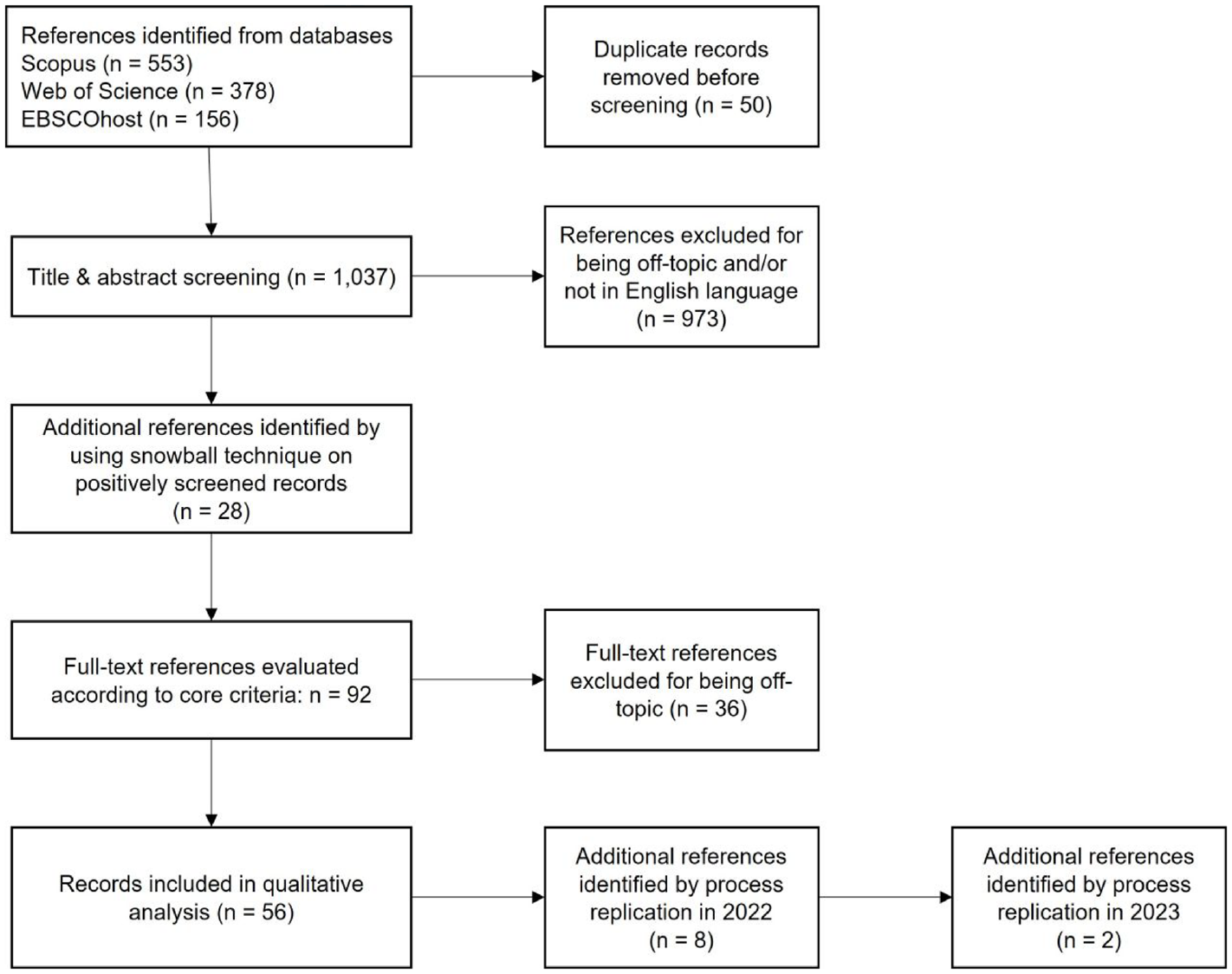
PRISMA flow chart.
Articles were excluded, if they were published in non-peer-reviewed journals, written in a language other than English, and/or did not meet the above criteria. In order to minimize database bias (Egger & Smith, 1998) and to ensure a complete capture of the existing literature, the following three online databases were searched during the identification phase: EBSCOhost, Scopus, and Web of Science. We searched by publication titles, abstracts, and key words, not discriminating in advance between research fields or journals but following the principle that cross-disciplinary perspectives should be adopted in systematic reviews (Tranfield et al., 2003). The first database search was carried out in 2017. To ensure it is up to date, it has been repeated in early 2022 within the scope of a dissertation project and in 2023. To begin with, a general search was conducted using key words associated with the phenomenon of co-shopping. In the process, various additional but equally linked keywords were identified, and the original search strings were adjusted (see Table 1 for the final search strings). Boolean operators were employed to increase the chance of retrieving relevant documents (Aliyu, 2017). The evolution of database search results from 2017 to 2023, on the basis of the search strings used, is also reflected in Table 1. The first database search in 2017 returned 1,087 records, of which 50 were deleted as duplicates. The remaining 1,037 individual articles were then screened for subject relevance by the contact author and an assistant individually and independently, the vast majority of which were eliminated through title and abstract reading because they were off-topic, such as records from unrelated disciplines such as medicine, robotics, biology, or information technology. Abstrackr was used as a tool for this process (Wallace et al., 2012).
Database Search Strings.

The corresponding author and the assistant double-checked all outcomes, resulting in 64 records relevant to the phenomenon of people shopping together. Based on these 64 records, 28 more records that had not been returned by database searches could be identified employing the snowball technique (Wohlin, 2014). Therefore, a total of 92 full-text records were evaluated for content relevance and eligibility for inclusion in the subsequent qualitative content analysis. During this stage, we eliminated records that did not meet the four core criteria established at the outset, such as those looking at online shopping exclusively. In addition, we did not include articles dealing with groups of more than two people shopping together in which there was not a distinct, decision-making individual influenced by a companion or companions. The latter criterion, for example, resulted in the exclusion of the work of Wilken et al. (2022), who explicitly investigated couples’ joint decision process in the search for products to consume together. We also excluded contributions dealing exclusively and unambiguously with social influences during the information searching phase of shopping behavior, such as, for instance, families discussing a future purchase at home. Lastly, we eliminated references looking social influence from a general viewpoint, that is, articles dealing with indirect social effects during shopping, such as interactions with strangers or salespeople, or the effects of crowding, which, for instance, led to the exclusion of the paper by Luck and Benkenstein (2015). At this stage, a total of 36 additional records were eliminated. Repetition of the search and screening process in 2022 and 2023 resulted in the inclusion of two and eight additional papers, respectively, for a total of 66 papers reviewed. Marketing, retail management, and consumer research journals contributed the largest number of papers, but they were joined by others in research categories not spontaneously associated with shopping behavior, such as nutrition sciences, sociology, and psychology. Conference papers were included, as well as journal articles, in order to account for the latest research on the topic. The full list of 39 journals and proceedings that were involved in the review is given in Appendix A. The 66 records that remained for qualitative content analysis are listed in Appendix B.
Results of Qualitative Content Analysis
The main analyses of the papers identified through use of the standard review protocol were carried out using the NVivo 11 Plus qualitative analysis software (QSR International, 2015), the output of which permitted the use of axial coding to identify relationships between and among the generated categories and subcategories (Hutchison et al., 2010). Our goals were to identify published theoretical contributions in the field of companion shopping, find points of content-related intersection between them and recognize neglected research topics. In accordance with our research goal of identifying companion traits and effects on shoppers, we coded the content of the articles according to three variables, which include the type of companion considered, the shopping context (i.e., the product category) and the associated outcomes regarding various aspects found in each reviewed contribution to the literature: see Table 2.
Key Categories and Subcategories Identified During Axial Coding.

During the coding process, we categorized the findings from published research studies of the roles and influences of shopping companions. By means of matrix coding, which allows for the investigation of relationships between different concepts and categories, we grouped the outcomes and corresponding types of companion examined in each study reviewed (see Hutchison et al., 2010). That operation provided a quantitative overview with regard to how often such combinations had been researched to date, summarized in Table 3. Altogether, 27 contributions dealt with children or adolescents as companions who influenced their parents’ decision making, accounting for nearly half of all analyzed inputs (41%). Eight studies examined friends or peers as shopping companions and three dealt exclusively with family companions. However, 16 others investigated a combination of friends and family members, representing the second biggest cluster at almost a quarter of the total (24.2%). Lastly, 12 reviewed papers did not specify the type of companion or look at the presence of an accompanying person in general. Table 3 provides an overview of the research findings on shopping companions in terms of study focus and their impact on shoppers.
Frequency of Outcomes Found by Different Types of Companion.

The next sub-section organizes the main contributions in terms of the respective kinds of influence or effect the shopping companions were found to have.
Affective Outcomes
Twenty-five of the 66 articles or papers reviewed reported affect-related outcomes. Of these, five dealt with shopping distractions caused by a companion, 14 described findings relating to emotions aroused by a companion, and 10 discussed the effects on shoppers’ confidence and risk perception. The contributions dealing with affective outcomes are summarized in Table 4.
Overview of Different Companion Types and Affective Effects on Shoppers.

Table 3 shows that articles dealing with children as shopping companions to their parents contribute the largest number of findings concerned with distraction of a shopper from the shopping process. Children tend to complicate the shopping process (Harrell, 2003b; Holden, 1983) up to the point of annoying their parents on occasion (Wingert et al., 2014). However, in some cases adult companions were also identified as a potentially distracting influence (Grewal et al., 2018; Prus, 1993).
With regard to emotions aroused during the shopping process, it has been found that both family members and friends can have a constructive influence as co-shoppers. That may result in a higher level of experienced utility (Mora, 2022), a more positively perceived and evaluated shopping experience, and greater satisfaction during the process (Borges et al., 2010; Gillison et al., 2015; Gui et al., 2021; Hart & Dale, 2014; Mangleburg et al., 2004; Merrilees & Miller, 2019; Scholz et al., 2021; Wenzel & Benkenstein, 2021). Research by Prus (1993) found that such positive perceptions could be due to appreciation of the time that could be spent with a friend or family member. That explanation is confirmed by a study (Lim & Beatty, 2011) which found the anticipation of enjoyment and pleasure in taking along a companion to be an important motive to be accompanied while shopping. One of the many effects that positive emotions engendered by the presence of a companion can have is a stronger perceived connection to the shopping location (Chebat et al., 2014), which will in turn protect shoppers from perceived stress due to such other environmental influences as crowding (Lucia-Palacios et al., 2018). In particular, teenagers have been found to be more open to retailers’ marketing tactics and initiatives when enjoying a shopping trip with friends and to experience greater enjoyment, more positive emotions and increased satisfaction as a result (Mangleburg et al., 2004; Wenzel & Benkenstein, 2018). Friends, especially, seem to be able to trigger strong positive and negative emotions. Though they can increase arousal during shopping, they may also increase “apprehension” (Chebat et al., 2014) and make the shopper feel uncomfortable through the perception of being judged, evaluated or pressured (Chebat et al., 2014; Prus, 1993). A companion of any kind can also make shoppers more attentive to marketing stimuli in their environment, potentially increasing their volume of purchases (Mangleburg et al., 2004).
In earlier, mostly qualitative research, shopping companions were found to generally increase the shopper’s self-confidence, mainly by reducing the perceived risks associated with a purchase (Bell, 1967; Kiecker & Hartman, 1994; Lindsey-Mullikin & Munger, 2011; Midgley, 1983), which can be a determinant in the decision whether or not to take along a companion at all (Lim & Beatty, 2011) and also a factor on the type of companion chosen. If products are associated with a high level of social or psychological risk, shoppers are more likely to choose companions of long standing, such as family members, than when they are associated with higher levels of functional risks (Bell, 1967; Kiecker & Hartman, 1993). Moreover, when the functional or financial risk is perceived to be higher than the social or psychological risk, both male and female shoppers tend to favor a male shopping companion (Kiecker & Hartman, 1993). In the case of teenagers in particular, the risk of social embarrassment or negative evaluation by peers may motivate the choice to shop alone rather than with a friend (Mangleburg et al., 2004). However, the findings on consumer risk perception have recently been qualified by the quantitative research of Wenzel and Benkenstein (2021). They should therefore be treated with caution, taking particular account of shopper type and shopping context, that is, product category and retail environment.
Behavioral Outcomes
Of the 28 reviewed contributions describing changes in shoppers’ behavior attributed to a shopping companion, two mention general in-store behaviors, eight refer to shoppers making impulse purchases, and 20 shed light on the amount of time or money, or both, spent by the influenced shopper.
The sources listed in Table 5 relevant to shoppers making impulse or unplanned purchases have found these behaviors to be affected by a variety of factors stemming from the shopping environment, one of which is the companion in question (Mihić & Kursan, 2010). Their tendency to engage in impulse buying is increased when shopping with family members (Badgaiyan & Verma, 2015) or friends (De Vries et al., 2018), or when enjoying the shared experience (Scholz et al., 2021). In the specific case of shopping in clothing stores, a close relationship with a companion further amplifies that effect, particularly with friends rather than parents as the influencers (Luo, 2005). The opposite effect was found in the case of grocery shopping, where family members and friends as companions can prevent unplanned purchases (Chomvilailuk & Butcher, 2014) with family members having the strongest impact (Chen et al., 2021). It has further been found that a companion of the opposite gender increases the likelihood of impulsive purchases (Cheng et al., 2013). With respect to general in-store behavior, shoppers with companions are less likely to visit crowded areas than their unaccompanied counterparts (Page et al., 2018; Zhang et al., 2014) and, when shopping in larger groups, tend to touch fewer products. If, however, shoppers are engaged in interactions with their companions, they tend become more involved with products, especially if they are new or exclusive (Zhang et al., 2014).
Overview of Different Companion Types and Behavioral Effects on Shoppers.

With regard to monetary effects, the effect of companions can be to increase spending (Grewal et al., 2018; Gui et al., 2021; Hart & Dale, 2014; Nicholls, 1997; Sommer et al., 1992; Woodside & Sims, 1976), especially if they are family members (Merrilees & Miller, 2019), or a child in a supermarket (Thomas & Garland, 1993) or the shopper is enjoying the shopping experience (Mangleburg et al., 2004; Prus, 1993). One study (Kurt et al., 2011) found companions to affect spending by men more strongly than spending by women. Negative influences on spending can occur when friends intervene to remind shoppers that they cannot or should not buy certain products (Prus, 1993). Two more studies contradicted the general notion that accompanied shoppers tend to spend more or buy more products (Mora & González, 2016; Zhuang et al., 2006).
Sources identified in Table 4 that report studies concerned with time spent in retail premises present contradictory findings, in that the effect of a companion seems to depend strongly on the type and the situation: for instance in the level of enjoyment of a shopping trip (Gillison et al., 2015), which, when reduced by disruptive behavior of a companion, may lead shoppers to abandon the purchase and leave the store (Scholz et al., 2021). More time can be spent as a result of any sort of distraction from the shopper’s task (Grewal et al., 2018), which makes the process more pleasant than shopping alone (Gui et al., 2021; Hart & Dale, 2014; Sommer et al., 1992). Extra time spent may also attributable to particularly helpful companions (Nicholls, 1997; Prus, 1993). There is evidence that small children can complicate the process and thus prolong it (Haselhoff et al., 2014; Thomas & Garland, 1993) but, on the contrary, some studies have found that shoppers with children take about the same length of time as unaccompanied shoppers to buy the same amount (Page et al., 2018; Yim et al., 2014).
Cognitive Outcomes
Of the 66 reviewed contributions to the relevant literature, 27 provided insights related to a shopping companion’s influences on a shopper’s purchase intention, 13 of which dealt with non-food purchases and 17 with food-related purchases. Some considered both product categories.
In the context of food shopping, children were found to influence their parents’ purchase intentions (Atkin, 1978; Calderon et al., 2016; Castro et al., 2017; Gaumer & Arnone, 2009; Kümpel Nørgaard et al., 2007; O’Dougherty et al., 2006; Pettersson et al., 2004; Wilson & Wood, 2004; Yim et al., 2014), mostly by making specific requests, and by being particularly helpful before doing so (Lora et al., 2016). Sometimes, parents made unplanned purchases to reward their children (Haselhoff et al., 2014) or, in particular, to reduce such antisocial behavior as tantrums (Wingert et al., 2014). Also in settings that combined grocery shopping and shopping in toy stores, children were found to influence parents’ purchase decisions to a certain degree (Buijzen & Valkenburg, 2008; Ebster et al., 2009). Two studies of teenagers specifically (Bevelander et al., 2011; Gustafson et al., 2014) found that they tended to adopt choices of accompanying friends, exhibiting an increased likelihood of buying high-calorie products under their influence.
In non-food buying situations, companions with whom the shopper has a good relationship increased likelihood of completing a purchase (Nicholls, 1997), for instance by suggesting products or areas within a retail location that would not have been considered spontaneously (Prus, 1993). In studies of parents accompanying young daughters (Haytko & Baker, 2004), it was found that mothers might even change their usual style of dress, or switch brands or stores, in response to their daughters’ influence (Gentina et al., 2013). In general, companions also provide confidence in a shopper’s buying intentions and facilitate the decision to buy (Woodside & Sims, 1976). One study (Zhuang et al., 2006) also found that companions increased mall shoppers’ likelihood to buy food, but decreased their likelihood to buy non-food products. On the whole, however, it is the relationship between shopper and companion and the strength of the companion’s influence on the shopper, that is largely responsible for the companion’s influence on the shopper’s purchase intention (Scholz et al., 2021).The literature shows that friends or family members may also affect a shopper’s purchase intention, in non-food settings for instance, by sharing negative experiences of a product or a brand (Chomvilailuk & Butcher, 2014) because they believe that purchase would not be a wise decision, or are acting as the shopper’s conscience by way of a reminder about the affordability of the purchase (Prus, 1993). companions may hinder shoppers from buying when the purchase is of very personal nature (Sommer et al., 1992). Family and friends, as shopping companions, may also reduce the influence of a salesperson on a shopper’s purchase intention (Zhang et al., 2014). Table 6 summarizes the literature reporting findings on shoppers’ purchase intention in food and non-food retail settings.
Overview of Different Companion Types and Cognitive Effects on Shoppers.

Person-Related Outcomes
These outcomes form the largest cluster in the analysis, comprising 43 published articles or papers in total. Those document the roles that companions fulfill for shoppers (13 items), the differences between types of companion (eight items), and processes of consumer socialization, for instance via the inputs of parents as shopping companions (13 items). Most elaborate on the relationships and interaction between shoppers and companions (25 items). These papers and their contributions are summarized in Table 7.
Overview of Different Companion Types and Person-Related Outcomes.

With regard to consumer socialization, one paper focused on young-adult daughters acquiring shopping skills from their mothers (Minahan & Huddleston, 2010); 12 others dealt with parents supervising young children during shopping trips, and teaching them about products or about how to behave in the retail environment (Gram, 2015; Grossbart et al., 1991; Harrell, 1994, 2003a; Holden, 1983; Keller & Ruus, 2014; O’Dougherty et al., 2006; Pettersson et al., 2004; Rust, 1993; Vohra & Soni, 2015; Wilson & Wood, 2004; Wingert et al., 2014).
The roles and tasks fulfilled by companions during shopping have been researched intensively by studying the behavior of family members or peers, or a combination of the two. Teenagers, specifically, find that shopping with others from the same generation makes for a more enjoyable shopping experience and so most often choose them as companions (Mangleburg et al., 2004) while younger women tend to take their mothers with them on clothes-shopping trips in the expectation of advice and help with the search (Darian, 1998). In general, the tasks that companions are likely to fulfill are numerous, ranging from providing product expertise, through offering opinions or sharing advice (Bell, 1967), to the provision of moral support, shared fun, and company (Hartman & Kiecker, 1991; Haytko & Baker, 2004; Kiecker & Hartman, 1994; Lim & Beatty, 2011; Lindsey-Mullikin & Munger, 2011; Midgley, 1983; Prus, 1993). By giving advice, companions may also reduce decision-making risks for the shopper and thus reinforce the intention to make a purchase (Lindsey-Mullikin & Munger, 2011; Woodside & Sims, 1976). Once again, however, it should be borne in mind that these findings with regard to the role of companions as risk reducers have recently been qualified by Wenzel and Benkenstein (2021). Even children may perform specific tasks in a retail environment but, overall, their influence has been found to be supportive rather than decisive (Kümpel Nørgaard et al., 2007). Companions do not always perform tasks for the accompanied shopper only but may also do so for the retailer, for instance by drawing attention to in-store merchandizing, pointing out products, offering product advice, identifying alternative products, or locating sales staff (Lindsey-Mullikin & Munger, 2011).
Turning to findings with respect to differences between types of companion, one study distinguished between the behavior of very young and young children in supermarkets (Rust, 1993), while eight reviewed papers compared the influence of friend and family companions in terms of their respective effects on shoppers. Especially when shoppers have a strong identification with a particular retail outlet, friends contribute better to a positive shopping experience for the shopper than family members do, and thereby deliver better outcomes for retailers (Borges et al., 2010). Friends have also been shown to elicit stronger emotions in shoppers than family members both in terms of both arousal and “apprehension” (Chebat et al., 2014). The general proposition that any companion will enhance the shopping experience seems to hold true when shoppers have no strong identification with the places in which they are shopping. The relationship shared between shoppers and their companions plays a crucial role in determining if and how the former accept the latter’s influence. While influences in “weak” relationships between shopper and companion tend to be functional and knowledge-based, “close” relationships more often provide stronger moral or social support, reassuring the shopper about the appropriateness of the purchase (Kiecker & Hartman, 1994). Drawing on research regarding consumers’ perceptions of risk associated with certain purchases, Kiecker and Hartman (1993) confirmed that the type of risk can determine the type of companion chosen by the shopper. Family members are chosen to reduce social or psychological risks, while non-family members with whom the shopper has a weaker relationship are chosen for their potential to reduce functional risk. A wider comparison of the effect of different types of companion on impulse buying behavior found spouses and parents to have significantly greater impacts on shoppers than friends, children, or other shoppers (Chen et al., 2021). In general, family members were found to reinforce a shopper’s focus on the actual task more strongly than a friend did and, at the same time, decrease the likelihood of impulse purchasing (Borges et al., 2010; Luo, 2005). With regard to gender differences, shoppers have been found to make use of male companions more often than female as sources of product information and expertise, and as sources of information on a given retailer and on prices. They are also used more frequently for finding and negotiating bargains, while female companions are most often depended on for moral support and to increase confidence in purchase decisions (Hartman & Kiecker, 1991).
Twenty-five of the reviewed papers and articles paid close attention to the specific relationships and interactions between shoppers and their companions, most of which related to parents accompanied by their children in grocery stores (Atkin, 1978; Buijzen & Valkenburg, 2008; Calderon et al., 2016; Castro et al., 2017; Ebster et al., 2009; Gaumer & Arnone, 2009; Harrell, 1994, 2003a, 2003b; Haselhoff et al., 2014; Holden, 1983; Keller & Ruus, 2014; Lora et al., 2016; O’Dougherty et al., 2006; Rust, 1993; Vohra & Soni, 2015; Wingert et al., 2014) or when shopping for clothes (Darian, 1998). Three further contributions dealt with the unique nature of the mother-daughter relationship and the respective influences on each other in terms of social comparison and interplay during the shopping process (Gentina et al., 2013; Gillison et al., 2015; Minahan & Huddleston, 2010). Among adult shoppers, only two articles actually observed and described specific interactions between shoppers and companions as well as corresponding results in shoppers’ behavior and emotions (Lindsey-Mullikin & Munger, 2011; Prus, 1993). Mixed genders within shopper-companion relationships were found to be an indicator of the strength of the relationship, while only about half of all-male or all-female shopping dyads were found to exhibit a close relationship (Kiecker & Hartman, 1994). Only the qualitative study of Scholz et al. (2021) described the impact of companions on the emotions, buying behavior and purchase intentions of shoppers, by highlighting the different behaviors and characteristics of the companions themselves.
Product Categories and Retail Salespeople
With regard to product categories given consideration in co-shopping research, the most extensively researched setting is shopping for grocery products with children, as shown in Table 8. Where adult companions are concerned, published research has included a larger diversity of products or, in many cases, no specified product category or no actual buying activity. When the latter was the case, the focus was on the interaction between shoppers and their respective companions and on the influence of the latter on the former’s perception of the shopping experience, rather than the purchase of a product.
Overview of different companion types and product category examined.

Note. Two articles involve shopping at a grocery store and a toy store, which is why the number of studies in Table 8 adds up to 68.
Notably, companions have hardly been researched at all in shopping contexts involving high-involvement products, such as those that are complex or costly. Only six studies involving friends and/or family members as shopping companions have addressed shopping for clothing which can, depending on the product category under consideration, relate to an individual’s social identity (Feinberg et al., 1992) and therefore increases the importance of a companion’s influence on the decision-making process. It has been found that, in such high-involvement situations, shoppers face stronger challenges in comparing and understanding products (Bell, 1967; Wang & Hsiao, 2012), which could be facilitated by the helpful influence of a shopping companion. It is therefore surprising that more research has not focused on how companions influence shoppers in their decision-making with respect to complex products.
Products associated with high involvement and high risks demand a more complex information-search process and between-products comparisons (Wang & Hsiao, 2012), which in turn increase the importance of social influences on decision making (Mothersbaugh et al., 2020). It is intuitively reasonable to assert that, when shoppers tend to rely on social influences to make a well-informed decision, interaction with retail salespeople will prove to be especially important, as well as the influence of a companion. It is therefore surprising that salespeople have been included in only four of the 66 reviewed contributions, while one more reported that shopping companions sometimes take over the tasks of salespeople or act in their interest (Lindsey-Mullikin & Munger, 2011). Two reviewed papers deal with salespeople rather marginally, one emphasizing that a consensus between salespeople, shopper and companion would potentially lead to actual sales (Darian, 1998) and the other that, in the presence of several companions, the influence of a salesperson may well be reduced (Zhang et al., 2014). One reviewed study highlights the importance of the level a salesperson’s knowledge and credibility in a sales pitch to a shopper accompanied by a companion, particularly when the product is previously unknown and external advice is therefore required (Woodside & Sims, 1976). Lastly, only one of the reviewed records emphasizes the importance of shopper-companion interplay under the simultaneous consideration of both, the characteristics and behaviors of the companion, and the interaction with a retail salesperson (Scholz et al., 2021).
Discussion
Our systematic review of the literature relevant to the influences of shopping companions has found that research published up to early 2023 has furnished several insights into the effects of their involvement, especially where adult companions were involved, which are almost exclusively concerned with very generic types of companion rather than with types of behavior or character traits that determine how influence is exerted on shoppers’ decision making, the qualitative study of Scholz et al. (2021) being the exception. Many research studies of co-shopping have focused on children as the companions concerned, and focused on describing the processes by which they learn to behave as normal consumers in the marketplace. The relevant reviewed studies also identified children as the most significant source of distraction in a parent’s buying routine. In contrast, evidence regarding the nature of adult companions’ influence on shoppers’ emotions has not so far been described in detail. The literature makes it clear enough that shoppers’ emotions are influenced by companions, but not exactly how that influence operates or how it is processed by the individual. With regard to shoppers’ emotions, the general finding is that companions appear to improve the shopping experience by engendering a positive mood, apart from some exceptions reported in studies in which shoppers felt uncomfortable, judged or pressured (Chebat et al., 2014; Prus, 1993). Reported findings are ambiguous with respect to the influence of adult companions on such behavioral outcomes as the amount of money spent. Several factors seem to play a role: for instance, the shopper’s gender or the shopping environment. Beyond the general type of companion and type of retail establishment, the reviewed literature has not yet taken psychological factors into consideration, such as shoppers’ resilience in the face of negative stimuli (Ong et al., 2006; Windle, 2011).
It is notable that three quarters of the reviewed studies of the influence children have on their parents observed their actual behavior at the point of sale: an input which has so far been widely neglected in evaluating the influence of adult companions on shoppers. And yet an understanding of how companions’ behavior leads to certain influences on shoppers, of both positive and negative nature, could be of particular importance for retail salespeople. It is unlikely that a salesperson will be able to predict a companion’s influence on a shopper solely on the simple fact that there is one in attendance, unless and until conversational exchanges can establish what the relationship is between the two and therefore what role the companion can be expected to fulfill. The ability to recognize and interpret behavioral cues emanating from companions could allow salespeople to choose their selling approach on a more informed basis, which could in turn prove more effective in terms of selling performance and shoppers’ perceptions of the service. Other studies have found that the product category also plays an important part, one that salespeople should certainly keep in mind. The influence of child companions on shoppers’ purchase intentions has been investigated exclusively in the context of grocery shopping, while studies involving adults have focused on non-food categories or the shopping experience in general. Adult companions can stimulate impulsive purchases and, it is generally agreed, increase both the length of time shoppers spend in a particular shopping venue and confidence in their purchase decisions. However, improved confidence in particular is thought to be strongly related to the product category and the shoppers’ prior experiences with the product. For instance, it has been suggested that, when shopping for hedonic products, customers seem to develop stronger purchase intentions when participating in interactive rather than non-interactive sales situations (Yurova et al., 2017). Therefore, it would be useful for future research on the influence of companions on shoppers’ confidence in their purchase decisions to devote more attention on the product category.
Besides the product category, the shopping environment and the decision-making behavior of shoppers influenced by the shopping environment remain important points to consider. While our paper does not address shopping behavior and social influences in the context of online shopping, e-commerce represents an area of interest for future research and, from a practical perspective, for online retailers. Especially during the COVID-19 pandemic, e-commerce and m-commerce have established themselves as reliable alternatives to bricks-and-mortar shopping. And even in this context, it seems that social influences continue to play a role in shaping the behavior of shoppers (Vinerean et al., 2022). There is evidence to suggest that data-driven tools and machine learning can be used to better customize and improve shoppers’ online experience (Kliestik et al., 2022; Nica et al., 2022) by means of an enhanced understanding of shoppers’ emotions and attitudes. Through big data and machine learning, interactive tools such as chatbots, for example, could function as more realistic and demand-driven support systems for online shoppers. While helping online retailers better understand the customer journey, they could help improve the perceived online shopping experience from the customer’s perspective. Potentially, they could evolve to provide shoppers with some of the benefits of traditional shopping companions that they might otherwise miss in the online environment.
Overall, across the reviewed literature, salespeople’s transactions with shoppers and their companions have been researched only to a very limited degree. One study of parent-child interactions in children’s clothing stores (Darian, 1998), found that salespeople did increase the probability of a purchase if they addressed the identified needs of both parent and child. If they also displayed a high level of expertise, synergetic effects were likely to occur and thus increase the likelihood of purchase (Woodside & Sims, 1976). The presence of shopping companions can, however, have adverse consequences for retailers by diminishing the salesperson’s influence on the shopper’s intention to buy (Zhang et al., 2014). To deal effectively with the various types of shopping companion and their particular influence in a given situation, salespeople must be able to adjust their approach accordingly. Ideally, that adaptation will be based on specific identifiable characteristics of shoppers, and their companions, such as whether they are more task-oriented, interaction-oriented, or self-oriented (McFarland et al., 2006). It is argued that one of the foremost goals in interacting with shoppers should be to establish credibility (Evans et al., 2012). In fact, a generally favorable attitude toward the salesperson can increase likelihood of a shopper developing a positive attitude to the retail establishment itself (Babin et al., 1999) and thereby increase the shopper’s sense of satisfaction (Homburg et al., 2011). Recent research also highlights the importance of retailers offering quality service to retain customers, especially to those belonging to Generation X or Millenials (Dabija & Băbuț, 2019). Furthermore, responding adequately to shoppers’ specific emotions is crucial. It has been shown that, if that does not happen, the level of customer satisfaction can be harmed (Menon & Dubé, 2000). Thus, a salesperson’s performance can be improved by the choice or adaptation of an approach to customers so that it caters to their individual needs, especially in service-oriented retail environments. Frontline employees’ superior personal skills, such as good product or service knowledge, experience, and emotional intelligence can facilitate the achievement of those goals (Kidwell et al., 2007; Szymanski, 1988).
In co-shopping situations, in which salespeople must cater to the needs and character of a shopper’s companion, the difficulty is that the second party in the process may have distinctly different personal characteristics, meaning that a fundamentally different approach is required from that which is appropriate for the shopper. Surprisingly, our review of the relevant literature has found only very little evidence for that particular consideration having been taken into account, even in research into “adaptive selling,” which has focused exclusively on salespeople’s interactions with a single shopper. Consequently, it remains unclear whether or not salespeople can draw on the same selling techniques in the presence of a companion as they do when interacting with a single shopper, and how effective those techniques are.
Implications and Suggestions for Further Research
Three interesting possibilities for further co-shopping research arise from our systematic review of the literature. First, an important general variable that demands further attention is the nature of the influence exerted by adult companions, as distinct from children or teenagers. To understand how that process works, researchers and practitioners need to know more about the actual behaviors and characteristics of those third parties. Attributing any effect they have on an accompanied shopper exclusively to demographic criteria and the type of relationship they share appears theoretically insufficient. It is likely that the attitudes they display to the shopping process itself, their level of enjoyment, and the way they communicate with the shopper also have an important in the shopper’s marketplace behavior and input processing. That being so, future studies should not only control for the general types of companion, but also pay special attention to their personal behaviors and characteristics. Those may fundamentally shape shopper-companion interaction and facilitate the understanding of resulting changes in shopper behavior.
Second, the perception of stress during shopping, inculcated by the retail environmental, is a recognized and researched issue (Albrecht et al., 2017; Moschis, 2007). It can precipitate avoidance behaviors, such as abandoning the purchase and leaving the premises. Causal factors could be, for instance, the physical layout of a store, the waiting time experienced or the presence of salespeople. Little or no attention has been directed so far toward perceived stress engendered by a distracting or disruptive companion and the consequent impact on shopping behavior. Babin and Attaway (2000) have shown that hedonic value perceived by consumers during a shopping trip can be damaged by negative emotions or a bad mood (Swinyard, 1993), which in turn can cause shoppers to avoid or withdraw from the particular environment responsible (Babin et al., 2013; Borges et al., 2010; Orth et al., 2010). While it is likely that an unenthusiastic or annoying companion can indeed engender negative emotions in a shopper, the research question needs to be raised about the behavioral consequences. This means that, while shoppers may not generally avoid a shopping location after experiencing a stressful companion and negative emotions, they may still withdraw from a stressful situation at some point. For example, if such a companion causes an atmosphere laden with negative emotions, shoppers may decide to cancel or postpone their shopping trip or simply buy less at that visit. Women and men have been shown to react to and deal with negative emotions differently (Babin et al., 2013). It would therefore be useful to control for gender differences when measuring negative emotions of this kind. Social inputs are also important in a consumer’s evaluation of the shopping experience (Kim et al., 2005). If shoppers and companions both enjoy a shopping trip, positive emotions can be expected to increase, potentially increasing resistance to negative environmental influences (Ong et al., 2006; Windle, 2011). Therefore, future co-shopping research concerned with a companion’s role in terms of perceived shopping stress should consider both social and psychological factors at play in shopper-companion interactions. In addition, the reasons for shoppers’ adaptive behavior could be adumbrated by linking research on their emotions to such inherent psychological factors as resilience to stressful stimuli.
The third interesting possibility for further co-shopping research stems from the fact that it has so far concentrated on interactions among two or more individuals shopping together, whereas research on adaptive selling has focused on those between salespeople and unaccompanied shoppers. The combination of a shopping companion plus the additional social influence of a retail salesperson has only rarely been studied, for instance by Darian (1998) and Woodside and Sims (1976). In the particular case of accompanied shoppers, the challenge for a retail salesperson is to establish credibility and be evaluated as knowledgeable and competent by not just one but at least two people, who may have different needs and expectations regarding the service provided. If salespeople were to be educated in what is known about the role and the potential influences of different types of shopping companion they could be better trained to cope with co-shopping situations. Offering better customer service is crucial to the maximizing of customers’ perceived value for local retail stores (Sweeney et al., 1997), and presumably equally for less local counterparts, who can thereby distinguish themselves from bricks-and-mortar competitors. This is a particularly important consideration when an increasing share of all shopping is being conducted in the less interactive online shopping environment, where it is harder to establish the “local” level of customer service. Being able to understand what research has to show about how different types of shopping companion exert influence on shoppers and how that influence is processed will enable retail salespeople to provide more customer-oriented service in their sales conversations with both shoppers and companion shoppers. Such knowledge can help sales staff to reinforce the positive influences of shopping companions or mitigate potential negative effects by identifying and taking into account shoppers’ and companions’ respective personal characteristics and needs (where those can be discovered). Given the partially outdated and incomplete findings on the interaction between co-shopping dyads and salespeople, we repeat an existing call for further studies of the interaction between retail salespeople and co-shoppers (Lindsey-Mullikin & Munger, 2011). Those could most usefully focus on the actual behaviors and characteristics of all parties, as well as on the potential influences the right selling approach by a salesperson could have on the selling interaction and its outcome.
Conclusion
This paper has summarized the current state of knowledge about the process of co-shopping (with a companion or companions) and provided a systematic, structured synopsis of what published research studies have found with regard to the different types of companion and their respective influences on shoppers. These relate to affective processes, such as the experience of emotions, cognitive processes, such as purchase intentions, and behaviors specific to shopping, such as time or money spent in-store or impulsive decision making. Categorization of all the potential effects of companions on shoppers shows clearly that their input can have a strong impact on shopping behavior and buying decisions. This has major implications for retailers in particular. Salespeople frequently encounter accompanied shoppers and must be able, as far as possible, to “read” the behavior of those companions and correctly assess their influence on shoppers correctly, in order to react accordingly. It is therefore especially important, if the aim is to deliver optimal customer service, that not only the discernible goals and needs of shoppers are taken into account and acted upon, but also those of their shopping companions. For example, if salespeople fail to maintain shoppers’ sense of wellbeing, they run the risk that their potential customers will leave without accomplishing their initial goal: that is, to make a purchase.
Service-oriented retailers are generally interested in long-term relationships with their customers. Therefore, it is especially important for their frontline employees to correctly assess the situations and moods of shoppers, and their companions and, in certain circumstances, not to force a short-term sale. Ideally, salespeople should be able not only to provide a pleasant shopping atmosphere for shoppers but also to deal with companions in such a way that two satisfied customers leave the store in the end. Moreover, in every interaction with co-shopping customers, there is an opportunity to convert a companion into a future customer. To make that possible, appropriate skills and traits are required, which retailers should emphasize in appropriate training and continuing education measures.
Footnotes
Appendix
Papers and Articles Selected for the Literature Review.

| Author(s) + Year | Title |
|---|---|
| Atkin (1978) | Observation of parent-child interaction in supermarket decision-making |
| Badgaiyan and Verma (2015) | Does urge to buy impulsively differ from impulsive buying behavior? Assessing the impact of situational factors |
| Bell (1967) | Self-confidence and persuasion in car buying |
| Bevelander et al. (2011) | Social modeling of food purchases at supermarkets in teenage girls |
| Borges et al. (2010) | Does a companion always enhance the shopping experience? |
| Buijzen and Valkenburg (2008) | Observing purchase-related parent–child communication in retail environments: a developmental and socialization perspective |
| Calderon et al. (2016) | What happens when parents and children go grocery shopping? An observational study of Latino dyads in Southern California, USA |
| Castro et al. (2017) | Who is influencing whom? Latino parent-child request interactions and food purchases in food retail environments |
| Chebat et al. (2014) | Why shopping pals make malls different? |
| Chen et al. (2021) | Impulsive purchasing in grocery shopping: Do the shopping companions matter? |
| Cheng et al. (2013) | The effect of companion’s gender on impulsive purchasing: the moderating factor of cohesiveness and susceptibility to interpersonal influence |
| Chomvilailuk and Butcher (2014) | Social effects on unplanned in-store buying |
| Darian (1998) | Parent-child decision making in children’s clothing stores |
| De Vries et al. (2018) | Friends with benefits: Behavioral and fMRI studies on the effect of friendship reminders on self-control for compulsive and non-compulsive buyers |
| Ebster et al. (2009) | Children’s influences on in-store purchases |
| Gaumer and Arnone (2009) | Grocery store observation: parent-child interaction in family purchases |
| Gentina et al. (2013) | Social comparison motivation of mothers with their adolescent daughters and its effects on the mother’s consumption behavior |
| Gillison et al. (2015) | Mother-adolescent daughter identity interplay processes |
| Gram (2015) | Buying food for the family: negotiations in parent/child supermarket shopping: an observational study from Denmark and the United States |
| Grewal et al. (2018) | In-store mobile phone use and customer shopping behavior: Evidence from the field |
| Grossbart et al. (1991) | Consumer socialization and frequency of shopping with children |
| Gui et al. (2021) | Greater patience and monetary expenditure: How shopping with companions influences purchase decisions |
| Gustafson et al. (2014) | How adolescents’ and parents’ food shopping patterns and social interaction when shopping is associated with dietary outcomes in rural communities |
| Harrell (1994) | The impact of shopping cart restraints and adult supervision on near injuries to children in grocery stores |
| Harrell (2003a) | Dangerous activities by children in grocery carts: is adult supervision important? |
| Harrell (2003b) | Effect of two warning signs on adult supervision and risky activities by children in grocery shopping carts |
| Hart and Dale (2014) | With or without you: The positive and negative influence of retail companions |
| Hartman and Kiecker (1991) | Marketplace influencers at the point of purchase: The role of purchase pals in consumer decision making |
| Haselhoff et al. (2014) | Strategies of children and parents during shopping for groceries |
| Haytko and Baker (2004) | It’s all at the mall: exploring adolescent girls’ experiences |
| Holden (1983) | Avoiding conflict: mothers as tacticians in the supermarket |
| Keller and Ruus (2014) | Pre-schoolers, parents and supermarkets: co-shopping as a social practice |
| Kiecker and Hartman (1993) | Purchase pal use: why buyers choose to shop with others |
| Kiecker and Hartman (1994) | Predicting buyers’ selection of interpersonal sources: the role of strong ties and weak ties |
| Kurt et al. (2011) | The influence of friends on consumer spending: The role of agency –communion orientation and self-monitoring |
| Lim and Beatty (2011) | Factors affecting couples’ decisions to jointly shop |
| Lindsey-Mullikin and Munger (2011) | Companion shoppers and the consumer shopping experience |
| Lora et al. (2016) | Preschoolers’ influence on and help with beverage selection at the grocery store is linked to maternal responsiveness and child beverage intake: An exploratory study |
| Lucia-Palacios et al. (2018) | Can social support alleviate stress while shopping in crowded retail environments? |
| Luo (2005) | How does shopping with others influence impulsive purchasing? |
| Mangleburg et al. (2004) | Shopping with friends and teens’ susceptibility to peer influence |
| Merrilees and Miller (2019) | Companion shopping: the influence on mall brand experiences |
| Midgley (1983) | Patterns of interpersonal information seeking for the purchase of a symbolic product |
| Mihić and Kursan (2010) | Assessing the situational factors and impulsive buying behavior: market segmentation approach |
| Minahan and Huddleston (2010) | Shopping with mum – Mother and daughter consumer socialization |
| Mora (2022) | Does consumption make company better? An activity and companionship model of experienced utility |
| Mora and González (2016) | Do companions really enhance shopping? Assessing social lift over forms of shopper value in Mexico |
| Nicholls (1997) | Time and companionship: Key factors in Hispanic shopping behavior |
| Kümpel Nørgaard et al. (2007) | Children’s influence on and participation in the family decision process during food buying |
| O’Dougherty et al. (2006) | Observations of parent-child co-shoppers in supermarkets: Children’s involvement in food selections, parental yielding, and refusal strategies |
| Page et al. (2018) | Parents and children in supermarkets: Incidence and influence |
| Pettersson et al. (2004) | Family life in grocery stores – A study of interaction between adults and children |
| Prus (1993) | Shopping with companions: Images, influences and interpersonal dilemmas |
| Rust (1993) | Parents and children shopping together: A new approach to the qualitative analysis of observational data. |
| Scholz et al. (2021) | Re-designing adaptive selling strategies: The role of different types of shopping companions |
| Sommer et al. (1992) | Social facilitation effects in shopping behavior |
| Thomas and Garland (1993) | Supermarket shopping lists: their effect on consumer expenditure |
| Vohra and Soni (2015) | Logit modeling of food shopping behavior of children in retail stores |
| Wenzel and Benkenstein (2018) | Together always better? The impact of shopping companions and shopping motivation on adolescents’ shopping experience |
| Wenzel and Benkenstein (2021) | No risk – More fun? The influence of shopping companions on adolescents’ risk perception and hedonism |
| Wilson and Wood (2004) | The influence of children on parental purchases during supermarket shopping |
| Wingert et al. (2014) | Child as change agent. The potential of children to increase healthy food purchasing |
| Woodside and Sims (1976) | Retail sales transactions and customer “purchase pal” effects on buying behavior |
| Yim et al. (2014) | Hedonic shopping motivation and co-shopper influence on utilitarian grocery shopping in superstores |
| Zhang et al. (2014) | An examination of social influence on shopper behavior using video tracking data |
| Zhuang et al. (2006) | Impacts of situational factors on buying decisions in shopping malls. An empirical study with multinational data |
Acknowledgements
None.
Declaration of Conflicting Interests
The author(s) declared no potential conflicts of interest with respect to the research, authorship, and/or publication of this article.
Funding
The author(s) received no financial support for the research, authorship, and/or publication of this article.
Ethics Statement
Not applicable: The methodology of this research was conducted in the form of a literature review followed by data analysis. No human contact was involved.

Data Availability Statement
Data sharing not applicable to this article as no datasets were generated or analyzed during the current study.