




Abstract
At the beginning of the third millennium, United Nations Sustainable Development Goals and the United Nations Millennium Development Goals opened a discussion on the role of human beings in the future. Concerns about social welfare created legal and normative pressures on organizations on social sustainability. To understand the social sustainability in organizations, we developed a research model based on the socially embedded model. From this perspective, this study aims to examine the relationship between knowledge sharing and social sustainability and determine the mediating role of thriving in this relationship. In this framework, we analyzed the data collected from 418 people working in the technology sector. The results have shown that thriving has a significant mediating role in the effect of explicit and implicit knowledge sharing on social sustainability (p < .01). As a result, the organizations encouraging knowledge sharing leads to high thriving levels in their employees, which in turn leads to the implementation of more social sustainability practices within their organizations. This study contributes both theoretically and practically by demonstrating that organizations fostering knowledge sharing lead to higher levels of employee thriving, subsequently facilitating the implementation of social sustainability practices, thus advancing understanding and guiding actions toward sustainable organizational development.
Plain Language Summary
In the early 2000s, the United Nations set out to make the world a better place through Sustainable Development Goals, sparking conversations about how organizations contribute to a brighter future. This led to a focus on social sustainability, ensuring people get along, and everyone’s needs are met. Our study explores how sharing knowledge at work and boosting employee happiness can help companies contribute to social sustainability. We based our study on the idea that organizations are like social ecosystems, and the way people share information plays a crucial role. We wanted to understand the relationship between knowledge sharing, employee thriving (a mix of feeling good and being successful), and social sustainability. We surveyed 418 people working in the tech industry to get a real-world perspective. Here’s what we found: when employees freely share what they know, it not only makes everyone happier and more successful (which is defined as thriving), but it also has a positive impact on social sustainability. Knowledge sharing leads to employee thriving, and thriving employees then contribute to making the workplace socially sustainable. Explicit and implicit knowledge sharing have a significant impact on social sustainability. Organizations that encourage employees to share what they know create an environment where everyone feels good actively contributes to making the company socially sustainable. It’s not just about internal growth – it’s about making a positive impact on the world. In conclusion, by fostering a culture of knowledge sharing, companies not only boost employee well-being but also become contributors to social sustainability.
Keywords
Introduction
Human sustainability and sustainable performance as a factor of success at work have received increasing attention in organizational behavior, especially in the last decade (Abid et al., 2019). Another reason for this interest is that employees have specific behavioral characteristics that cannot be taken for granted by businesses. Employees have specific needs, act voluntarily, and may leave if they feel they are underestimated in the work environment. Employees’ attitudes toward organizational practices are critical, as the survival and success of the business depends on employees (Staniškienė & Stankevičiūtė, 2018). Therefore, businesses strive to provide employees with a socially sustainable organizational environment. Social sustainability (SS) in the work context is related to social equity, job opportunities, health and safety, education and training, and professional growth (Ajmal et al., 2018). According to de Jonge and Peeters (2019), thriving employees can maintain sustainable performance, which is essential for socially sustainable organizations. In this context, employee thriving has attracted the attention of social and behavioral scientists (Kleine et al., 2019).
According to G. Spreitzer et al. (2005), thriving is a psychological state jointly constituted by learning and vitality. Thriving individuals are characterized by feeling energetic and alive (vitality) and the experience of growth, defined by a sense that they are constantly developing and getting better at what they do (learning). However, Walumbwa et al. (2018) noted that although thriving at work is positively related to important organizational outcomes such as employee health and performance, little is known about how the concept relates to contextual and personal factors. The active learning factor in the definition of thriving reveals the link between thriving and creating a productive environment for Knowledge sharing (KS) in organizations.
KS involves employees exchanging tacit and explicit knowledge to create new knowledge (Razmerita et al., 2016), as disseminating information and knowledge within a community is crucial in organizational knowledge management initiatives (Gao & Bernard, 2018). Employees gain knowledge as they learn, and new knowledge helps employees learn more. Knowledge resources enable employees to know how things are done so that they can focus on their work tasks. As employees acquire new knowledge and thus their knowledge resources grow, their capacity to focus on work tasks increases. In addition, knowledge resources help employees to explore and experiment (Boyd, 2015). This dynamic structure can lead to the realization of thriving employees.
SS is unfulfilled due to the ambiguity of the concept, differences in stakeholders’ priorities, and the need for a consistent understanding of this concept (Ajmal et al., 2018). Identifying the antecedents of SS within the organization from the axis of knowledge management and employees will provide unique insights. For this purpose, this study examines the relationship between KS and SS in organizations and the mediating role of thriving in this relationship. In this framework, determining the variables affecting SS at the organizations is expected to provide theoretical and practical contributions to researchers and practitioners.
This paper contributes to the literature and practice in two ways. First, we examined the relationship between SS, KS, and thriving. Although there are a few studies about KS and thriving (Ononye, 2022; Zhu et al., 2024), there is a gap in their relationship with SS. Some scholars assume that KS and thriving are critical for sustainability (Choi et al., 2008; de Jonge & Peeters, 2019; Oxenswardh, 2019). However, research on the relationship between SS, KS, and thriving is still limited. Our study aims to fill this gap by providing research results to SS literature.
The other contribution of this study is to examine the thriving level of self, colleagues, and managers. Therefore, employees’ perceived thriving level of others (colleagues and managers) also affects SS and their self-thriving level. To the best of our knowledge, this is the first study to investigate the perceived thriving levels of colleagues and managers. Therefore, findings enable us to consider an organization’s overall thriving level of employees.
Research Hypotheses
KS and SS
Sustainability is a concept and approach that involves meeting the needs of the present without compromising the ability of future generations to meet their own needs. It is often described in terms of three pillars: SS, environmental sustainability, and economic sustainability. These pillars represent the different aspects of human existence and well-being that must be balanced to create a sustainable society (Görmezoğlu, 2023). SS refers to democracy and social equity and contributes to the organization’s and its employees’ sustainability needs, such as health, wellness, and well-being (Amrutha & Geetha, 2020; Atanda, 2019). While SS is concerned with human capital development, job creation, and health and safety development, it is also related to socioeconomic processes, such as the ability of organizations to compete by ensuring their economic productivity and respect for the environment (Toker, 2020). In this context, SS means actively supporting the preservation and creation of skills and capabilities of future generations, promoting health, and supporting equal and democratic practices that allow for a good quality of life both within and outside the business context (Longoni & Cagliano, 2015). Therefore, SS promotes a social environment that is compatible with the development of civil society, conducive to the coexistence of culturally and socially diverse groups (Davidson, 2010), emphasizes social equity and justice, and reveals how the physical environment and community settings enable sustainable social outcomes (Eizenberg & Jabareen, 2017).
Staniškienė and Stankevičiūtė (2018) stated that SS in organizations consists of employee participation, employee cooperation, equal opportunities, employee development, occupational safety and health, and cooperation with external stakeholders. In this study, SS is considered a three-dimensional structure: employee participation and cooperation, equal opportunity and employee development, and occupational safety-health and cooperation with the outside. For businesses, knowledge is a valuable, rare, difficult to imitate, and irreplaceable resource (Iftikhar & Ahola, 2022). KS refers to the actions of employees making their knowledge, skills, and experience available to other employees to solve problems and develop new ideas within the organization (Derin et al., 2021; Jiao et al., 2020; Lo & Tian, 2020). Successful KS among employees produces an experience that facilitates synergy, collective learning, and creativity and accelerates the creation of shared values and standards (Arsawan et al., 2022). The dynamic KS process can occur through direct interactive means, such as face-to-face or phone calls, or facilitated methods, such as email or online communities of practice (Jiao et al., 2020).
There are two forms of KS: implicit (tacit) and explicit. Implicit knowledge derives from individuals’ actions, experiences, and values but cannot be expressed and codified as precisely or profoundly as tacit knowledge (Addis, 2016; Park & Gabbard, 2018). Knowledge creation begins with the creation and sharing of tacit knowledge, which results from socialization, facilitation of experience, and the individual’s capacity to interact with colleagues (Ganguly et al., 2019). Explicit knowledge, on the other hand, is knowledge that can be expressed in visual form (e.g., text, tables, diagrams, or documents), formalized, documented, and codified so that employees can have it without having to have the same experience (Park & Gabbard, 2018; Razmerita et al., 2016). Accordingly, explicit knowledge is more accessible to disseminate and communicate than tacit knowledge (Razak et al., 2016). Businesses with a culture of KS can carry out SS activities more effectively (Jilani et al., 2020). These organizations can develop and implement socially sustainable activities that contribute to the businesses, society, and the environment by leveraging the knowledge and experience of their employees.
KS promotes employee participation and collaboration. In organizations that encourage the free exchange of knowledge and experience, employees interact to share knowledge (Muñoz-Pascual et al., 2019). Therefore, KS takes place through the active participation and collaboration of employees. KS is when individuals mutually exchange their implicit and explicit knowledge (Van Den Hooff & De Ridder, 2004). This definition means KS contributes to SS through employee participation and collaboration.
KS is a crucial enabler of equal opportunity and employee development within an organization. KS ensures that information, best practices, and resources are accessible to all employees, regardless of their background, position, or seniority. This equitable access is a fundamental aspect of providing equal opportunities for employee development. Thus, individuals within the organization create mutual understanding by sharing their thoughts, beliefs, knowledge, and experiences (J. T. Yang, 2007). Besides, KS can help identify skill gaps within the organization. Equal opportunity and employee development initiatives can then be targeted to address these gaps, ensuring everyone has the necessary training and resources to develop their skills (S. Wang & Noe, 2010). This opportunity encourages employees to develop and apply their skills and motivation (Muñoz-Pascual et al., 2019). When shared freely, knowledge can break down barriers, promote inclusivity, and ensure that all employees have access to the resources and opportunities they need to develop their skills and advance their careers, which is a critical aspect of SS.
Moreover, KS is related to occupational safety-health and cooperation with the outside. It involves the dissemination of information and best practices within an organization. This information can include safety guidelines, procedures, hazard assessments, and incident reports in occupational safety and health. Sharing this knowledge helps employees stay informed about potential risks and safety measures. Collecting knowledge regarding safety risks and hazards and transforming them into knowledge capital with more efficiency within and between organizations can significantly influence problem-solving and decision-making on occupational health and safety (Duryan et al., 2020). Effective KS often involves training and education programs. In occupational safety and health, organizations can use KS to provide employees with the necessary training to recognize hazards, follow safety protocols, and respond to emergencies. Organizations encouraging KS are willing to listen to external voices and opinions. Because organizational knowledge is created within the organization and can be acquired externally, more and more attention has recently been paid to how organizations learn from their partners and develop new competencies through strategic alliances (Lee, 2001). Employees cooperating with external entities are more likely to consider external input and feedback, leading to improved decision-making and product/service/project development (Floyde et al., 2013). Sharing knowledge about market trends, customer preferences, and industry developments with employees can enhance their understanding of the external environment (Haas & Hansen, 2007). This knowledge can lead to more informed cooperation with external stakeholders, helping the organization meet market demands and sustain socially.
In summary, KS is a crucial driver of SS. It enhances individual empowerment, community resilience, collaboration, and equitable development. In turn, socially sustainable communities create an environment that fosters KS by valuing diversity, promoting inclusivity, and ensuring everyone’s voices are heard and valued. The H1 hypothesis we developed in line with this theoretical context is as follows:
H1: KS positively affects SS.
KS and Thriving
Thriving is a psychological state in which individuals experience both a sense of vitality and a sense of learning at work (G. Spreitzer et al., 2005; Walumbwa et al., 2018). Thriving employees feel that their current experiences and behaviors at work are intrinsically motivating and supportive for personal growth (Kleine et al., 2019). Thriving at work has been associated with several critical organizational outcomes, including performance, better health, innovation, lower burnout, higher job satisfaction, and citizenship behavior (Shahid et al., 2020; Walumbwa et al., 2018). Thriving consists of energy, including positive emotion and enthusiasm to participate in a specific task; the work environment can motivate employees to go beyond their job responsibilities and think creatively (Riaz et al., 2018). In this context, individuals experience vitality and learning in their organizational environments (Boyd, 2015). Vitality and learning relate to the emotional and cognitive psychological aspects of personal thriving (Abid et al., 2019; Sahin et al., 2020). Vitality is defined as feeling energized in one’s work experiences (Y. Yang et al., 2021). Learning refers to an individual’s ability to acquire and apply new skills and knowledge (Abid et al., 2018). Both vitality and learning are necessary conditions for thriving.
KS is a crucial factor contributing to employees’ thriving at workplace. From the perspective of socially embedded theory, broad KS is enablers of thriving. Based on this theory, thriving occurs through interactions with colleagues and others in the workplace (G. Spreitzer et al., 2005). The KS process is an active interaction for employees. A KS culture encourages employees to seek information, ask questions, and engage in discussions (Ononye, 2022). This learning process contributes to their professional development and sense of vitality.
Moreover, employees actively sharing knowledge often gain visibility within the organization. This visibility can also lead to opportunities for career advancement, contributing to employees’ sense of thriving (Huo, 2021; G. Spreitzer et al., 2005). A workplace that values and encourages KS has a positive and inclusive culture. Employees feel more engaged, connected, and motivated when they are part of a collaborative community that values their contributions. This positive work environment significantly contributes to their thriving (Bodla et al., 2018). KS empowers employees by enhancing their skills, promoting collaboration, and fostering a culture of continuous learning. As a result, employees thrive through personal growth and a positive work environment. In this context, the H2 hypothesis of the study is as follows:
H2: KS positively affects thriving.
Thriving and SS
The relationship between thriving and SS is closely intertwined. When employees are thriving within an organization, it benefits their well-being and contributes to the overall SS of the workplace. Thriving is related to employee participation and cooperation, the first dimension of SS. Thriving involves experiencing a high level of well-being, including physical, emotional, and psychological well-being (Feeney & Collins, 2015; Sahin et al., 2021). Employees who feel physically and mentally healthy are more likely to participate actively in their work and collaborate effectively with others. Thriving employees are more likely to be engaged, motivated, and satisfied in their roles (G. M. Spreitzer et al., 2010), naturally leading to increased participation and cooperation within the organization.
Thriving is also related to equal opportunity and employee development, the second dimension of SS. Thriving employees typically have higher self-efficacy, which is the belief in one’s ability to achieve goals (Arici Özcan & Vural, 2020). This increased self-efficacy can make employees more proactive in seeking and taking advantage of employee development opportunities (Abid et al., 2021). Thriving employees create a positive and supportive work environment (G. Spreitzer et al., 2005), essential for equal opportunity and employee development efforts. A culture of thriving can make these initiatives more effective and socially sustainable. Equal opportunity and employee development encompasses ensuring equal opportunities, tolerance of differences, adopting a management approach based on human rights, and developing policies to increase the proportion of minorities and women in senior management (Görmezoğlu, 2023). Thriving employees can be positive role models for others, particularly individuals from underrepresented groups. When employees from diverse backgrounds see their peers thriving and advancing, it can inspire them to actively engage in equal opportunity and employee development activities.
The third dimension of SS is occupational safety-health and cooperation with the outside. Thriving employees often contribute to a positive safety culture within the organization. They are more likely to actively participate in safety programs, report hazards, and encourage their colleagues to prioritize safety. They contribute to a safer and healthier workplace by fostering a safety culture, improving physical and psychological well-being, and promoting compliance with safety protocols (Z. Wang et al., 2024). When it comes to cooperation with the outside, successful cooperation with the external environment requires organizations to have a culture of collaboration and effective communication. Thriving employees contribute to the culture of collaboration and effective communication. Since they are more likely to engage with their local communities, they tend to volunteer, participate in community events, and support social events to contribute to SS by extending their positive influence beyond the workplace (Li et al., 2022; Qiu et al., 2020). Consequently, thriving employees are likelier to be engaged and participate actively in their work and the workplace community. These employees contribute positively to the SS of the organization by collaborating effectively, providing valuable input, and fostering a sense of shared purpose. Within the framework of this theoretical link, the H3 hypothesis of the study is as follows:
H3: Thriving positively affects SS.
The Mediating Role of Thriving in the Relationship Between KS and SS
The mediating role of thriving in the relationship between KS and SS highlights how the positive effects of KS on SS are explained by the extent to which employees thrive within the organization. In this context, thriving serves as a mechanism that channels the benefits of KS toward promoting SS.
Our research model is based on a social embedded model (G. Spreitzer et al., 2005). According to social embedded model, employee thriving is integrated into social systems and depends on dynamic interactions with colleagues, managers, and others. Therefore, thriving is self-driven and occurs through interactions with others. KS also requires interactions in the workplace, and it involves exchanging information, expertise, and experiences among employees. It empowers employees by providing valuable insights, improving their skills, and promoting a culture of collaboration.
KS enhances employees’ skills and level of thriving. As employees thrive, they are more motivated to participate actively in the organization’s activities and contribute positively to the workplace community (G. Spreitzer et al., 2005). Their increased thriving level enables them to harness the benefits of KS more effectively. Thriving employees are more likely to support a positive workplace culture, engage in sustainable practices, and contribute to the well-being of their colleagues and the broader community. This case, in turn, leads to improved SS within the organization. SS is achieved when employees experience a positive work environment that values diversity, supports well-being, and fosters a sense of community. It includes elements such as employee participation and cooperation, equal opportunity and employee development, and occupational safety-health and cooperation with outside. The H4 hypothesis we developed in line with these theoretical connections is as follows:
H4: Thriving has a mediating role in the effect of KS on SS.
Method
Purpose and Research Model
This research aims to examine the mediating effects of the thriving level of colleagues, the thriving level of the manager, and the thriving level of the employees in the effects of KS on SS. The research model prepared for this purpose is presented in Figure 1.

Research model.
Population and Sample
The population of this study consists of employees in companies operating in the technology field in communication and healthcare. An online questionnaire was sent to the human resources departments of the companies operating in the technology field in Istanbul via e-mail using the convenience sampling method. A total of 418 employees who answered the online questionnaire formed the sample of this research. Descriptive data of the sample are given in Table 1. Fifty-six percent of the sample consists of females, and 44% are male. Most participants (41%) are between the ages of 31 and 40. Forty-six percent of the participants are single, 35% have a bachelor’s degree, and 33% have 3 to 5 years of organizational tenure.
Socio-demographic Characteristics.

Data Collection and Data Tool
The ethics committee approval was obtained from the Social and Human Sciences Research and Publication Ethics Committee of Medeniyet University (Document dated 29.09.2021 and numbered 2021/56). Data were collected via an online survey between 15 September 2021 and 15 January 2022. SS, KS, and thriving scales were included in the online questionnaire. All scales were used as a 5-point Likert-type scale (1 = I strongly disagree, 5 = I strongly agree) in the questionnaire form.
SS Scale: The scale developed by Staniškienė and Stankevičiūtė (2018) and adapted into Turkish by Görmezoğlu (2019) was used. This scale consists of 6 dimensions and 31 questions, including employee participation, employee cooperation, equal opportunity, employee development, occupational health and safety, and cooperation with the outside. The reliability coefficients of the scale were reported as over .70 in the studies conducted by Staniškienė and Stankevičiūtė (2018) and Görmezoğlu (2019).
KS Scale: The scale developed by Z. Wang and Wang (2012) and adapted into Turkish by Aslan (2014) was used. The scale has two dimensions: explicit and implicit KS, consisting of 14 questions. While Z. Wang and Wang (2012) reported the reliability coefficient of the scale as above .90, Aslan (2014) reported it as above .80.
Thriving Scale: The scale developed by Porath et al. (2012) and adapted into Turkish by Ozcan et al. (2023) was used. This scale has two sub-dimensions, namely vitality and learning. Ozcan et al. (2023) reported that the Cronbach alpha value of this scale was .877 (Time 1) and .917 (Time 2). Within the scope of our study, the items in this scale were adapted to measure the thriving level of employees (self-thriving), colleagues, and managers. For example, the expression “I feel alive and vital” in the original scale was adapted as “my colleagues feel alive and vital” and “my manager feels alive and vital.” In this way, the employees who answered the questionnaire through this scale evaluated their thriving, their colleagues’ thriving, and their managers’ thriving.
Data Analysis
SPSS 22 and AMOS 22 statistical packages were used to analyze the data. The kurtosis and skewness coefficients were checked to determine the conformity of the data to the normal distribution. According to Kline (2016), a kurtosis coefficient of ±10 and a skewness coefficient of ±3 is sufficient for a normal distribution. In this direction, it was determined that the kurtosis coefficients of the variables were between −0.117 and 1.163, and the skewness coefficients were between −1.220 and −0.563 in this study. Based on this, it was determined that the data of this study were by the normal distribution.
Exploratory factor analysis, confirmatory factor analysis, reliability analysis, descriptive analysis, correlation, and linear regression tests were used to analyze the research data. RMR (Root Mean Square Residual), CFI (Com-parative Fit Index) and TLI (Tucker-Lewis Index), and RMSEA (Root Mean Square Error of Approximation) fit indices were used to show the model fit. Values above 0.90 for CFI and TLI fit indices indicate acceptable fit, while values below 0.08 for RMR and RMSEA fit indices indicate acceptable fit (Kline, 2016). In testing mediator variables, the approach of Baron and Kenny (1986) was followed. It was also tested whether the mediating effect was significant or not by the Sobel test.
Results
The Validity and Reliability
The validity and reliability analyses of the scales were first tested with Confirmatory Factor Analysis (CFA). KS Scale’s (x2/df = 3.48; RMR = 0.05; CFI = 0.97; TLI = 0.96; RMSEA = 0.077) and thriving (self, colleagues, and manager) scales’ fit indices (x2/df = 2.88; RMR = 0.07; CFI = 0.97; TLI = 0.96; RMSEA = 0.07) were found to be within acceptable limits. However, the social responsibility scale data did not comply with the model at an acceptable level. For this reason, the factor structure of the social responsibility scale was tested with exploratory factor analysis, and a 3-dimensional structure was achieved. This three-dimensional structure (employee participation and cooperation, equal opportunity and employee development, and occupational safety-health and cooperation with outside) was also confirmed by confirmatory factor analysis (x2/df = 3.25; RMR = 0.077; CFI = 0.93; TLI = 0.92; RMSEA = 0.07).
The average variance extraction (AVE) values of the scales were examined to test the convergent validity of the research scales. To ensure convergent validity, the AVE value should be 0.50 or above (Hair et al., 2010). Our study found that the AVE values of research variables are all above 0.50, which are given in Table 2. The correlation coefficients between the variables were examined to analyze the discriminant validity of the research variables. According to Kline (2016) the correlation coefficients between the variables should not be ≥0.90. In our study, the correlation coefficients between the variables ranged from .394 to .779 (see: Table 2). When the reliability coefficients of the variables are examined, it is seen that Cronbach’s alpha coefficients of all the variables are above .70 (see: Table 2).
Descriptive Data of the Variables, CR, AVE Values, Correlation, and Reliability Coefficients.
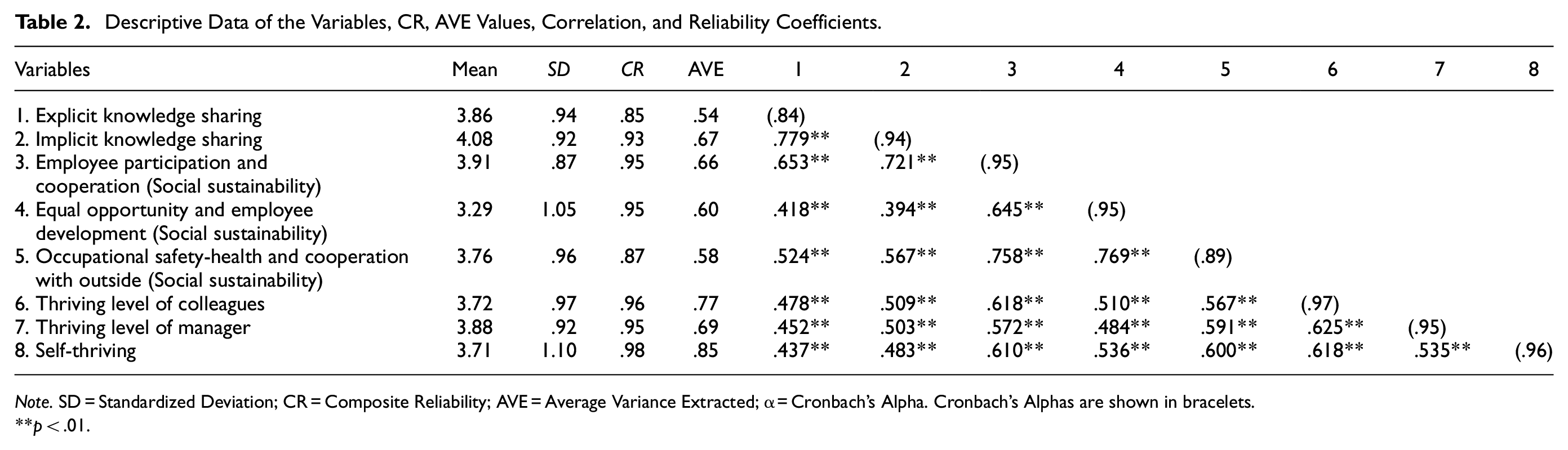
Note. SD = Standardized Deviation; CR = Composite Reliability; AVE = Average Variance Extracted; α = Cronbach’s Alpha. Cronbach’s Alphas are shown in bracelets.
p < .01.
Results of the Mediating Effect of Thriving
First, the effect of explicit and implicit KS, which are independent variables, on three mediating variables (thriving level of colleagues, thriving level of manager, and self-thriving) was tested with linear regression analysis. According to Table 3, the effect of explicit and implicit KS on three mediator variables were found to be significant Therefore, H2 was supported.
Results of Regression Analysis Showing the Effect of Independent Variables on Mediator Variables.

Note. Unstd. B = Unstandardized B; SE = Standard Error; Std β = Standardized Beta.
p < .05. **p < .01.
Table 4 indicates the effect of mediating variables (colleagues thriving, manager thriving, and self thriving) on the dependent variable (dimensions of SS). Colleagues thriving, manager thriving, and self thriving have positive and significant effect on employee participation and cooperation, equal opportunity and employee development, occupational safety-health, and cooperation with outside (p < .01). These results show that H3 was supported.
Results of Regression Analysis Showing the Effect of Mediating Variables on Dependent Variables.

Note. Unstd. B = Unstandardized B; SE = Standard Error; Std β = Standardized Beta.
p < .01.
In Table 5, the effect of explicit and implicit KS, which are independent variables, on the dependent variables “employee participation and cooperation,” “equal opportunity and employee development,” and “occupational safety-health and cooperation with outside” was tested. According to Table 5, the effect of explicit knowledge (p < .05) and implicit KS (p < .01) on all dependent variables was found to be significant, indicating that H1 was supported.
Results of Regression Analysis of Mediator Variables.
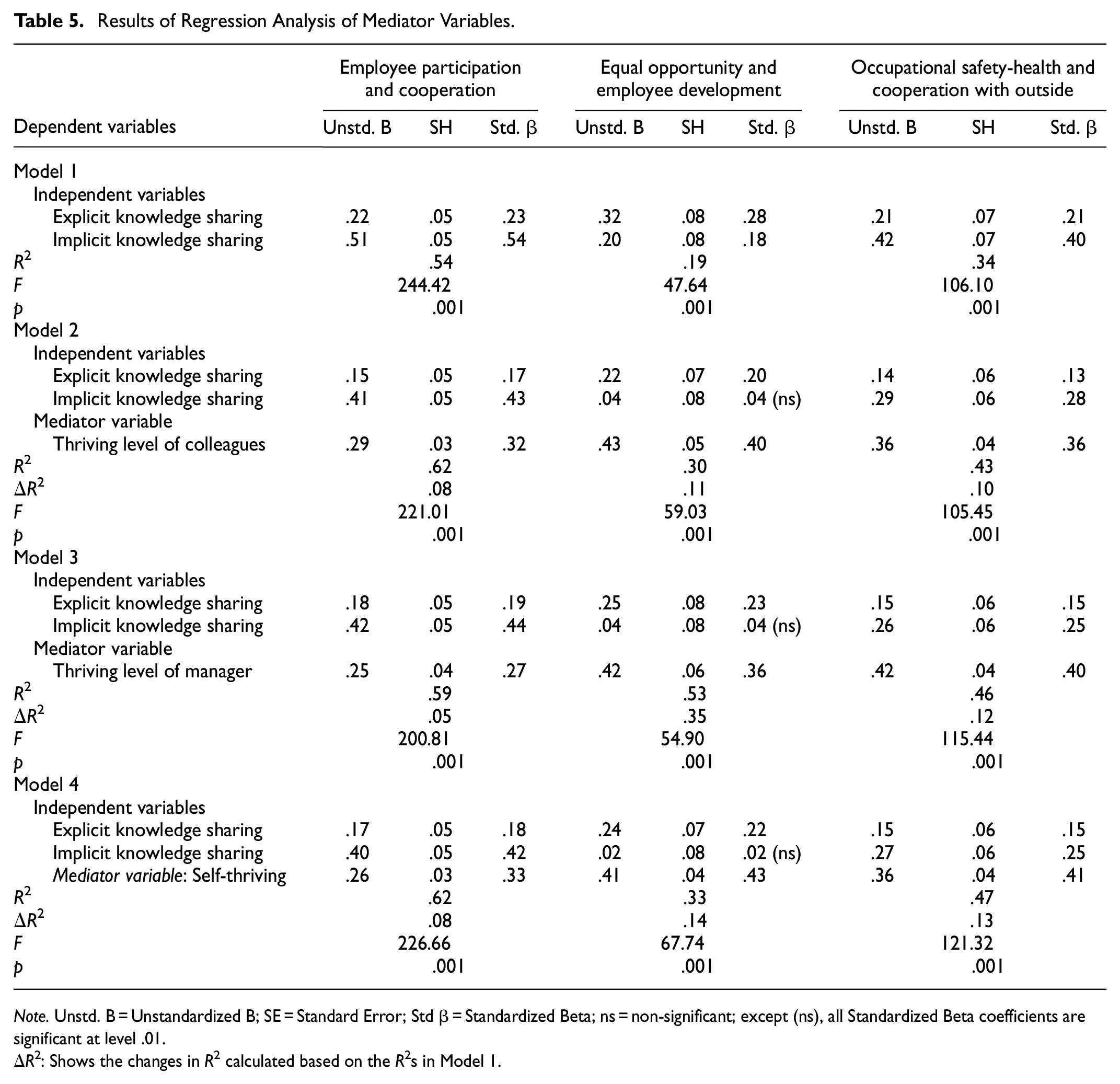
Note. Unstd. B = Unstandardized B; SE = Standard Error; Std β = Standardized Beta; ns = non-significant; except (ns), all Standardized Beta coefficients are significant at level .01.
ΔR2: Shows the changes in R2 calculated based on the R2s in Model 1.
In Model 2, the mediating effect of the thriving level of colleagues was tested. When the mediator variable was added to the model, the effect of explicit KS on the “equal opportunity and employee development” variable changed insignificantly, and its regression coefficients on the other dependent variables decreased. The effect of implicit KS on all dependent variables was found to be significant, and its regression coefficients decreased. When the mediating effect of the thriving level of colleagues in the effect of explicit KS on dependent variables was analyzed with the Sobel test, the mediating effect was found to be significant (p < .01). Likewise, the mediating effect of the thriving level of colleagues was found to be significant in the effect of implicit KS on dependent variables (p < .01).
Model 3 tested the mediating effect of the manager’s thriving level. The mediating effect of the manager’s thriving level was analyzed using the Sobel test, and it was found to be significant (p < .01). Finally, in Model 4, the mediating effect of self-thriving was tested. When the Sobel test analyzed the mediating effect of self-thriving, it was found to be significant (p < .01). Therefore, H4 was supported.
Discussion
This study investigated the link between KS and SS with the mediating role of thriving. To test the hypothesis, we collected data from employees working in tech companies. According to the analyses, we reached many significant results about KS, thriving, SS, and their relationships.
First, we found that KS significantly affected SS. There is some theoretical support in the literature in line with this result. For instance, according to Oxenswardh (2019) and Choi et al. (2008), KS is crucial for sustainability. However, there is a need for more empirical evidence on the relationship between KS and SS. Our study provided empirical evidence about the positive effect of KS on SS. Organizations with high KS can sustain socially more than those with low KS. This link may be because KS promotes collaboration, equal opportunity, and safety in the organization. Thus, we confirmed the first hypothesis of the study.
Then, we found that KS significantly affected thriving (thriving level of colleagues, manager, and self). KS promotes learning and vitality (thriving). This result aligns with the social embedded model of G. Spreitzer et al. (2005). The social embedded model indicates that employees need resources to thrive at work. These resources can be knowledge, support, and positive climate, etc. This result confirms that if employees access knowledge, their thriving level will be higher. KS is especially closely related to learning, one of the dimensions of thriving. Moreover, KS makes employees feel more energetic due to active interaction during KS and a sense of learning. In line with our study, Ononye (2022) and Zhu et al. (2024) have also found that KS significantly affects employee thriving. Indeed, the results have substantiated the validity of the study’s second hypothesis.
The other result of this study is that thriving (colleagues, managers, and self) positively affects SS. Employees perceiving themselves, their colleagues, and their manager with a high thriving level leads to SS practices in the organizations. From the social embedded model perspective, thriving is closely associated with well-being and development (G. Spreitzer et al., 2005). Thriving as a psychological state where employees show vitality and learning behavior contributes to SS and sustainable work performance through physical and psychological well-being. However, there are some gaps in the current literature regarding the relationship between thriving and SS. For example, de Jonge and Peeters (2019) called for research examining the relationship between thriving and sustainable performance. As stated by de Jonge and Peeters (2019), since thriving is a critical factor for human sustainability and sustainable performance, there is an urgent need for theoretical and empirical studies on the effect of thriving on human sustainability. Thus, the results confirmed the third hypothesis of the study.
Finally, we found that thriving (colleagues, manager, and self) significantly mediated the link between KS and SS. We hypothesized that KS led to an increase in the thriving level, which led to an increase in SS practices in the organizations. The literature on this topic is quite scarce. A few scholars have argued the relationship between KS, thriving, and SS. For instance, Pfeffer (2010) states that human sustainability is closely related to employees’ well-being. Also, Abid et al. (2020) consider thriving as an essential force for SS. However, there is a scarcity of empirical evidence for our research model. Our results showed that KS promotes the overall thriving level of colleagues, managers, and employees. When employees, their colleagues, and their managers feel a high level of thriving, they contribute to SS practices, such as employee participation and development, equal opportunity, occupational safety, and health. Our results also confirmed the fourth hypothesis of study.
Therotical Contributions
This research has two contributions to the literature. The first contribution is about SS. Sustainability is a new construct that has attracted to the researchers. Many scholars have studied environmental and economic sustainability in the literature. However, SS must be included in economic and environmental sustainability. According to Pfeffer (2010), SS is as important as economic and environmental sustainability for organizational performance. However, there still needs to be more research on SS. Due to the challenges in its conceptualizing, a few journals have made calls for papers about SS (e.g., Lämsä et al., 2023; Silva et al., 2023). Our study responded to these calls and provided empirical data on SS by testing the effect of KS on SS and the mediating role of thriving in this relationship.
The second contribution of this study is about the social embedded model. Our research model is developed based on the social embedded model of G. Spreitzer et al. (2005). In the existing literature, social embedded model was tested with many constructs as antecedents and outcomes (Kleine et al., 2019: Liu et al., 2021). However, this model is tested with KS as an antecedent and SS as an outcome for the first time. From this point, our research contributes to the existing literature by providing empirical evidence for the socially embedded model.
Practical Implications
The results of our study show that investing in employee development provides a competitive advantage to the organization as a whole by providing employees with a continuous learning experience to improve their existing skills and acquire new skills, which helps them adapt and perform effectively (Lee & Bruvold, 2003). Accordingly, implementing employee development policies is inevitable for organizations with corporate SS (Görmezoğlu, 2023). By recognizing the mediating role of thriving, organizations can focus on cultivating an environment where KS enhances employees’ skills and knowledge and contributes to their overall well-being. Such a work environment, in turn, amplifies the positive impact of KS on creating a socially sustainable workplace culture.
According to Muñoz-Pascual et al. (2019), employees interact to share knowledge in organizations that encourage the free exchange of knowledge and experience. This social interaction environment can contribute to SS by connecting employees and the organization. In this context, we emphasize that managers working in the technology sector should think about policies that can expand and develop KS within the organization. J. T. Yang (2007) stated that KS contributes to individuals’ mutual understanding by sharing their thoughts, beliefs, knowledge, and experiences. This climate of understanding supports employees’ integration with the internal and external environment and increases their adaptability. However, KS culture encourages employees to seek information, ask questions, and participate in discussions (Ononye, 2022). This continuous learning process contributes to employees’ professional development and sense of vitality. For this reason, managers’ designs for a dynamic organizational structure that can respond quickly to changing industry conditions must include KS and thriving components.
Limitations and Recommendations
This study has some limitations as well as its contributions. First of all, this study was designed as cross-sectional survey-based research. With this design, data were collected at a single point in time. So, it is difficult to determine the causality (Taris et al., 2021). We recommend that future researchers test this model in longitudinal data, which enables them to determine the trends and causality. The second one is social desirability bias. Respondents in cross-sectional surveys may provide answers they believe are socially acceptable or desirable rather than reflecting their true beliefs or behaviors (Teh et al., 2023). Surveys were created anonymously to avoid and limit the effect of social desirability bias. Participants were also ensured of the confidentiality of this research. The other limitation of this paper is collecting the data from one source (only from employees). This may lead to the common method variance bias. To mitigate the effect of this bias, we tested the discriminant validity of all constructs using structural equation modeling (Fornell & Larcker, 1981). For future researchers, it is recommended to collect data from different sources. For example, thriving level of colleagues can be obtained from their peers, or thriving level of employees may be obtained from their managers. Lastly, we could not add more variables to this model. However, the following researchers are recommended to explore the moderating effects of workplace characteristics, HR policies, and leadership styles in this research model.
Conclusion
This research highlights the premises needed for organizations to ensure SS. An extensive literature review has provided clues that KS may be among the critical antecedents of SS. Furthermore, there is deep theoretical connections with thriving, KS and SS in relevant study field. The research model developed within this framework describes the effect of KS on SS and the mediating role of thriving in this relationship. Empirical findings confirmed the hypothesized relationships between variables. KS is a critical variable affecting SS. Furthermore, thriving has a crucial mediating role by increasing the strength of this effect. KS and thriving are essential theoretical and managerial tools for organizations. Therefore, managers in the technology industry can use them to achieve SS in their organizations.
Footnotes
Acknowledgements
We are thankful to all participants. The research cannot use the name of the organizations.
Declaration of Conflicting Interests
The author(s) declared no potential conflicts of interest with respect to the research, authorship, and/or publication of this article.
Funding
The author(s) received no financial support for the research, authorship, and/or publication of this article.
Ethical Approval
Ethical approval for this study was obtained from the Social and Human Sciences Research and Publication Ethics Committee of Istanbul Medeniyet University (Document dated 29.09.2021 and numbered 2021/56).

Data Availability Statement
Data supporting this study’s findings are available from the corresponding author upon reasonable request, subject to applicable regulations and institutional policies.