




Abstract
This article suggests a new concept of entrepreneurship based on a modern approach about competition between agribusiness entities and according to the area of their commercial activity. The importance of entrepreneurship measurement is grounded and the correctness of the methodology is proven. Creating a model that covers all aspects of entrepreneurship measurement was determined as the aim of this article. This article presents a real, innovative methodology for measuring entrepreneurship in the agricultural sector based on the modification of TOPSIS method. The method chosen was recognized as the most appropriate for determining the level of entrepreneurship, which is expressed by quantitative parameters. Using the modification of multicriteria TOPSIS method for measuring entrepreneurship in agricultural entities, 12 specific criteria were selected. The model has been tested in the livestock farms of Lithuania to include entrepreneurship as a criterion in assessing the potential of these farms and their readiness to apply sustainable and environmentally friendly activities to organic farming. The applicability of the model has been directly confirmed. The use of the model makes it possible to rank agricultural businesses in a given region according to their degree of entrepreneurship.
Keywords
Introduction
Personality contribution in the process of decision making of each manager and specialist to the better results of the company and the pursuit of winning competition is emphasized in conditions of globalization and increased competition (Odlin & Benson-Rea, 2017). Whenever the economic viability of a business entity diminishes in the agricultural sector, any owner of this activity must look for suitable and acceptable actions of growth stimulation. According to Naudé (2010) as well as many other authors, it is the sector’s commercial and social entrepreneurship that becomes a crucial determinant of economic viability. Tobraegel (1998) and Popelier (2005), who deal with economic viability of farms, distinguish entrepreneurship as one of the main components of economic viability. They emphasize that the factors that motivate entrepreneurship are the most important for profitable activities of any company (Tobraegel, 1998). One of the main factors of entrepreneurship is the wish for achievement of desired results (Popelier, 2005). This author argues that entrepreneurship is really to be treated as the achievement of the economic profit in agriculture (and other industries as well). Production cycles are longer in agriculture, so farmers need some more time to exactly plan their costs and other economic indicators, which can only be met by selling their products. Some researchers (Yunis et al., 2017, and others) also note that the determinants of entrepreneurship between small farms and the self-employed differ from those of large businesses because of the increasing real competition. Different opportunities for business development exist in such companies.
Most authors note that the burden is on the owners and other executives of companies, who not only have to organize their production processes and be always innovative, but also have to involve other employees in such activities (Turner & Pennington, 2015; Yunis et al., 2017). They have to follow global technological development trends and implement new better ways of working to keep up with the competitors.
Practice has shown that only entrepreneurial farms are capable of adapting to the challenges of the market, and that is why farm entrepreneurship is an important feature that enables to achieve at least sufficient performance. The entrepreneurial economy is not afraid to innovate, and it is always at least a step ahead, surpassing its less innovative competitors in terms of the originality of its solutions and at the same time its performance. The change in the status of a farmer in Lithuania was observed almost two decades ago when land workers had to choose between staying with their traditional and traditional tillage methods or choosing modern technologies. This condition applies to all agricultural sectors. Lithuanians are conservative by nature, so at the beginning, only a small percentage of farmers were willing to take risks and innovate their farm. Interestingly, most of the farms who were afraid to take risks and low-entrepreneurial farms are already bankrupt or struggling to survive. Farming can be attributed, in some sort of form, to gambling. We may never know whether the invested money in any agricultural sector will get the planned output and planned income, because the consequence of the activity depends on a larger number of factors than in other business sectors. So where is the key to farm success
A systemic approach does not mean solving all aspects of a complex problem at once, but it does allow us to see the big picture: to break it down into separate components, to analyze them, to highlight the most important, and finally, to integrate them into a whole. Therefore, the development of a model that covers all aspects of entrepreneurship measurement is the goal of this article. The model would make it possible to rank agricultural businesses in a given region according to their degree of entrepreneurship. Testing the model on livestock farms in Lithuania would be an evaluation of the achievement of this objective.
Under the real conditions of economic globalization and competitive business development, not only public administrations but also business entities often have to assess current situations in commercial approach. In terms of financing, staffing, and prioritization of operations, commercial assessment is obviously a difficult action. Often some indicators can show some results as positive, and other indicators yet even may be unacceptable. This is also the case regarding the assessment of entrepreneurship in the agricultural sector, since a variety of criteria could provide a more detailed description of the phenomenon to obtain a more objective assessment in this field.
The objectivity of an entrepreneurship evaluation in agricultural sector is important because the results of such evaluation would help the Agricultural Public Management Authorities to decide on the financing of development projects, assessment of their feasibility, and the consequences of the progress made to disseminate progressive experience. The Agricultural Authorities of the Republic of Lithuania encourage agricultural entities to participate in various development programs by providing funding under certain conditions. Because only entrepreneurial economic operators are capable of purposeful and appropriate use of the available funding (Fang Zhao, 2005). This fact emphasizes the need for measuring entrepreneurship as a significant criterion for selecting agricultural companies for funding under many national programs. The ability to rank entrepreneurs in this sector in terms of entrepreneurship skills would also enable agricultural management services to promote farms, providing some benefits to leading farms and, and in turn, to stimulate the one’s lagging behind to achieve better entrepreneurial and innovative outcomes. In today’s competitive situation, there exist the interests of agribusiness companies to know their place in terms of their entrepreneurship among regional (or national) farms to promote themselves more successfully and present themselves to the market.
The evaluation of agricultural business entities’ entrepreneurship is also appropriate and sometimes necessary in such situations, for example, when required specifically assess companies in terms of entrepreneurship and find out the most innovative and active companies in some concrete agricultural sector. It may be necessary for the aim of stimulating or publicizing them for developing and for stimulating competition. Therefore, the surveyed farms should agree to participate in the entrepreneurship measurement process and identify priority areas of activity where they can justify their innovative and progressive activities and areas where it would be expedient to search for innovative solutions for achieving more efficient results.
Determining the entrepreneurship of agricultural entities and their contribution to economic development is one of the essential aspects of economic theory. The variety of methods and techniques proposed for such evaluation may be explained primarily by the complexity of the problem itself. A number of works have been devoted to this problem, but their analysis reveals some shortcomings, which can be explained not by arithmetic errors, but by the lack of quantitative analysis of the deep methodological problem of intensification. Objective decisions on the level of entrepreneurship on agricultural entities can be obtained by evaluating a set of criteria, which correspond to the specifics of both the activity of the farms and their production and various market situations. Despite the evidence of the direct influence of farm entrepreneurship and innovativeness on the success of their operations, there is only little empirical evaluation research, especially on the methodological potential of identifying and measuring agricultural companies’ entrepreneurship. The literature on entrepreneurship provides methods for measuring entrepreneurship level either based on one criterion focusing on the choice of such criteria or dedicated to the evaluation of entrepreneurship in a specific business (i.e., non-agricultural). Mostly, researchers evaluate the entrepreneurship of employees in a particular branch of industry or the processes of innovative enterprise development opportunities, and any objective quantitative methodology for measuring entrepreneurship in agribusiness is not provided. Hornsby et al. (2002) proposed measures of internal organizational factors that influence middle managers to initiate corporate entrepreneurship, also Turner and Pennington (2015) and Yunis et al. (2017) researched organizational learning as a mean to drive entrepreneurship and innovation, and numerous other authors provide measurement tools for business readiness, the influence of style on entrepreneurship, the aspects of social entrepreneurship, and the benefits of sustainable business, obviously leaving aside entrepreneurship research in the agricultural sector. It is difficult to speculate why, but from this point of view, the situation is obviously unfavorable because of the lack of relevant methodology and the lack of universal methods for assessing entrepreneurship that can be adapted to this specific business sector. The practical relevance of the problem under discussion and the need for a scientific approach led to our decision to undertake research in this area.
Formation of a Model for Measuring Entrepreneurship in Agricultural Companies
The lack of a single aggregate indicator covering the key aspects of entrepreneurship on subject (farms) and allowing for an integrated assessment of this phenomenon allows the measurement of farm entrepreneurship in this sector to be classified as a multi-criteria task. In the first phase, the purpose of measuring entrepreneurship needs to be distinguished and the situation of the test objects examined. As the measurement of farm entrepreneurship is purely voluntary, the first obvious challenge is to obtain consent from the farm on the willingness and the ability to participate in the evaluation. Such evaluations could involve not only public agricultural organizations but also private farms. Private farms would find it useful to find out their place, for example, in terms of innovative entrepreneurship among others in their field, or to publicize the innovative achievements of their organization and the commercial situation of the holding. Such achievements could obviously express the good quality of the product, as good product quality is the main criteria stimulating consumer willingness to purchase. The assessment of the entrepreneurship of farms should use relative economic indicators, so that no trade secrets would be disclosed. These circumstances should encourage farms to participate in such assessments. Therefore, the first element of the model should be aimed at identifying the objects to be evaluated, that is, selecting farms that should be involved in the entrepreneurship measurement process.
Innovation and entrepreneurship in agriculture is a dynamic process, because of fierce competition in this field. Farm managers must constantly think of innovative methods, adjust business plan to stay in good shape, or improve product quality to stay competitive. The assessment methodology should be based on a survey of farm staff. Because employees are aware of the situation in a farm and about using innovative methods. It has already been noted that measuring the entrepreneurship of agricultural companies and farms is a multi-criteria task and therefore another element of the model should be focused on the selection of such criteria. The selection of criteria is probably the most responsible task, because the criteria have to correspond not only to the specificity of the object under assessment and the activity of the farm, but also to the current situation from the commercial point of view.
Our proposed multi-criteria model of entrepreneurship evaluation of economic operators in agriculture (Figure 1) is based on the TOPSIS method (Technique for Order Preference by Similarity to an Ideal Solution), as many researches have proved the applicability of this method to social phenomena.

Model for measuring entrepreneurship of economic operators in the agricultural sector.
For example, Beinoraite and Drejeris (2014) applied eight general criteria and evaluated the entrepreneurship of the inhabitants of two regions of Lithuania. The model was built on the above considerations by applying aspects of the TOPSIS approach. Hung and Cheng (2009) also supported the suitability of the TOPSIS method for the assessment of social phenomena. In addition to the other qualities of the TOPSIS approach to entrepreneurship mentioned above, these authors highlight the following points:
Quite simple, usually rational, comprehensible concept;
Intuitive and clear logic that fully possibly represent the rationale of human choice;
Ease of computation and good computational efficiency;
A scalar value that accounts for both the best and the worst alternative abilities to measure the relative performance for each alternative in a simple mathematical form;
Possibility for visualization.
Roszkowska (2009) provided six criteria for choosing a multi-criteria valuation method and identified the advantages of the TOPSIS method over other methods in evaluating seller–buyer relationships. After all, the ability to sell one’s products is another aspect of entrepreneurship. Therefore, from this point of view, the TOPSIS method for measuring entrepreneurship is the most appropriate. But we found that the model is necessary to modify to adapt it to measure the objects of the agricultural sector. Above all, the criteria of assessment must be adapted to the object being assessed. Taking into account the specificity of agriculture is required to modify the existing TOPSIS model by addition of new components as well. Participation in such entrepreneurship measurement is typical only for agribusiness entities, as they mainly participate in business promotion programs and projects for financing. Thus, it is really necessary to determine the purpose of assessment and to select objects, which would like to be measured. These are responsible issues; they are particularly relevant for the agricultural sector due to the high level of competition in this area as well (Naudé, 2010).
It should be recognized that the criteria selection stage is an exclusive one, and selection has to be respectably in accordance with the type of industry. Next, after the selection and justification of the criteria, other traditional steps of the TOPSIS method are followed in the model: calculation of estimates, indicators normalization, creation of weighted normalized decision matrices, determination of ideal A+ and negatively ideal A– variants, determination of alternative distance to finding the ideal, and finally, analyzing the evaluation results. The model for measuring entrepreneurship in agricultural subjects should look like Figure 1.
The created model is flexible as it allows adding or removing variables in the evaluation system without altering the structure of the model. The following is a justification of all elements of the model and their content. It has already been mentioned that the application of the model is based on the TOPSIS multi-criteria assessment method, which was modified and recognized as the most suitable for measuring entrepreneurship.
Determining the Purpose of Entrepreneurship Measure
The main possible reasons for calculating entrepreneurship are identified in the previous section. In the most cases, public authorities are the initiators of measuring entrepreneurship. In addition to the above, such organizations may need to measure regional entrepreneurship or regional industrial entrepreneurship, of which agricultural entrepreneurship is one of the components. In this case, the entities’ entrepreneurship of other industries would also need to be calculated, and the total industrial entrepreneurship of the region would be the sum of the entrepreneurship of all industries. For the calculation of entrepreneurship for entities of other industries, the suggested methodology can be used, but should choose other assessment criteria in line with the specifics of the industry. These calculations would be useful for regional funding to activate some regions behind in this respect. Advertising companies and business consulting companies can be the initiators of measuring entrepreneurship as well. But in every case, the purpose of the measuring of entrepreneurship is necessary to be clearly and precisely formulated in terms of using and interpreting the appropriate results. This component of the model is mainly specific to the agricultural sector and its exclusion from other existing models makes potentially inaccurate estimates.
Selection of Research Objects
The objects of the evaluation are selected according to the purpose of the research. It has been mentioned that the need for evaluation can be initiated by both the public agricultural management authorities and the agribusinesses themselves to publicize the results achieved. It means that organizers of entrepreneurship measure have to explain the benefits of the results for potential participants of this process. In the former case, public agricultural management authorities may, for example, when publishing a public funding program, use the estimated farm entrepreneurship level as a criterion for allocating funds. It is also possible to use this dimension as one of the criteria to evaluate the eligibility for program objectives in some other multi-criteria assessment. In this case, the evaluated objects (alternatives evaluated) will be farms seeking to participate in the program (or project) and obtain funding for it.
Evaluation can also be initiated by, for example, district livestock farms—leaders in their field who, by measuring and comparing entrepreneurship levels with other district farms, can publicize their entrepreneurial results, highlighting the good quality of operational products, and thereby attracting more customers. Evaluation results may encourage lagging farms to activate as well.
Next, the task is formulated by constructing a matrix of solutions from the n chosen alternatives for the evaluation described by m indicators, that is, an initial decision matrix is formed. Typically, such assessments involve limited number of agribusiness entities, because not all of them agree to present some results of their commercial activity.
[F] = [Sij], i = 1, . . ., n; j = 1, . . ., m:

For the sake of clarity, such a matrix is best presented in a tabular form. This component of the model is also not applied in other models, but its implementation will allow better preparation for evaluation, and achieve more accurate results.
Selection of Evaluation Criteria
The selection of evaluation criteria is not only a responsible but also a daunting task. This element of the evaluation process is usually given the most exclusive and central role in the development of methodology for researching any phenomenon. The chosen solution of multi-criteria problems cannot be the best for all criteria. Thus, one must look for a solution which is not the best for each criterion but is the most acceptable for all the criteria chosen. The used criteria determine the validity of the assessment. The application of a broad spectrum of evaluation criteria ensures a more comprehensive evaluation. The criteria for assessing the entrepreneurship level of agricultural entities should be chosen so as to correspond with the specificities of both the agricultural entity and its field of operations. Therefore, it is appropriate to select an optimal set of criteria for the assessment of farm entrepreneurship and not to combine them into a group to achieve a more objective evaluation result. According to Hsu and Stanford (2007), the optimum number of criteria for an objective assessment should be a minimum of 10 and a maximum of 15 (a lower threshold would reduce the objectivity of the evaluation and the upper limit is due to overly complex evaluation activities). There is no need to choose a large number of criteria, because in this case, the importance of the criteria cannot be accurately weighed by experts in the mind. Many authors agree with 12 as a sufficient number of criteria (Figueira & Roy, 2002; Santiago-Delefosse et al., 2016, and others). They usually use several ways to select criteria: they select very specific criteria specific to a particular area of interest, or apply general criteria such as utility or accessibility. But Santiago-Delefosse et al. (2016) prefers general criteria and recommends considering criteria such as relevance, reliability, user-friendliness, and simplicity. Following this view, and to provide an objective assessment of entrepreneurship, it is appropriate to include both general and specific assessment criteria in the set, and such selection will best reflect the current situation.
Beinoraite and Drejeris (2014) proposed 14 criteria for measuring entrepreneurship of the region. The specificity of agricultural activity makes it impossible to apply all criteria without adjustment, and some are even manifestly inappropriate for assessing the entrepreneurship of agricultural entities (population unemployment dynamics, broadband internet penetration in the region, business certificates issued per 1000 inhabitants, etc.). So, we will describe some the most appropriate measures for assessing the entrepreneurship of agricultural entities, mentioned by Beinoraite and Drejeris (2014) as appropriate for measuring entrepreneurship of the region:
1. Personal characteristics of chief managers and staff (evaluated by points)
The success of every entrepreneur depends to a large extent on his or her personal qualities and characteristics. It is well understood that an entrepreneur and his entire team need courage, determination, creativity, and flexible thinking. The key is adaptability, pursuit of purpose, and of course, excitement. If the people in charge of the farm have set goals for a particular project or new product to develop, it only shows the strengths of the farm’s entrepreneurship. Ambitious, eager to innovate and innovative, always get better commercial results than those who do not. It is evident that innovative people usually look beyond existing problems and potential ones and come up with ideas to solve them and try to improve the quality of the organization’s operational product or increase the volume of production. In addition, staff creativity, as part of a firm’s innovation potential, is one of the most important advantage of companies in the competitive battle and often determines the innovativeness of an organization’s decisions (Ritter et al., 2014). Creativity is the ability of a person to be interested in and discover new phenomena, to discover completely new ways of expression or problem solving. In humanistic psychology, creativity is the dissemination of personality through self-actualization and self-expression (Fischer, 2012). In assessing the innovativeness of agricultural enterprises, Maredia et al. (2014) argue that corporate culture has a significant impact on entrepreneurship. They emphasize the influence of corporate culture specifically on the entrepreneurship of agricultural enterprises and suggest that one of the indirect general criteria for assessing entrepreneurship may be the personal qualities of managers and staff, which are expressed by their creativity.
2. Geographical location (evaluated by points)
Both the place of residence and the specifics of the region become important factors for a person’s entrepreneurship (Qian, 2013). Also, the location of the farm, in the region, may have an impact on the entrepreneurship of the agribusiness as a business entity. Merrett and Gruidl (2004) demonstrated the influence of a location not only on entrepreneurship but also on business success in rural areas. For example, bordering on neighboring countries fosters a desire to establish cross-border relationships with other businesses or entrepreneurs and to expand (or start) their own business, especially in the face of successful business from other entities. Being located in a well-soiled area makes more sense to develop farming businesses and also requires less effort in preparing feed for livestock. Therefore, the geographical location of any business entity can determine its entrepreneurship (Bizri, 2017; Kloosterman & Rath, 2001, p. 190).
3. Level of education (relative indicators)
This criterion is also important for several reasons. First of all, there is a tendency for more educated people to start a business and for those with higher education to succeed (Ngah & Salleh, 2015). This tendency could be explained by the fact that educated persons (especially those with higher university or higher non-university education) have a greater knowledge base during their studies and wish to use their own experience to build their own business (Staniewski, 2016). The mentioned author explain this circumstance with the greater innovation of educated people creating and implementing innovation requires a certain amount of knowledge. So, educational levels may be one of the criteria for measuring entrepreneurship. In other respects, the importance of education as a criterion for measuring entrepreneurship also means that the higher the education of farm workers, the better ideas they generate. So, educated individuals better and bolder are able to assess operational risk and make more objective decisions). Level of education could be expressed as the relative weight (%) of tertiary education workers among all farm workers.
4. Average age of farm workers (years)
Adopting new ideas requires flexibility in thinking. Young people tend to make radical decisions more easily (Willigen & Koops, 2015), so age would also be one indicator of innovation. It turns out that employee age has a direct influence on the number of innovative ideas an organization has for improving performance. It is clear that the age of the employees should also be one of the subjects of the survey. A lower average age of farm workers would mean greater operational flexibility and, at the same time, greater innovation and greater entrepreneurship.
5. Application of innovative ideas presented by farm managers in the recent period (qty)
This indicator would include only ideas proposed and implemented by managers aimed at better performance. As far as entrepreneurship of the whole economy is concerned, it should be borne in mind that most business improvement ideas are usually presented by farm owners (or other farm managers) who manage the finances of the farm and feel the greatest benefit from the realization of innovative ideas. Therefore, to measure the overall entrepreneurship of the economy (both managers and other employees), it is appropriate to differentiate the number of innovative ideas according to their source. Such differentiation makes sense, as practice shows that most of the key innovative ideas for performance improvement are provided by farm managers, so excluding these indicators would often only measure the entrepreneurship of farm managers, but not all employees. The exclusion of criteria is also necessary in view of the fact that, in the opinion of experts, the criteria may have different significance estimates when measuring the entrepreneurship of the whole economy. Littunen and Niittykangas (2010) investigated the growth factors of service companies and found that the search for innovative ideas alone is an obvious indicator of entrepreneurship. The farmer, who has a good team, is rarely working on the land himself and engaging in production because there is simply no time for it. He communicates with the buyers of the product, the buying companies, and observes which stage of sales is most in demand. Production processes are more related to the work of other employees. Therefore, from an operational point of view, it is expedient to separate the sources of ideas.
6. Adaptation of innovative business improvement ideas presented by other farm workers in the last period (qty).
While these would be one of the most important criteria for measuring entrepreneurship, other authors suggest using this one general criterion (the number of ideas realized over a period of time) when evaluating an organization’s entrepreneurship (Barsh et al., 2008), but differentiation would more accurately define the circumstance that would help make some personnel management decisions. Calculations include 5 years of innovative ideas. Morris (2015) argues that the number of realized ideas best expresses the entrepreneurial spirit of the organization and emphasizes that the result of the realization of commercialized ideas should be quantified and this indicator could be one of the most important descriptors of the entrepreneurship of the organization.
Among the specific evaluation criteria reflecting the nature of the activity, the entrepreneurial evaluation of agricultural companies should also include six criteria reflecting the characteristics of the activity. To increase the objectivity, at least one or two criteria should be selected among the criteria mentioned above, which could be used to assess the degree of exclusivity of the business entity. Such criteria would be particularly useful when assessing the entrepreneurship of one specific agricultural activity. The most appropriate specific criteria, selected on the basis of logic and scientific literature, are specific and appropriate for measuring entrepreneurship in agribusiness:
1. Growth (+) and decline (–) dynamics of agribusiness economic activity (%)
This indicator can be used to describe both the dynamics of the volume of marketed production in terms of volume and value. It is best to derive the average of the last 5 years. Morris (2015) also endorses the idea that improving the economic position of an entity best expresses the entrepreneurial spirit of the organization and argues that the dynamics of economic activity should be expressed as quantitative indicators of the growth (or deceleration of its activity) of the organization and the entrepreneurship of the organization. The relative expression of this indicator would not reflect the size of the farm or describe any of its trade secret.
2. Utilization of funds from agribusiness promotion programs (projects)
It has already been mentioned that the scale of economic development expresses the entrepreneurship level of the economy. Expenditure on business development requires costs, so the mere willingness to cover costs from outside sources and the pursuit and implementation of such ideas also reflect the entrepreneurial spirit of the economy. This indicator could be expressed in terms of both the number of projects involved and the amount of money spent on programs (or projects). Frederiksen and Davies (2008) emphasize that the involvement of an organization in project activities always involves certain risks and only entrepreneurial companies are inclined to take risks for the sake of business development, so participation in programs (or projects) can be an obvious ode to entrepreneurship. Project activity is one of the ways of implementing ideas, so the number of projects involving agribusinesses should also be one of the criteria for measuring entrepreneurship. These authors argue that a successful development project promotes employee job satisfaction and self-reliance in other projects, thereby being entrepreneurial and innovative, and seeking opportunities to re-create or participate in other programs (or projects).
3. Estimated funds for economic development in the next 5 years
It has already been mentioned that the entrepreneurship of the economy manifests itself in successful commercial development. Thus, aspiration and opportunities for future expansion are one of the indicators of entrepreneurship. Therefore, the attitude of the farm manager on these issues is of great importance for the formation of the approach to business development. The business manager prepares business development plans, takes risks, and provides funds for business development. Therefore, future economic development aspirations, expressed in monetary terms, would be an obvious indicator of entrepreneurship. Examples of business executives are provided by Behrens and Patzelt (2016). They provide a model that shows the paths to success after a failed project. The goal of every business is to increase revenue and reduce costs. Of course, relative cost reduction without compromising product quality is a daunting task, and only the most efficient and innovative agricultural organizations can achieve the highest results. As economic development always requires certain costs, the planning of such costs also reflects the entrepreneurial spirit of the farm.
4. Participation in events (exhibitions, conferences, as well as on the internet) on the topic of economic innovation and business expansion (number)
Entrepreneurship could also take the form of co-operation with other businesses to achieve a common goal. It is clear that the innovation of the staff is an integral part of farm entrepreneurship. It is believed that those people are called innovative who innovate in their activities. When it comes to organizations in the agricultural sphere, managers of entrepreneurial farms go deeper into innovation, application of computerized management systems, and such individuals strive to participate in agricultural exhibitions and conferences to broaden their knowledge in the field. Innovative tools for business enhancement make working hours more efficient. More efficient work helps not to reduce the amount of leisure time you can take interest in. Having leisure time is a pressing issue for agricultural workers. People’s willingness to learn and to improve could also be an expression of innovation in both business and public organizations. It is appropriate to express this indicator as the time spent by staff on in-service training or the number of trips to such institutions.
5. Suitability of working conditions
Entrepreneurial managers always strive for good (satisfactory) commercial performance. It is clear that the performance of the economy also depends on the quality of the work of the staff. Therefore, decent working conditions should be considered as an indicator of entrepreneurship, as quality work can only be done under decent working conditions. Economy-free work schedule, avoidance of harmful conditions, proper staff relations (psychological climate), and adequate work training always lead to work results, and good work results allow to achieve organizational development goals. Therefore, it is clear that the provision of decent working conditions is one of the indicators of entrepreneurship in an organization (Bhachu, 2017; Moog et al., 2015; Soto-Acosta et al., 2016).
It has already been mentioned that another one or two criteria should reflect the nature of the agribusiness, the size of the enterprise, or the specifics of production. A differentiation of criteria would be a new challenge for the use of TOPSIS method. Thus, we propose the criteria to differentiate, but give both groups equal significance as well. So, such a decision only increases the objectivity of the assessment. It is especially important for the assessment of social phenomena. And such a methodology would be exceptional in the use of the TOPSIS method.
Determining the Significance (Relative Importance) of Criteria and Normalizing Indicators
An expert method is proposed for the establishment of the relative importance of the criteria. It is necessary step before normalizing. The establishment of the criteria significance is also one of the main elements in the assessment, since typically criteria are not equally important for the final decision and the possibility to quantify the importance of the criteria boosts the objectivity of the assessment.
It is proposed to use a scale of 100 points, where total estimates are calculated as follows:

where Wie is an estimate of the ith criterion by the eth expert; n is the number of experts; and Wi is the sum of all i criterion estimates by all e experts.
The equation below is used to establish the relative importance of the criteria

where m is the number of criterion. In this case, the sum of criteria importance will always equal 1 (Lukic et al., 2017):

If the result is different, there must be a calculation error.
For comparison of different dimensional indices, we suggest the decision matrix to normalize by converting the indices of different dimensions into neutral dimensions (Formula 5):

where
Weighted normalized decision matrix [

So, the new matrix should look like this:

It is also appropriate to present the results in a table.
It can be mentioned that the TOPSIS method differs from most multi-objective evaluation methods of alternatives in that there are no limitations in determining the significance of the indicators and the sum of the significance of the indicators does not necessarily have to be equal to 1. Therefore, for this reason, this method is suitable and favorable for measuring entrepreneurship, as a simplified calculation is possible too.
Identify the ideal A+ and negatively ideal A– variants (Liguo et al., 2016):

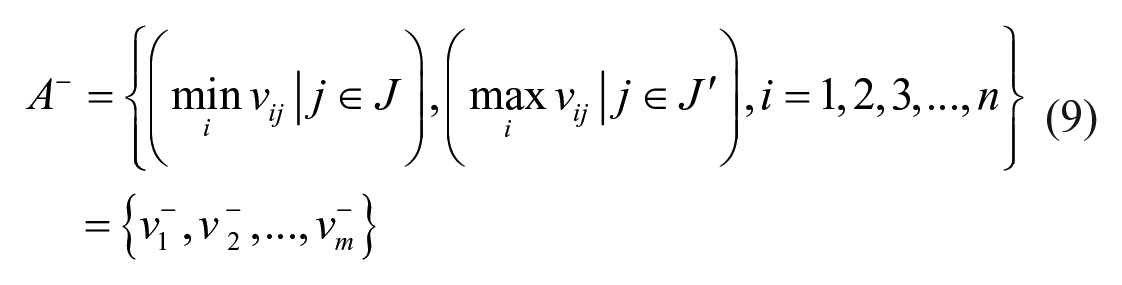
where J = {j = 1, 2, 3, . . ., m} is the set of maximizable indicators and J′ = {j = 1, 2, 3, . . ., m} is the set of minimizable indicators.
The distance of each alternative to the ideal is determined as (Wu et al., 2011):


These data should be used in further calculations.
Publication and Analysis of the Evaluation Results
By measuring the distance of each alternative to the ideal (Formula 10) and the distance to each of the alternatives to the negatively ideal (Formula 11), it is easy to calculate the

where 1 ≥ Cj + ≥ 0.
This approach can be used to evaluate many alternatives. Alternatives to priority line of alternatives or the ideal point of proximity can easily be determined by systematically indexing which alternatives are most appropriate. We have determined that, after positioning the evaluated objects in a line by value, the obtained results can be analyzed in accordance with the purpose of measuring.
Decision According to the Purpose of Measuring
As mentioned above, the purpose of entrepreneurship measuring has to be clearly and precisely formulated; therefore, the results of the evaluation must allow the necessary decisions to be made. The results in quantitative terms may be used for further evaluation as necessary indicators in the other multicriteria evaluation, or may be used to make a final decision depending on the purpose of the measurement.
The practical application of the model was during the implementation of the project “Competitive Farm” initiated by the Lithuanian Ministry of Agriculture in 2018. The aim of the project was to encourage livestock farms to switch to environmentally friendly activities and to expand the idea of organic farming. Only one well-prepared farm was allocated for the project. As business rotation is a challenge for agricultural entities related to farm entrepreneurship, farm entrepreneurship was recognized as one of the key evaluation criteria. Vytautas Magnus University, as a project partner, needed to develop a methodology and provide a practical application for quantifying entrepreneurship. Therefore, the need for evaluation was fully in line with the project objective in this cases. The practical application of the methodology below corresponds to each of the stages discussed.
The project was announced in the Republican Press. Nine livestock companies have applied for voluntary participation in the project. After an initial review of the applications, it was found that only three companies were eligible for the project. According to the suggested model, entrepreneurship has to be measured for the following three Lithuanian companies:
Joint-stock company (JSC) “The pigs breeding”;
Agricultural private company “Šilutė breeding”;
JSC “Šeduva sheep.”
The system of criteria was further developed according to the requirements. Each of the criteria for measuring entrepreneurship was discussed with experts, and the criteria describing the relevance of the general criteria and the nature of the activities were agreed. It was stressed that, according to the above criteria, measurements of farm entrepreneurship in livestock farming will be objective and appropriate. It was also decided that the most appropriate criterion for measuring the entrepreneurship of livestock farms would be “housing conditions.”
This criterion would be the only characteristic, according to the requirements presented, of the objects to be assessed exclusively, inherent to livestock companies. As far as business development opportunities are concerned, it should be borne in mind that livestock agricultural entitled productivity is influenced by livestock housing conditions (Muñoz-Osorio et al., 2016). Temperature regimen, proper nutrition, absence of stress, sufficient space, and cleanliness in the volley (Herbut et al., 2015; Roland et al., 2016; Sejian et al., 2018) are important. It is obvious that the business agricultural entities will try to make the most favorable conditions for livestock, because the suitability of the conditions will depend on the quantity and quality of production, as well as the income of the agricultural entities and the income will determine the development opportunities. Therefore, the pursuit and search for opportunities to provide the livestock with the best possible conditions would obviously be seen as one of the features of entrepreneurship. The alternatives to be evaluated (livestock companies) and the selected criteria are listed in a table prepared by Formula 1 in the form of a decision matrix.
An expert approach was used to determine the significance of the criteria and to evaluate the performance of each agricultural entity against the criteria selected. The significance of the criteria and the dimensional values of the estimates were calculated according to the proposed methodology. Five experts with the most experience in the agricultural business and knowledge of the situation in the livestock sector participated in the evaluation. The experts represented the Lithuanian Association of Beef Cattle Breeders and Improvers, the Lithuanian Organic Farms Association, the Agricultural Advisory Service, the Lithuanian Ministry of Agriculture, and the Vytautas Magnus University Agricultural Academy. The results are shown in Table 1.
Expert Evaluation of Livestock Farms According to Given Criteria.

Note. JSC = joint-stock company.
Formulas 2 and 3 were used to determine the significance of the criteria; the correctness of the calculations was verified according to Formula 4, and the dimensionless values of the estimates were recalculated according to Formula 5. It turned out that the most significant criterion is personal traits and even four criteria are of equal significance The weighted normalized decision matrix [U] was constructed by multiplying the normalized matrix by the significance vector of the indicators, that is, each element of the matrix is multiplied by the qi significance of the corresponding indicator using Formula 6. The results are presented in Table 1 following the matrix in Formula 7. The results of this table were used in further calculations.
The estimation procedures (the calculation of ideal A+ and negatively ideal A– variants) are shown in Table 2.
Calculation of A+ and A− Values.

The values of the aforementioned ideal A+ and negatively ideal A– variants are calculated according to Formulas 8 and 9. As both maximizing and minimizing criteria were used in the calculations, it can be stated that the result was objective. The results presented in Table 2 are also used in further calculations. The final results are presented in Table 3.
Final Results of the Entrepreneurship Value of Agricultural Companies Seeking to Participate in the Project.

Note. JSC = join-stock company.
The distance of each alternative from the ideal to the Formula 10 and the distance from each of the alternatives to the negative to ideal from Formula 11 allowed us to calculate the
Conclusion
This article clarifies the concept of entrepreneurship by emphasizing the characteristics of entrepreneurship in the agricultural sector. The need for measuring entrepreneurship in agribusiness is based on three arguments. Measurement can be beneficial to companies themselves, as leading entrepreneurs can publicize this information to drive sales of products with an emphasis on good product quality.
In addition, by setting low levels of entrepreneurship, published information will, in this respect, challenge the lagging farms to work more innovatively, effectively, and efficiently to achieve better economic outcomes. Likewise, the level of entrepreneurship may be one of the criteria for assessing financing opportunities for companies involved in agricultural projects and seeking financing for their activities.
The modified TOPSIS multicriteria approach is based on and recognized as the most suitable method for assessing entrepreneurship in agribusiness. A modified model of the application of this method has been prepared, which is adapted for the assessment of entrepreneurship criteria of agribusiness subjects. The suggested model is modified by the addition new two components and the selection of specific criteria, typical to the assessment of agricultural objects.
Using the multi-criteria TOPSIS method for measuring entrepreneurship in agricultural entities, specific evaluation criteria were selected for measuring entrepreneurship in agriculture. There are six general criteria and six specific criteria, which can be applied even for measuring the entrepreneurship of a specific agribusiness.
The model has been tested by the Lithuanian Ministry of Agriculture project “Competitive farm” to measure the entrepreneurship of livestock farms, to include this criterion in assessing the potential of these farms and their readiness to apply sustainable and environmentally friendly activities to organic farming.
Footnotes
Authors’ Note
The authors confirm that neither the manuscript nor any parts of its existing content are currently under consideration or published in any another journal.
Declaration of Conflicting Interests
The author(s) declared no potential conflicts of interest with respect to the research, authorship, and/or publication of this article.
Funding
The author(s) received no financial support for the research, authorship, and/or publication of this article.
