



Abstract
COVID-19 pandemic has been threatening the sustainability of companies in Indonesia. Various policies and restrictions have caused a significant decline in sales and led to bankruptcy. As the major players in the national economy, the micro, small, medium enterprises (MSMEs) are encouraged to focus on their survival and sustainability. Survey method is done to examine the direct effect of human capital readiness and information capital readiness on business sustainability. It investigates whether the relationship is sequentially mediated by market orientation and business performance. Online questionnaires were distributed to 347 owners/managers of Indonesian manufacturing MSMEs in the East Java Province, Indonesia. PLS-SEM equation modeling was employed to test the hypotheses. Result shows that human capital readiness and information capital readiness positively affect business sustainability, and business performance does not mediate the effect of human capital readiness on business sustainability. Most important finding reveals that market orientation and business performance sequentially mediate the human capital readiness-business sustainability relationship. Market orientation and business performance sequentially mediate information capital readiness-business sustainability relationship. This study contributes to the development of resource-based view (RBV) by providing the empirical result on the important internal resources on sustainability. This brings practical awareness to the owners/managers of Indonesian MSMEs on increasing their market orientation to enhance their business performance and to guarantee their business sustainability. Practically, this research has important implications for achieving business sustainability as it offers a way for practitioners to improve business sustainability by utilizing human capital readiness, information capital readiness, market orientation, and business performance.
Plain Language Summary
In Indonesia, the COVID-19 pandemic has been tough on business, especially smaller ones. This study focused on investigating micro, small, and medium enterprises (MSMEs) by surveying 347 manufacturing businesses in East Java to check how ready these businesses were in terms of their workforce (human capital readiness) and how well they used information and knowledge (information capital readiness). The findings were clear: businesses with strong human and information capital readiness were more likely to be sustainable. However, the road to success wasn't direct. The study found that two things really mattered: market orientation (how well a business understands and meets customer needs) and business performance. For businesses with well-prepared people, market orientation played a crucial role in sustainability. On the flip side, businesses with good information use needed both market orientation and strong business performance to ensure long-term success. For small businesses in Indonesia, having skilled people and using information effectively is vital. But it's not enough on its own. Understanding the market and performing well as a business are equally important, especially in challenging times like the COVID-19 pandemic. This information is valuable for business owners and managers, guiding them to improve strategies and secure the long-term success of their companies.
Keywords
Introduction
During the COVID-19 pandemic, most Micro, Small, Medium Enterprises (MSMEs) are experiencing a downturn and even bankruptcy. A survey conducted by the Bank of Indonesia in 2021 revealed that as many as 87.5% of MSMEs are affected by the COVID-19 pandemic, especially a significant decline in sales (Saputra, 2021). Only creative and innovative SMEs can survive and thrive during this deadly pandemic. Therefore, business sustainability is the most important issue for every company which is the reflection of a company’s success in implementing a sustainable strategy. Sustainability refers to meeting the needs of the present generation without sacrificing the interests of future generations (WCED, 1987). Sustainability consists of three aspects, namely financial, social, and environmental dimensions (Armindo et al., 2019; Dyck et al., 2019; Glavas & Mish, 2015; Hart & Milstein, 2003; Ozbekler & Ozturkoglu, 2020). The operational framework of sustainability is introduced by Elkington (1994) as the Triple Bottom Line (TBL). To achieve a good sustainability performance, companies must balance those three aspects and should not focus on just one aspect (Cantele & Zardini, 2018; Hahn et al., 2015; Henry et al., 2019; Van der Byl & Slawinski, 2015). Many factors affect business sustainability. This study argues that internal factors, including human capital, information capital, market orientation, and business performance play an important role in companies’ use to create sustainable competitive advantages and improve their business performance.
The resource-based view (RBV) explains that every company has a different combination of resources and capabilities to increase the value of the company and achieve a sustainable competitive advantage (Barney, 1991). Internal resources are the main foundation of a company’s competitive advantage (Nagai, 2009; Hameed et al., 2021). Effective resource management and company’s capabilities have a positive effect on business sustainability (Caloghirou et al., 2004; Chatzoglou et al., 2018). To achieve competitive advantage and business sustainability, internal resources that have the characteristics of valuable, rare, inimitable, and non-substitutable are needed (Barney, 1991; Penrose, 1959; Raza et al., 2021; Wernerfelt, 1984) Therefore, it is very important for companies to manage their internal resources including human capital, information capital, market orientation, and business performance to achieve competitive advantage and business sustainability.
The results of previous studies regarding the effect of human capital and information capital on business sustainability are still inconsistent. The previous studies that employ the construct of human capital readiness and information capital readiness are still rare. Most researchers use the construct of human capital and information capital. The current study argues that the value of intangible assets lies in their readiness to support the effectiveness of strategy execution. Several researchers have proven the positive influence of human capital and information capital on business sustainability (Alnoor, 2020; Burawat, 2017; Chabbouh & Boujelbene, 2020; Fareed et al., 2016; Taha & Espino-Rodríguez, 2020). However, other researchers have revealed that human capital and information capital do not directly affect business sustainability (Cabrilo & Dahms, 2018; Scafarto, 2016; Wang & Chang, 2005). The gap in the previous studies requires more in-depth research. Therefore, this study proposes market orientation and business performance as mediating variables in a comprehensive framework based on the following indications: (1) the influence of human capital and information capital on market orientation (Chabowski & Mena, 2017; Jogaratnam, 2017); (2) the influence of human capital and information capital on business performance (Nadeem, 2017; Smriti & Das, 2018); (3) the influence of market orientation on business performance (Acosta et al., 2018; Sett et al., 2017); and (4) and the influence of business performance on business sustainability (Al Mamun et al., 2018).
Market orientation and business performance have become two important aspects of a company. Market orientation emphasizes the importance of identifying and meeting customer needs to achieve good business performance (Kohli & Jaworski, 1990; Narver & Slater, 1990). Market orientation consists of customer orientation, competitor orientation, and interfunctional coordination (C. -H. Chin et al., 2013; Hilman & Kaliappen, 2014). Market orientation gives companies a competitive advantage through the development of marketing capabilities (Cadogan et al., 2002; Khuwaja et al., 2019; Murray et al., 2011). Market orientation focuses on customers as the main stakeholder group. However, other stakeholder groups such as regulators, shareholders, suppliers, employees, and the general public also influence companies, especially in global markets (Ferrell et al., 2010). Given its emphasis on meeting customer needs, market orientation is closely related to the achievement of business performance (Hurley & Hult, 1998; Slater & Narver, 1995). Thus, companies will add value and maximize business sustainability from their market orientation strategy.
This study develops the works of previous scholars, including Kaplan and Norton (2004), Fareed et al. (2016), Burawat (2017), Cabrilo and Dahms, (2018), Alnoor (2020), and Chabbouh and Boujelbene (2020) with the following differences and updates: (1) This current study employ a more specific construct that emphasizes the readiness of human capital and information capital; (2) This study uses a multi-mediation approach, so it provides more comprehensive understanding in explaining how the mechanism to achieve business sustainability; (3) While previous studies focused on business performance, this research focuses more on the antecedents of business sustainability; and (4) This study is the first study to investigate the effect of human capital readiness and information capital readiness, market orientation, business performance on business sustainability in the research setting of Indonesian MSMEs. The current study is guided by the following important questions: (1) Do human capital readiness and information capital readiness positively effect on business sustainability? (2) Do market orientation and business performance mediate human capital readiness-business sustainability relationship as well as information capital readiness-business sustainability relationship?
The paper is structured as follows. The next section describes a summary of the literature review and hypothesis development. The following section explains the research methodology. The results and discussions are reported afterwards in the subsequent section. The study concludes with conclusions, contributions, limitations, and future research.
Literature Review and Hypothesis Development
RBV is a theory stating that a company’s competitive advantage is created by managing internal resources that have valuable, rare, inimitable, and irreplaceable characteristics (Barney, 1991; Chi, 1994; Iqbal et al., 2020; Wernerfelt, 1984). These unique internal resources are utilized to achieve competitive advantage and business success. (Barney, 1991; Kaur et al., 2017; Mitchell, 2008). Although difficult to assess, intangible resources can be a strategic strength for businesses today. Managing resources such as human capital readiness and information capital readiness enables companies to implement strategies that increase their efficiency and competitive position (Kaplan & Norton, 2004). Therefore, managers must choose the strategy that best utilizes their internal resources relevant to external opportunities to achieve a sustainable competitive advantage.
Intangible resources can be utilized by companies to improve business continuity through their competitive advantages (Lu et al., 2021; Wernerfelt, 1984). Competitive advantage that is different from other organizations will become a strategic tool to create business continuity. RBV provides guidance for managers to achieve organizational goals by adopting business strategies and utilizing resources (Aidara et al., 2021; Nasir et al., 2017). The increasingly fierce competition requires a good strategy formulation and an effective strategy execution. Human capital readiness and information capital readiness matter for a successful execution.
In line with sustainability, organizational performance can be improved by balancing the three dimensions of sustainability, namely social, environmental, and economic (Cowley, 2015; Goosen & Cilliers, 2020; Palacky et al., 2015; Wolch et al., 2014). Sustainability creates a harmonious life that meets social, economic, and environmental needs (Goosen & Cilliers, 2020; Wolch et al., 2014). Companies are competing to implement their best strategy by focusing on market orientation to achieve their business performance (Khan et al., 2016; Maniora, 2018). Therefore, this current study argues that both human capital and information capital readiness play an important role in executing market orientation strategy to achieve business performance and business sustainability.
Human Capital Readiness and Business Sustainability
RBV argues that a company’s competitive advantage is created by properly managing resources that are valuable, rare, inimitable, and non-substitutable (Barney, 1991; Wernerfelt, 1984). Undoubtedly, investment in human resources is an absolute requirement for all companies because it can create economic value, which becomes organizational knowledge to create differential advantages to meet customer needs. Therefore, the value of human capital is highly dependent on its readiness. By developing human capital readiness, the strategy execution will be more effective, and a better business performance will be easier to achieve. Then, it will support the company’s business sustainability. Previous studies have proven the effect of human capital on business sustainability (Fareed et al., 2016; Kucharčíková et al., 2018; Yeh et al., 2020). A study by Fareed et al. (2016) on 40 human resources managers in Pakistan revealed that human capital development is very important to improve organizational performance and to gain a sustainable competitive advantage. Kucharčíková et al. (2018) conducted a study and proved that human capital with relevant education has a great influence on performance, competitiveness, and sustainability. Another study by Yeh et al. (2020) on 16 major industrial sectors in Taiwan revealed that human capital development is directly proportional to sustainability performance. Because the current study focuses on readiness, it argues that the higher the human capital readiness, the higher the business sustainability of MSMEs. Based on the previous discussions, the following first hypotheses is proposed:
H1: Human capital readiness is positively associated with business sustainability
Information Capital Readiness and Business Sustainability
In line with the RBV, companies can achieve a sustainable competitive advantage by integrating knowledge, utilization, and objects in information technology. This integration will create valuable and rare resources for companies so that not all can enjoy the efficiency and effectiveness of information technology. However, this will only generate value for the company if the company is prepared for information capital. Technological progress is one of the steps that can be applied to remove economic barriers in the era of globalization because it helps to increase the productivity and efficiency of economic production factors including labor, capital, and other resources. The adoption of information communication technology (ICT) is one of the areas recommended for MSMEs to face business competition (Nugroho et al., 2017). ICT has many benefits for the business sustainability of MSMEs. By increasing information capital readiness, a competitive advantage will be enhanced, and it supports the company’s business continuity. A study by Prasanna et al. (2019) proved that information technology and technology adoption increase productivity and business continuity. Because the current study focuses on the readiness, it argues that the higher the information capital readiness, the higher business sustainability of MSMEs. Based on the previous discussions, the following second hypotheses is proposed:
H2: Information capital readiness is positively associated with business sustainability
Mediating Role of Business Performance on the Effect of Human Capital Readiness on Business Sustainability
RBV argues that a company’s competitive advantage is achieved by properly managing internal resources that have the characteristics of valuable, rare, inimitable, and non-substitutable (Barney, 1991; Wernerfelt, 1984). These four characteristics can be found in human capital, which is an important part of the company. Human capital includes competence, knowledge, the ability to establish relationships, and one’s behavior (Shahzad et al., 2022; Ting et al., 2020). This is because, through HC, organizations can develop innovation, creativity, and develop strategies (Bontis, 1998; Nazari & Herremans, 2007). Companies need to develop and prepare their human capital so that they are ready to support effective strategy execution. The more effective the strategy execution, the better the business performance; then, it will drive to an enhanced business sustainability. Some previous studies have proven the effect of human capital on business performance (Nadeem, 2017; Smriti and Das, 2018; Tjahjadi, Soewarno, Nadyaningrum, et al., 2020). A study by Smriti and Das (2018) on 2500 companies in India proved that human resources have a major influence on company’s productivity. Good human capital affects business performance; then, it affects long-term performance or business sustainability. Because the current study focuses on readiness, it argues that the better the human capital readiness, the better business performance, and the better the business sustainability. Based on the previous arguments, the following third hypothesis is proposed:
H3: Business performance mediates the effect of human capital readiness on business sustainability.
Mediating Role of Business Performance on the Effect of Information Capital Readiness on Business Sustainability
Due to the unique resources a company has in line with the RBV and sustainability, a company is becoming more adept at creating innovative, high-quality, sustainable, and difference-making products/services. In today’s challenging business environment, intangible assets, such as information capital is a major source of competitive advantage (Haskel & Westlake, 2017; Jones, 2018; Mubarik et al., 2018). Information capital is a company’s core asset that aims to make decisions to achieve company goals. Information capital readiness provides infrastructures, databases, systems, networks that become the foundation of business processes. Thus, the high state of information capital readiness drives more effective strategy execution and processes that will generate a better business performance. A previous study of Tjahjadi, Soewarno, and Gunawan (2020) on 433 MSMEs in Indonesia revealed that information capital readiness has a positive effect on business performance. A better business performance leads to a better long-term performance or sustainability. Because the current study focuses on readiness, it argues that the better the information capital readiness, the better business performance, and the better the business sustainability. Based on this argument, the following fourth hypothesis is proposed:
H4: Business performance mediates the effect of information capital readiness on business sustainability
Mediating Role of Market Orientation and Business Performance on the Effect of Human Capital Readiness on Business Sustainability
Market orientation refers to the organization’s strategy in maximizing the value of products to achieve competitive advantage in the competitive market (Alotaibi & Zhang, 2017; Nakos et al., 2019; Tjahjadi, Soewarno, Nadyaningrum, et al., 2020). Market orientation plays an important role in increasing the success of organizations implementing business sustainability strategies (Hernández-Linares & López-Fernández, 2018; Masa’deh et al., 2018; Prifti & Alimehmeti, 2017; Sett et al., 2017). Market orientation strategies encourage organizations to continuously seek information about the needs and conditions of consumers, competitors, and others to maximize their outputs (He & Wei, 2011; Jawad et al., 2019). A study by Prifti and Alimehmeti (2017) in Albania showed that market orientation strategies positively affect performance. Masa’deh et al. (2018) conducted research on pharmaceutical companies in Jordan and the results proved that market orientation has a positive effect on companies’ performance. Because the current study focuses on readiness, it argues that the higher the human capital readiness, the better the implementation of market orientation strategy, the better the business performance, then the better business sustainability. Based on the previous arguments, the following fifth hypothesis is proposed:
H5: Market orientation and business performance sequentially mediate the effect of human capital readiness on business sustainability
Mediating Role of Market Orientation and Business Performance on the Effect of Information Capital Readiness on Business Sustainability
According to the RBV, a key feature in determining an organization’s sustainable competitive advantage is its internal and external resources. To achieve the desired competitive strategic position, companies can develop their competencies by looking into factors such as human competence, internal organizational strategies, regulations, and appropriate sources of information (Haseeb et al., 2019). The information capital readiness is an important strategic resource and the driver of competitive advantage because it integrates market orientation activities to achieve an enhanced business performance. Furthermore, a better business performance will lead to long-term business sustainability. Previous studies by Tjahjadi, Soewarno, and Gunawan (2020) confirmed that information capital readiness positively affects online market orientation strategy; furthermore, it affects business performance. Therefore, companies need to pay special attention to market orientation strategy that drives business performance and business sustainability. Because the current study focuses on readiness, it argues that the higher the information capital readiness, the better the implementation of market orientation strategy, the better the business performance, then the better business sustainability. Based on the previous discussions, the following sixth hypothesis is proposed:
H6: Market orientation and business performance sequentially mediate the effect of information capital readiness on business sustainability
This study investigates the effect of human capital readiness and information capital readiness on business sustainability with market orientation and business performance as mediating variables. The research conceptual framework is presented in Figure 1.

Research conceptual framework.
Methodology
Sample and Data Collection
MSMEs are one of the crucial sectors in the Indonesian economy, especially in contributing to the GDP, creating jobs, increasing investment and exports (Yuliani et al., 2020). In Indonesia, there are more than 64 million MSMEs so that they dominate 99% of employment and contribute 61.07% of the total GDP (Minister of Cooperatives and SMEs Regulation No. 5 of 2020). MSMEs in East Java continued to experience a rapid growth from 4.2 million in 2012 to 9.78 million in 2018 (East Java Province Cooperatives and SMEs Office, 2019). MSMEs dominate 99% of economic activity in East Java (Economic Census, 2016). East Java has the biggest number of MSMEs with 9,782,262 units (Economic Census, 2016). The MSMEs have experienced a significant negative impact due to the COVID-19 pandemic, so this study examines the antecedents of their business sustainability.
The population of MSMEs in East Java based on the database of the Department of Cooperatives and SMEs of East Java Province is 3,907 MSMEs. The criteria for MSMEs as samples in the study are as follows: (1) MSMEs are assisted under the Department of Cooperatives, and SMEs of East Java Province; (2) engaged in trading, service, and manufacturing; and (3) have data in the form of business name, address, and mobile phone number. Based on these criteria, 665 MSMEs were qualified as the respondents. The primary data was collected through online and offline surveys and was conducted for 3 months, from March until May 2021. Before being distributed, the questionnaires were tested on 35 MSMEs, and the result confirmed that the questionnaire items were valid and reliable. Furthermore, due to the COVID-19 pandemic social restrictions, as many as 665 questionnaires were sent to respondents. Each questionnaire was accompanied by a cover letter explaining the objectives of research and the confidentiality guarantees of respondents’ answers. Every 2 weeks, the respondents who did not fill out their questionnaires were reminded. After 3 months of the data collection period, 356 questionnaires were obtained, so the response rate was about 52%. As many as 347 questionnaires were complete and available for further process.
Analysis
This study employs the partial least squares structural equation modeling (PLS SEM) to analyze the data and to test the hypotheses studied. The PLS-SEM analysis technique is used in research for the following reasons: (1) it is exploratory or provides an extension of an existing theory (W. W. Chin, 1998; Hair et al., 2019); (2) it can measure latent constructs or variables that have various indicators (Hair et al., 2019); (3) the number of samples used is relatively small (Marcoulides & Saunders, 2006; Ratmono & Sholihin, 2013). The process consists of two stages. The first stage is to conduct the measurement model analysis which assesses the reliability and validity of the research model. When the model is reliable and valid, the second step is to conduct structural model analysis to test the hypotheses studied. This study follows Baron and Kenny (1986) to determine the types of mediating effect, namely partial mediation, full mediation, and no mediation.
Definitions and Measurements
Human Capital Readiness
Human capital readiness is defined as the readiness of human capital in terms of their skills, knowledge, and values so that the business strategy can be more effectively executed. This research adopts the measurements suggested by Kaplan and Norton (2004), namely skills, knowledge, and values. Ten statements have been developed consisting of the following items: (1) knowledge to carry out operational activities; (2) knowledge to know customer needs; (3) knowledge to create a good quality of products at affordable prices; (4) skills to implement business process; (5) communication skills in receiving suggestions and responding complaints; (6) good understanding on strategy; (7) good teamwork attitude to achieve common goals: (8) polite; (9) responsive; and (10) service-oriented. A 5-point Likert scale is used to measure the construct rating from (1) “strongly disagree” to (5) “strongly agree.”
Market Orientation
Market orientation is defined as a strategy focusing on conducting business processes and fulfilling market demands. As suggested by Narver and Slater (1990), there are three dimensions of market orientation, namely customer orientation, competitor orientation, and intra-functional coordination. In order to measure market orientation, 10 statements are developed with the following items: (1) customer satisfaction as a driver to run business; (2) commitment and orientation to serve customers; (3) products information to employees and customers; (4) competitive advantage based on customer-oriented knowledge; (5) customer satisfaction measurement on products; (6) customer service that operates regularly; (7) investment in product developments; (8) existence of company’ mission to serve customers; (9) medium for customers to assess the quality of products; and (10) regular customer satisfaction data updates to all employees. A 5-point Likert scale is used to measure the construct rating from (1) “strongly disagree” to (5) “strongly agree.”
Information Capital Readiness
Information capital readiness is the degree of readiness of an organization’s information capital to support the execution of strategy. To measure information capital readiness and referring to Kaplan and Norton (2004), seven statements are developed with the following items: (1) sufficient hardware (computers, laptops, CPUs, and printers); (2) sufficient knowledge to use information technology; (3) internet network with sufficient speed to communicate with each other and exchange data both internally and externally; (4) an application or system (accounting application and Excel) to process daily transactions; (5) business decisions based on computer-generated information; (6) business plan formulation based on computer-generated information; and (7) market information in the form of computer file. A 5-point Likert scale is used to measure the construct rating from (1) “strongly disagree” to (5) “strongly agree.”
Market Orientation
Online market orientation is defined as a marketing management concept that facilitates the company’s ability to provide superior products and services to customers. To measure online market orientation, the following 10 statements are developed with the following items: (1) understanding what customers want with regards to the products and services that customers need; (2) serving customers regularly, including asking if they are satisfied with the products/services purchased; (3) having information about customers, competitors, and market developments; (4) discussing information with employees regarding customer needs, competitor information, and always make plans to meet customer demands; (5) discussing with employees about changes in the business environment and develop plans to deal with these changes; (6) not ignoring customer suggestions about our products and services; (7) adapting our products and services to the needs of our customers; (8) monitoring market regularly; (9) conducting market research regularly; and (10) measuring customer satisfaction regularly. A 5-point Likert scale is used to measure the construct rating from (1) “strongly disagree” to (5) “strongly agree.”
Business Performance
Business performance is defined as the result obtained after executing overall business strategies utilizing all resources owned. Twelve statements are developed to measure business performance as suggested by Kaplan and Norton (2004). Ten statements relate to the last 3 years performance with the following items: (1) increase in sales; (2) cost efficiency; (3) increase in profit; (4) sell high-quality products at an affordable price; (5) decrease in customer complaint; (6) build good image and reputation; (7) products and services innovation; (8) improvement in employees’ skills; (9) improvement in information processing using computers; and (10) improvement in employees’ teamwork. A 5-point Likert scale is used to measure the construct rating from (1) “strongly disagree” to (5) “strongly agree.”
Business Sustainability
Business sustainability is defined as the result obtained after executing economic, social, and environmental activities. Ten statements are developed to measure business sustainability with the following items: (1) long term business relationships with customers and suppliers; (2) known as a company that provides good service to customers; (3) known as a company that maintains product quality; (4) having sufficient and competitive resources to maintain business; (5) inclusion of business sustainability values in vision and mission; (6) supports from local community; (7) involvement in community’s activities; (8) finding out the possible impact of our business on environmental damage; (9) conducting business based on sustainability principles; and (10) doing business with sustainability ethics. A 5-point Likert scale is used to measure the construct rating from (1) “strongly disagree” to (5) “strongly agree.”
Results
Characteristics of Respondents
Table 1 presents the characteristics of respondents. The respondents are dominated by MSMEs engaged in manufacturing (57%), MSMEs with a sales value of ≤Rp. 300 million (52%), and MSMEs with <5 employees (49%).
Characteristics of Respondents.

Descriptive Statistics
Descriptive statistics consist of the minimum, maximum, and mean values of respondents’ answers. To categorize the mean value of respondents’ answers, the following class intervals are used:

Based on the class interval calculation, the results of the respondents’ answers are grouped in Table 2. Table 3 presents the results of descriptive statistics revealing that the respondents agree and strongly agree with the statements in the questionnaires.
Category of Respondents’ Answers.
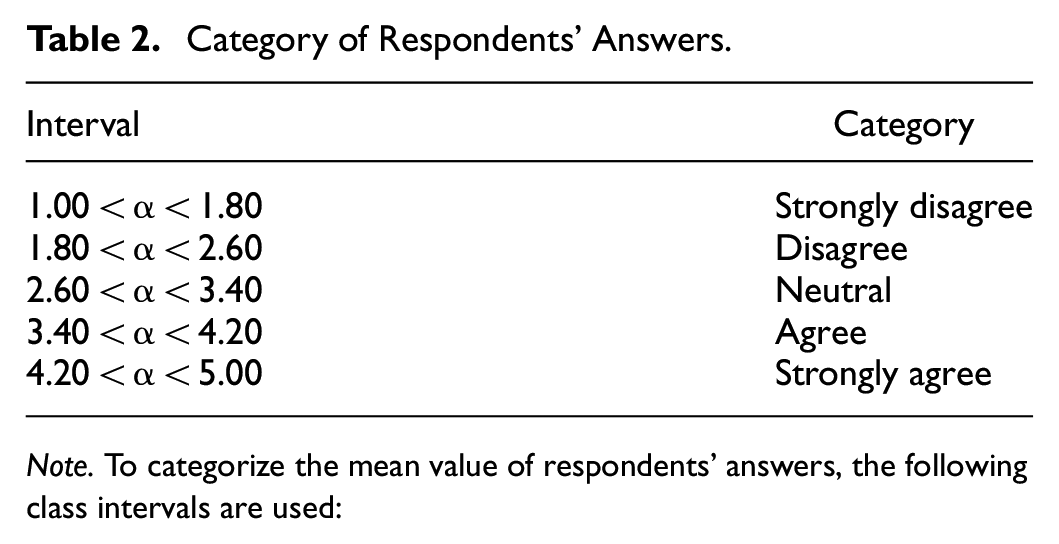
Note. To categorize the mean value of respondents’ answers, the following class intervals are used:
Results of Descriptive Statistics.


Measurement Model Analysis
This study employs the partial least squares structural equation modeling (PLS SEM) for the following reasons. First, it can handle a relatively small sample size (Ratmono & Sholihin, 2013). Second, it can simultaneously analyze many latent variables with various indicators (Hair et al., 2013). The WarpPLS 7.0 software is used because it considers linear and nonlinear relationships simultaneously (Kock, 2013). PLS SEM analysis consists of two steps, namely the measurement model analysis and structural model analysis.
The measurement model analysis assesses the relationship between measures and constructs by assessing the reliability and the validity of measures relating to specific constructs. Construct validity is evaluated using convergent validity and discriminant validity. Convergent validity is evaluated using average variance extracted (AVE) and its value must be greater than .5 (Hulland, 1999). Determinant validity assesses whether a construct shares more variance with its measures than with other constructs. It is evaluated by comparing the square roots of AVEs to the correlation between constructs. It is valid when the square root of AVE of a construct is greater than the correlation between the construct with another construct (Segars, 1997). Internal consistency reliability is evaluated using composite reliability with the value of more than .7 (Hair et al., 2019).
In the first iteration, the factor loading value of HCR8 (polite), HCR 9 (responsive), HCR 10 (service-oriented), MO 8 (monitoring market regularly), BP 5 (decrease in customer complaint), and BS 1 (long term business relationships with customers and suppliers) were less than 0.6. Therefore, those indicators were removed from the measurement model. Table 4 presents the results of the measurement model analysis. In the second iteration, all factor loading values of the constructs meet the criteria of more than 0.6. The composite reliability of all constructs is more than .7, and all AVE values are more than .5. Table 4 indicates that the square roots of the AVE are greater than the correlation between latent variables. Thus, the results demonstrate that the model is reliable and valid.
Results of Measurement Model Analysis.

Structural Model Analysis
Structural model analysis is used to test hypothesis of the study. The hypothesis testing consists of two steps. First, conducting direct testing regarding the effect of human capital readiness and information capital readiness on business sustainability. Second, conducting indirect testing by including the mediating variables of market orientation and business performance. Table 5 (Panel A) shows that human capital readiness has a positive and significant effect on business sustainability (β = .50; p < .01). Therefore, H1 stating that human capital readiness is positively associated with business sustainability, is supported. Furthermore, it shows that information capital readiness has a positive effect on business sustainability (β = .33; p < .01). Therefore, H2 stating that information capital readiness is positively associated with business sustainability, is supported.
Discriminant Validity Test.

Table 6 (Panel B) presents the results of indirect testing after including market orientation and business performance as the mediation variables. It shows the positive influence of human capital readiness on business sustainability (β = .27; p < .01). The effect of human capital readiness on business performance is insignificant (β = .03; p = .26), and the effect of business performance on business sustainability is significant (β = .54; p < .01). This result proves that business performance does not mediate the effect of human capital readiness on business sustainability; thus, H3 is not supported. Further analysis shows positive influence of information capital readiness on business sustainability (β = .14; p < .01), and the effect of business performance on business sustainability is significant (β = .54; p < .01). This result proves that business performance mediates the effect of human capital readiness on business sustainability. The nature of mediation is full mediation because the β coefficient before mediation of .33 and significant becomes .26 and insignificant. This proves that H4 is supported.
Results of Structural Model Analysis.
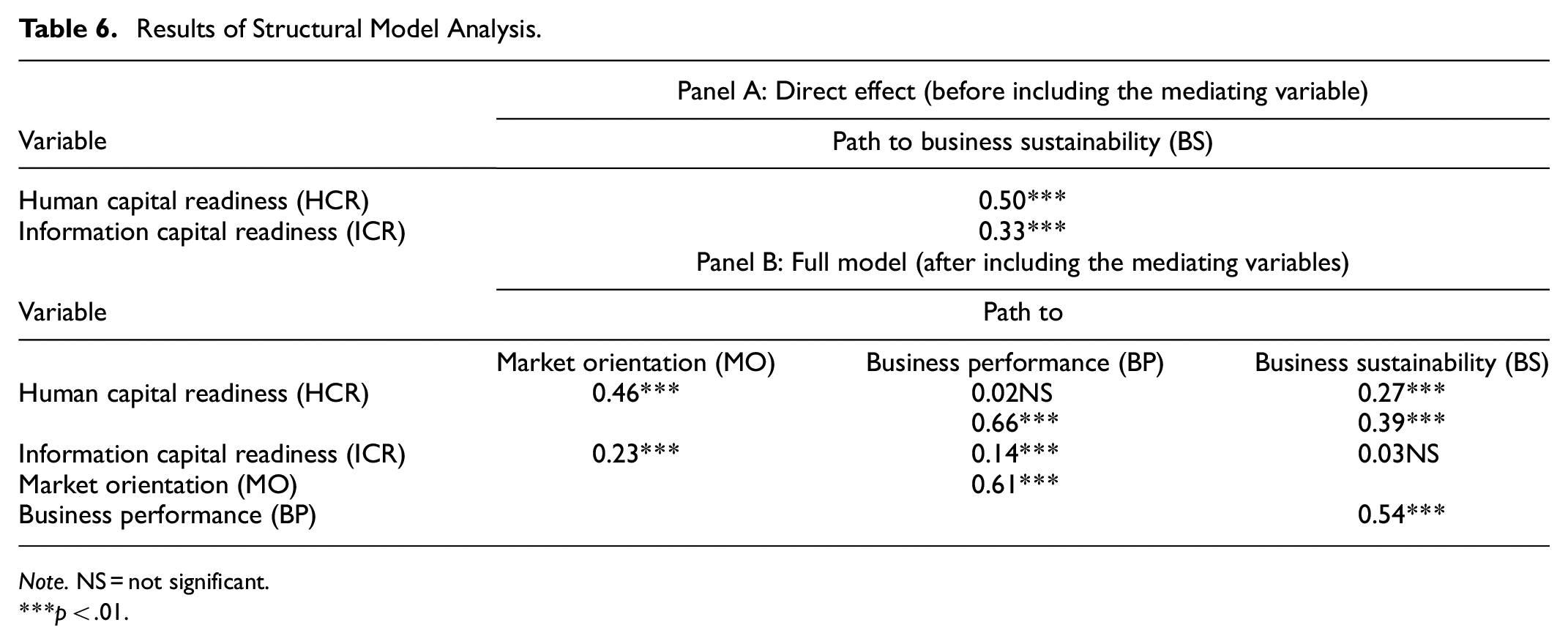
Note. NS = not significant.
p < .01.
Table 7 presents the result of multi-mediation testing. It shows that the p-value of indirect effect for paths with three segments regarding the mediating role of market orientation and business performance on the effect of human capital readiness on business sustainability is significant (β = .151; p < .01). This proves that H5 stating market orientation and business performance mediate the effect of human capital readiness on business sustainability is supported. Further results reveal that the p-value of indirect effect for paths with three segments regarding the mediating role of market orientation and business performance on the effect of information capital readiness on business sustainability is significant (β = .075; p < .01). This result proves that H6 stating market orientation and business performance mediate the effect of information capital readiness on business sustainability, is also supported.
Result of Multi Mediation Test.
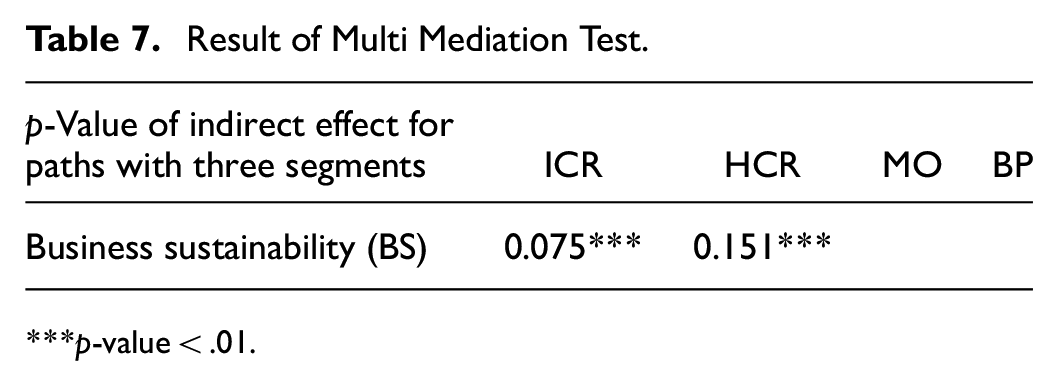
p-value < .01.
Discussion
Human Capital Readiness and Business Sustainability
As theoretically predicted by RBV, the company’s competitive advantage and sustainability is created by managing resources that have the characteristics of valuable, rare, inimitable, and non-substitutable, including human capital readiness. The results of this study support the previous scholars (Fareed et al., 2016; Kucharčíková et al., 2018; Yeh et al., 2020) who have investigated the crucial role of human capital in improving sustainable competitive advantage and business sustainability. According to the Ministry of Cooperatives and MSMEs, 37,000 MSMEs were reporting the severe impact of COVID-19 on business continuity, the cause of which came from a 56% decline in sales, 22% problems in financing aspects, 15% problems with the distribution of goods, 4% difficulties in obtaining raw materials. COVID-19 is an unfortunate but unique opportunity to consider human capital readiness in improving sustainability performance. In the context of Indonesian MSMEs, the results provide strategic information for managers/owners of MSMEs that they must develop the readiness of their human capital to sustain their business. The government agencies and non-government organizations have been assisting the MSMEs by providing training and workshops for improving competencies of the MSMEs’ human capital.
Information Capital Readiness and Business Sustainability
RBV has predicted that information capital readiness as one of the company’s resources will affect the company’s competitive advantage and sustainability. The adoption of information communication technology is recommended for MSMEs to face global business competition. The results support the previous scholars (Nugroho et al., 2017; Prasanna et al., 2019) who have investigated the effect of information capital on productivity, business performance and sustainability. Increased environmental uncertainty due to competitive pressures and the COVID-19 pandemic has disrupted the implementation of information capital readiness. On the other hand, according to the Financial Services Authority, the COVID-19 pandemic provides an opportunity for SMEs and cooperatives to take advantage of information and communication technology, considering that electronic commerce in 2020 will reach US $130 billion. In the context of Indonesian MSMEs, the results provide guidance for managers/owners of MSMEs in developing their IT infrastructure and improving the readiness of their information capital to sustain their business. The government and other stakeholders need to assist the MSMEs by providing IT infrastructure, training, and workshops for improving the ICT skills and capabilities.
Mediating Role of Business Performance on the Effect of Human Capital Readiness on Business Sustainability
The empirical result shows that business performance does not mediate the effect of human capital readiness on business sustainability. Empirically, human capital readiness does not affect business performance, although business performance has a positive and significant effect on business sustainability. Thus, the result does not support the previous scholars (Nadeem, 2017; Smriti & Das, 2018; Tjahjadi, Soewarno, Nadyaningrum, et al., 2020) who have examined the effect of human capital on business performance. This finding is logical because human capital must conduct activities or processes to be able to generate business performance. And it is also logical that business performance drives business sustainability. In the context of Indonesian MSMEs, the results provide useful information for managers/owners of MSMEs that their human capital needs to conduct processes, such as production or marketing processes to generate business performance. Therefore, a good strategy formulation and effective execution are needed to achieve a good business performance.
Mediating Role of Business Performance on the Effect of Information Capital Readiness on Business Sustainability
The empirical result shows that business performance fully mediates the effect of information capital readiness on business sustainability. Empirically, information capital readiness affects business performance, and business performance has a positive and significant effect on business sustainability. Different from human capital, some digital technology can work automatically without human attendance. Those computers do some processes automatically. Therefore, it is logical that information capital affects business performance and business performance affects business sustainability. In the context of Indonesian MSMEs, the results provide a good understanding for managers/owners of MSMEs that information capital is crucial for enhancing business performance and then increasing sustainability of their business.
Mediating Role of Market Orientation and Business Performance on the Effect of Human Capital Readiness on Business Sustainability
The empirical result shows that market orientation and business performance mediate the effect of human capital readiness on business sustainability. Market orientation is a strategy to maximize the value of products or services to achieve competitive advantage in the competitive market. This result confirms the previous scholars (Alotaibi & Zhang, 2017; Hernández-Linares & López-Fernández, 2018; Masa’deh et al., 2018; Nakos et al., 2019; Prifti & Alimehmeti, 2017; Sett et al., 2017; Tjahjadi, Soewarno, Nadyaningrum, et al., 2020), who have investigated the effect of market orientation strategy on performance. To effectively execute the strategy, the company needs human capital readiness. In the context of Indonesian MSMEs, the results provide a comprehensive understanding for managers/owners of MSMEs of the mechanism on how human capital readiness affects business sustainability via market orientation strategy and business performance.
Mediating Role of Market Orientation and Business Performance on the Effect of Information Capital Readiness on Business Sustainability
The empirical result shows that market orientation and business performance mediate the effect of information capital readiness on business sustainability. Market orientation is a strategy on customers and competitors to maximize the value of products or services to achieve competitive advantage. This result confirms the previous scholars (Sheehan, 2013; Tjahjadi, Soewarno, Nadyaningrum, et al., 2020) who have investigated the effect of market orientation on good business performance. Information capital readiness drives a good market orientation strategy and then it drives business sustainability. The COVID-19 pandemic has harmed MSMEs. Based on the Katadata Insight Center (KIC), most MSMEs (82.9%) felt the negative impact of this pandemic. The external crisis due to the COVID-19 pandemic provides the right time to investigate the implementation of market orientation and business performance to focus on the most critical activities. For this reason, encourages MSMEs to prepare human capital and information capital to create value in increasing business sustainability. In the context of Indonesian MSMEs, the results provide a comprehensive understanding for managers/owners of MSMEs of the mechanism on how information capital readiness affects business sustainability via market orientation strategy and business performance.
Contributions
This study has the following theoretical contributions: (1) it provides an important empirical evidence for the development of RBV in the research setting of the Indonesian MSMEs; (2) it provides a comprehensive research framework on how to achieve business sustainability via its antecedents, namely human capital readiness, information capital readiness, market orientation, and business performance; and (3) it provides empirical evidence of the role of specific constructs, namely human capital readiness, information capital readiness which are rarely examined by previous scholars.
This study has the following practical contributions: (1) it provides a strategic information for the managers/owners of MSMEs regarding the need for properly managing their human capital readiness and information capital readiness for their business sustainability; (2) it provides new insights for the owners/managers in improving their management practices, especially the role of intangible assets.
This study has the following contributions to the society: (1) because MSMEs are important in the society, this study provides important information about the antecedents of their sustainability; (2) this study shows the mechanism for improving the MSMEs’ sustainability for the society to participate.
Conclusions and Practical and Managerial Implications
Conclusions
Using 347 data of MSMEs in the East Java Province, Indonesia, this study investigates the relationship of five constructs, namely human capital readiness, information capital readiness, market orientation, business performance, and business sustainability. Employing the PLS SEM to test the hypotheses, the results show: (1) human capital readiness affects business sustainability; (2) information capital readiness affects business sustainability; (3) business performance does not mediate the effect of human capital readiness on business sustainability; (4) business performance fully mediates the effect of information capital readiness on business sustainability; (5) market orientation and business performance mediate the effect of human capital readiness on business sustainability; and (6) market orientation and business performance mediate the effect of information capital readiness on business sustainability. The results of this study contribute to the development of RBV, MSMEs management practices, and the welfare of society.
Practical and Managerial Implications
From a practitioner’s point of view, this research has important implications for achieving business sustainability. The study results offer a way for practitioners to improve business sustainability by utilizing human capital readiness, information capital readiness, market orientation, and business performance. This study exclusively confirms that internal resources, such as human capital readiness and information capital readiness, are intangible resources that are important in improving sustainability. Moreover, this research has proven the role of internal resources in significantly improving MSMEs’ business sustainability. Previous research has discussed the role of internal resources on business sustainability (Alnoor, 2020; Burawat, 2017; Chabbouh & Boujelbene, 2020; Fareed et al., 2016; Taha & Espino-Rodríguez, 2020), but other studies reveal human capital readiness and information capital readiness does not directly affect business sustainability. Therefore, this study adds two mediating variables, namely market orientation and business performance which provide better results for MSMEs. Finally, human capital readiness, information capital readiness, market orientation, and business performance play an important role in improving business sustainability, so MSME owners/managers must concentrate on these constructs in the decision-making process.
Limitation and Future Research
This study has the following limitations. First, this study uses a survey method to collect primary data. Unfortunately, the COVID-19 pandemic has caused the data collection is not optimal due to social distancing and mobility restrictions. Future researchers are encouraged to use secondary data to test the same model. Second, this study used an online questionnaire to collect data. Due to their digital illiteracy, some respondents have difficulty filling out online questionnaires. The correct proportion between online and hardcopy questionnaires is suggested for future studies. Third, the samples limit to the MSMEs in the East Java Province, so the results cannot be generalized to other regions with different characteristics. Future researchers are encouraged to expand the sample size to cover other regions to obtain better generalizations. Fourth, this research is designed as quantitative research. As a result, in-depth interviews were not conducted, which may result in in-depth assessments and analyses being inadequately presented. Future research can use a qualitative approach to gain deeper insight into the sustainability performance of MSMEs. Finally, this study only limits the four determinants of business sustainability. Future researchers are also encouraged to use other intangible assets, such as organization capital readiness which is not covered in this study. Organizational capital readiness includes leadership, organizational culture, teamwork, and alignment.
Footnotes
Acknowledgements
Authors would like to thank Kementerian Pendidikan, Kebudayaan, Riset, dan Teknologi (Ministry of Education, Culture, Research, and Technology) Indonesia for funding this research.
Declaration of Conflicting Interests
The author(s) declared no potential conflicts of interest with respect to the research, authorship, and/or publication of this article.
Funding
The author(s) disclosed receipt of the following financial support for the research, authorship, and/or publication of this article: This research has received funding from Kementerian Pendidikan, Kebudayaan, Riset, dan Teknologi (Ministry of Education, Culture, Research, and Technology) Indonesia

Data Availability Statement
The authors confirm that the data supporting the findings of this study are available within the article [and/or] its supplementary materials.