




Abstract
The offensive tactics of basketball teams consist of a series of actions performed with the collaboration of two or more players on the court. The study aimed to determine the differences in the possessions and the points of the play-type statistics of the eight playoff teams and the other ten non-playoff teams of the 2020 to 2021 men’s Euroleague season. The study sample consists of a total of 13,056 play types obtained through systematic observation methodology, which examined 272 matches involving 17 teams. Descriptive statistics and the Mann–Whitney U test was employed to obtain the findings. It was found that the catch’n & shoot, pick and roll ball handler are the most frequently used possessions and points that produced play-type statistics for all teams. Results showed that isolation (U = 3,7740.5; z = −3.93; p < .05) pick and roll handler’s (U = 39,932; z = −2.91; p < .05), post-up (U = 39,878.5; z = −2.94; p < .05) and Screen-off possessions (U = 41,689; z = −2,107; p < .05) of the playoff teams were statistically higher than non-playoff teams. Positively significant differences were also observed in isolation (U = 38,172; z = −3,744; p < .05), pick and roll handler’s (U = 40,278.5; z = −2,748; p < .05), post-up (U = 38,353.5; z = −3,659; p < .05), and Screen-off (U = 38,819.5; z = −3,434; p < .05) points of the playoff teams and non-playoff teams. These results show that playoff teams are prominent with the screen-off possessions and points as a team play, but post-ups, pick’n roll handlers selection, and catch’n shoot possessions and points are displayed by highly talented players. The findings may assist coaches and managers in roster building. Coaches might consider including these play-types in offensive sets and can create a more productive system. This understanding can be integrated into youth organizations’ training programs to raise high-level players.
Plain Language Summary
The offensive tactics of basketball teams consist of series of actions performed with the collaboration of two or more players on the court. These actions of the teams on the field are very important in terms of winning strategies. Recording these actions as box score is called play-type statistics. The study aimed to determine the differences in the possessions and the points of the play-type statistics of the eight playoff teams and the other ten non-playoff teams of the 2020-2021 mens Euroleague season. The data set consists of 13,056 play-types statistics were analysed by Mann–Whitney U test to determine the differences between the playoff and non-playoff teams. The catch & shoot, pick and roll ball handler are the most frequently used possessions and points that produced play-type statistics for all teams. Results showed that isolation pick and roll handler’s, post-up and screen-off possessions of the playoff teams were statistically higher than non-playoff teams. Positively significant differences were also observed in isolation, pick and roll handler’s, post-up, and screen-off points of the playoff teams and non-playoff teams. These results show that playoff teams are prominent with the screen-off possessions and points as a team-play, but post-ups, pick and roll handlers selection, and catch and shoot possessions and points are displayed by highly talented players. The findings may assist coaches and managers in roster building. Coaches might consider including these play-types in offensive sets and can create more productive systems. This understanding can be integrated into youth organizations’ training programs to raise high-level players.
Introduction
In basketball, as in many team sports, players compete to win the game by implementing predetermined defensive and offensive tactics (Gudmundsson & Horton, 2017). However, the success of a basketball team depends on the level of preparation. Coaches bear direct responsibility for ensuring the readiness of their players (Rangel et al., 2023). Coaches and team scouts rely on Game-Related Statistics (GRS) as a primary source of information for making tactical decisions, evaluating player performances, and planning training sessions (Shea, 2014). However, the process of collecting GRS data, which involves recording 2-point and 3-point field goals (successful and attempted), free throws (successful and attempted), rebounds, and other metrics during the game, can be quite laborious for the scouts (García et al., 2013).
With the advancement of technology, modern basketball has introduced automated systems that can quickly analyze the performance of teams and players during matches using predefined algorithms and protocols with consistent standards (Chen & Wang, 2020). These advanced and expensive technological systems are commonly used in top-tier professional leagues. However, scouts provide a contextual understanding of the game by considering situational factors, player interactions, and strategic decisions. Moreover, scouts have the ability to interpret intangible elements such as player emotions and team dynamics, allowing them to make real-time adjustments and provide instant feedback during matches or practices.
Although coaches are familiar with the quality of the leagues and the characteristics of the teams and players, they rely on statistical data to construct a strategy (Lamas et al., 2014). GRS metrics provide quantitative information about the opponent’s physical, technical, and tactical characteristics (Ibáñez et al., 2008). The tactical game plan determined by considering the GRS should be rational, allowing players to execute the comprehended tactics with maximum effort (Drust, 2010). GRS studies in the literature can be classified into various topics, including the importance of player positions (Božović & Mandić, 2020; Sampaio, Janeira, et al., 2006), the impact of rule changes (Ibañez et al., 2018), the influence of home court advantage (Watkins, 2013), scoring strategies in women’s basketball (Conte & Lukonaitiene, 2018), the effects of starting players and substitutes (Sampaio, Ibáñez, et al., 2006), and comparisons among different leagues and championships (Sampaio & Leite, 2013).
On the other hand, for systems that model player behavior, notational data in GRS play a crucial role. These systems combine the GRS data with factors such as time, shot distance, passing patterns, and the positions of other players using techniques like network analysis, regression analysis, and machine learning (Chen & Wang, 2020).
Even though numerous GRS studies have been conducted with a vast amount of quantitative data, providing some information to all stakeholders in the sport, the issue of how performances are carried out remains unclear. Therefore, stakeholders in the sports environment demand more profound explanatory evidence to fully understand tactical aspects (Franks et al., 2015). Goldsberry (2012) emphasizes that statistical analysis findings can only be practically applied with spatial analysis and suggests that decision-makers should combine the two. Marmarinos et al. (2016) also propose that basketball success is attributed to the dynamic harmony of the team rather than the sum of individual players’ performances, and they point out that future research should focus on this aspect rather than solely relying on GRS. Therefore, there is a need to examine additional performance indicators, such as pre-shot combinations or pick-and-roll analysis, to gain a better understanding of how teams play. Professional teams prefer to receive descriptive and qualitative information that goes beyond GRS in performance and team analysis (Sampaio et al., 2015). Offensive actions executed through individual, pair, and team interactions, prepared by scout staff, are referred to as play-type statistics (PTS). Based on the interpretations of PTS outcomes, professional teams have developed game strategies and improved team performance by enhancing their understanding of player context (Lorenzo et al., 2019). However, the classification and presentation of these process-oriented metrics as box scores impose a significant burden on research teams. As a result, PTS studies have focused on analyzing single or a few finishing actions rather than complete play types (Michelsen et al., 2015). Recent PTS studies have explored specific actions such as catch and drives (Demenius, 2020), cut and handoff actions (Zukolo et al., 2019), isolations (Selmanović et al., 2015; Zukolo et al., 2019), post-up games (Courel-Ibáñez et al., 2017), putbacks and off-screens (Lehto et al., 2010), and transitions (Conte et al., 2017). Nevertheless, the increase in pick-and-roll and 3-point field goal play types remains prominently visible.
Rolland et al. (2020, March) analyzed 26,332; 3-shot attempts from 632 games during the 2015 to 2016 NBA season. They found that catch and shoot plays required more time than pull-up shots. Furthermore, they discovered that players had to create separation from defenders or position themselves effectively to execute catch-and-shoot plays. Ultimately, they observed a drastic decrease in shot percentage when defenders were within six feet of the shooter. Zukolo et al. (2019) compared game statistics preferred by winning and losing teams in 6,034 play types from 30 randomly selected matches in the 2013 European Championship. Among the study findings, winning teams showed a greater preference for catch-and-shoot attempts compared to losing teams.
Matulaitis and Bietkis (2021) analyzed 38,640 possessions in 240 matches involving 16 teams in the EuroLeague during the 2017 to 2018 season. Their findings revealed that the most efficient offensive types were 2-point field goals in fast breaks, cuts, pick-and-roll screeners, and putbacks. Marmarinos et al. (2016) investigated and categorized 12,376 pick-and-roll actions from 502 EuroLeague games. They discovered that the most effective type of pick-and-roll offense occurred when a shot was attempted after two passes from the pick-and-roll, followed by the screener’s finish when rolling to the basket.
Current studies utilizing similar datasets aim to push the boundaries of existing literature (Demenius, 2020; Zukolo et al., 2019). Considering these factors, the primary objective of this study was to identify play-type statistics that differentiate playoff teams from non-playoff teams based on their finish-up position in the EuroLeague. Consequently, this research could generate scientific knowledge to assist coaches in developing strategies and predicting potential outcomes when facing teams employing specific offensive play types.
Enhancing players’ tactical understanding and performance knowledge through these play-type statistics can significantly contribute to future games. Furthermore, agents and performance analysts can leverage the results of this study to make informed decisions during the pre-season and in-season for roster arrangements.
Methods
Sample and Variable
To carry out the study, all 306 games played by the 18 participating teams in the 2020 to 2021 regular season of the Euroleague were recorded from private sport channels and EuroLeague TV (2021, April 9). The 2020 to 2021 Euroleague season was specific because of the post-pandemic COVID-19 restriction protocol on spectators, contacts, and player isolation cases. The team, which finished in last place in the Euroleague, played the second half of the season with young players instead of the professionals who had left because of the COVID-19 cases. Consequently, they suffered high-margin losses in their matches, deviating significantly from the norm. Due to being considered an outlier, this team was excluded from the study to ensure the data’s reliability. The study was conducted with 17 teams. Since each game consists of two datasets representing each team, the total dataset consists of 544 team performance (TP) and 13,056 PTS. In evaluating the teams’ performance, finishing the league among the top-8 teams was accepted as a success criterion, as in similar studies (Dogan & Ersoz, 2019). Thus, eight playoff teams (NTP = 256, NPTS = 6,912) and ten nonplayoff teams (NTP = 288, NPTS = 4,080) from the Euroleague made up the independent variables of the study. However, to fully explain the structure of a basketball game Zukolo et al. (2019), Jorgensen et al. (2021), and Matulaitis and Bietkis (2021) used similar independent variables to identify the offensive actions, but Bustamante-Sánchez et al. (2022), and Demenius (2020), used the same variables to identify offensive actions. The possessions and the points produced in these 12 play-types constitute a total of 24 dependent variables coded from recorded games to explain game outcome for the study, which were briefly defined in Table 1.
Definition of Dependent Variables Used in the Study.

The abbreviation Poss, which comes to the end of the dependent variables above, indicates the number of balls used in that play-type. For example, CnsPoss refers to the number of catch’n shoot possessions (Bustamante-Sánchez et al., 2022).
The abbreviation Poi, which comes to the end of the dependent variables above, indicates the points produced from that play-type. For example, PbPoi refers to points made from putback play-type (Bustamante-Sánchez et al., 2022).
Ethical Considerations
Based on ethical requirements set by the American Psychological Association (APA, 2002), informed consent was not required from the athletes as the present study was an observational study conducted with televised matches and a public stream. Nevertheless, the Euroleague media and communication service was informed, and consent to the study was obtained via e-mail.
Data Notation Procedure
The games were analysed through systematic observation (O’Donoghue, 2014). For the analysis of the games, two tables were created to notate the play-type possession and the points (available as Supplemental Material). In the first table prepared, 12 columns show the play types, and four rows show the periods of the game. Observers note successful play type with +sign and unsuccessful play type with −sign. In the second table, the signs in the box were calculated, and transformed into numbers. Two hundred seventy-two matches played by 17 teams from the 2020 to 2021 Euroleague season were examined, and a total of 13,056 play types were obtained by the data processing team consisting of 24 postgraduate and basketball speciality students who have high sport experience as basketball player. Two observers took note of the play-type statistics of the games. Before the data collection procedure, it is important to determine the interobserver and interobserver variability through randomly selected games (Losada & Manolov, 2015). To assess the validity and reliability of the PTS statistics noted during the training period, observers were divided into two groups and analysed five randomly selected matches. Kappa correlation coefficients were used to assess interobserver and interobserver reliability, and results between k = 0.87 and 0.89 showed excellent agreement rates (Cohen, 1960). Table 2 shows Kappa values.
Kappa-Values.

Statistical Analysis
First, the data obtained from observed games were manually noted on special charts were transferred to a Microsoft Excel worksheet. Then the data were analysed using the IBM SPSS version 26.0 statistical program. Descriptive analysis was conducted before inferential analysis to depict the general picture of the data. Normality assumptions were calculated using the Shapiro–Wilk test to determine the use of non-parametric or parametric analysis. Levene’s test results indicated p < .05; then, the Mann–Whitney U (non-parametric) test was considered to check univariate differences between teams (playoff vs. nonplayoff) (Courel-Ibáñez et al., 2013; Danilevičius & Kreivytė, 2019). In assessing the reliability of the results, the difference was deemed to be statistically significant, where p < .05. The Effect Size (ES) was characterized by practical significance rather than a simple interpretation of statistical significance (Hughes et al., 2002). Magnitudes of effect sizes were assessed and classified using the criteria of 0.10 = small effect, 0.30 = medium effect, and 0.50 = large effect with corresponding 95% confidence intervals (Robinson & O’Donoghue, 2007).
Results
Based on the results gathered trough decretive analyses, some of the frequent propensity of offensive play-types of ratios during the 2020 to 2021 Euroleague season has been observed. The related percentages are presented in Figure 1. When the figure is observed, it can be clearly seen that the most predominant play-type possessions for the playoff teams are catch’n shoots with 19% and pick’n roll handler with 18%. Moderately used play-type possessions for the playoff teams are catch’n drive with 9% and cut with 8%. The least preferred play-type possessions for the playoff teams are handoff with 3% and pick’n pop with 2%.

The distribution of play-type possessions of the playoff teams and nonplayoff teams.
The distributions of the play-type possessions of non-playoff teams are also presented in Figure 1. Like the playoff teams, the non-playoff teams were trusting on catch’n shoots with 21% and pick’n roll handler with 16% at most. The moderately preferred play-type statistics for the non-playoff teams are cut and catch’n drive with 9%. The least preferred play-type possessions for the non-playoff teams are the same as the playoff teams with the different percentages which are handoff (5%) and pick’n pop (3%).
Analysis of offensive play-type possessions ratio distribution amongst playoff and non-playoff teams showed that 9 out of 12 play-types were statistically significant which were shown Table 3. Four of them were in favour of, five of them were against of playoff teams. Specifically, further analysis using Mann–Whitney U test from SPSS 26.0 revealed usage of that isolation(U = 29747,5; z = −3,91; p < .05) pick’n roll handler’s (U = 30,846; z = −3,30; p < .05), post up (U = 32,094,5; z = −2,62; p < .05) and screen-off (U = 32748,5; z = −2,26; p < .0) possessions of the playoff teams were statistically higher than non-playoff teams. However, catch’n shoot (U = 31652,5; z = −2,86; p < .05), cut (U = 30963,5; z = −3,24; p < .05), handoff (U = 27,023; z = −5,45; p < .05), putback (U = 30776,5; z = −3,37; p < .05), and transition (U = 26925,5; z = −5,46; p < .05) possessions of the playoff teams were significantly lower than non-playoff teams.
The Descriptive Statistics of the Play-Types in Ball Possessions.
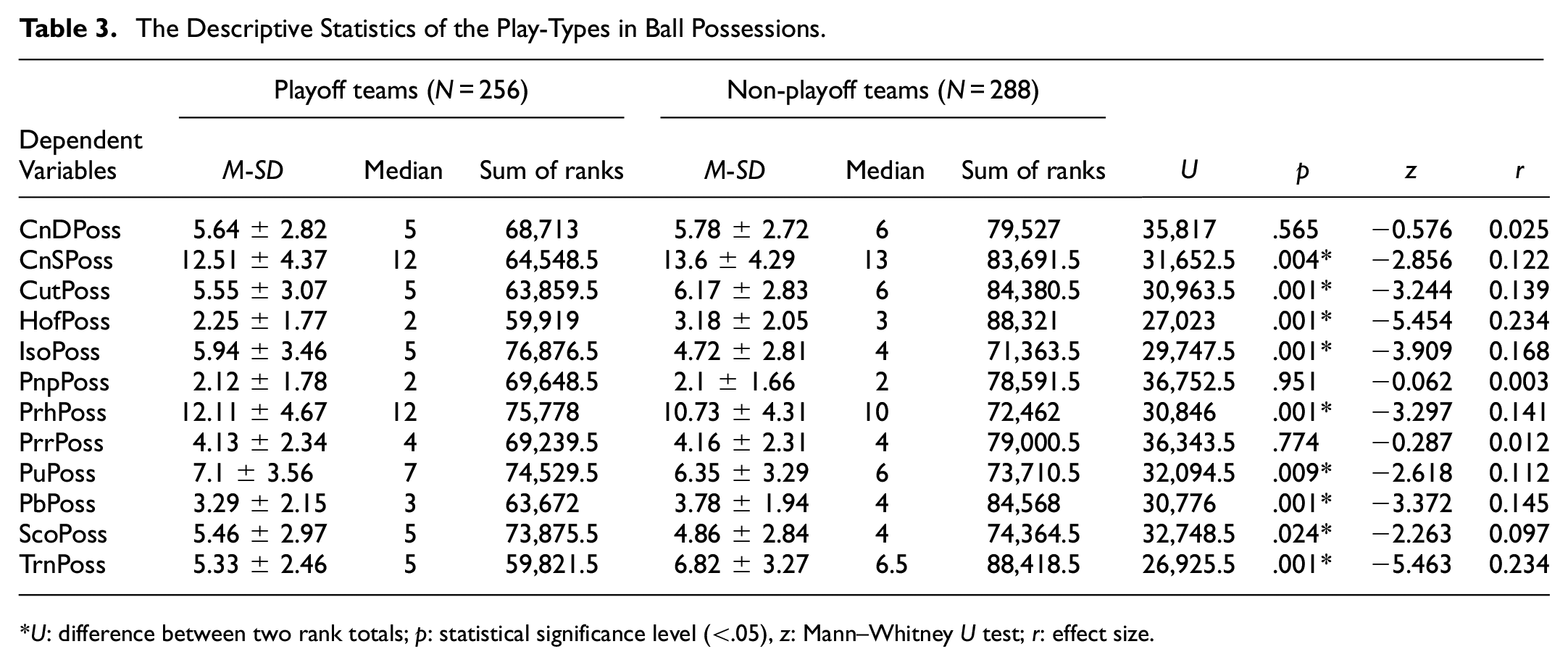
U: difference between two rank totals; p: statistical significance level (<.05), z: Mann–Whitney U test; r: effect size.
Analysing calculated descriptive statistics makes it possible to determine some of the frequent tendencies of points produced by play-types during the 2020 to 2021 Euroleague season. The most points generating play-types for the playoff teams are catch’n shoots with 20% and pick’n roll handlers with 15%. The moderately points generating play-types for the playoff teams are post-ups and screen-offs with 8%. The least points generating play-types for the playoff teams coincides with possessions for the playoff teams, which are handoff and pick’n pop with 3%.
However, the most points generating play-types for the non-playoff teams are catch’n shoots with 22% and pick’n roll handlers with 13%. The moderately points generating play-types for the playoff teams are catch’n drives and post-ups with 7%. The minor points generating play-types for the playoff teams are handoffs with 4% and pick’n pop with 2%. The distributions of the play-type points are presented in Figure 2.

The distributions of the play-type points of the playoff teams and nonplayoff teams.
The descriptive statistics of the studied variables in scored points are shown in Table 4. There is a statistically significant difference between playoff and non-playoff teams in points considering eight of the twelve play-types (Table 4). Four of them were in favour and four of them were against the playoff teams. Specifically, further analysis using Mann–Whitney U test from SPSS 26.0 revealed that isolation (U = 30,232; z = −3,65; p < .05), Pick and roll handler’s(U = 31,423; z = −2,98; p < .05), post up (U = 30,971; z = −3,25; p < .05), and screen off (U = 30,805; z = −3,33; p < .05) points of the playoff teams were statistically higher than non-playoff teams. Yet, points produced from catch’n shoot (U = 32442,5; z = −2,42; p < .05), handoff (U = 30,382; z = −3,65; p < .05), Putback (U = 33,200; z = −2,03; p < .05), and transition (U = 31,909; z = −2,72; p < .05) of the playoff teams were statistically significantly lower than non-playoff teams.
The Descriptive Statistics and Analysis of the Play-Types in Scored Points.

U: difference between two rank totals, p: statistical significance level (<.05), z: Mann–Whitney U test; r: effect size.
Discussion
This study aims to analyze the differences in play types of possession and points between playoff teams and non-playoff teams in the men’s 2020 to 2021 European League season. It was found that playoff teams utilized specific play types, such as isolation, pick-and-roll handler, post-up, and screen-off, and generated higher points compared to non-playoff teams. Based on these results, training programs should be designed to improve the offensive skills of all players, particularly perimeter players and pivots, in one-on-one situations. Additionally, drills should be implemented to enhance scoring and assist skills in pick-and-roll situations. The pick-and-roll defense in these drills should incorporate different tactical approaches to improve perimeter players’ productivity and problem-solving abilities. Furthermore, there should be an emphasis on creating more opportunities for off-screen shots in training exercises or specific drills. These drills should be conducted at match tempo and involve actual screens. It is expected that teams that train with sets involving off-screens, pick-and-rolls, and isolation plays will achieve success.
The findings of this EuroLeague study align with Demenius’s (2020) study, which showed that winning teams in the 2018 to 2019 NBA playoffs primarily relied on catch-and-shoot plays (21.33%), pick-and-roll handlers (17.60%), transition plays (15%), and isolation plays (7.67%). Both studies highlight the importance of play types that emphasize individual skills like catch-and-shoot, pick-and-roll handlers, isolation, and up-tempo plays as part of tactical game understanding (Demenius, 2020).Current studies indicate that play-type possessions have a significant impact on team success in professional basketball, as observed in the 2010 to 2011 season of EuroLeague and NBA (Selmanović et al., 2015), as well as the 2013 European Championship games (Zukolo et al., 2019). In our study, pick-and-roll handler possessions and points were the second most frequently used and statistically significant play types. The utilization of the pick-and-roll has increased by 40% in European championships (2003–2005–2007) and 34.8% in the World Championships (Gómez et al., 2015). The responsibility of using the ball and scoring in the pick-and-roll has shifted from pivot players to talented guards, resulting in a lower usage of post-up and pick-and-roll roller play types in EuroLeague and NBA (Demenius, 2020; Marmarinos et al., 2016). Specifically, the use of the ball handler in the pick-and-roll is the second most preferred play type in the 2018 to 2019 NBA playoffs (17.6%), which aligns with the findings of this study (Demenius, 2020). However, Matulaitis and Bietkis (2021) discovered that pick-and-roll roller play (61.5%) is one of the most efficient finishing actions for ball possessions in the 2017 to 2018 European League season. The study by Marmarinos et al. (2016) revealed that the most commonly used play type in the pick-and-roll was the shot attempt by the handler (42.85%), but the most effective pick-and-roll offense occurred when a shot was attempted after two passes (1.27 points per possession) from the pick-and-roll, followed by the screener’s roll (1.25 points per possession) to the basket in the 2012 to 2013 EuroLeague season.
Isolation possessions and points were not the most preferred play types for EuroLeague playoff teams, but they were statistically significant. Selmanović et al. (2015) emphasize that one-on-one play is a crucial element in modern basketball. Demenius (2020) provides detailed insights, stating that the isolation game is a dominant concept frequently employed by skilled players in the NBA, and winning teams tend to prefer this play type more than losing teams. Furthermore, the best NBA teams often secure victories by isolating one or two exceptionally talented players. Conversely, teams without superstars tend to focus more on team-centered offensive ball movement and passing (Demenius, 2020). Christmann et al. (2018) investigated the effectiveness of different play types in the endgame of close matches during the 2015 NBA regular season. Their findings revealed that one-on-one play, with or without isolation, was the least effective play type due to its static nature and longer duration. Additionally, the ball-handler faced increased defensive pressure in such situations.
Another significant difference was discovered in screen-off possessions and points, favoring playoff teams. Bazanov et al. (2006) demonstrated that in Division One of the Estonian Championship, the efficiency of screen-off plays varied based on the number of off-screens used during possessions, and offenses with one or more screens showed increased scoring efficiency. Lamas et al. (2011) confirmed similar results for the 2008 Olympics, highlighting the significant role of screen-off plays (.225) in half-court set scoring. Demenius’s (2020) study on NBA playoffs also parallels these findings, indicating that screen-off plays made a significant difference in determining the winner (MWin = 42.24%, MLoss = 30.63%). Zukolo et al. (2019) announced comparable results, showing that screen-off plays were the 4th preferred play type, with 44% having a significant impact on winning games in the 2013 European Championship. Selmanović et al. (2015) summarized European basketball tactical preferences as the prevalence of screens in set offenses, while American basketball tends to favour more isolation and one-on-one play types.
Post-up possessions and points may also play a significant role in the playoff performance of EuroLeague teams. This finding aligns with the study by Zukolo et al. (2019), which showed that winning teams had a higher percentage of one-on-one back-to-the-basket play types (MWin = 33%, MLoss = 26%). The dominance of post-up offense provides teams with a higher chance of securing offensive rebounds in the 2010 NBA playoffs series (Courel-Ibáñez et al., 2017). However, it was noted that defeated teams were more efficient in post-up play. To enhance the efficiency of post-up plays and options in the NBA, a dynamic approach that involves creating space and mobility, especially on the weak side, before receiving the ball and after engaging with the ball, is recommended (Courel-Ibáñez et al., 2017).
On the other hand, for this study, non-playoff teams used the catch-and-shoot, handoff, putback, and transition possessions and points, as well as cut possessions, more frequently than playoff teams, and these differences were found to be statistically significant. The catch-and-shoot play type stands out as the most preferred play type for both playoff and non-playoff teams, which aligns perfectly with the results of Zukolo et al. (2019). Chang et al. (2014) identified a noteworthy point that spot-up scenarios had a higher success rate compared to shots taken after a dribble. The cut play type is relatively preferred by both groups and has a significant impact only on the possessions, not the points, in this study. The studies conducted by Selmanović et al. (2015), Zukolo et al. (2019), and Demenius (2020) show a parallelism with each other, indicating that winning teams use the cut action more frequently than losing teams in European championships, EuroLeague, and NBA games. While cuts may not be used as frequently as other offensive strategies, they still play a statistically significant role in influencing the outcome of a basketball game. Due to the high tempo and constant movement of all players on the court during offense, a minor defensive mistake can lead to an open shot or an easy scoring opportunity. Handoff possessions and points are among the least popular play types, despite being more frequently employed by playoff teams in this study compared to non-playoff teams. However, Demenius (2020) observed that defeated teams proved to be more effective (MWin = 34.96%, MLoss = 41.53) in handoff play types. Selmanović et al. (2015) also point out the unusual situation where the handoff action was nearly twice as preferred in the 2019 NBA playoffs compared to the regular season (MRegular = 1.52%, MPlayoff = 2.97).
Although putback possessions are among the least preferred play types, they show a significant difference in favor of non-playoff teams. Özmen’s (2016) findings indicate that EuroLeague teams that secure at least one offensive rebound more than their opponents have a 6.3% higher chance of winning a game. Previous research has consistently concluded that fast break opportunities, which are utilized with moderate frequency, primarily after a missed shot, defensive rebound, or steal, play a decisive role in winning matches (Selmanović et al., 2015). Coaches are actively working on developing strategies to create more opportunities for transition possessions and points (Christmann et al., 2018). Matulaitis and Bietkis (2021) discovered that transition plays were among the most efficient ways to end ball possessions in the 2017 to 2018 men’s EuroLeague season.
There are certain limitations in the current research that should be taken into account for future studies. Firstly, this study was conducted using play-type statistics data from only one season, which limits the generalizability and practical application of the findings. As a statistical analysis, more comprehensive insights could be obtained by employing regression models or machine learning techniques to develop predictive models that explain the success of different teams. In the future, collaborating with professional sports clubs that have access to extensive databases would allow for the collection and analysis of data from multiple seasons and leagues using machine learning techniques. This analysis would facilitate the identification of key predictive factors for success specific to each league and provide a more nuanced understanding of the elements contributing to high performance. Sharing these results can help bridge the gap between academic research and practical implementation in basketball. However, further research on play-type statistics is necessary to support the findings of these future studies.
Conclusion
The results of this study may suggest that play-type statistics (PTS) should be given more consideration than Game-Related Statistics (GRS) when creating a roster in the EuroLeague. Teams composed of players who frequently utilize isolation, pick-and-roll handler, post-up, and screen-off plays and generate scores from these play types may have an advantage in finishing among the top eight teams in the EuroLeague. Therefore, when designing practice plans, youth team coaches should focus on developing the pick-and-roll game of perimeter players, the post-up game of pivot players, screen-off shots of perimeter players, and one-on-one skills of all players.
The dynamics of teams, players, and coaches in basketball evolve rapidly. The styles, performances, and tactical understandings of coaches and players are influenced by each other. It is recommended to work with a large sample size of collective play-type statistics to evaluate tactical changes in a comprehensive manner. For future studies, it would be beneficial to analyze finishing actions in greater detail, particularly 3-point shots and pick-and-rolls, by subdividing these complex offensive actions into sub-categories and considering their spatiotemporal characteristics and the position of the defense. Establishing collaborations between sports science faculties and professional basketball clubs is recommended to expedite access to such programs and potentially enhance the quality and quantity of research conducted in this field.
Supplemental Material
sj-doc-1-sgo-10.1177_21582440231220155 – Supplemental material for Examining the Differences Between Playoff Teams and Non-Playoff Teams in Men’s Euroleague; Play-Type Statistics Perspective
Supplemental material, sj-doc-1-sgo-10.1177_21582440231220155 for Examining the Differences Between Playoff Teams and Non-Playoff Teams in Men’s Euroleague; Play-Type Statistics Perspective by Yasin Akinci in SAGE Open
Supplemental Material
sj-doc-2-sgo-10.1177_21582440231220155 – Supplemental material for Examining the Differences Between Playoff Teams and Non-Playoff Teams in Men’s Euroleague; Play-Type Statistics Perspective
Supplemental material, sj-doc-2-sgo-10.1177_21582440231220155 for Examining the Differences Between Playoff Teams and Non-Playoff Teams in Men’s Euroleague; Play-Type Statistics Perspective by Yasin Akinci in SAGE Open
Supplemental Material
sj-doc-3-sgo-10.1177_21582440231220155 – Supplemental material for Examining the Differences Between Playoff Teams and Non-Playoff Teams in Men’s Euroleague; Play-Type Statistics Perspective
Supplemental material, sj-doc-3-sgo-10.1177_21582440231220155 for Examining the Differences Between Playoff Teams and Non-Playoff Teams in Men’s Euroleague; Play-Type Statistics Perspective by Yasin Akinci in SAGE Open
Supplemental Material
sj-sav-1-sgo-10.1177_21582440231220155 – Supplemental material for Examining the Differences Between Playoff Teams and Non-Playoff Teams in Men’s Euroleague; Play-Type Statistics Perspective
Supplemental material, sj-sav-1-sgo-10.1177_21582440231220155 for Examining the Differences Between Playoff Teams and Non-Playoff Teams in Men’s Euroleague; Play-Type Statistics Perspective by Yasin Akinci in SAGE Open
Supplemental Material
sj-xlsx-1-sgo-10.1177_21582440231220155 – Supplemental material for Examining the Differences Between Playoff Teams and Non-Playoff Teams in Men’s Euroleague; Play-Type Statistics Perspective
Supplemental material, sj-xlsx-1-sgo-10.1177_21582440231220155 for Examining the Differences Between Playoff Teams and Non-Playoff Teams in Men’s Euroleague; Play-Type Statistics Perspective by Yasin Akinci in SAGE Open
Footnotes
Acknowledgements
The author would like to thank the Euroleague media service for their kind mail in allowing this research. The author also would like to acknowledge all observers for the immense efforts of the data notation procedure and all the anonymous reviewers for their careful reading, comments, and suggestions.
Author Contribution
The author confirms sole responsibility for the following: study conception and design, data collection, analysis and interpretation of results, and manuscript preparation.
Declaration of Conflicting Interests
The author declared no potential conflicts of interest with respect to the research, authorship, and/or publication of this article.
Funding
The author received no financial support for the research, authorship, and/or publication of this article.
Ethical Approval
This research is in accordance with standards set by the Declaration of Helsinki. As a result of the application, approval was given by the Uşak University Clinical Research Ethics Committee with the 88-88-11 decision notification number.

Data Availability Statement
Supplemental Material
Supplemental material for this article is available online.
References
Supplementary Material
Please find the following supplemental material available below.
For Open Access articles published under a Creative Commons License, all supplemental material carries the same license as the article it is associated with.
For non-Open Access articles published, all supplemental material carries a non-exclusive license, and permission requests for re-use of supplemental material or any part of supplemental material shall be sent directly to the copyright owner as specified in the copyright notice associated with the article.
