




Abstract
This study aimed to determine the relationship between narcissism and team cohesion of transformational leadership and individual sports athletes interactions. In particular, individual sports can present a model to verify the level of perception of team cohesion according to the type of record sports and martial arts sports. Transformational leadership, narcissism, and team cohesion were measured among 225 college athletes. SPSS 24.0, Amos 24.0, PROCESS Macro programs (Model No. 5) were used for data analysis. The analysis includes frequency analysis, Cronbach’s alpha values, confirmatory factor analysis (CFA), Pearson’s correlation, and moderating effect. Transformational leadership significantly positively affected team cohesion and narcissism. Non-narcissism also significantly positively affected team cohesion. The interaction between transformational leadership and individual athletes was significantly higher for martial arts sports. Team cohesion was also important for athletes in individual sports, thus expanding the boundaries of transformational leadership theory. To cultivate a sports team (organization), strategic sports management will be necessary to enhance team cohesion.
Keywords
This study aimed to investigate the impact of transformational leadership and the interaction among individual athletes in team sports on team cohesion. Team cohesion is assumed to promote successful team performance (Grieve et al., 2000). Team sports demand team cohesion because they require the ability to strategize and employ tactics (Onağ & Tepeci, 2014). However, it is unclear whether team cohesion is necessary for athletes whose rankings are deter-mined by measuring records (e.g., running, long jump, high jump, throwing competitions) as opposed to athletes who play sports involving team tactical training or winning or losing through interpersonal fighting (e.g., kumdo, Taekwondo). Our study examines causality through transformational leadership and narcissism to understand the team cohesion of individual sports athletes.
Team cohesion is the tendency of teammates to unite in pursuit of a goal or to satisfy the emotional needs of members (Carron & Brawley, 2000). This definition reflects that group functioning and unity have a socially oriented basis (i.e., how well team members like one another and derive personal enjoyment from being a part of a team) and a task-oriented basis (i.e., how well team members work together to achieve common identifiable goals) (Marcos et al., 2010). Previous studies found relationships between passion and cohesion (Paradis et al., 2012), leadership and cohesion (Caperchione et al., 2011; Hardy et al., 2008), communication and cohesion (Sullivan & Short, 2011). In other words, it can be inferred that team cohesion holds significance as a variable in team sports (Onağ & Tepeci, 2014).
The relationship between transformational leadership and team cohesion can be confirmed through several previous studies. (e.g. Baird et al., 2020; Sahib & Wilderom, 2017; Smith et al., 2013) However, studies that confirm the mediating or moderating variables of their relationship are lacking. It is extremely difficult to understand the temperamental tendencies of the players and coach them according to their individual characteristics (Oh, 2021). We will check the narcissism of the players to see the cooperation, cohesiveness in the team. The term narcissism has been expanded beyond its pathological origins to encompass many tendencies among ostensibly normal people (Raskin & Terry, 1988). Narcissism and non-narcissism refer to two-dimensionally classified mental symptoms and tendency. O’Reilly and Chatman (2020) and Resick et al. (2009) conducted studies confirming the relationship between transformational leadership and narcissism within the realm of business administration. This study aims to expand the scope of research by focusing on sports athletes. Furthermore, the majority of previous studies have focused on exploring transformational leadership, narcissism, and team cohesion among team sports players, such as those in basketball (Grijalva et al., 2020) and soccer (Yildirim et al., 2023). This study stands out by emphasizing its key points objective, which is to establish causal relationship among athletes in individual sports.
This study will be able to contribute to the advancement of leadership research in order to improve the team organization of college players, and it will be reborn as a preceding study that can mediate high narcissism in players. Therefore, understanding the factors that improve team cohesion is crucial from the sociopsychological aspect of sports. This study will present four hypotheses and analyze them in detail.
Literature Review
The Relationship Between Transformational Leadership, Team Cohesion, and Narcissism
Transformational leadership is one of the most important factors for team organization. It also encourages team members to excel and promotes organizational knowledge sharing (Bryant, 2003; García-Morales et al., 2008). Bass et al. (1987) linked transformational leadership to a charismatic personality and morality, influence over members, and consideration for members with a motivating and humane attitude. In other words, this leadership style involves attempts to increase organizational effectiveness and team performance by transforming athletes’ personal values and self-concepts (Al-Husseini & Elbeltagi, 2018).
Previous studies found that transformational leadership improved team performance and innovation (Waldman, 1994). For example, Bass and Avolio (1994) described a process that can improve team decision-making skills through transformational leadership. However, Atwater and Bass (1994) presented a general conceptualization of how transformational leadership may interact with and influence team factors such as cohesion and conflict management, but they did not put forth any specific, testable propositions. Based on recent studies, we suggest that mechanisms that promote transformational leadership and team cohesion, thus improving organizational development, need to be continuously investigated (Chan & Mak, 2014).
In the relationship between transformational leadership and team cohesion, one personality variable that can influence leader behavior is narcissism, although it has not received much attention in the context of team members (Arthur et al., 2011). Narcissism can be essentially defined as the pursuit of self-enhancing experiences in social settings, driven by the fundamental need for respect and recognition (Morf et al., 2011; Pincus, 2013). Nevertheless, it is crucial to acknowledge that narcissism manifests in diverse forms and is linked to a wide range of both adaptive and maladaptive consequences (Cain et al., 2008; Newton & Stewart, 2012). Ames et al. (2006) developed a short and detailed scale for understanding narcissism (Narcissistic Personality Inventory; NPI-16). This scale describes two dimensions: narcissistic responses and non-narcissistic responses. Narcissistic reactions are known to lack empathy (Watson et al., 1984), to be more preoccupied with self-enhancement (Campbell et al., 2000), and to exploit others in their pursuit of self-enhancement (Campbell et al., 2000). Non-narcissistic responses have a fragile yet overinflated sense of self that they strive to protect (Rhodewalt & Eddings, 2002), seek admiration (Morf et al., 2001), rely on others to maintain their inflated self-views (Brunell et al., 2008), and perform well in situations that offer opportunities for glory (Arthur et al., 2011; Wallace & Baumeister, 2002). Transformational leader behaviors that emphasize team goals or behaviors limit opportunities for individual glory and likely motivate people with few narcissistic traits more than those with many narcissistic traits (Arthur et al., 2011). Thus, the following hypotheses were established:
H 1: Transformational leadership will have a significant effect on team cohesion.
H 2: Transformational leadership will have a significant effect on narcissism.
The Relationship Between Narcissism and Team Cohesion
Narcissists tend to be entitled, arrogant, have inflated senses of self-importance, and lack empathy for others (Campbell & Foster, 2007; Raskin & Terry, 1988). The nature of narcissism suggests how interpersonal traits can lead to dysfunctional team behavior (Grijalva et al., 2020). In previous studies, individuals’ narcissism was assessed, and it was concluded that individual narcissism was not related to performance (O’Boyle et al., 2013). However, we argue that narcissism at the individual level may enhance team cohesion. Meanwhile, Grijalva et al. (2020) explained that narcissism tends to be relational, so the influence of narcissism is stronger at the team level than at the individual level. However, this study examined the role of narcissism as a mediating variable in individual sports athletes.
Previous studies revealed causal relationships among transformational leadership, individual temperamental narcissism, and the team cohesion of team members. This is study to examine the influences of two groups (transformational leadership and record/martial arts sport) on team cohesion. Meanwhile, studies have been conducted on non-professional footballers (Huéscar Hernández et al., 2017), Canadian elite floorball players (Wilhelmsson, 2017), soccer players (Jabeen et al., 2021), student-athletes (Paradis et al., 2012), and individual sports (Frisbee) players to verify the relationship between transformational leadership and team cohesion (Smith et al., 2013). Boulte et al. (2021) investigated the relationship between narcissism and team cohesion in a sample of 706 sports athletes, providing insights into this connection. Although studies have targeted athletes in various sports, few studies have compared two individual groups of record/martial arts sports, as was one in the present study. Therefore, this study addresses a very interesting topic for sports socio-psychologists. Thus, the following hypotheses were established:
H 3: Narcissism will have a significant effect on team cohesion.
Record, Martial Arts Sports Concept, and Team Tactical Training
Examine record sports and martial arts sports in greater detail. Record sports are those that involve breaking or setting a new record for a specific feat, such as running a marathon in a certain time, lifting a certain amount of weight, or achieving a specific distance or height in a particular event (Loland, 2001). Examples of record sports include track and field events such as the long jump, pole vault, and high jump, as well as powerlifting and fire (Petrovič et al., 2020). Martial arts sports, on the other hand, are combat sports that involve various forms of physical contact, such as punching, kicking, grappling, and striking (Kostorz & Sas-Nowosielski, 2021). These sports are often practiced for self-defense, physical fitness, or competition (Anshel & Payne, 2006). Examples of martial arts sports include karate, judo, wrestling, taekwondo, boxing, and mixed martial arts (Jensen et al., 2017).
In both record sports and martial arts sports, athletes strive to improve their performance through training, technique, and strategy. However, the goals of these two types of sports are different: record sports focus on achieving a specific measurable outcome, while martial arts sports emphasize the development of physical and mental discipline, self-defense skills, and respect for one’s opponent. Sports team tactical training aims to enhance athletes’ performance within a team context by improving teamwork, decision-making, and execution of strategic plays through drills, simulations, and game scenarios. The objective is to gain a competitive edge by outmaneuvering opponents and achieving success in the chosen sport. We will confirm the relationship between transformational leadership and team cohesion as perceived by two different types of athletes in our study. Thus, the following hypotheses were established:
H 4: The effect of interaction between transformational leadership and record/martial arts sports on team cohesion
Method
Participants
The participants for this study were 225 elite college athletes registered by the 2022 Korean Sport and Olympic Committee, polled using an online survey tool. The participants were recruited using non-probability purposive sampling method. The general characteristics of the participants were 177 (78.7%) men and 48 (21.3%) women 61 (27.1%) participants competed in track and field, 41 (18.2%) in kumdo, and 123 (54.7%) in taekwondo. Out of the total, 28 individuals (12.4%) possessed less than 6 years of exercise experience, while 197 individuals (87.6%) boasted more than 6 years of exercise experience.
Measures
The questionnaire was comprised of scales of reliability and validity which had been adequately assessed in previous studies. We adopted 7 items from Carless et al. (2000) short measure of transformational leadership, including “Instills pride and respect in others and inspires me by being highly competent”. measured on a 5-point Likert-type scale (1 = strongly disagree; 5 = strongly agree). We used 16 items from the NPI-16, which is a short measure of narcissism (Ames et al., 2006) (narcissistic response, non-narcissistic response). “I think I am a special person.” and “I try not to be a show off,” respectively. measured on a 5-point Likert-type scale (1 = strongly disagree; 5 = strongly agree). Three items pertaining to team cohesion were adopted from Dion (2000), including “Our team is united in trying to reach its goals for performance.” measured on a 5-point Likert-type scale (1 = strongly disagree; 5 = strongly agree). Items were carefully adjusted to align with athletes’ specific contexts, incorporating insights from content relevance and item clarity as advised by two sports psychology professors and three Ph.D. experts. The data were used after informed consent from the study subjects.
Statistical Analysis
The collected data were analyzed using SPSS 24.0 (SPSS Inc., Chicago, Illinois, USA), SPSS PROCESS Macro 2.13, and Amos 24.0 (IBM, New York, United States) statistical programs. First, a frequency analysis was conducted. Second, Cronbach’s alpha values were calculated to check the reliability of each measurement tool, and confirmatory factor analysis (CFA) were performed to find out the validity of the constructs. Third, Pearson’s product-moment correlation was calculated on major variables. Fourth, SPSS PROCESS Macro (Hayes, 2018) was used to explore the moderating effect of individual sports was verified on the relationship between transformational leadership, narcissistic, and team cohesion. We performed 5,000 iterations of bootstrapping to test mediation effects and measured 95% bias-corrected percentile intervals at an alpha level of .05.
Results
Results of Statistical and Correlation Analyses
The descriptive statistics of study variables, including mean, standard deviation, skewness, and kurtosis are listed in Table 1. Correlations were performed to examine overall relationships between variables, and all variables were found to be correlated below .77 (see Table 1). To be more precise, a notable and positive correlation (+) was observed among transformational leadership, narcissism, and team cohesion. Also, CR, AVE reliability was adequate for all measures as reported in Table 1.
Pearson Correlations of Scores, Descriptive Statistics, and Cronbach’s α.

Note. CR = composite reliability; AVE = average variance extracted.
p < .05. **p < .01.
Path Analysis of Dimensions of Transformational Leadership, Narcissistic, and Team Cohesion
All the direct effects among each variable are shown in Table 2. Presents the relationship among transformational leadership, narcissistic, team cohesion and individual sport. Transformational leadership had a significant positive effect on team cohesion (B = 0.50, t = 5.06, p < .001), Hypothesis 1 was supported. Transformational leadership had a significant positive effect on the narcissistic response (B = 0.34, t = 4.69, p < .001), and a significant positive effect on the non-narcissistic response (B = 0.43, t = 8.52, p < .001), Hypothesis 2 was accepted. Finally, non-narcissistic response had a significant positive effect on team cohesion (B = 0.18, t = 4.56, p < .001), Hypothesis 3 was partially accepted (see Figure 1).
Direct and Interaction Effect Index.

Note. LL, UL: Bias-Corrected 95% Confidence Interval (lower limit, upper limit); bias-corrected bootstrapping method is conducted for indirect effect estimates.
p < .05. **p < .01. ***p < .001.
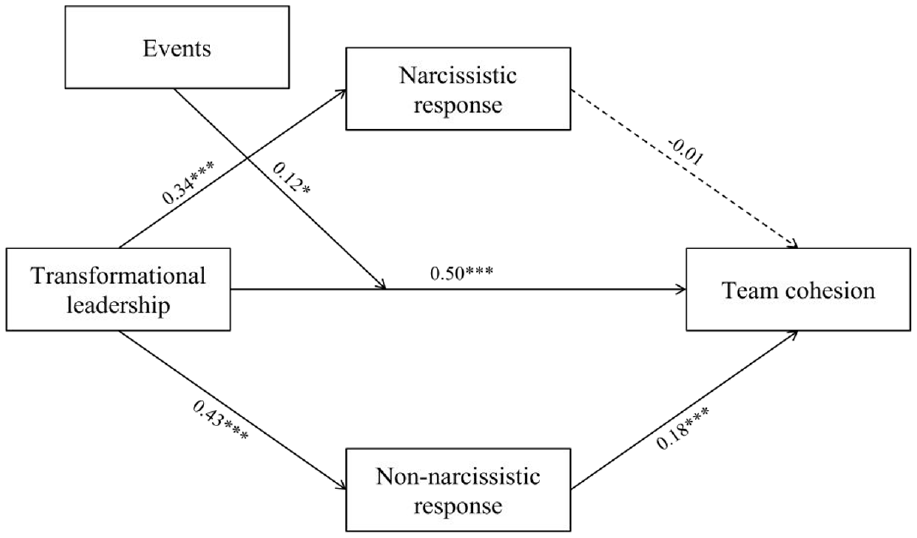
Finalized hypothesized model.
The Moderating Effect of Individual Sport on the Relationship Between Transformational Leadership, and Team Cohesion
The moderating effect of individual sport on the relationship between transformational leadership, and team cohesion (see Table 2). The moderating effects of transformational leadership and individual sports were found in martial arts sport .73 (95% CI [.66, .81]), and record sport .62 (95% CI [.52, .71]). Team cohesion was found to be important in record sports and martial arts sports. In particular, the value of martial arts sport was slightly higher, hypothesis 4 was accepted (see Figure 2).

Interaction effects graph.
Discussion
Tactical training is vital for team sports players. This process is directly related to team cohesion and performance. Team cohesion may be important for individual sports players. The purposes of this study are to classify the record sports/martial arts sports among individual sports and to verify the interaction effect of the two sports in the relationships between transformational leadership, team cohesion, and narcissism.
The examination of the empirical model showed partial support for all hypotheses. Transformational leadership had a significant effect on narcissism and team cohesion. The interaction between transformational leadership and record sports/martial arts sports was somewhat higher in martial arts sports, but both groups significantly affected team cohesion. Team cohesion may be as necessary for individual athletes as for team athletes. In particular, transformational leadership can control players narcissism and contribute to team cohesion. The role of coaching must be emphasized through leadership education in the sports field. In addition, it expands the theoretical of transformational leadership. A detailed discussion of the results follows.
Transformational leadership significantly positively affected team cohesion. These results show that transformational leadership has been widely applied in sports to strengthen the relationship between coaches and players (Bass, 1985; Bass & Riggio, 2006). Previous studies have predicted players’ perception of cohesion improvement, supporting the results of this study (Burke et al., 2014; Cronin et al., 2015; Smith et al., 2013). Kim and Oh (2022) conducted a study involving 269 taekwondo athletes, while Park and Yang (2019) coached 258 kumdo athletes. The results of Kim and Oh research demonstrated a significant impact of transformational leadership on exercise performance, aligning with the findings of Park and Yang, which highlighted its effect on team cohesion. Therefore, coaches’ exemplary behaviors should be oriented in the sports field as behaviors that can inspire athletes. For this process, it is necessary to strengthen leadership education within sports organizations and educational institutions (Sullivan et al., 2012).
Transformational leadership had a significant positive effect on narcissism. A study on 209 adolescent athletes reported that transformational leadership was significantly related to narcissism (Arthur et al., 2011). Meanwhile, Shepherd (2016) study on 104 people revealed a significant relationship between transformational leadership and narcissism, which also supports the current study. However, higher levels of narcissism have been described as generally egocentric. Narcissistic individuals tend to make few personal sacrifices for the team and encourage selfish behavior (Shepherd, 2016). Transformational leadership can directly affect the propensity of players, suggesting that strong leadership maintains an appropriate level of non-narcissistic responses through continuous management.
Among the two dimensions of narcissism, the non-narcissistic response had a significant positive effect on team cohesion. These results suggest that narcissists tend to be entitled and arrogant, have an inflated sense of self-importance, and lack empathy (Campbell & Foster, 2007; Carroll, 1987; Raskin & Terry, 1988). In addition, since teamwork requires teammates to depend on each other, interpersonal characteristics such as narcissism were predicted to appear (Grijalva et al., 2020). In this case, the interpersonal relationship among team members differed depending on how well they knew each other. That is, narcissists explained that there are traits (e.g., arrogance, entitlement, and overconfidence) that exacerbate interpersonal relationships through repetitive interactions (Grijalva et al., 2020). In our study, narcissism indirectly provided evidence of interpersonal characteristics through team cohesion.
The interaction between transformational leadership and record sports/martial arts sports was significant in the order of martial arts sports and record sports players. These results have limitations in comparing and contrasting the relationship between them, as studies conducted on athletes in specific sports are insufficient. A significant relationship found between autonomy support coaching and team cohesion for high school kendo athletes indirectly supports this study (Park & Yang, 2019). Our study suggests that team cohesion is essential not only for team sports players but also for individual athletes. Recently, as new forms of media (e.g., social media) develop rapidly in Korea, actual play scenes can be easily accessed through YouTube. At this time, 400M relay competitions, mixed relay competitions, taekwondo five-member team competitions, and power taekwondo competitions are attracting much attention. The best performance is exhibited when the process of composing the cohesion and strategy of the whole team is carried out compared to cases in which one player shows the best performance.
Our study suggests that team cohesion has no effect when a high level of narcissism is present in student-athletes. Furthermore, individual athletes perform best when team cohesion is demonstrated. The current findings suggest the need for coaching education by explaining the importance of transformational leadership for sports managers and coaches. Coaches strongly assert that they can continue to develop players’ performances by coaching them on the importance of team cohesion and that it can attract attention in the sports field.
Limitations and Suggestions for Future Research
In this study, the following conclusions were extracted through SPSS PROCESS Macro model validation targeting 225 record sport and martial arts sport athletes. First, transformational leadership significantly positively affected team cohesion. Second, transformational leadership significantly positively affected narcissistic and non-narcissistic responses. Third, the non-narcissistic response significantly positively affected team cohesion. Fourth, the interaction between transformational leadership and record sports/martial arts sports significantly affected team cohesion. The also suggest that individual athletes a role in team cohesion by inducing non-narcissistic responses.
The research subjects included athletes in record sports (swimming, gymnastics) and martial arts sports (judo, wrestling). However, this study revealed limits in its application to all records and martial arts sports athletes since it comprised two groups of athletes competing in only two sports: record sport and martial arts sport Future research should recruit athletes from various sports to verify whether the re-search results can be reproduced. Furthermore, the relationship between transformational leadership and team cohesion should be analyzed according to gender to determine whether male leaders are more effective than female leaders or vice versa, following the study of Dwiri and Okatan (2021). Finally, it should be noted that transformational leadership can play a significant role in fostering the development of organizational behavior necessary for effectively managing and operating a sports organization.
Footnotes
Author’s Note
This research was conducted while [Youngtaek Oh] was at [Department of Kinesiology & Sport Management, Texas A&M University, U.S]. They are now at [Department of Sport Science, Jeju National University, Republic of Korea] and may be contacted at [
Declaration of Conflicting Interests
The author declared no potential conflicts of interest with respect to the research, authorship, and/or publication of this article.
Funding
The author received no financial support for the research, authorship, and/or publication of this article.

Data Availability Statement
This research can be cited using in-text citations.