



Abstract
In previous systemic functional studies of modality in Chinese, the systems of types and degrees of modality have been discussed; however, the system that characterizes the realization of types and degrees of modality has been largely neglected, and realizations of modality have not been systematically explored. This paper explores the system of MODALITY in Chinese and realizations derived from the system from the perspective of Systemic Functional Linguistics. In this study, the systems of types and values of modality in Chinese are re-examined. The system of types of modality excludes usuality, since it distinguishes itself from modalization and modulation essentially. The system of values of modality is treated as a cline. More importantly, the study gives a systematic and comprehensive description of the system of MANIFESTATIONS that describes the realization of modality, which distinguishes among explicitly subjective, explicitly objective, and implicitly subjective realizations of modality. The present study is the first attempt to systematically and critically examine the systems of types, values, and realizations of modality in Chinese. It may contribute to a better understanding of modality in the particular language of Chinese, and may lend support to system-based typology, supplementing structure-based typology.
Introduction
It goes without saying that modality in English has been extensively researched in the literature (e.g., Bybee et al., 1994; Hengeveld et al., 2017; Nuyts & van der Auwera, 2016; Palmer, 1990, 2001; van der Auwera & Plungian, 1998). Compared with the proliferation of studies of modality in English, modality in Chinese has been much less explored. It is still an underdeveloped and problematic category in Chinese grammar (Peng, 2007).
This paper aims to describe the interpersonal clausal system of MODALITY in Chinese and structural realizations derived from the system from the perspective of Systemic Functional Linguistics (hereafter SFL). It intends to re-examine the systems of types and values of modality proposed by (Li, 2007) as well as Halliday and McDonald (2004), and more importantly establish the system that characterizes the realization of modality.
The current work is grounded in the systemic functional model of language (Caffarel et al., 2004; Halliday, 2009; Matthiessen, 2004, 2015). Systemic functional theory is based on several key semiotic dimensions: system, instantiation, stratification, and metafunction (Caffarel et al., 2004; Halliday, 2009; Matthiessen, 2015), which are briefly presented below.
First, SFL gives priority to system rather than structure: system or paradigmatic organization is the primary mode of organization of language (Halliday, 2009). It is treated as the more abstract category and is “realized in the form of structure” (Halliday, 2009, p. 64). This paper takes the system of MODALITY as the target of description and examines structural realizations derived from it. Second, the relationship between system and text in SFL is instantiation. A text is an instance of the system of a language, and the system of a language is the potential that lies behind all the instances. In this study, modality is treated as the system potential that provides modal meanings, and the system of MODALITY is based on extensive text analysis. Third, within SFL, language is conceived as a stratified semiotic system, comprising three strata, namely semantics, lexicogrammar, and phonology/graphology (Halliday, 1994). The system of MODALITY is located at the stratum of lexicogrammar. Fourth, in SFL language is organized metafunctionally (Halliday, 1994). The ideational metafunction is concerned with the use of language to construe experience and the logic relations of experience, the interpersonal metafunction refers to the use of language to construe social relations, and the textual metafunction indicates the use of language to construct coherent text. In Chinese, the clause is “the locus of the mapping of the experiential, interpersonal and textual strands of meaning on to one another”; the primary systems involved are those of TRANSITIVITY, MOOD, and THEME (Halliday & McDonald, 2004, p. 313). Interpersonally, the central clause system in Chinese is the system of MOOD; the other interpersonal clause systems are POLARITY, MODALITY, and ASSESSMENT (Halliday & McDonald, 2004; Li, 2007).
It should be noted that SFL draws a clear line between theory and description: the four theoretical dimensions introduced are general assumptions that serve to scaffold the description of the particular language of Chinese, and all the categories of the particular language of Chinese belong to the domain of description. That is to say, categories such as tense and modality are not treated as theoretical ones and are assumed to have universal status. They are built up from the description of Chinese.
Being a comprehensive theory that possesses rich theoretical dimensions, SFL offers two major benefits to the treatment of modality in Chinese. For one thing, as a theory of meaning as choice, SFL enables a systematic description of the system of MODALITY in different degrees of delicacy. For another, its theorization of the link between system and text enables the establishment of the system of MODALITY on the basis of a detailed analysis of modal options in real texts from a range of registers. This may contribute to uncovering the special qualities and presenting a more reliable and accurate picture of modality in Chinese.
Grounded in SFL, the present research endeavors to answer the following three research questions:
In the following sections, a brief literature review will first be presented, and then data and methodology will be discussed. In what follows, the systems of types of modality, degrees of modality, and realizations of modality in Chinese will be described separately, with the emphasis placed on the system of realizations of modality. Finally, a summary of the findings, as well as the implications and limitations of the study will be introduced.
Literature Review
The earliest discussion of modality in Chinese can be traced back to J. Z. Ma (1898/1983). Recent major researches on modality in the traditional or formal framework include Tsang (1981), Tiee (1985), Lin and Tang (1995), Tang (2000), Xie (2002), Cui (2003), Peng (2007), Xu (2007), Wen (2013), Fan (2017), and so forth. However, modality in Chinese is still far from being well-explored. There are divergent views on the definition of modality and types of modality. In addition, the analysis of the expression of modality mainly focuses on individual modal verbs; a comprehensive and in-depth description of the realization of modality is still necessary.
In previous systemic functional approaches to modality in Chinese (Halliday & McDonald, 2004; Li, 2007; McDonald, 1998; Zhu, 1996), the systems of types and degrees of modality have been briefly discussed. As Li (2007, p. 135) has argued, the primary opposition in the system of MODALITY in Chinese is between modalization and modulation. The former refers to degrees of probability and degrees of usuality; the latter includes degrees of obligation and degrees of willingness. Types of modality in Chinese are associated with three different degrees: high, median, and low. However, the system that characterizes the realization of modality has been largely overlooked, and the discussion on realizations of modality centers on individual modal verbs and modal adverbs as well. The realization of modality by “modal clauses” such as wǒ rènwéi “I believe,” wǒ xiǎng “I think” and by the co-occurrence of modal verbs or modal adverbs has not been systematically examined. Since the systems of types and degrees of modality have not been discussed in detail and the system that describes the realization of modality has not been established, it is necessary to conduct a thorough and systematic description of the system of MODALITY in Chinese.
Data and Methodology
In terms of methodology, the present study is descriptive and qualitative in nature. Qualitative analysis is adopted to analyze the systemic features of modality and identify realizations of modality. The study is also functional rather than formal in orientation. It aims to interpret realizations of modality by reference to how they are used.
Following the SFL tradition (e.g., Caffarel, 2006; Caffarel et al., 2004; Halliday & Matthiessen, 2014; Li, 2007; Matthiessen, 2015; McDonald, 1998), the description of the system of MODALITY and its subsystems in this paper is text-based: systems of modality are derived from the manual analysis of texts. Texts are not used merely as a source of examples but as the basis for description. A specially assembled text archive that includes a range of texts is collected by the author for the manual analysis. The reason to use a self-collected text archive for description is that the systemic features of modality are difficult to identify in the large corpus which is best for automatic analysis of words or phrases. The analysis of systemic features of modality and the identification of a variety of realizations of modality must be carried out manually in small volumes of text.
The text archive includes the following written and spoken Chinese texts: the award-winning novel Huózhe “To Live” written by Yu Hua (87,660 words); transcripts of influential TV interviews: A Date with Lu Yu and Yang Lan One on One (62,272 words); transcripts of the popular television serial: Rénmín de Míngyì “In the Name of People” (60, 538 words). The novel Huózhe “To Live” is referred to as Text 1. Text 2–9 are transcripts of TV interviews. Texts 10–14 are transcripts of the television serial Rénmín de Míngyì “In the Name of People.” These written or spoken texts are chosen because they include rich dialogic exchanges, and dialogic communications exhibit abundant resources of modality.
Since the text archive only includes small samples of text, the large-scale corpus of CCL (Corpus for Chinese Language) is also used so as to extract certain realizations of modality for illustrational purposes. CCL corpus is a 700-million-word collection of samples of written and spoken language. Texts in this corpus are collected from diverse registers ranging from newspapers and magazines to literature and academic journals. It can be considered as a representative sample of Chinese language.
The System of Types of Modality in Chinese
Modality is an interpersonal clausal system in Chinese (Halliday & McDonald, 2004; Li, 2007). It refers to the area of meaning that lies between the positive and negative polarity, representing the speaker’s judgment, “either on the validity of the assertion or on the rights and wrongs of the proposal” (Halliday & Matthiessen, 2014, p. 698). It is an area of meaning that the speaker and the listener often negotiate in verbal exchanges as illustrated in the following short extract between the two main characters in the novel To Live (1) Lóng èr: [a] Fúguì, nǐ shì lái zhǎo wǒ jiè qián de Fugui, you be come find I borrow money EMP MOD “Fugui, you are here probably because you want to borrow money from me, right?” [b] ànlǐshuō, wǒ yě by rights I also should borrow some MEAS money to you “By rights, I should loan you some money.” [c] Súhuàshuō, jiù jí bù jiù qióng. as the saying goes help emergency NEG help poverty “As the saying goes, one can give financial aid to others when he/she is in an emergency, but cannot do so when he/she is poor.” [d] Wǒ a, zhǐ I MOD only can help your emergency [e] NEG will help your poverty. ‘I can only help you when you are in an emergency, and I won’t help you because you are poor.’ Fúguì: [f] Wǒ I want rent some MEAS farmland “I want to rent some farmlands.” Lóng èr: [g] Nǐ you want ent how many MEAS “How many acres of farmland do you want to rent?” Fúguì: [h] Zū wǔ mǔ. rent five MEAS “I want to rent Five mu (approximately 0.8 acres) of farmland.” Lóng èr: [i] Wǔ mǔ? five MEAS [j] Nǐ zhè shēntǐ you DET body can do MOD: int “Renting five mu of farmland to cultivate? Are you physically able to do it?” Fúguì: [k] Liàn liàn jiù xíng le. practice practice just OK VPART “I can do it once I practice farming.” Lóng èr: [l] Wǒ gěi nǐ wǔ mǔ hǎo tián. (Text 1) I give you five MEAS rich farmland ‘I’ll give you 5 mu (approximately 0.8 acres) of rich farmland.’
This short conversation involves the landlord Longer and the tenant farmer Fugui. It occurs when Fugui visits Longer in an attempt to rent some farmland. The dialogue is largely concerned with exchanging goods and services, in other words, with issuing commands, giving suggestions, and making offers. The clauses [b], [d-h], and [j-l] concerning goods and services exchanges realize proposals. The clauses [a], [c], and [i] indicating information exchanges realize propositions.
In the propositions, Longer presumes that Fugui visits him so as to borrow money by the modal particle ba in [a]. In the proposals, Longer first indicates his obligation to help Fugui by the modal verbs gāi in [b] and néng in [d], then denotes unwillingness to loan money to Fugui through the modal verb bù huì in [e], and finally questions Fugui’s ability to cultivate farmland in [j], with the assessment of ability being expressed by the modal verb néng; Fugui expresses his willingness to rent farmland from Longer by the modal verb xiǎng in [f].
In this conversation, four types of modal meanings are negotiated by the speaker and the listener. In the propositions, the speaker expresses his assessment of the probability. In the proposals, the speaker lays obligation upon the listener to carry out a command; the speaker and listener convey willingness or ability to fulfill an offer.
In view of this, we can broadly recognize two distinct kinds of modality in Chinese: modalization and modulation. Modalization concerns the assessment of probability of the proposition. Probability, traditionally labeled epistemic modality, is concerned with the speaker’s judgment of the validity of the proposition (Halliday & Matthiessen, 2014). Modulation is concerned with the assessment of the proposal in terms of obligation, inclination, and ability. Obligation, known as deontic modality (e.g., Nuyts, 2016; Palmer, 1990, 2001), indicates the pressure on the other person to implement the command. Inclination and ability together have been referred to as dynamic modality (e.g., Nuyts, 2016; Palmer, 2001), denoting the speaker’s willingness or capacity to fulfill an offer.
In the system of types of modality proposed by Halliday and McDonald (2004, p. 340) and Li (2007, p. 135), modalization refers to degrees of probability and degrees of usuality of the proposition. However, in this article, usuality is excluded from the system of types of modality in Chinese. The exclusion of usuality lies in the fact that it denotes meanings that differ from those of modalization and modulation fundamentally. In Chinese, usuality is primarily expressed by adverbs of frequency such as zǒngshì “always,” jīngcháng “often,” yǒushí “sometimes.” Adverbs of usuality indicate that the events or “goings-on” have actually occurred before, with its frequency not precisely determined (e.g., many times or a few times). Experientially, they play a role in the transitivity structure of the clause, functioning as the circumstance of temporal Extent; interpersonally, they function as the circumstantial Adjunct rather than the modal Adjunct in the clause. By contrast, realizations of modalization and modulation do not indicate that the events or “goings-on” have occurred before. They describe the events as “purely within the realm of thought, knowable only through imagination” (Palmer, 2001, p. 1). Realizations of probability describe the events as within the speaker’s thought, and realizations of obligation, inclination and ability denote that the events are potential or unactualized. Experientially, they do not function as the circumstance in the transitivity structure of the clause; interpersonally, they function as the modal Adjunct or the Modality of the clause (Halliday & McDonald, 2004, p. 319). For example, (2) Zhè háizi DET child possibly be confused VPART “Possibly, this child is confused.” (3) Wǒ zhēnshì I really should carefully learn learn “I really should learn from him/her carefully.” (4) a. Tāmen they often talk about some writer work zhèxiē tánhuà ràng tā xīngfèn. (CCL) DET talk make s/he excited “They have often talked about some writers and their works, and these discussions have made him excited.” b. *Tāmen they possibly talk about some writer work zhèxiē tánhuà ràng tā xīngfèn. DET talk make s/he excited “*They possibly talk about some writers and their works, and these discussions have made him excited.” (5) a. Pǔtōng zhōng xiǎo xué regular middle primary school sometimes also conduct certain SUB zhíyè jiàoyù, dàn zhè shì hěn bùzú de. (CCL) vocational education but DET EMP very insufficient EMP “The regular middle schools and primary schools have sometimes conducted certain vocational education, but it is completely insufficient.” b. *Pǔtōng zhōng xiǎo xué regular middle primary school should also conduct certain SUB zhíyè jiàoyù, dàn zhè shì hěn bùzú de. vocational education but DET EMP very insufficient EMP “*The regular middle schools and primary schools should conduct certain vocational education, but it is completely insufficient.”
In (2), by using the modal adverb kěnéng, the “goings-on” is portrayed as only within the speaker’s mind and being based on the speaker’s imagination. The modal adverb functions as the modal Adjunct in the clause. In (3), the modal verb yīnggāi indicates that the event has not been actualized but is merely potential. The modal verb functions as the Modality of the clause. In (4), by using the adverb of usuality chángcháng in the first clause, the event is presented as typical and having happened many times before, and this is proved by the second clause in which the effects of the actual occurrences of the event are mentioned. In (5), by using the adverb of usuality yǒushí in the first clause, the event is described as actually having happened several times before, and in the second clause the occasional occurrences of the event are described as “insufficient.” The three adverbs of usuality function as the circumstance of Extent in the transitivity structure and the circumstantial Adjunct in the interpersonal structure of the clause. If we replace adverbs of usuality with realizations of modalization and modulation as in (4b) and (5b), the clauses are not grammatical, because the latter cannot function as the circumstantial Adjunct and indicate that the events have occurred before. Thus, usuality distinguishes itself from modalization and modulation essentially.
Based on the above analysis, we can establish the system of types of modality in Chinese, which is as in Figure 1.

System of types of modality in Chinese.
The Degrees of Modality and the Negation of Modality in Chinese
Li (2007, p. 135) argues that both modalizatoin and modulation involve three degrees: high, median, and low. Halliday and McDonald (2004) also recognize the three degrees in both modalization and modulation. The three degrees of modality are as shown below.
Three “Values” of Modality in Chinese (Li, 2007, p. 140).

In this article, three basic degrees of modality can also be established: high, median, low, on the basis of the analysis of modal options in texts. However, the three values are not absolute or discrete categories but areas of meanings on a cline. Within degrees of modality, there are delicate distinctions; between the degrees, there are intermediate points. The more subtle and refined degrees of modal assessment are typically realized by the co-occurrence of modal verbs, the co-occurrence of modal adverbs, or the combination of a modal verb and a modal adverb in the clause, as evident in the following examples: (6) Wǒ kàn, jīntiān wǎnshang I see today evening must have accident “I think, in this evening accidents must happen.” (7) Wǒde shì my work certainly must unsuccessful “My work must certainly be unsuccessful.” (8) Wǒ xiǎng, wǒ I think I probably must PASS shoot dead VPART “I think, I probably must be shot dead.” (9) Biérén méi gàn guò de, others NEG do VPART SUB probably DET thing NEG reliable ‘If others haven’t done this, this is probably not something that is worth trying.’ (10) Nǐ xiànzài you now probably probably all learn VPART MOD “Now you probably have learned all of it.” (11) probably possibly sell for twenty billion MOD “It can be probably sold for twenty billion yuan.” (12) possibly possibly end the battle in the shortest time possible gèng more possibly protracted “The battle may be ended in the shortest time possible, or it may be protracted.”
Compared to the modal verb of high probability yào in (6), the combination kěndìng děi in (7) indicates reinforced high probability, and the combination duōbàn yào in (8) may convey the intermediate degree between high and medium probability. In (9) and (10), the modal adverb duōbàn and the combination dàgài duōbàn both denote medium probability, but the modal assessment is clearly being reinforced in the latter. In (11), the co-occurrence of the two modal adverbs dàgài kěnéng may denote assessment between medium and low probability. In (12), the combination yěxǔ kěnéng expresses reinforced low probability, and the modal adverb kěnéng indicates low probability. Degrees of modality constitute a cline.
The three basic values of modality are closely related to the system of POLARITY. In a clause with realizations of modality, there are two types of negative: straight and transferred (Halliday & McDonald, 2004; Li, 2007). The former means the negative on the proposition or proposal, and the negative markers bù or méiyǒu typically occur after the modal item. The latter indicates the negative on modality, and the negative adverb bù occurs before the modal item. Among the three values of modality, the median value of modality is marked out from the two outer values by the system of POLARITY: the median value of modality is unaffected when the negative is transferred between the proposition and the modality, while the two outer values switch from high to low or low to high when the negative is transferred (Halliday & McDonald, 2004; Li, 2007). For example, (13) a. Wǒmen we NEG should hide VPART ‘We shouldn’t hide from them.’ b. Jiǎngshòu ‘Lectures shouldn’t revolve around one textbook.’ (14) a. Wàijírén foreigner NEG can buy HDB flat “Foreigners cannot buy HDB flats.” b. Wǒmen we may NEG investigate your matter “It is possible for us not to investigate your case.”
In (13a) and (14a), the modality is negated, and the negative adverb bù occurs before the modal verbs. In (13b) and (14b), the propositions are negated, and the negative marker bù occurs after the modal verbs. The median value of obligation is unaffected in (13a-13b), while in (14a-14b) the modal value of obligation switches from low to high when the negative is transferred.
The systems of values of modality and polarity are presented in a network as shown in Figure 2.

The systems of VALUE and POLARITY in Chinese.
The System of Realizations of Modality in Chinese
The discussion of the realization of modality in Chinese begins with a close examination of modal meanings in texts. Consider the following two short conversations from Text 8 and Text 14: (15) Yáng Lán: [a] Nín zìjǐ bù qù jìnxiū ma? you self NEG go further studies MOD: int ‘Don’t you pursue further studies?’ Zōng Qìnghòu: [b] Méiyǒu. NEG [c] should say we present POSS management
lǐniàn dōu shì yòng de xīfāng de.
principles all EMP use SUB western EMP [d] I feel they POSS theory shì yǒu dàolǐ de. (Text 8) EMP have truth EMP “No. It should be said that the management principles we are using now are all from the western countries. I feel that their management theories have been prove true.” (16) Gāo Yùliáng: [a] Zhè jiàn shì wǒmen DET MEAS thing we definitely will
chèchá dàodǐ.
investigate thoroughly “We definitely will investigate this incident thoroughly and fully.” Wáng āyí: [b] Wǒmen Hǎizǐ we Haizi certainly be PASS rén ànhài de. people kill secretly EMP “My child, Haizi, must be killed secretly by someone.” Gāo Yùliáng: [c] Qí Tóngwěi, Zhè jiàn shì Qi Tongwei DET MEAS thing
necessarily must investigate thoroughly clearly [d] Suǒyǒu diàochá cáiliào nǐ dōu all investigation file you all
must in person read “This incident must be investigated thoroughly and fully. You must read all of the investigation files by yourself.” Qí Tóngwěi: [e] will EMP I will with Chen revered carefully investigate “I will. I will carefully investigate the case with our Revered Mr. Chen.” Wáng āyí: [f] Wǒ I want come in see see [g] Wǒ I want see see my child “I want to go inside; I want to see my child.”
The first conversation involves the anchor Yang Lan and the guest Zong Qinghou. It is entirely concerned with the exchange of information: the anchor asking a question and the guest making statements. All the clauses in this dialogue realize propositions. In [c-d], the speaker indicates his modal judgment of probability by two separate “modal clauses.” The first “modal clause” yīnggāi shuō “should say” takes the form of an impersonal verbal process of saying. By employing this clause, the speaker dissimulates the fact that he is expressing his point of view, therefore highlighting objectivity. The second “modal clause” wǒ juéde “I feel” takes the form of a mental process of cognition. By using this “modal clause,” the speaker states explicitly that the probability is subjective, thus emphasizing subjectivity.
The second conversation involving three characters concerns the exchange of goods and services: making offers and issuing commands. It begins with an offer in [a], followed a statement in [b] and two commands in [c-d], and ends with three offers in [e-g]. The clause [b] is a proposition, and the speaker’s modal assessment of high probability is realized by the modal adverb kěndìng. The rest of the clauses in this dialogue are all proposals. The speaker’s modal assessment of high obligation on the listener to implement commands is realized by the modal verb yào and the combination yīdìng yào; the speaker’s medium and high willingness to carry out the offer are respectively expressed by the modal verb xiǎng and the combination yīdìng huì. By using modal verbs and modal adverbs, the speakers convey their subjective assessments toward the proposition or the proposal. Compared with the “modal clauses,” modal verbs and modal adverbs can be regarded as intermediate ways of expressing modality.
As shown in these two conversations, the speaker’s modal assessment can be realized by a separate “modal clause” to emphasize subjectivity or objectivity. Between highlighting subjectivity or creating objectivity that are two extremes, there are intermediate ways of expressing modality. They are realized by a modal element, such as a modal verb, a modal adverb, and a modal particle, or the co-occurrence of modal elements within the clause. Modal verbs, modal adverbs and modal particles are referred to as implicitly subjective realizations of modality. As they co-occur frequently in Chinese clauses and denote the speakers’ subjective assessments, it is unnecessary to make a distinction between “implicit subjective” and “implicit objective” realizations which have been introduced in Halliday and Matthiessen (2014, p. 693).
We can set up the system of MANIFESTATIONS that characterizes the realization of types of modality. The term “manifestation” is borrowed from Matthiessen (1995). This system makes a distinction among explicitly subjective, explicitly objective and implicitly subjective realizations of modality. The system of MANIFESTATIONS is presented as in Figure 3.

System of manifestations of types of modality in Chinese.
It should be pointed out the term “explicit” is used when modality is expressed in a separate clause, and the term “implicit” is used when modality is “expressed in the same clause as the main proposition” (Thompson, 2004, p. 71). Explicitly subjective and objective realizations of modality are distinguished in terms of the speaker—explicitness. Explicitly subjective realizations of modality indicate that the speakers express their modal evaluation in a way that makes it clear that this is their subjective evaluation, and the subjectivity (e.g., wǒ rènwéi “I think”) is encoded in a separate clause; explicitly objective realizations of modality mean that the speakers express their personal modal evaluation in a way that objectifies it by making it appear as if it was not their modal judgment at all, and the objectivity (e.g., zhèyàng kànlái “so it appears,” tuīcèqǐlái “it may be inferred”) is also expressed in a separate clause. In essence, explicitly subjective realizations of modality make explicit the source of modality and maximize the speakers’ intrusion, and explicitly objective realizations of modality hide the source of modality and signal objectification of the speakers’ subjective viewpoint.
The distinction among explicitly subjective, explicitly objective and implicitly subjective realizations of modality combines with the four types of modality, but there are exceptions. Probability and obligation can be realized explicitly by “modal clauses” to emphasize subjectivity or objectivity, while inclination and ability can only be realized implicitly by modal verbs or modal adverbs. In the following two sections, realizations of modalization and modulation are examined respectively.
Realizations of Modalization
Modalization concerns the speaker’s judgment of probability. There are explicitly subjective, explicitly objective, and implicitly subjective realizations of probability. In the following three sections, the three ways of realizing probability are illustrated respectively. The text and corpus examples are presented along with their systemic features.
Implicitly Subjective Realizations of Probability
The three basic degrees of probability can be realized implicitly in the following three ways: (a) by a modal verb that appears in the middle or beginning of the clause, (b) by a modal adverb that occurs in the middle or beginning of the clause, and (c) by a modal particle that stands at the end of the clause. For instance, (17) Modalization: probability & high & implicitly subjective & positive Wǒmen Hǎizǐ our Haizi certainly EMP PASS someone kill secretly EMP “Our child, Haizi, is certainly killed secretly by someone.” (18) Modalization: probability & median & implicitly subjective & positive “Probably, you have suffered the most.” (19) Modalization: probability & low & implicitly subjective & positive Nǐ xiǎozǐ shì xiǎng zhǔ ròu you guy EMP want cook meat MOD “You guys want to cook meat, presumably.”
In (18), the modal verb of probability yīnggāi stands at the beginning of the clause, evaluating the following proposition as “probable.” In (19), the clause-final modal particle ba indicates that the speaker presumes that the listener wants to cook meat. If the particle ba is deleted, the clause turns to be a categorical statement.
As discussed in the previous section, the speaker’s refined degrees of modal evaluation can be realized by the co-occurrence of modal items within the same clause. Specifically speaking, there are three types of co-occurrence of modal items of probability in the clause: (a) the co-occurrence of two successive modal verbs in the verbal group, e.g., yīnggāi yào ‘should must’; (b) the co-occurrence of two successive modal adverbs, e.g., dàgài duōbàn “probably probably,” dàgài yīdìng ‘probably certainly’; (c) the co-occurrence of a modal verb, a modal adverb, a modal particle, etc..
The co-occurrence of modal adverbs of probability or modal verbs of probability has been discussed in the literature (e.g., Q. Z. Ma, 1992; Xu, 2007; Zhang & Lin, 2017). However, the functions that the combinations serve in the clause have yet been fully explored. When modal items of the same degree co-occur, they are in “harmonic combinations” (Lyons, 1977, p. 807), and they “reinforce each other as concord” (Halliday, 1970, p. 331). Through the co-occurrence of modal items of the equivalent value, the speaker’s subjective judgment of probability is emphasized and reinforced.
(20) Modalization: probability & (reinforced) medium & implicitly subjective & positive Nǐ xiànzài you now probably probably all learn well VPART “You now probably have learned all of it well.”
In (20), the two modal adverbs of the median probability reinforce each other as harmony. Deleting either one of the two modal items in the clause would diminish the speaker’s modal evaluation.
When modal items of different degrees co-occur, they are “modally non-harmonic” (Lyons, 1977, p. 807). When a modal item of lower probability occurs immediately before a modal item of higher probability, the former diminishes or weakens the meaning of the latter; when a modal item of higher probability precedes a modal item of lower probability, the former strengthens the meaning of the latter. The co-occurrence of two modal items of different degrees allows the speakers to express their modal judgment of probability in greater refinement. For example, (21) Modalization: probability & medium high & implicitly subjective & positive Wànkē Wanke should must rise “The stock price of Wanke probably must rise.” (22) Modalization: probability & medium high & implicitly subjective & positive Wǒ zhècì shàng qiánxiàn qù I this time to front-line go probably certainly will die ‘This time I’m probably certain to die in the front-line.’
In (21), the modal verb of median probability yīnggāi weakens the meaning of the modal verb of high probability yào. The modal adverb of median probability dàgài diminishes the meaning of the modal adverb of high probability yīdìng in (22). The speakers use the combinations to express subtle and refined modal assessment of probability.
Explicitly Subjective Realizations of Probability
In addition to expressing their modal judgments implicitly, the speakers can state explicitly that their modal evaluation of probability is subjective and maximize their intrusion.
The speakers can emphasize subjectivity by means of a “modal clause” that consists of a first-person pronoun and a verbal group. The “modal clause” typically takes the form of a mental process of cognition (thinking, knowing, understanding, etc.) with the first-person pronoun wǒ as the Senser, e.g., wǒ rènwéi “I believe,” wǒ kàn “I think,” wǒ cāixiǎng “I guess,” wǒ gūjì “I estimate.” The “modal clause” of probability is being dressed up as a proposition, and on the surface, it seems to express experiential meanings. However, its main function is to make explicit the personal source of modality (Thompson, 2004), and it just functions as an expression of modality in the clause.
Such “modal clauses” have been labeled “parentheses” and treated as expressions of evidentiality in existing studies on Chinese grammar (e.g., Chen, 2009; Si, 2015), and have not been subsumed under the discussion of modality in recent studies on modality (e.g., Fan, 2017; Li, 2007; Peng, 2007; Xu, 2007). Fan (2017, pp. 73–74) even claims that the expressions wǒ rènwéi “I believe,” wǒ duàndìng ‘I’m sure,’ and the like are not expressions of epistemic modality, because they express propositional meanings. However, it is obvious that such “modal clauses” mark the source of modality and function as realizations of probability, although they are dressed up as propositions. For example, (23) Modalization: probability & high & explicitly subjective & positive I be sure Xiwang be Uncle He POSS friend ‘I’m sure that Xiwang is Uncle He’s friend.’
In (23), by means of the “modal clause” wǒ duàndìng, the speaker highlights that the proposition is his or her personal subjective judgments.
The speaker can also foreground subjectivity through a “modal clause” that includes a coverbal phrase that specifies the speaker’s angle and a verbal group that indicates that the speaker holds an opinion about something or makes a judgment, e.g., yī/zhào/zài/jù wǒ kànlái “as far as I can see,” yī/zhào/zài wǒ xiǎnglái “as far as I can see,” yī/zhào/jù wǒ gūjì “I estimate,” yī/zhào/jù wǒ tuīxiǎng “I guess.”
The constructions yī wǒ kànlái, zài wǒ xiǎng lái, jù wǒ gūjì and the like are treated as “modal clauses” in which the verbal groups kànlái “seem,” xiǎnglái “seem,” gūjì “estimate” are modified by the coverbal phrases yī/zhào/zài/jù wǒ “according to, I.” The reason is that these constructions center on the verbal groups: the coverbal phrases are just premodifiers indicating the speakers’ angle. In these constructions, the verbal groups cannot be left out, while the coverbal phrases can be left out. When left out, the verbal groups can still stand on its own as explicitly objective realizations of probability.
Such constructions typically take the forms of mental processes of cognition; however, they do not express any experiential meanings and their function is also to specify the source of the modal evaluation of probability. They function as the modal Adjunct in the clause. For example, (24) Modalization: probability & medium & explicitly subjective & positive according to I see MOD DET who all chū-bù-liǎo nǐ yángxiàng. (Text 10) make PV: NEG possible you spectacle “As far as I can see, anyone cannot make a spectacle of yourself.” (25) Modalization: probability & low & explicitly subjective & positive fǎngémìng ànjiàn. (CCL) counterrevolution case “I guess, it is a case involving counterrevolution.”
In (24) and (25), by using the “modal clauses” yī wǒ kàn and jù wǒ cāicè, the speakers state clearly that the propositions are their subjective point of view.
Explicitly Objective Realizations of Probability
Contrary to highlighting the subjectivity, the speakers can disguise the source of their modal assessment of probability, objectify their subjective point of view and minimize their intrusion. This can be primarily realized by two types of “modal clauses.”
The first type of “modal clauses” takes the form of an impersonal mental process of cognition, which typically includes the verb kàn “look,” or xiǎng “think,” e.g., zhèyàng kànlái “so it appears,” kànqǐlɑi “it appears,” xiànzài xiǎnglái ‘now it may be assumed,’tuīxiǎng/tuīcèqǐlái “it may be inferred.” The second type of “modal clauses” takes the form of an impersonal verbal process of saying, which often includes a modal verb and the verb shuō “say,” e.g., yīnggāi shuō “should say,” yīngdāng shuō “should say,” kěyǐ shuō “can say.” These two types of “modal clauses” are treated as explicitly objective realizations of probability because modality is coded not as a modal element within the clause but as a separate “modal clause” and the personal source of modality is disguised.
The first type of “modal clauses” often indicate that the speaker’s modal judgment of probability is based on known or available facts, therefore appearing to be objective. For instance, (26) Modalization: probability & low & explicitly objective & positive infer PV: rise come be DET MEAS incident “It may be inferred that it is an incident like that.”
In (26), by using the “modal clause” tuīcèqǐlái, the speaker makes inferences from known information. In this example, the source of modality is disguised, and the speaker minimizes his or her intrusion.
The second type of “modal clauses” such as yīnggāi shuō “should say,” yīngdāng shuō “should say” and kěyǐ shuō “can say,” consists of a modifying modal verb and the verb shuō that marks an opinion. By employing such expressions, the speakers dissimulate the fact that they are expressing their point of view and make it appear as if it was not their point of view at all. For example, (27) Modalization: probability & median & explicitly objective & positive Y
should say China POSS century-old shop relatively few “It should be said that in China there are relatively few century-old shops.”
By means of the “modal clause” yīnggāi shuō, the speaker indicates that it is reasonable to hold an opinion rather than stating that he or she is expressing his or her own opinion, therefore creating objectivity.
Realizations of Modulation
Modulation includes the assessment of obligation, inclination, and ability. It is primarily realized by modal verbs in Chinese.
Obligation can be realized implicitly in the following two ways: (a) by a modal verb in the verbal group or by a modal verb that appears at the beginning of the clause before a nominal group; (b) by a modal adverb that typically occurs medially in the clause. For example, (28) Modulation: obligation & high & implicitly subjective & positive have to you go back “It is necessary for you to go back.” (29) Modulation: obligation & high & implicitly subjective & positive Dào shànghǎi to Shanghai be sure to for I buy some cloth “Be sure to buy some cloth for me when you are in Shanghai.”
In (28), the modal verb of obligation děi occurs at the beginning of the clause before a nominal group, thematizing the speakers’ modal judgment of obligation. In (29), the modal adverb wùbì indicates the speaker’s assessment of high obligation.
Obligation can also be realized implicitly by the co-occurrence of modal verbs. Although it is claimed that “co-occurrence of expressions of two or more non-epistemic modalities in one clause is rarer and data are harder to come by” (Narrog, 2016, p. 107), modal verbs of obligation in Chinese can co-occur in a clause to express obligation. Xu (2007, p. 274) discusses briefly the co-occurrence of modal verbs of obligation; however, she does not specify what types of modal verbs of obligation can co-occur and what functions the combinations serve. This study finds that except modal verbs of permission, which indicate the lowest degree of obligation, modal verbs of high obligation can co-occur in the clause, e.g., bìxū děi “must,” děi bìxū “must,” bìxū yào “must must,” děi yào “must must,” and modal verbs of high and median obligation can also be combined, e.g., yīnggāi yào “should must,” yīngdāng yào “should must.” The reason may be attributed to the fact that modal verbs of high and median obligation both indicate the necessity of an action, so they can be combined to reinforce or diminish the meaning of obligation. Modal verbs of permission cannot co-occur with modal verbs of high and median obligation because they indicate possibility rather than necessity, and giving permission is “to make an action possible” (Palmer, 1990, p. 8).
Modal verbs of high obligation reinforce each other when they co-occur. The speaker’s subjective judgment of high obligation is emphasized and reinforced. For instance, (30) Modulation: obligation & (reinforced) high & implicitly subjective & positive Dāng nóngmín, jiù as farmer just must must cultivate land “As farmers, we must cultivate the land.”
In (30), the combination děi yào reinforces the speaker’s modal evaluation of obligation. Deleting either one of the successive modals would weaken the force of the obligation.
When a modal verb of median obligation occurs before a modal verb of high obligation, the former diminishes or weakens the meaning of the latter. The co-occurrence allows the speakers to express their modal judgment more precisely and subtly. For example, (31) Modulation: obligation & medium high & implicitly subjective & positive Tā hái xiǎo ne, s/he still young MOD should must concentrate on study “She is still young, and she must concentrate on her study.”
In (31), if the modal verb of median obligation yīnggāi is deleted, the speaker’s modal assessment turns to be more dictatorial. The modal verb of median obligation yīnggāi diminishes the meaning of the following modal item of high obligation yào, and the combination indicates more refined degrees of modal assessment.
Apart from indicating their modal assessment of obligation implicitly, the speakers can state explicitly that the modal assessment of obligation is subjective and maximize their intrusion by means of a “modal clause.” The “modal clause” is typically a verbal process of saying with the first-person pronoun wǒ as the Sayer, e.g., wǒ mìnglìng “I command,” wǒ yāoqiú “I request,” wǒ yǔnxǔ “I permit.” The “modal clause” of obligation differs from the “modal clause” of probability in that the former expresses experiential meanings: it is a verbal process that projects a command. Interpersonally, in the “modal clause,” the Subject wǒ explicates the source of obligation; the Predicator indicates the verbal process of demanding. For example, (32) Modulation: obligation & medium & explicitly subjective & positive I request you make explanation “I request that you offer us an explanation.”
Compared with the modal verb of obligation bìxū, the “modal clause” specifies the source of obligation and highlights subjectivity.
Inclination can only be realized implicitly in Chinese. Th three basic degrees of inclination can be expressed in the following two ways: (a) by a modal verb in the verbal group and (b) by a modal adverb that typically occurs medially in the clause. Li (2007, p. 140) argues that inclination can only be realized by modal auxiliaries. However, high inclination can be expressed solely by a modal adverb, e.g., yīdìng, piānpiān, fēi. For example, (33) Modulation: inclination & high & implicitly subjective & positive Wǒ jīntiān I today determinedly kill VPART you ‘Today I’m determined to kill you.’ (34) Modulation: inclination & low & implicitly subjective & positive Wǒ ‘I’m willing to do anything for this child.’
In (33), high inclination is realized by the modal adverb fēi. In (34), low inclination is expressed by the modal verbs yuànyì.
Inclination can also be realized implicitly by the co-occurrence of modal verbs. To be more specific, high inclination can be expressed by the combination of a modal verb and a modal adverb to reinforce the speaker’s modal assessment; the co-occurrence of a modal verb of median inclination and a modal verb of high inclination allows the speakers to indicate their subtle and precise modal assessment. For example, (35) Modulation: inclination & (reinforced) high & implicitly subjective & positive Wǒ I definitely will play to die. “I will definitely play movie roles until the day I die.” (36) Modulation: inclination & medium high & implicitly subjective & positive Wǒ I want will do one MEAS have shèhuì yǐngxiǎnglì de gōngsī. (Text 7) society influence SUB company “I want to establish a company that is influential in our society.”
In (35), the modal adverb yīdìng and the modal verb yào are combined to indicate the speaker’s strong willingness to play movie roles. In (36), the modal verb of medium inclination xiǎng weakens the meaning of the modal verb of high inclination yào, and the combination allows the speakers to indicate their refined assessment of inclination.
Ability is recognized as a subcategory of modulation in (Li, 2007) and Halliday and McDonald (2004), though it has been mentioned in passing. It is subdivided into two categories here, namely knowing how and internal ability. This distinction between learned ability and internal ability also exists in other languages. For example, in Lisu, there are distinct forms to indicate “knowing how” and “physical ability” (Palmer, 2001, p. 77).
Ability does not involve three degrees and can only be realized implicitly by modal verbs. The former type is realized by the modal verb huì “know how to,” which indicates that the speaker knows how to perform the action that requires learning and practices. The latter is expressed by the modal verbs néng “can” and kěyǐ “can,” which denote that the speaker possesses internal physical or mental powers to do the action. They are illustrated in the following examples: (37) Modulation: ability: knowing how & negative Wǒ I NEG know how to play golf ‘I don’t know how to play golf.’ (38) Modulation: ability: internal ability & positive Wǒ hái I also can help people do planning “I can also help people do program planning.” (39) Modulation: ability: internal ability & positive Wǒ shì xiāngxiàrén, wǒ I be countryman I can endure hardship ‘I’m a countryman, and I can endure hardship.’
In (37), the modal verb bù huì indicates that the speaker has not acquired the learned skill of playing golf. If the modal verb bù huì is replaced by the modal verb bù néng, the speaker may indicate that she or her is physically unable to play golf. In (38), the modal verb kěyǐ is used to express the speaker’s physical or mental capacity to help people to make planning, and in (39), the modal verb néng denotes the speaker’s physical or mental ability to endure hardship. In these two examples, the modal verb néng and kěyǐ cannot be replaced by huì, because enduring hardships and helping people to do something are not learned skills.
There is no doubt that the speakers have indefinitely many ways of highlighting the subjective nature of their modal evaluation or downplaying their opinions, which cannot be fully covered in this paper. What we have discussed here are the principal categories of the system of MANIFESTATIONS in Chinese, as shown in the following table.
Realization of Modality in Chinese: Examples of “Type” and “Manifestation” Combined.

Up to now, the overall system network of modality is as shown in Figure 4.
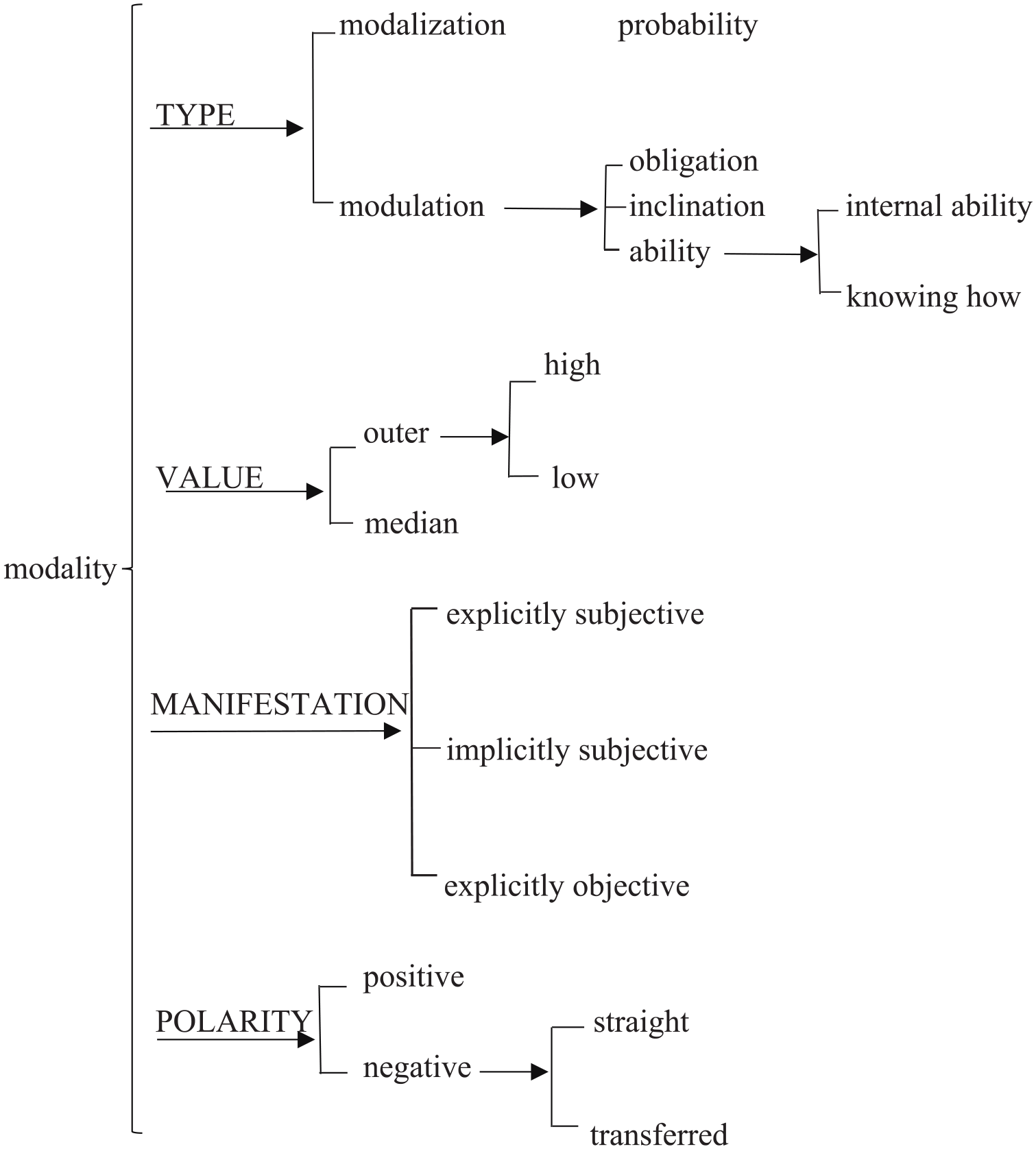
System network of modality in Chinese.
Conclusion
This paper has examined the systems of types, values and manifestations in modality and explored realizations of modality derived from the systems. There are two basic types of modality recognized in Chinese: modalization and modulation; usuality is excluded from the system of types of modality. Both modalization and modulation are organized as systems of three values: high, medium, and low. The three values are not discrete categories but areas of meanings on a cline. The realization of modality is categorized in terms of the system of MANIFESTATIONS, which distinguishes among explicitly subjective, explicitly objective, and implicitly subjective realizations of modality.
The present study is the first attempt to systematically and critically examine the systems of types, values, and realizations of modality in Chinese. It may enrich the relatively weak literature on modality in Chinese, since it has been less studied compared with other grammatical categories and contribute to a better understanding of modality in the particular language of Chinese as it presents a comprehensive and in-depth description of the system and realizations of modality that have not been fully discussed before. It may also yield evidence for and contribute to systemic functional typological studies: the description of the system of MODALITY in Chinese including its subsystems may be beneficial to developing typological generalizations about modality systems in different languages in the world. This systematic study of modality may lend support to system-based typology, supplementing structure-based typology.
The present work once again proves that SFL is not anglo-centric but a general linguistic theory. Its rich theoretical dimensions contribute to bringing out the special features of the particular language of Chinese. Moreover, the present study may shed some insights into the teaching of Chinese grammar. The establishment of the system of MODALITY and the analysis of realizations of modality will deepen the learners’ understanding of modal expressions in the clause of Chinese.
Finally, it should be noted that there are still some limitations in the current study and suggestions for further research should be provided. For one thing, regarding the system of types and manifestations of modality, the present analysis is still a tentative one. In future research, more delicate subsystems and the probability of the systems should be examined to present a more comprehensive account of the system of MODALITY in Chinese. For another, the relation between the system of MODALITY and the system of POLARITY is only briefly touched upon in the present work. In future trials, the relation needs to be further analyzed as they are interrelated systems at the same stratum of language.
Footnotes
Declaration of Conflicting Interests
The author declared no potential conflicts of interest with respect to the research, authorship, and/or publication of this article.
Funding
The author disclosed receipt of the following financial support for the research, authorship, and/or publication of this article: This work was funded by the National Social Science Fund of China (grant number 15CYY004).
