




Abstract
The luxury market has experienced considerable growth over recent years, being one of the sectors that have been the most resistant to the current economic recession. Selective fragrances make up one of the primary categories of the so-called accessible luxury consumed by a middle class that is seeking to approach the upper classes by copying their lifestyle. Despite the importance of this market, there is relatively little literature existing in regard to the study of the image of luxury brands due to the complexity of the luxury phenomenon. This article presents the results of an initial qualitative study conducted on focus groups of luxury fragrance consumers, making it possible to identify the types of attributes to be considered when studying the brand image of said luxury products. Subsequently, a quantitative study was conducted to determine the perceived image of the main luxury fragrances brands by consumers. Thanks to this study, it has been possible to determine the typical profile of each of the analyzed brands, to define the underlying dimensions of the image of luxury fragrances brands, and to analyze the correlations and dependency relations existing between the luxury brand dimension and the other attributes of image for the studied brands and between all the image attributes themselves.
Introduction
Although the phenomenon of luxury has existed since ancient times (Godey et al., 2013), only recently has the luxury goods industry grown at such a spectacular rate (Hennigs, Wiedmann, Behrens, & Klarmann, 2013; Jung Choo, Moon, Kim, & Yoon, 2012).
There are numerous and varied reasons for this increase in the consumption of luxury goods, including the continuous growth of economic wealth in developed countries, the rise of the middle class and its income level, and more recently, the incredible economic development of the so-called “emerging countries” (Cavender & Kincade, 2014).
According to research by Euromonitor International (2015), sales in the luxury market reached US$330.786 billion in 2014, 3% higher than the previous year. One of the largest product categories in this luxury market is that of “Perfumes & Cosmetics,” which makes up some 11% of the same, increasing by 3% from the previous year (Euromonitor International, 2015). “Perfumes,” specifically, is one of the main gateway goods into the world of luxury consumption, being a so-called “affordable luxury” (Allérès, 1990); therefore, most luxury fashion and jewelry brands have included perfumes in their diversification strategies (Campuzano García, 2007). According to data from Euromonitor International (2015), “perfumes” make up 5% of the luxury market, with sales of US$15.767 billion in 2014 (+23% from 2007).
Nevertheless, despite the growing importance of luxury goods consumption, academic and professional literature is quite limited with respect to the study of luxury brands image and the dimensions leading to the creation and maintenance of a luxury brand.
Existing studies on luxury brands’ image have measured only perceptions of the degree of luxury of the brands themselves, relying on earlier versions that modify or increase the dimensions and attributes considered in the evaluation of luxury.
This work focuses on the study of the image of luxury fragrances brands based on contributions provided by numerous authors regarding the concepts of brand identity and image and on the methodology and scales used to measure brand image. It aims to define the underlying dimensions of the luxury fragrances brands image and to analyze the correlations and dependency relations existing between the luxury brand dimension and the other image attributes of the studied brands and between all the image attributes themselves. This may serve the brands in creating the desired brand image, offering them the very characteristics that are demanded by the market. Furthermore, the results indicate how the fragrances brands may work on the relative perceptions of their degree of luxury, focusing on certain operational and controllable variables such as advertising, level of sophistication, notoriety, fragrance duration, and their experience and tradition in perfume creation.
Literature Review
Brand Image and Luxury Brand Image
To understand the concept of brand image, it is necessary to refer briefly to the concept of brand identity, given that the former is based on the latter.
Brand identity originates from the company (Marguiles, 1977, from Nandan, 2005) and is defined as the sum of brand meanings expressed as a product, organization, symbol, and person (D. A. Aaker, 1996a) that makes the brand unique and distinct from other brands (Kapferer, 2004)
Brand image refers to the consumer’s perception of the brand (Nandan, 2005) as formed during the process of decoding the brand identity facets (Roy & Banerjee, 2014). It may be defined as the set of consumer brand perceptions and beliefs based on memories (D. A. Aaker, 1996a; Keller, 1998; Kotler & Keller, 2012).
From this perspective, the difference between brand identity and brand image is that while identity stems from the source or company, image is perceived by the recipient or the consumer. Identity represents the company’s reality while image represents the consumer’s perception (Nandan, 2005). Therefore, the dimensions defining both concepts should be the same, so that if the company carries out a good communications strategy, both concepts (identity and image) will be consistent (Roy & Banerjee, 2014).
The literature is quite limited with regard to luxury brand images, and the studies created to study it have focused specifically on measuring the perceptions of the degree of luxury of the brand. Most of these studies rely on existing studies, expanding on the information they have provided. Therefore, despite their interest for measuring the degree of luxury of brands, they fail to consider other equally important perceptions related to other brand dimensions (such as those linked to personality, the organization that offers them, the product category to which they belong, etc.).
Therefore, this work propose that the study of luxury brand image should consider both dimension of brand luxury, in accordance with the work of Hennigs et al. (2013), as well as the dimensions proposed by D. A. Aaker (1996a) regarding the brand as a product, as an organization, as a person, and as a symbol.
Measuring Brand Image
Based on the multi-dimensional brand image perspective (Ambroise & Valette-Florence, 2010; Cerviño Fernández, 2002; Hsieh, 2002; Kotler & Keller, 2012; Koubaa, 2008; Stern, Zinkhan, & Jaju, 2001), most authors suggest the use of mixed techniques for image studies, combining qualitative and quantitative tools during the different study steps. The following steps should be followed when studying brand image (Churchill Jr., 1979; Del Rio, Vazquez, & Iglesias, 2001; Dobni & Zinkhan, 1990; Dolnicar & Grün, 2007; Huang, 2010; Koubaa, 2008; Low & Lamb, 2000; Martinez & de Chernatony, 2004; Netemeyer, Krishnan, Pullig, Wang, Yagci, Dean, & Wirth, 2004; Park, 2009; Sanz de la Tajada, 1994; Zaichkowsky, 1985):
First step: Identify the set of attributes/items that individuals associate with the investigated brand (image attributes). The typical techniques used in this step are Kelly repertory grid, free responses, focus groups, or depth interviews. Sector and product or brand experts should revise the initial list of attributes/items proposed for consumers to prevent repetitions or the inclusion of superfluous or inappropriate items.
Second step: Create the measurement instrument (scale). The attributes/items identified in the previous step are made available and are projected according to the most appropriate of the following types of scales: Likert-type, semantic differential, Stapel, Thurstone, or Q-Sort technique.
Third step: To collect the data by survey.
Fourth step: To analyze the data to calculate the brand score. The main techniques to do this are multi-attributes model, correspondence analysis, factor analysis, discriminant analysis, multi-dimensional scaling (attributes or pairwise), tri-modal scaling, conjoint analysis, and principal components analysis.
However, although there is great consensus regarding the methodology for the study of the brand image and there are scales that allow for the measurement of partial dimensions of brand image, there is yet to be agreement on a standard set of attributes and items to be included in a scale to measure the overall image of any type of brand, regardless of the specific brand product category.
Thus, to measure brand personality, the scale developed by J. L. Aaker (1997) is especially useful. To measure corporate image, the scale by Netemeyer et al. (2004) is appropriate—as it allows for measurement of not only the associations with the brand but also of the perceived quality, notoriety, and uniqueness—as well as the scale created by Mann and Ghuman (2014).
To measure brand quality and the associations with the brand as a product, the scales of Keller and Aaker (1992), D. A. Aaker (1996b), and Yoo and Donthu (2001)—this one also recognized to measure the associations with the brand as symbol—stand out.
As for the scales used to measure the luxury brand image, they only focus on measuring the degree of luxuriousness. Kapferer (1998) identified 18 attributes items to measure the degree of luxury associated with these luxury brands. Dubois, Laurent, and Czellar (2001) extended this to 20 attributes similar to the 20 proposed by Vigneron and Johnson (2004), who also grouped these into five luxury factors (conspicuousness, uniqueness, quality, hedonism, and extended self). Wiedmann, Hennigs, and Siebels (2007a, 2007b, 2009) and Hennigs et al. (2013) established that perceptions of the value of brand luxury are based on four interrelated dimensions grouped into 10 factors, which consist of a total of 48 attributes or semantic items. Godey, Lagier, and Pederzoli (2009) introduced and validated a measurement scale of aesthetic styles applied to luxury goods stores, and finally, Pop, Băcilă, Ciornea, and Drule (2011) added to the Wiedmann et al. studies, considering that luxury is characterized by a set of 11 values.
In all cases, the authors suggest that the items used to measure the degree of brand luxury are only valid in a specific cultural and geographic context. Therefore, to guarantee the appropriateness and comprehension of the study, the corresponding semantic items should be generated, enunciated, and validated in whichever context the model is to be used.
Method
As previously mentioned, the main objective of this study is to analyze the image of luxury brands from a multi-dimensional perspective (Ambroise & Valette-Florence, 2010; Cerviño Fernández, 2002; Hsieh, 2002; Kotler & Keller, 2012; Koubaa, 2008; Netemeyer et al., 2004; Stern et al., 2001) and while considering both the luxury dimension proposed by Hennigs et al. (2013) and the dimensions proposed by D. A. Aaker (1996b) for product brand as an organization, as a person, and as a symbol.
The product category chosen for this research was that of luxury fragrances. This decision was based on the importance of this category in the global luxury market (Bain & Company, 2013, 2015; Euromonitor International, 2015) and its widespread availability for purchase and use as an accessible luxury product (Allérès, 1990; Campuzano García, 2007). Historically, “Perfumes & Cosmetics” and “Apparel” are the most well-established categories within the luxury market (Bain & Company, 2015). Furthermore, within the “Perfumes & Cosmetics” category, “Perfumes” is the most important sub-category in terms of sales (Bain & Company, 2015; Euromonitor International, 2015). Another particularity of luxury fragrances is their relationship with the fashion brands; the majority of these, in their diversification process, tend to offer fragrances as complements to their clothing (Campuzano García, 2007). Furthermore, data from Stanpa (n.d) suggest the significance of luxury fragrances in the Spanish market of select perfumery and cosmetics (55% in 2014) and in the total Spanish fragrances market (73% in 2014). This emphasizes the strong penetration rate of this luxury product in the Spanish population.
The methodology used in this study was based on a process (as previously mentioned) that was defined by Dobni and Zinkhan (1990) for the study of brand image using a combination of qualitative and quantitative techniques. This process has been accepted and used by many authors (Del Rio et al., 2001; Joyce, 1963; Koubaa, 2008; Low & Lamb, 2000; Sanz de la Tajada, 1994, among others).
Therefore, in the initial qualitative phase of the study, six focus groups were held. The participants (35 male and female luxury fragrances consumers in Spain, grouped by age: between 18 and 29, 30 and 44, and 45 and older) were selected using the snowball sampling method. This phase allowed for the determination of the most well-known set of brands from the Spanish market and the basic criteria used in purchase decision making and consumption of the product purchased. It focused on attributes of image, stating them as items in precise and easily understood terms for Spanish consumers. These items were grouped in the five proposed dimensions related to the luxury fragrances brand image.
The results of this phase were reviewed with professional experts from the Spanish perfume sector (distributors and manufacturers), resulting in a reduction of the 33 initial image attributes to 21 definitive attributes, with their corresponding semantic items. This revision was conducted, as indicated in the academic literature, to avoid repetitions and to eliminate superfluous or inappropriate items (Hsieh, 2002; Netemeyer et al., 2004)
The second quantitative phase was carried out by structured personal survey conducted on 520 individuals who were selected via non-random quotas sampling (according to sex and age) by simple allocation. In this phase, a 7-point differential semantic scale was used to measure the image of the relevant brands. This scale was created based on the attribute items identified in the previous phase. It was confirmed that most of those attributes were similar to others that had already been validated in academic literature for the measurement of partial dimensions of brand image: perceived brand quality (Keller & Aaker, 1992), brand personality (J. L. Aaker, 1997), brand awareness/popularity and organizational associations (Netemeyer et al., 2004; Yoo & Donthu, 2001), and brand luxury degree (Hennigs et al., 2013). The reliability of the scale was evaluated using Cronbach’s alpha for the different dimensions of the considered image (see the data in Table 1).
Brand Image Attributes-Items for Luxury Fragrances.

Results
Qualitative Phase
Initially, 33 image attributes were identified, along with their semantic items, for luxury fragrance brands. On revision by experts from the Spanish perfume and cosmetics industry, the number of these attributes was eventually reduced to 21. For example, of the three initial attributes relating to the nature of the fragrances (fresh and light or heavy and intense; for the daytime or for the night; for the summer or for the winter), sector experts suggested that the first of the attributes (fresh and light or intense and heavy fragrances) in fact includes the other two, thus maintaining all three was repetitive and unnecessarily lengthened the scale.
The final 21 image attributes were grouped into five categories linked to the dimensions of the brand image. These categories were luxury brand attributes, brand personality attributes, fragrance brand attributes, organizational brand attributes, and symbolic brand attributes (see Table 1).
As for the most well-known luxury fragrances (according to the subjects), the following were identified: Chanel, Calvin Klein, Armani, Dior, Loewe, Paco Rabanne, J. P. Gaultier, and Boss. It was subsequently verified that these brands were the top sellers in the Spanish luxury fragrances market (NPD, 2015).
Quantitative Phase
Based on the attributes and semantic items identified in the prior phase (see Table 1), a 7-point differential semantic scale was constructed (with a total Cronbach’s α of .87), including five subscales, to measure the corresponding dimensions of the luxury fragrances brand image.
In the subsequent analysis, we studied the typical profile of the different brands and that of the “ideal” brand (Figure 1), and using factorial analysis of correspondences, we determined their positioning and created the corresponding positioning map (see it in Table 2 and Figure 2). The selection of the analyzed brands was carried out based on the results of the qualitative study regarding level of knowledge of the luxury fragrance brands by consumers. Furthermore, it was found that these brands were the ones having the most sales in the Spanish market (NPD, 2015).

Brands’ profiles.
Factorial Analysis of Correspondences (Basis = Luxury Fragrances Consumers Who Know Each Brand).
Absolute Values and Eigen Vectors.

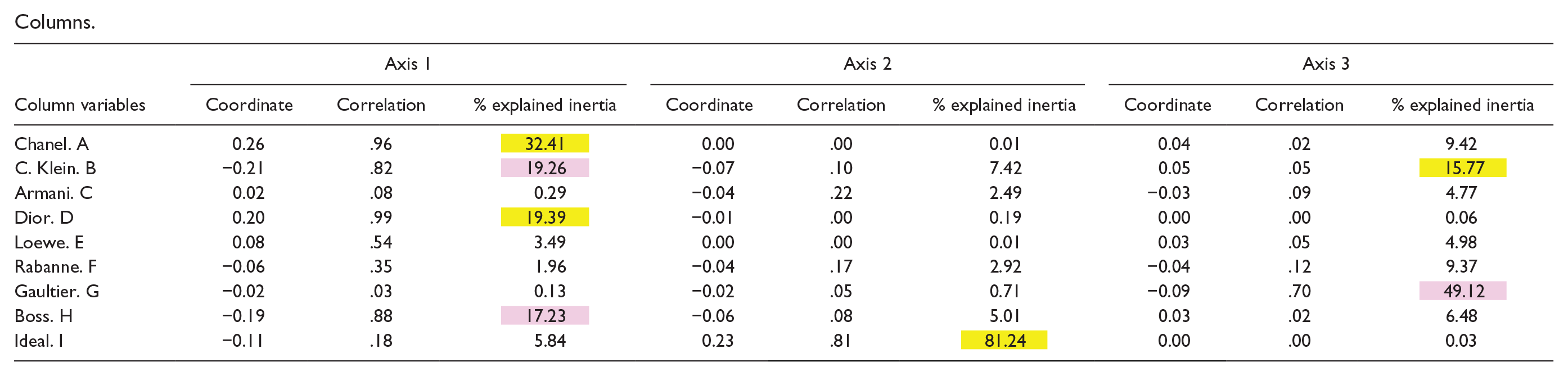
Columns.
Rows.
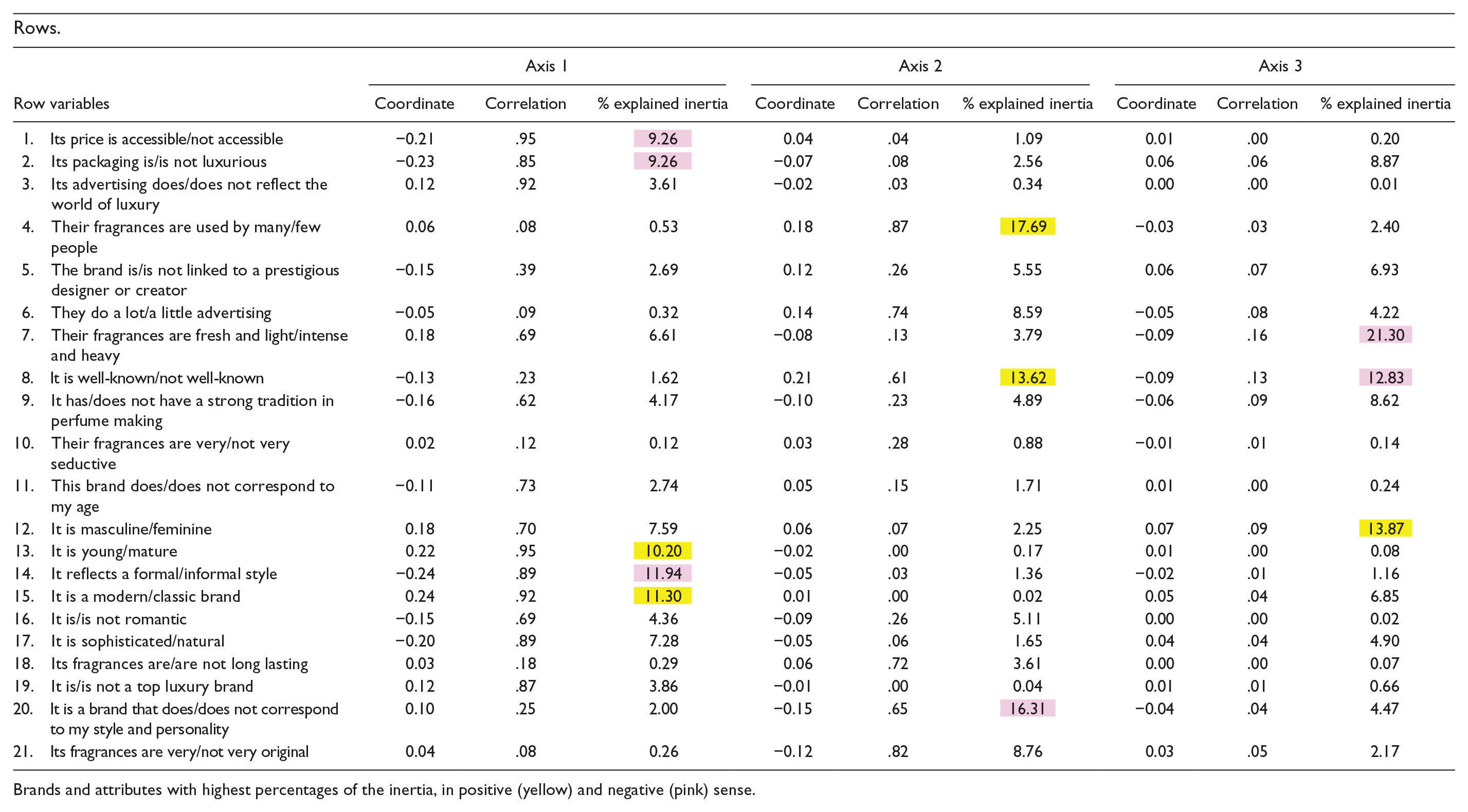
Brands and attributes with highest percentages of the inertia, in positive (yellow) and negative (pink) sense.

Graphic representation of the first two factors’ perceptual map.
Focusing on the typical profile of the “ideal” luxury fragrances brand (“prototype” of the brand that would be perfect for consumers), this is characterized by being a slightly known brand that is positioned at the top of the luxury segment; that conducts advertising but not excessively; is somewhat linked to a prestigious designer; has a considerable tradition in the creation of perfumes; is adapted to the age, style, and personality of consumer; has a lightly youthful, modern, romantic, and sophisticated style; is somewhat accessible in terms of price; and its fragrances are not used by an excessive amount of people. These fragrances are quite fresh and light, seductive, long lasting, and original, and their packaging is somewhat luxurious.
This profile varies in certain aspects based on the age and gender of the subjects that were analyzed. Thus, women demand more accessible prices than men, are less demanding in terms of whether or not the brand is used by few or many people or if it is linked to a prestigious designer, and they prefer a more feminine and romantic fragrance. With age, the consumer experience changes, mainly in regard to preferences with respect to personality attributes. It has been found that younger consumers opt for more youthful, informal, modern, natural, and romantic brands whereas older consumers tend to respond more to brands that are less romantic and more formal, classic, mature, and sophisticated.
As for the positioning of the examined brands, a correspondence factorial analysis reveals that the first factor explains 67.2% of the total inertia and that it is mainly related with the column variables (brands) A (Chanel) and D (Dior), in a positive manner, and with the B (Calvin Klein) and H (Boss) variables, in a negative manner. The most important relationships for this factor with the row variables (type or image attributes) are those of Variable 14 (reflect a very formal/informal style), negatively, of Variables 13 (is youthful/mature) and 15 (is a modern/classic brand), positively, and Variables 1 (inaccessible/accessible price) and 2 (packaging is/is not very luxurious), negatively. Thus, this axis/factor is identified with the personality or style associated with the brands (more or less informal, youthful and modern), with their degree of accessibility, and with the packaging of the fragrances sold (more or less luxurious).
The second factor explains 21.4% of the inertia and is basically related to the column 1 variable (“ideal” brand), in a positive manner, and with the row 4 variables (fragrances are used by many/few people) and 8 (it is a very well-known/not well-known brand), also in a positive manner, and with those of row 20 (it is a brand that does/does not correspond with my style and personality), in a negative manner. That is, the significance of this factor is based on the exclusivity of the fragrances brands and on their suitability to the style and personality of the consumers, and therefore, the “ideal” brand is associated with one that is used by few people, is not very well known, and that corresponds with the style and personality of the potential user.
The third factor only explains 4.8% of the inertia and is mainly related with the column G variable (Gaultier), in a negative manner, and with the row 12 variable (it is very masculine/feminine) in a positive manner.
Furthermore, in the graphic representation of the first two factorial axes (see Table 2 and Figure 1), it is verified that the majority of the analyzed brands tend to be associated with one or two of the attributes considered for their assessment.
Thus, Brands A and D (Chanel and Dior) are mainly linked with Attributes 15 and 13 that characterize them as classic and mature brands, and to a lesser degree with Attributes 19, 3, 12, and 7 which suggest that they are top luxury brands, they rely on advertising to reflect this world of luxury, and that they are much more feminine and with fragrances that are heavy and intense. These brands contrast with the B and H brands (Calvin Klein and Boss) that are mainly associated with the Attributes 17, 14, and 2 that characterize them as being brands of natural and informal styles or personalities, with fragrances packaging that is not very luxurious. Calvin Klein and Boss are also linked, to a lesser degree, with Attributes 9 and 16—which characterize them as brands that do not have a great tradition in the perfume creation industry and that are not romantic—and with Attribute 1 indicating that they are accessible in terms of price.
Brand E (Loewe) is positioned near Chanel and Dior and is mainly associated with Attributes 19 and 3 that define it as being a top luxury brand using advertising that reflects this world of luxury and is associated, to a lesser degree, with Attributes 10 and 18 that characterize it as a brand whose fragrances are seductive and long lasting.
Brands G and C (Gaultier and Armani) are lightly associated with Attribute 10, which indicates that their fragrances are seductive and even more so with Attributes 18 and 21 that define them as brands whose fragrances are long lasting and original.
Brand F (P. Rabanne) is not clearly linked with any attribute. The attributes that are most closely related to this brand and that are positioned equidistantly from it are Attributes 10, 18, 21 (which make reference to seductive, long-lasting, and original fragrances), 11 (referring to the suitability of the brand to the age of the potential user), and finally, Attributes 9 and 16 which indicate that it is a brand with a tradition of perfume making and that is not romantic.
In fact, the Gaultier, Armani, and Rabanne brands are positioned quite close to the origin of the coordinates and are not strongly linked to any attribute, suggesting that they are brands that are quite similar to the average profile of the luxury fragrances brand.
Attribute 20 (referring to the suitability of the brand to the style and personality of the potential user), appears quite distanced from the “ideal” brand and from the real brands. This is due to the large difference existing between the assessment of this attribute from the real brands (in a positive sense) and from the “ideal” brand (in a negative sense).
The same, although in the opposite direction, occurs with Attributes 8, 6, 4, and 5—in regard to it not being very well known, not relying on excessive advertising, not being used by too many people, and not being linked to a prestigious designer or creator. The “ideal” brand is linked quite closely with these attributes which, furthermore, are quite distanced from the real brands, once again due to the differences existing between the assessment of these attributes for the real brands (in one sense) and for the “ideal” brand (in the opposite sense).
These results lead us to ask about the correlations and the possible relationships of dependency between all the brand image attributes themselves and between the luxury brand dimension and the other brand image attributes.
Beginning with the analysis of the attributes, Table 3 shows the simple correlation coefficients between said attributes with the corresponding significance test. The order of appearance of these attributes and their numbering corresponds with that of Table 2 and Figure 1.
Simple Correlation Coefficients Matrix.

Note. p values in parenthesis.
Coefficients having values that are greater than .5 suggest that (a) the fresher the fragrance is perceived to be, the more youthful the brand shall be considered and the more it shall be perceived as adapting to the lifestyle and personality of its potential user (and vice versa); (b) the more seductive the fragrance is perceived to be, the more romantic the brand shall be considered to be (and vice versa), (c) when the brand is more youthful, it is perceived to be more modern (and vice versa); and finally, (d) the more original the fragrance is perceived to be, the more suitable it is considered to be to the style and personality of its potential users (and vice versa).
Given that the correspondence factorial analysis highlighted the importance of the fragrances brand corresponding to the consumer’s style and personality, a multiple regression analysis was conducted (based on the data related to the “ideal” brand) to explain this attribute based on the others. Table 4 shows the results of this analysis. It is affirmed that a luxury fragrances brand corresponding with the style and personality of its potential users depends mainly on whether the fragrances are original and somewhat light and fresh, whether the brand corresponds with the user’s age, reflects a youthful and somewhat informal style, is not overly luxurious, and is somewhat modern.
Multiple Linear Regression.
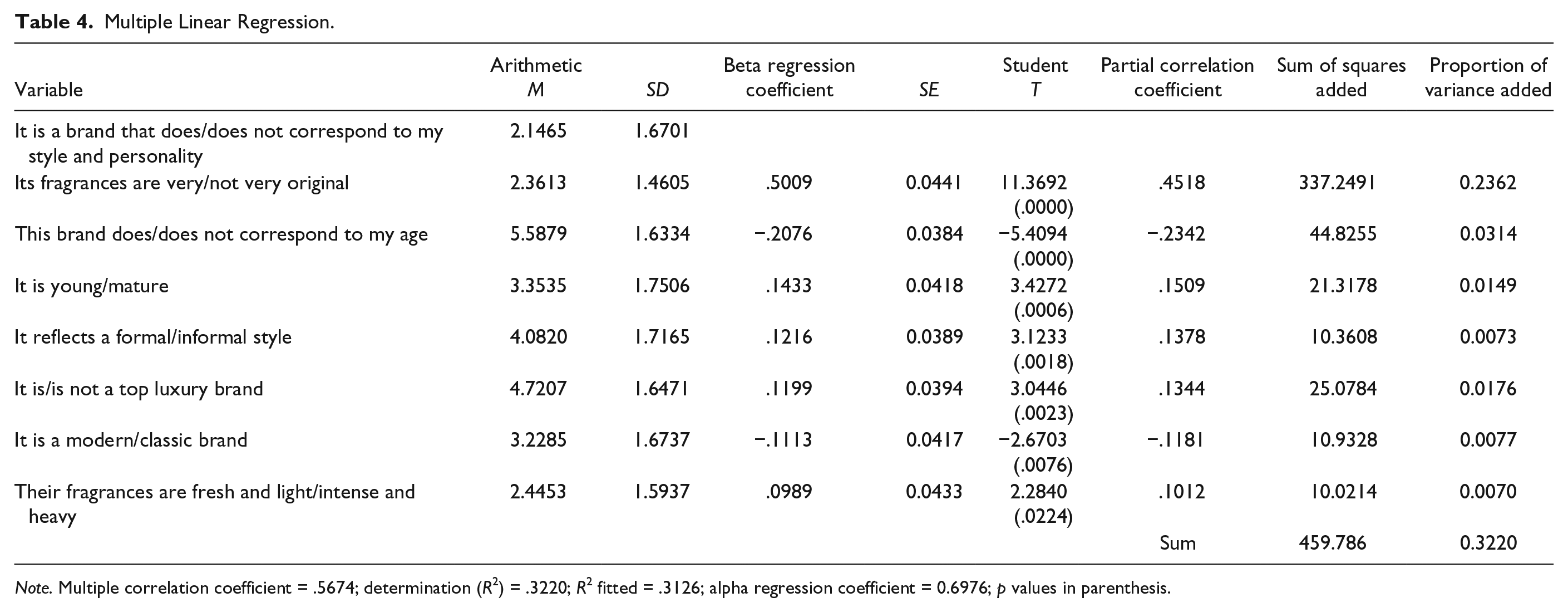
Note. Multiple correlation coefficient = .5674; determination (R2) = .3220; R2 fitted = .3126; alpha regression coefficient = 0.6976; p values in parenthesis.
Finally, given that this work was based on an examination of luxury brand image, the potential dependency relationships for both the attribute relating to the placement of the fragrances brand at the top of the luxury market and that related to the exclusivity of the fragrances with respect to other image attributes (once again, based on the data related to the “ideal” brand) were examined.
Thus, the first multiple regression analysis (see Table 5) suggested that the degree of luxuriousness linked to the fragrances brand depends on the maturity of the brand’s perceived personality; the seductiveness of their fragrances; the luxuriousness of the world reflected by its advertisement; the luxuriousness of its packaging; the brand awareness; its adjustment to the style, personality, and age of the consumer; and its link to a prestigious designer or creator.
Multiple Linear Regression.
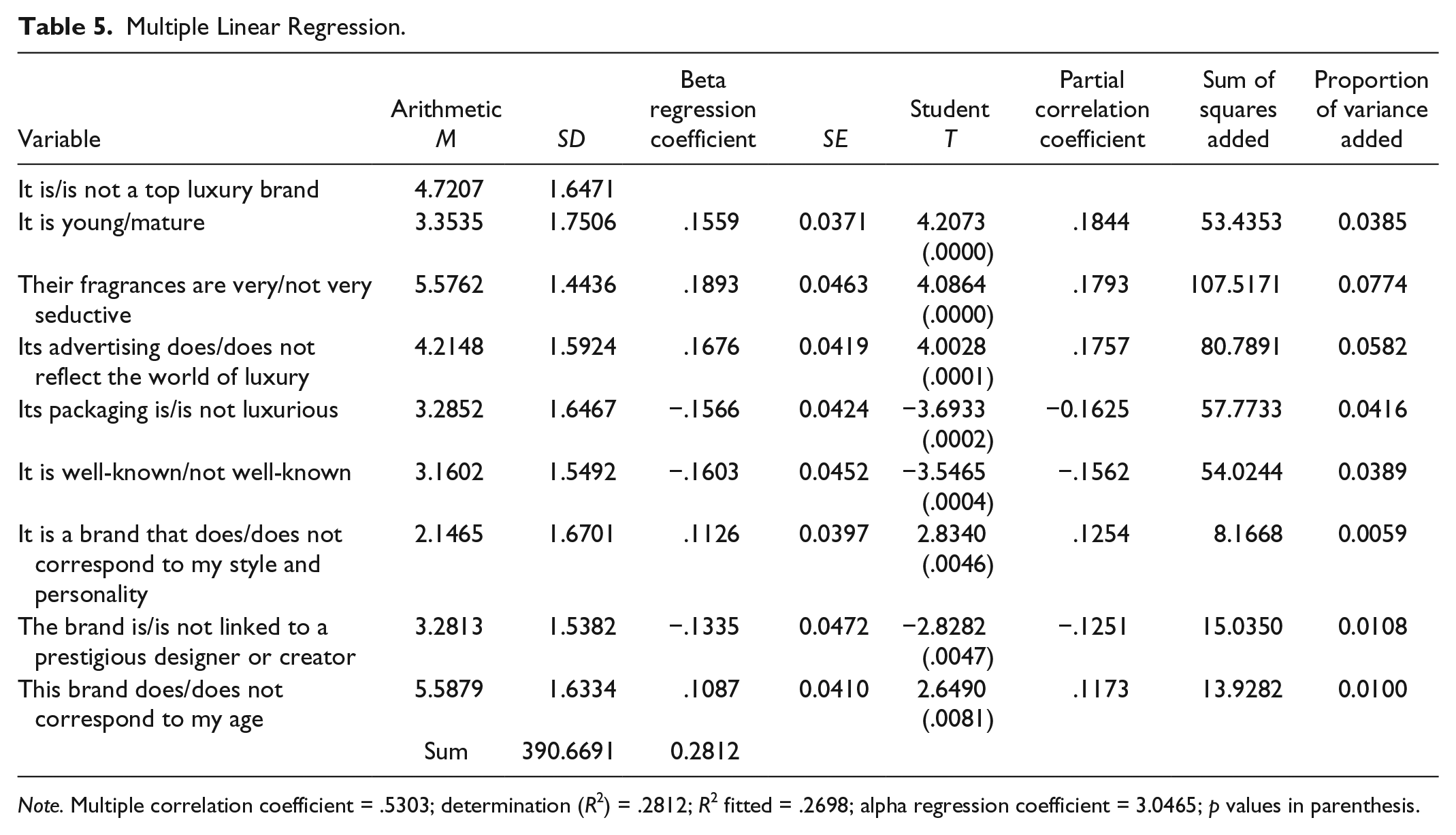
Note. Multiple correlation coefficient = .5303; determination (R2) = .2812; R2 fitted = .2698; alpha regression coefficient = 3.0465; p values in parenthesis.
At last, the second multiple regression analysis (see Table 6) reveals that the exclusiveness of the fragrances is explained by their seductiveness, price, intensity, and heaviness; by the quantity of advertisement done by the brand; the brand awareness; and by the classic and mature style of the brand.
Multiple Linear Regression.
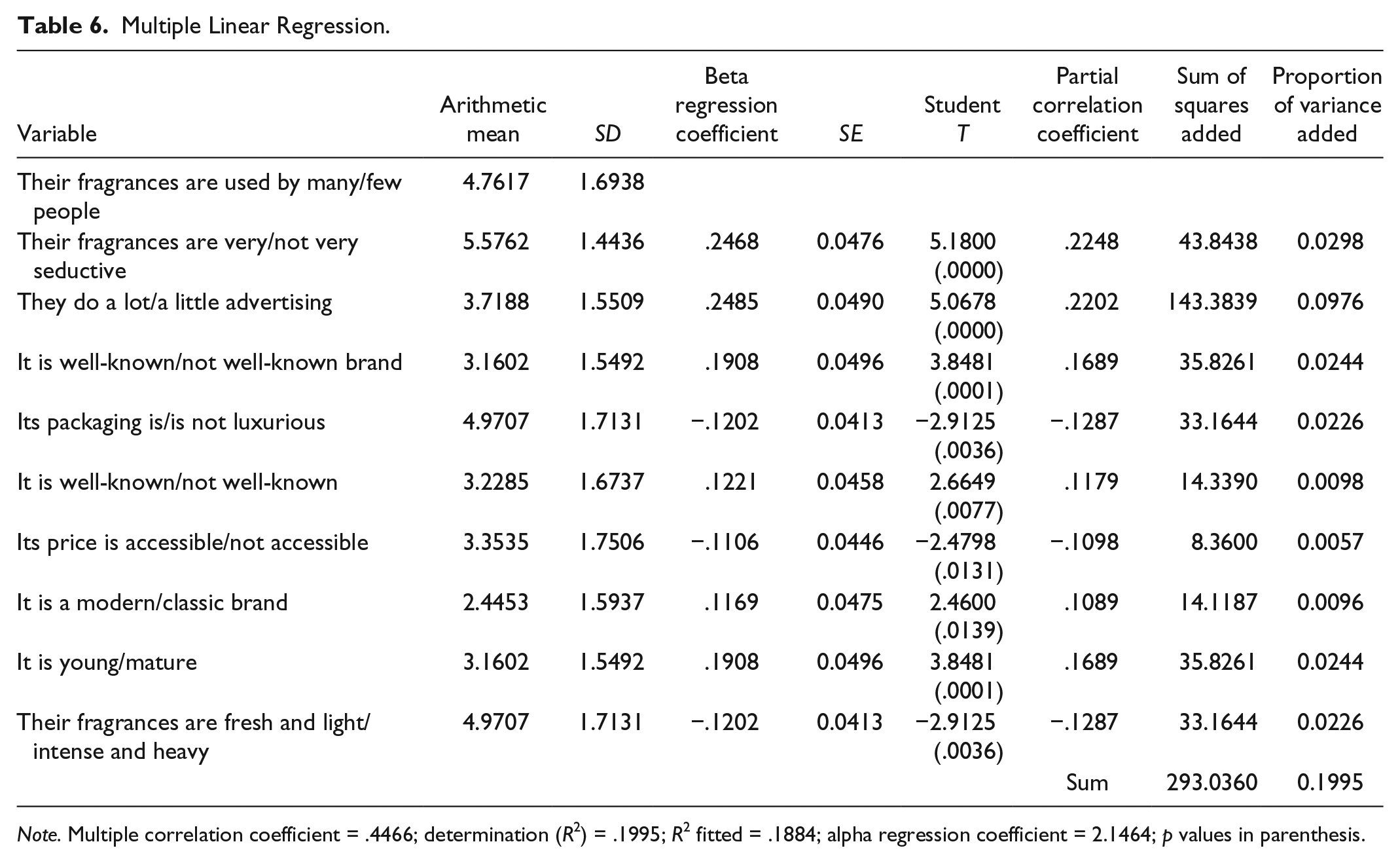
Note. Multiple correlation coefficient = .4466; determination (R2) = .1995; R2 fitted = .1884; alpha regression coefficient = 2.1464; p values in parenthesis.
Regarding the analysis of correlations and the dependence relationships between the luxury brand dimension and the rest of the brand image attributes, the following statistical analyses have once again been conducted: (a) a linear correlation analysis between the previous variables and (b) based on the most significant correlations from the prior analysis, a multiple regression analysis to explain the luxury brand dimension based on the other brand image attributes. In Tables 7 and 8, the “Luxury Factor,” related to the luxury brand dimension has been calculated based on the mean of the items linked to the luxury brand attributes.
Simple Correlation Coefficients.

Note. p values in parenthesis.
Multiple Linear Regression.

Note. Multiple correlation coefficient = .5739; determination (R2) = .3294; R2 fitted = .3204; alpha regression coefficient = 3.1261; p values in parenthesis.
The observed correlations (see Table 7) suggest that the degree of luxury attributed to a fragrances brand will be greater when its advertising is more luxurious, its style and personality is more sophisticated, it is more well-known, its fragrance duration is longer, its perfume-making experience and tradition is greater, and its advertising activity is more intense.
The subsequent multiple regression analysis (see Table 8) allows us to confirm that the observed correlations may be considered dependency relationships and that, therefore, the degree of luxury of a fragrances brand is explained based on how its advertising reflects or fails to reflect the world of luxury, its more or less sophisticated personality, its notoriety, the longer or shorter duration of the brand’s fragrances, and its tradition in fragrances or perfumes creation.
Of all the explanatory variables related to the degree of luxury attributable to a fragrances brand, the two most important variables are the first two that were presented; in fact, in the same multiple regression analysis that was conducted according to age segments, it was found that for all studied segments, the brand’s sophistication influences (from the youngest to the oldest) the degree of luxuriousness that is associated with the brand. And advertising that reflects the world of luxury affects the luxuriousness attributed to the brand for two of the analyzed age segments: the youngest (18-29 years of age) and those above the age of 45.
Conclusions and Recommendations
It should be recalled that the conclusions reached from the study refer to a specific moment of time (when the surveys were conducted) and to a specific competitive context (defined by the brands selected for the study). Furthermore, the study is geographically limited to Spain, and its results may not be generalized to broader areas.
Thus, the results obtained only have a paradigmatic reference value. However, the most relevant conclusion of the research is that the perceived image of the luxury fragrances brands are made up of a set of attributes that consider both the luxury dimension of the brands as well as other dimensions related to the brand personality and their benefits as a product, as an organization, and as a symbol. From these dimensions (and their corresponding attributes), it has been possible to identify the most important interdependent relationships and the dependency relationships between the global dimension of the luxuriousness attributed to a fragrances brand (and each of the most relevant luxury attributes) and the rest of the image attributes.
These results are interesting theoretical and practical contributions for both the academic and business world.
First, the importance of the luxury fragrances being suited to the style and personality of the consumer has also been found, also explained by the very nature of the fragrances and their degree of originality and by the style and age assigned to the brands.
Second, it was possible to determine the dependency relationships between the most important factors associated with the degree of luxury of the fragrances brands and other factors regarding their type and style, originality, price, and packaging.
Finally, it has been possible to identify the explanatory variables behind the global luxury dimension attributed to the fragrances brands; specific variables linked to the fragrances brand image in terms of product (long-lasting fragrance), organization (known and experts in fragrances creation), symbol (its advertising reflects a world of luxury), and personality (sophisticated).
Thus, it seems logical to highlight that these contributions should direct the luxury fragrances brands for them to attain the desired degree of luxury, based on other more operational variables of the marketing-mix of their products, and to carry out further studies to examine the lifestyles and inherent aspects of the distinct consumer personalities so as to develop products with which they can fully identify. The brand that is able to do this shall certainly triumph in the market, assuming that it also considers the other attributes that are positively valued by the individuals and that are linked to the fragrance presentation and its degree of exclusivity.
It is also important to insist on the need to differentiate between competitors. Thus, it is suggested that some of the studied brands seek out and create differentiation axes in regard to their direct competitors; Chanel versus Dior and Calvin Klein versus Boss.
Footnotes
Declaration of Conflicting Interests
The author(s) declared no potential conflicts of interest with respect to the research, authorship, and/or publication of this article.
Funding
The author(s) received no financial support for the research and/or authorship of this article.