




Abstract
Numerous language-learning variables play a crucial role in students’ pragmatic competence development. However, amongst many of these variables, factors like age, gender, and proficiency level have not been extensively researched. Specifically, domains like Motivation and its role in pragmatic development are understudied. This study aims to explore EFL learners’ pragmatic Motivation in a study abroad context. A quantitative research design was adopted for this study. Data were collected from 160 university students through a general pragmatic motivation questionnaire and a speech acts-specific motivation questionnaire focusing on request, refusal, and apology speech acts. After collecting and analyzing the data, this study revealed interesting findings on students’ pragmatic motivation, which was used to make pedagogical conclusions.
Plain Language Summary
Given the challenges of enhancing students’ communicative competence because pragmatic motivation is required, there is a need to investigate students’ pragmatic motivation while learning a language. This was the objective of this study. We used a mixed-method research design to implement the study through questionnaires. After analyzing the data, the study revealed relationships between pragmatic motivation and specific-speech-act-motivation. Other novel findings of the study were used to make pedagogical conclusions on the topic. The conclusions add to ongoing scientific discussions on pragmatic motivation in foreign language teaching.
Keywords
Introduction
Language learning is both a means of communication and a means of globalization. Currently, English is recognized as the global language and accepted as the world’s language. Given its global identity, research affirms that English language speakers and learners of diverse cultures possess unique characteristics like Motivation, cultural background, nationality, age, gender, language proficiency level, and so on (Hamad Al-khresheh, 2020). Already, there are novel scientific contributions to show the influence of these characteristics, like cultural background and age, on foreign language acquisition (Meng, 2021; Ozfidan & Burlbaw, 2019). Such studies and others insist that these characteristics play a vital role in language acquisition and must be considered in foreign and second language teaching and learning (Caldwell-Harris & MacWhinney, 2023; Kieseier et al., 2022).
Furthermore, its consideration is based on the premise that the above factors can influence foreign language learners’ communicative and pragmatic competence, especially speech acts. Knowledge of speech acts may help effective communication. Research shows that speech acts aid language cognitive processes (Li et al., 2022; M. F. Lin et al., 2022; Panahzadeh & Asadi, 2019; Sharqawi & Anthony, 2020). A similar study noted that speech acts are the basis for effective interaction (House & Kádár, 2023). Other authors in their studies revealed that neglecting the importance of speech acts in communication may impede communication among junior high school students (Hidayat et al., 2022). Nevertheless, scholarly research contends that teaching-related issues may be responsible for students’ challenges in learning speech acts (Tursunovich, 2023). Likewise, some authors counsel that using effective teaching strategies that integrate movies and TV series may assist learners’ pragmatic competence and improve their performance of speech acts (Omar & Razı, 2022). Others argue that integrating implicit and explicit instructional frameworks may improve learners’ pragmatic competence (Huang, 2022). While these discussions continue, authors seem to be undecided on learners’ pragmatic competence, given its role in communicative competence.
An exegesis of scientific contributions on this topic shows that several factors like Motivation, cultural background, nationality, age, gender, and language proficiency level can influence the development of pragmatic competence (Alzeebaree & Yavuz, 2017; Caldwell-Harris & MacWhinney, 2023; Hamad Al-khresheh, 2020; Kieseier et al., 2022). Admittedly, there are exhaustive studies on the role of culture, gender, and age on learners’ pragmatic development (Meng, 2021; Ozfidan & Burlbaw, 2019). Although a few studies on the influence of Motivation on learners’ pragmatic development. A recent study found that Chinese university students’ levels of pragmatic awareness were associated with their attitude toward the learners’ community and their intended learning efforts (Yang, 2022). In another study, the authors noted the non-existent nature of studies on pragmatic development, while they found low Motivation for pragmatic development among Indonesian students (Sanjaya et al., 2022). Another study in a Chinese context admitted that only some studies have explored the role of Motivation in pragmatic development regardless of its importance in language acquisition (Yang & Wu, 2022).
Building on the above, a few studies investigate Motivation’s role in pragmatic development. It is crucial to carefully examine this understudied area of pragmatics in language learning to unveil the role of crucial factors such as pragmatic competence in determining and influencing the learners’ language proficiency level in using speech acts. Given some laudable studies in the Asian context, providing scientific contributions on the role of Motivation in students’ pragmatic development in different educational contexts will contribute to the corpus of pragmatic studies in thoroughly understanding the role of Motivation in students’ pragmatic development.
Besides, varied assertions and conclusions on the approaches/strategies of teaching speech acts essential for effective communication and pragmatic development indicate that this language study domain requires more investigation. This study researches several factors affecting the development of communicative and pragmatic competence. The role of gender, age, proficiency levels of participants, and their pragmatic Motivation have been investigated in this regard. This paper approaches issues regarding pragmatic development from a whole-side perspective, investigating variables like gender, age, and proficiency levels of participants while focusing on pragmatic Motivation so far lacking in the broader literature on this topic.
Literature Review
Students and Communicative Competence
Developing communicative competence among students can be challenging due to various factors. Research acknowledges that a lack of authentic practice, given that students may need more opportunities for real-life communication in the target language, may hinder their ability to apply their skills effectively (Klimova et al., 2018). Also, limited exposure to the language in authentic contexts can lead to difficulties in understanding colloquial language, idioms, and cultural nuances, sometimes resulting in mistakes (Koval et al., 2019). Some authors revealed that traditional classroom approaches prioritizing rote memorization over practical application might fail to develop students’ ability to communicate effectively or even limit interaction, affecting their communicative competence (Ironsi & Popescu, 2021). There are already numerous studies on culture’s role in language learning. These studies suggest that understanding and using culturally appropriate language can be challenging, as students may need to become more familiar with the cultural norms and conventions of the language they are learning (Nghia & Quang, 2021). Neglecting these and other aspects may impede students’ communicative competence development.
Equally, other aspects, like reliance on digital communication platforms and translations, can deter students from practicing authentic language use and critical thinking (W. Lin et al., 2017). In addition to these teacher-centric practices, other teacher-dominated classrooms or strategies can hinder students from expressing themselves and engaging in interactive activities (Ozlem, 2020). Aside from these, recent studies assert that learning a language in a monolingual environment where the target language is not widely spoken can limit opportunities for practical use, which can influence students’ communicative competence (Chaya & Inpin, 2020). Other factors, like a lack of quality learning materials, multimedia content, and access to native speakers, can impede the development of communicative competence (Nghia & Quang, 2021). Importantly, students may need more intrinsic Motivation if they see the relevance of language learning to their personal goals or future career prospects (W. Lin et al., 2017), and so Motivation plays a paramount role in language learning and developing students’ communicative competence. Fostering a supportive learning environment can help students overcome these obstacles and develop solid communicative competence.
Motivation and Pragmatic Development
While Motivation and the factors mentioned earlier can influence students’ communicative competence, their development is reliant on students’ pragmatic knowledge. Incorporating pragmatics in L2 instruction and research has formed a new area known as Interlanguage Pragmatics (ILP), a subcategory of pragmatics and interlanguage studies (Alzeebaree & Yavuz, 2017). ILP applies pragmatics theories and principles to understand how language learners encode and decode meaning in their L2 (Arabmofrad et al., 2019). Several factors influence the acquisition of ILP. These factors are age, gender, language aptitude, intelligence, self-esteem, anxiety, learning styles, and Motivation (Nugroho & Rekha, 2020). In recent years, individual factors, especially Motivation, have received much attention in response to conflicting findings concerning the effects of learning environments (Li, 2019). Motivation as an individual difference is pivotal and determining in ILP acquisition and development.
There are already exhaustive studies on Motivation’s role in language learning and pragmatic development. Numerous studies affirm the contribution of motivational variables like positive attitude, perseverance, and confidence to language learning (Inagaki, 2019). Similar studies reiterate that motivated learners approach language learning positively, encouraging consistent effort and dedication (Yang & Ren, 2019). Some account for the role of Motivation in helping learners persist through difficulties, such as complex grammar rules or unfamiliar vocabulary (Inagaki, 2019; Tulgar, 2018). These are necessary for language learning. Equally, some scholars noted that Motivation plays a role in developing students’ pragmatic competence (Chen, 2017; Moradi, 2017). For instance, research asserts that motivated learners are more likely to engage deeply with language use in various contexts, enabling them to understand the subtle nuances, humor, and cultural implications embedded in pragmatic language (Sharqawi & Anthony, 2020; Westra & Carruthers, 2017). Also, there are suppositions that Motivation drives learners to apply their language skills in authentic situations, allowing them to practice and refine their pragmatic competence through actual communication (Barón & Ortega, 2018; Kecskes, 2018; Liu & Qian, 2018). Some insist that Motivation encourages learners to explore the cultural aspects of language, leading to a better understanding of the sociocultural norms that influence pragmatic language use (Ren, 2019).
Furthermore, some authors believe that motivated learners actively seek opportunities for exposure to native speakers and real-life interactions, providing valuable insights into how language is used in various contexts (Barron, 2019). These contexts enable students to adapt to different communication styles (Chen, 2017). Besides, there are notions in broader literature that Motivation drives learners to adapt their communication style to fit different situations, helping them master politeness strategies, indirect language, and appropriate speech acts (Inagaki, 2019). Concerning contextual learning, motivated learners are more likely to engage in activities that expose them to context-rich language use, such as watching films, reading literature, or participating in group discussions (Yang & Ren, 2019). Moreover, Motivation contributes to the retention of pragmatic knowledge and the ability to transfer it to new situations, ensuring that learners can apply what they have learned effectively (Tulgar, 2018). Notably, while Motivation can significantly enhance the development of pragmatic competence, finding a balance between motivation-driven learning and allowing for natural, context-rich language use is crucial and usually a challenge.
Pragmatic Competence and L2 Instruction: An Overview of Challenges
For instance, different cultures have varying norms and expectations about how language should be used in social interactions. What may be considered polite or appropriate in one culture might be perceived differently in another (Aboud, 2020). Teaching students to navigate these cultural differences requires a nuanced approach and may be tasking. Research recognizes that language usage can change based on the context, the relationship between speakers, and the setting of the communication (Demirkol, 2015), and students need to learn how to adapt their language to different situations, such as formal versus informal conversations or written versus spoken communication (Huwel & Ghayadh, 2020; Kecskes, 2015), this can be challenging as well. Some studies contend that language often contains ambiguity and indirectness, where the intended meaning is not explicitly stated, and teaching students to recognize and interpret these indirect cues, such as sarcasm, irony, or euphemisms, can be challenging (Panahzadeh & Asadi, 2019). Equally, pragmatic competence also involves understanding nonverbal cues like facial expressions, gestures, and body language, and teaching students to interpret and use these cues appropriately is crucial for effective communication, which may be demanding in many teaching settings (Zhang & Papi, 2021). Idioms, proverbs, and colloquialisms are common in language but can be difficult for non-native speakers to understand (Tabatabaei & Farnia, 2015). Teaching these expressions’ meaning and appropriate usage is part of developing pragmatic competence.
Furthermore, different languages employ various strategies to convey politeness or deference. Teaching students how to use these strategies appropriately can be complex, involving cultural norms and social hierarchies (Perdhani, 2016). Also, inaccurate interpretation of pragmatic cues can lead to misunderstandings or unintended offenses. Guiding students to recognize potential pitfalls and helping them develop strategies to clarify communication can mitigate these issues (Aboud, 2020). Some studies assert that traditional language teaching often focuses on grammar and vocabulary, neglecting pragmatic skills. Incorporating pragmatic instruction into language curricula requires specialized teaching methods and materials that some teachers may not possess (Zhang & Papi, 2021). However, motivated students will be ready to learn, provided the instruction is tailored to their needs (Panahzadeh & Asadi, 2019). To overcome these challenges, educators may use different exercises, real-life scenarios, video examples, and cross-cultural discussions to motivate and provide students with practical experience using language effectively in various social contexts.
The Present Study
There is a need to investigate students’ pragmatic Motivation, given the role of Motivation in fostering communicative competence. Moreover, given that pragmatic competence may be challenging to teach and transfer, it is essential to examine students’ pragmatic Motivation for language learning, which is essential for developing their communicative competence. Again, a careful analysis of studies within this domain limited scientific contribution to this topic. Some scholars insist that understudied domains of a discipline may require more investigation to provide sufficient empirical knowledge lacking in that field (Miles, 2017). These studies point to the need for further research focusing on the learner differences in pragmatic Motivation. In reaction to this lack of research, this study will investigate the relationship between gender, age, proficiency levels of participants, and their pragmatic Motivation. To achieve these, the following research questions were investigated;
Are there significant differences between male and female EFL learners in their pragmatic Motivation?
Are there significant differences among age groups of EFL learners in their pragmatic Motivation?
Are there significant differences among proficiency levels of EFL learners in their pragmatic Motivation?
Is there any relationship between the participants’ general pragmatic and speech act-specific motivation?
Methodology
Research Design
A mixed method research design with a sequential mixed approach was used to investigate English preparatory school students’ general pragmatic Motivation and speech-act-specific Motivation and explore their relationship with speech act production. Two pragmatic motivation questionnaires were used for the quantitative part of the study. The procedures are discussed below.
Procedures
The study was implemented in an English Preparatory School of a private and a multicultural university in Northern Cyprus. The research area is a university that offers programs both in English and Turkish. Students who chose to study in a department where the medium of instruction was English were required to take an English proficiency exam. The cut-off for passing the proficiency examination was set at 50%. Students who obtained a score lower than the cut-off of 50 out of 100 had to attend the English Preparatory School, where they studied English intensively for a semester or a year, depending on the entry-level that they were placed.
Participants
The participants were students who studied English as a foreign language in Northern Cyprus, where the daily language was Turkish. The participants used only English inside and outside the classroom daily because English was the mutual language between them and the community. Thus, this was a study-abroad setting for the participants, but different from most study-abroad research settings, the language they were learning at the university differed from the language of the community. The participants were recruited through convenience sampling, as the participants were readily available given the pandemic, and some learners followed the courses online. Those who were able to attend face-to-face classes participated in the study. Before commencing the study, oral and written consent was obtained from the participants, and they declared their willingness to participate in the study.
In total, 160 students were recruited for the study. For the demographics, 57.14% of the students were 18 to 20, 29.87% were 21 to 23, and 12.99% were 24. In addition, 59.74% of the students were male, and 40.26 were women. Furthermore, 47.40% of the students were at the intermediate level, 39.61% were at the upper-intermediate level, and 12.99% were at the advanced level.
Data Collection
The instruments for data collection were the General Pragmatic Motivation Questionnaire (GPMQ) and the Speech-Act-Specific Motivation Questionnaire (SASMQ), adapted and used for collecting participant data. Both questionnaires were structured on a five-point Likert scale, ranging from strongly agree (5), Agree (4), Neutral (3), disagree (2), strongly disagree (1). These instruments were deemed suitable to collect data for this study, given their high validity and reliability in obtaining information on L2 pragmatic and speech-act-specific motivation (Tajeddin & Moghadam, 2012). Equally, from the result of the exploratory factor analysis performed to test the validity of the General Pragmatic Motivation Questionnaire, a 14-factor structure explained 65.47% of the total variance, and there were similar features to the 12-item factor structure of the original questionnaire.
Also, it was observed that most of these factors consisted of a single item. This situation is unsuitable as it will prevent the formation of variance, which is the essential requirement of the measured parameter. For this reason, it was accepted that the General Pragmatic Motivation Questionnaire (GPMQ) showed a one-dimensional structure and was analyzed as a total score. According to the Cronbach Alpha test results for the internal consistency of the General Pragmatic Motivation Questionnaire (GPMQ), an alpha coefficient of .833 was obtained. This shows that the answers given to the questionnaire have internal consistency.
The second instrument used for collecting data was the Speech-act-specific Motivation Questionnaire (SASMQ), which had three sub-scales: request, refusal, and apology. In order to examine the validity of the Speech-act-specific Motivation Questionnaire (SASMQ), exploratory and confirmatory factor analysis was performed. From the analysis, we found that SASMQ had a five-factor structure with an eigenvalue above 1, but the variance explained by the last two factors was very low. On this premise, it was determined that the questionnaire had a three-factor structure that explained 47.61% of the total variance, as in the original. However, some items were loaded in different sub-dimensions than the original scale.
Afterward, confirmatory factor analysis was applied to the questionnaire whose factor structure is known, and it was found that the factor loads of all items in the questionnaire were appropriate. The goodness of fit indexes of the model were found to be appropriate. This is presented in Figure 1. The scale’s internal consistency was examined for its reliability, and Cronbach’s alpha coefficient of .892 was obtained. Additionally, a Cronbach alpha coefficient of .660 was obtained for the request speech act, .759 for the refusal speech act, and .796 for the apology speech act. The questionnaires were administered at the end of the period of the implementation.

Confirmatory factor analysis.
Data Analysis
Statistical Package for Social Sciences (SPSS) 26 and AMOS 26 software were used to analyze the research data. The distribution of students was analyzed using frequency analysis, and descriptive statistics was used to analyze the SASMQ and GPMQ questionnaires. Before administering this test, a normality test was administered and presented in Table 1
Normality Tests for SASMQ and GPMQ.
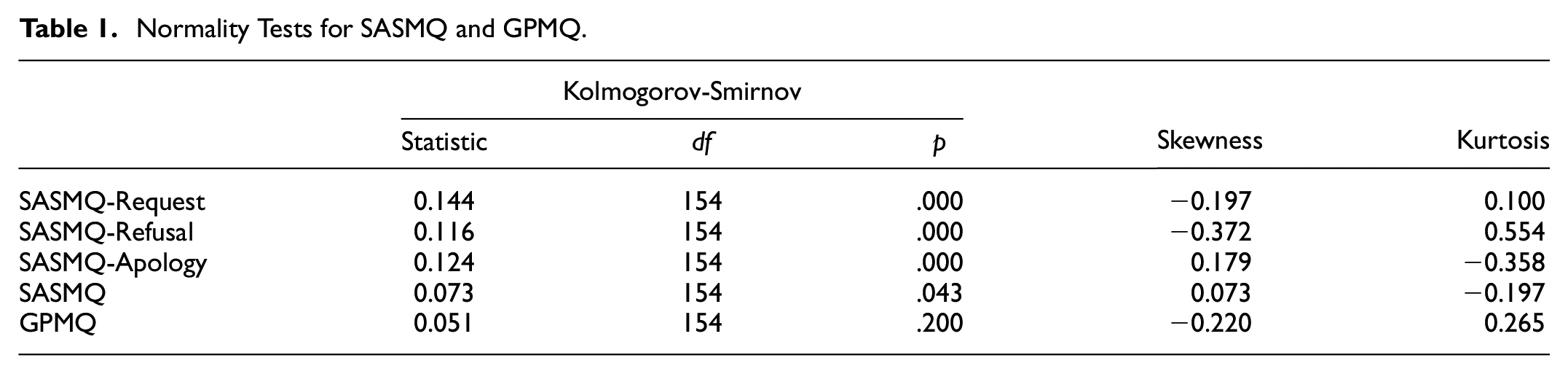
Given that the sample size was more than 100, a Kolmogorov-Smirnov test and skewness-kurtosis test were used to determine the normality or abnormality of SASMQ and GPMQ scores of the students. After analysis, the data set showed a normal distribution due to the low skewness and kurtosis values between ±1.5. On these grounds, parametric hypothesis tests were used in the study.
An Independent sample t-test was used to compare the SASMQ and GPMQ scores according to the gender of the students, and one-way ANOVA was used to compare the SASMQ and GPMQ scores according to age and level. In addition, three-way ANOVA was applied, in which all independent variables were used together. The correlations between the SASMQ and GPMQ scores of the students were determined with the Pearson test, and the predictive status of the students’ GPMQ scores on the SASMQ scores was examined with linear regression analysis and structural equation modeling. The values were standardized by dividing the mean values by the standard deviation.
Findings
This section presents the descriptive statistics regarding the SASMQ and GPMQ scores of the students who participated in the study.
Table 2 presents the descriptive statistics on students’ SASMQ and GPMQ scores. The table reveals that the mean score of
Descriptive Statistics on Students’ SASMQ and GPMQ Scores.

T-test Results Comparing SASMQ and GPMQ Scores According to Students’ Gender.

RQ1: Are There Significant Differences Between Male and Female EFL Learners in Their Pragmatic Motivation?
Table 3 presents the results of the independent sample t-test used to compare the SASMQ and GPMQ scores according to the gender of the students. The table shows that there was no statistically significant difference between the scores of the students who participated in the study from the Speech-act-specific Motivation Questionnaire (SASMQ) and the subscales of Request, Refusal, and Apology, according to their gender as the p-values obtained are more significant than .05 (p > .05). Equally, a statistically significant difference was found between the scores of the students from the General Pragmatic Motivation Questionnaire (GPMQ) according to their gender, and it was determined that the GPMQ scores of women and men were similar.
RQ2: Are There Significant Differences Among Age Groups of EFL Learners in Their Pragmatic Motivation?
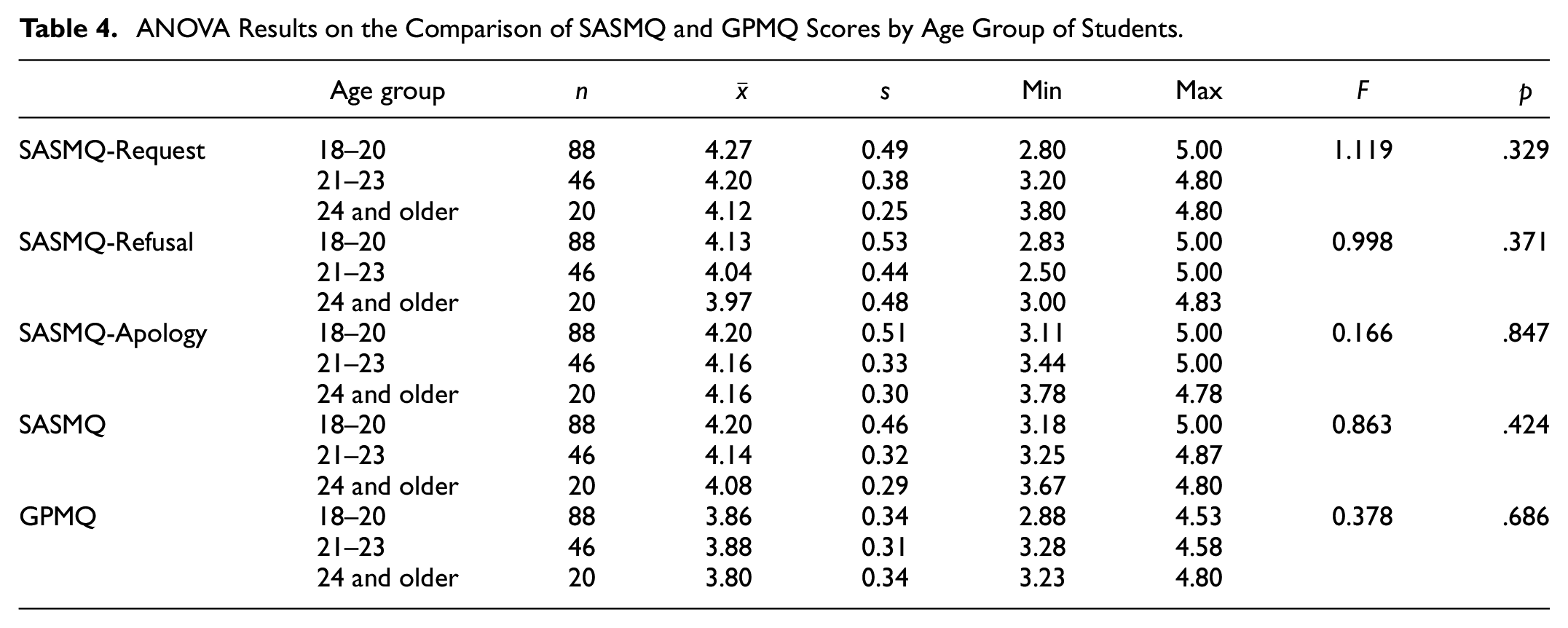
Table 4 presents the ANOVA results of the comparison of SASMQ and GPMQ scores according to the age group of the students. The table shows that there is no statistically significant difference between the scores of the students participating in the study from the Speech-act-specific Motivation Questionnaire (SASMQ) in general and the Subscales of Request, Refusal, and Apology (p > .05). For GPMQ, the table indicates that there was no statistically significant difference between the scores of the students from the General Pragmatic Motivation Questionnaire (GPMQ) according to age group (p > .05).
ANOVA Results on the Comparison of SASMQ and GPMQ Scores by Age Group of Students.
RQ3: Are There Significant Differences Among Proficiency Levels of EFL Learners in Their Pragmatic Motivation?
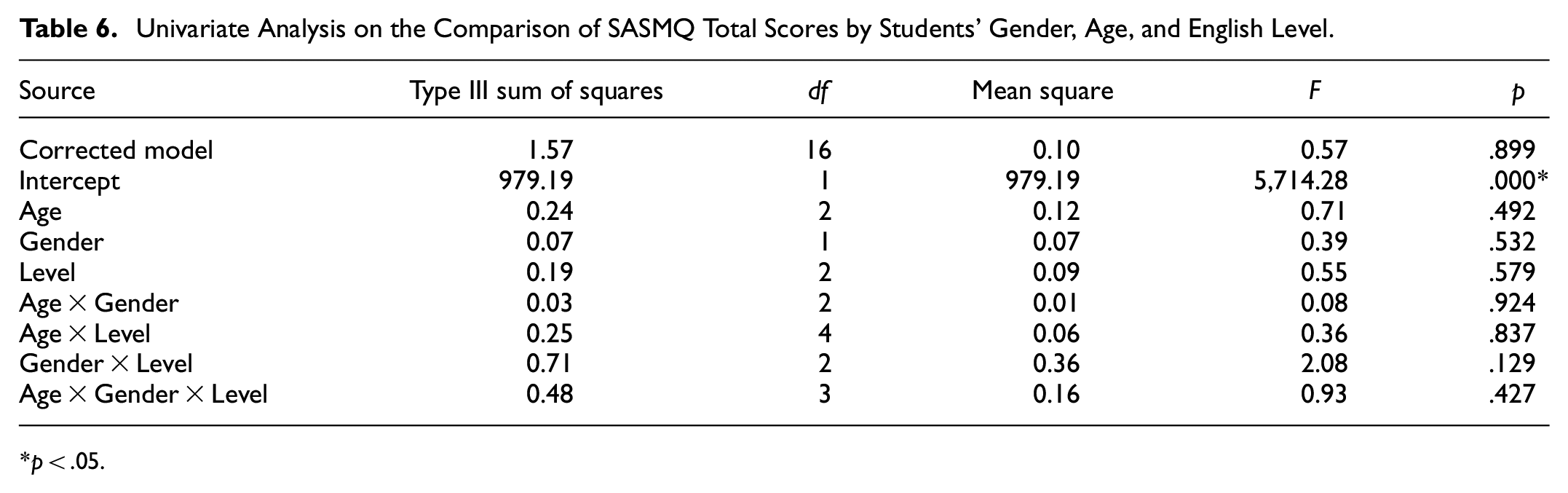
Table 5 presents ANOVA results comparing SASMQ and GPMQ scores according to the student’s English level. From the table, it can be deduced that there was no statistically significant difference between the scores the students got from the Speech-act-specific Motivation Questionnaire (SASMQ) and the subscales of Request, Refusal, and Apology according to their English level (p > .05). Furthermore, the results revealed that there was no statistically significant difference between the scores of the students who participated in the study from the General Pragmatic Motivation Questionnaire (GPMQ) according to their English level (p > .05). Intermediate, Upper-intermediate, and Advanced students scored similarly on the GPMQ. The summary of the above analysis, which describes the comparisons made across the different variables and their subscales, is presented in Table 6.
One-way ANOVA Results for Comparing SASMQ and GPMQ Scores According to Students’ English Level.

Univariate Analysis on the Comparison of SASMQ Total Scores by Students’ Gender, Age, and English Level.
*p < .05.
From the table above, it was determined that the SASMQ scores of the students did not differ according to age, gender, and English level individually (p > .05). In addition, when age, gender, and English levels were evaluated together, it was determined that GPMQ scores were not statistically significantly different (p > .05). Accordingly, SASMQ scores do not change according to the gender, age, and English level of the students.
RQ4: Is There Any Relationship Between the Participants’ Pragmatic and Speech Act-Specific Motivation?
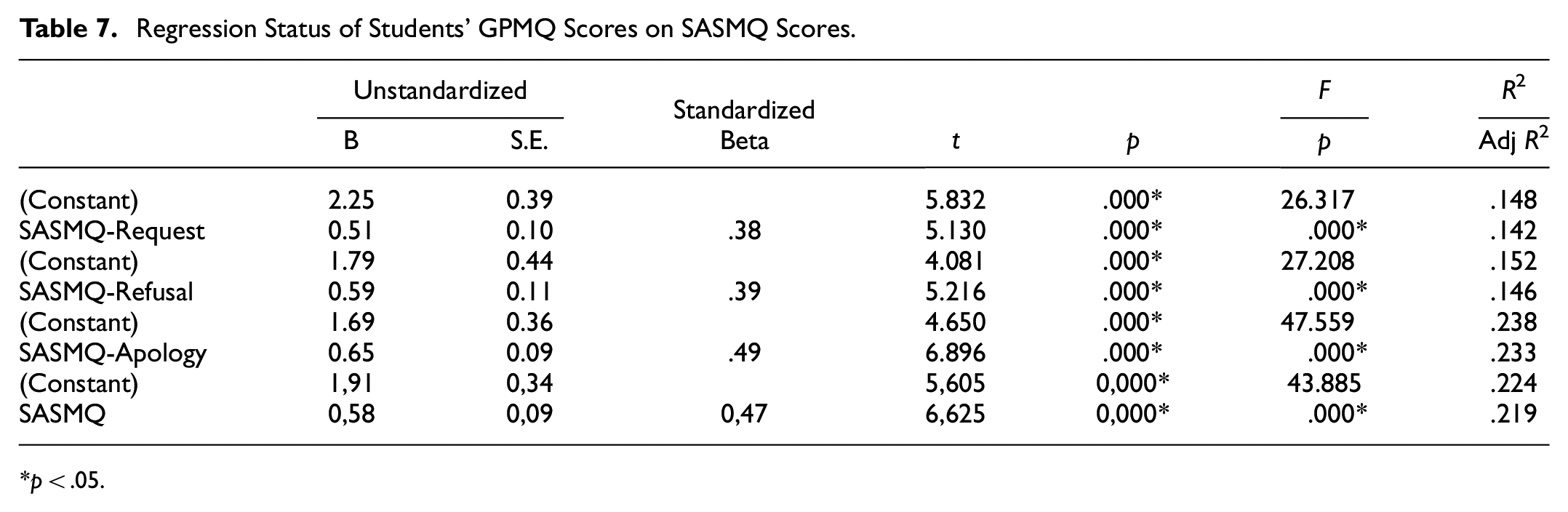
Regression analysis was employed to determine the relationship between the participants’ general pragmatic motivation and speech act-specific motivation. Table 7 presents the regression status of students’ GPMQ scores on SASMQ scores. Furthermore, the table demonstrates the regression analysis results in which the GPMQ scores of the students included in the study were examined in terms of predicting their SASMQ scores. The table unveiled the GPMQ scores of the students in the SASMQ, including request (β = .38; p < .05), refusal (β = .39; p < .05), and apology (β = .49); p < .05) subscales and SASMQ overall (β = .47; p < .05) were found to predict the scores they obtained statistically significantly and positively.
Regression Status of Students’ GPMQ Scores on SASMQ Scores.
*p < .05.
Discussion
After the analysis of the result above, the following findings were obtained. The study found no statistically significant difference between the scores of the students who participated in the study from the Speech-act-specific Motivation Questionnaire (SASMQ) and the subscales of Request, Refusal, and Apology, according to their gender. This study’s novel finding is in tandem with other studies that insist that, regardless of gender, some variables can influence pragmatic Motivation (Inagaki, 2019). In line with the findings of this study concerning students’ speech acts (request, refusal, and apology) and general pragmatic Motivation, the results provide empirical evidence to show that students have high Motivation to use the language. This result aligns with the suppositions of other studies that motivational variables like positive attitude, perseverance, and confidence in language learning influence pragmatic Motivation (Arabmofrad et al., 2019; Inagaki, 2019).
Similarly, this study’s results demonstrate no statistically significant difference between the scores of the student’s opinions on the Speech-act-specific Motivation Questionnaire (SASMQ) and the Subscales of Request, Refusal, and Apology according to age. This result is unique as some studies insist that age could influence pragmatic Motivation (Alzeebaree & Yavuz, 2017; Nugroho & Rekha, 2020), yet the findings corroborate other assertions in some studies that age does not (Barón & Ortega, 2018; Caldwell-Harris & MacWhinney, 2023). Although this finding may be contextual, it provides insights that age can influence pragmatic Motivation among some students, whereas it may not in others.
Concerning students’ English level, our study revealed no statistically significant difference between the scores the students obtained from the Speech-act-specific Motivation Questionnaire (SASMQ) and the subscales of Request, Refusal, and Apology according to their English level. Similarly, the results revealed that there was no statistically significant difference between the scores of the students who participated in the study from the General Pragmatic Motivation Questionnaire (GPMQ) according to their English level. While some studies suggest the influence of English proficiency level on students’ pragmatic Motivation (Li et al., 2022; Kieseier et al., 2022), our study found otherwise. These findings are insightful in guiding teachers in their classroom practices.
Regarding the relationship between the participants’ pragmatic motivation and speech act-specific motivation, the study provides empirical evidence to show that the GPMQ scores of the students in the SASMQ, including requests, were found to predict the scores they obtained statistically significantly and positively. This result confirms a relationship between pragmatic motivation and speech act-specific motivation, as found in similar studies (see Liu & Qian, 2018; Sharqawi & Anthony, 2020; Yang & Ren, 2019).
Conclusion
In reaction to this lack of research, this study will investigate the relationship between gender, age, proficiency levels of participants, and their pragmatic Motivation. Given the results obtained, the following conclusions were made; from careful investigation of the study, it can deduced that attributes like gender may not influence students’ pragmatic Motivation. This conclusion is made given that no significant relationship was unveiled between students’ gender and their pragmatic Motivation. This conclusion is essential in showcasing that Motivation to use pragmatic features in effective communication is not dependent on gender, implying its applicability across different gender groups.
Furthermore, the study provides the basis for the conclusion that other variables like age and student proficiency levels do not impact students’ pragmatic Motivation. This suggests that students of different genders, ages, and English levels can be motivated to learn and apply pragmatics to stimulate effective communication. Equally, this study summarizes that given that gender, age, and students’ English levels do not influence pragmatic competence, similar variables may not influence students’ communicative competence. This is helpful for teachers in designing their classroom lesson plans and activities.
Additionally, there are indications from the findings of this study that pragmatic Motivation is related to speech-act-specific Motivation; as the general Motivation of the learners increases, their speech-act-specific Motivation also increases. Besides, the study revealed a positive correlation between the students’ general pragmatic Motivation and Motivation for speech acts, and this Motivation increases when their general pragmatic motivation increases. Furthermore, students’ general pragmatic Motivation positively influences their Motivation for speech acts.
Analyzing the possible reasons for these findings and conclusions, it is possible to speculate that this influence could be caused by the Motivation to learn the language and self-motivation. For instance, given that students living in Cyprus must use English to express themselves daily, the most commonly used speech acts may be request, refusal, and apology. Again, although English was not the primary language in Northern Cyprus, given their study environment filled with international students, English is the only language for communication. This situation could explain their high levels of Motivation toward improving their pragmatic competence regardless of gender, age, and English levels.
In light of the conclusions, it may be suggested that teachers design their courses by creating an authentic and contextualized setting, especially for EFL learners, to motivate them to learn languages and participate in daily conversations. The conclusions made so far provide the grounds for planning and implementing English language lessons that are communicative-centered, as such lessons will motivate students to use language, resulting in the performance and production of language. Equally, this study bridges the gap in empirical knowledge on an understudied domain of pragmatics required for instructors and researchers.
Amidst the insightful findings of this paper, more studies are required for future investigation. For instance, while this research was conducted using questionnaires, another study involving discourse completion tasks and interviews is imminent. Such studies may provide interesting results on the same topic. Since our study focused on participants from similar backgrounds, future investigations may consider recruiting participants from different backgrounds. These studies will provide rich insights on this topic from different participant backgrounds. Overall, this study contributes to ongoing discussions on the role of different variables in pragmatic Motivation by showcasing that students’ gender, age, and English levels may not influence pragmatic Motivation.
Footnotes
Acknowledgements
We would like to thank the authorities who granted permission for this study and the students, who willingly participated in the study.
Declaration of Conflicting Interests
The author(s) declared no potential conflicts of interest with respect to the research, authorship, and/or publication of this article.
Funding
The author(s) disclosed receipt of the following financial support for the research, authorship, and/or publication of this article: This paper is a part of Aycan Kaderli’s PhD research. This research has not been funded by any authority.
Institutional Review Board Statement
The study was conducted following the Declaration of Özge Razi and approved by the Institutional Review Board (or Ethics Committee) of CYPRUS INTERNATIONAL UNIVERSITY (protocol code 100-3370 and date of approval; 19/04/2021)

Data Availability Statement
Data used for this study will be made available upon reasonable request.