




Abstract
This study investigates the three speech act strategies of request, suggestion and apology in Libyan Arab EFL undergraduate students (AREFLUS) and Amazigh EFL undergraduate students (AMEFLUS). It also examines their linguistic and pragmatic competence in these strategies. Two Libyan universities (Sebha and Zwara) are selected for the study, which includes 50 AREFLUS and 37 AMEFLUS participants. To investigate the students’ socio-pragmatic and pragma linguistic competence, two instruments are used: a questionnaire in the form of a Discourse Completion Test (DCT) and a rating scale. The results reveal numerous similarities between the Libyan Arab and Amazigh participants in performing all the speech act strategies of request, suggest and apology. However, some significant differences regarding gender are found among Libyan EFL students. Overall, both groups appear to be more competent in functioning than in structuring the three mentioned speech act strategies.
Introduction
In the past, the concept of learning a language was correlated with learning linguistic rules and structure only, while the cultural side was essentially neglected. Nowadays, globalisation and the continuous advances of technology facilitate the convergence of the world’s different cultures and their impact on language use. According to Kecskes (2007), ‘globalisation has changed the world and the way we use language’ (p. 1). The concepts of language and culture are now merged and intertwined. Many scholars agree that ‘learning a language means acquiring not only the linguistic competence of it which includes vocabulary, grammar, but also the pragmatic competence which involves how to use the language appropriately in different situations’ (Alerwi & Alzahrani, 2020, p. 63).
According to Littlewood and William (1981), when there is a lack of cultural knowledge, the social and pragmatic aspects of the spoken languages tend to be lost during conversation. Consequently, there may be an increase in miscommunication, exemplified by producing inappropriate speech acts and failing to grasp the meaning of what is being said. This emphasises the importance of conducting more studies to clarify and discuss relevant issues for better awareness and understanding of the target language culture. Research has postulated the need for pragmatic instruction in an EFL context (Al-Shar, 2017; Eslami & Liu, 2013; Ghobadi & Fahim, 2009; Hassaskhah & Ebrahimi, 2015; Kasper & Schmidt, 1996).
The number of studies on Libyan EFL learners’ pragmatic competence is relatively small. Thus, this study was conducted to find out the usage and performance of speech acts in Libyan university students with different language backgrounds. Most of the referenced students speak either Arabic or Amazigh as their mother tongue. The three speech acts studied in this research are request, suggestion and apology.
Objectives and Research Questions
The current study investigates the pragmatic competence of multilingual learners by examining the speech act strategy uses of request, suggestion and apology, as used by Libyan EFL Arab and Amazigh university students. Specifically, the research aims to answer the following questions:
What are the similarities and differences between AREFLUS and AMEFLUS concerning overall request, suggestion and apology strategy use and patterns?
To what extent are AREFLUS and AMEFLUS able to choose appropriate pragmatic and linguistic forms in performing the speech acts of request, suggestion and apology?
What are the similarities and differences between male and female Libyan EFL students regarding overall strategy uses and patterns in the speech acts of request, suggestion and apology? Are there any significant differences in the appropriate linguistic and pragmatic forms used by them?
Theoretical Framework
Pragmatic Competence
Pragmatics generally belongs to a speaker’s language skills in their daily usage, including what people say, how they speak, their body language and whether or not what they say correlates with local circumstances. At the same time, pragmatic competence concentrates mainly on conveying the intended meaning. As defined by Kim and Hall, pragmatic competence is primarily about knowing how to associate speech to locally situated circumstances. Pragmatic competence is the relation between the learners’ communicative competence, their L1 cultural effect on meaning and their L2 cultural background awareness.
Furthermore, pragmatic competence requires pragmalinguistics knowledge, speech acts (i.e., request, permission, apology, etc.) and applying both of these elements in language. It also requires an understanding of sociopragmatics and an idea of ‘when to use what’ or the appropriate situations of using each of the acts of speech. According to Kecskes (2014), learners of L2 are usually more pragmalinguistically than sociopragmatically competent. However, Muthusamy and Farashaiyan (2016) found that EFL learners suffer widely from using inappropriate expression, grammar, vocabulary and structure. Similarly, Hiani (2015) depicted that Moroccan EFL learners failed in structuring speech acts properly.
Speech Act Theory
Speech acts are the particular language functions performed by something which is said. J. L. Austin introduced the Speech Act Theory at Oxford University in a series of lectures between 1952 and 1954. Speech acts are more than acts; they reflect a language’s culture and social norms. In the 1970s, Communicative Language Teaching (CLT) promoted teaching the culture of the target language. Hence, using speech acts in an EFL/ESL context aimed to improve teachers’ and students’ cultural awareness of the target language. In fact, proponents of CLT argue that teaching a foreign or second language and teaching the cultural and social norms cannot be treated separately, and that ‘speech acts can be realised in different ways in different cultures’ (Güneş & Ortaçtepe, 2019, p. 378). Thus, EFL learners should learn how to use speech acts to better understand essential and basic functional needs, such as apologising expressions, refusing an invitation and producing requests (Derakhshan & Arabmofrad, 2018).
Halupka-Rešetar (2014) illustrates that the theory of speech acts explores how speakers can use language to fulfil intended actions and how hearers can grasp the meaning of the conversation. According to Austin (1965), utterance involves three types of linguistic acts: the locutionary act (what is said), the illocutionary act (what is meant) and the perlocutionary act (the effect on the hearer). Achiba (2003) defined the illocutionary act as a particular language function performed by an utterance. Through what they say, speakers convey communicative intentions, such as requests, apologies, promises, advice, compliments, offers, refusals and thanks. According to the classifications of Searle John (1979) and Cohen (1996), speech act can be classified into five categories:
(1) Representatives (claims, assertions, reports).
(2) Directives (requests, suggestions, commands).
(3) Expressives (complaints, apologies, thanks).
(4) Commissives (threats, promises, offers).
(5) Declaratives (decrees, declarations).
Based on the Speech Act Theory, two strategies—direct and indirect—are used to achieve the same act. Holtgraves (1986) defines direct speech as utterances, where the meaning of the sentence is precisely in line with the speaker’s intended meaning. In contrast, for indirect speech, the sentence meaning and the speaker’s meaning can differ. Bach and Harnish (1979) consider the speaker’s intention and attitude as the real reason for the hearer’s action. Trosborg (1995) maintains that ‘[o]nly in the case of directives, the hearer’s subsequent act (getting things done) is a part of the speaker’s intention’ (p. 20). While dealing with directive speech acts, both the interlocutors’ presence and their response to speakers’ intentions are fully required. The action will only be fulfilled after the hearer accepts the speaker’s intentions (Alcón & Safont, 2001).
Speech Act of Request
People usually make requests to start communications. The request is a directive and is considered a face-threatening act (FTA). According to Trosborg (1995), a request is an impositive act the speaker performs in order to affect the hearer’s intentional behaviour for the benefit of only the speaker and at the cost of the hearer. In contrast, in non-impositive acts, the benefit is for the hearer.
Compared to the other speech acts, requesting is considered the most thoroughly investigated field of development studies in second language pragmatics. This may be attributed to requests occurring more frequently in daily conversations during communicating. Request is the most common speech act to all languages, intrinsically affecting the norms of various languages’ cultures (Trosborg, 1995). Thus, a successful presentation of this speech act may lead to positive feelings, while failing to perform it may cause undesirable consequences. Strategies need to be followed by the speaker to lessen or alleviate offending (Achiba, 2003). Trosberg made a classification based on previous studies for the strategies used to perform request speech acts. He classified the strategies into four categories:
(1) direct
(2) conventionally indirect (hearer-based)
(3) conventionally indirect (speaker-based)
(4) indirect.
The following table illustrates Trosberg’s taxonomy for the realisation of strategies provided with examples for each. The examples show one situation with different strategies that the speaker requests to borrow the hearer’s car.
Some of the studies investigating the speech act of request were conducted in the Arab world. A study by Alfattah and Ravindranath (2009) found that Yemenis prefer to use direct requests with their friends and close relatives. With superiors, they use indirect requests and highly prefer using them in this situation. Another study by Roever and Al-Gahtani (2015) explored the development of L2 Arabic requests with different L1 backgrounds in Saudi Arabia, who study at four levels of a Modern Standard Arabic intensive program. They revealed that their directness in requests are attributed to the Saudi norm. In contrast, Alaoui (2011) found that Moroccan speakers tend to use models, and they generally use indirect requests in all cases. It is worth mentioning that the first and second studies were conducted in the Arabic Gulf context, that is, Yemen and Saudi Arabia, while the last was conducted in the same Libyan context, that is, the Maghreb.
Speech Act of Suggesting
Suggestions are regularly used in daily interactions. Based on Searle’s (1976) classification, the suggestion is also considered a direct speech act that is used to get the hearer to commit him/herself to some future course of action. Banerjee and Carrell (1988, p. 319) emphasised considering several concerns while performing suggestions, the urgency of the suggestion, degree of embarrassment and social distance and power between the hearer and the speaker. In contrast to the speech act of request, suggestion belongs to non-impositive directives that include less threatening acts than impositives, as Haverkate (1984) illustrated. However, as suggestion belongs to FTAs, there is a kind of imposition on the hearer by affronting his/her negative face in performing suggestions (Banerjee & Carrell, 1988). Consequently, using specific politeness strategies is significant for softening or mitigating, or minimising the effect/offense of suggestions on the hearer.
Strategies in this part are usually affected by different variables, such as language proficiency, age and gender. For example, studies such as those conducted by Banerjee and Carrell (1988) and Pishghadam and Sharafadini (2011) found that gender plays a significant factor in producing some suggestion strategies. Research indicates that males tend to use more direct strategies, whereas females utilise more indirect suggestions. In contrast, other studies (e.g., Allami, 2006; Smith, 2009) found that gender is an insignificant factor in non-natives’ production of speech acts. In general, Li (2010) found that, compared to native speakers, Cantonese students speaking in their L2 used fewer strategies to perform suggestions. Martínez Flor (2005) presented a taxonomy of the strategies used to perform the speech act of suggestion.
Speech Act of Apology
Apology serves the human need to express regret over offences. Goffman (1971) defines apology as providing action which aims to maintain social norms and restore harmony; it also contributes to restoring relationships. Based on Searle’s classification of speech acts, apology belongs to the ‘expressive’ class. Thus, it works as an instrument for expressing regret about something. Hence, the apologiser expresses what s/he feels towards others, but her/his intention cannot be ascertained. However, to have an impact on the hearer, the apologiser should present a real feeling of regret, responsibility and remedy. If the apology lacks those three elements, the apology will not be effective (Engel, 2001).
According to Lakoff (1975), apology belongs to FTAs. It is mostly perceived as a face-threatening act for the speaker and a face-saving act for the hearer. In other words, the apologiser tries to minimise praise of self and maximise dispraising of self (Leech, 1983). Apology is the most complex speech act, since performing it usually implements other speech acts like request, offer, etc. Moreover, an apology usually involves an implicit meaning that differs depending on the social context.
For a successful performing of the speech act of apology, the speaker should utilise specific strategies. The classification of apology strategies by Olshtain and Cohen (1983) is presented in Table 3 below. It is also used for analysing the apology speech act in the current study and is one of many other classifications proposed by authors such as Wolfson (1983), Holmes (1995), Sugimoto (1997) and Deutschmann (2003).
Taxonomy of Request Realisation Strategies (Trosborg, 1995, p. 205).

A Taxonomy of Suggestion Linguistic Realisation Strategies (Martínez Flor, 2005, p. 175).

Strategies for an Apology (Olshtain & Cohen, 1983).

Number of the Participants.

Strategies of apology are usually affected by a range of variables, such as social status and social differences. Based on the results of several studies, L1 learners have an influence on the way they perform apology in L2. Istifci (2009) noticed that EFL learners of intermediate level transfer their native Turkish norms into English. Similarly, Karimnia and Afghari (2012) found that the selection of apology strategies reinforced the culture-specific language use of Persian speakers. In the Arab context, Al-Zumor (2009) investigated the realisation of English apology strategies by Arab learners of English in different situations. He claimed that the pragmatic transfer from Arabic led to religious beliefs and social values like age and gender. According to the findings of the results of some studies, such as Holmes (1995) and Alzeebaree and Yavuz (2017), females use more apology strategies than males.
Methodology
The present study was conducted in Sebha University and Zawia University in Libya. The target population of Sebha University, which is located in the south of Libya, was Arab and Amazigh students studying in the Arts college of Sebha and Ubari branches. The participants from Zawia University, college of arts Zwara, located in the west of Libya, were Amazigh only. Those two universities and their previously mentioned branches were not randomly selected to be the current research context, as the vast majority of Amazigh citizens live mainly in these areas of the country. Furthermore, these two universities are the only accredited institutions in the two mentioned areas, resulting in a limited sample size.
Participants
There are 87 participants in this study: 50 are Arab EFL university students and 37 are Amazigh EFL university students. In order to guarantee the same English proficiency level of the participants as well as a better perception of the situation, all the students are from the advanced level (i.e., seventh and eighth semesters). Regarding their gender, 48 of the participants are female and 39 are male. In addition to being students of the English language, the 37 Amazigh participants speak their mother tongue, that is, Amazigh, along with Libya’s formal language, that is, Arabic. The Arab participants speak only their mother tongue and study English as a foreign language. However, both groups of participants share Islam as well as most of the same social and cultural norms and traditions. The following table illustrates the participants’ distribution.
Instruments
Two different instruments were implemented in the present study: a questionnaire in the form of a Discourse Completion Test (DCT), and a rating scale.
Discourse Completion Test (DCT)
The discourse completion tests are widely used in pragmatic studies, mainly because they are easy to administer, as claimed by Billmyer and Varghese (1996). Furthermore, they enable the researcher to collect a broad range of relevant data (Beebe & Cummings, 1996). The main instrument for collecting data in the current study was an open-ended questionnaire in a DCT form. It consists of twelve situations representing request, suggestion and apology speech acts, accompanied by demographic information to fill the background information of the participants, such as gender, age, country, mother tongue and the number of languages they speak. The questionnaire was translated into the Arabic language, as it is the formal language of Libya. The copies were handed in person to the participants. The questionnaire used in the current study was adopted from Alzeebaree and Yavuz (2017). According to them, the questionnaire’s reliability was checked statically, and the Cronbach Alpha was (.987), which is considered a good ratio.
Rating Scale
The second instrument used in the study was a rating scale adopted from Alzeebaree and Yavuz (2017). There are two parts of the scale to investigate the participants’ socio-pragmatic competence and pragma linguistic competence. Three qualified and experienced research assistants were the pragmatic raters of the rating scale. They were asked to check the participants’ responses with a five-point Likert scale ranging from entirely inappropriate to entirely appropriate.
Data Analysis Procedure
Descriptive statistics were used to determine the participants’ overall strategy use and strategy patterns as well as sociolinguistic and pragmalinguistic competence. The collected data were analysed via SPSS Statistical Package for Social Sciences) version 25.0, by performing descriptive statistics.
Results and Discussion
The following tables illustrate the descriptive data of the participants’ responses about the similarities and differences between AREFLUS and AMEFLUS in performing the speech acts of request, suggestion and apology strategy patterns and use. Three situations for each speech act are shown in the tables, and each situation represents a task of the DCT.
Speech Act of Request
Trosborg’s (1995) taxonomy of request linguistic realisation strategy was used in the present study as a data coding scheme and analysis method for examining the speech act of request. There were three tasks for this speech act representing the three following situations: (1) Asking the teacher to postpone an exam. (2) Asking a friend to borrow his/her lecture notes and (3) Asking a neighbour for help getting to school.
Table 5 shows the findings of the overall strategy used by AREFLUS and AMEFLUS to perform the three situations of the request speech act. Both groups of participants utilised direct strategies most for the three situations. These results are in line with the findings of Alfattah and Ravindranath (2009) and Roever and Al-Gahtani (2015), although they contrast with those of Alaoui (2011). The conventionally indirect (hearer-based) strategy was the second most-used strategy in all situations. The participants rarely employed conventionally indirect (speaker-based) and indirect strategies in performing the speech act of request. The findings show that Libyan groups tend to exhibit direct and explicit requestive behaviour in interacting with their interlocutors.
Overall Strategy Used by the Two Groups (Request 1, 2 and 3).

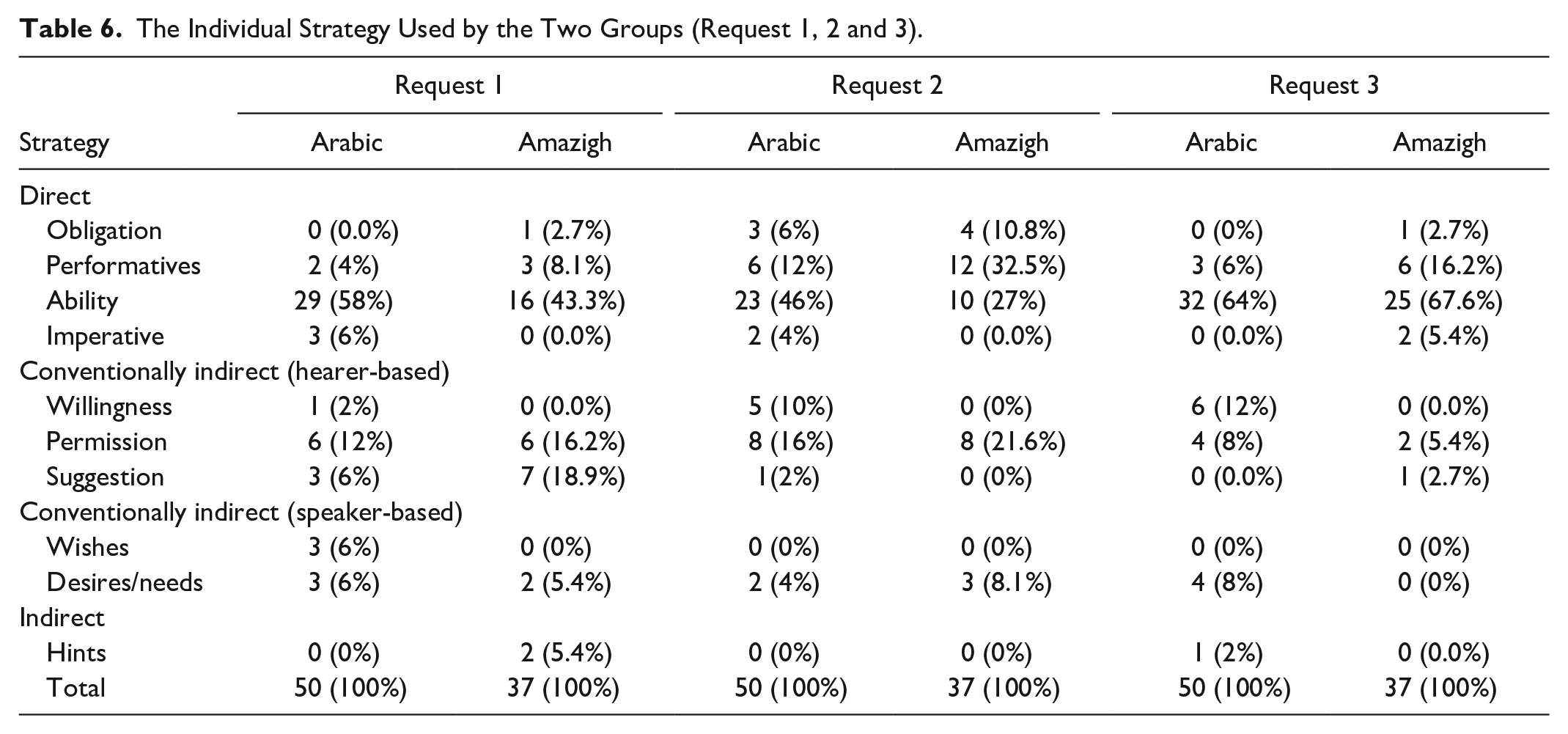
Table 6 illustrates the individual strategy used by the two groups in performing the three situations of the speech act of request. The given results of this speech act’s three situations show that AREFLUS chose mostly to use the ability strategy (Can/Could you. . .) when responding to all three questions that reflect the speech act of request. However, AMEFLUS used the same strategy to perform the first and third situations, while 27% utilised the same strategy for the second, and 32.4% used the performative strategy to perform the second situation. It is also noteworthy that AMEFLUS does not consider the willings or wishes strategy at all in performing the act of request, as the results show that 0% used it for any situation.
The Individual Strategy Used by the Two Groups (Request 1, 2 and 3).
Speech Act of Suggestion
The taxonomy of the suggestion linguistic realisation strategy by Martínez Flor’s (2005) has been used as a data coding scheme and analysis method for investigating the speech act of suggestion in the current study. The descriptive data of participants’ responses in performing the overall and individual suggestions speech act are presented in Tables 7 and 8, as shown below. The three situations that represent the suggestion speech act are: (1) Suggesting to friends to change the day of a picnic. (2) Suggesting going to the cinema to your family. (3) Suggesting a plan to a classmate after graduation from high school.
Overall Strategy Used by the Two Groups (Suggestion 1, 2 and 3).

The Individual Strategy Used by the Two Groups (Suggestion 1, 2 and 3).

The Individual Strategy Used by the Two Groups (Apology 1, 2 and 3).

The findings of the overall strategy used by AREFLUS and AMEFLUS to perform the three situations of the speech act of suggestion show that there is a difference in performing the situations concerning direct and conventional forms strategies. Both groups utilised direct strategies to perform the second (64%, 51.4%) and third (80%, 78.4%) situations. In contrast, they tended to use conventional forms for responding to the first situation (58%, 48.6%), which represents a suggestion to friends. Generally speaking, both groups utilised direct and explicit strategies the most for performing the speech act of suggestion.
Table 8 above provides data about the participants’ strategies in the two groups for performing the speech act of suggestion in the three mentioned situations. There is a difference between AREFLUS and AMEFLUS in responding to the first situation, as interrogative (How/What about. . .) was the most used type (40%), while performative (32%) was the second preferred type of strategy for AREFLUS, and vice-versa. In other words, performative (32.5%) was the preferred type for AMEFLUS in performing the same situation, while interrogative (27%) was the second most-utilised strategy. The results are similar for both groups in performing the second and third situations, which indicates that the performative strategy (I suggest/advise/recommend you. . .) was the preferred strategy in performing the situations of the suggestion act. However, there are differences regarding the second utilised type of strategies in performing the same situations.
Regarding the second situation, interrogative was the second preferred strategy for both groups (30%, 35.1%), whereas for the third situation, the second utilised type of strategy was imperative for AREFLUS and AMEFLUS (34%, 24.3%). It is also worth noting that neither of the Libyan EFL groups used (or only rarely used) the other types of strategies, such as those belonging to the indirect category. This supports Li’s (2010) findings, where EFL Cantonese students, in using their L2, employed few strategies in making suggestions.
Speech Act of apology
The following is an analysis of the apology speech act based on Olshtain and Cohen’s (1983) classification of apology strategies. The three situations of apology are: (1) Apology to a classmate for forgetting to return his/her notebook. (2) Apology to a stranger for stepping on his/her toe. (3) Apology to a friend for forgetting to call him/her back.
The results of the apology speech act are illustrated in the previous table. As can be seen, the most favoured strategy for both groups in expressing apology (consecutively) in both first and third situations was the formula of Illocutionary Force Indicating Device (sorry, excuse, forgive, etc.) + an account of explanation (IFID + EXPL). The difference was in performing the second situation, although 40.5% of AMEFLUS also used the same IFID + EXPL for responding to the second situation. AREFLUS preferred to utilise just IFIDs (46%) for performing the same situation.
In order to answer the second research question, three experienced and qualified research assistants rated all of the participants’ responses by using a five-point Likert rating scale, adopted from Alzeebaree and Yavuz (2017). The scale ranges from (entirely inappropriate) to (entirely appropriate). Tables 10 to 12 below show the mean and standard deviations of the respondents’ pragmatic performances of the speech act of request, suggestion and apology.
Appropriate Pragmatic and Linguistic Forms (Request).

Appropriate Pragmatic and Linguistic Forms (Suggestion).

Appropriate Pragmatic and Linguistic Forms (Apology).

Request
Table 10 shows the pragmatic and linguistic forms of performing the speech act of request. The results indicate that there is a difference between the mean scores of both sociopragmatic and pragmalinguistic competence. The participants show more competence in functioning the speech act of request than they do in structuring it.
Suggestion
Concerning the descriptive statistics of the respondents’ performances of the suggestion speech act, shown in Table 11 above, the results indicate a slight difference between the mean scores of both sociopragmatic and pragmalinguistic competence. It is also noticeable that the participants faced more challenges responding to the second situation than they did in the other two. Furthermore, the respondents were better able to perform the suggestion act functionally than structurally.
Apology
Table 12 displays the descriptive statistics of the speech act of apology. The findings indicate that there is a noticeable similarity between the mean scores of the function and the form of each situation of this speech act. Similar to cases of the previous speech acts of request and suggestion, the participants were able to realise the first and third situations in sociopragmatics better than pragmalinguistics, while in the second situation, the results differed, as the participants showed more competence in structuring the speech act of apology than in the functioning of it.
The tables above display the descriptive statistics related to pragmatic and linguistic forms utilised by AREFLUS and AMEFLUS in performing the speech acts of request, suggestion and apology. All of the tables’ results reflect the same finding: that both groups’ participants are more competent in functioning the three examined speech acts than structuring them.
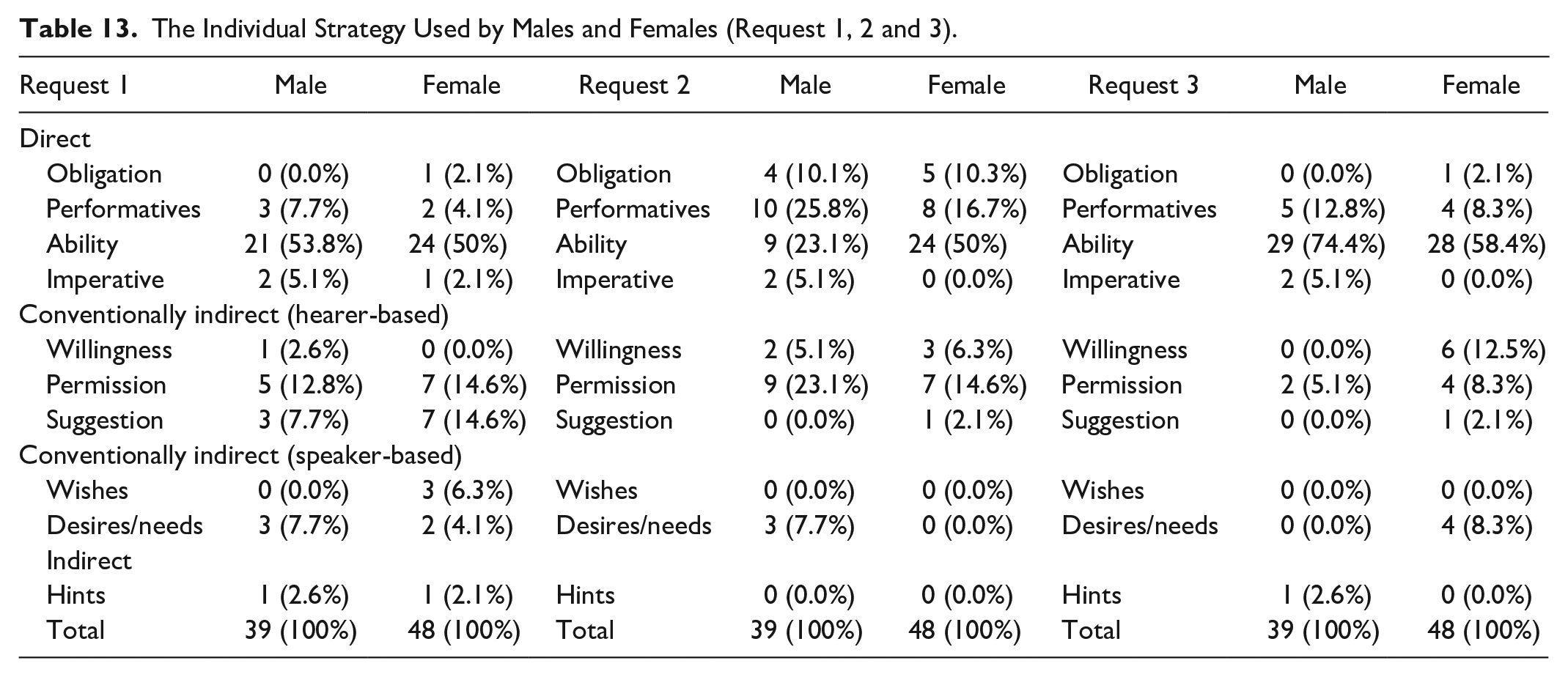
Firstly, in order to figure out the similarities and differences between the male and female participants in performing the strategy types of the speech acts of request, suggestion and apology, the frequency and percentage of the strategies utilised by LEFLUS male and female respondents in the three situations of each speech act are illustrated in the following three Tables 13 to 15
The Individual Strategy Used by Males and Females (Request 1, 2 and 3).
The Individual Strategy Used by Males and Females (Suggestıon 1, 2 and 3).

The Individual Strategy Used by Males and Females (Apology 1, 2 and 3).

Request
Although it is shown that both groups used direct strategies the most, some differences were found based on the explicitness of the request among males and females. The findings suggest that male participants used more explicit and direct requests, while female participants tended to utilise inexplicit and indirect strategies. This means that females had more polite requestive behaviour than males. However, females used the ability type of strategy (50%) more than males (23.1%) for the second situation.
Suggestion
Regarding the results of performing the suggestion speech act, it is evident that males used direct and explicit strategies the most (especially performatives). At the same time, female participants utilised interrogative forms more for the majority of the situations when performing suggestions. These findings are in line with those of Banerjee and Carrell (1988) and Pishghadam and Sharafadini (2011), whose studies indicated that gender is a significant factor in producing some strategies of suggestion. Additionally, the researchers found that males tend to use more direct strategies than females, which contrasts with the findings of Smith (2009) and Allami (2006).
Apology
Based on the results for apology, as shown in Table 18, the form of IFID and EXPL, that is, (Illocutionary Force Indicating Device [sorry, excuse, forgive, etc.] + an account of explanation) is the dominant form used by both groups, with more male than female participants utilising it. It is also noticeable that females used more strategies than males, a finding which is in line with those of Fraser (1981), Holmes (1995) and Alzeebaree and Yavuz (2017).
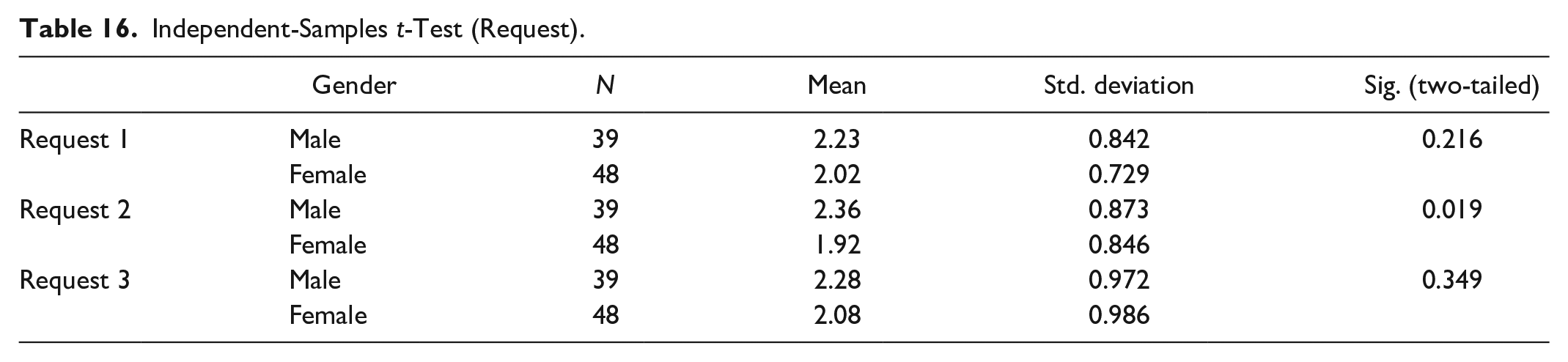
In comparing appropriate linguistic and pragmatic forms for the three studied speech acts in both male and female Libyan EFLUS, an independent-samples t-test was utilised to answer the second part of the third research question. The results are shown in Tables 16 to 18.
Independent-Samples t-Test (Request).
Independent-Samples t-Test (Suggestıon).

Independent-Samples t-Test (Apology).

Request
The findings suggested a statistically significant difference between males and females in the second situation for the request speech act. Furthermore, there was a difference between males and females for the two other request situations (first and third); however, these were not statistically significant. The findings indicated that males are more sociopragmatically and pragmalinguistically competent than females in performing and realising the speech act of request.
Suggestion
The t-test analysis (Table 17) shows statistically significant differences between male and female participants concerning the first and third situations. In contrast, the two groups were similar to each other in their request strategies for the second situation. The findings reveal that males showed more sociopragmatic and pragmalinguistic competence than females while performing and realising the speech act of suggestion.
Apology
The results presented in Table 18 reveal a statistically significant difference between males and females for the speech act of apology. The findings show that males are more sociopragmatically and pragmalinguistically competent than females in performing and realising the speech act of apology. Moreover, the second and third situations show the same result, but the differences between the two groups are not considered statically significant. The overall results suggested that Libyan male EFL students are more sociopragmatically and pragmalinguistically competent than Libyan female EFL students in performing the speech acts of request, suggestion and apology.
Conclusion
A lack of pragmatic competence of English learners in the Libyan context causes miscommunications in performing appropriate speech acts and grasping the intentional meaning of what is being said. This increases the need to conduct studies that focus on exploring the speech acts of request, suggestion and apology. The present study investigated the competence of AREFLUS and AMEFLUS in the three mentioned speech acts. The results reveal several similarities between these two groups of Libyan participants. Both AREFLUS and AMEFLUS mostly used direct and explicit forms for performing the speech acts of request and suggestion, which was in line with Alfattah and Ravindranath’s (2009) and Roever and Al-Gahtani’s (2015) findings, though contrasting with those of Alaoui (2011). Also, the current study found that male participants used more explicit and direct strategies in both the request and suggestion speech acts compared to females, which matches the findings of Smith (2009) and Allami (2006), but contrasts with the findings of Alzeebaree and Yavuz (2017).
Furthermore, regarding the speech act of apology, both groups utilised the formula of (IFID + EXPL) the most for responding to the three situations of the speech act of apology. Moreover, females used more strategies than males, and this finding is in line with those of Fraser (1981), Holmes (1995) and Alzeebaree and Yavuz (2017). The results of the present study also indicate that both AREFLUS and AMEFLUS are more competent in functioning the three mentioned speech acts than in structuring them, reflecting the findings of Muthusamy and Farashaiyan (2016) and El Hiani (2015), but overlapping with the results of Alzeebaree and Yavuz (2017). Finally, this study revealed that Libyan male EFL students have more sociopragmatic and pragmalinguistic competence in performing the speech acts of request, suggestion and apology than female participants. Overall, it is hoped that this study’s findings may guide EFL/ESL learners and teachers to consider pragmatic knowledge in language acquisition and increase the learners’ awareness of English socio-cultural norms of speech act realisations.
Footnotes
Declaration of Conflicting Interests
The author(s) declared no potential conflicts of interest with respect to the research, authorship, and/or publication of this article.
Funding
The author(s) received no financial support for the research, authorship, and/or publication of this article.
