




Abstract
A growing body of literature has investigated impoliteness in many domains. Nevertheless, little research has examined impoliteness done by foreign language learners. Impoliteness used in interlanguage complaints by English as a foreign language learners was observed. The effects of interlocutors’ different status levels and social distance on the use of impoliteness were analyzed. Empirical data were elicited by means of oral discourse completion tasks from 50 Indonesian English as a foreign language learners in Central Java, Indonesia. The overall direction of the findings showed trends that status levels and social distance between interlocutors prompted different frequencies and strategies of impoliteness. The frequent use of impolite complaints was instigated by a number of factors such as the learners’ understanding about the speech act in question, their perceptions on the social distance and status levels of interlocutors, and the nature of the research instrument.
Introduction
In the last two decades, a growing body of ILP (interlanguage pragmatics) research has investigated the abilities of L2 learners to produce various speech acts such as requests (Biyon, 2004; Félix-Brasdefer, 2007; Hassal, 2003; Schauer, 2004), apologies (Bataineh & Bataineh, 2006; Kim, 2008; Warga & Scholmberger, 2007), compliment responses (Sharifian, 2008), criticisms (Nguyen, 2008), refusals (Al-Eryani, 2007; Allami & Naeimi, 2011; Wannaruk, 2008), and complaints (Kraft & Geluykens, 2002; Tanck, 2002; Umar, 2006; Wijayanto, Laila, Prasetyarini, & Susiati, 2013). In general, the studies revealed a number of factors influencing different use of speech act strategies by L2 learners. Some of those factors include target pragmatic competence, L1 influences, collocutors’ social distance, facework strategies, and L1 cultural schemata.
Regarding interlanguage complaints, a number of studies suggest that nonnative speakers (NNSs) or L2 learners tend to use direct complaints (e.g., Kraft & Geluykens, 2002; Murphy & Neu, 1996; Pratiwi, 2013; Tanck, 2002; Umar, 2006). Nevertheless, although studies have revealed the use of inappropriate complaints by L2 learners, little research has examined impoliteness in interlanguage complaints. An investigation of this area is essential for avoiding communication breakdowns. The purpose of the present study is to examine the use of impoliteness in interlanguage complaints by English as a foreign language (EFL) learners. The investigation focuses on the influence of EFL learners’ awareness of different familiarities and social status levels of interlocutors on the applications of impoliteness in the complaints.
Speech Act of Complaint
A complaint generally refers to an expression of displeasure toward an event or situation that offends the complainer (Olshtain & Weinbach, 1993; Traverso, 2009; Trosborg, 1995). It is a part of conversation sequences in which a complainer directly or indirectly points out problems, makes criticisms, requests for repairs, and gives moral judgments relating to perceived offenses (DeCapua, 1989). The complainer may also make negative assessments to undertakings that have caused dissatisfaction, displeasure, unhappiness, and anger to him or her (Edwards, 2005; Laforest, 2002; Traverso, 2009). Thus, complaints could threaten the hearers’ positive face as they perform negative evaluations toward the hearers’ actions (Monzoni, 2008; North, 2000) or they jeopardize their negative face as they may force the complainees to redress the unpleasant situations (Kraft & Geluykens, 2002). Consequently, complaints could induce confrontations between interlocutors and incautiously impair social relationships (Moon, 2001).
To anticipate undesirable social consequences related to complainees, complainers should calibrate the directness levels of their complaints. According to Trosborg (1995), indirect complaints can be achieved through the following conditions: (a) their propositional contents should not be expressed directly, (b) the agents of the complaints should be implied, and (c) the negative evaluations of the propositional contents, the complainee’s behavior, and the complainee as a person should be implied. By contrast, direct complaints can be expressed with the following conditions: (a) their propositional contents have to be articulated explicitly, (b) the agents of the complaints have to be clearly specified, and (c) the negative evaluations of the propositional contents, the complainee’s behavior, and the complainee as a person have to be explicitly stated.
The speech act of complaint has attracted research attention. A growing body of cross-cultural research has revealed that speakers from different cultural backgrounds have different perception of what constitutes appropriate complaints (e.g., Henry & Ho, 2010; Mulamba, 2009; Murphy & Neu, 1996; Olshtain & Weinbach, 1993; Tatsuki, 2000). Other studies reported that social variables such as social distance and status levels or power of interlocutors influence the use of appropriate or polite complaints (Chen, Chen, & Chang, 2011; Wijayanto et al., 2013; Zhoumin, 2011).
Nevertheless, even though speakers can express their complaints indirectly, NNSs or L2 learners tend to produce direct complaints. Two main reasons may explain their direct complaints. The first reason is that they underuse mitigation strategies. For example, NNSs from different first language backgrounds (Chinese, Haitian Creole, Korean, Polish, Russian, Serbian, Spanish, and Thai) rarely produce components of excusing oneself when opening complaints and they frequently use confrontational questions (Tanck, 2002). Danish learners of English sound direct as they rarely use complaint modifications (Trosborg, 1995). Javanese learners of English frequently use rhetorical questions without incorporating hedges to mitigate them (Wijayanto, Prasetyarini, & Hikmat, 2014). Similarly, Indonesian learners of English rarely mitigate their complaints, particularly when they use rhetorical questions and imperative sentences to express accusations, blames, reproaches, and annoyance (Pratiwi, 2013). Japanese learners of English rarely employ softeners to mitigate their complaints (Rinnert & Iwai, 2002). The other reason is that L2 learners have a low level of pragmatic competence. For example, many Korean learners of English often produce aggressive complaints as they are incapable of selecting appropriate pragmalinguistic forms (Murphy & Neu, 1996). Similarly, a number of Sudanese learners of English produce confrontational and rude complaints as they are incapable of choosing appropriate complaint strategies (Umar, 2006). In Tatsuki’s (2000) study, a number of Japanese ESL (English as a second language) learners produce severe complaints as they are unable to use downgraders to mitigate their complaints.
Although a growing body of literature has reported that NNSs or L2 learners have a tendency to use direct complaints, studies that have systematically investigated impoliteness in complaints produced by NNSs or L2 learners are limited. Against this backdrop, the present study investigates impoliteness in complaints used by EFL learners. This brings us to the issues of impoliteness discussed in the following section.
Impoliteness
Impoliteness is considered as an act intentionally planned to attack others’ face (Archer, 2008; Bousfield, 2008; Limberg, 2009). Culpeper, Bousfield, and Wichmann (2003) stated that when speakers do impolite acts, they not only intend not to maintain the hearers’ face but they also intentionally select offensive language to attack their face. Furthermore, Bousfield (2007b) emphasized that
impoliteness constitutes the issuing of intentionally gratuitous and conflictive verbal face-threatening acts (FTAs) which are purposely performed: i. unmitigated, in contexts where mitigation is required, and/or, ii. with deliberate aggression, that is, with the face threat exacerbated, ‘boosted’, or maximised in some way to heighten the face damage inflicted. (p. 7)
While the previous scholars suggest that speakers’ intentionality is central in impoliteness, others view that both speakers’ intentionality and listeners’ reception are essential. For example, Tracy and Tracy (1998) averred that impoliteness refers to “communicative acts perceived by members of a social community (and often intended by speakers) to be purposefully offensive” (p. 227). In the same vein, Culpeper (2005) affirmed that impoliteness comes about when speakers deliberately communicate face attack, and/or hearers observe the behavior as intentionally face-attacking.
Literature suggests that impoliteness tends to occur in situations in which collocutors have conflicts of interest (Bousfield, 2007a; Culpeper, 2005; Kienpointner, 2008; Kryk-Kastovsky, 2006) or they have very close relationships (Culpeper, 1996). In addition, impoliteness has a close connection with social power. Speakers can manipulate it to get power over actions of other interlocutors (Locher, 2004; Locher & Watts, 2008). Although social power is highly dynamic and it is subject to negotiation (Locher & Bousfield, 2008), studies have indicated that those with more power, particularly legitimate and/or expert power, tend to use impoliteness (Culpeper, 1996; Kantara, 2010).
The last two decades have witnessed a growing body of literature dealing with impoliteness. Studies in this area are generally supported by theoretical frameworks built on classical theories of politeness, such as “verbal aggressions” proposed by Lachenicht (1980) and “face attacks” by Culpeper (1996). Both theoretical frameworks are modeled on the seminal work of Brown and Levinson’s (1978) politeness in which the concept of face is dominant. Brown and Levinson classify two types of face: Negative face—the need to be independent and free from the imposition of others—and positive face—the desires to be accepted, ratified, admired, and appreciated by others. Drawing on these concepts, Lachenicht’s verbal aggressions refer to acts intentionally used to damage others’ positive face (positive aggravations) or negative face (negative aggravations). Similarly, Culpeper’s (1996) face attacks refer to communicative strategies to attack both positive and negative face or more generally to create social disharmony. Culpeper proposed a classification of impoliteness as a reversal system of Brown and Levinson’s politeness. The system comprises five super strategies. Bald on-record impoliteness: the use of language in a direct way in situations in which speakers do not intend to maintain others’ face. Positive impoliteness: the use of particular acts to attack others’ positive face. Negative impoliteness: the use of acts to attack others’ negative face. Mock politeness: the use of insincere politeness. Withholding politeness, that is, the absence of politeness where it is expected. Culpeper’s taxonomy has been applied by researchers to study impoliteness in many domains.
Culpeper (1996) applied the taxonomy to analyze impoliteness in army recruit training discourse. Culpeper found a number of impolite acts deployed by noncommissioned officers toward a woman recruit. For example, they underestimated the property of the recruit’s competence, personal value, and mental stability, and they insulted the recruit’s social roles as an American citizen, a soldier, and a mother. In general, the findings supported the taxonomy. In a follow-up study, Culpeper et al. (2003) revealed that both linguistic and prosodic aspects (e.g., intonation and loudness) can generate impolite behaviors. Culpeper (2005) found a number of wh-questions and yes–no questions that can convey impoliteness through implicatures. Based on the findings, Culpeper added off-record impoliteness to his previous taxonomy.
Other studies reported different conversation strategies that can express impoliteness. A study by Bousfield (2007b) correlated organization and conductivity of conversations with impoliteness. The study found a number of communication strategies that can deliberately trap target persons into impolite situations. For example, rhetorical challenges or unpalatable questions can force listeners to listen to speakers’ vented emotions and put them in the position of getting verbal attacks. In addition, response-seeking challenges can function as verbal traps by which speakers provoke further impoliteness.
A study by Kienpointner (2008) reported that impoliteness can be achieved through destructive emotional arguments. For instance, ad hominem argument techniques combined with scorn or ridicule, and sarcastic mock politeness can attack others’ face. Ad misericordiam arguments, which appeal to pity, can turn into destructive emotional arguments when speakers formulate them forcefully. In this case, the appeals to pity block further discussion and they indirectly attack the negative face of the addressees.
Unlike previous studies, which highlight the importance of speakers’ intentionality and/or listeners’ reception, other literature tends to view impoliteness as negative assessments of behavior or conduct that does not comply with existing social norms. Locher (2006) affirmed that “what is perceived to be (im)polite will thus ultimately rely on interactants’ assessments of social norms of appropriateness that have been previously acquired in the speech events in question” (p. 250-251). In the same vein, Locher and Watts (2008) underscored that it is through the judgments of other participants that speech acts can be considered as polite or impolite and they are dynamically negotiated by a variety of contextual factors. Hence, impoliteness is discursive. Haugh’s (2010) work provided a good example of discursive impoliteness in interpersonal communication. Haugh investigated impolite emails sent by a lecturer to a student at the University of Auckland and he analyzed the interpretations of the emails by the lecturer and student as well as commentators in online discussion boards. Haugh revealed the variability in the perceptions underlying evaluations of the lecturer’s impolite emails. Through such an approach, however, it would be challenging to define impoliteness in communications as it can be relative and subjective. Culpeper (2010) criticized the approach: “it is difficult to see how communication could process without some shared conventions of meaning. . . . (1) that meanings are very unstable, negotiable, and fuzzy, and (2) that communication is a very uncertain business” (p. 3236).
The work on impoliteness thus far has been devoted to theorizing and observing impoliteness in a number of domains such as in army recruit training (Culpeper, 1996), in courtroom interactions (Kryk-Kastovsky, 2006), in disputes between traffic wardens and owners of illegally parked cars (Bousfield, 2007a; Culpeper et al., 2003), in TV shows (Culpeper, 2005), in political speech conflicts (Kienpointner, 2008), and in email exchanges (Haugh, 2010) among others. Nevertheless, despite the growing body of literature on impoliteness, little attention has been given to impoliteness employed by L2 or foreign language learners. Even though studies have explored this area, they are confined to examine the perception of impoliteness (e.g., Culpeper, 2010; Tajeddin, Alemi, & Razzaghi, 2014). The present study investigates the effects of different status levels and social distance between interlocutors on the applications of impoliteness in EFL complaints by Indonesian learners of English in Central Java, Indonesia.
Method
Research Participants
The participants of the study were chosen randomly from Indonesian learners of English at the English education department of a private university in Central Java, Indonesia. The EFL learners comprised males (n = 25) and females (n = 25) who were at the third-year course of the degree of English education. The ages of the learners ranged from 21to 24 years old, with the average age of 22.5 years. The English proficiency of the research participants was at the lower advanced level and they used English as a medium of communication predominantly in the lecture rooms. Prior to participating in the study, they reported that they had not previously made complaints in English in real-life situations.
Research Instrument
Written discourse completion tasks (WDCTs) are considered as effective instruments in ILP research as they allow researchers to elicit data with different social aspects of communication (Kwon, 2004) and to get large data in very short time (Doğançay-Aktuna & Kamışlı, 1997). Nevertheless, the validity of data obtained through WDCTs is generally questioned. For example, data elicited from WDCTs is deficient in spontaneous face-to-face interactions and research participants answer WDCT scenarios based on what they believe to be the appropriate responses. Although data taken from authentic conversations obviously represent real language use, they have some drawbacks too. For example, they provide unreliable speech samples of an identifiable group of speakers (Beebe & Cummings, 1996). The social attributes of collocutors such as age, ethnic backgrounds, and social statuses are rather hard to control (Nurani, 2009). In fact, gathering natural data is time-consuming (Cohen, 1996; Gass & Houck, 1999).
To enable the research participants to produce spontaneous oral responses, the present study developed oral DCTs (ODCTs). Nevertheless, like written DCTs, the ODCTs did not allow them to do face-to-face interactions. Considering the drawback, the present study focused more on the options of impoliteness strategies rather than on their interactional features.
The ODCTs of the present study consisted of nine scenarios of interpersonal communication in Indonesian contexts. The ODCT scenarios provided the research participants with specific social situations, settings, familiarities between interlocutors, and their social status levels. Based on the scenario descriptions, they responded to each ODCT orally. The speaker in each scenario represented one who had a particular social status level constituting a difference either in seniority or in occupation (lower, equal, higher) and social distance or familiarity (close, familiar, unfamiliar). The differences in status level between the speakers (complainers) and the hearers (complainees) constituted vertical distance reflecting the power of one over the others. The familiarities between them represented the degree of their social distance. The ODCTs had two levels of imposition (high or low). The study adapted four ODCT scenarios (i.e., Situation 2, 4, 5, and 9) from Wijayanto et al. (2013). The scenarios were summarized in Table 1 and their full version was presented in the appendix.
The Summary of the ODCT Scenarios.

Note. ODCT = oral discourse completion task.
The research participants received some explanations about the scenarios, their roles in the scenarios, and the techniques of answering the ODCTs. They read each ODCT scenario in detail, and they were encouraged to ask questions when they had some problems of understanding the scenarios. Upon answering the ODCTs, they had to imagine that they were in the situations as described in the scenarios and they had to respond as spontaneously as they would do in real-life situations. Although they were responding to the ODCTs orally, the researchers recorded them digitally. Then their complaints were transcribed.
Data Analysis
The present study discussed impoliteness included in complaints by Indonesian EFL learners. Considering the characteristics of the data (elicited data), the study adopted Culpeper’s (1996) taxonomy to analyze the impoliteness. The strategies include bald on-record impoliteness, positive and negative impoliteness, mock politeness, and withholding politeness. Bald on-record impoliteness is the use of language in a direct, clear, and concise way in circumstances where a speaker does not intend to maintain others’ face. Expressing impolite beliefs or assertions is its commonest strategy. Positive impoliteness refers to acts intentionally deployed to attack others’ positive face. According to Culpeper (1996), the following are the prevalent strategies.
Ignore other interlocutors; fail to acknowledge the presence of others.
Exclude others from activities.
Disassociate from others, such as denying association or common ground with them.
Disinterested, unconcerned, and unsympathetic to others.
Use inappropriate identity markers such as using a title and surname when a close relationship pertains, or a nickname when a distance relationship pertains.
Use an obscure or secretive language such as mystifying others with jargon or using a code known to members in the group, but not the target.
Make others feel uncomfortable.
Use taboo words, swear words, or abusive profane language.
Call the other names: Use derogatory nominations.
Negative impoliteness relates to acts which are intentionally used to attack others’ negative face. The following are Culpeper’s (1996) output strategies.
Frighten, instill a belief that an action detrimental to others will occur.
Scorn, ridicule by emphasizing the speaker’s relative power.
Contemptuous, not treating others seriously.
Belittle others (e.g., using diminutives).
Invade others’ space—literally or metaphorically.
Explicitly associate others with a negative aspect.
Put others’ indebtedness on record.
Mock politeness is insincere politeness. To achieve impoliteness through this strategy, speakers use sarcasm or ironies. Finally, withholding politeness, that is, the absence of politeness where it is expected.
The frequencies of occurrence of impoliteness strategies were counted as follows. When more than one of the strategies (e.g., bald on-record, negative, and positive impoliteness) were employed in the same episode, all of them were counted. It was also true when there was more than one occurrence of the same strategy (e.g., negative impoliteness), all of them were counted. To assess the differences in the frequency of impoliteness across collocutors’ social status levels and familiarities, the study applied Pearson’s chi-square test with a .05 level of significance.
Results
The study obtained 450 strategies of interlanguage complaints from the Indonesian EFL learners. Out of the total number of the complaints, there were 211 (47%) strategies that did not contain impoliteness as proposed by Culpeper (1996) and there were 239 (53%) complaints that included impoliteness. The following sections discuss the use of the impoliteness in relation to social status levels and interpersonal closeness between interlocutors.
Impoliteness in Complaints Across Status Levels
The following section analyzes impoliteness used by the EFL learners (complainers) across three different status levels (equal, lower, and higher). The analysis focuses on the influences of different status levels on the frequencies and types of impoliteness. The section begins with the analysis of impoliteness expressed by complainers who are close to complainees. It is then followed by the analysis of impoliteness used by complainers who are familiar to complainees. Finally, the section analyzes impoliteness employed by complainers who are unfamiliar to complainees. It should be noted that the grammar errors existing in the data are not discussed and they are presented as they are.
Impoliteness by close complainers (Situations 1, 2, and 3)
The differences in the status levels induced the complainers to employ certain impoliteness strategies more often than other strategies, χ2(4, N = 166) = 38.033, p < .05 (Table 2). For example, complainers with an equal status level employed bald on-record and positive impoliteness considerably more often than negative impoliteness. By contrast, complainers with a lower status level used positive impoliteness more often than negative impoliteness, and they used bald on-record impoliteness the least often. Higher status complainers used negative impoliteness more frequently than positive impoliteness, and they used bald on-record impoliteness the least.
The Frequencies of Impoliteness by Close Complainers.

The following are some examples of impoliteness strategies used in the responses to Situation 1 (a close friend broke your laptop), Situation 2 (your younger brother returns your motorcycle late), and Situation 3 (your lecturer has been lazy to give feedback to your thesis draft). Each example may contain more than one strategy, but we only boldfaced the one in focus. The type of impoliteness in the following cases is bald on-record in which the complainers assert impolite beliefs straightforwardly. The complainer in (1) or (2) asserts that the complainee is intellectually deficit. In (3), the complainer asserts that the complainee is an inconsiderate person.
(1) Err (.)
(2) Oh
(3) . . . this is three weeks ago I submit my thesis,
Some other examples indicated that the complainers employed positive impoliteness strategies such as calling the other names and using taboo words. To perform the former, they used derogatory address terms such as “a greedy bastard” (4), and “a devil of the house” and “a fucking shit” (5).
(4) Ah, you are a
(5) You are late! I can’t go to the campus! Fuck you! You are err (.)
To perform the latter, they predominantly used swear words such as “fuck” (6), “shit” (7), and “fuck you” (8).
(6)
(7) Ah,
(8)
Raising unpalatable questions and frightening were the most prevalent negative impoliteness strategies. Unpalatable questions were not literally employed to elicit information but rather to attack the complainees (e.g., 9 and 10). They used verbal threats to perform the strategy of frightening (e.g., 11).
(9) Oh,
(10) What the hell,
(11) Ah you are fucking brother you know that I have a test at 2 o’clock
Impoliteness by familiar complainers (Situations 4, 5, and 6)
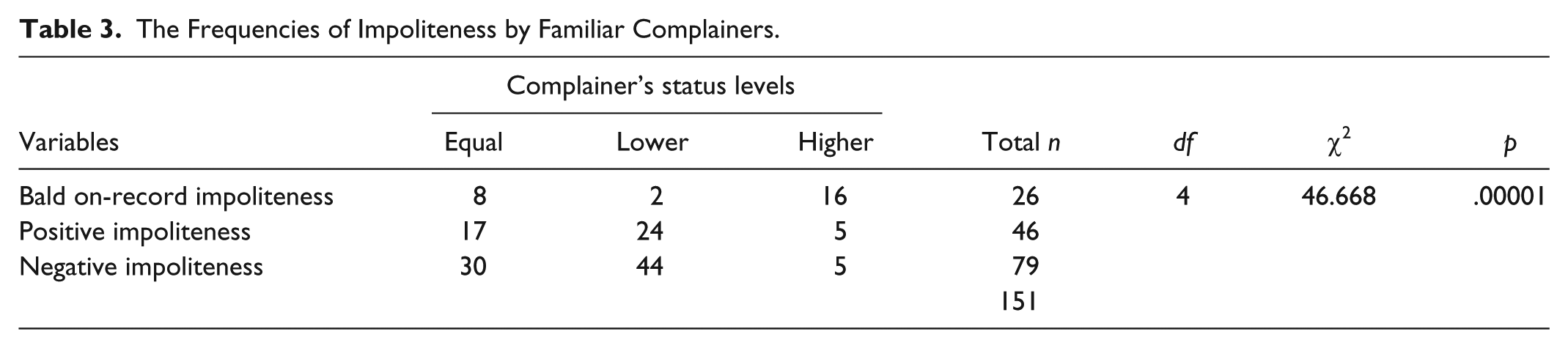
The differences in the status levels tended to influence the complainers to use certain impoliteness strategies more often than other strategies, χ2(4, N = 151) = 46.668, p < .05 (Table 3). For example, complainers with a lower or equal status level used negative impoliteness significantly more frequently than positive impoliteness, and they used bald on-record impoliteness the least often. By contrast, higher status complainers applied bald on-record impoliteness notably more regularly than positive or negative impoliteness.
The Frequencies of Impoliteness by Familiar Complainers.
The following are some examples of impoliteness strategies in the responses to Situation 4 (your next-door neighbor turns on rock music too loud), Situation 5 (your employee has not finished the report as you ordered), and Situation 6 (your lecturer gave you a bad mark). Each example may contain more than one strategy; the one in focus was boldfaced. The examples below indicated that complainers employed bald on-record impoliteness through two strategies. First, they asserted their impolite beliefs explicitly, for instance,
(12) I hate buddy, so damn.
(13) Come on!
Second, they criticized complainees implicitly, for example,
(14)
(15)
(16)
In (12), the complainer asserts that the complainee is an annoying person, whereas in (13) the complainer states that the complainee has a low intellectual capacity. The complainer in (14) asserts a similar proposition to the one in (13) but with a different strategy. The unpalatable question in (15) implies that the complainee is not professional, and the question in (16) suggests that the complainee is not a good lecturer.
Using taboo words and calling the other names were the most prevalent strategies of positive impoliteness. As for the former, they recurrently used swear words, for example,
(17)
(18)
They also used the swear words as intensifiers. For example, the complainer in (19) employs a taboo intensifier “the fuck” when making a direct request.
(19) Hey man!
When the complainers used the strategy of calling the other names, they used derogatory address terms, for instance “a fucking asshole” (20).
(20) Hey
Regarding negative impoliteness strategies, raising unpalatable questions and frightening were used the most often. Unpalatable questions basically attacked the complainees rather than asked them for information (e.g., 21 and 22). The strategy of frightening was usually used with the forms of verbal threats (e.g., 23 and 24).
(21)
(22)
(23) You don’t finish your job?
(24) If you don’t submit your job on time err (.) you will err (.)
Impoliteness by unfamiliar complainers (Situations 7, 8, and 9)
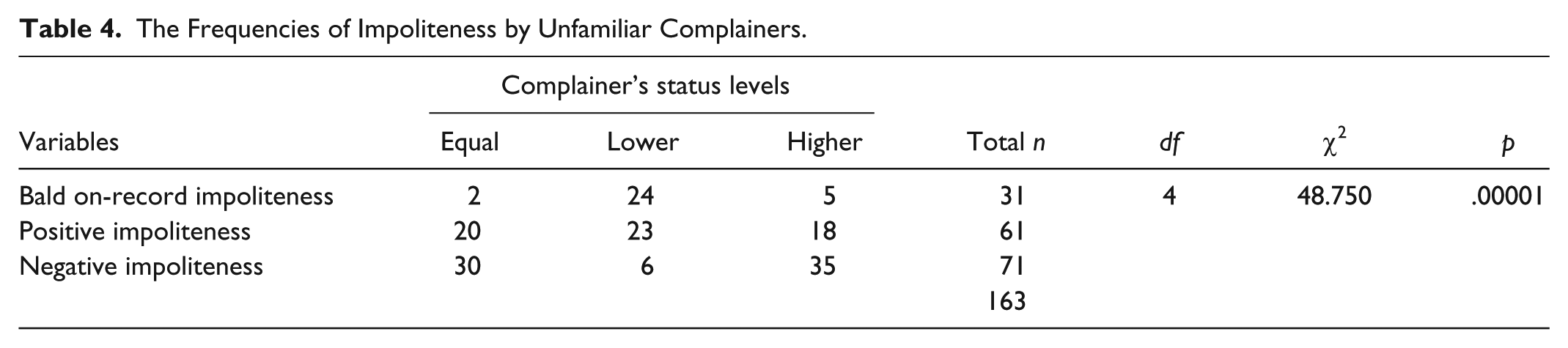
The differences in the status levels tended to induce the complainers to use certain impoliteness strategies more often than other strategies, χ2(4, N = 163) = 48.750, p < .05 (Table 4). For example, lower status complainers used bald on-record and positive impoliteness significantly more often than negative impoliteness. By contrast higher and equal status complainers employed negative impoliteness more often than positive impoliteness, and they used bald on-record impoliteness the least often.
The Frequencies of Impoliteness by Unfamiliar Complainers.
The following are some examples of impoliteness strategies in the responses to Situation 7 (a car hits your motorcycle from the back), Situation 8 (a recycler scatters rubbish in front of your house), and Situation 9 (administrative staffs ignore your presence). Each example may contain more than one strategy, but we only boldfaced the one in focus.
Asserting impolite beliefs about the complainees was the most common strategy of bald on-record impoliteness, for example,
(25) Hey you are so damn! What did you do with my motorcycle?
(26)
Using taboo words and calling the other names were the most prevalent positive impoliteness strategies. Swear words were recurrently used to express the former, for example,
(27)
(28) Oh . . .
Meanwhile, derogatory address terms were frequently used to express the latter, such as “asshole” and “prick” (29), “a fucking useless man” (30), and “a half man” (a man with a feminine or womanly behavior) (31).
(29) Hey
(30) Hey you,
(31) Damn! You are
As for negative impoliteness, they employed two strategies: asking rhetorical questions (e.g., 32 and 33) and frightening (e.g., 34).
(32)
(33)
(34) Hey bro, damn you!
Impoliteness in Complaints Across Different Social Distance
The following section analyzes the effects of interpersonal closeness or familiarity (close, familiar, and unfamiliar) between complainers and complainees on the frequencies and types of impoliteness. The section begins with the analysis of impoliteness conveyed by equal status complainers with three levels of familiarity to complainees. It is then followed by the analysis of impoliteness used by lower status complainers with three levels of familiarity to complainees. Finally, it discusses impoliteness phrased by higher status complainers with three levels of familiarity to complainees.
Impoliteness by equal status complainers (Situations 1, 4, and 7)
The differences in the familiarity between interlocutors induced the complainers to use certain impoliteness strategies more often than other strategies, χ2(4, N = 164) = 34.946, p < .05 (Table 5). For example, when they had a close relationship with the complainees they used bald on-record and positive impoliteness more often than negative impoliteness. By contrast, when they were familiar or unfamiliar to the complainees, they used negative impoliteness more often than positive impoliteness, and they used bald on-record impoliteness notably the least often.
The Frequencies of Impoliteness by Equal Status Complainers.

Asserting impolite beliefs was the most prevalent strategy of bald on-record impoliteness (e.g., 35). Unpalatable questions (e.g., 36) and swear words (e.g., 37) were the most common strategies of negative and positive impoliteness consecutively.
(35) Oh damn! What did you do with my motorcycle?
(36) Oh friend,
(37) What the fuck you are! (Situation 4).
Impoliteness by lower status complainers (Situations 3, 6, and 9)
The differences in the familiarity between interlocutors induced the complainers to use certain impoliteness strategies more often than other strategies, χ2(4, N = 189) = 55.007, p < .05 (Table 6). For example, when they were close to the complainees, they used positive impoliteness more often than negative impoliteness, and they employed bald on-record impoliteness the least often. By contrast, when they were familiar to the complainees, they used negative impoliteness more frequently than positive impoliteness, and they used bald on-record impoliteness very rarely. When they were unfamiliar to the complainees they used positive and bald on-record impoliteness more often than negative impoliteness.
The Frequencies of Impoliteness by Lower Status Complainers.

The complainers generally used the same strategies of bald on-record impoliteness (i.e., asserting impolite beliefs) and negative impoliteness (i.e., using unpalatable questions) across the three levels of familiarity. However, unlike the other two groups, the complainers who were unfamiliar to the complainees used the strategy of frightening. For instance, in (38), the complainer will report the complainee to the dean of the school. In addition, they used the strategy of ridiculing. For example, in (39) the complainer ridicules the complainee by stating that he is only interested in giving academic services to female students.
(38) So please man, I know that you are busy, but I know that this is not time to take a rest but this is time to serve, so please!
(39) Oh
Regarding positive impoliteness, the three groups of complainers used swear words frequently.
Impoliteness by higher status complainers (Situations 2, 5, and 8)
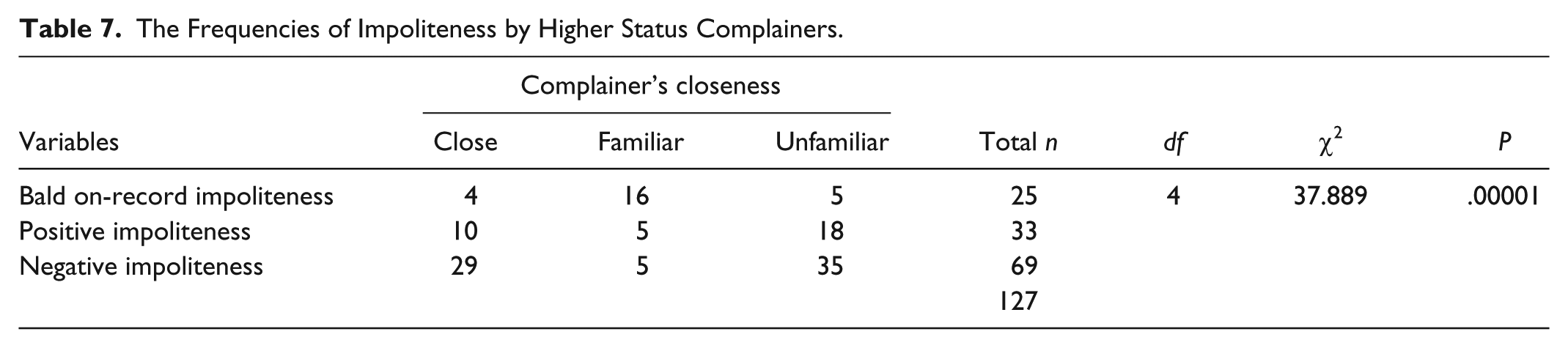
The differences in the familiarity between interlocutors induced the complainers to use certain impoliteness strategies more often than other strategies, χ2(4, N = 127) = 37.889, p < .05 (Table 7). For example, when they were close and unfamiliar to the complainees, they used negative impoliteness more often than positive impoliteness, and they employed bald on-record impoliteness the least often. By contrast when they were familiar to the complainees, they used bald on-record impoliteness notably more frequently than either positive or negative impoliteness.
The Frequencies of Impoliteness by Higher Status Complainers.
In general, the three groups of complainers employed similar strategies of bald on-record (e.g., asserting impolite beliefs), negative impoliteness (e.g., raising unpalatable questions, ridiculing, and frightening), and positive impoliteness (e.g., deploying swear words).
Discussion
The objectives of the present study were to examine impoliteness employed by EFL learners and to observe if their awareness of different status levels and social distance induce different applications of impoliteness. The data of the research were elicited through ODCTs from Indonesian (Javanese) EFL learners. The study adopted Culpeper’s (1996) taxonomy to analyze the impoliteness. Pearson’s chi-square test was applied to determine the differences in the frequency of impoliteness across social distance and status levels.
The results of the chi-square test showed trends that social distance and status levels prompted different complaining behaviors of the EFL learners (the complainers) in the present study. Indonesian cultural dimension may play a part in bringing about the results. Indonesians particularly Javanese people are generally status conscious (Koentjaraningrat, 1985; Magnis-Suseno, 1997); thus, this cultural dimension might have informed the EFL learners’ complaining behavior across the different status levels. In addition, there is evidence from ILP research that both social variables exert a strong influence on the use of speech acts by Indonesians (Hartuti, 2014; Purnomo, 2015; Wijayanto, 2012). Regarding the effects of social distance on the use of impoliteness, the EFL learners tended to show similarities in the use of impoliteness toward close and unfamiliar complainees. The finding seems to support Wolfson’s (1986) Bulge theory: People at the extreme ends of social spectrum tend to have similar speech behaviors as they understand exactly their social position and the expectation of one another.
The present finding agrees with that of the earlier studies (e.g., Pratiwi, 2013; Wijayanto et al., 2013). However, in Pratiwi’s (2013) and Wijayanto et al.’s (2013) research, both social variables prompt EFL learners to use different politeness strategies, whereas in the present study, they induced the research participants to use different impoliteness strategies. This slight discrepancy is obviously due to the different objectives of the studies; the earlier studies observe politeness, whereas the current study examines impoliteness. Despite the differences, it can nevertheless be argued that both social variables generate different complaining behaviors. Other previous studies (e.g., Culpeper, 1996; Kantara, 2010) have found that imbalance social power induces interlocutors to use impoliteness. They reported that interlocutors with more social power tend to exercise impoliteness. The present finding confirms and extends the earlier finding (Culpeper, 1996; Kantara, 2010). It shows that in addition to social power, social distance can induce different strategies of impoliteness.
The review of the literature indicated that L2 learners tend to use direct complaints (e.g., Murphy & Neu, 1996; Tanck, 2002; Trenchs, 1995; Trosborg, 1995; Umar, 2006). The present finding is consistent with the studies. Nevertheless, unlike the second language (SL) or EFL learners in those studies, the EFL learners in the present study recurrently employed swear words, derogatory address terms, harsh criticisms, and verbal threats that could convey impoliteness, at least according to Culpeper’s (1996) model. The following sections discuss the EFL learners’ use of impoliteness in relation to social distance and status levels of interlocutors.
The Use of Swear Words
Culpeper (1996) claimed that swear words or profanity can attack others’ positive face. This could be because they are developed on the basis of taboo categories, which are sanctioned and restricted on both institutional and individual levels (Andersson & Trudgill, 2007). When spoken, they insult, threaten the face, and injure the persons being the target (Jay, 2000).
A number of examples indicated that many EFL learners recurrently applied swear words that express propositional swearing. This confirms Jay and Janschewitz’s (2008) claim that such swearing is consciously planned. In other words, the speakers control the contents and meanings of the swearing. For example, the word bastard, shit, and fuck are semantically neutral. However, when they were used in the complaints above, they became very offensive as they intentionally expressed the complainers’ negatively charged attitudes toward the complainees.
Previous studies (e.g., Baba, 2010; Trenchs, 1995) reported that L2 learners do not usually use swear words when making complaints. The L2 learners in Baba’s study stated that they did not feel comfortable using curse words, whereas the learners in Trenchs’s study stated that they had never learned them in class. Surprisingly, in contrast to the earlier finding (Trenchs, 1995), the EFL learners in the present study frequently employed various swear words even though they had never learned them in class. They might have learned the bad words from other resources such as films, novels, books, and online media.
It is interesting to note that the differences in the status levels between interlocutors influenced the applications of swear words. For example, when responding to Situations 3 and 6 that involved higher status complainees (lecturers), they hardly employed swear words. The possible explanation for the finding maybe that in Indonesian social contexts particularly, and in other cultures, swearing students are generally judged as shocking and very impolite. It is intolerable for students to swear to their teachers or lecturers. The EFL learners understood this knowledge very well. By contrast, they used swear words very frequently when they complained to equal status complainees (ODCTs 1, 4, and 7). This confirms Culpeper’s (1996) claim that impolite behavior in equal relationships tends to escalate as such relationships lack a default mechanism by which interlocutors achieve their dominance. Interestingly, they did similarly when they responded to Situations 2, 5, and 8 that involved lower status complainees. This supports Locher and Bousfield’s (2008) claim that impoliteness can be used to influence others. In this case, collocutors with more social power would often do impolite acts.
Furthermore, the results indicated that different social distance prompted different use of swear words. A number of excerpts showed that complainers addressed swear words to complainees across the three degrees of social distance, except for those in Situations 3 and 6. Nevertheless, when they were close and unfamiliar to complainees they used the swear words more frequently. This confirms Culpeper’s (1996) claim that people in a close relationship tend to speak their mind more directly and so impoliteness usually occurs in such a relationship. In the situations in which they complained to the unfamiliar complainees, they might not have felt the necessity to maintain the complainees’ face as they did not know them well personally.
The Use of Insults
Supporting Culpeper’s (2010) work, the present study found a number of insults expressed through personalized negative vocatives and personalized negative assertions. When using the former, the EFL learners (the complainers) identified the complainees as having defective characteristics or qualities. By contrast, when using the latter, they asserted or declared that the complainees had defective or negative performance, abilities, behaviors or traits with the intentions of disrespecting or humiliating them. For example, they used the strategy of calling the other names such as in (4), (5), (20), (29), (30), and (31). Congruent with the finding of Culpeper’s (1996) study, insults with personalized negative vocatives used by the EFL learners expressed bald on-record impoliteness.
Regarding the influence of the social variables (social distance and status levels) on the use of insults, a number of examples indicated that equal and higher status complainers tended to use insults to attack complainees. In other words, those with less power did not usually employ insults. The EFL learners’ hierarchy conscious, as discussed earlier, might have informed the use of the insults based on differences in status levels.
The Use of Criticisms
A number of examples showed that the EFL learners used direct criticisms. They directed the criticisms to complainees across the three status levels and familiarities very frequently. The finding confirms the earlier studies (e.g., Deveci, 2010; Murphy & Neu, 1996) that reported that criticisms are common complaint strategies used by L2 learners.
It is interesting to note that some EFL learners might have experienced strong tension between, on one hand, expressing clear or explicit complaints, and, on the other hand, avoiding attacking the complainees’ face. Thus, they chose indirect criticisms as a compromise. For example, they expressed the criticisms through rhetorical questions. However, they might not have realized that the questions could induce impoliteness. For example, the rhetorical question in (16) Are you really a good lecturer? implies that the complainee does not have any good quality of a lecturer. Likewise, the question in (15) Can you be professional? implies that the complainee is not qualified or ignorant. The finding is consistent with that of the earlier studies (e.g., Bousfield, 2007b; Wijayanto et al., 2013) which have revealed that rhetorical or unpalatable questions can compel listeners to get verbal attacks. Regarding the use of indirectness, the finding seems to contest Brown and Levinson’s (1987) claim on the close connection between conventional indirectness and politeness. Indeed, the finding confirms Nguyen and Ho’s (2013) claim that indirectness does not always perform politeness.
The Use of Threats
A number of examples indicated that complainers used verbal threats with the intention of imposing injury on others. Some “if-then” threats such as (23), (24), and (34) above obviously reveal the complainers’ intention while they convey the possible punishment to impose on the complainees. The threat in (23) sounds much stronger as it employs a directive utterance in the “If you do/don’t do X” clause. The finding is consistent with that of the earlier studies (e.g., Limberg, 2009; Thanh-Hà Do, 2013; Trenchs, 1995). It shows that verbal threats can attack others’ face as they force people what to do. It is interesting to compare the strategies used by the EFL learners in Trenchs’s study and the ones used by the EFL learners in the present study. The EFL learners in Trenchs’s study involve an authority, for example, calling the police. Such an action is considered to be too intimidating that it can damage the social relationships between the interlocutors. By contrast, the EFL learners in the present study mostly expressed statements containing information to harm complainees psychically and psychologically. The finding lends support to Culpeper’s (1996) claim that threats can generate bald on-record impoliteness.
The complainers addressed verbal threats to equal and lower status complainees commonly, regardless of their social distance. Two different purposes of using the threats were found: (a) to frighten equal status complainers and (b) to force lower status complainees what to do. The second purpose lends support to Culpeper’s (1996) study. It shows that complainers can use threats to control others.
There were 32 (out of 50) EFL learners in the present study included impoliteness in their interlanguage complaints. Several possibilities may explain the finding, although they still require further investigation. They might lack pragmalinguistic and sociopragmatic knowledge of expressing direct but polite complaints. Koike (1989) suggested that high knowledge of both pragmatic aspects is crucial for performing L2 politeness. Another factor such as having limited models of the target language complaints could well be responsible for the finding. Even though English has been included as one of the subjects in the Indonesian national curriculum since 1950, it is not spoken on a daily basis. Consequently, Indonesian EFL learners in general have limited access to authentic use of English. Finally, Indonesians generally believe that the communication style of native English speakers is direct or outspoken (Hassal, 2004; Wijayanto et al., 2013). Unfortunately, the EFL learners in the present study might have misconstrued the directness of native English speakers.
In summary, this article has shown that the EFL learners in the present study recurrently used impoliteness in their complaints. The finding implicates a need for pragmatic teaching to the EFL learners or L2 learners in general. Teaching politeness strategies of the target language may help them to use direct but polite complaints. In addition, providing examples of mitigation or hedging strategies through teaching materials could be very useful for L2 learners, who usually get limited exposure to target language use. The learners also need to be taught how to recognize inappropriate or impolite complaints so that they can make better pragmatic choices. Importantly, pragmatic instruction should assist them to learn pragmalinguistic forms of the speech act in question and their use in various social contexts, and it should make the learners aware of their previous knowledge of a similar speech act in their L1.
Conclusion
Impolite complaints made by Indonesian EFL learners have been investigated. Complaints can become impolite when they contain outrageous address terms, swears words, direct criticisms, insults, and threats. Impoliteness can be communicated not only with offensive expressions but also with the ways of conveying them. The findings indicate that the learners’ awareness of different degrees of social distance and status levels prompts different frequencies and strategies of impoliteness. The frequent use of impolite complaints was instigated by a number of factors such as the intensity of social situations in the ODCTs, the learners’ understanding about the speech act in question, their perceptions on the social distance and status levels of interlocutors, their pragmatic competence, and the nature of the research instrument. Taken together, the findings suggest that without obtaining pragmatic instruction, the EFL learners tend to adopt impolite complaints.
A number of limitations need to be considered. One limitation of the present study lies in the research instruments (ODCTs). Although the ODCTs were able to elicit complaint strategies, the complaints only reflect what the EFL learners believed to be the right responses and, therefore, they may represent different communicative strategies as compared with data taken from authentic conversations. In addition, as the learners communicated only with imaginary interlocutors in the ODCTs, they were inclined to express their complaints explicitly. This might have induced many impolite complaints. Furthermore, most of the scenarios in the ODCTs contain Indonesian contextual features. Thus, the data elicited might be a mere transference from Indonesian language to English language. The findings should therefore be treated with considerable caution. Next, the number of research participants was limited; the findings therefore might not be the representative of EFL learners at large. Finally, impoliteness revealed by the present study was the result of interpretation on the linguistic data produced by the learners. In real interpersonal communication, impoliteness could be discursive. Despite the downsides, we believe that our findings could serve as a base for future studies of impoliteness in other L2 learning contexts.
Paralinguistic aspects such as intonation and stress could inflict impoliteness; research should be done to examine this area. The present study did not conduct a systematic analysis of the strategy use based on gender differences and levels of imposition; investigation on the topics is therefore recommended. In addition, the EFL learners in the present study were at the same level of language proficiency; studies should be undertaken to investigate whether different levels of language proficiency will induce different impoliteness strategies. Finally, future studies need to innovate their methods of data collection to elicit natural data of impoliteness.
Footnotes
Appendix
Acknowledgements
We would like to thank Lembaga Penelitian dan Pengabdian pada Masyarakat (LPPM) Universitas Muhammadiyah Surakarta for the administrative supports, Fitri and Yafi for assistances with the data transcription, and the research participants for providing us with the research data.
Declaration of Conflicting Interests
The author(s) declared no potential conflicts of interest with respect to the research, authorship, and/or publication of this article.
Funding
The author(s) disclosed receipt of the following financial support for the research, authorship, and/or publication of this article: This work was supported by the Directorate General of Higher Education of Indonesia (Grant Number 194.43/A.3-III/LPPM/V/2014).