



Abstract
The aftermath of the pandemic may have changes in consumer behaviors and motivations for buying. This study aims to find and prove the underlying psychological factors of compulsive buying behavior under the conditions of social isolation. The structural equation modeling via partial least squares (PLS-SEM) was used to test hypotheses and conduct a multigroup analysis on a sample of 394 consumers (n = 206 for Utilitarian products, n = 188 for Hedonic products). The empirical findings reveal the significant relationships among perceived scarcity, perceived control, uncertainty, perceived severity through loneliness, anxiety, fear appeal and finally compulsive buying. Besides, the proved moderating effects show a significantly higher impact of anxiety on compulsive buying for those who buy utilitarian products and a significantly stronger impact of fear appeal on compulsive buying for those who buy hedonic products. This study integrates perceptions of the epidemic (perceived scarcity, perceived control, uncertainty, perceived severity) and mental-health factors (loneliness, anxiety, and fear appeal) in consumers’ compulsive buying behavior during the public health emergency period and examines its actual impact, and extends the conceptual framework of compulsive buying by comprehending the theory of fear appeal, including product type as the moderating effect.
Plain Language Summary
Purpose: The aftermath of the pandemic may have changes in consumer behaviors and motivations for buying. This study aims to find and prove the underlying psychological factors of compulsive buying behavior under the conditions of social isolation. Methods: The study employed structural equation modeling via partial least squares (PLS-SEM) and conducted a multigroup analysis on a sample of 394 consumers. Among them, 206 were purchasing utilitarian products, and 188 were buying hedonic products. Conclusion: This study advances our understanding of compulsive buying behavior during public health crisis. It integrates perceptions related to the pandemic and mental health factors into the framework, shedding light on how these factors drive compulsive buying. The study also introduces the theory of fear appeal and reveals the moderating effect of product type. Implications: The findings emphasizing the importance of addressing positive guidance information and tailoring strategies for the variation of the pandemic have practical implications for policymakers. Policymakers should take into account as much as possible the harmful effects on the public and keep people’s lifestyles in a balanced state. The government should enable all sectors of society (suppliers, retailers, hospitals, etc.) to be prepared for the increased demands that are faced by a public health emergency to reduce negative emotions. Limitations: This study uses cross-sectional data and covers only one country. Further research should collect more data at different points in time, and conduct multicultural/cross-country studies to improve the generalization of the model and thus provide policymakers with more effective policies and response strategies.
Introduction
In recent years, the COVID-19 pandemic has affected all aspects of people’s lives, especially in terms of purchasing methods, consumer goods categories, and logistical distribution. When the government establishes a lockdown and control zone in the area where the pandemic is occurring in its earlier stage, residents of the area are required to be isolated at home, without leaving their buildings, and all food and necessities must be delivered to their homes by staff. One key implementation strategy in the earlier stage is restricting medium- and high-risk areas to reduce and even stop the spread of the virus in communities. In the current stage of the pandemic, China has optimized its regulations about anti-pandemic measures and reopened to enable business and life to return to normal. But the psychological impact of the epidemic is profound, whether it is a mandatory quarantine strategy or when people are afraid of being infected or have been infected in preparation for self-isolation, even though the symptoms may not be severe, and because it may result in being housebound for 1 to 2 weeks, people worry about whether their families and themselves will run short of supplies and medicines, and that even more, fearing a return of the outbreak or public health crisis, and force themselves to buy what they think is enough goods to alleviate their negative emotions. The post epidemic era has also seen many changes in the consumer behavior of global customers such as increased sustainable consumption, heightened fear of missing out and loss aversion, and herd behavior for India consumers (Gupta & Mukherjee, 2022); aware of label information, health and safety related issues of packaged food purchasing behavior (Yaşar et al., 2023); acceptance of online shopping for older adults (Erjavec & Manfreda, 2021); conscious and cautious consumption, rational purchase, mitigating social isolation, and frugality for generation Z consumers (Agrawal, 2023). A non-negligible reason for these changes in consumer behavior is the psychological impact of the public health crisis. Looking at a longer time frame, the world has experienced a variety of public health crises (e.g., SARS-CoV, Middle East respiratory syndrome coronavirus [MERS-CoV], COVID-19) in the last two decades that have been found to have widespread and continuous effects on mental health (Delanerolle et al., 2022). Or on a broader scope, such as the negative psychological impact of natural disasters can also trigger compulsive buying behavior (Sneath et al., 2009). Compulsive buying behavior during a global public health crisis is at the core of this study.
Initially, compulsive buying was identified as “one of chronic, repetitive purchasing that becomes a primary response to negative events or feelings” (O’Guinn & Faber, 1989), and further defined as the tendency of consumers to focus on buying as evidenced by repetitive purchases and lack of impulse control over purchases (Ridgway et al., 2008). To cope with disasters, some people use excessive purchasing means to alleviate event-induced stress and depression after a traumatic event, such as impulsive and compulsive buying (Sneath et al., 2009). The aftermath of the pandemic may have changes in consumer behaviors, as well as their motivations for buying, especially in the self-isolation circumstance. Based on the theory of fear appeal and compulsive buying, we chose to focus on loneliness, anxiety, and fear appeal as the core psychological health factors depending on existing literature on the psychological impacts of the COVID-19 pandemic. Previous research has suggested relatively high rates of symptoms of anxiety (6.33%–50.9%) and has focused on anxiety disorders in 11 of 19 studies (Xiong et al., 2020), and Omar et al. (2021) confirmed anxiety is a vital antecedent of panic purchasing behavior. In practical terms, China has been using the “dynamic zero-COVID” policy during the 3 years of the outbreak and people inevitably experience quarantine, which significantly triggers people’s loneliness (Groarke et al., 2020). A synthesized review of 56 articles about lonely consumers figured out that the problem of loneliness will become more severe and pervasive in the post-epidemic era and will have an impact on consumer psychology (X. Wang et al., 2021). Fear appeals, persuasive messages delivering information or increasing fear by highlighting the terrible effects of disregarding particular warnings (Witte, 1992), have been widely used in health communication in the hopes of lowering risky intentions or behaviors (Tannenbaum et al., 2015). Such strategies (e.g., social distancing and mask-wearing) used the way of fear appeals to persuade people to take actions to prevent the spread of the virus and even store certain supplies to ensure daily needs during the public health emergency period. Fear appeals type of information is constantly spread to people, reinforcing their fears, and causing panic and compulsive buying (Addo et al., 2020; Ahmed et al., 2020; Lopes et al., 2020). More specifically, the antecedents of these mental health factors are likewise worth being explored, and this study found that perceived scarcity, perceived control, uncertainty, and perceived severity which originated from pathological buying can have an impact on consumer psychological subhealth. Product type (Utilitarian vs. Hedonic) as the moderating variable to clarify the relationship between mental health factors and compulsive buying behavior can identify the important boundary conditions in consumer pathological buying behavior. This study aims to find and prove the underlying factors of compulsive buying behavior under a public health crisis. The primary objective of the present study is to provide deeper and more comprehensive practical advice for the mental-health building of consumers, and these managerial implications can be constructive for advising the government on the appropriate response measures in the subsequent public health crisis to reduce pathological buying. Accordingly, the following research questions need to be addressed. Does the changing psychological state of consumers during the outbreak influence the mental-health factors that force the choice of compulsive buying? Do feelings of loneliness, anxiety, and fear trigger consumers’ compulsive buying behavior? Does the type of product have a moderating effect on the extent to which unhealthy mentalities influence compulsive buying? In order to address these research questions, it will be of practical significance to explore the actual psychological factors that drive compulsive buying behavior in particular situations.
This research sheds new light on more pandemic-related mental health factors not only anxiety (Omar et al., 2021), exploring the underlying associations with compulsive buying behavior for isolated consumers, and the moderating effect of product type. The current study contributes the following to compulsive buying behavior. First, it integrates antecedents of mental health variables based on the theory of fear appeal in consumers’ compulsive buying behavior during the public health emergency period and examines its actual impact based on interdisciplinary literature on psychiatry and consumer behavior, involving not only mental health factors (e.g., loneliness, anxiety, fear) but also perceptions of the epidemic (e.g., scarcity, uncontrol, uncertainty and severity). Second, it detects that fear appeal is the most significant factor in compulsive buying compared with loneliness and anxiety, supporting the theory of fear appeal. Third, product type (Hedonic vs. Utilitarian) moderates the relationship between mental health factors and compulsive buying behavior. This suggests that the influence of mental health factors on compulsive buying behavior is varied when the product type is different. The remainder parts demonstrate the literature review and hypotheses development, methodology, results, discussion and conclusions.
Literature Review and Hypotheses Development
Compulsive Buying
Research has been explored on compulsive buying, often referred to as repetitive, uncontrollable and irrational purchases (O’Guinn & Faber, 1989; Ridgway et al., 2008), and compulsive buyers felt regretful after purchasing (Müller et al., 2015). It is a maladaptive response to negative feelings or psychological distress which provides relief and pleasure during shopping, but ultimately brings potentially harmful consequences for personal and society (McElroy et al., 1994; Müller et al., 2015; Otero-López & Villardefrancos, 2014). Research on the prevalence of compulsive buying was summarized by Maraz et al. (2016), and they concluded that compulsive buying is a relatively common disorder, accounting for approximately 4.9% of the general adult representative population. The numbers in China were even awful, where the prevalence of compulsive buyers was reported to be 10.4% in a student sample and 29.1% in the general population (He et al., 2018). The antecedents of compulsive buying behavior have been identified in previous studies, such as money attitudes (Roberts & Jones, 2001), internet addiction (Suresh & Biswas, 2020), anxiety (Darrat et al., 2016; Gallagher et al., 2017), personality (Brunelle & Grossman, 2022), and health crisis (Lopes et al., 2020).
The COVID-19 pandemic situation provided a different perspective on compulsive buying, Maraz and Yi (2022) stated that the compulsive buying behavior gradually increased in the first 6 months of the pandemic outbreak, and the degree of it was related to the economic position and distress caused by COVID-19. The epidemic has been going on for about 3 years, and frequent and prolonged social isolation arise fear, anxiety, distress, and loneliness of people (Çelik & Köse, 2021; Di Crosta et al., 2021; Kovács et al., 2022; X. Wang et al., 2021). They may experience difficulties of life uncertainty in terms of sudden unemployment or study interruptions, which negatively impact the psychological aspects of consumers. These adverse psychological influences are followed by potentially addictive behaviors (Maraz et al., 2021), panic buying of toilet paper (David et al., 2021), changes in food consumption (Chenarides et al., 2021), even substance use (Rogers et al., 2020), and more importantly compulsive buying (Maraz & Yi, 2022). Furthermore, when an outbreak occurs, the government takes several actions to control the spread of the epidemic, including locking down areas and “stay at home” to minimize social contact, making online buying one of the main ways to purchase essential goods for residents (Georgiadou et al., 2021). The features of online shopping could stimulate the incidence of compulsive buying behavior (Müller et al., 2022). Considering the aforementioned effects, compulsive buying behavior could be a coping mechanism for mental sub-health consumers to release pressure and alleviate distress, especially which is a maladaptive coping strategy causing harmful effects. Detecting the mechanism of this maladaptive coping strategy and identifying the triggers of compulsive buying have practical implications for consumer mental health countermeasures in the post-COVID-19 era, and encouraging consumers to use adaptative coping would be more active for society and economics.
Perceived Scarcity, Loneliness, Anxiety, and Fear Appeal
Hamilton et al. (2018) defined scarcity as “a real or perceived threat to the consumer’s ability to meet his or her needs and desires due to a lack of, or a lack of access to, goods, services or resource.” Under the public health emergency, the perceived scarcity in this research refers to the perceived lack of goods, especially the limited quantity of products, after the outbreak in the short term. Perceived scarcity is often driven by sudden surges in demand or disruptions in the supply chain, and the lockdown of the area, including scarcity of essential items such as medicines, personal protective equipment (PPE), food, and even non-essential items, as people stock up on what they deem to be essential during a crisis.
Individual’s perception toward the scarcity of products has a negative effect on consumer behavior and the entire market. When they recognize that certain goods are in short supply, they may engage in hoarding, which can lead to exacerbating the scarcity of supplies and the degree of difficulty for others to obtain necessities. And when consumers realize the goods are scarce, they will experience psychological stress, such as anxiety (Omar et al., 2021), and fear (Chua et al., 2021). Previous research introduced perceived scarcity as the motivator of panic buying behavior, as consumers will take necessary action to ensure personal freedom when they are threatened by a health crisis and feel the supplies are limited or unavailable (Omar et al., 2021). Further, Islam et al. (2021) conducted a multi-country survey and noted that both limited quantity scarcity and limited time scarcity heightened emotional arousal, which in turn promoted consumers’ impulsive and obsessive buying behavior during the particular crisis of COVID-19. Some authors found that food scarcity or food insecurity can contribute to feelings of loneliness and social isolation, as such difficulties may arise helplessness and shame, and ultimately increase loneliness (Nanama & Frongillo, 2012; H. Wu et al., 2022). Hence, the current study posits consumers’ perceived scarcity influences their impulsive or compulsive buying behavior, thus relieving pressure. Then we suppose when the level of perceived scarcity is high, the level of anxiety, loneliness and fear will arise, which in turn enhances the compulsive buying behavior. In summary, we hypothesize:
H1a: Perceived scarcity has a positive effect on loneliness.
H1b: Perceived scarcity has a positive effect on anxiety.
H1c: Perceived scarcity has a positive effect on fear appeal.
Perceived Control, Loneliness, Anxiety, and Fear Appeal
Perceived control, which means the extent to which an individual believes they have control over an event (Raines et al., 2014), is an important factor that affects an individual’s physical and mental health, specifically, a higher sense of perceived control protects emotional well-being (H. Yang & Ma, 2020), loss of control would cause discomfort and a strong desire to restore a sense of control (Liu et al., 2021).
The emergency and mandatory measures introduced by the government to reduce the spread of the pandemic have changed the daily lives of many people, especially those who were previously used to face-to-face social interaction. Brailovskaia and Margraf (2021) stated that many people consider the current COVID-19 situation to be a heavy burden, and the burden caused by COVID-19 was significantly positively correlated with a sense of uncontrol and further associated with anxiety symptoms. Based on the mental health issues resulting from the pandemic, COVID-19 was associated with highly significant psychological distress, such as anxiety, depression, and stress (Xiong et al., 2020). When people lose control of their daily activities and lifestyle during the pandemic, the negative effects of reduced perceived control and higher anxiety could develop (Goodwin et al., 2021), the correlation between a lower sense of control and anxiety symptoms was significant (Brailovskaia & Margraf, 2021). In terms of exploring the relationship between perceived control and feelings of loneliness, a greater sense of control leads to less loneliness for nursing home residents (Andrew & Meeks, 2018). At the personal (micro) level, people with a higher level of perceived control over health and life were less likely to suffer loneliness (Bower et al., 2023). Usually, people have the perception of control over their external environment, but some extreme events (e.g., mortality salience caused by COVID-19) will break their sense of control (Liu et al., 2021). Therefore, feelings of uncontrol over the pandemic create fear (Usher et al., 2020), illustrating that perceived control is a significant predictor of fear of COVID-19 consequences (Burruss et al., 2021). Under the situation of COVID-19, especially when residents were self-isolated to avoid infection, they feel even more out of control and helpless, and impotent, thus furthering their sense of loneliness, anxiety, and fear. Thus, the following propositions were hypothesized:
H2a: Perceived control has a negative effect on loneliness.
H2b: Perceived control has a negative effect on anxiety.
H2c: Perceived control has a negative effect on fear appeal.
Uncertainty, Loneliness, Anxiety, and Fear Appeal
Uncertainty is fundamentally “a mental state, a subjective, cognitive experience of human beings rather than a feature of the objective, material world, and is not equivalent to mere ignorance but rather the conscious awareness, or subjective experience of ignorance” (Anderson et al., 2019). In the current study, uncertainty under COVID-19 is defined as the extent to which the public health emergency poses uncertainty to you in terms of physical risk, emotional risk, financial risk, social risk, harm, and your family. As uncertainty arises from the impact of public health crises on many aspects of individuals’ lives, families, and well-being; specifically, the uncertainty of production shutdown and regional travel restrictions in a public health crisis scenario can hinder people’s work and education, and the different sequelae of being infected can affect physical health, as well as mental health, finance, and family in varying degrees, and further impacts on economic development and society well-being. These uncertain events, even if they do not occur, can cause psychological concern.
Parlapani et al. (2020) argued that restrictions and disruptions to daily routines were a significant source of uncertainty during the COVID-19 pandemic, loneliness may have been exacerbated by uncertainty about the duration of the quarantine and the need to maintain physical distance from family and friends. The ongoing nature of the pandemic, as well as the prolonged uncertainty about when life will return to normal, resulted in a sense of meaninglessness and worry about the future, forcing increased feelings of loneliness (Castiglioni & Gaj, 2020). If people’s lives are put back on track to a certain extent and reduce uncertainty, the associated feelings of loneliness can also be alleviated as a result. Meanwhile, the majority of study participants became anxious due to their fear of illness and uncertainty (Llorente-Barroso et al., 2021), and consumers’ uncertainty has a dominant and significant positive relationship with anxiety in procuring grocery products (Omar et al., 2021). In addition, the fear of COVID-19 is due to uncertainty about the risks and harmfulness that may be imposed on yourself and your family. Several studies noted that uncertainty or intolerance of uncertainty would increase fear of the pandemic (Deniz, 2021; Satici et al., 2022). Therefore, we suggest that:
H3a: Uncertainty has a positive effect on loneliness.
H3b: Uncertainty has a positive effect on anxiety.
H3c: Uncertainty has a positive effect on fear appeal.
Perceived Severity, Loneliness, Anxiety, and Fear Appeal
Yuen et al. (2020) indicated that perceived severity refers to the likelihood and seriousness of the consequences of not exhibiting a safe behavior. COVID-19 is a significant threat to people’s safety, and individuals’ subjective perceptions and assessments of the severity of the threat directly affect their mental health, and the impact on individuals’ mental states is dependent on their perception of the severity of COVID-19, with the more people perceive COVID-19 to be serious they more likely to have a negative mental state (Han et al., 2021). Perceived severity in this study is defined as the degree of serious threat, importance, and life-threatening extent of Covid-19.
The previous study about Chinese citizens revealed that the perceived severity of participants was positively related to an increase in negative emotion, a decrease in positive emotion, and more precautionary behavior (J.-B. Li et al., 2020). Consequently, higher perceived illness severity was a predictor of higher anxiety, further associated with loneliness (Newby et al., 2020), and Han et al. (2021) found that the higher individuals’ perceived severity of the COVID-19 pandemic, the higher their levels of depression, anxiety, and stress. In the tourism aspect, perceived pandemic severity positively contributed to travel anxiety (Huang et al., 2023), as people could not be confident that a quarantine due to the severity of the epidemic at the time of travel would not force them to stay in the travel destination or that a sudden and severe outbreak might not interfere with the travel itinerary. Moreover, even in different countries, the sense of loneliness and higher fear of the pandemic were reported by the degree of outbreak severity which was the specifically higher number of infections and deaths (Lo Coco et al., 2021). However, Y. Wang et al. (2022) showed that the perceived severity of COVID-19 was not directly related to loneliness, but the interaction effect between perceived severity and social support was marginally significant on loneliness which means that social support buffers the negative effect of perceived severity of COVID-19 on loneliness. Consumers’ feeling of fear is also positively influenced by perceived severity and vulnerability when dining at a restaurant under the threat of COVID-19 (Kim et al., 2022). Hence, we propose that:
H4a: Perceived severity has a positive effect on loneliness.
H4b: Perceived severity has a positive effect on anxiety.
H4c: Perceived severity has a positive effect on fear appeal.
Loneliness and Compulsive Buying
Loneliness is expected to prevail in the post-pandemic era, because of special precautions during the COVID-19 outbreak and the long-term effects of the post-pandemic era, and it is likely to become a major psychological state that frames consumer behavior and has commercial and social implications (X. Wang et al., 2021). Accordingly, compulsive buying behaviors among consumers who feel lonely may intensify. Compulsive buyers commonly have a strong sense of loneliness (O’Guinn & Faber, 1989; Sohn & Choi, 2014), loneliness gives young consumers a tendency to escape reality and prefer to stay in the virtual environment of the Internet, thus it is a precursor to Internet addiction, which has a significant impact on online compulsive buying (Suresh & Biswas, 2020). And when compulsive buyers experience negative emotions (e.g., loneliness, anger, frustration), they are more vulnerable to suffering episodes of loss of control with regard to purchasing (Lourenço Leite et al., 2014). Compulsive buying is a kind of behavioral addiction induced by ineffective coping and unsatisfying social life, and loneliness is positively correlated with shopping addiction (Uzarska et al., 2023). Moreover, Weinstein et al. (2015) stated that individuals with behavior addictions use repetitive behavior, a similar pattern of stress relief for obsessive-compulsive disorder, particularly in the case of compulsive buying, thus ameliorating a common predicament of loneliness, anxiety, and depression, and boosting positive feelings. Harnish et al. (2019) posited that loneliness is not only positively correlated with compulsive buying but also predicting compulsive buying, yet the statistical results were not supported. However, Rachubińska et al. (2022) revealed that loneliness was not a significant factor in shopping addiction, but the inclusion of depression as a mediating variable resulted in a significant indirect effect between loneliness and the degree of shopping addiction. It seems that loneliness might be one of the antecedents of compulsive buying behavior in the self-isolation circumstance. In this study, loneliness should be empirically examined as an important antecedent of compulsive buying.
H5: Loneliness has a positive effect on compulsive buying.
Anxiety and Compulsive Buying
Anxiety is defined as a persistent feeling of worry, fear, or nervousness (Mental Health UK, 2022; Smith et al., 2020), where the World Health Organisation has recognized that restricted social interaction may result in people becoming more anxious under the COVID-19 epidemic (World Health Organization [WHO], 2022). Most behavioral addictions have strong links to depressive and anxiety disorders (Starcevic & Khazaal, 2017), where compulsive shopping can be conceptualized as a behavioral addiction (Black, 2022), specifically depression and anxiety were positively related to shopping addiction (Andreassen et al., 2015). A review of the literature suggested that negative emotions are the most common antecedents of compulsive buying (Miltenberger et al., 2003), compulsive buyers have a sense of tension and anxiety before purchasing, and compulsive buying disorder has been linked to significant psychiatric comorbidity, specifically anxiety disorders (Black, 2022; Mueller et al., 2010). On the consumer behavior side, the research showed that consumer anxiety is essential for compulsive buying in most cases (Darrat et al., 2016; Otero-López & Villardefrancos, 2014), and stronger brand anxiety affects obsessive–compulsive buying (Japutra et al., 2022). There have been a lot of news reporting on the lack of food supply for isolated people at home due to the lack of delivery capacity (Zhou, 2022), and the ensuing anxiety among consumers. In addition, previous studies found that anxiety is positively related to panic buying behavior in an attempt to stockpile during the COVID-19 pandemic (Lins et al., 2021; Omar et al., 2021). Phang et al. (2021) stated that anxiety triggered compulsive buying internally, and confirmed that panic buying due to stock shortages during COVID-19 has a positive impact on compulsive buying. Therefore, to test whether anxiety caused by epidemic disease is a significant trigger of compulsive buying in the situation of COVID-19 is of practical importance.
H6: Anxiety has a positive effect on compulsive buying.
Fear Appeal and Compulsive Buying
Fear appeals are persuasive messages aimed at communicating facts or fearing people by exaggerating the horrible consequences of ignoring certain warnings, and the higher the fear appeal, the greater the fear aroused (Witte, 1992). Fears of COVID-19-related danger, contamination and socioeconomic consequences are the main facets of COVID distress, along with xenophobia, traumatic stress symptoms, and compulsive checking and reassurance-seeking (Taylor et al., 2020). The fear of COVID-19 brings about a change in consumer purchasing behavior either in shopping habits or customer needs (Eger et al., 2021; S. Wang et al., 2022). Connecting with consumer purchasing behavior, fear appeal could be constructed as the various responses people made in reaction to fear appeals messages, including buying necessities and overstock at home, being intensely involved in purchasing groceries, sanitizers, and toilet paper (Addo et al., 2020; Ahmed et al., 2020). Extant studies showed that fear appeal is positively associated with purchasing personal protective equipment (Addo et al., 2020) since the fear of missing the chance to purchase medical protective products aroused by scarcity affects impulsive buying (Zhang et al., 2022). Ahmed et al. (2020) concluded that fear appeal is an important mediator positively affecting impulsive buying. Furthermore, Lopes et al. (2020) conducted an online experiment and showed that fear of COVID-19 leads those exposed to COVID-19 news to be more likely to participate in maladaptive compulsive behaviors (e.g., compulsive buying) preventing the harmful influences caused by self-isolated or infection, and fear of COVID-19 was a widespread factor which motivated compulsive buying behaviors (Jaspal et al., 2020). Thus, we hypothesized that:
H7: Fear appeal has a positive effect on compulsive buying.
The Moderating Effect of Product Type (Utilitarian vs. Hedonic)
Babin et al. (1994) categorized shopping value into two distinct types, which are (1) a utilitarian value resulting from some type of conscious pursuit of an intended consequence and (2) a hedonic value resulting from fun and playfulness than from task completion. In other words, for utilitarian products, consumers are more concerned about the functional value, whereas hedonic products will give consumers fun, enjoyment, and experience (Martín-Consuegra et al., 2019).
Many previous studies have focused on the influence of hedonic values or motivations on compulsive buying, stemming from materialism personality traits (Horváth & Adıgüzel, 2018; Jhamb & Mittal, 2022; Tarka et al., 2022). Lim et al. (2020) included both utilitarian and hedonic value in a model which they established with brand attachment as a mediator and found that hedonic value and materialism had a positive effect on compulsive buying, but that utilitarian value had only an indirect effect on compulsive buying without a direct effect. While Malafe et al. (2023) revealed both utilitarian and hedonic browsing of advertising influenced impact the urge to buy impulsively and compulsive buying, and impulsive buying impacted customer anxiety, which in turn affected compulsive buying. Considering further the negative psychological factors, Das et al. (2003) found evidence that socially lonely people are more likely to engage online for a hedonic purpose, and emotional loneliness is positively related to consumers’ self-gifting hedonism motivation (Rippé et al., 2022), as a means of overcoming negative mood of loneliness. And the authors stated that individuals’ stress and loneliness triggered by the pandemic’s restrictions on social interaction could generate increased consumption of hedonistic foods and snacks (X. Li et al., 2021). In COVID-19 circumstances, people preferred utilitarian products based on problem-focused strategy coping with awe (e.g., threat, anxiety, and risk) (O. Li & Qian, 2022; Y. Yang et al., 2020). Besides, Addo et al. (2020) proposed that consumer purchasing behavior in response to the epidemic crisis would be focused on solving survival problems, that is, purchases motivated by fear (hedonic) and necessity (utilitarian). Considering the compulsive buying behavior under self-isolated experience, the product types (Utilitarian vs. Hedonic) may have moderating effects on the relationship between loneliness, anxiety, fear appeal, and compulsive buying. Taken together:
H8a: Loneliness has a greater effect on compulsive buying when purchasing a hedonic product than when purchasing a utilitarian product.
H8b: Anxiety has a greater effect on compulsive buying when purchasing a utilitarian product than when purchasing a hedonic product.
H8c: Fear appeal has a greater effect on compulsive buying when purchasing a hedonic product than when purchasing a utilitarian product.
Based on the theoretical background from the previous literature, the conceptual framework is designed (Figure 1).
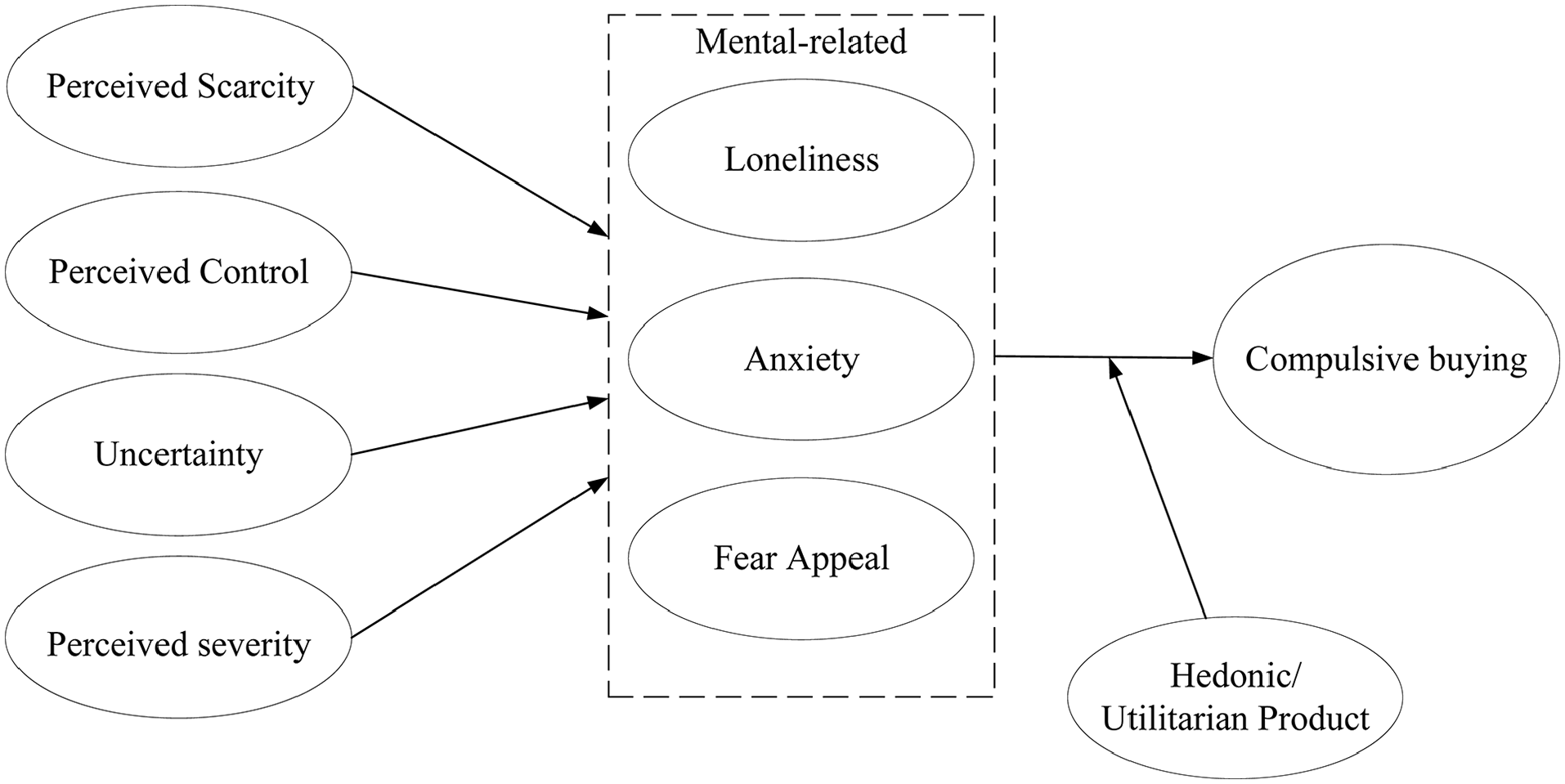
Conceptual framework.
Methods
Research Design
A quantitative research approach was adopted which used an online survey to examine the hypotheses. The online survey includes scales of perceived scarcity, perceived control, uncertainty, perceived severity, loneliness, anxiety, fear appeal, compulsive buying, Utilitarian/Hedonic product type, and some screening questions, as well as demographic information of respondents. Respondents were asked to respond to the filtering question about whether they had purchased products during the epidemic and a reverse question to improve sample quality.
Procedure
The data for this study were collected from Chinese residents in June 2022 through an online survey platform (Credamo) by recruiting respondents via social media and online advertising. All respondents were available and willing to respond. Out of 450 questionnaires distributed to respondents, 440 responses were collected. By eliminating the incomplete or failed reverse question responses, 394 usable responses were left for analysis where 206 consumers bought utilitarian products and 188 consumers bought hedonic products.
Measures
The constructs were primarily based on existing scale items adopted from previous studies. The questionnaire was established of several items measuring perceived scarcity, perceived control, uncertainty, perceived severity, loneliness, anxiety, fear appeal, product type, and compulsive buying.
Perceived Scarcity: Perceived scarcity (PSC) was measured using a 4-item scale adopted from W. Wu et al. (2012) and Islam et al. (2021) (e.g., “During the pandemic, I am concerned about limited quantity of groceries available in the supermarket,”“During the pandemic, I feel that the limited edition of a product will cause many people to buy,”“During the pandemic, I think that the current supply of available groceries are limited in supermarket”), on a 7-point Likert type scale from (1) Strongly Disagree to (7) Strongly Agree, with higher scores indicating higher perceived scarcity.
Perceived Control: Perceived control (PC) was measured using a 3-item scale adopted from M. Li et al. (2020). The measure includes: “At the moment, I feel helpless,”“At the moment, I feel powerless,” and “At the moment, I feel like I don’t have a sense of control.” Items are rated on a 7-point Likert type scale from (1) Strongly Disagree to (7) Strongly Agree, with higher scores indicating lower perceived control and reverse coded.
Uncertainty: Uncertainty (U) was measured using a 6-item scale adopted from Omar et al. (2021) (e.g., “The certainty that Covid 19 pandemic will not cause physical risk to you is (extremely certain-extremely uncertain),”“The certainty that Covid 19 pandemic will not cause financial risk to you is (extremely certain-extremely uncertain),”“The certainty that Covid 19 will not harm you is (extremely certain-extremely uncertain)”), on a 7-point Likert type scale from (1) Extremely certain to (7) Extremely uncertain, with higher scores indicating higher uncertainty.
Perceived Severity: Perceived severity (PS) was measured using a 3-item scale adopted from Omar et al. (2021). The measure includes: “Covid-19 pandemic is a serious threat,”“Covid-19 pandemic is critical,” and “Covid-19 pandemic can be life-threatening.” Items are rated on a 7-point Likert type scale from (1) Strongly Disagree to (7) Strongly Agree, with higher scores indicating higher perceived severity.
Loneliness: Loneliness (L) was addressed via the Three-Item Loneliness Scale (Hughes et al., 2004). The scale assessed how often to which individuals feel a lack of companionship, left out and isolated from others, on a 3-point scale of (1) Hardly Ever, (2) Some of the Time, (3) Often.
Anxiety: Anxiety (A) was adopted from the Generalized Anxiety Disorder 7-item (GAD-7) scale (Spitzer et al., 2006). The GAD-7 asks how often the respondent bothered the following problems from “Not at all” (0) to “Nearly every day” (3), for example, “Feeling nervous, anxious or on edge,”“Not being able to stop or control worrying.”
Fear Appeal: Fear appeal (FA) was measured using a 3-item scale adopted from Ahmed et al. (2020) (e.g., “The fear of contiguous coronavirus pushed me to buy and stock items”), on a 7-point Likert type scale from (1) Strongly Disagree to (7) Strongly Agree, with higher scores indicating higher fear appeal by COVID-19.
Compulsive Buying: Compulsive buying (CB) was measured using a 4-item scale adopted from Ridgway et al. (2008) and using the modified version of Islam et al. (2021), (e.g., “During the pandemic, my kitchen closet has unopened shopping bags of this groceries in it,”“During the pandemic, much of my life centers around buying things from the supermarket”), on a 7-point Likert type scale from (1) Strongly Disagree to (7) Strongly Agree, with higher scores indicating higher compulsive-buying behavior.
Product type (Utilitarian vs. Hedonic): The Utilitarian/Hedonic scale (HED/UT) by Voss et al. (2003) was employed in the study, as well as one question about “What type of products did you last purchase?” to classify the product categories. The question was designed to allow respondents to recall what products they had last purchased. The options for product types are “fresh vegetables, fruits and meat,”“cosmetics,”“clothing and personal adornment,”“daily necessities,”“electrical products,”“snacks” and “pharmaceutical-related products,” and allow respondents to fill in the product name directly. We distinguished products purchased by consumers according to what consumers perceived to be utilitarian and hedonic attributes, which is utilitarian score minus hedonic score (Kushwaha & Shankar, 2013). If the results are greater than zero, we recognize that this respondent bought a utilitarian product, and less than zero means this respondent bought a hedonic product. The questionnaire was first developed in English, then it was translated into Chinese to better engage respondents in the survey.
Data Analysis
Both the structural equation modeling via partial least squares (PLS-SEM) and multi-group analysis (MGA) are applied in this study to evaluate the measurement and structural model. PLS-SEM is adequate for predicting key target constructs in the structural model (i.e., predicting compulsive buying behavior) (Hair et al., 2011). And MGA as the moderating effect test method to examine how the product types have a different influence on the relationship between mental health factors and compulsive buying. The analyzing software chosen for this study is SmartPLS 4.0, which is one of the most widely used PLS-SEM software tools and has sufficient functions.
Results
Sample Demographics
Table 1 shows the sample characteristics, including gender, age, education level, and monthly income. In terms of gender, the sample size of males (47.21%) and females (52.79%) was relatively balanced. Most respondents were between 21 and 30 years old (48.73%), and 134 (34.01%) respondents were 31 to 40 years age bracket. With respect to education level, about 71.83% of respondents possessed a bachelor’s degree, and 18.78% had a college diploma or below. More than half of respondents had an income earning ranges from 6001 to 12,000.
Sample Characteristics.

Common Method Bias
The study uses both procedural and statistical remedies to mitigate common method bias (Podsakoff et al., 2012). First, the items on the Loneliness (Hughes et al., 2004) and Anxiety Scale (Spitzer et al., 2006) are based on previous research and follow the original scale properties, namely “Hardly Ever, Some of the Time, Often,”“Not at all, Several days, More than half the days, Nearly every day.” Other variables using 7-point Likert-type scales, did not share the same scale properties. It was simply that in subsequent analyses, loneliness and anxiety scales were transformed into a 7-point scale for ease of calculation. And Utilitarian/hedonic scales were semantic differential scales according to literature (Kushwaha & Shankar, 2013; Voss et al., 2003). Eliminating common scale properties is a good procedural remedy to reduce the potential for common method bias. Second, all measurement scales were based on existing scale items and have been validated by previous studies. Every effort is made to ensure accuracy in the translation process to eliminate ambiguous items. Third, in this questionnaire the author also adds a reverse question to reduce the inflating estimates of the reliability (Mirowsky & Ross, 1991), for example, “The overall quality of the product is high” and “This product seems to be poor quality (negative item)” (Lin et al., 2018) although not related to the research model. If respondents answer the same score in these two questions, then their responses would be dropped. For statistical remedies, this research conducted Harman’s single-factor test which is one of the post-hoc statistical techniques (Fuller et al., 2016) to examine the common method variance (CMV), and the results showed that the first factor accounts for 35.23% of the variance which lower than 50% indicating CMV is not reached problematic level. Moreover, the correlations among constructs were less than 0.9. Thus, it seems that common method bias would not be an issue in the study.
Measurement Model
The measurement model evaluation followed the guidelines of Hair et al. (2017) to assess indicator reliability (outer loadings), internal consistency (Cronbach’s alpha, composite reliability), convergent validity (AVE), and discriminant validity (HTMT) for all the constructs. The premise of the MGA is that the measurement model tests for each subgroup need to satisfy, and the following measurement model assessment would present in two subgroups. All the loadings were greater than the cut-off value of 0.7. Composite reliability and Cronbach’s alpha of all the constructs exceeded .834 and .730 respectively. And Average Variance Extracted (AVE) ranged between 0.557 and 0.886, exceeding the threshold value of 0.5, which meant that an adequate convergent validity was suggested (see Table 2). Tables 3 and 4 demonstrate the results of discriminant validity by presenting both the Fornell-Larcker criterion and the heterotrait-monotrait (HTMT) ratio for two subgroups. All the square root of AVE values were greater than the correlation estimates (Fornell & Larcker, 1981), and HTMT ratios were less than .9 (Hair et al., 2017), thus an acceptable discriminant validity existed. Subsequently, the multicollinearity indicator which is the Variance inflation factor (VIF) was examined to be ranged 1.257 to 1.858, lower than the guideline of 5, suggesting that there was no collinearity problem. Finally, the SRMR value which is 0.058 in this study, is less than the threshold value of 0.08 indicating a good fit.
Results of Measurement Model.

Discriminant Validity (Fornell-Larcker Criterion).

Note. The square roots of average variance extracted are shown bold in diagonal.
Discriminant Validity (Heterotrait-Monotrait Approach).

Note. PSC = perceived scarcity; PC = perceived control; U = uncertainty; PS = perceived severity; L = loneliness; A = anxiety; FA = fear appeal; CB = compulsive buying.
Structural Model Evaluation for Complete Sample
The hypothesis tests were conducted using a partial least squares SEM (PLS-SEM) approach in SmartPLS 4.0 software. We used bootstrapping to test the significance of hypotheses (95% CI, p-values, and t-statistics) and path coefficient. The results of the hypothesis testing were all supported except for H3a, H4a, and H4b which were the direct effect of uncertainty on loneliness and the direct effect of perceived severity on loneliness and anxiety (see Table 5).
Path Coefficients and Hypothesis Testing.
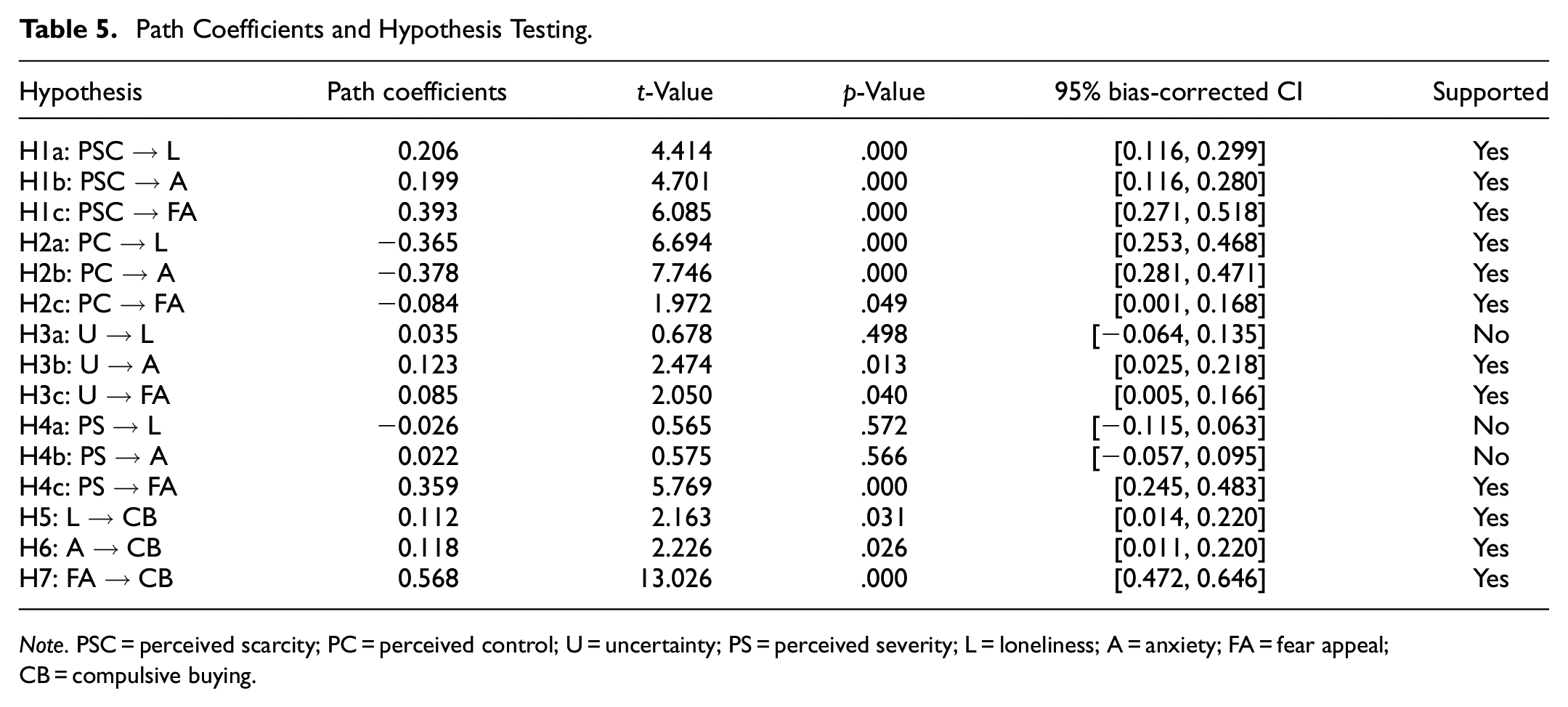
Note. PSC = perceived scarcity; PC = perceived control; U = uncertainty; PS = perceived severity; L = loneliness; A = anxiety; FA = fear appeal; CB = compulsive buying.
As shown in Table 5, perceived scarcity has a positive effect on loneliness (β = .206; p < .001), anxiety (β = .199; p < .001), and fear appeal (β = .393; p < .001), therefore empirically supporting H1a, H1b, and H1c. Perceived control has a negative effect on loneliness (β = −.365; p < .001), anxiety (β = −.378; p < .001), and fear appeal (β = −.084; p < .05), thus H2a, H2b and H2c were supported. Uncertainty positively impact on anxiety (β = .123; p < .05), and fear appeal (β = .085; p < .05), supporting H3b and H3c, but not loneliness (β = .035; p > .05). Perceived severity is positively associated with fear appeal (β = .359; p < .001) which supports H4c. Loneliness (β = .112; p < .05), anxiety (β = .118; p < .05), and fear appeal (β = .568; p < .001) all have significant influences on compulsive buying. Therefore, H5, H6, and H7 were supported. The value of R2 represents the amount of explained variance of the endogenous constructs, these antecedents about COVID-19 perceptions together explain 27.7%, 35.1%, and 51.8% of the variances in loneliness (R2 = 0.277), anxiety (R2 = 0.351), and fear appeal (R2 = 0.518), respectively. More importantly, the model explains 46.6% of the variances in compulsive buying, which is considered to be moderate (Hair et al., 2017).
The prediction-oriented viewpoint is critical for this study. To evaluate the predictive power of the model, both the Stone-Gleisser Q2 value and the PLSpredict were used. The Q2 values for loneliness, anxiety, fear appeal, and compulsive buying are 0.176, 0.223, 0.406, and 0.270, respectively, indicating the model is relevant to predicting these endogenous variables as Q2 values are all above zero (Garson, 2016). We then use PLSpredict approach to examine the predictive power of the model by comparing the RMSE errors between PLS-SEM and LM model (Shmueli et al., 2019). All the Q2predict values for indicators are greater than zero, then the next step should compare the RMSE values with the linear model benchmark. The results in Table 6 show that the model has a medium predictive power as the majority of the items in PLS-SEM produce lower RMSE values compared to LM.
Results of PLSpredict.

Note. PSC = perceived scarcity; PC = perceived control; U = uncertainty; PS = perceived severity; L = loneliness; A = anxiety; FA = fear appeal; CB = compulsive buying.
Multi-Group Analysis
Moderating effects analysis was performed by multi-group analysis (MGA) as product type was a categorical moderator, and the PLS approach requires running multi-group analysis for moderating effects test to identify model relationships that differ significantly across groups. A MICOM procedure is essential to assess measurement invariance before undertaking a multigroup analysis to ensure that differences between latent variables should stem from true differences in structural relationships, not from different meanings assigned to phenomena by different groups of respondents, which involves three steps: (1) configural invariance (i.e., equal parameterization and way of estimation), (2) compositional invariance (i.e., equal indicator weights), and (3) equality of composite mean values and variances (Henseler et al., 2016). The step 1 of MICOM was established by satisfying the same indicators, same data treatment and same algorithms for both groups. The step 2 of MICOM required a permutation test for utilitarian and hedonic product types, and the partial measurement invariance was confirmed (see Table 7). The partial measurement invariance for all constructs was established which permits the multigroup analysis by comparing the standardized coefficients across groups (Henseler et al., 2016). However, the full measurement invariance was established in perceived severity, loneliness, anxiety, and fear appeal, not in perceived scarcity, perceived control, uncertainty, and compulsive buying. In summary, it is appropriate to report the results of structural model for utilitarian and hedonic product types separately.
Results of Measurement Invariance Testing.

Note. PSC = perceived scarcity; PC = perceived control; U = uncertainty; PS = perceived severity; L = loneliness; A = anxiety; FA = fear appeal; CB = compulsive buying.
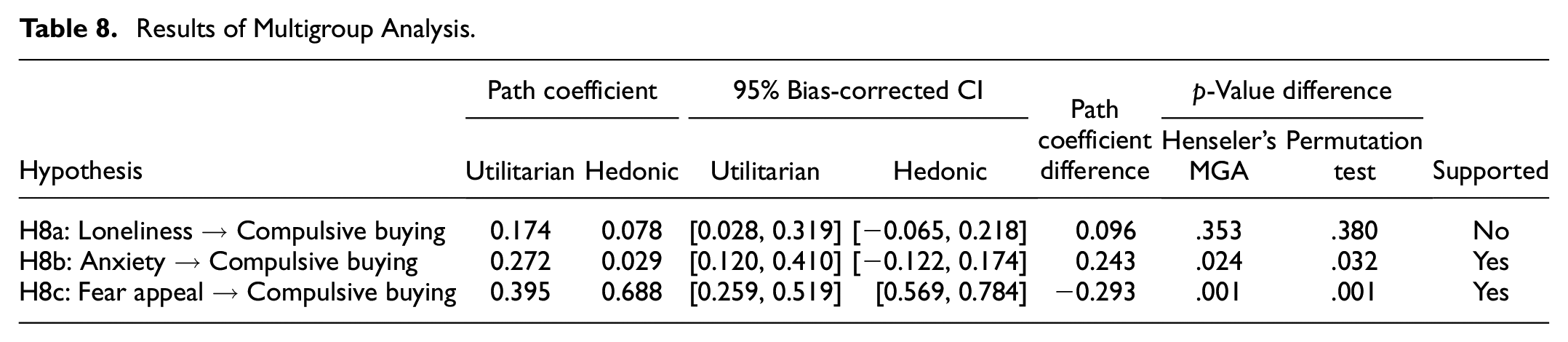
The moderating effect of product type was analyzed using SmartPLS MGA analysis, and the product type was the categorical variable by classifying product type with a higher utilitarian score than hedonic score as a utilitarian product, and vice versa (Kushwaha & Shankar, 2013; Voss et al., 2003). The results in Table 8 revealed that product type had a significant moderating effect on the relationship between anxiety and compulsive buying (βdifference = 0.243; p < .05), as well as fear appeal and compulsive buying (βdifference = −0.293; p < .001), supporting H8b and H8c as the path coefficients between two product types were significantly different. Anxiety had a significantly higher effect on compulsive buying with utilitarian products (βutilitarian = 0.272, βhedonic = 0.029), and fear appeal had a significantly stronger effect on compulsive buying with hedonic products (βutilitarian = 0.395, βhedonic = 0.688). However, there was no evidence that product type had a significant moderating role in the relationship between loneliness and compulsive buying (βdifference = 0.096; p > .05). The slope plots for the moderating effects of product type are presented in Figures 2 and 3.
Results of Multigroup Analysis.

Moderating effect of product type: Anxiety on compulsive buying.

Moderating effect of product type: Fear appeal on compulsive buying.
Discussion
The primary objective of the present study is to identify psychological factors that drive compulsive buying behavior in the post-COVID-19 era, further the moderating role of product type on compulsive buying. This study considers the mental health aspect of consumers aroused by COVID-19 due to either social distancing to avoid being infected or self-isolated after being infected. The results by testing the PLS-SEM model reveal that the changing psychological states of consumers during the public health crisis situation which are perceived scarcity, perceived control, uncertainty and perceived severity influence the mental-health factors which finally force the behavior of compulsive buying, and further confirmed that loneliness, anxiety and fear trigger compulsive buying. Specifically, perceived scarcity significantly positively affects loneliness, and perceived control negatively impacts loneliness. Perceived scarcity and uncertainty positively influence anxiety, and perceived control negatively influences anxiety, whilst all four perceptions of the epidemic (perceived scarcity, perceived control, uncertainty, perceived severity) have significant effects on fear appeal. Loneliness, anxiety, and feal appeal positively impact compulsive buying behavior. In addition, the results show a significantly higher impact of anxiety on compulsive buying for those who buy utilitarian products, and a significantly stronger impact of fear appeal on compulsive buying for those who buy hedonic products. The research will provide several theoretical and managerial implications.
Theoretical Implications
The findings of this study have important theoretical implications for the rationales of compulsive buying during the COVID-19 pandemic. First, the extant studies on panic buying, impulsive buying and compulsive buying integrate various antecedents of the sub-mental health state caused by COVID-19, hence the undertaken study examines the modified conceptual model by comprehending the theory of fear appeal to connect the pathological buying behavior, more specifically, compulsive buying, based on previous literature. Our study extends the conceptual framework by taking a compulsive buying perspective, while previous studies mostly examined the impact of COVID-19 negative perceptions on panic buying or just impulsive buying (Ahmed et al., 2020; Islam et al., 2021; Omar et al., 2021), and the relationships between negative psychological factors caused by pandemic and compulsive buying are confirmed. For research on compulsive buying mainly in two directions which are psychiatry and consumer behavior, authors revealed several rationales that creating compulsive buying, for instance, negative emotions such as anxiety (Darrat et al., 2016), depression (Sneath et al., 2009), and distress (Kovács et al., 2022), personal predispositions such as materialism (Harnish et al., 2019; Sharif & Khanekharab, 2017) and self-esteem (Ridgway et al., 2008), and even culturally-related motivation (He et al., 2018). Drawing on a set of interdisciplinary literature on psychology and business, this research may be the early attempt to investigate antecedents of compulsive buying regarding not only mental health factors (e.g., loneliness, anxiety) but also perceptions of the epidemic (e.g., scarcity, uncontrol, uncertainty and severity), contributing to a broader perspective on compulsive buying researches.
Second, fear appeal seems to be the most important cause of compulsive buying compared with loneliness and anxiety, supporting the theory of fear appeal which argues that the information exaggerating the dire consequences of ignoring certain warnings affects purchasing behavior (Addo et al., 2020; Eger et al., 2021; Witte, 1992). The rationale behind the association between fear appeal and compulsive buying is that fear is a maladaptive emotion when the threat is uncertain and continuous (Mertens et al., 2020) as there are no visible signs of controlling or curing COVID-19 (Addo et al., 2020); meanwhile, compulsive buying is a kind of maladaptive behaviors for psychologically sub-healthy consumers coping with pandemic (Lopes et al., 2020). Although the fear appeal scale items adopted from Ahmed et al. (2020) may overestimate the relationship between fear appeals and compulsive buying behavior due to the items mentioned that fear drives people to buy and stock supplies. Fear appeals have been controversial in health communication which have resulted in unintended negative outcomes by exacerbating the existing stress of this public health emergency (Stolow et al., 2020), where we cannot neglect its negative impact on consumers’ mental health. Thus, the stronger fear information dissemination induces more compulsive buying behavior and is harmful to the mental health of consumers.
Third, the moderating effect of product type (Utilitarian vs. Hedonic) has been empirically proved which may be the few current studies in the compulsive buying context. While prior literature has delved into the association between hedonic motivations and compulsive buying (Horváth & Adıgüzel, 2018; Tarka et al., 2022), differences in product type moderating the influence of mental health factors on compulsive buying yielded interesting findings. By conducting a multigroup analysis, we find that the relation between anxiety and compulsive buying can be enhanced by utilitarian products, while the relation between fear appeal and compulsive buying is strengthened by hedonic products. The special outcomes of the moderating effect of utilitarian products stem from life-saving purchase decisions and are consumed for the problem-solving purpose (O. Li & Qian, 2022). It is worth noting that the relationship between loneliness and compulsive buying is not significant for different product types. A possible explanation for this result obtained would be that lonely consumers’ choice of different product types is based on the temporal distance that choosing utilitarian products to solve problems when feeling social exclusion in the present and choosing hedonic products to use emotions to alleviate when imagining social exclusion in the future (Xu & Jin, 2020). Therefore, the empirical results could enrich the moderating effect of product type (Utilitarian vs. Hedonic) on mental health factors and compulsive buying.
Practical Implications
From a practical point of view, the findings reveal important managerial implications for policymakers and disaster risk management. First, compulsive buying and its antecedents examined in the current study show the significant relationships among perceived scarcity, perceived control, uncertainty, perceived severity through loneliness, anxiety, fear appeal and finally compulsive buying. These psychological factors induce pathological buying, and mainly originate from excessive worry about the outbreak. The pathological buyers typically have economic burdens, such as debt, and emotional problems, for both themselves and even family members (Maraz & Yi, 2022). Therefore, to reduce the possibility occurrence of compulsive buying behavior, it may be effective to inform the public the adequate messages about the useful products coping with the outbreak and more importantly moderate the quantity of purchasing products (e.g., medicine, necessities), or even use obligatory means to limit the number of purchases for some essential goods. The perceived scarcity, uncontrollable feelings, uncertainty and perceived severity of COVID-19 could be diluted by the positive guidance information, hence proper use of mass media will play a role in this regard.
Second, the predictive power of the research model suggests the high occurrence possibility that mental health problems such as loneliness, anxiety, fear, and compulsive buying become a reality when negative perceptions about the pandemic are formed. There is concern that one may have to live with the virus for a long time to come, and this source of suffering is likely to have a profound impact on community mental health (Castiglioni & Gaj, 2020). Unfortunately, human feelings and behaviors are difficult to control and predict, and it is challengeable for the government to respond perfectly to this unprecedented and long-lasting outbreak, especially in the post-COVID-19 era. One possible solution for the government is adopting dynamic measures based on the escalation of the pandemic, taking into account as much as possible the harmful effects on the public and keeping people’s lifestyles in a balanced state. Establishing a monitoring mechanism, based on the information obtained at an early stage, the government should enable all sectors of society (suppliers, retailers, hospitals, etc.) to be prepared for the increased demands that may be faced by a public health emergency to reduce negative emotions.
Third, the current study detects that there is no direct effect of perceived severity on loneliness and anxiety which does not confirm what the previous studies have mentioned (Han et al., 2021; Lo Coco et al., 2021; Newby et al., 2020). This result reveals a status quo that coronavirus has been variant and has become less aggressive like Omicron, with symptoms concentrated in the upper airways and a lower death rate than the earlier virus which means the severity of infections significantly decreased (Esper et al., 2023). The perceived severity of COVID-19 might no longer be the key factor inducing psychological problems (e.g., anxiety, loneliness, fear). However, the disease is not trivial, the profound impact of the public health crisis on mental health can last for a long time such as worrying about the occurrence of sequelae or severe illness of the elderly in the family. Identifying the causes of psychological problems and compulsive buying behaviors in consumers is an ongoing process for policymakers.
Fourth, when examining the moderating effect of product type (Utilitarian vs. Hedonic) on the relationships between loneliness, anxiety, fear appeal, and compulsive buying, loneliness has no different effect on compulsive buying when purchasing a hedonic product or a utilitarian product. This is inconsistent with the results obtained in previous studies (Das et al., 2003; X. Li et al., 2021; Rippé et al., 2022). This finding suggests that the hedonic value is not the only target that lonely people pursue, and is influenced by other considerations. Many research stated that loneliness was associated with more hedonic consumption or motivations (Das et al., 2003; Welch et al., 2019). However, Youn et al. (2022) stated that consumers who faced lockdown-related stress would be inclined to the utilitarian benefits of online shopping. A study of anthropomorphism products showed that rather than making choices based on product type only, lonely consumers also considered the degree of anthropomorphism of products presented as an inverted U-shaped curve, preferring hedonic products with high anthropomorphism and utilitarian products with low anthropomorphism (Feng, 2016). Therefore, the moderating effect of product type on the relationship between loneliness and compulsive buying requires further research in the different reality contexts.
Limitations and Future Research
Overall, the antecedents of compulsive buying have been proven in this study, but there are still several potential limitations. First, within the compulsive buying behavior context, this study focuses on the public health crisis situation as the outbreak is expected to be constantly changing and the conclusions may not be comprehensive enough. The data collected in the present study is cross-sectional, while the changes over time are worth studying. The duration of the future study can be further increased in such a way that the psychological state and behavior changes in consumers can be detected as the crisis proceeds, a longitudinal method would be more inspiring.
Second, we used an online survey to collect the data in China, and the methodology of structural equation modeling to find the relationships between variables. The strength is finding the possible influencing factors, but the limitation is the lack of causal inference, although the model in this study reflected medium predictive power. We encourage future research using experiment method to further examine the causal relationships between variables.
Third, the results were all tested based on Chinese consumers, but the causes of compulsive buying may be conditioned by the preventive measures taken by the government in different countries and the socio-cultural characteristics of different region residents. Cross-country studies on compulsive buying would support the generalization of the model and provide stronger evidence to assist policymakers in screening vulnerable groups and building responses earlier from a global perspective to prepare for the future public health crisis.
Conclusion
With the tremendous impact of COVID-19 on society as a whole and the lives of individuals, it is important to focus on the mental health and pathological buying behaviors of consumers in the post-epidemic era. As a response to potential future public health crises, how to effectively reduce the impact of such emergencies on consumer psychology and behavior, that is, identifying the antecedent variables that drive consumers’ compulsive purchasing behaviors, is the goal of this study. Therefore, in this research we established an expanded compulsive buying framework to examine the relationships between three main mental-health factors (loneliness, anxiety, and fear appeal) and perceptions of public health emergency (perceived scarcity, perceived control, uncertainty, perceived severity) and finally compulsive buying, including product type as the moderating effect. This study provides policymakers with more insight into how a public health crisis influences consumer behaviors and focuses on the impact of different product types on the strength of the relationship between mental health factors and compulsive buying. Our findings suggest that not only external event perceptions but also internal psychological factors need to be considered when studying the negative effects of pandemics.
Footnotes
Acknowledgements
None.
Declaration of Conflicting Interests
The author(s) declared no potential conflicts of interest with respect to the research, authorship, and/or publication of this article.
Funding
The author(s) received no financial support for the research, authorship, and/or publication of this article.
Ethics Approval Statement
No potentially identifiable human images or data is presented in this study.

Data Availability Statement
The data that support the findings of this study are available from the corresponding author upon reasonable request.