




Abstract
Posting of workers is a common reality in all EU Member States and in all export-oriented industries. The problem relates to existing travel restrictions in connection with the COVID-19 pandemic and in the context of the carbon footprint of business travel. In this context, the development of new Industry 4.0 technologies plays a significant role. The aim of the article is to identify the impact of Industry 4.0 technology on the international posting of workers in light of the COVID-19 pandemic on example of the German chemical industry. The basis of the analysis are two factor conditions of the Diamond Model of M.E. Porter: innovation and human capital. A qualitative study was conducted with experts in Industry 4.0 that regularly post workers. The results indicate that the COVID-19 pandemic has accelerated the pace of technology adoption (especially Augmented Reality cluster). Industry 4.0 technologies enable companies to reduce the posting of workers. For this purpose, IT skills are now the most important, followed by communication, flexibility, and openness, as well as soft, team and didactic skills.
Introduction
The subject of the analysis of the Diamond Model elaborated by M.E. Porter is the environment of the country where companies operate and compete (Porter, 1990). Porter explains that each industry is unique, having its own sources of competitive advantage and opportunities for evolution (Porter, 1998, p. 179). Furthermore, Erboz (2020, p. 267) states that competitive pressure from competitors and consumers forces companies to adopt and develop new ways of thinking, focusing more on core competencies, including digitization. Porter and Heppelmann (2014) emphasize that the structure of the industry and the nature of competition are changing; completely new industries are created, exposing companies to new opportunities and competitive threats.
Production factors vary depending on the specifics of the industry. This article focuses on the chosen elements of M.E. Porter’s Diamond Model—two factor conditions: technological innovations and human resources, and the additional, exogenous variable: chance. Technological innovations are understood as the Fourth Industrial Revolution (Industry 4.0). Employees posted to work abroad constitute a human resource. Finally, the chance is the global COVID-19 pandemic, which has drastically changed the reality of how sectors function and how people work. Habánik et al. (2021) describe that the COVID-19 pandemic significantly affected all spheres of life, disrupted existing processes and activities, and changed the functioning of the labor market. The pandemic significantly attenuated human mobility (Morgan et al., 2021). Locking residents in their homes, closing some production plants and stores, and freezing supply chains have created a new reality. Entrepreneurs and employees had to take on new challenges and adapt to them flexibly in order to survive on the market. In this severe situation, companies need to increase their competitiveness by implementing progressive technologies (Habánik et al., 2021).
The research focuses on the German chemical industry. Kagermann (2015, pp. 23–24, 32) argues that “Germany has one of the most competitive manufacturing industries in the world.” The manufacturing industry is the backbone of the German economy. To keep its leading position in the world, innovation must be initiated and actively implemented. Due to its highly disruptive impact on markets, digitization will be the main driver of innovation in all sectors of the economy (Kagermann, 2015, p. 23). However, the presented issue is not limited only to the specificity of the chemical industry in Germany. Posting of workers is a common reality in all EU Member States and in all export-oriented industries (De Wispelaere & Pacolet, 2019; Lens et al., 2022). The problem relates to existing travel restrictions in connection with the COVID-19 pandemic and in the context of the carbon footprint of business travel. In this context, the development of new Industry 4.0 technologies plays a significant role.
The research objective is to identify the impact of the COVID-19 pandemic on changes in production factors in the chemical industry in Germany. Two aspects are emphasized: the development of technological innovations (in line with the concept of Industry 4.0) and changes in the rapid development of new skills of employees. Both factors are analyzed in terms of the existing problem of posting employees to work abroad. The key purposes of the article are threefold: first, to identify the impact of technological innovation on the posting of workers; second, to identify changes in human capital; and third, to investigate the impact of COVID-19 on the posting of workers in the German chemical industry. The definition of these key goals as well as the literature review led to the formulation of six research questions.
After reviewing the literature, a qualitative study was conducted from May to July 2021 using partially structured interviews. The interviews were conducted with 15 Industry 4.0 experts from major German chemical manufacturers. The interviewees are experienced, confronted with Industry 4.0, and regularly post workers around the world.
The article is structured as follows: the first part presents the model of the Diamond Model M.E. Porter and selected two factors important for the chemical industry: technological innovations and human resources, and an exogenous factor: chance. The next section briefly presents the specifics of the chemical sector in Germany. Then the research methodology is described. Finally, the results and discussion are presented. The article ends with conclusions, theoretical and practical implications, limitations, and suggestions for future research.
Literature Review
Determinants of Competitiveness of the Industry Based on M.E. Porter’s Diamond Model
M.E. Porter developed the concept of the Diamond Model based on observations and conclusions that “every industry is unique, with its own sources of competitive advantage and its own evolutionary path” (Porter, 1998, p. 179). The author stated that a nation can be successful in a particular industry based on four key attributes that affect the quality of the environment in which domestic companies operate. These determinants of competitiveness are as follows: factor conditions; demand conditions; related and supporting industries; and firm structure, strategy, and rivalry (Porter, 1990). Moreover, there are two additional exogenous factors that also contribute to building a competitive advantage for the sector: government and chance. Diamond conditions can be referred to as the foundations of competitiveness at the microeconomic level. They are statistically significant in explaining productivity differences between countries (Brosnan et al., 2016, p. 506). According to Porter (1991), a properly developed environmental regulation may increase the company’s productivity and its international competitiveness, because the positive effects achieved (such as e.g., innovation) may reduce the negative impact of compliance costs (e.g., the costs of environmental protection regulations) (Ding et al., 2022).
Porter understands chance as various events that can have a positive and negative impact on a particular industry. They both can convert chance events into a competitive advantage (Bakan & Doğan, 2012, p. 446; Porter, 1998, pp. 124–126). They are, for example, inventions, entrepreneurship, and innovations, as well as natural disasters, surges in demand, wars, imposed embargoes, or other political restrictions. Another example of chance is the COVID-19 pandemic which has affected many industries around the world. It is the subject of the considerations presented in the article.
Factor conditions are necessary to compete in an industry (Porter, 1990, p. 71) which affects international competitive success (Yu et al., 2021). They are often grouped into five broad categories: human, physical, knowledge, and capital resources as well as infrastructure. Porter (1990, p. 75) underlines that the mix of factors differs considerably between industries. Their role and hierarchy among factors are related to how efficiently and effectively they are implemented (Porter, 1990, p. 76). More expected and preferred are advanced and specialized factors such as highly educated, narrowly skilled, industry-specific workforce, access to specialized inputs including knowledge and information, and modern infrastructure (Bakan & Doğan, 2012, p. 443–444; Brosnan et al., 2016, p. 506; Kharub & Sharma, 2017). They are significant to achieve higher-order and sustainable competitive advantage. They can be created and constantly upgraded through the implementation of factor-creating mechanisms, especially private ones (Porter, 1990, pp. 76–80). Interpreting the role of advanced and specialized factors, researchers the importance of the educational system, universities, research institutions, and management schools as providers of specific know-how generating technological innovations (Kutschke et al., 2016, p. 4). Moreover, they are good sources of human capital in terms of highly skilled R&D workforce (scientists and engineers), especially in scientific fields, high-tech and knowledge-intensive industries playing an important role in the growth, the wealth of firms and nations (Brenner & Mühlig, 2013, pp. 25–26; Kutschke et al., 2016, p. 4; Tellis et al., 2009, pp. 3, 5). This is especially important for the manufacturing industry, which plays a significant role in the sustainable economic development of the country. The manufacturing industry spreads to other sectors, thereby increasing the overall productivity of the entire economy, enabling it to compete in the global market (Yu et al., 2021).
Technological Innovation as a Factor of Industry Competitiveness
Technological innovation is the first factor condition with high relevance for this article. The main trigger is the technology stack summarized as Industry 4.0. According to Kumar and Kumar (2020) the first three industrial revolutions have already impacted the lives of individuals and society through technological progress, as society started to face the impacts of the Fourth Industrial Revolution (Industry 4.0). Today Industry 4.0 is preparing the way for the digital age.
There are many technologies associated with Industry 4.0. All of them offer innovative solutions to transform the industrial production processes toward higher automation and integration. There are many approaches to Industry 4.0 cluster technologies in research. Moreover, the identified key technologies differ between research areas (Brettel et al., 2014; Zhong et al., 2017). In addition, a literature review by Oztemel and Gursev (2020) confirmed extensive Industry 4.0 research that focuses on IT, engineering, HR, society, and many other fields. For the purpose of this research nine technology clusters identified by Boston Consulting Group were used (Rübmann et al., 2015): (1) Big Data & Analytics, (2). Autonomous Robots, (3). Simulation, (4). Horizontal & Vertical System Integration, (5). The Industrial Internet of Things, (6). Cybersecurity, (7). The Cloud, (8). Additive Manufacturing, (9). Augmented Reality. Each of these clusters includes an innovative part, which links it to the factor condition of technological innovation.
The role of the chemical industry is important for the development of the Industry 4.0 concept itself, as it is a key supplier of digital and intelligent technologies. Currently, the term Chemicals 4.0 appears in the literature and in practice. The essence of this new sectoral concept lies in the latest technologies and solutions used in the chemical industry: digital adoption, the use of cyber-physical systems, the transformation of supply chains, as well as the introduction of new business models by chemical companies along the entire value chain, including modeling, design, operation, logistics, management and control of production (Shevtsova et al., 2020).
Manufacturing companies, including the ones in the chemical industry, delegate employees to work abroad. This solution is associated with problems of not only legal, tax, and economic (Aranea et al., 2022; Lens et al., 2022; VDR, 2020) but also technological nature. According to Orzes et al. (2018) and Caruso (2018), the implementation of Industry 4.0 must deal with many challenges. The COVID-19 pandemic has caused additional difficulties related to the inability to post workers abroad due to travel restrictions (Habánik et al., 2021; Morgan et al., 2021). This situation in turn had an impact on for example, development of new forms of work organization (Gan & Yusof, 2019; Kniffin et al., 2021; Valenduc & Vendramin, 2016) and accelerated digital transformation (Randstad Deutschland, 2020). The willingness to investigate changes in Industry 4.0 technology and their impact on the posting of workers during the COVID-19 pandemic led to the formulation of four research questions:
RQ1 How far Industry 4.0 technologies can prevent the posting of workers and related business travel?
RQ2 How do technology clusters contribute to reducing worker posting?
RQ3 Has there been any acceleration in the implementation of Industry 4.0 technologies due to the COVID-19 pandemic?
RQ4 Did the accelerated implementation of Industry 4.0 technologies during COVID-19 lead to the prevention of workers’ posting?
Human Resources as a Factor of Industry Competitiveness
Along with technological innovation, human resources are the second factor condition of the Porter’s Diamond Model, important for the chemical industry. The Global Competitiveness Report (GCR) defines human resources as the “capabilities and skills of individuals and populations” (Schwab & Zahidi, 2020, p. 21). This is more concrete than the classical economic approach based on Smith’s “Wealth of the Nations” where labor is defined as all human activity for the product and human capital lies primarily in education (Smith, 2020). The GCR reflects more on the modern definition of human capital which is nowadays the modern approach to describing the workforce of a company (Goldin, 2014). The human resources factor will be crucial in the competitive area of Industry 4.0 as a “suitable approach of HR practices could assist organizations to reach the objectives of IR 4.0 effectively” (Gan & Yusof, 2019). The inseparable connection between Industry 4.0 and human resources is shown particularly by the term Human Capital 4.0—a term that describes the tasks, challenges, requirements, and opportunities for handling human resources in the future under Industry 4.0 (Flores et al., 2020). The necessary practices of human capital 4.0 were identified, researched, and described by Gan and Yusof (2019) as: knowledge management, HR policy making, training, recruiting, a reward system, and job design.
Industry 4.0 involves, among other things, managing the workflow of integrated activities between various processes, devices, and users (Bellini et al., 2022). When evaluating the literature, it is noticeable that there are many studies and reports about how Industry 4.0 changes and will change the local workforce (Bag et al., 2021; Burgess & Connell, 2021; Gaduena et al., 2022; Paz et al., 2022) and how the above-mentioned practices need to evolve (e.g., Flores et al., 2020). The results show that robots and other assistant systems will not replace human workforce. Furthermore, they will be supporting systems for the human workforce—but this will make it necessary to adapt skills, competences, jobs and professions to the new situation (Bundesverband Informationswirtschaft Telekommunikation und Neue Medien e. V, 2016). Of course, the specific skills and tasks that change differ depending on the sector or even the processes that are reviewed. However, several studies concluded that these two will change: tasks and skills (Nicolás-Agustín et al., 2022; Sima et al., 2020). These studies were the basis for defining two research questions—determining how the tasks and skills of posted employees’ will change:
RQ5 How will employee tasks change with the emergence of Industry 4.0 technologies?
RQ6 How will employee skills change with the emergence of Industry 4.0 technologies?
International Posting of Workers
This article concentrates on another kind of employees: employees that work abroad. There is no standard word or definition for this kind of people. The term business traveler excludes long-term employees that stay 2 years and more in a country. The term expat/expatriate, on the other hand, excludes the short-term travelers. For this article we will therefore use the term “posted workers” in the meaning of the EU Commission’s very broad definition: “sometimes an employer in one Member State (“the posting state”) will want to send an employee to work in another member state (“the state of employment”). Such employees are known as posted workers” (European Commission, 2019, p. 7). While the definition was made for inter-EU postings, the definition can be used worldwide, as there is always a sending and a receiving state. Lens et al. (2022) describe that workers posted to work abroad perform service contracts for their employer and are subject to the labor law of the host country. A posted worker can have any kind of tasks abroad: a technical focus, supporting the host company with technical advice, conducting a project character where collaboration is the major focus, a managerial purpose, sales venture or any kind of networking activity. In the area of posting employees knowledge sharing and exchange is the basis for success according to trust as underlined by Rotsios et al. (2021, p. 600)—a higher level of trust of a foreign partner in a local one influences a more effective transfer of knowledge. Moreover, efficient communication is the key element for any kind of international cooperation with posted workers. But this is not always easy to achieve due to different national languages, limitations in communication tools (lack of good quality internet or politically suppressed IT tools) or different levels of English across the world (Tenzer et al., 2020, p. 892).
Chemical Industry in Germany
The chemical industry is one of the major sectors of the modern world economy. It is the source of many semi-finished and finished products, most of which are used by other sectors of the economy (in particular, for manufacturers of textiles, food products, wood and paper, basic metals and fabricated metal products, engineering, construction, agriculture, medicine, etc.). In this context, it largely determines their competitiveness and the pace of development, and thus is considered one of the engines of their technological development (Shevtsova et al., 2020).
Currently, China is a world leader in the chemical industry regarding revenue, but the European Union (especially Germany, France, Italy and Great Britain) is also an important center of the chemical industry (Shevtsova et al., 2020).
Kagermann (2015, pp. 23, 32) argues that the backbone of the German economy is the manufacturing industry, which stands for 22.4% of the country’s gross domestic product (GDP) and employs one-sixth of all German workers. This leading competitive position in the world was achieved thanks to the ability to manage complex industrial processes performed by various partners around the world. Kagermann (2015, pp. 32–32) claims that about 90% of all industrial manufacturing processes are already supported by Information and Communication Technologies (ICT).
The chemical and pharmaceutical industry is Germany’s third largest sector with an annual turnover of around 200 billion EUR. Johannsen (2020) states that the chemical industry of Germany is just behind the automotive and machinery industry. Ochoa Bique and Zondervan (2018) report that the German chemical industry explores new technologies including digitalization, nano- and biotechnologies, as well as the hydrogen economy—with digitalization and innovative processes gaining comparatively higher importance than the other fields. According to Kang et al. (2016), Germany’s governance established the ultimate realization of Industry 4.0, and it is a combined project involving the private sector, government, and academia. The European Chemical Industry Council (2021) says that the chemical industry of Germany has high presence in Europe and across the world. Key factors for this success are the ideal geographic location in the middle of Europe with access to more than 500 million customers from the EU. The workforce consists of over 460,000 employees. Those are well trained and focused on production efficiency. Therefore, the chemical industry of Germany is Europe’s largest. It is globally ranked third, just behind China and the USA. The products of the chemical industry are broadly used in segments like agriculture, healthcare, construction, automobiles, or consumer goods. Due to the above, the chemical industry of Germany has also been impacted by the COVID-19 pandemic.
Looking into the past years’ GCR indices, Germany does very well in the area of human resources. Since 2018, Germany ranked forth and fifth in the Skills pillar. But also in the earlier reports, where different aspects of labor and employees were reviewed, Germany reached very good rates. It ranked worst (2018 and 2019) in the criterion Pupil-to-teacher ratio in primary education—but more importantly for this article, the criterion Digital skills among active population is ranked last (2018) or next to last (2019). It can be concluded that the German workforce is highly skilled, but more in the conventional fields, and less in the novel and digital skills related to Industry 4.0 (Schwab & Zahidi, 2020, p. 21). Naturally, the willingness of employees to travel on business is important for the exporting country in the area of workers and human resources. This willingness to travel is evident in Germany where, in 2019, 13 million business travelers made 195.4 million business trips (VDR, 2020). However, in recent years VDR has observed “a jump in replacing business trips with existing and new online tools, meetings, conferences and training” (VDR, 2020, p. 18).
The COVID-19 pandemic, announced in March 2020, has had a huge impact on the globalized world. Within a few weeks, global trade and travel around the world have almost come to a halt, which led to unprecedented consequences for all the world’s economies. Lian et al. (2020) identified that the demand for products and services declined especially in the companies affected by significant hindrances to production. Closure of national borders and traveling bans caused negative disruptions in the supply chains, as well as operational, manufacturing and other fields of business. Gómez and Radel (2020) stated that the COVID-19 outbreak dropped the global GDP by 7 trillion USD. The German GDP rated 11.3% below the year before and the total export value in the vital motor, vehicle and semi-trailer industry amounted only 3.5 billion EUR, which is just one-third of the export amount of April 2019 (11.1 billion EUR; Statistisches Bundesamt, 2021). Having ascertained this downturn, experts predicted a massive effect on Germany’s economy throughout 2020 for the following years. However, thanks to comprehensive and rapid support by the government, such as tax reliefs and fiscal support for short time work, the consequences were less severe than expected. The Federal Ministry for Economic Affairs and Energy announced that Germany’s GDP fell by 4.6% in 2020, with the prior projection being at least 6.3%. For 2021, experts are predicting a growth of 3.5% (Germany Trade & Invest [GTAI], 2021). Since the beginning of COVID-19, various studies and research have been made to look into the consequences. Most of them focus on the medical aspects rather than on facts based on the economy, such as GDP, the local labor market, export figures, unemployment rates, etc.
Research Methodology
The research objective is to identify the impact of the COVID-19 pandemic on changes in production factors in the chemical industry in Germany. Two aspects are emphasized: the development of technological innovations (in line with the concept of Industry 4.0) and changes in the rapid development of new skills of employees. Both factors are analyzed in terms of the existing problem of posting workers to work abroad. As no targeted dataset was available, it was decided to collect primary data focusing solely on the aspects of the impact of COVID-19 on the development of new technologies and, consequently, on the situation of posted workers. As deep knowledge and extensive insight into the development of Industry 4.0 in the chemical industry was required, the authors decided to conduct expert interviews.
To reach renowned experts, the German Chemical Industry Association (VCI) was contacted and asked for help in reaching the relevant specialists. The chosen approach was to reach out to the leading companies in the chemical industry in Germany. These companies were selected on the basis of the volume of revenues and the number of employees. In addition, they were large international entities with extensive experience in Industry 4.0 technologies and the posting of employees. In these companies’ experts were sought to conduct the research. The recruiting of the experts’ group was purposive as well. The restrictions for group members were as follows: min. 8 years of professional experience and extensive knowledge of the technology (business function, information or operational technology), min. 3 years of professional experience in Industry 4.0 and regular posting of workers all over the world. This collaboration resulted in 15 different contacts.
The study was conducted from May to July 2021. All interviews were conducted using Microsoft Teams as it was not possible to conduct them in person due to the ongoing COVID-19 pandemic. Prior to the interviews, the experts received a general description and purpose of the study but did not have access to the questions contained in the questionnaire.
In order to achieve the main purpose of the article that is identifying the impact of technological innovations on the posting of workers, identifying changes in human capital, and studying the impact of COVID-19 on the posting of workers in the German chemical industry, a qualitative study was conducted. The definition of these key research areas, work experience and observations in the workplace, as well as a review of the literature (which was limited in this case) led to the formulation of six research questions:
RQ1 How far Industry 4.0 technologies can prevent the posting of workers and related business travel?
RQ2 How do technology clusters contribute to reducing worker posting?
RQ3 Has there been any acceleration in the implementation of Industry 4.0 technologies due to the COVID-19 pandemic?
RQ4 Did the accelerated implementation of Industry 4.0 technologies during COVID-19 lead to the prevention of workers’ posting?
RQ5 How will employee tasks change with the emergence of Industry 4.0 technologies?
RQ6 How will employee skills change with the emergence of Industry 4.0 technologies?
Structured interviews were not selected as no previous research on this topic has been identified. On the other hand, due to the too wide range of possible interview points, no unstructured interviews were conducted either. Therefore, it was decided to use the concept of a semi-structured interview, defined as an optimal hybrid of both (Ayres, 2008). This gave the required framework and possibility to guide the interviewed experts to a specific research issue (Table 1). As to Edwards and Holland (2013), this gives the necessary flexibility to conduct a high-quality interview while leaving enough space for broad answers and expert ideas. The semi-structured interview is in general a qualitative research method—but it was still possible to ask qualitative and quantitative questions.
Differentiation of Possible Types of Interviews.

Source. Own elaboration based on (Ayres, 2008; Firmin, 2008a, 2008b).
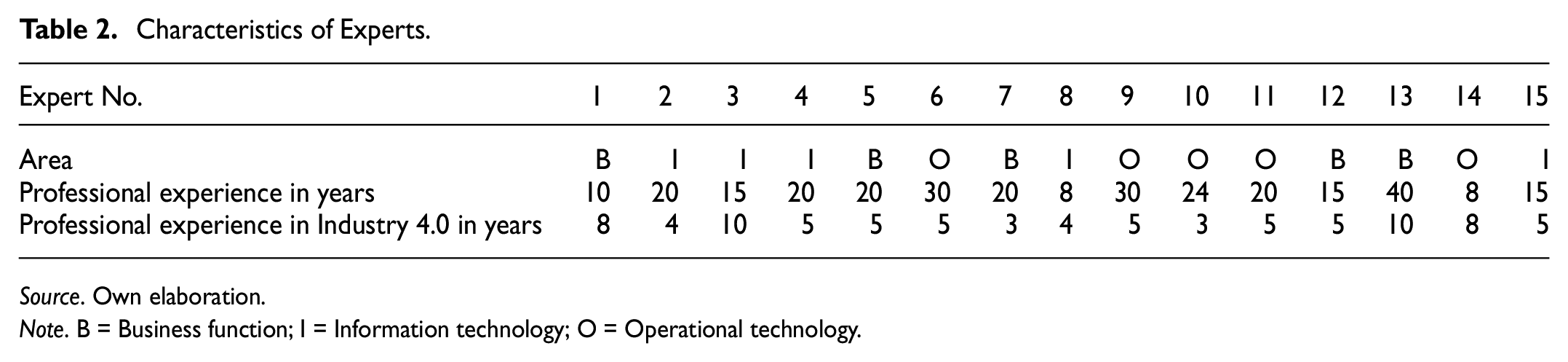
As shown in Tables 2 and 3, the experts were selected in such a way that they represented three departments equally—five people from each department, amounting to 33%. The respondents had from 8 to 40 years of professional experience. Most of them (five experts) have worked in enterprises for 20 years. Their experience in the field of Industry 4.0 ranges from 3 to 10 years. The experts did not receive any questions in advance. During the interview, the interviewer made sure not to raise suggestive questions, not to guide the expert in a specific direction, but, of course, ensured that the general framework provided for in the expert study was met.
Characteristics of Experts.
Source. Own elaboration.
Note. B = Business function; I = Information technology; O = Operational technology.
Characteristics of the Research Sample.

Source. Own elaboration.
Note. BIZ = Business function; IT = Information technology; OT = Operational technology.
The analysis of the interviews was conducted according to Mayring (2015). This analysis is a three-step post-interview transcription procedure. First, the content of the interviews was thoroughly analyzed in order to clarify unclear or incomplete information. Starting with the explicit content analysis to clarify unclear or incomplete information. was a structured content analysis in which a category system was developed to filter the main criteria. The authors decided to develop the category system inductively. Finally, the categories were grouped and the content was summarized. The result is the essence of key factors mentioned by the experts (Table 4).
Methods of Analyzing Qualitative Content.

Source. Own elaboration based on (Mayring, 2015).
In order to better classify the statements, personal data and additional information from the interviewed experts were collected and taken into account during the data study. Oral interviews were transcribed in two steps. At first, the responses to asked questions were gathered in an Excel file. Then, they were mapped into specific research areas.
Results
The results of the empirical study can be divided into four main research areas. The first is related to technology. It assesses how Industry 4.0 technology clusters can prevent the posting of workers and related business travel. In addition, it examines whether there are obstacles to the full exploitation of these technology clusters. The second aspect observed concerns the impact of the COVID-19 pandemic on the implementation of Industry 4.0 technologies. The next two issues are related to the changes of tasks and skills of posted workers in connection with the implementation of Industry 4.0 technology.
Industry 4.0 Technologies and Posting of Workers
RQ1 (How far Industry 4.0 technologies can prevent the posting of workers and related business travel?) explains the extent to which Industry 4.0 technologies can prevent the posting of workers and related business travel. 13 out of 15 experts claim that technology could replace worker posting. On average, they assume that posting can be prevented in about two-thirds of the cases. 13 experts say there are obstacles preventing the utilization of Industry 4.0’s potential in reducing postings. The main reason stated concerns the human factor: “employees and customers are not ready,” “direct contact with the customer is always needed,” “human contact is required,” “personal development is a reason to continue the posting/business travel,” “building confidence and mutual trust is the reason to travel.”
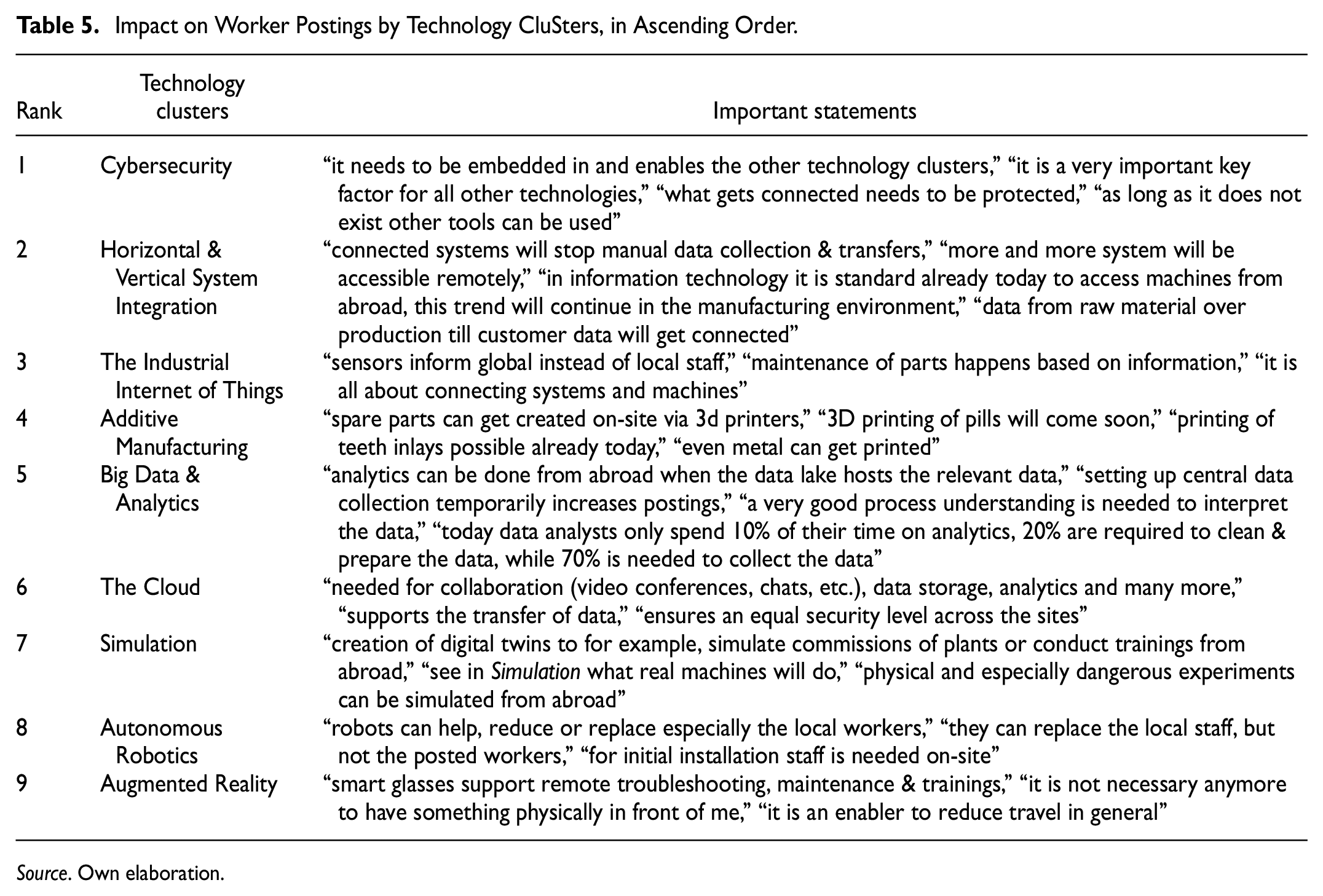
RQ2 (How do technology clusters contribute to reducing worker posting?) identifies the contribution of technology clusters in reducing worker posting. On an average, the experts stated that seven out of nine technology clusters (80%) support reducing worker postings. The smallest number of responses was for the cluster Horizontal & Vertical System Integration (65%). On the other hand, all of the experts (100%) commented on Augmented Reality. According to experts’ point of view, all of the technology clusters may limit the posting of workers. However, in some of them, experts see greater potential in reducing worker posting. The technology cluster with the lowest potential to reduce the number of postings is Cybersecurity (7%), while the highest is Augmented Reality, where 79% of the experts see a strong potential. Table 5 presents, in ascending order, the technology clusters with the potential to reduce the posting of workers and lists the most important statements of experts.
Impact on Worker Postings by Technology CluSters, in Ascending Order.
Source. Own elaboration.
According to experts, the general conclusion is that the use of the above-mentioned technology clusters may contribute to reducing the number of posted workers. For example, the data from machine sensors can be collected, stored in The Cloud and then analyzed in detail. Data analysis may indicate that the installation of a specific spare part is required. This part is then printed in a local factory with a 3D printer. To replace this spare part, a local engineer is supported by a global engineer with smart glasses to install the part.
The experts state that for all technology clusters there are obstacles which need to be resolved to reduce the need for worker posting. Here, the difference between the technology clusters is significant, because for Data Analytics and Horizontal & Vertical System Integration only 7% of experts mentioned obstacles. In contrast, for Augmented Reality more than a third of the experts (36%) see obstacles. Table 6 lists, in ascending order, technology clusters which experts believe to be hindered by the greatest obstacles. It also highlights key expert statements.
Obstacles of Technology Clusters, in Ascending Ordered, to Eliminate Worker Posting.

Source. Own elaboration.
It is worth mentioning that when it comes to obstacles, there are also links between different technology clusters. Some of them rely on each other to solve given obstacles. For instance, to conduct data analytics it could be required to overcome several difficulties. First, sensors (The Industrial Internet of Things) need to be installed in order to collect data during the manufacturing process. Second, a cloud instance (The Cloud) is required to receive the data. By collecting data from multiple sensors over time, The Cloud instance acts as a data lake (Big Data & Analytics). An appropriate software is required (Big Data & Analytics) for the actual data analysis. Finally, it needs to be ensured that the used technology stack is secured (Cybersecurity).
Implementation of Industry 4.0 Technologies in the Light of COVID-19 Pandemic
RQ3 (Has there been any acceleration in the implementation of Industry 4.0 technologies due to the COVID-19 pandemic?) addresses the possibility of accelerating the implementation of Industry 4.0 technologies by the COVID-19 pandemic and determining whether this leads to the prevention of worker posting (RQ4 Did the accelerated implementation of Industry 4.0 technologies during COVID-19 led to the prevention of workers’ posting?). Fourteen out of Fifteen experts say that the COVID-19 pandemic has accelerated the process of implementation of Industry 4.0 technologies. Experts’ estimates of the degree of acceleration range from 0 to 10 years with an average of 4.43 years. This is even more compared to the 3-year acceleration stated by McKinsey & Company (2021) in October 2020. Interestingly, the experts were not focusing much on advanced technologies directly affecting production. Seven interviewees mentioned that this crisis has primarily changed the employee’s mindset. Technologies were already there before, but the crisis forced the companies to use them. The COVID-19 pandemic has proven that virtual meetings, intensive use of home office and remote support technologies can be effective. Businesses can still operate in this virtual environment. The post-crisis reality will show whether the utilization of technology remains at the present high level and how it will develop further in terms of new or additional technology implementations. Therefore, it is important that employees remain curious to learn about and adapt these new tools to their daily work.
Changes of Employee Tasks Driven by Industry 4.0 Technologies
RQ5 (How will employee tasks change with the emergence of Industry 4.0 technologies?) concerns the way Industry 4.0 affects the tasks of posted workers during their stay abroad. It is based on the HR practice called “job design” described by Gan and Yusof (2019, p. 620), which is essential when processes need to be adopted to the new reality under Industry 4.0. Job design is about tasks and activities, as well as relationships and responsibilities at work (Parker, 2014, p. 662). All of the 15 experts interviewed stated that Industry 4.0 affects the nature of their employees’ tasks. In total, 76 statements were gathered (presented in Tables 7 and 8), grouped by keywords and then sorted by the number of responses. Table 7 shows the experts’ statements regarding changes in employee tasks driven by Industry 4.0 technology.
Expert Statements on Changes in Employee Tasks Driven by Industry 4.0 Technology.

Source. Own elaboration.
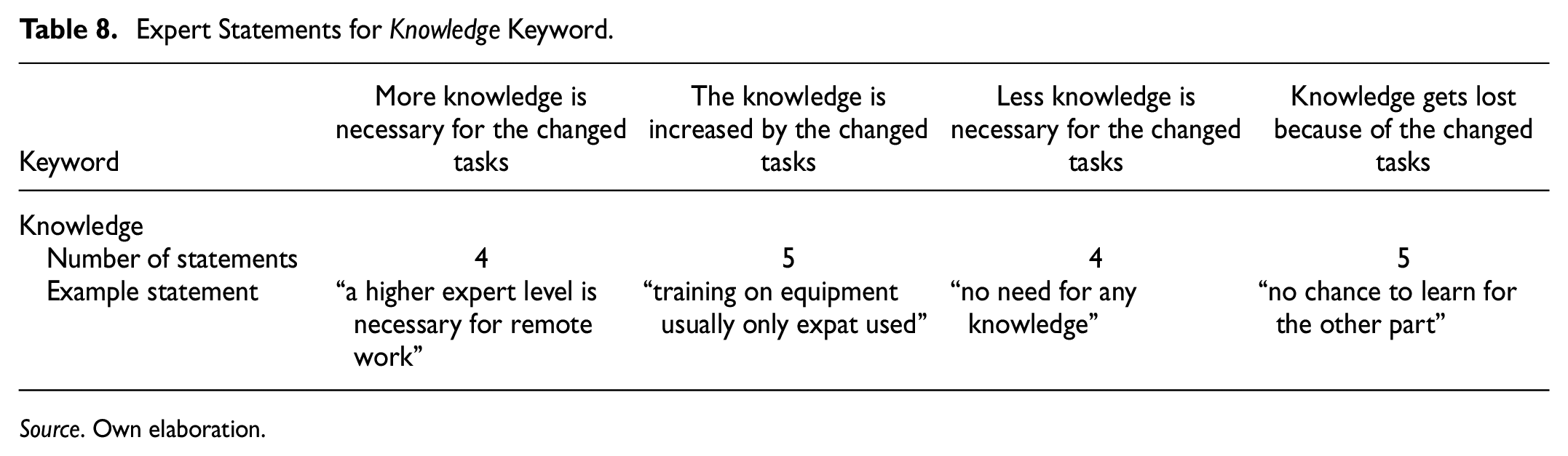
Expert Statements for Knowledge Keyword.
Source. Own elaboration.
The knowledge keyword plays a special role in the obtained results. Therefore, it is worth distinguishing between the directions in which knowledge develops or needs to be developed (Table 8).
It seems that the direction of changes—whether there will be less or more knowledge, is not clear. Nine statements refer to how an employee’s knowledge needs to be raised to work in Industry 4.0 or how it is enhanced by Industry 4.0 technologies. Also, nine statements refer to how Industry 4.0 reduces knowledge or needs less educated employees. This variety of opinions may be explained by the wide range of tasks and the multitude of applicable technologies at hand. Already during the preparations for the interviews, it was feared that a wide group of experts and the Inclusion of nine Industry 4.0 technology clusters could lead to a broad perspective. The impact that Industry 4.0 will have seems to be dependent on the future structuring of the business environment.
Table 7 shows that the second most frequently mentioned changes in employee tasks driven by Industry 4.0 technology concerns increasing the focus on tasks (12 statements). This section mentions more specialization, less support and preparation work, as well as greater efficiency. This was not pointed neutrally in all cases; in two instances, the expert stated that greater productivity may be associated with greater stress for the employee. In addition, monotony may increase with lower diversification of the assigned tasks.
The keyword travel came only third. Posted workers now have to travel less, which “saves time and helps improve work-life balance” (statement of expert 13). The next keywords in Table 7 were: role of employees in the company, workplace, personal contact and team integration. Five statements were listed in each of them. The same vague picture of role can be seen as with the keyword knowledge. It can develop toward broader or smaller roles—depending on the specific task. The explanation remains the same: it is up to today’s and future roles whether the roles will be larger or smaller. There was a common agreement that the execution of a task no longer depends on the workplace. It will be possible to conduct tasks from anywhere. The loss of personal contact was also mentioned in reference to changes in tasks. This is surprising at first, but obviously the personal contact and geographic allocation are rated very high by the experts. Nowadays, personal contact seems to be the key issue to successful work. Therefore, it’s no surprise that the keyword Team integration has this many statements—focusing on the one hand on organizational challenges like international teams instead of regional teams—but also on the issue of new communication channels that are becoming necessary.
The last keywords mentioned in reference to the changing employee tasks are: from doing to guiding and more office and less manual work (Table 7).
The long list of 76 statements presented in Table 7 shows that many things will change in the nature of employee tasks. This affects various aspects of everyday work, especially the circumstances. The tasks themselves will not change that much, but rather the way they are performed and under what conditions. These changes are not generally seen as negative or positive, they tend to go both ways or are entirely neutral.
Change in Employee Skills Driven by Industry 4.0 Technology
The last RQ6 (How will employee skills change with the emergence of Industry 4.0 technologies?) in the survey inquiries about the changes that employee skills will undergo due to Industry 4.0 technologies. As with the tasks, the experts agreed that skills will also change or need to be changed due to Industry 4.0 technologies. 43 statements were mapped to the identified keywords and listed in an order of the number of statements (Table 9).
Expert Statements Regarding Changes in Employee Skills Driven by the Implemented Industry 4.0 Technology.

Source. Own elaboration.
The leading keyword with nine statements relates to IT skills such as: general IT knowledge, programming language, IT affinity and knowledge of cloud solutions. With IT comes the keyword communication skills—five statements relate to communication skills and 4 statements concern language skills. This appears to be the key to the successful use of Industry 4.0 technologies. The third mentioned keyword is change, namely: the ability to change and adopt to a new situation—and, as Expert 3 stated: “Constant adaptation to a constantly changing environment.”Cultural aspects is a keyword that the experts mentioned four times. Different cultures, including religions, have their own specifics and manage problems in different ways. Experts emphasize that one should have great understanding and respect for cultural aspects. They must be known and accepted. The next keywords are skills: soft, team and teaching. Notably, if treated jointly, these would rank the skill aspect higher. Experts pay attention to the specificity of the present day, manifesting itself in an evident shift from hard to soft skills, the ability to establish contacts, as well as interaction without personal contact. Twelve out of fifteen experts say that the loss of personal contact in a completely remote environment is a significant obstacle and is seen as the most disturbing issue. To quote expert 9: “Business processes are more difficult when we don’t drink beer together.” An important element of today’s business reality is also the opportunity to learn and share knowledge.
According to experts, Industry 4.0 will require a change in IT skills and software that comes with new technologies. Soft skills in communication, cultural differences and teamwork are also mentioned quite often. Again, there is no assessment in one direction or the other changes are perceived as neutral, positive or negative.
Discussion
In order to identify factors important for the chemical industry, M.E. Porter’s Diamond Model was used. Two key endogenous factors were distinguished: technological innovations and human resources, as well as one exogenous factor: chance. Based on the conducted qualitative research, the following conclusions can be drawn.
Importance of the Technological Innovations in the Light of COVID-19 Pandemic
Industry 4.0 technologies have the potential to reduce the posting of workers in the chemical industry in Germany (RQ1 How far Industry 4.0 technologies can prevent the posting of workers and related business travel?). This was strongly influenced by the COVID-19 pandemic, which accelerated the implementation of changes. In this severe situation, companies needed to increase their competitiveness by implementing progressive technologies (Habánik et al., 2021; Morgan et al., 2021). According to Caruso (2018), investment in technology must be widespread throughout the organization before its full impact on productivity can be assessed. Typically, productivity gains are the result of organizational changes and technological innovations however, according to Porter (1991), properly developed environmental regulations are also of great importance (Ding et al., 2022). Valenduc and Vendramin (2016) state that only those companies that are willing to simultaneously adopt new forms of work organization to implement new technologies will increase productivity. Limiting the posting of workers may be facilitated by technology, but it also requires organizational adjustments to fully use its potential. These results are also in line with the Randstad Deutschland assessment (2020) which states that most German companies are increasing the use of home office, virtual conferencing, e-learning and distance leadership. The number of in-house meetings and business travel is expected to remain permanently reduced.
Another result is that different technology clusters are of unequal importance in terms of their contribution to the reduction of worker posting. The most promising technology cluster in this respect is Augmented Reality, while Cybersecurity contributes less (RQ2 How do technology clusters contribute to reducing worker posting?). There are additional, not always technical, obstacles to the implementation of these technologies. Orzes et al. (2018) identified the existence of multiple obstacles when implementing Industry 4.0 technologies. Complexity of the solution, data stored in silos, data security concerns, uncertainty about the systems reliability, weak IT infrastructure and immature technology are the summarized technology-related findings, which have also been confirmed by Berg (2019). However, Schneider and Sting (2022) claim that “manufacturing employees generally seem to think and feel far more differentiated about Industry 4.0 than, for instance, just being afraid (or not).”
Regarding the chance—exogenous factor in the Diamond Model, the worldwide COVID-19 pandemic was found to increase the speed of technology deployment and adoption by nearly 4.5 years (RQ3 Has there been any acceleration in the implementation of Industry 4.0 technologies due to the COVID-19 pandemic?). This is in line with the Randstad Deutschland (2020) research which confirmed that more than 50% of companies affected by the COVID-19 pandemic have accelerated their digital transformation. This took place due to the new pandemic reality rather than strategic development.
Importance of Posting of Workers
Companies, including German chemical industry manufacturers, focused on technologies supporting remote work or reducing the need for personal contacts (RQ4 Did the accelerated implementation of Industry 4.0 technologies during COVID-19 led to the prevention of workers’ posting?). De et al. (2020) claim that the COVID-19 pandemic has radically changed the use of digital technologies, affecting all aspects of work. However, the manner in which these changes will be implemented depends largely on the response of companies to emerging trends. The COVID-19 pandemic made the posting of workers impossible (Morgan et al., 2021), but at the same time challenged the belief and opinion that personal contact is very important and cannot be reduced to zero. It has accelerated the migration of work to online or virtual environments (Habánik et al., 2021). This relates to changes in human resources.
Changes of Skills and Tasks of Posted Workers in the Light of COVID-19 Pandemic
In RQ5 (How will employee tasks change with the emergence of Industry 4.0 technologies?), all 15 experts pointed that the tasks and skills of posted workers will change with Industry 4.0 technologies. The pandemic has accelerated the implementation of information and communication technologies, which is changing the skills and competences of employees (Habánik et al., 2021). Bag et al. (2021) and Nicolás-Agustín et al. (2022) emphasize that the development of employee competences in line with the Industry 4.0 approach will enable digitization of training, employee empowerment, multi-functional teamwork and learning. As to Gan and Yusof (2019, p. 620), flexibility and openness are the key challenges for the future job design. The main task change concerns the area of knowledge. This confirms the conclusion of Gan and Yusof (2019) that equipping employees with new competences will be a significant change and a fundamental task for new job design in the Industry 4.0 area. The obtained result supports Gan and Yusof (2019) and Nicolás-Agustín et al. (2022) that the HR department will have to be very flexible in taking up tasks and developing new job designs. As knowledge will evolve in different and even opposite directions, there is no one-size-fits-all solution. Therefore, jobs have to be adjusted very flexibly. It is also worth noting that the experts participating in the research did not refer to the aspect of trust. Thus, it cannot be referred to the statement by Rotsios et al. (2021) that trust is fundamental to effective knowledge sharing.
In addition, two other keywords are also important, such as focus on tasks and travel (RQ5 How will employee tasks change with the emergence of Industry 4.0 technologies?). It is interesting that no expert mentioned the emergence of new jobs. On the other hand, Sima et al. (2020), as a result of an in-depth literature review, noticed that new jobs had emerged.
The RQ6 (How will employee skills change with the emergence of Industry 4.0 technologies?) bases on the HR practice knowledge management, which is about “obtaining, organizing, processing, re-utilizing, and transferring knowledge among employees, as well as making knowledge available to all organizations’ members” (Gan & Yusof, 2019, p. 621) and training. In terms of skills, IT skills are the most important, as well as communication, change (ability to adopt to new situations), soft, team, and teaching skills. The fact that so many changes to employee skills were mentioned by the experts indicates a necessity in this regard. This is also confirmed by Gan and Yusof (2019), who noted that well-trained employees will be better adapted to changes in Industry 4.0 and therefore the implementation of new skills will be a decisive factor in a competitive environment. Similarly, Sima et al. (2020) underlined that new jobs will require employees to have new skills, especially digital ones. It is also worth mentioning that the communication skills stated by the experts participating in the study is consisted with the results of Tenzer et al. (2020, p. 912). This means that communicative aspects are important and language differences do not affect the company’s decision regarding international cooperation. However, an important role is played by leaders who try to build new skills in order to function effectively in new working conditions (Kniffin et al., 2021).
Implications
Currently, entrepreneurs and residents face the problem of instability and insecurity. The COVID-19 pandemic has significantly disrupted the way people live and the operation of businesses. This contributed to significant changes in the labor market. It significantly impaired human mobility (Morgan et al., 2021). Entrepreneurs and employees had to take up new challenges and flexibly adapt to them in order to survive on the market. In such conditions, it is worth getting acquainted with the changes implemented in enterprises. The Porter Diamond Model allows for the identification of key areas influencing business activity. In the case of chemical companies in Germany, the COVID-19 pandemic has had a significant impact on technology development and personnel changes.
The study confirms that investments in Industry 4.0 technologies should be undertaken to deal with the current crisis and prepare for the next one. The wider and deeper companies have implemented Industry 4.0 technologies, the easier it is for them to prevent posting of workers. As the prevention of worker posting can be intentional (for reasons of cost savings, safety, environmental protection, reduced travel time of workers, etc.) or unintentional (due to crisis or protectionism), it is recommended to prepare companies by implementing an appropriate set of Industry 4.0 technologies. Industry 4.0 will require a change in IT skills and the software that comes with new technologies. Soft communication skills, cultural differences and teamwork are important as well. In such a situation, managers should consider potential scenarios for which they can prepare their companies and choose the most appropriate technologies. The scenarios should then be carefully analyzed in terms of their impact on employee management, including the posting of workers. Then, the impact of potential decisions on cost reduction, safety, environmental protection, employee travel time, etc. should be assessed. These are important areas for preparing for the next crisis. Finally, it is recommended to regularly monitor the introduced changes and implement the modifications in accordance with the new possibilities.
Limitations and Suggestions on Future Research
This study has three limitations. First, the limitation of the qualitative research conducted among experts is the potential bias in data collection and analysis and the fact that the obtained data cannot be statistically verified. A small group of experts was selected, which means that the conclusions obtained cannot be generalized to the entire chemical industry. This cannot be done even despite the fact that the interviews were conducted with experienced employees of the largest and most important companies in the chemical industry in Germany. In the future, the study should be expanded to include experts from other countries as well as other industries.
Secondly, due to time constraints, the data was collected at one point in time. For this reason, it is impossible to infer the dynamics of changes taking place in the studied area. It means that in the future additional repeated studies could look at changing outcomes over time. It is worth comparing the obtained results at a time when enterprises were learning about new market realities and when they introduced the necessary changes. Another proposal for further research would be to investigate the situation after the end of the COVID-19 pandemic. It would be interesting to investigate whether companies learned from the crisis situation and strategically implemented appropriate technology and processes, including trainings for their employees.
Finally, in the research semi-structured interviews were used. Another approach may be to change the research method from semi-structured interviews to a survey approach. This would enable the collection of quantitative data from a larger sample.
More detailed research should be undertaken with an emphasis on the combination of specific tasks, business processes and technologies that apply to the definition of employee role. It is worth including additional issues in the field of human capital management, which will ensure the creation of a coherent policy, including recruitment, reward and motivation systems, and which were not the subject of the qualitative research. The study collected results based on nine technology clusters. Therefore, it could be adapted to use other methodologies to clustered Industry 4.0 technologies.
Taking into account the limitation of employee mobility and the development of the working from home model, in subsequent studies it is worth examining the impact of the diversity of work organization on the efficiency, innovation, creativity and motivation of employees.
Footnotes
Declaration of Conflicting Interests
The author(s) declared no potential conflicts of interest with respect to the research, authorship, and/or publication of this article.
Funding
The author(s) received no financial support for the research, authorship, and/or publication of this article.
