




Abstract
Since the first phase of the lockdown in Malaysia, the cinema has been the place which best exemplifies the implementation of the control order in the venue-based sectors. After almost 2 years of physical distancing and lifestyle changes, the authority attempted to bring a new form of “normal life” to its residents. Such a decision witnessed more economic sectors were permitted to reopen, cinema among them. This study employed a mixed-method approach which aims to identify the emerging factors which inform about Malaysian audiences’ perception of cinema-going in the context of the COVID-19 pandemic. It examines the audiences with the help of the Theory of Planned Behavior (TPB) as this theory claims that people are more likely to act in a certain way if they feel certain behaviors will lead to specific results that are in keeping with their values. This study identified the attitude toward cinema reopening and readiness toward visiting cinema are able to significantly predict all the related factors of cinemagoers’ willingness in the post COVID-19 era. The results informed on the concerns of their family members, friends, and those with whom they have regular physical contact have become the agent of decision-making in terms of cinema-going.
Introduction and Background
The COVID-19 pandemic had generated numerous challenges for movie theater chains in Malaysia and their movie going audience. Although cinemagoers are “critical to the continuance of the Malaysian cinema industry,” they have been seriously limited in attendance since March 2020 with “the government imposing the Phase 1 of lockdown (known locally as Movement Control Order [MCO])” (Balakrishnan et al., 2021, p. 2). The number of operational working days for Malaysia’s cinema operators has been significantly reduced as a result of three waves of COVID-19 which have triggered different phases of the MCO. These different restriction levels and phases of MCO are Conditional MCO, Restricted MCO, Recovery MCO, and Full MCO. During these phases, cinemas across the country experience a lack of audience attendance. According to Cheah Chun Wai, the vice president of the Malaysian Association of Film Exhibitors (MAFE), “Closing and reopening cinemas are extremely cumbersome, costly, and disruptive not only for cinemas, but also for our landlords and customers” (2020, para. 7). Though all cinemas in Malaysia are anticipating reopening once the MCOs could be lifted, the future cinema-going behavior of Malaysian audiences is presently an unknown both for local and international cinema operators. It could be understood that the pandemic of COVID-19 may lead to fear, panic, and a loss of trust among people.
In certain previous studies (e.g., Bowles, 2007; Griff, 2012; Jiang & Huang, 2017) which attempt to delineate an understanding of cinema audiences in the region, their goals are primarily related to identifying marketing budgets, government support, and audience perception. These studies usually obtain data from using a survey methodology. Griff (2012) has demonstrated that the significance of the measure on cinema audience in a regional base such as this has “the capacity to contribute to a better understanding of the audience, [although] their impact on earnings is difficult to empirically resolve” (p. 170). There is another set of scholarly discussions which investigate the potential complementarity or relationship of enhancing qualities in the evolving tactics to audience research. In their editorial note titled, “Reflections on Audience Data and Research, ”Hadley et al. (2019) assert that “audience research need(s) an injection of rigor into the methods deployed to understand the diverse and complex experiences of different kinds of audiences” (p. 85). Before the pandemic of COVID-19, numerous published papers (e.g., Achen & Openjuru, 2012; Elinwa, 2020; Smet, 2013) employ ethnographic methods for investigating the social experience of cinemagoers in a nationwide setting. These studies could basically draw an association that exists between audiences and the relevant media texts. Nevertheless, this type of methodology may provide feeble comprehension of text-based messages at the semantic level. This point echoes the statement made by Klitgaard et al. (2021): “The researcher will always influence the descriptions, acting as a “filter” between the observee and the reported when choosing what to write down and how to report the findings” (p. 384). The measures on audience are understood to be reliable and certainly these measures should be based on a probability sample or a reasonable approximation.
The pandemic of COVID-19 appears to have reshaped the patterns of audience behavior in viewing a film. According to Wang et al. (2021), “the effects of the pandemic of COVID-19 have further accelerated and magnified the development and expansion of video streaming platforms” (p. 2) in Southeast Asia. Audiences are now enjoying the consumption of films from these streaming media. During the pandemic, Malaysia has repeatedly implemented movement control orders which has substantively redefined film viewing behavioral patterns. This present study attempts to contribute to the discourse and reflection on Malaysian cinemagoers who are undergoing a disruption and transformation in their viewing habits through the various circumstances caused by the pandemic of COVID-19.
To better understand the changes of cinema-going behavior in the post COVID-19 era, this study employs computational ontology which “implies a rethinking of traditional structures and uses of data” (Christie, 2005, p. 52). It is used to “formally model the structure of a system” (Guarino et al., 2009, p. 2). In recent years, increasing efforts have been devoted to the use of ontology to understand audiences in western contexts. According to Hanchard et al. (2020), the employment of computational ontology allows researchers to collect data from interviews, film-elicitation groups, surveys, secondary analysis of statistical data, and document analyses, which are brought together to understand the meaning, experiences, and value of film for audiences. Merrington et al. (2019) use a mixed-method approach that “enables the cross referencing of data that provides a rich, multi-layered, and relational understanding of film audiences but requires time and attention to data management and coding” (p. 118). Their study has demonstrated a solid comprehension of the UK audience by using the “principles of a computational ontology”; and therefore, it responds to the issues of “inequality of access to a broad range of film” (Merrington et al., 2019, p. 119) in the UK. The pandemic of COVID-19 prompts the researchers to re-examine cinema audiences in a regional base. It has been found that the fear of COVID-19 has led to maladaptive responses (Pilch et al., 2021) among most individuals. This study conducted in Malaysia could be a reference for the study of other nations and their audience behavior as they move toward recovery phases in the post-COVID-19 era.
Several empirical studies conducted before 2000 have explored various factors, such as region, state, location, age, gender, ethnicity, religion, and education, influencing cinema attendance behaviors within the Malaysian context (Abdullah, 2014; Wang, 2019). Additionally, some existing studies have shed light on aspects of the film market in Malaysia, revealing a prevalent preference among local audiences for Hollywood productions (Aziz, 2014; Nagaraj, 2019; Shaiful, 2019). The literature on cinema audience research has seen a “pause” since the beginning of 2020. After almost 2 years of physical distancing and lifestyle changes, Malaysia started “treating COVID-19 as an endemic disease around the end of October” (Lee, 2021, para. 1) in 2021. It signified Malaysia’s transition toward a post-COVID-19 era, marking a notable milestone in the nation’s recovery journey. More economic sectors were permitted to reopen, cinema among them. Read and Chinn (2021) point out that “Behavioral scientists say it’s difficult to forecast [people’s anxiety] with certainty because human behavior is complex” (para. 9). However, researchers “as audience and storyteller” (Klitgaard et al., 2021, p. 383) are empowered to narrate the present characteristics which probably are associated with the audiences’ motives on cinemagoing. Though the uncertainty caused by the pandemic may add layers of complexity to cinema audience research, “A more productive approach would be to direct our attention toward the potentials of digital research tools as we see them” (Athique, 2017, p. 72).
The objective of this study is to identify the emerging factors which inform about Malaysian audiences’ perception of cinema-going in the context of the pandemic. Furthermore, it explores the relationship between Malaysian audiences and their readiness in visiting the cinema by examining their willingness and attitudes toward theatre attendance amidst COVID-19. This study seeks to address the following research questions:
What are the key factors shaping Malaysian audiences’ perceptions of cinema-going during the COVID-19 pandemic?
How do Malaysian audiences’ attitudes and willingness toward visiting cinemas relate to their readiness in light of the ongoing pandemic?
What is the relationship between Malaysian audiences’ perceptions of cinema-going and their willingness to attend theaters amidst the COVID-19 pandemic?
This study requires a mixed-method approach to obtain data and the mixed methodology is through in-depth interview, and a survey among the Malaysians. A mixed-method approach is employed to gather both qualitative interview and quantitative survey data. The employment of mix-methods aims to “explore how film is consumed and by whom, how people experience and interpret film, and the importance of place and venues” (Merrington et al., 2019, p. 121). The methods of “dynamification” are applied to a wide range of informational flows which are correlated to the context of post COVID-19. Benthem’s (2008) two-tier setup, which includes a “static basic logic” and “dynamic extension” (p. 42) leads this study to consider both sets of variables within these two tiers, as the “updates” caused by the pandemic. They are to be described explicitly as “a dynamic extension,” interpreted to be the state of “new norms” as the outcome and effects caused by the pandemic. According to Benthem (2008), “The computational analysis then adds a set of dynamic reduction axioms for effects of events” (p. 42).
Theoretical Framework
This research examines the audiences with the help of the Theory of Planned Behavior (TPB). This theory claims that people are more likely to act in a certain way if they feel certain behaviors will lead to specific results that are in keeping with their values. TPB is a set of “attitudes,”“subjective standards,” and “perceived behavioral control” that guide human behavior, according to Ajzen (1991). This theory was first introduced by Ajzen in the 1980s, and it included beliefs as well as other categories such as “attitude, subjective norms, and perceived behavioral control” (Ajzen & Madden, 1986, p. 453). In 1991, Ajzen published a modified version of TPB and this new model looked at “the relationships among attitude, subjective norm, perceived behavioral control, and intention” (p. 179). TPB analyses the influence of “involuntary elements on people’s behavior” that the approach of “reasoned action ignores as an extension of the theory of reasoned action” (Fishbein & Ajzen, 2011, p. 18).
Attitude is regarded as a constant way of feeling or thinking about things or products, which can be positive or negative, and is often tied to common sense when carrying out a behavior. It is the product of important ideas and appraisals of consequences (Ajzen & Fishbein, 1980; Han & Kim, 2010; Han et al., 2011). As a result, people develop favorable or unfavorable attitudes toward engaging in this behavior (Bianchi et al., 2017; Wang, 2020). On the other hand, behavioral intention is a set of subjective rules seen as a social aspect in nature (Ajzen & Driver, 1992; Wang et al., 2020). “Individuals’ perceived social pressure to engage or not engage in a behavior and their tendency to adjust to this pressure” is referred to as subjective norms (Ajzen, 2020; Fishbein & Ajzen, 2011). And, subjective norms represent an individual’s sense of how others see their behavior and incentive to comply.
TPB has been used extensively in past studies (i.e., Alam & Sayuti, 2011; Al-Swidi et al., 2014; Fila & Smith, 2006; Kumar & Smith, 2018) in a variety of scenarios to better understand individual’s behavior and/or actions. Furthermore, TPB has been employed in a variety of research to anticipate “intentions and human behavior,” demonstrating that this theory has been beneficial “in forecasting human behavior and intention” (e.g., Liu et al., 2021; Wang et al., 2021), as well as consumers’ buying behaviors (e.g., Lehberger et al., 2021; Youn et al., 2021) during COVID-19 pandemic. Nonetheless, no study that to our knowledge that are available on the understanding of human behavior in visiting cinema after the pandemic. Therefore, this study would explore and apply this theory in the new context looking into the behavioral intention of cinemagoers amidst the pandemic.
In the current study, the theoretical framework that is proposed in line with TPB explaining the connection between the TPB using quantitative research by providing a comprehensive account of how attitudes toward cinema reopening (AT), readiness to visit cinema (RVC), and subjective norms (SN) interact to impact the willingness of individuals to go to the movie. In contrast to conventional TPB models, the structural model considers subjective norms as a latent variable that is impacted by attitudes and preparation, rather than directly affecting behavioral intention. This adjustment is based on the hypothesis that, in the context of cinema attendance after COVID-19, the willingness and attitudes of individuals toward the safety and enjoyment of going to the cinema have a significant impact on the social pressures (subjective norms) they perceive regarding cinema attendance.
Re-conceptualizing Malaysian Cinema-goers in the Post COVID-19 Era
Since the first phase of the lockdown in Malaysia, the cinema has been the place which best exemplifies the implementation of the control order in the venue-based sectors. For example, at the end of Oct 2020, MAFE made “the decision to temporarily suspend operations at all … cinemas nationwide” (The Straits Times, 2020, para. 1) in the light of the conditional MCO implementation. Diverse voices doubted if the cinema-going experience would survive the coronavirus pandemic. Bowles (2009) asserts that “Cinema-going operates within a network of connections between places and people, involving each audience member” (p. 84). For Malaysia the relevant control policy caused by the pandemic has removed such a place from the routine of daily activities and over a long period of time. Although the priority of the relevant authority’s actions address the crucial question: “how space should be used such that it will not negatively impact the health of oneself or others” (James, 2020, p. 187), the value of the cinema space has been placed in a questionable position.
While Merrington et al. (2019) identify five key themes to measure cinema audiences pre-COVID-19—“type of audience, practice of film watching, the value of film and cinema, venue and place, and reasons for watching” (p. 123), this study asserts that distinct themes could be useful to measure cinema audience in the post-COVID-19 era in the region that allows cinemas to reopen. There may have been far greater change in audience behavioral relationships in a context where “The pandemic of COVID-19, which forced cinema theatres to close and left exhibitors without revenue over a long period, may have dramatically changed the film business and its future” (Wang et al., 2021, p. 1542). Although restrictions “on the operation of cinemas in response to the COVID-19 pandemic appear to be … similar in different countries” (Hanzlík & Mazierska, 2021, p. 2), cinema-going behavior in the post COVID-19 era reflects dynamic and complex changes. They encompass audiences’ perception on “the value of film and cinema” and their “practice of film watching” while at the same time, this study finds contradictory opinions from interview sessions. According to Hanchard et al. (2020), three entities at the center of their ontology which aims to understand audience formation include “person, film, and organization” (p. 5). Their study projects an understanding on “how people engage with specialized film” (Hanchard et al., 2020, p. 6). To re-conceptualize Malaysian cinema audience in post-COVID-19 era, this study follows the categorization of the domains on film and audiences discussed and applied by Hanchard et al., but the entities for each domain and the relationship between them are distinct to this study.
Audience Interviews and Coding
To understand how Malaysian audiences perceive and engage with cinema-going while the “coronavirus pandemic is far from over” (Joly, 2021, para. 1), this study attempted to identify the emerging themes from interviews; these themes were then corroborated from a quantitative method. The authors of the study undertook 20 semi-structured interviews between August and September in 2021; this study opted to take a purposive sampling approach to recruit interviewees as they are within a sampling universe which are “represented in the final sample of [the] project” (Robinson, 2014, p. 32). Due to the pandemic, the interviews were carried out in a virtual manner, based on the interviewee’s preference on virtual meeting applications. According to the national recovery plan by Malaysian National Security Council (2020), individuals aged 17 and below, senior citizens above 60 years old are not allowed to enter cinema. This study, therefore, collected data from Malaysian residents aged 18 and above. The 20 interviewees are all Malaysian residents that include female (n = 11) and male (n = 9) with ages distributed relatively across the following groups: 18 to 24 (35%), 25 to 34 (40%), and 35 to 59 (25%; see Table 1).
Cross-Tabulated Table Illustrating a Sample Stratified by Two Variables: Gender and Age.

This study uses the questions from the annual report titled, “BFI 2022: Supporting UK Film” by British Film Institute (BFI), as a reference to construct in-depth interview questions. BFI has acknowledged “a whole new array of screens and technologies” across “interactive world” (British Film Institute [BFI], 2021, p. 2). While the present study is designated to identify the constructive findings for the film sector in Malaysia, this repost also demonstrates the commitment of BFI which aims to achieve continual improvement regarding sustainability in the film section in the UK. Specifically, three segments from this report—“what we mean by ‘film’,”“future audiences,” and the concept of nationwide opportunity (British Film Institute [BFI], 2021)—have been included in the in-depth interview. As the landscape for film evolves and expands, all audiences have been offered the opportunity to consume a diverse range of content “both in venues and on demand” (British Film Institute [BFI], 2021, p. 12). For the dynamic sustainability and growth of cinema industry in the region, the “inward investment strategies” are used for supporting nationwide “opportunities for economic growth” (British Film Institute [BFI], 2021, p. 25). Although “Cinema-going has not yet been labelled as an outdated mode of viewing films in Malaysia” (Wang, 2019, p. 541), the existing literature (i.e., Wang, 2019; William, 2002) showcases that a considerable amount of Malaysian audiences frequently visited cinema before the pandemic. Rasital et al. (2015) argue that “Most of film viewers [in Malaysia] are active in assigning meanings, interpreting, and evaluating a film according to different perceptions” (pp. 1235–1236). This constructs a paradigm of audience views on cinema-going.
In addition, this research is seen as documenting the unprecedented experience of cinema-going resulting from the COVID-19 lockdown in the region, prompting the exploration of previously uncharted territory in cinema audience research. To revise the possible questions for the interview, two sets of published scholarly discussions were considered. Firstly, some recent studies (i.e., Banerjee & Rai, 2020; Lovari, 2020; Nieuwerburgh, 2021) found that the coronavirus pandemic had a deleterious influence on psychological wellness. Breakwell and Jaspal (2021) state that “The COVID-19 global pandemic … required reordering of work and family life, significant change in social behavior and traumatic emotional upheavals” (pp. 335–336); their study attempted to measure people’s “fear of COVID-19 and perceived own risk” (p. 336) and identified that “uncertainty is positively correlated with mistrust of sources of self-protection” (p. 347). These published discussions inspired this study to rectify interpersonal concerns and attitudes toward cinema-going behavior. Secondly, a few latest studies (i.e., Gupta & Singharia, 2021; Hanzlík & Mazierska, 2021; Wang et al., 2021) observed the shift from conventional media to streaming media in different regions, particularly during the period of lockdown. In their essay titled, “Consumption of OTT Media Streaming in COVID-19 Lockdown: Insights from PLS Analysis,”Gupta and Singharia (2021) asserted that the current period of coronavirus lockdown witnesses “consumers’ habit of consuming streaming services” (p. 40) has been established. This study seeks to identify if such a habit may influence the audiences’ cinema-going decision.
These topics and new areas of research mentioned above allowed the researchers to ask participants a sequentially ordered set of questions. Participant attitudes were explored in terms of how they were acquired toward the current situation of the local cinema exhibitors, how their film viewing behaviors have changed over time, how they perceive the standard operating procedure (SOP) implemented in the venue-based sector and how they evaluate their own readiness to watch films in cinema theatres. In this study, qualitative interview data was subject to descriptive and conceptual coding, resulting in the development of a coding scheme termed dual coding. This approach commenced with the assignment of overarching descriptive codes. Descriptive coding involves categorizing data based on observable characteristics. Conceptual coding, on the other hand, involves identifying underlying concepts within the data. Subsequently, a hierarchical structure of sub-codes was formulated under each primary category, utilizing descriptive language, as advocated by Saldaña (2015). From the in-depth interviews, the researchers identified three (3) primary themes. They are: (a) attitude, (b) subjective norm, and (c) readiness toward visiting cinema. Numerous existing studies (i.e., Fuller-Seeley, 2008; Maltby, 2003; Waller, 2005) have demonstrated “how cinema-going is shaped not just by screen content, but also by the wide variety of times and places in which it occurs” (Aveyard & Moran, 2011, p. 75). These resultant themes that emerged are an appropriate response to the condition of “the wide variety of times and places,” even though most of the residents had never experienced this before.
Through the use of a quantitative approach, this study attempted to investigate and further rectify how the subjective norm associated with the coronavirus pandemic determines an individual’s intention in visiting the cinema, what Malaysian residents’ attitudes toward the cinema reopening would be, and how to measure Malaysian residents’ readiness toward cinema-going while the “impacts of the COVID-19 pandemic [include] the complex interplay between health, economics, and care work responsibilities” (Janning et al., 2021, p. 12). In this study, the mixed-method approach was integrated to complement the quantitative findings with qualitative insights, ensuring a holistic understanding of the factors influencing cinema-going intentions among Malaysian audiences in the post-COVID-19 era. This study emphasis on how qualitative insights from interviews were valuable in identifying and improving our latent variables—AT, RVC, and SN—for the quantitative phase. The qualitative component of the study focused on enhancing the comprehension of the intricate attitudes and readiness elements that impact individuals’ intentions to in visiting the cinema during the pandemic. This qualitative investigation was essential in developing a quantitative model that is firmly rooted in the specific context, guaranteeing that the variables we are interested in accurately reflect the real-life experiences and concerns of Malaysian cinemagoers. Therefore, the methodological narrative now more explicitly shows how the qualitative research went beyond just identifying hidden variables. It served as a fundamental step in constructing a comprehensive model that is consistent with the TPB framework and takes into account the specific circumstances of post-COVID-19 cinema attendance.
Confirmatory Factor Analysis of the Variables
To examine the possible hypotheses of the indicators among the human actors, a survey had been conducted, then continued with a confirmatory factor analysis (CFA) (Comrey & Lee, 2021). This analysis used a Partial Least Squares Structural Equation Modelling (PLS-SEM) to understand the participants (Sarstedt et al., 2022). The purpose of the CFA was used to confirm the construct of Malaysian cinema-goers in the post COVID-19 era and the PLS-SEM was used to validate the relationship among the factors of Malaysian cinema-goers in the post COVID-19 era. The participants of the survey, which took place in November and December 2021, included 171 males (41.3%) and 243 females (58.7%).
Instrument
The survey consisted of 12 questions. The items examined in this study could be categorized into three categories. Each item in the survey question was evaluated using a 5-point Likert Scale. The Likert Scale ranged from 1 (strongly disagree) to 5 (strongly agree). The sample items for the survey study included “Subjective Norm,”“Readiness Toward Visiting Cinema,” and “Attitude Toward Cinema Reopening.” The reliability (Cronbach’s alpha) of each construct ranged from .848 to .937 and the higher reliability value for the variable was the “Readiness Toward Visiting Cinema.”
Data Analysis
For the purposes of this study, the item factor loadings, composite reliability (CR), average variance extracted (AVE), and Cronbach’s alpha values were utilized to examine the reliability of the items, the internal consistency, and the construct dependability. Confirmatory factor analysis was used to evaluate the reliability of the items, the internal consistency of the items, and the reliability of the constructs. The PLS-SEM approach, which investigates correlations between components, was employed as well (Goggins & Xing, 2016). “Known as the second generation of multivariate analysis, the partial least squares structural equation modelling (PLS-SEM) technique,” also known as “variance-based latent variable structural equation modelling” (VBLVSEM; Wong, 2013, p. 30), is particularly useful for investigating the relationships between a set of latent variables (Goggins & Xing, 2016; Kim & Jang, 2015; Tsai et al., 2021). The PLS-SEM technique was used in this study to investigate the interrelationships between the variables (factors) of cinemagoers willingness in the post-COVID-19 era.
In order to take advantage of the exploratory nature of the technique and the predictions of the hypothesized model among the variables (factors) of the cinemagoers willingness and attitudes in the post COVID-19 era, the following steps were taken. It was first decided to use the maximum likelihood method to form the model. Then a bootstrapping re-sampling was used to determine the statistical significance of the path coefficients in the designed model to determine the statistical significance of the path coefficients (Dushoff et al., 2019; Taimalu & Luik, 2019).
When determining the reliability of all of the items and the internal consistency of the items, the values of Cronbach’s alpha, average variance extracted (AVE), and composite reliability (CR) were calculated. The values of item reliability, internal consistency of the items, convergent and construct reliability, and convergent and construct validity were calculated to ensure that the construct validity was confirmed (Sarstedt et al., 2021, 2022). Pearson’s correlation analysis was also used to demonstrate both the intercorrelations among all of the factors as well as the discriminant validity for each element of cinemagoers willingness in the post-Covid-19 era (Mu et al., 2018; Xin et al., 2021). Valid discriminant validity is proven when the squared root of AVE is greater than the Pearson correlation coefficient between the elements influencing cinemagoers’ willingness in the post COVID-19 era (Comrey & Lee, 2021; Mhunpiew et al., 2021).
Validity and Reliability
According to the item factor loadings, composite reliability (CR), average variance extracted (AVE), and Cronbach’s alpha values for assessing item reliability, internal consistency, and construct reliability, the model (see Figure 1) was validated through confirmatory factor analysis (see Table 2) using the item factor loadings. The validated items were found to be organized into three latent components, according to the findings. SN is for “Subjective Norm,” RVC stands for “Readiness to Visit Cinema,” and AT stands for “Attitude Toward Cinema Reopening.” These three latent components are SN, RVC, and AT.
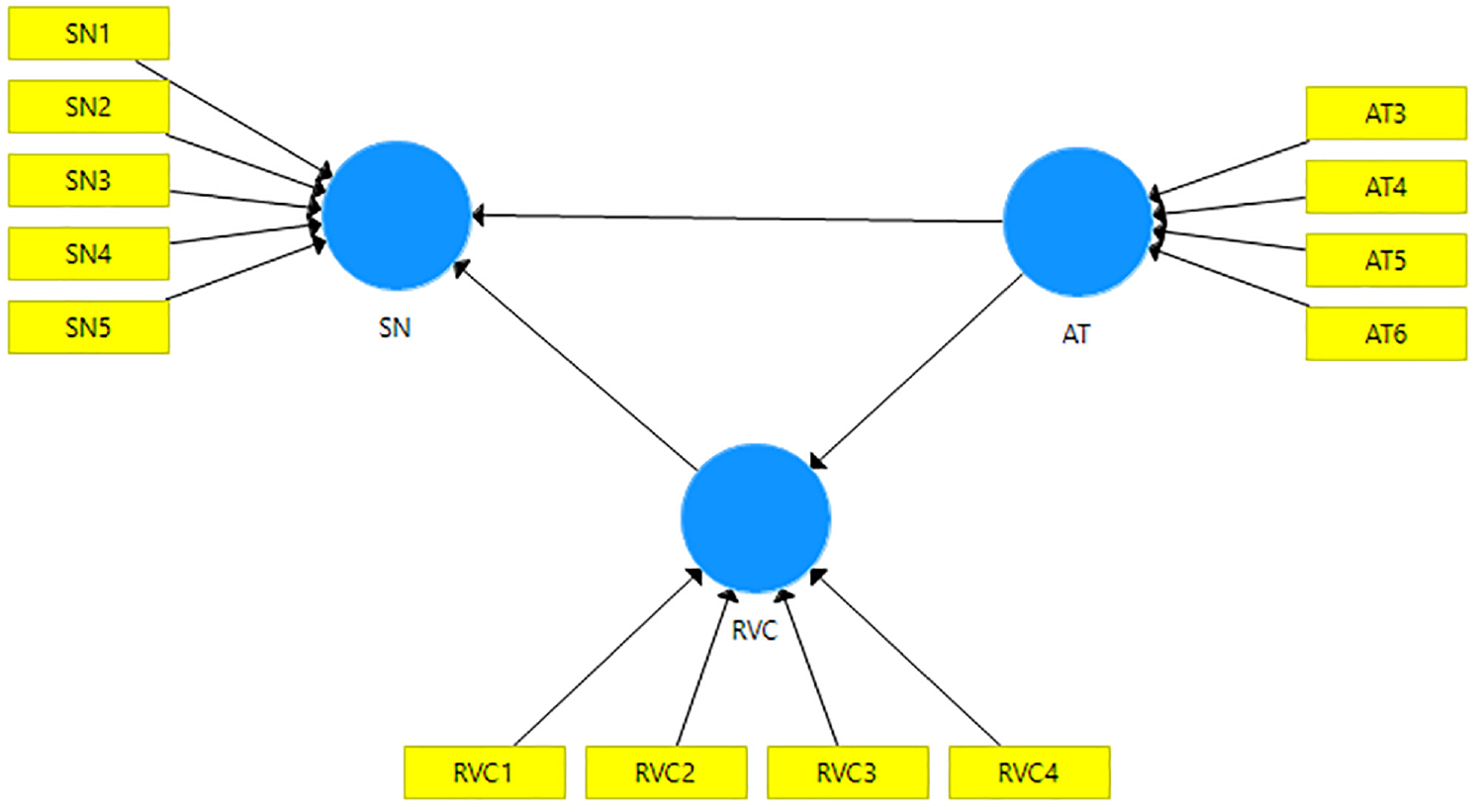
The suggest structural relationships confirmed among factors of the cinemagoers’ willingness in the post Covid-19 era.
Summary of All the Items Loading Weight.

As indicated in Table 2, there were a total of 13 items that were validated and kept in the proposed model. When it comes to the AT, RVC, and SN, all goods had factor loading more than 0.70. Table 2 shows the overall items loading factor for a variety of goods.
The item factor loadings for all of the items were greater than 0.70 (0.701–0.948). Furthermore, each factor’s CR values were greater than 0.70 (0.898–0.955), the average value of each factor was greater than 0.50 (0.688–0.842), and the Cronbach’s alpha value for each factor was greater than .70 (.848–.937), all of which exceeded the minimum value of .70 (.848–.937); all of the measurements can be found in the following table (see Table 3).
Result of the Confirmatory Factor Analyses and Reliabilities of the Model (n = 414).

Correlations Among the Factors and the Discriminant Validity
On the right-hand side of Table 4 is the correlation matrix, as well as the square root of the AVE value of the Malaysian cinemagoers’ willingness to pay in the post COVID-19 era component. Results revealed that all three variables had a statistically significant relationship with one another. According to the findings, the square root of the AVE value of each variable was greater than 0.5 and greater than the Pearson’s correlation coefficients between each variable and the others in terms of discriminant validity. As a result, the researchers were able to validate that the three factors in the study of cinemagoers’ willingness after COVID-19 were valid discriminants.
The Correlations and the Discriminant Validity Among the Factors of the Cinemagoers’ Willingness in the Post Covid-19.
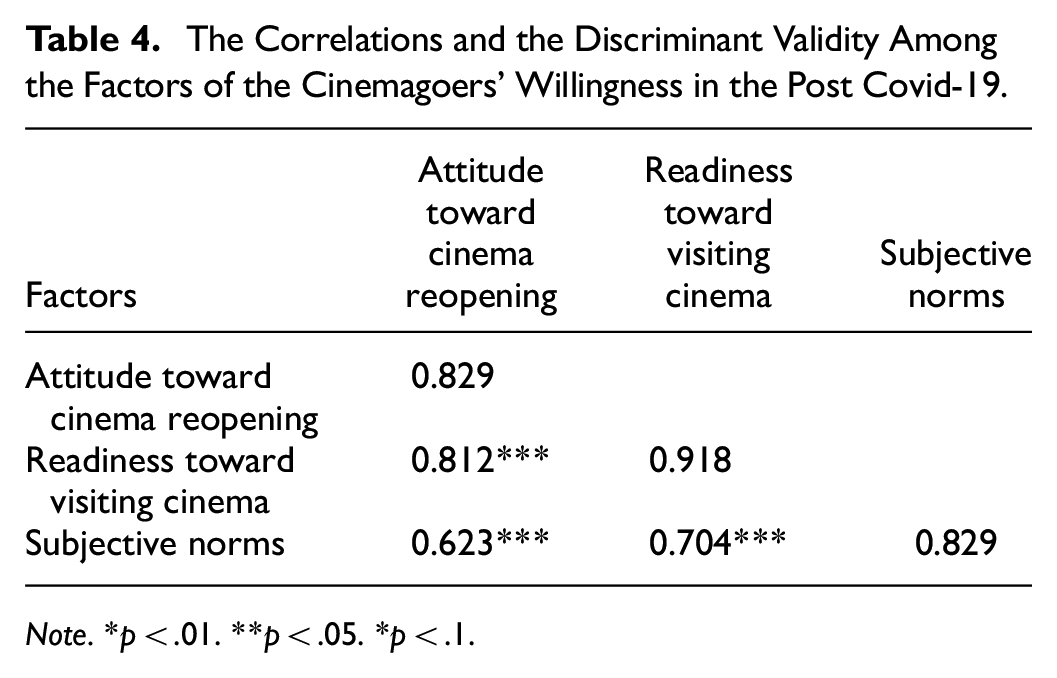
Note.*p < .01. **p < .05. *p < .1.
The Structural Relationships
PLS-SEM was also used to investigate the structural links between the five computational thinking scale variables that were measured with the participants. Figure 2 depicts the pathways that were statistically significant (established in this study by a p-value of less than .05). Specifically, according to Figure 2, the Attitude Toward Cinema Reopening (AT) was found to be positively related to the Readiness Toward Visiting Cinema (RVC) (path coefficient 0.812, p = .001; adjusted R-square .659), and the Subjective Norms (SN) was found to be positively related to the Readiness Toward Visiting Cinema (RVC) (path coefficient 0.584, p = .001; adjusted R-square .500). The Subjective Norms (SN) did not predict the Attitude Toward Cinema Reopening (AT), and the path coefficient for the AT was 0.148, which was significant at the 0.001 level (adjusted R-square .611).
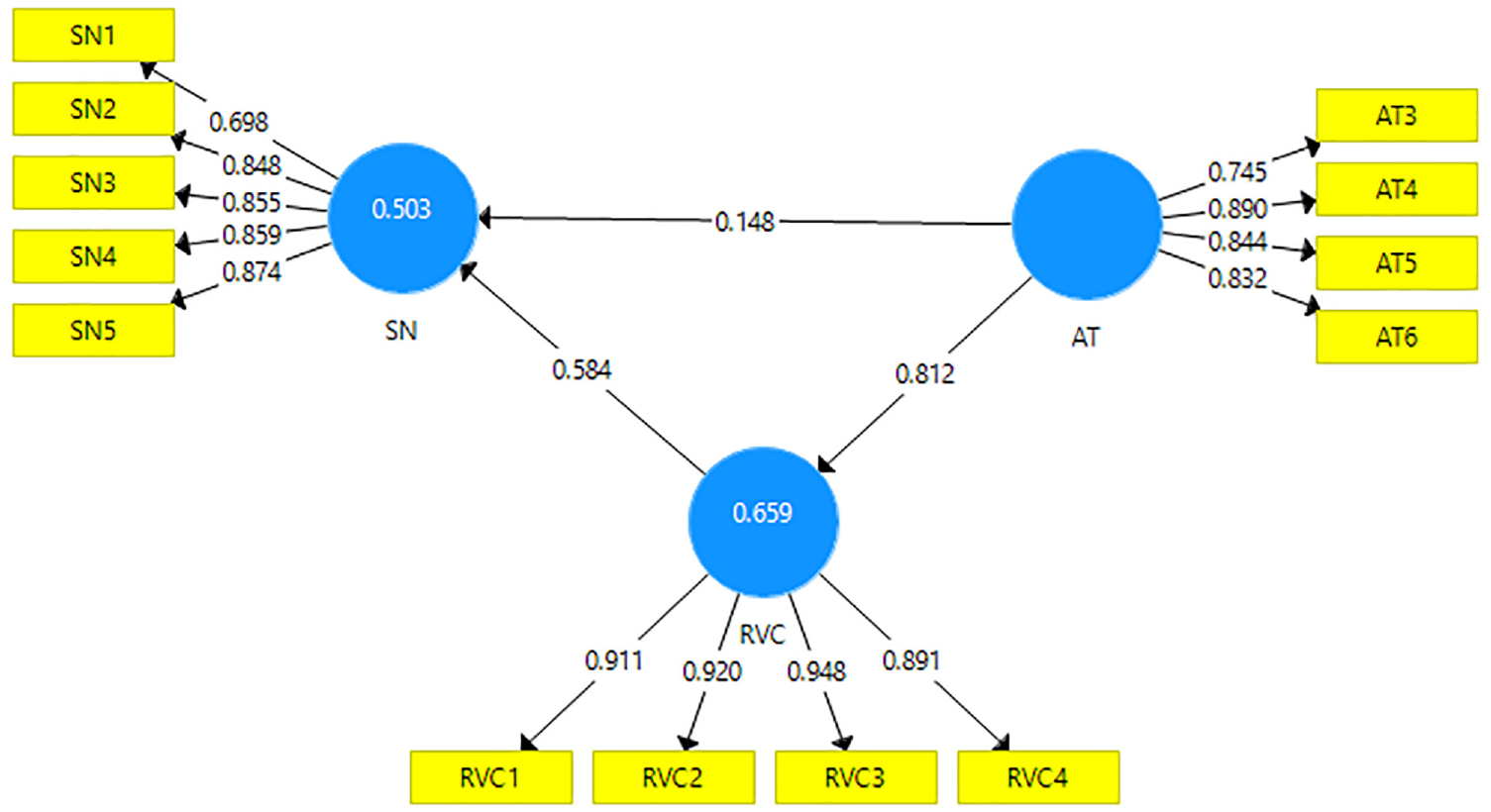
The structural relationships confirmed among the factors of the cinemagoers’ willingness in the post Covid-19 era.
Discussion
Through the use of a PLS-SEM method of analysis, this study could not only confirm the reliability and validity of the factors of Malaysian cinemagoers’ willingness in the post COVID-19 era, but also rectified the proposed structural relationship among the factors of the cinemagoers’ willingness in such a context. Consequently, the Attitude Toward Cinema Reopening (AT) and Readiness Toward Visiting Cinema (RVC) are able to significantly predict all the related factors of cinemagoers’ willingness in the post COVID-19 era. Therefore, the factors of cinemagoers’ willingness in the post COVID-19 era has been supported according to the evidence found in the study.
The interviews with participants revealed that they chose to consume streaming content while cinemas were closed during the COVID-19 lockdown. As streaming platforms became the primary source of entertainment during the lockdown, their popularity surged even further. According to Latiff et al. (2022), the onset of COVID-19 in Malaysia led to a surge in new users of streaming platforms, reaching 14.1 million in early 2020 (p. 2128). It has been witnessed that “the advent of streaming can be seen as part of a shift that has been termed the post-network” (Spilker & Colbjørnsen, 2020, p. 1214), and “The penetration of streaming video has increased intensely during this pandemic as millions have been forced to operate from home” (Wang et al., 2020, p. 1547). However, this study found that such changes of film consumption do not show any evidence that it changes the Malaysian audiences’ willingness to watch films at the cinema theatres. The experience of cinema-going seems irreplaceable and echoes the statement made by Weaving et al. (2020): … participants placed on the social aspect of all of these various cultural, leisure and entertainment ‘experiences’ offers some pointers to the … film industry in its quest to understand and exploit audiences’ valuing of movie-going … Matrix found that the streaming experience frustrates some viewers as it disrupts ‘cultural unification’(p. 90).
The participants still find the experience of cinema-going could not be replaced by streaming media. Therefore, their attitude toward cinema-going could be regarded as positive. The Malaysian participants believed their behavior of cinema-going is a form of support toward local entertainment industry; they showcased their plans to visit the cinema on a regular basis once the local authority had reopened the venue-based sectors at the end of 2021. They have demonstrated anticipation and overwhelming readiness to enjoy films at the cinema theatres by following the relevant SOP. Moreover, such readiness for this behavior is not only on an individual base but also in a collective manner.
By analyzing the data related to subjective norms, this study found that the behavior and decision of visiting the cinema are not merely determined by the individual, but the surroundings. The interviews with the participants also informed on the concerns of their family members, friends, and those with whom they have regular physical contact have become the agent of decision-making in terms of cinema-going. They have showcased concern on individual and family well-being while home has become the most-used common space. Consequently, the interviews tell that there has been a notable shift toward prioritizing individual and familial health considerations, leading to a heightened reliance on the home environment as the primary communal space. Malaysian participants displayed some contradictions in terms of planned behavioral patterns. Their attitudes toward cinema-going, and readiness toward cinema-going displayed positive indications of subjectivity whereby the concerns on safety and health of their surroundings were also dominant. This duality highlights the complex interplay between individuals’ intrinsic desires for leisure activities and their heightened awareness of health risks posed by public gatherings, underscoring the multifaceted nature of decision-making processes in the post-pandemic landscape.
Conclusion and Limitation
An ontological approach serves as a prompt pointing to a conceptual model of an emerging analytic domain of cinema audiences. This initiative will foster accessibility by ensuring that “the ontology, data, and a series of data analytical tools openly accessible to film development stakeholders for use in their own work” (Hanchard et al., 2020, p. 13). For this study, the cinema audiences are specifically those that are gradually exposed to venue-based sectors in Malaysia—a country which is shifting to the recovery phase in the backdrop of the coronavirus pandemic. The Malaysian government has “demonstrated much effort in paving the way for the sector to recover” (Ho & Sia, 2020, p. 196). This study offers invaluable insights into a paradigm shift that has reshaped the dynamics of audience engagement with cinema, providing a nuanced understanding of the challenges and opportunities inherent in this evolving landscape. According to statistics provided by the National Film Development Corporation Malaysia (The National Film Development Corporation Malaysia, 2023), cinema viewership in 2020 and 2021 amounted to 1.2 and 2.92 million, respectively. Worth noting is the slow increase in viewership witnessed in 2022, which represented just one third of the figure recorded in 2019.
In this respect, from the interview, the researchers attempt to understand the potential emerging factors which might determine Malaysian citizens’ willingness to watch films at the cinema theatre. The quantitative methods have become the significant process which has further confirmed and testified of the new actors that drive the behavior of cinema-going in the social background of the COVID-pandemic. Although this study examines the audiences living in Malaysia only, it aims to make the identified new emerging variables and their visualizations correlated to the pandemic of COVID-19 available to audience development stakeholders. Therefore, they may find them useful for decision-making in sustaining the cinema industry.
A limitation of the study may be the participant selection and audience past experience in watching movies. The data were collected from participants who may have had more or less experience than others with watching movies. Whether the patterns are the same for other generations of movie goers is an interesting question to be explored in future studies. The proportion of senior citizen participants in the interviews is less than one-fourth. Future research may benefit from a more diversified sample, including individuals from higher age groups, as “they may offer distinct perspectives” (Gupta & Singharia, 2021, p. 43) on the consumption of streaming services and their inclination toward cinema attendance. Furthermore, other possible variables may also affect and contribute to the willingness of the cinemagoers in the post COVID-19 era, and these variables need to be studied in greater detail, as the literature is still limited. Therefore, future studies may further rectify and elucidate the possible effect, role, and position of the willingness of the cinemagoers, and their subjectivity to the situation of COVID-19 pandemic/endemic. As the primary purpose of the current study is to investigate the willingness and readiness of the cinemagoers, other issues related to cinemagoers are not included. These include the variables related to emotion, other behaviorism and capability; These variables may possibly be significant to examine and investigate in future studies.
Footnotes
Author’s Note
This research was conducted while Lucyann Kerry was at Chadron State College. She is now at Tom Hanks Center for Motion Pictures, Wright State University.
Declaration of Conflicting Interests
The author(s) declared no potential conflicts of interest with respect to the research, authorship, and/or publication of this article.
Funding
The author(s) disclosed receipt of the following financial support for the research, authorship, and/or publication of this article: This work was supported by the Xiamen University Malaysia Research Fund [XMUMRF/2021-C8/IART/0012].
Ethical Approval
This research project involves ethical issues of privacy regarding data collection from Malaysian citizen through the use of interviews and questionnaire. All data were provided anonymously. The interview questions and the questionnaire were reviewed, assessed and approved by Ethics Committee of Xiamen University Malaysia (REC-2111.01).

Data Availability Statement
Data sharing not applicable to this article as no datasets were generated or analyzed during the current study.