




Abstract
Brand Service Recovery Strategies (BSRS) have garnered significant attention due to their transformative potential in traditional business practices. However, the precise influence of BSRS on fostering positive Electronic Word of Mouth (eWOM) remains inadequately elucidated within the academic literature. Most scholarly investigations have tended to adopt either a theoretical perspective or have overlooked intermediary factors, particularly the role of consumer attitudes toward the brand. Drawing upon the Social Exchange Theory, this study presents an empirical model that seeks to examine whether consumer attitude toward the brand mediates the relationship between BSRS and positive eWOM. Based on survey data from 292 Executive MBA students in a large Chinese university, our study confirms that BSRS strongly impact consumer attitudes, leading to increased positive eWOM. Additionally, we discover that consumer power plays a moderating role, highlighting its contextual importance in this relationship. This study provides vital practical insights for businesses, emphasizing the need for comprehensive strategies involving BSRS, fostering positive consumer attitudes, active eWOM engagement, tailored approaches for consumer power, and ongoing adaptation to customer feedback, all contributing to improved brand perception and customer satisfaction in today’s business environment.
Plain Language Summary
This study builds on the social exchange theory to offer and empirically test a model exploring whether consumer attitude toward the brand mediates the relationship between BSRS and positive eWOM. Using data from surveys of 292 participants enrolled in Executive Master of Business Administration program of large public sector university in China, we tested a proposed model using regression analysis. The empirical results support our predictions that BSRS affect consumer attitude toward the brand, which, in turn, affect positive eWOM. These outcomes establish attitude toward the brand as positive mediator in the relationship between BSRS and a positive eWOM. Additionally, the consumer power also moderated this relationship. Managerial implications therefore are presented.
Introduction
Word of mouth (WOM) is a widespread and influential phenomenon that occurs both online and offline. It involves informal communication among consumers about the ownership, usage, or attributes of specific products, services, or their sellers (Westbrook, 1987). WOM can take place through various platforms, including review websites, social media, and in face-to-face interactions. When this communication occurs through online channels, it’s referred to as electronic word of mouth (eWOM), further amplifying WOM’s impact on consumer behavior. Positive eWOM entails consumers engaging with one another through online means like websites, blogs, chatrooms, or email, and it plays a significant role in shaping consumer perceptions and actions (Grewal et al., 2022).
Existing research has highlighted the positive impact of eWOM on various aspects of brand performance, including sales revenue, customer satisfaction, and trust (Miremadi et al., 2021; Wong & Haque, 2022). While studies have explored eWOM within face-to-face communication contexts (Mai & Liao, 2022), its relevance is increasingly significant in online shopping environments (Zulauf & Wagner, 2022). However, previous research has not delved into the specific factors that drive positive eWOM. Traditionally, research on eWOM antecedents has primarily focused on intrinsic factors like social bonding and self-affirmation needs, as well as extrinsic factors such as service quality, loyalty, and satisfaction (L.-C. Yu & Hsu, 2022). Surprisingly, little attention has been given to brand service recovery strategies (BSRS), despite their recognized importance in consumer research. Calls for further exploration in this area have underscored the need for a deeper understanding of the influence of BSRS. To address this research gap, our study aims to investigate how BSRS contribute to and clarify the emergence of positive eWOM.
This research revolves around two fundamental questions: (1) Do BSRS influence the level and intensity of engagement in positive eWOM? (2) If so, what mechanisms underlie this influence?
BSRS have been recognized as crucial in re-engaging consumers following service failures (Stauss & Friege, 1999). These strategies can be categorized into emotional recovery, aimed at fostering emotional connection and trust in the customer-brand relationship (J. Wei et al., 2023), and economic recovery, which offers tangible compensation for losses (Cerra & Saxena, 2008). Responding effectively to service failures can stimulate positive consumer behaviors, including generating positive eWOM (Donthu et al., 2021). The choice of BSRS should be tailored to the extent of the service failure (Halima et al., 2021; Thakur & Hale, 2022). Thus, online brands must maintain enduring customer relationships by promptly implementing the most suitable BSRS following a service failure.
Considering that BSRS have a predictive relationship with positive eWOM, this study posits that attitude toward the brand (ATB) acts as a mediator in this process. ATB represents an individual’s predisposition to react favorably or unfavorably to a specific brand following exposure to advertising stimuli (Phelps & Hoy, 1996). Indeed, word-of-mouth behavior is influenced by consumers’ ATB (Mishra et al., 2022). BSRS aid in shaping a positive brand image, which, in turn, influences consumers to perceive the brand as distinct and fosters a more favorable attitude toward it. ATB is a precursor to customer loyalty, as reflected in positive eWOM and consumer citizenship behavior.
Furthermore, in the world of service recovery strategies, where emotions run high, there’s an intriguing twist to consider: the role of consumer power in moderating this relationship. BSRS come in a variety of flavors, offering consumers both tangible, like money, and intangible, like emotional, benefits. But here’s where it gets interesting: power isn’t just about who’s in control; it’s also about who wields the resources (Peinkofer et al., 2022). Service recovery strategies are like communication pathways where companies and consumers come together to tackle issues stemming from a not-so-great service experience (Gannon et al., 2022). But here’s the twist—consumers with different levels of power play favorites and make judgments differently (Tassiello et al., 2021). So, it’s not just about what the company offers; it’s also about who holds the cards, and that can shape how service recovery strategies play out in the grand theater of consumer-business interactions.
This study employs the Social Exchange Theory (SET), as proposed by Blau in 1964, to underpin our conceptual framework. According to SET, relationships between individuals are formed through a process of weighing costs and benefits (Blau, 1964). SET posits that individuals share their resources with the expectation of receiving something in return, a concept often referred to as the theory of reciprocity (Emerson, 1976). This theory asserts that social exchanges occur within autonomous relationships, where outcomes depend on the efforts and decisions of the parties involved (Ferm & Thaichon, 2021; Kuruzovich et al., 2021). In the context of SET applied to branding, brand owners invest in service recovery strategies with the expectation that online consumers will reciprocate by sharing positive information about their brand, whether on social media platforms or through face-to-face interactions.
In summary, this study makes three significant contributions to the existing literature. Firstly, it investigates the impact of two specific BSRS on the generation of positive eWOM. Previous research has predominantly focused on the positive consumer responses to BSRS, making this a novel exploration. Secondly, our study delves into the role of ATB as a mediating mechanism, enhancing our understanding of the processes underlying consumers’ generation of positive eWOM. This examination of the mediating role of ATB provides valuable insights for businesses aiming to improve their service recovery strategies in the face of failures. Prior research has not extensively explored the connection between ATB and BSRS. Lastly, we explore the moderating influence of consumer power. Consumer power has emerged as a crucial aspect of societal dynamics, with psychological studies highlighting its impact on perceptions of recovery strategies and WOM. For instance, C. Prakash and Majumdar (2021) found that individuals with high levels of power engage in positive eWOM to alleviate negative emotions and focus on long-term goals. Other studies have shown that high-power consumers prefer status-enhancing public refunds following service failures (C. Wei et al., 2020) and exhibit lower negativity toward service providers (Hu, 2022). Building upon these findings, our study investigates how various BSRS strategies influence the generation of positive eWOM, taking into account the moderating role of consumer power.
This paper is structured as follows: In the next section, we present the theoretical framework and outline the hypotheses. We then proceed to elucidate the methods employed for our analysis. Following that, we present our findings, which form the basis for our discussion and the implications of our results. In the final sections, we address the limitations of our study, suggest future directions for research, and conclude our paper. Our theoretical model is visually represented in Figure 1.

Research framework.
Literature Review and Hypothesis Development
Social Exchange Theory
Social Exchange Theory (SET) posits that individuals in the marketplace aim to maximize profits while minimizing losses (Blau, 1964). This theory suggests that people constantly assess personal benefits from their actions and tend to favor relationships they believe offer more rewards than costs (Blau, 1964; Homans, 1958; Smith, 1986). These responses can manifest as relational or behavioral, potentially leading to increased commitment to a brand. Conversely, negative interactions may deter close associations, resulting in poor relationship quality. SET views social life as a series of transactions between two or more parties (Urbonavicius et al., 2021). According to SET, individuals respond to positive actions with more positive interactions, considering the benefits they expect to receive in return for their contributions. Greater perceived benefits increase the likelihood of individuals investing in a relationship. SET also assumes that all human relationships involve costs and rewards. People assess the value of their associations to make rational decisions. Relational partners apply economic principles to minimize costs (e.g., time, money, emotional energy) and maximize rewards (e.g., companionship, affection, love).
Expanding on these principles, SET suggests that consumers are more likely to engage with brands when they perceive higher benefits. Personal costs and benefits influence consumer behavior (Wengler et al., 2021). Recognition by consumers enhances perceived value in the relationship process (Michel et al., 2022). Research has shown that consumers are more likely to assist others when they perceive greater value being offered by a brand (Batra et al., 2022). The strength of the SET model lies in its holistic approach, which considers self-interests, rational decision-making, and emotional processes in the pursuit of maximizing profit and minimizing costs. Therefore, scholars have utilized SET as a theoretical framework to explore consumer responses to BSRS and their outcomes, such as eWOM, repurchase intentions, and purchase intentions (Babin et al., 2021).
Brand Service Recovery Strategies and Positive Electronic Word of Mouth
Service recovery involves a service provider’s response to a service failure (Grönroos, 1988). Two main categories of service recovery have been identified—emotional recovery and economic recovery (Lu et al., 2021). Emotional recovery entails the brand offering an apology and an explanation for the service failure (I. Y. Yu et al., 2021), while economic recovery strategies involve the brand addressing disappointments by providing alternative services, refunds, or related monetary compensation, such as vouchers, discounts, or gifts (Shen et al., 2019).
Previous research has shown that when a BSRS fails to meet consumers’ expectations, consumers may not engage in positive eWOM, potentially leading to a reduction in the brand’s market share and reputation (Hydock et al., 2020; Khamitov et al., 2020). In contrast, following an effective BSRS, consumers are more inclined to forgive brand mishaps and are more likely to recommend the brand to others (Tan et al., 2021). BSRS encompasses elements such as courtesy, issue resolution, and effort made by the brand to assist consumers after a service disappointment, which collectively enhance the brand’s evaluation. Drawing from SET, emotional recovery strategies are seen as a way to redistribute goodwill as a crucial social resource in a transactional relationship (Cerra & Saxena, 2008). By employing emotional recovery, a brand signals its willingness to take responsibility for the disappointment, demonstrating its commitment to maintaining consumers’ satisfaction (Y. Wang et al., 2021). Previous research suggests that consumers are more inclined to share positive eWOM about a brand’s missteps following emotional recovery efforts (Yuan et al., 2020). Apologies, in particular, have been identified as a highly influential factor under the control of the wrongdoer in eliciting positive eWOM from the victim (Purbadharmaja et al., 2021).
As Gannon et al. (2022) suggest, offering an economic refund is a tangible and straightforward recovery strategy that can make a brand appear compassionate and concerned about its consumers’ interests. However, Su et al. (2021) caution that providing refunds without explanations may not change consumers’ perceptions; instead, it can lead to consumers viewing the brand as guilty and rude, ultimately resulting in negative evaluations. Monetary incentives have been found to be less effective than apologies in persuading customers to remove negative feedback (Rahman & Valentine, 2021). Additionally, offering economic refunds can increase the brand’s expenses without improving consumer satisfaction (H. Li et al., 2020). Consumer experiences, views, and attitudes toward a product or service collectively form brand perception (I. Y. Yu et al., 2021). It represents what people believe a brand offers, irrespective of the brand’s claims. Positive brand perception indicates a higher likelihood of people choosing the company over competitors (Gannon et al., 2022). It also suggests an increased likelihood of attracting new customers to the business, as 60% of customers tend to refer their preferred companies to friends and family (Thakur & Hale, 2022).
Recovery strategies are methods for restoring a company’s operations to an acceptable standard following a service disruption, with evaluation based on recovery time objectives established during market impact analysis (Zulauf & Wagner, 2022). Service recovery is crucial as it enables businesses to meet customer needs and prevent customer defection. It provides an opportunity for companies to maintain and cultivate customer relationships, ultimately leading to greater customer satisfaction and a unique brand perception. Research indicates that successful BSRS can lead to positive eWOM (Coombs, 2007b; Ma, 2023). However, some studies suggest that relying solely on one form of BSRS may weaken the impact of positive eWOM (Donthu et al., 2021). Consequently, it is concluded that simultaneously implementing both economic and emotional recovery strategies can result in positive eWOM from consumers who are both economically and emotionally satisfied. Therefore, we hypothesize that:
Mediating Role of Attitude Toward the Brand
In the realm of advertising and marketing research, attitudes have garnered significant attention for two compelling reasons: firstly, they serve as reliable predictors of consumer behavior, and secondly, the field benefits from an array of well-established theoretical perspectives on attitudes, simplifying the research process on this pivotal variable. The enduring relevance of attitudes is evident in the American Marketing Association’s annual conference dedicated to attitudes since 1970 and the prevalent use of attitude-based hierarchy of effects models. Notably, attitudes toward brands emerge as a particularly prevalent attitudinal construct, frequently applied across various advertising sectors, including tracking studies, brand extensions, and brand evaluations.
Mitchell and Olson (1981) define attitude toward the brand as an “individual’s internal evaluation of the brand,” representing the overall like or dislike a customer holds, which can fluctuate over time. ATB plays a pivotal role in brand management (I. Y. Yu et al., 2021). Brand attitude reflects consumers’ favorable assessments of a specific brand, signifying its appeal (Paul, 2019; Xie et al., 2019). ATB is linked to consumer preferences and their overall evaluation of a brand, showcasing their inclinations (Niedermeier et al., 2021). As Dhun and Dangi (2022) suggest, attitudes can be either positive or negative, with fostering a positive ATB proving beneficial and resulting in positive eWOM. Previous studies have examined ATB as a mediator (X.-W. Wang et al., 2019). For instance, Honora et al. (2022) investigated the impact of BSRS on positive eWOM (Tran et al., 2021) using responses from FMCG firms with top corporate social responsibility expenditures. Their findings suggest that consumers subconsciously process corporate social responsibility details and may not distinctly recall specific aspects. However, these consumers are more likely to consider the brand favorably when influenced by positive attitudes that linger behind. K. Yang et al. (2017) established ATB as the link between brand awareness and purchase intention. According to Coelho et al. (2018), brand image aids consumers in forming relationships based on personality traits, ultimately fostering positive attitudes toward the brand and building trust. Despite both BSRS and consumer attitude toward the brand being recognized as crucial components in customer-brand positive eWOM relationships (S. Yang et al., 2022), only a limited number of empirical studies have simultaneously investigated both variables (e.g., Tan et al., 2021; E. S. T. Wang & Chang, 2013).
We argue that specific BSRS can lead to the development of favorable brand attitudes, subsequently influencing the generation of positive eWOM. For example, when customers encounter an effective service recovery process, it often results in the cultivation of trust and loyalty toward the brand (Chu et al., 2019). These trust and loyalty components play an integral role in shaping a positive attitude toward the brand (Coombs, 2007a; Pang, 2021). Customers who place their trust in and exhibit loyalty to a brand are more inclined to adopt the role of brand advocates, thereby disseminating positive eWOM (Yusuf et al., 2018). Similarly, effective BSRS extend beyond addressing immediate issues and contribute to the establishment of enduring customer relationships (Banerjee & Pal, 2023). When customers witness a brand’s commitment to rectifying problems and prioritizing their satisfaction, it augments their propensity for long-term loyalty, subsequently enhancing the generation of positive eWOM (Arghashi et al., 2021). In fact, brands can assess the efficacy of their service recovery strategies by monitoring shifts in customer attitudes and their subsequent eWOM expressions (Wu et al., 2023). This approach allows for data-driven decision-making and the fine-tuning of strategies to optimize the generation of positive eWOM (Fan et al., 2023). In sum, by comprehending and proactively managing the customers ATB, brands can foster a more favorable brand image, reinforce customer loyalty, and ultimately reap the benefits of promotion through eWOM for their products or services. Therefore, we posit the following:
Moderating Role of Consumer Power
We propose that consumer power moderates the relationship between BSRS and ATB. Consumer power consists of two components: “personal power,” related to individuals’ freedom and resources, and “social power,” involving the ability to influence outcomes (Tassiello et al., 2021). Consumer awareness of their own power, shaped through interactions with BSRS following service failures, impacts both their ATB and positive eWOM. Surprisingly, the link between power and positive eWOM has received limited attention in interpersonal relationship research (Kankhuni & Ngwira, 2022) and remains largely unexplored in consumer-brand relations.
The perception of power plays a critical role in shaping consumer positive eWOM and behavior. Specifically, we suggest that when a service failure occurs, consumers anticipate that the brand will compensate for their losses (de Kervenoael et al., 2022). This aligns with SET, which involves a reciprocity process where one party tends to reciprocate the actions of another party (H.-W. Kim et al., 2018). Prior studies demonstrate that in a service recovery context, consumer power generally leads to more favorable assessments of ATB (C. Wei et al., 2020). As consumers understand that brand recovery outcomes (whether economic or emotional) are influenced by how they are treated and the effort the brand invests in resolving the situation, our research emphasizes the role of consumer power. Current studies indicate that high-power consumers place more importance on brand attitudes than low-power consumers (Li et al., 2022). High-power individuals tend to be more self-focused and less concerned about others’ needs (Tassiello et al., 2021). However, when high-power consumers consider others, their self-focus drives them to ensure their own interests are met, thus prioritizing their attitude. High-power consumers also tend to exhibit greater optimism (Nguyen & Nao, 2022), which, in turn, leads to more positive social outcomes, including a positive attitude. When consumers feel empowered, they view this as a desirable state to attain (Choi et al., 2018). Consequently, high-power individuals actively seek to maintain this status, sometimes by acquiring assets like knowledge (C. Wei et al., 2020). In contrast, low-power individuals may lean toward emotional recovery. For high-power consumers, equality and the brand’s apology may hold more significance than economic compensation in the context of service recovery. Therefore, we propose that high-power consumers prefer emotional recovery as it aligns with their desire to maintain their empowered status.
Understanding the influence of consumer power on BSRS and ATB is vital in consumer research. ATB plays a crucial role in shaping consumers’ perceptions of technology, products, or activities, ultimately impacting online consumers and positive eWOM. Previous research indicates that consumers’ perceptions of power positively influence their assessments of consumer power (Lieber-Milo, 2022), while the reverse effect is not consistently observed. High consumer power leads to a rise in their pro-social tendencies, including forgiveness (Guinote, 2017). High-power consumers, due to their better understanding of positive attitudes, place greater importance on perceiving BSRS efforts as genuine and fair compared to low-power consumers. When consumer power is high, it prompts consumers to exhibit a positive attitude and generate positive eWOM about the brand. We suggest that, for consumers with high power, acceptance of recovery strategies hinges on their perception of the strategies’ authenticity. This acceptance subsequently leads to positive ATBs and results in positive eWOM. In essence, consumer power enhances consumers’ positive ATBs. Hence:
Interestingly, the concept of consumer power has not been argued as a simple way to spread, as it is highly allied to how consumers react toward a situation. For example, for low-power consumers, the literature is unclear on whether they prefer comfort or money. Thus, researching this circumstance’s effect on individuals’ brand attitudes and positive eWOM is crucial for consumer research (Fan et al., 2023). ATB helps form the realization of the values of certain technologies, products, or activities, which converts a valued factor for online consumers and positive eWOM. Previous investigation reveals that consumers’ perceptions of power will come first and positively inspires their assessments of consumer power (Lieber-Milo, 2022). Meanwhile, the opposite progressive effect is not maintained. As consumers’ power of recovery outcomes (i.e., distributive usefulness) is influenced by the way they have been treated and the efforts made by the firm to resolve the condition, our study focuses on consumer power. Consumer power will improve consumers’ positive eWOM. Furthermore, for both high- and low-power consumers, indications of ATB can cause an upsurge in their prosocial directions, which include understanding others (Guinote, 2017). Given high- and low-power consumers’ greater understanding of positive attitude, they find importance in perceiving ATB as positive; hence, this scenario results in positive eWOM toward the brand. We then posit that for consumer power to develop a positive ATB, they must first be satisfied with the brand. As a result, consumer power will improve consumers’ positive ATBs, which will result in positive eWOM. Therefore:
Research Method
Sample and Procedures
During November–December 2018, we conducted an online survey to collect primary data and gather relevant demographic information from respondents. We employed the widely used convenience sampling technique to collect data. Convenience sampling involves selecting participants who are easily accessible and readily available, rather than using a random sampling approach. Our target demographic consisted of individuals enrolled in an Executive Master of Business Administration (EMBA) program at a large public sector university in China, aged between 22 and 35. We clearly communicated the research objectives and ensured complete anonymity and confidentiality when distributing the questionnaire to the targeted participants.
We used pre-validated measures to assess all variables prior to receiving advice and helpful comments from three university researchers. The survey was then pilot tested with 10 target sample participants. This was undertaken to determine the instrument’s face and content validity. We then adjusted the questions based on the comments from the pilot test as well as the researchers. For participants to be able to answer the questionnaire, the first author took the permission from the department for them to conduct the study. After the respective departmental permission, the author outlined the purpose of the study to the respondents before administering the survey. Additionally, they were told that the study was voluntary and then requested to sign a consent form attached to the survey. The participants completed a survey that contained questions on demographics and then regarded the items linked to BSRS, ATB, consumer power and positive eWOM.
The questionnaire was designed in English and then translated to Chinese following the back-translation procedure suggested by Brislin (1980). We then back-translated the questionnaire to remove any substantial differences in the meaning of the items. Of the 300 questionnaires distributed, 292 usable responses were obtained thus gaining an effective response rate for data analysis. Demographic information of respondents is given in Table 1.
Demographics of the Respondents.

Measures
All the variables were measured on a five-point Likert scale from 1 = strongly disagree to 5 = strongly agree. A 5-Likert scale is preferred over a 7-Likert scale because it relieves respondents’ burden of feeling deluged by the number of options available, and it takes less time and effort to complete, resulting in a higher response rate. Additionally, it generates reliable quantitative data with a lower margin of error that is relatively simple to analyze and interpret.
BSRS
The measures was the 17-items instruments amended from Mostafa (2017), which contained four dimensions: apology, compensation, speed of response and courtesy. The participant’s responses to the items of each measurement were averaged into a composite score; a higher score indicated greater service recovery. This scale has been previously used in various studies (e.g., Khoa, 2022). Sample items were “The company apologized to me for what had happened” for Apology, “The compensation the company gave me for the loss incurred is good” for Compensation, “The company reacted promptly to my inquiries” for Speed of response and “The service provider was friendly to me” for Courtesy. The online consumers were asked how often the online brands owners have displayed their behavior (brands failure) that includes BSRS questionnaires (Sarkar et al., 2021). Cronbach’s alphas were .784.
ATB
Four scales were improved from Aaker and Biel (1993). This scale has been previously used in various studies (e.g., Halima et al., 2021; Sanyal et al., 2023). Sample items including “I like the idea of an online brand’s services.” Cronbach’s alphas were .834.
Positive eWOM
The participants rated positive eWOM scale developed from Verhoef et al. (2002). Previously, this scale has been used in various studies (e.g., Wong & Haque, 2022; Zhang et al., 2022). Sample items included “I have spoken favorably of this company to others.” Cronbach’s alphas were .847.
Consumer Power
The respondents rated the consumer power scale adapted from Anderson and Galinsky (2006). This scale has been previously used in different studies (e.g., Merdin-Uygur & Ozturkcan, 2023). Sample items included “To what extent do you feel powerful.” Cronbach’s alphas were .794.
Control Variables
We decided to control the factors that may possibly affect the selected variables in this study like age, gender and education on positive eWOM as previous research has shown their influence (e.g., Cheung et al., 2009).
Results
Data Analysis Strategy
We first calculated descriptive statistics and correlations in SPSS. Then, we tested the mediation effect of ATB using Hayes’ PROCESS Model 4 (Hayes, 2012) and examined the moderation role of consumer power with Hayes’ PROCESS Model 1, as seen in recent studies (Usman et al., 2021; D. Wang et al., 2023). Data were standardized for analysis.
Reliability and Validity
Reliability and validity were assessed through Cronbach’s alpha (CA), factor loadings (FL), composite reliability (CR) and average variance extracted (AVE). Table 2 shows the results of CA, FL, CR, and AVE, which indicated that all the values were in the acceptable range recommended by Hair et al. (2007) and Fornell and Larcker (1981) and validated by current studies (Kiani, Ali, et al., 2021; D. Wang et al., 2022). Furthermore, Table 3 exhibits that all values of the square root of AVEs were greater than the variable’s inter-correlations, as approved by recent studies (Kiani et al., 2020). Furthermore, the model fitness indices meet the criteria as λ2 = 1.944, CFI = 0.964, RMSEA=0.057, and SRMR=0.045 (Hu & Bentler, 1999).
Reliability and Validity Results.

Means, Standard Deviations and Correlations.

Note. BSRS = Brand Service Recovery Strategies; ATB = Attitude Toward the Brand; PeWOM = Positive Electronic Word of Mouth; CP = Consumer Power. The bold values are the square roots of AVE.
Correlation is significant at the .05 level (two-tailed).
Correlation is significant at the .01 level (two -tailed).
Preliminary Analyses
Table 3 shows the means, standard deviations, and correlations for all the variables. BSRS showed higher level of positive eWOM, which supports Hypothesis 1. Besides, BSRS was positively associated with ATB and ATB was positively associated with positive eWOM.
Mediation
We drew on PROCESS macro Model 4 developed by Hayes (2012) to examine hypothesis 2. BSRS was significantly associated with positive eWOM (β = .293, p < .01) and ATB (β = .246, p < .01). And the relationship between ATB and positive eWOM was also significant (β = .365, p < .01). The indirect effect of BSRS on positive eWOM via ATB was .157, with a 95% confident interval of [0.080, 0.243], which does not include zero. Therefore, ATB mediated the relationship between BSRS and positive eWOM, supporting Hypothesis 2. Result was shown in Table 4. The path results can be seen in Figure 2.
Mediation Effect.

Note.**p < .01, Bootstrap sample size = 5,000, CI = confidence interval; LU = lower limit; UL = upper limit; BSRS = Brand Service Recovery Strategies; ATB = Attitude Toward the Brand; PeWOM = Positive Electronic Word of Mouth.

Path results.
Moderation
We drew on the PROCESS macro (Model 1) developed by Hayes (2012) to test the moderating effect. It was predicted in H3 that the indirect associations between BSRS and ATB would be moderated by consumer power. The interaction between BSRS and consumer power was significant (β = .122, p < .01, t = 2.071, p < .01), so the relationship between BSRS and ATB was moderated by consumer power, supporting Hypothesis 3. Similarly, we tested H4 using PROCESS macro (Model 1). The interaction between ATB and positive eWOM was significant (β = .137, p < .001, t = 2.064, p < .40), supporting Hypothesis 4 that consumer power moderated the relationship between ATB and positive eWOM. Results are shown in Table 5.
Moderation Effect.
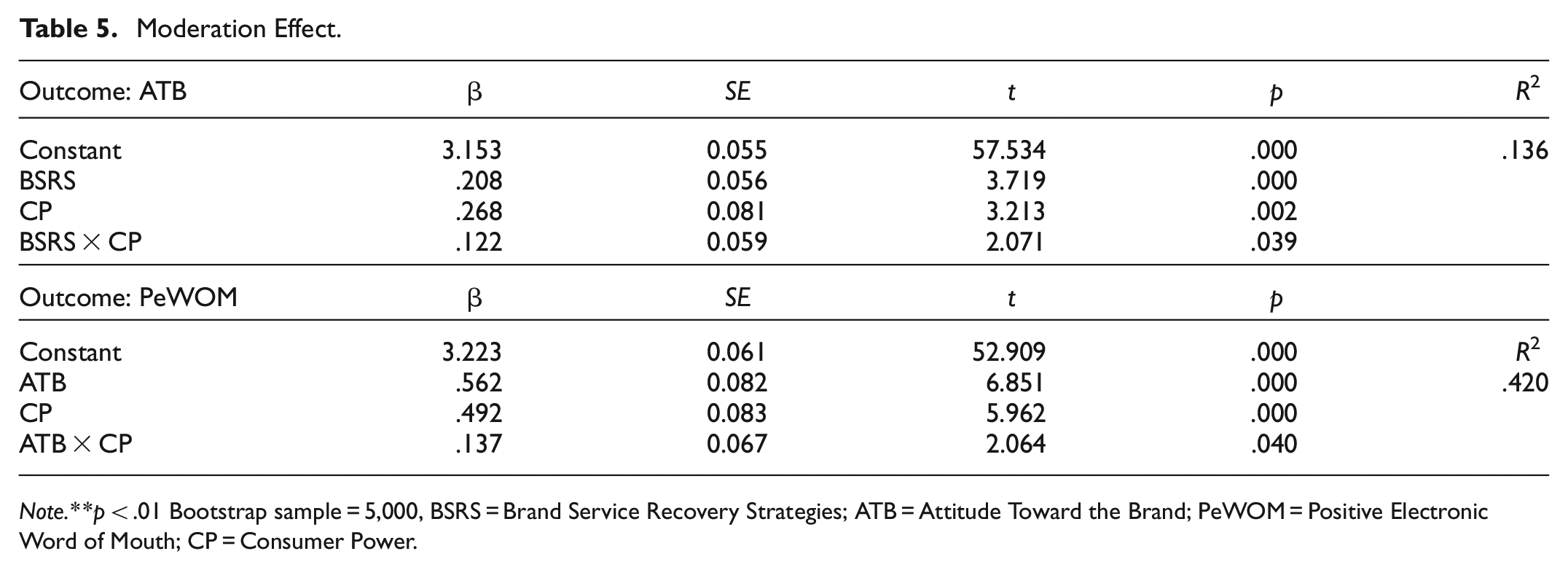
Note.**p < .01 Bootstrap sample = 5,000, BSRS = Brand Service Recovery Strategies; ATB = Attitude Toward the Brand; PeWOM = Positive Electronic Word of Mouth; CP = Consumer Power.
To describe it more directly, figure of predicted ATB against BSRS was plotted. Low and high levels of consumer power (1 SD below the mean and 1 SD above the mean, respectively) were showed in the figure separately (Figure 3). Result suggested that, BSRS were significantly associated with ATB for both highly and lowly consumer power. It is notable that highly consumer power was more likely to be influenced by BSRS compared with lowly consumer power ones. The relationship between ATB and positive eWOM for low and high level of consumer power was also plotted (see Figure 4). High levels of ATB were significantly associated with low levels of positive eWOM for both highly and lowly consumer power, but the positive eWOM level was higher for those highly consumer power (see Figure 4).

The moderating effect of consumer power between the relationship of brand service recovery strategies and attitude toward the brand.

The moderating effect of consumer power between the relationship of attitude toward the brand and positive electronic word of mouth.
Discussion
This study aims to verify whether BSRS lead to real-life positive eWOM. Consistent with prior research, our findings indicate that consumers are more inclined to engage in positive eWOM when BSRS are present. Furthermore, our results reveal that ATB serves as a mediator in the relationship between BSRS and positive eWOM. Specifically, consumers, upon recognizing BSRS after a failure, tend to generate positive eWOM. The study also identifies that consumer power, as a critical factor, amplifies the positive connection between BSRS and ATB, as well as between ATB and positive eWOM. High consumer power individuals align with brand goals, invest in the brand as if it were their own, and remain dedicated even during brand crises. Consequently, this sense of ownership buffers the negative impact of brand crisis behaviors on consumers’ forgiving reactions, such as engaging in positive eWOM.
Theoretical Implications
This research carries several theoretical implications. Firstly, it deepens our understanding of service recovery strategies in developing markets, an area with limited existing literature (e.g., Gannon et al., 2022). The application of SET sheds light on how consumers in these markets engage in online brand interactions, offering insights into emerging economies’ digital consumer behavior (Andronie et al., 2021). We highlight the potential for consumer empowerment in shaping brand perceptions and consumption patterns through positive eWOM. The cross-cultural dimension of this study provides insights into how cultural factors influence this relationship, facilitating culturally sensitive service recovery strategies (Kliestik et al., 2022). We point to the long-term implications of positive eWOM on brand equity, especially in markets with evolving consumer behaviors and technologies (Mahadin & Akroush, 2019). These insights collectively contribute to a richer theoretical framework for understanding service recovery in developing markets.
Secondly, this study extends the geographical scope of previous academic investigations into ATB, particularly within the context of Chinese markets. Based on our analysis, the studied variables, specifically ATB, exhibit a positive influence on the positive outcomes attributed to positive eWOM. The current study reveals that the intersection between online branding and BSRS literature is valuable for gaining deeper insights into post-crisis consumer evaluations of online brands (e.g., Tan et al., 2021). Previous research has explored economic and emotional response strategies associated with positive eWOM (e.g., Maxham, 2001; E. S. T. Wang & Chang, 2013). As an extension of this, our research contributes to SET by examining the relationship between BSRS and positive eWOM through ATB. Our findings align with prior studies on the positive consequences of BSRS and ATB (Halima et al., 2021; Maxham, 2001; E. S. T. Wang & Chang, 2013).
Thirdly, this study integrates research on eWOM, offering empirical support to address a significant gap in our understanding of how individual behaviors, such as consumer power, moderate the relationship between BSRS and ATB, as well as between ATB and positive eWOM. Building on the SET framework, our findings elucidate the impact of BSRS on positive eWOM within the consumer power context (Choi et al., 2018; Huang et al., 2020). Our results suggest that BSRS acts as the primary predictor, with consumer power subsequently influencing consumers’ ATB and, subsequently, positive eWOM (E. S. T. Wang & Chang, 2013). Prior research has delved into emerging markets to categorize the determinants of online positive eWOM, including factors such as managerial characteristics (G. Prakash, 2018) and emotional strategies (Issock et al., 2019). This research contributes to the expansion of scholarly knowledge by highlighting the significance of BSRS as a critical driver influencing consumers’ brand attitudes in generating positive eWOM.
Managerial Implications
This study gleans important managerial implications. First, BSRS are essential for a brand’s financial success, as they impact consumer satisfaction and, consequently, brand performance (Soriano et al., 2021). Positive eWOM enhances information exchange and innovation for brands but can also pose challenges to their strategic goals. Effective BSRS and brand performance can lead to positive eWOM by motivating sellers to improve customer satisfaction and boost sales revenue. A key strategy to reduce complaints is by enhancing BSRS and sales efficiency while minimizing dispositional and contextual factors that may lead to dissatisfaction (Bambauer-Sachse & Helbling, 2021). Second, empirical evidence supports the effectiveness of BSRS in the marketplace (M. Kim & Tang, 2021), and their significant impact is well-documented in the existing literature. Brands should consider implementing specific initiatives, such as training programs and selective processes, to highlight the importance of BSRS, as these strategies can lead to positive eWOM. For instance, brands may encourage suppliers to undergo specialized training, focusing on those who may not fully appreciate the significance of service recovery or require improvement in anger management and interpersonal skills (Honora et al., 2022). Additionally, brands can maximize the implementation of BSRS through human resource practices, including careful selection and training of their staff.
Finally, managers recognize the strategic importance of service recovery (Ozuem et al., 2021), but fully implementing BSRS can sometimes be challenging. Our study reveals that consumer power can counter the effects of BSRS. Consequently, organizations have an opportunity to enhance consumer empowerment, which can be achieved through structural changes to the brand (Biraglia et al., 2023). This concept is crucial because individual variations in consumers can result in different outcomes regarding positive eWOM (López et al., 2022). In essence, empowering consumers and adapting brand structures can help mitigate the challenges associated with implementing BSRS effectively.
Limitations and Future Research Directions
This study explores how online brand owners can enhance positive eWOM by improving service recovery strategies. Future research should expand globally and conduct longitudinal studies to delve deeper into consumer value. Investigating factors related to service recovery and their impact on business growth, new customer intentions, and positive attitudes, such as subtle switching behavior, is crucial. Additionally, examining how positive eWOM affects the seller-consumer relationship, old customers’ willingness to recommend the business, cooperation, and crisis management can help brands handle failures effectively (Biraglia et al., 2021; Schmitt et al., 2022). Exploring the influence of a passionate CEO’s involvement in service recovery on positive eWOM is another avenue for future research, using mixed methods to uncover insights into this interplay (Kiani, Yang, et al., 2021, 2023). Job searches will also continue to demand adaptability, resilience, and the integration of eWOM (Islam et al., 2021). Moreover, the relationship between service recovery strategies and attitudes toward brands can be influenced by various factors. For example, cultures with high uncertainty avoidance emphasize clear recovery processes, possibly moderating the impact of such strategies (S. Yang et al., 2022). Social media influencers can amplify recovery experiences (Wu et al., 2023), while customers with high hedonic well-being prioritize emotional satisfaction, making emotional recovery strategies more effective for them (Fan et al., 2023). These factors significantly shape customer attitudes.
Conclusion
In the enticing Chinese online business market, our study explores the role of ATB in the context of BSRS and positive eWOM. We highlight the importance of persuading online brand owners to prevent crises that may deter consumers. Additionally, we examine consumer power as a moderating factor. Our framework shows how maintaining a positive brand attitude through BSRS can drive favorable eWOM, offering opportunities for consumer psychologists to delve into attitude certainty, its determinants, and its effects on consumer behavior. Our research raises questions about whether BSRS influence the strength and extent of engagement in positive eWOM among online communicators and how this influence manifests. We hope our study provides valuable guidance for exploring these questions.
Footnotes
Declaration of Conflicting Interests
The author(s) declared no potential conflicts of interest with respect to the research, authorship, and/or publication of this article.
Funding
The author(s) disclosed receipt of the following financial support for the research, authorship, and/or publication of this article: This research is supported by the National Science Foundation of China (Nos. 72071192, 71671172, 71631006) and the Fundamental Research Funds for the Central Universities (WK2040000027).

Data Availability Statement
Data will be shared upon request.